Luc Moreau
School of Electronics and Computer Science, University of Southampton
and
Peter Dickman
Department of Computing Science, University of Glasgow
and
Richard Jones
Computing Laboratory, University of Kent
The Java RMI collector is arguably the most widely used distributed garbage collector. Its dis-tributed reference listing algorithm was introduced by Birrell et al. in the context of Network Objects, where the description was informal and heavily biased toward implementation. In this paper, we formalise this algorithm in an implementation-independent manner, which allows us to clarify weaknesses of the initial presentation. In particular, we discover cases critical to the correctness of the algorithm that are not accounted for by Birrell. We use our formalisation to derive an invariant-based proof of correctness of the algorithm that avoids notoriously difficult temporal reasoning. Furthermore, we offer a novel graphical representation of the state transition diagram, which we use to provide intuitive explanations of the algorithm and to investigate its tolerance to faults in a systematic manner. Finally, we examine how the algorithm may be opti-mised, either by placing constraints on message channels or by tightening the coupling between application program and distributed garbage collector.
Categories and Subject Descriptors: D.3.4 [Programming Languages]: Processors—Memory management (garbage collection)
General Terms: Algorithms, Verification
Additional Key Words and Phrases: Distributed garbage collection; distributed reference count-ing/listing; proof of correctness
Authors’ address: Luc Moreau,[email protected], School of Electronics and Computer Science, University of Southampton, Southampton, SO17 1BJ, UK.
Peter Dickman, [email protected], Department of Computing Science, University of Glasgow, Glasgow, G12 8QQ, UK.
Richard Jones, [email protected], Computing Laboratory, University of Kent, Canterbury, Kent, CT2 7NF, UK.
Permission to make digital/hard copy of all or part of this material without fee for personal or classroom use provided that the copies are not made or distributed for profit or commercial advantage, the ACM copyright/server notice, the title of the publication, and its date appear, and notice is given that copying is by permission of the ACM, Inc. To copy otherwise, to republish, to post on servers, or to redistribute to lists requires prior specific permission and/or a fee.
c
20 ACM 0164-0925/20/0500-0001 $5.00
1. INTRODUCTION
Modern programming systems have popularised the idea of distributed object-oriented languages that abstract away from the physical reality of distributed mem-ory by providing the same invocation interface for local and remote objects. These abstractions may be part of the language (for example, Emerald [Jul et al. 1988]) or provided through libraries (such as Modula-3’s Network Objects [Birrell et al. 1994a; 1994b; 1995] or Java’s RMI package [Sun Microsystems 1996]). A crucial component of this abstraction layer is a distributed garbage collector that extends uniprocessor garbage collection [Jones 1996] in order to reclaim unused objects in a distributed setting.
In a significant number of distributed languages, among them Java RMI, dis-tributed garbage collection relies on disdis-tributed reference counting or listing algo-rithms. Intuitively, distributed reference counting counts the number of remote references to an object, whereas distributed reference listing keeps a list of re-mote processes holding a reference to the object. Such algorithms provide timely, low-cost, incremental recovery of garbage objects by determining when the last reference to an object is discarded or overwritten. Besides their technical appeal, such algorithms are also popular from an implementation viewpoint because they can be integrated relatively easily with existing uniprocessor garbage collectors. The drawback is that distributed reference counting and listing algorithms, in their basic forms, are unable to collect distributed cyclic data structures. However, this can be addressed through hybridisation with a more expensive complete1collector or partially overcome by inclusion of a limited cycle collector [Rodrigues and Jones 1998; 1996; Lang et al. 1992].
Because of their wide application, distributed reference counting and listing al-gorithms are an important subject of investigation. In this paper, we provide new insights into the principles, formalisation, implementation and extension of a crit-ically important algorithm that is in widespread use in distributed systems. This distributed reference listing algorithm was initially presented by Birrell, Evers, Nel-son, Owicki and Wobber, and for short we will refer to it as Birrell’s algorithm. Through its use in Java, it is arguably the most disseminated and widely used algorithm in the distributed reference counting and listing family.
Birrell’s reference listing algorithm is built into a Remote Procedure Call (RPC) layer constructed over a lossy message-passing layer. First presented in DEC SRC Technical Report 116 [Birrell et al. 1993], an adjunct to the Network Objects Tech-nical Report 115 [Birrell et al. 1994a], Birrell gives an informal description and an outline proof of safety and liveness properties of their algorithm. Unfortunately, the informality of their presentation leaves a number of questions open and the underspecification of key points of their algorithm provides only limited guidance to the implementor.
Distributed garbage collection algorithms are difficult to specify or implement correctly. In this paper, we identify the limitations of the original presentation and provide a formal description of the algorithm. We represent the distributed system
1Acompletecollector is one that guarantees to reclaim all garbage eventually. Typically, tracing
as an abstract state machine, composed of processes that communicate through asynchronous message passing, whose behaviour is described by state transitions. This representation has five advantages. (i) We can describe the behaviour of the system with a novel, and highly intuitive, graphical representation. (ii) Our description is independent of implementation technique (such as RPC or stack-based run-time systems). (iii) In order to address concurrent execution, the critical sections of the algorithm are made explicit. (iv) It permits us to provide new, simpler proofs of key properties (safety and liveness) than those based on (notoriously difficult) temporal reasoning. (v)Finally, we are able to clarify details of Birrell’s algorithm to ensure that future implementors avoid subtle pitfalls.
Outline of the paper
We motivate our approach in Section 2 by highlighting problematical subtleties in the original presentation and by showing how the original informal proofs depend on hard-to-formalise aspects of the implementation. To allow more robust proofs and simplify the comparison with other algorithms, the bulk of this paper describes (Section 3) and proves properties (Section 4) of a formalisation of Birrell’s algo-rithm. We suggest variants and optimisations of the algorithm in Section 5. In Section 6, we show how our formalisation may be extended to accommodate com-munication and process failures. We compare related work in Section 7 and identify directions for further work in Section 8 before concluding in Section 9.
2. OVERVIEW OF BIRRELL’S ALGORITHM
Distributed reference counting and listing algorithms have been developed over the last twenty years [Jones 1996; Plainfoss´e and Shapiro 1995; Abdullahi and Ringwood 1998] and are all variations and extensions, to a greater or lesser extent, of the original reference counting algorithm proposed by Collins [1960] for single-threadedLisp-style languages on uniprocessors.
In this section, we introduce the terminology adopted to describe such algorithms, present the naive definition of reference counting in a distributed setting and revise Birrell’s answer to this problem.
2.1 Terminology
Object-based distributed systems compute using a dynamically manipulated graph of objects and references. From the point of view of the garbage collector, the appli-cation program simply mutates the object graph. Thus, the program is referred to as themutator in memory management literature [Dijkstra et al. 1978]. Whenever a new instance of an object is created, areference to it is provided to the creating process. Such references may be discarded by overwriting the storage containing them with another reference or the distinguished valuenull. References may also becopied, with the copy being placed in another storage slot or passed in amessage to another object. References may be received in messages. A process can send messages only to objects for which it holds references. Objects continue to exist until deemed to begarbage by a garbage collection (GC) algorithm, at which point they may bereclaimed and any references they hold are discarded.
Objects reside in processes, which partition the computational and storage re-sources. Messages pass between objects and when the source and destination are
in different processes they are passed between the processes in point-to-point chan-nels, which may have certain key properties, such as beingfifoor lossy. A message sent by a process, or scheduled to be sent, and not received by its recipient is said to bein transit. In a given process, a reference is said to belocal if it refers to an object allocated in the same process; alternatively, a reference is said to beremote (orglobal) if it refers to an object allocated in another process. We usually refer to theowner of a reference as the process that initially allocated the object to which the reference refers.
In a garbage-collected distributed system, objects are allocated in each process in a local heap managed by a local garbage collector. The purpose of the garbage collector is to reclaim heap resources occupied by objects that can no longer af-fect the computation, i.e. that aredead orgarbage. The primary safety guarantee is that the collector should not reclaim live objects. Most garbage collector im-plementations define the liveness of an object in terms of its reachability2 from a set of roots. Roots are distinguished memory locations holding references to heap objects; in general, roots include processor registers, slots in program stack frames and global variables. An object in the heap is locally reachable if and only if a reference to the object is held in a root or in another locally reachable heap object [Jones 1996].
In a distributed environment, references to objects allocated in one process may be used by computations running in another process. Using the same ‘liveness by reachability’ estimate, an object may be live because it is reachable from a live object in a remote process via a remote reference, even though it may not be locally reachable. Conversely, the purpose of adistributed garbage collector is to reclaim space used by objects that are no longer globally reachable. Formally, an objecto isglobally reachable if one of the following conditions holds:
(1) ois locally reachable in a process taking part in the computation, (2) there is a locally reachable object that contains a remote reference too, (3) there is a globally reachable object that contains a reference (local or remote)
too,
(4) there is a message in transit between between processes that contains a reference too.
In order to ascertain whether an object is globally reachable in a computation-ally efficient manner, distributed reference counting or listing algorithms tend to associate extra state with objects, so that global reachability can be determined solely on the basis of local information. Distributed reference counting or listing algorithms are thus responsible for maintaining such state as computation proceeds. The timeliness and incrementality of these algorithms is achieved by performing key actions when references are copied or overwritten, and their low cost is achieved by piggy-backing collector messages onto mutator messages or by completing certain actions in the background (when the processor would otherwise be idle) in order
2We note, however, that reachability is a conservative estimate of liveness, since objects may
to avoid delaying the mutator. A distributed garbage collector must also correctly handle references contained in messages that are in transit between processes.
Families and variants of algorithms arise from differing choices as to: how much information is retained and where it is held; which participant in message exchanges is responsible for the GC-related activity; the degree of, and approach to, fault tolerance; the precise semantics of remote communications; and the eagerness or laziness of execution of GC actions.
2.2 Naive Distributed Reference Counting
Reference counting was initially conceived in the context of uniprocessor applica-tions [Collins 1960]. In a reference counting system, each object is associated with a reference counter that is incremented every time a new reference to the object is created, and decremented every time such a reference is discarded. A reference counter equal to zero indicates that there is no reference to the object and therefore that the space occupied by the object may be reclaimed safely. A corollary is that the reference counts of objects that are members of an isolated cyclic data structure never fall to zero, and hence such cycles cannot be reclaimed purely by reference counting.
This reference counting technique cannot be extended naively to a distributed context. Suppose that, as before, a reference counter is associated with each object, but two collector messages, increment anddecrement, are introduced to mark re-mote processes’ requests to increment and decrement the object’s reference counter when references to the object are copied or discarded. Unfortunately, this results in an incorrect algorithm.
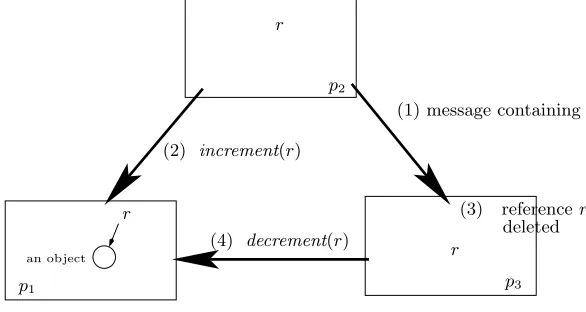
The essence of the problem is summarised in Figure 1, in which a referencerto an object located in processp1 is passed from process p2 to process p3, immediately followed by process p3 discarding its reference r. A naive extension of reference counting would send anincrement message to request an increment of the counter forp1when ris sent top3, and it would send adecrement message to request the counter for p1 be decremented whenp3 discards its reference r. Unfortunately, a race condition betweenincrement and decrement messages may cause the counter for p1 to be decremented before it is incremented, possibly making it zero tem-porarily. A zero counter would cause the object to be collected in processp1, even thoughp2 still holds a live referencer.
Naive referencelisting would maintain the set of processes having access to the reference, instead of maintaining a counter counting the number of references. Here, anincrement message has the effect of adding the process that sent the message to the set, whereas a decrement message has the effect of removing the process that sent the message. Naive distributed reference listing suffers from the same problem as naive distributed reference counting — the set of processes may temporarily become empty if thedecrement message is processed before theincrementmessage.
2.3 Birrell’s Algorithm
Many algorithms have been designed to combat the problem inherent in naive dis-tributed reference counting, including Weighted Reference Counting [Bevan 1987; Watson and Watson 1987], Indirect Reference Counting [Piquer 1991], and those of Lermen and Maurer [1986], Birrell et al. [1993], Moreau and Duprat [2001] and
(1) message containingr
p1 p3
p2
an object
(2) increment(r)
(4) decrement(r)
(3) referencer r
r
r
[image:6.612.170.463.69.225.2]deleted
Fig. 1. Naive Extension of Reference Counting to a Distributed Context
Dickman [2000]. We discuss some of these in the related work section, but we focus here on Birrell’s algorithm, which is used in the distributed garbage collector for Java RMI.
As the rest of the paper focuses on our own presentation of Birrell’s algorithm, we quote here relevant excerpts3of the original technical report [Birrell et al. 1993] and discuss some of the issues raised by this presentation. First, the algorithm is presented as follows in the absence of failures.
Terminology
[Section 1]Anetwork object is an object that can be shared by processes in a distributed system. The process that allocated the network object is called itsowner, and the instance of the object at the owner is called the
concrete object. Other processes, known asclients may have references to the object.
A client cannot directly read or write the data fields of a network object to which it holds a reference, it can only invoke its methods. A reference in a client program actually points to asurrogateobject, whose methods perform remote procedure calls to the owner, where the corresponding method of the concrete object is invoked. There is at most one surrogate for an object in a process, and all references in the process point to that surrogate. A network object is marshaled by transmitting itswireRep, which consists of a unique identifier for the owner process, plus the index of the object at the owner.
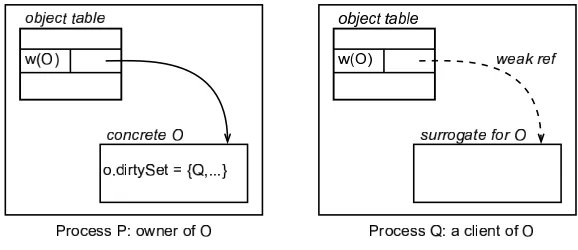
[Section 2]Each process maintains anobject table, which maps a wireRep
w(o)to the local instance of the corresponding network object O, if there is one. For the owner of an object, the table contains a pointer to the concrete object. A concrete object must be in the table whenever another process has a surrogate for it.
Adirty setis maintained for each object by its owner. The dirty set contains
identifiers for all processes that have surrogates for the object. When the dirty set becomes empty, the object can be removed from its owner’s object table.
Fig. 2. Object tables at owner and client processes [Birrell et al. 1993]
Serialisation (marshalling)
[Section 2.1]SupposeP marshals [also calledserialising] a network object
O to processQ, as an argument or result of remote method invocation. P
may be the owner of O, or it may be a client that has a surrogate forO. In either case,P sendsQthe wireRepw(O). Whenw(O)arrives,Qlooks it up in its object table to see if there is a corresponding local object. IfQfinds either a surrogate or concrete object, that object is used as the required argument or result. Note that if a client transmits a remote object back to its owner, this use of the object table causes the owner to access the concrete object; no surrogate is created.
IfQdoes not find an object in the table, there are two possibilities to con-sider. First, w(O)may be in the table but mapped to anilreference. In this case surrogate creation is under way, and the thread doing the unmar-shaling suspends itself until the surrogate is created or the attempt fails. Alternatively,w(O)may not be in the table, or it may be there with a null weak ref indicating that a surrogate existed but had been collected. In this case, the recipient must create a new surrogate. It first enters w(O) in the table with a mapping to nil, releases the lock on the table, and then makes adirty call [emphasis added] to the owner of the object. Assuming no communication failure, the owner receives the call and adds Q toO’s dirty set. When the dirty call returns, Q creates a surrogate for O and enters it in the object table.
Race conditions
[Section 2.1] There is one more wrinkle to be considered in transmitting a network object. This is the potential race condition between the dirty call from clientQ and a clean call [emphasis added] from a client whose surrogate has been deleted. If the clean call arrived first, and if it left
O.dirtySetempty, thenO might be removed from its owner’s object table
and its space reclaimed by the local collector. When the dirty call arrives, the object is no longer available.
To prevent this scenario, we make sure thatO.dirtySetremains non-empty whileO is being transmitted. When the sending processP is O’s owner, this is accomplished by putting P into O.dirtySetuntil an acknowledge-ment fromQindicates that the reference has been received. SinceQsends the acknowledgement after completing the dirty call, this guarantees that
O’s dirty set remains non-empty, and its memory is not collected. When
P is not the owner of O, it must have a surrogate forO. This surrogate is kept reachable untilQ’s acknowledgement is received. Since a reference to the surrogate is on the stack during transmission, we simply ensure that the transmitting procedure not return until acknowledgement fromQis re-ceived. So long as this surrogate is reachable, the basic collector invariant guarantees thatP is inO.dirtySetandO’s space will not be collected.
[Section 2.2]Collection of surrogates is the responsibility of the client’s local garbage collector. When the client’s collector determines that a surrogate is unreachable, the object’s owner must be informed so that the client can be removed from its dirty set. We have already mentioned how weak refs allow the distributed a garbage collector to be informed of surrogate collection so it can take this action. To recap, when the client’s collector determines that the surrogate is not reachable (except from the weak ref in the client’s object table), it prepares to reclaim the surrogate’s memory. However, it first schedules a clean up routing that was registered when the weak ref was created and replaces the weak ref with a special null value.
When the cleanup routine begins execution, it checks the object table to see if the entry for this object’s wireRep still has the special null weak ref. If not, a new surrogate for the objection will have been created (or will be in the process of being created) and no clean up action is required. But if the null weak ref is still present, clean up action is necessary. The object table entry is removed, and the wireRep is put on a queue of objects to be processed later by a cleaning demon. This demon is responsible for sending clean calls to the owner.
2.4 Weaknesses
While we recognise that we have only quoted particular excerpts from the orig-inal presentation of Birrell’s algorithm, we believe that they are sufficient both to summarise the key ideas of the algorithm and to reveal the limitations of that presentation.
(1) The discussion of the algorithm is tightly bound to specific communication assumptions, namely the remote method invocation paradigm.
(2) The algorithm makes strong assumptions about the specific run-time imple-mentation. Our point is not that Birrell’s implementation is deficient, but that their description is biased towards a particular implementation or use of the algorithm. These implementation details are also hard to formalise.
its argument objects onto the stack, thereby making them locally reachable for the duration of the call. Birrell’s presentation also requires that there be precisely one surrogate in processpfor a remote concrete object. Thus, their algorithm can be thought of as ‘object listing’ rather than reference listing; the implementation of concrete object O in Figure 2 makes this very plain. However, this is an implementation decision and not a requirement of reference listingper se: more generally, one might associate the list of remote processes with an entry in the object table (of references) rather than the concrete object itself. Furthermore, Birrell’s presentation makes use of specific GC-related techniques such as weak references.
(3) From a technical viewpoint, important aspects of the algorithms are underspec-ified. Consequently, it is left to the implementor to judge how to complete the algorithm:
(a) Critical sections are generally underspecified.
(b) A race condition is identified in Section 2.1 but a solution is discussed only for the case of a method invocation, during which a reference on the stack remains accessible. No solution is presented for a reference returned as part of an invocation result.
(c) It is unclear how the algorithm should behave when a reference is received but the cleanup action has been already initiated.
(d) It is unclear how the algorithm would handle parallel sending of references to the same destination.
(4) The informal proof by Birrell depends on hard to formalise aspects of the im-plementation. Indeed, the correctness proof of a system that uses the run-time stack to keep references live during the invocation of a remote procedure re-quires the formalisation of the run-time system and method calling conventions. Likewise, the use of GC weak references (as in Figure 2) requires a formal ac-count of local garbage collection, including reachability and finalisation. A further problem with this approach is that it brings elements of liveness into the proof of safety. Birrell’s proof is therefore unconvincing, as none of these elements have been formalised. In fact, we shall see in the rest of the paper that they need not be formalised in order to prove the correctness of the al-gorithm provided the alal-gorithm is specified at a suitable level of abstraction. Finally, the informal proof of Birrell’s algorithm uses temporal reasoning which is notoriously difficult to handle.
In summary, the initial presentation of Birrell’s algorithm has shortcomings that have potentially serious consequences. Implementors must make decisions on how to extend the algorithm for the cases that are not completely specified: this may result in incorrect implementations or implementations that cannot inter-operate properly. It is very difficult to port the algorithm to a different context, such as a message passing system or a distributed termination mechanism [Tel and Mattern 1993]. For algorithm designers, it is quasi-impossible to compare such an algorithm with others as its principles are hidden behind its implementation. We address these issues below in a revisited presentation of the algorithm.
3. DESCRIPTION OF THE ALGORITHM
In this section, we present a precise and implementation-independent formalisation of Birrell’s algorithm, accompanied by an informal description of the algorithm. The formalisation is intuitive since it uses a notation that bears some similarity with executable pseudo-code, but it is also rigorous and suitable for both manual and mechanical proofs. By making our formalisation independent of implementation technique, we do not restrict the implementer’s design decisions (e.g. by requiring them to use specific mechanisms such as weak references). We also present a novel graphical representation of the state transition diagram for the algorithm which we believe substantially improves understanding of the algorithm.
3.1 Design Philosophy
We represent a distributed system — in this case, the distributed reference listing algorithm — by an abstract machine, identifying a finite set of processes able to communicate byasynchronous message passing. The behaviour of the distributed system is described by the transitions that the abstract machine is allowed to per-form and that modify the internal state of processes and/or communication chan-nels.
In the past, we have successfully used this formalism to describe a new dis-tributed reference counting algorithm [Moreau and Duprat 2001] and to specify the behaviour of a fault-tolerant directory service for mobile agents [Moreau 2001a; 2002]. Our practical experience, reported in the first of these papers, has shown that the formalism is suitable for mechanical proof derivations, which we have carried out for these algorithms using the Coq theorem prover [Barras et al. 1997].
The notation allows us to express any form of transitions, but is not prescriptive about their nature, complexity or granularity. In this paper, we adopt a systematic coding style, which we summarise as follows.
—A transition involves only one process at a time.
—The input of a message changes only a process’s internal state. Sometimes we need to express that the receipt of a message is meant to trigger the sending of another message (for example, when an acknowledgement has to be sent). In such a case, we use two transitions: the first one receives the input message and stores some useful information in a to do table; the second transition is in charge of extracting the information from theto dotable and generating a suitable output message.
—We generate acknowledgement messages explicitly (rather than relying on par-ticular implementations such as RPC).
Not only does such a coding style make rules simple, but it also brings realism to the formalisation, as it offers a route to implementation:
—Inputs and outputs are desynchronised.
—The size of critical sections is minimised for each transition of the abstract ma-chine, which favours proper concurrent execution in the implementation. —As far as implementation is concerned, outputs can be generated asynchronously
3.2 States and Transitions: a Graphical Representation
Birrell’s algorithm defines a life cycle for objects, which we refine and specify in this section. An object’s life cycle typically evolves as messages containing references to this object are processed by the distributed reference listing algorithm. More precisely, it is the state of the reference held by the client that evolves (reference received, dirty call acknowledged,. . . ). Thus, we first identify the messages that the algorithm handles, and then continue with a study of a reference’s life cycle.
Messages. We do not make any assumptions of the environment in which the reference listing algorithm can be embedded. For example, it could be embedded in a distributed object language (such as Java RMI) or in a distributed termination detection system. We indicated in the previous section that, whereas Birrell’s algorithm assumed a communication layer based on remote procedure calls, we model the algorithm as an asynchronous message passing system. Consequently, we will express calls as two messages: an outbound message followed by a return message that carries the call completion acknowledgement (including, possibly, a result). Birrell’s algorithm supports three different calls, which we in turn express as the six messages summarised in Figure 3 and described below.
reference copy copy
copy acknowledgement copy ack
dirty call dirty
dirty call acknowledgement dirty ack
clean call clean
clean call acknowledgement clean ack
Fig. 3. Algorithm messages and their formal notation
From the reference listing algorithm’s viewpoint, references can be copied be-tween processes, which we express by a reference copy message. In practice, one (or more) copy message(s) could be part of a remote method invocation (whether as arguments or as a return value) or could be sent alone, depending on the envi-ronment in which the algorithm is embedded. For the algorithm, it is important that a reference sender be notified of the receipt of a reference — this is the role of acopy acknowledgement message. Adirty call message allows a process to register a new instance of a reference with the reference’s owner; such a call is followed by a dirty call acknowledgement that informs the sender of the dirty call of the successful completion of that call. Symmetrically, a clean call message allows a process to notify the reference’s owner that the reference has been discarded, and such a message is followed by aclean call acknowledgement that marks the end of the cleanup operation.
It is important to realise that we present the algorithm in an abstract manner, that is not muddied by implementation details. It is not a requirement that the algorithm be implemented as an asynchronous distributed system, although such a form of modelling is very appropriate for identifying the flow of information in the system. At a later stage, an implementor may make particular implementation
decisions, such as to batch up messages or to piggy-back GC messages onto muta-tor messages in order to reduce communication costs. We also note that Birrell’s algorithm makes a further implementation decision by imposing at most one sur-rogate per object. Our formalisation is about references and not about objects; we therefore do not impose a similar constraint, but implementors may elect to adopt it in their specific implementations.
Life cycle. Before an object’s reference is received (in a copy message) by a pro-cesspfor the first time, the reference is unknown and considered to be nonexistent byp. Such an initial state is marked⊥and denotes the reference’s pre-existence4. When a reference is received byp, the reference moves to a temporary state in which it is known by pbut is not yet usable, since the reference has not been registered with its owner. Following Birrell’s algorithm, we refer to this state asnil. As soon as the object’s owner is aware of the existence of the remote reference, and p is aware that the owner is aware (through a dirty call followed by an acknowledge-ment), the reference becomes usable, which we indicate by the OK state. As the reference becomes locally unreachable onp, the reference is scheduled for cleanup. When the cleanup is triggered, a clean call is initiated and the reference moves to the state ccit (standing for ‘clean call in transit’), in which the reference is no longer in use but has not been completely recycled by the process. As soon as a clean call acknowledgement is received, the space used by the reference is recycled. This marks the end of the reference’s existence in this processp: its state therefore reverts to⊥.
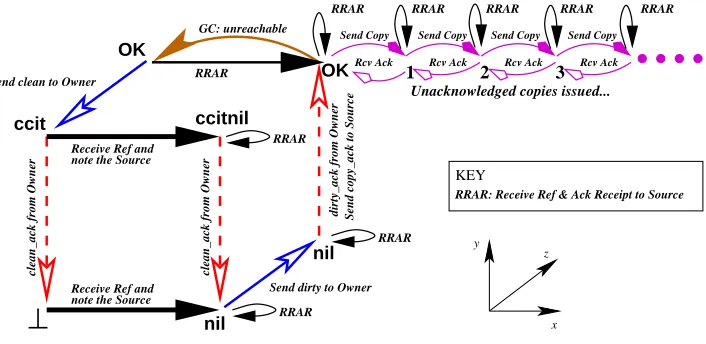
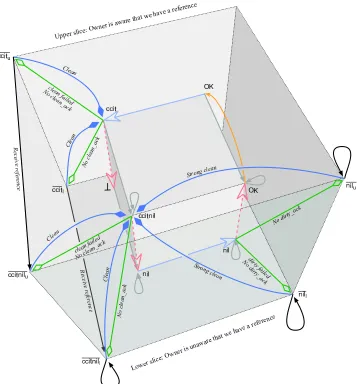
The states and transitions of the state machine can be illustrated by a state tran-sition diagram. Our graphical representation5 of the state transition diagram for (our formalisation of) Birrell’s algorithm lays out its states as vertices of a cube, with cube edges marking permitted transitions (see Figure 4). Our representation has several advantages. It provides the implementor with an intuitive, yet precise, description of the algorithm that is independent of implementation technique. It readily identifies transitions (and their associated states and messages) in a system-atic fashion. For example, consider the cube’sx-axis to be horizontal,y-axis to be vertical andz-axis to be into the page. Now, all copy messages lie on edges parallel to thex-axis, dirty and clean calls to a reference’s owner lie on edges parallel to the z-axis and acknowledgement messages from a reference’s owner lie parallel to the y-axis, and so on. The layout makes it easy to determine which state changes might be possible, simply by considering the edges at each vertex. One outcome has been that this representation immediately revealed the need for the introduction of a new state, not present in Birrell’s description, but crucial for correctness.
The sequence of transitions⊥ → nil → OK → ccit → ⊥is purely determined by the processpsending messages to the reference’s owner and receiving acknowl-edgements from the owner. In addition, other instances of the same reference may be received by p at any moment during the reference’s life cycle. These cause a movement along the cube’s edges in three cases: from⊥tonilif the reference was
4Webster’s dictionary defines pre-existence as ‘existence in a former state, or previous to something
else’ (Merriam-Webster’s Collegiate Dictionary, Tenth Edition); this captures our concept of the reference being in an initial state, before its existence is revealed to the receiving process.
Send copy_ack to Source
dirty_ack from Owner
OKRcv Ack Rcv Ack Rcv Ack Rcv Ack Send Copy Send Copy
Send Copy Send Copy
Unacknowledged copies issued...
nil
⊥
ccitnil
RRAR
Send clean to Owner 3
clean_ack from Owner
nil
Send dirty to Owner note the Source
Receive Ref and note the Source Receive Ref and
y
x z
RRAR RRAR RRAR RRAR RRAR
KEY
RRAR: Receive Ref & Ack Receipt to Source
OK
ccit
clean_ack from Owner
[image:13.612.132.485.79.251.2]2 00 00 11 11 00 00 11 11 00 00 11 11 00 00 11 11 1 RRAR RRAR RRAR GC: unreachable
Fig. 4. Birrell’s algorithm transitions
unknown by the processp; from an unreachableOKreference to a reference that is reachable again; and from accit state to a new state, in which a clean call is still in transit, but the reference is ready to be used again, so its deallocation should be cancelled, which we mark by ccitnil. The latter state was not explicit in Birrell’s algorithm but is immediately apparent from our layout of the state transition di-agram. This new state turns out to be crucial in order to ensure the algorithm’s correctness.
Once registered with its owner, a reference becomes usable (the OK state) and may be sent to remote processes. The distributed reference listing algorithm must make sure that the reference remains locally reachable until the acknowledgement of the copy message is received. We ensure this by the sequence of statesOK →
1 → 2 →. . . in the diagram. Every time a reference is sent remotely, the state changes fromi toi+ 1; every time the copy of the reference is acknowledged, the state changes fromito i−1.
Birrell’s algorithm is distinguished by the number of states in a reference’s life cycle, their position on the cube and the permitted transitions allowed between them. For instance, there is no transition fromccitniltoOKbecause the algorithm prevents the sending of a dirty message until the clean call acknowledgement mes-sage has been received. The spatial representation of states in our diagram also lends itself to a very intuitive explanation of the state of a reference: has a process pdeclared that it has a reference? is the owner aware of this? and, is the reference usable? Figures 5, 6 and 7 illustrate these questions.
In Figure 5, states are partitioned by a vertical slicing of the cube. States on the ‘front’ plane indicate that the processphas not declared possession of a reference while, in the ‘back’ states, the process has declared possession. In Figure 6, states are partitioned by a horizontal slicing of the cube. In ‘lower’ states, a processphas received a reference, but has not received a confirmation from the owner that the
ccitnil
⊥
OK
ccit
We have not declared possession of a reference We have declared possession of a reference
GC: reference not in use Receive duplicate ref Receive a Reference
Receive Ack from owner Send message to owner
Pass copy of ref to another Receive Ack for copy ref
nil
nil
OK 0000
[image:14.612.145.375.78.202.2]11 11 00 00 11 11 00 00 11 11 00 00 11 11
Fig. 5. Depth Slicing: has a process announced its possession of a reference?
ccitnil
⊥
OK
ccit
OK
Owner is aware that wehave a reference
have a reference Owner is unaware that we
GC: reference not in use Receive duplicate ref Receive a Reference
Receive Ack from owner Send message to owner
Pass copy of ref to another
[image:14.612.129.377.269.390.2]Receive Ack for copy ref nil nil 00 00 11 11 00 00 11 11 00 00 11 11 00 00 11 11
Fig. 6. Horizontal Slicing : does the owner know that a process has a reference?
ccitnil
⊥
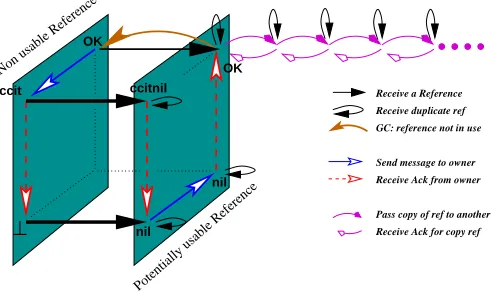
Non usable Reference
Potentially usable Reference ccit
GC: reference not in use Receive duplicate ref Receive a Reference
Receive Ack from owner Send message to owner
Pass copy of ref to another
Receive Ack for copy ref nil nil OK OK 00 00 11 11 00 00 11 11 00 00 11 11 00 00 11 11
[image:14.612.129.376.447.598.2]reference has been properly registered. In ‘upper’ states, process pconsiders that the owner is aware thatphas a reference. In Figure 7, the states on the ‘left’ plane describe situations in which the reference cannot be used by the process (i.e. pre-existence or post-cleanup). The states on the ‘right’ describe situations in which a reference has begun its active existence.
Figure 4 presented a fairly complete summary of Birrell’s algorithm but over-looked some of its details, such as when should messages be issued, what informa-tion needs to be shared between states, and so on. In the following secinforma-tion, we answer all these questions with a complete specification of the algorithm.
3.3 Algorithm Formalisation
In this section, we introduce our specification of Birrell’s algorithm based on the notion of an abstract machine modelling an asynchronous distributed system, and the life cycle and transitions described in Section 3.2. First, we define our notation, inspired by previous formalisations, namely another distributed reference counting algorithm [Moreau and Duprat 2001] and a distributed directory service for mobile agents [Moreau 2001a].
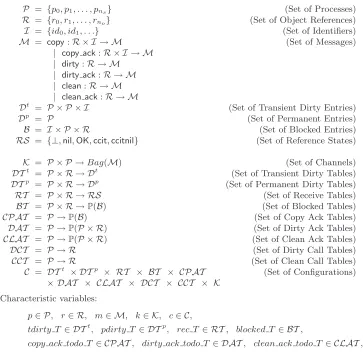
3.3.1 Notation. The algorithm is formalised by an abstract machine, whose state space is shown in Figure 8. In this abstract machine, we model only messages exchanged by the distributed reference listing algorithm, and we do not model any form of computation in which it would be used.
A finite number of processes are involved in the algorithm, and we consider a finite number of remote references. The set of messages is defined by an induc-tive type, whose constructors are named according to the messages presented in Section 3.2, namely copy, copy ack, dirty, dirty ack, cleanand clean ack. Commu-nication channels are assumed to be reliable and not to duplicate messages; we do not make any assumption about message order, and therefore we represent channels as bags of messages between pairs of processes. We shall relax these assumptions when discussing fault-tolerance (Section 6).
A series of tables are defined as functions whose first argument is a process. While the formal notation sees such functions as ‘global’ in the abstract machine, we expect their implementation to be distributed across each process. A configuration of the abstract machine consists of a tuple composed of all tables and message channels.
We assume that each reference r refers to an object that has initially been al-located and created by a given process, which we refer to as its owner. In our formalisation, we define a function
owner : R →P rocess
that maps each reference onto the process that owns the object to which the refer-ence refers.
We use pseudo-statements such as post, receive or table updates in order to provide an imperative look to the algorithm. Informally, post(p1, p2, m) inserts a message m into the channel from processp1 to process p2, and receive(p1, p2, m) collects the message. Formally, these pseudo-statements act as configuration trans-formers and are defined as follows.
P = {p0, p1, . . . , pns} (Set of Processes)
R = {r0, r1, . . . , rno} (Set of Object References)
I = {id0, id1, . . .} (Set of Identifiers)
M = copy:R × I → M (Set of Messages)
| copy ack:R × I → M | dirty:R → M | dirty ack:R → M | clean:R → M | clean ack:R → M
Dt = P × P × I (Set of Transient Dirty Entries)
Dp =
P (Set of Permanent Entries)
B = I × P × R (Set of Blocked Entries)
RS = {⊥,nil,OK,ccit,ccitnil} (Set of Reference States)
K = P × P →Bag(M) (Set of Channels)
DTt = P × R → Dt (Set of Transient Dirty Tables)
DTp = P × R → Dp (Set of Permanent Dirty Tables)
RT = P × R → RS (Set of Receive Tables)
BT = P × R →P(B) (Set of Blocked Tables)
CPAT = P →P(B) (Set of Copy Ack Tables)
DAT = P →P(P × R) (Set of Dirty Ack Tables)
CLAT = P →P(P × R) (Set of Clean Ack Tables)
DCT = P → R (Set of Dirty Call Tables)
CCT = P → R (Set of Clean Call Tables)
C = DTt × DTp × RT × BT × CPAT (Set of Configurations)
× DAT × CLAT × DCT × CCT × K
Characteristic variables:
p∈ P, r∈ R, m∈ M, k∈ K, c∈ C,
tdirty T ∈ DTt
, pdirty T ∈ DTp
, rec T ∈ RT, blocked T∈ BT,
copy ack todo T ∈ CPAT, dirty ack todo T∈ DAT, clean ack todo T ∈ CLAT,
dirty call todo T ∈ DCT, clean call todo T ∈ CCT
Initial State:
ci = htdirty Ti, pdirty Ti, rec Ti, blocked Ti, copy ack todo Ti, dirty ack todo Ti,
clean ack todo Ti, dirty call todo Ti, clean call todo Ti, kii
ki = p1, p2 → ∅
tdirty Ti, pdirty Ti, rec Ti = p, r→ ⊥
blocked Ti = p, r→ ∅
copy ack todo Ti = p→ ∅
dirty ack todo Ti, clean ack todo Ti = p→ ∅
[image:16.612.126.489.84.437.2]dirty call todo Ti, clean call todo Ti = p→ ⊥
—If table T is a component of a configuration h. . . , table T, . . .i, then the expres-siontable T(a0, . . . , an) :=V denotes the configurationh. . . , table T′, . . .i, where table T′(
x0, . . . , xn) = table T(x0, . . . , xn) if (x0, . . . , xn) 6= (a0, . . . , an), and table T′(
a0, . . . , an) =V.
—Ifkis the set of message channels of a configurationh. . . , ki, then the expression post(p1, p2, m) denotes the configuration h. . . , k′i, with k′(p1, p2) = k(p1, p2)⊕
{m}, andk′
(pi, pj) =k(pi, pj),∀(pi, pj)6= (p1, p2)6.
—Ifkis the set of message channels of a configurationh. . . , ki, then the expression receive(p1, p2, m) denotes the configurationh. . . , k′i, withk′(p1, p2) =k(p1, p2)⊖
{m}, andk′
(pi, pj) =k(pi, pj),∀(pi, pj)6= (p1, p2).
The abstract machine is characterised by an initial state and a set of transitions. The initial state appears in Figure 8, and intuitively can be summarised as com-posed of empty tables and empty message channels. The arrow notation used here defines the initial state of the tables as functions taking one or two arguments and returning a result. Thustdirty Ti takes a P and an Rargument and returns ⊥7. In the initial configuration, the receive table rec Ti maps each process, reference pairp, r to ⊥. Thus, in a manner similar to physical addresses in a real machine, references are never ‘created’ although they are initially associated with⊥.
Rules are the formal way to express permissible transitions of the abstract ma-chine. They are specified in the next section, using the following syntax:
rule name(v1, v2, . . .) :
condition1(v1, v2, . . .) ∧ condition2(v1, v2, . . .) ∧ . . .
→ {
pseudo statement1; . . .
pseudo statementn;
}
A rule is identified by its name and is parameterised by a number of variables. Conditions can appear to the left-hand side of the arrow: these are guards that must be satisfied in order for the rule to be fireable. The right-hand side denotes the configuration that is reached after transition: its value is the result of applying the configuration transformer obtained by composing all the pseudo-statements to the configuration that satisfied the guard. From a concurrency viewpoint, we assume that the execution of a rule, i.e. verification of its guards and application of its pseudo-statements, is performed atomically, meaning that rule execution can neither be interrupted nor interleaved with the execution of other rules. The design philosophy of Section 3.1 is intended to minimise the number of operations to be performed when rules are fired. Consequently, these rules provide a realistic basis for an implementation design.
6We use the operators⊕and⊖to denote union and difference on bags. 7Or, inλ-calculus notation,tdirty T
i=λpr.⊥.
In the presentation of the algorithm, we distinguish the guards of a rule from assertion statements. Guards are conditions that must be satisfied for a rule to be fireable. Assertion statements appear as comments in a rule body and indicate that a given property is proved to hold at that point in the execution. When we want to provide the reader with better understanding of the condition in which a rule is fired, we use assertion statements as opposed to guards, otherwise we would have to prove that the extra guards do not induce deadlocks. Furthermore, assertion statements can describe a global state of the distributed system, which does not necessarily have to be computable by the process executing the rule.
3.3.2 Configuration. Let us now examine the content of a configuration of the abstract machine. It consists of a set of communication channels and a set of tables, for which we provide some intuitive explanation; their usage will be specified by the transition rules.
We use dirty- and receive-tables to represent a process’s knowledge about the references that it has sent and received. Whenever a process p1 sends a reference to a remote processp2or receives a dirty call from it,p1 makes an entry in a dirty table. The dirty tables are the explicit representation of reference listing that the algorithm achieves. Symmetrically, the receive-table contains all the references that have been received by and are alive in a process. If a referencerdoes not exist in a processp, thenrec T(p, r) =⊥, meaning that the referenceris in its pre-existence state in process p. The permissible values in a receive-table are the states of the life cycle (⊥, nil, OK, ccit, ccitnil). The life cycle states2, 3, . . . of Figure 4 are not represented explicitly as potential values in the receive tables; instead, they are encoded in the form of reference listing in the transient dirty table. Note that this representation neither relies on nor prescribes details of implementation and hence differs from Birrell’s original account (which assumed, for example, references would be held on process stacks).
When a reference is received for the first time, the receiver must initiate a dirty call in order to register the reference with its owner before the reference becomes usable by the receiver. During that time, deserialisation activities (and associ-ated remote invocations) must be suspended. Such information is modelled by the blocked-table.
All ‘outbound’ messages are followed up by an acknowledgement. With our design rules, we decouple the receiving of a message from the sending of its ac-knowledgement so as to ensure short and explicit atomic sections during rule ex-ecution. The corollary is that it is necessary to introduce states internal to each process that represent those messages remaining to be acknowledged: such states are encoded by the tablescopy ack todo T,dirty ack todo Tandclean ack todo T. Similarly, clean and dirty calls are typically made in response to another event in the system. Their scheduling is indicated by entries in the clean call todo T and dirty call todo T tables.
measure, denoted by ±xfor some integer x; these measures are used in the proof of the liveness of the algorithm (see Section 4.2).
Rulemake copy in Figure 9 models p1 sending a reference to a processp2 (sup-posed to be different fromp1). Such a transition can only occur if the reference is locally reachable by p1 and if its state in the receive table isOK. The effect is to add a new entry into the transient dirty table, and to send a copy message in the channel betweenp1andp2.
The receipt of a copy message is modelled by rule receive copy, which is one of the most complex rules of the algorithm as it has potential implications for numerous internal tables of a process. This rule can take place only if there is a copy-message in transit between two processesp1andp2; its intuitive behaviour is better explained by referring to Figure 7 in which the reference’s state is shifted to the ‘right’ of the figure. Once the message has been received byp2— expressed by the statementreceive(p1, p2,copy(r, id)) — the rule suspends the deserialisation of the contents of the message for states that need to complete a dirty call. In these cases, it also schedules such dirty calls, cancels pending clean calls and schedules copy acknowledgements.
(Note 1). Birrell’s algorithm assumes RPC-style communications that are com-posed of a method invocation and the associated return of a result. As we rely on asynchronous message passing, we create a new identifier id for each copy of a reference, which allows us to identify the matching acknowledgement message, copy ack. Such identifiers are also able to distinguish multiple messages sent in parallel between two processes. We note that the identifieridmust be new to the whole distributed system; URI schemes could be used here, incorporating the name of the process that executes the transition.
(Note 2). Birrell’s algorithm prescribes that a reference sent remotely by a re-mote method invocation is kept locally reachable on a stack frame. We formalise this in an implementation technique independent manner: we assume the existence of a table, defined to be a root of the local collector, which we call the transient dirty table and denote tdirty T. Any object referred to by an entry in this table remains locally reachable by the garbage collector. Adopting such a dirty table is beneficial for a number of reasons:
(1) We need not make a distinction between remote method invocation and return of a result. Birrell’s algorithm is silent about method returns, which typically coincide with stack deallocation, although references still have to be kept lo-cally reachable. In our algorithm definition, we always store a reference in the transient dirty table before it is communicated remotely, whether it is an argument or the result of a remote method call.
(2) In Birrell’s algorithm, the dirty set is only present in the memory space of the reference owner, and is meant to contain the list of processes that sent dirty calls to the owner. For the owner, we introduce permanent dirty tables that have a similar role (as discussed in Note 6). Transient dirty tables for all processes contain information aboutcopymessages sent, which we record as a triple: the sender, the receiver and the message identifier. We refer to such a triple as a transient dirty entry, as opposed to permanent dirty entries, to be introduced later.
make copy(p1, p2, r) :
p16=p2 ∧ rec T(p1, r) =OK
→ {
(Note 1)
id:=new Identif ier;
(Note 2)
tdirty T(p1, r) :=tdirty T(p1, r)∪ {hp1, p2, idi};
post(p1, p2,copy(r, id));
}
receive copy(p1, p2, r, id) : copy(r, id)∈k(p1, p2)
→ {
//–14
receive(p1, p2,copy(r, id));
if rec T(p2, r) =nil ∨ rec T(p2, r) =ccitnil, then
(Note 3) //+2
blocked T(p2, r) :=blocked T(p2, r)∪ {hid, p1, ri};
elif rec T(p2, r) =⊥ ∨ rec T(p2, r) =ccit, then
{
(Note 3) //+1
if rec T(p2, r) =⊥, then rec T(p2, r) =nil;
//+1
elif rec T(p2, r) =ccit, thenrec T(p2, r) =ccitnil;
//+9
dirty call todo T(p2) :=dirty call todo T(p2)∪ {r};
//+2
blocked T(p2, r) :=blocked T(p2, r)∪ {hid, p1, ri};
}
elif rec T(p2, r) =OK, then
{
(Note 4)
clean call todo T(p2) :=clean call todo T(p2)\ {r};
//+2
copy ack todo T(p2) :=copy ack todo T(p2)∪ {hid, p1, ri};
} }
(Note 3). An incoming new referenceris not immediately usable by programs, since first it has to be properly registered with the reference’s owner through a dirty call. During this time, the deserialisation thread has to be suspended, which we in-dicate by an entry in theblocked table, denotedblocked T, identifying the reference, its sender and the message id. Similarly, the receipt of a reference that is already known to the process but is not currently usable also suspends the deserialisation code.
(Note 4). When we formalise the interaction with the local garbage collector, we shall see that any reference observed to be locally unreachable is scheduled for a cleanup operation; this is represented by an entry in theclean call todo T table, as discussed in Note 9. The normal course of action would be to send acleanmessage to its owner to clear the owner’s permanent dirty entry for that process. Before we send such a message, anothercopymessage with this reference could have been received by this process. In order to avoid successively sending acleanand adirty message, we introduce an optimisation that consists of cancelling both messages and resurrecting the reference. It is safe to do so because the owner still believes that the reference is live, and no clean message has been scheduled yet. More importantly, it is efficient to do so, because it avoids blocking the deserialiser for the duration of thecleananddirtymessages and their respective acknowledgements. Hence, we remove the entry in theclean call todo T.
Rule do copy ack in Figure 10 is triggered by the presence of an entry in a copy ack todo T table, which indicates that a copy acknowledgement has been scheduled. The entry is removed from the table and acopy ackmessage is posted. Rulereceive copy ack deals with the receipt of acopy ackmessage.
do copy ack(p1, p2, r, id) :
hid, p2, ri ∈copy ack todo T(p1)
→ {
//–2
copy ack todo T(p1) :=copy ack todo T(p1)\ {hid, p2, ri};
//+1
post(p1, p2,copy ack(r, id));
}
receive copy ack(p1, p2, r, id) :
copy ack(r, id)∈k(p1, p2)
→ {
//–1
receive(p1, p2,copy ack(r, id));
tdirty T(p2, r) :=tdirty T(p2, r)\ {hp2, p1, idi};
}
Fig. 10. Copy Processing (b)
Ruledo dirty call in Figure 11 initiates the sending of a dirty call that had been previously scheduled (as indicated by an entry in thedirty call todo T table). The
receipt of a dirty call message for a referencerby rulereceive dirty call entails the adding ofrto the owner’s permanent dirty table; this means that the sender of the dirty call possesses reference r. Rule do dirty ack sends a dirty call acknowledge-ment, handled by rulereceive dirty ack (changing the status from a ‘lower’ state to an ‘upper’ state in Figure 6).
(Note 5). We have not made any assumption of the order in which messages are delivered. In particular, sending a dirty message when a cleanmessage is already in transit could result in thedirtymessage being processed first. The early receipt of a dirty message would have no effect (as a permanent dirty entry is already present), but the processing of the delayedcleanmessage would clear the dirty entry, which would result in an incorrect situation, as the reference may become locally unreachable by the owner. Consequently, we postpone the sending ofdirtymessages when the reference state isccitnil until we have received an acknowledgement that thecleanmessage has been processed.
(Note 6). When a dirty message is received by a reference owner, a new entry is added to its permanent dirty table to indicate that the owner believes that the message sender owns a live reference. The entry consists of the process identifier only, and is called a permanent dirty entry; it should be distinguished from the entry (sender, receiver, message identifier) in the transient dirty table described in Note 2. The permanent dirty table must also be defined as a root of the local collector. We see again here that this algorithm does indeed list references rather than count them. Even though we use a set notation, in practice the permanent dirty table does not need to be a set since the algorithm never receives an incoming dirty message from a processpif there is already an entry forpin the permanent dirty table.
(Note 7). When a dirty ack message is received, entries in the blocked table (which contain the source of a copy-message, the reference and an identifier) can be added to the set ofcopy ackmessages to be sent. It is important that the send-ing ofcopy ackis postponed until thedirty ackhas been received, otherwise a race condition reminiscent of naive reference counting may occur: the reference could become garbage on the sender before its receiver had time to register it properly with the owner.
(Note 8). Once the reference has been registered with its owner, all deserialisa-tion threads that were suspended may be resumed.
do dirty call(p, r) :
(Note 5)
r∈dirty call todo T(p) ∧ rec T(p, r)6=ccitnil
→ {
//–9
dirty call todo T(p) :=dirty call todo T(p)\ {r};
//+8
post(p, owner(r),dirty(r)); }
receive dirty(p1, p2, r) :
p2=owner(r) ∧ dirty(r)∈k(p1, p2)
→ {
//–8
receive(p1, p2,dirty(r));
(Note 6)
pdirty T(p2, r) :=pdirty T(p2, r)∪ {p1};
//+7
dirty ack todo T(p2) :=dirty ack todo T(p2)∪ {hp1, ri};
}
do dirty ack(p1, p2, r) :
hp2, ri ∈dirty ack todo T(p1)
→ {
//–7
dirty ack todo T(p1) :=dirty ack todo T(p1)\ {hp2, ri};
//+6
post(p1, p2,dirty ack(r));
}
receive dirty ack(p1, p2, r) : dirty ack(r)∈k(p1, p2)
→ {
//–6
receive(p1, p2,dirty ack(r));
(Note 7) //+X
copy ack todo T(p2) :=copy ack todo T(p2)∪blocked T(p2, r);
// Deserialisation code to be resumed
(Note 8)
// for each entry in blocked T(p2, r)
//–X
blocked T(p2, r) :=∅;
//+5
rec T(p2, r) :=OK;
}
Fig. 11. Dirty Processing
f inalize(p, r) :
¬locallyLive(p, r) ∧ rec T(p, r) =OK ∧ p6=owner(r) ∧r6∈clean call todo T(p)
→ {
(Note 9)
clean call todo T(p) :=clean call todo T(p)∪ {r};
}
do clean call(p, r) :
r∈clean call todo T(p) → {
clean call todo T(p) :=clean call todo T(p)\ {r};
(Note 10) //–4
rec T(p, r) :=ccit;//assert: wasrec T(p1, r) =OK
//+3
post(p, owner(r),clean(r)); }
receive clean(p1, p2, r) :
p2=owner(r) ∧ clean(r)∈k(p1, p2)
→ {
//–3
receive(p1, p2,clean(r));
pdirty T(p2, r) :=pdirty T(p2, r)\ {p1};
//+2
clean ack todo T(p2) :=clean ack todo T(p2)∪ {hp1, ri};
}
do clean ack(p1, p2, r) :
hp2, ri ∈clean ack todo T(p1)
→ {
//–2
clean ack todo T(p1) :=clean ack todo T(p1)\ {hp2, ri};
//+1
post(p1, p2,clean ack(r));
}
receive clean ack(p1, p2, r) : clean ack(r)∈k(p1, p2)
→ {
//–1
receive(p1, p2,clean ack(r));
(Note 11)
if rec T(p2, r) =ccitnil, then
//–1
rec T(p2, r) :=nil;
else//assert: rec T(p2, r) =ccit
//–1
rec T(p2, r) :=⊥;
}
(Note 9). Rulefinalize defines the interaction with the system in which the ref-erence listing algorithm is embedded (for example, a local garbage collector). We maintain asynchrony between the environment and the distributed reference listing algorithm. Once a reference is detected to be locally unreachable, a flag is set in the form of an entry in theclean call todo T table. The state of the reference, as represented by the receive tablerec T, is unchanged. This allows the state to revert before the cleaning sequence is started, as described in Note 4. In order to prevent the repeated firing of rule finalize, we have added a guard requiring the reference to be absent fromclean call todo T(p).
(Note 10). After a clean call has been scheduled, a cleanmessage is sent to the owner, and the reference state is changed toccit, to indicate that a ‘clean call is in transit’.
(Note 11). A clean call can be received when the reference is in one of two states: ccitorccitnil. In the former case, the receiver has no useful reference (see Figure 7) and so the state of the reference reverts to state⊥. In the latter case, a new, usable copy of the reference has been received subsequently and so the state changes to nil: transitiondo dirty call is now fireable and a new life cycle is initiated.
This concludes our presentation of Birrell’s algorithm. Our two descriptions, graphical and formal, are complementary. The graphical presentation exposes the complete life cycle of references in an intuitive manner, whereas the formal seman-tics presents, in an unambiguous fashion, the precise states that must be main-tained by processes taking part in the algorithm. Interestingly, the formal notation is suitable both for establishing the correctness of the algorithm and as a basis for an implementation. We now discuss the correctness of the algorithm.
4. PROPERTIES AND PROOFS
The correctness of an algorithm typically has two different facets: safety guaran-tees that nothing bad can happen and liveness guarantees that something good will eventually happen. In the specific context of this distributed reference listing algorithm, such properties can be expressed as follows. Safety guarantees that if a remote reference to a resource exists, then one of its owner’s dirty tables will contain an entry (permanent or transient) for the reference, which prevents the resource from being recycled by the owner. Liveness guarantees that if all references to a resource are deleted, all its dirty entries (permanent and transient) will eventually be removed by its owner, thus allowing the resource to be claimed at some later point by a local garbage collector. The purpose of this section is to establish both properties.
4.1 Proof of Safety
The proofs that we derive in this paper are based on invariants that we prove to hold for all configurations of the abstract machine. Given an arbitrary valid config-uration, the proofs typically proceed by induction on the length of the transitions that lead to the configuration, and by a case analysis on the kind of transitions. For the sake of conciseness, we present only those transitions that have an effect
on subterms of the property we are trying to establish; the others have no effect on the property. The base case of the induction also requires us to derive the property in the initial configuration.
This kind of proof has some advantages. It is systematic and can easily be encoded in a mechanical theorem prover (as illustrated by other proofs [Moreau and Duprat 2001; Moreau 2001a; 2002] successfully encoded in Coq by the first author). It is less prone to error than the kind of temporal reasoning used in Birrell’s proof. The difficulty of a proof lies in establishing its fine details (such as some of the mutually exclusive cases we consider in Lemma 3), and their formulation becomes complicated in a formalism for temporal-based reasoning.
Outline. Two key invariants are established. First, in Invariant 1, we define a condition in terms of messages in transit and process states that specifies when a transient dirty entry appears in the dirty table. Second, in Invariant 2, we derive an equation that links the existence of a permanent dirty entry to messages in transit and process states. Third, using these lemmas, we establish that suitable dirty entries are maintained by the algorithm for all types of references found in the system, which ensures the safety property. 2
First, let us prove some simple properties. In Lemma 1, we show that whenever a reference is in stateccitnil, a dirty call has been scheduled for the reference.
Lemma 1. For any process p and reference r, if rec T(p, r) = ccitnil, then
r∈dirty call todo T(p). 2
Proof. This implication holds in the initial configuration since rec T(p, r) =
⊥. The receive table is set to ccitnil only by transition receive copy, which also adds an entry to the table dirty call todo T. Entries are only removed from dirty call todo T by transition do dirty call, which fires only if the receive table is not in stateccitnil.
Then, in Lemma 2, we show that a reference must be in theOKstate for an entry inclean call todo T to exist.
Lemma 2. For any configuration, for any process pand for any reference r, if
r∈clean call todo T(p), thenrec T(p, r) =OK. 2
Proof. We proceed by induction on the length of transitions that lead to the
configuration, and by case analysis on the kind of transitions. The property is initially true sinceclean call todo T(p) is empty in the initial configuration. Only three rules modify the tableclean call todo T(p).
receive copy(p1, p2, r, id):
This transition removes r from clean call todo T(p) when rec T(p, r) =OK, which validates the consequent whatever the value of the antecedent.
f inalize(p, r):
This can be fired ifrec T(p, r) =OK; it addsrto the tableclean call todo T(p). Therefore, Lemma 2 is satisfied.
This removesr from the tableclean call todo T(p). After transition, the an-tecedent is false and therefore the Lemma is trivially satisfied.
Invariant 1 is the first major invariant we derive for the algorithm. We show
that a transient entry in a dirty table can be found if and only if we can find related copy or copy ack messages in transit, or related entries in blocked T or copy ack todo T tables; these conditions are shown to be mutually exclusive.
Lemma 3 Invariant 1. For any processes p1 and p2, for any reference r, for
any identifier id, and for any configuration, the following equality holds:
hp1, p2, idi ∈tdirty T(p1, r)
= _
copy(r, id)∈k(p1, p2)
hid, p1, ri ∈blocked T(p2, r) copy ack(r, id)∈k(p2, p1)
hid, p1, ri ∈copy ack todo T(p2).
Additionally, the four terms:
copy(r, id)∈k(p1, p2)
hid, p1, ri ∈blocked T(p2, r) copy ack(r, id)∈k(p2, p1)
hid, p1, ri ∈copy ack todo T(p2).
are mutually exclusive. 2
Proof. The equality holds in the initial configuration since there is no message
in transit and all tables are empty. We now consider only those transitions that may have an effect on terms in the equality.
make copy(p1, p2, r):
Ifidis the new identifier referred to by transitionmake copy(p1, p2, r), then the equality holds after the transition, since there is acopymessage in the channel betweenp1 andp2, and the triplehp1, p2, idiwas added totdirty T(p1, r). At this stage, the identifieridis unknown in processp2, andcopy(r, id)∈k(p1, p2) is the only term that holds among the four.
receive copy(p1, p2, r, id):
The equality and the mutual exclusivity of terms are preserved by the transi-tion, since thecopymessage in the channel betweenp1 andp2 (as specified in the rule premise) is replaced by the triplehid, p1, rieither inblocked T(p2, r) if rec T(p2, r)6=OK, or incopy ack todo T(p2) ifrec T(p2, r) =OK. The equal-ity is preserved because tdirty T(p1, r) is unchanged, and the terms remain mutually exclusive.
do copy ack(p2, p1, r, id):
The equality is preserved by the transition, since the triple hid, p1, ri in the copy ack todo T table is replaced by acopy ack(r, id) message in the channel fromp2 top1.
receive copy ack(p2, p1, r, id):
The equality is preserved by the transition, since the triplehp1, p2, idiis removed from tdirty T(p1, r) when the copy ack is removed from the channel from p2 top1. We note here that we rely on the fact that the four terms are mutually exclusive: if there is acopy ackmessage in transit before transition, then there is no entry in the blocked T or copy ack todo T tables, nor is there a copy message in transit.
receive dirty ack(p, p2, r):
The equality is preserved by the transition, since any triplehid, p1, riis removed from blocked T(p2, r) and added to copy ack todo T(p2). The terms remain mutually exclusive.
The statesccitandccitnilare related to the presence ofcleanmessages in transit, as specified in the following Lemma.
Lemma 4. For any processesp1andp2, for any referencer, withp2=owner(r),
and for any configuration, the following implication holds:
If clean(r)∈k(p1, p2)
∨ hp1, ri ∈clean ack todo T(p2)
∨ clean ack(r)∈k(p2, p1),
then rec T(p1, r) =ccit∨ rec T(p1, r) =ccitnil.
Additionally, the three states:
clean(r)∈k(p1, p2)
hp1, ri ∈clean ack todo T(p2) clean ack(r)∈k(p2, p1)
are mutually exclusive. 2
Proof. The implication holds in the initial configuration since there is no
mes-sage in transit and all tables are empty: the antecedent is false, which trivially validates the implication. We now consider only those transitions that may have an effect on terms in the implication.
receive copy(p, p1, r, id):
The implication is preserved by the transition, since it may change the state of rec T(p1, r) fromccit toccitnil.
do clean call(p1, r):
The implication holds after the transition, because it adds acleanmessage be-tween p1 and p2 (with p2 equal to owner(r)), and sets rec T(p1, r) to ccit. Before transition, rec T(p1, r) = OK, by Lemma 2. Therefore, the terms clean(r)∈k(p1, p2),hp1, ri ∈clean ack todo T(p2) andclean ack(r)∈k(p2, p1) must be false, otherwise rec T(p1, r) would be equal to ccit or ccitnil. Thus, they remain exclusive.
receive clean call(p1, p2, r):