Generalized Low-Density Parity-Check Coding Aided Multilevel Codes
R. Y. S. Tee, F. C. Kuo and
1L. Hanzo
School of ECS, University of Southampton, SO17 1BJ, UK.
Tel: +44-23-8059 3125, Fax: +44-23-8059 4508
Email:
1[email protected], http://www-mobile.ecs.soton.ac.uk
Abstract – Classic Low-Density Parity-Check (LDPC) codes have recently been used as component codes in Mul-tilevel Coding (MLC) due to their impressive BER perfor-mance as well as owing to their flexible coding rates. In this paper, we proposed a Multilevel Coding invoking Gen-eralized Low-Density Parity-Check (GLDPC) component codes, which is capable of outperforming the classic LDPC component codes at a reduced decoding latency, when com-municating over AWGN and uncorrelated Rayleigh fading channels.
1. INTRODUCTION
Multilevel Coding (MLC) was proposed by Imai and Hirawaki [1] as a bandwidth efficient coded modulation scheme designed for protecting each bit of a non-binary symbol with the aid of binary codes, while maintaining different target Bit Error Rates (BERs). Multistage Decoding (MSD) [2] was advocated for decoding MLCs, since its performance approaches that of the full maximum-likelihood decoding, while having the benefit of reduced decoding complexity. However, due to its high time delay and owing to the potential error propagation across the multiple decoding stages, it is not suitable for time-sensitive interactive audio/video applications. Alternatively, Parallel In-dependent Decoding (PID) [2] may also be employed as an efficient decoding strategy, where there is no information ex-change across the different protection classes.
MLC schemes may be constructed using different compo-nent codes, for example convolutional codes, Bose-Chaudhuri-Hocquenghem (BCH) codes or turbo codes [3]. Recently, clas-sic Low-Density Parity-Check (LDPC) codes [4] have also been commonly used as component codes [5] [6] owing to their flex-ible code rates and good BER performance. Belief Propagation (BP) [4] may be used for iterative soft decoding at each differ-ent BER protection level. In this paper, we propose a novel MLC design using Generalized LDPC (GLDPC) codes rather than classic LDPC codes [7] [8] as component codes, which has the benefit of an improved BER performance and an im-plementationally attractive parallel decoding structure.
The financial support of the EPSRC, UK and that of the European Union under the auspices of the Phoenix and Newcom projects is gratefully acknowl-edged.
It is widely recognized that as a benefit of their block-based nature and random generator matrix construction, long block codes are capable of ’over-bridging’ the channel fades and hence no channel interleaver is required for LDPC or GLDPC component codes. For our GLDPC codes, instead of using Gallager’s single-error detecting parity check code [4], we em-ploy binary BCH error-correcting codes [3] as the constituent codes. Simple iterative Soft-Input Soft-Output (SISO) decoders [3] are used for each constituent BCH code of the MLC scheme. We invoke both inner-iterations within the LDPC/GLDPC com-ponent codes and outer-iterations exchanging information be-tween the LDPC/GLDPC block codes and the demapper as seen in Figure 2 and 3. Gray Mapping (GM) of the bits to modulated symbols is used for non-iterative decoding, while Set Partitioning (SP) based mapping is used for iterative de-coding, because it provides improved iteration gains.
The rest of the paper is organized as follows. In Section 2 we describe the GLDPC codes adopted in our system, while our simulation results characterizing the proposed scheme are detailed in Section 3. Finally, our conclusions are presented in Section 4.
2. SYSTEM OVERVIEW
2.1. GLDPC Component Codes
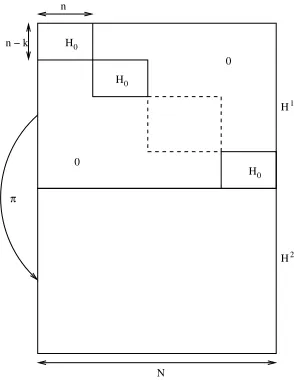
We propose a MLC invoking GLDPC component codes [7] having a parity check matrix (PCM) illustrated in Figure 1.
The PCMHwas constructed by the single-error detecting
par-ity check codes of a classic LDPC code [4] by the appropriately
tessellated PCMH0of the binary BCH codesC0(n, k)used as
constituent codes. The PCM was constructed with the aid ofJ
so-called GLDPC superblocks. We opted for usingJ=2, since
it results in a high minimum distance [7], despite its low
de-coding complexity. The J=2 superblocks are defined by two
PCMs, which satisfyH2=πH1, whereH1 denotes the block
diagonal matrix of thef irstsuperblock,H2represents matrix
of thesecond superblock andπrepresents a pseudo-random
column-wise permutation. This code construction produces
L=N/nconstituent codes, where N denotes the total coded
block length.
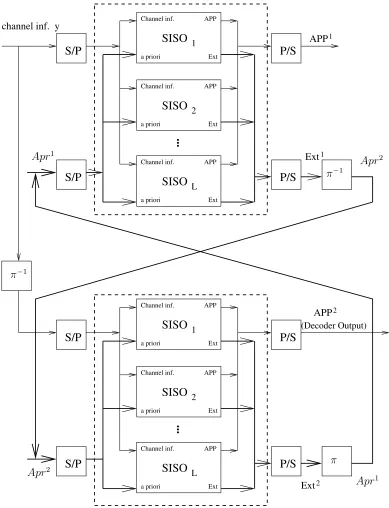
Each BCH constituent code of thef irstGLDPC superblock
seen in the upper half of Figure 2 has an associated SISO
H0
H0
H0 0
0
π n
n − k
H2 H1
N
Figure 1: Parity Check Matrix (PCM) of a GLDPC Code,
hav-ingJ=2 superblocks.
coder and the BCH constituent codes are decoded in
paral-lel, before the resultantextrinsicinformation is fed into the
second interleaved GLDPC superblock portrayed at the bot-tom of Figure 2. This operation is repeated in an iterative inner GLDPC decoding loop. The substantial implementational ben-efit of this is that a number of cost-efficient, low-speed parallel SISO decoders maybe used instead of a single high-speed de-coder.
Figure 2 portrays the Lnumber of SISO decoders of the
L constituent BCH codes. Since we have J=2 GLDPC
su-perblocks, the channel’s output informationy is fed directly
into theLnumber of parallel BCH SISO decoders of thef irst
GLDPC superblock, while after deinterleaving in the block
π−1 into the second GLDPC superblock of Figure 2.
Fol-lowing the last GLDPC iteration, theaposterioribit
proba-bilitiesAP P2generated at the output of the SISO decoder of
Figure 2 will be used for obtaining the hard decision based
GLDPC decoder output bits. TheextrinsicoutputsExt1 of
thef irstsuperblock’s SISO decoders are de-interleaved and
used asa prioriinformationApr2for each of the BCH
con-stituent decoders of the second GLDPC superblock in
Fig-ure 2. During the next inner iteration, theextrinsic
informa-tionExt2arriving from thesecondsuperblock is used as the
a prioriinformationApr1 for the BCH constituent decoders
of thef irstGLDPC superblock of Figure 2, as in classic turbo
detectors [3]. The processing block length of a constituent
BCH SISO decoder isN/n, as opposed toN in a LDPC or
turbo constituent decoder.
2.2. Modulation and Demodulation
Figure 3 shows the MLC/PID system model, employing the iterative GLDPC scheme of Figure 2 for each MLC protec-tion class and having an addiprotec-tional outer decoding loop. A 3 bit/symbol encoded data is transmitted using 8-PSK
modula-tion. We combine the three GLDPC component codes having
different code rates, where each of the three source bitsu0,u1
andu2is encoded into the associated coded bitv0,v1andv2
before the 8-PSK mapper, as seen in Figure 3. At the output of the channel, the received bits are demodulated and decoded with the aid of their corresponding GLDPC decoders for the
sake of obtaining the decoded output bits ofuˆ0,uˆ1anduˆ2, as
[image:2.595.95.242.57.247.2]seen in Figure 3. The 8PSK mapper employs Gray Mapping (GM) when non-iterative detection is used and Set Partitioning (SP), when iterative of detection is invoked, as outlined below. Again, Gray mapping is employed in a non-iterative scheme, where the parallel decoding of the three bits is implemented without outer iterations. The absence of a long interleaver in Figure 2 has the potential of reducing the decoding delay im-posed. However, for the sake of achieving a useful outer iter-ation gain in the decoder of our scheme seen in Figure 3, we also propose an iterative scheme employing SP based mapping, which is identical to that of Ungerb¨ock’s Trellis Coded Mod-ulation (TCM) scheme, as described in Section 9.6.1 of [3]. Again, the outer iterations are illustrated in Figure 3, while the
inner iterations are portrayed in Figure 2. Theextrinsicsoft
Log Likelihood Ratios (LLR) generated by the GLDPC
de-coders are converted into a stream ofa prioribit probabilities,
which are then fed back to the input of the demapper seen in
Figure 3 as thea prioriinformationˆuused in the next outer
iteration.
Since thea prioriinformation fed to the demapper of
Fig-ure 3 represents non-equiprobable bits after the first iteration, the achievable iteration gains maybe expected to increase by
efficiently exploiting thea prioriprobabilities, provided that
an appropriate bit-to-symbol mapping scheme is used. In other
words, after the first outer iteration, the channel outputyseen
in Figure 2 will be enhanced by thea prioriinformationPa
provided by the previous outer iteration. The extrinsic
prob-ability expressionPe of the MLC demapper of Figure 3
pro-viding new information for enhancing our confidence inywas
given by [9].
With the aid of the so-called equivalent capacity rule [2], we obtain the desired code rate of each component for 8-PSK
modulation using Gray Mapping, yieldingR0/R1/R2= 0.510/
0.745/0.745. Given that the total number of uncoded input bits
iski and the total number of channel coded output bits isni
for the GLDPC encoder at theith MLC protection level, the
coding rate of theith GLDPC component code is [7]
Ri= 1−J(1−ki/ni). (1)
Therefore, the overall effective throughputC of the
pro-posed system is
C=P−J
i=L
i=0
(1−ki/ni) bits/symbol, (2)
wherePis the total number of modulation levels and we have
S/P
S/P
P/S
P/S
Ext2 APP2 APP1
S/P
S/P
P/S
P/S
SISO
1SISO
1...
...
(Decoder Output) channel inf. y
a priori Ext
APP
a priori Ext
APP
SISO
SISO
L 2
a priori Ext
APP Channel inf.
Channel inf.
Channel inf.
a priori Ext
APP
a priori Ext
APP
SISO
SISO
L 2
a priori Ext
APP Channel inf.
Channel inf.
Channel inf.
1 Ext
π
−1π
−1Apr
2Apr
1Apr
1Apr
2 [image:3.595.101.490.57.565.2]π
Figure 2: SISO BCH decoder of the GLDPC component codes.
Rt=C/log2M, whereM is the total number of modem
con-stellation points obeyingM = 2P. The effective throughput of
the system is therefore (0.51 + 0.745 + 0.745) = 2 bit/symbol. The BCH constituent codes employed in our scheme which
approximate the Ri rates are the C0(20,15), C1(48,42) and
C2(48,42) codes, respectively. The system parameters are
sum-marized in Table 1. Our benchmarker scheme employing
clas-sic LDPC codes uses the equivalent PID coding rates ofR0,
R1andR2.
3. SIMULATION RESULTS
Fig-S/P Channel
Source
GLDPC Encoder 0
GLDPC
GLDPC Encoder 2
GLDPC
GLDPC Decoder 1
GLDPC Decoder 2 Decoder 0
LLR
x y
ˆ
u0
ˆ
u1
ˆ
u2 u0
u1
u2
v0
v1
v2
ˆ
u
Sink P/S
Encoder 1 Mapper Demapper
8PSK
[image:4.595.73.531.58.183.2]Converter
Figure 3: System model of MLC/PID using iteratively detected GLDPC inner codes as well as outer iterations. The iterative GLDPC decoder is seen in Figure 2.
PID Coding rate R0 R1 R2
0.51 0.745 0.745
BCH constituent codes C0 C1 C2
(20,15) (48,42) (48,42)
Modulation 8PSK
Non-iterative mapping scheme Gray Mapping (GM)
Iterative mapping scheme Set Partitioning (SP)
Number of symbols 2640
Table 1: System parameters table.
ure 3, in the spirit of Section 9.6.1 of [3]. Figure 4 shows that
at BER=10−5, the proposed scheme demonstrates anEb/N0
improvement of around 0.5dB in AWGN channels compared to our MLC-LDPC benchmarker system, while exhibiting a convenient parallel decoding structure. When employing SP based mapping and six outer iterations over AWGN channels, both systems achieve a further 2-2.5 dB performance improve-ment and the proposed MLC-GLDPC scheme retains its per-formance advantage. When communicating over uncorrelated Rayleigh fading channels, our MLC-GLDPC scheme outper-forms the MLC-LDPC benchmarker by about 1dB in both the single outer-iteration Gray mapping and the six outer-iteration
aided SP-based scenarios at BER=10−5. This might appear
to be a modest gain, but it is achieved with the aid of a more convenient parallel architecture.
We further investigate the effects of inner iterations in our MLC-GLDPC scheme with reference to our MLC-LDPC bench-marker in both AWGN and uncorrelated Rayleigh fading chan-nels. The inner iterations are facilitated in the context of GLDPC component codes, since the information exchange can be car-ried out in the ”turbo-like” architecture shown in Figure 2 with the aid of a number of parallel, low complexity SISO decoders, each requiring a reduced block length in comparison to LDPC or turbo component codes. The number of inner iterations re-quired for generating the most reliable extrinsic output for the outer iterations therefore also determines the delay imposed on the overall system.
We employIouter=6 outer iterations in our MLC-GLDPC
2 3 4 5 6 7 8 9 10 11 12
Eb/N0(dB)
10-5 10-4 10-3 10-2 10-1 1
BER
2 3 4 5 6 7 8 9 10 11 12
Eb/N0(dB) 10-5
10-4 10-3 10-2 10-1 1
BER
6 outer-iter, SP 1 outer-iter, Gray MLC-GLDPC MLC-LDPC
AWGN
[image:4.595.309.554.231.398.2]UC Rayleigh
Figure 4: BER of both MLC-GLDPC and MLC-LDPC over an AWGN Channel and uncorrelated (UC) Rayleigh fading
chan-nel invokingIouter=1 or 6 outer andIinner=10 inner iterations.
The effective throughput was 2 bits/symbol and the BCH codes were the (20,15), (48,42) and (48,42) schemes, respectively.
2 3 4 5 6 7
Eb/N0(dB)
10-5 10-4 10-3 10-2 10-1 1
BER
2 3 4 5 6 7
Eb/N0(dB) 10-5
10-4 10-3 10-2 10-1 1
BER
20 inner-iter 8 inner-iter 5 inner-iter MLC-GLDPC MLC-LDPC
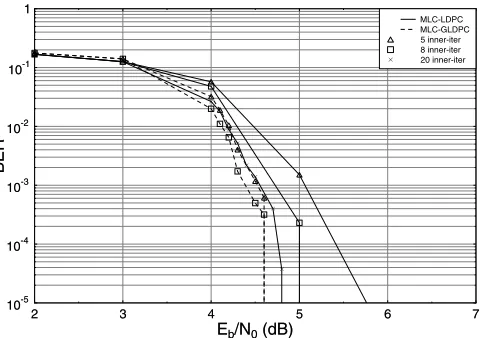
Figure 5: BER of both MLC-GLDPC and MLC-LDPC over an
AWGN channel invokingIinner=5, 8 or 20 inner andIouter=6
[image:4.595.312.553.488.657.2]4 5 6 7 8 9 10 11 Eb/N0(dB)
10-5 10-4 10-3 10-2 10-1 1
BER
4 5 6 7 8 9 10 11
Eb/N0(dB) 10-5
10-4 10-3 10-2 10-1 1
BER
[image:5.595.44.289.60.228.2]8 inner-iter 3 inner-iter MLC-GLDPC MLC-LDPC
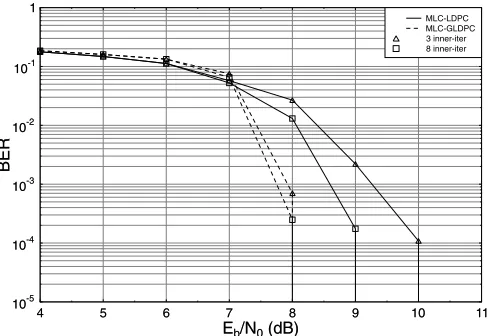
Figure 6: BER of both MLC-GLDPC and MLC-LDPC over
uncorrelated Rayleigh fading channel invokingIinner=5 or 8
inner andIouter=6 outer iterations.
scheme, each invoking a different number of inner iterations (Iinner) using the SP mapping scheme. Figure 5 demonstrates that when transmitting over AWGN channels, our MLC-GLDPC
scheme requires anEb/N0value of around 4.6dB at BER=10−5,
in conjunction withIinner=5 inner iterations. The MLC-LDPC
benchmarker converges slowly at anEb/N0close to 4.6dB,
re-quiring up toIinner=20 inner iterations for achieving BER=10−5.
In other words, the classic MLC-LDPC requires a quadrupled
number of total iterations (Iouter.Iinner) compared to our
MLC-GLDPC scheme for the sake of achieving a similar
perfor-mance of BER=10−5.
Let us now extend these investigations to the uncorrelated Rayleigh fading channel, where both schemes invoke the same
number of Iouter = 6 outer iterations. The MLC-GLDPC
scheme, achieves a coding advantage of 2dB compared to the
MLC-LDPC scheme at BER=10−5, when invokingIinner = 5
inner iterations, as shown in Figure 6. This coding advantage
is reduced to about 1dB, when Iinner = 8 inner iterations
are employed. As observed from both Figures 5 and 6, our
MLC-GLDPC scheme requireIinner = 5inner iterations for
achieving its best possible BER performance both in AWGN and uncorrelated Rayleigh fading channels.
4. CONCLUSIONS
In conclusion, this paper provided an insight into a range of MLC GLDPC schemes. Our simulations results suggested that the attainable SNR improvement compared to a classic ran-dom LDPC component code based MLC benchmarker ranged between 0.5dB and 2dB. This was achieved using the same number of iterations and an implementationally beneficial par-allel architecture. We argued that multilevel coding using Gray mapping combined with parallel independent decoding is at-tractive in the context of supporting low-latency real time ap-plications.
5. REFERENCES
[1] H. Imai and S. Hirawaki, “A New Multilevel Coding
Method Using Error Crrecting Codes,”IEEE Transactions
on Information Theory, pp. 371–377, May 1977.
[2] U. Wachsmann, R. F. H. Fischer and J. B. Huber, “Mul-tilevel Codes: Theoretical Concepts and Practical Design
Rules,”IEEE Transaction on Information Theory, vol. 45,
pp. 1361–1391, July 1999.
[3] L. Hanzo, T. H. Liew and B. L. Yeap, Turbo Coding,
Turbo Equalisation and Space Time Coding for Transmis-sion over Wireless channels. New York, USA: John Wiley IEEE Press, 2002.
[4] R. Gallager,Low Density Parity Check Codes. USA: MIT
Press, 1963.
[5] J. Hou and M. H. Lee, “Multilevel LDPC Codes Design
for Semi-BICM,”IEEE Communications Letters, pp. 674–
676, Nov. 2004.
[6] J. Hou. P. H. Siegel, L. B. Milstein and H. D. Pfister, “Multilevel Coding with Low-Density Parity-Check
Com-ponent Codes,”IEEE Global Telecommunications
Confer-ence, pp. 1016–1020, Nov. 2001.
[7] J. Boutros, O. Pothier and G. Z ´mor, “Generalized Low
Density (Tanner) Codes,”Proceeding of the International
Conference of Communication, pp. 441–445, 1999.
[8] M. Lentmaier and K. S. Zigangirov, “On General-ized Low-Density Parity-Check Codes Based on
Ham-ming Component Codes,”IEEE Communications Letters,
pp. 248–250, Aug. 1999.
[9] X. Li and J. A. Ritcey, “Bit-interleaved coded modulation
with iterative decoding using soft feedback,”IEE