PROPOSE AN OPTIMUM PERIODIC SUPERVISION ON CONVENTIONAL SHEARING MACHINE AT POWER BOOSTER ENGINEERING & MAINTENANCE SDN BHD USING RELIABILITY
METHODOLOGY
QAYYUM EDLEE BIN ABDUL AZIZ
PROPOSE AN OPTIMUM PERIODIC SUPERVISION ON CONVENTIONAL SHEARING MACHINE AT POWER BOOSTER ENGINEERING & MAINTENANCE SDN BHD USING RELIABILITY METHODOLOGY
QAYYUM EDLEE BIN ABDUL AZIZ
This report is submitted
in fulfillment of the requirement for the degree of Bachelor of Mechanical Engineering (Design and Innovation)
Faculty of Mechanical Engineering
UNIVERSITI TEKNIKAL MALAYSIA MELAKA
i
DECLARATION
I hereby declare that the work in this report is of my own except for summaries and
quotations which have been duly acknowledged.
Signature:
Author: Qayyum Edlee bin Abdul Aziz
ii APPROVAL
I hereby declare that I have read this thesis and in my opinion, this report is sufficient in
terms of scope and quality for the award of the degree of.
Bachelor of Mechanical Engineering (Design & Innovation)
Signature:
Supervisor’s Name: Dr Mohd Asri bin Yusuff
iii
iv
ACKNOWLEDGEMENT
First and foremost, I would like to express my sincere gratitude to my supervisor, Dr
Mohd Asri bin Yusuff. Without fail, he has provided me details guidance and encourages me
through the project. He has always been enthusiastic in solving reflecting, responding and
advising my problem in this research. I appreciate for the countless time he had spent having
discussion with me regarding my final year project and offering numerous suggestion to
improve my work.
Secondly, I would like to acknowledge and give appreciation to engineer from Power
Booster Maintenance & Engineering Sdn Bhd, Mr. Survenius for giving me maintenance
schedule for the machine and also give me information about the machine.
Special thanks to my parents and families for their good-natured forbearance with the process
and their pride in this accomplishment. My gratitude is for their understandings of my busy life
and pack schedules.
My gratitude are also go to Muhammad Fitri Hashim, Norazman Nayan and
Muhammad Sham Sharani who always dedicate me moral support and ideas on solving
problems and sharing knowledge. Their kindness has built me up to be a strong and dedicated
person. Nevertheless, thanks to my course-mates and friends for their support, patience,
v ABSTRACT
In this study, to propose optimum maintenance schedule there are several methodology
to be done. The distribution related with reliability engineering are exponential, lognormal and
Weibull distribution. This study needed to choose one of the distribution to analyse the
reliability calculation such as MTBF value, hazard rate function and so on. The method to
choose the distribution is using software Weibull ++ then the failure rate data was inserted and
the software automatically choose them. Monte Carlo simulation also used to generate data due
to lack of data that we get from the company. This study more used Microsoft Excel to get the
data of reliability and regression analysis should be done to get the value such as characteristic
life, shape parameter and many more. Next, the MTBF value was calculated from value of
shape parameter and characteristic life and the gamma table function are used to insert in the
formula. Furthermore, to propose the optimum maintenance schedule need MTBF value for
vi ABSTRAK
Di dalam kajian ini, terdapat beberapa kaedah yang perlu dilakukan untuk mencadangkan
jadual penyelenggaraan optimum. Taburan yang berkait dengan kejuruteraan kebolehharapan
adalah taburan exponential, lognormal dan Weibull. Kajian ini perlu untuk memilih salah satu
daripada taburan untuk menganalisis pengiraan kebolehpercayaan seperti nilai MTBF, fungsi
kadar risiko dan sebagainya. Kaedah untuk memilih taburan tersebut iaitu dengan
menggunakan perisian Weibull ++, data kadar kegagalan dimasukkan dan perisian secara
automatik memilih taburan yang bersesuaian dgn data tersebut. Simulasi Monte Carlo juga
digunakan untuk menjana data kerana kekurangan data yang dikumpul daripada syarikat.
Kajian ini juga menggunakan Microsoft Excel untuk mendapatkan data kebolehpercayaan dan
analisis regresi yang perlu dilakukan untuk mendapatkan nilai seperti ‘characteristic life’,
‘shape parameter’ dan banyak lagi. Seterusnya, nilai MTBF itu dikira dari nilai ‘shape
parameter’ dan ‘characteristic life’ dan jadual fungsi gamma digunakan untuk dimasukkan ke
dalam formula. Tambahan pula, untuk mencadangkan jadual penyelenggaraan optimum nilai
MTBF diperlukan untuk setiap component, jadi untuk mendapatkannya ia berkaitan dengan
vii
TABLE OF CONTENT
CHAPTER CONTENT PAGE
DECLARATION I
APPROVAL ACKNOWLEDGEMENT ii iv ABSTRACT ABSTRAK v vi TABLE OF CONTENT Vii LIST OF FIGURE Ix
LIST OF TABLE X
LIST OF ABBREVIATIONS Xi
CHAPTER 1 INTRODUCTION 1
1.1 Background 1
1.2 Problem Statement 2
1.3 Objectives 3
1.4 Scope of Project 3
CHAPTER 2 LITERATURE REVIEW 4 2.1 Introduction 4
2.2 Shearing machine 4 2.2.1 History of Machine 6
2.2.2 Function of Machine 6
2.2.3 Problem of Machine 7
2.2.4 Part of Failure 8
2.3 Maintainability 8
2.3.1 Objective Maintenance 9
2.3.2 Advantage Maintainability 10
2.3.3 Maintainability Need and Relationship between Reliability and Maintainability 10 2.4 Reliability Engineering 11
2.4.1 Theory of Reliability 11
2.4.2 Measure of Reliability 12
2.4.3 Probability density function 12
2.4.4 Cumulative density function 12
2.4.5 Hazard function 13
2.5 Formula of Reliability 14
2.5.1 Mean time to failure 14
viii
2.5.3 Mean time to repair 15
2.6 Typical failure Distribution 15
2.6.1 Exponential Distribution 16
2.6.2 Lognormal Distribution 17
2.6.3 Weibull Distribution 17
CHAPTER 3 METHODOLOGY 18 3.1 Introduction 18
3.2 Finding Machine 19
3.3 Gathering Information 19
3.4 Method Carry Out 20
3.4.1 Methodology Flowchart 20
3.4.2 Analysis distribution pattern failure 21
3.5 Software Weibull ++ 22
3.5.1 Software flowchart 22
3.6 Collecting Data 23
3.7 Study of Machine Failure Data 24
3.8 Distribution Model Prediction 24
3.8.1 Exponential Distribution 25
3.8.2 Lognormal Distribution 26
3.8.3 Weibull Distribution 27
3.9 Propose an optimum maintenance schedule 28
CHAPTER 4 RESULT AND ANALYSIS 29 4.1 Data analysis 30
4.2 Analysis method 30
4.3 Finding probability distribution model 35
4.4 Parametric estimation 37
4.5 Mean time before failure (MTBF) 41
4.6 Hazard rate function 42
4.7 Variance and Standard deviation 43
4.8 Predict component’s reliability 46
4.9 Preventive maintenance model optimization 47
CHAPTER 5 CONCLUSION AND RECOMMENDATION 50 5.1 Conclusion 50
5.2 Recommendation 51
REFERENCES 52
APPENDIX 54
ix
LIST OF FIGURES
Figure Title Page
Figure 1.0 Shearing machine at Power Booster Sdn. Bhd 3
Figure 2.0 Part on shearing machine 6
Figure 2.1 Weibull shape parameters superimposed on the bath-tub curve 13
Figure 2.2 Lognormal distribution 17
Figure 3.0 HACO B-8810 RUMBEKE Shearing machine 19
Figure 3.1 Methodology flowchart 21
Figure 3.2 Software flowchart 23
Figure 3.3 Graph of Exponential distribution
26
Figure 3.4 Graph of Lognormal distribution 27
Figure 3.5 Graph of Weibull distribution 28
Figure 4.0 Chart of failure percentage of components 34
Figure 4.1 Chart of No of failure and Failure % versus Components 34
Figure 4.2 ReliaSoft Weibull++ software. 36
Figure 4.3 Distribution Wizard 37
Figure 4.4 Best fitted line graph Ln (Ln(1/(1-Median R)) versus LnTTF 39
[image:11.612.100.518.101.583.2]Figure 4.5 Reliability prediction for Cutting edge using Software Weibull ++ 46
Figure 4.6 Graph component vs MTBF (hour) 48
x
LIST OF TABLES
Table Title Page
Table 4.1 Shearing machine component failure and operation hour 2014 31
Table 4.2 Total number of shearing machine components failure 2014 32
Table 4.3 Shearing machine operation hour 2014 33
Table 4.4 Shearing machine components failure percentage 2014 34
Table 4.5 Time to failure of 2014 35
Table 4.6 Regression Analysis Data Modelling for Cutting Edge 38
Table 4.7 Summary Output for Cutting edge Failure Data Parameter Estimation 40
Table 4.8 The value of Failure Distribution Parameter, MTBF and Failure rate of cutting edge.
45
xi
LIST OF ABBREVIATION
MTTF Mean time to failure
MTBF Mean time to failure
MTTR Mean time to repair
PDF Probability density function
CDF Cumulative density function
1 CHAPTER 1
INTRODUCTION
1.1 Background
A shearing machine is one of two things, an industrial machine that cuts metal or a
machine that cuts the wool off sheep. An industrial shearing machine generally presses
blades down into metal sheets to punch out shapes. These shapes may be the desired end
product or they may be the waste product. While shearing metal sheets is most common,
other metallic objects may be processed in one of these machines. A sheep-shearing machine
maybe anything from a pair of small clippers similar to ones found in a barber shop to a large
machine that features an external power supply and multiple clipping arms.
The part of the machine was broken is still one of the major problems in engineering.
This is often caused by the part is not be maintenance wisely. The part broke caused the
product that produced from the machine totally not in high quality. The part in the machine
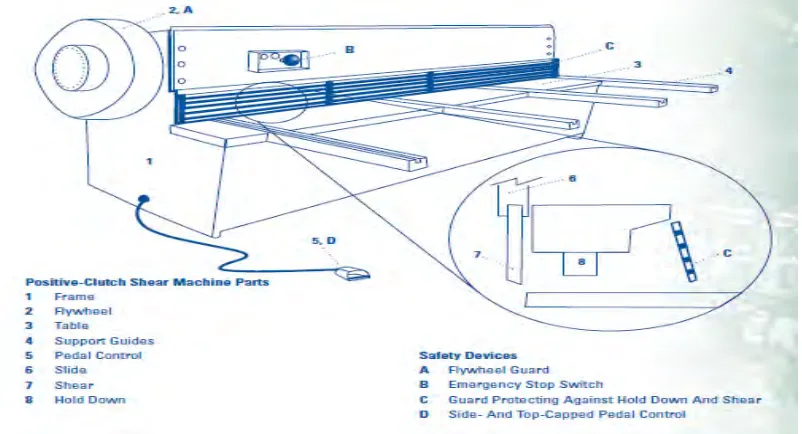
include frame, flywheel, table, support guides, pedal control, slide, and shear and hold down.
A metal shearing machine uses sharp blades and a lot of pressure to quickly cut
shapes out of metal. The blades on a shearing machine are typically directly perpendicular
to the surface getting punched. This maximizes the applied force and maintains an even cut.
Some shearing machines operate like a pair a scissors. This shearing style is less common,
as the pressure isn’t evenly applied to the metal.
Depending on the quality and thickness of the sheared material, the blades on the
shearing machine may be of a higher-quality metal. The general rule for metal cutting is that
the blades must be harder than the material being cut, but this rule doesn’t always hold true
2 blades.
While the majority of shearing machines cut sheet metal, some cut other metal forms.
The most common metal behind sheets is metal bars. These bars are often very long, and the
shearing machine cuts them into more manageable lengths for use in other machines. Other
machines focus on nearly-finished parts; they cut along edges to remove burrs or leftover
material from earlier manufacturing processes.
1.2 Problem Statement
Machine efficiency is one of the factors that are frequently overlooked by the
management and this can lead towards losses which reduces the yield. Improper maintenance
of machines will result in low standards of produced parts and increases the maintenance of
machines. Machines are meant to work efficiently, but in some circumstances machines can
be less productive due to improper preventive maintenance. Preventive maintenance is a key
factor that keeps the machine running efficiently through the production process. The
maintenance activity on machines needs extra attention by the management along with the
responsible personnel to ensure optimum usage of machineries which will eliminate
unwanted wastages due to machine stoppages.
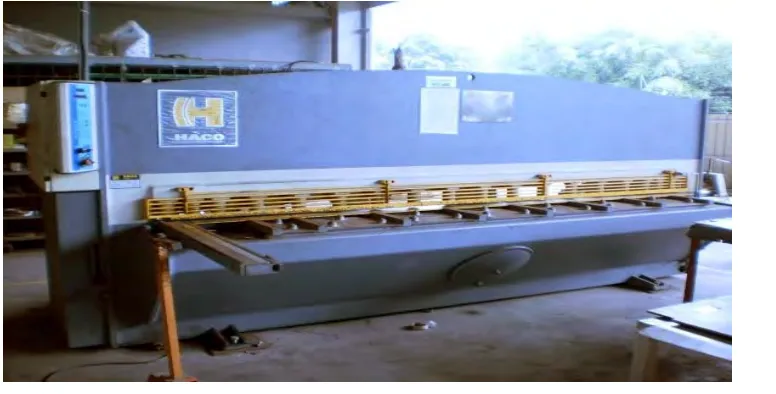
The shearing machine at the Power Booster Sdn Bhd as shown in Figure 1. This
machine should be maintenance wisely because if not do that, the efficiency of the machine
is low. Next, the product made from this machine also is low of quality. The low of quality
of product makes that product was rejected so it also make high cost caused by wastages.
The low efficiency of the machine usually happen in industry because the technician or
maintenance not maintain the reliability of the machine they because they take the easy about
this. Besides that, maybe the company not improve their maintenance schedule so, the
technician only follow the old maintenance schedule. After that happen, the production have
3
Figure 1.0: Shearing machine at Power Booster Sdn. Bhd.
1.3 Objectives
The objectives of this project are as follow:
1. Recommend appropriate action in improving and increasing the efficiency of the machine.
2. To provide the best maintenance schedule of shearing machine to avoid low quality
product.
1.4 Scope of Project
The scope of this project is review the history record of the system failure and
component, distribution pattern failure for the shearing machine and determine the
appropriateness of the distribution that is used to rate the failure of any component involves.
Study about the failure parts on the shearing machine and calculate the efficiency of
the shearing machine until get the best efficiency. Next provide the best maintenance
4 CHAPTER 2
LITERATURE REVIEW
2.1 Introduction
The probability of performing a successful repair action within a given time that the
definition of maintainability. In other words, maintainability measures the ease and speed
with which a system can be restored to operational status after a failure occurs. System
reliability analysis except that the random variable of interest in maintainability analysis is
time-to-repair rather than time-to-failure similar to that. It can be obtain many useful results
concerning the overall performance availability, uptime, downtime, when combine system
maintainability analysis with system reliability analysis. It will help you to make decisions
about the design and or operation of a repairable system. (reliasoft.com 1992)
High-integrated products and the maintainability assessment must take into account
all these different aspects such as mechanical parts, electronic devices and software.
Maintainability can be affected by actions beginning from the failure detection depending
on what activities are considered and those concerning diagnostic, reparation and test. It also
depends on all criteria that may affect the main maintenance steps with different actions to
be carried out to bring the product back to its functional status. Different criteria that may
affect product maintainability have been identified in (A. Coulibaly et al. 2007)
2.2 Shearing Machine
A shearing machine is one of two things; an industrial machine that cuts metal or a
machine that cuts the wool off sheep. An industrial shearing machine generally presses
5
product or they may be the waste product. While shearing metal sheets is most common,
other metallic objects may be processed in one of these machines.
The part of the machine was broken is still one of the major problems in engineering.
This is often caused by the part is not be maintenance wisely. The part broke caused the
product that produced from the machine totally not in high quality. The part in the machine
include frame, flywheel, table, support guides, pedal control, slide, and shear and hold down.
To quickly cut shapes out of metal a metal shearing machine uses sharp blades and a
lot of pressure. The blades on a shearing machine are typically directly perpendicular to the
surface getting punched. By that, it can maximizes the applied force and maintains an even
cut. Some shearing machines operate like a pair a scissors. This style is less common, as the
pressure is not evenly applied to the metal.
The blades on the shearing machine may be of a higher-quality metal and depending
on the quality and thickness of the sheared material. The general rule for metal cutting is the
blades must be harder than the material being cut, but this rule does not always hold true in
a shearing machine. Steel can often cut steel with little problem even the cut is so fast and
the pressure is so high.
While the majority of shearing machines cut sheet metal, other than that cut other
metal forms. The most common metal behind sheets is metal bars. These bars very long, and
the shearing machine cuts them into more manageable lengths for use in other machines.
Other machines focus on nearly-finished parts, they cut along edges to remove burrs or
6
Figure 2.0: Part on shearing machine (www.irsst.qc.ca)
2.2.1 History of Machine
The first shearing machines appeared in New Zealand in 1880, on stations such as
Galloway in Otago, and Flax Bourne in Marlborough. They were originally driven by steam,
often using a traction engine. Later, electricity made them more efficient and their use more
widespread.
The first public demonstrations of shearing machines were in Australia in 1885.
Although sheep owners were slow to accept the change, they became converts when they
saw the extra pound (0.45 kilogram) of wool harvested from each sheep shorn with a
machine rather than blades.
2.2.2 Function of machine
Both mechanical and hydraulic machines can perform shear machining. When use
7
fabrication, they work well for factories. In addition, hydraulic shears are best if the
operation requires intense pressure and also do not require a lot of maintenance, will operate
continuously, and are fast and quiet. While applying the same amount of pressure, hydraulic
shear machines take up less space than mechanical shear machines.
When the metal is inserted into hydraulic machines, then it is secured by clamps so
it does not slip under high pressure. Use a squaring arm or back gauge to ensure that the cut
is smooth and even for a 90 degree cut. Minute burrs may be formed by the edge of the cut
metal, these must be removed by grinding. Be careful of the little marks left by the cutting
blades and holding clamps while working if you use hydraulic shears. You need to remove
them or otherwise account for them
2.2.3 Problem of machine
Each time a fabricator works on a shearing job, he needs to check these factors that
affect the blade:
i. condition of the cutting blade
ii. tonnage of the machine
iii. size of the area between the upper blade and lower blade
iv. angle required for the blade
v. how it is gripped to keep it stead
Each job needs to be evaluated for these variables:
i. grade of material needed to satisfactorily complete the job
ii. thickness of the material
8
According to the industrial visit, the engineer said the critical part or component
usually break is:
i. Cutting edge
ii. Pedal control
iii. Emergency button
iv. Gear
2.3 Maintainability
Maintenance is another important aspect of system performance after reliability.
There are several facets of maintenance management, and in this introductory chapter we
would like to have these surveyed. Broadly speaking, maintenance is the process of
maintaining equipment in its operational state either by preventing its transition to a failed
state or by restoring it to an operational state following a failure. This leads to various types
of maintenance activities that can be planned to realize the objective of maintenance, such
as preventive, predictive, or corrective.
The cost of maintaining a machine is a direct function of the maintenance frequency
and failure interval for the machine and major components, the time and labour required to
completed unscheduled maintenance actions and the time and labour required to complete
routine maintenance tasks. These cost control efforts have usually centre on optimizing
scheduled maintenance operation, reducing maintenance staffs, better control spare parts
inventories, use of contract maintenance support and deferring nonessential maintenance.
9 2.3.1 Objective Maintenance
Maintenance is an important factor in quality assurance, which is another basis for
the successful competitive edge. Inconsistencies in equipment lead to variability in product
characteristics and result in defective parts that fail to meet the established specifications.
Beyond just preventing break downs, it is necessary to keep equipment operating within
specifications for example process capability that will produce high level of quality. Good
maintenance management is important for the company’s cost control.
Many manufacturing organizations, particularly those with JIT (Just-In-Time)
programs are operating with inventories so low that, they offer no protection in the event of
a lengthy equipment failure. Maintenance function can help prevent such as
occurrence. Organizations like airlines and oil refineries have huge investments in the
equipment. Equipment failure will be disastrous for such companies. They need proper
maintenance to keep the equipment in good condition. Objectives of Maintenance
Management: The following are some of the objectives of maintenance management:
i. Minimizing the loss of productive time because of equipment failure (i.e. minimizing
idle time of equipment due to break down).
ii. Minimizing the repair time and repair cost.
iii. Minimizing the loss due to production stoppages.
iv. Efficient use of maintenance personnel and equipment.
v. Prolonging the life of capital assets by minimizing the rate of wear and tear.
vi. To keep all productive assets in good working conditions.
vii. To maximize efficiency and economy in production through optimum use of
facilities.
viii. To minimize accidents through regular inspection and repair of safety devices.
ix. To minimize the total maintenance cost which includes the cost of repair, cost of
preventive maintenance and inventory carrying costs, due to spare parts inventory.
10
The purpose of maintainability engineering is to increase the efficiency and safety
and to reduce the cost of equipment maintenance. To accomplish this, it is evident that the
achievement design (Conway, E.J. and R. Unger 1998). Maintainability engineering will not
eliminate the need for service and repair on mining equipment, it provides the following
advantages:
i. Reduction of the time required to complete scheduled and unscheduled maintenance.
ii. Minimization of the frequency of unscheduled maintenance by improving
accessibility for inspection and servicing.
iii. Reduction of maintenance errors and incorrect installation.
iv. Improvement of post maintenance inspection.
v. Reduction of maintenance-related injuries.
vi. Minimization of maintenance personnel training requirements.
vii. Improved troubleshooting performance.
viii. Inadequate component handling capability and component machine interface design.
2.3.3 Maintainability Need and Relationship between Reliability and Maintainability
According to Dhillon (1999), there are several factors responsible for the need of
product maintainability. In particular two important are the alarmingly high operating and
support costs because of failures and subsequent maintenance. The main objectives of both
reliability and maintenance is to assure that the system manufactured will be in the readiness
state for operation when required, capable of performing effectively its designated functions,
11 2.4 Reliability Engineering
Reliability is a broad term that focus on the ability of a product to perform in intended
function. Mathematically speaking, assuming that an item is performing its intended function
at time equals zero, reliability can be defined as the probability that an item will continue to
perform its intended function without failure for a specified period of time under stated
conditions. The product defined here could be an electronic or mechanical hardware product,
a software product, a manufacturing process or even a service.
According to Rausand (2004), reliability is a design characteristic that result in
durability of the system or equipment to carry out its designated function under a stated
condition and time period. It is accomplished through various actions including controlling
process, selecting optimum engineering principles, testing and adequate component sizing.
Nonetheless, there are many specific general principles of reliability: design for simplicity,
use less number of parts to perform multiple functions, design to minimize the occurrences
failures, maximize the use of standard parts and provide for simple periodic adjustment of
parts subject to wear.
2.4.1 Theory of reliability
According to Nakagawa T. (2005) reliability theory has grown out of the valuable
experiences from many defects of military systems in World War II and with development
of modern technology. The importance of reliability has been increasing greatly with the
innovation of recent technology.
Failure occur in several different types of failure modes such as wear, fatigue,
fracture crack, breaking, erosion, corrosion instability and many more. Failure is classified
into intermittent failure and extended failure. Extended failure has been divided into
complete failure and partial failure, both of which are classified into sudden failure and
gradual failure. Extended failure also divided into catastrophic failure which is both sudden