New Heuristic-Based Design of
Robust Power System Stabilizers
S. Dechanupaprittha, I. Ngamroo, K. Pasupa, J. Tippayachai,
K. Hongesombut, Member, IEEE, and Y. Mitani, Member, IEEE
Abstract— This paper proposes a new robust design of power
system stabilizers (PSSs) in a multimachine power system using a heuristic optimization method. The structure of each PSS used is similar to that of a conventional lead/lag stabilizer. The proposed design regards a multimachine power system with PSSs as a multi-input multi-output (MIMO) control system. Additionally, a multiplicative uncertainty model is taken into account in the power system representation. Accordingly, the robust stability margin can be guaranteed by a multiplicative stability margin (MSM). The presented method utilizes the MSM as the design specification for robust stability. To acquire the control parameters of PSSs, a control design in MIMO system is formulated as an optimization problem. In the selection of objective function, not only disturbance attenuation performance but also robust stability indices are considered. Subsequently, the hybrid tabu search and evolutionary programming (Hybrid TS/EP) is employed to search for the optimal parameters. The significant effects of designed PSSs are investigated under several system operating conditions.
Index Terms— Robust control, tabu search, evolutionary
pro-gramming, optimization problems, multivariable control system, power system stabilizer.
I. INTRODUCTION
The insufficient damping of an electromechanical oscillation mode (EMO) always causes an unavoidable low frequency oscillation (0.2-2.5 Hz) in a power system. To solve this problem, a power system stabilizer (PSS) is regarded as a significantly effective device to increase the damping of EMO mode via an excitation system [1]. In addition, the structure of a conventional PSS (CPSS) is a lead/lag controller with speed or electrical power deviations input. Therefore, it is easy to implement in practice.
However, the main problem of CPSS is the parameter tuning of lead/lag controllers. Many heuristic approaches have been successfully applied to achieve the control parameters, such as tabu search [2], genetic algorithm [3] and simulated annealing [4]. In these studies, however, the uncertainty model was not embedded in the mathematical model of the power system. Furthermore, the robust stability against system uncertainties of PSS was not considered in the optimization process. There-fore, the robust stability margin of PSSs mentioned above may not be guaranteed in the face of uncertainties.
S. Dechanupaprittha, I. Ngamroo, K. Pasupa, and, J. Tippayachai, are with the Electrical Power Engineering Program, Sirindhorn Interna-tional Institute of Technology (SIIT), Thammasat University, Pathumthani 12121, Thailand (e-mail: [email protected]; [email protected] [email protected]; [email protected]).
K. Hongesombut and Y. Mitani are with the Electrical Engineering Pro-gram, Kyushu Institute of Technology, Kitakyushu, Fukuoka 804-8550, Japan (e-mail: [email protected]; [email protected]).
In this paper, a new robust design of PSSs in a multi machine power system is proposed. The presented method translates the design problem to a multi-input multi-output (MIMO) control system. In addition, effects of system non-linearity such as modelling and characteristics of synchronous machines, system loading conditions, variations in power system configuration due to unpredictable disturbances, etc. are treated as system uncertainties. Accordingly, system un-certainties represented by a multiplicative uncertainty model are incorporated in the mathematical model of the study system. As a result, a robust design of MIMO system can be formulated as an optimization problem. The control pa-rameters of PSSs are optimized by the hybrid tabu search and evolutionary programming (Hybrid TS/EP). In the objective function, not only the disturbance attenuation performance but also robust stability indices are included. Based on the applied uncertainty model, the multiplicative stability margin (MSM) can be regarded as the design specification. The evaluation of control effects are carried out in the case of two-area four-machine power system.
The organization of this paper is as follows. Section II explains the proposed design method. Next, the Hybrid TS/EP algorithm is given in section III. Subsequently, the evaluation study is shown in section IV. Finally, the outcomes from this paper are summarized.
II. CONTROLPROBLEMFORMULATION
A. Linearized Model of Power System
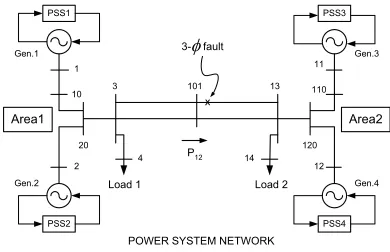
The study power system consists of 4 generators in 2 areas as illustrated in Fig. 1, [5]. It is represented by a linearized model around a designed operation point. Each generator is equipped with a simplified exciter and is represented by a 5-state transient model.
Area1 Area2
Gen.1
Gen.2
Gen.3
Gen.4
POWER SYSTEM NETWORK
PSS1 PSS3
PSS4 PSS2
Load 1 Load 2
x
P12
1
2 3
4
11
12 14
101 10
20
13
120 110
[image:1.595.339.534.598.724.2]3- faultI
The state equations of a linearized power system (AS,BS, CS,DS) in Fig. 1 can be expressed as:
∆x• = AS∆x+BS∆uP SS,
∆y = CS∆x+DS∆uP SS, (1)
∆uP SS = KP SS(s)∆ω,
where,∆x= ∆δ ∆ω ∆ed ∆eq ∆Ef d
T
,(5n×1); ∆y= ∆ω,(m×1); ∆δdenotes the deviation of rotor angle, (n×1); ∆ω is the deviation of rotor speed, (n×1); ∆ed
and∆eq are the deviations of transient internal voltages of a generator ind-axis andq-axis, respectively,(n×1);∆Ef d is
the deviation of field voltage,(n×1);KP SS(s)is the diagonal
controller with designed PSSs as diagonal elements,(m×m); ∆uP SS is the control output signal ofKP SS(s),(m×1);n
and m are the numbers of machines and PSSs, respectively. Note that the system (1) is an MIMO control system and is referred to as the nominal plantG.
B. PSS Structure
The transfer function of PSS is in a form of a lead/lag controller as:
∆uP SS,i = Ki·
sTw
1 +sTw ·
1 +sT1i
1 +sT2i ·
1 +sT3i
1 +sT4i ·∆ ωi,
i= 1, . . . , m, (2)
where,∆uP SS,iand∆ωi are the control output signal and the
rotor speed deviation at thei-th machine, respectively;Ki is
a controller gain;Twis a wash-out time constant (s); andT1i, T2i,T3i, andT4i are time constants (s).
In this paper, Tw is set to 10 s. The control parameters Ki,T1i,T2i,T3i, andT4i are searched based on the objective
function explained in the following subsection.
C. Determination of Objective Function
In derivation of the objective function, both attenuation performance of system disturbance and robust stability of control system against system uncertainties are taken into consideration. Since the main purpose of the PSS control is to improve the system damping following any disturbances, therefore, the damping ratio (ζ) of EMO mode is used as a design specification. Assuming that eigenvalues corresponding to the mode of oscillation can be determined as −σ±jωd,
the damping ratio is given by:
ζactual= −
σ
σ2+ω2d. (3)
The desired damping ratio of the eigenvalues corresponding to the mode of oscillation is specified asζdesired. Accordingly,
the difference between the desired and the actual damping ratios can be defined as:
ψ=|ζdesired−ζactual|. (4)
Note that the disturbance attenuation performance increases when ψ is minimized.
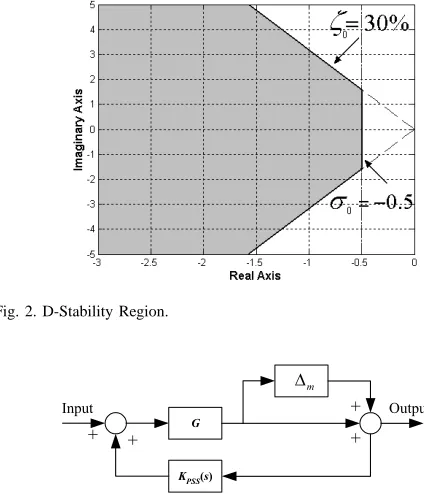
Here, the D-Stability region is exploited to guarantee the desired damping ratio and the real part of controlled EMO
Fig. 2. D-Stability Region.
G
KPSS(s)
Input Output
+ +
m '
[image:2.595.315.527.53.300.2]+ +
Fig. 3. Feedback system with multiplicative uncertainty.
mode. As shown in Fig. 2,ζ0andσ0are set at 30 % and -0.5, respectively.
For the robust stability of a system, the plant uncertainty is modelled as a multiplicative form [6] demonstrated in Fig. 3. ∆mis a stable multiplicative uncertainty. Based on the
small-gain theorem, the closed loop system will be robustly stable if
|∆m|< 1
|G·KP SS(1−G·KP SS)−1|
, (5)
where, the symbol|•|shows the magnitude of transfer function (•). Note thatG·KP SS(1−G·KP SS)−1is the complementary
sensitivity function, T. Based on this uncertainty representa-tion, the robust stability margin can be guaranteed in term of MSM. In other words, MSM also implies the maximum uncertainty bound and can be calculated by
MSM = 1
T∞, (6)
where,T∞is the∞-norm ofT. From (5) and (6), it is clear that by minimizingT∞, the MSM increases and the robust stability will be ensured [6]. Thus, the normalized robustness index of the objective function is defined as:
γ=T∞/T∞(initial), (7)
where, T∞(initial) is the ∞-norm of T at the initial of a search process.
Combining (4) and (7), the control problem can be formu-lated as the following optimization problem:
Minimize C(Ki, Tji) =ψ+γ,
subject to Kmin≤Ki≤Kmax, i= 1, . . . , m, (8)
where, C(Ki, Tji) is the objective function. The minimum
and maximum values of the gain Ki are set as 1 and 500,
respectively. The minimum and maximum values of the time constantsTji are set as 0.01 and 1, respectively. In this paper,
the hybrid tabu search and evolutionary programming method (Hybrid TS/EP) introduced by [7] is applied to solve the optimization problem.
III. HYBRIDTABUSEARCH ANDEVOLUTIONARY
PROGRAMMINGMETHOD(HYBRIDTS/EP)
A. Initialization
The actual parameters of theN parameters, Pi, i= 1, . . . , N, are randomly generated between the minimum actual pa-rameters (Pi,min) and the maximum actual parameters (Pi,max)
of the k-th individual solution, Xk = [P1k, . . . , Pik, . . . , PNk], k = 1, . . . , N P, where N P is the population size. After initializing the individual solutions in the population, the objective function in (8) is used to verify the quality of initial individuals. The best initial individual is recorded into the tabu list (to be discussed in Subsection III-C).
Furthermore, for each generation, Hybrid TS/EP performs 5 operations: perturbation strategies, tabu list restriction, fitness function evaluation, rank selection with elitism, and adaptive parameter setting strategies (to be discussed in Subsection III-B, III-C, III-D, and III-E, respectively).
B. Perturbation Strategies
In this paper, hybrid TS/EP use mutation as a diversification searching strategy and arithmetic crossover [8] operator as an intensification searching strategy to obtain the optimal or near optimal solution [7].
1) Mutation: The offspring individuals (the new trial
solutions) obtained from mutation process, Xnew
k =
[P1k,new, . . . , Pik,new, . . . , PNk,new], k = 1, . . . , Nm, are
de-fined as:
Pik,new=Pik+H(0, µi), i= 1, . . . , N, (9)
where,
Pk
i: the i-th actual parameter of k-th parent
indi-vidual;
H(0, µi): a uniform random variable with variance,µi; µi: |Ck/Cmax|(Pi,max−Pi,min)β,i= 1, . . . , N;
Ck: the objective value of thek-th parent
individ-ual;
Cmax: the maximum objective value in the parent population;
β: an adaptive mutation scale;
Nm: the number of mutated individuals.
Note ifPik,new is higher or lower than its operating limits, set it to the limit.
2) Arithmetic Crossover: Based on the inherited genotypes
of two randomly selected parent individualsXk1andXk2, the
offspring individuals obtained from the arithmetic crossover,
Xnew
k = [P
k,new
1 , . . ., Pik,new, . . . , P k,new
N ], k = Nm +
1, . . . , N P, are formulated by:
Xknew=Xk1+u·(Xk2−Xk1), (10)
where,uis defined as a uniform random number ranges from zero to one.
C. Tabu List Restriction
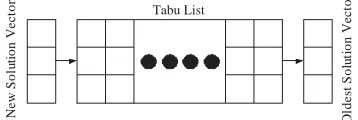
The tabu list (TL) is used to keep best offspring individuals (solution vectors) in past iterations. During the search process, a new solution vector enters TL and the oldest one is released, as shown in Fig. 4. In particular, this technique prevents a cycling of visited offspring individuals in the perturbation process by forbidding perturbed individuals, which are similar to those in TL, from being used as solution candidates [9].
N
e
w
S
o
lu
tio
n
V
e
c
to
r
Tabu List
O
lde
st
S
o
lu
ti
on V
e
c
to
[image:3.595.347.526.207.267.2]r
Fig. 4. Mechanism of Tabu List.
In general, if the size of TL is too small, the cycling of solution occurs in the search process. On the other hand, if the size is too large, the search process is in less diversity. Hence, the appropriate size in our applications is between 7 and 30.
For each generation counter g, the tabu list size (T LS)
must be satisfied under the condition,0≤T LS≤τ(g).τ(g)
is the maximum allowable of tabu list size (to be discussed in subsection III-E). The tabu restriction for k-th individual,
k= 1, . . . , N P can be expressed as:
N
i=1
Pik,new−Pitabu,t
Pi,max−Pi,min 2
< (d0·ηg=∆dtabu), t = 1, . . . , T LS, (11)
where,dtabuis the tabu distance;d0is the initial value of tabu
distance(= 5×10⁻⁴);η is the drop factor (= 0.95);Pitabu,t
is the i-th actual parameter of thet-th tabued solution in TL. At the beginning, a higher dtabu is used to provide
di-versification in order to reduce the search effort towards the optimal region. Moreover, the intensification will occur when the generation counter g reaches the maximum generation limit,gmax.
D. Fitness Function Evaluation and Rank Selection with Elitism
The fitness function is evaluated based on a distance term and an objective function term. It can be formulated by:
Fk = 4·N P −(RCk+α·RDk),
k= 1, . . . ,2×N P, (12)
where,
Fk: the fitness score of thek-th individual,k= 1, . . . ,2× N P;
RCk: the integer rank score ofCk of the k-th individual
can be assigned by the lowest score (= 1) for the lowestCkand the highest score (= 2×N P) for the
highestCk;
RDk: the integer rank score of Dk of the k-th individual
can be assigned by the lowest score (= 1) for the highest Dk and the highest score (= 2×N P) for
the lowestDk;
Ck: the objective value of thek-th individual;
Dk, the summation of distance between thek-th individual
and each visited solution vector in TL, can be expressed as:
Dk=
T LS
t=1
N
i=1
Pk
i −P
tabu,t i Pi,max−Pi,min
2
, (13)
where, Pk
i is the i-th actual parameter of thek-th individual.
With the rank selection operator, the N P highest fitness score individuals will be chosen as parent individuals for next generation. Those individuals are obtained from a combined population (2×N P) of the old parent population and the off-spring population. This strategy is used to avoid the premature convergence of solution.
Moreover, if a new parent population for the next generation does not contain the current best individual, the elitism will replace the last individual in a new parent population by the current best individual. This technique guarantees the current best individual surviving until the last generation.
E. Adaptive parameter setting strategies
1) Determination of Nm and Nc: The parameters setting
for Nm andNc must satisfy the condition:
Nm+Nc=N P, (14)
where, 0≤Nm≤N P and0≤Nc ≤N P.
Initially, both parameters are set to 50 % of N P. For the next generation, if the best offspring individual is better than the best parent individual by mutation (or crossover) process, the parameter Nm (or Nc) for the next generation will be
increased by the intensification number (I). I is set to 20 % of N P.Nc is the number of arithmetic crossover individuals.
Otherwise, if the best offspring individual does not improve solution quality better than the best parent individual, then both parameter settings ofNmandNc for the next generation will
be recovered to the old generation parameter settings.
2) Determination ofα,β andτ: The parameters setting of
α,β, andτ, represented byS, can be formulated by (15).S∆is the step size related to each parameter.Cmin(g)is an objective value of the best offspring individual at the generation counter
g.
At the beginning, S is set to the maximum value of parameter setting. For the next generation, S is controlled by the generation counter g. In this paper, βmin,βmax, and β∆
are set to 0.005, 0.5, and 0.025, respectively.αmin,αmax, and
α∆ are set to 0.005, 0.5, and 0.025, respectively.τmin,τmax, andτ∆ are set to 7, 30, and 1, respectively.
F. Hybrid TS/EP Procedure
The Hybrid TS/EP procedure can be described as follows:
Step 1: Read the system data, and specify the parameter settings of Hybrid TS/EP.
Step 2: Initialize the initial individuals, Xk, k =
1, . . . , N P and the design specification. Evaluate the objective function (Ck) in (8), and update tabu list (TL).
Step 3: Initialize the generation counterg to zero. Step 4: Execute Hybrid TS/EP operators as follow:
Step 4.1: Perform the perturbation strategies.
Step 4.1.1: Initialize the individual counter k to one.
Step 4.1.2: Perform the mutation based on TL restriction until thek-th offspring individual does not satisfy TL restriction in (11).
Step 4.1.3: If k < Nm, increase the individual
counterk by one and go to Step 4.1.2.
Step 4.1.4: Initialize individual counterktoNm+
1.
Step 4.1.5: Perform the arithmetic crossover based on TL restriction until thek-th offspring individ-ual does not satisfy TL restriction in (11). Step 4.1.6: If k < N P, increase the individual counterk by one and go to Step 4.1.5.
Step 4.2: Combine the offspring population and parent population into a single population to evaluate the objective value and fitness of each individual. Step 4.3: Perform the rank selection with elitism mechanism to update the new parent individuals from a combined population with the old parent population and offspring population for the next generation. Step 4.4: Perform the adaptive parameter setting strategies and update TL.
Step 4.5: If the generation countergis less than the maximum generation limitgmax, increase generation counterg by one and go to Step 4.
Step 5: Hybrid TS/EP is terminated and the current best individual is a solution for the robust design.
IV. EXPERIMENTALRESULTS
The two-area four-machine power system, as delineated in Fig. 1, is used as the study system. Details of system data are given in [5]. PSSs are installed at all machines. The proposed robust design based Hybrid TS/EP is developed via the MATLAB programming language. The parameters of designed PSSs are determined with the proposed objective function (8) by the design procedure. N P and gmax are
S(g+ 1) =
Max{Smin, S(g)−S∆} ; ifCmin(g) =Cmin(g−1)
S(g) ; ifCmin(g)< Cmin(g−1) (15)
0 1 2 3 4 5 6
1.04 1.05 1.06 1.07 1.08 1.09
Time (s)
Fault bus voltage (pu)
PSSs (Klein et al., 1992) Designed PSSs
0 1 2 3 4 5 6
0.3 0.4 0.5 0.6 0.7 0.8 0.9
Time (s)
Tie Line Power (pu) PSSs (Klein et al., 1992) Designed PSSs
(a) Case 1.
0 1 2 3 4 5 6
0.92 0.94 0.96 0.98 1 1.02
Time (s)
Fault bus voltage (pu)
PSSs (Klein et al., 1992) Designed PSSs
0 1 2 3 4 5 6
1.5 2 2.5 3 3.5
Time (s)
Tie Line Power (pu) PSSs (Klein et al., 1992) Designed PSSs
(b) Case 2.
0 0.5 1 1.5 2 2.5 3 3.5 4 4.5 5 2
4 6 8 10
Time (s)
Machine Power Output (pu)
Machine 1 Machine 2 Machine 3 Machine 4
0 0.5 1 1.5 2 2.5 3 3.5 4 4.5 5 2
4 6 8 10
Time (s)
Machine Power Output (pu)
Machine 1 Machine 2 Machine 3 Machine 4
PSSs (Klein et al., 1992)
Designed PSSs
(c) Case 3.
0 0.5 1 1.5 2 2.5 3 3.5 4 4.5 5 2
4 6 8 10
Time (s)
Machine Power Output (pu)
Machine 1 Machine 2 Machine 3 Machine 4
0 0.5 1 1.5 2 2.5 3 3.5 4 4.5 5 3
4 5 6 7 8 9
Time (s)
Machine Power Output (pu)
Machine 1 Machine 2 Machine 3 Machine 4
PSSs (Klein et al., 1992)
Designed PSSs
[image:5.595.59.558.58.559.2](d) Case 4.
Fig. 5. System responses results under the four different operating conditions.
factorζdesired= 0.3 is appointed.
PSS1= 11.267· 10s
1 + 10s ·
1 + 0.384s
1 + 0.155s·
1 + 0.112s
1 + 0.091s, (16a)
PSS2= 25.340· 10s
1 + 10s ·
1 + 0.103s
1 + 0.011s·
1 + 0.156s
1 + 0.038s, (16b)
PSS3= 16.128· 10s
1 + 10s ·
1 + 0.279s
1 + 0.221s·
1 + 0.389s
1 + 0.387s, (16c)
PSS4= 26.381· 10s
1 + 10s·
1 + 0.112s
1 + 0.010s·
1 + 0.500s
1 + 0.495s. (16d)
The designed PSSs are examined under four different op-erating conditions as given in Table I. The control effects of designed PSSs are compared with those of PSSs proposed by Klein et al, 1992 in [10]. Note that both designed PSSs and PSSs [10] are designed based on the same operating condition
TABLE I OPERATINGCONDITIONS.
Case study Tie line power, System operating conditions
P12(pu)
1. NOC 1.5
-2. HL & WL 3 one circuit 3-101 is out of service, 3. HL & CP 5.5 20% constant power load at bus 14 4. HL, WL & CP 4.5 one circuit 3-101 is out of service,
20% constant power load at bus 14 Note: NOC = nominal operating condition; HL = heavy load;
WL = weak line; CP = constant power load.
1 in Table I.
damp ratios of EMO modes in case of the designed PSSs are superior to those of PSSs [10]. Table III indicates the values of MSM for each case study. Under various conditions, the MSM, which is the maximum uncertainty bound, of the power system with designed PSSs can maintain at the high value.
TABLE II
DOMINANTMODES ANDDAMPINGRATIOS.
Case No PSS PSSs, [10] Designed PSSs
1. NOC -0.08±j4.05 -0.78±j4.07 -1.27±j3.55
0.021 0.190 0.34
2. HL & WL -0.02±j2.84 -0.46±j2.83 -0.91±j2.43
0.007 0.159 0.35
3. HL & CP -0.05±j3.39 -0.45±j3.41 -0.93±j3.05
0.014 0.130 0.29
4. HL, WL & CP -0.01±j2.77 -0.39±j2.77 -0.82±j2.47
0.003 0.138 0.31
TABLE III
MULTIPLICATIVESTABILITYMARGINS(MSMS).
Case PSSs, [10] Designed PSSs
1. NOC 0.9831 0.8744
2. HL & WL 0.8145 0.8533
3. HL & CP 0.8489 0.8576
4. HL, WL & CP 0.7447 0.8126
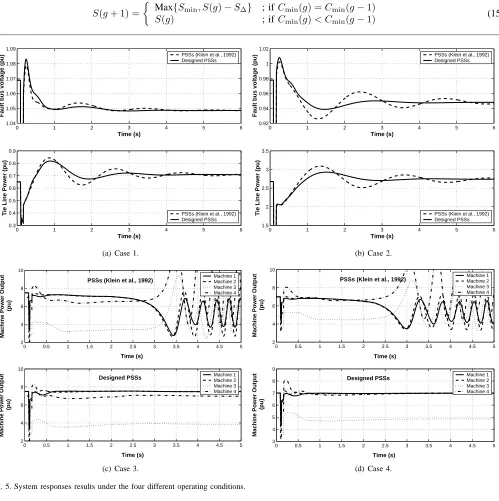
The non-linear simulations [11] are carried out to show the robustness of designed PSSs under four situations as given in Table I. It is assumed that the three-phase fault to ground is applied at bus 101 on one circuit of line 101-13 as shown in Fig. 1. The fault is cleared after 20 ms and 70 ms at bus 101 and bus 13, respectively. After the fault is cleared, a faulted circuit of line 101-13 is removed from the network.
As exhibited in Figs. 5(a) and 5(b), the designed PSSs provide more damping effects than PSSs [10]. PSSs [10] completely lose their control effects for operating conditions 3 and 4, as shown in Figs. 5(c) and 5(d). On the other hand, the designed PSSs still retain system stability successfully. This explicitly shows the superior robustness of designed PSSs beyond PSSs [10].
V. CONCLUSION
A new robust control design of power system stabilizers in a multimachine power system is proposed in this paper. The Hybrid TS/EP is employed to search for the optimal pa-rameters of PSSs. According to the multiplicative uncertainty model, the MSM can be used to guarantee the robust stability of designed PSSs. Simulation study reveals that the designed PSSs provide the significant damping performance and robust stability against various system uncertainties.
REFERENCES
[1] Y. Yu, Electric Power System Dynamics. Academic Press, 1983. [2] Y. Abdel-Magid, M. Abido, and A. Mantawy, “Robust tuning of power
system stabilizers in multimachine power systems,” IEEE Trans. Power
Syst., vol. 15, no. 2, pp. 735–740, 2000.
[3] Y. Abdel-Magid, M. Abido, S. Al-Baiyat, and A. Mantawy, “Simultane-ous stabilization of multimachine power systems via genetic algorithms,”
IEEE Trans. Power Syst., vol. 14, no. 4, pp. 1428–1437, 1999.
[4] M. Abido, “Robust design of multi-machine power system stabilizers using simulated annealing,” IEEE Trans. Energy Conversion, vol. 15, no. 3, pp. 297–304, 2000.
[5] G. Rogers, Power System Oscillations (CD-ROM). Kluwer Academic Publishers, 2000.
[6] B. Shahian and M. Hassul, Control System Design using MATLAB. Prentice Hall, 1993.
[7] W.-M. Lin, F.-S. Cheng, and M.-T. Tsay, “An improved tabu search for economic dispatch with multiple minima,” IEEE Trans. Power Syst., vol. 17, no. 1, pp. 108–112, Feb. 2002.
[8] M. Gen and R. Cheng, Genetic Algortihms and Engineering Design. New York: John Wiley & Sons, 1997.
[9] F. Glover and M. Laguna, Tabu Search. London: Kluwer Academic Publishers, 2001.
[10] M. Klein, G. Rogers, S. Moorty, and P. Kundur, “Analytical investigation of factors influencing power system stabilizers performance,” IEEE
Trans. Energy Conversion, vol. 7, no. 3, pp. 382–388, 1992.