This is a repository copy of
On the Efficiency tradeoffs in User-Centric Cloud RAN
.
White Rose Research Online URL for this paper:
http://eprints.whiterose.ac.uk/126637/
Version: Accepted Version
Proceedings Paper:
Hashmi, US, Zaidi, SAR, Darbandi, A et al. (1 more author) (2018) On the Efficiency
tradeoffs in User-Centric Cloud RAN. In: 2018 IEEE International Conference on
Communications (ICC). IEEE ICC 2018, 20-24 May 2018, Kansas City, MO, USA. IEEE .
ISBN 978-1-5386-3180-5
https://doi.org/10.1109/ICC.2018.8422228
© IEEE 2018. Personal use of this material is permitted. Permission from IEEE must be
obtained for all other uses, in any current or future media, including reprinting/republishing
this material for advertising or promotional purposes, creating new collective works, for
resale or redistribution to servers or lists, or reuse of any copyrighted component of this
work in other works.
[email protected] https://eprints.whiterose.ac.uk/
Reuse
Items deposited in White Rose Research Online are protected by copyright, with all rights reserved unless indicated otherwise. They may be downloaded and/or printed for private study, or other acts as permitted by national copyright laws. The publisher or other rights holders may allow further reproduction and re-use of the full text version. This is indicated by the licence information on the White Rose Research Online record for the item.
Takedown
If you consider content in White Rose Research Online to be in breach of UK law, please notify us by
On the Efficiency tradeoffs in User-Centric Cloud
RAN
Umair Sajid Hashmi
∗, Syed Ali Raza Zaidi
†, Arsalan Darbandi
∗and Ali Imran
∗∗School of Electrical and Computer Engineering, University of Oklahoma, Tulsa, OK, USA †School of Electronic and Electrical Engineering, University of Leeds, Leeds LS2 9JT, U.K.
Abstract—Ambitious targets for aggregate throughput, energy efficiency and ubiquitous user experience are propelling the advent of ultra-dense networks. Intercell interference and high energy consumption in an ultra-dense network are the prime hindering factors in pursuit of these goals. To address the aforementioned challenges, in this paper, we propose a novel user-centric network orchestration solution for Cloud RAN based ultra-dense deployments. In this solution, a cluster (virtual disc) is created around users depending on their service priority. Within the cluster radius, only the best remote radio head (RRH) is activated to serve the user, thereby decreasing interference and saving energy. We use stochastic geometry based approach to quantify the area spectral efficiency (ASE) and RRH power consumption models to quantity energy(EE) efficiency of the proposed user-centric Cloud RAN (UCRAN). Through extensive analysis we observe that the cluster sizes that yield optimal ASE and EE are quite different. We propose a game theoretic self-organizing network (GT-SON) framework that can orchestrate the network between ASE and EE focused operational modes in real-time in response to changes in network conditions and the operator’s revenue model, to achieve a Pareto optimal solution. A bargaining game is modeled to investigate the ASE-EE tradeoff through adjustment in the exponential efficiency weightage in the Nash bargaining solution (NBS). Results show that compared to current non user-centric network design, the proposed solution offers the flexibility to operate the network at multiple folds higher ASE or EE along with significant improvement in user experience.
Index Terms—User-centric architectures, Cloud RAN, Poisson Point Process, Area Spectral Efficiency, Energy Efficiency, Nash Bargaining Solution
I. INTRODUCTION
Cell-free user-centric networks are envisioned as enablers for interference management in ultra-dense 5th generation (5G) cellular networks. In particular, signal degradation for cell-edge users that is considered a limiting factor in LTE is addressed by structural evolution of the 5G networks designed from the users’ (rather than base stations’) perspective [1]. Operationally, each served user within a user-centric network is connected to one or more small cells in the vicinity defined by an elastic virtual user-centric cell boundary [2][3]. The virtual user-centric cell size is adaptable with respect to user traffic, channel environment and quality of service (QoS) requirements.
While the 5G systems target multiple fold increase in data rate, millisecond level latency and support for up to 500 km/hr user mobility; all this must be achieved with an improvement in spectral efficiency and reduced operational costs [4]. One enabling technology to meet these goals is Cloud-RAN
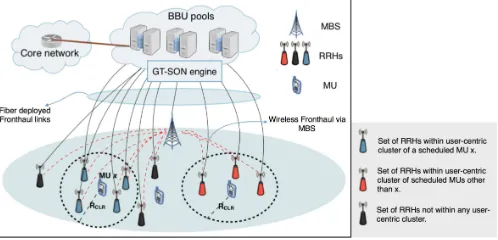
(C-Fig. 1. User-centric C-RAN architecture
RAN) which is based on separating Baseband Units (BBUs) from the radio access units [5][6]. The BBUs are migrated to the cloud forming a BBU pool for centralized processing and resource allocation. C-RAN provides the network scalability for large scale remote radio head (RRH) deployment in dense networks at lower operational costs.
[image:2.612.314.563.185.305.2]the overall system throughput or the energy efficiency (EE). The cluster size selection is dependent upon the network operator’s spatio-temporal revenue model which may include traffic intensity, time of the day and hotspot locations (e.g. cafes, stadiums) [9].
The key research question at hand is determining the optimal cluster size around a scheduled user. The cluster size C = πR2
CLR determines the interference free region around each scheduled user. Increasing the RRH cluster size offers the following gains: 1) larger distances between MUs and interfering RRHs results in larger link SINR and thus, better link throughput, and 2) a larger RRH cluster size yields more macro diversity gain or cooperative gain through selection or cooperation among larger number of RRHs in the cluster, respectively. However, the downside of a larger RRH cluster size is reduced spectrum reuse and reduced number of MUs that can be served simultaneously which, in turn, reduces system level capacity. Hence with a larger cluster, there are fewer high quality links as opposed to many low bit-rate links (which occur with a smaller cluster).
In the back drop of these insights the goal of this paper is to investigate following research questions: 1) What are the optimal RRH cluster sizes that maximize KPIs of capacity (in terms of area spectral efficiency (ASE)), energy efficiency (EE) and the user quality of experience (QoE)? 2) Given that the optimal RRH cluster sizes for all the three KPIs is expected to be different, how to design the pareto-optimal solution that achieves the desired balance among aforementioned KPIs?
While recent relevant works address transmit power control [10], interference alignment [11], dynamic load balancing [12] and optimal cluster dimensioning strategies [8][13][1], to the best of the authors’ knowledge, we are the first to simulta-neously investigate the intertwined KPIs, i.e. ASE, EE and QoE in ultra-dense user-centric networks. The contributions and findings of this work are summarized as follows:
A. Contributions and Organization
• By employing well established stochastic geometry prin-ciples [14], we characterize the ASE and EE of a UCRAN system as a function of the mobile user (MU) and RRH deployment distributions. The analytical model takes into account both MU and RRH thinning arising from the user-centric RRH clustering performed in the centralized BBU pools during each TTI.
• The ASE-EE tradeoff in a UCRAN is modeled through a
two-player bargaining problem. The performance metrics are modeled as virtual game players and a Nash bargain-ing solution is found that corresponds to a unique optimal cluster radius for a given set of network parameters.
• Based on our analysis, we advocate the gains of dynamic adaptation of the ASE-EE tradeoff by integrating a GT-SON engine within the BBU pools. Through an expo-nential weightage parameter, the GT-SON engine shifts the operator’s preference between ASE and EE while ensuring higher SINR gains within a particular spatio-temporal zone.
The rest of the paper organization is as follows: in section II, we describe the spatial model, user-centric RRH clustering and the radio propagation model assumed in this work. Section III focuses on the analytical derivation of the ASE and EE of the UCRAN. In section IV, we present the proposed GT-SON model for adaptive cluster size adjustment based on network parameters and the operators’ revenue model. Efficiency tradeoff analysis is performed through extensive simulations in section V. The paper closes with conclusions and future research directions in Section VI.
II. SYSTEMMODEL
A. Spatial Model
We consider the downlink of a two-tier UCRAN consisting of one central macro base station (MBS) that has RRHs and MUs spatially distributed across its foot-prints. We model the spatial distributions of RRHs and MUs using two independent stationary Poisson point processes (SPPPs)ΛRRH ∈ R2 and ΛM U ∈ R2 with intensities λRRH and λM U respectively. Specifically, at an arbitrary time instant, the probability of finding ni ∈ N, i ∈ {RRH, M U} RRHs / MUs inside a typical macro-cell with area foot-print A ⊆ R2 follows the Poisson law with mean measureλiv2(A). The mean measure is characterized by the average number of RRHs / MUs per unit area (i.e., λRRH\λM U) and the Lebesgue measure [18]
v2(A) = R
AdxonR
2, where ifA is a disc of radiusr then
v2(A) =πr2 is the area of the disc.
B. Channel Model
We model hxyl(kx − yk) as the channel between an
arbitrary MU x ∈ ΛM U and an RRH y ∈ ΛRRH . Here
hxy ∼ ε(1) is a unit mean exponential random variable
that captures the effect of the small-scale fading between the MU and RRH as Rayleigh-distributed fading channel. In order to account for the large-scale fading we denote
l(|x−y|) =|x−y|−αwhere|x−y|is the distance between
x andy andα≥2 is the path loss exponent. It is assumed that the same transmit powerPRRH is used for all RRHs.
C. User-centric RRH Clustering
The RRH clustering mechanism in the user-centric C-RAN is envisioned on a scenario where a high service priority MU is served by a RRH that provides the largest signal-to-noise-plus-interference ratio (SINR) within its cluster. Service priority to each MU is assigned using a random probability
other UE with higher service priority within a radial distance of 2RCLR . The joint RRH clustering and user scheduling scheme is summarized as algorithm 1. The symbol b(x, r) denotes a ball of radius r centered at a point x.
Algorithm 1 RRH clustering and MU scheduling algorithm Inputs:ΛRRH,ΛM U,RCLR
Outputs:Λ′
RRH,Λ′M U
1: Initialize the set of scheduled MUs and the RRHs serving within the user-centric clusters at any given time slot asΛ′
M U, Λ′
RRH← ∅. 2: UpdateΛ′
M U andΛ′RRH for the current time slot using the following conditions:
foreach x∈ΛM U do ify∈b(x,2RCLR)andp
{x}
M U > p
{y}
M U,∀y∈ΛM U,y6=x then
Λ′
M U∪ {x}
foreach r∈ΛRRH do if r∈b(x, RCLR)then
if hrxl(||r−x||) > hr′xl(||r′−x||),∀r′ ∈ ΛRRH,r′∈b(x, RCLR),r′6=r then
Λ′
RRH∪ {r} end end end else continue. end end
3: Serve all the scheduled users Λ′
M U from the associated RRHs and update scheduling prioritiesp{x}M U for allx∈ΛM U, i.e. increment p{x}M U if x∈Λ′
M U and decrement p
{x}
M U if x∈/ Λ′
M U.
4: Go to step 1.
III. EFFICIENCYMETRICS INUSER-CENTRICC-RAN
A. Area Spectral Efficiency
Consider a scheduled userx∈Λ′
M U. LetScop(x, RCLR) = Λ′
RRH∩b(x, RCLR)be the singleton set containing the RRH selected to serve x on the basis of the scheduling criteria (Algorithm 1). Furthermore, letΛI = Λ′RRH\Scop(x, RCLR) be the set of RRHs which are concurrently scheduled to serve
y 6= x,∀y ∈ Λ′
M U. Let sx and sy be the desired and interference signals respectively at an arbitrary MU x , then the received signal at xwill be
rx=
r
PRRH max
i∈Scop
hixl(||x−i||)sx+
X
y∈Λ′
M U,y6=x
r
PRRH max
j∈Λ′
RRH∩(y,RCLR)
hjxl(||x−j||)sy+ϕx,
(1)
where maxi∈Scophixl(||x − i||) is the channel gain between the serving RRH i and the MU x, maxj∈Λ′
RRH∩(y,RCLR)hxjl(||x − j||) is the interference experienced at x due to a RRH j serving another MU
y, PRRH is the transmit power employed by the RRHs and ϕx is the additive white Gaussian noise (AWGN) at
x’s receiver front end. Without loss of generality, we use the Silvnyak’s theorem [14] and focus our analysis on the
arbitrary MU x assumed to be located at the origin. Since ultra dense small cell networks are generally considered to be interference-limited, we may ignore the AWGN for our analytical analysis and express the signal-to-interference ratio (SIR) at MUxas
Γx=
maxi∈Scophil(ri) P
j∈ΛIhjl(rj)
, (2)
whereri andrj are the relative distances of MU xwith its DL scheduled and interfering RRHs respectively.
The primary hurdle in characterizing the SINR in a UCRAN arises from the fact that unlikeΛM U, the point process of the scheduled MUsΛ′
M U is non-stationary. A closer inspection of Λ′
M U reveals that it is a modified version of Type II Matern Hard Core process [14]. Therefore, it can be approximated by an equidense SPPP with appropriate modified intensity [15][16] given by
¯
λM U= 1−e −4πλ2
M U
4πR2 CLR
. (3)
Once the Λ′
M U distribution is characterized, the next step is to characterize the aggregate interference experienced by an arbitrary MU from the activated RRHs outside its user-centric cluster area.
Proposition 1.The mean of the aggregate interference ex-perienced by a typical MU under user-centric RRH clustering can be approximated as follows:
E(I) =2πλRRH[1−exp(−[1−exp(−4πλM UR
2
CLR)]/4)] (α−2)(RCLR)α−2(λRRHπR2CLR)
, (4)
whereαis the terrain dependent pathloss exponent.
Proof: Consider the SPPP ΛRRH, then under the user-centric RRH clustering algorithm, for each scheduled MU, only a single RRH which resides in the vicinity as well as provides maximum channel gain to that MU is activated by the MBS. A natural implication of this policy is that the resulting PPP Λ′
RRH is non-stationary. However, like Λ′M U, it can be approximated with an equivalent SPPP with modified density
λRRHpACT. Here pACT is the activation probability for the RRH and can be computed as follows:
pACT (a)
= P r{Λ′M U∩b(r, RCLR)6=∅|r∈Λ′RRH}. P r{hrl(rr)> hjl(rj)|j∈Λ′RRH,j6=r},
=
1−P r{Λ′M U∩b(r, RCLR) =∅|r∈Λ′RRH}
. P r{hrl(rr)> hjl(rj)|j∈Λ′RRH,j6=r},
=
1−exp(−¯λM UπR2CLR)
.(1/[λRRHπR2CLR]),
= 1−exp (−[1−exp (−4πλM UR 2 CLR)]/4) λRRHπRCLR2
,
(5)
where (a) follows from the fact that a RRH is only activated if: i) there is a scheduled user within a distance of RCLR, and ii) there is no other RRH within a distance of RCLR from that user providing better channel gain. Now noticing that ΛI = Λ′RRH\Scop(o, RCLR), we can precisely describe ΛI = Λ′RRH\b(o, RCLR). Hence the mean interference can be computed using Campbell’s theorem [14] as follows
E(I) =E(I) =E
X
j∈Λ′
RRH\b(o,RCLR)
hjl(rj)
,
= 2πλRRHpACT
Z ∞
R CLR
E(H)r1−αdr.
(6)
Once the interference is characterized, we can approximate the link success probability which represents the percentage of users with adequate link channel quality with the connected RRHs for DL.
Proposition 2. The link success probability of the probe MU served under the proposed user-centric clustering and RRH selection scheme algorithm can be lower-bound as
Psuc
x ≥1−exp −
2πλRRH
αγth2/αx E(I)2/α
γ(2/α, γthxE(I)RαCLR)
!
,
(7)
where γthx is the MU x’s SIR threshold for reliable DL
transmission and γ(a, b) = R0btα−1exp(−t)dt is the lower incomplete Gamma function. Psucx = P r{Γx > γth} is
x’s successful transmission probability, i.e. probability that the received SIR at x is higher than γth. The derivation of coverage probability is in same spirit as [13] and in the interest of space left for the journal version of the paper.
Considering a constant bitrate system, the system wide ASE can simply be lower bounded using transmission success probability as
ASE(RCLR)≥λ¯M Ulog2(1 +γth)Psuc(γth, R2CLR). (8)
A thorough investigation of (8) reveals that the effective number of scheduled users will increase as cluster size shrinks. On the other hand, increasing the cluster size decreases co-tier interference and thus enhances Γx. This discussion implies
that there exists an optimal cluster radius that maximizes system wide ASE.
B. Energy Efficiency
The power consumption of a stand-alone small cell was investigated in the award winning project EARTH [17]. The model was extended by parameterization for C-RAN [18]. Taking inspiration from [19] and [18], the power consumption per unit area can be written in simplified form as
PCRAN =λRRHpACT(M θP0+ ∆uPu), (9)
where M is the mean RRH activation per cluster, P0 is the fixed power consumption of an active RRH, ∆u is the coefficient that lumps together frequency dependent response of a power amplifier and several other factors, andPudenotes the load (active MU density) dependent RRH transmit power. 0 ≤ θ ≤ 1 parameterizes the UCRAN implementation efficiency withθ= 1indicating least energy efficienct deploy-ment. The mathematical expression for determining average number of RRHs in each cluster (M) is given in Lemma 1.
Lemma I:The average number of activated RRHs within an arbitrary user-centric cluster, i.e.M, is the complement of the void probability of the RRHs, i.e. M = 1−e−λRRHπRCLR2 .
Proof: Consider that ΛRRH is a SPPP with intensity
λRRH, then under user-centric scheme, the average number of RRHs within a circular area of radius RCLR is given by
λRRHπR2CLR. Since each user-centric cluster can have at most one activated RRH, the average number of activated RRHs is the complement of the probability that an arbitrary cluster would at least one RRH within its foot-prints, i.e.
M =P r{ΛRRH∩b(x, RCLR)6=∅|x∈Λ′M U}, = 1−P r{ΛRRH∩b(x, RCLR) =∅|x∈Λ′M U},
= 1−exp{−πλRRHR2CLR}.
Considering unity bandwidth, the system energy efficiency ’EE(RCLR)’ (bits/s/Joule) for a UCRAN system can be ex-pressed as the ratio of sustainable system throughput (8) and the total power consumed by the activated RRHs (9).
IV. GT-SON FRAMEWORK FORRRH CLUSTERSIZE OPTIMIZATION
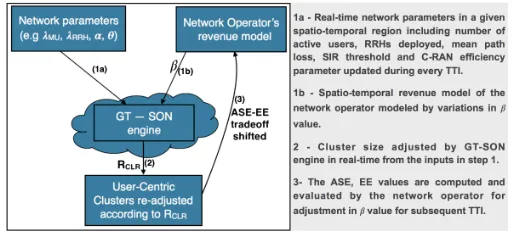
The GT based SON engine is embedded within the central-ized BBU pool for real-time adjustment ofRCLR to optimize a system level efficiency parameter of interest with respect to terrain environment, user demographics, RRH deployment sce-nario and network operator’s spatio-temporal revenue model (see fig.2). The variation in the cluster size models the dynamic tradeoff between ASE and EE in our bargaining game model. The proposed GT-SON framework with the sequence of steps in dynamic cluster size adjustment for modeling the ASE-EE tradeoff is given in fig. 2.
[image:5.612.309.565.425.542.2]To analytically express the ASE-EE tradeoff, we formulate a two-player cooperative bargaining game where both ASE and EE are modelled as virtual game players that indepen-dently estimate the best cluster size for maximizing their respective utility functions. We will see later that due to a large dissimilarity in cluster size preferences of the players, each player’s payoff is affected by the cluster size selection made by the other player. However, both players can mutually benefit through the cooperative game where they negotiate for the RCLR that achieves optimal ASE-EE tradeoff. Using Nash’s axiomatic model, it is well known that the Nash bargaining solution (NBS) achieves a pareto-optimal solution, i.e. the optimal tradeoff in the utilities of the players in such cooperative games [20]. If the players can be denoted by the
Fig. 2. GT-SON Framework in UCRAN
setN={1,2}, where playeri= 1denotes ASE, playeri= 2 denotes EE and Si denotes the set of all feasible payoffs to an arbitrary MUi as
Si ={Ui|Ui=Ui(RCLR), RCLR∈R:RCLR>0}. (10)
Let us define the spaceS as the set of all feasible payoffs that playersi∈Ncan achieve when they collaborate, i.e.
S={U = (u1, u2)|u1∈S1, u2∈S2} (11)
whereu1(x1)is the utility of the first player andu2(x2)is the utility
of the second player such that
and x1 = x2 = RCLR ∈ R : RCLR > 0. β ∈ [0,1] is the
exponential bias factor in NBS that defines the bargaining power (or the tradeoff) division between the two players. We also define the disagreement space D ∈ S as the set of the two disagreement points d= (d1, d2)whered1=u1(D)and
d2 =u2(D) represent the payoffs for the two players if the bargaining process fails and no outcome is reached. For our game, we set d = (0,0) thus giving both players uniform leeway to improve their utilities. [21] shows that the NBS in such parametric cooperative games exists only if the utility functions for the players form convex and compact sets.
Proposition 3. The utility and disagreement spaces in the proposed GT-SON framework constitute a two-player bargain-ing problem defined by (S, d)whereS ∈R2,d∈ S and the resulting unique bargaining outcome is pareto-optimal.
Proof: A bargaining problem can be defined as the pair (S, d) if: i) S is a convex and compact set, ii) There exists some s ∈ S such that s > d, i.e. s1 > d1 and s2 > d2. It is quite obvious that S is compact and since d = (0,0), positive utilities for our players satisfies the 2nd condition. This leaves behind the question whether S is convex which holds true if: ∀ǫ : 0 ≤ ǫ ≤ 1, if Ua = (ua
1, ua2) ∈ S1 and
Ub = (ub
1, ub2) ∈S2, then ǫUa+ (1−ǫ)Ub ∈ S. From (8), we see thatǫua
1+ (1−ǫ)ub1= [¯λM Ulog2(1 +γth) ¯P]β where ¯
P = [ǫ(Pa
suc)β + (1−ǫ)(Pbsuc)β] and since we know that 0 ≤ Pa
suc, Pbsuc, β ≤ 1, the sum in (14) forms a convex set, i.e.
ǫua
1+ (1−ǫ)ub1∈S1. (14) Similarly, from (9), we see that ǫua
2 + (1 − ǫ)ub2 = [ λ¯M Ulog2(1+γth) ¯P
λRRHpACT¯ (M θP0+∆uPu)]
(1−β), where the numerator is
con-vex from (14) and denominator is concon-vex since pACT¯ =
ǫ(pa
ACT)1−β+(1−ǫ)(pbACT)1−βand0≤paACT,pbACT, β≤1. Therefore,
ǫua
2+ (1−ǫ)ub2∈S2. (15) From (14) and (15), we conclude that ǫUa+ (1−ǫ)Ub ∈ S which satisfies the conditions for convexity for setS. Accord-ing to Nash’s axiomatic approach [20], there exists a unique solution for the two-player bargaining problem which is the pair of utilities (s∗
1, s∗2)that solves the following optimization problem:
max (s1,s2)
(s1−d1)(s2−d2),(s1, s2)∈ S ≥(d1, d2). (16)
Proposition 3 implies that for an arbitrary MU x, the optimal cluster size "RoptCLR,x" is obtained through the solution of a convex optimization problem (also known as Nash Product (NP)) which for our model can be given by
RoptCLR,x= max
RCLR,x
[ASE(RCLR,x)]β[EE(RCLR,x)]1−β. (17)
Notice that the computational complexity of the GT-SON en-gine is a function of the cluster size granularity, i.e.O(NCLR) whereNCLR denotes the number of distinct cluster sizes over which the optimization in (17) is performed. As the processing times are independent of MU or RRH densities, real-time implementation of the GT-SON optimization framework is practically realizable and scalable throughout the network.
V. SIMULATIONRESULTS ANDDISCUSSION In this section, we discuss the analytical trends and Monte Carlo simulation results for an LTE-like dense network de-ployment scenario. For simulation, we consider a two tier HetNet with a tri-sector hexagonal MBS of radius 500 m. We consider a single sector of the MBS covering an area of 73850 m2 where MUs and small cell RRHs are uniformly distributed according to their independent SPPPs. Without loss of generality, the channel power gains between all MUs and RRHs are assumed unity. We assume uniform transmit power of 30 dBm for all RRHs. Other power consumption parameters are taken from [21]. Simulation results are averaged over 1000 Monte Carlo trials.
A. Impact ofβ on ASE, EE in a UCRAN
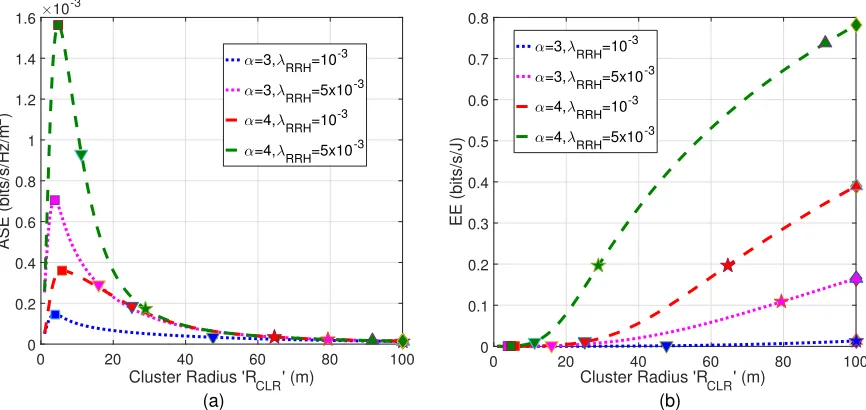
From the analytical results in (8), (9) and (17), we investi-gate the variation in the optimal cluster size and the efficiency metrics asβ is shifted between ASE-optimal (β = 1) and EE-optimal (β= 0) points. The GT-SON engine optimizesRCLR on the following fixed network parameters:λM U= 10−2/m2,
θ = 0.5, γth = 4 dB, and 0 < RCLR ≤ 100 m. The ASE results in fig. 3a indicate around the same ASE-optimal cluster size of 5m for variations in pathloss exponent and RRH deployment densities. It is seen that higher RRH densities yield superior system throughput which is understandable considering pACT is expected to increase with λRRH. It is also noted that α = 4 yields more than two-fold increase in ASE as compared to α = 3. Since mmWave network propagation studies [22] have indicated higher pathloss due to blocking effects, the UCRAN is expected to yield more system capacity at mmWave spectrum by virtue of relatively larger MU-interfering RRH distances. EE results in fig. 3b indicate optimalRCLR to be the highest possible cluster size because of the combined effect of inreased throughput and reduced power consumption with increase in RCLR. Like ASE, the maximum EE is achieved at higher RRH density and pathloss exponents. This implies that the GT-SON engine will most effectively utilize the ASE-EE tradeoff with gain variations of over 100% through appropriate β adjustment in ultra-dense mmWave networks.
B. User QoE Analysis in a UCRAN
Users’ QoE analysis is conducted through SINR distribution between MUs in an LTE like simulation tool with network parameters: λM U = 10−2/m2, λRRH = 10−3/m2, α=4,
0 20 40 60 80 100
Cluster Radius 'RCLR' (m)
0 0.2 0.4 0.6 0.8 1 1.2 1.4 1.6
ASE (bits/s/Hz/m
2 )
×10-3
α=3,λ
RRH=10 -3
α=3,λ
RRH=5x10 -3
α=4,λ
RRH=10 -3
α=4,λ
RRH=5x10 -3
0 20 40 60 80 100
Cluster Radius 'RCLR' (m)
0 0.1 0.2 0.3 0.4 0.5 0.6 0.7 0.8
EE (bits/s/J)
α=3,λ
RRH=10 -3
α=3,λ
RRH=5x10 -3
α=4,λ
RRH=10 -3
α=4,λ
RRH=5x10 -3
[image:7.612.82.515.54.259.2](b) (a)
Fig. 3. (a) ASE and (b) EE at differentβvalues when varying theλRRH andα. The NBS for each use case is shown separately for ASE
and EE atβvalues of 0, 0.25, 0.5, 0.0.75 and 1 and denoted by,N, ⋆,Hand respectively.
-40 -20 0 20 40 60 80
SINR (dB)
0 0.1 0.2 0.3 0.4 0.5 0.6 0.7 0.8 0.9 1
UC(ASE) UC(EE) NUC
Fig. 4. Downlink SINR cdf comparison between centric and non user-centric approaches
is because of lower number of users in the thinned PPP ¯λM U which is a direct consequence of the larger cluster sizes in EE optimization. The 5 percentile SINR performance (for the cell-edge users with worst SINR in conventional networks) is also significantly improved for user-centric approaches with about 20 dB and 40 dB gain with UC(ASE) and UC(EE) respectively. Clearly the user-centric approach eliminates cell-edge degradation and guaranteed high QoE for every user regardless of its physical location.
C. ASE, EE v/s λRRH in a UCRAN
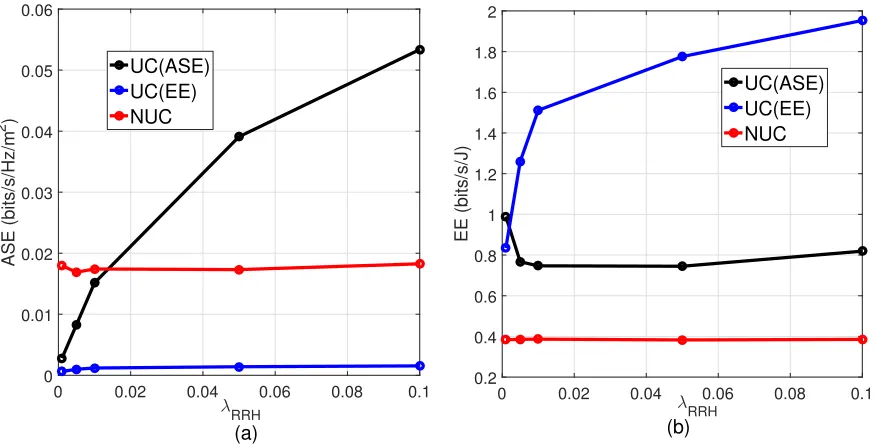
Fig. 5 compares the system wide ASE and EE of the user-centric approaches with the baseline scheme at different RRH densities and λM U = 10−2/m2, α=4, θ = 0.5 andγth = 4 dB. Fig. 5a reveals that as the RRH deployment density increases, UC(ASE) emerges as the most data efficient scheme.
While NUC exhibits uniform ASE, UC(ASE) by virtue of increasedPsucexhibits highest system capacity. On the other hand, UC(EE), though not throughput efficient by any regards, yields more than 5 times power efficient network as compared to NUC approach (fig. 5b). This observation highlights the inherent ASE-EE tradeoff available to the network operator by adjustingβ via the GT-SON and choosing the appropriate RRH cluster size.
VI. CONCLUSION
0 0.02 0.04 0.06 0.08 0.1
λ RRH
0 0.01 0.02 0.03 0.04 0.05 0.06
ASE (bits/s/Hz/m
2 )
UC(ASE) UC(EE) NUC
0 0.02 0.04 λ 0.06 0.08 0.1
RRH
0.2 0.4 0.6 0.8 1 1.2 1.4 1.6 1.8 2
EE (bits/s/J)
UC(ASE) UC(EE) NUC
(a) (b)
Fig. 5. (a) ASE and (b) EE comparison of UC(ASE), UC(EE) and NUC approaches with different RRH densities
ACKNOWLEDGEMENT
This material is based upon work supported by the National Science Foundation under Grant Number 1619346 and Grant Number 1559483.
REFERENCES
[1] S. Zaidi, S. Affes, U. Vilaipornsawai, L. Zhang, and P. Zhu, “Wireless Access Virtualization Strategies for Future User-Centric 5G Networks,” in2016 IEEE Globecom Workshops (GC Wkshps), Dec 2016, pp. 1–7. [2] L. Wang and Q. Liang, “Optimization for user centric massive mimo cell free networks via large system analysis,” in 2016 IEEE Global Communications Conference (GLOBECOM), Dec 2016, pp. 1–1. [3] B. Romanous, N. Bitar, S. A. R. Zaidi, A. Imran, M. Ghogho, and H. H.
Refai, “A Game Theoretic Approach for Optimizing Density of Remote Radio Heads in User Centric Cloud-Based Radio Access Network,” in 2015 IEEE Global Communications Conference (GLOBECOM), Dec 2015, pp. 1–6.
[4] V. Mohanan, R. Budiarto, and I. Aldmour, Powering the Internet of Things With 5G Networks, ser. Advances in Wireless Technologies and Telecommunication. IGI Global, 2017. [Online]. Available: https://books.google.com.pk/books?id=XYwtDwAAQBAJ
[5] R. Wang, H. Hu, and X. Yang, “Potentials and Challenges of C-RAN Supporting Multi-RATs Toward 5G Mobile Networks,”IEEE Access, vol. 2, pp. 1187–1195, 2014.
[6] A. Checko, H. L. Christiansen, Y. Yan, L. Scolari, G. Kardaras, M. S. Berger, and L. Dittmann, “Cloud RAN for Mobile Networks x2014;A Technology Overview,”IEEE Communications Surveys Tuto-rials, vol. 17, no. 1, pp. 405–426, Firstquarter 2015.
[7] C. Mobile, “C-RAN: the road towards green RANs,”White Paper, ver, vol. 2, 2011.
[8] Y. Zhang and Y. J. Zhang, “User-centric virtual cell design for Cloud Radio Access Networks,” inSignal Processing Advances in Wireless Communications (SPAWC), 2014 IEEE 15th International Workshop on, June 2014, pp. 249–253.
[9] A. Imran, M. Imran, and R. Tafazolli, “A novel Self Organizing framework for adaptive Frequency Reuse and Deployment in future cel-lular networks,” inPersonal Indoor and Mobile Radio Communications (PIMRC), 2010 IEEE 21st International Symposium on, Sept 2010, pp. 2354–2359.
[10] H. Zhang, Z. Yang, Y. Liu, and X. Zhang, “Power Control for 5G User-Centric Network: Performance Analysis and Design Insight,”IEEE Access, vol. 4, pp. 7347–7355, 2016.
[11] C. Li, J. Zhang, M. Haenggi, and K. B. Letaief, “User-Centric Intercell Interference Nulling for Downlink Small Cell Networks,”IEEE Trans-actions on Communications, vol. 63, no. 4, pp. 1419–1431, April 2015. [12] S. Bassoy, M. Jaber, M. A. Imran, and P. Xiao, “Load Aware Self-Organising User-Centric Dynamic CoMP Clustering for 5G Networks,” IEEE Access, vol. 4, pp. 2895–2906, 2016.
[13] S. Zaidi, A. Imran, D. McLernon, and M. Ghogho, “Characterizing Coverage and Downlink Throughput of Cloud Empowered HetNets,” Communications Letters, IEEE, vol. PP, no. 99, pp. 1–1, 2015. [14] J. M. D. Stoyan, W. S. Kendall and L. Ruschendorf,Stochastic geometry
and its applications. Wiley Chichester, 1995, vol. 2.
[15] M. Haenggi, “Mean Interference in Hard-Core Wireless Networks,” Communications Letters, IEEE, vol. 15, no. 8, pp. 792–794, August 2011.
[16] Z. Chen, C.-X. Wang, X. Hong, J. Thompson, S. Vorobyov, X. Ge, H. Xiao, and F. Zhao, “Aggregate Interference Modeling in Cognitive Radio Networks with Power and Contention Control,”Communications, IEEE Transactions on, vol. 60, no. 2, pp. 456–468, February 2012. [17] [Online]. Available: https://www.ict-earth.eu/
[18] R. Gupta, E. Calvanese Strinati, and D. Ktenas, “Energy efficient joint DTX and MIMO in cloud Radio Access Networks,” in Cloud Networking (CLOUDNET), 2012 IEEE 1st International Conference on, Nov 2012, pp. 191–196.
[19] G. Auer, V. Giannini, C. Desset, I. Godor, P. Skillermark, M. Olsson, M. Imran, D. Sabella, M. Gonzalez, O. Blume, and A. Fehske, “How much energy is needed to run a wireless network?”Wireless Communi-cations, IEEE, vol. 18, no. 5, pp. 40–49, October 2011.
[20] Z. Han, D. Niyato, W. Saad, T. Basar, and A. Hjorungnes, Game Theory in Wireless and Communication Networks: Theory, Models, and Applications. Cambridge University Press, 2012.
[21] B. Romanous, N. Bitar, S. A. R. Zaidi, A. Imran, M. Ghogho, and H. H. Refai, “A Game Theoretic Approach for Optimizing Density of Remote Radio Heads in User Centric Cloud-Based Radio Access Network,” in 2015 IEEE Global Communications Conference (GLOBECOM), Dec 2015, pp. 1–6.
[22] T. S. Rappaport, G. R. MacCartney, M. K. Samimi, and S. Sun, “Wideband Millimeter-Wave Propagation Measurements and Channel Models for Future Wireless Communication System Design,” IEEE Transactions on Communications, vol. 63, no. 9, pp. 3029–3056, Sept 2015.
[image:8.612.80.518.51.273.2]