***
*
*
*
*
*
*
•••
COMMISSION OF THE EUROPEAN COMMUNITIES
Brussels, 18.07.1997 COM(97)373 final
RESEARCH AND TECHNOLOGICAL
DEVELOPMENT ACTIVITIES
OF THE EUROPEAN UNION
1997 ANNUAL REPORT
SUMMARY
This Annual Report by the Commission on research activities in the year 1996 is the third in the series. It fulfils the requirement of Article 130P of the EC Treaty and of the Framework Programme decisions (EC and Euratom) for the Commission to
send
a report each year to the European Parliament and the Council. It is written, however, with a broader audience in mind. By providing a synopsis of policy developments and an analysis of research activities undertaken and results achieved, it will be of interest to researchers and research organisations, industrial enterprises. research policy planners and politicians, whether they are already involved in Community research or new to the field.This year's report builds on the experience of previous repOrtS and the comments received ori them. It is distinct notably from the 5-year assessments reports and the annual monitoring reports prepared by independent experts on both the framework programmes and the specific programmes. The intention is, however, that it should complement these reports which therefore together provide a wealth of information, from different perspectives, on the European Union's research activities: The report itself gives an overview of the major developments during the year. (in this case extending into the first months of 1997 to cover the development of the Commission's proposals for the Fifth Framework Programme). Annex I gives more detailed information tor each specific proarammc on the research activities carried out in 1996, examples of achievements of projects commenced in earlier years which have come to fruition in 1996, and projects for 1997. Annex II gives statistical tables on signed contracts in 1996, projects and funding.
In 19% and in addition to continued processing of calls for proposals and the establishment of project contracts under the Fourth Framework Programme, a major effort was made to prepare future research activities. The Commission initiated a large scale debate on the Fifth Framework Propamme, leading up to formal proposals early in 1997. Negotiations were pursued on a proposal for supplementary funding for the Fourth Framework Programme. The Green Paper on Innovation was followed up with an Innovation Action Plan .
•••
The Fourth Framework Programme has been particularly successful in involving small and medium sized enterprises (SMEs). During 1995 and 1996 the overall rate of participation was 20% and 3,800 SMEs were involved in collaborative research projects, as many as fnr the full four years of the Third Framework Programme. 1 ,200 SMEs moreover benefited from exploratory awards and CRAFT projects during this period. The first 5-year independent assessment of Community · research was carried out in 1996, and covered all of the specific programmes as well as the
framework programme.
The overall assessment, conducted by a Panel chaired by Viscount Davignon acknowledged the importance and quality of Community research. Looking to the future, the Panel concluded that a more strategic and flexible approach is needed if the full potential of the framework programme is to be realised I.
***
The main focus for policy developments in 1996 was the preparation of the -Fifth Framework Programme. The Commission initiated an intensive debate and adopted in July a Communication2
setting out first guidelines under the title "Inventing Tomorrow". This signalled a major r::hange in approach, to si~t!plify the structure of the framev.rork progr~mme and to achieve significant improvements in the concentration of research effort, flexibili~y and efficiency.
Member States, representatives of industry, the research community and ot~1er interested parties all contributed to the debate, and approximately 200 external position papers were submitted to the Commission. The European Parli~ment adopted a Resolution on the future of science and technology policy, based on an own-initiative report. A large scale public seminar was organised by the Commission in February 1997.
"Inventing Tomorrow" was followed up with two workfng papers, describing respectively. the modalities and research content proposed by the Commission3 and in April 1997 the Commission adopted formal proposals for the Fifth Framework Programme4•
The C9mmission presented in January 1996 its proposal for a financial supplement for the Fourth Framework Programme, amounting to a total of ECU 700 million focused on a limited number of priority areas. Following lengthy negotiations, a final decision on a reduced level of funding is due to be made by the European Parliament and Council.
The first Action Plan for European Innovation was adopted by the Commission in November\ following an invitation from the European Council. Directed towards helping to overcome European weaknesses in turning research into innovation, and taking account of the wide-ranging debate initiated by the Commission's Green Paper on Innovation published in 19956 • the Action Plan identifies a number of priority areas for the Community.
COM(97) 151 final. 15.04.1997
COM(96) 332 tina!, 10.07.1996
COM(96) 595 timtl. 20.11.1996; and COM(97) 47 final, 12.02.1997
COM(97) 142 final. 30.04.1997 COM(96) 589 tina!, 20. 11.1996
Efforts to improve research coordination at Europelill level by regular exchange of information on national activities, and to improve the coordination and interface between research and structural policies, were further developed in 1996. A Communication was adopted in July on promoting cooperation with emerging economies 7, and negotiations on scientific and technological cooperation with the United States were begun. The Commission continued to work 0~1
:improvements to management efficiency, holding a seminar in June with representatives of industry
and the research community. ·
[
CONTENTS
THE COMMUNITY'S RTD POLICY IN 1996- 1997
· 1. PREPARATION OF FUTURE RESEARCH POLICY GUIDELINES ... ."t
1.1 FROM "INVENTING TOMORROW" TO THE FORMAL 5th FRAMEWORK
PROGRAMME PROPOSAL ... 1
1.2 THE CONTRIBUTIONS TO THE PREPARATION OF THE 5TU FRAMEWORK PROGRAMME .•..•••..••••..••.•.••.•••.••.••..••••.•.•••••••••.•• ~ •••••..•.•.•..••.•..••••••.•••••..•..•..•..••..•...•...•..•...••.•....•... J 2. OTHER MAIN ASPECTS OF COMMUNITY RESEARCH POLICY IN 1996 -1997 •···•·••··•·•••·•••·•••••••••••••••••••••••••••••·•••·••···•••••·••··••···•·•••···••·••••·•···•···•···•··· 5
2.1 FINANCIAL SUPPLEMENT ... :: ... S 2.2 ACTION PLAN FOR INNOVATION IN EUROPE ... : ... 6
2.3 CREST AND COORDINATION BETWEEN COMMUNITY POLICIES AND NATIONAL POLICIES ... 7
2.4 ADVISORY COMMITTEES ... 8
2.5 RTD POLICY AND ECONOMIC AND SOCIAL COHESION ... 9
1.61NTERNATIONAL COOPERATION ... II 3. RESEARCH ACTIVITIES IN 1996 AND IMPLEMENTATION OF THE FRAMEWORK PROGRAMMES ....•... ~ ... It 3.1 SCIENTIFIC AND TECHNICAL RESULTS ... 12
3.2 MONITORING OF THE FRAMEWORK PROGRAMMES ... 12
3.3 CONTRACTS SIGNED AND PAYMENTS MADE IN 1996 : ANNUAL BASIS AND FRAMEWORK PROGRAMMES ... 13
3.4 IMPLEMENTATION OF THE FRAMEWORK PROGRAMMES AND OBJECTIVES OF EUROPEAN RESEARCH POLICY ... 14
3.4.1 Industrial pa1ticipation in the framework programme ... 14
3.4.2 Technology stimutation measures for SME access to RTD ... 14
3.4.3 Research collaboration links in the European Union ... 16
4. MANAGEMENT OF RESEARCH ...••...•..•... 16
ANNEX I : RTD ACTIVITIES AND WORK PROGRAMMES FOR 1997 ... 19
ANNEX II: STATISTICAL AND FINANCIAL DATA: ANNUAL BASIS 1996 AND FRAMEWO'RK PROGRAMMES ... 75
THE
COMMUNITY'S
RTD
POLICY IN
1996 -
1997
·.The European· Union's research and technological development (EU RTD) policy aims to strengthen Europe's scientific and technological base and thus to contribute to the development of the competitiveness of European industry and to promote the quality of life of Europe's citizens. EU RTD policy complements Member States' national research efforts and supports other Union policies such as on agriculture, cohesion, transport, environment, health, education, energy, etc.
The European Union's RTD policy is implemented by means of research programmes which
associate . companies - including SMEs - universities and r~earch centres from various European
countries in joint research projects. The research themes covered by EU RTD are defined in multiannual Framework Programmes. The current Framework Programme ( 1994:-1998) has a total bu4get of ECU 13 100 million, respectively ECU 11 764 million for the Fourth EC Framework Programme and ECU 1 336 million for the Euratom Framework Programme. This figure may be increased by between ECU 100 and 200 million, depending on the outcome of a decision on a financial supplement currently being debated between the European Parliament and Council.
The Joint Research Centre (JRC) with its seven institutes is the Community's own research centre, which carries out research directly, contributes to the implementation of the Framework ,Programmes and provides scientific support for other Union policies. A separate annual report of
the JRC for 1996 is available8 (brief summary is included in Annex 1).
1. Preparation of future research policy guidelines
LL
From "Inventing Tomorrow" to the formal 5th Framework Programme pranosalWith the approach of the new millenium, the Commission has decided to make the 5th Framework
Programme the instrument of a new Community research strategy. European citizens now expect scientific and technological advances to meet their concerns with regard to health and quality of life and their aspirations in terms of social welfare and economic prosperity.
In this context, at the beginning of 1996 the Commission began to consider what form the 5th Framework Programme should take, consulting all the parties involved in the future of European research.
On the basis of the suggestions· received and its own experience of the four previous framework
programmes, the Commission set out preliminary guidelines for the 5th Framework Programme9• in
July 1996, in its communication "Inventing Tomorrow'.''o:
"Inventing Tomorrow" emphasises the socio-economic needs of the Union which Community research must address. On the basis of strict selection criteria, six priority themes were identified tor research, technological development and demonstration activities:
• unlocking the resources of the living world and the ecosystem, · • creating a user-friendly information society,
• promoting competitive and sustainable growth,
• confirming the international role'of·European research, • innovation and participation of SMEs,
• improving human potential.
This communication sparked off a wide-ranging exchange of ideas. Many reactions were received and it was generally welcomed by government bodies, academia and industry, __ and various trade associations.
The Commission gradually fleshed out the ideas for the 5th Framework Programme outlined in "Inventing Tomorrow"; first of all, concerning its structure (six programmes), in a first working paper'' adopted in November 1996; and then, concerning the scientific and technical content, in a second working paper 12 adopted in February 1997.
On this basis, on 30 April 1997, the Commission adopted its two formal proposaJs13 for the 5th Framework Programme (the first pursuant to the EC Treaty, the second pursuant to the Euratom Treaty).
Characterised by a simplified structure, with six programmes, the 5th Framework Programme breaks new ground compared with earlier framework programmes. This desire for simplification will lead both to greater consistency in action by the Community as a result of wider-ranging programmes, each addressing priority socio-economic needs of the Union and greater t1exibility and efficiency of management, thanks in particular to the decompartmentalisation of activities within programmes where· various scientific and technlogical disciplines interact.
The six programmes corresponding to the six priority themes identified in .. Inventing Tomorrow'' reflect the Community activities provided for in Article 130 G of the EC Treaty. The tirst three "thematic" progranunes are designed to implement Article 130 G a)l4 while the other three more "horizontal" programmes are designed to implement Articles 130Gb), c) et d). ·
The "horizontal" programll)eS will conduct activities specific .to them but their objectives (international cooperation, innovation and participation of SMEs, and training) will also be pursued to a large extent within the thematic programmes as well.
Another innovation concerns the three thematic programmes which will comprise three types of closely related activities: key actions, activities for research and development of generic technologies, and activities in support of infrastructures.
11 COM (96) 595 final, 20.11.1996
12 COM (97) 47 ttnal, 12.02.1997
IJ COM (97) 142 final., 30.04.1997
The key actions are the expression of a genuine research strategy; they reflect a proactive approach aimed at the joint resolution of clearly defined RTD problems standing in the way of important socio-economic objectives for
the
Union.The activities for research and development of generic technologies are essential adjuncts of that , strategy. Focusing on priority research issues for the Union, they are intended to encourage creativity and help to forge future knowledge and enrich the Union's scientific and technological base.
The activities in support of research infrastructures supplement the panoply of instruments made available to the thematic programmes, by encouraging access to and optimum utilisation of the Union's major research facilities.
Ll.
Tlte contributions to the pre.pqration aftlte 5th Framework fawommeTHE EUROPEAN PARLIAMENT RESOLUTION ON "SCIENCE AND- TECHNOLOGY POLICY IN THE 21ST CENTURY"
The "Desama" .Report and the subsequent European Parliament Resolution15 provide a general
analysis of the Community's research and technological devel --pment policy.
The "Desama" Report takes stock of the European Union's research and innovation system at the half-way point of the implementation of the 4th Framework Programme (I 994-1998) and analyses its main features. On this basis, a series of possible avenues is proposed for the future.
In its diagnosis, the report analyses the changes that have occurred with regard to the basic concepts: it concludes that the linear model linking research and innovation is now obsolete, and goes on to identify the characteristics of a new mode of knowledge production operating in a context of transdisciplinary application and according to heterogeneous and transitory non-hierarchial forms. The needs of today, which call for the deployment of new practices. favour interaction and a multidisciplinary approach. A new "European research and innovation system" is therefore needed in order to improve coordination and reduce the many examples of compartmentalization.
The problems identified as havin~ priority are connected both with the needs of the European research and innovation system and with issues relating to R&D policy. Where the tirst aspect is concerned, the relationships between research and innovation should be addressed while, where the second aspect is concerned, a new structure for the framework programme, new programme management arrangements, new techniques for funding Community research, new tasks for the Joint Research Centre, and reinforced international cooperation activities should be envisaged.
OUTSIDE CONTRIBUTIONS TO THE 5TH FRAMEWORK PROGRAMME PROPOSAL
Their opinions and comments concerned in particular the structure of the framework programme, the procedures for identifying and selecting objectives, and ways of improving coordination and flexibility of management. Among the issues most often brought up, mention can be made of the following:
i. Research needs public support since knowledge production is a lengthy process. This activity cannot depend on market forces alone. In order to be able to address major complex issues, research needs investment over the medium or long term. It is essentially an activity involving risks.
2. The broad lines of the framework programme should reflect the expectations of society. The need to identify social requirements before defining research priorities was widely endorsed. Needs relating to health care, quality of life, mobility an~ the requirement to increase competitiveness of
industry, and in particular of SMEs~ and maintain or create jobs were often mentioned.
3. A consensus emerged about relying on the experience acquired and focusing res~_urces on problems
common to the Union as a whole where there is an identifiable Community "added value". ·
4. Greater flexibility was often called for in the Community programming arrangements to allow tor the possibility of addressing unforeseen issues during the implementation of the programmes. In this connection, the general feeling was that further simplification and streamlining of management would be· desirable.
The Govenunent bodies, economic interests, user and consumer groups \vere particularly insistent that the priorities identified for the 5th Framework Programme should serve to help the most hmovative businesses to regain economic growth; more generally, Community research should encourage job creation throughout the Union.
FIVE- YEAR ASSESSMENT OF THE FRAMEWORK PROGRAMMES
The five-year evaluation of the framework programmes and the specific programmes was carried out by panels of independent outside experts and covered Community RTD activities conducted
over the last five years. ·
The operation was mainly conducted in 1996, culminating in an overall report in February 1997, and involved the setting up of 18 panels, one for each specific programme. seven panels for the seven JRC institutes (an independent expert compiled a summary report) and a panel tor the overall evaluation of the framework programmes chaired by Viscount Etienne Davignon. This exe1:cise involved a total of around 170 internationally recognised experts.
The Davignon panel comprised eight very high level experts, and its recommendations are based on a thorough knowledge of European research and on the_ evaluation of the results of the ti·amework programme. In particular, the panel said that it was satisfied with the research can·ied out in the programmes. However, it would like the framework programme to reflect a genuine Cemmunity strategy, the priorities of which coincide better with those of the Union and are not simply an amalgam of national wishes. In addition, the report stresses the difficulty of deciding on rapid readjustments to take account of new research needs, and recommends a structure geared to the formulation of autonomous Community strategies.
the framework programme needs to be the fruit of a strategic approach. To this end, the panel recommends in particular changes to the legal framework {in particular adoption of the Council decisions by qualified majority), and improvements in the implementation process and methods, in particular more active promotion of the diffusion of technology and commercial exploitation, greater assistance to SMEs to give them access to RTD, a more systemic approach, the creation of ; virtual institutes, and Union participation in national projects.
In its 5th Framework Programme proposal the Commission took the utmost account of the panel's recommandations that are compatible with the existing legal framework.
The report on the evaluation of the framework programmes and the summaries of the conclusions and recommendations of the panels for the evaluation of the specific programmes were published together with the Commission's reply 16.
2. Other main aspects of Community research policy in 1996-
1997
lL
Financial suvvlementIn January 1996, the Commission made a proposaJ17 to increase the overall budget of the Fourth EC Framework Programme {1994-1998) and the Euratom Framework Programme ( 1994-1998) by a· total of ECU 700 million, as provided for in Article 1 (3) of the relevant decisions.111 The objective
of the proposal was selectively to refinance certain priority research areas associated with the research-industry .Task Forces : aeronautics, educational software and multimedia. transport intermodality, the car of tomorrow and the environment, including water.
In November the Commission adjusted the proposed figure to ECU I 00 million; while emphasising that this took account of the fact that the financial perspective 1995-1999 remained unchanged and that the budgetary procedure for 1997 had not then been concluded. At the same time, the research _themes were amended, both to take into account the suggestion of the European Parliament tor research on landmine detection and to respond to the concems raised by the appearance of a new form of Creutzfeldt-Jakob disease which could be linked to BSE in cattle. As regards the latter. a set of research activities involving the three life sciences programmes amounting to a total of 35 Mecu was included, following directly from the Action Plan on Transmissible Spongit(xm Encephalopathies (TSE) proposed by the Commission on the basis of the report of a high level expert committee.
Furthennore the Commission ensured that the preliminary draft budget tor 1998 included a sufficient margin to allow for the possibility of a financial supplement of more than ECU I 00 million. Thus the Commission has made every endeavour to facilitate an early agreement by co-decision between the European Parliament and the Council and to ensure that their co-decision can be quickly impleme~lted.
l l
Action Plan for Innovation in EurapeThe Green Paper on Innovation published by the European Commission in I 995 emphasised Europe's shortcomings in this area19• The public debate that ensued showed that there was broad agreement about the need for an overall approach to this issue, covering the technological aspects, :training, the development of venture capital, and the legal and administrative environment.
At the June 1996 Florence Summit, the European Council called upon the Commission to draw up an action plan for innovation.
Action for innovation is first of all the responsibility of individual citizens, firms and national, regional and local authorities. In compliance with the principle of subsidiarity, action at Community level is called for in order to establi$1 and enforce the ground rules, and organize the exchange and diffusion of best practices. Last but not least, the Community should set an example by mobilizing its own instruments, and in particular the RTD Framework Programme and the Structural Funds.
In the interests of efficiency, the First Action Plan for Innovation in Europe, adopted by the Commission on 20 November 199620, sets out a number of priority measures to be launched rapidly at Community level and incorporates the measures in progress or announced since the launching of the Green Paper on Innovation. These measures can be grouped together according to the following three objectives:
• fostering a genuine innovation culture;
• establishing a legal, regulatory and financial framework conducive to innovation; • . gearing research more towards innovation.
In the field of education and training, the plan advocates measures aimed at promoting initial training ("Learning in the information society" and Erasmus apprenticeship initiative~ ... ). encouraging the mobility of researchers and engineers (placement in tirms ... ), and helping to develop an innovation culture in firms (stepping up training schemes in management tor innovation ... ).
Adjustments are also required in the regulatory and legal field, in particular as regards the protection of industrial and intellectual property (e.g. launching of a Green Paper on the Community patent and the European patent system, and setting up of an intellectual property help desk tor Community research - IPR Help Desk).
Where funding is concerned, the Commission will encourage venture capital companies to invest more in the early phases of innovative projects (launching of the I-TEC pilot project with the European Investment Fund), and create conditions to encourage the development of new European capital markets for rapidly growing firms. Last but not least, the action plan proposes the stepping up of technology watch activities at European level; and measures to encourage the formation
or
technology-based companies (campus companies, clustering).Jhis Action Plan is a first step, and others will be needed. It provides a common reference framework which can be applied to specific sectors and adapted to the particular circumstances of individual Member S_tates. The Commission intends to examil{e their priorities with them. The
19 The Green Paper on Innovatio•l specifies the concept of innovation ami proposes areas for action. CO!'vl(<.l5) oRR final.
20.12.1995
intention is to set in motion a joint economic and social dynamic process that will generate growth and create jobs.
2.1..
CBEST and coordination between Community POlicies and nqtionq/policjes, In the course of 1996, to carry out its mandate, as renewed by the Council Resolution of 28.9.95, CREST (the Scientific and Technical Research Committee) held discussions concerning the coordination of RTD policies as a whole and the identification of strategic priorities for Community RTD. These discussions resulted 1n the adoption by the Committee of reports and opinions: a contribution on the 5th Framework Programme; opinions on the research-industry Task Forces, the Commission communication on the prospects for international R TD cooperation21, and the process of evaluating and monitoring RTD activities under the 4th Framework Programme, and a report on SMEs in the context of the Framework Programme.
With regard to activities more specifically concerned with coordination between European policy and national policies, in particular in connection with Article .130H of the EC Treaty, the Con~mittee
started to discuss, on the basis ofa study launched by the Commission, a theme of common interest liable to be the subject of coordination activities, namely indirect RTD support measures in industry. A seminar aimed at identifying best practices in this area will be organized in 1997. [n addition, on the Commission's initiative, in 1997 CREST will discuss other themes of con l. n
interest where possible, bearing in mind that the Committee's deliberations will be strongly influenced by the preparation of the 5th Framework Programme.
With regard to the establishment of a system for the exchange of information in national R TO activities, on the Commission's initiative and in accordance with the Council conclusions of 9.6:.95. the ad hoc advisory committees produced their first annual reports on the various programmes. The main featuresof the ad hoc committees' 1996 annual reports concern the choice of priority areas where increased coordination might be profitable. Examples of areas \Vhich are or will be the subject of coordination activities are given below.
In the case of materials, the ad hoc committee recommended three themes: "clean material processing", "raw and traditional materials", and "high added value materials'', the lattet· having priority.
Turning to research into information technoloiies, software, multimedia, and new industrial paradigms ("Integration in Manufacturing" (liM) and "Teclmologies for Business Processes" (TBP) are the areas most frequently mentioned as candidates for possible coordination.
Where biotechnoloiy is concerned, structural biology was the theme recommended tor a pilot coordination action in 1996.
As regards non-nuclear eneriy, the areas "clean coal techi1ologies" and "photovoltaic" were chosen ti.w
1996, and "Biomass" and "waste and energy in transport" were chosen tor I 997.
With regard to the djssemjnatjon and exploitation of results, technology take-up by 1inns and. in particular, SMEs, and the taking into account of innovation in RTD policy were judged to be the most relevant for the exchange of infonnation in 1996.
Turning to traininK throuah research, the areas judged to be priority candidates for coordination are · "skills and competences of European researchers in the future" and "industry-academia relationship in training through research": hnge-scale facilities were also regarded as an area of growing importance where the possibilities for coordination should be explored.
This first annual exercise of exchanging infonnation on national RTD activities is judged to have been positive overall, and a dynamic process has been set in motion. In most cases, it ensured a better flow of infonnation regarding RTD activities between Member States and the Commission. lt also showed that the problem lies with organization and dissemination of information between the parties concerned rather than with the infonnation itself. In the first half of 1997, CREST will make a detailed examination of the first annual reports and, on the basis of an analysis by the Commission Services.
will adopt conclusions for the future work of the ad hoc committees. During 1991 these como1ittees
will continue their activities by carrying out more detailed work in the priority areas already selected and identifying other areas.
l l
AdviSozy CommWees- IRDAC
The major themes addressed by IRDAC (Industrial Research and Development Advisory
Committee which now comprises 18 high level industrialists on a personal basis and 5
representatives of European associations) in 1996 were innovation and the 5th Framework
Programme. IRDAC gave its opinion on the Green Paper on Innovation in July 1996 and. at the
Commissioner E. CRESSON's request, is continuing to examine this matter by analysing the
Action Plan for Innovation. Its opinion on the 5th Framework Programme was drawn up in the course of two round tables and presented in June 1996.
The Committee also gave its opinions on: intellectual property rights, services. information and communications teclmologies, manufacturing technologies (industrial and materials technologies). the satellite industry (priority actions in the field of satellite communications and navigation). education and training (Commission White Paper "Teaching and Learning: Towards the Learning Society"), life sciences and SMEs. Round tables are scheduled to be held in autumn 1997 on the specific programmes under the 5th Framework Programme.
Round tables will also be held concerning the standard contract for the 5th Framework Programme. venture capital, industrial efficiency, training and exchanges with industry and obstacles to transnational mobility. The IRDAC summer seminar will focus on the value added by Community RTD policy for European industry and will form the basis for the publication of a study on industry's opinion of European RTD policies.
In 1996 the IRDAC Plenum met Commissioners E.CRESSON. M.BANGEMANN and E. KINNOCK.
-ESIA
-The ESTA (European Science and Technology Assembly, which brings together 96 eminent academics and industrialists) held two plenary meetings in April and October 1996.
nuclear fusion; the role of basic research in Union RTD activities~ Europe's competitive position in science, technology and i11clustry. ESTA's contribution towards the preparation of the new Framework Programme continued via the establishment of workshops on the three priority themes proposed in "Inventing Tomorrow" following each of which reports were submitted in December.
: ESTA also sho~ed particular interest in cooperation between industry and universities with regard to research and international S&T cooperation (in particular the Engelberg Forum, and the examination of the !NCO programme). Several EST A members also took part as observers in the evaluations of the research project proposals. ESTA was also closely involved in the launching of an evaluation of the strengths and weaknesses of European science conducted under the auspices of the main national resea(ch councils.
The October 1996 meeting provided an opportUnity for an exchange of views in the presence of the Commissioner E. CRESSON, on the guidelines proposed by the Commission for the 5th Framework Programme. On this occasion, the Assembly was also invited to pronounce on various matters, including the coordinati_on of ~ational research and the Community~ Action Plan for Innovation.
The membership of the Assembly will be partially renewed in 1997.
l l
RTD polikJ? and economic and social cohesionIn 1996 the coordination and interface between RTD Policy and Structural Policies developed further . . helping to improve the conditions for enhanced economic and social cohesion in the European Union.
The objective of this policy liaison is to continue ~o provide support to measures aimed at narrowing the development gap in less favoured regions in order to make full use of RTD tor the generation of economic growth.
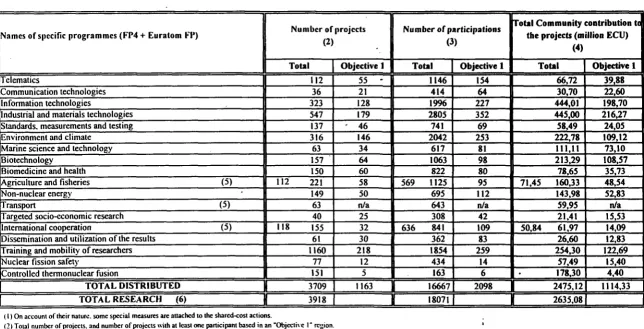
For both the 4th Framework Programme and the Structural Funds, the Conunission's indicators are still at an experimental stage and only give orders of magnitude. Table 6 (Annex II, p. 87) gives. for most of the progranunes, the number of projects with at least one participant based in an hObjective I"
region,22 the number of corresponding participations as well as to the total Community contributions to these projects.
In 1996 for the specific programmes under the first activity (cf A1mex II. Table 9 p. 94) of the 4th Framework Programme (excepting the Transport programme) on average 40% of projects involved at least one participant from Objective 1 regions, 12% of total participations were based on Objective I
regions, and 49% of the total Community contribution went to projects with at least one participant in an Objective 1 region. Although it has not been possible to complete an exhaustive analysis of these relationships, it is illustrative to compare them with the proportion of Europe's population based in Objective I regions (26%) and the share2J of research professionals in those regions in the European Union total (approximately 7%). Calculations made elsewhere for 1995 indicate that objective I projects on average involve more participations than others.
regional innovation and technology transfer strategies and infrastructures (RITTS), regional innovation strategies (RIS), and regional technology transfer (RTT) projects. The call resulted in the selection of 50 proposals involving approximately 60 regions out of 250 regions or 1 almost out of 4 regions in Europe.
:With regard to the Structural Funds. the allocation for RTD related activities in Objective l regions amounts to about ECU 4500 million, which equals 5% of the total objective 1 Community allocation for 1994-99. In Objective 2 regions, RTD has been established as one of the priorities in the current programming period. The Community allocation for RTD related activities in Objective 2 areas for the period 1997-99 has increased to ECU 1500 million (from ECU 870 million for 1994-96) and represents now a ratio24 of 18,5% (12,5% for 1994-96). Operational measures focus inter alia on the ·
provision of training and advisory services, the stimulation of interaction between the scientific and productive sector and the support for SMEs to access and to finance R
:ro.
In order to raise awareness, several accompanying seminars25 have been conducted and publications26
produced in 1996 to familiarise those involved at national; regional and local lever with the potential of RTD to reduce regional disparities. In addition, a major conference on "Global Comparison of Regional RTD & Innovation Strategies for Development and Cohesion (RESTPOR 96)" was held in Brussels (19-21.09.96), bringing 270 participants from 37 countries together to discuss trends·and issues of R TD support in regional development.
Furthermore, an impact study on the enlargement of the EU towards the I 0 associated Central and Eastern European Countries has been launched to analyse the potential for RTD related Community support, facilitating economic development in the countries concerned. In relation to the impact study on enlargement, it is envisaged that 10 local seminars will be organised along with a concluding workshop in Vietma to exchange experiences and to diffuse results in 1997.
The preparation of the Fifth Framework Programme and the prospective re-orientation of Structural Funds beyond 1999 offer good opportunities to explore further synergies between R TD and Cohesion. A planned Commission Communication on "Cohesion, RTD and Competitiveness" will provide strategic guidelines to address relevant structural disparities.
Two conferences have so far taken place inl997, the first on "New approaches to support RTD within the European Union" in Bergamo (6-7.02.1997) and the second, the 6th European STRIDE Conference on "Inter-regional Co-operation and RTD" in Bremen (3-4.03.1997).
Besides the mid-tem1 review of RTD-related Objective 1 operational programmes and O~jective 2 negotiations, activities for 1997 will include the continuation of mobilisation seminars in Objective 2 areas (in Denn1ark, France, Netherlands and United Kingdom), the launch of a study reviewing I 0 years of Community actions to reduce the technology gap in the cohesion countries. and a pub I ication on "Regional RTD profiles for Objective 1 regions".
24 The 8th Annual Report will provide the consolidated and official tigures for Structural Fund expenditun: for RTD.
25 Mobilisation Seminars :
tructural Funds and the stimulation of RTD actions in LFRs- 22.03.1996 Albacete (ES) TD support tbr regional policy and development - 30.05.1996 Jyvlikylli (FI)
&Tin rural areas- 30.09.1996 Monschau (DE)
TD support for regional pol icy and development - 09. 12.1996 Lulea (SW)
26 "Research and Rural Regions, the contribution made by Research and Technological Dt:velnpmcnt in the rural ami bland
regions" ,OPOCE 1996 - "Munaging Science & Technology in the Regions, proceedings of the 5th STRIDE
Conference" ,OPOCE 1996
~ International cooneration
In view of what is at stake for the European Union with regard to international cooperation on S&T the Commission took a number of initiatives in line with its communication on the prospects tor international cooperation on RTD27.
Parliament adopted a resolution in response to the communication, and the Commission organized a symposium (19.11.1996) with experts from the Union and all other regions of the world. It was an opportunity to highlight the possible impact for the EU of S&T cooperation: greater awareness throughout the world of European knowhow in relation to scien~e and technology- in particular by comparison with the USA and Japan - , encouragement for other parts of the world to take into account European practices and standards, to buy European, to
train
in Europe, to invest there and to establish links with European industry.With the prospect of the Union's enlargement towards the East, efforts have been made to strengthen RTD cooperation with the countries in question through the activity "Cooperation with the Central and Eastern European countries and the New Independent States arising from the former Soviet Union" and the other specific programmes under the Framework Programme, partly with the support of the 2nd aGtivity "International cooperation"·
In the wake of the Transatlantic Action Plan signed on 5.12.199::>, the discussions initiated between the EU and the USA on an S&T cooperation agreement continued .
. The communication on promoting cooperation with the ·world's emerging economies (e.g. China, India and Brazil),28 stresses the need to develop RTD cooperation with those countries. which are both the Union's partners and its competitors; it recommends 'the adoption of differentiated approaches based on the conclusion of sectoral agreements.
Where the developing countries are concerned, a conference on pattnership tor research (Leiden, 11-13 March 1997) brought together 200 participants (Research and Cooperation Ministers, European Mps, researchers, etc.) from 49 countries. The communication29 on scientific and teclmological research:. a strategic part of EU cooperation with the developing countries provided the basis tor several of the discussions in Leiden.
Last but not least, the Commission is considering the possibility of negotiating an S&T Cooperation Agreement with Russia in areas of mutual interest. The aim would be to consolidate and expand the present collaboration between the two sides, which presupposes the resolution of various related issues (taxation applicable in Russia, intellectual property, etc.).
3.
Research activities m 1996 and implementation of the framework
programmes
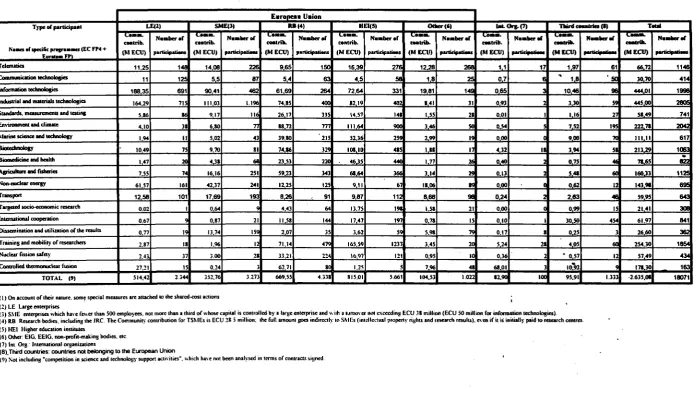
basis: for the first two years of the 4th Framework Programme the respective share of tirms. universities and research centres was 40%, 24% and 29% of total European participation in shared-cost actionsJI for the first activity of the 4th Framework Programme.
l l
Scientific and teclrnjcql results. In the course of 1996 Community RTD projects produced numerous significant results and genuine breakthroughs in the most varied areas of science and technology. For example, it was a Community project involving over 1.00 European laboratories which in 1996. as a world first. unravelled the complete sequence of the genome of a complex living organism, namely wheat, a result that is liable to have considerable medical and industrial implications. [r, 1996 a project was . launched to determine the feasibility of satellite surveillance of forest fires in Europe. It was also a Community project which in October studied the consequences for the environment and climate of the eruption of the Icelandic volcano VatnajOkull under the biggest glacier in Europe. Last but not least, a project developed an underwater robot with several unique features which is capable of diving to a depth of 6 000 metres.
Progress was also made in other sectors, ranging from the understanding of global change to the study of oceans, the search for new information and communication services and technologies, the development of biomedical technologies, the improvement of manufacturing processes, and the development of clean energy technologies, etc. The various projects which received support from the Union in 1996 contribute, in their own particular fields, in one way or another, to an improvement in the quality of life in Europe. Examples of the results are given in Annex
r
to this report.Apart from the scientific results and teclmical adva':lces, giving rise to over 3 000 publications and patents in 1996, mention should also be made of the number and the importance of examples of cooperation developed as a result of to the Union and which cement the European scientific community. The partnerships established in the context of Community RTD projects bring together resources and skills, encourage exchanges and stimulate the innovation process. Links are established. dialogue is ensured, and expertise is brought together. The transnational dimension of Community RTD projects makes it possible both to generate a critical mass of intellectual and physical resources and to exploit Europe's wealth and diversity. These results help to establish a solid basis on which to develop the Union's scientific and technological excellence, its industry's competitiveness and its quality of life.
l l
Molljtorine aftlle framework prouammesThe 1996 annual external monitoring exercise was the second of its kind. The experience gained through the previous year's monitoring was taken into account32. The exercise involved 19 panels of independent experts from the Member States. For the Specific Programmes. the 18 panels reported in March 1997, and for the Framework Progran1me in May 1997.
The Framework Programme level overall assessment was prepared by a Panel of eight senior experts under the chairmanship of Prof. U. Colombo, former Italian Minister of Universities. Science and Technology. The Panel's report highlighted progress achieved in 1996 and provided recommendations for further improvement in Programme implementation. The Panel underlined
31 For 1995 and 1996 the data are those given in Table S of the 1996 ami 1997 Article 130P reports li1r Eumpcan Union participants: the "Others" category amounts to 7%.
that, "there is no parallel to the Framework Programme endeavour among other collaborative RTD
programmes, anywhere in the World. The Commission Services have shown a remarkable ability in handling such a complex and diversified RTD programme involving many thousands of projects and researchers".
; The Panel concluded that overall the Framework Programme is "developing in a positive way''. Substantial results have been achieved in specific fields. However more attention should be paid to project results and commercial exploitation, as well as to the effective contribution to Community policies and distinctive European ·added value. Improvements were also noted in processing of proposals, supply of information to applicants, reduction of over-subscription. management flexibility, co-ordination and co-operation between programmes.
l l
Contracts sirued andpavments made in 1996; annual basis and framework prmuammesThe statistical and budgetary data (Annex II, Tables 1-8) cover 1996 and are in accordance with the Commission's revenue and expenditure accounts. In addition, the efforts made by the Commi~sion-'3 since the first "Article 130P" reports34 to develop a common basis for statistical analysis based on
contracts signed were continued in 1996. These data relate to the Community and Euratom fran1ework programmes, the financing structures of which are indicated in Tables 9-11.
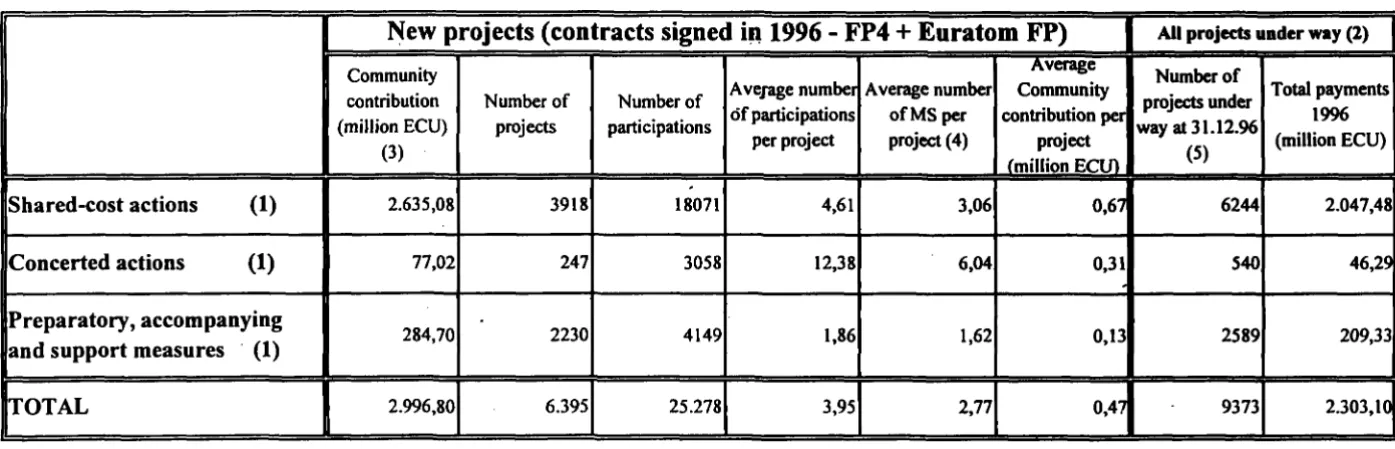
For the annual data (Tables 1-8) the analysis concerns indirect actions that were new or were in progress in 1996: almost 24 000 proposals were received by the Commission in response to the various calls for proposals, and over 6 000 contracts were signed, corresponding to nearly ECU 3 000 million 35 and over 25 000 participation~. On 31 December 1996 over 9 000 projects were in
progress under the 2nd, 3rd and 4th EC Framework Programmes and Euratom Framework Programmes.
The statistical analysis (number of projects, participations36, Member States. type of participants. location, collaboration links between Member States per specific programme and tor the Framework Programmes as a whole, etc.) concerns the contracts signed in I 996 under the 4th Framework Programme37 (Tables 1, 2, 5, 6 and 7).
In the case of shared-cost actions alone, nearly 4 000 new contracts involving over 18 000 participations and a total Community contribution ofECU 2 635 million were signed.
In 1996, the economic significance of the accompanying measures increased: while in 1995 they accounted for 5% of the Community contribution to contracts signed. in 1996 they represented 9.5% (11% and 16% ofparticipations in 1995 and 1996 respectively).
33 In 1996 in view of their nature (support to the Commission Services) the competitive ~cicntific ;uuJ technic:al support activities were not the subject of an analysis by contracts signed. Qualitative and quantitative inform:ation concerning them i~
to he found in Annex I to this report (p.72).
34 COM(95)443 final. 28.09.1995- COM (96) 437 final, 09.09.1996
All the payments for Community research are set out in Table 1, with nearly ECU 2 300 million
or
payments made, of which ECU 534 million was for the 3rd Framework Programme (Table 3A) and ECU 1 710 million for the 4th Framework Programme (Table 38).For the multiannual data (Tables 9-11), Table 9 gives for the 4th Framework Programme the , breakdown of funding between the various specific programmes for indirect actions and for JRC direct actions. Tables 10 and 11 set out the commitments ( 1984-1998) for the Community research Framework Programmes38 in current prices and 1992 prices39.
M
Implementation q,ftlre framework prauammes and ofUectives Q[Europea11 research polic,y3.4.1 Industrial participation in the framework programme
The Commission attaches great importance to the industrial benefits of the Framework Programme.
Aggregated data for 1995/96 show that in Activity 1, industrial research groups -constitute 40% of participations (19% for big entreprises and 21% for SMEs) in shared-cost actions and account for 43% of funds dispensed.40 For the major "industrial" programmes, IMT and IT, the levels of industrial participation are 68% and 62% respectively.
In the context of the 4th Framework Programme a more diversified policy with regard to tirms was established through various research incentive measures (cf. 3.4.2), and also support measures aimed either at better technology take-up by firms under the "Information Technologies'' programme or as support for the establishment of innovation assitance net\vorks and infrastructures.
In 1996, the Commission published a study41 on the RTD strategies of 500 of the biggest industrial companies and their participation in the European Framework Programmes and in Eureka. It would appear that the importance of European research for the latter is seen more in terms of participation in top quality European research networks than in financial terms.
3.4.2 Technology stimulation measures for SME access to RTD
SMEs are regarded as one of the engines of growth in Europe;42 they represent 99.8% of tirms.
66% of jobs and 65% of private sector tumover43. SMEs are the main source of innovation in the rapid growth high technology sectors (such as biotechnology, medical technologies, environmental technologies, software, and multimedia). In Europe in the period 1988-95 companies with fewer than 100 employees provided the majority of new jobs, offsetting the job losses in the major groups in the process of reorganization. Last but not least, SMEs play a crucial role in local economies. and in some regions they are the only industrial operators.
The single market and the globalization of economies is compelling many SMEs to adapt their strategies, with the atTival of foreign competitors on their markets. The increase in the
38 Every year the Commission publishes a budgetary vademecum ("The Commutlity Butlgt:t: The Facts in Figures'') which indicates the research payments every year since 1958: 1996 Edition SEC (96) 1200.
39 The current financial -perspective was decided upon in 1992 at the Edinhurgh Summit for the period 1992-1999.
40 Aggregated data for 1995/1996 are taken from Table 5 of the reports conct:rning those years for t1H: Ell.
41 Rt:port EUR 17244
42 Green Paper on Innov;llion. and Commission rt:port to the Madrid Europt:an Council (December 1995) on the role of SMEs as a dynamic source of employmt:nt, growth ;md competiveness in the Europe;m Union. CSE :!087 ..
technological content of products and processes is therefore a marked trend which compels most industrial companies to innovate. Participating in Community RTD programmes is a response to this need, by making it possible to share the costs and the risks, while developing new transnational collaboration networks.
:In order to promote and facilitate SME participation in the Community RTD programmes, the 4th Framework Programme includes a series of technology stimulation measures implemented through nine specific programmes. Aimed both at SMEs which have little or no autonomous research capacities and at high technology SMEs, these measures are of two kinds:·
1. · Exploratory
awardS
with a two stage submission procedure and a continuously open call for proposals in preparation for research projects;2. Cooperative research: this type of project (CRAFT: Cooperative Research Action for Technology) enables SMEs that have little or no autonomous research capacities to have some or all of their RTD work carried out by one or more research organizations.
The network of focal points (CRAFT network) has· been reinforced in order to make available to SMEs · infom1ation and assistance with the preparation of dossiers, at national, regional and local levels. It operates in conjunction with other less specialised networks which nevertheless are designed to promote SME access to.Community activities, the network oflnnovation Relay Centres and the network of Euro-Info Centres.
The experience built up during the pilot phase of CRAFT under the 3rd Framework Programme showed that in the case of SMEs such networks and accompanying measures are essential to enable them to obtain information and participate in·Community RTD programmes:
• In 1996, nearly 50 informSltion and assistance schemes were organised.
• In October 1996 the first SME Technology Days brought together nearly 850 economic actors ·and representatives of the research world, 35% of which were from SMEs.
• All in ail, nearly 100 000 SMEs were. contacted44 in 1995 and 1996 in the context of these accon.1panymg measures.
SMEs now represent 20% of all participations in the specific programmes as a whole. and their percentage participation in all the specific programmes increased between 1995 and 1996. The most significant result in terms of SME participation4S undoubtedly concerns the increase in SMEs with research facilities and participating in collaborative research projects. Nearly 3 800 SMEs were funded in a project of this type in 1995 or 1996: as many as during the four years of the previous Framework Programme. 46
The technology stimulation measures for SMEs (TSME) thus enabled, in 1995 and 1996. I 200 SMEs to benefit from one of the 500 exploratory awards financed and more than 500 other SMEs to participate in one of the 80 CRAFT projects in progress47.
44 Depending on the programmes, between 20 and 40% of the proposals received in 1996 in the context of the technology
stimulation measures for SMEs (TSME) were directly related to these measures.
45 The 5 000 SME participations indicated in Table 5 for 1995 and 1996 break down into 3 800 SMEs collabonuing with other
An analysis of SME participation indicates that:
• The TSME seem to be particularly suited to small firms with fewer than 50 employees, since they represent the majority of beneficiaries (75% in the case of awards, 50% in the case of CRAFT projects).
• The CRAFT projects seem to meet the needs of firms from sectors or regions where the level of technology is less advanced: 40% of SMEs participating in them are in relatively traditional industrial sectors (food, wood, textiles, construction, mining) and 18% of them are from one of the four Cohesion-Fund countries4B.
• The TSME have made it possible to extend support to a new category of SMEs, nearly 75% of which have never previously participated in a Community project.
With an average of 6-7 SMEs per CRAFT project, it is to be expected that SME participation in the FP will increase still further in percentage terms in 1997 following the submission of projects prepared thanks to the 500 exploratory awards underway or stimulated by the abovementioned accompanymg measures.
3.4.3 Research collaboration links in the European Union
In 1996 nearly 62 000 collaboration links were recorded between teams in the Europe of 1549 • The collaboration links are characterized first of all by the internal links within Member States. For the two years 1995 and 1996 as a whole, the ratio of internal links to total links is 17%. The links established are to a very large extent transnational, but their internal component is far from insignificant.
When analysing the links it is also necessary to take account of the role of Member States whose national research is more developed. Classifying the Member States according to domestic research expenditure and population, the ranking is similar to the standing of the individual Member States in European research links, and the same applies to the ratio. of internal 'tinks to total links.
Lastly, the role of collaboration links with third countries is significant, nearly 8 000 links having been identified between the Europe of 15 and the rest of the world.
-4.
Management of research
In 1996, the Commission continued to work on streamlining and simplifying management procedures and harmonising them between the research programmes. In order to take stock of the situation and to allow its "clients" to express their views on the management of projects and programmes, the Commission organised a seminar in June 1996 to which representatives of industry (including small firms), academia and research organisations were invited.
For the seminar, the Commission prepared a background paper ("Equity, efticiency and transparency in the management of EU research programmes : the next steps"). setting out the overall situation and context within which EU research programmes operate and the measures being introduced, planned or under discussion to improve their management. As part of the preparation of this background paper, two informal workshops were organised. The tirst involved research
of an exploratory award do not appear. Similarly. very many SMEs benetit from the Community RTD programmes as subcontractors, without the Commission being able to quantify their participation, or funding received hy them.
48 Greece, Ireland, Portugal and Spain.
programme administrators from the Member States and was aimed at comparing management practices between the Commi_ssion and national research programmes. The second involved representatives of contractors and· organisations that advise researchers. on EU research programmes and was concerned with "customer feedback" on administrative issues of managing research projects. Following the seminar, the background paper was made publicly available on· the : Commission's World Wide Web server, with an invitation to readers to put forward comments or
suggestions.
The seminar was divided into three· main sessions, dealing with reducing levels of oversubscription. the efficiency and transparency of the proposal evaluation and project selection process, and improvements to contract negotiation, payments and contractual issues.
On the question of oversubscription, the principal recommendation of the seminar was that ,although there were a number of short term options for obtaining small reductions in oversubscription, the only way to improve success rates significantly was to focus the research progranm1es much more strongly. The Commission has taken forward this recommendation in its proposal for the Fifth Framework Programme. On the· proposal evaluation process, the seminar noted the need for improved harmonisation and transparency of the process and endorsed the Commission's intention of preparing a· general manual of evaluation procedures, supplemented by detailed programme-specific manuals. The session on contractual issues also pointed out the need for improved harmonisation between the different services of the Commission. As a result, a vade-mecum on the use ofthe Commission's model contract is currently under preparation.
·The seminar also noted the need to improve response times to proposers ti·om small companies. Through improvements to internal procedures, the time between proposal receipt and a Commission evaluation decision has been reduced from around 6 months to 3 months in the case of SME-specific measures.
In order to adapt its management methods to the changed circumstances which will come about in the fifth Framework Programme, an inter-service working group on management has been put in place to examine all the steps in the implementation of programmes. This group will continue its work during 1997 and, where necessary, will recommend improvements to management methods currently in use.
Where staff are concerned, 99 new posts were created in the course of the 1996 budgetary procedure, increasing the research staff complement to 1453 posts authorised as at 1 January 1996. The costs of managing the specific programmes are published every year as forecasts in the European Union budget,50 and as outturn in the revenue and expenditure account. For 1996 the
1s
t
activ
i
ty
or the 4th EC Framework Programme and the Euratom Framework Programme ... 2lInfonnation and communication teclmologies ... 21 l. Telematics ... 21 2. Communication technologies ... , ... 24
3. Jnfonnation technologies ... :: ... 26
Industrial technologies ... 29
4. Industrial and materials technologies ... _. ... 29
5. Measurements and testing ...................................................................................................................... 32
Environment ... 34
6. Environment and climate ... 34
7. Marine sciences and technologies ................................................... 37
Life sciences and technologies ... 39
8. Biotechnology ... 39
9. Biomedicine and health ... : ... 41 10. Agriculture and fisheries (including agro-industricS, food technologies, forestry, aquaculture
and rural development) ... 44
Energy ... 46
II. Non-nuclear energy ... 46 • R&D component. .................................................................................... 46 • Demonstration component ... 4 7
12. Nuclear fission safety ... 50 13. Conrrolled thermonuclear fusion ... ,52
14. Transport ... 55 15. Targeted socio-economic research ... 57
2
nd
a
cti
v
i
ty
of the 4th Framework Programme ... .'59Cooperation with third c.ountries and international organizations ... 59
3
r
d a
cti
v
i
ty
ofihe 4th framework Programme ... 63Dissemination and opti~ization of results ... · ... 63
4
t
h
a
ctiv
i
ty
or the 41 h Framework Progra rn me ... 66Stimulation of the training and mobility of researchers ... 66
J
o
int
R
e
searc
h
Cent
r
e
(
JR
C)
..
..
....
...
..
...
..
..
...
..
...
...
....
..
...
..
.
...
69Co
m
pe
t
it
i
ve scie
n
tific a
n
d tec
hni
ca
l
s
u
ppor
t
a
c
t
i
v
it
i
e
s
...
..
..
.
.
.
..
...
.
...
...
73INFORMATION AND COMMUNICATIONS TECHNOLOGIES
1.
TELEMATICSACTIVITIES IN 1996
At the end of 1996 the Telematics Applications Programme was running a total of some 400 projects, including over 300 shared-cost projects. In the course of 1996 contracts we.re signed following the third call for proposals which generated 67 new projects, including 46 shared-cost projects (30 of which for the sector "Telematics for the elderly and disabled"). ·
The rolling call for programme support activities (technology watch, concertation between projects, awareness and dissemination of results, international cooperation, training, special measures for SMEs) resulted . in the selection of three new projects covering applications of transport technologies in China. the structuring of Community projects relating to regional health-care networks, and the training of the elderly and disabled in the use of new technologies.
A conference bringing together all the projects (over 800 participants) ensured broad cross-sector concertation on horizontal themes (e.g. applications and generic technologies, electronic commerce, usability. special user groups) and the technological solutions envisaged.
For the tirst annual examination of projects, 212 independent external experts got together to carry out a technical audit of 278 projets, 21 of which were examined in detail, resulting in the conclusion of three contracts.
The Task Force for educational software and multimedia, the report of which was published in July 1996 (SEC(96) 1426), has given rise to inter-programme coordination going beyond the research context.
The five-year evaluation and annual monitoring reports both stressed the favourable contribution of the programme to the structuring of communities of users at European level. This aspect is particularly encouraging for a programme which places the emphasis on activities for the technical validation. in real-life situations, of demonstrators developed by the projects. The development of de'monstrators involves the future users of telematic systems and services (hospitals, schools and other educational establishments, administrations, libraries, local and
EXAMPLES OF RESULTS
Details of the projects under the 3rd
Framework Programme were given in 1996 for all the areas concerned:
administrations, education and training,
health care, rural areas, transport, libraries, language
research and engineering.
The computer-assisted mail project has made
it possible to improve procedures affecting
delivery times for international mail in 50 000 post offices in