This is a repository copy of
Teachers’ Cognitive Processing of Complex School-Based
Scenarios: Differences Across Experience Levels
.
White Rose Research Online URL for this paper:
http://eprints.whiterose.ac.uk/129641/
Version: Published Version
Article:
Kim, Lisa E. orcid.org/0000-0001-9724-2396 and Klassen, Robert Mark
orcid.org/0000-0002-1127-5777 (2018) Teachers’ Cognitive Processing of Complex
School-Based Scenarios: Differences Across Experience Levels. Teaching and Teacher
Education. pp. 215-226. ISSN 0742-051X
https://doi.org/10.1016/j.tate.2018.04.006
[email protected]
https://eprints.whiterose.ac.uk/
Reuse
This article is distributed under the terms of the Creative Commons Attribution-NonCommercial-NoDerivs
(CC BY-NC-ND) licence. This licence only allows you to download this work and share it with others as long
as you credit the authors, but you can’t change the article in any way or use it commercially. More
information and the full terms of the licence here: https://creativecommons.org/licenses/
Takedown
If you consider content in White Rose Research Online to be in breach of UK law, please notify us by
Teachers' cognitive processing of complex school-based scenarios:
Differences across experience levels
Lisa E. Kim
*, Robert M. Klassen
Department of Education, University of York, UK
h i g h l i g h t s
Expert teachers process school scenarios differently to beginning and pre-service teachers.
Teacher groups differed in strategy, scope, content, and reasoning used to process the scenarios.
Group differences are starkest when processing scenarios without pre-existing answer options.
Teachers are more confident in their answers to school scenarios than non-school scenarios.
a r t i c l e
i n f o
Article history:
Received 11 December 2017 Received in revised form 28 February 2018 Accepted 4 April 2018
Keywords: Cognitive processing Teacher expertise Situational judgment test Teacher education
a b s t r a c t
Teachers are confronted with and must process challenging situations every day. Yet the development trajectory of their processing ability is unknown. Our two-part mixed method studies use a think-aloud
methodology to understand how teachers cognitive process difficult school-based and non-school-based
scenarios. Studies 1 and 2 examine the differences between expert, beginning, and pre-service teachers without and with pre-existing response options, respectively. Results from qualitative (but not quanti-tative) analyses indicate group differences in strategy, scope, content, and reasoning. Furthermore, we
find that teaching is a domain-specific expertise. We discuss how this information can inform teacher
education and professional development programs.
©2018 The Authors. Published by Elsevier Ltd. This is an open access article under the CC BY-NC-ND
license (http://creativecommons.org/licenses/by-nc-nd/4.0/).
Teachers encounter challenging school situations every day. Although a teacher's level of effectiveness increases with years of experience (Atteberry, Loeb,&Wyckoff, 2015), the specifics of this
developmental trajectory is unclear. Cognitive psychologists have been studying development of expertise since the 1960s, exploring domain-specific skills such as chess (Chase & Simon, 1973; de
Groot, 1966), physics (Larkin, McDermott, Simon,&Simon, 1980),
and music (Colley, Banton, Down, & Pither, 1992). In contrast,
studies on the development of teacher expertise are lacking. An explicit understanding of the cognitive processes of expert teachers can be particularly useful for training of pre-service teachers and for professional development of beginning teachers (Berliner, 2001). This explicit understanding can function as a scaffold which teachers can refer to, modify, and apply to their own pro-fessional lives (Shulman, 1986) given that cognitive processes are
malleable (Hennissen, Beckers,&Moerkerke, 2017). The need for
such scaffolds is high as teachers with limited teaching experience are expected to perform at equal professional competence levels to their experienced colleagues (Tait, 2008).
A seminal study in the area of cognitive processes and teacher expertise is by Swanson, O'Connor, and Cooney (1990). The re-searchers examined the cognitive processing differences between expert and novice teachers in solving classroom discipline prob-lems using a think-aloud methodology. A think-aloud methodology involves a participant verbalizing his or her thoughts while solving problems. In effect, the methodology allows investigations into teachers' cognitive processing; that is, the information attended to, strategies employed, and inferences drawn from the information without interrupting the flow of working memory (Ericsson &
Simon, 1984). Using a similar methodology, Swanson and col-leagues (1990) found that expert teachers focused on defining and representing the problems, unlike novice teachers who focused on generating possible solutions to the problems.
The current set of two mixed-method studies will extend
*Corresponding author.
E-mail address:[email protected](L.E. Kim).
Contents lists available atScienceDirect
Teaching and Teacher Education
j o u r n a l h o m e p a g e :w w w . e l s e v i e r . c o m / l o c a t e / t a t e
https://doi.org/10.1016/j.tate.2018.04.006
Swanson and colleagues' (1990) study infive important ways. First, we recognize that teachers frequently encounter a variety of chal-lenging scenarios other than classroom discipline problems, such as meeting departmental deadlines and dealing with anxious parents. Thus, a variety of school-based scenarios, including classroom discipline scenarios, are used in the studies. Second, we recognize the usefulness of studying teachers with more than two experience levels (e.g., pre-service vs in-service or early-career vs late-career teachers as is often used in previous studies) when examining cognitive processes, in order to obtain a more nuanced under-standing of the trajectory of expertise development. Accordingly, we compare the cognitive processes of teachers in three key stages of their careerdat the pre-service, beginning, and experienced
(‘expert’) stages. Third, we compare teachers' responses to school-based scenarios with non-school-school-based scenarios (i.e., medical-based scenarios) in order to explore the domain-specificity and career-stage specificity of teacher expertise. Fourth, most studies on cognitive processing have examined the expert answer genera-tion process. However, how experts recognize appropriate re-sponses when presented with a range of predefined responses is also of interest (e.g., Gauthier, Williams, Tarr, & Tanaka, 1998;
Rhodes, Hayward,&Winkler, 2006;Tanaka&Curran, 2001). Hence,
we not only compare the cognitive processing differences between the three teacher groups when presenting scenarios without response options (generation;Study 1) but also with response op-tions (recognition;Study 2). Fifth, cognitive processing studies have traditionally examined how one chooses to respond yet their
con-fidence in whether their response is accurate has not been captured. Thus, we examine the confidence ratings of the partici-pants' responses to the scenarios.
In summary, this two-part mixed methods paper aims to iden-tify the cognitive processes undertaken by pre-service, beginning, and expert teachers when responding to challenging school-based and non-school based scenarios. Specifically, the similarities and differences in the levels and content of the mental representations and confidence ratings between the three teacher groups are examined.
1. Study 1
In Study 1 we examined how expert teachers differ in the way that they solve school-based problems as well as non-school-based problems compared to beginning and pre-service teachers. Based on previous research in both education and cognitive psychology, we expected differences between the three teacher groups infive key areas: strategy, scope, content, reasoning, and confidence ratings.
1.1. Cognitive processing of school-based scenarios
Strategy. The mental structure of organizing and accessing knowledge to solve problems differs between experts and novices (Ericsson&Simon, 1984), manifested in the different strategies that
experts use. Specifically, experts tend to seek to understand the problem before proposing solutions (Chi, Glaser, & Farr, 1988).
Indeed, Swanson and colleagues (1990) found that novice teachers addressed classroom discipline problems at a surface level, whereby they focused immediately on generating a solution to a perceived problem. The problem is compounded as novice teach-ers' visual focus is limited; novice teachers tend to focus on one event for a long time at the sacrifice of noticing other relevant events (Van den Bogert, van Bruggen, Kostons,&Jochems, 2014).
Such a strategy of immediately generating solutions and failing to notice other events mean novices may miss the principles and abstractions underlying the problem. On the other hand, expert
teachers used more analytical and evaluative strategies than other strategies. Other studies using various media (e.g., classroom videos and static slides) also support thefinding that expert teachers are able to better interpret and evaluate classroom events and behav-iors than advanced beginner and novice teachers (;Carter, Cushing, Sabers, Stein,&Berliner, 1988;Nelson, 1988;Peterson&Comeaux,
1987). Expert teachers' greater ability to analyze and evaluate scenarios is a result of their extensive experience (Berliner, 1988). In this vein, we expected differences in the frequencies of analytical and evaluative strategies made about the challenging school-based scenarios between the three groups, with the highest frequency from the expert teachers (H1).
Scope.Experts, through years of experience, have formed highly developed schemas, which are templates of organized and inter-related thoughts, patterns, and behaviors (Anderson, 1984). Asso-ciated with a more developed schema is an expert's ability to generate more solutions to problems than novices (Kagan &
Tippins, 1991), as the schemas are more accessible, detailed, nuanced, and have formed multiple links with other schemas and ideas than a novice's schema (Shulman, 1986). Thus, we expected differences in the frequency of possible responses generated for the school-based scenarios between the three groups, with the highest frequency from the expert teachers (H2).
Content.Based on educational literature on behavioral modifi -cation and psychoedu-cational procedures, Swanson and colleagues (1990) divided expert and novice teachers' responses to classroom disciplinary scenarios into two categories: internal-based re-sponses and external-based rere-sponses. Internal-based rere-sponses were activities that focused on modifying the level of internal controls within the student. Examples included providing empathy, setting up a time to discuss with the student, and communicating with parents. External-based responses focused on modifying the structural elements of the classroom. Examples included providing contingent praise, giving warnings, confronting the student, and sending them to administration. We used Swanson and colleagues' internal-based and external-based response categories as a basis to classify our responses as well as including other response types that emerged from the corpus. Swanson and colleagues found that expert teachers were more likely to use external-based responses and novice teachers were more likely to use internal-based re-sponses. We expected differences in the frequency of response types between the three teacher groups for the school-based sce-narios (H3).
Reasoning.Novice teachers often are overwhelmed by class-room events (Olson & Osborne, 1991) as they manage multiple
simultaneously occurring events while teaching. Novice teachers, given the multiplicity and complexity of the events and their relative lack of experience, often cannot respond effectively to these events (Doyle, 1986). According to the dual process model of cognition, this is the result of cognitive overload, whereby the re-sources needed to process external stimuli exceeds the internal resources available (Sweller, 1989). In contrast, an expert's large mental database of actual experiences is more readily accessible than novices' mental database (Shulman, 1986) and they tend to not experience cognitive overload. As a result, expert teachers have the capacity articulate more clearly the justification for their choices of responses to challenging school-based scenarios. Thus, we expected differences in the number and sophistication of the reasoning provided for their choice of responses in the school-based scenarios between the three groups (H4).
experts used more analogical reasoning than business novices (Dew, Read, Sarasvathy,&Wiltbank, 2009). Hence, we also expect
differences in the frequency of analogical reasoning evidence pro-vided in response to the school-based scenarios between the three groups (H5).
Confidence rating.A step before knowing how confident one is to carry out an action (self-efficacy;Bandura, 1997) is knowing how confident one is that their choice of action is correct (confidence rating of accuracy). Confidence rating of the accuracy of a response is mostly used in meta-cognitive research to study under- and over-confidence (e.g., Kleitman & Stankov, 2007). The trajectory of teacher self-efficacy increase is unclear. One line of research in-dicates that self-efficacy increases during pre-service years but decreases in the first year of teaching (Woolfolk-Hoy & Burke-Spero, 2005), whereas other research indicates that self-efficacy increases non-linearly during a teacher's career (Klassen and Chiu, 2010). In this light, we tentatively expected that there would be no differences in the confidence ratings in the school-based scenarios between the three groups (H6).
1.2. Cognitive processing of non-school-based scenarios
Expertise in one domain is not transferable to another domain, even if they seem intuitively similar (see Feltovich, Prietula, &
Ericsson (2006) for a review), as expertise is acquired through deliberate practice of domain-specific activities (Ericsson, Krampe,
&Tesch-Romer, 1993€ ). For example, experts in chemistry perform like novices when faced with political science problems (Voss, Greene, Post,&Penner, 1983;Voss, Tyler, Yengo,&Others, 1983).
However, no previous studies have examined whether teacher expertise and judgment can be applied to other contexts outside of education, such as in medicine. In light of other studies, we ex-pected no differences between the three groups in measures of cognitive processing of medical-based scenarios (H7a). We also hypothesized that domain-specific expertise would be reflected in (a) no differences in the confidence ratings between the three groups for the medical-based scenarios (H7b) and (b) higher
con-fidence ratings for the school-based scenarios than for the medical-based scenarios (H7c).
In summary, we examined three teacher groups with differing levels of experience as they solved challenging school-based and medical-based scenarios. Specifically, we investigated their cogni-tive processing in strategy, scope, content, and reasoning as well as their confidence ratings for the scenarios.
2. Method
2.1. Participants
Study 1 consisted of 18 in-service and pre-service teachers (10 female; 8 male) from the United Kingdom: six expert teachers (mentors to pre-service and in-service teachers, with more than
five years of teaching experience), six beginning teachers (teachers with up to three years of teaching experience), and six pre-service teachers (initial teacher education trainees). The characteristics of the mentors were consistent with the criteria of expert teachers (Palmer, Stough, Burdenski,&Gonzales, 2005;Sternberg, 1998).
Nine of the participants reported working or being trained in primary schools and nine in secondary schools. All participants, except for one Asian/Asian British teacher, reported a British ethnicity. The mean age of the three groups were: 43.00 (SD¼12.03) for the expert teachers, 26.50 (SD¼4.59) for the beginning teachers, and 24.00 (SD¼4.15) for the pre-service teachers. The mean years of teaching experience for the three groups were: 16.33 (SD¼10.91) for the expert teachers, 2.83
(SD¼1.89) for the beginning teachers, and 1.501(SD¼1.87) for the pre-service teachers. Participants received gift vouchers for their time.
2.2. Procedure
Participants were seated in a quiet room 90 away from the
researcher. The researcher introduced themselves and asked the participant to read through the study information and to sign the consent form if they agreed to participating in the study. The interview was audio-recorded from the time of indicating consent. The participants were asked to read aloud six school-based and two medical-based scenarios. Also, the participants were asked to think aloud what they would do in those scenarios; that is, the they were instructed to:“think, reason in a loud voice, speak everything that passes through your head as you respond to the questions. Don't plan what to say or speak, but rather let your thoughts speak, as though you were really thinking aloud.”When participants were silent, researchers encouraged them to voice their thinking by us-ing four prompts:“Keep on thinking aloud, please”,“Could you think aloud, please?”,“Keep on talking, please”, and“What are you thinking now?”. After the interview, retrospective follow-up questions were posed:“How did you come to determine your re-sponses in the scenarios?”,“How did you come to determine your confidence levels in the scenarios?”, and “How did youfind the classroom scenarios compared to the medical scenarios?”
2.3. Measures
Scenarios.The study included six school-based scenarios from the Teacher Situational Judgment Test (Klassen, Durksen, Rowett,&
Patterson, 2014) and two medical-based scenarios used as example for Australian General Practice Training application (AGPT, 2015). A summary of the six scenarios are found inTable 1. The participants were presented with three school-based scenarios followed by a medical-based scenario then another three school-based scenarios followed by a medical-based scenario. The order of the scenarios was counterbalanced among the participants.
Confidence ratings.After each of the scenarios, the participants were asked“How confident are you that your answer is correct (0%
absolutely uncertainto 100%completely certain)?”. Confidence
rat-ings are frequently used in meta-cognitive studies, which report high reliabilities, ranging from 0.82 to 0.97 (e.g.,Burns, Burns,&
Ward, 2016;Kleitman&Stankov, 2007).
Other measures.Additionally, the participants reported their years of teaching experience and demographic information. The participants also completed a personality scale (Gosling, Rentfrow,
& Swann, 2003) and a teaching self-efficacy scale (
Tschannen-Moran &Hoy, 2001) but these results are not discussed here as
they deviate from the focus of the current paper.
2.4. Coding
The codes were identified using both deductive and inductive methods. First, we examined Swanson and colleagues' (1990) codes and adapted these codes for our context. For example, rather than coding each different type of heuristic subprocess and strategy, which Swanson and colleagues (1990) had done, we coded these activities holistically as‘Analysis and Evaluation’as our focus was on the holistic group differences rather than granular differences.
1 The pre-service teachers may have counted their years as a teaching assistant,
Swanson and colleagues also outlined two types of responses one could give to challenging classroom scenarios: internal control (e.g., listening, empathizing) and external arrangements (e.g., separating students, confronting the student). Recognizing that some type of responses may notfit under these codes and greater nuances could be found in different response options. For example, although requesting for help from other colleagues would be categorized under the code of external arrangements using Swanson and col-leagues' codes, classifying they are of different nature involving different personnel with potential different consequences. Thus, we recognized that we may need to identify and distinguish more additional types of responses. Furthermore, there were no codes capturing reasons why participants chose to respond in a certain way, and thus we recognized that there may need to be an addi-tional theme of‘Reasoning’in our analyses.
Second, we conducted a thematic analysis (Braun & Clarke, 2006), whereby we generated initial codes or ‘start’ codes by reading through the transcripts multiple times and then refining the codes. An essentialist/realist approach was used, whereby the meaning and the experience behind the participants' language were analyzed rather than interpreting the psychology behind the participants' language within the sociocultural context (Braun&
Clarke, 2006). The codes generated using the second approach were merged with thefirst approach and the codes were further refined through multiple rounds of coding,finally using thefinal set of codes using NVivo. Themes, under which these codes can be found, were then identified and defined.
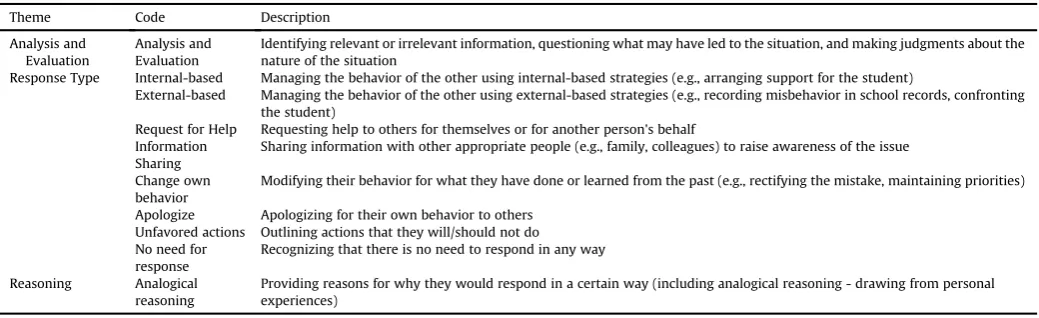
As can be seen inTable 2, we identified three major themes. Participants' spoken-aloud thoughts were coded as‘Analysis and Evaluation’(under the theme of the same name) when thoughts were associated with identifying relevant or irrelevant information, questioning what may have led to the scenario, and making judg-ments about the nature of the scenario.
Eight codes within the theme of ‘Response Type’ were
identified, which were the type of action the participant said that they would take in the challenging scenario. The eight codes were: (a) internal-based, (b) external-based, (c) requesting for help from other staff, (d) sharing information with other relevant staff, (e) managing the scenario through own behavior, (f) apologizing, (g) noting that some actions are unfavorable, and (h) the decision not to take any action.
Unlike Swanson and colleagues (1990), we included‘Reasoning’
as a theme, which reflects the rationale participants gave for choosing to respond in a particular way to the scenarios. No particular groups of reasoning other than analogical reasoning (reference to own experience;“many teachers and I seem to be able to manage and to get through”;“our school's really good in that they can give you some time off timetable if you arefinding it quite hard”), and thus, we coded‘Analogical Reasoning’as a code under the theme of‘Reasoning’.
2.5. Analysis
We investigated both the quantitative and qualitative differ-ences between the three groups in their cognitive processing. In our quantitative analysis, we examined the mean frequencies of the codes and the confidence ratings between the three groups. A reference to a code was counted only if it was a conceptually new reference within a scenario. In our qualitative analysis, we compared the content of the cognitive processing between the three groups to gain a more nuanced understanding of how the three groups differed in their processing.
To examine differences in strategy (H1, H7a), the frequency of
[image:5.595.42.544.86.171.2]‘Analysis and Evaluation’references across the three groups were examined using one-way ANOVAs. Planned contrasts controlling for Decision-Wise Error Rate (DER) were also conducted between expert teachers and beginning and pre-service teachers, on average, as well as between beginning and pre-service teachers. Table 1
Summary of school-based and medical-based scenarios.
Scenario Type Summary
School-based A student is reprimanded for swearing by a teacher, although this was in reaction to students taunting the student
A parent wants to meet with you urgently although you have started class registration A student refuses to stay behind after class for a behavior that is against school policy You realize after punishing a student that you were probably a little quick to judge There are multiple deadlines and you cannot complete all tasks within the timeframe Youfind out that one of your disruptive students is a carer for his parents
Medical-based A patient requests nicotine replacement patches although they have not worked in the past for the patient A patient is confirmed to have cancer but the family wishes for the patient not to know
Table 2
Descriptions of themes and codes.
Theme Code Description
Analysis and Evaluation
Analysis and Evaluation
Identifying relevant or irrelevant information, questioning what may have led to the situation, and making judgments about the nature of the situation
Response Type Internal-based Managing the behavior of the other using internal-based strategies (e.g., arranging support for the student)
External-based Managing the behavior of the other using external-based strategies (e.g., recording misbehavior in school records, confronting the student)
Request for Help Requesting help to others for themselves or for another person's behalf Information
Sharing
Sharing information with other appropriate people (e.g., family, colleagues) to raise awareness of the issue
Change own behavior
Modifying their behavior for what they have done or learned from the past (e.g., rectifying the mistake, maintaining priorities)
Apologize Apologizing for their own behavior to others Unfavored actions Outlining actions that they will/should not do No need for
response
Recognizing that there is no need to respond in any way
Reasoning Analogical reasoning
[image:5.595.34.554.585.744.2]To examine differences in scope (H2, H7a), we examined the mean frequencies of total responses across the three groups using one-way ANOVA and planned contrasts controlling for DER.
To examine differences in content (H3, H7a), we examined the mean frequencies of response types across the three groups using one-way ANOVA and planned contrasts controlling for DER.
To examine differences in reasoning (H4, H7a), we examined the mean frequencies of coded reasoning segments across the three groups using one-way ANOVA and planned contrasts controlling for DER. In particular, differences in analogical reasonings across the three groups (H5) were also examined using one-way ANOVA and planned contrasts controlling for DER.
Mean confidence ratings between the three groups on the school-based scenarios (H6) and the medical-based scenarios (H7b) were compared using one-way ANOVAs and planned con-trasts controlling for DER. Mean confidence ratings between the school-based scenarios and medical-based scenarios (H7c) was compared using a pairwiset-test.
3. Results and discussion
3.1. Cognitive processing of school-based scenarios
The frequencies of analysis and evaluation, response types, and reasonings can be found in Table 3, for both school-based and medical-based scenarios.
Strategy.The three groups did not differ in the frequencies of analysis and evaluation,F2, 15¼1.79,p¼.20. More specifically, the expert teachers did not report higher frequencies than the other two groups, on average, nor did the beginning teachers report higher frequencies than the pre-service teachers. Examining the content of the analytical and evaluative references, expert teachers commented on issues underlying or critical to the scenario, such as
“I think more important actually, and underlying this, is the taunting…that could be indicative of something more worrying… more serious, and I think it's very easy to deal with the…perhaps the swearing as an issue and miss something, actually there might be a more significant issue as well.”This was in contrast to begin-ning and pre-service teachers who commented on surface level issues, such as, “I assume he would be rather an older student, probably close to adulthood, if not already a student of age of eighteen or older”. Ourfinding that experts identified and inter-preted issues on a deeper level is in line with previous research (e.g., Sabers, Cushing, & Berliner, 1991), in which advanced
beginner and novice teachers had no problemperceivingthe events in video classroom scenarios but had difficulty interpreting the events in the scenario. They lacked the ability to infer, predict, conclude, evaluate, and suggest what should be done, which ex-perts were able to do. Other studies have also shown that indeed expert teachers are able to pick up more cues and make inferences from limited information (Sabers et al., 1991;Nelson, 1988). In this light, it seems that expert teachers are able to recognize patterns, use these cues, and make inferences about different aspects of scenarios more easily, indicating that expert teachers use a‘ top-down’ approach and beginning and pre-service teachers use a
‘bottom-up’approach.
Scope and Content.The total frequency of generated responses did not differ between the three groups,F2, 15¼0.88,p¼.44. More specifically, the expert teachers did not report higher frequencies than the other two groups, on average, nor did the beginning teachers report higher frequencies than the pre-service teachers. Furthermore, the three groups did not differ significantly in the frequency of each response type,F2, 15¼0.48e2.44,ps>.05. More
specifically, the expert teachers did not report higher frequencies of
each response type than the other two groups, on average, nor did Table
[image:6.595.400.482.79.743.2]the beginning teachers report higher frequencies than the pre-service teachers.
However, qualitative analyses within each response type demonstrated that there are indeed differences in the scope and content of the cognitive processing between the three groups. For example, the timing and the function of the response type of
‘request for help’differed between the groups. The expert teachers requested help from others only when they needed to attend to another urgent event (e.g., seeing a parent) while beginning and pre-service teachers requested help in a variety of scenarios (e.g., requesting a deadline extension and requesting for help from col-leagues to help with their workload). Beginning and pre-service teachers' willingness to request for help in solving these logistical matters may indicate that they are comfortable with seeking and using available resources.
A previous study found teachers accessed help-seeking and help-avoidance ways of coping with behavioral problems ( Inbar-Furst & Gumpel, 2015). The reason for endorsing one type of
response over the other differed. Teachers sought help if they wanted to end the confrontation rapidly or develop new coping abilities. Teachers did not seek for help if they feared failure or wanted to deal with the problem independently. Our results sug-gest that beginning and pre-service teachers sought help as a method to develop new coping abilities, especially as help-seeking behavior is encouraged during teacher education programs. That is, they had regular meetings with university and school mentors, whose primary function is to support them emotionally and pro-fessionally (van Ginkel, Oolbekkink, Meijer,&Verloop, 2016).Tait
(2008)even noted that seeking help from other colleagues (e.g., sharing resources and classroom management techniques) is one of the characteristics of a resilient novice teacher, which can also be helpful in reducing teacher attrition. On the other hand, expert teachers may not seek help frequently because they believe in their ability to deal with the problem independently. Their relative lack of help-seeking behavior may be associated with their greater years of experience but also with the seniority of their position and the wish to convey a self-sufficient and independent image.
Moreover, within the response type of‘external response’, the beginning and pre-service teachers frequently mentioned
sacri-ficing sleep to complete tasks, which was absent among the expert teachers. The beginning and pre-service teachers stated that in face of impending deadlines,“you'd just work overnight if you had to because I wouldn't just not get it done. If it needs doing it needs doing regardless of how much sleep you get”. Indeed, research suggests that pre-service teachers are impacted socially and emotionally when teachingdthey are emotionally and physically
weary, and their sleeping and eating patterns are disturbed (Caires, Almeida,&Martins, 2009). Given that beginning and pre-service
teachers have not established a well-developed automated routine in completing the tasks associated with being a teacher (e.g., teaching, marking, lesson plan creation) compared to expert teachers, each task may take them longer and lead to them believing that they must sacrifice sleep to complete them.
Reasoning.The three groups did not differ in the frequencies of reasonings given to justify their responses, F2, 15¼0.90, p¼.43. More specifically, the expert teachers did not report higher fre-quencies than the other two groups, on average, nor did the beginning teachers report higher frequencies than the pre-service teachers.
However, the three groups differed in the frequencies of analogical reasonings given, F2, 15¼4.55, p¼.03. The expert teachers (M¼3.17) reported higher frequencies of analogical reasoning comments than the beginning and pre-service teachers (M¼1.17),F1, 15¼6.82,p¼.02, but there were no differences be-tween the beginning and pre-service teachers. Follow up questions
on how participants came to determine their responses revealed that analogical reasoning was important for all groups, whereby“I was mostly thinking about similar situations that I've been in and thinking about what I've done that works”. However, since begin-ning and pre-service did not have much experience to draw from, they were a lot less confident and had to rely on“instinct”. For example, a beginning teacher felt less confident about a scenario when“I've never really had anything like that…. so the answer I gave I was a little less sure about whether it was right”. Greater episodic knowledge accumulated through years of experience contributes to the ability to describe and interpret classroom phenomena (Berliner, 1988). This episodic knowledge would have provided experts with the ability to provide and access an enriched schema to use personal experiences to rationalize their responses. Qualitative differences were also found in the content of the reasonings between the three groups. Beginning and pre-service teachers could often not verbalize why they thought certain op-tions were not appropriate. Reasoning for their choice in response often ended with the comment that a certain action“isn't going to help” while expert teachers were better able to articulate their reasoning for a response, such as“because I would be more familiar with the parent and the child concerned than this Head of Year who probably didn't know them.” This pattern of differences in the reasoning sophistication is consistent with other studies (Carter et al., 1988; Sabers et al., 1991), whereby expert teachers were able to describe and interpret video and slides of classroom more effortlessly andfluidly than advanced beginner and novice teach-ers. Again, greater teaching experience may assist teachers in un-derstanding and verbalizing why certain responses are appropriate or not, especially those gained through first-hand personal experiences.
Confidence Rating.The three groups did not differ significantly in their confidence ratings,F2, 15¼2.53,p¼.11. More specifically, the expert teachers did not report higher confidence ratings than the other two groups, on average, nor did the beginning teachers report higher ratings than the pre-service teachers. Ourfindings are similar to findings from a study on clinical assessments, where expert and novice psychologists' confidence in their assessments did not differ (O’Byrne & Goodyear, 1997). The non-significant
difference may be due to low sample size, which was also the case forO’Byrne and Goodyear's (1997)study with 14 participants in each group.
Although there were no quantitative differences in the confi -dence ratings, the content of their cognitive processing suggested that there were qualitative differences. In a scenario where par-ticipants witnessed an event that a senior teacher was wrongly reprimanding a student for, pre-service and beginning teachers were not confident to intervene in the scenario. They did not want
“…to undermine the seniority of the teachers as I'm currently a newly qualified member of staff”and they did not want it to look
“as if you are going above a senior teacher”. A beginning teacher also noted that“…as someone who's relatively new to teaching, knowing how to deal with the scenario in which someone who is quite senior to you is involved and is kind of doing what they think is appropriate…. I think I would be careful.”Thus, it seemed that beginning and pre-service teachers were unsure about what to do given their status, which was not the case for expert teachers.
3.2. Cognitive processing of non-school-based scenarios
The total frequencies of generated responses also did not differ between the three groups,F2, 15¼0.83,p¼.45. More specifically, expert teachers did not report higher frequencies than the other two groups, on average, nor did the beginning teachers report higher frequencies than the pre-service teachers. The three groups did not differ in the frequencies of any of the response types,F2, 15¼0.57e1.59,ps>.05. There was, however, a modest difference in
the frequencies of internal-based responses between the three groups, F2, 15¼3.78, p¼.047. None of the contrasts for each response type were significant, except the expert teachers made more references to internal-based responses (M¼2.00) than the beginning and pre-service teachers, on average (M¼1.08), F1, 15¼6.17,p¼.03.
The three groups did not differ in the frequencies of reasonings,
F2, 15¼1.37,p¼.28. More specifically, the expert teachers did not report higher frequencies than the other two groups, on average, nor did the beginning teachers report higher frequencies than the pre-service teachers. The content of the responses nor the reasoning did not differ between the three groups.
The three groups did not differ significantly in their confidence ratings,F2, 15¼7.40,p¼.49. More specifically, the expert teachers did not report higher confidence ratings than the other two groups, on average, nor did the beginning teachers report higher confi -dence ratings than the pre-service teachers. However, the content of their reasonings indicated that beginning and pre-service teachers were more comfortable with answering the medical-based scenarios than the expert teachers. In response to a follow up question on how the participants found the school-based sce-narios compared to the medical-based scesce-narios, expert teachers reported that they were trying to draw on from their experience in teaching and apply it to the medical-based scenarios:“I was just trying to relate it back to the classroom situation. Start thinking of the same triggers, the confidentiality, the safeguarding, the different options of support. So yeah but definitely a lot more white space in the head!”. In contrast, it was a lot more common for beginning and pre-service teachers to report a ‘matter of fact’
response, where they reported that the“classroom scenarios were very specific to what I've been trained for and the medical scenarios are more I guess moral questions that I haven't been given or taught how to deal with…but just from what I think would be morally right.” A beginning teacher even commented that “I think the medical ones were easier because there wasn't that pressure thinking I should know this because this is my job and I'm meant to know what to do in these situations”. There seemed to be a greater fear of knowing what to do for the school-based scenarios, which was absent for the medical scenarios, hence assisting them to believe that the medical-based scenarios were easier to answer than the school-based scenarios.
Strengthening the evidence on the domain-specificity of expertise, all three teacher groups expressed discomfort and anx-iety when answering the medical-based scenarios: “my brain's stopped already”and“(long pause exhale)not confident with this at all”. Furthermore, the teacher groups gave higher confidence rat-ings in the school-based scenarios (M¼85.85,SD¼11.38) than in the medical-based scenarios (M¼63.19, SD¼28.05), t17¼4.36, p<.001. Follow up questions on how they found the school-based scenarios in comparison to the medical-based scenarios revealed that the former was“much easier to answer because obviously I've experienced that…and done it probably a million times. Whereas no experience with the other ones whatsoever.”Overall, we found that expertise is domain-specific (Feltovich, Prietula, &Ericsson,
2006) and this domain-specificity is true for professional roles, such as in education and medicine, even though these professions may share some features, such as a reliance on interpersonal skills and empathy (e.g., Klassen et al., 2017; Patterson, Cleland, &
Cousans, 2017).
4. Study 2
Previous studies of expert cognitive processing have examined how expertsgenerateresponses when presented with open ques-tions, as featured in Study 1. Another type of cognitive processing is needed torecognizecorrect responses. The processes of cognitive organization and retrieval (used for generation) is different to that of judgment (used for recognition). Expert recognition research has mostly been conducted on faces (e.g., Rhodes et al., 2006) and objects (e.g.,“Greebles”, dog and bird breeds; e.g.,Gauthier et al., 1998;Tanaka&Curran, 2001), whereby experts are able to
recog-nize correct responses with higher accuracy and speed than nov-ices. Limited educational research on recognition exists; one study found that pre-service teachers were more able to classify education-related concepts under logical clusters after entering teacher education program than before, indicating greater recog-nition of concepts after the program (Hennissen et al., 2017). In education settings, an understanding of the differences between generation and recognition skills is important for teacher selection, teacher education, and teacher development, especially for pre-service and beginning teachers as they are taught the range of appropriate responses more than how to generate the appropriate responses. Thus, in Study 2, we examined whether there were differences between the three teacher groups when presented with the eight school-based and medical-based scenarios from Study 1 together with their respective predefined response options.
Cognitive load may have particular relevance to a teacher's recognition of responses.Feltovich et al. (2006)suggested that due to short term memory overload, novices may not able to access available and relevant knowledge needed for recognition. In contrast, for experts, many of the subordinate tasks are automated such that they have higher capacity for controlled memory recall. Indeed, eye-tracking research indicates that expert teachers focus on classroom events for a shorter period of time than novice teachers, indicating faster visual processing (Van den bogert, van bruggen, kostons,&jochems, 2014), which can be considered as
evidence of lower cognitive load. Thus, expert teachers may be able to better recognize a variety of responses and provide reasoning for why the responses may be appropriate or inappropriate. Extra in-formation (i.e., predefined response options) may even more clearly distinguish between the three groups both quantitatively and qualitatively as there are a standard set of responses to compare their evaluations and reasoning against. Furthermore, we expected that expert would generate more responses additional to the pre-defined responses than the other two teacher groups as they may not have been satisfied with the responses provided, in view of their greater levels of expertise. Thus, given expert teachers' enriched cognitive schemata (Shulman, 1986) and lower cognitive load (Feltovich et al., 2006) resulting from their greater years of teaching experience (Berliner, 1988), we expected that there would be group differences in the cognitive processes when recognizing responses to challenging school-based scenarios. In this light, we retained Study 1's hypotheses as we expected that having pre-defined answer options would result in the same hypothesized results as we proposed in Study 1.
5. Method
5.1. Participants
more than five years of experience), five beginning teachers (teachers with up to three years of experience), and five pre-service teachers (initial teacher education trainees). None of the Study 2 participants were involved in Study 1. Eleven of the par-ticipants reported working or being trained in primary schools and four in secondary schools. All participants reported British ethnicity. The mean ages of the three groups were: 42.20 (SD¼8.41) for the expert teachers, 25.40 (SD¼3.36) for the beginning teachers, and 23.80 (SD¼3.03) for the pre-service teachers. The mean years of experience for the three groups were: 18.60 (SD¼8.59) for the expert teachers, 0.98 (SD¼0.60) for the beginning teachers, and 0.33 (SD¼0.47) for the pre-service teachers. The participants received gift vouchers for their time.
5.2. Procedure and test battery
The procedure and the test battery were the same as those used in Study 1, except that in Study 2 we provided scenarios with response options. We used two formats for the scenarios, mimicking the response option formats provided in current teacher selection tools (Klassen et al., 2017). Three school-based and one medical-based scenario providedfive response options, which participants needed to rank from most appropriate to least appropriate. The other three school-based scenarios and one medical-based scenario provided eight response options, which participants needed to choose three most appropriate actions. Again, the order of the scenarios was counterbalanced among the participants.
6. Results and discussion
6.1. Cognitive processing of school-based scenarios
The frequencies of references to analysis and evaluation, response types, and reasoning can be found inTable 4, for both school-based and medical-based scenarios.
Strategy.The three groups did not differ in the frequencies of analysis and evaluation,F2, 12¼1.15,p¼.35. More specifically, the expert teachers did not report higher frequencies than the other two groups, on average, nor did the beginning teachers report higher frequencies than the pre-service teachers. There were very low frequencies of analysis and evaluation in general, perhaps because participants focused on providing reasoning for the answer options than analyzing and evaluating the scenarios.
Scope and Content. The total frequencies of additional generated responses did not differ between the three groups,F2, 12¼1.48,p¼.27. More specifically, expert teachers did not report higher frequencies than the other two groups, on average, nor did the beginning teachers report higher frequencies than the pre-service teachers. This finding was in contrast to our expecta-tions, which may be the result of the response options providing appropriate answers that were developed with teacher experts and thus did not induce additional responses. Furthermore, since the task was for participants to rank or pick the three most appropriate responses, the focus may have been on completing the task rather than providing better answers.
Additionally, the three groups did not differ significantly in the frequencies of each response type, F2, 12¼0.50e225, ps>.05.
More specifically, the expert teachers did not report higher fre-quencies than the other two groups, on average, nor did the beginning teachers report higher frequencies than the pre-service teachers, consistent with results from Study 1.
Reasoning.The three groups did not differ in the frequencies of reasonings,F2, 12¼1.69,p¼.23. Additionally, the three groups
did not differ in the frequencies of analogical reasoning, F2, Table
[image:9.595.398.465.74.704.2]12¼0.15, p¼.86. More specifically, the expert teachers did not report higher frequencies of reasoning nor analogical reasoning than the other two groups, on average, nor did the beginning teachers report higher frequencies than the pre-service teachers. Again, thesefindings may be the result of participants focusing on completing the task than to justify their generated responses.
However, qualitative analyses indicated differences between the three groups in their reasoning. Pre-service teachers' reasonings, in particular, expressed uncertainty about appropriate responses:
“although it's useful for classes to know that you make mistakes…. it's not going to be the most beneficial to do …but it depends whether the rest of the class has reacted to the situation…So that could be difficult”. It was also the case that pre-service teachers changed their minds about what the most appropriate answer was after providing reasoning for each response, e.g.,“So I have changed my mind…” and“… no I think I'd put that lower down”. This finding is similar to results from an earlier study in which novice teachers gave contradictory comments about videos of classroom sessions (e.g., being focused but not working) whereas expert teachers' comments showed more consistency (Sabers et al., 1991). Another early study of teacher expertise found that expert teachers offered more consistent interpretation of photographs of classroom scenes, whereas beginning and novice teachers showed greater variation and confusion about interpreting the classroom events (Carter et al., 1988). Thesefindings of inconsistencies and less so-phisticated reasoning between teacher groups indicate novice's higher cognitive load and inability to use higher order thinking when interpreting challenging school-based scenarios.
Qualitative analyses revealed that all groups were relying on analogical reasoning to determine their responses. Follow up questions revealed that expert teachers stated that“I was thinking about my own experiences…from previous chances of doing these things”. However, beginning and pre-service teachers had limited experience to draw from, as also found in Study 1:“I was trying to relate to in terms of my own experience, although limited”, and“I put myself in that position, try to think if something similar happened (but) none of them had happened in the past”. Thus, they needed to rely on aspects other than just experience, namely“a mixture of just from what other people have said you should do and what I, kind of a bit of my own judgement”, similar to Study 1.
Confidence Ratings.Consistent with Study 1findings, the three groups did not differ in confidence ratings, F2, 14¼1.02, p¼.39. More specifically, expert teachers did not report higher confidence ratings than the other two groups, on average, nor did the begin-ning teachers report higher confidence ratings than the pre-service teachers. However, as was also found in Study 1, the content of their cognitive processing indicated that the beginning and pre-service teachers were not sure about their responses. For example, a pre-service teacher indicated that “… that's something I really feel I'm not sure of and that's something that kind of has confused me in the past a little, because I feel like I don't know, maybe I've misunderstood but maybe there's two schools of thought.” More-over, as was also found in Study 1, beginning and pre-service teachers were wary not to “undermine the seniority of the [other] teacher”because“not everyone would be OK with that”. These findings again indicate that beginning and pre-service teachers are less confident with their responses to challenging scenarios than expert teachers.
6.2. Cognitive processing of non-school-based scenarios
Consistent with Study 1findings, the three groups did not differ in the frequencies of analysis and evaluation reported,F2, 12¼0.36, p¼.70. Also, consistent with Study 1findings, the three groups did not differ in the frequencies of reasoning,F2, 12¼1.65,p¼.23. More
specifically, the expert teachers did not report higher frequencies of analysis and reasoning nor reasoning than the other two groups, on average, nor did the beginning teachers report higher frequencies than the pre-service teachers. The content of the responses and the reasonings did not seem to differ between the three groups.
Also in agreement with Study 1findings, the three groups did not differ in their confidence ratings, F2,14¼1.59, p¼.24. More specifically, the expert teachers did not report higher confidence ratings than the other two groups, on average, nor did the begin-ning teachers report higher confidence ratings than the pre-service teachers. As was also found in Study 1, the expert teachers were particularly hesitant about giving responses to the medical-based scenarios. Three of the expert teachers expressed uncertainty about providing answers:“I think this is a difficult one because I'm not really sure what the best course of action is because it's not my profession”,“OK so already I'm feeling a little more anxious than if it was a teaching scenario because I'm not a medic…”, and“I'm in a panicking mode here because I'm thinking they all look the same but they're clearly not.”Their uncertainty to the medical-based may reflect that their schemata associated with being a teacher is the most salient and dominant in their lives so scenarios of other na-ture unsettles them greatly. Their preference for their domain of expertise is further evidenced in their response to the follow up question that “Thefirst non-classroom scenario panicked me… because it was out of myfield”,“I wasn't very confident with that at all, because it's not something that I do every sort of day”and“I haven't got the backup of that experience”.
On the other hand, there was only one reference to uncertainty to the medical-based scenarios from the beginning teachers “No idea to be honest”and none from the pre-service teachers. In the follow up questions, beginning and pre-service teachers stated that
“even though they're very different jobs and very different skill sets they're still the same moral kind of…unwritten rules almost that you still stick to in terms of respecting patients, students, parents etc.”and“in some ways they're not that wildly different because it's just to me it feels like it's just logical…So in some ways that's kind of a personality trait as well I think as your ability to reason”. One pre-service teacher even stated that“I don't know why I think I found the medical ones a bit easier…I think it's probably because I'm not in the medical situation, I didn't feel you needed to think it through as clearly or as much but…I just felt there was a lot more to the teaching ones”. The similarities that beginning and pre-service teachers seemed to find in the medical-based scenarios compared to the school-based scenarios may indicate that they are more able to adapt their knowledge to answer domains other than their area of teaching.
Our findings are consistent with research on cognitive entrenchmentdas one develops in their area of expertise, they
become less flexible as a result. Inflexibility is manifested in decreased ability to find optimal solutions to problems, adapt to novel scenarios, and to generate radically creative ideas (Dane, 2010). We also found this phenomenondbeginning and
pre-service teachers were more likely to beflexible and adaptable in their solutions to areas of non-expertise than expert teachers.
Consistent with Study 1findings, we again observed that being a teacher requires domain-specific skills. That is, teacher groups gave higher confidence ratings in the school-based scenarios (M¼77.81, SD¼10.28) than in the medical-based scenarios (M¼67.67, SD¼22.65),t14¼4.36,p<.001.
7. General discussion
We extended the traditional expertenovice comparison studies
examined in particular the differences in strategies, scope, content, and reasoning of the cognitive processes as well as the confidence ratings on the accuracy of their responses. Quantitative analyses of responses did not consistently reveal differences between the three groups. However, qualitative analyses revealed differences be-tween the three groups, particularly in Study 1 when participants generated responses to the scenarios. Lastly, both quantitative and qualitative analyses indicated that teaching expertise is a skill that cannot readily be transferred to a different domain.
The way that mental representations are organized and accessed reflects one's level of teaching experience. In agreement with other literature on expertise (e.g., Ericsson, 2006; Feltovich et al., 2006), expert teachers in our study organized their knowl-edge according to principles and abstractions while those with less experience organized their knowledge according to surface level features. Furthermore, schemas were more accessible and highly developed among experts than among beginning and pre-service teachers, reflected in the different strategies they used to generate and recognize answers. Additionally, in agreement with other literature on the domain-specificity of expertise (Feltovich et al., 2006), being a teacher develops domain-specific skills. Teachers, regardless of their levels of teaching experience, can process more, and are more confident with school-based scenarios than with scenarios from other domains.
The sophistication of the teachers' responses differed with levels of teaching experience. Our results align with Swanson and col-leagues' (1990) findings, who reported that expert and novice teachers differed in their processing and solutions to challenging classroom discipline problems. Specifically, the scope of the an-swers differed between the three groups, but this was only apparent when the participants were free to generate their own responses. The function, timing, and endorsement of certain types of responses differed.Berliner (1986)found that expert teachers' responses to problem-solving activities are more creative, adapt-able, and opportunistic, and that experts are more likely to have contingency plans for unexpected scenarios than novices. We certainly found that expert teachers were readily aware of what they would do in the face of challenging scenarios, reflected by their enriched schemata (Shulman, 1986) and lower cognitive load (Feltovich et al., 2006).
The quality of reasoning in both studies was less developed for the beginning and pre-service teachers than the expert teachers. Limited processing capacity is characteristic of novice performers who are overwhelmed with complex information and limited mental capacity to process them (Paas&Van Merri€enboer, 1994).
According to Paas and Van Merri€enboer's schematic model of cognitive load, cognitive load determines the amount of task in-formation that is processed and performed. Mental load de-termines the type and the amount of processing undergone through controlled processing and automatic processing, which affects the amount of mental effort that is required to process and thereby perform the task. For novices, given the cognitive overload, there is less capacity in the mental load and automatic processing, resulting in overloaded mental effort and diminished performance. Thus, for novices, more focus may have been placed on determining the most appropriate response that was readily accessible in their schema, but without the capacity to justify why the response would be appropriate.
Some of the similarities in the cognitive processes displayed by the three groups indicate the importance of providing professional support at all levels of a teacher's career. In both Studies 1 and 2, teachers indicated that they would share information with school staff or parents about issues that arose from the school-based scenarios. Thisfinding may indicate their awareness of the appro-priate personnel to deal with certain problems as well as their
willingness to communicate and involve a wider group to solve a bigger underlying situation. All three teacher groups also were able to request help; however, the scenarios when they request help seemed to differ. Experts requested for help such that they could remove themselves from a situation to attend another urgent matter. On the other hand, beginning and pre-service teachers requested for help such that they could attend to logistical matters, such as preparing for lessons and meeting departmental deadlines. When participants were given more restrictions on the task (i.e., when they were‘forced’ to rank or pick three most appropriate answers), their level of cognitive processing to analyze and evaluate the task, and provide reasoning for their responses seemed to diminish. This finding is in line with Swanson and colleagues' (1990)finding that providing guidelines to participants to think about certain things diminished the cognitive processing differ-ences between expert and novice teachers. Thus, when studies of cognitive processing are conducted, it may be best to minimize response restrictions in order to capture the highest quality and detailed cognitive processes both quantitatively and qualitatively.
7.1. Practical implications
Cognitive processes are malleable and can increase in less than three months of a teacher education program (Hennissen et al., 2017). Given this malleability of cognition and the power that teacher education programs can have to enrich one's cognitive schemata, it may be possible to train pre-service and in-service teachers to process complex school-based scenarios in a way that will benefit both themselves and the wider school community. For example, comparing the transcript of their thinking with expert teachers' patterns of thinking can provide information on what they should think more or less about. Undertaking such exercises throughout the teacher education program can also be a way for pre-service teachers to monitor how their cognitive processes are changing in or not in line with expert teachers' cognitive processes. Observations of the thoughts and the corresponding behaviors of expert teachers can serve as useful scaffolds from which beginning and pre-service teachers can learn, apply, and develop in their own teaching (Berliner, 1986). Including such training within teacher education programs and professional development programs may be an effective way to enhance teachers' pathway to become more effective teachers.
7.2. Limitations and future studies
Teaching is highly contextual and differs across cultures (Stigler, Gallimore,&Hiebert, 2000). The expectations of teacher practice
and student behavior and the values upheld in the educational system may differ across countries (Klassen et al., 2018). Thus, care must be taken when generalizing the current studies'findings to other countries as there may be differences in teaching behaviors and classroom norms, and studies of similar nature should be conducted in other cultures.
Our research asked participants‘what they would do’ when confronted with challenging scenarios. Although such instructions may capture participants' behavioral tendencies (McDaniel, Hartman, Whetzel,&Grubbs, 2007), they may not reflect
partici-pants' true behavior in classroom environments. Future studies may investigate the congruence between responses to instructions capturing behavioral tendencies and their actual behavior. Such investigation can clarify the level of cognitionebehavioral
trans-ference between the three teacher groups.