Rochester Institute of Technology
RIT Scholar Works
Theses Thesis/Dissertation Collections
12-20-2017
No Beginning and No End
Ryan Arthur Florey
Follow this and additional works at:http://scholarworks.rit.edu/theses
This Thesis is brought to you for free and open access by the Thesis/Dissertation Collections at RIT Scholar Works. It has been accepted for inclusion in Theses by an authorized administrator of RIT Scholar Works. For more information, please [email protected].
Recommended Citation
Rochester Institute of Technology
A Thesis Submitted to the Faculty of
The College of Imaging Arts and Sciences
School for American Crafts
In Candidacy for the Degree of
MASTER OF FINE ARTS IN CERAMICS
No Beginning and No End
by
Ryan Arthur Florey
Table of Contents
Pg. 1
Title Page
Pg. 2
Table of Contents
Pg. 3 Thesis Committee Members
Pg. 5 Abstract
Pg. 6
Introduction
Pg. 8
Chapter 1. -Sea Rocks-
Pg. 16
Chapter 2. -Mirror Stone-
Pg. 20
Chapter 3. -Adaptive Growth-
Pg. 26
Chapter 4. -Conclusion-
Pg. 28
Image List
Pg. 29
Bibliography
Thesis Committee Members
Chief Thesis Adviser
Jane Shellenbarger
Associate Thesis Advisor
Peter Pincus
Associate Thesis Advisor
Andy Buck
Administrative Chair
No Beginning and No End
“In the contemplation of nature we are perpetually renewed, our sense of mystery and our
imagination is kept alive, and if rightly understood, it gives us the power to project into a plastic
medium, some universal or abstract vision of beauty” 1.
Abstract
This thesis describes the realization of my art, created with the intention to project into a plastic medium the story of an ancient artifact, a weather-beaten stone, or a plant responding to stress in its environment. It describes the evolution of my inspiration and thought over the course of my graduate
career, as well as, the various ancient cultures, artifacts, and traditions of making, that I have found to
be rooted in similar inspiration, and which have helped to guide the progression of my works.
Introduction
My thesis exhibition contains a collection of ceramic vessels and sculptures comprised of three
distinct bodies of work. This collection represents my artistic journey, an evolution of thought and
inspiration. The first body of work "Sea Rocks" is inspired by both the history of ancient cultures and
geology, specifically the weather worn stone, and its ability to record both the subtle, and monumental
cataclysmic forces of nature over the span of millions of years. "Mirror stones", the next body of work
that evolved, are inspired by architecture and geometry, a continuation of a previous body of work, but
resulting from research into the mysteries of the Inca. The third body of work "Erratic Vessels" is
inspired by biology, specifically, a phenomenon referred to as "adaptive growth" whereby a plant
actively adapts to the stresses in its natural environment. My fascination with different processes in
nature is what ties these works together, but it is also that they represent a physical record of the effects
of the forces of nature, whether it be a volcanic eruption three million years ago, or the direction of the
prevailing wind, they both tell of natural history. "Sea Rocks" are meant to draw meaningful
connections to ancient cultures through the suggested narrative of myth and ritual. They create the
illusion of a naturally occurring object realistic enough so the viewer is forced to question the object's
materiality (is it stone, clay, cement?) and perhaps leading them to imagine their own narrative of its
natural history and origin. Mirror Stones were created to build a bridge between my old work and new,
they are the missing link which allow the audience to understand the lineage and progression of the
overall thesis body of work. Erratic vessels are intended to illustrate adaptive growth by incorporating a
dynamic "living tension" into a structured geometric form. I seek to express the abstracted story of
adaptation and growth by building an organic movement into the clay so that these objects might
of geometric and organic in the format of sculptural vessel, their metaphorical volume containing
limitless potential for life. My thesis exhibition describes the progression of my art work over the
course of my final year in graduate school, from Sea Rock to Erratic Vessel. It is meant to be
experienced as a sequence of objects, a three-dimensional narrative projected into a plastic medium,
Chapter 1
Sea Rocks
In order to describe the origin of the "Sea Rocks" I have to reach back to the beginning. Back
to time spent exploring creeks as a child, collecting arrowheads and wondering at the layers of earth
that had been cut through by the running water and the passage of time, picking up a tumbled river
stone and questioning how it got so round and smooth. At the time, I answered these questions with
my imagination; the different layers of earth came from exploding volcanoes, and great floods, and the
leaves falling. The rocks became round over the course of their journey, as they tumbled down the river
bed for thousands of miles, all the way from the mountain tops and arrowheads the remnants of battles
fought by lost cultures hundreds of years ago. The weather worn stone, and its ability to record both the
subtle, and monumental cataclysmic forces of nature over the span of millions of years, has always
fascinated me, just as artifacts of antiquity fascinate me because they act as a physical record of our
cultural history. Both tell a story, but in different scales of time.
To foster this passion and connect with the history of stone-craft over the course of my adult
life, I have carved stone sculpture, worked as a traditional dry-stack stone mason, and spent many
hours exploring mountain streams building rock stacks as a form of meditation, to connect with the
landscape.
When I first began making rocks out of clay fourteen years ago they were in the form of these
stacked river stones, they were intended to be objects of contemplation built in reverence of nature, a
several of these holed stones on the southern coast of Australia. The sculptures, I felt came from a very
pure place artistically and though I stopped making them I always wanted to reinvestigate the work.
After my first year in Graduate school I knew my current practice was unsustainable. The
slip-casting process I was working with removed my hands from the clay. There was a lack of spontaneity,
and tactile response that artistically I couldn't justify. To get back to a place of pure expression I looked
to my past. I decided to explore the "Sea Rock" forms, to feed my soul and express some "universal..
abstract vision of beauty"
My work, these earthenware "Sea Rock" sculptures describe a fictional natural history, the
illusion of a naturally occurring object, realistic enough so the viewer is forced to question the object's
materiality, age, and origin, leading them to engage the work on a deeper level and perhaps imagine
their own narrative of its natural history and share in the mystery I felt exploring those creek beds in
my youth.
In order to form a deeper understanding of these objects I was emulating, and to feed my
interest in ancient cultures, I began to research different cultures that place significance on similar
naturally occurring objects. The Celto-Germanic tribes of the dark ages, the Song Dynasty in China and
even the Inca Empire held reverence for natural or ritualistic objects similar to what I have been
inspired to make. I studied these objects, and cultures as sources of inspiration, to glean some insight
into what it is about these timeless objects that holds such cultural and spiritual significance, distilling
the essence of the object and applying it to my own work.
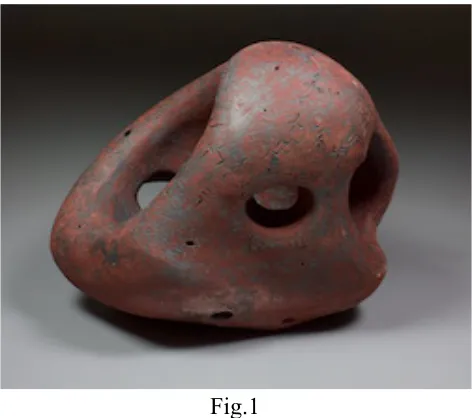
These holed stones with which I have long been interested in hold spiritual and ritual
significance in many different cultures the most significant of which being the Celto-Germanic tribes of
some believed if you wrote a wish on a piece of paper rolled it up and pushed it through the hole in the
stone your wish would be granted. On the other hand, some believed if you hung it from your bedpost
it would protect you from nightmares, but more literally a visit from the night hag, as "mare" or "
maere" means witch or hag in Celto-Germanic. This is where the name witch stone or hag stone comes
from, according to surviving folklore if you peer through the hole you can see into the Otherworld. It is
in these narratives and myths that the identity of the ritual objects resides.
Fig.1
After discovering these objects had ritual significance, I began creating a connection to ancient
traditions of story-telling and the origins of written word by employing certain types of cuneiform (the
earliest form of written language) as surface decoration. It was my hope that my audience would be
uncertain of the age, materiality, and origin of these objects and that perhaps this uncertainty would
push them to create their own story about the object. Why did the people of old find these objects to be
so fascinating, and powerful? I tried to tap into that which gives the witch-stones objects significance.
My research into witch-stones of the Celto-Germanic cultures led me to discover the scholar
rock of Ancient China, one of the earliest examples of this tradition was "The stone of Great Yu,
[image:11.612.188.424.233.442.2]Yu, who is said to have founded the Xia Dynasty in about 2100bc, attests to an early use of large,
sculpted rocks for religious or commemorative purposes...By Song times smaller, favored rocks were
taken into the scholars study: some were used as brush rests or ink stones; but most vehicles for
contemplation meant to mimic nature or a mountain peak in the Chinese garden"2.
The rock represented a microcosm of the universe on which the scholar could meditate within
the confines of garden or studio. There were many factors that went into determining the value of these
rocks but, "more than anything else, it was the formal qualities of the rocks that appealed to the
Chinese literati;...form, color, texture... attenuated proportions that recall soaring peaks, textured
surfaces that suggest great age, forceful profiles that evoke the grandeur of nature, overlapping layers
and planes that impart depth, and hollows or perforations that create rhythmic, harmonious
patterns...painted by the powers of nature."2. The scholars defined these attributes so as a way to
quantify the value of a rock. I used this description of the "formal qualities" 2. to help define the
qualities that I wanted my work to possess.
[image:12.612.115.500.447.702.2]I was surprised to find that scholar rocks were often carved, "... most have to be
chiseled, ground and polished to complete their beauty...those that are slightly inferior in their
characteristic hollows and crags are improved by more chiseling and then aged by re-submersion, so
that the stone may be scoured by wind and rain and its patterns restored to a living appearance. " So,
the scholars of the song dynasty were not troubled that these rocks were not entirely "painted by the
powers of nature"2. I thought perhaps the act of introducing the human hand somehow lessened or,
tainted the object's aura. I look at this example of sculpting a natural object, as historical president to
justify my own process.
Upon closer examination of my intentions with these works through critical analysis offered by
my professors I came to realize that I was flirting dangerously with "Kitsch Art" and all of its baggage.
Kulka in his book "Kitsch in Art" offers a definition I found helpful; he itemizes three necessary
conditions of kitsch. First, kitsch is highly charged with stock emotions. Second, kitsch employs
subject matter that is instantly and effortlessly identifiable. Third, kitsch does not significantly enrich
our associations in connection with the subject matter. Accordingly, kitsch cannot be stylistically
innovative, for such originality would interfere with the effortlessness of identification.
My work, the Sea Rocks fits these criteria surprisingly well. I am engaging emotionally
potent memories from my childhood, and trying to illicit similar emotion in my audience. My intention
is to create an object of beauty, my subject matter easily identifiable as nature. The third point is where
I may diverge from kitsch. My work is intended to enrich the audience's associations in connection to
the natural world but this connection is dependent on the viewers willingness to engage with the object,
and therefore purely subjective. In the future, I intend to investigate this relationship more closely,
trying to view Kitsch through a lens less clouded by negative preconceptions. Perhaps if I embrace
historical, or ritualistic content I am inspired by these works will find resolution.
There are several ceramic artists that I feel have successfully navigated the fine line between
nature inspired art objects and the world of kitsch. Keisuke Mizuno is one such contemporary
ceramicist. He creates excellently rendered hyper-realistic porcelain flowers and fruits, sometimes in
the format of humorously impractical pottery, and sometimes purely sculptural compositions with no
suggested function. They are intended to illustrate the cycles of life, from embryonic to death and
decay. It seems that by offering the viewer these amazingly intricate, finely rendered, and easily
recognizable compositions, his intent is to lure them in so that they might confront the subtle grotesque
metaphorical details he has strategically included.
We are both inspired to somehow recreate the stories told through nature. Where his work
draws a viewer in offering them subtle details completing the narrative. My own work is intended to
engage the audience on a similar level, but the narrative is left open ended, a vehicle of contemplation
similar to the scholar rock... "but why?" I am asked. I respond, "to glorify the beauty in nature, to
express a feeling of rightness only found in the natural world..." I see now how empty this response is
and how squarely it places me within kitsch. I am well within the realm of beach wood wind chimes,
and snow globes, rather than the good kitsch, the kitsch that offers insight into sociological, and
politically potent issues.
As I was creating the Sea Rocks I had a notion as to their perceived shortcomings of, and
attempted to reconcile this by completing the narrative. As I mentioned previously I began creating a
connection to ancient traditions of story-telling and the origins of written word by employing certain
types of cuneiform as surface decoration. In the end, these subtle details seemed to fall short, they
largely went unnoticed.
Leon comments that “wood, much like clay itself, tells many stories like an ancient footprint.”4.
Inspired by rustic Taiwanese wooden furniture, Ah Leon’s installation "Memories of elementary
School" exhibited at the American Museum of Ceramic Art in 2010, emphasizes the surrealism of what
it’s like to return to the past with an adult perspective. The desks personify the friends of his past;
people from his home who have come back for reunion after thirty to forty years to find the desks have
aged or bear the same marks as those who once occupied them.
Ah Leon is inspired by the ancient story of wood, just as I am inspired by the ancient story of
stone and its connection to clay. Where he is describing the melancholic story of the loss of youth and
the inevitability of time through metaphor. I am describing the narratives of the forces of nature, and
the beauty of an object painted by the forces. The metaphor Ah Leon uses; the dilapidated rotting
wooden desks and chairs of his childhood seen through the eyes of an adult and rendered in clay, with
infinite detail, is the bridge the viewer needs to draw the connection between the objects he has made
and the story he is telling.
Admittedly, my work is missing this bridge. More specifically the bridge to greater
understanding and appreciation of the subject matter is too subtle or veiled to be easily recognized.
Moving forward I think perhaps I need to more fully incorporate kitsch or pop art, in the form of
graffiti to offer a contrasting detail, suggestive of narrative in a more contemporary context. Perhaps
the act of defacing a beautiful object of my own creation will offer some form of cathartic release.
I began creating the Sea Rocks again because I felt that something intrinsic was missing from
my work. They were meant to give me the opportunity to re-engage with the clay with my hands,
experiencing its tactile response physically, viscerally. I felt it imperative to explore a making process
from my past which came from a pure place artistically.
objective with these Sea Rocks remains to describe a fictional natural history leading the audience to
engage with the object and their own imagination allowing them to create their own narrative of its
history perhaps sharing a glimpse of the mystery I felt exploring those creek beds in my youth, as well
as perhaps some "universal or abstract vision of beauty". Is this perhaps an act of self-gratification? It
is not enough in the context of contemporary art to create a vision universal of beauty.
If I can see beyond my negative preconceptions of kitsch, I believe there is potential to
strengthen this body of work by engaging kitsch more intentionally, using it for its ability to express
feelings of loss and sentimentality by creating objects that capture the past, and more potently identify
with the basic human need to connect with nature in a deep and meaningful way. My research has
uncovered several culturally relevant sources of inspiration that might help me realize this goal. To
some ancient people, these artifacts were windows into another world, to others they represent a
microcosm of our universe, serving as vehicles of contemplation, to others still they are ritual objects
shrouded in mystery known only to reflect and pay homage to the natural world around them. I am
finally beginning to digest the significance of these ancient practices/ beliefs and how they relate to my
own work. In hindsight, I realize the bridge to greater understanding and appreciation of the subject
matter depends greatly on the context in which the objects are displayed. Scholar Rocks were generally
situated on ornately carved wooden pedestals, Hag Stones were supposed to be hung from a windowsill
by a red string, and the Incan Mirror stone is literally carved directly into bedrock. Placing my work in
a context that relates to the historical setting of the original object and inspiration would give me an
opportunity to engage with the idea of kitsch more directly as well as completing the narrative that I am
Chapter 2
Mirror Stone
When I first started making pottery, I was never content to throw round vessels on the wheel. I
would always alter round forms to achieve an animated quality, a movement. I was disinterested in
static form. Contrarily, for years I have created symmetrical, geometric, slip-casted vessels, in what I consider to be an analytical, design oriented process. A form study undertaken for the development and discovery of new shapes and unique ways of describing structure and geometry in the form of vessel. For years now I have had a strange compulsion to bring these shapes into three-dimensional reality. I believe that by continuing to develop the process and refining the forms, I can come to a greater understanding of the aesthetic principles and rules that determine the success or failure of a design within this faceted geometric format. I have spent many long hours and experienced much failure experimenting and studying geometric forms and the slip-casting process, eventually developing enough analytical understanding to manipulate this process on an intuitive level.
It is because of my compulsion to reinvestigate these forms, as well as my research into the Incas that led to the next evolution in my work. The Inca, in a mysterious ritual practice, would carve
natural stone formations to mirror the surrounding landscape in an abstracted miniature. They had no
written language, so the exact purpose of these ritual stones remains unknown, but it is assumed to be a
form of nature worship. These carvings would normally be situated within a shrine structure where it is
believed that they were used in ritual by priests to pay homage to the spirit of the mountain or the gods.
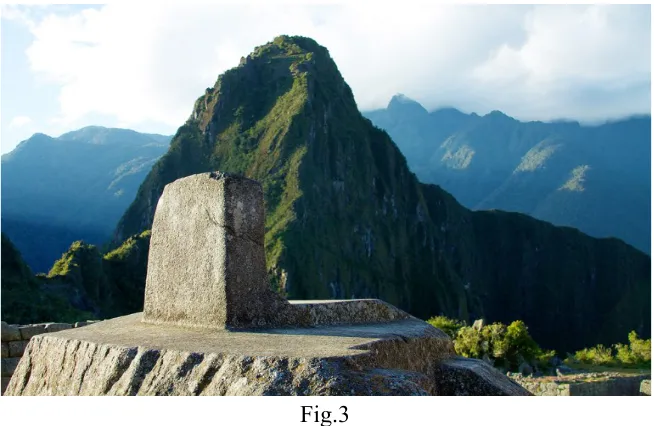
One of the most famous ritual stones, Intihuatana, is located at Machu Pichu in Peru, its name
Fig.3
I became fascinated by the idea that the Inca potentially deified their landscape and were
compelled to carve an abstract "totem" to better facilitate the ritual worship of a mountain. I decided to
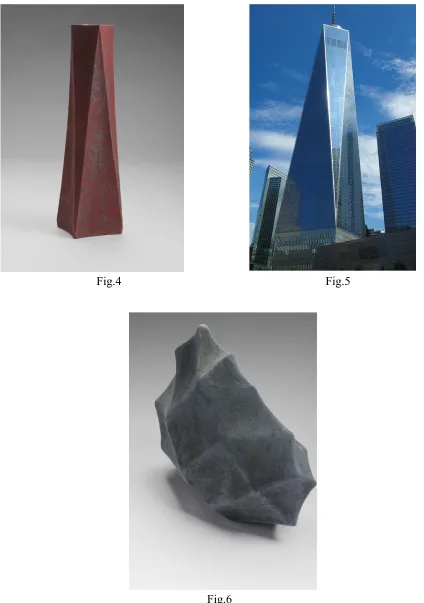
appropriate and re-contextualize this theme in my own work, looking at a city skyline as modern
landscape. The World Trade Center being the most dominant and recognizable feature of the New York
City skyline as well as a culturally potent symbol is why I chose it as the subject for a few of my shape
studies. The geometric faceted architecture of the building also factored into my use of it as inspiration
because it employs a similar design language to that of my own earlier work. I thought this a fortuitous
opportunity to utilize this iconic cultural landmark as a subject while maintaining the integrity of my
own distinctive design language. This piece marks a departure from the naturalistic Sea Rock
sculptures both chronologically and philosophically. It is intended to reflect the ambiguous age and
materiality suggestive of a ritualistic vessel or relic from our collective past. It is also meant to
reference the design language of architecture and geometry, to build a bridge of continuity between the
sea rocks and a form study I have been actively engaged with over the past decade. Over the years, this
[image:18.612.143.470.55.268.2]Fig.4 Fig.5
[image:19.612.86.510.54.657.2]Fig.7
[image:20.612.86.533.95.619.2]Chapter 3
Adaptive Growth
Nature is and has always been the most potent source of artistic inspiration for me. If I am looking, I see it producing one miracle after another. The growth of a complex plant from a tiny seed. The way a flower can somehow sense and track the sun through its daily transit. "Pando", a quaking aspen grove and the world's most massive organism, has been creeping inexorably over the Colorado Plateau seeking nutrient rich soil for more the 80,000 years. These natural phenomena occur on a timescale too slow for our senses to register in real time, but if you are observant, and know where to look you can see the evidence of the story they tell. It is this same story "Erratic Vessels" are meant to express.
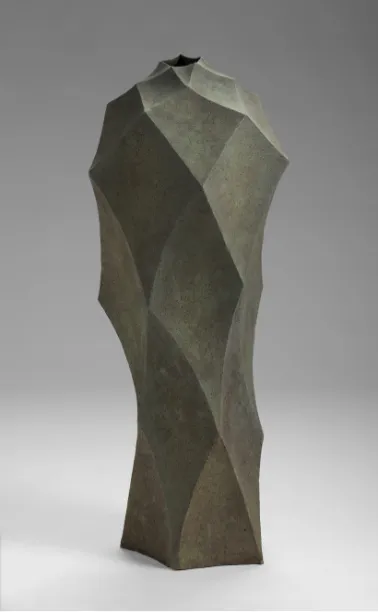
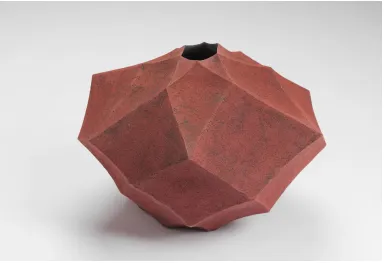
[image:21.612.328.517.392.698.2]These sculptural vessels are a hybrid, blending the geometric and the organic, the analytic and the intuitive. I am seeking to express growth while allowing myself the freedom to explore the potential of dynamic form. The vessel's function is to contain substance. In my imagination, these vessels contain the metaphorical substance of life, a limitless potential for growth, like a seed. They are an abstraction, referencing plant development, specifically a phenomenon referred to as "adaptive growth" (whereby a plant actively adapts to the stresses in its natural environment). Erratic Vessels are meant to illustrate this biological adaptation by incorporating a dynamic tension into a structured geometric framework, activating the form by altering its dimensions and giving it a gesture, a living potential. This abstracted growth pattern is intended to suggest that they are actively responding and adapting to the forces enacted upon them by the living world.
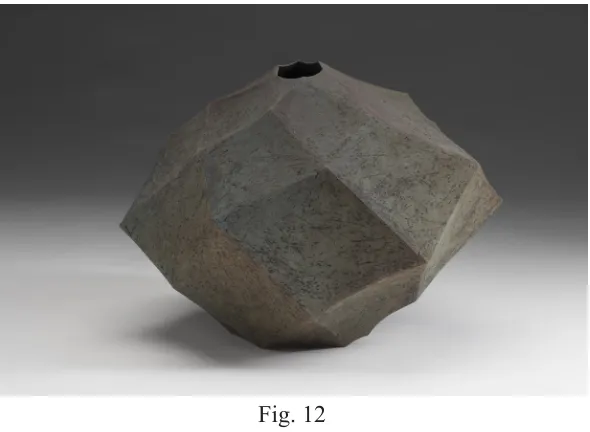
Fig. 12
Clay is the ideal medium with which to realize my intent because it is impossible to divorce the material from its metaphysical connection to the earth from which it came. Clay, the product of
me a freedom to build spontaneously, experiencing the vitality and demands of the material. I try to respond intuitively to the intricacies of a developing form within a pre-designed architecture, giving it a breath with which to evolve and find its own gesture. I slowly build an organic movement into the object, sculpting directional growth, as if the object is responding to a stress in its natural environment.
[image:23.612.115.499.427.690.2]After the form is complete, I scrape the surface of the bone-dry clay with a metal rib, exposing the coarse aggregate material within, creating a rough textured surface, and erasing the mark of the maker. This texture is filled with the chemical, copper oxide, which when fired in an oxygen rich environment, bleeds through the layered wash of colorants which have been sprayed on top of it. The oxide in combination with the colorants give the vessel a weathered dry surface while allowing for a vibrancy and richness of color that I have never before achieved in my own work. This surface is one that is not commonly associated with the ceramic objects, it is however similar to that of a patina on oxidized metal, or the lichen on a stone, a fact that is meant to confuse the initial assumptions made about the objects materiality.
In the format of sculptural vessel, the structure and design of the opening is incredibly vital to the successful realization of intention. It is the point at which metaphorical space within interacts with physical space without. I construct the opening of an Erratic Vessel in such a way to restrict light from hitting the interior walls and to cast the inside into darkness. If you cannot see what is hidden inside,
you cannot know what is held within, therefor limitless possibilities remain. The design of the
opening is partially inspired by the work Andy Goldsworthy who utilizes a similar a similar device in
many of his earthwork sculptures. In a work titled 'Rowan leaves around a whole'. Hundreds of leaves
arranged in a circle radiate around the hole with decreasing vibrancy of color. The paper-thin terminus
allows for very limited access to the pitch-black hole's interior. This shear edge around a hole, that
Andy uses in a number of his sculpture achieves the very effect I was trying to achieve. That is,
denying the viewers access to visual information inside the volume, the knowledge of what lies within,
offering instead a void of light. This void leads to a question that cannot be answered, which in turn
instigates a higher level of engagement between object and viewer. The opening is sculpted to appear
much thinner than the actual structural walls of the vessel creating the illusion that the entire vessel is
constructed in the same way. This should lead an engaged audience to question their preconceptions about the physical nature of clay and engage with the vessel more deeply, inspecting it for clues to its origin and construction.
Michael Sherrill in his artist statement writes; "I am compelled by the sensation of seeing
things fresh; as if for the first time ... It is as if I have been asleep, and when I wake up, I am surprised
by the things that surround me... it is the flora and fauna that surrounds my studio that continues to
surprise me... these discoveries are epiphanies. My desire is to create something that might bring its
observer to the same place of discovery. It's one thing too for me to respond to a stimulant and then to
viewer."6. When I was first introduced to his work perhaps thirteen years ago I had only just began
making pottery, and at the time I was also working as a blacksmith. The way that Sherrill seamlessly
incorporates flawlessly rendered ceramic elements with intricately forged metal was hugely formative
for me especially in those earlier years when I was working more with metal forging and fabrication.
My work has never approached his level of execution, nor am I interested in achieving the level of
realism he employs, but the discovery that the intent behind his work so closely parallels my own has
been an inspiration. Thinking back on that time, I realized that these natural processes, specifically the
cycles of life and death, the growth and adaptability of plant life, have always been hugely inspiring to
me. Even if my connection to nature has faded somewhat since my younger years, the growth of plants
always inspires a sense of awe.
While shuffling through books in the library, researching in greater depth my early
inspirations, I stumbled across a description of the sketches that Augusta Rodin made during a
pilgrimage to Florence to study the work of Michelangelo Bounarroti. The art scholar recounts, " it was less the equilibrium and grace of antique sculpture that intrigued Rodin than it was the tension and
torsion of Michelangelo's figures... a condensed energy that in the work of Michelangelo had been
termed 'terribilita'."7. My work, these Erratic Vessels are not abstracted from the work of Michelangelo
or Rodin. It is the description of Michelangelo’s work through the eyes of Rodin that I find inspiring.
It is this condensed energy, this tension and torsion that I am interested in. I see it exhibited in nature as
adaptive growth. I am inspired to emulate this condensed potential energy, to suggest directed growth
because I feel that by doing so one can breathe life into static form.
Erratic Vessels are meant to contain the stuff of life, limitless potential for growth. With them I
Chapter 4
Conclusion
Was I successful? Was I able to project into a plastic medium the story of an ancient artifact, a weather-beaten stone, a plant responding to stress in its environment? In just a few instances, perhaps I was able to impart my abstract vision of beauty.
With the sea rocks, at times it felt as though I was simply copying nature. This was never my
intention. My ego rebels against the notion that I am creating a "fake" object. The idea was to create
an illusion, a "living appearance", with the intention of illustrating a fictional natural history and to
glorify the natural world around us. I believe that displaying my work in a context that relates to the
original setting of the historical object (i.e. Hag stone suspended from a red rope, Scholar rock
displayed on an ornately carved cherry wood pedestal) would give me an opportunity to engage with
the idea of kitsch more directly, creating settings that capture the past, perhaps eliciting emotions of
loss and sentimentality as well as completing the narrative that I am trying to portray. In the time
since I departed from this exploration my process has evolved to where I feel more comfortable
reexamining the body of work. I will come back to it in a few more years. Perhaps time will offer
insight needed to bring this body of work to fruition.
The Erratics I am still actively engaged with, and excited about their potential. As I mentioned,
this body of work began as a form study, however my process never reflected this guiding philosophy.
In order for it to function as a true study of form I needed a rapid prototyping process in order to work
through potential forms more quickly and efficiently. At one point one of my thesis committee
members Professor Andy Buck suggested I make small vessels, like models. At the time, I wasn't ready
started making Erratics again, only at a tenth the scale. Also, I made them solid allowing them to dry
slightly and then hollow them out, this instead of coil building the whole form. Using this method, I am
able to control the form more intentionally, and work through variations with a quickness. The process
also gives me the ability to play with the gesture of the form much more freely. In the future, I plan
on scaling up the process, creating large site-specific installations. I plan on making several human
sized vessels and situate them so they are interacting with one another, or engaging with the
environment they are in more intentionally.
I continue to revisit these themes from my past perhaps because they have yet to be fully realized. Perhaps also I seek to connect with a younger self, an artist who is less influenced from without, more from within, less encumbered by the past, more willing to take risks. I revisit my past so that the work I have made is not wasted, so that I can use what I have learned to inform future work. I think it is a basic human need to feel that the time they spend throughout the course of their life is worthwhile, that it has meaning. I think kitsch in a way might help express a similar thing in that it can describe the "sensibility of loss- a yearning for objects to help recapture the past"8. The act of creation
List of Images
Fig.1-
Hag Stone,
2017
(Earthen-ware, ^04, Oxidation, sprayed oxide wash)
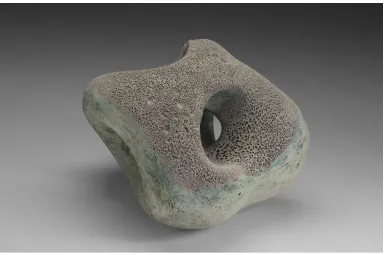
Fig. 2-
Odin Stone,
2017
(Earthen-ware, ^04, Oxidation, sprayed oxide wash)
Fig. 3-
Intihuatana, Peru
Fig. 4-
Mirror Stone,
2017
(Earthen-ware, ^04, Oxidation, sprayed oxide wash)
Fig. 5- World Trade Center, USA
Fig. 6-
Expression of Time
, 2017
(Earthen-ware, ^04, Oxidation, sprayed oxide wash)
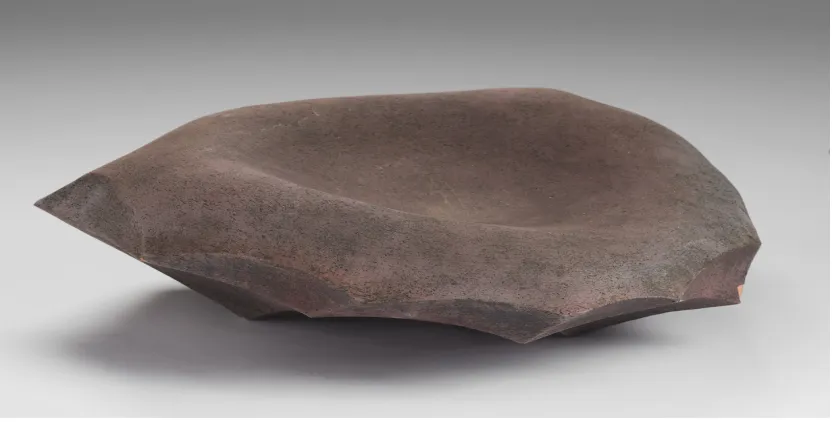
Fig. 7-
Ritual Basin
, 2017
(Earthen-ware, ^04, Oxidation, sprayed oxide wash)
Fig. 8-
Blue Vessel
, 2017
(Earthen-ware, ^04, Oxidation, sprayed oxide wash)
Fig. 9-
Yellow Vessel
, 2017
Fig. 10-
Erratic Vessel
#4, 2017
(Earthen-ware, ^04, Oxidation, sprayed oxide wash)
Fig.11-
Erratic Vessel
#3, 2017
(Earthen-ware, ^04, Oxidation, sprayed oxide wash)
Fig.12-
Erratic Vessel
#1, 2017
(Earthen-ware, ^04, Oxidation, sprayed oxide wash)
Fig.13-
Erratic Vessel
#2, 2017
(Earthen-ware, ^04, Oxidation, sprayed oxide wash)
Bibiliography
1. Curtis, P. and Hepworth, B. (1998).
Barbara Hepworth
. London: Tate Gallery Pub.
2. Mowry, D. Robert (1997).
Worlds Within Worlds, The Richards Rosenblum
Collection of Chinese Scholar Rock.
Cambridge Massachusetts: Harvard University Art
Museums
3. Tomas, Kulka (1996).
Kitsch and Art.
Philadelphia: Pennsylvania State University
Press.
School" and the Spirit of Yixing Tea Ware.
http://www.amoca.org/ah-leon.
5.
Burger, L. Richard and Salazar, C. Lucy (2004).
Machu Picchu: Unveiling the
Mystery of the Incas.
New Haven: Yale University Press.
6. Sherrill, Michael (2017). https://michaelsherrill.net/artiststatment/
7. Fergonzi, Flavio; Lamberti, M. Maria; Ragioniera, Pina; Riopelle, Christopher
(1997).
Rodin and Michelangelo; A Study in Artistic Inspiration.
Philadelphia:
Philadelphia Museum of Art
8. Olalquiaga, Celeste (2002).
The Artificial Kingdom.
Minneapolis: University of
Minnesota Press.
Acknowledgments