Scene changes, experienced changes: a longitudinal and comparative study of Canberrans who use illegal drugs
Phyllis Rose Dance April 1 1998
Unless otherwise stated, the research reported in this thesis is my own
ACKNOWLEDGEMENTS
The National Campaign Against Drug Abuse provided me with a PhD scholarship and grant. The Commonwealth AIDS Research Grants Committee provided me with two grants and I also received a bursary from the National Centre for Research into the Prevention of Drug Abuse at Curtin University. I would not have been able to conduct my research in the way I was able to without this help and I deeply appreciate this assistance.
I turned to several specialists when I needed help with particular aspects of the research. Robyn Attewell and Mike Jones provided frequent statistical advice. Simon Bronitt and Richard Refshauge helped me with legal issues. Shane Darke was always very cooperative when I contacted him with questions about The Opiate Treatment Index. Leslie Devereaux gave me a lot of insight into conducting ethnographic work. Diane Laycock and Irene Passaris of the Communicable Diseases Branch at the ACT Health Authority were more than generous when responding to my request for information on notifications and risk factors for hepatitis C in the ACT. Rod McClure and Lia Battisson provided me with the numbers of people in the ACT Methadone Program. David Plummer made some invaluable comments on the draft of my findings on genital health. Paul Williams provided me with references on social health. I am very grateful to all these people for so generously sharing their expertise with me.
John Barnes reconstructed, and improved, my diagrams after they were lost during a period when I was having problems with my computer. Christine Benger and Suzanne Lister transcribed some of the qualitative data. Peter Olsen expediently and sympathetically repaired my computer when it broke down three times in the last three months of my writing this thesis. Frank Trainor has always readily responded to my requests for computer support. Phil and Dot Ware photocopied the attached documents in the Appendices.
The friendly and helpful staff at the Alcohol and other Drugs Council of Australia library always cheerfully responded to my requests for assistance and were very welcoming when I visited the library. They made my literature searches much easier and I thank them all.
research process and I thank him not only personally, but on behalf of the people I interviewed who were also very relieved when my work was gazetted under this Act.
All the staff at NCEPH gave me wonderful support but there are some people I would like to particularly mention. During the course of his hectic schedule, Professor Bob Douglas always found time to ask me about my progress. Blanka Baric is worthy of my special thanks for always being so cheerful and friendly. Peggy Daroesman, Kaye Devlin, Jean Hardy and Vera Joveska provided excellent administrative support. I made frequent requests for computer support which Colin McCulloch and Jifu Xing always willingly responded to with good humour.
The support given by the staff at the ACT Assisting Drug Dependants Incorporated greatly expedited the research process. I would particularly like to thank the AIDS Bus workers for helping recruit respondents, Perry Fletcher for providing me with data on the numbers of clients accessing the Needle Exchange Program, and Jude Byrne and Tarquin McPartlan, for not only encouraging people to present for interview, but also for encouraging me in my work.
My very special thanks go to my supervisors and advisers. Both A1 Klovdahl and Marion Watson provided advice in the early stages of the research. Marion Watson was also very helpful in encouraging people to present for interview. I shall always be grateful to Stephen Mugford for inspiring me to conduct research among people who use illegal drugs. He also gave me advice in the early stages of the research. Matt Gaughwin has always displayed an interest in my research and he made thoughtful comments of my thesis drafts. Dorothy Broom helped shape my thinking during my undergraduate career. She gave me support throughout my time as a PhD student and provided excellent and constructive criticism on the drafts of my written work. Since our first meeting, Gabriele Bammer has been a source of inspiration and encouragement. I thank her deeply for her wisdom, her guidance and her kindness throughout the whole of the research process. Our relationship was also enhanced by our shared sense of humour.
formatting of the thesis, including that of the tables. Frances Morphy proofread drafts of the thesis and kindly provided her expert editorial advice. The tables in the appendices were transformed after I followed her suggestions. I would also like to thank my Canadian friends Jim and Sandy Paterson for so quickly responding to my request for a publication that was otherwise unobtainable. Adele Stevens made very helpful comments on some of the issues relating to women who use drugs. Additionally, her friendship was a source of strength throughout our PhD experience together. Celia Westwood undertook some of the transcribing of the qualitative data and also proofread my questionnaire.
My extended family have always been a source of strength. In particular, their encouragement and interest in my work helped me throughout the process of this research.
I would like to acknowledge my very deep gratitude to the people who presented for interview and who so openly gave me details of the most intimate aspects of their lives. Above all, this work would not have been possible without them and I am indebted to them all. I am deeply grateful to those people who invited me into their lives outside of the interview setting. As always, my very special thanks to “Roger” and his fellow Oswaldians.
ABSTRACT
The most widespread image of people who use illegal drugs is that they manifest a range of problems due to their dependence. But some people who use illegal drugs represent themselves as “recreational” users who differ from this stereotype. This research investigates a group of polydrug users who called themselves “recreational” users when I first met them in 1989. I study how they have fared over the nine years I have had contact with them. In 1989, their use was associated with fun, most obviously displayed in the spoof worship of “Saint Oswald”, the “Patron Saint” of drug use. For obvious reasons, the members of this group call themselves “Oswaldians.”
My first hypothesis was that, not only was the invention of this “Saint” unique, but that group members were different from other users of illegal drugs, both in their approach to drug using and also in realms such as education, their extensive polydrug use, their strong friendship links and their limited involvement with serious crime. After an examination of the literature, which indicated that there are more non-dependent than dependent heroin users, my second hypothesis was that the Oswaldians’ “recreational” use of heroin would persist longterm.
To test these hypotheses, I interviewed both Oswaldians and non-Oswaldians, and 1 also considered it important to conduct two rounds of interviews in order to measure changes over time. I interviewed 139 Canberra-based users of illegal drugs during 1992 and, during 1993 and 1994, I reinterviewed 97 of these people, 40 of whom were Oswaldians. Both qualitative and quantitative data were collected on sociodemographic characteristics, drug use, health and crime. The baseline data obtained at the first interview and the prospective data on a variety of changes which occurred between interviews were used to explore differences between Oswaldians and non-Oswaldians.
Most people I interviewed had completed their Higher School Certificate and many were involved in tertiary education. A history of extensive polydrug use was common. The majority had strong social support networks. A few IDUs were still sharing needles and syringes. There was a high incidence of unsafe sex. Between interviews, several IDUs had been diagnosed with hepatitis B and/or C. There was very little involvement in serious crime and very few people had been incarcerated.
illegal drugs. Very few were able to maintain all their drug use at a “recreational” level. Over the years, many Oswaldians have become dependent on heroin and this precipitated their first treatment. Others had ceased or decreased their use of illegal drugs, including heroin.
Amongst the total sample, there was a significant increase in the number of people with a history of treatment at the second interview. I also found a significant relationship between treatment status and both age and duration of heroin use. These findings lead me to question previously held wisdom about the ratios of dependent to non-dependent heroin users. I suggest that, in contemporary Australia, long term non-dependent heroin may be possible for only a minority. My findings are derived from only a small sample. I recommend, therefore, a longitudinal study of a larger sample of heroin users in order to better estimate Australian ratios of dependent and non-dependent heroin use.
I was also interested in gender differences but found only a few, most notably in women’s riskier sexual behaviours. I also compared those who went on to present for the second interview with those interviewed only once. The latter were significantly younger and it is possible, therefore, that their experiences between interviews would have been different from those who presented twice.
TABLE OF CONTENTS VOLUMES I AND II
Chapter 1: Introduction
1.1: Background to the research 1.2: Genesis of the research ... 1.3: The Oswaldians...
1.4: General hypotheses
1.5: Overview of the research... 1.6: Overview of the th e sis ... 1.7: Definitions related to drug u s e . . 1.8: C onclusion... Chapter 2: Methodological approach
2.1: Introduction... 2.2: Sampling ... 2.3: Integrated methodology ... 2.4: Instruments used for interviews 2.5: The interview s... 2.6: Ethical considerations ... 2.7: Sources of bias ... 2.8: Reliability and v a lid ity ... 2.9: Data analysis ... 2.10: Summary ... Chapter 3: Sociodemographic profiles
3.1: Introduction ... 3.2: Characteristics of the A C T ... 3.3: Residential sta b ility ... 3.4: G e n d e r... 3.5: Age ... 3.6: Country of b ir th ... 3.7: R elig io n ... 3.8: Secondary education ... 3.9: Tertiary education ... 3.10: Conclusion ...
Chapter 4: Setting the scene: a history of drug use in Australia, the ACT and among respondents
4.1: Introduction ... 41
4.2: A brief history of drugs in Australia ... 42
4.3: Drug use in the ACT ... 45
4.4: Data collection on drug use at the first interview ... 46
4.5: Drug use histories of respondents ... 48
4.6: Alcohol... 49
4.7: Tobacco ... 49
4.8: Cannabis... 49
4.9: Hallucinogens... 50
4.10: Stimulants... 52
4.11: Opioids ... 54
4.12: Inhalants ... 56
4.13: Benzodiazepines... 58
4.14: Antidepressants ... 60
4.15: Barbiturates ... 60
4.16: Antipsychotics... 60
4.17: “Cocktails” ... 60
4.18: Miscellaneous drugs ....^... 60
4.19: Respondents’ histories of treatment for drug problems ... 61
4.20: Conclusion ... 662
Chapter 5: Dynamics of drug use: scene changes, experienced changes 5.1: Introduction ... 63
5.2: Data collection on drug use at the second interview... 65
5.3: Changes in number of drugs used between interviews ... 66
5.4: Changes in alcohol u s e ... 68
5.5: Changes in tobacco use ... 70
5.6: Changes in cannabis use ... 70
5.7: Changes in stimulant u s e ... 71
5.8: Changes in opioid use ... 72
5.9: Changes in hallucinogen u s e ... 75
5.10: Changes in benzodiazepine use... 76
5.11: Changes in inhalant u s e ... 77
5.12: Changes in other drugs used ... 78
5.13: Personal explanations for changes in drug use ... 78
5.14: Methadone treatment... 80
5.15: Other drug treatment ... 86
5.17: Other reasons given by respondents for changes in drug consumption
patterns ... 87
5.18: Discussion ...104
5.19: Conclusion ... 108
Chapter 6: General physical psychological and social health 6.1: Introduction... I l l 6.2: The harm minimisation movement in Australia ...I l l 6.3: Mortality and morbidity associated with drug u s e ...112
6.4: The positive effects of drug use... 115
6.5: A mixed experience of drug use ...116
6.6: Overview of the presentation of the findings... 116
6.7: General physical health ... 117
6.8: Psychological health ... 126
6.9: Social health... 133
6.10: Conclusion ... 146
Chapter 7: Behaviours related to injecting drug use and sexual and genital health 7.1: Introduction... 149
7.2: Presentation of the findings... 149
7.3: Prevalence of injecting in Australia ... 150
7.4: Prevalence of injecting in the A C T ... 150
7.5: Injecting histories of respondents ... 151
7.6: Human Immuno-deficiency Virus/Acquired Immuno-Deficiency Syndrome... 154
7.7: Hepatitis B virus... 157
7.8: Hepatitis C virus... 159
7.9: Effects of bloodbome viruses on drug u s e ...160
7.10: Discussion and implications of findings on bloodbome viruses ....161
7.11: Other health problems associated with IDU ...163
7.12: HIV Risk Behaviour Score ...163
7.13: Needle risk use behaviours ...165
7.14: Sexual behaviours ...173
7.15: Commercial se x ...176
7.16: Genital health ...177
Chapter 8: Criminal behaviours
8.1: Introduction ...181
8.2: Data collection on criminal behaviours ... 182
8.3: OTI score and summary of all criminal behaviours... 182
8.4: Drug-related crim es...184
8.5: Property crim e...185
8.6: Fraud ...187
8.7: Assaults ... 187
8.8: Miscellaneous crimes ... 188
8.9: Apprehensions for illegal activities...188
8.10: Illegal income... 191
8.11: Effects of changes in treatment status and drug use on criminal activities ... 191
8.12: Discussion ... 192
8.13: Conclusion ... 193
Chapter 9: Summary, conclusions and recommendations 9.1: Introduction... 195
9.2: Findings from total sample ... 195
9.3: Differences between the people who presented only for the first interview and those who presented for b o th ...197
9.4 : Changes between interviews ... 198
9.5: Differences between Oswaldians and non-Oswaldians ... 201
9.6: Differences between core-Oswaldians and the Remainder... 202
9.7: Gender differences ... 203
9.8: Suggestions for future research... 203
9.9: Suggestions for further harm minimisation ... 204
9.10: Limitations of the findings... 209
9.11: Conclusion ... 210
Appendices
Appendix 1: Abbreviations and acronyms ... 241
Appendix 2: Dance, P. 1991. Befriending friends: methodological and ethnographic aspects of a study of a Canberra group of illicit drug users. International Journal of Drug Policy, 2: 34-6... 245
Appendix 3: Dance, P and S Mugford. 1992. The Saint Oswald's Day celebrations: “carnival” versus “sobriety” in an Australian drug enthusiast group. Journal of Drug Issues, 22: 591-606...249
\ Appendix 4: Definitions ... 265
Appendix 5: The flyers... 267
Appendix 6: Interview Guide used at the first interview ... 271
Appendix 7: Interview Guide used at the second interview... 321
Appendix 8: Codes used at the first interview for quantitative data ... 359
Appendix 9: Codes used for quantitative data for the second interview... 367
Appendix 10 The Opiate Treatment Index ...373
Appendix 11: The consent forms ... 397
Appendix 12: The ACT Epidemiological Studies (Confidentiality) Act, 1992 ..401
Appendix 13: Sociodemographic findings ...411
Appendix 14: McDonald, D. A Stevens, P Dance, and G Bammer G. 1993. Illicit drug use in the Australian Capital Territory: implications for the feasibility of a heroin trial. Australian and New Zealand Journal of Criminology, 26:127-45... 415
Appendix 15: Respondents’ histories at the first interview for classes of drug and individual drugs used ... 435
Appendix 16: Drugs used, by interview ... 463
Appendix 17: NUD.IST codes for reasons given by respondents for changes in drug use between interviews ... 503
Appendix 18: Changes in treatment and drug u s e ... 527
Appendix 19: Changes in physical, psychological and social health... 557
Appendix 20: IDU, sexual and genital health ... 593
Appendix 21: Dance P. 1992. Picking the Right Fit. ACTTVNews, 18:1-2... 607
CHAPTER 1: INTRODUCTION
1.1: Background to the research
M ost known human societies, as well as some non-hum an societies, have used psychotropic substances (Plant, 1975; Davies, 1986; Mugford and Cohen, 1989; Siegel, 1989; Fraillon, 1990). People have been using these substances for a long historical period of at least 8 thousand years (Lang, 1998). In more recent times, it has become apparent that such use may lead to harm. My interest is largely in the prevention of health problems among people who use illegal drugs. This interest evolved throughout a nursing career which taught me that, where possible, prevention rather than treatment of disease should be the primary goal of health professionals. My philosophy towards the use of drugs came, therefore, to be based on the harm minimisation approach. This is defined by The National Drug Strategy (NDS) (abbreviations and acronyms are also included as Appendix 1) Committee for the Ministerial Council on Drug Strategy as “an approach that aims to reduce the adverse health, social and economic consequences of alcohol and other drugs by minimising or limiting the harms and hazards of drug use for both the community and the individual without necessarily eliminating use” (1994:4).
My involvement with research among people who use illegal drugs began in 1989. I begin this chapter with an overview of the genesis o f the further research discussed in this thesis. I then present the general hypotheses generated by the 1989 research. I go on to outline the research conducted for this thesis, the structure of the thesis, and define some of the associated terminology. The chapter continues with a summary of the main findings.
1.2: Genesis of the research
My research into illegal drug use began in 1989 when, as part of my Honours degree in Sociology at the Australian National University (ANU), I become involved in data collection for two ongoing research projects. The first project was the Australian National AIDS and Injecting Drug Use Study (ANAIDUS). The aim of this research was to “determine the variables associated with the risk o f HIV (human im m uno deficiency virus) infection in Australian injecting drug users” (ANAIDUS, 1991: unnumbered page, executive summary)1. The second project was the Australian Capital Territory’s (ACT) Drug Indicators Project (DIP), a three year research initiative funded by the then National Campaign Against Drug Abuse (NCADA). This was set up to “develop and refine methodologies for estimating the incidence, prevalence and character o f drug use in local communities” (Stevens and Wardlaw, 1994:21). My task for both these projects was to find Canberra-based “recreational” injecting drug users (IDUs).
At that time I knew no IDUs, and in order to gain access I was advised by my then supervisor, Stephen Mugford, to ask all of my friends and acquaintances if they knew anyone who injected drugs. I asked about 50 people without success until I found Roger (pseudonyms are used throughout) whom I first met when he came along to a meeting of an organisation to which I belonged. The following description of accessing the group o f which Roger is a member, as well as the description of the group, is synthesised from previous publications (Dance, 1989; Dance, 1991a; Dance, 1991b; Dance, 1992a; Dance and Mugford, 1992). Two of these publications are included as Appendices 2 and 3 (Dance, 1991a; Dance and Mugford, 1992).
After our second meeting with Roger, my partner and I invited him home for dinner. By the end o f the evening I had told Roger of my project. After questioning my attitudes toward the use and legalisation of illegal drugs, he told me he was a “recreational” injecting drug user, and enthusiastically insisted that he be the first person I interviewed:
It's about time someone got interested in us. All anyone has done so far is research addicts and we're not addicts [1 ’ve got] thirty to forty friends who are recreational users ... they're from mostly middle class backgrounds and we're not idiots. Whatever you do, don't treat us like idiots.
Roger said that he would get as many as possible of his friends to come to me for interview, and for the 1989 ANAIDUS and DIP research he was the nucleus of a snowball for 13 of his friends whom I also interviewed. The link with Roger, who had been around the Canberra drug scene for thirteen years, was crucial in encouraging his friends to present for interview. Since Roger was an influential group member, a “recreational” illegal drug user of many years standing, respected and trusted by his friends, I benefited from the “halo effect.” Fetterman describes this as a process whereby the greater the trust which the group places in the intermediary, the greater the trust extended to the researcher (1989). During the ethnographic work, which was not planned but which evolved during the 1989 research, the closeness and reciprocal friendship with Roger led people to relax in my presence, permitting a study of people who use illegal drugs in their “native habitats” (Becker, 1970:33). The “halo effect” was also a crucial factor in encouraging Roger's friends to present for interview. Not only did Roger see me as a friend, we both belonged to an organisation that had excellent credibility in his eyes and this fortified his personal trust in me.
and the other people were all only once removed from Roger. During the networking research, details of a further 25 group members were given to me by the group- members. Because some members of the group invented “Saint Oswald” the “Patron Saint of drug use, group members often call themselves the “Oswaldians.” I subsequently use this term when referring to them.
1.3: The Oswaldians
At the core of the Oswaldian group are many people who have known each other since schooldays. Several belong to the same families. During the 1989 interviews Sarah prompted the first real awareness that these people were, in the strict sociological meaning of the term, a group, not merely an aggregate:
This is a strange lot here in Canberra, they'll use anything. I don't know anywhere else like it. We get on each other's nerves; we all know everything about each other, do things together and we all sleep with each other. We have to get away sometimes, but we all come back.
Similar tantalising comments were coming through as I conducted the ANAIDUS and DIP interviews. For example, Patrick said: “We're a close knit group, I guess you could call us incestuous.” Jackie made a similar comment: “We're incestuous, we've really slept with everyone in the group. If we've not actually slept with them we've at least slept with someone who has.” Drew-11 said “I tried Uni’ at Wollongong but couldn't fit in. They're a bit rough there. They think we're intellectuals in Canberra, and I guess our group is.”
Based on interview data from 1989, and data from the interviews for the research described here, as well as my ethnographic work, I consider the core group of Oswaldians to contain 36 people. I have interviewed all but five of these Oswaldians at some stage and have interacted with all of them during ethnographic work. I have also, over the years, interviewed 22 people I consider to be peripheral or transitory group members. Some Oswaldians have presented for all four interviews I have conducted since I first made contact with them.
The requirements for entry into the Oswaldian group are not tightly based on such factors as gender or age, and even though the majority come from middle class backgrounds such values are eschewed and are not a basis for group entry. The individuals in the group, though largely from Anglo-Celtic backgrounds, also include those from Aboriginal and other non-Anglo-Celtic backgrounds. The ratio of women to men is fairly even and members represent a wide variety of occupations including
tertiary students, health professionals, academics and public servants. Many Oswaldians are, however, unemployed.
Although there is no universality concerning characteristics such as those described above, there are other characteristics which are both common and highly valued. The patterns of use and routes of administration vary considerably, but the consumption of alcohol and the use of illegal drugs is common to all group members. The 1989 interview data, and my ethnographic work, led to Stephen Mugford and myself coining the phrase “drug enthusiasts” to describe both the variety and intensity of the drug use by group members (Appendix 3). We concluded that much of the group organisation revolves around drug consumption, both legal and illegal.
There are group norms other than illegal drug use, such as belonging to the left of the political spectrum (best described as non-violent anarchism ). As D rew -1, a longstanding core-Oswaldian, had pointed out, erudition is another valued group norm. His claim to intellectualism has been validated by my ethnographic work where I have frequently observed boardgames such as Scrabble, Goh and chess being played. Most Oswaldians are well read and are informed and articulate about current affairs. There are also expectations that group members will be interesting and friendly. Other researchers have noted that people who use illegal drugs not only share the drug using experience, they also “share many valued things such as housing, food, money, clothing and childcare” (Grund et al, 1992:383). Similarly, I found that the Oswaldians share their problems, look after each others' children, play sport together and have fun together. One of the most fun things they share is the participation in the spoof “worship” of “Saint Oswald”, the “Patron Saint” of drug use. This “Patron Saint” was invented in 1981 by three group m em bers and is one of the bonds which unites them. The celebrations revolve around a yearly ceremony for “Saint Oswald's Day”, as well as frequent references to this imaginary figure at other social occasions (Appendix 3).
Although most Oswaldians had been involved in crime other than illegal drug use, generally they had restricted these activities to shop stealing1 and selling illegal drugs. Very few Oswaldians had been apprehended by law enforcement agencies, and none had been incarcerated. A few peripheral group members had previously been in treatment for their opioid use, but at the time of the 1989 interviews they considered themselves to have become “recreational” users.
1.4: General hypotheses
During my 1989 research I had serendipitously discovered a group of people who use illegal drugs. The Oswaldian group structure differs from the people Zinberg studied since he found “controlled” heroin users “huddled together in small isolated groups.” The groups he described were “fragile and drug-centred ... because it is difficult to find controlled users who would make compatible friends” (1984:153). My discovery, as well as the specific features of the Oswaldians, stimulated a desire to undertake further work with the group, to observe and record their behaviours longitudinally, and to make comparisons between them and other people who use illegal drugs.
My first general hypothesis, which emerged from the 1989 research findings, was that the Oswaldians were very different from most samples of people who use illegal drugs which are usually derived from “captive” populations (Becker, 1970:33). Becker coined this term to describe those in drug treatment or law enforcement institutions and from whom, he argued, most samples of people who use illegal drugs at that time were drawn. (Since the advent of HIV/AIDS, there have been several successful attempts to access illegal drug users not in treatment. Some of these studies are described in other parts of the thesis.) I hypothesised that not only was the invention of “Saint Oswald” unique to the group, the Oswaldians would be different from other illegal drug users I studied in variables such as their education, their extensive polydrug use, their strong friendship links and their marginal involvement with serious crime.
According to the Commonwealth Department of Community Services and Health (CDCSH), Australia has up to two non-dependent heroin users for every one that is dependent (1988a). Upon reading of this ratio put forward by a government body, I then hypothesised that the Oswaldians who used heroin would be able to maintain their use at a non-dependent level.
The ratio put forward by the CDCSH appears to be derived from the one proposed by Hartnoll and colleagues in the United Kingdom. Opioid users were asked by these researchers to nominate friends who were regular opioid users and to indicate whether or not they had attended a clinic in the past year. This ratio was then used to extrapolate the total hidden population. For every regular opioid user nominated by respondents, there were typically 2 to 3 people whom they knew to use occasionally or intermittently (1985). In addition, for every nominated opioid user who had received treatment in the previous year, 6 to 10 who had not were nominated.
6
progressed, I learnt of several respondents whose heroin use was increasing and of several who had entered into treatment. These changes affected both Oswaldians and non-Oswaldians. I use longitudinal data, particularly those from the Oswaldians, to discuss ratios of dependent to non-dependant heroin users. In so doing, I recognise that making a direct comparison between my findings and previous studies of ratios dependent to non-dependant heroin users is problematic since my conclusions are based on a longitudinal study whilst previous studies have been cross-sectional.
1.5: Overview of the research
To test my hypotheses, I interviewed 139 Canberra-based users of illegal drugs during 1992. During 1993 and 1994, I reinterviewed 97 of these people. Forty were Oswaldians and 57 were not. One of my major interests was in changes over time. Unless otherwise specified, the findings are, therefore, based on the people who were interviewed twice.
Since the majority of Oswaldians had not been in treatment and none had been incarcerated, I wanted to compare them with similar people. I consequently made attempts to access as many people as possible who used illegal drugs who did not have a history of treatment or incarceration. I was only partially successful. Considering both Oswaldians and non-Oswaldians, 7 respondents were in treatment at the first interview and a further 21 had a previous history of treatment. A further 5 people without a treatment history had also been incarcerated, all for a short period of time. As I go on to show in Chapter 5, there was a significant increase in the number of people with a history of treatment at the second interview and I also found a significant relationship between treatment status and both age and duration of heroin use.
Because the Oswaldian group contained both IDUs and non-IDUs, I wanted the comparative subset to be of a similar composition. At the first round of interviews, 81.8 per cent of Oswaldians (n=36) and an almost identical proportion (74.7%, n=71) of non-Oswaldians were current IDUs. (When used in relation to the first interview, “current/ly” means during the 12 months prior to interview, and when used in relation to the second interview, it means the period between interviews. These definitions are also included in Table 1 in Appendix 4.) There was some attrition at the second interview (this is fully discussed in Chapter 2) but these proportions were little changed when 82.5 per cent of Oswaldians (n=33) and 80.7 per cent of non-Oswaldians (n=46) were current IDUs.
7 subset of 71, which I refer to as the “Remainder”, whom I compared with the core- Oswaldians. (The definitions of these and other subsets are included in Table 2 in Appendix 4.) I also looked to see if there had been any significant changes between the two interviews for the total sample, as well as all the subsets. Whilst the thrust of the thesis is on the findings from the 97 people who were interviewed twice, I also used the data from the first interview to compare those who went on to present for the second interview with those who did not. Where possible, I compare my findings for the total sample with other, mostly Australian, studies of people who use illegal drugs.
Adler has hypothesised that women’s and men’s behaviours are converging. This convergence includes similarities in “their profile of physical diseases, their psychological configurations, their criminal deviances, and their addictive patterns” (1975:132). This hypothesis has been the subject of some debate in the drug literature (reviewed by Robbins, 1989). Several researchers have argued that women have been rendered invisible by drug researchers (for example, Gomberg, 1986; Hser et al, 1987; Stevens, 1991). Wodak believes that “the combination of intoxication and risk taking is predominantly a male prerogative”, adding that men “also account for a far greater proportion of the adverse health and social consequences associated with alcohol and drugs” (1992:108). Broom notes that the kinds of suffering experienced by men and women may be qualitatively different, and she gives as an example the fact that though more men drink alcohol, women are damaged more quickly by excessive alcohol consumption (1994). Whilst far more men than women in the Western world have contracted HIV, Treichler has persuasively argued that, in most issues related to HIV/AIDS, women have been relegated to the place of “Other”1 (1989:194). Given this debate, I looked to see if there were any gender differences among the people I interviewed. Those I found are discussed in the relevant parts of the thesis.
As early as 1940, Lindesmith argued that many so called “dope fiends” maintain their self-respect and social status: “it is not the effect of the drug that produces the alleged deterioration of character in the addict, but rather the social situation into which he is forced by the law and by the public’s conception of addiction which does the damage” (1940:202-3). More recently, Dole also argued against the myth of the stereotype of the “narcotics addict” (1994:4). Still, the stereotypes persist such that people who use illegal drugs are still seen as “mad (addicted) or bad (criminal)” (Newcombe, 1993).
Users fear the discrimination which emanates from such stereotypes and many have experienced losing their job or children or have suffered discrimination by pharmacists, members of the police forces and professionals such as doctors and solicitors who may
8
refuse to have them as clients (Newcombe, 1993). Not surprisingly, the people who use illegal drugs I got to know dislike these images and many live in fear of the possible ramifications o f their illegal drug use being discovered. They see one of my important roles as telling the ‘“ true story’ (which will get) to the public through [the researcher’s] report” (Becker, 1970:30). Fetterman describes “advocate ethnography” as a process whereby participants “define their reality (and) consider their view about the ideal solution to their problem” (1989:126). The task of the ethnographer is, however, not only to describe the respondents and their world as their respondents see it, but also as they see it themselves (Walters, 1980). However sympathetic the ethnographer’s view may be, it may not always accord with the opinions of the people they study, who may, indeed, differ among themselves.
I attempt to fulfil this dual role by presenting qualitative and quantitative data on the lives o f people who use illegal drugs in aspects related to their illegal activities as well as the many normal aspects o f their lives. This has been made possible, not only by the interview data, but also by several respondents inviting me into their everyday lives.
1.6: Overview of the thesis
The thesis is presented in two volumes. Volume I contains the text, and the chapters are constructed so that the relevant literature review, specific hypotheses and research questions are covered in each chapter. These are woven into my research findings thus making each chapter relatively self contained. In the second Chapter, I present an overview o f the research design and the methodology. Chapter 3 sets the drug use patterns o f the people I interviewed in context by presenting the sociodemographic findings. In Chapter 4 , 1 document the drug use histories before going on in Chapter 5 to discuss in detail the changes in drug use which occurred between interviews. Chapter 6 is concerned with general physical, psychological and social health whilst Chapter 7 focuses on bloodborne viruses (BBVs) and sexual and genital health. Crim inal behaviours are outlined in Chapter 8. The concluding Chapter includes a summary of the main findings and, suggestions for future research, as well as possible further harm minimisation strategies.
1.7: Definitions related to drug use
In this thesis, “drug use”, means all drug use, from the legal and commonly used drugs, most notably tobacco and alcohol, to illegal drugs such as m arijuana and heroin. Prescribed drugs may be used strictly according to a physician’s prescription, or they may be used in other ways by the individual who is prescribed them. They may also be given to, or obtained from, friends and acquaintances. There are also drugs which are obtained over the counter, or bought in supermarkets, such as nitrous oxide (available in bulbs containing meringue, described more fully in Chapter 4) as well as a range of drugs, most commonly mushrooms and poppy seeds, which users simply go out and gather, or purchase, but whose use is still prohibited. Thus, I use the term “drug use” to denote the use of both legal and illegal drugs, and the term “illegal drug use” to denote the illegal use of any substance even if the substance is not prohibited.
Drug users are often classed as “dependent” or “non-dependent.” Dependent users are those who use frequently and regularly (CDCSH, 1988a). D ependence has been defined as “a cluster of cognitive, behavioral and physiological symptoms indicating that the individual continues use o f the substance despite significant substance-related problem s” (American Psychiatric Association, 1994:178). Recently, it has been recognised that neuroadaption, “an altered physiological state ... produced by the repeated administration o f a drug”, occurs when people become dependent (W helan, 1998:22). Non-dependent users are those who use occasionally, or in particular contexts (CDCSH, 1988a). For the sake of convenience I use the terms “dependent” and “non-dependent”, but as Edwards and colleagues note “no sharp cut-off point can be identified for distinguishing dependence from non-dependent but recurrent use” (1981:230). As my findings demonstrate, levels of use may also vary considerably over time.
As I found, and as Stowe and Ross also indicate, “recreational use” is a term used by people who use illegal drugs (nd:3). To that we might add that the terms “junkie” and “addicts” are commonly used by those who use illegal drugs, but they should no longer be used by professionals. I have abandoned the use of the term “recreational” use (which I used to describe the people I accessed in 1989), in favour of “non-dependent” use.
1.8: Conclusion
10
users who had experienced little pathology with their drug use. I was looking for “recreational” IDUs and this is how the people I first contacted described themselves. The drug use histories, however, corresponded with this self description and I am as confident as I can be that this was a true self description.
11 CHAPTER 2: METHODOLOGICAL APPROACH
2.1: Introduction
With the advent of HIV/AIDS, there have been several longitudinal studies of people who use illegal drugs (for example, Plant et al, 1988; Power, 1989; Skidmore et al, 1989; Morrison, 1991; Nicolosi et al, 1991; Vlahov et al, 1991; Loxley and Marsh, 1992). Because I wanted to evaluate changes in a range of behaviours, I also conducted a longitudinal study.
Below, I present an outline of the sampling system, the integrated methodology, the instruments used for the interviews and a description of the way the interviews were conducted. I go on to discuss ethical considerations, possible sources of bias and issues of validity and reliability. The chapter then outlines the way in which the data were analysed, and the way the results are presented.
2.2: Sampling
I wanted tö compare the Oswaldians with other people who use illegal drugs in terms of these other people being similar in having a history of minimal contact with treatment and law enforcement agencies. These people are sometimes referred to as “hidden users.” Becker says that these are people who participate in an activity which is both stigmatised and illegal so that “those who engage in it do not make that face publicly known or easily available” (1970:30). This description most closely approximates the group I found in 1989 and the population from which I was hoping to seek more respondents.
12
A criterion of probability sampling is a population with high visibility (Biernacki and Waldorf, 1981). Given that my aim was to find people engaged in illegal activities, and, moreover, to find as many as possible of those “hidden users”, my target group did not meet this criterion. Alternative sampling methods, therefore, had to be found. The most important of these was snowballing, which had also proved to be successful for my 1989 research. This is a method of sampling through referrals made among people “who share or know of others who possess some characteristics of research interest.” It is particularly applicable when the focus of study is a sensitive issue (Biernacki and W aldorf, 1981:141), and when exploring populations about whom we know little (Kaplan et al, 1987). Although some researchers are disparaging about snowballing (Barnes, for example, says that “for most purposes this is a poor way of sampling” [1972:23]) the method has been widely used for obtaining samples of people who use illegal drugs (Plant and Reeves, 1976; Zinberg, 1984; Power, 1988; Power, 1989; Watters and Biernacki, 1989; Goldstein et al, 1990; ANAIDUS, 1991; Morrison, 1991; Fitzgerald, 1993; Pivnick et al, 1994).
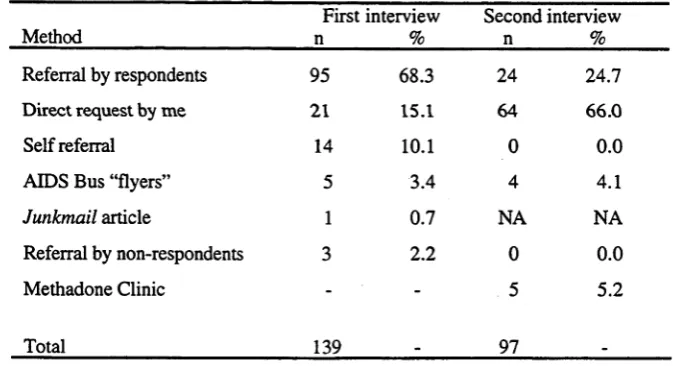
I prepared flyers (Appendix 5) containing details of the interview and my mobile phone number. Table 2.1 shows the results of the sampling for all respondents at both interviews. For the first round of interviews, 60 flyers were sent to the Needle Exchange Program (NEP) in the nearby town of Queanbeyan, 40 were taken by an ACT Refuge w orker and I placed 140 in the paper bags used to distribute injecting paraphernalia for IDU clients of the AIDS Bus1. I gave 21 to peer outreach workers and a further 288 were taken by 50 respondents to hand out to their contacts. A majority of interview referrals (68.3%) were from other respondents, mainly prompted by the flyers. Other researchers have also found this method of referral to be an effective method of recruitment where out-of-treatment samples of people who use illegal drugs have been sought (Nelson et al, 1991; Marsh and Loxley, 1992).
Some respondents whose only illegal drug was marijuana, and that very occasionally, passed the flyers on to respondents who injected heroin and am phetamines, thus indicating that a variety of drug use patterns may exist within a drug-using network. Through my ethnographic work, I was able to ask 21 people directly for an interview and many self referrals were also made in this context. Although only 5 respondents presented for interview after picking up flyers on the AIDS Bus, most of these referred several other respondents. Similarly, the Junkmail article (a journal for IDUs and their service providers) (Dance, 1992a), yielded only one phone call but this person referred
10 people directly to me and most of these people referred others too.
There were 28 occasions when people did not show up for their scheduled first interview. Six of these people recontacted me and were interviewed later.
At the end of the first interview, I asked respondents if they would be willing to present for a follow-up interview. Though one person declined, he still appeared for a second interview. I asked people for means of contacting them. M ost gave me a phone number; some said they wanted me to phone someone mutually known and a few people said they would prefer to be recontacted via a flyer on the AIDS Bus.
For the second round of interviews, I left 100 flyers on the AIDS Bus and placed advertisements at the ACT Drug Referral and Information Centre (DRIC)1 and at the ACT Intravenous League (ACT IV League)2. Because I was aware that some respondents were in methadone treatment, I also placed a total of 90 flyers in the two ACT outlets. Thirty six people took 150 flyers for the second interview. The most successful way of reaccessing people for the second round of interviews was by personal contact (66.0%).
Table 2.1: Sampling for all respondents at both interviews
13
First interview Second interview
Method____________________ n % n %
Referral by respondents 95 68.3 24 24.7
Direct request by me 21 15.1 64 66.0
Self referral 14 10.1 0 0.0
AIDS Bus “flyers” 5 3.4 4 4.1
J u n km ail article 1 0.7 NA NA
Referral by non-respondents 3 2.2 0 0.0
Methadone Clinic - - 5 5.2
Total 139 _ 97
Of the 139 people originally interviewed, 44 (31.6%) were Oswaldians and I consider 28 of these people to be core-Oswaldians. Nine Oswaldians I interviewed during 1989 did not present for interview. One had stopped all illegal drug use and had disassociated herself from most group members, 5 had left the ACT, and the other two offered themselves for interview only after I had commenced the second round of interviews.
1 This is a community based organisation which offers a range of services for drug users and their families including advice, counselling, information and education.
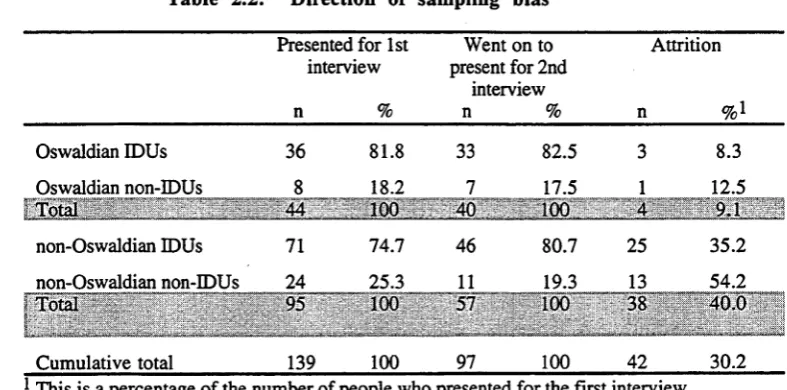
[image:25.529.103.441.368.551.2]I started the first round of interviews in January 1992 and finished it in September of that year. The second round of interviews began in November 1993 and was completed in April 1994. There was an average length of 18.3 months between the interviews with a range of 11-24 months. Ninety seven o f the 139 people interviewed during 1992 made themselves available for reinterview (Table 2.2). This represents a follow-up rate of almost 70 per cent. Particularly given this timespan between interviews, the follow up rate compares favourably with other longitudinal studies. Plant and colleagues, for example, report a follow-up rate of 56 per cent over a six month period for their study of drug users in Sydney (1988). Over a similar timeframe, Robertson and colleagues report a follow-up rate of 80 per cent in their British study of IDUs (1988).
Given my continued ethnographic contact with the Oswaldians, these people were the easiest to reaccess for the second interview. Forty of the people who presented for the second interview were O sw aldians (41.2% of the sam ple, 90.9% o f Oswaldians interviewed at the first interview). Of the 4 Oswaldians who were not reinterviewed, two peripheral group members had left the ACT and two core-Oswaldians were having personal problems. Fifty seven non-Oswaldians (58.8% o f the sample, 60.0% of non- Oswaldians interviewed at the first interview) presented for the second interview.
Table 2.2 demonstrates the sampling bias at the second interview. Proportionately more non-Oswaldian IDUs (35.2%) and non-Oswaldian non-IDUs (54.2%) than Oswaldian IDUs (8.3%) and Oswaldian non-IDUs (12.5%) were lost to attrition. Although the attrition rate for the non-Oswaldians may impact on the major findings, the attrition rate for the Oswaldians was low. It is, therefore, unlikely that the attrition rate for this subset will affect the conclusions based on their findings.
Table 2.2: Direction of sampling bias
Presented for 1st interview
n %
Went on to present for 2nd
interview
n %
Attrition
n
Oswaldian IDUs 36 81.8 33 82.5 3 8.3
Oswaldian non-IDUs 8 18.2 7 17.5 1 12.5
Total 44 100 40 100 4 9.1
non-Oswaldian IDUs 71 74.7 46 80.7 25 35.2
non-Oswaldian non-IDUs 24 25.3 11 19.3 13 54.2
Total 95 100 57 100 38 40.0
r' v i ______A,. • ...;.I ..' .. ■... J.L < .._ ..
Cumulative total 139 100 97 100 42 30.2
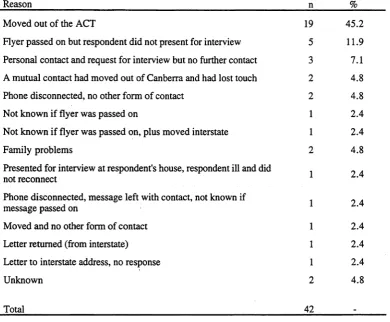
[image:26.529.66.460.522.717.2]15 Table 2.3 shows what is known about the people who did not present for a second interview. In the majority of cases, the people concerned had simply moved out of Canberra. This was ascertained either from ethnographic work or from people these respondents said I could communicate with as a means of recontacting them. I was able to contact a further two people who had moved to Sydney and I reinterviewed them on a visit there. Even though I used a variety of strategies to recontact respondents, including making several phone calls, writing letters or making contact with someone mutually known, in some cases this was to no avail. I made personal contact with 3 people who then did not appear for interview. Evidence from a variety of sources, including the media and ethnographic work, shows that at least 5 of those who did not present for the second interview had legal problems and a further two had family problems. Using the data obtained at the first interview, I discuss the differences found between those who did and did not present for the second interview in the results chapters (Chapters 3-8).
16
T a b le 2 .3 : R e a so n s fo r r e s p o n d e n ts n o t p r e se n tin g fo r th e se c o n d in te r v ie w
R e aso n n %
M o v e d o u t o f th e A C T 19 4 5 .2
F ly e r p a s s e d on b u t re s p o n d e n t d id n o t p re se n t fo r in te rv iew 5 1 1.9 P e rso n a l c o n ta c t a n d re q u e s t fo r in te rv ie w b u t no fu rth e r co n tac t 3 7.1 A m u tu a l c o n ta c t h a d m o v e d o u t o f C a n b e rra an d h ad lo st to u ch 2 4 .8 P h o n e d is c o n n e c te d , no o th e r fo rm o f c o n ta c t 2 4 .8 N o t k n o w n if f ly e r w as p a s s e d on 1 2 .4 N o t k n o w n i f f ly e r w as p a s s e d o n , p lu s m o v e d in te rsta te 1 2 .4
F a m ily p ro b le m s 2 4 .8
P re s e n te d fo r in te rv ie w a t re s p o n d e n t's h o u se , re sp o n d e n t ill an d d id
n ot re c o n n e c t 1 2 .4
P h o n e d is c o n n e c te d , m e s s a g e le ft w ith c o n ta c t, n o t k n o w n if
m e ssa g e p assed on 1 2 .4
M o v e d a n d n o o th e r fo rm o f c o n ta c t 1 2 .4
L e tte r re tu rn e d (fro m in te rstate) 1 2 .4
L e tte r to in te rsta te ad d re ss, no re sp o n se 1 2 .4
U n k n o w n 2 4 .8
T o ta l 42 _
W hilst specifying too few eligibility criteria can create problems related to screening, specifying too many can result in verification problems (Biemacki and Waldorf, 1981). Because o f the potential criticism that respondents will tell the interviewer what s/he wants to hear, I did not stipulate a particular type or history of illegal drug use on the flyer (Appendix 5). Because o f the possibility of phone-tapping, I did not ask any questions that m ight be incrim inating when people phoned to book an interview. Furtherm ore, it would not have been wise to ask about drug treatment and criminal histories as soon as I met someone and then refuse to interview those who had these histories and who had taken the time and trouble to present for interview. Had I acted in that way it is also possible that subsequent respondents might not have divulged these histories. Since these are particularly sensitive areas, I needed to establish some rapport and it was not until well into the interview that I asked these questions. I found Goldstein and colleagues to be correct in their perception that the problem is seldom how to recruit people but rather how to reject those who, for one reason or another, do not meet the criteria for participation (1990). It was inevitable, therefore, that my sample did contain people with a history of treatment or incarceration.
[image:28.529.57.448.73.395.2]who were willing to pass on flyers that though I was interested in all drug use behaviours, “hidden users” were, by definition, the most difficult to access and I would be grateful if they could give the flyers to any of these people. I also gave this information to people during the process of my ethnographic work, as well as to the ACT IV League and NEP staff. The article I wrote for Junkmail outlined my research interests and my major target group for research.
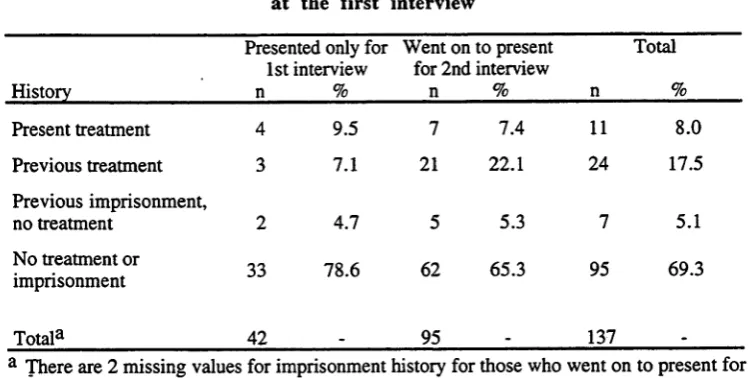
Table 2.4 shows the results of these strategies, demonstrating that 11 people were in treatment at the first interview and 128 were not. A further 24 people had a history of drug treatment. Seven people with a history of treatment also had a history of imprisonment and 7 people who did not, had also been imprisoned. We are thus left with 95 people (69.3%) who had never been in treatment or incarcerated. Fifty nine (43.1%) were current heroin users.
A markedly greater proportion of people who went on to present for the second interview had a history of treatment for drug use. This may affect some of the findings discussed in subsequent chapters, particularly the significant increase in the number of people presently in treatment at the second interview, which included some people with a previous history of treatment.
Table 2.4: Treatment and imprisonment history for all respondents at the first interview
Presented only for 1st interview
Went on to present for 2nd interview
Total
History n % n % n %
Present treatment 4 9.5 7 7.4 11 8.0
Previous treatment 3 7.1 21 22.1 24 17.5
Previous imprisonment,
no treatment 2 4.7 5 5.3 7 5.1
No treatment or
imprisonment 33 78.6 62 65.3 95 69.3
Total3 42 - 95 . 137
-a There -are 2 missing v-alues for imprisonment history for those who went on to present for the second interview.
2.3: Integrated methodology
The guiding philosophy of this research was that of harm minimisation. The techniques I used were grounded not only in my training as a sociologist but also in my 25 years experience as a health professional.
[image:29.529.89.464.410.599.2]18
have indicated, both methods have their weaknesses which, to some extent, may be compensated for by the strengths of the other (Watters and Biemacki, 1989; Lambert and Wiebel, 1990; Steckler et al, 1992). The strengths of quantitative methods are that they produce “factual, reliable outcome data that are usually generalisable to some larger population” and the strengths of qualitative methods are that they “generate rich, detailed, valid process data that usually leave the study participants' perspectives intact” (Steckler et al, 1992:2). Steckler and colleagues go on to say that “social interventions are complex phenomena which require the application of multiple m ethodologies in order to properly understand or evaluate them” (1992:4). Other researchers in the drug field are now com bining both qualitative and quantitative research methods (for example, Wiebel, 1988; Goldstein et al, 1990; Marshall, 1990; Morrison, 1991; Barnard and Frischer, 1995).
Ethnography was one component of the qualitative methodology. This has been defined as “the art and science of describing a group or culture from their perspective” (Fetterman, 1989:11). Although it has traditionally been seen as the domain of social anthropologists, it is a methodology which has also been used by other people researching drug use per se (for example, Becker, 1963; Preble and Casey, 1969; Plant, 1975; Moore, 1990; Grund, 1991; Maher, 1996) and also by those working specifically on ways of preventing HIV among IDUs (for example, Feldman and Biernacki, 1988; W iebel, 1988; Power, 1989; W illiams, 1990; Grund et al, 1991; Rivera-Beckm an,
1992).
My involvement with ethnographic work was an unplanned consequence of the initial 1989 research. (This process is fully discussed in the publications attached as Appendices 2 and 3.) During the research described here I have, in addition, undertaken some ethnographic work with non-Oswaldians. I have seen 14 people from this subset (definitions of the subsets are included in Table 2 in Appendix 4) in a social setting at least once and have had more intense interactions with 8 of them.
respondents did ask about my drug-taking activities, but no one tried to pressure me into participating in illegal drug use.
One o f the rules of participant observation is that the researcher must, as far as possible, not influence events but endeavour to record them as they occur. This is an unacceptable luxury to ethnographers who may be observing potentially harmful behaviours. Power concludes that “in the current climate research objectivity may at times have to take a back seat to health education and risk reduction” (1989:50). Marsh and Loxley also believe that rigid separation between research and intervention is inappropriate in the HIV/AIDS area (1992).
W hilst the continued ethnographic work allowed closer contact with many respondents than that allowed by relying only on contact at interview , there was very little information gleaned from this contact which shed any light on further harm minimisation strategies. I have as a consequence used very few o f these data in the thesis. The papers included as Appendices 2 and 3 describe previous ethnographic work in more detail.
Before commencing the interviews, I undertook a health education course at the ACT NEP, and became qualified to exchange injecting equipment and distribute condoms. I also gained practical experience by working several shifts on the AIDS Bus, I trained as a volunteer at ACT AIDS Action Inc and I worked as a nurse in the ACT Sexually Transmitted Disease Clinic/AIDS Reference Centre.
2.4: Instruments used for interviews
The ANAIDUS and AIC questionnaires influenced the interview guide I drafted (Appendix 6). I also examined other questionnaires. Some questions were suggested by Oswaldians and some by service providers. Many o f the qualitative questions were stimulated by the 1989 research when it was apparent that respondents found it difficult to confine themselves to pre-coded responses concerned with the complex behaviours associated with drug use, needle use and sexuality. They were, however, very willing to talk about these matters in detail. Other questions flowed from my ethnographic work, as well as my literature review.
20
results chapters. Not all of the quantitative questions were pre-coded. The codes I used for the quantitative data at the first round of interviews are attached as Appendix 8. Those for the second interview are attached as Appendix 9.
At both interviews, I also employed the Opiate Treatment Index (OTI) (Appendix 10). As Darke and colleagues indicate, a major problem in most drug-related research is the inability to compare results (1991a; 1992a). Where possible I compare my results with those from other researchers who have also used the OTI. The OTI was developed in Sydney for both research and clinical applications (Darke et al, 1991a). The NDS has recommend its use (1993). One of the functions of the OTI is to assess the impact of treatment over time and it has been used in this way by other researchers (Macleod et al, 1996). I also used it to assess the changes that occurred between interviews. The OTI has been used for people both in and out of treatment (Darke et al, 1991a) and also solely for those not in treatment (Baker et al, 1994). It has also been administered to people whose prim ary drug was amphetamine (Hall and Hando, 1994). W here possible, I use these findings from other researchers to make comparisons with the people I interviewed.
The OTI has been found to be both reliable and valid (Darke et al, 1991a; Darke et al, 1991b; Darke et al, 1992a; Adelekan et al, 1996; Deering and Sellman, 1996). It has been structured so that the higher the score, the greater the degree o f indicated dysfunction. During the developm ent of the OTI, results obtained in the HIV risk behaviour scores (HRBS), and the social, criminal, physical, and psychological health domains, were divided by Darke and colleagues into quintiles. This, then, allows for a clinical interpretation of the degree of dysfunction for each of these domains. The degrees of dysfunction were classified by the researchers as High, Above Average, Average, Below Average and Low (Darke et al, 199la :23-24). I also analysed my data according to these degrees of dysfunction (also defined in Table 3, Appendix 4) but the results must be viewed with some caution since, as Dark and colleagues indicate, the degrees of dysfunction are based solely on the distribution of the scores of respondents interviewed during the development of the OTI and they are continuing their work “to provide more comprehensive norms” (1991a:24).
21 Goldberg and Hiller broke items in the GHQ-28 down into a somatic symptoms area, an anxiety area, a social dysfunctional area and a depression area. Each area has seven self-completed questions and respondents are informed that the questions relate to “medical complaints, and how your health has been in general over the past few weeks” (1979:143). There are four possible responses to each of these questions (Appendix 10:393-5). Either of the first two responses are scored as zero, and either of the second two responses are scored as one (Goldberg and Hiller, 1979).
The GHQ-60 item version has been tested within an Australian population of general practice clients by Tennant. Each respondent’s score was also re-calculated for the 12-, 20- and 30-item versions. Tennant found all four to be reliable and valid (1977). Darke and colleagues found a high Pearson correlation coefficient of 0.88 for the GHQ-28 score among 50 opioid users who were retested one week after their initial interview (1991a).
Although these findings give room for optimism that the GHQ-28 is a valid and reliable instrument for one-off testing, Radovanovfc and colleagues document a problem they found when they looked at the test-retest validity of the GHQ-60. When using this version of the GHQ, they found a marked decrease in the mean GHQ scores of both men and women when they administered the questionnaire to a sample of medical students three times with an interval of two years between each test (1988). In order to examine the sensitivity of the GHQ-60, respondents were also interviewed by a psychiatrist who based his assessment solely on the use of the Standardised Psychiatric Interview. Over time, a fall in sensitivity to 64.7 per cent was found. No sensitivity tests were possible in my study, and even though Radovanovi'c and colleagues used a different version of the GHQ, and were able to identify the confounding factors of an attempt by students to hide their symptoms and the inability of the psychiatrist to completely ignore the knowledge obtained at previous interviews, their finding is of some concern and needs to be considered when looking at my longitudinal findings.
2.5: The interviews
The first interviews ranged from 1 hour 20 minutes to 7 hours and 45 minutes with an average of about three hours; the second interviews ranged from 50 minutes to 2 hours and 45 minutes with an average length of about 1 hour and 20 minutes.
22
Once we were in the interview venue, a consent form (Appendix 11) was read out to prospective respondents who were then asked to read through it themselves to ensure they were properly informed. In order to preserve anonymity, and with the approval of the A N U ’s Ethics in Human Experimentation Committee, the consent form was signed by me once I was confident the participant had given their informed consent.
Everyone granted permission for the qualitative data in the first interview to be audiotaped. I instructed the people who transcribed the tapes to return them immediately if they recognised anyone’s voices. This did not prove to be necessary. The audiotapes were a source of some concern to some respondents and once they were transcribed and the transcriptions checked, I w iped the tapes. Due to financial constraints, the qualitative data in the second interview were not audiotaped.
2.6: Ethical considerations
I attempted to get my research gazetted under the Commonwealth Epidemiological Studies (Confidentiality) Act 1981. This Act helps ensure the confidentiality o f data provided by respondents. Both the 1989 ANAIDUS and AIC research were gazetted under this Act, and this proved to be useful in encouraging respondents to present for interview. I was unable to have my research covered as the Act covers only research instigated by the Commonwealth. I eventually commenced interviewing without legal protection. This meant that strenuous efforts had to be undertaken to ensure that everything possible was done to protect the respondents from prosecution resulting from the data collection. These measures were approved by the AN U ’s Ethics In Human Experimentation Committee. Completed questionnaires were locked in a secure place and data keyed into the computer were placed in a locked partition.
The first 94 people at the first interview were told there was no legal protection o f their data (Appendix 11: consent form 1). Michael Moore (an Independent M ember o f the ACT Legislative Assembly) was instrumental in drawing up an Epidemiological Studies (Confidentiality) Act in 1992 for the A C T1 (Appendix 12). The Act protects the respondents by stipulating punishment in the form of imprisonment and/or a fine if the researcher divulges any information which might identify them. When my research was gazetted under this Act, which contained a clause to protect the data already collected, subsequent respondents were informed of this protection (Appendix 11: consent form 2). I also wrote a small article for the ACTIV League newsletter which included this information (Dance, 1992b). Until Simon Bronitt conducted some research on legal issues for the Feasibility Research into the Controlled Availability of Opioids, I believed the information I gave in both this consent form, and the consent form for the second 1 The impetus for this Act was primarily to protect data collected by the research team for the