
Financial report 1997
127
0
0
Full text
(2) Cover photo: Thessaloniki, European City of Culture 1997— The White Tower..
(3) EUROPEAN UNION. FINANCIAL REPORT. 1997.
(4) A great deal of additional information on the European Union is available on the Internet. It can be accessed through the Europa server (http://europa.eu.int). Cataloguing data can be found at the end of this publication. Luxembourg: Office for Official Publications of the European Communities, 1998 ISBN 92-828-3777-7 © European Communities. 1998 Reproduction is authorised provided the source is acknowledged. Printed in Belgium.
(5) FOREWORD The year 1997 was marked by exceptionally good interinstitutional relations on budgetary matters, which saw Parliament and Council agree a stringent 1998 budget to match the efforts being made by Member States with a view to the third stage of EMU. Throughout the year the Commission continued to implement the SEM 2000 programme launched in 1995 to promote sound and efficient management of resources. Within the Commission most of the measures to improve the efficiency of Community financial management which were envisaged when the programme was launched have now been implemented. Under the partnership arrangement with the Member States, work focused on the management of the Structural Funds. The Commission clarified the rules on eligibility of expenditure and adopted a regulation on financial control by Member States of operations part-financed by the Structural Funds. Two progress reports were sent to the Council which, in its conclusions, welcomed the advances made and underlined its attachment to the dialogue, in matters of sound financial management, between the Commission, the Member States and the Court of Auditors. In July the Commission presented a communication entitled 'Agenda 2000: For a stronger and wider Union" which proposes a reference financial framework for 2000-06. The Commission sought to reconcile the development of reformed Community policies and the financing of Union enlargement while keeping the own resources ceiling unchanged at 1.27 % of GNP. There was only one supplementary and amending budget in 1997; it was presented on 30 April and definitively adopted on 30 November. On the expenditure side it was mainly concerned with the budgetary impact of the Commission's follow-up action on the report of Parliament's temporary committee of inquiry into bovine spongiform encephalopathy (BSE), providing the necessary resources to boost consumer protection policy. It also provided additional staff for the Court of Auditors to increase its audit capacity..
(6) The utilisation rates for 1997 appropriations were higher than for 1996. The increase was particularly marked for structural operations, where for the first time all the payment appropriations for the Community support frameworks were used. The utilisation rate for internal policies was 97.0 % in commitments and 91.9 c/c in payments. For external action the rates were 98.4 % in commitments and 86 % in payments. For the EAGGF Guarantee Section utilisation was 99 %. On the revenue side own resources under the 1997 budget totalled ECU 80.5 billion, 1.147 % of Community GNP.. Erkki LIIKANEN Member of the Commission with responsibility for budgetary affairs.
(7) CONTENTS. Page Economic and financial framework. 7. Revenue. 15. Expenditure. 20. Heading 1 — Agricultural market guarantees. 20. Heading 2 — Structural operations. 28. Heading 3 — Internal policies. 34. Research and technological development. 34. Transport. 35. Education, vocational training and youth policy. 35. Culture and audiovisual media. 36. Information and communication. 37. Social dimension and employment. 37. Energy. 38. Euratom nuclear safeguards. 39. Environment. 39. Consumer protection. 40. Aid for reconstruction. 40. Internal market. 40. Industry, services and information market. 41. Statistical information. 42. Trans-European networks. 42. Cooperation in the fields of justice and home affairs. 43. Heading 4 — External action. 43. Prince: an information programme for European citizens Common foreign and security policy Heading 5 — Administrative expenditure. 53 56 59.
(8) Borrowing and lending operations. 60. Treasury report. 67. Annex 1 —The ECSC's financial and budgetary activities in 1997. 72. Annex 2 — Financial out-turn of the EDF in 1997. 78. Consolidated accounts of the European Union. 83. Accounting principles. 84. Accounting rules and methods. 84. Consolidated revenue and expenditure account for 1997. 87. Consolidated balance sheet at 31 December 1997. 96. Explanatory notes to the consolidated balance sheet. 99. Off-balance-sheet commitments at 31 December 1997. 110. Explanatory notes concerning off-balance-sheet commitments — potential liabilities and claims. 114.
(9) ECONOMIC AND FINANCIAL FRAMEWORK. The basic budget principles The budget of the European Union is governed by six basic principles.. The two annexes to this report contain a summary of the budgetary and financial operations of the ECSC (operating budget and borrowing and lending operations) and the EDF.. Unity. Universality. This principle, enshrined in Article 199 of the Treaty, requires that all EU expenditure and revenue must be incorporated in a single budget document. In the early years of the Community, the autonomy of the institutions set up under the ECSC, EEC and Euratom Treaties resulted in up to five separate budgets being produced to cover any one year. After the Luxembourg Treaty of 22 April 1970, documents covering the majority of the Community's financial activities were gradually merged so that, now. there are only two: the general budget and the ECSC operating budget. However, there are still two categories of financial operation outside this structure: the European Development Fund (EDF) and borrowing and lending activities. The EDF was set up by the EEC Treaty with a view to increasing trade with associated developing countries and assisting them in carrying out economic and social development projects. The resources of the EDF are provided by contributions from the Member States. For what are essentially political reasons, the Member States wish to retain their direct influence over certain development aid operations by maintaining an independent financial regime and management procedures which are not subject to the ordinary rules. The EEC Treaty made no express provision for borrowing and lending operations. However, as the achievement of the Community's objectives made it necessary to lay down rules for operations on the capital market, borrowing and lending activities were finally authorised in 1975, on the basis of Article 235 of the EEC Treaty. Most borrowing and lending operations (with the exception of ECSC operations) are included in the balance sheet of the European Communities.. This principle comprises two rules: the rule of non-assignment, meaning that budget revenue must not be earmarked for specific items of expenditure, and the gross budget rule, meaning that revenue and expenditure are entered in full in the budget without any adjustment against each other. Annuality The budget for the year is cast at two levels: a commitment budget and a payment budget. Commitment appropriations cover new commitments for the year, whereas payment appropriations must cover the amounts payable against both new and existing commitments. Annuality means that a budget is adopted for a single year and that the appropriations it contains, both for commitments and payments, must be used during that year. The principle does not rule out the possibility that certain commitments may last for more than one year. Clearly, in sectors such as the Structural Funds, research and external cooperation, the EU needs to enter into some commitments which exceed the period of one year. In these sectors, a mechanism known as 'differentiated appropriations' allows for a separate annual vote of commitments and payments. Under certain clearly defined conditions, some unused appropriations may be carried over to the following year. Equilibrium Estimated revenue for the year must equal payment appropriations for that year. There is no Community legal instrument authorising.
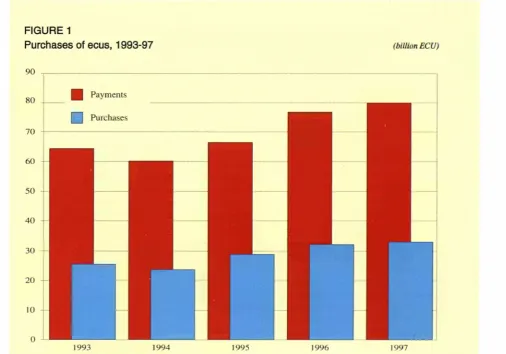
(10) 8. borrowing to cover a budget deficit. Any surplus for the year is carried forward to the following year. A modest operating deficit can also be carried forward. On the other hand, a significant departure from the original budget during the year requires the adoption of a supplementary or amending budget. Specification This principle requires that each appropriation be assigned to a specific purpose and a specif-. ic objective. It is intended to prevent any blurring of the lines between two appropriations when they are authorised and used. This ensures that the budget is drawn up with the requisite transparency and implemented in compliance with the will of the legislative authority. The principle of specification determines the horizontal structure (distinction between the statement of revenue and the statement of expenditure, and subdivision of the statement of expenditure into six individual sections (one. FIGURE 1 Purchases of ecus, 1993-97. (billion ECU). 90 80. | Payments | Purchases. 70. 60. 50. 40. 30. 20. —. 10. 1993. 1994. 1995. 1996. 1997.
(11) for each of the institutions) and the vertical structure of the budget (the budget nomenclature distinguishes appropriations according to their nature and purpose by subdividing sections — and in particular Section III, which contains all EU expenditure on operations — into titles, chapters, articles and items). A certain flexibility in the application of the rule of specification is achieved by means of transfers of appropriations, which, subject to certain conditions, allow appropriations to be moved to headings other than those to which they were assigned when the budget was established. The Treaty itself makes provision for transfers, the object being to ensure the best possible utilisation of budget appropriations. The use of the ecu The currency unit of the European Union is the ecu, made up of a 'basket' of 12 national currencies. Its composition should remain unchanged until the introduction of the single currency. Since 1992 the Commission has been using ecu-denominated accounts at the French and Irish Treasuries. The Commission promotes the adoption of the ecu as the single currency by using it as much as possible in the execution of the budget. Most EU programmes, other than EAGGFGuarantee operations, are implemented in ecus. In 1996, for example, 95 % of the budget and 44 % of operational programmes (excluding EAGGF-Guarantee operations) were implemented in ecus.. The economic situation in the European Union in 1997 The EU's economy has been rapidly picking up speed since mid-1997. The year was marked by remarkable export performance, due to high demand abroad and a strong dollar. It is thought that net exports contributed 0.4 percentage points to the Fifteen's annual. GDP growth figure of 2.7 %. The most striking feature of 1997 was the Asian crisis which broke out in July. The crisis hit the currency and stock markets first but spread to banking systems and manufacturing in the affected countries, which are now facing the prospect of a major recession in 1998. Through international trade, the crisis will also affect the economies of the USA and Europe, though its impact will be relatively limited. Otherwise, the short-term outlook for the European economy is quite encouraging, to judge by the very positive surveys of consumer and business opinion. For both groups, the results are almost as good as they were at the peak of the 1987-91 cycle. Growth is likely to be led more by internal demand than by exports, with the launch of the euro with 11 countries acting as a catalyst. Furthermore, interest rates should stay low as a result of the deflationary impact of the Asian crisis and shrinking budget deficits. The labour market began to pick up in 1997. After 1996, when there was virtually no growth in the number of jobs, 600 000 new jobs were created in 1997, pushing the employment rate up by 0.4 %. Unemployment in the EU fell from almost 11 % of the active population in 1996 (calculated in accordance with Eurostat's harmonised definition) to 10.7 % in 1997. The downward trend should continue in 1998. The European Union's inflation performance was again good in 1997. Consumer prices in the EU as a whole rose by 2.1 % in 1997, down from 2.6 % in 1996. And there was a remarkable convergence between the different Member States. The low inflation figure is due not only to a sustained economic policy of stable prices and wage restraint but also to the fall in the price of oil and raw materials triggered primarily by the Asian crisis. Budget deficits in the Union peaked in 1993 at 6.2 % of GDP. Since then they have steadily contracted to reach an estimated 2.4 % of GDP in 1997. This was achieved by means of the consolidation efforts which governments.
(12) 10. have been making for a number of years, with the help of growth and also as a result of the drop in interest rates which affect public debt. The steadily shrinking deficits enabled the EU to reduce its public debt-to-GDP ratio for the first time — from 73.0 ck in 1996 to 72.1 % in 1997. And the deficit-reduction measures made it possible for 11 Member States to meet the criteria for monetary union and create the 'euro zone' on 1 January 1999.. Financial perspective 1993-99 The 1997 procedure came within the framework of the financial perspective as adjusted in December 1994 following the enlargement of the Community to include Austria. Finland and Sweden in accordance with paragraph 24 of the interinstitutional agreement of 29 October 1993 on budgetary discipline and improvement of the budgetary procedure. In February 1996. acting under paragraph 9 of the interinstitutional agreement, the Commission made the technical adjustment to the financial perspective for 1997 on the basis of the most recent macroeconomic forecasts available for gross national product and prices. The data for these forecasts concerned the 12-member Community from 1992 to 1995 and the 15-member Community from 1995 to 1996. Following the adjustment, the ceiling for payment appropriations was set at ECU 85 807 million for 1997. leaving a margin of 0.03 % of GNP beneath the own resources ceiling, set at 1.24 % of GNP by the 1994 decision on own resources, which has been ratified by all Member States. At the interinstitutional trialogue meeting on 16 April 1996, Parliament, the Council and the Commission reached agreement on the adjustment of the financial perspective to take account of the conditions of implementation. The commitment appropriations for the Structural Funds which were not used in 1995 were transferred to 1997. 1998 and 1999 (ECU 380 million. 1 000 million and 693 mil-. lion respectively). Some ECU 11 million not used for the Cohesion Fund was transferred to 1997. The overall ceiling on appropriations for payments was also raised by ECU 186 million for 1997. ECU 633 million for 1998 and ECU 632 million for 1999 in line with the commitment appropriations transferred for the Structural Funds and the Cohesion Fund. With this higher ceiling on appropriations for payments, the margin available beneath the own resources ceiling in 1997 is 0.02 7c of GNP. On 18 March 1996 the Commission adopted a proposal amending the financial perspective for 1996 to 1999. The intention was to meel new requirements by giving priority to spending that would stimulate growth, competitiveness and employment (trans-European transport networks, research and small and medium-sized enterprises). There was no need to raise the overall ceiling on commitments for the period as a whole, however, since the expected margins under the agricultural guidelines for 1998 and 1999 allowed some room for the redeployment of certain items of expenditure from heading 1 (agricultural policy). The payments ceiling was also left unchanged by the Commission proposal. However, on 14 October 1996 the Council noted that it was unable to muster a qualified majority on this proposal.. Budget for the 1997 financial year Following the second reading in Parliament on 12 December 1996, the President of Parliament declared the 1997 budget adopted on 18 December 1996. The budget totalled ECU 89 137 million in appropriations for commitments and ECU 82 366 million in appropriations for payments. While commitments were 2.95 % up on the 1996 budget, the zero-growth target aimed for by the two arms of the budgetary authority was virtually achieved for payments (an increase of only 0.52 %) with cuts of ECU.
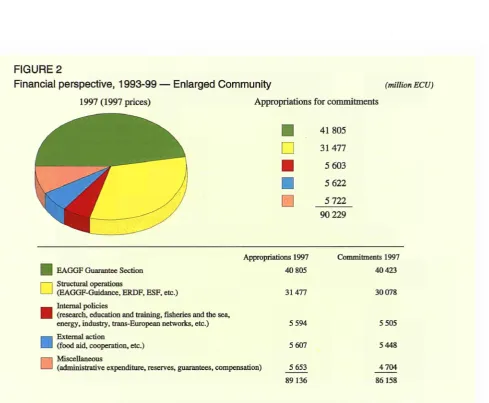
(13) 11. FIGURE 2 Financial perspective, 1993-99. Enlarged Community. (miiuonEcu). Appropriations for commitments. 1997 (1997 prices). 41805. D. 31477 5 603 5 622 5 722. 90 229. Appropriations 1997 |. EAGGF Guarantee Section. □. 40 805. Structural operations (EAGGF-Guidance, ERDF, ESF, etc.). ^ _ Internal policies | (research, education and training, fisheries and the sea, energy, industry, trans-European networks, etc.) External action (food aid, cooperation, etc.) Miscellaneous. With margins of ECU 1 092 million for com mitment appropriations and ECU 3 441 mil lion for payments, the 1997 budget was no. 5 594 5607. Γ administrative expenditure, reserves, guarantees, compensation). 2 000 million from the allocations for agricul tural expenditure and structural operations in the initial preliminary draft budget (before the letters of amendment). The appropriations for payments were equivalent to 1.17 % of GNP.. 31477. Commitments 1997 40423 30078. 5 505 5 448. 5 653. 4 704. 89 136. 86158. table for its stringency. As economic and monetary union approaches, the two arms of the budget authority were determined that budget austerity should be applied not only to the Member States' finances but also to the Union's. Nevertheless, the budget allowed extra fund ing to be provided for the Union's priority.
(14) 12. areas (ECU 300 million for the peace initiative in Northern Ireland, research and transEuropean networks) without exceeding the ceilings laid down by the financial perspective. A total of ECU 40 805 million was allocated for agricultural expenditure. This amount was ECU 1 000 million down on the Commission's initial preliminary draft and took account of letters of amendment Nos 1 and 2/97. It was large enough to fund the emergency action plan agreed on by the Council (Agriculture) of 30 October 1996. This was designed to help the beef market to cope with the consequences of BSE. Some ECU 31 477 million was allocated to spending on structural measures. The commitments allocated to the Structural Funds totalled ECU 28 620 million — the amount decided on at Edinburgh, adjusted for enlargement. The amount finally settled on for Northern Ireland was the amount proposed in the preliminary draft, though the financial perspective was not increased accordingly, despite the fact that RETEX and Rechar had since been allocated an additional ECU 100 million. However, it was possible to stay within the ceiling for the heading by setting up a negative reserve for an equivalent amount, to be funded from the Structural Funds as a whole. Furthermore, ECU 1 000 million was cut from the Commission's proposed figures for payment appropriations. Up 5.26 % on 1996. the allocation for internal policies almost touched the ceiling at ECU 5 601 million. D The allocation for research was increased to ECU 3 500 million. Research is one of the Union's three priority areas identified by Parliament. Accordingly the fourth framework programme has been allocated an additional ECU 100 million (in the reserve chapter). Since there was no room for such an increase within the ceiling for the heading, it was accommodated by establishing a negative reserve of ECU 26 million.. D The allocation for trans-European networks under the heading was 27 % higher than in the 1996 budget. The increase was targeted on priority transport networks. Under heading 4, an additional ECU 100 million was set aside for extending the networks beyond the Union's external borders. D As for other policies, appropriations were provided for implementation of a number of measures which the budgetary authority deemed particularly important such as promoting job-creation in non-market sectors (ECU 10 million), cooperation with NGOs working with the disabled (ECU 6 million) and aid for refugees (ECU 10 million under the first pillar and ECU 3.75 million under the third). The allocation for external action totalled ECU 5 601 million, up 6.4 <7, on the 1996 budget, leaving ECU 21.5 million under the ceiling for the heading. The increase was linked to aid for economic restructuring in central and eastern Europe (ECU 1 206 million) and implementation of an EUMediterranean partnership as part of the expansion of the Union's Mediterranean policy (ECU 995 million). Particular importance was also attached to reconstruction in the former Yugoslavia. The allocation for food and humanitarian aid was much the same as in 1996. New budget headings were inserted, e.g. return of refugees (ECU 10 million), support for international courts (ECU 3 million) and the role of women in development (ECU 3 million). Lastly, in line with the Union's priorities, heading 4 was increased by ECU 100 million to fund the extension of transEuropean transport networks beyond the Union's external borders. Appropriations for administrative expenditure saw a 2.4 % increase compared with 1996, to ECU 4 284 million. Of this figure, ECU 2 377 million was for the Commission and ECU 1 486 million was for the other institutions (excluding pensions)..
(15) 13. The budget approved in December was modified by a supplementary and amending budget, which was finally adopted on 13 November 1997. The expenditure side was intended to cover the budgetary cost of the action taken by the Commission on the report by the temporary committee of inquiry into bovine spongiform encephalopathy, by providing the necessary resources to implement. the consumer health protection policy. It also provided for the redeployment of the Court of Auditors' administrative expenditure and the creation of new posts at the Court. The revenue side concerned the entry in the budget of the balance from the 1996 financial year (ECU 4 384 million) and the updating of the correction of budgetary imbalances..
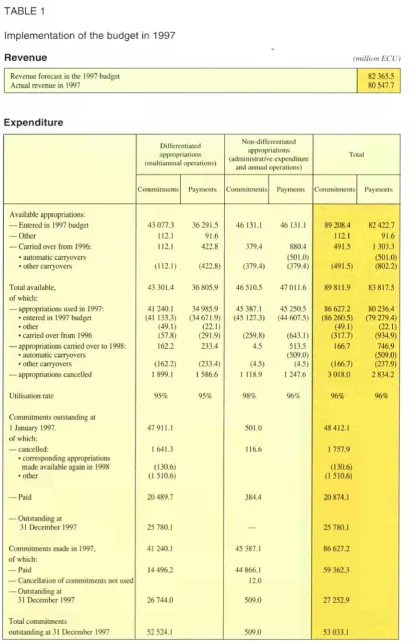
(16) 14. TABLE 1 Implementation of the budget in 1997 Revenue. (million ECU). Revenue forecast in the 1997 budget Actual revenue in 1997. 82 365.5 80 547.7. Expenditure Differentialed appropriations ιimitiiamui.il operations). Commitments. Payments. Non-diffcrcniiatcd appropriations (administrative expenditure and annual operations) Commitments. Payments. Total. Commitments. Payments. Available appropriations: — Entered in 1997 budget. 43 077.3. 36 291.5. — Other. 112.1. 91.6. — Carried over from 1996:. 112.1. 422.8. 379.4. (112.1). (422.8). (379.4). 43 301.4. 36 805.9. 46 510.5. 47 011.6. 89811.9. 83 817.5. 41 240.1 (41 133.3) (49.1) (57.8). 34 985.9 (34671.9) (22.1) (291.9). 45 387.1 (45 127.3). 45 250.5 (44 607.5). (259.8). (643.1). 86627.2 (86 260.5) (49.1) (317.7). 80236.4 (79 279.4) (22.1) (934.9) 746.9 (509.0) (237.9). • automatic carryovers • other carryovers Total available,. 46 131.1. 46 131.1. 89 208.4. 82422.7. 112.1. 91.6. 880.4. 491.5. 1 303.3. (501.0) (379.4). (491.5). (501.0) (802.2). of which: — appropriations used in 1997: • entered in 1997 budget • other • carried over from 1996 — appropriations carried over to 1998: • automatic carryovers • other carryovers. 162.2. 233.4. 4.5. (162.2). (233.4). (4.5). 513.5 (509.0) (4.5). — appropriations cancelled. 1 899.1. 1 586.6. 1 118.9. 1 247.6. 3 018.0. 2 834.2. Utilisation rate. 95%. 98%. 96%. 96%. 96%. 95%. 166.7 (166.7). Commitments outstanding at 1 January 1997.. 47911.1. 501.0. 48 412.1. 1641.3. 116.6. 1 757.9. of which: — cancelled: • corresponding appropriations made available again in 1998 •other. (130.6) (1 510.6). — Paid. 20489.7. 384.4. 20 874.1. — Outstanding at 31 December 1997. 25 780.1. —. 25 780.1. Commitments made in 1997,. 41 240.1. 45 387.1. 86627.2. 14 496.2. 44 866.1. 59 362.3. (130.6) (1 510.6). of which: — Paid — Cancellation of commitments not used — Outstanding at 31 December 1997. 12.0 26 744.0. 509.0. 27 252.9. 52 524.1. 509.0. 53 033.1. Total commitments outstanding at 31 December 1997.
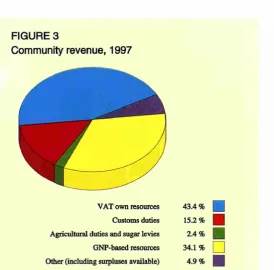
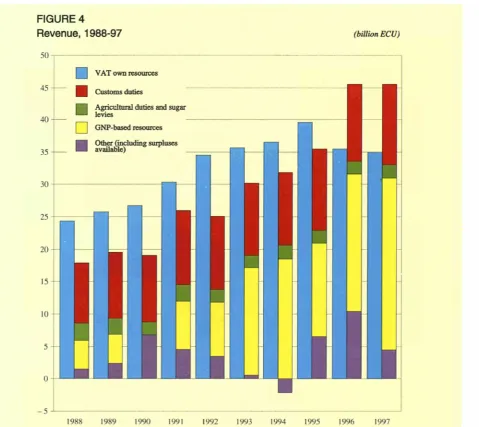
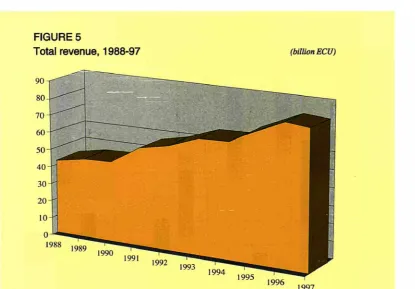
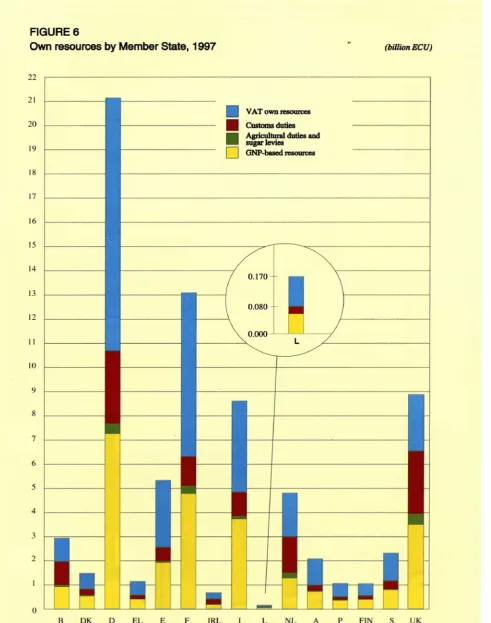
(17) REVENUE. The budget of the European Union was fi nanced from a number of sources in 1997, the breakdown being shown in Figure 3. Total revenue came to ECU 80.6 billion.. 15. year revenue from this source was 8.2 % lower than in 1996, mainly because of the fall in storage levies.. VAT own resources Traditional own resources The EU's traditional own resources are made up of customs duties, agricultural duties and sugar levies. They are established by the Member States, which keep 10 % to cover collection costs. Customs duties are levied on trade with non member countries, at rates based on the Common Customs Tariff. These rates have often been subject to reductions as a result of negotiation rounds under the General Agreement on Tariffs and Trade (GATT) and specific agreements granting preferential tar iffs to certain trading partners. The amount of customs duties collected was up by 4.1 % on last year. This was due to a surge in imports in 1997, which was, however, partly offset by a fall in the average rate from 2.5 to 2.3 %.. The VAT own resources are calculated by ap plying a uniform rate to the national VAT bases, which are determined in accordance with Community rules. In accordance with the June 1988 reform and the recently ratified de cision on the Communities' ownresources system, the uniform rate is determined by ap plying a percentage, set at 1.16 % for 1997, to the VAT base and deducting the compensation for the United Kingdom. The base used must not exceed the percentage of the Member State's GNP laid down in the decision on own resources. For 1997, this limit was 50 % for four Member States and 52 % for the others. This year the VAT base for Ireland, Luxembourg and Portugal was capped under these rules.. Agricultural duties are charged when a Member State imports agricultural products from a nonmember country. The yield was 26.5 % up on last year. In the cereals sector the purpose of the duties is to offset differences between the world price and the Community price.. FIGURE 3 Community revenue, 1997. The proportion of total levies accounted for by levies on cereals is declining as the reform of the agricultural policy brings internal prices closer to world prices. In most other sectors the fall in the proportion of revenue provided by levies has been due mainly to negotiated commitments for a steady reduction in agricultural duties (by 6 % per year). Sugar and isoglucose producers pay levies on production to cover marketsupport arrange ments and to finance a system for the equali sation of sugarstorage costs, thus ensuring that sugar supplies reach the market steadily throughout the year. These levies offset ex penditure of virtually the same amount. This. ___^^^^^r"*^^^^^^^^^. VAT own resources. 43.4%. Customs duties. 15.2%. Agricultural duties and sugar levies. 2.4%. GNP-based resources Other (including surpluses available). 34.1% 4.9%. u ■ ■ D ■.
(18) 16. Payments for a given year derive from the forecasts for that year and the negative or pos itive adjustments for previous years estab lished using the final statements of the bases.. of 1996, the budget forecasts having over estimated economic growth,. ■ , n , n u Λ,Λ-r rroi, In 1997. the VAT resource amounted to ECU 34 919 million.. GNP-based own resources. This year, negative adjustments totalling ECU 567 million were made, particularly in respect. A new source of revenue based on a propor tion of each Member State's GNP was first in traduced in 1988 to balance budgel revenue. FIGURE 4 Revenue, 1988-97. (billion ECU). 50 | VAT own resources |. 40. Customs duties. I Agricultural duties and sugar ^ * levies J GNP-based resources I Other (including surpluses available). 1988. 1989. 1990. 1991. 1992. 1993. 1994. 1995. 1996. 1997.
(19) 17. and expenditure, i.e. to finance the part of the budget not covered by other revenue. The rate is fixed during the budgetary procedure and depends on the total of other revenue; the rate is applied to the aggregate GNP of all the Member States, determined in accordance with Community rules. This year this additional resource was called in, with each Member State paying 0.384 % of its GNP (not including the EAGGF mon. etary reserve, the loan guarantee reserve and the emergency aid reserve). In addition, five Member States had to finance their share of the compensation for the United Kingdom by making a payment based on GNP as their VAT payments had reached the maximum rate, i.e.. in 1997, the GNP resource amounted to ECU 27 150 million (not including reserves).. FIGURE 5 Total revenue, 1988-97 90 -β. (billion ECU). ^-^''. &0-? 7060-' 504030^fl. 20-. H. 10-. o-' 1988. jq„n 'yoy. 1 ^ ^ ^ ^ ^ 1990 1991. 1992. 1993. 1994. 1995 1996. .99 7.
(20) 18. FIGURE 6. Own resources by Member State, 1997. (billion ECU). 22 21 I VAT own resources 20. |. Customs duties Agricultural duties and sugar levies j GNP-based resources. ■. 19. Β. DK. D. EL. E. F. IRL. I. L. NL. A. Ρ. FIN. S. UK.
(21) 19. Net negative adjustments totalling ECU 544 million were made for 1988-96.. Miscellaneous revenue The general budget is also financed by miscellaneous revenue, including tax and other deductions from staff remuneration, bank in-. terest, outside contributions to research programmes, repayments of unused aid and interest on late payments. Together, these sources generated revenue amounting to ECU 871 million. The revenue for 1997 also includes the ECU 4.384 billion surplus from 1996..
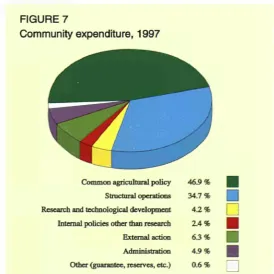
(22) 20. EXPENDITURE. Heading 1 —Agricultural market guarantees Objectives and means Article 38 of the EEC Treaty provides that the common market shall extend to agriculture and trade in agricultural products, and that the operation and development of the common market for agricultural products must be accompanied by the establishment of a common agricultural policy among the Member States. Article 39 defines the objectives of the common agricultural policy as: D to increase agricultural productivity: D to ensure a fair standard of living for the agricultural community: D to stabilise markets:. D to assure the availability of supplies: D to ensure that supplies reach consumers at reasonable prices. Although these objectives have largely been met, certain permanent adjustments have had to be made, the most recent of which is the reform of the common agricultural policy adopted by the Council in May 1992. The reform is based on more competitive prices and direct aid to the farmers in greatest need. Its aim is to reduce surpluses, stem the tide of rural depopulation and preserve the environment by discouraging intensive produci ion. In pursuit of the above objectives, the common market in agricultural produce is based on three principles: lhe single market, Community preference and financial solidarity. The third of these principles is fundamental to the policy, and in April 1962 the Member States accordingly decided to set up a Community fund, the European Agricultural Guidance and Guarantee Fund (EAGGF), which is part of the EU budget. It is subject to the general budgetary rules, with the addition of specific provisions. The Fund was subdivided into two sections in 1964: the Guarantee Section covers expenditure on markets and prices and lhe Guidance Section covers expenditure on farm structures.. FIGURE 7 Community expenditure, 1997. Constraints. Common agricultural policy. 46.9 %. Structural operations. 34.7 %. Research and technological development. 42 %. Internal policies other than research. 2.4 %. External action. 63 %. Administration. 4.9 %. Other (guarantee, reserves, etc.). 0.6 %. D D. In June 1988, when own resources had run out as a result of ever-increasing agricultural expenditure triggered by imbalances on certain markets, the European Council agreed on principles of budgetary discipline in order to establish a better balance between the various categories of expenditure and keep their growth under control. These principles were reaffirmed by the Edinburgh European Council in December 1992. To bring agricultural expenditure under control, the European Council adopted the princi-.
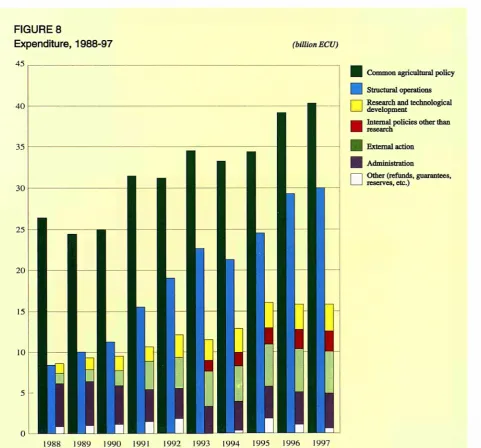
(23) 21. pie of a guideline. Within this guideline the EAGGF Guarantee Section has to finance: D export refunds: D market intervention operations, including depreciation of 'new' stocks; D marketrelated rural development opera tions and measures to combat fraud.. However, in line with the conclusions of the Edinburgh European Council, the guideline was extended with effect from 1993 to cover:. D new flanking measures to accompany the reform of the common agricultural policy (early retirement, environment, afforesta tion);. FIGURE 8 Expenditure, 1988-97. (billion ECU). 45 I Common agricultural policy | S tructural operations. □ ■. 40. ■ ■■II □ |. 35. |. 1111 til. 30. 25. 20. II 15 -. 10. 1 1 5 -. 1988. 1989. 1990. 1991. 1992. 1993. 1994. 1995. 1996. 1997. Research and technological development Internal policies other than research External action Administration. Other (refunds, guarantees, reserves, etc.).
(24) 22. D all set-aside expenditure, which had been shared equally between the EAGGF Guidance Section and Guarantee Section until 1992 (heading 2); D expenditure on income aid (under heading 2 of the financial perspective in 1992); D spending from thefisheriesguarantee fund.. 1997 budget Initial appropriations. The appropriations covered by heading I of the financial perspective amounted to ECU 40 805 million, not counting the ECU 500 million monetary reserve, which is called on only if needed. The figure does, however.. FIGURE 9 Total expenditure, 1988-97. (billion ECU). 1994. 1995. 1996. 1997.
(25) 23. FIGURE 10 Expenditure on agricultural market guarantee, 1997. (billion ECU). Arable crops Sugar Olive oil and dried fodder Fibre plants. Q. Fruit and vegetables Products of the winegrowing sector Tobacco. I. Milk and milk products Beef and veal Sheepmeatand goatmeat Pigmeat. a ■. Expenditure 1996 Expenditure 1997. Other. 0. I. 3. 4. 5. 6. 7. 8. 9. 10. II. 12. 13. 14. 15. 16. 17. 18.
(26) 24. (million ECU i Chapter a. Sector b. Budget c. Expenditure. Expenditure — budget. d. e = d-c. %ofc. 10 11 12 13 14 15 16 17 18. Arable crops Sugar Olive oil Dried fodder and dry vegetables Fibre plants Fruit and vegetables Wine Tobacco Other crop measures. 16 160.4 1 833.5 2 167.7 393.5 832.7 1 680.9 862.8 1 021.2 265.3. 17 414.0 1 607.8 2 196.0 367.4 906.9 1 569.0 1030.1 998.0 274.4. 1 253.7 - 225.7 28.3 -26.1 74.2 - 111.9 167.3 - 23.2 9.1. 7.8 - 12.3 1.3 -6.6 8.9 -6.7 19.4 -2.3 3.4. 20 21 22 23 24 25 26. Milk and milk products Beef and veal Sheepmeat Pigmeat Eggs and poultry Other livestock product measures Fisheries. 3 632.0 7 451.0 2 021.7 168.0 137.8 112.7 42.8. 3 101.2 6 580.4 1 424.9 478.8 78.7 94.4 33.5. -530.8 - 870.6 - 596.8 310.8 -59.1 - 18.3 -9.3. -14.6 - 11.7 -29.5 185.0 -42.9 - 16.3 -21.7. 30 33 35 36 37 38 39. Non-Annex II products Food aid Distribution to the needy Anti-fraud measures Clearance of accounts Promotion measures Other measures. 519.8 94.3 194.3 42.8 -910.0 93.8 140.9. 565.9 15.0 183.8 42.8 - 867.6 54.2 204.2. 46.1 -79.3 -10.5 0.0 42.4 -39.8 63.3. 8.9 -84.1 -5.4 0.0 -4.7 -42.4 44.9. 38 959.9. 38 353.7. - 606.1. -1.6. 9.7 1 835.4. 4.5 2 064.8. -5.2 229.4. -53.6 12.5. 40 805.0. 40 423.0. - 381.9. -0.9. Titles 1, 2 and 3 — Total 40 50. Income aids Accompanying measures EAGGF-Guarantee — Total Percentage difference. -0.94.
(27) 25. include the ECU 72 million entered in Chapter BO40, 'Provisions'. The Commission had thought that the full ECU 41 805 million allowed for under the agricultural guideline would be required. In order to support the Member States' drive for budget restraint in the runup to monetary union, the budget authority decided, on the basis of outturns from previous years, to cut ECU 1 billion off the requests for appropria tions proposed by the Commission. Implementation of the budget Expenditure for 1997 totalled ECU 40 423 million, which represents an underspend of: D ECU 382.0 million (0.94 %) relative to the ECU 40 805 million appropriations entered in the budget;. ■ Arable crops Initial appropriations Expenditure Difference 16 160.4. 17414.1. + 1 253.7. Expenditure exceeded the amount in the bud get because oilseed advances for 1997/98 were paid in 1997. The budget was based on the Commission proposal to change the pay ment date, with the result that the advances would be covered by the 1998 budget. When the Council failed to adopt the proposal, how ever, the Commission paid the advance in ac cordance with the existing rules. This added an extra ECU 1.3 million to the spending total. Setaside accounted for a further ECU 150 million extra spending. On the other hand, marketsupport measures cost around ECU 200 million less than the amount in the budget, thanks primarily to the appreciation of the dollar against the ecu. Sugar. D ECU 1 382.0 million (3.31 %) relative to the requirements on which the budget was based (ECU 41 805 million).. Initial appropriations Expenditure Difference 1 833.5. 1 607.8. ■225.7. Breakdown of differences by chapter The table above shows, for each chapter, the difference between actual expenditure and the amount in the budget. While the difference between initial appropriations and the budget as a whole is relatively modest, individual chapters show large discrepancies. For some chapters (arable crops, pigmeat, accompany ing measures, wine and fibre plants) expendi ture was quite significantly overspent, where as others were underspent (milk, beef and veal and sheepmeat). For the main chapters of the budget the differ ences in million ECU are accounted for below.. Most of the savings result from underspend ing on the export programme and the strong dollar. Only 2 725 tonnes were exported — some 200 000 tonnes less than the 2 940 000 tonnes on which the initial budget was based. In ad dition the average refund was ECU 443 per tonne for 1996/97, against the budget figure of ECU 470 per tonne. This was mainly the result of the rise of the dollar. Fibre plants Initial appropriations 832.7. Expenditure Difference 906.9. + 74.2.
(28) 26. In the cotton sector, spending outstripped ap propriations by some ECU 50 million as the result of a small reduction in cotton aid. The unit amount of aid for cotton depends on the quantity produced. If it exceeds the maximum quantity guaranteed, a penalty is applied to re duce the amount of aid. In the budget, the re duction in aid was based on the hypothesis that Greece would produce 1 300 000 tonnes. In August 1996. Greece reported that its fore cast was 1 220 000 tonnes. In the event, actual declared production totalled no more than 928 000 tonnes with the result that the penalty actually applied was lower than the budget forecast.. fore the acrosstheboard cut) by ECU 142 million. Producers made greater use of private storage arrangements and claimed more aid for the use of must than expected, leading to an overspend of ECU 17 million for 'private storage' and ECU 43 million lor 'use of musi'. At a conservative eslimate, a further ECU 70 million was charged to the budget for lhe de preciation of 742 000 hectolitres of alcohol distilled from wine in Italy.. For flax and hemp, the areas cultivated were greater than anticipated in the budget (132 000 hectares against 105 000 hectares for flax and 13 700 hectares against 10 000 hectares for hemp).. Aid for distillation cost ECU 33 million more than the amount forecast in the budgel. bul ECU 23 million of that was offset by savings on alcohol storage. There has been a shift away from compulsory distillation to preven tive distillation and. though this attracts high er aid payments, (he alcohol produced is nol charged to the Community budge!.. • Fruit and vegetables. •Milk. Initial ■ ,· appropriations 1 680.9. .. Expendi lure Difference ' ■'■' 569.0 111.9. The underutilisation of appropriations is due mainly to the low uptake of appropriations in tended for the operational funds of producer organisations, i.e. slower than anticipated rate of reform. Wine. Initial appropriations 3 632.0. Ex. Penditure 3 101.2. Difference 530.8. The reason for the underutilisation of lhe ap propriations is that the additional milk levy for 1995/96 and 1996/97 (around ECU 240 million and ECU 310 million respectively) was entered in the accounts for 1997, though it did not appear in the budget. • Beef and veal. Initial appropriations. Expenditure. Difference. Initial appropriation. Expenditure. Difference. 862.8. 1 030.1. + 167.3. 7 451.0. 6 580.4. - 870.6. Though expenditure easily exceeded the allo cation for 1997. it was a normal level from a historical perspective. As with fruit and veg etables, the wine harvest varies greatly from year to year in terms of both quantity and quality. Consequently expenditure is very volatile. Spending overshot the Commission's forecast in the 1997 preliminary draft (i.e. be. The very large savings in this sector are main ly due to two factors. Firstly, around 350 000 tonnes were bought in, against the 530 000 tonnes allowed for in the budget. This was the result of lowerthan expected production and a smaller fall in con sumption. When the 1997 budget was adopt.
(29) 27. ed, all observers thought that the outlook for the market and consumption in particular was rather bleak. This positive trend has led to savings of around ECU 560 million. Secondly, expenditure on premiums for the early slaughter of calves was not as high as expected. The budget was based on a figure of 6.35 million calves. In the event only a million animals were slaughtered, saving some ECU 340 million. • Sheepmeat Initial Expenditure Difference appropriations 2021.7. 1 424.9. -596.8. ECU 550 million, of which ECU 407 million was charged to the 1997 budget, with its allocation of only 9.7 million. This unexpected expenditure was partially offset by savings of ECU 63 million resulting from a relative shortage of supply on the internal market, which pushed both refund rates and the quantities qualifying for refunds down lower than anticipated. Furthermore, there was no need for private storage arrangements, which saved another ECU 23 million. • Eggs and poultry Initial Expenditure Difference appropriations 137.8. The average market price was very high in 1996 (ECU 3 634 per tonne against ECU 3 250 in the budget) and climbed even higher in 1997. In addition fewer animals qualified for the premium than were forecast in the budget (73.4 million for 1996 and 73.6 million for 1997 against 77.9 million in the budget for both years), giving rise to lower expenditure. Pigmeat Initial Expenditure Difference appropriations 168.0. 478.8. + 310.8. In this sector, expenditure (ECU 478.8 million) exceeded the budget allocation (ECU 168 million). An outbreak of classical swine fever in Belgium, Germany, the Netherlands and Spain was responsible for the overspending, which would have been even more serious if the reduction in supply on the internal market had meant that fewer exports were subsidised. As one of the measures taken to eradicate the epidemic, the Commission authorised the slaughter of some 9.8 million animals, of which 8.8 million were in the Netherlands. This cost the Community budget an estimated. 78.7. 59.1. For eggs, the refund rates were significantly lower than anticipated (35 to 45 % lower depending on the product), as were the amounts exported (44 % lower). The forecasts concerning poultry exports proved fairly accurate. However, actual refund rates were far lower than the budget had predicted (between 40 and 45 % lower, depending on the specific product). Non-Annex II products Initial Expenditure Difference appropriations 519.8. 565.9. + 46.. Expenditure on refunds for processed products was some ECU 56 million higher than the budget allocation of ECU 499.4 million. This was essentially due to the fact that the volume of exports of sugar, skimmed milk and butter in the form of processed products were higher than forecast in the budget — 70 000 tonnes higher in the case of sugar, 33 000 tonnes for skimmed milk and 1 000 tonnes for butter. The refund rate for sugar was lower than predicted, however, offsetting at least part of the overspend..
(30) 28. At 2 200 000 tonnes, the volume of cereal exported was somewhat lower than the budget forecast of 2 645 000 tonnes. However, the average refund rate was higher than the budget predicted, wiping out virtually all of the savings made through lower export volumes. • Food aid Initial Expenditure appropriations 15.0. 94.3. Difference 79.3. Expenditure was generally lower than expected, with the exception of spending on sugar. For all other products, the quantities supplied were at most a quarter of the quantities allowed for in the budget. World market prices for milk powder and cereals were also higher than predicted. As a result, only half the budget allocation for refunds was actually used. • Other measures Initial appropriations 140.9. Ex. P^,ture 204.2. Difference + 63.3. In the 1997 budget the Commission had forecast requirements of ECU 144.6 million, for disbursement of the second tranche of agrimonetary aid to Belgium. Luxembourg. Denmark, the Netherlands, Germany, Austria and Sweden in line with Council Regulations (EC) Nos 1527/95 and 2990/95. The Council settled on an allocation of ECU 140.9 million. There have been a number of developments since the budget was drawn up which account for the additional spending. Most significantly, in 1997 ECU 87 million was spent on Ireland as part of the first tranche of the new aid provided for by Council Regulations (EC) Nos 1451/96 and 724/97. This was in response to agri-monetary developments. Requirements in 1997 were, however, reduced by some ECU 32.9 million as a result of the swift disbursement, in 1996. of a large part of the second tranche for the Netherlands.. Accompanying measures Initial appropriations Expenditure Difference 1 835.4. 2 064.8. + 229.4. Most of the additional spending slems from the success of the environment-friendly farming programmes in Austria. Ireland and Italy for instance: lhe backlog of payments was cleared.. Heading 2 operations. Structural. Community initiatives and most of the Community support frameworks (CSFs) and the single programming documents (SPDs) were adopted in 1994. 1995 and 1997. As pari of the effort to put European policy at the service of growth and employment, plans for industrial aid to regions in decline were completed in 1997, a year which was also marked by the adoption of territorial pacts for employment. Important policy papers concerning Community structural measures, employment, cohesion policy and the environment were adopted by the Commission, usually in the form of communications to the Council: D in July, in its communication 'Agenda 2000: a stronger and wider union', the Commission set out its position on the future development of the policy of economic and social cohesion: greater geographical concentration and continuing to strive for cohesion (in April a European Cohesion Forum was held); D on 30 May. in connection with (he midterm review of the 1994-99 Structural Funds programmes, the Commission defined its priorities with a view to the possible adjustment of some of its programmes (basic infrastructures, innovation. RTD, environment and sustainable development..
(31) 29. FIGURE 11 Breakdown by Member State of Community contribution under the various objectives of the Structural Funds (current prices). (billion ECU). I Objective 1 |. Objective 2. I Objectives 3 and 4 I Objective 5a (Agriculture) I Objective 5a (Fisheries) I Objective 5b I Objective 6. Β DK D NB: Figuresrelateto the period 1994-99, except in the case of the three new Member States — Austria, Finland and Sweden (1995-99).
(32) 30. development of human resources and equal opportunities): D on 6 May. the Commission adopted a communication entitled 'Towards an urban agenda in the European Union' and organised a European summit of regions and towns on 16 and 17 May in Amsterdam. The 1997 budget earmarked ECU 28 625 million for operations under the three Structural Funds and the Financial Instrument for Fisheries Guidance (FIFG). Of this total. ECU 27 230 million was actually committed. This breaks down as follows: (billion ECU). 4.133. EAGGF Guidance Section ERDF. 14.387. ESF. 8.315. FIFG. 0.395 Total. 27.230. The Union supports six specific objectives through the Structural Funds and the FIFG. Community support frameworks (CSFs) and single programming documents (SPDs) Regions lagging behind in their development (Objective 1 ) The Community's total contribution for 1997 came to ECU 17 039 million, of which ECU 17 016 million was committed. Regions suffering industrial decline (Objective 2) In 1997 the Commission approved 65 new SPDs and. for Spain, a new CSF, covering the period 1997-99. The new SPD for Finland had been approved in 1996. In a communication adopted on 14 November, the Commission. presented all of this new programming, which reflects the priorities set out in the guidelines adopted in 1996. Employment has remained the main priority, and the other priority areas are small businesses, including local development and employment initiatives, research and development, the environment and sustainable development, and equal opportunities. The Community's total contribution lor 1997 came to ECU 2 902 million, all of which was committed. Combating long-term unemployment and facilitating the integration into working life of young people and of people exposed to exclusion from the labour market (Objective 3) The following priorities were selected in partnership with the national authorities: improving the job prospects of the long-term unemployed: promoting the integration into working life of young people seeking jobs: improving lhe job prospects of people threatened by exclusion from the labour market; and promoting equality of opportunity loimen and women on the labour market. The Community's total contribution for 1997 came to ECU 2 203 million, all of which was actually committed. Adjustment of the workforce to industrial change and to changes in production systems (Objective 4) The priorities are as follows: anticipating trends on the labour market and vocational qualification needs; developing training, guidance and advice facilities; improving new and existing training schemes so that workers are better qualified to meet new requirements; and technical assistance measures in the fields of information, counselling, services and assessment. The measures taken concentrate on training workers to meet the need for skills.
(33) 31. identified by advanced measures. Priority is given to small firms and workers threatened by unemployment as a result of industrial change. The Community's total contribution for 1997 came to ECU 477 million, all of which was committed. Adjustment of agricultural structures (Objective 5a) (billion ECU). Objective. Appropriations available. in 1997. Appropriations committed. Sanotin la and 5b 5a in 5b. 0.422 0.553. 0.422 0.553. Total. 0.975. 0.975. In order to clarify, simplify and rationalise the rules on Objective 5a (on improving agricul tural structures, improving the processing and marketing conditions for agricultural products and producer groups and associations there of), the Council recast these rules on 20 May. On 24 February, it also extended by two years the special provisions for the granting of com pensatory payments in the lessfavoured areas of Portugal in order to improve agricultural structures there. On 11 November, the Commission also proposed to draw up the list of lessfavoured areas in Denmark. The Community's total contribution came to ECU 975 million, all of which was commit ted. Fisheries structures (Objective 5a) In 1996 the Council adopted amendments to Regulation (EC) No 3699/93 laying down the criteria and arrangements regarding Community structural assistance in the fish eries and aquaculture sector, and the process ing and marketing of its products:. D limiting the premiums for the scrapping of vessels over 30 years old and introducing a ceiling on aid from the Financial Instrument for Fisheries Guidance (FIFG) for the temporary layingup of vessels; □ introducing a reference to the new aid scheme for producer organisations; D confirming that only the budgetary rate for the ecu would be used, and not the agricul tural rate. The Community's total contribution for 1997 came to ECU 164 million, of which 59 mil lion was committed. Development of rural areas (Objective 5b) Objective 5b is concerned with the develop ment of rural areas in difficult circumstances which are not located in Objective 1 regions; 12 Member States are involved. The Objective 5b areas designated for the period 199499 have a total population of approxi mately 32 745 000, including the new Member States, and a combined surface area of840 876km:. On 22 January the Community approved an SPD (199799) for France. The purpose of this document is to provide technical assis tance to improve the effectiveness and mutual consistency of operations carried out under the 20 Objective 5b SPDs covering regions in France. The Community's total contribution for 1997 came to ECU 1 248 million, all of which was committed. Regions with a low population density (Objective 6) Finland and Sweden are the only regions af fected by this objective. Its main priorities are economic and commercial development, human resources, promotion of knowhow,.
(34) 32. agriculture, forestry, fisheries, farmland improvement, the environment and Community social measures. The Community's total contribution for 1997 came to ECU 138 million, all of which was committed. Community initiatives. Total funding for the Community initiatives represents 9 % of the total volume of the Structural Funds, in accordance with Article 12 of Council Regulation (EEC) No 2081/93. This figure was obtained by taking 8 c/c of the total funding allocated to each objective (including transitional measures and innovative schemes) and adding 1 % taken from the allocations for Objectives 3 and 4. On 8 May 1996. the Commission adopted the decision on the use of the reserve for the Community initiatives. The total came to ECU 1 665 million at 1996 prices. Appropriations available for 1997 totalled ECU 3 173 million, of which 1 949 million was committed. Other structural measures Transitional and innovative measures. In 1997. as in the previous year, the Commission selected pilot projects or innovative demonstration projects covered by the guidelines adopted in its communications: D under Article 10 of Regulation (EEC) No 4254/88, in regional and local economic development (land use planning, urban development), 113 innovative projects were chosen, and for interregional cooperation, more than 25 projects: D under Article 6 of Regulation (EEC) No 4255/88, as regards the Social Fund, 48 pilot projects were selected in training, or-. ganisation of work, job creation or employment services. Technical assistance was granted for the implementation of territorial pacts for employment to prepare concrete action plans. Ninety pads were concluded in lhe regions and certain towns; D pilot or demonstration projects under Regulation (EEC) No 4256/88 were also given technical assistance. These projects concerned non-food crops, agrienvironmental aspects, the forest economy and rural development; D in the fields of small-scale coastal fishing, studies, technical assistance and information, the FIFG selected over 36 projects. Appropriations available for 1997 totalled ECU 301.448 million, of which ECU 262.323 million was committed. Action against fraud in the field of structural action. The unit for combating fraud provided the Member States with technical assistance, mainly with on-the-spot checks. Appropriations available for 1997 totalled ECU 0.75 million, all of which was committed. Implementation, monitoring and evaluation of programmes and projects. This concerns the implementation, monitoring and evaluation of the environmental dimension of the programmes and projects undertaken under Chapters B2-I0, II, 12, 13, 14, 18, 20 and 40 of the budget, to achieve the objectives set out in the Community programme of policy and action in relation to the environment and sustainable development. Appropriations available for 1997 totalled ECU 3 million, of which ECU 1.6 million was committed..
(35) 33. Cohesion Fund. The Cohesion Fund was set up by the Treaty on European Union and first started operation in 1993. Its allocation for the period covered by the financial perspective for 1993-99 amounts to ECU 15.15 million (at 1992 prices).. On 23 June the Commission adopted its annual report on the work of the Cohesion Fund in 1997. It states that 99.99 % of the 1996 commitment appropriations were used up. The Commission also launched its first evaluation of the results of the projects financed by the Cohesion Fund. The stress is placed on. Amount of commitments in 1997 Member State. (million ECU). Transport. Environment Amount. %. Amount. %. Total. Share. Amount. %. Greece. 210.453. 14.0. 283.031. 22.7. 493.484. 18.0. Spain. 853.072. 56.9. 661.523. 53.1. 1 514.595. 55.1. Ireland. 134.054. 8.9. 111.489. 8.9. 245.543. 8.9. Portugal. 302.363. 20.2. 190.870. 15.3. 483.233. 17.9. 1.845. 0.1. 2 748.700. 100.0. Technical assistance Grand total. 1 499.942. 100.0. 1246.913. 100.0.
(36) 34. achieving a balance in financing between environmental and transport projects, while giving priority to rail transport. In accordance with Article 6 of Regulation (EEC) No 1164/94 setting up the Cohesion Fund, the Commission examined the budgetary situation of the Member States which had an excessive deficit and were eligible under the Cohesion Fund. It emerged that the government deficits of the eligible countries (Spain. Greece. Portugal), while excessive, remained within the limits of the objectives recommended by the Council. In accordance with Article 6 of the regulation setting up the Cohesion Fund, assistance to those countries would continue. In 1997. the appropriations committed to financing projects in Ireland. Greece, Portugal and Spain totalled ECU 2 748.7 million. The breakdown by country of these appropriations is shown in the table above. In 1997, a total of 228 projects were financed by the Cohesion Fund (59 in Greece, 33 in Ireland. 45 in Portugal and 91 in Spain).. Heading 3 — Internal policies Research and technological development The year 1997 was the third year of the fourth framework programme (1994-98). The initial appropriations amounted to ECU 3 400 million. They were supplemented during the course of the year by ECU 100 million in a supplementary and amending budget. Budgetary implementation was close to 99 % for commitment appropriations and, for the payment appropriations, improved on the 94 % rate of the previous years. The appropriations available in 1997 for RTD were as follows:. (million ECU I. Budget, not including European Economic Arca (EEA) support Indirect action by shared-cost projects. 3 255. Direct action by Joint Research Centre. 245. EEA contribution Indirect action by shared-cost projects. 55. Direct action by Joint Research Centre. 3. The additional appropriations for cooperation with the European Economic Area concerned the non-nuclear appropriations of the framework programme. The ECU 3 250 million in commitments for the different areas of sharedcost projects breaks down as follows: (million ECU). Information technology and communications. 1 054. Industrial technologies. 541. Environment. 198. Life sciences and technologies. 381. Non-nuclear energy. 288. Transport. 85. Targeted socioeconomic research. 40. Scientific and technical support for Community policies. 37. Cooperation with third countries and international organisations. 177. Dissemination and utilisation of research results Training and mobility of researchers Nuclear fission safety Controlled thermonuclear fusion. M 173 13 187. This year the Joint Research Centre (JRC) continued to implement two framework programmes which it is carrying out for the European Community in the non-nuclear field.
(37) 35. and the European Atomic Energy Community in the nuclear field. Parallel to these activities, it carried out institutional research and scientific and technical support for the European Union's policies, competitive activities involving participation in shared-cost projects and work carried out under contract with third parties. The Commission continued its international cooperation activities under European cooperation in the field of scientific and technical research (COST) and Eureka with EFTA and with the main industrialised countries. Pursuant to the agreement on the European Economic Area (EEA). Iceland, Norway and Liechtenstein took part in the specific non-nuclear programmes of the fourth RTD framework programme. The agreements signed with Israel and South Africa in 1996 enabled participants from these countries to take part on an equal footing with their European partners. The Council and Parliament decided in 1997 to grant an additional ECU 115 million for the fourth framework programme, thus bringing the overall maximum amount to ECU 13 215 million. More than half of this supplement was concentrated on two issues which became priorities as a result of topical events: research on bovine spongiform encephalopathy (ECU 35 million) and anti-personnel mines (ECU 27 million). In 1997, the Commission made its proposal for the fifth framework programme (19982002), based on a concentration of resources on precise socioeconomic objectives. The proposed financial allocation is ECU 16 300 million, and reflects the priority given by the Commission in its communication, Agenda 2000, under the financial perspectives for the period 2000-06, to research and innovation as an active policy for growth and employment.. Transport To pave the way for the common transport policy, the Community budget helped finance. a variety of measures relating to pilot schemes for combined transport, the development of long-term transport policy and transport safety. The appropriations entered in the 1997 budget for this purpose (ECU 21.6 million) were committed in their entirety. In 1997, the Commission concentrated on achieving a better balance between the various transport modes. Its communications on intermodal freight transport and transEuropean rail freight freeways were directed towards this goal. Another priority area was transport safety, where the Commission adopted a communication on the promotion of road safety, a proposal for a directive on the application of international maritime safety standards and two proposals for directives on aviation safety.. Education, vocational training and youth policy Appropriations available for 1997 totalled ECU 382 million for the whole of this field. As regards education, the Socrates programme (1995-99), which covers the entire educational spectrum, was continued: available appropriations totalled ECU 171.4 million in 1997. In accordance with the original decision, on 14 March 1997 the Commission adopted a report on the results obtained in the first two years of the programme. This report was accompanied by a proposal for a decision aiming to increase the financial package for the programme for the last two years, 1998 and 1999. In December 1997, Parliament and the Council reached a political agreement on the basis of an ECU 70 million increase. The financial package for the Socrates programme consequently increased from ECU 850 to 920 million. In addition to the Socrates programme, the Commission also gave its support to promoting and safeguarding regional and minority laneuases and cultures, as well as to the activ-.
(38) 36. ities of the European Bureau for Lesser-Used Languages (ECU 3.7 million). The field of education, vocational training and youth has two other programmes, which, like the Socrates programme, cover the period 1995-99. The Leonardo da Vinci programme, whose main objective is to ensure the implementation of a vocational training policy supplementing and supporting the actions of the Member States, was allocated ECU 150 million in 1997. In the field of youth, the Youth for Europe programme was awarded ECU 24.5 million in its third year of implementation. These two programmes, and the Socrates programme, were also opened up to participation from the countries of central Europe and Cyprus, with a view to enlargement. On 12 November 1997, in its communication 'Towards a Europe of knowledge', the Commission presented its new general guidelines for the future Community measures intended to replace these programmes. The 'European voluntary service' pilot scheme was allocated ECU 11.8 million in 1997. the second year of its implementation. The aim of this pilot scheme is to prepare a programme which would enable young people aged 18 to 25 to gain a formative experience, recognised at European level, consisting of activities that benefit the community. At the end of 1996 the Commission presented a proposal for a decision aiming to establish such a voluntar)' service programme for the period 1998-2002. In 1997, the legislative procedure reached the stage where the Council was able to adopt a joint position on 16 December. The European Centre for the Development of Vocational Training (Cedefop) received a subsidy of ECU 12.3 million, with a further ECU 2 million to cover the cost of its relocation to Thessaloniki. The remainder of the available appropriations were allocated to cooperation with nonmember countries (ECU 2.1 million), and to. preparatory measures for stepping up cooperation in lhe fields of education (ECU 3.2 million) and vocational training (ECU 1.4 million).. Culture and audiovisual media Appropriations available for 1997 totalled ECU 114 million for the whole of (his field. As regards culture. 1997 was marked by the adoption by Parliament and the Council of two new programmes: Ariane and Raphael. The Ariane programme, which concerns books and reading, covers the period 1998-99. In 1997, it was allocated ECU 2.8 million. The overall budget provided for this programme is ECU 7 million. The Raphael programme concerns the European cultural heritage. For the period 1997-2000, a budget of ECU 30 million has been allocated. The appropriations available under this programme came to ECU 10.6 million in 1997. The Commission also continued to pursue measures under the Kaleidoscope programme, the aim of which is to support artistic and cultural activities with a European dimension. The programme, which covers the period 1996-98, has a budget of ECU 26.5 million. In 1997, it was allocated ECU 8.6 million. Apart from the multiannual programmes, an amount of ECU 6.0 million was allocated to the other cultural actions implemented in the Community and in cooperation with nonmember countries. In the audiovisual field, most of the activities, totalling ECU 58.3 million, were carried out under the MEDIA II programme. The programme, covering the period 1996-2000, has two parts: one devoted to development and distribution, and the other relating to the training of professionals in the audiovisual sector. In addition to the ac-tivities under MEDIA II measures were financed to promote the European dimension in the audiovisual field (ECU 2.5 million) and multilingual television and radio services (ECU 5.9 million)..
(39) 37. The advanced European television programme was concluded in mid-1997. In its last year of existence, the two parts of this action plan, concerned with the production and conversion of 16/9 format television programmes and their broadcasting, were allocated ECU 9.7 million and 9.5 million respectively.. Information and communication. employment services (EURES) network (ECU 10.5 million), which includes a database with job vacancies and information on working and living conditions in the Member States of the Union. Within the same framework, the Commission also launched the pilot scheme 'Third system and employment', with funding of ECU 11.3 million to study the employment potential of the 'third sector', principally non-profit-making organisations of various kinds.. The appropriations available under the information and communication activities totalled ECU 120.8 million. These activities can be divided into two groups: Prince, the information programme for European citizens (ECU 55 million), and the other information and communication activities (ECU 65.8 million).. In the field of social protection and the free movement of workers, appropriations available in 1997 totalled ECU 51.9 million. The Community's activities in this field mainly related to general social security guarantees and the protection of certain disadvantaged groups.. As far as activities other than Prince are concerned, the available appropriations under the heading 'General information and communication work' totalled ECU 44.5 million: one priority was funding celebrations to mark the 40th anniversary of the signing of the Treaties of Rome in March 1997. Information programmes for non-member countries were allocated ECU 7.4 million. Some ECU 7.7 million was allocated to the information relays. Sport received ECU 3.0 million and the Jean Monnet project for university teaching on European integration, ECU 3.2 million.. The Commission carried out programmes to promote equal opportunities for the disabled (budget of ECU 5.8 million), and also cooperated with non-governmental organisations and associations of disabled people and supported their activities (budget of ECU 6.0 million).. Social dimension and employment Appropriations available for 1997 totalled ECU 189 million for the whole of this field. To complement the measures financed by the European Social Fund, the Community has developed a policy aimed at encouraging dialogue between the social partners and stimulating employment (ECU 61.9 million available in 1997). In this context, the Commission undertook action such as continuing its work for equality between men and women (ECU 8.3 million), and developing the European. Some ECU 4 million was allocated for cooperation with charitable organisations and ECU 2.8 million for measures in favour of the family and children. The Community also implemented measures for combating violence against children, adolescents and women. Some ECU 3.0 million was allocated for this purpose. As 1997 was the European Year against Racism, special emphasis was placed on measures for combating racism, xenophobia and anti-Semitism (ECU 8.0 million available). Some ECU 10.5 million was also allocated to measures to assist refugees, with the aim of preventing social exclusion and helping refugees become independent, particularly by supporting vocational training for them. In public health, the Commission continued its programmes adopted for the period 19962000. These programmes relate to promotion,.
(40) 38. information, education and training in public health (ECU 7.0 million available for 1997). the fight against cancer (ECU 11.25 million), the prevention of AIDS and other transmissible diseases (ECU 9.01 million), and the fight against drug abuse (ECU 4.85 million). Parliament and the Council also reached an agreement on a Community action programme on health monitoring (1997-2001), aiming to provide reliable, comparable data on trends and patterns in health status and its determinants. The budget provided for this programme is ECU 13.8 million. Appropriations available for 1997 totalled ECU 2.3 million. Some of the appropriations were allocated to measures to improve the quality of life of people suffering from neurodegenerative diseases, such as Alzheimer's disease (ECU 2.5 million available in 1997), health protection, hygiene and safety at work (ECU 4.5 million) and the action for safety at work in Europe (SAFE) (ECU 8.8 million). The European Agency for Safety and Health at Work was also awarded a subsidy of ECU 4 million.. On the basis of the information in the White Paper, on 18 November 1997 the Commission adopted a proposal for a decision setting up a framework programme for actions in the energy sector (1998 to 2002). The framework programme groups all the current actions and programmes (especially SAVE, Altener and Synergy), and aims to improve (heir efficiency and ensure that they are consistent with the objectives for energy. In any case, these programmes and actions continued in 1997 according to the original plan. Under the existing SAVE II programme (to promote energy efficiency), which covers the period 1996 to 2000 with a reference amount of ECU 45 million. ECU 17.9 million was committed in 1997 (second year of the programme).. Appropriations available for 1997 totalled ECU 37 million.. The Altener 1 programme, intended lo promote renewable energy sources in lhe European Union, was completed. Il covers lhe period 1993-97 and its overall budget is ECU 40 million. The initial appropriations of the 1997 budget, ECU 5.2 million, were increased by a budget transfer of ECU 3.85 million. Almost all the available appropriations were committed during 1997, the fifth and final year of the programme, which meant that ECU 47 million was spenl between 1993 and 1997. As regards the continuation of this promotion of renewable sources of energy, on 12 March 1997 the Commission adopted a proposal for an Altener II programme to run from 1998 to 2002. with a reference amount of ECU 30 million for the first (wo years. 1998 and 1999. On 8 December 1997. the Council reached a political agreement on a common position (with ECU 22 million as a reference amount).. In 1997 the Commission gave particular priority to improving the transparency of the energy actions at Community level. To this end, it adopted a communication on 23 April 1997. entitled 'An overall view of energy policy and actions'. In this White Paper on energy policy, the Commission included a table showing all the Union's energy programmes.. On 14 April 1997 the Council adopted (he Synergy programme for the year 1997 with a reference amount of ECU 7 million. All the budget appropriations. ECU 6.9 million, were committed in 1997. In order to avoid an interruption of Synergy's activities, on 18 December 1997 the Council decided to continue the programme in 1998.. These activities were supplemented by those carried out by the European Foundation for the Improvement of Living and Working Conditions, which was subsidised to the tune of ECU 13.6 million, and by those of the European Monitoring Centre for Drugs and Drug Addiction (subsidy of ECU 6.3 million).. Energy.
Figure
+7

Related documents