COMMISSION OF THE EUROPEAN COMMUNITIES
Brussels, 09.10.1998 COM(l998) 559 final
COMMUNICATION FROM THE COMMISSION
To THE COUNCIL
AND FOR INFORMATION TO THE EUROPEAN PARLIAMENT, THE ECONOMIC AND SOCIAL COMMITTEE
AND THE COMMITTEE OF THE REGIONS
ON THE IMPLEMENTATION AND FUNCTIONING
TABLE OF CONTENTS
I. Ii'I'I'RODUCTION ... l
2. COMMUNITY MEAStJRES IN THE AREA OF RADIO FREQUENCIES ... 2
2.1 FRI'QI JI'NCY DIRECTIVES ... 2
2.2 fURTIIER DEVI'LOI'l\1ENTS IN C'O-OIWINATION OF FRI'(lllt:NC'II'S ... 4
2.3 0TllER COMMl INITY MEASURES CON< 'FRNIMi MOim.E ( 'OM!\H INil'ATIONS ... 5
2.4 [VOl.llTION TOWAIWS TIIIIW CiENI:RATION MOBILE C<l.\IMl.INK'ATIONS SYSTI',vlS ... 7
J. DIRE("J'IVE 87/372/EF.C ... ~ ... 7
I [!,\( 'K< iR! II INI > ... · ... : .... ... 7
.1.2 ( 'IJI(RI'NT SIT I J,\ Ill lN.: ... ; ... 7
3. :!./ A!~lr/((•f {J,.,.I'Iolllllt'/1{... ... ... .. .. .... .. ... 7
3. }. 2 lmJIIIclt!/FrcrJIIL'IICl' /Jirl'clil't' 011 the Markl'!... ... .. .. ... .. ... .. ... !-\ 3. 2.3 5/n'c/l'lt/11 /'.Iwragenrent ant! Amilahility ... ... 9
3. 2.4 Transposition/Implementation issues ... 10
3.3 SIGNIFICANT ISSUES ... : ... 12
4. DIRECTIVE 90/544/EEC ... ~ ... lJ 4.1 I3ACK<iiWIJND ... 13
4.2 CIJRI(I'NT SrnJATH>N ... 13
4.:'.. I Market Dn•elotmwnt... . ... .. ... 13
4.2.:'. !11/flltcl o(tltc Frt'tfltt'IIC\' Din·t'fil'e ... .. ... 15
·1.2.3 .'JjJectl'/1111 Al'llilahilitr a~~tl!llanagcnwnr .... .. . .... 15
4.2.4 7hrll.l'fiO.\'itionllmtJI<'IIICIII<IIinlt i.l'.l'lll'.\'.. .... ... .. ... IS 4 .. ~ Sl<iNII'I!'ANTISSIII'.S ... ... 1(> 5. J)JI{J<:( 'TIVE 91/2!!7/J<:E(' ... 17
S. I! .. \('(.;( ii(()IINI l. .. ... .... ... . .. ... ... . ... II -~ ., ( 'III~I<I·NT S! llli\TI< lN... ... ... . ... 17
5.2.1 1\farkL'f !>cl·dotJIIIt'lll ... 17
52.2 !mpacto/tlre Frelflll'IIC\' Dircctil'(' ... .. ... IS 5.2.3 Spectrum Management awl Al·ailahili~\' ... , ... I 8 5.:!.4 Transposition/Implementation issues ... 19
5.3 SIGNIFICANT ISSUES ... : ... 19
6. CONCLUSIONS ... 20
(>.1 GENERAL ... 20
(J.2 !Ml'I.FMENTATION' ... 20
(d 0Tlli:R ISSI.li'S: SJ>FCTRIJM [1.[,\\'.\t iFl\1 ENT, IXI'NSIN(; AND S.1\FETY OF mEQlii'NC'Y IIS,\t ;1 : ... 21
(>.4 I' AI{'! It 'lll.AI\- ( iSt\·1... ... , ... , ... 2~
(J_) I'ARTI< '(I[J\R- I;RMI:S ... 2.\
(1,(> I' A RTI< 'Ill i\ I< - l l I~( ~T ... 2.\
ANNJ·:XJo:S ... ::!-1
Ai'!NioX I: C'<HJNCil DIRI'CTIVI: X7/372ilTC: NATIONAl. RHiiiLAI(JRY FRA[I.IloWURKS ... 2:'i Tah/" I ... ... 29
Tahle 2 .. ... . . ... 35
ANNJ:X 2: COUNCil. DIRJ:C:TIVF 90/54-II!~EC: Ni\TIONAI. REGIJLATORY FI~AMEWORKS ... .' ... 38
Toh/e 3 ... ~ ... 43
In the last decade mobile communications has arguably been the most dynamic market in the telecommunications sector. Analogue and digital cellular telephony, paging and cordless telephony arc now an integral part of developed telecommunications markets. And all the market trends point to continued and sustained growth in mobile telecommunications.
Of particular note has been the world-wide success ofthe GSM family (GSM, DCS 1800, DCS 1900) with 220 GSM networks in operation in 106 countries with more than 44 million users.
Whilst GSM has swept the world, the growth of the ERMES paging system and the DECT systems has been much less dramatic. Substantial regional variation between the Far East, the EU and the USA can be observed in the paging market, with Europe lagging behind Far Eastern countries. Cordless telephony, including DECT, is now well established and could be on the verge of substantial growth, though competing technologies may contain this growth.
Further expansion in the mobile market is to be·expected within the next few years with the introduction of a third generation mobile system UMTS (Universal Mobile Telephony Services}.
This Communication:
o reports on the implementation and functioning of the three Council Directives which reserved frequency spectrum for the co-ordinated introduction ofGSM1, ERMES2 and DECP and reviews the extent with which Member States have complied with the requirements of the Directives;
o assesses the impact of the frequency directives on the development of the markets for each of these three technologies.
o considers additional action needed to ensure full compliance ofthe national regulatory lramcwork with the requirements of the directive, in order to further encourage the development of the market.
Following this Communication, the Commission will initiate a wide discussion on the appropriateness of the current regulatory framework for frequency allocation in the Community, with a view to considering the need for additional Community measures in the area, where appropriate.
3
Council Directive 87/372/EEC (GSM) of25 June 1987 on the frequency bands to be reserved for the co-ordinated introduction of public pan-European cellular digital land-based mobile communications in the Community.
Council Directive 90/544/EEC (ERMES) of 9 October \990 on the frequcm:y bands designated for the co-ordinated introduction Of pan-European land-based public radio paging in the Community.
2. COMM1IJNTITY MIEA.§llJRJE§ UlJ TIHIIE AREA OIF RAlDlllO IFJREQ:UJIENCITIE§
2.1 IFreqMelllcy Dnrectnves
Fostering the development of mobile services has always been a key issue of the European Community's policy for telecommunications. Initiatives were launched as early as 1987 to promote the Community-wide introduction of digital cellular communications systems, of digital radio-messaging systems, and of digital cordless communications. Three Recommendations have been adopted by the Council promoting the co-ordinated introduction of services based on these systems, while the Commission has used its powers to propose three Directives reserving frequency band for the same services, which have been adopted by the Council. The Directives do not link frequency reservation to a specific technology to be applied. They only have as objective to reserve frequency necessary for a co-ordinated Community-wide introduction of modem cellular communications and paging.
All these measures can be described as
follows:-• Council Recommendation of 25 June 1987 on the co-ordinated introduction of public pan-European cellular digital land-based ·mobile communications in the Community4, Council Resolution of 14 December 1990 on the final stage of the co-ordinated introduction of public pan-European cellular digital land-based mobile communications in the Community5, accompanied by Council Directive 87/372/EEC of 25 June 1987 on the frequency bands to be reserved for the co-ordinated introduction of public pan-European cellular digital land-based mobile communications in the Community6.
The Directive is aimed at ensuring reservation of adequate frequency in the 900 MHz band for the introduction of public pan-European cellular digital land-based mobile communications in the Community which, under Council Recommendation 8 7/3 71 /EEC of 25 June 198 7, should be started by 1991 at the latest.
In particular, Article 1(1) of the Directive requires Member States to ensure that the 905-914 and 950-959 MHz frequency bands (often referred to as "core band") or equivalent parts of the band mentioned in paragraph 2 are reserved exclusively for GSM services by 1 January 1991. Under Article 1(2), Member States shall ensure that the necessary plans are prepared for GSM to be able to occupy the whole of the 890-915 and 935-960 MHz bands according to commercial demand as quicKly as possible. No deadline is set out concerning the latter obligation. Member States were given 18 months after notification of the Directive to bring into force the provisions necessary to comply with the Directive, and were requested to inform the Commission thereof. • Council Recommendation of 9 October 1990 on the co-ordinated introduction of
pan-European land-based public radio paging in the Community7, coupled with
Co{Ulllllcfi[ [J)nrednve 90/54141/IEIEC of9 October 1990 on the frequency bands designated for the co-ordinated introduction of pan-European land-based public radio paging in the Community!!.
The Directive is aimed at ensuring adequate frequency band in the 169.4 to 169.8 MHz range for the provision ofpan-European land-based radio paging service which, under Counci I Recommendation 90/543/EEC of 9 October 1990, should be started by 31 December 1992 at the latest. In particular, Article 2( 1) of the Directive requires Member States, in accordance with CEPT Recommendation T/R 25-07, to give protection and priority to four channels in the 169.4 to 169.8
MHz
range for the pan-European land-based radio paging service by 31 December 1992 at the latest. These four channels should be, preferably:e 169,6
MHz
o 169.65 MHzCii 169,7 MHz
0 169.75 MHz
Under Article 2(2) Member States shall ensure that plans are prepared as quickly as possible to enable ERMES services to occupy the whole of the 169.4 to 169.8 MHz band (i.e. 16 channels) according to commercial demand. No deadline is set out concerning this obligation. Member States were requested to bring into force the . provisions necessary to comply with the Directive by 18 October 1991.
o Coumdfi RecommeiiDI!llatimn of 3 June 1991 on the co-ordinated introduction of digital
European cordless telecommunications (DECT) into the Community9, coupled with
Commdfi IDirednve 91/287/lEEC of 3 June 1991 on the frequency bands to be
designated for the co-ordinated introduction of digital European cordless telecommunications (DECT) into the Community1o.
8
9
The Directive is aimed at ensuring adequate band in the 1880-1900 MHz range for the provision of DECT services which, according to Council Recommendation 91/288/EEC of 3 .June 199111 , should be implemented by 31 December 1992 at the
latest. In particylar, Article 2(l) of the Directive requires Member States, in accordance with CEPT Recommendation T/R 22-02, to designate the frequency band 1880-1900 MHz for digital European cordless telecommunications by 1 January 1992. In accordance with the CEPT Recommendation, DECT shall have a priority over other services in the same band and be protected in the designated band. Under Article 3(1) Member States were requested to bring into force the provisions necessary to comply with the Directive by 31 December 1991, and inform the Commission thereof.
OJ n. L 310 of9.11.1990, page 28.
OJ n. L 144 of 8.06.1991, page 47.
10 OJ n. L 144 of 8.06.199 I, pugc 45.
rn
a wider European context, the application of three Directives have been extended to CEPT countries by Decisions adopted by the CEPT/ERC in 199412. Moreover, in 1997 a further ERC Decision identi tied the "extended bands" to be used for GSM when additional spectrum is needed beyond the frequency band mentioned in the previous ERC Decision on GSMIJ.2.2 Further developments in co-ordination of frequencies
Council Resolution 90/C 166/02 of 28 June 1990 on the strengthening of the European-wide co-operation on radio frequencies, in particular with regard to services with pan-European dimension14 recognised the importance of a co-ordinated approach to frequency allocation for Europe-wide systems and noted with satisfaction that a reform of the radio frequency planning and co-ordination mechanisms was being developed within the framework of CEPT. Five major policy goals .in the area of frequency allocation were identified.
o to strengthen European co-operation in the field of radio frequency co-ordination, with the objective of providing for a sufficient frequency spectrum for new services; o to work towards' the timely allocation of sufficient frequency resources for mobile
and satellite applications;
Ill to promote the most efficient use of the frequency spectrum;
Q to develop common European positions in relation to the use of the frequency
spectrum, in particular with regard to the ITU and its relevant administrative radio conferences, using mechanisms set up by CEPT.
o to support these objectives, encouraging the further development of the framework of
co-operation between frequency experts from national authorities responsible for frequency management, telecommunications organisations and other service providers, industry and users, developing the existing co-ordination mechanisms set
upbyCEPT. .
In the Resolution, the Council invited the Commission, the Member States and CEPT to support the further development of the new fran:tework set up by CEPT.
12 ERC Decision of 24 October 1994 on the frequency bands to be designated for the co-ordinated introduction of the GSM digital pan~European communications system (ERC/DEC/(94)01); ERC Dec::ision of 24 October 1994 on the frequency bands to be designated for the co-ordinated introduction of the European Radio Messaging System (ERMES) (ERC/DEC/(94)02); ERC Decision of 24 October 1994 on the frequency bands to be designated for the co-ordinated introduction of the Digital European Cordless Telecommunications system (ERC/DEC/(94)03).
!3 ERC Decision of 21 March 1997 on the extended frequency bands to be used for the GSM digital pan• European communicationssystem (ERC/DEC/(97)02). Not all CEPT Members have ¥et committed themselves to apply the terms of this Decision
The Resolution has certainly played a role for the development of a Europe-wide framework for frequency co-ordination, and a number of important initiatives have been taken by CEPT European Radiocommunications Committee (ERC) in response to this initiative, including the setting up of a European Radiocommunications Office (ERO) and the adoption of a mechanism to secure implementation by members of CEPT of ERC Decisions concerning radio frequencies.
Subsequent CoumrndD IR.esoHI!ll~nmn 92/C 313/01 of 19 November 1992 on the implementation in the Community of European Radiocommunications Committee decisions15 reaffirmed support to the CEPT method of co-operation as the primary means for Europe-wide frequency co-ordination. This was followed by a Communication of the Commission in September 1993, concerning a new approach to the co-ordination of frequency in the Community16 and by another Communication of the Commission on the ERC Decision mechanism in April199517.
A Memorandum of Understanding is currently in force between ERC and the Commission, and a framework contract between the Commission and ERQ18 setting out
arrangements for co-operation and procedures. The framework contract allows the Commission to mandate ERO to conduct work of a technical nature in the form of ''work requirements", with a view at reaching Decisions concerning designation of harrnonised frequencies for certain services. So far, Decisions have been adopted by ERC on, inter alia, TETRA, DCS 1800, Terrestrial Digital Audio Broadcasting, Satellite Personal Communications Services (S-PCS) and UMTS.
Lastly, the Commission has also issued a Communication on "Radio frequency requirements for Community policies in the context of the World Radiocommunications Conference 1999 (WRC-99)"19•
2.3 Other Community measures concerning mobile commruumications
Building on the consensus achiev~d on the basis of the Mobile Green Paper20 and, in particular, on the support of the Council and the European Parliament to abolition of special and exclusive rights in the mobile sector, the Commission adopted in January
15 0Jn.C318of4.12.1992,page 1. 16 COM (93) 382 final of 10.09.1993. 17 COM (95) 85 final of26.04.1995.
18 The framework contract expired at the end of April 1998, but a proposal has been put forward by the Commission to grant a prolongation.
19 COM(98)298, 13.05.1998.
1996 a Directive amending the Services Directive21 to include mobile communications,
which had so far been excluded from its
scope:-o Commission Directive 96/2/EC (Molhnle lDlnrective) of 16 January 1996 amending
Directive 90/388/EC with regard to mobile and personal communications22.
Besides requiring the removal of any remaining special and exclusive rights by February 1996, the Directives provides for: i) an early liberalisation of infrastructure, so that restrictions on mobile operators arc lifted with regard to the establishment of their own infrastructure, the use of infrastructures provided by third and the sharing of infrastructure, other facilities and sites; ii) the right for mobile operators to interconnect directly with 'other mobile networks or with the public fixed network; iii) the licensing of DCS 1800 systems by 1 of January 1998 and of public access/telepoint applications, including systems based on DECT.
Essential provisions concerning frequency allocation are set out by Article 3b of Directive 90/388/EC, as amended by the Mobile Directive, under which Member States must pUJiblisiiD every year or make available on request the allocatimn scheme of frequei!Bcnes, induding plans for future expansiol!ll of such frequencies. This designation must be reviewed
hy
Member States at regular appropriate nnteJrVals. Other Community measures containing provisions related to frequency assignment are:·0 Directive 97/13/EC (!Licensing Directive) of the European Parliament and of the
Council of 10 April 1997 on a common framework for general authorisation and individual licences in the field of telecommunications services23.
The Directive aims at establishing a common framework for general authorisations and individual licences in a liberalised environment, to avoid that an undue burden is imposed on operators through licensing conditions or procedures. Article 7(1) makes it possible for Member States to issue individual licences inter alia to allow the licensee
to access radio frequencies or numbers; the efficient use of radici frequencies is among the reasons justifying a limitation of the number of licences under Article 10(1), and the charging of additional fees under Article 11 (2).
Gl DecisioE1 710/97/IEC (S-JPCS) of the European Parliament and of the Council of 24
March 1997 on a co-ordinated authorisation approach in the field of satellite personal-communications services in the Community24.
In the light of the growing importance of satellite personal communications, in particular through systems comprising low-earth orbiting satellites (LEOs), the Decision aims at facilitating the rapid introduction of compatible satellite
personal-21 Commission Directive 90/388/EC of 28 June 1990 on competition in the market for
telecommunications services (OJ n. L 192 of24.07.1990, page 10). 22 OJ n. L 20 of 26.01.1996, page 59.
communications services in the Community by means of a co-ordinated approach to selection and authorisation. An important role is to be played by CEPT, which is being given mandates to make proposals concerning harmonisation of frequency use and of the conditions attached to general authorisations for S-PCS.
On 3 March 1998 the Commission submitted a proposal for a European Parliament and Council Decision on the co-ordinated introduction of mobile and wireless communications (UMTS) in the Community (98/C 131 /05)25. The proposed Decision aims at supporting gradual evolution towards third generation mobile communications systems, capable of providing in particular innovative wireless multimedia services and combining the use of terrestrial and satellite components, by means of co-ordination of national licensing regimes. Under the proposed framework, CEPT should be given mandates by the Commission to harn1onise frequency use and the conditions to be attached to authorisations for UMTS networks and services, without prejudice to the provisions of the Licensing Directive regarding individual licences.
3. DIRECTIVE 87/372/EEC
3.1 Background
The development of the digital mobile communications market over the past decade has been dramatic. It is recognised that this development has been supported by the policy initiatives taken by the Commission ten years ago to encourage the introduction of digital mobile communications in the Member States. Council Recommendation 87/371/EEC made proposals for the co-ordinated introduction of a pan-European cellular digital land-based mobile system in the Community; Council Directive 87/372/EEC reserved the frequency bands for such a system. In addition, the standardisation activity received considerable support from the Commission by means of mandates to ETSI.
3.2 Cunent sitWJation
3.2. 1 Market Development26
Today there are more than 42 million users of digital mobile communications in the Community. Another 8 million subscribers use analogue systems. Penetration rates currently average 13% across the EU. The most successful countries have achieved penetration rates between 31.5% (Finland) and 26.6% (Sweden). Given the dramatic
25 OJ n. C 131 of29.04.1998, page 9.
26 Sources: ERC (March 1998); data provided to the Commission by the National Regulatory Authorities; two studies realised for the Commission: "UMTS Market Forecast", Analysis/Intercai, February 1997; "The effectiveness of the Mobile Communications Frequency. Directives in Member States", Eurostrategies, November 1997. Data provided reflects status at 1 January 1998, unless otherwise indicated.
growth in the mobile market in Europe over the -last two to three years, current level of penetration in ihc Scandinavian countries and the expected increase of competition and availability of ser,rices across Europe, it is expected thc:.t, even in less optimistic .::cena::-ios, pen~tration rates could achieve 40% to 50'% levels in 2005 in some of the more developed markets, with an average 221Xl for the ;,vhoit; of the EU. GSM (and its related
technologies, DCS I ROO ;md PCS 1900) has <llso cmt~rgcd <lS a world standard for mohi!c comnHmicllions, with s'..::-viccs provided through nc;1rly 220 ne!wnrks with mon: i.ll<l!l 44 million users in over lOO counlrics. The su:.:ccs:~ ol' \.)Sf\.11 ~.:an be SL'Cil from iLs global
market share of W% for all digital mobile markets.
The numhcr of authorisations granted varies between Member States, which is partly to
he ~xplaincd hy the Ji!Tcrent libcralisation dates ;md ·the size and opportunities of each n;tlinnal market. There an:: currently <tl least two digital mobile systems (GSM) in each
Member Sta1t:, although some
or
them were not yet opcrati9nal at I January 1998 (e.g.Luxembourg, where the second licence was awarded at the end of 1997)27 .
Analogue systems are still in operation in nine Member States (Denmark, Spain, Ireland,
Italy, Netherlands, Austria, Finland, Sweden United Kingdom). Despite the graduai and steady shift from analogue to digital mobile services in the last years, analogue systems
continue to maintain a relatively high number of subscriptions in a few countries, owing to the relatively limited need for intemational roaming for certain categories of use;-s and
to the lower priced service packages for the analogue systems.
There is no doubt !hat the mobile communications sector is currently the fasiesl gro'.:ving
area
or
!cl;;communicatin:1s. By 2010 there could be nc<lrly 200 million mobile users inthe EU ft)r :1ll mobile services, including UMTS.- Ultimately mobile con1munications
penclr<l!ion could he as high as 80%
or
the population, whereas fixed penetration is not~.;xp~;cted lo exceed 50'% of the population. In muny rvlcmbcr States 35'% penetration rates wiil he !casibk >vi thin the next 10 years. With the forecasts
or
GSM subscriberpopulation for Europe running so high, many opcralors of GSM networks complain that
the current allocation of frequencies will be a major constraint.
312 Impact of Frequency Directive on the Market
A recent study2x on the effectiveness of the Frequency Directives has assessed the impact of the GSM Frequency Dircclive on the GSM markeL AB respondents {regulators,
27 H is \vorth providing i.'! shnrt ovGrvicw of DCS t 8DO ~;yslcrns, giv·..!n their close relations vvith GS:Vi
systems {without pn:_jutiiGe lo any markel usses:>~TI::nt !hal lhe Commission muy carry out, on a case by cas:: basis, in th~ fmnv~work
or
the applicationor
compdition rules). As of 30 June 1998, "pure" DCS 1800 lir:em:es, or cornbincd GSi\.·1/DCS 1800 licenses have been awarded in 14 countries {Belgium, Denmark, Germany, Greece, France, Ireland, Italy, Luxembourg, Netherlands, Austria, ?orl:ugal, Finland, Sweden and United Kingdom) and tendering p;-oceclurr.s are very close tn ccnclusinn in Spain. In this respe:.:t, it is recal!ed that according to the M,;bib Directive, at least one DCS 1800 licence should havf;; been gr::mted before l Jl!nuary 1998. In recent years the tendency has grown to grant frequencies in the: lSDO MHz band to the existing GSM operators (e.g. Denmark, Italy, Luxembourg), and to <nvard combined licences GS.NL'DCS l SOO. It is recalled that' frequencies for DCS 1800 have been reserved through ERC Decision of 1 De-::ember 1995 on the frequency bands to be designated for the introduction ofDCS 1800 (ERC/DEC/(95)03).operators, manufacturers, us.crs} confinncd that the Directive had made a pos1t1ve contribution to the early introduction of GSM. Some res;Jondents also pointed out tha'. the timing orthe Directive coincided with technological opportunity and market demand. The Directive had also enabled the availability of frequencies in a binding way across Europe. The implementation of international roaming and the free circulation of handsets were also cited as major achievements which had been factors in the success of the Directive.
Some concerns were also expressed. ln particular, the lack of implementation dates outside the "core band" is causing concern in relation to the phasing-out of analogue networks, which in many Member States still occupies part of the GSM reserved bands. Similarly the lack of a date, at European level, tor the phasing out of analogue networks was seen as a problem. In short, it would appear that the Directive has raised the profile ofthe GSM system both politically and legally.
3.2.3 Spectrum Management and Availability
The "core band" as set out by the Directive is now used for GSM in all Member States. As far as the "extension band" is concerned (i.e. 890-905 MHz and 935-950 MHz), often occupied hy other analogue systems despite formal reservation under national legislation, this is being gradually cleared by Member States, although at different paces: owing to the lack of compulsory deadline lor full GSM occupation, different time limits or no time limits at all, in some cases, have been set out by Member States. Estimates indicate that, even when these bands arc cleared and fully used, there will oe a need to use the further GSM extension bands, i.e. 880-890 MHz and 925-935 MHz.
Despite international co-ordination in the use of frequency bands, there are large differences in the amount of spectrum allocated to operators in different countries and even to operators within the same country. !n some cases, differqnces can be justified between countries due to different market conditions, but it is harder to understand differences within countries. Very often, these are due to the fact that the incumbent operator with a mobile subsidiary enjoys access to both analogue and digital frequency bands, as it is the case in Austria, Den..'Tiark, Finland, Ireland, Italy, the Netherlands, Portugal, Spain, Sweden and the United Kingdom.
Given the growth rates exhibited by GSM operators throughout Europe, it is likely that lack ol availability or spectrum could inhibit market growth. Network operators arc able lo alleviate lhc problem of a lack of new spectrum,. up to a point, by introducing micro/pica cells, particularly in urban areas which allow greater frequency re-use and hence can accommoda~c a higher degree of traffic loading on the network. There is a
limit, however, beyond which further investments in network infrastructure cannot provide for a more efficient use of the radio frequency spectrum. In this case the only solution seems to be availability of more spectrum.
It would appear that a further element impeding fair allocation of frequency is the fact that publishing of existing and intended future frequency allocation does not appear to be obligatory in most countries, despite the requirements of the Community directives.
3.2. 4 Tnmsposithm/lmplcmcnlation issues
K~:x issues of Din:ctivc. N7/372/Ei~C
---··
--·----·---·---·-While a ck;Ir deadline is lixcd by /\rtide; ! ( l) of the Directive concerning allocation of'
the "con: hand", no such dale is csluhlished concerning !lw obligation to make available the remainder ol'tlw b;md reserved !l.x GSM: al!oc;J!ion of !he "extension band" is lc1l for
assessment by Member States in accordance with the principle of subsidiarity.
An indication is, hm~,:ever, provided by Recital 11 of the Directive which states that "on the basis of present technological and market trends it would appear to be reali~tic to envisage the exclusive occupation of the 890-915 and 935-960 MHz frequency band by
the pan-European system withi·n 10 years of 1 January 1991 ,;_ The date of 1 January
2001 is, therefore, suggested to Member States as a realist~c deadline for occupation of the whole reserved band, given market and technology tendencies early in 1987. Since
more recent surveys confirm that a clear move towards digital technologies is under way lhroL!ghout Europe a!Jd that market tlcmnnd is buoyant, such an indication seems to
r~:main valid.
[['E~cn
in the lackof~ bincii~g
dateu;d~r
theD1recti~e,
tbe Co-mmission is of the view that1! Member States shouBd identify clearly time limits for the phasing out of amdogue
\'systems, bearing in mind that such phasing -out should not be excessively delayed. The
~
1
Commission is av;are of difficulties 1inked to the clostrr~ of analogue services, but it is1 also concemerl that cbvelopment of pan--European cellular digital mobile
t
communications shou1d not b:_~~1lpered.The lack of a deadline ir! the Directive dot::.s not affect the main obligation on Member States under A.rlicle l (2) >')fthe Directive, which is to tlra'V"¥ a1.p plans to allow expansion
of C§M into the ,;;:omph::te bmu1 as quickJ·y as .possible, according to commercial
demand and io communicate these plans to th·;; Commission in accordance with Article 4(2). ln this coni.c:<t, it §s ':g§en~b~ ~~11all J\·~em~cr States carry out an accurate
asscs:-.m.c,1t ~;f ~·o1rm1cn:hill dtmlmf~. n:pca!~ci.i n~ rcf:2:u~ar ~ntcrvals, and t)f the rdalcd.
n~;cd !t)f expansion of !"rcqu~.;ncics, with a view to dntwing up and reviewing allocation
plans, in order to cnsu;-c effective spectn.1m ~·nanagemcnt. Member States should,
therefore, ensure thai effective mc:chanisrns ure in pla::e to measure evolution of demand
a<. regular intervals. Only i
r
suc;h mechanisms :.ere in place can allocation plans he drawnup and reviewed in an cfGxliv.:; wuy, including itkiltillc<JtiOI~ of a deadline for phasing. out anaiogue system and of a time-schedule be fixed for gradual assignment of new frequencies to GSM.
This approach is confirmed l;y the Iviobile Directive (96/2/EC): under Article 3b of
Directive 90/383/EC, as amended by the J'vlobile Directive, [v.Iember States must publish
every year or ma...lce avai1ab1e on request the aHoeation scheme of freqanency, including phlns for future expansion of such frequencies, according to the scheme described in
/\nncx. This designation mu"l be reviewed by fvl;:;mber States at regular appropriate
intervals.
I
The Commission considers-th~t
establishment of final dead1i.nes for closing analogue'I • ., . • • . • • , , ~-~
c
. .
1: :·~ql:»Jrl;C.w
N~y C..owr:;: p:-e~u:: pHm~: ~:lL to C~CV]I_CW L:en. r':<;,tw:tr ~;. l 1e omm1ssion .1
!
takes the vie.\v that revision of plans slv::mid take place :;;.,t least e:v;::ry year. Plans ~hould [I11
.
include a dear time-sc?Je for further exn:;.nsion and identif.:·inte:T::~xiiate
dates and steps~I
.
...i
fo;- migration; !bey shm:ic be cor::mun1cated lo the Co:n:-r.issicn. ,'
J
11 The Commission will inVt.~stigat') closdy whether th~~ oblig::.t;o!.l ofp~1blishing of" existing
li
and ~!anncd frequency allocation scheme ha:.; been clc:.irly set out in the nutional[l~~~tlu~~~-=~==:,=_:~~~Y~~~~fr-~~::~~:\~~:'1~~:~:~-=·--;=-
~-~- ~=-,--
79
~
Status of lransposition ·
The Directive has been transposed by a majority of Member States by adoption of specific regulations (details in Annex 1). In some other countries reservation of frequencies has been ensur>~d either by decision of the national regulatory authorities responsible for frequency allocation (Portugal, Finlar .. d) or through the published National frequency allocation table, and subsequent licensing decisions (Sweden). In one case (United Kingdom) no legislation has been enacted to implement the Directive, since the existing legislation was considered sufficient to pen·nit provision of GSM.
In general, most
or
the Mcmhcr Slates had dinict.dtics in meeting the transposition deadline, and at an ~arly stage the ( 'ommission had to Otlcn inlhngcmcnt proceedings against a number or Member States for non-communication of national implementation measures. Proceedings were only closed against notification of rctcvant implementingmeasures.
Transposition is, hov.;cver, only part of the process necessary to ensure implementation of
the Directive. Member States have also an obligation to ensure effective application of transposition· measures, and it is part of the Commission's responsibility to ensure that Member States fulfil this obligation.
fn particular, the requirement of Article 1 (1) of the Directive, under which Member States have to ensure that the 905-914 and 950-959 MHz frequency bands ("core hand") or equivalent part of the band mentioned in paragraph 2 are reserved exclusively for
GS!'v1 service by 1 January ! 991, has been implemented in all Member SL1.tes, even !.hough with some delay. Only one country (Ireland) has reserved ''an equivalent part". In :1li McmhGr States at least two operators have hccn granted licences and frcqucnt.:ics to
rrovidc sl:rvic~.:s natlon-widc.
As far as Article 1(2) of the Directive is concerned, legislation is in place which reserves
the whole of 890-915 and 935-960 MHz bands exclusively for GS~ virtually in aH Member States. However, only four countries (Gem1any, France, Luxembourg, United Kingdom) have actuully assigned all relevant frequencies to GSM operators. In these countries coexistence of analogue and digital networks is not problematic since GSM and analogue systems (where ~xisting) do not operate in the same band. In two other Member States, although no anaiogue or other system is reported to be operational, some freq1lencies remain to be assigned: Belgium, with 914-915 and 959-960 Ivlliz bands to
assign, and Greece, where only 2xl0 MHz of the overall band have been assigned to two
GSM providers, the remaining 2x5 MHz being free and available for future operators.
In the remaining Member States, full occupation of the above-mentioned range of frequencies seems to be delayed mainly by the existence, in the bands reserved for GSM,
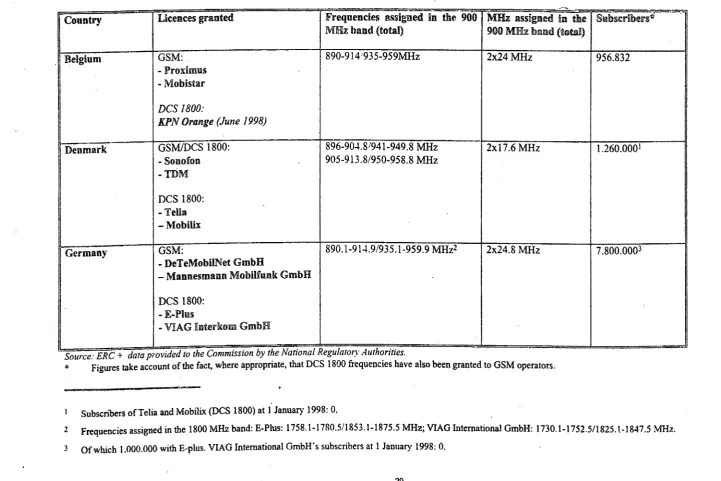
of analogue services like NMT900, TACS and E-TACS (Denmark, Spain, Ireland, Italy, Netherlands, Austria, Sweden, Finland), or of cordless systems like CTl or SLTl (Denmark, Italy, Netherlands, Austria, Portugal, Sweden, Finland), or of fixed service systems (Spain). In these countries, given the wide geographical coverage and the sizeable and still increasing number of subscribers (though at a slower pace than GSM subscriptions), national authorities seem reluctant to take short tcm1 initi<Hivcs to reduce spectrum allocated to analogue systems and phase these systcri.1s out. Plans arc said to be in place in several countries for closing existing analogues networks, and virtually all Member States have set out the date for phasing out analogue systems (ranging from 1.1.200 I, in the case of Spain, to 2007-2012 in Finland) or are preparing to take a decision on the issue (Netherlands). However, apart from these deadlines, only a few countries (Austria and Sweden) have provided the Commission with detailed information about the time-scaae for the migration of the concerned frequencies to GSM, as required by the Directive. Information on frequency assignment and licensing is provided by Tables I and 2.
3.3 Significant Issues
The phasing out of the analogue systems needs to be addressed in a specific way, in consultation with the national regulatory authorities and the relevant market players. With respect to the existing GSM service, the main concern is that, in the absence of a compulsory deadline in the Directive for' the phasing out of analogue systems, transition from the analogue use of GSM frequency bands is proceeding at uneven paces in Member States, and general1y very slowly. This issue is also linked to the setting of tariffs in the Member States. At present there are wide differences between tariffs set in all the Member States. This is a key factor in the rate of migration from amilogue to digital systems and hence the clearing of the GSM reserved bands.
One of the reasons for the slow migration from analogue to digital is that bot~ NMT and T ACS analogue services tend to be highly profitable and still represent large investments for operators. The situatioi1 which now occurs is that new entrants, who do not have access to the analogue frequency pool of incumbent operators, have to implement technical solutions to . accommodate increasing traffic densities within spectrum allocations in some instances as small as 5.4 MHz.
'The Commission will continue to support the migration to digital systems. The crucial question which needs to be addressed is how to ensure the phasing in of (additional) digital frequency bands and equipment while at the same time taking account of the state of development of, and investment in, current mobile systems, including analogue networks. In particular, the Commission will continue to monitor the situation in Member States in order to determine whether:
e incumbent operators tend to support or restrict the migration to digital systems;
o incumbent operators use their monopoly use of analogue frequencies to strengthen their already dominant position and also slow down the migration to digital technologies;
o it is realistic ami tksirahk to set deadlines by which digital s~:rvin·s should have the ~:xclusivc disposal
or
lh::quency hands which arL· currently partly used by analogul' serv1ces.The Commission will review, in co-operation with the NRAs, their plans to allocate the full range of frequencies set out in the Directive, in particular raising the issue of the phasing out of the analogue use of the GSM bands. In case Member States do not communicate their plans, the Commission will open infringement proceedings.
In phasing out analogue service, Member States should ensure that consumers are given dear anu!ltr~unspare~mt nJmformatnoJm by the operator marketing these services of any time limits attached to the continuation ofthe service.
Paging is the longest cstablishcJ form or mobile communicati6ns in Europe. ERMES was Jcvclopcd as a European digital paging system in the same way that GSM was developed for the cellular telephony market, i.e. to provide greater functionality, intelligence and pan-European roaming.
The Community launched similar initiatives as were taken for the digital mobile communications service to encourage the introduction of ERMES in the Member States. Council Recommendation 90/543 made proposals for the co-ordinated introduction of pan-European public radio paging in the Community. In addition Council Directive 90/544/FEC' reserved the frequency bands lor such a system. The standardisation process, undertaken in I•TSI, also received considerahk support from the ( 'ommunity.
4.2 4: 'au rn.·ntd Sihs:oGiun
4. 2. I Market l>cveloJIIII£'1/fl'J
Globally, paging has emerged in the 1990s as an important sector in the total market of mobile communications. The world paging market is estimated at approximately 120 million units-in-service at the end of 1 _996. About 38% of all pagers are in North America where the market has been growing at an average rate of nearly 25% per year for the past seven years. Today there are 44 million pagers, giving a penetration rate of 15% of the population. Another 56% of the total base are in the Asia-Pacific region, which is home to some of the world's highest paging networks, such as China, Korea and Japan. The total number of pagers in use in this region amount to· 67 million. Some of the penetration rates are also very high, with countries like Singapore reaching more than
J0%1 penetration.
2'1 Snurc~.:s: s~.:~.: ltHllnole 2X. l>ala provid~.:d rdkt:ls status at I January JIJ9X, unkss olhcrwisl' indicated.
On the other hand, the paging market in E~rope seems underdeveloped compared with the rest of the world. The European penetration rate is only 1.5% with a total number of 5.8 million pagers in Western Europe. In some countries the number of subscribers has incrt.:ascd significantly (Francl:, Germany, UK, Portugal, Netherlands), whereas in other countril:s llw markd would appear to he slagn:mt (Denmark, Grel:cc). The reasons why Europe lags behind vary, depending on the commentators, but most .of them agree that the main reasons arc historical in natlirc: i.e. that i1aging in the lJS was introduced much earlier than cellular telephony (as compared to Europe) and nwrkctcd hy stand-alone paging operators whose livelihood depended, on their core business, as opposed to the European telecommunications operators for whom paging was only a secondary activity. ERMES licences have been granted in nine Member States (Denmark, Germany, Greece, France, Italy, Netherlands, Finland, Sweden, United Kingdom). In addition to that, in no country have plans been drawn up to assign the complete band, largely owing to the lack of clear obligations and compulsory deadlines under the Directive. Analogue paging networks arc also in operation in all Member States, mainly based on the POCSAG technology. They operate over a different frequency band except in Austria, Finland and Sweden. The number of operators runs from one (Greece, Italy, Finland) to 440 · (Finland).
So far, the mass acceptance and implementation of ERMES services across Member States has been somewhat delayed. Among the possible reasons the following can be identified: i) some existing paging operators still have excess capacity on their analogue networks, and foresee no major costs or service benefits from introducing ERMES; ii) most of the major markets hat! not until very recently licensed ERMES operators, which has retluced the attractions of the roaming facility; iii) the success of cellular telephony, and in particular GSM,. may have absorbed some potential ERMES customers; iv) there have been technical difficulties, especially interference with adjacent channels utilised by cable TV operators; v) national frequency management bodies seem to have been rclucrant to release spectrum.
There arc now signs that ERMES is becoming more successful. Over the past year ERMES has gained strength and licences have been granted in several Member States, with a promise of more networks being opened. In spite of the fact that Europe lags behind the rest of the world in pager penetration rates, the European market has one of the highest untapped potential for paging. ll is predicted that the market could grow by 2YYt~ per annum in Europe over the next few years. The total number of users could triple by the beginning ofthc 21st century, with potential for penetration levels of 10% in later years, ifthe right market conditions are created to sustain this growth.
4.2.2 Impact of the Frequency Directive
A recent stuuy on the effectiveness of the ERMES rrequency Directive revealed mixed perceptions of its impact10 . A m~1jority of regulators uid not consider tlwt the Directive had contributed to the ,early introduction of ERMES in Europe, while a majority of paging operators. manut:u:turers and users have agreed that the Directive had been successful in ·promoting a pan-European paging service. and that there were clear incentives on using speci!ied frequency bands ami implementation dates.
4.2.3 Spectrum Availahility and Management
In all Member States national regulatory measures have been adopted giving protection and priority to four channels in the )(,9.4 to 169.8 MHz range for ERMES (see chapter 4.2.5). However, not all channels have been actually assigned, allegedly for lack of sufficient commercial demand. The major difficulty that had been encountered for ERMES spectrum allocations (see Annex 2) seems to have been the problems caused by· joint usage of the same frequencies, associated with interference between ERMES transmitters and cable TV signals, particularly in Germany and Austria.
4.2.4 Transposilion/lmplemenlalion issues
Key issues of Directive 90/544/EEC
The remarks made in section 3.2.4 apply, mutatis mutandis, to Directive 90/544/EEC. Status of transposition
The Directive has been transposed by a maJonty of Member States by adoption of specific regulations (details in Annex 2). In some other countries reservation of frequencies has been ensured either by decision of the national regulatory authorities responsible for frequency allocation (Portugal, Finland) or through the published National frequency allocation table, and subsequent licensing decisions (Sweden). In one case (United Kingdom) no legislation has been enacted to implement the Directive, since the existing legislation was considered sufficient to permit provision of ERMES.
The requirement of Article 2( 1) of the Directive, under which Member States must give protection and priority ·to four channels in the ]()9.4 to I ()9.8 MI-Iz range for the pan-European land-based radio paging service by 31 Dcce·mber 1992 at the latest (and, preferably, to the following channels: 169.6 MHz, 169.65 MHz, 169.7 MHz and 169.75 MHz) has been transposed in all Member States, with some variations. In particular, on the basis of information collected from national regulators, which in some cases is not fully complete or accurate, the following overview can be drawn:
o in seven Member States (Denmark, Greece, Ireland, Italy, Austria, the Netherlands and Portugal), the transposition measure/allocation decision has explicitly reserved four channels for ERMES systems (three in the Netherlands), which are in three cases the same as those recommended by the Directive. In some cases the whole band is also in principle reserved fully to ERMES, although it is laid down that the
30 See footnote 28. ·
n:lllaining channds of this hand will he made available when necessary, taking Into account expansion of tlw service. 0 f these countries only Denmark, Greece, Italy, and the Netherlands have subsequently assigned channels to operators.
o in five further Memhcr States (Belgium, Gem1any, Spain, France, Luxembourg) the transposition measures reserve the hand fix ERMES, but without specific reference to any channels. Channels have been . subsequently assigned in Belgium, Germany. France.
o in Finland, Sweden and United Kingdom, channels have been reserved (three channels in Finland) and then assigned to ERM ES systems in various ways.
The description above is .. to he read in conjunction with information concerning the c!Tectivc implementation of the Directive. Despite adoption of legal acts, implementation of the directive, including frequency assjgnment, has proved difficult in several countries, owing apparently to the lack of sufficient demand for ERMES services. This alleged lack of commercial demand can be explained, in some cases, by the existence of analogue paging systems in the national markets, often licensed at a time when the Directive had already entered into force. " ,
ERMES licences have been granted in Denmark (two), Germany (three), Greece (one), France (three), Germany (three), Italy (?ne), Netherlands (two), Finland (one), Sweden (two), United Kingdom (four). In Belgium, Spain, Ireland, Austria and Portugal there are still no ERM ES operators, but the grant of some licences is envisaged. In the United Kingdom licences have also been granted recently allowing to usc the FLEX standard.
In none of the Member States have plans been drawn up to make the whol~ band ~tvailable; the decision is lert for future assessment. Inforn~ation on frequency assignment and licensing is provided by Table 3.
4.3 Significant Issues
Other technical solutions are currently available for paging, in some cases with comparable features. For example, some Member States are: licensing the Motorola based FLEXTM technology which is now coming into direct competition with ERMES. There is no evidence to substantiate the view that ERMES is more expensive than FLEX or POCSAG. On the contrary, estimates show that the ERMES pagers themselves are comparable in price to FLEX or POCSAG quality pagers and the i1ctwork components (base stations and switches) arc also similar in cost.
The frequency band is a critical factor. At equal power levels, a hjgh speed network operating at 169 MHz (e.g. ERMES at 6400 bps or FLEX at 6250 bps) requires as many base stations as a low rate 300 bps· FLEX or POCSAG network operating at 900 MHz. In other words, the investJllCnt in an ER.MES_ high speed network operating at 169 MHz woulu require the same investment as a low speed FLEX network at 450-900 MHz. Hence the interest in the 169 MHz band.
The Commission will continue to encourage the lfWillU nmpRemerrn~attfimll of ~!hJ.e IEJRMlE§ 1
ID>fi[l"ectfive, in particular by monitoring the channel utilisation plans of the Member
I
States.
The Commission has initiated a study on the future of the paging market, investigating in particular growth prospects and likely scenarios lor evolution of the paging market in Europe.
5. Jl)J!RJECTRVE 91/287/!EIEC
5.1 JBaclkgrmnl!lldl
The Digital Enhanced Cordless Telephone (DECT) system has been developed and is now commercially available. Thanks to the extreme nexibility of the technical standards, lht: DECT technology can he used to provide cordless access to a range of networks, hoth mobile and fixed. In this context, DECT can he used either for ortcring "limited" mobility in urban areas (Cordless Telephone Mobility. CTM) as a low cost alternative to full~lledgeo cellular mobile systems which is particularly attractive in densely populated areas, or as access technology in wireless local loop configurations (WLL), where it can provide high capacity transmission links. DECT products have been on the market only since 1994, but have achieved success particularly in the residential cordless telephone and cordless PBX domains. Its development has heen further enhanced by adoption of Common Technical Regulations under Directive 91 /263/EEC.
As for GSM and ERMES the development of DECT has been assisted by policy measures taken by the community in 1991 to encourage the introduction of DECT in the Member States. Council Recommendation 91/288 made proposals on the co-ordinated introduction of DECT into the Community. Council Directive 91/287 reserved the frequency bands for such a system. In addition, standardisation activities have been supported by the Commission by means of standardisation mandates to ETSI.
5.2 Current §ituatiorn
5.2.1 Market DevelopmentJI
DECT was engineered as a successful product of European co-operation and is developing well. Between 1994 and mid. 1997, more than 50 suppliers shipped more than 8 million units. The most successful application of the DECT technology has been for residential cordless telephones which accounts for 7 million units out of the total shipments. DECT based wireless PBXs are also available in the majority of Member
States. '
Since DECT was conceived to be a flexible radio access technology, one of its target applications was to provide the public with limited mobility -access capability to fixed networks: This was seen to be particularly attractive iJ1. densely populated areas, for, instance in shopping centres, petrol stations etc. This application of DECT remains underdeveloped with one operational DECT network in Finland, two licenses granted in France and one in l!aly.
The potential for introducing the l>E( T technology at commercial level remains largely under-exploited. It is expected that the cordless telephone applications lor the residential and cordles~ PBX markets will continue to be successful. The DECT Forum predict that
7
mi Ilion units will be sold in 1997 and that by the tum of the century, annual shipments will reach more than 30 million units.DECT's future as a public networking technology is unclear. It does not have the intelligent networking abilities of GSM or DCS 1800. A number of operators are currently carrying out trials which combine DECT with other technologies (most commonly with GSM or DCS 1-800). DECT would then complement GSM in high traffic density zones and pico-cellular indoor environments. In this respect, it would appear that some operators arc preparing to launch commercially DECT in dual mode during I 998.
The future for DECT as a WLL technology is also not fully clear. The potential is certainly there. Wireless local loops arc seen as a cost effective way of extending the lixed network, particularly ii1 urban areas, and can shorten waiting lists dramatically. DECr could have competition in this licld from such technologies as CTM and CT2. Outside Europe, systems such as the Public, Access Cordless Systems (PACs) and the
Personal Handyphone System (PHS) seems to provide serious competition to DECT.
5.2.2 linpacl (~lthe Frequemy Directive
The views of NRAs and manufacturers support the notion that the DECT Frequency Directive has contributed to the extensive introduction of DECT and had improved the European market opportunities. Market opportunjties ought to be realised more quickly. Also, the Directive had encouraged less expensive equipment as a result of the larger market for a single standard, and by providing a clear incentive to use a specified frequency band with implementation dates.
Some manufacturers suggest that there had been only limited success in achieving the aim of promoting· Pan-European DECT services for customers, owing to two main reasons. Firstly, lack of clarity over the regulatory status ofDECT-based wireless in the local loop services is limiting market development, particularly in relation to the development ol public services DECT networks. A second reason would appear to be the delay by some national regulatory authorities lo develop DECT regulations; again particularly in respect to public services.
5.2.3 Spectrum Management and Availability
"minor deterrents" and that spectrum availability for public service users IS being generally delayed.
There is a general concern in CEPT on the spectrum available for DECT studies arc being undertaken in conjunction with the planning for FLMTS/UMTS. There is also pressure to extend the currently allocated band 1800-\')00 MHz to 1920 Mllz.
5.2.4 Transposition/Implementation issues
The Directive has been transposed by a majority of Member States by adoption of speci fie regulations (details in Annex 3). In some other countries reservation of frequencies has been ensured either by decision of the national regulatory authorities responsible for frequency allocation (Portugal, Finland) or through the published National frequency allocation table, and subsequent licensing decisions (Sweden). In one case (United Kingdom) no legislation has been enacted to implement the Directive, since the existing legislation was considered sufficient to permit provision of DECT.
II seems that the requirement of Article 2( I) of the Directive, under which Member States must designate the li·equency band 1880-1900 M Hz lor digital European cordless telecommunications by 1 January 1992, has been implemented by all Member States. In some countries, however, the band reserved for DECT is partly occupied by other systems (mainly military telecommunications networks, or digital fixed links).
§.3 Sngnifoca~~n~ llssues
o Whilst interest in the licensing of DECT operators is increasing, so far only a few operators have been licensed to provide DECT services, in some cases already enjoying a dominant pbsition in the public switched telephone network market. The Commission is concerned that competition is ensured for DECT services and has already taken action against certain member States.
o In most countries DECT is used as a terminal technology rather than as a service provided to third parties.
6. CONCLUSIONS
6.1 ( ;l'ncnol
Thert.: is cons~:nsus that n.'Sl'rvalion of frl'(JUl'IH.'Y h:md, hannonis~:d at l•:uropcan level.
through a binding instrument such as a Directive, hus contributed to the introduction of GSM, ERMES and DECT in Europe. Success of the three services has been uneven, with considerable variations also between Member States, owing not only to regulatory aspects but also to market conditions and commercial demand.
In general, the Directives have proved particularly effective when clear implementation deadlines have been fixed: this is the case for the designation of the "core band" for GSM, of the four channels in the 169.4 to 169.8 MHz range for ERMES and of the fi·equency hand for DECT, which have been fully transposed and implemented in all Member States. On the other hand, the absence or binding provisions concerning full occupation of whole range or rrequencies reserved (Cor GSM and ERMES) is to be seen as a major reason Cor uneven implementation by Member States: different deadlines, or no deadline at all in some cases, have been set out by Member States, orten giving rise to slowness and d?lays in making available the necessary frequency, with special reference to GSM.
The Commission will take account of these elements when reviewing its current spectrum policy with a view to identify the- best solutions for harmonised allocation of frequencies.
6.2 Implementation
The three Directives have been transposed by all Member States either by means of regulatory measures, or through decisions ·of the national regulatory authorities
responsible for frequency allocation. As regards practical implementation, however, problems have emerged in some countries concerning full occupation of the reserved bands.
In particular,.as l~1r as the GSM and the ERMES Directives are concerned, where the obligation is imposed on Member States to drawn up plans to aiDow expansion of GSM and ~=R.M-ES into ~he complete band as quickly as possible, according to commercial demand and to communicate them to the Commission, these plans .have been notified only by a limited number of Member States so far (see Annexes 1 and 2).
The Commission will continue to monni~mr nmpDemenntt21tionn of the Frequency Directives, putting a particular emphasis on the nneeldl tto ennsOJire ttfuun~ 21Dll olbllogatno!lllill are sati§fneldl.
Ill onk;r lo t:llSIIn.: Iiiii illlpk:llll"lltalion or thl· l>irerlivcs, the ( 'ollllllission will liSt: all its powers, induding rceoursc to its li11mal powers under the Trcaty to launch f«Drmanl 8nnU'rinngcmcnntt iP'WCc~hnrcs anganinnstt Ml·nnnbu Sdattcs.
As far as spectrum management is concerned, the Commission notes that in general
there are large differences in the amount of spectrum assigned to operators in different countries and even to operators within the same country for the three systems, for reasons which are not always clear.
The Commission, while reaffirming that lfreqMency assng!lllmennt is a~ matter for ttlhe
mnttnmn~O mntllnornttncs to dcdde, ann connformoty wntlln IF:C Ba~w (often dealt with in the framcwork of licensing procedures), recalls the main principles applicable under the Communfty legal framework
o Under Article 3a of Directive 90/388/EEC as amended by the Mobile Directive (96/2/EC) "as .flu· as frequencies arc availahlc, member States shall award licenses according to open, non-discriminatory and transparent conditions. Member States may limit the number of licenses for mobile and personal communications systems to be issued only on the basis of essential requirements and only where related to the lack of availability of frequency spectrum and justified under the principle of proportionality." In addition to that, Article 10(1) of Directive 97/13/EC lays down that Member States "may limit the number of individual licences for any category of telecommunications services and for the establishment and/or operation of telecommunications infrastructure, only to the extent required to ensure the efficient usc of radio frequencies ( ... )". It follows that only the lack of sufficient spectrum, when justified under the principle of proportionality, can be invoked to limit the number of licences granted. Therefore, w0neli11 lfrcqlllleli1ldes are avan[ab~e, tOney In an tto be assognnedl.
o These principles shoLdd be read in conjunction with other essential principles under EC law. In particular, when granting licenses Member States should also take into account, under Article 2(4) of Directive 90/388/EEC as amended by the Mobile Directive, "the requirement to ·ensure effective competition between operators
competing in the relevant markets" and should give, under Art. 10(3) of Directive 97/13/EC, "due weight to the need to facilitate the development of competition and to maximise benefits for users". Frequencies should be ~anted in an adequate way so as
tto aHHow reaR com.petottoonn lbdweenn operator§, bearing in mim~ that there is no unique
solution: Member States have to identify the most appropriate assignment in the specific national context on the basis of a thorough evaluation of market needs. An inadequate frequency assignment could in fact result into increasing the operators' roll out costs of the networks (especially in urban areas ·where the effort to acquire sites might be substantial, given planning rules and the cost of negotiating agreements with a great number of individual owners and landlords) thus affecting, especially in the case of new entrants, its ability to compete in the market.
The Commission takes the view that,· when granting frequencies through licensing procedures, Member States should make sure that a~l availab~e frequencies are ~assigned, in so far as appropriate allocation decisions have l?een made. In doing so they should ensure effBcnent IUISC of th~ spectrllllm and should allow operators to compete in an
effective wayin the relevant market.
Member States should review the extent to which claims of shortage of frequency are justified as against inefficient use of frequency by operators. Member States should also verify that frequencies granted are actually used for the intended ·purposes. They should report to the Commission on these matters.
The Commission will prepare a report on the implementation of the Mobile Directive. In this context, the measures adopted by Member States on frequency planning and management wi11 be further reviewed.
As ·l~1r as licensing· is concerned the Licensing Directive, although it does not aim at full
harmonisation of national licensing procedures, is expected to introduce more homogeneity between 'the latter. If, in accordance with the principle of subsidiarity, Member States arc free as regards, for instance, choice of procedures and level of licensing charges, they have nevertheless to comply with the relevant principles laid down by the Directive (such as: priority to be given to "lighter" authorisation regimes; granting of individual licences only in speci lie circumstances; maximum duration of the licensing procedures; licence fees to reflect the administrative c9sts incurred in the issuing ofthe licence, etc.).
The Commission notes that, in practice, divergent authorisation procedures for voice te'lephony and public telecommunications networks have been implemented by Member States, although virtually in all cases individual licences are required to apply for scarce resources, i.e. numbers and/or frequencies. In some Member States auctioning systems arc under consideration or already being put in practice for attributing- certain frequencies;
The number
or
authorisations granted also varies between Member Stales, which is partly to he explained by the different liberalisation dates and the size and opportunities of each national tclecommunicat ions markcL 1 n the same way, fees vary widely from country to country.The Commission will review by 2000, on the basis of the results of the application of the Licensing Directive, the extent to which licensing procedures can be improyed and harmonised within the Community.
Finally, as regards safety of frequency usage, even though this issue is not covered by