This is a repository copy of Consolidating and advancing knowledge on the post-entry performance of international new ventures.
White Rose Research Online URL for this paper: http://eprints.whiterose.ac.uk/140815/
Version: Accepted Version
Article:
Ibeh, K., Jones, M.V. and Kuivalainen, O. (2018) Consolidating and advancing knowledge on the post-entry performance of international new ventures. International Small Business Journal, 36 (7). pp. 741-757. ISSN 0266-2426
https://doi.org/10.1177/0266242618793926
Ibeh, K., Jones, M.V. and Kuivalainen, O., Consolidating and advancing knowledge on the post-entry performance of international new ventures, International Small Business
Journal, 36 (7) pp. 741-757. Copyright © 2018 The Authors. DOI: https://doi.org/10.1177/0266242618793926
[email protected] https://eprints.whiterose.ac.uk/
Reuse
Items deposited in White Rose Research Online are protected by copyright, with all rights reserved unless indicated otherwise. They may be downloaded and/or printed for private study, or other acts as permitted by national copyright laws. The publisher or other rights holders may allow further reproduction and re-use of the full text version. This is indicated by the licence information on the White Rose Research Online record for the item.
Takedown
If you consider content in White Rose Research Online to be in breach of UK law, please notify us by
CONSOLIDATING AND ADVANCING KNOWLEDGE ON THE POST-ENTRY PERFORMANCE OF INTERNATIONAL NEW VENTURES
Kevin Ibeh, Birkbeck, University of London, UK Marian V Jones, University of Sheffield, UK
Olli Kuivalainen, Lappeenranta University of Technology, Finland & the University of Manchester, UK
ABSTRACT
This paper consolidates emerging evidence on factors influencing the post-entry performance of INVs. It also addresses the challenging question of how to effectively measure performance in the entrepreneurial internationalisation context. The discussion presents and reflects on empirical findings from the studies included in the current Special Issue on INVs’ post-entry performance, extends debates on the themes examined and performance measures employed, whilst also acknowledging issues requiring future investigation. Notably, the studies’ findings reinforce previous evidence on the performance -enhancing effects of exposure to diverse, extra-regional market. Support is also reported for the importance of learning capabilities, but the relevant study goes even further to show how these capabilities interact with INVs’ strategies and resources to enhance post-entry performance. INV setting is especially difficult for the performance measurement as internationalization requires resources and young age means that firms are early in their life-cycle and financial performance, for example, may not be relevant. The paper also addresses the issues associated with measuring post-entry performance among INVs and discusses next steps and future research implications.
INTRODUCTION
International new ventures (INVs), born global (BGs) and other small and medium sized firms persist as the central focus of International Entrepreneurship research (IE) at scholarly and policy levels. Yet the field abounds with calls for further research on the performance of those venture types, or the effect of the internationalization process on those organisations.
Calls for more research include a focus on: the relationship between rapid internationalization and international performance (Aspelund et al., 2007; Trudgen & Freeman, 2014; Zhou & Wu, 2014); performance during INVs’ post-entry phases (Autio et al., 2000; Morgan-Thomas & Jones, 2009; Sleuwagen and Onkelinx, 2014; Khan and Lew, 2018); and strategies for their sustained growth or success (Kuivalainen, Sundqvist, & Servais, 2007; Wright et al., 2007; Coviello, 2015).
Khavul, Perez-Nordtvedt, & Wood, 2010; Gerschewski et al., 2015; Khan and Lew, 2018). This lack of clarity is exacerbated by the heterogeneous manner in which international performance is measured (Crick, 2009; Jones et al. 2011; Gerschewski et al. 2015), and little explicit focus on the relative importance of different performance measures to INVs (Gerschewski & Xiao, 2015).
Also, although previous research has widely recognised the critical role of network relationships in rapid internationalization, much less is known about their effect on post-entry performance (Knight & Liesch, 2015) or, more importantly, how INVs utilise resources through network relationships to develop influential capabilities for enhanced post-entry performance. Furthermore, as several scholars have noted (e.g., Kuivalainen et al., 2007; Jones et al., 2011; Fernhaber & Li, 2013; Gerschewski et al., 2015; Autio, 2017), the effect of key resources, strategies and capabilities, including learning and knowledge, at the post-entry INV stages is still insufficiently understood, as is the status of learning and knowledge creation as important INV outcomes (Coviello 2015).
Coviello (2015) highlights the need to address questions, including how, when and why the capabilities and strategies of early international firms shift in nature and configuration as they develop through their life cycles. Observed patterns might differ where INVs internationalize rapidly, then slow down, or maintain a rapid pace of internationalization thereafter. Additionally, against the backdrop of the IE field’s preoccupation with time to initial international market entry, scholars have called for a broader range of timing-speed related performance outcomes, including speed or rate of change in international intensity over time, speed of international learning, speed or rate of change in ongoing commitment abroad and speed or rate of change in the scope/dispersion of international markets over time (Jones and Coviello, 2005; Oviatt and McDougall, 2005; Casillas and Acedo, 2013; Chetty, Johanson, and Martín Martín, 2014).
This Special Issue was impelled by the aforementioned weaknesses in IE research. Shoring up vulnerabilities on post-entry performance measurement could enhance the predictability of entrepreneurial internationalization outcomes, improve survival rates among INVs (e.g., Kuivalainen et al., 2012; Mudambi and Zahra, 2007; Sui and Baum, 2014), and foster more sustainable growth benefits for firms and national economies. The ultimate goal, to be sure, is the continuing development of this exciting organisational form whose characteristic innovativeness and disruptiveness, boundary less market focus, and relentless opportunity exploration and effectuation (Sundqvist, Kyläheiko, Kuivalainen & Cadogan, 2012; Kalinic, Sarasvathy & Forza, 2014) offer credible pathways for the transformation of national, regional and global economies.
and networks, and marketing intensity on the post-entry growth and performance of INVs? We also asked how might the international performance of INVs be more effectively conceptualised and measured, including for studies concerned with “process”? Crucially, we sought to capture important new insights with a view to advancing the field as well as providing clearer guidance to managers and policy makers on how this increasingly prevalent venture type might be assisted to achieve consistently favourable performance outcomes.
As guest editors, we were delighted to have received a large number of insightful and rigorously executed papers, which made the task of whittling down to the handful allowed for the SI very challenging. Our final list of papers include Cerrato and Fernhaber’s “Depth Versus Breadth: Exploring Variation and Performance Differences Among Internationalizing New Ventures”; Sadeghi, Rose and Chetty’s contribution on “Disentangling the effects of post -entry speed of internationalization (PSI) on INVs’ export performance”; Gerschewski, Lew, Khan and Park’s paper “Post-Entry Performance of International New Ventures: The Mediating Role of Learning Orientation”; and Puig, González-Loureiro and Ghauri’s research entitled “Running Faster and Jumping Higher? Survival and Growth in International Manufacturing New Ventures (MNVs)”.
In the spirit of fostering the IE field’s identity development (Fiol and Romanelli, 2012; Coviello, 2015), this SI has avoided using the terms INV and BG interchangeably. That said, the studies included have not all defined INVs in the strict Oviatt and McDougall’s (1994) sense of new ventures coordinating multiple value chain activities across borders, or Jones’ (1999) ‘standard’ of enterprises undertaking multiple outward and inward value chain activities, within very few years of founding. A slightly more accommodating approach has been taken in recognition of the continuing and yet unresolved debate on these definitional matters (Cesinger et al., 2012; Madsen, 2013; Zander, McDougall-Covin, and Rose, 2015; Reuber, Dimitratos, and Kuivalainen, 2017).
The remainder of the SI introduction is organised as follows. The next section presents brief synopses of the its four papers. The substantive insights and performance measurement issues emerging from the studies are subsequently discussed, replete with appropriate linkages to the extant IE and proximate research literature. The final section reflects on observed gaps and implications for future research.
THE SPECIAL ISSUE PAPERS
previous INV research has typically examined separately despite firms’ tendency to trade-off the risks of one of against the other (Shrader et al., 2000). The study, thus, adds to the scant body of research on how INVs’ international intensity and geographic scope co-vary, and addresses the neglected question of whether new ventures are willing to trade off higher international intensity for broader geographic scope (or vice versa), or view the two dimensions as complementary in the pursuit of their international strategies.
Taking a risk-taking perspective, they advance that an INV’s international intensity and geographic scope can be traded off in multiple ways to minimize risk. Return on assets (ROA) was also used to measure the focal INVs’ performance. Cluster analysis resulted in a taxonomy, which identifies four configurations or variations among the study INVs, specifically: (a) home regional dabblers; (b) home regional committed; (c) host regional; and (d) global balanced INVs. Their findings support the existence of different patterns of INV internationalization, driven by a trade-off of risks associated with international intensity, and with geographic scope.
Performance differences between the clusters point to links between higher risk configurations and higher return/performance outcomes. The global balanced and host regional focused INVs are associated with the highest risk and high performance, while no significant performance difference was observed between the global balanced and host regional focused clusters. These findings suggest that geographic scope, rather than international intensity, matters more for INV performance.
Sadeghi, Rose and Chetty’s paper examines the effects of post-entry speed of internationalization (PSI) on the export performance of INVs on financial and non-financial export performance. They argued that although PSI is typically associated with favourable performance consequences, it can also be a double-edged sword, especially for resource-constrained INVs. Their theoretical lens, organizational learning theory (March, 1991) and time compression diseconomies (TCD) (Dierickx and Cool, 1989), together help explain performance consequences and inefficiencies, including negative organizational learning and performance effects, of accelerating organizational processes.
different, potentially conflicting, performance dimensions into one composite measure, and instead recognises the distinctive effect of each dimension.
This finding that different aspects of PSI are not equally beneficial for performance offers new theoretical insights into how PSI contribute to stronger export performance, and suggests that rapid internationalization may appear problematic if gauged only against financial measures. The uneven effects of PSI on export performance, the authors concluded, is contingent on the path-dependent development processes of INVs, including their capacities for international learning, cultivating new capabilities and adapting to new markets. They further noted that faster may not always be better, as overstretching may expose INVs to challenges that can hamper learning and capability development. They conclude by prompting INV managers to be aware of the complexities and potentially detrimental effects of rapid international growth, and, when limited in experience and resources, to be cautious and selective on how and when to speed up their internationalization process.
Gerschewski, Lew, Khan and Park address a gap in the understanding of key capabilities through which network relationships enhance INVs’ post-entry performance (Fernhaber and Li, 2013; Coviello, 2015), by examining the performance effects of learning orientation, network and niche orientation. Their conceptual model hypothesizes relationships among the aforementioned concepts and measures performance along three dimensions - operational, financial and overall effectiveness.
Their analysis suggests that learning orientation mediates the relationship between niche orientation and post-entry performance, and between network resources and post-entry performance of INVs. This mediating effect, the authors argue, offers a more granular view of the post-entry performance of INVs, by showing that learning orientation may be a capability through which INVs deploy their strategies and resources to influence post-entry performance. The paper extends the literature on learning capabilities by showing how these capabilities interact with INVs’ strategies and resources to enhance post-entry performance.
(Johanson and Vahlne, 1977, 2009) versus, the instant, or rapid internationalization patterns of the INV School (Oviatt and McDougall, 1994, 2005). The empirical context of traditional manufacturing rather than high technology firms potentially opens both theories to fresh examination.
The longitudinal analysis of 3,181 Spanish MNVs, categorised as non-international, importers only and exporters, examined dependant variables, specifically survival and growth of the firm; these respectively reflect overall effectiveness and financial performance, as conceptualised in the wider management literature (Venkatraman and Ramanujam, 1986; Hult et al., 2008; Gerschewski and Xiao, 2015).
Findings show ‘late internationals’ and early internationals’ as having the lowest failure risk and lowest cumulative survival rate respectively, regardless of commitment mode. ‘Early internationals’ also exhibited as much failure risk as domestic ventures, while ‘late internationals’ revealed lower risk statistic than both categories irrespective of commitment mode.
Regarding post-entry growth, results indicate that the timing of first entry had no impact on the likelihood of high growth within the analysis timeframe of 10 years; and all three venture types exhibited a similar risk of low growth. Results prompt the authors to conclude that while internationalization is less risky than focusing entirely on saturated domestic markets in traditional industries, the timing of international entry should be carefully considered in view of evidence that early internationalization can be more perilous than beneficial, and that late internationals survive longer than early ones. They counselled that if MNVs wish to go international early, they should be ready to run faster and jump higher than late internationals and purely domestic ventures, by fortifying themselves with requisite performance-enhancing resources and capabilities.
WHAT DO WE NOW KNOW ABOUT INVS’ POST-ENTRY PERFORMANCE
AND PERFORMANCE MEASUREMENT?
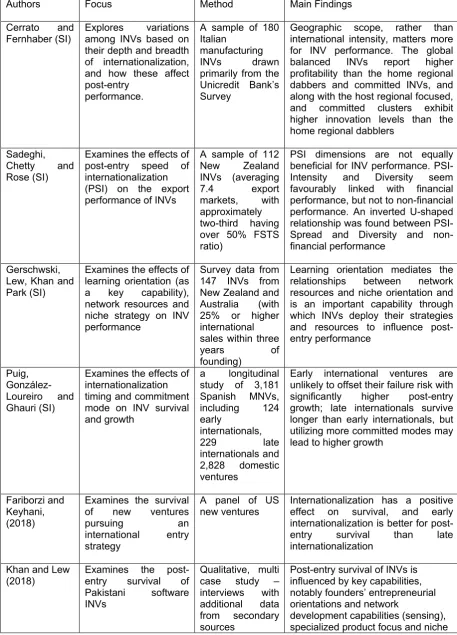
The SI papers point to an appreciable addition to the empirical research base on the post-entry performance of INVs. Themes addressed include the relative importance of spatial and temporal influences on post-entry performance, and the applicable risk-return trade-offs. Also examined are the effects and inter-relationships among key capabilities, specifically learning orientation, resources, specifically networks, and niche focused strategies. The studies further add to our understanding of how internationalization timing and commitment mode affect post-entry survival and growth of INVs – see Table 1.
*Table 1 about here*
regional focused types, are more likely to achieve better financial and operational performance than their intra-regionally focused counterparts. The latter study finds a positive link between international performance, specifically financial performance, and the speed of post-entry expansion to diverse foreign markets (PSI-Diversity).
This is explained by the learning and capability development gains of extending sales to diverse markets, and occurs as “an iterative process of organizational learning” (Jones and Coviello, 2005) that offers a temporal conduit through which internationalization impacts INV performance (Autio, 2017). Results in these papers tend to support the idea that if the early internationalizing firm can develop its market scope, it may, as previous research suggests (Kuivalainen et al. 2007; Kuivalainen et al., 2012), perform better in the post-entry phase.
The effects of organizational learning call to mind another contribution from the SI papers. That is the relevance of learning orientation as a key capability through which INVs deploy their strategies and resources to influence post-entry performance. This resonates with extant literature on the role of capabilities in entrepreneurial internationalization (Knight and Cavusgil, 2004), as more strongly established by contributions on the ‘learning advantages of newness’ (e.g. Autio, Sapienza, and Almeida, 2000), learning orientation (Jantunen, Nummela, Puumalainen, and Saarenketo, 2008), imprinting (e.g., Bruneel, Yli-Renko, & Clarysse, 2010; Sapienza, Autio, George, & Zahra, 2006; Schwens & Kabst, 2009), cognition theory and INV capability development (Autio, George, & Alexy, 2011), new and revamped capabilities (Hashai, 2011; Knight & Cavusgil, 2004), routines, experience, learning and capability development (Prashantham and Floyd, 2012), and ‘higher order capabilities’ (Khan and Lew, 2018).
Empirical evidence from the SI studies also adds to our knowledge of the performance consequences of two classic IE themes, namely internationalization timing and commitment mode. As Puig and colleagues report, early internationalization entails higher failure risk and no significant growth and sales benefit, while more committed internationalization modes may lead to better growth levels. The former agrees with much of the extant literature that early entry into international markets increases INVs’ risk of failure (Khan and Lew, 2018).
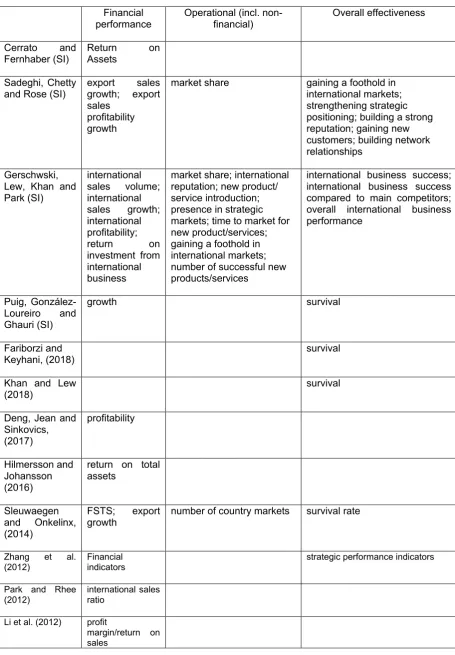
Regarding the measurement of post-entry performance of INVs, the following reflections are worth considering
employed only a single type of performance measure (see Gerschewski and Xiao, 2015).
*Table 2 about here*
Recourse to separate categories of performance measures, originally conceptualised by Venkatraman and Ramanujam (1986) in the wider management field, appropriately acknowledges the multi-faceted nature of organisational performance (Snow & Hrebiniak, 1980) - a perspective reflected in some export and entrepreneurship performance measurement research. Examples of the former include Zou, Taylor, and Osland’s (1998) financial, strategic, and satisfaction measures or Styles’ (1998) sales growth, profitability, and perceived success/achievement indicators, while Rauch et al. (2009) financial and non-financial indicators or Rosenbusch et al. (2013) subjective and objective measures exemplify entrepreneurship performance measures.
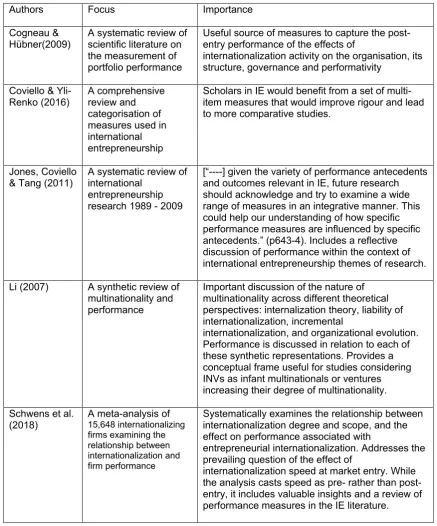
International Entrepreneurship researchers, thus, appear to be heeding calls to use a wider canvas of performance measures. The longer established general management literature, specifically on organisational performance, arguably contributes to a more holistic perspective and deeper understanding of performance measurement in the INV context. It also responds to Coviello’s (2015) call for the ‘continued use of traditional performance measures in order to remain consistent with the practices of complementary disciplines’. Additional inspiration in this regard could be sourced, for example, by looking at the field of Finance, specifically portfolio performance, which boasts 101 ways of measuring performance (Cogneau, P. & Hübner, 2009) – see Table 3 for this and other performance review papers, including Coviello and Yli-Renko (2016).
*Table 3 about here*
Second, financial measures emerged in this SI as the most commonly adopted and include profitability, sales/international sales, growth/sales growth and return on investment. These are analogous with the financial performance measures reported in Gerschwski and Xiao’s (2015) review of the extant literature, including the research stream on export performance (e.g. sales, profitability, and change in sales and profitability - Shoham, 1998) and entrepreneurship (e.g. profitability, growth, and capital market dimensions - Combs, Crook, & Shook, 2005).
and number of successful new products/services, as well as two overall effectiveness indicators i.e. perceptions of IB success and overall IB performance, in assessing operational performance and overall effectiveness respectively.
Third, respondents’ subjective perceptions rather than objective data were utilized in two of the SI studies in operationalising performance indicators. This reflects widespread findings on the use of managers’ subjective perceptions or assessments in measuring performance (Azar & Ciabuschi, 2017; Oura, Zilber, & Lopes, 2015; Julian, Mohamad, Ahmed, & Sefnedi, 2014; Filatotchev, Liu, Buck, & Wright, 2009). For example, Chen, Sousa, & He’s (2016) review empirical export performance studies, identified 53 different measures, including a preponderance of financial/objective measures such as, profitability, export sales/growth, export intensity, but also subjective measures, including satisfaction and goal achievement. Another review by Sousa (2004) put subjective measures at 80% of all performance indicators. Diamantopoulos (1998) attributed this use of objective and subjective indicators to the multifaceted nature of export performance. The entrepreneurship field also reflects a similar pattern, with Rauch et al’s. (2009) meta-analysis of entrepreneurship studies reporting a tendency to focus on perceived financial performance, followed by combinations of perceived financial and non-financial performance, and archival financial performance. Fourth, we next reflect on a number of research design issues, specifically the extent of adoption of qualitative or mixed methods, longitudinal dataset and appropriate unit of analysis. Rather surprisingly, none of the SI studies employed qualitative or mixed data collection methods, which goes against calls in IE and IB research for qualitative approaches (Birkinshaw, Brannen, & Tung, 2011; Piekkari & Welch, 2011; Lamb, Sandberg, and Liesch, 2011), or mixed methods (Coviello & Jones, 2004; Hurmerinta-Peltomäki & Nummela, 2006; Mort & Weerawardena, 2006; Johnson, Onwuegbuzie, & Turner, 2007; Creswell, 2013; Gerschewski and Xiao, 2015). Neither did any of the papers utilise event or sojourn level investigation, which reflects the dominant use of firm level analysis and performance measurement in INV research (e.g. Kuivalainen, Sundqvist, and Servais, 2007; Efrat and Shoham, 2012). Notable exceptions include Knight and Cavusgil (2004), and Knight, Madsen, and Servais (2004). On a more positive note, secondary data sources and a longitudinal approach, perennially advocated across the IB, IE and wider management fields, are used in some of the SI studies.
IMPLICATIONS AND FUTURE DIRECTIONS
The first relates to other likely influences on post-entry INV performance. Although early research on entrepreneurial internationalization highlighted the performance-enhancing effects of capabilities such as global technological competence, unique products, quality focus and leveraging of foreign distributor competences (Oviatt and McDougall, 1994; McDougall, Shane & Oviatt, 1994; Knight and Cavusgil, 2004), these factors have arguably not received sufficient attention from INV researchers. This is surprising given the view that network, innovation and capabilities may be the key underlying for factors explaining the post-entry performance of INVs (e.g., Mudambi and Zahra, 2007; Coviello, 2015; Knight and Cavusgil, 2015; Romanello, Masoud, Gerschewski, & He, 2018). These particular capabilities are only marginally examined in the present collection of papers, so future researchers are urged to pay greater attention to these, including exploratory and exploitative innovation capabilities and potential capability-related mediators such as organisational structure and leadership (Zhao et al., 2010; Gerschewski and Xiao, 2015). Further, D’Angelo et al. (2013) finding that determinants of (export) performance might differ depending on whether a firm follows regional or global internationalization strategy merits additional research attention. For example, the observed use of external managers as part of the latter strategy points to a different learning and capability development approach which needs to be better understood.
Measuring performance is widely recognised as one the most difficult tasks in management research and doing so in the INV context is no different, as it also throws up myriads of issues. One such aspect is the need for researchers to pay attention to the suitability of particular performance measures relevant to different INV lifecycle stages (e.g. new versus adolescent versus established - Coviello, 2015), that is their relevance in part, to the enterprise’s phase of development (Trudgen and Freeman, 2014; Hilmersson and Johanson, 2016; Garcia-Garcia et al., 2017). Gerschewski and Xiao (2015), for example, suggest that typically small and young INVs, particularly manufacturing ones, should prioritise financial performance over operational performance when they internationalize early, since the former directly influences their survival and success (Autio et al., 2000), and then pay more regard to operational indicators at a later stage in their life cycle. Another appealing direction would be to make a distinction between firm’s general performance, international performance and performance at the event or sojourn level. This might entail multi-level performance analysis over the firms’ international trajectory.
indicators such as the foreign sales: total sales ratio since performance is also influenced by investments shared between domestic and international markets (Debaere et al., 2010). We thus call on researchers to constructively consider broadening the performance measurement landscape.
References
Aspelund, A., Madsen, T.K. & Moen, Ø. (2007), A review of the foundation, international marketing strategies and performance of international new ventures, European Journal of Marketing, 41: 1423–1448.
Autio E (2017). Strategic entrepreneurial internationalization: A normative framework. Strategic Entrepreneurship Journal 11(3): 211-227.
Autio E, George G and Alexy O (2011). International entrepreneurship and capability development: Qualitative evidence and future research
directions. Entrepreneurship Theory and Practice 35(1): 11-37 Autio E, Sapienza HJ & Almeida JG. (2000), Effects of age at entry,
knowledge intensity, and imitability on international growth, Academy of
Management Journal, 43: 909-924
Azar, G., & Ciabuschi, F. (2017). Organizational innovation, technological innovation, and export performance: The effects of innovation radicalness and extensiveness. International Business Review, 26, 324–336.
http://dx.doi.org/10.1016/j.ibusrev. 2016.09.002.
Birkinshaw, J., Brannen, M. Y., & Tung, R. L. (2011). From a distance and generalizable to up close and grounded: Reclaiming a place for qualitative methods in international business research. Journal of International
Business Studies, 42(5), 573–581.
Bloodgood, J. M., Sapienza, H. J., & Almeida, J. G. (1996), The
internationalization of new high-potential U.S. ventures: antecedents and outcomes, Entrepreneurship Theory and Practice, 20(4): 61-76.
Bruneel J, Yli Renko H and Clarysse B (2010). Learning from experience and learning from others: how congenital and inter-organizational learning substitute for experiential learning in young firm internationalization.
Strategic Entrepreneurship Journal 4(2): 164-182
Casillas JC and Acedo FJ. (2013) Speed in the internationalization process of the firm. International Journal of Management Reviews 15(1): 15-29.
Cesinger B, Fink M, Koed Madsen T and Kraus S. (2012) Rapidly internationalizing ventures: how definitions can bridge the gap across contexts. Management Decision, 50(10): 1816-1842.
Chen J, Sousa CM and He X. (2016) The determinants of export
performance: a review of the literature 2006-2014. International Marketing
Review 33(5): 626-670.
Chetty S, Johanson M and Martín Martín O. (2014) Speed of
internationalization: conceptualization, measurement and validation.
Journal of World Business 49(4): 633-650.
Combs, J. G., Crook, T. R., & Shook, C. (2005). The dimensionality of organizational performance and its implications for strategic management research. In D. Ketchen & D. Bergh (Eds.), Research methodology in strategy and management (pp. 259–286). San Diego: Elsevier.
Coviello, N. (2015) Re-thinking research on born globals, Journal of
International Business Studies, 46: 17–26
Coviello, N. & Yli-Renko, H. (2016), Handbook of Measures for International Entrepreneurship Research: Multi-Item Scales Crossing Disciplines and Contexts, Edward Elgar Publishing, Cheltenham.
Cogneau, P. & Hübner, G. (2009), The 101 Ways to Measure Portfolio
Performance, https://ssrn.com/abstract=1326076 or http://dx.doi.org/10.213 9/ssrn.1326076
Creswell, D. (2013), Steps in Conducting a Scholarly Mixed Methods Study, DBER Speaker Series Discipline-Based Education Research Group, DigitalCommons@University of Nebraska – Lincoln, 14 November.
Crick, D. (2009), The internationalization of born global and international new venture SMEs, International Marketing Review, 26 (4/5): 453 - 476
D'Angelo, A., Majocchi, A., Zucchella, A., & Buck, T. (2013), Geographical pathways for SME internationalization: insights from an Italian sample.
International Marketing Review, 30(2), 80-105.
Debaere P, Lee H and Lee J (2010) It matters where you go: outward foreign direct investment and multinational employment growth at home. Journal of
Development Economics 91(2): 301–309.
Deng Z, Jean R-J and Sinkovics RR. (2017) Rapid expansion of international new ventures across institutional distance. Journal of International
Business Studies.
Dierickx I and Cool K. (1989) Asset stock accumulation and sustainability of competitive advantage. Management science 35(12): 1504-1511.
Dimitratos, P., Lioukas, S., & Carter, S. (2004). The relationship between entrepreneurship and international performance: The importance of domestic environment. International Business Review, 13, 19–41.
Efrat, K., & Shoham, A. (2012). Born global firms: The differences between their short and long-term performance drivers. Journal of World Business, 47(4), 675–685.
Fariborzi H and Keyhani M. (2018) Internationalize to live: a study of the postinternationalization survival of new ventures. Small Business
Economics 50: 607-624.
Fernhaber, S. A., & Li, D. (2010), The impact of inter-organizational imitation on new venture international entry and performance, Entrepreneurship
Theory and Practice, 34(1): 1-30.
Fernhaber SA and Li D (2013). International exposure through network relationships: Implications for new venture internationalization. Journal of
Business Venturing 28(2): 316-334.
Filatotchev, I., Liu, X., Buck, T., & Wright, M. (2009). The export orientation and export performance of high-technology SMEs in emerging markets: The effects of knowledge transfer by returnee entrepreneurs. Journal of
International Business Studies, 40(8): 1005–1021.
Fiol, C. M., & Romanelli, E. 2012. Before identity: The emergence of new organizational forms. Organization Science, 23(3): 597–611.
Frishammar, J., & Andersson, S. (2008), The overestimated role of strategic orientations for international performance in smaller firms, Journal of
International Entrepreneurship, 7(1): 57–77.
García-Lillo, F. & Claver-Cortés, E., Úbeda-García, M. & Marco-Lajara, B. (2017), Exploring the intellectual structure of research on ‘born globals’ and INVs: A literature review using bibliometric methods, J Int Entrep,
Gerschewski, S., Rose, E. L., & Lindsay, V. J. (2015). Understanding the drivers of international performance for born global firms: An integrated perspective. Journal of World Business, 50 (3): 558–575.
Gerschewski, S., Xiao, S. S. (2015), Beyond financial indicators: An assessment of the measurement of performance for international new ventures, International Business Review, 24 (4): 615–629.
Gleason, K. C., & Wiggenhorn, J. (2007). Born globals, the choice of
globalization strategy, and the market’s perception of performance. Journal
of World Business, 42(3), 322–335.
Hashai, N. (2011), Sequencing the expansion of geographic scope and foreign operations by “born global” firms, Journal of International Business
Studies, 42(8): 995–1015.
Hennart, J. F. (2014), The Accidental Internationalists: A Theory of Born Globals. Entrepreneurship: Theory and Practice, 38(1): 117–135.
Hilmersson M and Johanson M. (2016) Speed of SME internationalization and performance. Management International Review 56(1): 67-94.
Hult, G. T. M., Ketchen, D. J., Jr., Griffith, D. A., Chabowski, B. R., Hamman, M. K., Dykes, B. J., et al. (2008). An assessment of the measurement of performance in international business research. Journal of International
Business Studies, 39(6), 1064–1080.
Hurmerinta-Peltomaki, L., & Nummela, N. (2006). Mixed methods in
international business research: A value-added perspective. Management
International Review, 46(4), 439–459.
Jantunen, A., Nummela, N., Puumalainen, K., & Saarenketo, S. (2008), Strategic orientations of born globals—Do they really matter? Journal of
World Business, 43, 158–170
Johanson, J., & Vahlne, J. E. (1977). The internationalization process of the firm: A model of knowledge development and increasing foreign market commitments. Journal of International Business Studies, 8(1), 23–32. Johanson J and Vahlne JE (2009). The Uppsala internationalization process
model revisited: From liability of foreignness to liability of outsidership.
Journal ofInternational Business Studies 40(9): 1411-1431.
Johnson, R.B, Onwuegbuzie, A.J. & Turner, L.A. (2007), Toward a Definition of Mixed Methods Research, Journal of Mixed Methods Research, 1(2): 112-133
Jones, M.V. & Coviello, N. (2005), ‘Internationalization: conceptualising an entrepreneurial process of behaviour in time’, Journal of International
Business Studies, 36(3): 284–303.
Jones, M.V., Coviello, N., & Tang, Y.K. (2011), International Entrepreneurship research (1989–2009): A domain ontology and thematic analysis. Journal
of Business Venturing, 26 (6): 632-659.
Julian, C. C., Mohamad, O., Ahmed, Z. U., & Sefnedi, S. (2014). The market orientation-performance relationship: The empirical link in export ventures.
Thunderbird International Business Review, 56(1), 97–110.
Kalinic, I., Sarasvathy, S. D. & Forza, C. (2014), ‘Expect the unexpected’: implications of effectual logic on the internationalization process,
International Business Review, 23: 635-647.
Khan Z and Lew YK (2018). Post-entry survival of developing economy international new ventures: A dynamic capability perspective. International
Khavul, S., Perez-Nordtvedt, L., & Wood, E. (2010). Organizational entrainment and international new ventures from emerging markets,
Journal of Business Venturing, 25(1), 104-119.
Kim, D., Basu, C., Naidu, G. M., & Cavusgil, E. (2011). The innovativeness of born-globals and customer orientation: Learning from Indian Born-Globals.
Journal of Business Research, 64(8), 879–886.
Knight, G. & Cavusgil, S. T. (2004), Innovation, organizational capabilities, and the born-global firm, Journal of International Business Studies, 35(2):
124–141.
Knight GA (2015). Born global firms: Evolution of a contemporary
phenomenon. In Entrepreneurship in International Marketing Emerald Group Publishing Limited, 3-19.
Knight GA and Liesch PW (2015). Internationalization: from incremental to born global. Journal of World Business 51(1): 93
Knight, G. A., Madsen, T. K., & Servais, P. (2004). An inquiry into born-global firms in Europe and the USA. International Marketing Review, 21(6), 645– 665.
Kuivalainen O., Saarenketo S. & Puumalainen, K. (2012), Start-Up Patterns of Internationalization - A Framework and its Application in the context of Knowledge-Intensive SMEs, European Management Journal, 30(4), 372-385.
Kuivalainen, O., Sundqvist, S. & P. Servais (2007), Firms' degree of born-globalness, international entrepreneurial orientation and export performance. Journal of World Business, 42 (3), 253-267.
Kundu, S. K., & Katz, J. A. (2003). Born-International SMEs: BI-level impacts of resources and intentions. Small Business Economics, 20(1), 25–47. Lamb, P., Sandberg, J. & Liesch, P.W. (2011), Small firm internationalization
unveiled through phenomenography, Journal of International Business
Studies 42(5): 672–693.
Li L. (2007) Multinationality and performance: A synthetic review and research agenda. International Journal of Management Reviews 9(2): 117-139. Li, L., Qian, G., & Qian, Z. (2012). Early internationalization and performance
of small high-tech born-globals. International Marketing Review, 29(5), 536–561.
Lu, W. J., & Beamish, P.W. (2001), The internationalization and performance of SMEs. Strategic Management Journal, 22(6-7): 565-586.
Madsen TK. (2013) Early and rapidly internationalizing ventures: similarities and differences between classifications based on the original international new venture and born global literatures. Journal of International
Entrepreneurship 11(1): 65-79.
Madsen, T K and Moen O. (2018), Managerial assessments of export
performance: What do they reflect? International Business Review, 27(2): 380-388
March JG. (1991) Exploration and exploitation in organizational learning.
Organization Science 2(1): 71-87.
McDougall, P. P. & Oviatt, B.M. (1996), New venture internationalization, strategic change and performance: a follow up study. Journal of Business
McDougall, P.P., Shane, S. and Oviatt, B. M. (1994), Explaining the formation of international new ventures: The limits of theories from international business research, Journal of Business Venturing, 9 (6): 469-487 Morgan-Thomas, A. and Jones M.V. (2009) Post-entry Internationalization
Dynamics: Differences between SME's in the development Sspeed of their International Sales. International Small Business Journal, 27: 71-97.
Mort, G. S., & Weerawardena, J. (2006). Networking capability and
international entrepreneurship – How networks function in Australian born global firms. International Marketing Review, 23(5), 549–572.
Mudambi R and Zahra SA (2007). The survival of international new ventures.
Journal of International Business Studies 38(2): 333-352.
Oliveira, J. S., Cadogan, J. W., & Souchon, A. (2012), Level of analysis in export performance research. International Marketing Review, 29(1), 114-127.
Oura, M. M., Zilber, S. N., & Lopes, E. L. (2015). Innovation capacity, international experience and export performance of SMEs in Brazil.
International Business Review, 25(4), 921–932.
Oviatt, B.M. and McDougall, P.P. (1994), Toward a theory of international new ventures, Journal of International Business Studies, 25(1): 45-64.
Oviatt, B. and McDougall, P. (2005), Defining international entrepreneurship and modeling the speed of internationalization, Entrepreneurship Theory &
Practice, 29: 537–554.
Park, T., & Rhee, J. (2012). Antecedents of knowledge competency and performance in born globals – The moderating effects of absorptive capacity. Management Decision, 50(8), 1361–1381.
Paul, J., Parthasarathy, S. and Gupta, P. (2017), Exporting challenges of SMEs: A review and future research agenda, Journal of World Business
52: 327–342
Piekkari, R. & Welch, C. (2011), Pluralism in international business and international management research: making the case, Rethinking the case
study in international and management research, books.google.com, 3-23.
Prashantham, S., & Floyd, S. W. (2012). Routine micro-processes and capability learning in international new ventures. Journal of International
Business Studies, 43(6): 544–562.
Rauch, A., Wiklund, J., Lumpkin, G. T., & Frese, M. (2009). Entrepreneurial orientation and business performance: An assessment of past research and suggestions for the future. Entrepreneurship Theory and Practice, 33(3), 761–787.
Reuber A.R., Dimitratos P. and Kuivalainen O. (2017). Beyond categorization: New directions for theory development about entrepreneurial
internationalization. Journal of International Business Studies 48(4): 411-422.
Romanello R, Masoud K, Gerschewski S and He, C. X. (2018). The
exploration of international opportunities in born global firms: The role of institutions. Proceedings of McGill International Entrepreneurship
Conference 2018, Halmstad University, Sweden.
Rosenbusch, N., Rauch, A., & Bausch, A. (2013). The mediating role of entrepreneurial orientation in the task environment-performance
Sapienza, H. J., Autio, E., George, G., & Zahra, S. A. (2006). A capabilities perspective on the effects of early internationalization on firm growth and survival. Academy of Management Review, 31(4), 914–933.
Schwens, C., & Kabst, R. 2009. How early opposed to late internationalizers learn: Experience of others and paradigms of interpretation. International Business Review, 18(5): 509–522.
Schwens, C., Zapkau, F.B., Bierwerth, M., Isidor, R., Knight, G & Kabst, R. (2018) International Entrepreneurship: a meta-analysis on the
internationalization and performance relationship, Entrepreneurship Theory
& Practice, published first online – 23 January 2018,
https://doi.org/10.1111/etap.12280
Shoham, A. (1998). Export performance: A conceptualization and empirical assessment. Journal of International Marketing, 6(3), 59–81.
Shrader RC, Oviatt BM and Phillips McDougall P. (2000) How new ventures exploit tradeoffs among international risk factors: Lessons for the
acceleratedinternationalization of the 21st century. Academy of
Management Journal 43: 1227-1247.
Sleuwaegen L and Onkelinx J. (2014) International commitment, post-entry growth and survival of international new ventures. Journal of Business
Venturing 29: 106-120.
Snow, C. C., & Hrebiniak, L. G. (1980). Strategy, distinctive competence and organizational performance. Administrative Science Quarterly, 25(2), 317– 335.
Sousa, C. M. P. (2004). Export performance measurement: An evaluation of the empirical research in the literature. Academy of Marketing Science Review, 4(9), 1–22.
Styles, C. (1998). Export performance measures in Australia and the United Kingdom. Journal of International Marketing, 6(3), 12–36.
Sui S and Baum M (2014). Internationalization strategy, firm resources and the survival of SMEs in the export market. Journal of International Business
Studies 45(7): 821-841.
Sundqvist, S., Kyläheiko, K., Kuivalainen, O., & Cadogan, J. W. (2012), Kirznerian and Schumpeterian entrepreneurial-oriented behavior in
turbulent export markets, International Marketing Review, 29(2): 203-219. Trudgen R and Freeman S. (2014) Measuring the Performance of
Born-Global Firms throughout their Development Process: The Roles of Initial Market Selection and Internationalization Speed. Management International
Review 54: 551-579.
Venkatraman, N., & Ramanujam, V. (1986). Measurement of business
performance in strategy research: A comparison of approaches. Academy
of Management Review, 11(4), 801–814.
Wright, M., Westhead, P. & Ucbasaran, D. (2007), The Internationalization of SMEs and International Entrepreneurship: A Critique and Policy
Implications. Regional Studies, 41 (07): 1013-1029.
Zander, I., McDougall-Covin, P., & L Rose, E. (2015), Born globals and international business: Evolution of a field of research, Journal of
International Business Studies, 46(1): 27–35.
Zhang, M., Tansuhaj, P., & McCullough, J. (2012). International
traditional exporters in China. Journal of International Entrepreneurship, 7(4), 292–322.
Zhou, L., Wu, W., & Luo, X. (2007). Internationalization and the performance of born global SMEs: The mediating role of social networks. Journal of
International Business Studies, 38(4), 673–690.
Zhao X, Lynch JG and Chen Q (2010). Reconsidering Baron and Kenny: Myths and truths about mediation analysis. Journal of Consumer Research
37(2): 197-206.
Zhou L and Wu A. (2014), Earliness of internationalization and performance outcomes: Exploring the moderating effects of venture age and
international commitment. Journal of World Business, 49: 132-142. Zou, S., Taylor, C. R., & Osland, G. E. (1998). The EXPERF scale: A
cross-national generalized export performance measure. Journal of International
Table 1: Themes covered in recent relevant empirical studies on INV post-entry performance
(including the current Issue’s papers)
Authors Focus Method Main Findings
Cerrato and
Fernhaber (SI)
Explores variations
among INVs based on their depth and breadth of internationalization, and how these affect post-entry
performance.
A sample of 180 Italian
manufacturing
INVs drawn
primarily from the
Unicredit Bank’s
Survey
Geographic scope, rather than international intensity, matters more for INV performance. The global
balanced INVs report higher
profitability than the home regional dabbers and committed INVs, and along with the host regional focused,
and committed clusters exhibit
higher innovation levels than the home regional dabblers
Sadeghi,
Chetty and
Rose (SI)
Examines the effects of post-entry speed of internationalization (PSI) on the export performance of INVs
A sample of 112
New Zealand
INVs (averaging
7.4 export
markets, with
approximately two-third having over 50% FSTS ratio)
PSI dimensions are not equally beneficial for INV performance.
PSI-Intensity and Diversity seem
favourably linked with financial performance, but not to non-financial performance. An inverted U-shaped relationship was found between PSI-Spread and Diversity and non-financial performance
Gerschwski, Lew, Khan and Park (SI)
Examines the effects of learning orientation (as
a key capability),
network resources and niche strategy on INV performance
Survey data from 147 INVs from New Zealand and
Australia (with
25% or higher international sales within three
years of
founding)
Learning orientation mediates the
relationships between network
resources and niche orientation and is an important capability through which INVs deploy their strategies and resources to influence post-entry performance
Puig,
González-Loureiro and
Ghauri (SI)
Examines the effects of internationalization timing and commitment mode on INV survival and growth
a longitudinal
study of 3,181
Spanish MNVs,
including 124
early
internationals,
229 late
internationals and
2,828 domestic
ventures
Early international ventures are unlikely to offset their failure risk with
significantly higher post-entry
growth; late internationals survive longer than early internationals, but utilizing more committed modes may lead to higher growth
Fariborzi and Keyhani, (2018)
Examines the survival
of new ventures
pursuing an
international entry
strategy
A panel of US new ventures
Internationalization has a positive
effect on survival, and early
internationalization is better for
post-entry survival than late
internationalization
Khan and Lew (2018)
Examines the
post-entry survival of
Pakistani software
INVs
Qualitative, multi
case study –
interviews with
additional data
from secondary
sources
Post-entry survival of INVs is influenced by key capabilities,
notably founders’ entrepreneurial
orientations and network
market development (seizing), and transformation and renewal
capabilities (reconfiguration). Stable
leadership, including the team’s
international experience, also facilitates the creation and
maintenance of dynamic capabilities.
Deng, Jean and Sinkovics, (2017)
Examines the effect of rapid expansion of INVs to institutionally distant markets on performance outcomes
Published
firm-level
micro-datasets of
Chinese manufacturing
INVs (non-state
owned SMEs)
Rapid export expansion to more open up-market locations positively affects performance, and vice versa. The degree of market liberalization
in INVs’ subnational regions
moderates the above speed–
performance relationships Hilmersson and Johansson (2016) Examines the performance
consequences of the speed of SME Internationalization, defined in
multidimensional terms
– breadth, intensity and resource commitment
A survey of 203 internationally active SMEs from Sweden
Different speed dimensions have heterogeneous performance consequences; with better performance favourably linked to speed of expansion to multiple countries, but inversely related to speed of commitment of foreign resources Sleuwaegen and Onkelinx, (2014) Compares performance and survival likelihood among three types of newly-internationalizing firms
Published longitudinal micro-dataset of international
SMEs from
Belgium
INVs, specifically global start-ups export to more markets and continue to increase commitment over time. They also exhibit higher growth rates and comparable failure/survival rates as other examined categories
Morgan-Thomas & Jones (2009)
Examines the influence of knowledge intensity, reliance on ICTs, international
diversification strategy and international channel strategy on post-entry international sales development
Survey of 200 newly
internationalizing firms
Table 2: INV performance measures employed in recent relevant studies
(including the present Issue’s papers)
Financial performance
Operational (incl. non-financial)
Overall effectiveness
Cerrato and
Fernhaber (SI)
Return on
Assets
Sadeghi, Chetty and Rose (SI)
export sales
growth; export
sales profitability growth
market share gaining a foothold in
international markets; strengthening strategic positioning; building a strong reputation; gaining new customers; building network relationships
Gerschwski, Lew, Khan and Park (SI)
international
sales volume;
international
sales growth;
international profitability;
return on
investment from international business
market share; international reputation; new product/ service introduction; presence in strategic markets; time to market for new product/services; gaining a foothold in international markets; number of successful new products/services
international business success; international business success compared to main competitors; overall international business performance
Puig,
González-Loureiro and
Ghauri (SI)
growth survival
Fariborzi and Keyhani, (2018)
survival
Khan and Lew (2018)
survival
Deng, Jean and Sinkovics, (2017) profitability Hilmersson and Johansson (2016)
return on total assets
Sleuwaegen
and Onkelinx,
(2014)
FSTS; export
growth
number of country markets survival rate
Zhang et al. (2012)
Financial indicators
strategic performance indicators
Park and Rhee (2012)
international sales ratio
Li et al. (2012) profit
Efrat and Shoham (2012)
Strategic performance
Kim, Basu, Naidu, and Cavusgil (2011)
Financial indicators
Crick (2009) overseas sales growth; overseas sales volume; overseas
profitability
overseas market share
Morgan-Thomas &
Jones (2009)
international sales
Jantunen et al. (2008)
sales volume; profitability
market share; market entry; knowledge development
image development; overall performance
Zhou, Wu, and Luo (2007)
export,
profitability; total sales growth
Gleason and Wiggenhorn (2007)
profitability (ROA, ROE)
Kuivalainen et al. (2007)
export sales; export sales growth;
satisfaction with export volume; export profits; satisfaction with export profits; overall profitability
market share; rate of new market entry; sales efficiency performance: ratio of export sales to employees’ number; ratio of export sales to number of export markets
Mort and
Weerawardena (2006)
entry into multiple markets; rapid market expansion
Knight et al. (2004)
sales growth; pre-tax profitability; ROI
market share
Knight and Cavusgil (2004)
Sales growth; pre-tax profitability; ROI
market share perceived success of venture
Dimitratos, Lioukas, and Carter (2004)
foreign country sales ratio
Kundu and Katz (2003)
export growth; exports as a percentage of total sales
Autio et al. (2000) international sales growth
Oviatt (1996) ratio; return on investment (ROI)
Notes
Financial performance: reflects the achievement of economic goals of the firm and is considered the narrowest conception of business performance. Indicators include profitability (e.g., return on investment (ROI), sales growth, and earnings per share.
Operational (incl. non-financial) performance: represents a broader conception of business performance and tend to lead to financial performance. Indicators include product-market outcomes, such as market share, introduction of new products, and marketing effectiveness and internal process outcomes (e.g., employee satisfaction).
Overall effectiveness: offers the broadest conceptualisation of performance and is more difficult to measure. Indicators include survival of the firm, reputation, perceived overall performance, and achievement of goals
Table 3: Performance Review Papers
Authors Focus Importance
Cogneau & Hübner(2009)
A systematic review of scientific literature on the measurement of portfolio performance
Useful source of measures to capture the post-entry performance of the effects of
internationalization activity on the organisation, its structure, governance and performativity
Coviello & Yli-Renko (2016)
A comprehensive review and categorisation of measures used in international entrepreneurship
Scholars in IE would benefit from a set of multi-item measures that would improve rigour and lead to more comparative studies.
Jones, Coviello & Tang (2011)
A systematic review of international
entrepreneurship research 1989 - 2009
[“----] given the variety of performance antecedents
and outcomes relevant in IE, future research should acknowledge and try to examine a wide range of measures in an integrative manner. This could help our understanding of how specific performance measures are influenced by specific
antecedents.” (p643-4). Includes a reflective
discussion of performance within the context of international entrepreneurship themes of research.
Li (2007) A synthetic review of
multinationality and performance
Important discussion of the nature of multinationality across different theoretical perspectives: internalization theory, liability of internationalization, incremental
internationalization, and organizational evolution. Performance is discussed in relation to each of these synthetic representations. Provides a conceptual frame useful for studies considering INVs as infant multinationals or ventures increasing their degree of multinationality.
Schwens et al. (2018)
A meta-analysis of 15,648 internationalizing firms examining the relationship between internationalization and firm performance
Systematically examines the relationship between internationalization degree and scope, and the effect on performance associated with
entrepreneurial internationalization. Addresses the prevailing question of the effect of