Trigonometry
Ted Sundstrom
and
Ted Sundstrom and Steven Schlicker
Grand Valley State University
Grand Valley State University Allendale, MI
Grand Valley State University Allendale, MI
Trigonometry
Copyright c 2019, 2017 by Ted Sundstrom and Steven Schlicker
License
This work is licensed under the Creative Commons Attribution-NonCommercial-ShareAlike 3.0 Unported License. The graphic
that appears throughout the text shows that the work is licensed with the Creative Commons, that the work may be used for free by any party so long as attribution is given to the author(s), that the work and its derivatives are used in the spirit of “share and share alike,” and that no party other than the author(s) may sell this work or any of its derivatives for profit. Full details may be found by visiting
http://creativecommons.org/licenses/by-nc-sa/3.0/
or sending a letter to Creative Commons, 444 Castro Street, Suite 900, Mountain View, California, 94041, USA.
Note to Students v
Preface viii
1 The Trigonometric Functions 1
1.1 The Unit Circle . . . 2
1.2 The Cosine and Sine Functions . . . 12
1.3 Arcs, Angles, and Calculators . . . 24
1.4 Velocity and Angular Velocity . . . 35
1.5 Common Arcs and Reference Arcs . . . 45
1.6 Other Trigonometric Functions . . . 63
2 Graphs of the Trigonometric Functions 71 2.1 Graphs of the Cosine and Sine Functions. . . 72
2.2 Graphs of Sinusoidal Functions . . . 90
2.3 Applications and Modeling with Sinusoidal Functions . . . 110
2.4 Graphs of the Other Trigonometric Functions . . . 130
2.5 Inverse Trignometric Functions . . . 142
2.6 Solving Trigonmetric Equations . . . 156
3 Triangles and Vectors 166 3.1 Trigonometric Functions of Angles . . . 166
3.2 Right Triangles . . . 178
3.3 Triangles that Are Not Right Triangles . . . 191
3.4 Applications of Triangle Trigonometry . . . 207
3.5 Vectors from a Geometric Point of View . . . 218
3.6 Vectors from an Algebraic Point of View. . . 232
4 Trigonometric Identities and Equations 245 4.1 Trigonometric Identities . . . 245
4.2 Trigonometric Equations . . . 253
4.3 Sum and Difference Identities . . . 263
4.4 Double and Half Angle Identities. . . 275
4.5 Sum and Product Identities . . . 286
5 Complex Numbers and Polar Coordinates 294 5.1 The Complex Number System . . . 295
5.2 The Trigonometric Form of a Complex Number . . . 305
5.3 DeMoivre’s Theorem and Powers of Complex Numbers. . . 314
5.4 The Polar Coordinate System . . . 321
A Answers for the Progress Checks 336
B Answers and Hints for Selected Exercises 397
C Some Geometric Facts about Triangles and Parallelograms 419
This book may be different than other mathematics textbooks you have used in the past. In this book, the reader is expected to do more than read the book and is expected to study the material in the book by working out examples rather than just reading about them. So this book is not just about mathematical content but is also about the process of learning and doing mathematics. Along the way, you will also learn some important mathematical topics that will help you in your future study of mathematics.
This book is designed not to be just casually read but rather to beengaged. It may seem like a clich´e (because it is in almost every mathematics book now) but there is truth in the statement thatmathematics is not a spectator sport. To learn and understand mathematics, you mustengagein the process of doing mathematics. So you must actively read and study the book, which means to have a pencil and paper with you and be willing to follow along and fill in missing details. This type of engagement is not easy and is often frustrating, but if you do so, you will learn a great deal about mathematics and more importantly, about doing mathematics.
Recognizing that actively studying a mathematics book is often not easy, sev-eral features of the textbook have been designed to help you become more engaged as you study the material. Some of the features are:
Beginning Activities. The introductory material in almost every section of this book contains a so-called beginning activity. Some beginning activities will review prior mathematical work that is necessary for the new section. This prior work may contain material from previous mathematical courses or it may contain material covered earlier in this text. Other beginning ac-tivities will introduce new concepts and definitions that will be used later in that section. It is very important that you work on these beginning ac-tivities before starting the rest of the section. Please note that answers to these beginning activities are not included in the text, but the answers will be developed in the material later in that section.
Focus Questions.At the start of each section, we list some focus questions that provide information about what is important and what ideas are the main focus of the section. A good goal for studying section is to be able answer each of the focus questions.
Progress Checks. Several Progress Checks are included in each section. These are either short exercises or short activities designed to help you de-termine if you are understanding the material as you are studying the material in the section. As such, it is important to work through these progress checks to test your understanding, and if necessary, study the material again before proceeding further. So it is important to attempt these progress checks before checking the answers, which are are provided in AppendixA.
Section Summaries. To assist you with studying the material in the text, there is a summary at the end of each of the sections. The summaries usu-ally list the important definitions introduced in the section and the important results proven in the section. In addition, although not given in a list, the section summaries should contain answers to the focus questions given at the beginning of the section.
Answers for Selected Exercises. Answers or hints for several exercises are included in an AppendixB. Those exercises with an answer or a hint in the appendix are preceded by a star.?/.
Interactive Geogebra Applets.The text contains links to several interactive Geogebra applets or worksheets. These are active links in the pdf version of the textbook, so clicking on the link will take you directly to the applet. Short URL’s for these links have been created so that they are easier to enter if you are using a printed copy of the textbook.
Following is a link to the GVSU MTH 123 playlist of Geogebra applets on the Geogebra website. (MTH 123 is the trigonometry course at Grand Valley State University.)
http://gvsu.edu/s/Ov
Video Screencasts. Although not part of the textbook, there are several on-line videos (on YouTube) that can be used in conjunction with this textbook. There are two sources for video screencasts.
1. The MTH 123 Playlist on Grand Valley’s Department of Mathematics YouTube channel:
http://gvsu.edu/s/MJ
Note: MTH 123 is the course number for the trigonometry course at Grand Valley State University.
2. MTH 123 video screencasts onRocket Math 1. These video screencasts were created by Lynne Mannard, an affiliate faculty member in the Department of Mathematics at Grand Valley State University.
http://gvsu.edu/s/0cc
Website for the Book. There is a website for the book at
This text was written for the three-credit trigonometry course at Grand Valley State University (MTH 123 – Trigonometry). This text begins with a circular function approach to trigonometry and transitions to the study of triangle trigonometry, vec-tors, trigonometric identities, and complex numbers.
The authors are very interested in constructive criticism of the textbook from the users of the book, especially students who are using or have used the book. Please send any comments you have to
Important Features of the Textbook
This book is meant to be used and studied by students and the important features of the textbook were designed with that in mind. Please see theNote to Students
on page (v) for a description of these features.
Content and Organization
The first two chapters of the textbook emphasize the development of the cosine and sine functions and how they can be used to model periodic phenomena. The other four trigonometric functions are studied in Section1.6and Section2.4. Triangles and vectors are studied in Chapter 3, trigonometric identities and equations are studied in Chapter4, and finally, using trigonometry to better understand complex numbers is in Chapter5. Following is a more detailed description of the sections within each chapter.
Chapter1– The Trigonometric Functions
Section1.1introduces the unit circle and the wrapping function for the unit circle. This develops the important relationship between the real numbers and points on
the unit circle, which leads to the idea of associating intervals of real numbers with arcs on the unit circle. This is necessary for the development of the cosine and sine functions in Section1.2. Understanding the ideas in this section is critical for proceeding further in the textbook.
The next two sections are intended to provide a rationale as to why we use radian measure in the development of the trigonometric functions. In addition, calculators and graphing devices are ubiquitious in the study of mathematics now, and when we use a calculator, we need to set the angle mode to radians. One of the purposes of Section1.3is to explain to students why we set our calculators to radian mode. It seems somewhat intellectually dishonest to simply tell students that they must use radian mode and provide no explanation as to why. Section1.4 can be considered an optional section since it is not used later in the textbook. However, it does provide interesting applications of the use of radian measure when working with linear and anglular velocity.
The common arcs 6,
4, and
3 are introduced in Section1.5. The exact values of the cosine and sine functions for these arcs are determined using information about the right triangle with two45ıangles and the right triangle with angles of 30ıand 60ı. An alternate development of these results using points on the unit circle and the distance formula is given in Exercises (9) and (10). Section 1.5
concludes with a discussion of the use of reference arcs, and Section1.6introduces the tangent, secant, cosecant, and cotangent functions.
Chapter2– Graphs of the Trigonometric Functions
The first three sections of this chapter deal with the graphs of sinusoidal functions and their use in modeling periodic phenomena. The graphs of the cosine and sine functions are developed in Section2.1 using the unit circle. Geogebra applets are used in this development. Section2.2deals with the graphs of sinusoidal functions of the formyDAsin.B.x C //CDory DAcos.B.x C //CD. In this sec-tion, it is emphasized that the amplitude, period, and vertical shift for a sinusoidal function is independent of whether a sine or cosine is used. The difference in using a sine or cosine will be the phase shift. Sinusoidal models of periodic phenomena are discussed in Section2.3. With the use of technology, it is now possible to do sine regressions. Although the textbook is relatively independent of the choice of technology, instructions for doing sine regressions using Geogebra are given in this section.
at least discuss the material related to the graph of the tangent function since the inverse tangent function is part of Section2.5. The inverse sine functionand inverse cosine function are, of course, also developed in this section. In order to show how inverse functions can be used in mathematics, solutions of trigonometric equations are studied in Section2.6.
Chapter3– Triangles and Vectors
This chapter contains the usual material dealing with triangle trigonometry includ-ing right triangle trigonometry, the Law of Sines and the Law of Cosines, which are both handled in Section3.3. The emphasis in this section is how to use these two laws to solve problems involving triangles. By having them both in the same sec-tion, students can get practice deciding which law to use for a particular problem. The proofs of these two laws are included as appendices for Section3.3.
More work with the Law of Cosines and the Law of Sines is included in Sec-tion3.4. In addition, this section contains problems dealing with the area of a triangle including Heron’s formula for the area of a triangle. (The proof of Heron’s formula is also in an appendix at the end of the section.)
The last two sections of this chapter deal with vectors. Section3.5deals with the geometry of vectors, and Section3.6deals with vectors from an algebraic point of view.
Chapter4– Identities and Equations
The first section of this chapter introduces the concept of a trigonometric identity. The emphasis is on how to verify or prove an identity and how to show that an equation is not an identity. The second section reviews and continues the work on trigonometric equations from Section2.6.
The last three sections of the chapter cover the usual trigonometric identities in this type of course. In addition, the sections show how identities can be used to help solve equations.
Chapter5– Complex Numbers
in trigonometric form. Section5.3contains the material dealing with DeMoivre’s Theorem about the powers of complex numbers and includes material on how to find roots of complex numbers.
Note to Instructors
Please contact Ted Sundstrom [email protected] information about an in-structors manual with solutions to the beginning activities and the exercises. In your email, please include the name of your institution (school, college, or uni-versity), the course for which you are considering using the text, and a link to a website that can be used to verify your position at your institution.
There is also a website for the book at
The Trigonometric Functions
Trigonometry had its start as the study of triangles. The study of triangles can be traced back to the second millenium B.C.E. in Egyptian and Babylonian mathemat-ics. In fact, the word trigonmetry is derived from a Greek word meaning “triangle measuring.” We will study the trigonometry of triangles in Chapter 3. Today, however, the trigonometric functions are used in more ways. In particular, the trigonometric functions can be used to model periodic phenomena such as sound and light waves, the tides, the number of hours of daylight per day at a particular location on earth, and many other phenomena that repeat values in specified time intervals.
Our study of periodic phenomena will begin in Chapter2, but first we must study the trigonometric functions. To do so, we will use the basic form of a repeat-ing (or periodic) phenomena of travellrepeat-ing around a circle at a constant rate.
1.1
The Unit Circle
Focus Questions
The following questions are meant to guide our study of the material in this section. After studying this section, we should understand the concepts mo-tivated by these questions and be able to write precise, coherent answers to these questions.
What is the unit circle and why is it important in trigonmetry? What is the equation for the unit circle?
What is meant by “wrapping the number line around the unit circle?” How is this used to identify real numbers as the lengths of arcs on the unit circle?
How do we associate an arc on the unit circle with a closed interval of real numbers?
Beginning Activity
As has been indicated, one of the primary reasons we study the trigonometric func-tions is to be able to model periodic phenomena mathematically. Before we begin our mathematical study of periodic phenomena, here is a little “thought experi-ment” to consider.
Imagine you are standing at a point on a circle and you begin walking around the circle at a constant rate in the counterclockwise direction. Also assume that it takes you four minutes to walk completely around the circle one time. Now suppose you are at a pointP on this circle at a particular timet.
Describe your position on the circle 2 minutes after the timet.
Describe your position on the circle 4 minutes after the timet.
Describe your position on the circle 6 minutes after the timet.
Describe your position on the circle 8 minutes after the timet.
4 minutes, you are back at your starting point. In fact, you will be back at your starting point after 8 minutes, 12 minutes, 16 minutes, and so on. This is the idea of periodic behavior.
The Unit Circle and the Wrapping Function
In order to model periodic phenomena mathematically, we will need functions that are themselves periodic. In other words, we look for functions whose values repeat in regular and recognizable patterns. Familiar functions like polynomials and ex-ponential functions don’t exhibit periodic behavior, so we turn to the trigonometric functions. Before we can define these functions, however, we need a way to intro-duce periodicity. We do so in a manner similar to the thought experiment, but we also use mathematical objects and equations. The primary tool is something called
the wrapping function. Instead of using any circle, we will use the so-calledunit circle. This is the circle whose center is at the origin and whose radius is equal to 1, and the equation for the unit circle isx2Cy2D1.
Figure 1.1: Setting up to wrap the number line around the unit circle
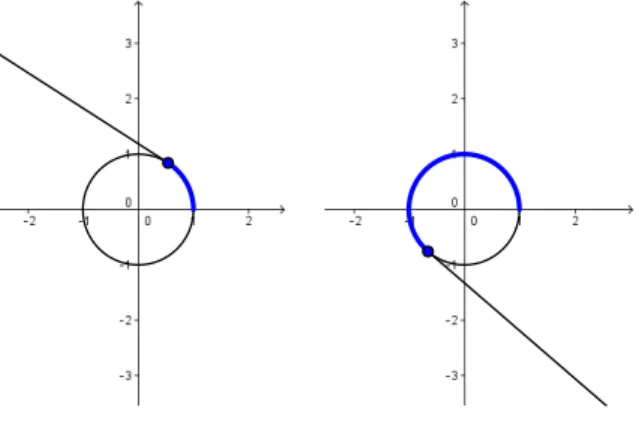
part of the number line around the circumference of the unit circle in a clockwise direction.
Two snapshots of an animation of this process for the counterclockwise wrap are shown inFigure 1.2 and two such snapshots are shown in Figure 1.3 for the clockwise wrap.
Figure 1.2: Wrapping the positive number line around the unit circle
Figure 1.3: Wrapping the negative number line around the unit circle
Following is a link to an actual animation of this process, including both posi-tive wraps and negaposi-tive wraps.
http://gvsu.edu/s/Kr
the circle infinitely many times. A result of this is that infinitely many different numbers from the number line get wrapped to the same location on the unit circle.
The number 0 and the numbers 2, 2, and 4 (as well as others) get wrapped to the point.1; 0/. We will usually say that these points get mapped to the point.1; 0/.
The number
2 is mapped to the point .0; 1/. This is because the circum-ference of the unit circle is 2 and so one-fourth of the circumference is
1
4.2/D 2.
If we now add2 to
2, we see that 5
2 also gets mapped to.0; 1/. If we subtract2 from
2, we see that 3
2 also gets mapped to.0; 1/.
However, the fact that infinitely many different numbers from the number line get wrapped to the same location on the unit circle turns out to be very helpful as it will allow us to model and represent behavior that repeats or is periodic in nature.
Progress Check 1.1(The Unit Circle.)
1. Find two different numbers, one positive and one negative, from the number line that get wrapped to the point. 1; 0/on the unit circle.
2. Describe all of the numbers on the number line that get wrapped to the point . 1; 0/on the unit circle.
3. Find two different numbers, one positive and one negative, from the number line that get wrapped to the point.0; 1/on the unit circle.
4. Find two different numbers, one positive and one negative, from the number line that get wrapped to the point.0; 1/on the unit circle.
One thing we should see from our work in Progress Check1.1 is that integer multiples of are wrapped either to the point.1; 0/or. 1; 0/and that odd inte-ger multiples of
Progress Check 1.2(The Unit Circle and).
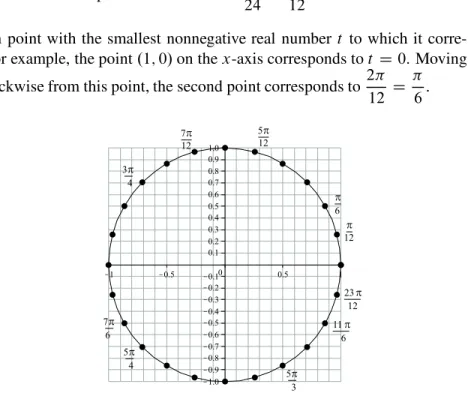
The following diagram is a unit circle with 24 points equally spaced points plotted on the circle. Since the circumference of the circle is 2 units, the increment
between two consecutive points on the circle is2 24 D
12.
Label each point with the smallest nonnegative real numbert to which it corre-sponds. For example, the point.1; 0/on thex-axis corresponds tot D0. Moving
counterclockwise from this point, the second point corresponds to2 12 D
6.
π
12
π
6
π
4 3
π
12 7
π
3 5
π
4 5
π
6 7
π
12 5
π
6 11
π
12 23
Figure 1.4: Points on the unit circle
UsingFigure 1.4, approximate thex-coordinate and they-coordinate of each of the following:
1. The point on the unit circle that corresponds tot D 3.
2. The point on the unit circle that corresponds tot D 2 3 .
3. The point on the unit circle that corresponds tot D 4 3 .
5. The point on the unit circle that corresponds tot D 4.
6. The point on the unit circle that corresponds tot D 7 4 .
Arcs on the Unit Circle
When we wrap the number line around the unit circle, any closed interval on the number line gets mapped to a continuous piece of the unit circle. These pieces are calledarcsof the circle. For example, the segment
h
0; 2
i
on the number line
gets mapped to the arc connecting the points.1; 0/and.0; 1/on the unit circle as shown inFigure 1.5. In general, when a closed intervalŒa; bis mapped to an arc on the unit circle, the point corresponding tot D a is called theinitial point of the arc, and the point corresponding tot Db is called theterminal point of the arc. So the arc corresponding to the closed interval
h
0; 2
i
has initial point.1; 0/
and terminal point.0; 1/.
arc
x y
x2 +y2
= 1
Figure 1.5: An arc on the unit circle
Progress Check 1.3(Arcs on the Unit Circle). Draw the following arcs on the unit circle.
1. The arc that is determined by the intervalh0; 4
i
2. The arc that is determined by the interval
0;2 3
on the number line.
3. The arc that is determined by the intervalŒ0; on the number line.
Coordinates of Points on the Unit Circle
When we have an equation (usually in terms ofxandy) for a curve in the plane and we know one of the coordinates of a point on that curve, we can use the equation to determine the other coordinate for the point on the curve. The equation for the unit circle isx2Cy2 D 1. So if we know one of the two coordinates of a point on the unit circle, we can substitute that value into the equation and solve for the value(s) of the other variable.
For example, suppose we know that the x-coordinate of a point on the unit
circle is 1
3. This is illustrated on the following diagram. This diagram shows
the unit circle (x2 Cy2 D 1) and the vertical line x D 1
3. This shows that
there are two points on the unit circle whose x-coordinate is 1
3. We can find they-coordinates by substituting thex-value into the equation and solving fory.
x
y
1
x = -
3
_
x2Cy2D1
1
3
2
Cy2D1
1 9 Cy
2 D1
y2D 8 9
Sincey2 D 8
9, we see thaty D ˙
r
8
9 and soy D ˙
p
8
3 . So the two points
on the unit circle whosex-coordinate is 1 3 are 1 3; p 8 3 !
; which is in the second quadrant, and
1 3; p 8 3 !
The first point is in the second quadrant and the second point is in the third
quad-rant. We can now use a calculator to verify that
p
8
3 0:9428. This seems consistent with the diagram we used for this problem.
Progress Check 1.4(Points on the Unit Circle.)
1. Find all points on the unit circle whosey-coordinate is1 2.
2. Find all points on the unit circle whosex-coordinate is
p
5 4 .
Summary of Section1.1
In this section, we studied the following important concepts and ideas:
Theunit circle is the circle of radius 1 that is centered at the origin. The equation of the unit circle isx2Cy2 D1. It is important because we will use this as a tool to model periodic phenomena.
We “wrap” the number line about the unit circle by drawing a number line that is tangent to the unit circle at the point.1; 0/. We wrap the positive part of the number line around the unit circle in the counterclockwise direction and wrap the negative part of the number line around the unit circle in the clockwise direction.
When we wrap the number line around the unit circle, any closed interval of real numbers gets mapped to a continuous piece of the unit circle, which is called an arc of the circle. When the closed intervalŒa; bis mapped to an arc on the unit circle, the point correpsonding tot D ais calledthe initial point of the arc, and the point corresponding tot Dbis calledthe terminal point of the arc.
Exercises for Section
1.1
1. The following diagram shows eight points plotted on the unit circle. These points correspond to the following values when the number line is wrapped around the unit circle.
x
y
(a) Label each point in the diagram with its value oft.
?(b) Approximate the coordinates of the points corresponding tot D 1, tD5, andt D9.
2. The following diagram shows the points corresponding tot D
5 andt D 2
5 when the number line is wrapped around the unit circle.
x
y
On this unit circle, draw the points corresponding tot D 4 5 , t D
6 5 , tD 8
5 , andt D 10
5 .
(a) The arc that is determined by the interval
h
0; 6
i
on the number line.
(b) The arc that is determined by the interval
0;7 6
on the number line.
(c) The arc that is determined by the intervalŒ0;
3on the number line.
(d) The arc that is determined by the intervalŒ0; 4
5 on the number line.
?4. Determine the quadrant that contains the terminal point of each given arc
with initial point.1; 0/on the unit circle.
(a) 7 4
(b) 7 4
(c) 3 5
(d) 3 5
(e) 7 3
(f) 7 3
(g) 5 8
(h) 5 8 (i) 2:5 (j) 2:5
(k) 3
(l) 3C2
(m) 3
(n) 3 2
5. Find all the points on the unit circle:
?(a) Whosex-coordinate is1
3.
?(b) Whosey-coordinate is 1
2.
(c) Whosex-coordinate is 3 5.
(d) Whosey-coordinate is 3
1.2
The Cosine and Sine Functions
Focus Questions
The following questions are meant to guide our study of the material in this section. After studying this section, we should understand the concepts mo-tivated by these questions and be able to write precise, coherent answers to these questions.
If the real numbertrepresents the (signed) length of an arc, how do we define cos.t /and sin.t /?
In what quadrants (of the terminal point of an arcton the unit circle) is cos.t /positive (negative)? In what quadrants (of the terminal point of an arcton the unit circle) is sin.t /positive (negative)?
What is the Pythagorean Identity? How is this identity derived from the equation for the unit circle?
Beginning Activity
1. What is the unit circle? What is the equation of the unit circle?
2. Review Progress Check1.4on page9.
3. Review the completed version of Figure1.4that is in the answers for Progress Check1.2on page6.
4. (a) What is the terminal point of the arc on the unit circle that corresponds to the interval
h
0; 2
i
?
(b) What is the terminal point of the arc on the unit circle that corresponds to the intervalŒ0; ?
(c) What is the terminal point of the arc on the unit circle that corresponds
to the interval
0;3 2
?
(d) What is the terminal point of the arc on the unit circle that corresponds to the interval
h
0; 2
i
The Cosine and Sine Functions
We started our study of trigonometry by learning about the unit circle, how to wrap the number line around the unit circle, and how to construct arcs on the unit circle. We are now able to use these ideas to define the two major circular, or trigonmetric, functions. These circular functions will allow us to model periodic phenomena such as tides, the amount of sunlight during the days of the year, orbits of planets, and many others.
It may seem like the unit circle is a fairly simple object and of little interest, but mathematicians can almost always find something fascinating in even such simple objects. For example, we define the two major circular functions, thecosineand
sine1in terms of the unit circle as follows.Figure 1.6shows an arc of lengtht on
the unit circle. This arc begins at the point.1; 0/and ends at its terminal pointP .t /. We then define the cosine and sine of the arct as thexandy coordinates of the pointP, so thatP .t / D.cos.t /;sin.t //(we abbreviate the cosine as cos and the sine as sin). So the cosine and sine values are determined by the arctand the cosine
x y
t P(t) = (cos(t), sin(t))
2 x +y2= 1
Figure 1.6: The Circular Functions
and sine arefunctionsof the arct. Since the arc lies on the unit circle, we call the cosine and sinecircular functions. An important part of trigonometry is the study of the cosine and sine and the periodic phenomena that these functions can model. This is one reason why the circular functions are also called the trigonometric functions.
Note: In mathematics, we always create formal definitions for objects we com-monly use. Definitions are critically important because with agreed upon defini-tions, everyone will have a common understanding of what the terms mean. With-out such a common understanding, there would be a great deal of confusion since different people who have different meanings for various terms. So careful and precise definitions are necessary in order to develop mathematical properties of these objects. In order to learn and understand trigonometry, a person needs to be able to explain how the circular functions are defined. So now is a good time to start working on understanding these definitions.
Definition. If the real numbertis the directed length of an arc (either positive or negative) measured on the unit circlex2Cy2D1(with counterclockwise as the positive direction) with initial point (1, 0) and terminal point.x; y/, then thecosineoft, denoted cos.t /, andsineoft, denoted sin.t /, are defined to be
cos.t /Dx and sin.t /Dy:
Figure 1.6illustrates these definitions for an arc whose terminal point is in the first quadrant.
At this time, it is not possible to determine the exact values of the cosine and sine functions for specific values oft. It can be done, however, if the terminal point of an arc of lengtht lies on thex-axis or they-axis. For example, since the circumference of the unit circle is2, an arc of lengtht Dwill have it terminal point half-way around the circle from the point.1; 0/. That is, the terminal point is at. 1; 0/. Therefore,
cos./D 1 and sin./D0:
1. cos 2 and sin 2 . 2. cos 3 2 and sin 3 2 .
3. cos.0/and sin.0/.
4. cos 2 and sin 2 .
5. cos.2/and sin.2/.
6. cos. /and sin. /.
Important Note: Since the cosine and sine are functions of an arc whose length is the real numbert, the inputtdetermines the output of the cosine and sin. As a result, it is necessary to specify the input value when working with the cosine and sine. In other words, we ALWAYS write cos.t /wheret is the real number input, and NEVER just cos. To reiterate, the cosine and sine are functions, so we MUST indicate the input to these functions.
Progress Check 1.6 (Approximating Cosine and Sine Values).
For this progress check, we will use the Geogebra Applet calledTerminal Points of Arcs on the Unit Circle. A web address for this applet is
http://gvsu.edu/s/JY
For this applet, we control the value of the inputtwith the slider fort. The values oft range from 20 to20in increments of0:5. For a given value oft, an arc is drawn of lengthtand the coordinates of the terminal point of that arc are displayed. Use this applet to find approximate values for each of the following:
1. cos.1/and sin.1/.
2. cos.2/and sin.2/.
3. cos. 4/and sin. 4/.
4. cos.5:5/and sin.5:5/.
5. cos.15/and sin.15/.
6. cos. 15/and sin. 15/.
Some Properties of the Cosine and Sine Functions
The cosine and sine functions are called circular functionsbecause their values are determined by the coordinates of points on the unit circle. For each real number t, there is a corresponding arc starting at the point.1; 0/of (directed) lengtht that lies on the unit circle. The coordinates of the end point of this arc determines the values of cos.t /and sin.t /.
Progress Check 1.7 (Domain and Range of the Circular Functions.)
1. What is the domain of the cosine function? Why?
2. What is the domain of the sine function? Why?
3. What is the largestx coordinate that a point on the unit circle can have? What is the smallestx coordinate that a point on the unit circle can have? What does this tell us about the range of the cosine function? Why?
4. What is the largesty coordinate that a point on the unit circle can have? What is the smallesty coordinate that a point on the unit circle can have? What does this tell us about the range of the sine function? Why?
Although we may not be able to calculate the exact values for many inputs for the cosine and sine functions, we can use our knowledge of the coordinate system and its quadrants to determine if certain values of cosine and sine are positive or negative. The idea is that the signs of the coordinates of a pointP .x; y/that is plotted in the coordinate plan are determined by the quadrant in which the point lies. (Unless it lies on one of the axes.)Figure 1.7summarizes these results for the signs of the cosine and sine function values. The left column in the table is for the location of the terminal point of an arc determined by the real numbert.
Quadrant cos.t / sin.t /
QI positive positive
QII negative positive
QIII negative negative
QIV positive negative
x y
sin (t) > 0 sin (t) > 0
cos (t) > 0 cos (t) > 0 cos (t) < 0
cos (t) < 0
sin (t) < 0 sin (t) < 0
Figure 1.7: Signs of the cosine and sine functions
the unit circle from the point.1; 0/in the positive (counterclockwise) direction, we will intersect one of the coordinate axes every quarter revolution. For example, if 0 < t <
2, the terminal point of the arc determined by t is in the first quadrant and cos.t / > 0and sin.t / > 0.
Progress Check 1.8 (Signs ofcos.t /andsin.t /.)
1. If
2 < t < , then what are the signs of cos.t /and sin.t /?
2. If < t < 3
2 , then what are the signs of cos.t /and sin.t /?
3. If 3
2 < t < 2, then what are the signs of cos.t /and sin.t /?
4. If 5
2 < t < 3, then what are the signs of cos.t /and sin.t /?
5. For which values oft (between 0 and2) is cos.t /positive? Why?
6. For which values oft (between 0 and2) is sin.t /positive? Why?
7. For which values oft (between 0 and2) is cos.t /negative? Why?
8. For which values oft (between 0 and2) is sin.t /negative? Why?
Progress Check 1.9 (Signs ofcos.t /andsin.t /(Part 2))
Use the results summarized inFigure 1.7to help determine if the following quan-tities are positive, negative, or zero. (Do not use a calculator.)
1. cos
5
2. sin
5
3. cos
5
8
4. sin
5
8
5. cos
9 16
6. sin
9
16
7. cos
25
12
8. sin
25
12
The Pythagorean Identity
In mathematics, anidentityis a statement that is true for all values of the vari-ables for which it is defined. In previous courses, we have worked with algebraic identities such as
7xC12xD19x aCbDbCa
a2 b2D.aCb/.a b/ x.yCz/DxyCxz
where it is understood that all the variables represent real numbers. In trigonome-try, we will develop many so-called trigonometric identities. The following progress check introduces one such identity between the cosine and sine functions.
Progress Check 1.10 (Introduction to the Pythagorean Identity)
We know that the equation for the unit circle isx2Cy2D1. We also know that if tis an real number, then the terminal point of the arc determined byt is the point .cos.t /;sin.t //and that this point lies on the unit circle. Use this information to develop an identity involving cos.t /and sin.t /.
Using the definitionsxDcos.t /andy Dsin.t /along with the equation for the unit circle, we obtain the following identity, which is perhaps the most important trigonometric identity.
For each real numbert; ..cos.t //2C.sin.t //2D1:
This is called thePythagorean Identity. We often use the shorthand nota-tion cos2.t /for.cos.t //2and sin2.t /for.sin.t //2and write
For each real numbert;cos2.t /Csin2.t /D1:
Important Note about Notation. Always remember that by cos2.t / we mean .cos.t //2. In addition, note that cos2.t /is different from cos.t2/.
The Pythagorean Identity allows us to determine the value of cos.t /or sin.t /if we know the value of the other one and the quadrant in which the terminal point of arctlies. This is illustrated in the next example.
Example 1.11 (Using the Pythagorean Identity)
Assume that cos.t /D 2
for the arct is the point.cos.t /;sin.t //. That is,x D cos.t /andy D sin.t /. So this problem is very similar to using the equationx2Cy2 D1for the unit circle
and substitutingxD 2 5.
Using the Pythagorean Identity, we then see that
cos2.t /Csin2.t /D1
2 5
2
Csin2.t /D1
4 25 Csin
2.t / D1
sin2.t /D1 4 25
sin2.t /D 21 25
This means that sin.t /D ˙
r
21
25, and since the terminal point of arc.t /is in the
fourth quadrant, we know that sin.t / < 0. Therefore, sin.t / D
r
21
25. Since
p
25D5, we can write
sin.t /D
p
21
p
25 D
p
21 5 :
Progress Check 1.12 (Using the Pythagorean Identity)
1. If cos.t / D 1
2 and the terminal point of the arc t is in the fourth quadrant, determine the value of sin.t /.
2. If sin.t /D 2
3 and < t < 3
Summary of Section1.2
In this section, we studied the following important concepts and ideas:
If the real number t is the directed length of an arc (either positive or negative) measured on the unit circle x2Cy2 D1(with counterclockwise as the positive direction) with initial point (1, 0) and terminal point.x; y/, then
cos.t /Dx and sin.t /Dy:
x y
t P(t) = (cos(t), sin(t))
2 x y2
+ = 1
The signs of cos.t /and sin.t /are determind by the quadrant in which the terminal point of an arct lies.
Quadrant cos.t / sin.t /
QI positive positive
QII negative positive
QIII negative negative
QIV positive negative
One of the most important identities in trigonometry, calledthe Pythagorean Identity, is derived from the equation for the unit circle and states:
For each real numbert;cos2.t /Csin2.t /D1:
Exercises for Section
1.2
?1. Fill in the blanks for each of the following:
(a) For a real numbert, the value of cos.t /is defined to be the -coordinate of the point of an arc twhose initial point
is on the whose equation is x2 C
y2D1.
(c) The maximum value of cos.t / is and this occurs at t D for0 t < 2. The minimum value of cos.t /
is and this occurs att D for0t <
2.
(d) The range of the cosine function is .
2. (a) For a real numbert, the value of sin.t /is defined to be the -coordinate of the point of an arct whose initial point
is on the whose equation is x2 C
y2 D1.
(b) The domain of the sine function is .
(c) The maximum value of sin.t /is and this occurs at
t D for0 t < 2. The minimum value of sin.t /is
and this occurs att D for0 t <
2.
(d) The range of the sine function is .
3. (a) Complete the following table of values.
Length of arc on Terminal point
the unit circle of the arc cos.t / sin.t /
0 .1; 0/ 1 0
2
3
2
2
(b) Complete the following table of values.
Length of arc on Terminal point
the unit circle of the arc cos.t / sin.t /
0 .1; 0/ 1 0
2 3
(c) Complete the following table of values.
Length of arc on Terminal point
the unit circle of the arc cos.t / sin.t /
2 .1; 0/ 1 0
5 2 3 7 2 4
4.?(a) What are the possible values of cos.t /if it is known that sin.t /D 3 5?
(b) What are the possible values of cos.t /if it is known that sin.t / D 3 5 and the terminal point oftis in the second quadrant?
?(c) What is the value of sin.t /if it is known that cos.t /
D 23 and the terminal point oftis in the third quadrant?
?5. Suppose it is known that0 <cos.t / < 1
3.
(a) By squaring the expressions in the given inequalities, what conclusions can be made about cos2.t /?
(b) Use part (a) to write inequalities involving cos2.t /and then inequal-ities involving1 cos2.t /.
(c) Using the Pythagorean identity, we see that sin2.t / D 1 cos2.t /. Write the last inequality in part (b) in terms of sin2.t /.
(d) If we also know that sin.t / > 0, what can we now conclude about the value of sin.t /?
6. Use a process similar to the one in exercise (5) to complete each of the fol-lowing:
(a) Suppose it is known that 1
4 < sin.t / < 0and that cos.t / > 0. What can be concluded about cos.t /?
(b) Suppose it is known that0 sin.t / 3
7. Using the four digit approximations for the cosine and sine values in Progress Check1.6, calculate each of the following:
cos2.1/Csin2.1/.
cos2.2/Csin2.2/.
cos2. 4/Csin2. 4/.
cos2.15/Csin2.15/.
1.3
Arcs, Angles, and Calculators
Focus Questions
The following questions are meant to guide our study of the material in this section. After studying this section, we should understand the concepts mo-tivated by these questions and be able to write precise, coherent answers to these questions.
How do we measure angles using degrees?
What do we mean by the radian measure of an angle? How is the radian measure of an angle related to the length of an arc on the unit circle?
Why is radian measure important?
How do we convert from radians to degrees and from degrees to radians?
How do we use a calculator to approximate values of the cosine and sine functions?
Introduction
The ancient civilization known as Babylonia was a cultural region based in south-ern Mesopatamia, which is present-day Iraq. Babylonia emerged as an independent state around 1894 BCE. The Babylonians developed a system of mathematics that was based on a sexigesimal (base 60) number system. This was the origin of the modern day usage of 60 minutes in an hour, 60 seconds in a minute, and 360 de-grees in a circle.
Many historians now believe that for the ancient Babylonians, the year con-sisted of 360 days, which is not a bad approximation given the crudeness of the ancient astronomical tools. As a consequence, they divided the circle into 360 equal length arcs, which gave them a unit angle that was 1/360 of a circle or what we now know as a degree. Even though there are 365.24 days in a year, the Babylo-nian unit angle is still used as the basis for measuring angles in a circle.Figure 1.8
Figure 1.8: A circle with six 60-degree angles.
Angles
We often denote a line that is drawn through 2 pointsAandBbyAB. The portion! of the lineAB!that starts at the pointAand continues indefinitely in the direction of the pointB is calledrayABand is denoted byAB. The point! Ais theinitial pointof the rayAB. An! angleis formed by rotating a ray about its endpoint. The ray in its initial position is called theinitial sideof the angle, and the position of the ray after it has been rotated is called theterminal sideof the ray. The endpoint of the ray is called thevertex of the angle.
A
BC
initial side
term inal s
ide
vertex
α
Figure 1.9shows the rayAB!rotated about the pointAto form an angle. The terminal side of the angle is the rayAC!. We often refer to this as angle BAC, which is abbreviated as†BAC. We can also refer to this angle as angleCAB or
†CAB. If we want to use a single letter for this angle, we often use a Greek letter such as˛(alpha). We then just say the angle˛. Other Greek letters that are often used areˇ(beta), (gamma),(theta), (phi), and(rho).
Arcs and Angles
To define the trigonometric functions in terms of angles, we will make a simple connection between angles and arcs by using the so-called standard position of an angle. When the vertex of an angle is at the origin in thexy-plane and the initial side lies along the positivex-axis, we see that the angle is instandard position. The terminal side of the angle is then in one of the four quadrants or lies along one of the axes. When the terminal side is in one of the four quadrants, the terminal side determines the so-called quadrant designation of the angle. SeeFigure 1.10.
A
Binitial side term
ina l s
ide
vertex
α
vertex
vertex
x
y
C
Figure 1.10: Standard position of an angle in the second quadrant.
Progress Check 1.13 (Angles in Standard Position)
Draw an angle in standard position in (1) the first quadrant; (2) the third quadrant; and (3) the fourth quadrant.
If an angle is in standard position, then the point where the terminal side of the angle intersects the unit circle marks the terminal point of an arc as shown in
functions in terms of angles as well as arcs. Before we do this, however, we need to discuss two different ways to measure angles.
(0,0) angle
arc
Figure 1.11: An arc and its corresponding angle.
Degrees Versus Radians
There are two ways we will measure angles – in degrees and radians. When we measure the length of an arc, the measurement has a dimension (the length, be it inches, centimeters, or something else). As mentioned in the introduction, the Babylonians divided the circle into 360 regions. So one complete wrap around a circle is 360 degrees, denoted 360ı. The unit measure of1ı is an angle that is1=360 of the central angle of a circle. Figure 1.8shows 6 angles of60ıeach. The degreeıis a dimension, just like a length. So to compare an angle measured in degrees to an arc measured with some kind of length, we need to connect the dimensions. We can do that with the radian measure of an angle.
Radians will be useful in that a radian is a dimensionless measurement. We want to connect angle measurements to arc measurements, and to do so we will directly define an angle of 1 radian to be an angle subtended by an arc of length 1 (the length of the radius) on the unit circle as shown inFigure 1.12.
Definition. An angle ofone radianis the angle in standard position on the unit circle that is subtended by an arc of length 1 (in the positive direction).
x y
1 radian 1
Figure 1.12: One radian.
1 radian 2 radians
3 radians
4 radians
5 radians
6 radians
Figure 1.13: Angles with Radian Measure 1, 2, 3, 4, 5, and 6
We can also have angles whose radian measure is negative just like we have arcs with a negative length. The idea is simply to measure in the negative (clockwise) direction around the unit circle. So an angle whose measure is 1 radian is the angle in standard position on the unit circle that is subtended by an arc of length 1 in the negative (clockwise) direction.
So in general, an angle (in standard position) oftradians will correspond to an arc of lengtht on the unit circle. This allows us to discuss the sine and cosine of an angle measured in radians. That is, when we think of sin.t /and cos.t /, we can considert to be:
a real number;
the length of an arc with initial point.1; 0/on the unit circle;
the radian measure of an angle in standard position.
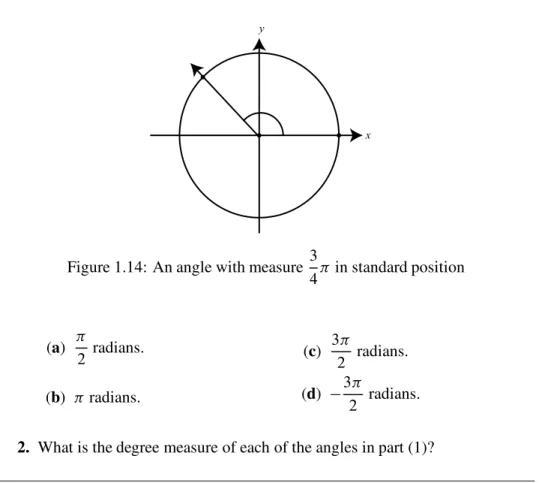
When we draw a picture of an angle in standard position, we often draw a small arc near the vertex from the initial side to the terminal side as shown inFigure 1.14,
which shows an angle whose measure is3
4radians.
Progress Check 1.14 (Radian Measure of Angles)
x y
Figure 1.14: An angle with measure 3
4 in standard position
(a)
2 radians.
(b) radians.
(c) 3
2 radians.
(d) 3
2 radians.
2. What is the degree measure of each of the angles in part (1)?
Conversion Between Radians and Degrees
Radian measure is the preferred measure of angles in mathematics for many rea-sons, the main one being that a radian has no dimensions. However, to effectively use radians, we will want to be able to convert angle measurements between radi-ans and degrees.
Recall that one wrap of the unit circle corresponds to an arc of length2, and an arc of length2 on the unit circle corresponds to an angle of2 radians. An angle of360ıis also an angle that wraps once around the unit circle, so an angle of360ıis equivalent to an angle of2 radians, or
each degree is
180radians,
each radian is 180
Notice that 1 radian is then 180
57:3
ı, so a radian is quite large compared to
a degree. These relationships allow us to quickly convert between degrees and radians. For example:
If an angle has a degree measure of35degrees, then its radian measure can be calculated as follows:
35degrees radians 180degrees D
35
180radians:
Rewriting this fraction, we see that an angle with a measure of 35 degrees
has a radian measure of 7
36 radians.
If an angle has a radian measure of3
10 radians, then its degree measure can be calculated as follows:
3
10radians
180degrees
radians D
540
10 degrees:
So an angle with a radian measure of 3
10 has an angle measure of54 ı.
IMPORTANT NOTE:Since a degree is a dimension, we MUST include the de-gree markıwhenever we write the degree measure of an angle. A radian has no dimension so there is no dimension mark to go along with it. Consequently, if we write 2 for the measure of an angle we understand that the angle is measured in radians. If we really mean an angle of 2 degrees, then we must write2ı.
Progress Check 1.15 (Radian-Degree Conversions)
Complete the following table to convert from degrees to radians and vice versa.
Calculators and the Trignometric Functions
We have now seen that when we think of sin.t /or cos.t /, we can think oftas a real number, the length of an arc, or the radian measure of an angle. In Section1.5, we will see how to determine the exact values of the cosine and sine functions for a few
special arcs (or angles). For example, we will see that cos
6
D p
3
Angle in radians Angle in degrees
0 0ı
6 4 3
2 90
ı
120ı
3
4 135
ı
150ı
180ı
Angle in radians Angle in degrees 7
6 5
4 4
3 3
2 270
ı
300ı
315ı
330ı
2 360ı
Table 1.1: Conversions between radians and degrees.
approximate the values of the circular (or trigonometric)functions. Most hand-held calculators, calculators in phone or tablet apps, and online calculators have a cosine key and a sine key that you can use to approximate values of these functions, but we must keep in mind that the calculator only provides an approximationof the value, not the exact value (except for a small collection of arcs). In addition, most calculators will approximate the sine and cosine of angles.
degrees, see Exercise (4)).
Progress Check 1.16 (Using a Calculator)
In Progress Check1.6, we used the Geogebra Applet called Terminal Points of Arcs on the Unit Circleathttp://gvsu.edu/s/JYto approximate the values of the cosine and sine functions at certain values. For example, we found that
cos.1/0:5403, sin.1/0:8415.
cos.2/ 0:4161
sin.2/0:9093.
cos. 4/ 0:6536
sin. 4/0:7568.
cos. 15/ 0:7597
sin. 15/ 0:6503.
Use a calculator to determine these values of the cosine and sine functions and compare the values to the ones above. Are they the same? How are they different?
Summary of Section1.3
In this section, we studied the following important concepts and ideas:
Anangleis formed by rotating a ray about its endpoint. The ray in its initial position is called theinitial sideof the angle, and the position of the ray after it has been rotated is called theterminal sideof the ray. The endpoint of the ray is called thevertex of the angle.
When the vertex of an angle is at the origin in thexy-plane and the initial side lies along the positivex-axis, we see that the angle is instandard position.
There are two ways to measure angles. For degree meausre, one complete wrap around a circle is 360 degrees, denoted360ı. The unit measure of1ı is an angle that is1=360of the central angle of a circle. An angle of one radianis the angle in standard position on the unit circle that is subtended by an arc of length 1 (in the positive direction).
We convert the measure of an angle from degrees to radians by using the fact that each degree is
180 radians. We convert the measure of an angle from
radians to degrees by using the fact that each radian is180
Exercises for Section
1.3
1. Convert each of the following degree measurements for angles into radian measures for the angles. In each case, first write the result as a fractional multiple of and then use a calculator to obtain a 4 decimal place approxi-mation of the radian measure.
?(a) 15ı
?(b) 58ı
(c) 112ı
(d) 210ı
?(e) 40ı
(f) 78ı
2. Convert each of the following radian measurements for angles into degree measures for the angles. When necessary, write each result as a 4 decimal place approximation.
?(a) 3
8 radians
?(b) 9
7 radians
(c) 7
15radians
?(d)
1 radian
(e) 2.4 radians
(f) 3 radians
3. Draw an angle in standard position of an angle whose radian measure is:
(a) 1 4
(b) 1 3
(c) 2 3
(d) 5 4
(e) 1 3
(f) 3.4
4. In Progess Check1.16, we used the Geogebra Applet calledTerminal Points of Arcs on the Unit Circleto approximate values of the cosine and sine func-tions. We will now do something similar to approximate the cosine and sine values for angles measured in degrees.
y-coordinate of the point of intersection of the terminal side of that angle and the unit circle.
We will now use the Geogebra appletAngles and the Unit Circle. A web address for this applet is
http://gvsu.edu/s/VG
For this applet, we control the value of the inputaı with the slider for a. The values ofarange from 180ıto180ıin increments of5ı. For a given value ofaı, an angle in standard position is drawn and the coordinates of the point of intersection of the terminal side of that angle and the unit circle are displayed. Use this applet to approximate values for each of the following:
?(a) cos.10ı/and sin.10ı/.
(b) cos.60ı/and sin.60ı/.
(c) cos.135ı/and sin.135ı/.
?(d) cos. 10ı/and sin. 10ı/.
(e) cos. 135ı/and sin. 135ı/.
(f) cos.85ı/and sin.85ı/.
1.4
Velocity and Angular Velocity
Focus Questions
The following questions are meant to guide our study of the material in this section. After studying this section, we should understand the concepts mo-tivated by these questions and be able to write precise, coherent answers to these questions.
What is arc length?
What is the difference between linear velocity and angular velocity?
What are the formulas that relate linear velocity to angular velocity?
Beginning Activity
1. What is the formula for the circumferenceC of a circle whose radius isr?
2. Suppose personAwalks along the circumference of a circle with a radius of 10 feet, and personB walks along the circumference of a circle of radius 20 feet. Also, suppose it takes bothAandB 1 minute to walk one-quarter of the circumference of their respective circles (one-quarter of a complete revolution). Who walked the most distance?
3. Suppose both people continue walking at the same pace they did for the first minute. How many complete revolutions of the circle will each person walk in 8 minutes? In 10 minutes?
Arc Length on a Circle
In Section1.3, we learned that the radian measure of an angle was equal to the length of the arc on the unit circle associated with that angle. So an arc of length 1 on the unit circle subtends an angle of 1 radian. There will be times when it will also be useful to know the length of arcs on other circles that subtend the same angle.
x
y
r
1
θ
θ
s
Figure 1.15: Arcs subtended by an angle of 1 radian.
circle subtended by the angle is, and we have usedsto represent the arc length on the circle of radiusr subtended by the angle.
Recall that the circumference of a circle of radiusr is2 r while the circum-ference of the circle of radius 1 is2. Therefore, the ratio of an arc lengthson the circle of radiusr that subtends an angle of radians to the corresponding arc on
the unit circle is2 r
2 Dr. So it follows that
s D
2 r 2 sDr
Definition. On a circle of radiusr, thearc lengthsintercepted by a central angle with radian measure is
sDr:
Note: It is important to remember that to calculate arc length2, we must measure the central angle in radians.
2It is not clear why the lettersis usually used to represent arc length. One explanation is that the
Progress Check 1.17 (Using the Formula for Arc Length) Using the circles in the beginning activity for this section:
1. Use the formula for arc length to determine the arc length on a circle of radius 10 feet that subtends a central angle of
2 radians. Is the result equal to one-quarter of the circumference of the circle?
2. Use the formula for arc length to determine the arc length on a circle of radius 20 feet that subtends a central angle of
2 radians. Is the result equal to one-quarter of the circumference of the circle?
3. Determine the arc length on a circle of radius 3 feet that is subtended by an angle of22ı.
Why Radians?
Degree measure is familiar and convenient, so why do we introduce the unit of radian? This is a good question, but one with a subtle answer. As we just saw, the lengthsof an arc on a circle of radiusr subtended by angle of radians is given bys Dr, so D s
r. As a result, a radian measure is a ratio of two lengths (the quotient of the length of an arc by a radius of a circle), which makes radian mea-sure a dimensionless quantity. Thus, a meamea-surement in radians can just be thought of as a real number. This is convenient for dealing with arc length (and angular velocity as we will soon see), and it will also be useful when we study periodic phenomena in Chapter 2. For this reason radian measure is universally used in mathematics, physics, and engineering as opposed to degrees, because when we use degree measure we always have to take the degree dimension into account in computations. This means that radian measure is actually more natural from a mathematical standpoint than degree measure.
Linear and Angular Velocity
The connection between an arc on a circle and the angle it subtends measured in radians allows us to define quantities related to motion on a circle. Objects traveling along circular paths exhibit two types of velocity: linear and angular
moment the pebble was released. This is thelinear velocityof the pebble. The linear velocity measures how the arc length changes over time.
Consider a pointP moving at a constant velocity along the circumference of a circle of radiusr. This is calleduniform circular motion. Suppose thatP moves a distance ofsunits in timet. Thelinear velocityvof the pointP is the distance it travelled divided by the time elapsed. That is,v D s
t. The distancesis the arc length and we know thatsDr.
Definition. Consider a pointP moving at a constant velocity along the cir-cumference of a circle of radiusr. Thelinear velocityv of the pointP is given by
vD s t D
r t ;
where , measured in radians, is the central angle subtended by the arc of lengths.
Another way to measure how fast an object is moving at a constant speed on a circular path is calledangular velocity. Whereas the linear velocity measures how the arc length changes over time, theangular velocityis a measure of how fast the central angle is changing over time.
Definition. Consider a pointP moving with constant velocity along the cir-cumference of a circle of radiusron an arc that corresponds to a central angle of measure (in radians). Theangular velocity!of the point is the radian measure of the angle divided by the timet it takes to sweep out this angle. That is
!D t:
Note: The symbol!is the lower case Greek letter “omega.” Also, notice that the angular velocity does not depend on the radiusr.
This is a somewhat specialized definition of angular velocity that is slightly different than a common term used to describe how fast a point is revolving around a circle. This term isrevolutions per minuteorrpm. Sometimes the unit revolu-tions per secondis used. A better way to represent revolutions per minute is to use the “unit fraction” rev
is moving atxrevolutions per minute, then
!Dxrev min
2rad
rev Dx.2/
rad min:
Progress Check 1.18 (Determining Linear Velocity)
Suppose a circular disk is rotating at a rate of 40 revolutions per minute. We wish to determine the linear velocityv (in feet per second) of a point that is 3 feet from the center of the disk.
1. Determine the angular velocity! of the point in radians per minute. Hint: Use the formula
! Dxrev min
2rad rev :
2. We now know! D
t. So use the formulav D r
t to determinev in feet per minute.
3. Finally, convert the linear velocityvin feet per minute to feet per second.
Notice that in Progress Check1.18, once we determined the angular velocity, we were able to determine the linear velocity. What we did in this specific case we can do in general. There is a simple formula that directly relates linear velocity to
angular velocity. Our formula for linear velocity isv D s t D
r
t . Notice that we
can write this isv Dr
t. That is,vDr!.
Consider a pointP moving with constant (linear) velocityvalong the circum-ference of a circle of radiusr. If the angular velocity is!, then
v Dr!:
So in Progress Check 1.18, once we determined that ! D 80rad
min, we could determinevas follows:
vDr!D.3ft/
80rad min
D240 ft min:
Example 1.19 (Linear and Angular Velocity)
The LP (long play) or331
3 rpm vinyl record is an analog sound storage medium and has been used for a long time to listen to music. An LP is usually 12 inches or 10 inches in diameter. In order to work with our formulas for linear and angular velocity, we need to know the angular velocity in radians per time unit. To do this,
we will convert331
3 revolutions per minute to radians per minute. We will use the
fact that331 3 D
100 3 .
!D 100 3
rev
min
2 rad 1rev
D 2003 rad
min
We can now use the formulavDr!to determine the linear velocity of a point on the edge of a 12 inch LP. The radius is 6 inches and so
vDr!
D.6inches/
200 3
rad min
D400inches min
It might be more convenient to express this as a decimal value in inches per second. So we get
v D400inches
min
1min 60sec
20:944inches sec
The linear velocity is approximately 20.944 inches per second.
Progress Check 1.20 (Linear and Angular Velocity)
For these problems, we will assume that the Earth is a sphere with a radius of 3959 miles. As the Earth rotates on its axis, a person standing on the Earth will travel in a circle that is perpendicular to the axis.
2. As the Earth rotates, a person standing on the equator will travel in a circle whose radius is 3959 miles. Determine the linear velocity of this person in miles per hour.
3. As the Earth rotates, a person standing at a point whose latitude is60ınorth will travel in a circle of radius 2800 miles. Determine the linear velocity of this person in miles per hour and feet per second.
Summary of Section1.4
In this section, we studied the following important concepts and ideas:
On a circle of radiusr, thearc lengthsintercepted by a central angle with radian measure is
sDr:
Uniform circular motion is when a point moves at a constant velocity along the circumference of a circle. Thelinear velocityis the arc length travelled by the point divided by the time elapsed. Whereas the linear velocity mea-sures how the arc length changes over time, theangular velocityis a measure of how fast the central angle is changing over time. Theangular velocityof the point is the radian measure of the angle divided by the time it takes to sweep out this angle.
For a pointP moving with constant (linear) velocityvalong the circumfer-ence of a circle of radiusr, we have
vDr!;
where!is the angular velocity of the point.
Exercises for Section
1.4
1. Determine the arc length (to the nearest hundredth of a unit when necessary) for each of the following.
?(a) An arc on a circle of radius 6 feet that is intercepted by a central angle
of 2
?(b) An arc on a circle of radius 100 miles that is intercepted by a central
angle of 2 radians.
?(c) An arc on a circle of radius 20 meters that is intercepted by a central
angle of 13
10 radians.
(d) An arc on a circle of radius 10 feet that is intercepted by a central angle of 152 degrees.
2. In each of the following, when it is possible, determine the exact measure of the central angle in radians. Otherwise, round to the nearest hundredth of a radian.
?(a) The central angle that intercepts an arc of length3 feet on a circle of
radius 5 feet.
?(b) The central angle that intercepts an arc of length18feet on a circle of
radius 5 feet.
(c) The central angle that intercepts an arc of length 20 meters on a circle of radius 12 meters.
3. In each of the following, when it is possible, determine the exact measure of central the angle in degrees. Otherwise, round to the nearest hundredth of a degree.
?(a) The central angle that intercepts an arc of length3 feet on a circle of
radius 5 feet.
?(b) The central angle that intercepts an arc of length18feet on a circle of
radius 5 feet.
(c) The central angle that intercepts an arc of length 20 meters on a circle of radius 12 meters.
(d) The central angle that intercepts an arc of length 5 inches on a circle of radius 5 inches.
(e) The central angle that intercepts an arc of length 12 inches on a circle of radius 5 inches.
5. Determine the