Construction of some higher associate class PBIB designs using symmetrically repeated differences
Parneet Kaur* and Davinder Kumar Garg**
* Research Scholar, Department of Statistics, Punjabi University, Patiala-147002 (Punjab)
** Professor and Head (Corresponding Author), Department of Statistics, Punjabi University, Patiala-147002 (Punjab)
ABSTRACT:
The present paper presents four series of higher associate class PBIB designs using the method of symmetrically repeated differences by developing some sets of initial blocks. Three series develop five-associate class PBIB designs and one series develops three-five-associate class PBIB designs have been constructed. The designs constructed are highly efficient for the purpose of its applications in real life. The average efficiency factor and the different kinds of efficiencies in all the series have also been computed and listed at the end of the paper.
Keywords: Design of Experiments, five-associate class PBIB design, symmetrically repeated differences, three-associate class PBIB design.
1. INTRODUCTION:
Two associate class PBIB designs have been studied widely by some of the authors like Bose and Shimamato (1952), Nandi and Adhikary (1966), Mesner (1967), Clatworthy (1973). Bose et al (1953) constructed GD-PBIB designs by using the method of symmetrically repeated differences. Authors like Raghavarao and Aggarwal (1974), Nair (1980), Suen (1989), Garg and Singh (2012) also constructed some PBIB designs using the method of symmetrically repeated differences. Some other methods of construction of higher associate class PBIB designs are due to authors like Sinha (1991), Kageyama and Miao (1995), Sinha et al. (2002b), Kageyama and Sinha (2003), Garg (2010), Garg and Singh (2014), Garg and Farooq (2014). Bearing in mind the need for constructing new designs, we have introduced some new series of three-associate class and five-associate class PBIB designs using the method of symmetrically repeated differences by forming some sets of initial blocks.
In this paper, we have developed two association schemes: one for three associate class PBIB designs and other for five associate class PBIB designs followed by their construction methodology. Five-associate class PBIB designs have been constructed by dividing the treatments into five groups of equal sizes.
2. ASSOCIATION SCHEME:
2.1. Five-associate class association scheme:
Let there be v=5n treatments divided into 5 groups each of size n. Each group denoted by the elements of module M of residue class mod(5) i.e. 0, 1, 2, 3, 4 such that the n treatments of group 1 are denoted by 01, 02, 03, …, 0n, n treatments of group 2 are denoted by 11, 12, 13, …, 1n and so on. Here in the
notation of any treatment aα , a denotes the modular element having any of the value 0, 1, 2, 3, 4 and α
denotes the class having any of the value 1, 2, 3, …, n. Thus we have a total of v = 5n treatments. On these treatments, five-associate class association scheme is described below:
i. Two treatments aα and bβ are said to be first associates if α = β and difference between a and b is
either 1 or 4 i.e. difference between aα and bβ is either 1 or 4 of pure type.
ii. Two treatments aα and bβ are said to be second associates if difference between them is either 1
or 4 of mixed type.
iii. Two treatments aα and bβ are said to be third associates if difference between them is either 2 or
3 of pure type.
iv. Two treatments aα and bβ are said to be fourth associates if difference between them is either 2
or 3 of mixed type.
v. Two treatments aα and bβ are said to be fifth associates if difference between them is 0 of mixed
type.
The parameters of the association scheme are:
v = 5n n1 = 2 n2 = 2(n-1) n3 = 2 n4 = 2(n-1) n5 = (n-1)
and the P-matrices are
P1 =
0 0 1 0 0
0 0 0 𝑛 − 1 𝑛 − 1
1 0 1 0 0
0 𝑛 − 1 0 𝑛 − 1 0
0 𝑛 − 1 0 0 0
P2 =
0 0 0 1 1
0 0 1 𝑛 − 2 𝑛 − 2
0 1 0 1 0
1 𝑛 − 2 1 𝑛 − 2 0
1 𝑛 − 2 0 0 0
P3 =
1 0 1 0 0
0 𝑛 − 1 0 𝑛 − 1 0
1 0 0 0 0
0 𝑛 − 1 0 0 𝑛 − 1
0 0 0 𝑛 − 1 0
P4 =
0 1 0 1 0
1 𝑛 − 2 1 𝑛 − 2 0
0 1 0 0 1
1 𝑛 − 2 0 0 𝑛 − 2
0 0 1 𝑛 − 2 0
P5 =
0 2 0 0 0
2 2(𝑛 − 2) 0 0 0
0 0 0 2 0
0 0 2 2(𝑛 − 2) 0
0 0 0 0 𝑛 − 2
2.2 Three-associate class association scheme:
i. Two treatments are said to be first associates if they belong to the same class.
ii. Two treatments are said to be second associates if they belong to different classes and giving non-zero difference.
iii. Two treatments are said to be third associates if they belong to different classes and giving zero difference.
The parameters of the three-associate class association scheme are:
v = mn n1 = (m – 1) n2 = (m – 1)(n – 1) n3= (n – 1)
and the P – matrices are
P1 =
m-2 0 0
0 m-2 (n-1) n-1
0 n-1 0
P2 =
0 m-2 1
m-2 m-2 (n-2) n-2
1 n-2 0
P3 =
0 m-1 0
m-1 m-1 (n-2) 0
0 0 n-2
3. CONSTRUCTION OF FIVE – ASSOCIATE CLASS PBIB DESIGNS:
3.1 Series-I:
Let us consider a module M of residue class mod(5) having elements 0, 1, 2, 3, 4 and all the elements of M are assigned to each of the n classes. A set of t initial blocks each of size k is constructed in the following way:
Assign any one of the n classes to every element of module M, giving us first five elements and the remaining (k – 5) elements of the initial block are obtained by assigning the remaining (n – 1) classes to anyone but same element of modulo M. In this way, we get our first initial block. Repeating the above procedure, to obtain the remaining (t – 1) initial blocks in such a way that in each initial block the first five elements are obtained by assigning to each element of M a class that has not already been assigned at these positions. The remaining (k – 5) elements of each initial block are obtained by assigning the (n – 1) classes other than the class that has already been assigned to first five positions in the same block, to the element of M that was assigned the (n – 1) classes in the first initial block.
Thus, we get a total of t (t = n) initial blocks each of size k = n + 4 as given below:
(01, 11, 21, 31, 41, 42, 43… 4n)
(02, 12, 22, 32, 42, 43, 44 … 4n, 41)
| | |
| | |
| | |
By developing these n initial blocks with the use of the elements of module M, we get symmetric five-associate class PBIB designs following the association scheme 1.1 with parameters:
v = 5n b = 5n r = n+4 k = n+4
λ1 = 5 λ2 = 2 λ3 = 5 λ4 = 2 λ5 = n
3.1.1 Illustration:
Let us illustrates our methodology for n = 4 giving us the following parameters of the five associate class association scheme with parameters:
v = 20 n1 = 2 n2 = 6 n3 = 2 n4 = 6 n5 = 3
The P-matrices are given below:
P1 =
0 0 1 0 0 0 0 0 3 3 1 0 1 0 0 0 3 0 3 0 0 3 0 0 0
P2 =
0 0 0 1 1 0 0 1 2 2 0 1 0 1 0 1 2 1 2 0 1 2 0 0 0
P3=
1 0 1 0 0 0 3 0 3 0 1 0 0 0 0 0 3 0 0 3 0 0 0 3 0
P4=
0 1 0 1 0 1 2 1 2 0 0 1 0 0 1 1 2 0 0 2 0 0 1 2 0
P5=
0 2 0 0 0 2 4 0 0 0 0 0 0 2 0 0 0 2 4 0 0 0 0 0 2
Using the construction methodology explained in 2.1, we get the following set of n= 4 initial blocks:
(01, 11, 21, 31, 41, 42, 43, 44); (02, 12, 22, 32, 42, 43, 44, 41);
(03, 13, 23, 33, 43, 44, 41, 42); (04, 14, 24, 34, 44, 41, 42, 43)
By developing these four initial blocks we get a five associate class symmetric PBIB design with parameters:
v = 20 b = 20 r = 8 k = 8
λ1 = 5 λ2 = 2 λ3 = 5 λ4 = 2 λ5 = 4
The blocks are given below:
(01,11,21,31,41,42,43,44); (02,12,22,32,42,43,44,41); (03,13,23,33,43,44,41,42); (04,14,24,34,44,41,42,43)
(21,31,41,01,11,12,13,14); (22,32,42,02,12,13,14,11); (23,33,43,03,13,14,11,12); (24,34,44,04,14,11,12,13)
(31,41,01,11,21,22,23,24); (32,42,02,12,22,23,24,21); (33,43,03,13,23,24,21,22); (34,44,04,14,24,21,22,23)
(41,01,11,21,31,32,33,34); (42,02,12,22,32,33,34,31); (43,03,13,23,33,34,31,32); (44,04,14,24,34,31,32,33)
The various types of efficiencies of this design are:
E1 = 0.950 E2 = 0.896 E3 = 0.950 E4 = 0.896 E5 = 0.927
and the overall efficiency factor is:
E = 0.911
3.2 Series-II:
Let N be a subset of module M having first four elements of M with elements 0, 1, 2, 3. Let N= {0, 1, 2, 3} be the set of the elements. Here with v = 5n treatments, we construct a new set of t initial blocks each of size k as follows:
Every initial block contains k elements such that the first three elements are the treatments obtained by assigning any one of the n classes to the first three elements of N i.e. 0, 1 and 2 and remaining (k – 3) elements of initial block are obtained by assigning the remaining element of N i.e. 3 to each of the n classes. To get the remaining (t – 1) initial blocks, we repeat the above procedure such that in each initial block, first three elements of N are assigned to a class that has not been assigned to the elements at these positions in any of the earlier initial blocks and remaining (k – 3) elements of each initial block are same as those of last (k – 3) elements of first initial block. Thus, we get a total of t = n initial blocks as follows:
(01, 11, 21, 31, 32, …, 3n)
(02, 12, 22, 32, 33, …, 3n, 31)
| | |
| | |
| | |
(0n, 1n, 2n, 3n, 31, 32, …, 3n-1)
By developing the above n initial blocks, we get a total of b = 5n blocks each of size k = n + 3 and every treatment among v = 5n treatments is replicated r = n+3 times. So, the parameters of our new five-associate class symmetric PBIB designs following the association scheme 1.1 obtained by above procedure are as follows:
v = 5n b = 5n r = n+3 k = n+3
Notes:
1. If in each initial block the last (k – 3) elements are obtained by assigning all of the n classes to first element of N i.e. 0, the design remains unchanged.
2. If in each initial block the last (k – 3) elements are obtained by assigning all of the n classes to either of the two middle elements of N i.e. 1 or 2 we get five associate class symmetric PBIB designs with following parameters:
v = 5n b = 5n r = n+3 k = n+3 λ1 = 3 λ2 = 2 λ3 = 3 λ4= 1 λ5 = n
3.2.1 Illustration:
Let us now, illustrate the above procedure by taking n = 4. So, the parameters of our association scheme are:
v = 20 n1 = 2 n2 = 6 n3 = 2 n4 = 6 n5 = 3
The P-matrices are given below:
P1 =
0 0 1 0 0 0 0 0 3 3 1 0 1 0 0 0 3 0 3 0 0 3 0 0 0
P2 =
0 0 0 1 1 0 0 1 2 2 0 1 0 1 0 1 2 1 2 0 1 2 0 0 0
P3 =
1 0 1 0 0 0 3 0 3 0 1 0 0 0 0 0 3 0 0 3 0 0 0 3 0
P4 =
0 1 0 1 0 1 2 1 2 0 0 1 0 0 1 1 2 0 0 2 0 0 1 2 0
P5 =
0 2 0 0 0 2 4 0 0 0 0 0 0 2 0 0 0 2 4 0 0 0 0 0 2
The set of n = 4 initial blocks is:
(01, 11, 21, 31, 32, 33, 34); (02, 12, 22, 32, 33, 34, 31);
(03, 13, 23, 33, 34, 31, 32); (04, 14, 24, 34, 31, 32, 33)
The blocks developed from the above set of initial blocks are:
(01,11,21,31,32,33,34); (02,12,22,32,33,34,31); (03,13,23,33,34,31,32); (04,14,24,34,31,32,33)
(11,21,31,41,42,43,44); (12,22,32,42,43,44,41); (13,23,33,43,44,41,42); (14,24,34,44,41,42,43)
(21,31,41,01,02,03,04); (22,32,42,02,03,04,01); (23,33,43,03,04,01,02); (24,34,44,04,01,02,03)
(41,01,11,21,22,23,24); (42,02,12,22,23,24,21); (43,03,13,23,24,21,22); (44,04,14,24,21,22,23)
Thus, the parameters of above design are:
v = 20 b = 20 r = 7 k = 7
λ1 = 3 λ2 = 1 λ3 = 3 λ4 = 2 λ5 = 4
And the different efficiency factors and overall efficiency factor are:
E1 = 0.902 E2 = 0.864 E3 = 0.910 E4 = 0.888 E5 = 0.934
E = 0.891
3.3 Series-III:
Like in the series 2.2, N be the subset having first four elements of M i.e. N = {0, 1, 2, 3}. Let us now construct a new set of t initial blocks each of size k giving us a new series of five-associate class PBIB designs.
Assign any one of the n classes to every element of N giving us first four elements of our first initial block. The remaining (k – 4) elements are obtained by assigning each of the (n – 1) remaining classes to middle two elements of N. In this way, we get our first initial block. The remaining (t – 1) initial blocks are obtained by repeating the above procedure such that in each initial block, first four elements are obtained by assigning any one of the n classes to all the elements of N that has not already been assigned at these positions and remaining (k – 4) elements are obtained by assigning the remaining (n – 1) classes, other than the class assigned to the first four elements, to the middle two consecutive elements of N. In this way, we get the following set of t = n initial blocks, each of size k = 2(n + 1):
(01, 11, 21, 31, 12, 22, 13, 23, …, 1n, 2n)
(02, 12, 22, 32, 13, 23, …, 1n, 2n, 11, 21)
| | |
| | |
| | |
(0n, 1n, 2n, 3n, 11, 21, 12, 22, …, 1n-1, 2n-1)
Developing the above set of initial blocks, we get a series of five-associate class symmetric PBIB designs following association scheme 1.1with following parameters:
v = 5n b = 5n r = 2(n + 1) k = 2(n + 1)
Note:
If one of two consecutive elements, used to obtain the last (k – 4) elements of each initial block is either the first or last element of N i.e. 0 or 3, then we get five-associate class symmetric PBIB designs following association scheme 1.1 with parameters:
v = 5n b = 5n r = 2(n + 1) k = 2(n + 1)
λ1 = n + 2 λ2 = n + 1 λ3 = 3 λ4 = 3 λ5 = 2n
3.3.1 Illustration:
Let us illustrate the above methodology by taking n = 4. So, the parameters of our association scheme are:
v = 20 n1 = 2 n2 = 6 n3 = 2 n4 = 6 n5 = 3
The P-matrices are given below:
P1 =
0 0 1 0 0 0 0 0 3 3 1 0 1 0 0 0 3 0 3 0 0 3 0 0 0
P2 =
0 0 0 1 1 0 0 1 2 2 0 1 0 1 0 1 2 1 2 0 1 2 0 0 0
P3 =
1 0 1 0 0 0 3 0 3 0 1 0 0 0 0 0 3 0 0 3 0 0 0 3 0
P4 =
0 1 0 1 0 1 2 1 2 0 0 1 0 0 1 1 2 0 0 2 0 0 1 2 0
P5 =
0 2 0 0 0 2 4 0 0 0 0 0 0 2 0 0 0 2 4 0 0 0 0 0 2
The set of n = 4 initial blocks is:
(01, 11, 21, 31, 12, 22, 13, 23, 14, 24); (02, 12, 22, 32, 13, 23, 14, 24, 11, 21);
(03, 13, 23, 33, 14, 24, 11, 21, 12, 22); (04, 14, 24, 34, 11, 21, 12, 22, 13, 23)
Following is the design obtained by developing the above initial blocks:
(01, 11, 21, 31, 12, 22, 13, 23, 14, 24); (02, 12, 22, 32, 13, 23, 14, 24, 11, 21)
(11, 21, 31, 41, 22, 32, 23, 33, 24, 34); (12, 22, 32, 42, 23, 33, 24, 34, 21, 31)
(21, 31, 41, 01, 32, 42, 33, 43, 34, 44); (22, 32, 42, 02, 33, 43, 34, 44, 31, 41)
(41, 01, 11, 21, 02, 12, 03, 13, 04, 14); (42, 02, 12, 22, 03, 13, 04, 14, 01, 11)
(03, 13, 23, 33, 14, 24, 11, 21, 12, 22,); (04, 14, 24, 34, 11, 21, 12, 22, 13, 23)
(13, 23, 33, 43, 24, 34, 21, 31, 22, 32); (14, 24, 34, 44, 21, 31, 22, 32, 23, 33)
(23, 33, 43, 03, 34, 44, 31, 41, 32, 42); (24, 34, 44, 04, 31, 41, 32, 42, 33, 43)
(33, 43, 03, 13, 44, 04, 41, 01, 42, 02); (34, 44, 04, 14, 41, 01, 42, 02, 43, 03)
(43, 03, 13, 23, 04, 14, 01, 11, 02, 12); (44, 04, 14, 24, 01, 11, 02, 12, 03, 13)
The parameters of the above PBIB designs are:
v = 20 b = 20 r = 10 k = 10
λ1 = 6 λ2 = 6 λ3 = 3 λ4 = 2 λ5 = 8
The efficiency factors for the given design are:
E1 = 0.950 E2 = 0.950 E3 = 0.0907 E4 = 0.899 E5 = 0.980
The overall sufficiency factor is:
E = 0.933
4. CONSTRUCTION OF THREE – ASSOCIATE CLASS PBIB DESIGNS:
Series-IV
Consider a module M having m elements (0, 1, 2, …, m – 1) where m is prime and m≥5. To each element of M there correspond n classes. A new set of t initial blocks for v = mn treatments each of size k is constructed below:
Assign any one of the n classes to each of the element of module M. Thus, we have obtained the first m elements; the remaining (k – m) elements are obtained by assigning the remaining of (n – 1) classes to any one element of module M. Thus, we have our first initial block. The remaining (t – 1) initial blocks are obtained in the same way i.e. by assigning any one of the classes to all the elements of M that has not already been assigned at this position and the last (k – m) elements are obtained by assigning the (n – 1) classes other than the class already assigned in the same block to the same element of M that was used to obtain the last (k – m) elements of first initial block. In this way, we get a set of t = n initial blocks each of size k = m + n - 1 given as:
(01, 11, 21, 31, …, m-11, m-12, …, m-1n)
(02, 12, 22, 32, …, m-12, m-13, …, m-1n, m-11)
| | |
| | |
(0n, 1n, 2n, 3n, …, m-1n, m-11, m-12, …, m-1n-1)
Developing the above n initial blocks, we get a three-associate class PBIB design following association scheme 1.2 with parameters:
v = mn b = mn r = m + n – 1 k = m + n – 1
λ1 = m λ2 = 2 λ3 = n
4.1 Illustration:
Let us illustrates our methodology for m = 5, n = 4 giving us the following parameters of the five associate class association scheme with parameters:
v = 20 n1 = 4 n2 = 12 n3 =3
The P-matrices are given below:
P1 =
3 0 0 0 9 3
0 3 0 P2 =
0 3 1 3 6 2
1 2 0 P3 =
0 4 0 4 8 0 0 0 2
Following is the set of n = 4 initial blocks by the above methodology:
(01, 11, 21, 31, 41, 42, 43, 44); (02, 12, 22, 32, 42, 43, 44, 41);
(03, 13, 23, 33, 43, 44, 41, 42); (04, 14, 24, 34, 44, 41, 42, 43)
By developing these four initial blocks we get a five associate class symmetric PBIB design with parameters:
v = 20 b = 20 r = 8 k = 8
λ1 = 5 λ2 = 2 λ3 = 4
The blocks are given below:
(01,11,21,31,41,42,43,44); (02,12,22,32,42,43,44,41); (03,13,23,33,43,44,41,42); (04,14,24,34,44,41,42,43)
(11,21,31,41,01,02,03,04); (12,22,32,42,02,03,04,01); (13,23,33,43,03,04,01,02); (14,24,34,44,04,01,02,03)
(21,31,41,01,11,12,13,14); (22,32,42,02,12,13,14,11); (23,33,43,03,13,14,11,12); (24,34,44,04,14,11,12,13)
(31,41,01,11,21,22,23,24); (32,42,02,12,22,23,24,21); (33,43,03,13,23,24,21,22); (34,44,04,14,24,21,22,23)
(41,01,11,21,31,32,33,34); (42,02,12,22,32,33,34,31); (43,03,13,23,33,34,31,32); (44,04,14,24,34,31,32,33)
The efficiencies of the design are:
E1 = 0.950 E2 = 0.896 E3 = 0.926
The overall efficiency is:
Table 3.1.1: Table of efficiencies for designs constructed from series I
Sr.N o.
v b r k λ1 λ2 λ3 λ4 λ5 E1 E2 E3 E4 E5 E
1 10 10 6 6 5 2 5 2 2 0.972 0.845 0.972 0.845 0.845 0.897
2 15 15 7 7 5 2 5 2 3 0.958 0.880 0.958 0.880 0.898 0.904
3 20 20 8 8 5 2 5 2 4 0.950 0.896 0.950 0.896 0.927 0.911
4 25 25 9 9 5 2 5 2 5 0.944 0.904 0.944 0.904 0.944 0.917
5 30 30 10 10 5 2 5 2 6 0.940 0.909 0.940 0.909 0.956 0.921
6 35 35 11 11 5 2 5 2 7 0.937 0.912 0.937 0.912 0.964 0.924
7 40 40 12 12 5 2 5 2 8 0.934 0.914 0.934 0.914 0.970 0.926
8 45 45 13 13 5 2 5 2 9 0.932 0.915 0.932 0.915 0.975 0.927
9 50 50 14 14 5 2 5 2 10 0.930 0.916 0.930 0.916 0.979 0.928
10 55 55 15 15 5 2 5 2 11 0.929 0.916 0.929 0.916 0.981 0.929
Table 3.2.1: Table of efficiencies for designs constructed from series II
Sr.N o.
V b r k λ1 λ2 λ3 λ4 λ5 E1 E2 E3 E4 E5 E
1 10 10 5 5 3 1 3 2 2 0.917 0.824 0.918 0.858 0.858 0.875
2 15 15 6 6 3 1 3 2 3 0.908 0.851 0.913 0.879 0.907 0.883
3 20 20 7 7 3 1 3 2 4 0.902 0.864 0.910 0.888 0.934 0.891
4 25 25 8 8 3 1 3 2 5 0.899 0.870 0.909 0.893 0.950 0.896
5 30 30 9 9 3 1 3 2 6 0.896 0.874 0.907 0.895 0.961 0.899
6 35 35 10 10 3 1 3 2 7 0.894 0.876 0.906 0.897 0.969 0.902
7 40 40 11 11 3 1 3 2 8 0.892 0.878 0.905 0.897 0.974 0.903
8 45 45 12 12 3 1 3 2 9 0.890 0.879 0.904 0.898 0.979 0.904
9 50 50 13 13 3 1 3 2 10 0.889 0.879 0.903 0.898 0.982 0.905
10 55 55 14 14 3 1 3 2 11 0.888 0.880 0.902 0.898 0.984 0.905
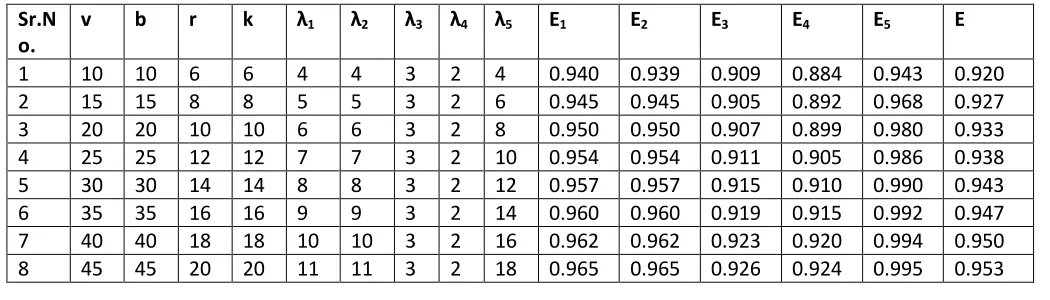
Table 3.3.1: Table of efficiencies for designs constructed from series III
Sr.N o.
v b r k λ1 λ2 λ3 λ4 λ5 E1 E2 E3 E4 E5 E
1 10 10 6 6 4 4 3 2 4 0.940 0.939 0.909 0.884 0.943 0.920
2 15 15 8 8 5 5 3 2 6 0.945 0.945 0.905 0.892 0.968 0.927
3 20 20 10 10 6 6 3 2 8 0.950 0.950 0.907 0.899 0.980 0.933
4 25 25 12 12 7 7 3 2 10 0.954 0.954 0.911 0.905 0.986 0.938
5 30 30 14 14 8 8 3 2 12 0.957 0.957 0.915 0.910 0.990 0.943
6 35 35 16 16 9 9 3 2 14 0.960 0.960 0.919 0.915 0.992 0.947
7 40 40 18 18 10 10 3 2 16 0.962 0.962 0.923 0.920 0.994 0.950
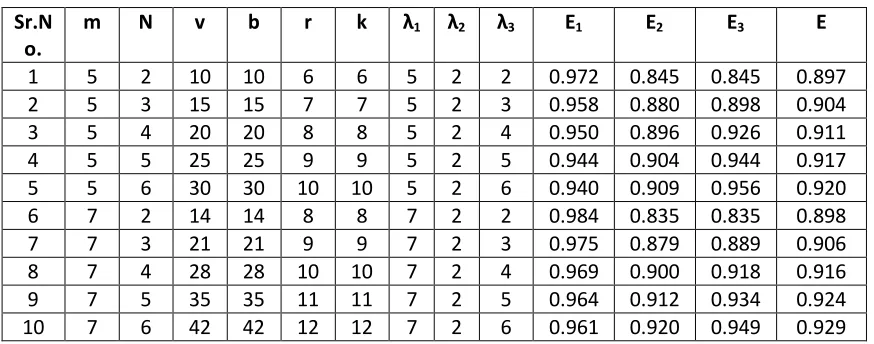
Table 4.1: Table of efficiencies for designs constructed from series IV
Sr.N o.
m N v b r k λ1 λ2 λ3 E1 E2 E3 E
1 5 2 10 10 6 6 5 2 2 0.972 0.845 0.845 0.897
2 5 3 15 15 7 7 5 2 3 0.958 0.880 0.898 0.904
3 5 4 20 20 8 8 5 2 4 0.950 0.896 0.926 0.911
4 5 5 25 25 9 9 5 2 5 0.944 0.904 0.944 0.917
5 5 6 30 30 10 10 5 2 6 0.940 0.909 0.956 0.920
6 7 2 14 14 8 8 7 2 2 0.984 0.835 0.835 0.898
7 7 3 21 21 9 9 7 2 3 0.975 0.879 0.889 0.906
8 7 4 28 28 10 10 7 2 4 0.969 0.900 0.918 0.916
9 7 5 35 35 11 11 7 2 5 0.964 0.912 0.934 0.924
10 7 6 42 42 12 12 7 2 6 0.961 0.920 0.949 0.929
CONCLUSION:
REFERENCES:
1. Bose, R. C., & Shimamoto, T. (1952). Classification and analysis of partially balanced incomplete block designs with two associate classes. Journal of the American Statistical Association, 47(258), 151-184.
2. Bose, R. C., Shrikhande, S. S., & Bhattacharya, K. N. (1953). On the construction of group divisible incomplete block designs. The Annals of Mathematical Statistics, 167-195.
3. Clatworthy, W. H. (1973). Tables of two-associate-class partially balanced designs. NBS Applied Mathematics Series 63, National Bureau of Standards, Washington, DC.
4. Dey, A. (1986). Theory of Block Designs.New York: Halsted.
5. Garg, D. K. (2010). Pseudo New Modified Latin Square (NML m (m)) Type PBIB Designs. Communications in Statistics—Theory and Methods, 39(19), 3485-3491.
6. Garg, D. K. & Farooq, A. (2014). Construction of PBIB designs using modified magnificent (Mn) matrices of type - ׀׀׀. Indian Journal of Applied Research, 4(2), 5 - 7.
7. Garg, D. K. & Singh, G. P. (2012). Construction of two series of higher associate class PBIB designs using symmetric differences. Far East Journal of Theoretical Statistics, 38 (2), 87 – 99.
8. Garg, D. K., & Singh, G. P. (2014). Construction of three associate class PBIB designs with three replicates using pairing in triplets system. PARIPEX – Indian Journal of Research, 3(2), 37 – 39.
9. Kageyama, S. & Miao, Y. (1995). Some methods of constructions of rectangular PBIB designs, Combinatorics Theory, 1, 186-198.
10. Kageyama, S., & Sinha, K. (2003). Some patterned constructions of rectangular designs. Journal of the Japan Statistical Society, 33(1), 137-144.
11. Mesner, D. M. (1967). A new family of partially balanced incomplete block designs with some Latin square design properties. The Annals of Mathematical Statistics, 38(2), 571-581.
12. Nair, C. R. (1980). Construction of PBIB designs from families of difference sets. Journal of Indian Society of Agricultural Statistics, 32, 33-40.
13. Nandi, H. K. & Adhikary, B. (1965). On the definition of Bose-Shimamoto cyclical association scheme. Calcutta Statistical Association Bulletin, 15, 165-168.
14. Parneet Kaur, Kush Sharma and Davinder Kumar Garg (2016). PBIBD: Partially Balanced Incomplete Block Designs. R package version 1.1.
https://CRAN.R-project.org/package=PBIBD
16. Raghavarao, D., & Aggarwal, K. R. (1974). Some new series of PBIB designs and their applications. Annals of the Institute of Statistical Mathematics, 26(1), 153-161.
17. Sinha, K. (1991). A construction of rectangular designs. Journal of Combinatorial Mathematics and Combinatorial Computing, 9, 199-200.
18. Sinha, K., Singh, M. K., Kageyama, S., & Singh, R. S. (2002). Some series of rectangular designs. Journal of statistical planning and inference, 106(1), 39-46.