2490
Child-Computer Interaction: Identifying Children’s
Interaction Ability And Pattern Formation In
Writing Mathematical Numbers
Nor Azman Ismail, Choo Yen Lee, M.C Abdullah
Abstract:— Nowadays children already exposed to the new technology and experience excellent learning adventures. Many studies have found that these new and emerging technologies could help children build their discipline and self-motivation. However, the number of studies that address interaction ability and pattern formation in writing mathematical number among kindergarten children are still limited. Designing children computer applications adapted to the capabilities of children is an important part of the today software development methodology. Thus, in this study, an investigation of children aged 5 to 6 years old writing ability in mathematical numbers with and without a computer software was investigated. Total 40 children from a kindergarten in Skudai, Johor were involved in the study. In the first study, the results show that the highest frequency of mirror-writings and formation writings of each error were number letter ―7‖ (more than 53%) and the number letter ―8‖ (more than 32%). Moreover, in the second study, the result show that the highest frequency of drop error and drawing error for each error was number letter ―5‖ (more than 40%) and number letter ―7‖ (more than 30%). However, the frequency of each error is differing due to the high different variability of each number letter. This study reports on the identified children’s interaction ability in writing mathematical numbers. The implications of these findings might encourage and establishing children requirements in designing children writing mathematical educational tool and application more effectively.
Index Terms:— Computer Mouse, Mirror Writing, Formation Writing, Child-computer Interaction, Human Computer Interaction —————————— ——————————
1
I
NTRODUCTIONFor many years children are introduced to computer technology and have experienced excellent learning adventures. Many studies have proven that children show ensuring capability in the design process at various stages [20]. However, children remain excluded in the software application design process. Children are not given enough opportunity to share their thoughts, feeling and requirements for technologies which they will interact with [21]. Thus, most of the application either fail to establish the interaction design or are not child-friendly [22]. Children’s requirements are different from adults. Children may play a significant role in the technology design process [26]. Druin [27] had previously suggested a framework that suggesting the level of children’s participation in the software design process (Fig. 1). Children can play four different roles in the design process; user, tester, informant or design partner. The growing rings indicates that as one moves from user to design partner, each role incorporates the one before it and becomes extensive and more involved [25]. Software designers and developers need to learn how to attract and acknowledge children development and changes. Therefore, the establishment of child's requirements and needs should be considered in building related technology and applying for them [14, 23-25]. Child Trends Databank had reported that use of the computer in school has had rapidly grow in early childhood education [8]. Many researchers reported that computer mouse is the most suitable input device for children but limited to certain tasks [9, 10]. For instance, click on a button and dragging computer mouse was difficult to perform by children. It was due to demand more motor skill and eye-hand coordination. Most of the computer mouse interaction involves drag-and-drop and click-move-click [9, 11-13].
Fig. 1. Levels of children’s involvement in the design
process
Elementary of mathematics is important in early childhood education [1] and research on children writing skill have increased attention over last two decades [2]. When children begin starting to learn writing, most of all children indicate the situation of reverse or wrong direction in writing some single letter [3]. A reverse of a single letter is known as mirror writing. For instance, number letter of 9 had been written as ―୧‖ or letter of 3 was written as ―Ɛ‖. Many researchers focus on mirror writing study but less of researchers focusing on wrong direction writing [4-7]. Investigation on how children write mathematical number benefit to early childhood development. Although current computer technologies are believed to have advantages, little has been done to understand how to design a children computer interaction to facilitate children's in learning mathematical numbers. Therefore, evaluation to identify children interaction problem occur in writing mathematical number is important in designing children technology. In this paper, we report from two different studies on the interactions ability and pattern formation of children in
___________________________________
Nor Azman Ismail is an Associate Professor in Human Computer Interaction, Universiti Teknologi Malaysia, E-mail: [email protected] •Choo Yen Lee currently pursuing PhD degree program in computer
Science in Universiti Teknologi Malaysia, E-mail: [email protected] •M.C Abdullah currently pursuing Master degree program in Computer
writing mathematical numbers. Each study involved 20 children that participated in the evaluations tasks. The first study evaluation based on the paper-based prototype. The second study focuses on interaction evaluation based on the computer-based prototype.
2 Method
2.1 Study A
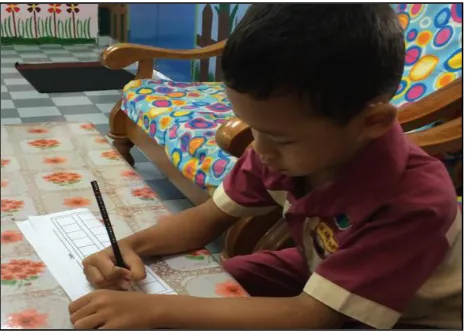
This study used to observe and revised how children writing mathematical numbers through paper-based. The aims of the study were: How much time spends to write the mathematical number? And identify the problems when children write mathematical number without a computer?
A. Participants
20 children (9 boys and 11 girls) at the age of 5 to 6 years old (M, mean=5.38, SD=0.56) participated. All of these children had been teaching to writing the mathematical number from number 0 to 9 in kindergarten. 15 children are right-handle while another 5 children are left-handle. One of the participant results had been excluded due to her result was not in the range of obtained data. The children were not aware of a pack of snack, as compensation will be given for their involvement in this study.
Fig. 2 Paper-based Prototype
B. Procedures and Task
20 children (9 boys and 11 girls) at the age of 5 to 6 years old (M, mean=5.38, SD=0.56) participated. All of these children had been teaching to writing the mathematical number from number 0 to 9 in kindergarten. 15 children are right-handle while another 5 children are left-handle. One of the participant results had been excluded due to her result was not in the range of obtained data. The children were not aware of a pack of snack, as compensation will be given for their involvement in this study.
2.2 Study B
Our experiment is to identify and study the problem of children in writing the mathematical number with and without the computer. Therefore, study B was to study the identity problems occur when children write the mathematical number with the computer. In particular, we wanted to evaluate time taken to write each number letter and identify the problem
occur using the computer mouse to write number letter.
A. Participants
This time 20 children (13 boys and 7 girls) at the age of 5 to 6 years old (M, mean=5.42, SD=0.35) participated as test subjects in the experiment. All of these children had been teaching to writing the mathematical number from number 0 to 9 in kindergarten. The effect of controlling computer mouse either by left-handers or right handle is not taken into account in this study because the other researchers showed that no different between them [15-17]. In addition, 20 children were right-handle in controlling the computer mouse. One of the children got the experiences of using the computer because he has been attended computer class before. Moreover, this participant is well performed with the computer but his result was well within the range of obtained data to analyses. Additional, [18] noted that for younger children (5-6 years old) previous experience does not influential on mouse performance. The children were not aware of that, a pack of snack, as compensation will be given for their involvement in this study.
B. Procedures and Task
The experiment conducted in a small room provided by the headmaster of kindergarten to avoid interferes from the other children. Children have been given an explanation and ensure they cleared with what they needed to do before the experiment started. A video recorder had been used to record children’s’ activities during the tasks has. Children had to write the mathematical number through computer mouse only neither keyboard nor both simultaneously are not allowed in this study. Participants are allowed to put the mouse in any place that they felt comfortable to use on it (Fig 3).
Fig. 3 Computer-based prototype in Preschool Classroom
Activity Settings
3 R
ESULTSA. Study A: Writing Mathematical Number in Paper-Based Prototype The total of 190 productions produces by 19 participants in this Study (19 children x 10 number letters). Average times taken for each mathematical number letter are shown in Table 1.
TABLEI
AVERAGE TIMES TAKEN FOR EACH MATHEMATICAL NUMBER
LETTER
Number Letter Time (in second)
1 10.65
2 21.15
2492
4 20.60
5 29.85
6 16.95
7 11.55
8 15.70
9 22.10
0 14.90
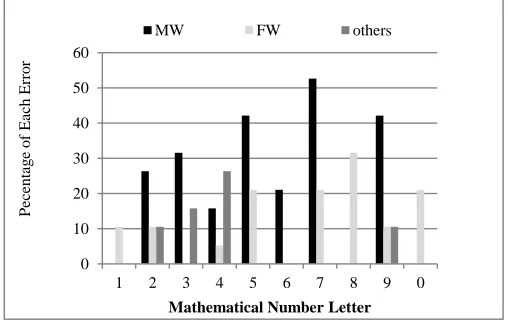
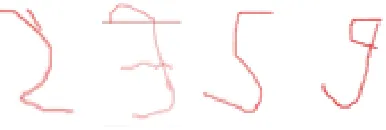
As it can be seen, the average of times in writing number letter ―1‖ was the shortest compare to writing number letter ―8‖. According to these result, the time taken to write number letter for (1,3,6,7,9) is less than 3s while writing number letter for (0,2,4,5,8) is require more time to write. Based on the observation, when children write the mathematical number through paper-based prototype, it found that there were two types of errors occurs. These errors are known as mirror writing error and formation writing error. Mirror writing is a direction that is a reverse of number letter. For example, mathematical number letter of 9 had been written as ―୧‖, letter of 3 was written as ―Ɛ‖. Formation writing is the wrong direction of starting point and end point such as starting letter from the bottom, right to left or even going back and filling in missing parts of the number letters. For example in writing number letter ―1‖, the correct formation of writing number letter ―1‖ was started from the top to bottom, but the children perform in different ways. In task 1, two children tended to write in reverse direction in writing the letter ―1‖. Out of 190 productions, it consists of 109 (57.37%) correct writings, 44 (23.16%) mirror-writings, 25 (12.16%) incorrect formation writing and 12 (6.31%) others (both mirror writing and incorrect formation writing or incorrect letter). The frequency of mirror writing and formation writing for each number letter is shown in Fig 4. In particular, the highest percentage of mirror-writings of the number letter ―7‖ (more than 53%) compare with number letters ―1‖, ―8‖ and ―0‖ which have no (0%) mirror writing error. Fig 5 show the sample output of mirror writing performs by children during the study.
MW – Mirror Writing FW – Formation Writing Others - Both Mirror and Formation writing or incorrect
Fig. 4. Percentage of each error for each number letter
Fig. 5. Samples of mirror writing for number letter 2,3,4,7
and 9
Next, the highest percentage of formation writing of the number letter ―8‖ (more than 32%) contrast with number letter ―3‖ and ―6‖ which have no (0%) formation writing error. Fig 6 show the sample output of formation writing performs by children during the study.
Fig. 6 Samples of formation writing for number letter 1 and 8
B. Study B: Writing Mathematical Number in Computer-Based Prototype Before discussing the result, it is important to emphasis that in this study we focus on the interaction of children in controlling the computer mouse to write the mathematical number. Average times taken for each mathematical number letter are shown in Table 2.
TABLEII
AVERAGE TIMES TAKEN FOR EACH MATHEMATICAL NUMBER
LETTER
Number Letter Time (in second)
1 1.68
2 3.00
3 2.72
4 4.04
5 4.24
6 2.76
7 2.88
8 6.52
9 2.64
0 2.64
As it can be seen, the average of times in writing number letter ―1‖ was the shortest compare to writing number letter ―5‖. According to these result, the time taken to write number letter for (0,1,7) is less than 15s while writing number letter for (2,3,4,5,6,8,9) is require more time to write. Based on the observation, when children write the mathematical number through computer-based prototype, it found that there were two types of errors occurs in using the computer mouse. These errors are known as drop error and drawing error. Drop error occur when dropped the objects before reaching the end point while drawing error is children write outside of the specific area.
0 10 20 30 40 50 60
1 2 3 4 5 6 7 8 9 0
P
ec
ent
ag
e
o
f
Ea
ch
Er
ro
r
Mathematical Number Letter
Fig. 7 Percentage of interaction error occur for each mathematical number
The frequency of drop error and drawing error for each number letter is show in Fig 7. In particular, the highest percentage of drop error in writing number letter ―5‖ (more than 40%) compare with number letters ―1‖ and ―7‖ which have no (0%) dropping error. Fig 8 shown the sample output of drop error performs by children during the study. Next, the highest percentage of drawing error of the number letter ―7‖ (more than 30%) compare to the low percentage of drawing error of some of the number letter (less than 10% for number letter 2,4,9 and 0). Fig 9 show the sample output of formation writing performs by children during the study.
Fig. 8 Samples of drop error for number letter 2, 3, 5 and 9
Fig. 9 Samples of drawing error for number letter 3, 8 and 9
4 C
ONCLUSIONThis paper has reported from two different studies on children ability in performing writing mathematical number with and without the computer. The first study revealed that evaluation of time taken and identifies the problem of children in writing the mathematical number. Mirror writing is typical occur in the developing children [20]. The result showed that average of 23% of children occurs mirror writing problem, 13% of children occur formation writing problem and 6% of children occur both mirror and formation writing problem. The frequency of percentage for each error is different for each mathematical number letter. However, from the observation, we found that many students occur formation-writing problem while writing
the mathematical number. Formation writing is very important in children development, it may occur children learning ability problem in future. But there are fewer researchers were focusing on writing formation error. The correct number formation guide as shown following:
Fig. 10 Number letter formation guide (provided by
kindergarten teacher)
As our prediction time taken in writing mathematical number though computer-based prototype will take longer time compare to paper-based prototype was true. This was due to children are not familiar with using the computer mouse and less motor ability in controlling the computer mouse. Moreover, we also found that some children are used to turn their paper when writing the mathematical number. It seems like they prefer in moving the paper compared to moving their hand to write the mathematical number. Next, the second study revealed that evaluation and identify the computer mouse interaction while writing the mathematical number. The result showed that average of 20% of children occur drop error, 17% of children occur drawing and 7% of children occur both drop and drawing error. Time taken to write number letter 0, 1 and 7 were less compare to another mathematical number, this was due to these number letters require less movement or less different angle to control the computer mouse. However, for number letter ―5‖ is the most difficult number which requires more different angle to move the computer mouse. Moreover, we also found that when children felt difficult in controlling the computer mouse, they use two hands to move the computer mouse to write the mathematical number. Some of the children felt frustrated in using the computer mouse, but they still want to play again using the computer to learn to write the mathematical number. It can be concluded that all the student able to write the mathematical number with and without the computer. It requires more time when children perform writing through using the computer mouse. We found that most of the children are agree that using the computer to learn to write mathematical number is more fun and enjoyable compared to paper-based prototype. They felt more excited and motivate to use the computer to learn the mathematical number. In order to enhance children interaction performance with the computer, it is suggested an alternative input modality technology in assist children with education technology. Future study should conduct to found out the applicable and suitable devices for children before implementing.
A
CKNOWLEDGMENTThe authors wish to thank members of VicubeLab research group and School of Computing. This work was supported in part by a grant from Universiti Teknologi Malaysia (UTM).
R
EFERENCES[1] National Association for the Education of Young Children & National Council of Teachers of Mathematics (NAEYC/NCTM), ―Position statement: Early childhood mathematics: Promoting good beginnings.‖ 2002/2010, Available online http://www.naeyc.org/
0 5 10 15 20 25 30 35 40 45
1 2 3 4 5 6 7 8 9 0
P
ec
ent
ag
e
o
f Ea
ch
Er
ro
r
2494
[2] [2] G. E. Binghama, M. F. Quinna, H. K. Gerdeb, 2017. ―Examining early childhood teachers’ writing practices: Associations between pedagogical supports and children’s writing skills.‖ Early Childhood Research Quarterly, vol. 39, 2nd Quarter 2017, p. 35–46.
[3] J. P. Fischer and A. M. Koch, ―Mirror writing in typically developing children: A first longitudinal study.‖ Cognitive Development, vol. 38, 2016, p.114–124.
A. Brennan, ―Mirror writing and hand dominance in children: a new perspective on motor and perceptual theories.‖ Yale Review of Undergraduate Research in Psychology, vol. 4, 2012, p. 12–23.
[4] J. P. Fischer, ―Digit reversal in children’s writing: a simple theory and its empirical validation.‖ Journal of Experimental Child Psychology, vol. 115, 2013, p. 356–370
[5] J. P. Fischer, ―Mirror writing of digits and (capital) letters in the typically developing child.‖ Cortex, vol. 47(6), 2011, p. 759–762.
[6] R. D. McIntosh and S. S. Della, ―Mirror-writing.‖ The Psychologist, vol. 25(10), 2012, p. 742–746.
[7] Child Trends DataBank, 2015. Available online: http://www.childtrends.org/?indicators=home-computer-access.
A. Donker and P. Reitsma, ― Young children’s ability to use computer mouse.‖ Computers and Education, vol. 48(4), 2007, p. 602–617.
[8] E. Wood, T. Willoughby, A. Schmidt, L. Porter, J. Specht, and J. Gilbert, ―Assessing the use of input devices for teachers and children in early childhood education programs.‖ Information Technology in Childhood Education Annual, 2004, p. 261–280.
[9] D. J. Gillan, K. Holden, S. Adam, M. Rudisill and L. Magee, ―How does Fitts’ law fit pointing and dragging?.‖ In Proceedings of Human Factors in Computing Systems (CHI 90), ACM Press, 1990, p. 227–234.
[10]K. Inkpen, K. S. Booth, and M. Klawe, ―Interaction styles for educational computer environments: a comparison of drag-and-drop vs. point-and-click.‖ Technical Report No. 96-17, Department of Computer Science, University of British Columbia, 1996a, Available online: http://www.cs.sfu.ca [11]K. Inkpen, K. S. Booth and M. Klawe, ―Drag-and-drop vs.
point-and-click mouse interaction for children. ―Technical Report No. 96-20, Department of Computer Science, University of British Columbia, 1996b, Available online: http://www.cs.sfu.ca/~inkpen/Papers/TR20_DD.
[12]J. C. Read and M. M. Bekker, ―The nature of child computer interaction.‖ In Proceedings of the 25th BCS Conference on Human-Computer Interaction (BCS-HCI '11), British Computer Society, Swinton, UK, 2011, p.163-170.
[13]A. Donker and P. Reitsma, ―Young children’s ability to use computer mouse.‖ Computers & Education, Elsevier Inc., vol. 48(4), 2007, p. 602–617.
[14]M. Peters and V. J. Ivano, ―Performance asymmetries in computer mouse control of right-handers, and left-handers with left- and right-handed mouse experience.‖ Journal of Motor Behavior, vol. 31(1), 1999, p. 86–94.
[15]V. Woods, S. Hastings, P. Buckle and R. Haslam, ―Development of non-keyboard input device checklists through assessments.‖ Applied Ergonomics, vol. 34(4), 2003, p. 511–519.
[16]R. Joiner, D. Messer, P. Light and K. Littleton, ―It is best to point for young children: a comparison of children’s pointing
and dragging.‖ Computers in Human Behavior. Elsevier Inc. vol. 4(3), 1998, p. 513–529.
[17]J. P. Fischer and A. M. Koch, ―Mirror writing in 5- to 6-year-old children: the preferred hand is not the explanation.‖ Laterality: Asymmetries of Body, Brain and Cognition, vol. 21(1), 2016, p. 34–49.
[18]Sitbon, L. and Farhin, S. (2017). Co-designing interactive applications with adults with intellectual disability. Proceedings of the 29th Australian Conference on Computer- Human Interaction - OZCHI ’17, 487–491. [19]Iversen, O. S., Smith, R. C. and Dindler, C. (2017). Child as
Protagonist: Expanding the Role of Children in Participatory Design. Proceedings of the 2017 Conference on Interaction Design and Children - IDC ’17, 27–37.
[20]Walsh, G. and Foss, E. (2015). A case for intergenerational distributed co-design: The Online Kidsteam Example. Proceedings of the 14th International Conference on Interaction Design and Children - IDC ’15, 99–108.
[21]Papadakis, S., Kalogiannakis, M. and Zaranis, N. (2018). Educational apps from the Android Google Play for Greek preschoolers: A systematic review. Computers & Education. 116, 139–160.
[22]Kumar, B. A. and Mohite, P. (2018). Usability of mobile learning applications: a systematic literature review. Journal of Computers in Education. 5(1), 1–17.
[23]Guha, M. L. and Fails, J. A. (2018). Kids and Design. The Wiley Handbook of Human Computer Interaction. 1(2002). [24]Fails, J. A., Druin, A. and Guha, M. L. Interactive storytelling:
interacting with people, environment, and technology. International Journal of Arts and Technology. 7(1), 112–124. 2014