Molecules 2020, 25, x; doi: FOR PEER REVIEW www.mdpi.com/journal/molecules Article
Exploring the Potential of
-Catenin O-GlcNAcylation
by Using Fluorescence-Based Engineering and
Imaging
Angelina Kasprowicz 1, Corentin Spriet 1, 2, Christine Terryn 3,Matthew G. Alteen 4, Tony Lefebvre 1 and Christophe Biot 1,*
1Univ. Lille, CNRS, UMR 8576 – UGSF – Unité de Glycobiologie Structurale et Fonctionnelle 59000 Lille (France); [email protected] (A.K.); [email protected] (C.S.); [email protected] (T.L.); [email protected]@univ-lille.fr (C.B.)
2Univ. Lille, CNRS, UMS 2014 - US 41 - Plateformes Lilloises en Biologie & Santé. 59000 Lille (France); [email protected] (C.S.)
3PICT Platform, University of Reims Champagne-Ardenne, 51 rue Cognacq-Jay, 51100, Reims (France); [email protected] (C.T.)
4Department of Chemistry, Department of Molecular Biology and Biochemistry, Simon Fraser University, Burnaby (Canada) ; [email protected] (M.A.)
* Correspondence: [email protected]; Tel.: +33 (0)3 20 43 61 41
Abstract:
Monitoring glycosylation changes within cells upon response to stimuli remains challenging because of the complexity of this large family of post-translational modifications (PTMs). We have developed an original tool enabling labeling and visualization of the cell cycle key-regulator -catenin in its O-GlcNAcylated form based on intramolecular Förster resonance energy transfer (FRET) technology in cells. We opted for a bioorthogonal chemical reporter strategy based on the dual-labeling of -catenin with a green fluorescent protein (GFP) for protein sequence combined with a chemically-clicked imaging probe for PTM resulting in a fast and easy to monitor qualitative FRET assay. We validated this technology by imaging the O-GlcNAcylation status of -catenin in HeLa cells. Moreover, the changes in O-GlcNAcylation of -catenin were varied by perturbing global cellular O-GlcNAc levels with inhibitors of O-GlcNAc transferase (OGT) and O-GlcNAcase (OGA). Finally, we provided a flowchart demonstrating how this technology is transposable to any kind of glycosylation.
Keywords: bioorthogonal chemistry, fluorescence, glycosylation, metabolic incorporation, GFP, -catenin.
1. Introduction
The complete set of glycans, i.e. the glycome, represents a large diversity of structures and functions, and plays a central role in biology and health [1]. Glycans are involved in many biological processes such as protein folding and traffic, cell-to-cell recognition, immune defense, or cell protection [1]. Glycans are also specific markers for numerous pathologies including, most notably, cancers [2]. This functional diversity is linked to great structural diversity. Indeed, a wide variety of different forms of glycosylation are possible and, moreover, variation in glycosylation of the same protein within tissues occurs leading to various “glycoforms” of a given protein glycoforms [3].
The various forms of glycosylation is essential for cell homeostasis, in this regard it is considered that 2% of the human genome is devoted to glycosylation. The most complex forms of glycosylation, namely N-linked protein, O-linked protein, and O-linked mucin-type glycosylation, take place
mainly in the endoplasmic reticulum and the Golgi apparatus where the requisite biosynthetic
enzymes residue. Another widespread form of glycosylation is O-linked -N
-acetylglucosaminylation (O-GlcNAcylation) [4]. O-GlcNAcylation is much more simple than
glycosylation occurring within the secretory pathway and consists of the modification of cytoplasmic, nuclear and mitochondrial proteins with a single residue of N-acetylglucosamine (GlcNAc). Further, in contrast to the more complex glycosylation of the secretory pathway, O-GlcNAcylation is highly
dynamic, its versatility being managed by a unique couple of enzymes, O-GlcNAc transferase (OGT)
and O-GlcNAcase (OGA), which respectively install and removes the GlcNAc moiety on and off targeted substrate proteins [5].
During the last three decades, Metabolic Oligosaccharide Engineering (MOE, also termed Metabolic GlycoEngineering (MGE)) paved the way for the manipulation of biosynthetic pathways responsible for oligosaccharides and glycoconjugates production [6–9]. MOE exploits the substrate promiscuity of different glycosylation pathways to incorporate non-natural monosaccharides into cellular glycans. Upon metabolization, the non-natural saccharides are detected with a complementary probe through bioorthogonal ligation. This technology has been mostly used for labeling cell surface-exposed glycoconjugates especially with fluorescent probes [6,7], but there are some intra-cellular MOE applications, notably targeting O-GlcNAc.
However, these strategies usually aim to report for the general glycosylation status of a cell and, to date, only a few MOE methods have been reported that account for the glycosylation pattern of a single specific glycoprotein. The five examples are based on dual-labeling strategies exploiting Förster resonance energy transfer (FRET). Haga and coworkers used azido sialic acid (SiaNAz) labeling of GLUT4-GFP to image cell surface glycoproteins [3]. Belardi and coworkers developed a technique using Ac4ManNAz (the precursor of SiaNAz) to study the vitronectin receptor V3 after targeting with a donor fluorophore‐labeled Fab fragment [10]. The dual-labeling of membrane proteins developed by Lin and coworkers relies on two bioorthogonal chemical reporters delivered one to the protein and the other to the glycan [11]. Surprisingly, only modest progresses have been made in studying intracellular glycosylation with O-GlcNAc. The two examples to visualize O -GlcNAcylation in a protein-specific manner has been also reported by Lin and coworkers [12], and Doll and coworkers [13].
Herein, we present optimized methods for probing the glycosylation state of -catenin within HeLa cells using fluorescence-based imaging. -catenin plays many critical functions in animals. First, Wnt/-catenin signaling – for which the protein is the central component - is actively involved in embryonic development from fly to mammals [14]. -catenin is also crucial for cell cycle progression and for the maintenance of the adherens junctions in epithelia. -catenin is a proto-oncoprotein, its upregulation being responsible for tumorigenesis in a wide variety of cancers. The fate of the protein is well established as being controlled by phosphorylation of a D-box located at the N-termini: phosphorylation at S33, S37, T41 and S45 trigger the poly-ubiquinylation of -catenin and its subsequent targeting to the 26S proteasome [15]. Therefore, mutations of the D-box or deletions of the N-termini of -catenin are frequently found in patients’ tumors. We have previously demonstrated that O-GlcNAcylation of -catenin reduced its proteasomal susceptibility, particularly
modification of T41 with O-GlcNAc was found to interfere with the sequential phosphorylation and
ubiquitinylation that leads to destruction of this protein [16]. Given these important biological roles and defined functions for specific post-translational modifications, -catenin appeared to us as the model of choice for the development of our strategy of visualization of specific glycosylated proteins in cells.
2. Results
We have opted for a bioorthogonal chemical reporter strategy to detect the O-GlcNAc modification state of -catenin. This technology is based on the incorporation of a chemically modified metabolic precursor of UDP-GlcNAc [16] bearing a pendant bioorthogonal handle at the 2-position of the pyranose ring. This chemically reactive analogue permits conjugation with a fluorophore to generate an imaging probe. This approach allows the in vivo study of O-GlcNAc modified -catenin without interfering with native biological processes (Figure 1). The technology we propose involves the dual-labelling of -catenin with a genetically encoded GFP tag followed by
bioorthogonal installation of a second fluorophore on the O-GlcNAc unit. The combined use of two
fluorescent reporters in close proximity to each other enables a convenient and efficient FRET assay suitable for imaging cells.
Figure 1. Schematic representation of the strategy: FRET-based imaging of dual labeling of protein and glycans.
-catenin is genetically labelled with GFP (donor). The intracellular O-GlcNAcylated proteins are labelled by metabolic oligosaccharide engineering (MOE) followed by bioorthogonal chemistry with a fluorophore (acceptor). As the distance between donor and acceptor is less than 10 nm, only acceptor bound to the glycans on -catenin is excited via intramolecular FRET.
Briefly, the chemical structure of UDP-GlcNAc is shown in the upper right in Figure 1 (green box). The different colors represent the various metabolic origins of the nucleotide-sugar, as follow:
brown, carbohydrate metabolism; blue, glutamine metabolism; purple, metabolism of fatty acids and ketogenic amino acids; green, nucleotide metabolism. The unnatural GlcNAc analog used for our
tracing strategy is Ac4GalNAz (see below). This reporter enters the cell by passive diffusion.
Thereafter, Ac4GalNAz is deacetylated by esterases and then further metabolized to generate
UDP-GalNAz. After isomerization into UDP-GlcNAz by the epimerase GALE (UDP-glucose 4-epimerase), OGT transfers GlcNAz to a set of proteins including GFP-β-catenin. The addition of a compatible
alkyne-labeled fluorophore results in conjugation of the fluorophore to the azide handle of the GlcNAz unit through a strain-promoted azide-alkyne cycloaddition (SPAAC). This permits FRET
between the GFP group and the fluorophore conjugated to the sugar, making it possible to specifically visualize O-GlcNAcylated β-catenin in cells.
UTP PPi
lem=563 nm
GFP- -catenin
lexc=489 nm
lem=509 nm
O H O H O O H N O H
C H3
O PO PO N
H O O H O N H O O O O O O
U D PG lcNA c
O H O H N O H C H2 O H O O H N N N
G alNA z U D PG alNA z
O H O H N O H C H2 O H O N N N
OU D P
U D PG lcNA z
O H O H N O H C H2 O N N N
O U D P H O
Met aboli
c Eng ineer
ing
Protein Engineering
A c4G alNA z
O
A cO H N OA c
C H2
O A cO
OA c
N N
N
O A cO
H N OA c
C H2
O A cO
OA c
N N N O H O H N O H
H2C O N N N O H O FRET
2.1. Optimization of fusion protein linker
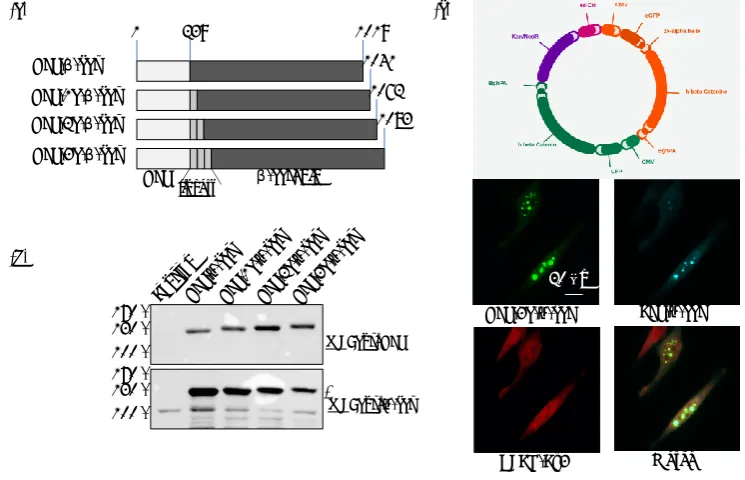
The linker between -catenin and GFP is an important consideration in order to satisfy the requirements for FRET, including the distance between fluorophore pairs (< 10 nm) and dipole orientation. Therefore, four different fusion proteins were investigated with either no linker or 1-to-3 -helix linkers (1a, 2a and 3a) inserted between the GFP and the -catenin domains: (1) GFP- -catenin, (2) GFP-1a--catenin, (3) GFP-2a--catenin and (4) GFP-3a--catenin (Figure 2a). As a lack of rigidity of these linkers can be a limitation for FRET-based systems [17], a semi-flexible peptide linker
(EAAKEAAAKEAAAKEAAAKA)1-3, which adopts an alpha helix conformation, was chosen to
bridge the domains. We envisioned this linker would strike a balance in the degee of motility between the two domains, maximizing the potential for efficient FRET.
The different N-terminal GFP-tagged -catenins were produced in HeLa cells and analysed by western blotting in order to assess the expression level of each form (Figure 2b). We found that all four fusion protein constructs were suitably expressed and therefore chose to assess each variant in microscopy experiments. Note that the insertion of linkers increases the apparent molecular weight
of GFP--catenin depending on the number repeats between the two domains.
Figure 2 Design and validation of fluorescent -catenin fusion proteins.
a) Schematic representation of the different GFP--catenin constructs used in this study. b) HeLa cells were transfected with the various GFP--catenin expressing vectors. Cell lysates were analyzed by western blots using anti-GFP and anti--catenin antibodies. The asterisk indicates the detection of the endogenous form of -catenin. (c) Fluorescence images of HeLa cells expressing GFP-3a−-catenin and CFP--catenin, treated with 200 M Ac4GalNAz and labeled with 100 M DBCO-cy3. The map of
the vector encoding both the GFP-3a--catenin and the CFP--catenin is shown above.
To ensure that FRET will be related to the proximity between donor and acceptor, and not to relative orientation of each modification, we choose the most flexible construct (GFP-3a--catenin) for FRET experiments.
Interestingly, a di-systronic expression vector was designed and produced in order to combine the direct synthesis and secretion of both GFP-3a--catenin and cyan fluorescent protein β-catenin construct(CFP--catenin). Fluorescence colocalization microscopy demosntrated that both proteins localize in the same subcellular compartments (Figures 2c). Therefore, we chose to proceed with the GFP--catenin construct in future experiments because to achieve optimal spectral overlap. We also
concluded that the length of linker between the GFP and β-catenin domains has no dramatic effect
on the integrity of the fusion protein.
GFP
linkers b-catenin
1 239 1019
GFP-b-cat
GFP-1a-b-cat
GFP-2a-b-cat
GFP-3a-b-cat
GF P-ß-cat Cont
rol GF
P-1a-ß -cat
GF P-2a-ß
-cat
GF P-3a-ß
-cat
WB: anti GFP
WB: anti ß-cat
1041
1062
1083
100 130 170 100 130
-170 - GFP-3a-ß-cat CFP-ß-cat
DBCO-Cy3 Merge
(c)
20 µm
* (a)
2.2. Optimization of metabolic oligosaccharides engineering (MOE)
The ligation reactions used in the metabolic oligosaccharides engineering (MOE) technology are
based on the principle of “click chemistry“ introduced by the group of Sharpless [18]. A wide range of bioorthogonal reactions has been developed including nucleophilic substitution reactions, carbonyl chemistry and cycloaddition reactions between unsaturated compounds such as Diels-Alder reactions or 1,3-dipolar cycloaddition reactions. Here, we chose the strain-promoted alkyne-azide cycloaddition (SPAAC) due to its ability to label glycans in live cells [19]. Being one of the most widely used cyclooctyne derivative due to its robust stability and reactivity, we selected a fluorophore carrying a dibenzylcyclooctyne (DBCO), also known as ADIBO (azadibenzocyclooctyne) or DIBAC (dibenzoazacyclooctyne) [20].
As N-azidoacetylglucosamine (GlcNAz) turned out to be a weak metabolic labeling reagent [16],
we instead used N-azidoacetylgalactosamine (GalNAz) which is more efficiently metabolized into
UDP-N-GlcNAz in cells. In its peracetylated form (Ac4GalNAz), this derivative has the property of being cell-permeable.
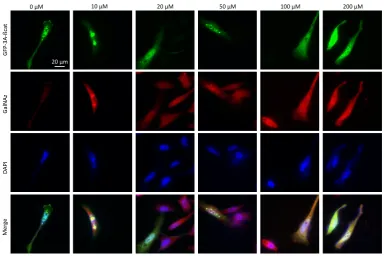
To address the optimum Ac4GalNAz concentration for cell labeling and FRET analysis, HeLa
cells were treated with increasing Ac4GalNAz concentration (10, 20, 50, 100 and 200 M) to introduce the O-GlcNAz onto intracellular O-GlcNAcylated proteins. The azidosugar was then labeled with the
with DBCO-cy3 FRET acceptor (100 M) using the SPAAC reaction, permitting visualization of O
-GlcNAz modified β-catenin. Colocalization of green and red signals produced a yellow color, validating the dual labeling (figure 3).
Figure 3. Optimization of the concentration of the chemical reporter.
HeLa transfected with the GFP-3a--catenin expressing vectors were treated with increasing Ac4GalNAz concentration (10, 20, 50, 100 and 200 M) and labeled with DBCO-cy3 (10 M).
As shown in Figure 3, no modification of the morphology of the cells was observed even at the highest dose of 200 M of the chemical reporter showing that the the toxicity of the azidosugar concentration is very negligible even at the highest concentrations. Acetic acid release inside cells
upon enzymatic deacetylation of Ac4GalNAz did not seem to induce cytotoxicity as was previously
reported for Ac4ManNAz (>50 μM) [21]. In order to promote high FRET efficiencies, we chose the highest Ac4GlcNAz concentration of 200 M.
10 µM 20 µM 50 µM 100 µM
0 µM 200 µM
GFP
D
A
P
I
M
er
ge
G
al
N
A
z
G
FP
-3
A
-ß
ca
t
2.3. SLiM-FRET readout assay
To carry out a quantitative analysis of the FRET between the GFP and the cy3-labeled GlcNAc, a Spectral fluorescence Lifetime imaging Microscopy (SLiM) acquisition system was used, permitting unambiguous FRET measurements (Figure 4a). In the absence of the chemical reporter, a mean value (m) of 2.8+/- 0.06 ns was observed in GFP-3a--catenin-expressing cells (Figure 4b).
We then imaged GFP-3a--catenin expressing cells that were treated with Ac4GalNAz and click-labeled with DBCO-cy3. Using these conditions, the m value of the GFP reporter in Ac4 GalNAz-treated cells decreased to 2.5+/-0.17 ns (Figure 4b). A FRET event can thus be observed with a p value <0.05.
G
FP
Control
20 µm
GFP-3a-ß-cat
d
GFP-3a-ß-cat /Ac4GalNAz
GFP-ß-cat GFP-1a-ß-cat GFP-2a-ß-cat GFP-3a-ß-cat
D
A
P
I
M
er
ge
G
al
N
A
z
G
FP
20 µm
Mean lifetime: 2.8ns
Mean lifetime: 2.5ns
GFP-3a-ß-cat GlcNAz Merge
B
ef
o
re
A
ft
er
0 0,5 1 1,5 2 2,5 3 3,5 4 4,5 5
Ac4GalNAz Ac4GalNAl
PbFRET (%)
FRET
(b) (c)
Figure 4. Proof of feasibility: FRET imaging of O-GlcNAcylated GFP-3a--catenin
(a) Fluorescence images of HeLa cells expressing GFP-linker--catenins, treated with 200 M Ac4GalNAz and labeled with DBCO-cy3. (b) SLiM-FRET experiment using two-photon excitation:
representative photon decay curves and associated fluorescence mean lifetime extracted from only the GFP emission channel. (c) Donor dequenching after acceptor photobleaching. The inserted blue box indicates the photobleached area. Histograms correspond to calculated pb-FRET inside the cells after photobleaching.
These experiments allowed us to observe variations up to 300 picoseconds in lifetime
experiments. This range corresponds to a deviation from GFP-3a--catenin basal O-GlcNAcylation
level to the non-O-GlcNAcylated state. This dynamic range is sufficient to decipher subtle variations in O-GlcNAcylation levels.
We have thus demonstrated that our device associating GFP-3a--catenin GalNAz-cy3
SLiM-FRET strategy is sufficiently sensitive for use in live cells. This important point at this level of the study can be considered as a proof of concept for this new tool.
2.4. Pb-FRET readout assay
While SLiM allows quantitative and sensitive FRET measurements, it requires a dedicated acquisition system and is highly time-consuming. After validation of the biosensor using SLiM, we wanted to demonstrate the robustness of our method using a traditionnal confocal microscope to monitore FRET through a photobleaching FRET readout assay, a fast and widely available technology.
As depicted in Figure 4c, DBCO-cy3 was specifically photobleached within a defined region of the cell in order to keep an internal control [23]. Using pb-FRET, we observed a measurable FRET efficiency of 4.4+/-0.1 on GFP-3a--catenin expressing cells when treated with Ac4GalNAz and click-labeled with DBCO-cy3.
In order to confirm that measured FRET resulted from intramolecular FRET, we performed control experiments with GFP-3a--catenin and the alkyne-containing reporter Ac4GalNAl [23]. This analogue is unable to react with DBCO-cy3, allowing evaluation of the possible contributions from intermolecular FRET between the two fluorophores. More than a thousand intracellular proteins are post-translationally modified with O-GlcNAc and thus susceptible to incorporation of GlcNAz
followed by DBCO-cy3. However, maintaining low expression of GFP--catenin and concentration
of cy3 in a 3D environment induces a statistically neglectable amount of donor and acceptors in close
vicinity [24]. No measurable FRET compared to GFP--catenin alone was monitored as confirmed by
experiments presented in Figure 4c. Indeed, a low background signal of 1.2 +/-0.5 was recorded when cells were treated with Ac4GalNal.
2.5. Pharmacology
Having developped an efficient, robust and easy to use technique to process Hela cells for pb-FRET imaging, we used this approach to evaluate the pharmacological effects of thiamet-G and Ac45SGlcNAc. Thiamet-G [25] and Ac45SGlcNAc [16] are effective cell active inhibitors of O
-GlcNAcase (OGA) and O-GlcNAc transferase (OGT) respectively. OGT catalyzes the addition of O
-GlcNAc to proteins [26], OGA removes the modification [27]. Thiamet-G is a potent (in vitro Ki = 2.1
nM, cell-based EC50 = 21 nM) stable mimic of the oxazoline-like transition state used by OGA active
site during the OGA-catalyzed hydrolysis of O-GlcNAc leading to an increase of O-GlcNAc
modification of proteins. Within cells, the prodrug Ac45SGlcNAc generates the OGT inhibitor
UDP-5SGlcNAc (in vitro Ki = 5 M) within cells and decreases cellular O-GlcNAcylation , (cell-based EC50
= 5 M). Both compounds have been evaluated in SK-N-AS cells for imaging the changes of tau O
-GlcNAc [12], to the best of our knowledge this is the first study to compare the inhibitory effect of thiamet-G and Ac45SGlcNAc upon O-GlcNAcylation on β-catenin in living cells.
pb-FRET signal was recorded consitent with a higher rate of occupancy of O-GlcNAc moieties on -catenin in response to OGA inhibition.
Conversely, when GFP-3a--catenin-transfected HeLa cells were incubated with 100 M
Ac45SGlcNAc for 2 h prior to the treatment with Ac4GalNAz and labeled with DBCO-cy3, a large
increase (2.1 %; see Figure 5) of the pb-FRET signal was recorded compared to untreated cells. This observation is consistent with previous studies [26-28], that showed a major reduction in cellular O-GlcNAc when using this inhibitor. Indeed, the expression of OGT increases in response to its inhibition. Thus the blockade of its activity by UDP-5SGlcNAc results, as expected, in higher OGT expression as previously demonstratedand also seen with the OGT inhibitor OSMI-1 [28], or upon glucose deprivation [29,30]. It should also be noted here that the substrate is present in an excess amount compared to the inhibitor in our step-up, as Ac4GalNAz concentration is higher than Ac45SGlcNAc concentration, and effective inhibition nevertheless still occurs. On the other hand
adding the OGT inhibitor after treating the cells with Ac4GalNAz had no effect, the same pb-FRET
signal being recorded as that of the control cells incubated only with the azido-sugar. The absence of increase in signal is most likely due to the fact that the incubation time with the inhibitor is too short to observe an increase in expression of OGT as we assume for the previous condition.
Figure 5. Imaging the changes of pb-FRET for GFP-3a--catenin in HeLa cells induced by the OGT and OGA inhibitors.
(a) Fluorescence images of the O-GlcNAcylated glycoform of -catenin before and after photo-bleaching using thiamet-G or Ac45SGlcNAc. (b) Histograms corresponding to calculated pb-FRET
3. Discussion
The Human Genome project consortium revealed that human DNA coded for only a third of the 100,000 genes expected [31]. Since then, this number is continuing to be lowered with a current estimate of about 21,000 genes. Yet, the human proteome is very broad since it is estimated capable of regulating more than 500 million different biological activities [32]. In addition to the mechanisms of alternative splicing of the transcribed primary proteins, post-translational modifications increase exponentially the number of possible protein isoforms [4]. These PTMs alter proteins functions through various mechanisms such as changes in protein-protein interactions, altered stability or adaptation of catalytic activity to the environmental context. Owing to the vast diversity and the complexity of PTMs, studying them is usually challenging; the difficulty comes with the specific tagging of one precise form of the protein of interest and to the lack of imaging tools to permit tracking of this protein form [3,6,10,12]. In this regard, the FRET technologies described in this work may help with visualizing the glycosylation state of specific glycoproteins and also provide the bases for characterizing glycomes with molecular precision.
Our present work refers to the specific O-GlcNAcylation PTM that occurs mostly intracellularly. Indeed, O-GlcNAcylation regulates a large set of biological functions in a nutrient-dependent manner [34]. Dysregulation of O-GlcNAcylation processes are observed in a variety of diseases including neurodegenerative diseases, metabolic disorders, cardiovascular disorders and cancers.
A better understanding of O-GlcNAcylation function, protein by protein, would certainly translate in significant progress in knowledge and treatment of these diseases. However, there are few existing molecular tools that allows a rapid and easy determination of the O-GlcNAcylation status of a protein of interest in live cells, rendering such progresses difficult to make.
In this study, we successfully adapted the dual labeling method initially developed by Lin and co-workers [12] to detect a -catenin glycoform using FRET techniques. As the selection of a suitable linker of GFP-tagged proteins is often neglected and underexplored, we focused a part of our study
in the design and the choice of the linker between GFP and -catenin. As FRET is contingent upon
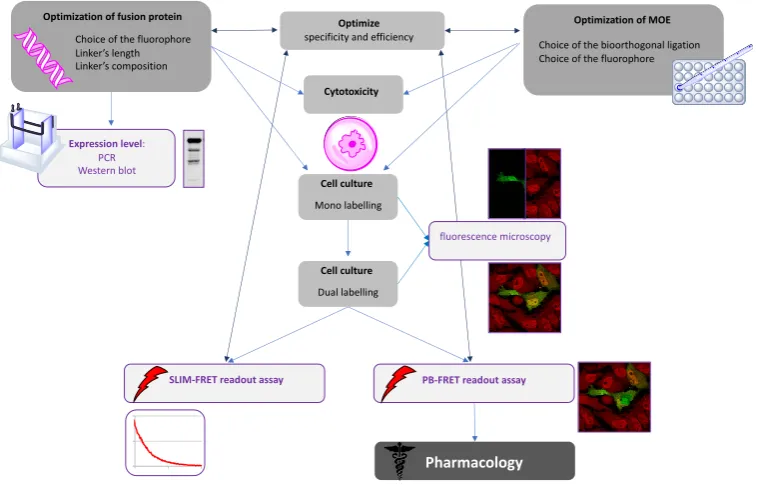
the ability to precisely introduce a suitable pair of donor and acceptor fluorophores into the protein of interest, we concomitantly optimized not only the linker but also the chemical reporter concentration. We validated our approach using a combination of azido sugar labeling and two-photon fluorescence life time imaging spectroscopy (SLiM). As a negative control, we also used an alkyne sugar analogue (which is unable to react with the selected fluorophore via a SPAAC reaction) to confirm intramolecular FRET. Thereafter, we turned our attention to demonstrate the robustness of our technology using a conventional confocal microscope to monitor FRET through a pb-FRET readout assay. With this technology in our hands, we evaluated changes of -catenin O-GlcNAcylation by inhibiting OGA or OGT. Finally, we provided a flowchart demonstrating how these technologies could be meaningfully combined (Figure 6).
Figure 6. Flowchart demonstrating how to combine the technologies for FRET-based imaging of dual labeling of glycoproteins
4. Materials and Methods
4.1. Chemical compounds
Ac4GalNAz, Ac4GAlNAl and DBCO-Cy3 were purchased from Click Chemistry Tools (Scottsdale,
USA). Thiamet-G and Ac45SGlcNAc were prepared as previously described [25,33].
4.2. Cell culture
HeLa cells were obtained from the American Tissue Culture Collection. Cells were grown in
Dulbecco’s modified Eagle’s medium (Lonza) supplemented with 10% (v/v) of fetal calf serum (Lonza).
Cells were maintained at 37°C in a humidified atmosphere containing 5% (v/v) CO2.
4.3. Plasmids
vCMVp-GFP-ß-catenin, vCMVp-GFP-1a-ß-catenin, vCMVp-GFP-2a-ß-catenin, vCMVp-GFP-3a-ß-catenin, vCMVp-GFP-3A-ß-catenin-CFP-ß-catenin were generated by e-Zyvec (www.e-zyvec.com, Loos, France). Linkers between GFP and ß-catenin are an alanine-rich amino acid sequence repeated
one, two or three times: 5’- EAAAKEAAAKEAAAKEAAAKA -3’.
4.4. Transfections
For microscopy, cells were grown on glass coverslips and transfected at 70% confluency. Transfections were performed using 1µ L of Jetoptimus (Polyplus), 1µ g of plasmid in 900µ L DMEM
according to manufacturer’s instruction. Transfections mix was replaced 4 hours later with fresh
medium containing Ac4GAlNAz or Ac4GalNAl (200 µ M), with or without Ac45SGlcNAc (100 µ M) or
Thiamet G (1 µ M), for 24 hours.
4.5. Western blot analyses
Cells were washed once in ice-cold PBS and lysed in RIPA buffer (Tris/HCL 50mM, NaCl 150 mM, NP40 0,5% (v/v), EDTA 1 mM, Na3VO4 1mM, NaF 5 mM, pH 7.9) supplemented with a protease inhibitors mix (Roche Diagnostics) for 20 minutes on ice. Lysate were centrifuged at 5000 RPM, 4°C for 10 min and supernatants were collected. Protein quantitation was determined by using the BCA assay (ThermoFischer). Equal quantities (15-20 µ g) of proteins were loaded and separated by 10% SDS-PAGE. Proteins were transferred onto nitrocellulose membrane (GE Healthcare) at 200 mA for 2 hours.
Optimization of fusion protein Optimization of MOE
Choice of the bioorthogonal ligation Choice of the fluorophore
SLIM-FRET readout assay
fluorescence microscopy Cytotoxicity
Pharmacology
Choice of the fluorophore Linker’s length Linker’s composition
Optimize specificity and efficiency
Mono labelling Cell culture
Expression level:
PCR Western blot
Dual labelling Cell culture
PB-FRET readout assay
1.0
0.8 0.6
Membranes were blocked for 1 h at room temperature with 5% (w/v) nonfat dry milk in Tris-buffered saline (TBS) Tween (TBST) buffer (15 mM Tris, 140 mM NaCl, 0.05% (v/v) Tween20, pH 8.0). Membranes were incubated overnight at 4°C with anti ß-catenin (1:2000) (H102, Santa Cruz Biotechnology, Santa Cruz, CA, USA) or anti GFP (1:1000) monoclonal antibodies. After three washes with TBST, membranes were incubated with corresponding secondary HRP-linked antibodies (1:10,000 in TBST) for 1h at room temperature. After three washes in TBST, detection was performed with a CCD camera (Fusion Solo, Vilber Lourmat).
4.6. Sample preparation and bioothogonal ligation for fluorescence microscopy
Cells cultured on coverslips were washed three times in Dulbecco’s Phosphate Buffer Saline
(Lonza) containing calcium and magnesium. Cells were fixed with 4% (w/v) paraformaldehyde (pH 7.3) for 30 min at room temperature and washed with ice-cold PBS thrice. Coverslips were switched in a humid chamber. For SPAAC, 10µ M DBCO-Cy3 was applied for 1 hour. Cells were washed three times with ice-cold PBS and coverslips were mounted in mounting medium (Dako).
4.7. Spectral fluorescence lifetime imaging microscopy
Lifetime measurements were performed using a MW-FLIM detector and a SPC 150 photocounting card from Becker & Hickl (Becker & Hickl, Berlin, Germany) adapted on a laser scanning microscope LSM 710 NLO Zeiss (Zeiss SAS, Germany) and coupled with a Chameleon TiSa accordable 80 MHz pulsed laser (COHERENT, USA). For more details on acquisition and analysis procedure for FRET, please see [34]. For GFP lifetime measurements, acquisitions were performed at 860 nm and detection between 500 and 560 nm. Lifetime values were extracted from a minimum of 10 cells per experiment.
4.8. Photobleaching FRET
The samples were observed under A1 Nikon confocal microscope with a 60X Oil immersion objective. The green fluorescence (GFP) was acquired with λex = 488 nm and λem = 500-530 nm and the red fluorescence (Cy3) was acquired with λex= 561.6 nm and λem=570-620 nm. Photobleaching of the acceptor was achieved by increasing laser power from 10% to 100%, increasing the zoom from 1 to 16 and by scanning the selected area 10 time. Images acquired before and after photobleaching were processed according to [22] with ImageJ. Photobleaching FRET values were extracted from a minimum of 10 cells per experiment.
Author Contributions: Conceptualization, C.B. and T.L.; methodology, A.K., C.S., C.T., M.A., T.L. and C.B.; writing—original draft preparation, A.K., C.S., T.L. and C.B.; writing—review and editing, A.K., C.S., T.L. and C.B.; funding acquisition, T.L. and C.B. All authors have read and agreed to the published version of the manuscript.
Funding: This study was supported by the French government through the Programme Investissement d’Avenir
(I-SITE ULNE / ANR-16-IDEX-0004 ULNE) managed by the Agence Nationale de la Recherche.
Acknowledgments: The different four expression vectors were synthesized by e-Zyvec. (www.e-zyvec.com). We are indebted to "UMS 2014 - US 41 - Plateformes Lilloises en Biologie & Santé" for providing the technical environment conducive to achieving this work. Pr. David Vocadlo is acknowledged for helpful discussion.
References
1. Varki, A., Cummings, R.D., Esko, J.D., Stanley, P., Hart, G.W., Aebi, M., Darvill, A.G., Kinoshita, T.,
Packer, N.H., Prestegard, J.H., Schnaar, R.L., Seeberger, P.H., Eds.; Essentials of Glycobiology; 3rd ed.; Cold
Spring Harbor Laboratory Press: Cold Spring Harbor (NY), 2015.
2. Silsirivanit, A. Glycosylation markers in cancer. Adv Clin Chem2019, 89, 189–213,
doi:10.1016/bs.acc.2018.12.005.
3. Haga, Y.; Ishii, K.; Hibino, K.; Sako, Y.; Ito, Y.; Taniguchi, N.; Suzuki, T. Visualizing specific protein
glycoforms by transmembrane fluorescence resonance energy transfer. Nat Commun2012, 3, 1–7,
doi:10.1038/ncomms1906.
4. Yang, X.; Qian, K. Protein O-GlcNAcylation: emerging mechanisms and functions. Nat. Rev. Mol. Cell
Biol.2017, 18, 452–465, doi:10.1038/nrm.2017.22.
5. King, D.T.; Males, A.; Davies, G.J.; Vocadlo, D.J. Molecular mechanisms regulating O-linked
N-acetylglucosamine (O-GlcNAc)-processing enzymes. Curr Opin Chem Biol2019, 53, 131–144,
doi:10.1016/j.cbpa.2019.09.001.
6. Dube, D.H.; Bertozzi, C.R. Metabolic oligosaccharide engineering as a tool for glycobiology. Curr Opin
Chem Biol2003, 7, 616–625, doi:10.1016/j.cbpa.2003.08.006.
7. Gross, H.J.; Brossmer, R. Enzymatic introduction of a fluorescent sialic acid into oligosaccharide chains
of glycoproteins. Eur. J. Biochem.1988, 177, 583–589, doi:10.1111/j.1432-1033.1988.tb14410.x.
8. Wratil, P.R.; Horstkorte, R.; Reutter, W. Metabolic Glycoengineering with N-Acyl Side Chain Modified
Mannosamines. Angew. Chem. Int. Ed. Engl.2016, 55, 9482–9512, doi:10.1002/anie.201601123.
9. Gilormini, P.A.; Lion, C.; Vicogne, D.; Guérardel, Y.; Foulquier, F.; Biot, C. Chemical glycomics
enrichment: imaging the recycling of sialic acid in living cells. Journal of Inherited Metabolic Disease2018,
41, 515–523, doi:10.1007/s10545-017-0118-3.
10. Belardi, B.; de la Zerda, A.; Spiciarich, D.R.; Maund, S.L.; Peehl, D.M.; Bertozzi, C.R. Imaging the
Glycosylation State of Cell Surface Glycoproteins by Two-Photon Fluorescence Lifetime Imaging
Microscopy. Angew. Chem. Int. Ed. Engl.2013, 52, 14045–14049, doi:10.1002/anie.201307512.
11. Lin, W.; Du, Y.; Zhu, Y.; Chen, X. A cis-membrane FRET-based method for protein-specific imaging of
cell-surface glycans. J. Am. Chem. Soc.2014, 136, 679–687, doi:10.1021/ja410086d.
12. Lin, W.; Gao, L.; Chen, X. Protein-Specific Imaging of O-GlcNAcylation in Single Cells.
ChemBioChem2015, 16, 2571–2575, doi:10.1002/cbic.201500544.
13. Doll, F.; Buntz, A.; Späte, A.-K.; Schart, V.F.; Timper, A.; Schrimpf, W.; Hauck, C.R.; Zumbusch, A.;
Wittmann, V. Visualization of Protein-Specific Glycosylation inside Living Cells. Angew. Chem. Int. Ed.
Engl.2016, 55, 2262–2266, doi:10.1002/anie.201503183.
14. Clevers, H.; Nusse, R. Wnt/β-catenin signaling and disease. Cell2012, 149, 1192–1205,
doi:10.1016/j.cell.2012.05.012.
15. Liu, C.; Li, Y.; Semenov, M.; Han, C.; Baeg, G.-H.; Tan, Y.; Zhang, Z.; Lin, X.; He, X. Control of
β-Catenin Phosphorylation/Degradation by a Dual-Kinase Mechanism. Cell2002, 108, 837–847,
doi:10.1016/S0092-8674(02)00685-2.
16. Boyce, M.; Carrico, I.S.; Ganguli, A.S.; Yu, S.-H.; Hangauer, M.J.; Hubbard, S.C.; Kohler, J.J.;
Bertozzi, C.R. Metabolic cross-talk allows labeling of O-linked β-N-acetylglucosamine-modified proteins via
the N-acetylgalactosamine salvage pathway. PNAS2011, 108, 3141–3146, doi:10.1073/pnas.1010045108.
17. Chen, X.; Zaro, J.L.; Shen, W.-C. Fusion protein linkers: property, design and functionality. Adv. Drug
18. Kolb, H.C.; Finn, M.G.; Sharpless, K.B. Click Chemistry: Diverse Chemical Function from a Few Good
Reactions. Angew. Chem. Int. Ed. Engl.2001, 40, 2004–2021,
doi:10.1002/1521-3773(20010601)40:11<2004::aid-anie2004>3.3.co;2-x.
19. Jewett, J.C.; Bertozzi, C.R. Cu-free click cycloaddition reactions in chemical biology. Chem. Soc. Rev.
2010, 39, 1272–1279, doi:10.1039/B901970G.
20. Kuzmin, A.; Poloukhtine, A.; Wolfert, M.A.; Popik, V.V. Surface Functionalization Using Catalyst-Free
Azide−Alkyne Cycloaddition. Bioconjugate Chem.2010, 21, 2076–2085, doi:10.1021/bc100306u.
21. Sang-Soo, H.; Dong-Eun, L.; Hye-Eun, S.; Sangmin, L.; T, J.; Jung-Hwa, O.; Hyang-Ae, L.;
Sung-Hwan, M.; Jongho, J.; Seokjoo, Y.; et al. Physiological Effects of Ac4ManNAz and Optimization of
Metabolic Labeling for Cell Tracking. Theranostics2017, 7, 1164–1176, doi:10.7150/thno.17711.
22. Camuzeaux, B.; Spriet, C.; Héliot, L.; Coll, J.; Duterque-Coquillaud, M. Imaging Erg and Jun
transcription factor interaction in living cells using fluorescence resonance energy transfer analyses. Biochem
Biophys Res Commun2005, 332, 1107–1114, doi:10.1016/j.bbrc.2005.05.057.
23. Batt, A.R.; Zaro, B.W.; Navarro, M.X.; Pratt, M.R. Metabolic Chemical Reporters of Glycans Exhibit
Cell-Type-Selective Metabolism and Glycoprotein Labeling. Chembiochem2017, 18, 1177–1182,
doi:10.1002/cbic.201700020.
24. Sipieter, F.; Vandame, P.; Spriet, C.; Leray, A.; Vincent, P.; Trinel, D.; Bodart, J.-F.; Riquet, F.B.;
Héliot, L. From FRET imaging to practical methodology for kinase activity sensing in living cells. Prog Mol
Biol Transl Sci2013, 113, 145–216, doi:10.1016/B978-0-12-386932-6.00005-3.
25. Yuzwa, S.A.; Macauley, M.S.; Heinonen, J.E.; Shan, X.; Dennis, R.J.; He, Y.; Whitworth, G.E.; Stubbs,
K.A.; McEachern, E.J.; Davies, G.J.; et al. A potent mechanism-inspired O-GlcNAcase inhibitor that blocks
phosphorylation of tau in vivo. Nat. Chem. Biol.2008, 4, 483–490, doi:10.1038/nchembio.96.
26. Haltiwanger, R.S.; Holt, G.D.; Hart, G.W. Enzymatic addition of O-GlcNAc to nuclear and cytoplasmic
proteins. Identification of a uridine diphospho-N-acetylglucosamine:peptide
beta-N-acetylglucosaminyltransferase. J. Biol. Chem.1990, 265, 2563–2568.
27. Dong, D.L.; Hart, G.W. Purification and characterization of an O-GlcNAc selective
N-acetyl-beta-D-glucosaminidase from rat spleen cytosol. J. Biol. Chem.1994, 269, 19321–19330.
28. Decourcelle, A.; Loison, I.; Baldini, S.; Leprince, D.; Dehennaut, V. Evidence of a compensatory
regulation of colonic GlcNAc transferase and GlcNAcase expression in response to disruption of
O-GlcNAc homeostasis. Biochem Biophys Res Commun2020, 521, 125–130, doi:10.1016/j.bbrc.2019.10.090.
29. Cheung, W.D.; Hart, G.W. AMP-activated Protein Kinase and p38 MAPK Activate O-GlcNAcylation
of Neuronal Proteins during Glucose Deprivation. J Biol Chem2008, 283, 13009–13020,
doi:10.1074/jbc.M801222200.
30. Taylor, R.P.; Geisler, T.S.; Chambers, J.H.; McClain, D.A. Up-regulation of O-GlcNAc Transferase
with Glucose Deprivation in HepG2 Cells Is Mediated by Decreased Hexosamine Pathway Flux. J Biol
Chem2009, 284, 3425–3432, doi:10.1074/jbc.M803198200.
31. Venter, J.C.; Adams, M.D.; Myers, E.W.; Li, P.W.; Mural, R.J.; Sutton, G.G.; Smith, H.O.; Yandell, M.;
Evans, C.A.; Holt, R.A.; et al. The sequence of the human genome. Science2001, 291, 1304–1351,
doi:10.1126/science.1058040.
32. Ho, B.; Baryshnikova, A.; Brown, G.W. Unification of Protein Abundance Datasets Yields a
Quantitative Saccharomyces cerevisiae Proteome. Cell Systems2018, 6, 192-205.e3,
doi:10.1016/j.cels.2017.12.004.
biosynthetic pathway yields a glycosyltransferase inhibitor within cells. Nat. Chem. Biol.2011, 7, 174–181,
doi:10.1038/nchembio.520.
34. Terryn, C.; Paës, G.; Spriet, C. FRET-SLiM on native autofluorescence: a fast and reliable method to
study interactions between fluorescent probes and lignin in plant cell wall. Plant Methods2018, 14, 74,
doi:10.1186/s13007-018-0342-3.