IJEDR1403021
International Journal of Engineering Development and Research (www.ijedr.org)3010
Re-Clustered Energy Efficiency Leach Protocol in
WSN
Aditi, Bhumika Garg
Research Scholar, Assistant Professor
MIET, Department of Department of Computer Science & Engineering, Kurukshetra University
________________________________________________________________________________________________________
Abstract - In the recent past, wireless sensor networks have found their way into a wide variety of applications and Systems with vastly varying requirements and characteristics. As a consequence, it is becoming increasingly difficult to discuss typical requirements regarding hardware issues and software support. Compared with the traditional wireless networks, wireless sensor networks have energy constraints, low-data-rate of high redundant and data flow of high-to-one, and so on. Energy effectiveness is the key performance indicators of wireless sensor networks. Based on the analysis of energy management strategy in the wireless sensor networks, the main factors affecting energy consumption are: perceptual data, data processing and radio communications, the radio communication is the main part of energy consumption.
Keywords - WSN, Routing Protocol, SPIN, Clustered, Loss Ratio
______________________________________________________________________________________
I. INTRODUCTION
Wireless sensor network consists of large number of sensor nodes. These nodes are low-cost, low-power and multifunctional and always consists of sensing, data processing and communication components. In a wireless sensor network application, these nodes are usually random deployed over the monitored area. They can measure the ambient conditions, process the measurements, and communication with other sensor nodes surrounding them to exchange their measurements and other information via radio or optic. The networked sensor nodes can improve the sensing accuracy. There are multiple sensor nodes surrounding the phenomenon when an event occurs. So the physical phenomenon is sensed by several sensor nodes. These sensing data from each node can be aggregated to get a multi-dimensional and more precision view of the event. The networked sensor nodes can also make the monitor task unattended. When the sensors nodes deployed in the monitoring area, they can form a self-organized network. So when a sensor node sensed a data, it could communication with other nodes to find a route that can send their measurements to the sink node. The sink node is a special node that is more powerful than other node in the network, and it can send the data which is from other nodes to the user. Also user can access the sink node to get the situation of the monitoring area. So the wireless sensor network can perform many unattended applications, such as the forest fire detection.
II. ROUTING STRATERGY IN WSN
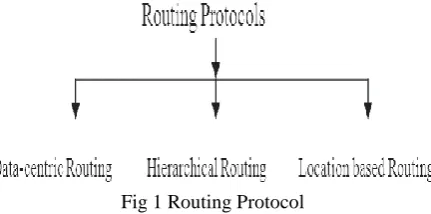
Routing in WSNs is very challenging due to the inherent characteristics that distinguish these networks from other wireless networks like mobile ad hoc networks or cellular networks. First, due to the relatively large number of sensor nodes, it is not possible to build a global addressing scheme for the deployment of a large number of sensor nodes as the overhead of ID maintenance is high. Thus, traditional IP-based protocols may not be applied to WSNs. Furthermore, sensor nodes that are deployed in an ad hoc manner. Despite the innumerable applications of WSNs, these networks have several restrictions, e.g., limited energy supply, limited computing power, and limited bandwidth of the wireless links connecting sensor nodes. One of the main design goals of WSNs is to carry out data communication while trying to prolong the lifetime of the network and prevent connectivity degradation by employing aggressive energy management techniques. All the proposed protocols will fall under any of the three categories:
Fig 1 Routing Protocol 1.2.1 Data-centric Routing
IJEDR1403021
International Journal of Engineering Development and Research (www.ijedr.org)3011
feasible to assign global indenters to each node due to the sheer number of nodes deployed. Such lack of global identication along with random deployment of sensor nodes makes it hard to select a specific set of sensor nodes to be queried. Therefore, data is usually transmitted from every sensor node within the deployment region with signcant redundancy.Since this is very inefficient in terms of energy consumption, routing protocols that will be able to select a set of sensor nodes and utilize data aggregation during the relaying of data have been considered. This consideration has led to datacentric routing, which is different from traditional address-based routing where routes are created between addressable nodes managed in the network layer of the communication stack. In data-centric routing, the sink sends queries to certain regions and waits for data from the sensors located in the selected regions. Since data is being requested through queries, attribute-based naming is necessary to specify the properties of data. Some of the protocols which follow the data centric routing are,
SPIN
ACQUIRE
EEABR
Sensor Protocols for Information via Negotiation (SPIN)
SPIN is among the early work to pursue a data-centric routing mechanism. The idea behind SPIN is to name the data using high-level descriptors or meta-data. Before transmission, metadata are exchanged among sensors via a data advertisement mechanism, which is the key feature of SPIN. Each node upon receiving new data, advertises it to its neighbours and interested neighbours, i.e. those who do not have the data, retrieve the data by sending a request message. SPINs metadata negotiation solves the classic problems of ooding such as redundant information passing, overlapping of sensing areas and resource blindness thus, achieving a lot of energy eciency. There is no standard meta-data format and it is assumed to be application specic, e.g. using an application level framing.
Active Query Forwarding In Sensor Network (ACQUIRE)
A fairly new data-centric mechanism for querying sensor networks is ACtive QUery forwarding In sensoR nEtworks (ACQUIRE). As the approach views the sensor network as a distributed database and is well-suited for complex queries which consist of several sub queries. The querying mechanism works as follows: the query is forwarded by the sink and each node receiving the query, tries to respond partially by using its precached information and forward it to another sensor. If the pre-cached information is not up-todate, the nodes gather information from its neighbors within a look-ahead of d hops. Once the query is being resolved completely, it is sent back through either the reverse or shortestpath to the sink. One of the main motivations for proposing ACQUIRE is to deal with one-shot, complex queries for data where a response can be provided by many nodes.
An Energy Efficient ANT Based Routing algorithm (EEABR)
This routing protocol is based on ANT colony based routing algorithm [9][10] for MANETs. By introducing energy efficiency parameter to this algorithm, it can be adopted in WSN. It is used for multi-hop ad-hoc networks and is based on swarm intelligence and on the ANT colony based meta-heuristic. These approaches try to map the solution capability of swarms to mathematical and engineering problems. This routing protocol is highly adaptive, efficient and scalable. This feature makes it adaptive to energy constraint WSN. The EEABR protocol is based on the ANT colony optimization (ACO) heuristic and is focused on the main WSN constrains. EEABR uses a colony of artificial ANTS that travel through the WSN looking for path between sensor nodes and a destination node, that are both short in length and energy efficient, contributing in that way to maximize the lifetime of the WSN. EEABR protocol finds the shortest path between the source and destination nodes by using forward (FANT) and backward ANTS (BANT). A forward ANT is launched periodically from every node in the network in order to find the path to the destination node, ANT stores the identifiers of all the nodes it visits.
1.2.2 Hierarchical Routing
Since energy efficiency is more important for wireless sensor networks than any other networks, more research works have already been done in routing in WSN. In general, data transmission in wireless communication takes more power than data processing. Whenever the nodes are transmitting more number of data proportionately their battery power also get reduced. To reduce the data size we can go for data fusion or aggregation techniques. Data fusion is that in which the sensed data from different nodes are fused at certain point suitable for the transmission in its reduced size. Even in the data aggregation concept there are two types of aggregation. The first type of data aggregation fuses the data gathered from different sources and sends the final fused data in reduced size. But the problem behind this approach is it lacks in accuracy and precision of data from various sensor nodes. The second approach combines the data from different sources under the single header and forwards it to the base station. Here header packets consolidates and pass it to the base station without any modification to the original data from the sensors. Hence accuracy is improved. Study on energy efficient routing in WSN brings this two broad classification of approaches. They are,
Clustering approach Tree based approach
Clustering approach
IJEDR1403021
International Journal of Engineering Development and Research (www.ijedr.org)3012
localizing energy efficient route setup within the clusters. Some of the energy efficient routing protocols based on clustering are LEACH, HEED etc.III. RELATED WORK
Handy, Haase , D. Timmermann et al[1] , This paper focuses on reducing the power consumption of wireless micro sensor networks. Therefore, a communication protocol named LEACH (Low-Energy Adaptive Clustering Hierarchy) is modified. We extend LEACH’S stochastic cluster head selection algorithm by a deterministic component Depending on the network configuration an increase of network lifetime by about 30 % can he accomplished. Furthermore, we present a new approach to define lifetime of micro sensor networks using three new mebics FNLI (First Node Dies), HNA (Half of the Nodes Alive), and LND (Last Node Dies). LEACH uses the following clustering-model: Some of the nodes elect themselves as cluster-heads, These cluster-heads collect sensor data from other nodes in the vicinity and transfer the aggregated data to the base station. Since data transfers to the base station dissipate much energy, the nodes take turns with the transmission -the cluster-heads “rotate”. This rotation of cluster-heads leads to a balanced energy consumption of all nodes and hence to a longer lifetime of the network. This paper proposes a modification of LEACH’S cluster head selection algorithm to reduce energy consumption. For a microsensor network we make the following assumptions for example the base station (BS) is located far from the sensors and immobile.
Shin , Moh , and Chung et al[2] , A wireless sensor network (WSN) consists of a lot of inexpensive sensors that have a limited energy resource. Many applications including environment monitoring use a clustering approach for efficient energy consumption. LEACH (Low Energy Adaptive Clustering Hierarchy) is the most famous one of clustering protocols, which enables the balanced consumption of energy to prolong network lifetime. In LEACH, however, additional energy and time are consumed to reform clusters at the setup phase of every round. This side effect is worse as the number of clusters increases. This paper presents a novel energy-efficient clustering scheme to remove cluster reforming process required at every round after the first round, which is called COTS (Clustering with One Time Setup). The proposed COTS allows that the role of cluster head is rotated among members in a cluster without cluster reforming process. This significantly saves the energy because the cluster reforming process is not necessary, resulting in increased network lifetime. According to our simulation study, the network performance and lifetime are improved much better as the number of clusters is increased.
Duan and Yuan et al[3], Large-scale wireless sensor networks are composed of hundreds or thousands of autonomous sensor nodes. How to manage wireless sensor networks effectively is a big challenge. This paper presents a hierarchical management architecture for wireless sensor networks. In contrast to previous management architecture on wired networks and wireless ad-hoc networks, this architecture is based on wireless sensor networks' two distinct features: centralization and task orientation. Based on such architecture, the paper also develops a lightweight, taskoriented clustering algorithm to reduce the granularity of wireless sensor networks. The simulation demonstrates its effectiveness in wireless sensor network based on energy analysis. This proposes a practical architecture for wireless sensor networks management. It is scalable and can reduce coverage time effectively. This architecture also implements a task-oriented mechanism and supports lightweight operations. The characteristic and applicability of centralized, distributed and hierarchical network management architectures are compared . This paper investigates the issues of effective management in wireless sensor networks, and proposes a task oriented management architecture for wireless sensor networks. Despite the extensive researches on the wireless sensor networks, to the best of our knowledge, there is no reported work on the construction of an effective management architecture for wireless sensor networks.
IV. PURPOSED WORK
In this paper a new optimal data aggregation scheme is developed which is bases of our proposed model named as Re-clustered energy efficient routing protocol. We initially form a cluster and cluster head is chosen based upon the cost value calculation which is described further. Each node has to keep adjoining node info table (ANIT). ANIT contains the ID of node, distance and cost. This ANIT data is broadcast to the head of cluster. Each cluster has to elect the supervisor node in a willy-nilly manner in the network. These supervisor nodes have to be nearby the cluster and its functioning is to invigilate the working of the nodes and directs them for particular operations. Each cluster head aggregates the data from all the sensor nodes and transmit it to the supervisor node.
Supervisor node calculates the data fatal ratio which is defined as the ratio of how many packets expelled and total number of packets transmitted from the source. After calculating this data fatal ratio we can alter the size of cluster and the progressive node count of each node can be increased or decreased which is explained in . After the alteration of cluster, the supervisor node again collects the information from cluster head compresses it and transmit to the sink.
Because of data fatal ratio is calculated at supervisor node energy dissipation can be effectively decreased. And reliability is provided due to modification in size of cluster before the data is sending to sink.
REER algorithm details
The operation of REER is broken upon in to some steps, where initial step is cluster building stage, after building of clusters second step is election of cluster head based on cost value calculations which is calculated by some random node chosen as supervisor node outside the cluster followed by third step which is data transmission phase in which data is transmitted from that supervisor node to the base station and alteration of cluster is done based on packet loss ratio calculated by supervisor node itself. In order to minimize overhead, the data transmission and cluster size alteration phase is long compared to the cluster building phase.
4.1.1 Cluster building phase
IJEDR1403021
International Journal of Engineering Development and Research (www.ijedr.org)3013
4.1.2 How to choose cluster head?In this paper our main focus is how to choose cluster head.
Initially we form clusters in which sensor nodes are fitted. Then we randomly select a supervisor node which is around the cluster and closest to it. Supervisor node’s duty is to choose cluster head.
Neighboring nodes M of cluster head are chosen by the supervisor node which depends upon node density. Sensor nodes give information about the M number of closest neighbors to the supervisor node SN. Distance of nodes is determined by RSSI. RSSI is defined as Received signal strength indicator. Candidate set of cluster heads S(CH) is choose by SN with the help of K-theorem.
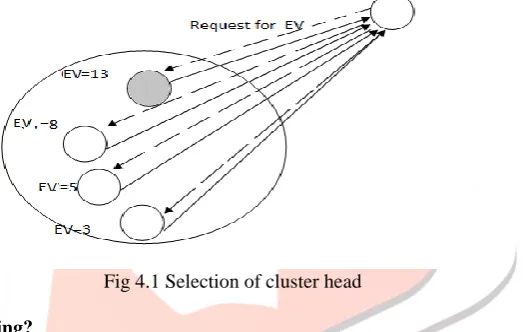
When SN sent request for candidate set of cluster heads then sensor nodes reply their expense value (EV)
Each node of candidate cluster head set determines its own expense value based on the residual energy, and its distance to SN. Cost value calculation is explained later in the topic.
A node is elected as cluster head based upon the EV by supervisor node. A node which has highest EV it has more chances of being cluster head. After selection of cluster head by SN; SN acknowledge each cluster for their CH. 4.1.2.1 Cluster head selection:
Let us take an example of cluster depicted in the figure 4.1. We have a cluster in which four sensor nodes are deployed. And randomly a SN is elected which is closest to cluster. SN broadcast a request message to nodes for their cost value. Cost value is given in reply by the nodes 1, 2, 3 and 4. Their cost value is checked out and the node having highest cost value is elected as cluster head. Cost value of node 1 has highest cost value of 13 and therefore it is declared as CH of the cluster. SN sends this information to other clusters.
Fig 4.1 Selection of cluster head 4.1.3 How to choose M for clustering?
M is defined as the node density which is relative to ratio of cluster heads in any wireless sensor network. M value is defined by the SN. This ratio must lie in the range 0.01 to o.99 and should be below than 0.50. Many of local optima can be achieved using value of M. using value of M the best sensor nodes which are suitable for cluster head can be obtained. By providing alternate suboptimal options by M; optimal sensor node for cluster head can be selected.
Selection of M closest neighbor for each node in the cluster relies on the distance. Distance between the sensor nodes is calculated by RSSI. For long distance, closet neighboring nodes is determined using multi-hop communication route. Compared to direct communication energy dissipation is less when we choose a neighbor by multi-hop communication.
Every sensor node do calculates its own frequency of occurrence and minimum frequency needed for a cluster to become a CH is also computed. Frequencies weighted mean is calculated and it is enhanced by adding 1 to it. Weighted mean is calculated as product of each frequency of occurrence and number of sensor nodes having that frequency. The obtained frequency value is then rounded to its nearest integer. The value of nodes having frequency F or larger are identified and these nodes become the candidates for cluster head (CH) and added in cluster head set. The nodes which can be candidate cluster head nodes would always be equal to value of F.
4.1.4 Factors for expense value
The expense value (EV) is determined based on following factors: Residual energy (E)
The residual energy of a node preferably is greater than the approximate energy dissipated in previous round by the cluster head. Distance to coordinator node (D)
We know that energy consumption is directly proportional to the square of distance. The nodes which are having the less distance from supervisor node should have greater probability to become cluster head of cluster.
Expense value depends upon what is the residual energy of a node how much distance from the supervisor node. The cost is greater when the residual energy is more and the less distance to the supervisor node.
Formula for EV is given by
EV= (a X E) + (b X (1/ D)) ………. (1)
IJEDR1403021
International Journal of Engineering Development and Research (www.ijedr.org)3014
And E and is defined as residual energy and distance to coordinator node respectively.’Data loss ratio calculation in our network
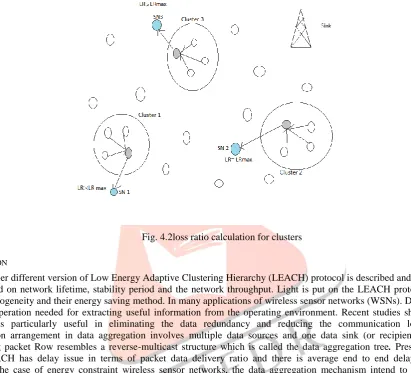
Figure 4.2 shows that we are considering the case of three clusters with their corresponding supervisor nodes SN 1, SN 2, SN 3. Clusters DLR is measured by SNs itself. DLR is measured in terms of how many packets have been transmitted by CN to BS and how many packets have been received back by CN.
Fig. 4.2loss ratio calculation for clusters V. CONCLUSION
In this paper different version of Low Energy Adaptive Clustering Hierarchy (LEACH) protocol is described and analyzed the protocol based on network lifetime, stability period and the network throughput. Light is put on the LEACH protocol with the effect of heterogeneity and their energy saving method. In many applications of wireless sensor networks (WSNs). Data gathering is a critical operation needed for extracting useful information from the operating environment. Recent studies show that data aggregation is particularly useful in eliminating the data redundancy and reducing the communication load. Typical communication arrangement in data aggregation involves multiple data sources and one data sink (or recipient). Thus, the corresponding packet Row resembles a reverse-multicast structure which is called the data aggregation tree. Present clustered protocol LEACH has delay issue in terms of packet data delivery ratio and there is average end to end delay of sensors. Considering the case of energy constraint wireless sensor networks, the data aggregation mechanism intend to eradicate the redundant data transmissions thereby improving the lifetime of the wireless sensor network.
REFERENCES
[1] M. J. Handy, M. Haase, D. Timmermann, “Low Energy Adaptive Clustering Hierarchy with Deterministic Cluster-Head Selection” , IEEE 2002, pp 368-372
[2] Heewook Shin, Sangman Moh, and Ilyong Chung, “Energy-Efficient Clustering with One Time Setup for Wireless Sensor Networks”, proc. of 2012 Fourth International Conference on Computational Intelligence, Communication Systems and Networks, IEEE 2012, pp 64-69
[3] Shangwei Duan and Xiaobu Yuan, School of Computer Science, “Exploring Hierarchy Architecture for Wireless SensornNetworks Management”, IEEE 2006, pp 1-6
[4] M.Ismail and M.Y.Sanavullah, Research Scholar, “SECURITY TOPOLOGY IN WIRELESS SENSOR NETWORKS WITH ROUTING OPTIMISATION”, IEEE 2008, pp 7-15
[5] Maher N. Elshakankiri,Mohamed N. Moustafa, Yasser H. Dakroury, “Energy Efficient Routing Protocol for Wireless Sensor Networks”, 2008 IEEE, pp 393-398
[6] Bhupendra Vidushi Sharma, School of Information and Communication Technology, “Energy Efficient Communication Overhead Algorithm in Wireless Sensor Networks”, proc. of 2013 3rd IEEE International Advance Computing Conference (IACC), IEEE 2012, pp 427-430.
[7] O. Younis and S. Fahmy, “HEED: A Hybrid, Energy-Efficient, Distributed Clustering Approach for Ad Hoc Sensor Networks”, IEEE Transactions on Mobile Computing, vol. 3, NO. 4, pp. 366-379, Oct-Dec 2004.
IJEDR1403021
International Journal of Engineering Development and Research (www.ijedr.org)3015
[9] C.F. Li, M Ye, G.H Chen, and J. Wu, “An Energy Efficient Unequal Clustering mechanism for Wireless SensorNetworks”, Proc. of 2nd IEEE MASS, 2005.