Fault Tolerance Mechanism for Computational Grid Using Checkpoint Algorithm | ISSN: 2321-9939
2013 | IJEDR1301011 INTERNATIONAL JOURNAL OF ENGINEERING DEVELOPMENT AND RESEARCH | IJEDR (All right reserved by www.ijedr.org)
54
Fault Tolerance Mechanism for Computational Grid
Using Checkpoint Algorithm
Mr.Ramesh Prajapati
Dept. of Computer Science EngineeringJagannath University, Jaipur, India
Abstract-- Computational grids have solving large-scale scientific applications using heterogeneous and geographically distributed resources Grid infrastructure is a large set of nodes geographically distributed and connected by a communication. In Computational grid, fault tolerance is one of the main research areas. Fault tolerance is a necessary by the distribution that create a number of problems related to the heterogeneity of hardware, operating systems, networks, middleware, applications, the dynamic resource, the scalability. In this research paper our main focus is on the development of fault tolerance system for computational grids. we have studied existing fault tolerance in Computational Grid in detail, and have ascertained the frequent causes of failures in it. So Checkpoint is process as a designated place in a program at which normal processing is interrupted specifically to preserve the status information necessary to allow resumption of processing at a later time. Checkpointing is the process of saving the status information. The probability of fault occurrence increases, as the number of resources involved in grid increases. For this we had setup a computational grid based on the Alchemi middleware. Alchemi is a .NET based grid computing framework that provides the runtime machinery and programming environment required to construct computational grid. After setting up grid environment we had generate the different checkpoint result and compare with chandy-Lamport result.
Keywords--Grid computing, fault tolerance, check pointing
I. INTRODUCTION
In Large-scale science and engineering are done through the interaction of people, heterogeneous computing resources, information systems, and instruments, all of which are geographically and organizationally dispersed. The overall motivation for “Grids” is to facilitate the routine interactions of these resources in order to support large-scale science and Engineering. There are many Opportunity of grid in eScience and eBusiness suppose for Physicists worldwide pool resources for peta-op analyses of peta bytes of data, for Civil engineers collaborate to design, execute, & analyze shake table experiments, for An insurance company mines data from partner hospitals for fraud detection, for An application service provider offloads excess load to a compute cycle provider, and for An enterprise configures internal & external resources to support eBusiness workload.
There are many Challenges technical requirement for the grid. [2]
• Dynamic formation and management of virtual organizations
• Online negotiation of access to services: who, what, why, when, how
• Establishment of applications and systems able to deliver multiple qualities of service
• Autonomic management of infrastructure elements So that in the grid Computing, main element for concept on Resource sharing, Coordinated problem solving, and Dynamic, multi-institutional virtual organizations. Grid resources are also heterogeneous in nature so resources may enter and leave the grid at any time, in many cases outside of the applications’ control. So therefore interaction faults may be likely to occur between disparate grid nodes. Also resource may be outside of the organization so that is not guaranteed that a resource being used is not malicious. So here challenging issue is that faults and failure in grid. So fault tolerance is a crucial aspect for grid computing.
Section II describes the related work. In section III, we talk about Types of fault tolerance. Checkpoint recovery of for grid is described in section IV. The Implementation scheme is presented in Section V.In section VI described Performance Evaluation. In section VII, we present the Conclusion. Future Enhancements describe in section VIII.
II. RELATED WORK
2013 | IJEDR1301011 INTERNATIONAL JOURNAL OF ENGINEERING DEVELOPMENT AND RESEARCH result in an error; nevertheless, the same fault may result in
multiple errors. Similarly, a single error may lead to multiple failures.
Fault tolerance[33] is an important property in grid computing, since the resources are geographically
Check pointing method is used to
performance in the presence of failure, their effectiveness largely depends on tuning runtime parameters such a checkpointing interval there are still many issues that need to be explored. In current system chandy-lamport algorithm there are no. of checkpoint are taken during computation, due to that we required more space and bandwidth to store that checkpoints. The current algorithm is weak in terms of task completion time in both of fault-free and faulty situations. By using checkpoint algorithm, every node saves its context in stable storage. So that system has context saving overhead. Basic algorithm does not reduce that overhead
checkpoint algorithm it could not generate the information about which node has crash and how to recover the failure node. Then after I had compared my proposed algorithm with chandy and Lamport algorithm.
III. TYPES OF FAULT TOLERANCE A. Types of Fault Tolerance
There are many types of fault [4] that we faced in grid computing related to hardware (like faults of CPU, Disk storage), application and operating system (Memory link and resource unavailable), and network (like node failure and packet losses) see the figure 1. While considering all thes factors, we have to consider the desirable properties of failure detectors and correctors that are Completeness, Accuracy, Consistency, Detection Latency, Scalability, Flexibility, adaptiveness.
The main objective of fault tolerance [3] is to preserve t delivery of expected services despite the presence of fault caused errors within the system itself. Errors are detected and corrected, and permanent faults are located and removed while the system continues to deliver acceptable service.
INTERNATIONAL JOURNAL OF ENGINEERING DEVELOPMENT AND RESEARCH (All right reserved by , the same fault may result in
, a single error may lead to multiple
is an important property in grid computing, since the resources are geographically distributed. improve system performance in the presence of failure, their effectiveness largely depends on tuning runtime parameters such as the there are still many issues that need to lamport algorithm[3] there are no. of checkpoint are taken during computation, due to that we required more space and bandwidth to store that The current algorithm is weak in terms of task free and faulty situations. By node saves its context in system has context saving overhead. es not reduce that overhead. here in all checkpoint algorithm it could not generate the information about which node has crash and how to recover the failure had compared my proposed algorithm with
PES OF FAULT TOLERANCE
that we faced in grid computing related to hardware (like faults of CPU, Disk storage), application and operating system (Memory link and resource unavailable), and network (like node failure and While considering all these factors, we have to consider the desirable properties of failure detectors and correctors that are Completeness, Accuracy, Consistency, Detection Latency, Scalability, Flexibility,
is to preserve the delivery of expected services despite the presence of fault-caused errors within the system itself. Errors are detected and corrected, and permanent faults are located and removed while
to deliver acceptable service.
Figure 1 T
TABLE I DETAILED TYPES OF FAULTS Sr.No Main Type
1 Hardware Relate Faults
2 Application & Operating System Oriented Faults
3 Network Related Faults
4 Software Related Faults 5 Timeout Faults 6 Response Relate Faults
B. Problem Definition
From a user's point of view, a distributed application should continue despite failures
ways to deal with failures, various fault tolerance mechanisms are there. Some of these fault tolerance mechanisms are Figure 2)
1. Application Dependent: fault
algorithms and encapsulate them into reusa artifacts, or modules.
2. Monitoring Systems: In this a fault monitoring unit is attached with the grid. The base technique which most of the monitoring units follow is heartbeating technique 3. Checkpointing recovery
saving enough state information of an executing program on a stable storage so that, if required, the program can be re-executed starting from the state recorded in the checkpoints.
4. Fault Tolerant Scheduling [16]algorithms are using the
policies with the job replication schemes such that jobs are efficiently and reliably executed. Scheduling policies are further classified on basis of time sharing and space sharing.
INTERNATIONAL JOURNAL OF ENGINEERING DEVELOPMENT AND RESEARCH | IJEDR (All right reserved by www.ijedr.org)
55 Type of Faults
TABLE I DETAILED TYPES OF FAULTS Detailed Types of faults CPU
Memory Storage
Application & Operating Operating System Specific • Memory Leaks • OS Faults Application Specific Node fault
Network oriented • Packet corrupted • Packet Losses Unhandled Exception Unexpected Input Timeout Run Exception Timeout Job Exception Value
Byzantine
From a user's point of view, a distributed application failures. To achieve the automatic ways to deal with failures, various fault tolerance mechanisms are there. Some of these fault tolerance mechanisms are (See : fault-tolerance[15] experts write algorithms and encapsulate them into reusable code : In this a fault monitoring unit is attached with the grid. The base technique which most of the monitoring units follow is heartbeating technique. Checkpointing recovery: Checkpointing[1] involves
2013 | IJEDR1301011 INTERNATIONAL JOURNAL OF ENGINEERING DEVELOPMENT AND RESEARCH Figure 2 Fault Tolerance Mechanisms
IV. CHECKPOINT RECOVERY
Check pointing, we can restore the partially completed job from the last checkpoint saved and then starting a job from scratch is avoided. The main disadvantage of
mechanism [4] is that it performs identically rega
stability of the resource. The check pointing is one of the most popular techniques to provide fault-tolerance on unreliable systems. It is a record of the snapshot of the entire system state in order to restart the application after the occurre
failure. The checkpoint can be stored on temporary as well as stable storage. However, the efficiency of the mechanism is strongly dependent on the length of the check pointing interval.
V. IMPLEMENTED SCHEME
Check pointing is one of the techniques of fault tolerance. Till now many middleware in the grid environment are not fully faults tolerant. Different middleware have different levels of fault tolerance. Some of the middleware like Alchemi.NET do not have a robust fault tolerance
Therefore, in this research work Alchemi.NET has been chosen and a checkpointing algorithm has been designed for it. Alchemi.NET [32] is an open source software framework that allows you to painlessly aggregate the computing power of networked machines into a virtual supercomputer and develop applications to run on the grid. Alchemi.NET includes:
• The runtime machinery (Windows executabl construct grids.
INTERNATIONAL JOURNAL OF ENGINEERING DEVELOPMENT AND RESEARCH (All right reserved by Mechanisms
CHECKPOINT RECOVERY
heck pointing, we can restore the partially completed job from the last checkpoint saved and then starting a job from scratch is avoided. The main disadvantage of checkpointing is that it performs identically regardless the The check pointing is one of the most tolerance on unreliable the snapshot of the entire system state application after the occurrence of some can be stored on temporary as well as efficiency of the mechanism is strongly dependent on the length of the check pointing
IMPLEMENTED SCHEME
f the techniques of fault tolerance. Till now many middleware in the grid environment are not fully faults tolerant. Different middleware have different levels of fault tolerance. Some of the middleware like Alchemi.NET do not have a robust fault tolerance mechanism. Therefore, in this research work Alchemi.NET has been chosen and a checkpointing algorithm has been designed for is an open source software framework that allows you to painlessly aggregate the computing power of networked machines into a virtual supercomputer and develop applications to run on the grid. The runtime machinery (Windows executables) to
• A .NET API and tools to develop .NET grid applications and grid enabled legacy applications.
A. Checkpoint Algorithm with certain time period
Algorithm: Checkpoint Algorithm with certain time period Input: Enter maximum limit for
(1000000) Host
Port Number Host Name Password
Time interval to create consecutive checkpoint Output: Generate Checkpoint, Executor Log
Algorithm Step:
S1: Initialization Set Checkpoint time Processes.
S2: Send message to manager for alive connection. Check Failure condition If failure
4. Otherwise continue to step 3 S3: while process Pi till the end. Initialize new checkpoint flag value as If Process Current time= Checkpoint
taking checkpoint Take stable checkpoint with current process state increase checkpoint number
time set flag false after successful checkpoint with current process state. number Update checkpoint interval time successful checkpoint.
S4: After checkpoint flag is checked, process Pi send and receive message and Check
greater than Current checkpoint
checkpoint no = Current checkpoint no then flag=0 Current checkpoint no = Manager checkpoint no new checkpoint with current process state checkpoint no = Manager checkpoint no
VI: PERFORMANCE
A.
Results Taken From
This study was done on the bases on 15 executors running with one manager to
generation application. Each node comprises of one CPU core with 512MB ram and storage spaces of 40 GB.I have
three parameters.
INTERNATIONAL JOURNAL OF ENGINEERING DEVELOPMENT AND RESEARCH | IJEDR (All right reserved by www.ijedr.org)
56 A .NET API and tools to develop .NET grid applications and grid enabled legacy applications.
Checkpoint Algorithm with certain time period
: Checkpoint Algorithm with certain time period Input: Enter maximum limit for prime number
Time interval to create consecutive checkpoint Checkpoint, Executor Log file
Set Checkpoint time Interval initialize no of
message to manager for alive connection. If failure occur then go to step continue to step 3
process Pi till the end. Initialize checkpoint no new checkpoint flag value as true. Initialize CT If Process Current time= Checkpoint Intervals set flag 1 for
Take stable checkpoint with current process int number Update checkpoint interval successful checkpoint Else Take stable checkpoint with current process state. Increase checkpoint Update checkpoint interval time set flag false after
checkpoint flag is checked, process Pi send and manager checkpoint number greater than Current checkpoint number. If Manager urrent checkpoint no then flag=0 Set Manager checkpoint no Else Take new checkpoint with current process state Set Current Manager checkpoint no Set flag = 1
: PERFORMANCE EVALUATION
Results Taken From Alchemi Tool
2013 | IJEDR1301011 INTERNATIONAL JOURNAL OF ENGINEERING DEVELOPMENT AND RESEARCH | IJEDR (All right reserved by www.ijedr.org)
57 Total Execution Time: The experiment was done on the
bases two policies. First policies comparison of Different Number of Executer with Different input range with respect to time.
TABLE 2 COMPARISON OF DIFFERENT NUMBER OF EXECUTER WITH DIFFERENT INPUT RANGE WITH RESPECT TO TIME
Table 1 shows result summary of prime number generation with different executers, different input range given by user and fix time interval of 300 ms. so we can compare result with Chandy-Lamport algorithm with different input range given and total time to complete the application. And second policies comparison of comparison of Different Number of Executer with Different input range with respect to Generation of checkpoint.
TABLE 3 COMPARISON OF DIFFERENT NUMBER OF EXECUTER WITH DIFFERENT INPUT RANGE WITH RESPECT TO GENERATION OF CHECKPOINT
Table 2 shows result summary of prime number generation with different executers, different input range given by user and fix time interval of 300 ms . so we can compare result of
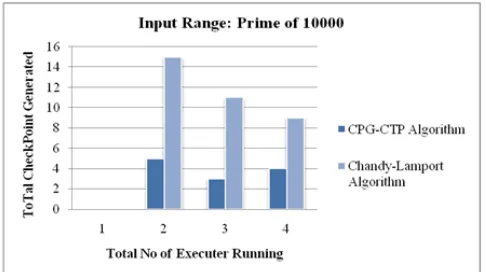
number of checkpoint generated with Chandy-Lamport algorithm and Implemented algorithm.
Figure 3 Comparison of checkpoint generation (Input Range: 10000)
Figure 3 shows result summary of prime number generation with different executers, different input range given by user and fix time interval of 300 ms .so we can compare result with Chandy-Lamport algorithm with different input range given and total time to complete the application Implemented algorithm total time taken by application is small compare to Chandy-Lamport algorithms in different input ranges.
2013 | IJEDR1301011 INTERNATIONAL JOURNAL OF ENGINEERING DEVELOPMENT AND RESEARCH | IJEDR (All right reserved by www.ijedr.org)
58 Figure 5 Comparison of checkpoint generation (Input Range:
100000)
Figure 6 Execution Time (CPG-CTPAlgorithm with Prime of 10000)
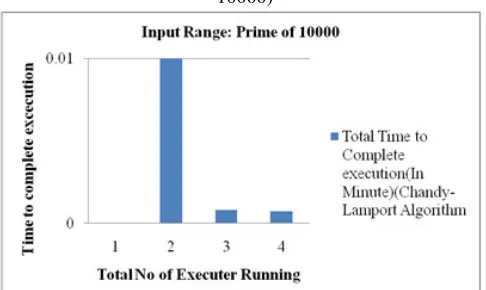
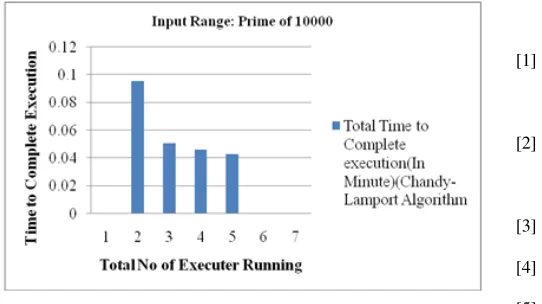
Figure 7 Execution Time (Chandy-Lamport Algorithm with Prime of 10000)
Figure 8 Execution Time (CPG-CTPAlgorithm with Prime of 50000)
Figure 9 Execution Time (Chandy-Lamport Algorithm with Prime of 50000)
2013 | IJEDR1301011 INTERNATIONAL JOURNAL OF ENGINEERING DEVELOPMENT AND RESEARCH | IJEDR (All right reserved by www.ijedr.org)
59 Figure 11 Execution Time (Chandy-Lamport Algorithm with
Prime of 100000)
In this entire figure we had compared in our algorithm with number of executor increases it takes less execution time to complete application and in chandy-Lamport algorithm it takes more execution time to complete application.
VII. CONCLUSION
In this paper the sharing of computational resources is a main motivation for constructing Computational Grids in which multiple computers are connected by a communication network.Alchemi.NET for handling the faults dynamically has been identified. On the basis of identified shortcomings, proposed and updated fault tolerance in Alchemi.NET middleware with the help of check pointing algorithm..Implemented checkpoint concept that will help in avoiding the grid to become inaccessible if the Manager or Executor fails. This implementation done in Alchemi.Net Grid with fix time interval to take checkpoint of the running system. Number of checkpoint created is proportional to time taken by system to execute the job. In case executer fails and restarts it starts the job from the last checkpoint which increases the performance in both given approaches. Handles large amount of data with multiple executers which increases the overall performance i.e. taken less time by the system in this approach.
VIII .FUTURE ENHANCEMENTS
Checkpoint can be extended to work with load balancing technique. Backup manager concept that will help in avoiding the grid to become inaccessible if the central manager fails. This implementation is kind of third party software that will improve the grid fault tolerance. But this can be integrated into the Alchemi.NET middleware code to help the user to easily use it.
RERERENCES
[1] Sriram Krishnan, “An Architecture for Checkpointing and Migration of Distributed Components on the Grid” PhD Thesis, Department of Computer Science, Indiana University, November 2004
[2] Dheeraj Bhardwaj. Grid Computing
Concepts, Applications, and Technologies Department of Computer Science and Engineering Indian Institute of Technology, Delhi
[3] Paul Townend and Jei Xu, “Fault Tolerance within a Grid Environment” Proceedings of AHM2003
[4] Foster, I., Kesselman, C., “The Grid: Blueprint for a New Computing Infrastructure, Morgan Kaufmann”, pp. 15-51, 1999. [5] Prakash R. and Singhal M.Low-Cost Checkpointing and
Failure Recovery in Mobile Computing Systems. ,IEEE Transaction On Parallel and Distributed Systems, vol. 7,no. 10, pp. 1035- 1048, October1996.
[6] Chandy K. M. and Lamport L., "Distributed Snapshots: Determining Global State of Distributed Systems," ACM Transaction on Computing Systems, vol. 3, No. 1, pp. 63-75, February 1985.
[7] Koo. R. and S.Toueg. .Checkpointing and Rollback-Recovery for Distributed Systems. .IEEE Transactions on Software Engineering, SE- 13(1):23-31, January 1987.
[8] Silva L, Silva J 1992 Global checkpointing for distributed programs. Proc. IEEE 11th Symp. On Reliable Distributed Syst. pp 155-162.
[9] J.L. Kim and T. Park. "An efficient protocol for checkpointing recovery in Distributed Systems" IEEE Transaction On Parallel and Distributed Systems, 4(8):pp.955-960, Aug 1993.
[10] G. Cao and M. Singhal. "On impossibility of Min- Process and Non-Blocking Checkpointing and An Efficient Checkpointing algorithm for mobile computing Systems". OSU Technical Report #0SU-CISRC-9/97-TR44, 1997, pp 37-44.
[11] D.V. Subba Rao and MM Naidu: A new, efficient corrdinated checkpointing protocol combined with selective sender based message logging, IEEE, 2008, Page(s): 444 – 447.
[12] "An Adaptive Index-based Algorithm using Time-coordination in Mobile Computing", by Yanping Gao, Changhui Deng, Yandong Che in the Proceedings of the 2008 International Symposium on Information Processing (ISIP 08), May 2008, pp.578-585. [13] Ajay D Kshemkalyani: “A symmetric O(n log n) message
distributed snapshot algorithm for large scale systems”, IEEE, 2010, pp 1-4
[14] Ajay D Kshemkalyani “ Fast and message efficient global snapshot algorithms for large scale distributed systems” IEEE 2010. Page(s): 1281 – 1289.
[15] Anh Nguyen-Tuong, “Integrating Fault-Tolerance Techniques in Grid Applications” PhD Thesis, University of Virginia, August 2000
[16] J.H. Abawajy, “Fault-Tolerant Scheduling Policy for Grid Computing Systems”, IPDPS’04
[17] www.gridsim.org
[18] gridsimulator.http://www.buyya.com/gridbus/gridsim/,relea sed on Apr 08, 2009
[19] http://www.gridcomputingplanet.com [20] www.Alchemi.NET.net
2013 | IJEDR1301011 INTERNATIONAL JOURNAL OF ENGINEERING DEVELOPMENT AND RESEARCH | IJEDR (All right reserved by www.ijedr.org)
60 [22] www.wiki.gridpp.ac.uk/wiki/Grid middleware
[23] Amit Jain and R.K. Shyamasundar, “Failure Detection and Membership Management in Grid Environments” Fifth IEEE/ACM International Workshop on Grid Computing (GRID'04) pp. 44-52
[24] Neeraj Kumar Rathore Ms. Inderveer Chana, "Comparative Analysis of Checkpointing" IMR Third National IT Conference-2008 on "Prestige Institute of Management and Research", Indore (M.P), India.
[25] Liang PENG, Lip Kian NG, “N1GE6 Checkpointing and Berkeley Lab Checkpoint/Restart” Dec 28, 2004
[26] Paul Townend and Jie Xu-"Fault Tolerance within a Grid Environment",University of Durham, DH1 3LE, United Kingdom.
[27] C.Kesselman. I. Foster. Computational grids. In The Grid: Blueprint for a New Computing Infrastructure., chapter 2. Morgan-kaufman edition, 1999.
[28] Yuuki Horita, Kenjiro Taura, Takashi Chikayama, “A Scalable and Efficient Self-Organizing Failure Detector for Grid Applications” 6th IEEE/ACM International Workshop on Grid Computing, Grid 2005
[29] en.wikipedia.org/wiki/Grid_computing
[30] Leu P-J, Bhargava B "Concurrent robust checkpointing and recovery in distributed systems". Proc. Int. Conf. on Data Engineering pp 154-163,1988
[31] Yanping Gao, Changhui Deng, Yandong Che: an adaptive index based algorithm using time coordination in mobile computing, International symposiums on information processing, IEEE, 2008, pp 578-585.
[32] Rajkumar Buyya and Srikumar venugopal , "A Gentle Introduction to Grid Computing and Technologies", CSI Communications, pages 9-19, Vol.29, No.1, ISSN 0970-647X, Computer Society of India (CSI), Mumbai, India, July 2005. [33] J. Joseph, C. Fellenstein, "Grid Computing", Prentice Hall/IBM
Press, Edition 2004