3395 which is associated with electronics, software and sensors .We are going towards IoT because it is a combination of sensor, connectivity, people and processes. Even though IOT provide service to all application, it has some challenges in mobility and energy consumption. MAC layer and Network layer plays the key role in effective utilization of battery operated devices. Routing Protocol for Low Power and Lossy Networks (RPL) is universally accepted routing protocol for static environment. Contiki OS, one of the IoT Operating system used for simulating the performance of RPL. Comparison has been done between two different objective function for RPL in Static and Mobile Environment for different number of nodes.
Index Terms: RPL, Contiki OS, IoT, Objective Function, Static environment, Mobile environment.
————————————————————
1.
INTRODUCTION
IoT has the ability to interconnect global information and communication infrastructure. It provides things related service such as interpretation between physical things and virtual things. In order to provide interconnectivity among devices IoT uses different hardware and network platforms[1]. These devices are not stable in all circumstance (i.e dynamic changes occur such as connected/disconnected). In order to provide efficient data handling, the number of devices which used for handling/managing purpose should be in order greater than number of devices connected. Gaining network and Producing data are performed by Accessibility and Compatibility. The layers in IoT are Smart Device/Sensor Layer, Gateway and Networks Layer, Management Service Layer, Application Layer. Smart Device Layer provides services in terms of Wi-Fi, Ethernet, Bluetooth, Infrared. WiFi ,Ethernet, GSM, LTE is also provided by Gateway Network of Gateway and Network Layer. Management Service Layer provides Business Process Execution, Business Process Modelling, Virtual Entity etc.. Application Layer is used for IoT applications. IoT has not only layers but also has technology. These technology are categorized into three groups such as First group, Second group and Third group. Technologies in the first group impact devices such as microship. Second group comprises some technologies which support network related services such as network sharing, address capacity. Technologies in third group have impact on management services and IoT
applications.
2
RPL
LLN is a network ,where both routers and their interconnect are constrained .LLN routers operate with the constraints such as power ,energy ,memory and their interconnections are High loss rate, low data rate and instability .LLN operate from few dozen to 1000 routers and it also has traffic flows such as P2P, P2M, M2P [2]. To operate in wide range of LLN application RPL separate packet processing and forwarding from the routing objective .This objective minimise the energy and latency . RPL is based on distance vector which is an proactive protocol that create an Directed acyclic graph which is used for exchanging of data among a node. It also operates on IEEE 802.15.4 .This routing protocol is used in wireless network with low power consumption which is optimized for multi-hop and many to one communication, but it also supports one to one communication. RPL has4 control messages.They are DIS (DODAG Information Solicitation), DIO (DODAG Information Object), DAO (Destination Advertisement Object), DAOACK (Destination Advertisement Object Acknowledment). Objective Function is used to compute the rank of node. It operates on a combination of metrics and constraints to compute the ‘best’ path. OF in RPL is used to select the optimal path towards the DODAG root in an network. There are two type of Objective function in RPL. They are Objective Function zero (OF0) and Minimum Rank with Hysteresis Objective Function [5]. OF0 uses an hop count to calculate the rank of the node and the MRHOF uses Expected Transmission Count to calculate the rank of the node.
————————————————
Gopal S B, Assistant Professor , Department of ECE, Kongu Engineering College, Erode,India , PH-+91 9842737494.
E-mail: [email protected]
C.Poongodi, Associate Professor , Department of IT, Kongu Engineering College, Erode,India , PH-+91 9843560116
E-mail: [email protected]
M. Joseph Auxilius Jude, Assistant Professor (SLG) , Department of ECE, Kongu Engineering College, Erode,India , PH-+91 9443994332.
E-mail: [email protected]
Umasri S is currently pursuing Bachelor degree in Electronics and Communication Engineering in Kongu Engineering College, Erode, India. E-mail: [email protected]
Sumithra D is currently pursuing Bachelor degree in Electronics and Communication Engineering in Kongu Engineering College ,Erode, India. E-mail: [email protected]
Fig.1.Control Flow In RPL
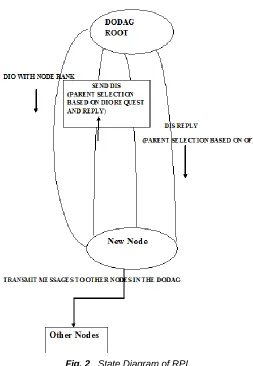
Fig. 2. State Diagram of RPL
3397 randomly in position. The sink node was placed in centre
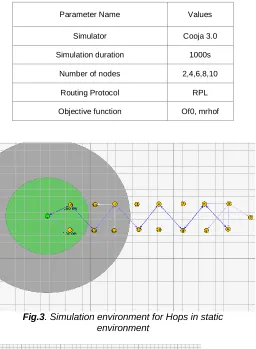
around the sink node, the sender nodes is placed. Table 1 contains the parameters used during our simulation.
TABLE 1. SIMULATION PARAMETERS
Parameter Name Values
Simulator Cooja 3.0
Simulation duration 1000s
Number of nodes 2,4,6,8,10
Routing Protocol RPL
Objective function Of0, mrhof
Fig.3. Simulation environment for Hops in static environment
Fig. 4.Simulation Environment for Branch in static environment
Fig. 5.Simulation Environment for hop in mobile environment
Fig. 6.Simulation Environment for Branch in mobile environment
In static environment: By increasing Hops
Fig. 7.Average Power Consumption vs Number of Hops
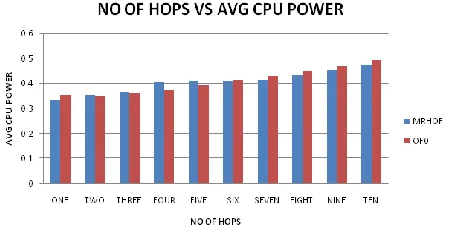
Fig. 8.Average CPU Power vs Number of Hops
Listen power for OF0 is greater than MRHOF this is due to very efficient working of CPU service in MRHOF. So average power consumption for MRHOF is smaller.
Fig. 9.Average LPM Power vs Number of Hops
Listen power for OF0 is greater than MRHOF this is due to very efficient working of LPM service in MRHOF. So average power consumption for MRHOF is smaller.
Fig. 10.Average Listen Power vs Number of Hops
Listen power for OF0 is greater than MRHOF this is due to efficient analysing of the medium is ideal or not in MRHOF. So average power consumption for MRHOF is smaller.
Fig. 11.Average Transmit Power vs Number of Hops
Listen power for OF0 is smaller than MRHOF this is due to higher transmit powerin MRHOF, higher the transmit power power lower wll be the average power consumption. So Listen power for MRHOF is greater.
Fig. 12.Average Listen Duty Cycle vs Number of Hops
Listen duty cycle for OF0 is greater than MRHOF this is due to low battery wake time during analysing of medium which is ideal or not in MRHOF. So Listen duty cycle for MRHOF is smaller.
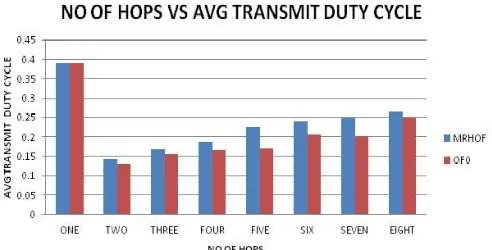
Fig. 13.Average transmit Duty Cycle vs Number of Hops
3399
Fig. 14.Average Power Consumption vs Number of Branches
OF0 does not depend on any routing metrics for data path selection whereas, MRHOF selects path based on minimum node rank value. So the power consumption for OF0 is higher than MRHOF.
Fig. 15.Average CPU Power vs Number of Branches
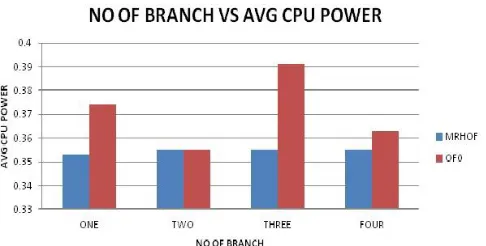
Listen power for OF0 is greater than MRHOF this is due to very efficient working of CPU service in MRHOF. So average power consumption for MRHOF is smaller.
Fig. 16.Average LPM Power vs Number of Branches
Listen power for OF0 is greater than MRHOF this is due to very efficient working of LPM service in MRHOF. So average power consumption for MRHOF is smaller.
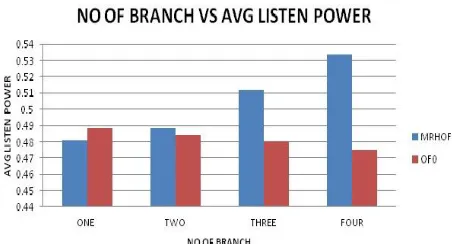
Fig. 17.Average Listen Power vs Number of Branches
Listen power for OF0 is greater than MRHOF this is due to efficient analysing of the medium is ideal or not in MRHOF. So average power consumption for MRHOF is smaller.
Fig. 18.Average Transmit Power vs Number of Branches
Listen power for OF0 is smaller than MRHOF this is due to higher transmit powerin MRHOF, higher the transmit power power lower wll be the average power consumption. So Listen power for MRHOF is greater.
Fig. 19.Average Listen Duty Cycle vs Number of Branches
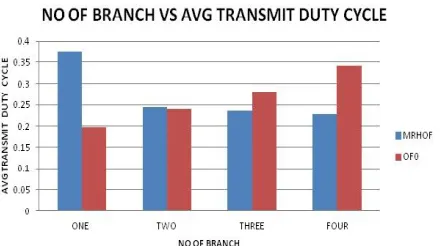
Fig. 20.Average transmit Duty Cycle vs Number of Branches
Transmit duty cycle for OF0 is greater than MRHOF this is due to low battery wake time during transmission in MRHOF. So Transmit duty cycle for MRHOF is smaller. In Mobile environment: By increasing hops
Fig. 21.Average Power Consumption vs Number of Hops
OF0 does not depend on any routing metrics for data path selection whereas, MRHOF selects path based on minimum node rank value. So the power consumption for OF0 is higher than MRHOF.
Fig. 22.Average CPU Power vs Number of Hops
Listen power for OF0 is greater than MRHOF this is due to very efficient working of CPU service in MRHOF. So average power consumption for MRHOF is smaller.
Fig. 23.Average LPM Power vs Number of Hops
Listen power for OF0 is greater than MRHOF this is due to very efficient working of LPM service in MRHOF. So average power consumption for MRHOF is smaller.
Fig. 24.Average Listen Power vs Number of Hops
Listen power for OF0 is greater than MRHOF this is due to efficient analysing of the medium is ideal or not in MRHOF. So average power consumption for MRHOF is smaller.
Fig. 25.Average Transmit Power vs Number of Hops
Listen power for OF0 is smaller than MRHOF this is due to higher transmit powerin MRHOF, higher the transmit power power lower wll be the average power consumption. So Listen power for MRHOF is greater.
Fig. 26.Average Listen Duty Cycle vs Number of Hops
3401
Fig. 27.Average transmit Duty Cycle vs Number of Hops
Transmit duty cycle for OF0 is greater than MRHOF this is due to low battery wake time during transmission in MRHOF. So Transmit duty cycle for MRHOF is smaller. In mobile environment: By increasing branch
Fig. 28.Average Power Consumption vs Number of Branches
OF0 does not depend on any routing metrics for data path selection whereas, MRHOF selects path based on minimum node rank value. So the power consumption for OF0 is higher than MRHOF.
Fig. 29.Average CPU Power vs Number of Branches
Listen power for OF0 is greater than MRHOF this is due to very efficient working of CPU service in MRHOF. So average power consumption for MRHOF is smaller.
Fig. 30.Average LPM Power vs Number of Branches
Listen power for OF0 is greater than MRHOF this is due to very efficient working of LPM service in MRHOF. So average power consumption for MRHOF is smaller.
Fig. 31.Average Listen Power vs Number of Branches
Listen power for OF0 is greater than MRHOF this is due to efficient analysing of the medium is ideal or not in MRHOF. So average power consumption for MRHOF is smaller.
Fig. 32.Average Transmit Power vs Number of Branches
Fig. 33.Average Listen Duty Cycle vs Number of Branches
Listen duty cycle for OF0 is greater than MRHOF this is due to low battery wake time during analysing of medium which is ideal or not in MRHOF. So Listen duty cycle for MRHOF is smaller.
Fig. 34.Average transmit Duty Cycle vs Number of Branches
Transmit duty cycle for OF0 is greater than MRHOF this is due to low battery wake time during transmission in MRHOF. So Transmit duty cycle for MRHOF is smaller.
The above results shows that the behaviour of mrhof is better compared to of0 in the above specified environment.
4
CONCLUSION
Thus the comparison between two objective function was done using Cooja simulator. The performance was measured between the of0 and mrhof objective function by varying number of branches and number of hops. The observed performance reveals that the measured power consumption for the mrhof is comparatively high than the of0. This analysis has been done based on static environment. Future work can be done for mobile and secured environment.
REFERENCES
[1] Yousaf Bin Zikria a, Muhammad Khalil Afzal b, FarruhIshmano Sung Won Kim a,Heejung Yu a,(2018) ‘A survey on routing protocols supported by the Contiki Internet of things operating system’.
[2] Yassein M.B, S.Aljawarneh, E.Masa’deh, A new elastic trickle timer algorithm for Internet of Things, J. Netw. Comput. Appl. 89 (2017) pp 38 47.
[3] S.A. Alvi, F. u. Hassan, A.N. Mian, On the energy efficiency and stability ofRPL routing protocol, in: Proc. International Wireless Communications and Mobile Computing Conference, IWCMC, Valencia, Spain, 2017, PP. 1927– 1932.
[4] Benson D, R.Kinicki, A Performance Evaluation of RPL with Variations of the Trickle Algorithm (Bachelor thesis), WPI MQP, 2016.
[5] Ghaleb B, A. Al-Dubai, E. Ekonomou, B. Paechter, M. Qasem, Trickle-plus: Elastic trickle algorithm for low-power networks and Internet of Things, in: Proc. 2016 IEEE Wireless Communications and Networking Conference, Doha, Qatar, 2016, pp. 1–6.
[6] Parasuram A, D. Culler, R. Katz, An Analysis of RPL Routing Standard for LowPower and Lossy Networks (Master Thesis), EECS Department, University ofCalifornia, Berkeley, USA, 2016.
[7] Yassein M.B, S. Aljawarneh, E. Masa’deh, B. Ghaleb, R. Masa’deh, A newdynamic trickle algorithm for low power and lossy networks, in: Proc. 2016 International Conference on Engineering & MIS, ICEMIS, Agadir, Morocco, 2016, PP. 1–6.
[8] Belghachi M, M. Feham, QoS routing RPL for low power and lossy networks,Int. J. Distrib. Sensor Netw. (IJDSN) 2015 PP.1–10.
[9] Kamgueu P.O, E. Nataf, T.N. Djotio, On design and deployment of fuzzy-based metric for routing in low-power and lossy networks, in Proc. 40th IEEE Local Computer Networks Conference Workshops, New York, USA, 2015, PP.789–795
[10]Khelifi N, S. Oteafy, H. Hassanein, H. Youssef, Proactive maintenance in RPLfor 6LowPAN, in: Proc. 2015 International Wireless Communications and Mobile Computing Conference, IWCMC, Dubrovnik, Croatia, 2015, PP.993–999
[11]Meyfroyt, T., Stolikj, M., Lukkien, J., 2015. Adaptive Broadcast Suppression for Trickle-Based Protocols, IEEE International Symposium on a World of Wireless Mobile andMultimedia Networks (WoWMoM), PP. 1–9, Boston.
[12]Ghaleb, B., Al-Dubai, A., Ekonomou, E., 2015. E-Trickle: Enhanced Trickle Algorithm for Low- Power and Lossy Networks, In: Proceedings of the 14th IEEE International Conference on Ubiquitous Computing and Communications, (IUCC-2015), Liverpool, UK, PP. 1123 – 1129.
[13]ChenY, J.-P. Chanet, K.M. Hou, RPL routing protocol a case study: Precision agriculture, in: Proc. First China-France Workshop on Future Computing Technology, Harbin, China,Feb. 2012, PP. 1–6.