Volume 2009, Article ID 718318,16pages doi:10.1155/2009/718318
Research Article
Cautious Rating for Trust-Enabled Routing in
Wireless Sensor Networks
Ismat Maarouf,
1Uthman Baroudi,
1and A. R. Naseer
21Computer Engineering Department, King Fahd University of Petroleum and Minerals, Dhahran, Saudi Arabia 2JITS, Nustalapur, K.N. District, AP-505481, India
Correspondence should be addressed to A. R. Naseer,dr [email protected]
Received 30 January 2009; Revised 13 July 2009; Accepted 20 October 2009
Recommended by Hui Chen
Trust aware routing in Wireless Sensor Network (WSN) is an important direction in designing routing protocols for WSN that
are susceptible to malicious attacks. The common approach to provide trust aware routing is to implement an efficient reputation
system. Reputation systems in WSN require a good rating approach that can model the information on the behavior of nodes
in a way that represents different sources of this information. In some WSN applications, nodes need to be more cautious in
rating other nodes since it may be in a very hostile environment or it may be very intolerant to malicious behavior. Moreover, to prove the creditability of a reputation system or its related rating components, a global and system-independent technique is required that can evaluate the proposed solution. In this paper, a new rating approach called Cautious RAting for Trust Enabled Routing (CRATER). CRATER is introduced which provides a rating model that takes into account the cautious aspect of WSN nodes. Further, a promising evaluation mechanism for reputation systems called REputation Systems-Independent Scale for Trust On Routing (RESISTOR). RESISTOR is presented which can be used to evaluate and compare reputation and rating systems in a global, simple, and independent manner.
Copyright © 2009 Ismat Maarouf et al. This is an open access article distributed under the Creative Commons Attribution License, which permits unrestricted use, distribution, and reproduction in any medium, provided the original work is properly cited.
1. Introduction
Sensor networks are susceptible to attacks at the routing layer that are related to the node behavior. The most familiar attacks are nonforwarding attacks in which a compromised node will drop packets it receives instead of forwarding them. Such attacks cannot be detected or avoided by identity checking mechanisms. Hence, behavior trust should be implemented in order to defend against these attacks. Trust shall facilitate the cooperation among these nodes, though “trust” is a complex concept and it is difficult to define it precisely [1,2]. The trust has several characteristics that can be summarized with the following six features: subjectivity, transitivity, temporalness, contextualness and dynamicity, and nonmonotonicity [3].
In this work, we adopt the following definition for the “trust”: the level of confidence that a node has in its neighbor’s cooperation [4]. This trust can be attained following two broad approaches: centralized or distributed. The centralized approach assumes a central agent that can
assess the “credibility” of each node and then disseminate this information to all “real” nodes. It is obvious that such approach is difficult to realize in practice. On the other hand, the distributed approach is a localized scheme where each node assesses the credibility of its neighboring nodes and accordingly it builds its trust-aware routing.
into account. Thirdly, trust systems usually depend on subjective and general measures of (reliability) trust as input, whereas objective information or ratings about specific events, such as transactions, are used as input in reputation systems.
In the context of MANET and WSN, the reputation of a node is the amount of trust the other nodes grant to it regarding its cooperation and participation in forwarding packets [6]. Hence, each node keeps track of each other’s reputation according to the behavior it observes, and the reputation information may be exchanged between nodes to help each other to infer the accurate values.
Any reputation system in this context should, generally, exhibit the following three main functions [6,7].
(i) Monitoring: this function is responsible for observing the activities of the nodes of its interest set, for example, the set of its neighbors [8].
(ii) Rating: based on the node’s own observation, other nodes’ observations that are exchanged among them-selves and the history of the observed node, a node will rate other nodes in its interest set.
(iii) Response: once a node builds knowledge on others’ reputations, it should be able to decide about diff er-ent possible reactions it can take, like, avoiding bad nodes or even punishing them.
The rating component of a reputation system is a very critical part since it is responsible for providing the reputation of nodes. Thus, it can be considered as the heart of any reputation system. To illustrate the rating operation, assume that node A wants to evaluate a reputation value for a node B that may or may not be directly monitored by A. Then, the reputation value of B evaluated by A is a number that reflects how good or bad node B behaves from the perspective of node A, considering what follows.
(i) Monitoring results of all types of routing activities. (ii) Monitoring results obtained by direct observations
from A as first hand information (FHI).
(iii) Monitoring results gathered from other nodes observing B and shared with A as second-hand information (SHI).
In this work, we are proposing a new rating tech-nique called Cautious Rating for Trust Enabled Routing (CRATER). Basically, this technique identifies three rating factors: FHI, SHI, and Neutral Behavior period during which a node is not doing any activity. The new contribution in CRATER is its mathematical approach that is used to rate nodes based on what we call cautious assumptions, which are very true in most WSN. Moreover, we are proposing a new promising mechanism to evaluate different reputation systems and their corresponding rating components called Reputation Systems-Independent Scale for Trust On Routing (RESISTOR). RESISTOR is based on the analogy of the resistance phenomenon in electric circuits. It defines a metric called “resistance” to represent how much a node is resisting its malicious neighbors. Then, based on that figure,
the reputation system performance is being analyzed for evaluation.
The rest of this paper is organized as follows. InSection 2, we provide an overview of our proposed reputation system. After that, the monitoring approach is described inSection 3. Then, a detailed description of CRATER is given inSection 4
along with RESISTOR with some validation experiments results and analysis. Section 5 then describes the response (routing) component of our reputation system. InSection 6, we show system performance evaluation with the focus on system resistance behavior. This is followed by literature review inSection 7. Finally, we conclude our paper with the main findings of this research and future suggested work in
Section 8.
2. Reputation System Overview
2.1. Network Model. In this work, the nodes in our WSN are deployed randomly or in a grid topology inside a square area. It is assumed that nodes communicate via bidirectional links so that they can monitor each other. Moreover, all nodes have equivalent power transmission capabilities; that is, all have equivalent transmission range. It is also assumed that the consumed power during the simulation time does not impact the transmission range of nodes. This assumption is made to keep the focus of our work on security issues and not on power control. To demonstrate the power consumption under the proposed scheme, we assume that the transmission and reception power are 1000 times more than the processing power per transmission, reception, or monitoring operation [9] (in our computation we used 1 Watt, 1 milli-watt; resp.). In this work, we care more about the overall performance and not the absolute values of the consumed power as the focus here is on securing our routes. RF channel is assumed to be ideal and collision free. Moreover, we assume a static WSN. Mobile WSN can be an interesting subject of a future research work.
Regarding communication discipline, we assume that each node in the system can initiate a routing operation. Thus, any node can be a source. Moreover, any node can be a destination for that node. The selection of source-destination pair is done randomly.
2.2. Attack Model. The existence of the reputation system does not imply a complete solution for all security problems. Our proposed solution tries to solve a particular security problem that is related to nodal behavior in the routing oper-ation, as has been discussed earlier. Thus, some reasonable assumptions are made to make the work more focused on our problem.
(i) The system assumes always suspicious nodes. This means that a node cannot be fully trusted. Every node is assumed to have a minimum risk value that can be encountered if that node is used as a router.
rating component. This can be considered for future work.
(iii) The system treats only one type of behavior related attacks, that is, nonforwarding attack. In this attack, when a malicious node receives a packet to forward, it drops this packet with a certain probability that will represent its actual risk value.
(iv) The system assumes honesty in treating information exchange about nodes energy levels or risk values. Honesty can be accounted for in the rating compo-nent. However, we left this aspect for future studies.
2.3. Reputation System Model. Our reputation system con-sists of three main components, that is, monitoring compo-nent, rating compocompo-nent, and response component.
2.3.1. Monitoring Component. The monitoring component observes packet forwarding events. A monitoring node will apply a watchdog mechanism by which it will be continu-ously monitoring other neighboring nodes for possible non forwarding attacks. When a misbehaving event is detected, it is counted and stored until an update timeTupdateis due.
Then a report is sent to the rating component, CRATER.
2.3.2. Rating Component: CRATER. The rating component, CRATER, evaluates the amount of risk an observed node would provide for the routing operation. The risk value is a quantity that represents previous misbehaving activities that a malicious node (a node that drops packet) obtained. This value is used as an expectation for how much risk would be suffered by selecting that malicious node as a router. It is calculated based on first hand information (FHI) and second hand information (SHI). FHI is achieved by the direct observation done by the node of concern. Risk values are updated based on the FHI every time a new misbehavior report is received from the monitoring component. Moreover, if an observed node shows an idle behavior during a certain period, its risk value is reduced. A monitor also updates the risk values of its neighbors by SHI received periodically from some announcers.
2.3.3. Response Component. The response component in our system is a trust aware version of the GEAR routing protocol [10]. Our protocol incorporates risk values com-puted by rating component along with distance and energy information to choose the best next hop for the routing operation. A node will only try to avoid malicious nodes. We call this as a defensive approach. A future possible enhancement is to allow a node not to forward packets initiated from a malicious node as a response. However, we are not considering such a mechanism in this current work.
3. Routing Events Monitoring
In monitoring operation, a node will record any new packet transmission that it can overhear. The following algorithm is used to identify misbehavior events.
(i) Record each overheard packet transmission.
(ii) Search for a match for that packet in a monitoring queue.
(iii) If a match is found, delete the packet from the monitoring queue. A match here corresponds to a match in source ID, destination ID, and previous hop ID.
(iv) If the match is not found, then if the next hop node in the packet is a neighbor, that is, it can be monitored, add the recorded packet as a new entry to the monitoring queue; otherwise, ignore the packet.
(v) If an update period Tupdate passes, clear the
moni-toring queue. This step provides a maximum period (Tupdate) allowed to validate that a node has
for-warded a packet.
(vi) After eachTupdate, report the number of misbehaving
events for each monitored node to the rating compo-nent.
4. Rating Component: CRATER
In this work, our proposed rating technique is called Cautious Rating for Trust Enabled Routing (CRATER). Basically, this technique identifies three rating factors: first hand information (FHI), second hand information (SHI), and neutral behavior period (NBP). FHI is the information gathered by direct monitoring and interaction between the monitoring and monitored node. SHI is the opinion of other nodes about a monitored node. NBP is a period during which a node is not doing any routing activity. The new contribution in CRATER is its mathematical approach that is used to rate nodes based on what we call cautious assumptions.
4.1. Cautious Assumptions. Rating methodology proposed in CRATER assumes what we call “the cautious assumptions.” These assumptions are the following.
(i) Pessimistic start: the default status of a node joining the WSN network is to be untrustworthy. However, its reputation, or what we will call later the risk value, will not be at the extreme level.
(ii) Unreliable SHI: a node tries to be as much indepen-dent from SHI as possible to avoid dishonesty issues.
(iii) Rejecting good news: announcing “good news” about other nodes in SHI can be a trial from the announcer to relieve itself from routing duties and put the burden on the others or it can be thought as collusion between the announcer and an attacker. Thus, nodes are not interested in hearing good news. On the other hand, “bad news” is very much welcomed. The differentiation between these good or bad announcements is realized by a threshold.
In CRATER, each node rates its neighbor by assigning a risk value to the corresponding monitored node. The risk value of nodejassigned by nodei, ri,jis defined as a quantity
that represents how much risk the node i will encounter when it uses nodejas a next hop to route its packets. This value ranges from 0 to 1 where 0 represents the minimum risk and 1 represents the maximum risk. The reputation of nodejas per nodeiis then computed as
repi,j=1−ri,j. (1)
CRATER operation is based on rating the nodes on the risk notion. Each node evaluates the risk values of its neighbors and takes the proper action based on the values it obtains. Risk values calculations are affected by the three factors, that is, FHI, SHI and NBP. Each node in the system continuously and periodically updates the risk values of its neighbors based on the information collected during these update periods. The general algorithm that a nodeifollows to rate its neighborjis what follows.
(i) nodeimonitors nodejfor the duration of the update period,Tupdate.
(ii) at the end of each update period, do the following:
(a) calculateri,j,FHIusing the new FHI
(b) update the old risk value,ri,j,oldusing the new
calculatedri,j,FHIto getri,j
(c) calculate theri,j,SHIusing the SHI
(d) updateri,jusing theri,j,SHI
(e) update ri,j if neutral behavior periods are
realized.
4.2. Rating on First Hand Information. During an update period, nodeimonitors its neighborj. Based on the outputs of this monitoring operation, the value ofri,j,FHIis calculated.
All risk evaluation formulas are based on the frequency of misbehaviors (the number of packets that are dropped over a period of time regardless of the total transmitted packets, assuming error free channel). Adopting such approach instead of considering the rate (i.e., dropped/transmitted) as a measure of trustworthiness will prevent forwarder nodes from taking advantage of their status and starts dropping more packets and eventually, it deceives the overall system. This is another interesting feature of our reputation system.
Let us define the following quantities
(i)ci,j: the occurrence count of nodejmisbehavior that
is monitored by nodei.
(ii)Tupdate: the length of the update period during which
the misbehavior of nodejmonitored byioccurs. (iii) fi,j: the frequency of node j misbehavior that is
monitored by nodei. Thus, fi,j can be calculated as
follows:
fi,j=
ci,j
Tupdate. (2)
(iv) fmax: a maximum misbehavior frequency value that
can be tolerated by the reputation system. In fact,
fmax can be used to account for false positives, that
is, drops that are not related to attacks. In some practical scenarios, if the channel is known to have lots of collisions or if we allow node mobility in the system, fmax can be used to tolerate these factors.
For example, if we estimate that a channel would have a collision rate of 2 packets/second; fmaxshould
be designed to be greater than 2 since we know that we will encounter some drops due to collisions. However, modeling fmax with these factors requires
much more in-depth analysis. In this work, we just focus on looking at its effect as an input to the rating system.
Given the previous parameters, the risk value ri,j,FHI
assigned by nodeito jon FHI is calculated and normalized as follows:
ri,j,FHI=
fi,j
fmax.
(3)
However, ri,j,FHI in (3) can be greater than 1. Thus, to
ensure thatri,j,FHI ∈[0, 1], the quantity fi,j/ fmax should be
less than 1. Thus (3) is rewritten conditionally as follows:
ri,j,FHI=
fi,j
fmax
, where fi,j
fmax <
1. (4)
In fact, the case where fi,j/ fmax > 1 indicates a serious
misbehavior event that cannot be tolerated by the reputation system, since fmaxrepresents the maximum tolerable
misbe-havior. In that case, the node will be assigned the maximum risk value, that is, 1. Now, once ri,j,FHI is obtained, nodei
should update the old risk valueri,j,old.
It is well known that the trust is originally a social value and it is a very complex issue. Hence, the proposed approach tried to tackle the trust problem thoroughly via identifying the different cases and find a way to characterize each case uniquely and then propose a method to assess the risk/trust properly. In this work, CRATER updates ri,j,old differently
based on the value ofri,j,FHI. We can consider the following
three cases.
Case 1(ri,j,FHI =0). Ifri,j,FHI is equal to zero, it means that
nodejhas proved a good behavior during the update period (Remember that if node jwas idle, it will be considered as a neutral behavior period andri,j,FHI will not have a value,
hence, no update tori,jwill be done at this step). In this case
ofri,j,FHI =0,ri,j,old should be updated to have a new value
smaller than the old one because node jhas proved a good behavior . The updated value ofri,jwill be recalculated as
ri,j,new=ri,j,old×
1−θi,j
, (5)
whereθi,jis a reduction factor∈[0,θmax] andθmaxis a global
system andθmax<1. We can notice thatθi,jdiffers according
to the monitored node. The reason is thatθi,j should reflect
the trust relationship between nodeiandj, that is, Trusti,j.
We define the trustworthiness of a nodejwith respect to
ias follows:
Trusti,j=1−
ri,j
ri,th
, (6)
where ri,th is the maximum risk level a node can exhibit
beyond which it cannot build a trust relationship with node
i. If Trusti,j =1, node jis fully trusted. If 0 ≤Trusti,j < 1,
nodejis trusted with some risk as Trusti,jdecreases towards
0. When Trusti,j≤0, jis never trusted.
Given this trust notion,θi,j in (5) can be calculated as
follows:
θi,j=θmaxTrusti,j. (7)
Since the reputation system assumes an always suspicious environment,ri,jcannot reduce indefinitely. Thus, a
reduc-tion will be allowed as long as the new value ofri,j will be
greater than or equal to a minimum allowed valuermin. We
can notice here that the better the reputation of a node (i.e., the lower its risk value is), the more reduction it will acquire.
Ifri,j,FHI is not equal to zero, we look at the following
other two cases.
Case 2(ri,j,FHI> ri,j,old). In this case, the new risk value will
be updated and biased to the current value, that is,ri,j,FHI.
This is to punish the misbehaving node according to how much it misbehaves more than the expectation of staying atri,j,old. The update methodology used here in CRATER is
similar to the average exponential weighting. The equation used to calculate the new riskri,j,newgiven the old valueri,j,old
and the current FHI risk valueri,j,FHIis as follows:
ri,j,new=λri,j,FHI+ (1−λ)ri,j,old. (8)
Here, λ is a real number ∈ (0.5, 1] that represents a preference parameter to indicate the importance of the history of FHI embedded inri,j,oldand the currentri,j,FHI. In
CRATER,λis a tunable design parameter that depends on the difference between the current and old risk values, that is,
rdiff=ri,j,FHI−ri,j,old. (9)
If the difference between the two risk values is insignifi-cant,λshould be moderate to the value 0.5. As the difference increases,λshould increase because the current risk value is more and it predicts more about the future than the history. So,λis modeled by the following equation:
λ=0.5(1 +rdiff). (10)
Case 3(ri,j,FHI≤ri,j,old). Here, although jhas equal or better
current observation results than previous observations, it is still misbehaving. Thus, we still should punish node j and increase its risk value. However, this time the increase will
depend on a discouragement and attraction strategy. If a node has a low risk value, it will be punished more compared to a node with higher risk. This is to discourage any further trials from the lower risk node. In the same time, the higher risk node will be attracted to behave better in the future by increasing its risk value slightly. This will not affect the rating fairness because the higher risk node is already in a very serious situation and increasing its risk value greatly or slightly will not have a significant difference.
Mathematically, the increment of the risk value should decrease asri,j,oldincreases. Sinceri,j,old∈[0, 1], we can relate
where ε0 is a value representing the relation constant.
However, it is better to reflect this constant in the lights of the old and current FHI so that if the current value is very close to the old value, the increment should increase. So,ε0
should be related to the ratio between the current and the old risk values. Moreover, if the current value itself is large, the increment should also be more. Thusε0 should be also
related to the current value. As a result,ε0 can be modeled
by:
Notice that ε is guaranteed to be always positive since
ri,j,old <1. Finally, the updated valueri,j,newis the old value
4.2.1. Discussion. The proposed approach as mentioned in several places in the paper is a suspicious approach. Therefore, when a node tries to show “good” behavior, the system will be suspicious and its new risk value gets worse. On the same direction, when the node’s FHI is higher than the old value, its new risk value will be higher but not with the same rate as the case where the FHI is greater than the old risk value (i.e., Case2). On the other hand, the trust theorem still applies but not immediately. The node should show this “good” behavior for sufficient time and then its risk value will get lower (more trusted).
4.3. Rating on Second Hand Information. Due to the assump-tion of rejecting good news, accepting SHI is governed by a threshold value. When a nodekwants to announce to node
ithe risk value it obtained about j, it sends its current first hand observation risk value, that is, ri,j,FHI. When node i
threshold, that is,rk,j,SHI. Ifrk,j,FHI> rth,SHI, it will accept this
SHI announcement. Otherwise, it will ignore it.
When node i receives all SHI regarding node j, it calculates the corresponding rating of node jbased on SHI, that is,ri,j,SHI. This step should account for the concept of
accuracy of the reported information. Accuracy is the term used to represent how much a reported information deviates from the actual reading. There are many ways to account for accuracy when calculatingri,j,SHI. One approach that we use
in CRATER is to take the average of the reported SHI. Thus,
ri,j,SHIis calculated as
ri,j,SHI=
∀kri,k,FHI
K , (15)
whereKis the number of accepted reporters or announcers. IfK=0, no SHI update will be done.
Once ri,j,SHI is calculated, the risk value ri,j will be
updated to get ri,j,new by considering the old value ri,j,old
and ri,j,SHI. The update methodology will follow a similar
approach to the exponential average weighting approach by the following equation:
ri,j,new=ωri,j,old+ (1−ω)ri,j,SHI. (16)
Here,ωis a real number∈[0, 1] that represents a preference parameter to indicate the importance of the history of the node rating and the SHI. In our system,ωis a tunable design parameter that depends on the difference between the old rating risk value and SHI risk value, that is,
rdiff=ri,j,old−ri,j,SHI. (17)
If the difference between the two risk values is insignifi-cant,ωshould be moderate to the value 0.5. As the difference increases positively or negatively,ωshould increase because we want to rely on the old experience due to the unreliable SHI assumption, which is one of the previously mentioned cautious assumptions. Since we want the preference to be always associated with the old rating over the SHI, we consider the absolute value of the difference rather than the signed difference. So, ω can be modeled by the following equation:
ω=0.5(1 +|rdiff|). (18)
4.3.1. Example. Let us assumeri,j,old=0.1 andri,j,SHI=0.4,
then using (16), ri,j,new = 0.205. If howeverri,j,SHI = 0.9,
thenri,j,new = 0.18. This appears as a paradoxical; how can
a very negative SHI (risk of 0.9) have a smaller impact than a less negative SHI (risk of 0.4)? This issue can be explained as follows. In our approach, we do not want to make SHI to deviate our measurements far from old values. Therefore, the SHI measurements that deviate new risk measurements far away from the old ones are not well respected. Using such approach should minimize the bad mouthing nodes.
4.4. Rating on Neutral Behavior. When node j is observed by i for n consecutive update periods to be idle in its behavior, nodeiwill give nodeja chance to be more trusted
by reducing its current risk value. A node is considered to be in idle behavior if it does not perform any routing operation. The reduction procedure follows exactly the same methodology explained in rating based on FHI when
ri,j,FHI = 0. The only difference here is that in the case of
neutral behavior the update is done after we observe such behavior during n consecutive update periods whereas it is done immediately after an update period in the case of
ri,j,FHI = 0. The choice of n is a design parameter that
depends on how much a network is tolerable against attacks. High values of n mean that we are not willing to forgive malicious nodes quickly.
4.5. CRATER Evaluation Using RESISTOR. As any rating mechanism, CRATER needs to be evaluated to see how var-ious rating factors affect trust evolution and risk evaluation. One approach is to see how the risk value is evolving during network operation. In this work, we enhance this evolution mechanism using a new technique that we call REputaion Systems-Independent Scale for Trust On Routing(RESISTOR). In RESISTOR, we introduce a new metric called the resistance metric. The resistance between node i and a malicious node j in the direction from i to j is denoted by RESi,j. It is defined as the ratio of the risk value ri,j
to the number of packets that flow from nodei to j; Pi,j.
Mathematically:
RESi,j=
ri,j
Pi,j.
(19)
Thus, a good reputation system must provide high resistance. A perfect reputation system should provide an infinite resistance sincePi,j=0.
For reputation systems evaluation purpose, RESITOR works as follows.
(i) For each nodeiin the network, do the following steps at the end of each update period,Tupdate:
(a) at the end of each update period, node i
computesri,jfor all neighbors,
(b) at the end of each update period, nodeiknows how many packets have been forwarded to its neighbor,j,
(c) for each malicious neighbor, nodeiwill com-pute its resistance against that malicious nodej
as
RESi,j=
ri,j−ri,min
Pi,j
, (20)
whereri,minis the minimum risk value among its neighbors
andPi,j=/0. Please notice that whenri,min =ri,j, the nodei
is either completely surrounded by malicious nodes or it has only one neighbor who is malicious. In either case, ifPi,j=/ 0,
RESi,j=0 which reflects thatiis not able to resist node j.
(i) IfPi,j =0;iwill not compute RESi,j. This is because
(ii) Compute the average resistance of nodeiagainst its neighborhood RESi,avg as the arithmetic mean of all
RESi,j, that is,
RESi,j=
∀jRESi,j
m , (21)
where m is the number of malicious neighbors and j is neighboring malicious nodes. Ifm=0, RESi,avgis set to 0.
(iii) Repeat all the previous steps, but this time assume thatri,j is the expected theoretical valueri,j,theoritical.
In the case of nonforwarding attack, like in this work, we can modelri,j,theoriticalas the probability of
dropping a packet. Compute then the corresponding RESi,avg,theoritical. Notice that Pi,j is the same in the
theoretical or actual calculations. The rational behind this step is to weigh the short-term resistance value to the long-term resistance value and this what we called Resistance Figure.
(iv) Compute the resistance figure RESi,figof a nodeias:
RESi,fig=
RESi,avg
RESi,avg,theoritical.
(22)
(v) Compute the average resistance figure of all nodes RESavg,fig as the arithmetic mean of all RESi,fig, that
is,
RESi,fig=
∀iRESi,avg
Number of nodes in the network. (23)
(vi) Plot the obtained values of RESavg,fig versus their
corresponding update times and analyze the behavior of the curve.
4.6. Validation Experiments. Before analyzing out reputation system performance, we need to make sure that CRATER is working as required. Thus, we provide some validation tests to investigate following points
(i) The effective role of FHI rating, SHI rating, and neutral behavior related rating. The purpose is to see how much these factors affect CRATER.
(ii) The effect of the frequency of rating updates, that is to see if very frequent updates can improve the resistance significantly or not.
(iii) The effect of changing some threshold parameters on the resistance of the system so that better choices can be adopted for those that provide higher resistance.
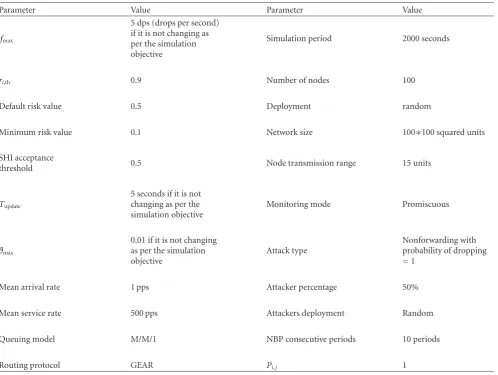
Table 1summarizes all experiments’ parameters.
Figure 1shows the resistance figure for CRATER versus time for two cases. In the first case, the thick curve, CRATER rates nodes based on FHI only. In the second case, the thin
2000 1500
1000 500
0
Time (seconds) FHI
FHI and NBP 0
0.1 0.2 0.3 0.4 0.5 0.6 0.7
R
esistanc
e
figur
e
Figure1: The resistance figure for FHI with and without neutral behavior period (NBP).
dotted curve, CRATER rates nodes on FHI and allows a reduction of the risk level of nodes if a neutral behavior period (NBP) is observed for 10 consecutive update periods. The figure shows that when CRATER implements FHI only, the resistance is higher than the case when it allows for NBP. The reason is that when NBP is allowed, its main role is to provide a chance for those idle malicious nodes to be more engaged in the routing operations by reducing their risk values. The lower resistance of that case proves that CRATER works as expected in terms of NBP.
Another important point to note here is the curve convergence issue. We can see that the curves are strictly increasing in a nonlinear trend with time. If the curves will converge, they have to converge at a value close to one, as explained earlier. However, it seems from curves behavior that the curve is very slowly converging since it increases from 0.45 att = 0 to 0.6 at t = 2000 seconds in case of FHI. This slow convergence is due to the choice of rating parameters, as will be discussed later.
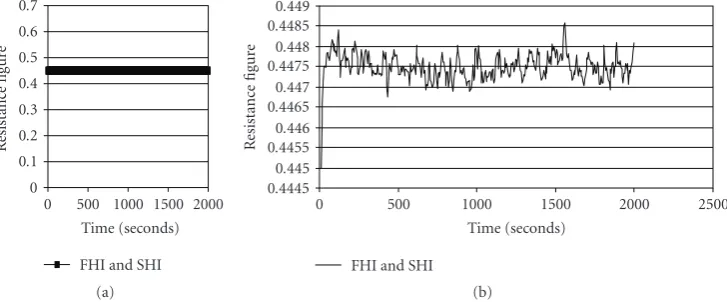
In Figure 2, we are studying the effect of adding SHI as a rating factor in CRATER. The same rating parameters used for FHI inFigure 1are used here. The left side of the figure shows the resistance in compressed scale, while the right hand side shows the same figure magnified on a detailed scale.
Before analyzing the curves, we should highlight the role of SHI in CRATER. SHI should assist in rating a certain node in a way that makes everyone has similar opinion about that node. To illustrate this point, assume that nodes A and B are interested in rating node C. Assume also that initially,
rA,C=0.9 andrB,C=0.5. If SHI is not allowed, A and B may
Table1: Simulation parameters for CRATER experiments.
Parameter Value Parameter Value
fmax
5 dps (drops per second) if it is not changing as per the simulation objective
Simulation period 2000 seconds
ri,th 0.9 Number of nodes 100
Default risk value 0.5 Deployment random
Minimum risk value 0.1 Network size 100∗100 squared units
SHI acceptance
threshold 0.5 Node transmission range 15 units
Tupdate
5 seconds if it is not changing as per the simulation objective
Monitoring mode Promiscuous
θmax
0.01 if it is not changing as per the simulation objective
Attack type
Nonforwarding with probability of dropping
=1
Mean arrival rate 1 pps Attacker percentage 50%
Mean service rate 500 pps Attackers deployment Random
Queuing model M/M/1 NBP consecutive periods 10 periods
Routing protocol GEAR Pi,j 1
resistance figure is equal to 1. However, the curve shows that this convergence happens at a value around 0.4475, which is much less than 1. This can happen only if FHI is suppressed by another factor that is trying to reduce FHI-related resistance, while at the same time; it tries to keep the ratings at a “global opinion” level. This is exactly what SHI role is supposed to be. This effect of SHI is much clearer in the right side ofFigure 2where we can see how the resistance curve is alternating around an average of 0.4475 as if SHI is competing FHI in a trial to keep the resistance around that value. The convergence at the value 0.4475 is not the ideal case. Where to converge is actually related to the rating parameters.
Figure 3shows the resistance curve for CRATER consid-ering all rating factors, that is, FHI, SHI, and NBP. The same parameters used for Figures1and2are used here. The left side provides a compressed scale while the right one gives the same curve in a detailed scale. If we compare Figure 2
withFigure 3, we can notice that there is no big difference between the two situations. This is becauseFigure 3differs fromFigure 2by the addition of NBP in rating calculations. As we have seen in the analysis of Figure 1, NBP does not affect the FHI rating very much. As a result, NBP
has transparent effect on CRATER under these settings and conditions.
Figure 4 studies the impact of the frequency of rating updates on the system resistance. The figure studies the resistance of CRATER considering FHI. Three cases are provided here, that is, when the updates are done every 2 seconds, 5 seconds, and 10 seconds. We can notice that as the updates are done more frequently the resistance gets higher values and converges faster towards 1. For example, with the updates done every 2 seconds, the resistance is 0.8 att = 1000 seconds, whereas it is equal to 0.45 when they are done every 10 seconds. Although the rate of attack is still the same, with frequent updates, CRATER punishes the malicious nodes in smaller increments in their risk values, but more frequently. This accumulates at a larger risk value as compared with less frequent updates. As a result, fast convergence and high resistance can be achieved with more frequent updates. However, remember that we are working in WSN environment where this can be an unnecessary overhead that consumes resources.
Figure 5analyzes the effect of varying fmaxon the
resis-tance of CRATER as FHI rating is concerned. Remember that
2000
Figure2: The effect of SHI on resistance figure: (a) compressed scale, (b) detailed scale.
3000
Figure3: The RESISTOR curve for CRATER with all rating factors, that is, FHI, SHI, and neutral behavior: (a) compressed scale, (b) detailed scale.
value that can be tolerated by the reputation system. So, when we decrease the value of fmaxwe should expect a very
sensitive system that will assign much higher risk values for malicious nodes as compared to high fmaxvalue case. Thus,
we expect to have higher resistance with low values of fmax. Figure 5shows that as we decreasefmaxfrom 10 dropped
packets per second (dps) to 0.5 dps, the resistance is improv-ing in terms of the convergence value and the convergence speed as well. For example, with fmax=10 dps, the resistance
is very slowly increasing and it is operating around 0.43, whereas with fmax =0.5 dps, the system very early jumps to
0.85 at aroundt=500 seconds. Although the fmax=0.5 dps
provides better resistance, it can cause a situation where we overestimate the misbehaving nodes. In such cases, the resistance may exceed 1. This can happen, for example, if the attacker drops the packet with probability less than 1. In that case, RESi,avg,theoriticalcan be less than RESi,avgdue to fmax.
However, in this section, we are studying the non forwarding attack with dropping probability = 1. Thus, the system does not overestimate nodes’ behavior as they are all at their maximum risk value when calculating RESi,avg,theoritical.
Thus, RESi,avg,theoritical will be always greater than or equal
to RESi,avg, and, consequently, the resistance figure will be
always less than or equal to 1.
5. Response
Once a node obtains risk information about its neighbors, a routing decision should be made regarding its future transaction. In our system, we modify GEAR protocol, which is geographic and energy aware routing protocol, to have the additional feature of trust awareness. Trust awareness is achieved by the rating functionality that will feed the routing protocol with the trust metric, which is basically the risk values,ri,j. The risk valueri,j, as discussed earlier, is a
quantity that reflects, to some extent, the expectation that a node j will not forward the packet received from nodei, assuming non forwarding attack.
The risk value metric, along with distance and energy metrics, is used to compute a learned cost function for each neighbor. The concerned node, then, makes the routing decision by selecting the neighbor of the lowest cost. The cost function that will be used to select the best router is as follows:
tj,R=βri,j
2000 1500
1000 500
0
Time (seconds) FHI, 2 s updates
FHI, 5 s update FHI, 10 s update 0
0.1 0.2 0.3 0.4 0.5 0.6 0.7 0.8 0.9
R
esistanc
e
figur
e
Figure4: Studying the effect of update periods frequency on the resistance figure considering FHI factor.
2000 1500
1000 500
0
Time (seconds) fmax=0.5 dps
fmax=1 dps
fmax=5 dps fmax=10 dps
0 0.2 0.4 0.6 0.8 1
R
esistanc
e
figur
e
Figure 5: Studying the effect of fmax on the resistance figure considering FHI factor.
where
(i)t(j,R) is thetrust-awarecost of using the node jby nodeias a router to the destinationR.ri,jis therisk valuethat nodeiso far knows about node j.
(ii)d(j,R) is the normalized distance from j to R(the distance fromjtoRdivided by the distance from the farthest neighbor ofitoR).
(iii)e(j,R) is the so far normalized consumed energy at nodejwhich is announced periodically everyTupdate.
(iv)α is a tunable parameter ∈ [0, 1] to give more preference to distance or energy.
(v) [αd(j,R) + (1− α)e(j,R)] is the GEAR component of the routing decision.
(vi)βis a tunable parameter∈[0, 1] to give more or less preference to trust as opposed to other resources.
If we are concerned about trust more than other resources,βshould be close to 1. Whenβequals 1, the trust-aware cost will consider only the trust part of (24) and the next hop will be the most trusted one. Settingβto zero, how-ever, turns the protocol to pure GEAR without any security considerations from the routing protocol perspective.
Different than GEAR, our routing operation involves only packet forwarding and does not implement dissemina-tion. This is because in the dissemination phase in GEAR, packets are intended to be forwarded to all nodes in the target region. However, when we consider trust awareness, a misbehaving node should not be given a chance to have the packet since it will not forward the packet. Thus, our protocol continues to forward packets based on the routing decisions made by the learned cost function.
Finally, regarding the problem of void regions, which is the case when a node finds itself the closest to the destination among its neighbors, there is no change in the escaping operation proposed by GEAR. The only difference here is that the reason of being in a void region can be related to the existence of misbehaving nodes in the proximity of the node of interest.
6. Reputation System Resistance Evaluation
In this part of the work, our simulation experiments are set to study the impact of adopting CRATER as a monitoring procedure on the performance on the reputation system. This will be done by studying the evolution of the resistance figure after allowing real interaction between CRATER and our trust-aware routing. The main difference between these experiments and the ones presented in Section 4.6 is that the system was trust unaware in Section 4.6. Thus, packet flow was governed by trust aware decision. Whereas in this section, our routing protocol is trust aware. Thus, rating and packet flow will be definitely impacted by routing decisions. Simulation settings and parameters are provided inTable 2. In this simulation, we will focus on the effect ofTupdateand
fmax since they represent the key parameters in risk and
resistance evolution.
6.1. Varying Tupdate. Tupdate represents the periodicity of
information update regarding cost functions and risk eval-uation. The more frequent the system is updated, the faster the system can reach the actual risk values of nodes. However, since our trust aware version of GEAR makes relative routing decisions, system performance in terms of delivery ratio (number of successfully delivered packets/total generated packets) cannot be directly related toTupdate values. This is
on routing performance. The investigation of this problem, however, is left for a future work.
In this part of simulation analysis, we are interested in seeing how responsive is our reputation system in relation toTupdatevariation as well as inspecting the stability issues.
CRATER parameters used in this experiment are presented inTable 3.
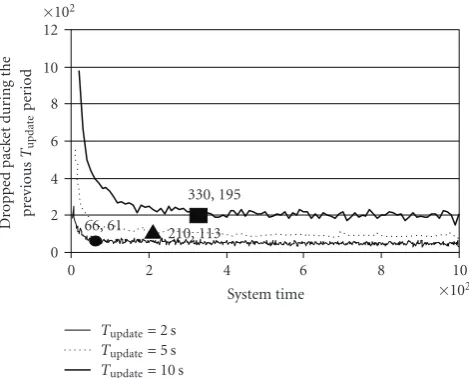
Figure 6 shows the number of dropped packets per a previousTupdate versus simulation time. We can notice that
asTupdateincreases, the dropped packets increase, which is an
intuitive result. However, what is important for this analysis is the time at which the number of dropped packets starts to stabilize around the average. The simulation shows the following observation: (after applying initial data deletion technique).
It is very noticeable that as the system gets updated very frequently, that is, asTupdategets smaller, the system reaches
a stable state much faster, as shown inTable 4.
Moreover, the resistance figure inFigure 7shows that as
Tupdate gets smaller, the stable value of the resistance figure
increases. The increase in the resistance figure should be analyzed using the resistance definition, that is, RESi,j =
(ri,j −ri,min)/Pi,j. Now, RESi,j gets higher as ri,j increases
and Pi,j decreases. However, ri,j is mostly affected by FHI
calculations as, ri,j,FHI = fi,j/ fmax, where, fi,j is given by
fi,j = ci,j/Tupdate. However, the ratioci,j/Tupdateis fixed and
not affected by Tupdate values for the assumption of fixed
rate, noncollusion attack. Thus,ri,j is almost unaffected by
Tupdate for initial interactions. On the other hand,Pi,j gets
smaller with Tupdate as it is evident from Figure 6. Thus,
RESi,jbecomes higher with smaller values ofTupdate.
The benefit of having high values of resistance is not reflected on the performance of routing protocol, as we explained earlier. However, this trend of resistance figure with Tupdate values has an important application, if we
adopt offensive and dismissal response mechanisms. For example, we can apply thresholds to start punishing nodes based on reaching certain resistance values by the whole system. If we have a sever situation where we require fast punishment and critical threshold values, small values of
Tupdate like 2 seconds will be the best choice. Of course,
this will be at the expense of more overhead, which is beyond the scope of the work objective. Since our routing protocol does not implement such advanced mechanisms, and since changing Tupdate does not have a direct impact
on routing performance, the best choice for Tupdate is the
one that provides the least overhead, that is, Tupdate =
10 seconds. However, in the remaining simulations we use
Tupdate = 5 seconds for the sake of consistency with other
simulations.
One last observation to notice here is that the value of the resistance figure in these experiments can exceed 1. This is actually due to the fact that we are allowing the attacker to drop packets with probabilities less than 1. As explained earlier in Section 4.6, this leads to overestimating the risk level of nodes. However, considering cautious assumptions, overestimating in CRATER is acceptable according to these assumptions.
Figure6: Dropped packets perTupdatefor differentTupdatevalues.
1000
Figure7: Resistance figure under different values ofTupdate.
6.2. Varying fmax. For experiments regarding varying fmax,
we used the same parameters inTable 3except thatTupdateis
set to 5 seconds andfmaxvaries as 1, 5, and 10.
As in the analysis of Tupdate impact on routing
perfor-mance, the same argument is applied here with the variation of fmax(maximum misbehavior frequency value that can be
tolerated by the reputation system). Routing performance in terms of delivery ratio is not influenced by changing
fmax because the concept of routing decision relativity is
still maintained.Figure 8clearly indicates that aspect since it shows that the number of dropped packets is the same during the simulation time irrespective of fmaxvalue.
However, as fmaxdecreases RESi,jincreases. That is why
the resistance figure becomes higher as fmax decreases in Figure 9. Again, these absolute values of the resistance under the lights of fmax can be utilized to design threshold for
Table2: Simulation parameters for repuation system experemints.
Parameter Value Parameter Value
Number of nodes 100 nodes Queuing model M/M/1
Network dimensions Square 90 unitsunits ∗90 Simulation platform
Event driven simulation using Java programming language
Transmission range 15 units Simulation duration 1000 seconds
Network deployment Random topology Retransmission timeout Explicit retransmission
request
Power consumption
1 Watt per reception, 1 Watt per sending, 1 milli-Watt per processing operation
Retransmission trials Unlimited
Mean arrival rate 1 pps Update strategy Periodic, every 5 seconds
Mean service rate 500 pps α 0.5 (GEAR parameter)
Outsider attackers
deployment Random
Communication discipline
Random source to random destination
Escaping void Using GEAR part and
then distance
Void failure: max
number of hops 100
% of attackers 50% Attackers deployment Random
Table3: Simulation parameters forTupdatevariation experiments.
Parameter Value Parameter Value
Tupdate 2, 5, 10 seconds fmax 10
% of attackers 50% Simulation time 1000 seconds
Number of nodes 100 nodes Attackers deployment Random
NMA PON1=PON2=1 β 0.5
Table4: Packet drops information with differentTupdate.
Tupdate Stabilizationtime Average number ofdropped packets
2 seconds 66 seconds 61
5 seconds 210 seconds 113
10 seconds 330 seconds 195
to 1 to have high resistance in sever applications in order to apply isolation mechanisms in an offensive response.
6.3. The Effect of Attacker Population in the Network. It is trivial to conclude that as the attackers’ percentage increases in the system, the delivery ratio degrades. However, the pur-pose of this simulation is to show how much improvement is expected by being exposed to less number of attackers under the lights of various values ofβ.
InFigure 10, we tested three attackers’ percentages, that is, 10, 30 and 50%. We did not go beyond 50% since after that the network is mostly owned by the attacking community. Two important observations can be extracted fromFigure 10.
(i) The impact ofβ(the trust aware preference param-eter) on delivery ratio starts to appear significantly after β = 0.4, which is beyond the value 1/3 that
1000 800
600 400
200 0
System time fmax=1
fmax=5 fmax=10
0 100 200 300 400 500 600
Dr
opped
p
ac
ke
ts
in
pr
ev
ious
Tupdat
e
pe
ri
od
Figure8: Packet dropping perTupdatefor different fmaxvalues.
1000
Figure9: Resistance figure under different values offmax.
1
Figure10: Delivery ratio with various percentages of attackers.
(ii) The delivery ratio improves significantly by reduc-ing the percentage of attackers in the system. For example, at β = 0.9, the delivery ratio improves from 0.49 to 0.9. Since WSN can be dynamically redeployed, one trick can be used here is to decrease the number of attacker by deploying more “fresh” nodes. However, this guarantees that better nodes will exist in the vicinity of other nodes and they will be more qualified to be routers as opposed to the malicious ones.
Coming to resistance analysis,Figure 11shows an inter-esting phenomenon of our RESISTOR tool. That is, the more exposure to attacks the system is, the more resistant the system should be. When the number of attackers is high, more packets will be dropped initially. This is because the alternative routers are also malicious. This implies that the victim node will have better updates on the risk value as it will experience more interactions with malicious nodes. As a result, the risk values will get higher. In a later time, yet not so much late, fewer packets will be delivered per malicious node due to the discovery of its malicious behavior. Thus,
1000
Figure11: Resistance figure with various percentages of attackers in the integrated system.
ultimately we will have high risk values with few delivered packets per malicious node that implies high resistance. However, although we deliver fewer packets per malicious node in high percentage of attackers, the collective drops due to the population of the attackers sums up to larger drop counts than what is encountered when we have less percentage of attackers where more packets are mistakenly delivered to malicious nodes. This is evident from the delivery ratio results inFigure 10.
7. Related Work
In literature, several famous work deals with behavioral related routing security problems using different approaches. For example, Intrusion-tolerant Routing in Wireless Sensor Networks (INSENS) [11] constructs tree-structured routing for wireless sensor networks (WSNs). It aims to tolerate damage caused by an intruder who has compromised deployed sensor nodes and is intent on injecting, modify-ing, or blocking packets. INSENS incorporates distributed lightweight security mechanisms, including one-way hash chains and nested keyed message authentication codes to defend against routing attacks such as wormhole attack. Adapting to WSN characteristics, the design of INSENS also pushes complexity away from resource-poor sensor nodes towards resource-rich base stations.
shares a common key. The protocol provides the methods for nodes to securely share their keys and communicate directly so that the efficiency of communication is increased.
The two previously mentioned protocols are crypto-based solutions. They can successfully fight against attacks in which an intruder falsifies his identity to be a relay for the source such as sybil attack. However, other attacks like selective forwarding, blackhole and HELLO flooding [13] are still possible especially when the attack is performed by an insider node or a node compromised by an intruder. Moreover, any misbehavior due to selfishness or faulty operational nodes cannot be prevented or even detected.
The authors of [8, 14] introduced a mechanism that includes two parts: watchdog and pathrater. The watchdog is the monitoring part that is designed to be responsible for detecting only non forwarding misbehavior. This is accom-plished by overhearing the transmission of the next node. The node thus is assumed to be in a continuous promiscuous mode. When the attack is detected, the observing node informs the source of the concerned path.
The pathrater is the component used for reputation. Ratings are kept about every node in the network based on its routing activity and they are updated periodically. Nodes select routes with the highest average node rating. Thus, nodes can avoid misbehaving nodes in their routes as a response. However, misbehaving nodes can still transmit their packets as there is no punishment mechanism adopted here. Moreover, no SHI propagation view is considered which limits the cooperativeness among nodes.
In SORI (Secure and Objective Reputation-Based Incen-tive Scheme for Ad Hoc Networks) [15], the authors target only the non forwarding attack, as we have implemented in this work. SORI monitors the number of forwarded packets from neighborhood and the number of forwarded packets to neighborhood. Reputation ratings are then acquired by computing the ratio between the two numbers with a con-sideration for the confidence in the rating proportional to the number of packets that are initially requested for forwarding. SHI is delivered only to the immediate neighbors. This rating source, however, is weighted by what is called credibility, which is derived from the rating ratio. The delivery of the SHI is achieved by hash-chain based authentication.
An important reference for reputation systems in ad hoc networks is Cooperation Of Nodes—Fairness In Dynamic Ad-hoc Networks (CONFIDANT) [16]. It is a reputation-based secure routing framework in which nodes monitor their neighborhood and detect different kinds of misbehav-ior by means of an enhanced PACK mechanism. The nodes use the second-hand information from others as a resource of rating, as well. The protocol is based on Bayesian estimation that aims to classify other nodes as misbehaving or normal. The observing node excludes misbehaving nodes from the network as a response, by both avoiding them for routing and denying them cooperation. The protocol assumes a DSR operational routing protocol and lacks a provision on WSN constraints and conditions as it is designed for general ad hoc networks.
Another famous reputation mechanism in literature is CORE protocol (Collaborative Reputation Mechanism to
Enforce Node Cooperation in Mobile Ad Hoc Networks) [5]. It is a complete reputation mechanism that differentiates between subjective reputations or observations, indirect reputation which includes only the positive reports by others (SHI), and functional reputation, also referred as task-specific behavior, which are weighted according to a combined reputation value that is used to make decisions about cooperation or gradual isolation of a node. The system assumes a DSR routing in which nodes can be requesters or providers. The rating is done by comparing the expected result with the actually obtained result of a request.
The authors of [7] proposed a robust reputation system for P2P and mobile ad hoc networks. Their main contri-bution is its proposal for a distributed reputation system that can handle false disseminated information. Every node maintains a reputation rating and a trust rating about every node that is of interest. The authors use a modified Bayesian approach so that they will accept only an SHI set that is compatible with the current reputation rating. Also, Trust ratings are updated based on the compatibility of second-hand reputation information with prior reputation ratings. The work avoids exploitation of good behavior that can be incorrectly built over time by introducing a concept of re-evaluation and reputation fading.
The work in [17] is an integrated approach that provides energy, efficiency, reliability, scalability, and support for QoS. It applies TRAP; a trust-aware routing protocol that derives its routes based on link quality and echo ratio (node packets forwarded by j that belong to i to the total broadcasted packets byi) and from both components a reputation system is developed.
An algebraic approach is adopted in [18], where the trust inference problem is modeled as a generalized shortest path problem on a weighted directed graph. A weighted edge from vertex to vertex corresponds to theopinionthat entity, also referred to as theissuer, has about entity. Each opinion consists of two numbers: thetrust value, and theconfidence
value. To enhance the reliability of the system, multiple trust paths are utilized to compute the trust distance from the source to the destination. The essence of this approach is the two operators used to combine opinions. One operator combines opinions along a path, while the other operator combines opinions across paths. Eventually, we end with solving path problems in graphs, provided that they satisfy certain mathematical properties, that is, form an algebraic structure called a semiring.
Another recent work on developing a reputation system is the one presented in [19]. It incorporates a measure of uncertainty based on subjective logic into the reputation system to reflect the confidence in such system.
a Bayesian formulation, using a beta distribution model for reputation representation.
The system starts the operation by monitoring. Monitor-ing mechanism follows the classic watchdog methodology in which a node is assumed to be in a promiscuous mode to overhear neighbors’ packets. Monitoring behavioral events can result in either cooperative event, α, in which a node is behaving well or noncooperative behavior,β, in which a node misbehaves. The count of each type is injected into the beta distribution formula as the distribution parameters to calculate the node reputation R. This formula calculates node’s reputation based on FHI. The reputation is updated based on the new monitoring events, SHI received and according to the age of the current reputation value. Any response action is based on selecting the most trusted node. The trust value of a node that is used for decision making is calculated as the statistical expectation of the reputation value.
RFSN, however, lacks some important points.
(i) The monitoring mechanism uses a normal watchdog mechanism that assumes a promiscuous mode oper-ation for every node. This is not suitable for the WSN conditions in terms of energy scarcity as discussed earlier.
(ii) The work does not propose a response methodology, for example, a routing algorithm. Instead, it leaves it as an open issue. Therefore, the work lacks performance figures that can show the efficiency and security gain and benefits in routing operation that can be obtained in adopting this solution.
8. Conclusion and Future Work
In this paper we proposed a new rating approach for reputation systems in WSN called CRATER. CRATER eval-uates nodes reputation by a risk representation. This risk value is computed based on first hand information (FHI), second hand information (SHI), and idle behavior (NBP). The mathematical modeling of CRATER assumes a set of conditions that we define as cautious assumptions in which a node is very cautious in dealing with other’s information. Our proposed approach is robust against nonforwarding attack and we hint in our discussion for its ability to mitigate bad mouthing attack. Also, CRATER is a modular approach that can easily be modified to tackle other attacking such as colluding attacks.
CRATER has been evaluated using our novel evaluation technique RESISTOR. Simulation results proved our expec-tation on how CRATER should behave. CRATER parameters variations were directly reflected in our proposed resistance figure and trust-awareness knowledge evolution.
As a future work, we suggest the following important research directions.
(i)Using RESISTOR for comparisons among different rating methods: to further prove the efficiency of RESISTOR as an appropriate tool to measure dif-ferent reputation systems, we can use other rating
techniques and trust evolution algorithms instead of CRATER and then use RESISTOR to evaluate these different systems and compare the results with other evaluation techniques. This can help in achieving standardized mechanisms to evaluate reputation sys-tems.
(ii)Modifying routing protocol to have offensive and dismissal response: in our reputation system, our response part performs a defensive function in the sense that it only avoids malicious nodes without any further actions against them. However, we can make use of the obtained risk values and the trust relations to enhance system response to function in offensive manner (e.g., not forwarding malicious nodes’ packets) or dismissal manner (e.g., total isolation of malicious nodes). This will be done by designing certain thresholds that determine how and when such actions should be taken. These thresholds will be set by the network operator by the aid of RESISTOR.
Acknowledgments
The authors would like to thank King Fahd University of Petroleum and Minerals for its support. Also, special thank is due to the anonymous reviewers for their valuable comments and input that help in presenting our work better.
References
[1] A. Jøsang, R. Ismail, and C. Boyd, “A survey of trust and
reputation systems for online service provision,” Decision
Support Systems, vol. 43, no. 2, pp. 618–644, 2007.
[2] A. Jøsang, E. Gray, and M. Kinateder, “Simplification and
analysis of transitive trust networks,” Web Intelligence and
Agent Systems, vol. 4, no. 2, pp. 139–161, 2006.
[3] A. Boukerch, L. Xu, and K. EL-Khatib, “Trust-based security
for wireless ad hoc and sensor networks,”Computer
Commu-nications, vol. 30, no. 11-12, pp. 2413–2427, 2007.
[4] A. Rezgui and M. Eltoweissy, “TARP: a trust-aware routing
protocol for sensor-actuator networks,” inProceedings of the
IEEE Internatonal Conference on Mobile Ad hoc and Sensor Systems (MASS ’07), pp. 1–9, Pisa, Italy, October 2007. [5] P. Michiardi and R. Molva, “Core: a collaborative reputation
mechanism to enforce node cooperation in mobile ad hoc
networks,” in Proceedings of the International Conference of
Communication and Multimedia Security, pp. 26–27, Portoroz, Slovenia, September 2002.
[6] A. Jøsang and R. Ismail, “The beta reputation system,” in
Proceedings of the 15th Bled Electronic Commerce Conference, e-Reality: Constructing the e-Economy, Bled, Slovenia, June 2002. [7] S. Buchegger and J.-Y. Le Boudec, “A robust reputation system
for peer-to-peer and mobile ad hoc networks,” inProceedings
of the Workshop on Economics of Peer-to-Peer Systems (P2PEcon
’04), Harvard University, Cambridge, Mass, USA, June 2004.
[8] S. Buchegger and J.-Y. Le Boudec, “Self-policing mobile ad
hoc networks by reputation systems,”IEEE Communications
Magazine, vol. 43, no. 7, pp. 101–107, 2005. [9] http://www.xbow.com/.
wireless sensor networks,” Tech. Rep. UCLA/CSD-TR-01-0023, 2001.
[11] J. Deng, R. Han, and S. Mishra, “Insens: intrusion-tolerant
routing in wireless sensor networks,” inProceedings of the 23rd
International Conference on Distributed Computing Systems (ICDCS ’03), Providence, RI, USA, May 2003.
[12] C. C. Oniz, S. E. Tasci, E. Savas, O. Ercetin, and A. Levi,
“SeFER: secure, flexible and efficient routing protocol for
dis-tributed sensor networks,” inProceedings of the 2nd European
Workshop on Wireless Sensor Networks (EWSN ’05), pp. 246– 255, Istanbul, Turkey, January-February 2005.
[13] C. Karlof and D. Wagner, “Secure routing in wireless sensor
networks: attacks and countermeasures,” Ad Hoc Networks,
no. 2-3, pp. 293–315, 2003, special issue on Sensor Network Applications and Protocols.
[14] S. Marti, T. J. Giuli, K. Lai, and M. Baker, “Mitigating routing
misbehavior in mobile ad hoc networks,” in Proceedings of
the Annual International Conference on Mobile Computing and Networking (MOBICOM ’00), pp. 255–265, Boston, Mass, USA, August 2000.
[15] Q. He, D. Wu, and P. Khosla, “SORI: a secure and objective reputation-based incentive scheme for ad-hoc networks,” in Proceedings of the IEEE Wireless Communications and Networking Conference (WCNC ’04), pp. 825–830, Atlanta, Ga, USA, March 2004.
[16] S. Buchegger and J.-Y. Le Boudec, “Performance analysis of the CONFIDANT protocol: cooperation of nodes—fairness in
dynamic ad-hoc networks,” inProceedings of the International
Symposium on Mobile Ad Hoc Networking and Computing (MobiHoc ’02), pp. 226–236, Lausanne, Switzerland, June 2002.
[17] A. Rezgui and M. Eltoweissy, “μRACER: a reliable adaptive
service-driven efficient routing protocol suite for
sensor-actuator networks,” IEEE Transactions on Parallel and
Dis-tributed Systems, vol. 20, no. 5, pp. 607–622, 2009.
[18] G. Theodorakopoulos and J. S. Baras, “On trust models and
trust evaluation metrics for ad hoc networks,”IEEE Journal on
Selected Areas in Communications, vol. 24, no. 2, pp. 318–328, 2006.
[19] K. Kane and J. C. Browne, “Using uncertainty in reputation methods to enforce cooperation in ad-hoc networks,” in
Proceedings of the 5th ACM Workshop on Wireless Security (WiSE ’06), vol. 2006, pp. 105–113, Los Angeles, Calif, USA, September 2006.
[20] S. Ganeriwal, L. K. Balzano, and M. B. Srivastava,
“Reputation-based framework for high integrity sensor networks,”ACM