R E S E A R C H A R T I C L E
Open Access
Diversity-multiplexing tradeoff analysis and
optimization for OFDM-based multihop
relaying systems
Weiwei Yang
1*, Yueming Cai
1, Wendong Yang
1and Baoyu Zheng
2Abstract
In this article, we consider a single-antenna orthogonal frequency division multiplexing-based multihop relaying system over frequency selective fading channels employing subcarrier grouping and linear constellation precoding at the source, and linear detection at the destination. We derive closed-form expressions of the diversity-multiplexing tradeoff relation, and propose the optimal precoder design and symbol loading strategy to achieve the optimal diversity performance. Simulation results are presented to verify our theoretical analysis.
Introduction
Multihop relaying communication is well known for being a cost-effective approach to improving the energy effi-ciency of communication systems in the case of long source–destination distance [1-3]. On the other hand, orthogonal frequency division multiplexing (OFDM) is one of the dominating transmission techniques in many broadband wireless systems [4], e.g., IEEE 802.16 (WiMax), EV-DO Revision C, and the long-term evo-lution, which divides the broadband wireless channel into a set of orthogonal narrowband subcarriers and hence eliminates the inter-symbol interference. Com-bining OFDM with multihop relaying has been shown promising in future wireless broadband networks, and has received a lot of attention recently [5-8]. In par-ticular, this OFDM-based multihop relaying architecture has been proposed by current wireless standards, i.e., IEEE 802.16j [5]. Can et al. [6] have considered the implementation issues of OFDM-based multihop cellu-lar networks. The authors of [7] have exploited the hop diversity to improve the spectral efficiency of OFDM-based multihop relaying networks, which employed a decode-and-forward (DF) protocol in each hop link. Zhang et al. [8] further considered OFDM-based lin-ear multihop networks over broadband wireless channels,
*Correspondence: yww [email protected]
1Institute of Communications Engineering, PLA University of Science and Technology, Nanjing, China
Full list of author information is available at the end of the article
and derived the maximum end-to-end average trans-mission rate and its corresponding optimal power and time allocation. In these prior works, OFDM converts a frequency-selective fading channel into parallel flat-fading subchannels and the correlation between adjacent subchannel is ignored for simplicity. However, the price paid for OFDM’s simplicity is that these OFDM-based multihop relaying schemes cannot exploit multipath diversity.
In order to exploit multipath diversity, the authors of [9-12] have employed linear constellation precoding for OFDM systems which can be implemented with lim-ited complexity and is especially suitable for high-rate, delay-sensitive applications where powerful outer codes cannot be employed. In most of these works, the decod-ing at the destination node has been done by usdecod-ing the maximum-likelihood (ML) detector, which has been shown to achieve the maximum possible diversity. How-ever, the ML detector has an exponential complexity in the number of precoded data streams and may not be feasible in practical systems with complexity constraint. The linear detectors, i.e., linear zero-forcing (ZF) detector and lin-ear minimum-mean-square-error (MMSE) detector can reduce the complexity of the receiver, and have been con-sidered in [11,12] for single hop frequency-selective fading channels. However, diversity gain obtained from linear detectors is critically dependent upon the system design,
i.e., precoder design, subcarrier grouping, and symbol loading. It is therefore of interest to develop optimal design for OFDM-based multihop relaying systems with linear constellation precoding and linear detection.
The diversity-multiplexing tradeoff (DMT) has origi-nally been developed in [13] to study narrowband sin-gle hop multiple-input multiple-output (MIMO) fad-ing channels. Recently, the DMT performance of relay channels under various protocols has been presented in [14-17]. These works mainly focused on two-hop relay networks, where the communication between a source and its destination is assisted by relay nodes. For large networks, multiple hops of relays may be needed to establish communication for a source–destination pair. This multihop relay channel scenario has been investi-gated in [2,3,18-20]. Sreeram et al. [2,3] have proposed a improved flip-and-forward relay scheme by changing the partitions adaptively according to the multiplexing rates, and observed better DMT performance. In [18], the DMT upper bound for the MIMO multihop chan-nel has been derived by using the capacity cut-set upper bound. In [19], the MIMO multihop relay channel with one multiple-antenna relay at each hop has been stud-ied, and the results showed that under the full-duplex constraint, the DF relay scheme can achieve the DMT cut-set upper bound. The DMT performance of a MIMO full-duplex single-user multihop relay channel has been investigated in [20], and an AF-based space–time relay scheme has been proposed for full-duplex MIMO multi-hop relay networks to achieve the optimal DMT of the channel. However, these results were discussed mainly for flat-fading channels. The DMT framework has also been used in [21,22] to study frequency-selective fading chan-nels. The fundamental DMT for the MIMO frequency-selective fading channels has been derived in [23] and the code design criteria to achieve this tradeoff was obtained in [24]. However, the design criteria in [24] has been derived assuming the ML detector at the receiver and hence is not applicable to suboptimal linear detectors which are of interest to us. Recently, the authors of [25] have analyzed the DMT performance for multiple-input multiple-output OFDM systems over frequency-selective fading channels. However, to the best of the authors’ knowledge, the DMT performance of an OFDM-based multihop relaying system over frequency-selective fading channels remains hitherto unknown, and how to design these OFDM-based relaying systems optimally in terms of DMT is still an open problem, which motivates our work.
In this article, we adopt the framework of DMT to study an OFDM-based multihop relaying system with lin-ear constellation precoding and linlin-ear detection over fre-quency selective fading channels. Our main contributions are summarized in the following.
(1) We derive closed-form expression of the DMT performance for an OFDM-based multihop relaying system employing linear constellation precoding at the source node and linear ZF or MMSE detection at the destination node.
(2) We show that the smallest of the multipath channel orders experienced in each wireless links becomes the performance bottleneck in the high-signal-to-noise ratio (SNR) regime. Different from ML detector, the achievable multipath diversity gain by linear detectors is dependent upon the symbol loading strategy and precoder design for given multihop relaying networks. Furthermore, no diversity gain is achieved when full-rate precoder and linear detector are employed for OFDM-based multihop relaying systems. The loss of multipath diversity is the price paid for simplicity of linear detection.
(3) In order to obtain the maximum multipath diversity gain, we design the optimal symbol loading strategy and give the necessary and sufficient precoder design conditions. Simulation results show that the optimal symbol loading and precoder design strategy can improve the DMT performance significantly.
The rest of this article is organized as follows. In the fol-lowing section, an OFDM-based multihop relaying system under consideration is briefly described. In Section “DMT analysis”, the DMT analysis for the OFDM-based multi-hop relaying system with linear constellation precoding and linear detection is given. In Section “Optimal trans-mit strategies design”, we develop the optimal transtrans-mit strategies for the OFDM-based multihop relaying sys-tem, including symbol loading and precoder design. In Section “Simulation results and discussion”, some simu-lation results are presented and discussed. Concluding remarks are given in Section “Conclusions”.
Throughout this article, the following notations will be used.(·)Tand(·)Hdenote transpose and Hermitian trans-pose, respectively. span{x1,. . .,xk}is the vector subspace
spanned by the k vectors x1,. . .,xk. rank{X}, |X| and
[X]m,ndenote the rank, the Frobenius norm, and the
ele-ment at themth row and thenth column of the matrixX, respectively. vec{X}indicates the vector obtained stacking up the columns of the matrixX. diag{X1,. . .,Xk} is the
block-diagonal matrix containing the matricesX1,. . .,Xk
on the main diagonal. For any two matricesA,Bwith iden-tical number of rows (columns), [A,B] ([A;B]) denotes the matrix formed by concatenating the columns (rows) ofBwith those ofA.tr{A}andλmin{A}denote the trace and the minimum eigenvalue of the square matrixA.Ik
indicates the identity matrix of order k. ⊗ denotes the Kronecker product. E{·} denotes statistical expectation.
f(ρ) =. g(ρ) indicates that limρ→∞logf(ρ)
logρ =
limρ→∞logg(ρ)
System model
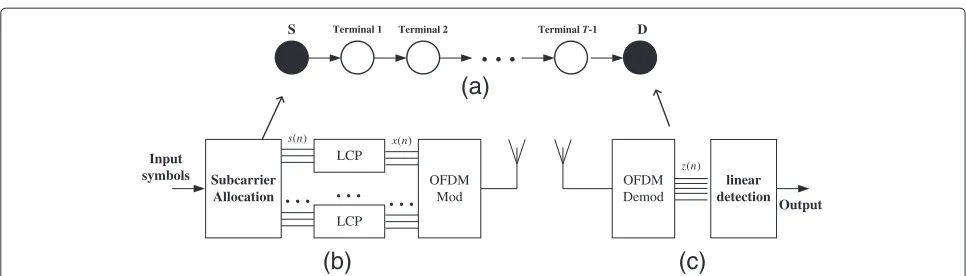
We consider a wireless multihop OFDM-based relay-ing system with one source node, one destination node, and T−1 relay nodes (T≥2), as shown in Figure 1, where the tth relay is denoted by terminal t, and the source and destination are denoted by terminals 0 andT, respectively.
We assume that due to the propagation path-loss, the signal transmitted by terminaltcan only be received by its direct neighboring nodes, i.e., terminalt−1 and terminal
t+1. Thus, the source signals travel throughThops until they are received by the destination node. Every node is equipped with a single antenna, and we also assume that all relays work in full-duplex mode. This assumption is merely for simplicity of notation. Since we assume that the signal of each node can only be received by its direct neighboring nodes, the half-duplex constraint is directly translated to a reduction of degrees of freedom by a con-stant factor and does not impact the relaying strategy. The non-regenerative relay strategy is employed at relay nodes, where each relay node simply amplifies and forwards (AF) OFDM symbols. All relay nodes employ amplifiers with fixed gainα. Network operators determine the value ofα.
The channel from terminalst−1 tot(t ∈ {1,. . .,T})
is modeled as frequency selective Rayleigh fading and described by the discrete-time impulse response ht =
[ht(0),. . .,ht(Lt−1)]T, whereLtdenotes the
correspond-ing channel order, andht(l)(l ∈ {0,. . .,Lt−1}), denotes
the Rayleigh fading coefficient of the lth path, and is a zero-mean complex Gaussian random variable with varianceδt,l2. The channel impulse responses include the effects of transmit receive filters, physical multipath, and relative delays among antennas. We assume the channel power constraint asLt−1
l=0 δt,l2 =1.
At the destination node, after removing the cyclic prefix and applying the FFT, the frequency received signal at the
nth subcarrier is given by
z(n)=αT−1
T
t=1 Ht(n)
x(n)+w(n) (1)
where x(n) is the transmitted signal from the source node at the nth subcarrier, E|x(n)|2 = 1, Ht(n)
is the channel frequency response between termi-nals t − 1 and t at the nth subcarrier. Denote
fLt(n) = 1,e−j2
πn/N,. . .,e−j2πn(Lt−1)/N, and H
t(n)can
be expressed as
Ht(n)=fLt(n)ht (2)
The effective noise term w(n) is the noise received at the destination node at the nth subcarrier, which cap-tures the overall noise in the multihop channel. Letvt(n)
denote the zero-mean complex Gaussian noise with vari-anceσ2introduced at thetth hop transmission at thenth subcarrier, andw(n)can be expressed as
w(n)=vT(n)+αHT(n)vT−1(n)+ · · · +αT−1
×Ti=2Hi(n)
v1(n)
(3)
Note thatw(n) is not white in general. However, since our focus is on the system asymptotic behavior and it has been shown that in this scale of interest, non-Gaussian noise does not affect the analytical results [20]. So, for largeT, using the central limit theorem, we treatw(n)as Gaussian noise with zero mean and a variance of
E|w(n)|2≈σ2
1+T−1
t=1 α 2t
, ∀n=1,. . .,N
(4)
The destination node normalizes the received signal by a factor of
1
σ21+T−1 t=1 α2t
. This does not affect
LCP ( )
s n
( )
z n
Input
symbols OFDM
Demod
linear detection
( )
x n
Subcarrier Allocation
LCP
OFDM
Mod Output
Terminal 1 Terminal 2 TerminalT-1
…
…
…
…
(b)
D S
(c)
(a)
the SNR, but simplifies the presentation. After normaliza-tion, we have
z(n)=√ρ
T
t=1 Ht(n)
x(n)+w(n) (5)
where w(n) = w(n)σ21+T−1 t=1 α2t
is the zero-mean complex Gaussian noise with unit variance, and
ρ =α2(T−1)σ21+T−1 t=1 α2t
represents the transmit SNR.
Subcarrier grouping and linear constellation precoding Subcarrier grouping and linear constellation precoding can exploit the multipath diversity with low-complexity decoding, which has been applied to single-hop or dual-hop OFDM systems [9-12]. Each group employs one lin-ear precoder and the groups are independently decoded in parallel. Linear constellation precoding is employed across a group of any K ≤N tones within one OFDM symbol. Let K{n1,. . .,nK} be the set of index of
the precoded tones. Upon defining Hg=diag([ T
t=1 Ht
(n1),. . .,T
t=1
Ht(nK)]T), z
g =[z(n1),. . .,z(nK)]T, xg =
[x(n1),. . .,x(nK)]T, andwg =[w(n1),. . .,w(nK)]T, the
corresponding received signals can be recast as follows:
zg =√ρHgxg+wg (6)
where xgUsg, U∈CK×M is a linear constellation
precoding matrix and trUUH=K. sg=[s(n1),. . ., s(nM)]T∈AMis a vector containingMindependent and
identically distributed information symbols, where Ais the modulation constellation set. Mmeans the number of symbols assigned to each group, which is decided by the symbol loading strategy. We assumeEsgsHg
= IM
and the precoding matrix U is full column-rank, i.e.,
rank(U)=M.
Linear detection
The ML decoding complexity increases exponentially with the increase of the size of the constellation alpha-bet and the column of the precoding matrixM, and may not be feasible in practical systems with complexity con-straint. To reduce the complexity of the receiver, linear ZF and MMSE detection in [11,12] are employed at the des-tination. IfHgUis full column-rank, the ZF detection can
be described as ˆ
sg=(UHHHgHgU)−1UHHHgzg (7)
=√ρsg+ ˜wg
where w˜g=(UHHHgHgU)−1UHHHgwg. In this case, E{ ˜wgw˜Hg} = (UHHHg HgU)−1 Q and the
post-processing SNR for themth data symbol is SNRZFm = ρ
[Q]m,m
(8)
The MMSE detection can be described as ˆ
sg=(UHHHgHgU+ ρ1IM)−1UHHHgzg (9)
In this case, the post-processing SNR for themth data symbol is
SNRMMSEm = ρ [(UHHH
gHgU+ 1ρIM)−1]m,m
−1 (10)
As stated in [26], in the following we assume that the residual interference plus noise at the output of the MMSE filter can be modeled as Gaussian random variable.
DMT analysis
In this section, we study the DMT relation of an OFDM-based multihop relaying system over frequency selective fading channels, which employs subcarrier grouping and linear constellation precoding at the source and linear ZF or MMSE detection at the destination.
LetEindicate the event that at least one of the entries of sg is erroneously detected andR(ρ) be the transmit
rate over a group ofKtones. We say that a transmission scheme achieves a spatial multiplexing gain of γg if the supported data rate
R(ρ)≈γglogρ (11)
where γg ∈[ 0,K] denotes the multiplexing gain over a group ofKtones. The DMT can be characterized by map-ping the diversity gain as a function ofγg, i.e.,d(γg), where d(γg)is the diversity gain and defined by
d(γg)= lim ρ→∞−
log(Pr(E))
logρ (12)
where Pr(E)is the probability of the eventE.
Let γg ∈[ 0,K] denote the multiplexing gain over a
group of K subcarriers. The next theorem analyzes the DMT performance of the OFDM-based multihop relaying system.
Theorem 1 Employing a given full column-rank pre-coderU ∈ CK×M to implement linear constellation pre-coding over an arbitrary group of K ≤ N tones at the source node and linear ZF detection at the destination node, the DMT of the OFDM-based multihop relaying system is
d(γg;M;G;K)=
(1−γg/M)min{K−G+1,Lmin},
0 ,
γg∈[ 0,M] γg∈[M,K]
Proof of Theorem 1Consider first the ZF detector. Based on (11), we have
Pr(E)=Pr tion precoding matrixU, we can transmitMparallel data streams over a group ofK tones. Furthermore, it exploit the correlation structure of the OFDM subchannels and can achieve multipath diversity gain.
Notice that max{
m
[Q]m,m} ≤tr{Q} ≤Mmax{ m
[Q]m,m},
and (14) can be expressed as
Pr(E)=. Pr can be rewritten as
Pr(E)=. Pr{λmin(UHHgHHgU) < ρ−(1−γ )} (16)
Using the Rayleigh-Ritz Theorem [27, Theorem 4.2.2], we have
M−1-dimensional subspace ofCM. Without loss of gen-erality, let us assume hererank{[u1,. . .,uG]H} =Mand
independent of the channel andρ. Letcmax=max
j {cj}, for
The probability Pr(E)can be lower-bounded by
Pr(E) ˙≥Pr{cmax|hG|2< ρ−(1−γ )}
nels according to their channel orders. So, the channel with the smallest order is ht1 with the order Lmin letβmin2 be the minimum nonzero eigenvalue ofandh=
[ht1(0),. . .,ht1(η2−1)]T. Then, we can get
, andϕis a Chi-squared random variable with 2ηdegrees of freedom. Hence, we can obtain the lower bound of Pr(E)
Pr(E) ˙≥Pr{ϕ < ρ−(1−γ )βmin2 }
.
=ρ−(1−γ )min{K−G+1,Lmin}
We now derive the upper bound of Pr(E). We can
tian and positive semi-definite, and use the Weyl theorem [27, Corollary 4.3.3], we can obtain
Pr(E)=. Pr{λmin(UHHHgHgU) < ρ−(1−γ )}
˙≤Pr{λmin(UH1Hg1HHg1U1) < ρ−(1−γ )}
˙≤Pr{λmin(UH1U1)λmin(HHg1Hg1) < ρ−(1−γ )}
(26)
where the second inequality employs the Ostrowski theorem [27, Theorem 4.5.9]. Finally, notice that
λmin(UH1U1) depends upon the specific tone ordering
employed in (25); nevertheless, we can always find a pos-itive constant C2 (which is independent of the channel
andρ) such thatλmin(UH1U1) ≥ C2for all possible tone
orderings. So, (26) can be expressed as
Pr(E)˙≤Pr{λmin(Hg1HHg1) < ρ−(1−γ )} (27) there have at leastτ distinct tone index in deep fade. So, we have Following similar steps in (21)–(24), we can obtain
Pr(E)˙≤ρ−(1−γ )min{K−G+1,Lmin} (29)
Based on (24) and (29), we can conclude that employ-ing a given full column–rank precoder U ∈ CK×M to implement linear constellation precoding over an arbi-trary group ofK≤Ntones at the source node and linear ZF detection at the destination node, the DMT of the OFDM-based multihop relaying system is
d(γg;M;G;K)= Similarly, for the MMSE detector, we have
Pr(E)=. Pr Following similar steps in (16)–(29), we can write (31) as Pr(E)=. ρ−(1−γ )min{K−G+1,Lmin} (32)
So, employing a given full column–rank precoderU ∈
CK×M to implement linear constellation precoding over
an arbitrary group of K ≤ N tones at the source and linear MMSE detection at the destination, the DMT of the OFDM-based multihop relaying system is the same as (30).
Based on Theorem 1, it is shown obviously that for given multiplexing gain over a group of K tones, the achievable diversity gain by linear detector, i.e., linear ZF detector or MMSE detector, is decided byLmin, G, and M.Lminis the smallest channel order overT hop
the diversity performance of the OFDM-based multihop relaying systems.
Optimal transmit strategies design
For a givenM, we see from (13) that the value ofG(which is determined by theK×Mprecoder) can be optimized to improve the diversity order at any multiplexing gain.
d(γg;M;K)= max
M≤G≤Kd(γg;M;G;K),γg∈[ 0,K] (33)
Notice that if K−G+1≥Lmin, d(γg;M;K)= (1−γg
M)Lmin, which means M ≤ G ≤ K−
Lmin + 1; if K − G + 1 ≤ Lmin, d(γg;M;K) = (1−γg
M) max
M≤G≤K{K−G+1} = (1 − γg
M)(K−
M+ 1) when G = M. So, we can obtain directly the necessary and sufficient condition of optimal precoder design: For a given M, a precoder U can maximize the diversity order at any multiplexing gain if and only if
M≤G≤max{M,K−Lmin+1} (34)
Then, the DMT of the OFDM-based multihop relaying system employing optimal linear constellation precoder over an arbitrary group ofK ≤Ntones at the source and linear detection at the destination is
d(γg;M;K)=
(1−γg/M)min{K−M+1,Lmin}, γg∈[ 0,M]
0 , γg ∈[M,K]
(35)
Choosing a precoder withG = Mis clearly sufficient to achieve (33). Fortunately, selecting the firstMcolumns of the K × K DFT matrix [12] (or the rotated signal constellation matrix [10]) as the precoder always yields.
Notice that the symbol loading strategy, which means the value ofMitself, can also be optimized. In order to maximize the achievable diversity gain at any multiplexing gainγg, we obtain
d(γg;K)= max
1≤M≤Kd(γg;M;K),γg ∈[ 0,K] (36)
It is clear that d(γg;K − Lmin +1;K) ≥ d(γg;M;K)
if M ≤ K − Lmin + 1. So, we only need to examine
the case whenM ≥ K −Lmin+1. Further, notice that
the diversity order corresponding toMandM+1 sym-bols should cross over at some γg. For all multiplexing
gains less than that cross-over point,d(γg;M;K)will
dom-inate whereas for all multiplexing gains greater than the cross-over point,d(γg;K −Lmin +1;K) will dominate.
To determine the cross-over point, we equated(γg;K− Lmin + 1;K) = d(γg;M;K) and obtain the crossover
point to beM(M+1)(K+1). Similarly, the cross-over point betweend(γg;M+1;K) andd(γg;M+2;K) can
be determined to be(M+1)(M+2)(K+1). Thus, for
γg ∈[M(M+1)
(K+1),(M+1)(M+2)(K+1)], the optimal symbol loading is M + 1, i.e., in this range
d(γg;M+1;K) dominates all other diversity orders. So,
we can obtain the optimal symbol loading strategy over an arbitrary group ofK ≤Ntones at the source as
M=
ϑ,γg∈[ 0,(ϑ+1)f(ϑ)]
i,γg∈[(i−1)f(i),(i+1)f(i)] ,ϑ+1≤i≤K
(37) whereϑmax{K−Lmin+1, 1}andf(x)x
(K+1). Then, we obtain the DMT relation of the OFDM-based multihop relaying system employing the optimal linear constellation precoder and optimal symbol loading strat-egy over an arbitrary group ofK ≤Ntones at the source and linear detection at the destination
d(γg;K)=
⎧ ⎪ ⎪ ⎨ ⎪ ⎪ ⎩
(1−γgϑ)(K−ϑ+1),γg ∈[ 0,(ϑ+1)f(ϑ)]
(1−γgM)(K−M+1),γg∈[(M−1)f(M),
(M+1)f(M)] ,ϑ+1≤M≤K
(38)
Specially, if choosingM= K, which means the system employs full-rate symbol loading strategy over an arbi-trary group of K ≤ N tones, and the precoder is also full-rate, the DMT of the OFDM-based multihop relay-ing system employrelay-ing linear constellation precodrelay-ing and linear detection is
d(γg;K)=(1−γg
K),γg ∈[ 0,K] (39)
It indicates that different from the ML detection, for the OFDM-based relaying system with linear detection, no diversity order gain is achieved when full-rate precoders are employed. The loss of multipath diversity is the price paid for OFDM’s simplicity of the linear detection since each symbol is transmitted over a single flat subchannel.
Simulation results and discussion
In this section, some simulation results are given to val-idate the theoretical conclusions. We assume that the source node, relay nodes, and destination node are located in a line, and all the relay nodes are equally spaced. The channel between terminalst−1 andt(t∈ {1,. . .,T})are assumed to be frequency selective Rayleigh fading with the channel orderLt. We assume a uniform power delay
profile, where all taps are subject to Rayleigh fading and path-loss, with the same path loss exponent. All relays work in full-duplex mode and employ the AF protocol to relay the received signals. The channel fading coeffi-cients are assumed to be constant within a OFDM block, and change independently from block to block. Without loss of generality, we set the fixed amplified gainα = 1. In our simulations, we consider a 3-hop relay network whereT = 3 and the channel order of each hop link is
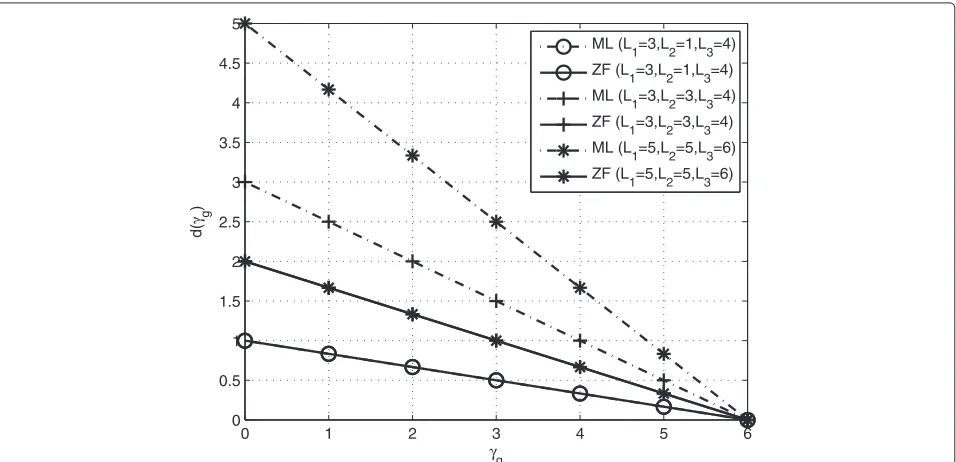
In Figure 2, we plot the DMT relation of the OFDM-based multihop AF relaying system employing subcarrier grouping with arbitrary group sizeK=6, linear constella-tion precoding with deterministic symbol loadingM= 5 at the source node, and linear detector at the destination node with different channel setting, including that Case 1:
L1 = 3,L2 = 1,L3 = 4, Case 2:L1 = 3,L2 = 3,L3 = 4,
Case 3:L1 =5,L2= 5,L3 = 6. For the sake of
compari-son, we also plot the corresponding DMT curves obtained with ML detection. From Figure 2, we can find that both linear detection and ML detection can only achieve the diversity gain of 1 when the multiplexing gain γg = 0 in Case 1 because the smallest of the multipath channel orders is L2 = 1, which is the performance bottleneck in the high-SNR regime in Case 1. Furthermore, there is the same DMT curve for the OFDM-based multihop AF relaying system when employing linear detection in Cases 2 and 3. Because, in these cases,K−M+1<Lminand the
achievable diversity gain is determined by the relationship betweenKandMbased on Theorem 1.
In Figure 3, we plot the DMT relation of the OFDM-based multihop AF relaying system employing subcarrier grouping with arbitrary group sizeK=6, linear constella-tion precoding with different symbol loading at the source node, and linear detector at the destination node. For the sake of comparison, we also plot the corresponding DMT curves obtained with ML detection. In this simulation, we setL1=4,L2=5,L3=6, and employ the optimal symbol loading strategy based on (37). From Figure 3, the opti-mal symbol loading strategy provides significant diversity gains over the conventional loading, particularly at lower
multiplexing gain. However, for linear detection, no diver-sity gain is achieved when the full-rate precoder with maximal symbol loading,K=M=γg, is employed.
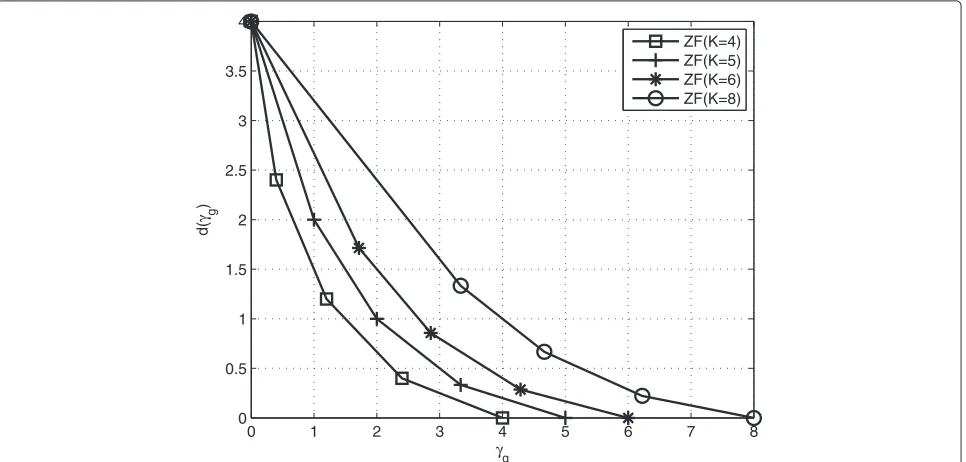
In Figure 4, we plot the DMT relation of the OFDM-based multihop AF relaying system employing subcarrier grouping with different group size K = 4, 5, 6, 8, lin-ear constellation precoding with optimal symbol strategy based on (37) at the source node, and linear detector at the destination node. Figure 4 indicates that the achiev-able diversity gain is improved with the increase of the group size K at the given multiplexing gain. However, a large value ofK would result in the increase of the linear detection complexity.
In Figure 5, we plot the outage probability versus SNR curves for the OFDM-based multihop AF relaying sys-tem employing subcarrier grouping, linear constellation precoding with different symbol loading at the source node, and linear ZF detector at the destination node. We consider an OFDM-based relaying system with N = 32 tones out of which a group ofK = 8 tones are used for data transmission, and the given threshold rate is 1 bit per-channel-use, which mains that 1 bit information per symbol is transmitted over each tone in the group. The data symbols are precoded using a precoder formed by the first Mth columns of aK × K DFT matrix. For the sake of comparison, we also plot the corresponding outage probability curves obtained with ML detection. Note that the case ofM = 8 means a full-rate precoder employed. Because of full-rate precoder in the case, the ML detector can achieve full multipath diversity with a diversity order of 4 whereas the linear detectors have a diversity order of
0 1 2 3 4 5 6
0 0.5 1 1.5 2 2.5 3 3.5 4 4.5 5
γg
d(
γg
)
ML (L
1=3,L2=1,L3=4)
ZF (L1=3,L2=1,L3=4)
ML (L
1=3,L2=3,L3=4)
ZF (L1=3,L2=3,L3=4)
ML (L
1=5,L2=5,L3=6)
ZF (L1=5,L2=5,L3=6)
0 1 2 3 4 5 6 0
0.5 1 1.5 2 2.5 3 3.5 4
γg
d(
γg
)
ML(K=6,M=6) ZF(K=6,M=4) ZF(K=6,M=5) ZF(K=6,M=6) ZF(K=6,M−opt)
Figure 3DMT of the OFDM-based multihop AF relaying system with different symbol loading (K=6andL1=4,L2=5,L2=6).
1. With the decrease ofM, the achievable diversity gain is improved for linear detection, and the slope of the curves become more and more sharp. It can be also observed that the curves ofM = 5 andM = 3 for linear detec-tion both have the identical slope, especially in high SNR, due to the same achievable diversity gain. On the other hand, for ML detection, full multipath diversity gain can
always be achieved with differentM, the curves have the identical slope.
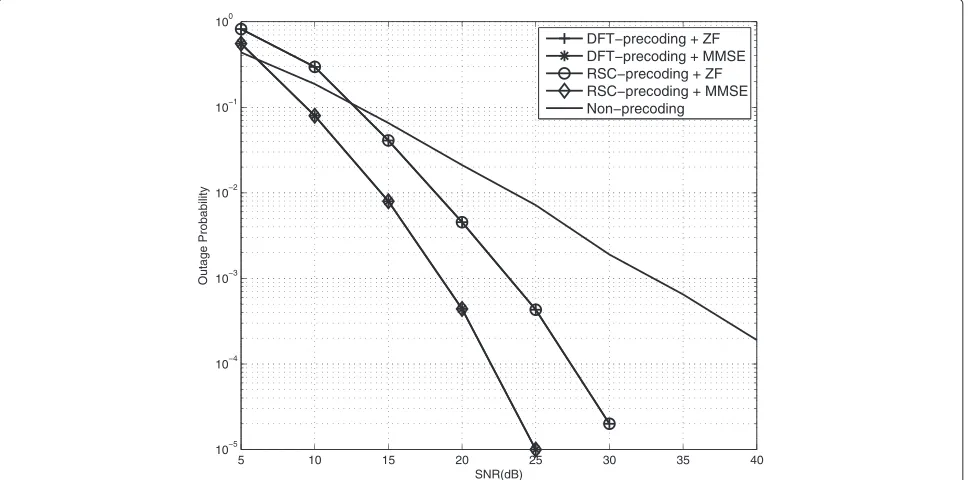
In Figure 6, we plot the outage probability versus SNR curves for the OFDM-based multihop AF relaying sys-tem employing different precoding design at the source node and linear ZF and MMSE detector at the destina-tion node. We consider the same set-up as in Figure 5,
0 1 2 3 4 5 6 7 8
0 0.5 1 1.5 2 2.5 3 3.5 4
γg
d(
γ g
)
ZF(K=4) ZF(K=5) ZF(K=6) ZF(K=8)
5 10 15 20 25 30 35 40 10−6
10−5 10−4 10−3 10−2 10−1 100
SNR
Pout
ZF M=8 ZF M=7 ZF M=5 ZF M=3 ML M=8 ML M=7 ML M=5 ML M=3
Figure 5Outage probability versus SNR curves for different symbol loading.
besides three different precoders as: (1) non-precoding scheme which means the source node do not precode the data symbols, (2) DFT-precoding scheme which means the data symbols are precoded using a precoder formed by the first Mth columns of a K × K DFT matrix, (3) RSC-precoding scheme which means the data sym-bols are precoded using a precoder formed by the first
Mth columns of a K × K rotated signal constellation
matrix base on [10]. It can be seen from Figure 6 that the outage performance with linear constellation precod-ing is improved significatively compared to that with-out precoding. Note that as predicted by our analysis, the outage performance curves employed DFT-precoding and RSC-precoding has the identical slope in high-SNR due to the same achievable diversity gain. In can also observed that the MMSE detector exhibits a much better
5 10 15 20 25 30 35 40
10−5 10−4 10−3 10−2 10−1 100
SNR(dB)
Outage Probability
DFT−precoding + ZF DFT−precoding + MMSE RSC−precoding + ZF RSC−precoding + MMSE Non−precoding
performance for a wide range of SNRs compared to the ZF detector.
Conclusions
In this study, we have derived the closed-form expres-sions of the DMT relation for OFDM-based multihop AF relaying systems employing subcarrier grouping and linear constellation precoding at the source node, and lin-ear detection at the destination node. The results show that the smallest of the multipath channel orders expe-rienced in each wireless links becomes the performance bottleneck in the high-SNR regime, and the achievable multipath diversity gain by linear detectors is dependent upon the symbol loading and precoder design. Then, the optimal precoder and the symbol-loading strategy have been proposed to achieve optimal diversity performance. Accordingly, a complete analysis and optimization frame-work for OFDM-based multihop relaying systems over frequency selective fading channels has been obtained, which can be used as a powerful tool for performance evaluation and optimal design of existing and upcoming OFDM-based multihop relaying systems.
Competing interests
The authors declare that they have no competing interests.
Acknowledgements
This study was supported by the NSF of China (Grant No. 61001107, 60972051), the Major National Science & Technology Projects (Grant No. 2010ZX03006-002-04), and the Jiangsu Natural Science Foundation (Grant No. BK2010101).
Author details
1Institute of Communications Engineering, PLA University of Science and
Technology, Nanjing, China.2Nanjing University of Posts and
Telecommunication, Nanjing, China.
Received: 16 December 2011 Accepted: 20 July 2012 Published: 7 August 2012
References
1. O Oyman, JN Laneman, S Sandhu, Multihop relaying for broadband wireless mesh networks: From theory to practice. IEEE Commun. Mag.
17, 116–122 (2007)
2. K Sreeram, S Birenjith, PV Kumar, DMT of multi-hop cooperative networks—Part I: bsic results [Online] http://arxiv.org/abs/0808.0234 3. K Sreeram, S Birenjith, PV Kumar, DMT of multi-hop cooperative
networks—Part II: half-duplex networks with full-duplex performance. [Online] http://arxiv.org/abs/0808.0235
4. Z Wang, G Giannakis, Wireless multicarrier communications: where Fourier meets Shannon. IEEE Signal Process. Mag.17, 29–48 (2000) 5. IEEE 802.16’s Relay Task Group. [Online] http://www.ieee802.org/16/relay/ 6. B Can, M Portalski, HSD Lebreton, S Frattasi, HA Suraweera,
Implementation issues for OFDM-based multihop cellular networks. IEEE Commun. Mag.17, 74–81 (2007)
7. L Song, M Tao, Y Xu, Exploiting hop diversity with frequency sharing in multi-hop OFDM networks. IEEE Commun. Lett.13, 908–910 (2009) 8. X Zhang, M Tao, W Jiao, S Chun, End-to-end outage minimization in OFDM
based linear relay net- works. IEEE Trans. Commun.57, 3034–3044 (2000) 9. Z Liu, Y Xin, G Giannakis, Linear constellation precoding for OFDM with
maximum multipath diversity and coding gains. IEEE Trans. Commun.
51, 416–427 (2003)
10. W Zhang, Y Li, X-G Xia, PC Ching, BL Khaled, Distributed space-frequency coding for cooperative diversity in broadband wireless ad hoc networks. IEEE Trans. Wirel. Commun.7, 995–1003 (2008)
11. L Venturino, N Prasad, X Wang, M Madihian, Design of linear dispersion codes for practical MIMO- OFDM systems. IEEE J. Sel. Topics Signal Process.1, 178–188 (2007)
12. C Tepedelenlioglu, Maximum multipath diversity with linear equalization in precoded OFDM systems. IEEE Trans. Inf. Theory.50, 232–235 (2004) 13. L Zheng, DNC Tse, Diversity and multiplexing: a fundamental tradeoff in
multiple-antenna channels. IEEE Trans. Inf. Theory.49, 1073–1096 (2003) 14. Sh Yang, J-C Belfiore, Optimal space-time codes for the MIMO
amplify-and-forward cooperative chan- nel. IEEE Trans. Inf. Theory.
52, 647–663 (2006)
15. M Yuksel, E Erkip, Multiple-antenna cooperative wireless systems: a diversity-multiplexing tradeoff perspective. IEEE Trans. Inf. Theory.
53, 3371–3393 (2007)
16. AA Haghighi, K Navaie, Outage analysis and diversity-multiplexing tradeoff bounds for opportunistic relaying coded cooperation and distributed space-time coding coded cooperation. IEEE Trans. Wirel. Commun.9, 1198–1206 (2010)
17. O Leveque, C Vignat, M Yuksel, Diversity-multiplexing tradeoff for the MIMO static half-duplex relay. IEEE Trans. Inf. Theory.56, 3356–3368 (2010)
18. S Yang, J-C Belfiore, Diversity of MIMO multihop relay channels. IEEE Trans. Inf. Theory. http://www.ieee802.org/16/relay/
19. D Gunduz, A Khojastepour, A Goldsmith, HV Poor, Multihop MIMO relay networks: diversity- multiplexing trade-off analysis. IEEE Trans. Wirel. Commun.9, 1198–1206 (2009)
20. Q Li, KH Li, KC Teh, Achieving optimal diversity-multiplexing tradeoff for full-duplex MIMO multihop relay networks. IEEE Trans. Inf. Theory.
57, 303–316 (2011)
21. L Grokop, DNC Tse, inProc. 2007 IEEE Int. Symp. Information Theory (ISIT) Diversity-multiplexing tradeoff in ISI channel. (Chicago, IL, 2004), pp. 96 22. L Grokop, DNC Tse, Diversity-multiplexing tradeoff in ISI channel. IEEE
Trans. Inf. Theory.55, 109–135 (2009)
23. A Medles, DTM Slock, inProc. 2007 IEEE Int. Symp. Information Theory (ISIT) Optimal diversity vs. multiplexing tradeoff for frequency selective MIMO channels. (Adelaide, Australia, 2005), pp. 1813–1817
24. P Coronel, H Bolcskei, inProc. 2007 IEEE Int. Symp. Information Theory (ISIT) Diversity-multiplexing tradeoff in selective-fading MIMO channels. (Nice, France, 2007), pp. 2841–2845
25. N Prasad, L Venturino, X Wang, Diversity-multiplexing tradeoff analysis for OFDM systems with sub- carrier grouping, linear precoding, and linear detection. IEEE Trans. Inf. Theory.56, 6078–6096 (2010)
26. Y Jiang, MK Varanasi, J Li, Performance analysis of ZF and MMSE equalizers for MIMO systems: an indepth study of the high SNR regime. IEEE Trans. Inf. Theory.57, 2008–2026 (2011)
27. RA Horn, CR Johnson,Matrix Analysis(Cambridge, U.K., Cambridge Univ. Press, 1993)
doi:10.1186/1687-1499-2012-245