R E S E A R C H
Open Access
Performance analysis of interference-limited
dual-hop multiple antenna AF relaying
systems with feedback delay
Jinlong Wang
1, Yuzhen Huang
1*, Caijun Zhong
2,3, Fawaz Al-Qahtani
4, Qihui Wu
1and Yunpeng Cheng
1Abstract
In this paper, we present a comprehensive performance analysis of dual-hop multiple antenna channel state information (CSI) assisted amplify-and-forward (AF) relaying systems over Rayleigh fading channels employing arbitrary transmit antenna selection (TAS) and receiver maximum ratio combining (MRC) with feedback delay in the presence of co-channel interference (CCI) at both the relay and destination. Specifically, an upper bound on the cumulative distribution function (CDF) of the end-to-end signal-to-interference ratio (SIR) is proposed, based on which closed-form expressions for the outage probability and the average symbol error rate (SER) are derived. To gain further insights, simple and high informative expressions for the outage probability and the average SER are obtained at the high SIR regime, which readily enable us to characterize the achievable diversity order and coding gain of the system. Moreover, we present new analytical upper and lower bounds for the ergodic capacity of the system, which apply to the system with arbitrary number of antennas, CCI and feedback delay at any SIRs. Finally, to minimize the outage probability of the system, an optimum power allocation scheme is devised under the total transmission power constraint between the source and the relay. The findings suggest that the feedback delay limits the diversity order to one, while the CCI degrades the outage performance by affecting the coding gain of the system.
Keywords: Amplify-and-forward (AF) relaying; Multiple antenna system; Co-channel interference (CCI); Outage probability; Symbol error rate (SER); Ergodic capacity; Power allocation
1 Introduction
Relaying transmission has been proposed as a promis-ing technique to improve the coverage and throughput of wireless communication systems [1]. Among the var-ious relaying protocols, the most two common relaying schemes are amplify-and-forward (AF) and decode-and-forward (DF). In particular, the AF relaying scheme has received significant attention due to its low implementa-tion complexity. Depending on the availability of chan-nel state information (CSI) at the relay, the AF relaying scheme generally falls into two categories, i.e., variable gain relaying [2] and fixed gain relaying [3]. Over the last decades, a significant amount of effort has been devoted to investigate the key performance measures such as
*Correspondence: [email protected]
1College of Communications Engineering, PLA University of Science and Technology, Nanjing, 210007, China
Full list of author information is available at the end of the article
outage probability, average symbol error rate (SER), and ergodic capacity for AF relaying schemes over various fading channels [4-8].
Nevertheless, all the above works assume that the relay-ing systems operate in a noise-limited environment. How-ever, future wireless communication networks tend to operate in an interference-limited environment due to aggressive frequency reuse. Motivated by this observation, many works have investigated the effect of co-channel interference (CCI) on the performance of the relaying systems in a variety of different scenarios. In [9], the authors proposed a relay selection algorithm for dual-hop CSI-assisted AF relaying networks in the presence of interference at the relay. In [10], the outage proba-bilities for both AF and DF relaying systems with noisy relay and interference-limited destination were derived. In [11], the authors investigated the outage performance of dual-hop fixed-gain relaying systems in the presence of interference at both the relay and destination and pointed
out that the worst outage performance occurred when the power of interference at the relay and destination was equal. In [12,13], the authors investigated the joint effects of imperfect channel estimation and CCI on the perfor-mance of dual-hop relaying systems, respectively. Most recently, some works addressed the case with Nakagami-mfading [14-18]. In [14], the authors studied the outage probability and the average BER of dual-hop fixed-gain AF relaying systems with a single interferer in Nakagami-m fading channels. In [15], the authors considered the per-formance of interference-limited dual-hop CSI-assisted AF systems in Nakagami-mfading channels. In [16], the outage probability of multi-branch dual-hop DF cooper-ative relaying systems with CCI over Nakagami-mfading channels was analyzed. In [17], the authors derived the exact closed-form expression for the outage probability of multi-hop transmission systems with AF and DF relaying protocols in Nakagami-mfading channels in the presence of CCI and made a comprehensive comparison between the two relaying protocols. In [18], the authors analyzed the ergodic capacity of dual-hop CSI-assisted AF relaying system with both CCI at the relay and destination.
While these prior works have improved our understand-ing on the impact of CCI on the performance of dual-hop relaying systems, the key limitation of these works is that they all consider a single antenna relaying sys-tem. With the fact that the multiple antenna technique will be adopted as one of the key enabling technologies for the next generation wireless communication systems, the importance of understanding the fundamental per-formance of multiple antenna relaying systems becomes increasingly evident [19-22]. In [19], the outage proba-bility and the average SER were analyzed in a two-hop multiple-input multiple-output (MIMO) relaying network using transmit antenna selection with receiver maximal-ratio combining (TAS/MRC). In [20], a unified framework for the average SER of distributed TAS/MRC in MIMO relaying networks was proposed. In [21], two attractive MIMO protocols, i.e., TAS/MRC and transmit antenna selection with receive selection combining (TAS/SC), were analyzed in a dual-hop AF relaying network with respect to the average SER. In [22], a low-complexity protocol that guaranteed a two-fold diversity, i.e., multi-antenna diversity via TAS/MRC and multiuser diversity via opportunistic scheduling, was proposed in multiuser AF relaying networks. However, it is worth pointing out that these aforementioned works also assume the noise-limited scenario; hence, the impact of CCI on the perfor-mance of dual-hop multiple antenna AF relaying systems has not been well understood. Recently, only a few ana-lytical results concerning the performance of dual-hop multiple antenna AF relaying systems in the presence of CCI are available in the literature [23-25]. In [23], the performance of dual-hop fixed-gain AF relaying systems
with a single Rayleigh interferer at the relay was investi-gated under the special case, where only one of the nodes is equipped with multiple antennas. In [24], the outage performance of a dual-hop fixed-gain AF MIMO relaying network using maximum ratio transmission and maxi-mum ratio combining (MRT/MRC) in the presence of interference was analyzed. In parallel, [25] investigated the effect of feedback delay on the outage probability and the average SER of multiple antenna AF relaying systems employing MRT/MRC.
In this paper, different from these prior works, we con-sider a dual-hop multiple antenna CSI-assisted AF relay-ing system applyrelay-ing arbitrary TAS/MRC in the presence of interference at both the relay and destination. Further-more, the CSI feedback delay of the first-hop link is also taken into consideration. For such practical system model, we pursue a comprehensive analysis of the joint effects of feedback delay and multiple antennas on the performance of the system. The main contributions of the paper are summarized as follows:
• We propose an upper bound of the equivalent end-to-end signal-to-interference ratio (SIR) of the system and derive its cumulative distribution function (CDF).
• With the help of the CDF of the proposed upper bound, we investigate the joint effects of number of antennas, CCI, and feedback delay on the system performance in terms of the outage probability and the average SER. Specifically, we present closed-form expressions for the outage probability and the average SER, which provide a fast and efficient means to evaluate the performance of the system. In addition, we look into the asymptotic high SIR regime and characterize the key performance measures such as diversity order and coding gain. Our findings suggest that the impact of feedback delay on the performance of the system is significant as it limits the diversity order to one regardless of the number of antennas at the source and destination. On the other hand, the impact of CCI on the performance of the system is less significant, since it does not reduce the diversity order, but affects the coding gain of the system.
• We also present new analytical upper and lower ergodic capacity bounds for interference-limited dual-hop multiple antenna CSI-assisted AF relaying systems with feedback delay. The proposed bounds apply to arbitrary number of antennas, CCI, and feedback delay at any SIR. Moreover, they involve only standard mathematical functions and therefore can be easily and efficiently evaluated.
closed-form power allocation expressions. Simulation results demonstrate that the optimum power
allocation scheme achieves better coding gain compared to the equal power allocation scheme.
The remainder of the paper is organized as follows. Section 2 introduces the system model. In Section 3, we derive the upper bound of the equivalent end-to-end SIR and investigate the outage probability, average SER, and ergodic capacity of the system. In Section 4, the opti-mum power allocation scheme is proposed to minimize the outage performance of the system. Numerical results are presented in Section 5. Finally, Section 6 concludes the paper.
2 System model
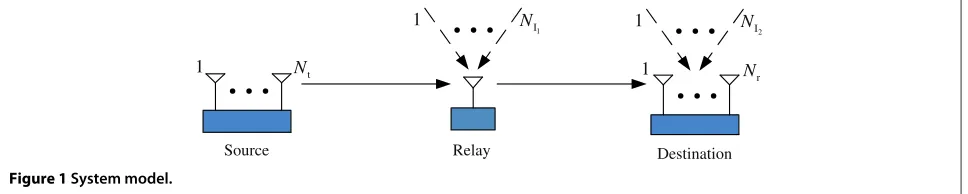
We consider a dual-hop CSI-assisted AF relaying sys-tem in the presence of multiple interference at both the relay and destination as illustrated in Figure 1, where the sourceS communicates with the destinationDwith the help of an intermediate relay node R. The source S is equipped with Nt antennas and the destination D is equipped withNr antennas, whereas the relay Ronly has a single antenna. The S → R channel vector is denoted by hsr=
h1r,. . .,hNtr T
, and its entries follow independent and identically distributed (i.i.d.) Rayleigh fading with parameters E|hir|2
= λsr, while theR→D channel vector is denoted byhrd=
h1d,. . .,hNrd T
, and its entries follow i.i.d. Rayleigh fading with parameters Ehjr2
=λrd. To reduce the cost and the complexity of system design while maintaining satisfying performance, we adopt TAS algorithm in this paper, in which a single antenna is selected based on the feedback of CSI from the relayR. We consider the general scenario where thekth worst antenna is selecteda. Clearly,k =Ncorresponding to the case where the best antenna is selected. In addition, due to imperfect feedback link, the feedback delay of CSI about the first link is also considered.
The entire communication between the source S and the destination Dconsists of two orthogonal phases. In the first phase, the sourceS transmits the desired signal to the relayRwith an average transmit powerPs, which is impaired by NI1 interfering signals with an average
power ofPir,i∈1,· · ·,NI1. Assuming the interference-limited environment, the received signal at the relay can be expressed as
yR= Psh(k)rxs+ NI1
i=1
Pirgirxir, (1)
whereh(k)ris the channel coefficient between the selected kth worst antenna and the relay node,xsis the source sym-bol with E|xs|2
= 1,xir is theith interference symbol satisfying E|xir|2=1, andgiris the corresponding inter-ference channel link, whose amplitude follows Rayleigh distribution with parameterλir.
In the second phase, the relayRforwards the received signal to the destinationDafter applying a gain factorG. As in the previous literature [3,26,27], the relay gainGis given by
G=
Pr
⎛
⎝Psh(k)r2+ NI1
i=1
Pirgir2
⎞
⎠, (2)
wherePrdenotes the transmit power at the relayR. There-fore, the received signal at the destinationD, after MRC processing, is given by
yD=GwThrd
⎛
⎝ Psh(k)rxs+ NI1
i=1
Pirgirxir
⎞ ⎠
+wT
NI2
j=1
Pjdgjdxjd,
(3)
where w= hrd
hrdF is theNr×1 weight vector with ·F being the Frobenius norm, NI2 is the number of inter-ferers at the destination, Pjd is the transmit power of the jth interference at the destination, xjd is the jth interference symbol at the destination with a unit energy, gjd=
gj1d,. . .,gjNrd T
is the jth interference channel vector forj∈1,. . .,NI2
, and the amplitude of its entries follows i.i.d. Rayleigh fading with parameter Egjmd2
=λjdform∈ {1,. . .,Nr}.
N
1 1 N
Source
1
1
I
N 1 NI
Relay Destination
Defining fjd=wTgjd, and using the results reported in [23,24], it can be easily shown that |fjd| follows the
Rayleigh distribution with parameters Efjd2
=λjdfor j∈1,. . .,NI2. To this end, after some mathematical manipulations, the end-to-end SIR can be expressed as
γ = γ1(k)γ2
γ1(k)γI2 +γ2γI1+γI1γI2
, (4)
whereγ1(k)=Psh(k)r2,γ2=Prhrd2F,γI1= NI1
i=1
Pirgir2,
andγI2 =
NI2
j=1
Pjdfjd2.
Letγ1(1)≤ · · · ≤γ1(Nt)be the order statistics obtained by arranging γ1(k) for k ∈ {1,· · ·,Nt} in an increas-ing order, whereγ1(k)denotes the instantaneous transmit power between thekth worst antenna and the relay with-out feedback delay, thenγ1(k)is theτtime delayed version ofγ1(k). According to [28-30], the relation betweenγ1(k) andγ1(k)can be modeled as
γ1(k)=√ργ1(k)+ 1−ρω1(k), (5)
whereω1(k)2is the chi-square distributed random vari-able (RV) having the same variance as γ1(k), and ρ is the correlation coefficient betweenγ1(k) andγ1(k) which, according to Jakes’ autocorrelation model [30], can be expressed as
ρ=J02πfdτ
2
, (6)
where J0(·) denotes the zeroth-order Bessel function of the first kind ([31], eq. (8.411)), and fd is the maxi-mum Doppler frequency. The probability density function (PDF) ofγ1(k)is given by
fγ1(k)(x)=
∞
0
fγ1(k)|γ1(k)(x|y)fγ1(k)(y)dy, (7)
wherefγ1(k)|γ1(k)(x|y)=fγ1(l),γ1(l)(x,y)
fγ1(l)(y)is the PDF ofγ1(k) conditioned onγ1(k). Sinceγ1(l)andγ1(k)are the two correlated exponentially distributed RVs, the joint PDF ofγ1(l)andγ1(k)can be expressed as [32]
fγ1(l),γ1(l)(x,y)= 1 (1−ρ) γ21e
− (x+y) (1−ρ)γ1I
0
2√ρxy (1−ρ) γ1
,
(8)
whereγ1=Psλsr denotes the average power of the first hop, andI0(·)denotes the modified Bessel function of the
first kind ([31], eq.(8.406.1)). On the other hand, the PDF ofγ1(k)can be derived as
fγ1(k)(y)=k
Nt
k Fγ1(l)(y)
k−1
1−Fγ1(l)(y)
Nt−k
fγ1(l)(y),
(9)
wherefγ1(l)(y)=1
γ1e−y/γ1 andFγ
1(l)(y)=1−e
−y/γ1.
Hence, substituting (8) and (9) into (7) and utilizing the approach in [33], we have
fγ1(k)(x)=k
Nt k
k−1
n=0 (−1)n
γ1
k−1 n
α βe
−α
γ1x, (10)
where α= (Nt−k+nβ)(1−ρ)+1 and β=Nt−k+n+1. To this end, the corresponding CDF ofγ1(k)can be deduced from (10) as
Fγ1(k)(x)=1−k
Nt k
k−1
n=0 (−1)n
β
k−1 n
e− α γ1x. (11)
3 End-to-end performance analysis
In this section, we perform a comprehensive performance analysis of the system under consideration by presenting closed-form analytical expressions for key performance measures, i.e., the outage probability, the average SER, and the ergodic capacity. We start by characterizing the statistics of the upper bound of the end-to-end SIR. Based on which, the closed-form approximations for the outage probability and the average SER are obtained. Moreover, to gain more insights, we look into the asymptotic high SIR regime and present simple analytical expressions for the outage probability and the average SER. Finally, we investigate the ergodic capacity of the system and propose tight upper and lower bounds on the ergodic capacity of the system.
3.1 Upper bound of the end-to-end SIR
In general, an exact analysis of the statistics of the end-to-end SIR shown in (4) is very challenging. Hence, to circumvent this difficulty and obtain useful analytical results to evaluate the performance of the system, we first propose the following upper bound for the end-to-end SIR:
γ ≤γup=min
γ1(k) γI1
, γ2 γI2
. (12)
In addition, it has been demonstrated that this upper bound is in general very tight, especially in the high SIR regime.
To this end, to analyze the outage and SER performance of the system, the statistical behavior of the SIR upper bound γup is required, which is given in the following theorem:
Proof.From (12), the CDF ofγupcan be expressed as
Fγup(x)=1− undergo Rayleigh fading, the CDF of γ2 is given by Fγ2(x)=γ lower incomplete Gamma function ([31], eq.(8.350.1)). The PDFs ofγI1andγI2 are given by [25] of theith interference at the relay and thejth interference at the destination, respectively. In this paper, we assume that γ3i=Pirλir, i = 1,· · ·,NI1, and γ4j=Pjdλjd, j = derived, after performing some required integrations, as
Fγ1(k)
where we have used [31] eq.(6.451.1) to solve the corre-sponding integral. Finally, substituting (19) and (20) into (14) yields the desired result.
3.2 Outage probability
As an important performance measure of wireless com-munication systems, the outage probability is defined as the probability that the instantaneous achievable rate falls below a given threshold R. Mathematically, the outage probability can be expressed as [32]
Pout(R)=Pr lower bound of outage probability can be directly obtained from (13). Note that the expression (13) only involves the standard function which allows for fast evaluation in popular mathematical software such as Matlab or Mathe-matica, thereby providing an efficient means to assess the impact of various key system parameters such as number of antennas, CCI, and correlation coefficient on the outage performance of the system.
To gain further understanding on the impact of number of antennas, CCI and correlation coefficient on the outage performance, we now look into the asymptotic high SIR regime. We find it convenient to treat the following two cases separately. Case 1: interference only (no feedback delay), i.e.,ρ=1, and Case 2: interference and feedback delay, i.e.,ρ <1.
Corollary 1. With only CCI, i.e.,ρ=1, the asymptotic outage probability of interference-limited dual-hop multiple antenna CSI-assisted AF relaying systems is given by
P∞out(z)≈
Proof. See Appendix 1.
Corollary 1 suggests the intuitive result that the out-age performance of the system depends on the selection order of the transmit antenna, i.e.,k. Moreover, the impact of CCI on the outage performance varies as the selection orderkchanges. As we can readily observe, whenk<Nr, the outage probability is solely affected by the CCI at the relay and is independent of the CCI at the destination. Similarly, when k > Nr, the outage probability is only affected by the CCI at the destination regardless of the CCI at the relay. Only for the case k = Nr, the impact of CCI at both the relay and destination on the outage probability becomes evident. This phenomena is some-how expected, since in a dual-hop relaying system, the overall outage performance is limited by the worst link.
Now, we look at the case when the system is subjected to both the CCI and feedback delay, and we have the following key result:
Corollary 2. With both the CCI and feedback delay, i.e., ρ <1, the asymptotic outage probability of interference-limited dual-hop multiple antenna CSI-assisted AF relay-ing systems is given by
Pout∞ (z)≈
Proof. Following the same lines as in the proof of Corol-lary 1, the asymptotic outage probability whenρ <1 can be computed as
Pout∞ (z)≈1−
To this end, the desired results can be obtained after some algebraic manipulations.
Corollary 2 shows that the achievable diversity order is one when the transmitter only has access to a delayed version of the CSI. Moreover, whether the interference at the destination affects the outage probability of the sys-tem depends on the number of antennas employed at the destination. It is worth noting that when the destination has a single antenna, the interference at the destination will affect the outage probability of the system. Otherwise, the interference at the destination has no impact on the outage probability.
3.3 Average symbol error rate
In this section, we analyze the average SER of the system, which is another important metric to quantify the per-formance of wireless communication systems. For a wide range of modulation schemes, the average SER is given by
Pe=E
dy is the complementary error function, anda andbare the modulation specific constants. For instance,a=1,b=1 for BPSK,a=1,b= 0.5 for BFSK with orthogonal signaling,a=2(M−1)/M, b=3M2−1for M-PAM, anda=2,b=sin2(π/M) for M-PSK.
Utilizing the result presented in [34], the average SER can be alternatively computed by
Pe≈ a
Theorem 2. The average SER of interference-limited dual-hop CSI-assisted multiple antenna AF relaying networks with feedback delay is lower bounded by
Pe≈
where (·,·)is the upper incomplete Gamma function ([31], eq.(8.350.2)) and
H1=H1,[1:1],0,[1:1]1,1,1,1,1
with H1,[1:1],0,[1:1]1,1,1,1,1 [·]being the generalized Fox’s H-function ([35], eq.(2.2.1)).
Proof.See Appendix 2.
Theorem 2 presents an analytical expression for the average SER of the system, and it applies to the generic scenario with arbitrary number of antennas, CCI, and feedback delay at any SIR. The closed-form expression involves the gen-eralized Fox’sH-function, which can be efficiently evaluated via the algorithm developed in ([36] Table two), hence provides a fast and reliable way to evaluate the average SER of the system.
In order to get more insights into how the system parameters such as number of antennasNtandNr, interference, and correlation coefficientρaffect the average SER of the system, we now present simple expressions of the average SER in the high SIR regime, from which the diversity order and coding gain of the system can be easily analyzed. Similar to the outage analysis part, we consider two asymptotic SER cases depending on the value ofρ.
Corollary 3. With only CCI, i.e.,ρ=1, the asymptotic SER of interference-limited dual-hop multiple antenna CSI-assisted AF relaying systems is given by
P∞e ≈
Proof.Substituting the asymptotic CDF expression presented in (22) into (26) and utilizing [31] eq.(3.351.3), the desired result can be obtained after some algebraic manipulations.
Corollary 4. With both the CCI and feedback delay, i.e.,ρ <1, the asymptotic average SER of the interference-limited dual-hop multiple antenna CSI-assisted AF relaying systems is given by
P∞e ≈
Proof.Substituting the asymptotic CDF expression presented in (23) into (26) and utilizing [31] eq.(3.351.3), the desired result can be obtained after some algebraic manipulations.
3.4 Ergodic capacity
In this section, we study the ergodic capacity of interference-limited dual-hop multiple antenna CSI-assisted AF relaying systems with feedback delay. Math-ematically, the ergodic capacity of the system can be expressed as It is worth pointing out that unlike the outage probabil-ity and SER metrics which have been widely studied for various dual-hop relaying systems in the presence of CCI, few works have investigated the ergodic capacity of dual-hop relaying systems with CCI due to the fact that it is extremely difficult to obtain tractable expressions for the ergodic capacity. Indeed, two key challenges encountered in the analysis of ergodic capacity include obtaining the exact PDF of the end-to-end SIR and taking expectation of the nonlinear log(·)function. To circumvent these chal-lenges, we hereafter seek upper and lower bounds of the ergodic capacity of interference-limited dual-hop multiple antenna CSI-assisted AF relaying systems with feedback delay. We start by presenting the following ergodic capac-ity upper bound.
Theorem 3. The ergodic capacity of interference-limited dual-hop multiple antenna CSI-assisted AF relaying sys-tems with feedback delay is upper bounded by
Cu= eq.(8.360)),Cis the Euler constant ([31], eq.(8.367.1)), and
1=k
Proof. See Appendix 3.
Theorem 3 provides a general expression of the capac-ity upper bound, which is valid for arbitrary number of antenna, CCI and feedback delay. Now, we turn our atten-tion to the ergodic capacity lower bound, and we have the following key result:
Theorem 4. The ergodic capacity of interference-limited dual-hop multiple antenna CSI-assisted AF relaying sys-tems with feedback delay is lower bounded by
Cl=
Proof. See Appendix 4.
It is worth highlighting that the upper and lower bounds on the ergodic capacity presented in the previous theo-rems involve only standard functions, hence can be very fast and efficiently evaluated in popular softwares such as Matlab or Mathematica. More importantly, the derived bounds remain very tight across the entire range of SIRs as will be demonstrated in Section 5.
4 Optimum power allocation
As can be readily observed from (22), more power should be allocated to the sourceSto suppress the inter-ference at the relay whenk<Nr. In contrast, the relay node should be allocated more power to alleviate the detrimental effect of the interference at the destination whenk > Nr. On the other hand, the casek=Nr=L requires much more careful consideration. The optimal power allocation problem can be formulated as
ε∗1=arg min
To this end, taking the second derivative of Pout∞ (ε1,Pt) with respect to ε1, it can be shown that ∂2Pout∞ (ε1,Pt)
∂ε21 is strictly positive in the interval (0, 1), which implies that the objective function is a strictly convex function ofε1in the interval(0, 1). There-fore, taking the first-order derivative ofP∞out(ε1,Pt)with respect to ε1 and setting it to zero, the optimal ε1 can be obtained. After some straightforward yet tedious algebraic manipulations, we get
ε∗1=
Similarly, for the caseρ <1, more power should be allo-cated to the source node when the destination node has more than a single antenna. On the other hand, when the destination is equipped with a single antenna, the optimal power allocation problem can be formulated as
ε∗2=arg min
After some algebraic manipulations, it can be proven that the second derivative ofP∞out(ε2,Pt)with respect toε2 is strictly positive, which implies that the objective func-tion is a strictly convex funcfunc-tion of ε2. Setting the first derivative of the objective function with respect toε2to zero, the optimal power allocation factor can be derived as
ε∗2=
5 Numerical results
In this section, we perform extensive numerical simula-tions to validate analytical results developed in the previ-ous sections and to investigate the impact of number of antennas, CCI, and feedback delay on the performance of interference-limited dual-hop multiple antenna CSI-assisted AF relaying systems with feedback delay. In all simulations, unless otherwise specified, we use the follow-ing set of parameters:Pr=Ps,λsr =1, andλrd = 1. The rate thresholdRis set 5W, and the BPSK modulation, i.e., a=1 andb=1, is used.
0 5 10 15 20 25 30 35 40
10−5
10−4
10−3
10−2
10−1
10
Ps (W) Monte Calro simulation result Exact analytical result Asymptotic analytical result
k=1,ρ=1
k=2,ρ=0
k=2,ρ=0.8
k=2,ρ=1
λ=0.4,λ=0.6,λ=0.8. λ =0.2,λ =0.3,λ =0.25. 0
Outage Probability
Figure 2Outage probability versus the transmit powerPswhen
Nt=Nr=2,Pir=5W,Pjd=0W, andNI1=NI2=3.
noting that increasing the number of interferers results in a higher outage probability.
Figure 4 examines the average SER of interference-limited dual-hop multiple antenna CSI-assisted AF relay-ing systems with differentρ. As can be clearly seen from the figure, the analytical results are in close agreement with the Monte Carlo simulations at the entire SIR region, while high SIR curves are also compatible with the simula-tions. Specifically, when the SIR is in the high regime, the theoretical lines agree with the simulations, which verifies the correctness of the upper bound on the SIR. Further-more, in the case of perfect feedback (no feedback delay), the diversity order of the select orderkis achieved. How-ever, due to the feedback delay in selecting the antenna, the diversity order is degraded to one regardless of the
0 5 10 15 20 25 30 35 40
10−6
10−5
10−4
10−3
10−2
10−1
10
Monte Calro simulation result Exact analytical result Asymptotic analytical result
NI1=NI2=4,ρ=0.8
NI1=NI2=2,ρ=0.8
NI1=NI2=4,ρ=1
NI1=NI2=2,ρ=1
λ=0.4,λ=0.6,λ=0.8,λ=0.7. λ =0.2,λ =0.3,λ =0.25,λ=0.35.
Ps (W)
Outage Probability
0
Figure 3Outage probability versus the transmit powerPsunder
different interference whenPir=5W,Pjd=0W,Nt=Nr=2,
andk=2.
0 5 10 15 20 25 30 35 40
10−7
10−6
10−5
10−4
10−3
10−2
10−1
10
Symbol Error Rate
Monte Carlo simulation result Exact analytical result Asymptotic analytical result
k=1,ρ=1
k=2,ρ=0.8 k=2,ρ=0
k=2,ρ=1
λ=0.4,λ=0.6,λ=0.8. λ=0.2,λ=0.3,λ=0.25.
Ps (W) 0
Figure 4Symbol error rate versus the transmit powerPswhen
Nt=Nr=2,Pir=5W,Pjd=0W, andNI1=NI2=3.
number of antennas. Further, we can see that when ρ increases, the average SER is improved. This can be clearly noticed in the two curves ofρ = 0 and 0.8 in the figure. Besides, Figure 5 shows the relation between the aver-age SER and the number of interference, and we adopt the same setting parameters as Figure 3. From the figure, more interference significantly degrades the average SER performance due to the increasing interference power.
Figure 6 plots the proposed upper and lower bounds for ergodic capacity of interference-limited dual-hop mul-tiple antenna CSI-assisted AF relaying systems with dif-ferent ρ. As can be readily seen, the derived upper and lower bounds keep tight across the entire SIR range. We also observe the intuitive result that the ergodic capac-ity becomes less asρgets smaller (i.e., the feedback delay
0 5 10 15 20 25 30 35 40
10−8
10−7
10−6
10−5
10−4
10−3
10−2
10−1
10
Monte Carlo simulation result Exact analytical result Asymptotic analytical result
NI1=NI2=4,ρ=1 NI1=NI2=2,ρ=0.8
N
I1=NI2=2,ρ=1
NI1=NI2=4,ρ=0.8
λ=0.4,λ=0.6,λ=0.8,λ=0.7. λ =0.2,λ =0.3,λ =0.25,λ=0.35.
Ps (W) 0
Symbol Error Rate
Figure 5Symbol error rate versus the transmit powerPsunder
different interference whenPir=5W,Pjd=0W,Nt=Nr=2,
0 5 10 15 20 25 30 35 40 0
1 2 3 4 5
Monte Calro simulation result Capacity upper bound Capacity lower bound
ρ=1
ρ=0
λ=0.4,λ=0.6,λ=0.8. λ=0.2,λ=0.3,λ=0.25.
Ps (W) 6
Ergodic Capacity
Figure 6Ergodic capacity versus the transmit powerPswhen
Nt=Nr=3,k=3,Pir=5W,Pjd=0W, andNI1=NI2=3.
becomes large). Furthermore, we characterize the number of interference on the ergodic capacity in Figure 7. It is shown that more interference results in the lower ergodic capacity under different cases.
Figure 8 provides the outage performance compari-son between the optimal power allocation scheme and the equal power allocation scheme with/without feedback delay, respectively. We can see that the outage probability of the optimal power allocation scheme outperforms that of the equal power allocation scheme. This is due to the fact that more power will be allocated to the link which is subjected to more interference power to overcome the interference. Furthermore, it is worth noting that the opti-mal power allocation scheme can further bring the coding gain compared with the equal power allocation scheme to the underlying system.
0 5 10 15 20 25 30 35 40
0 1 2 3 4 5
6 Monte Carlo simulation resultCapacity upper bound
Capacity lower bound
NI1=NI2=2,ρ=1
NI1=NI2=4,ρ=1
λ1r=0.4,λ=0.6,λ=0.8,λ=0.7.
λ1d=0.2,λ=0.3,λ=0.25,λ=0.35.
Ps (W)
Ergodic Capacity
Figure 7Ergodic capacity versus the transmit powerPsunder
different interference whenNt=Nr=3,k=3,Pir=5W,
andPjd=0W.
0 5 10 15 20 25 30 35 40
10−4
10−3
10−2
10−1
10
Equal power allocation scheme Optimal power allocation scheme
Nt=3, Nr=1, k=1,ρ=1
Nt=3, Nr=2, k=2,ρ=1 Nt=3, Nr=1, k=3,ρ=0
λ=0.4,λ=0.6,λ=0.8. λ=0.2,λ=0.3,λ=0.25.
Pt (W) 0
Outage Probability
Figure 8Outage probability comparison of two power allocation schemes whenPir=5W,Pjd=0W, andNI1=NI2=3.
6 Conclusions
In this paper, we have investigated the impact of number of antennas, CCI, and feedback delay on the performance of interference-limited dual-hop multiple antenna CSI-assisted AF relaying networks with arbitrary TAS/MRC. Specifically, based on a tight upper bound for the effec-tive end-to-end SIR, the closed-form approximate expres-sions for the outage probability and the average SER were derived, which provided a fast and efficient tool for evaluating the impact of the key parameters on the sys-tem performance. Simulation results illustrated that the derived approximations for the outage probability and the average SER achieved a good match with the exact results. Furthermore, simple and high informative expres-sions were also provided to obtain the diversity order and the coding gain of the system with perfect feedback and delayed feedback. The finding of the paper suggested that the full diversity order of min{k,Nr} was achieved under perfect feedback, whereas the diversity order was degraded to one underdelayed feedback. More impor-tantly, some new analytical upper and lower bounds were first derived for the ergodic capacity of the considered system, which demonstrated that the proposed bounds worked quite well under different cases. In addition, the optimal power allocation between the source and the relay was proposed to minimize the asymptotic outage prob-ability. A profound reduction in the outage probability was attained using the optimal power allocation compared to the equal power allocation due to additional coding gain.
Endnote
aThe reason for using thekth worst antenna selection
Appendices
Appendix 1
Utilizing the McLaurin series expansion for the exponen-tial function in (11) and performing some mathematical manipulations, the asymptotic CDF ofγ1(k)
express the incomplete Gamma function using the series expansion as ([31], eq.(8.354.1))
γ (m,θx)=(θx)m
Then, substituting (48) into (20) and carrying out the inte-gration with the help of [31] eq.(3.351.3), the asymptotic CDF ofγ2
Finally, substituting (47) and (49) into (14) and simplifying them, the asymptotic outage probability is derived as
Pout∞ (z)≈1−
To this end, the desired result can be obtained after some mathematical manipulations.
Appendix 2
Substituting (13) into (26), the average SER can be expressed as
With the help of [31] eq.(3.361.2), the integralI1can be computed as
I1= /
π
b. (52)
Also, utilizing [31] eq.(3.383.10), the integral I2 can be evaluated as [28] eq.(8.350.2). To evaluate the integral I3, we first exploit the equalities ([39], eq.(8.4.23.3)) as follows:
Appendix 3
Capitalizing on the techniques proposed in recent works [40,41], we get the following upper bound for the ergodic capacity of the system.
Cu=
We start with the first term in (57). Noticing that the random variablesγ1(k) andγI1 are statistically indepen-dent, E
can be expanded as
E
Substituting (10) and (15) into (58), the integralI4can be simplified as
To this end, utilizing [31] eq.(4.337.1) and [31] eq.(6.228.2), we get
I4=k tion ([31], eq.(9.100)), andC is the Euler constant ([31], eq.(8.367.1)).
On the other hand, by using the PDF of γI1 and with the help of [31] eq.(4.331.1), the integralI5can be easily computed as
in (57) can be expressed as
E eq.(4.337.1), we have
I6=
where Ei(·) is the exponential integral function ([31], eq.(8.211.1)). Now, I8can be evaluated with the help of [31] eq.(4.352.1) as
I8=γN2r(Nr−1)! whileI9can be computed with the help of [31] eq.(6.228.2) as
first term can be evaluated after some simple manipula-tions with the aid of [31] eq.(4.331.1) as
Elnγ1(k)
Performing the required integration with the help of [31] eqs.(4.352.1) and (4.331.1), the second term can be evalu-ated as
To this end, pulling everything together, we obtain the desired result.
Appendix 4
Substituting (4) into (31) and performing some simple algebraic manipulations, the ergodic capacity can be writ-ten as
Applying Jensen’s inequality on the third term, we obtain the following capacity lower bound:
Cl= in closed-form as
Elog2γ1(k)+γI1
Now, we look at the third term. Since the other two expectations have the same integral forms as the expec-tation Eγ1(k)γI2
, we focus on analyzing the expectation Eγ1(k)γI2
. Due to the independence ofγ1(k)andγI2, the first expectation simplifies to
Eγ1(k)γI2
where we have used [31] eq.(3.351.3) to solve the corre-sponding integral.
Similarly, the other two expectations can be derived as
Eγ2γI1
To this end, pulling everything together yields the desired result.
Competing interests
The authors declare that they have no competing interests.
Authors’ contributions
JW carried out the design of the framework, participated in the sequence alignment and drafted the manuscript. YH participated in the design of the system model and performed the mathematical analysis. CZ revised the manuscript, and participated in its design and coordination. FAQ revised the manuscript, and done the simulation results. QW participated in the sequence alignment. YC checked the manuscript. All authors read and approved the final manuscript.
Acknowledgements
This work was supported by the National Science Foundation of China (grants numbers 61201229, 61172062, and 61072044), the Jiangsu Provincial Natural Science Foundation of China (grant number BK2011116), the Zhejiang Provincial Natural Science Foundation of China (grant number LQ12F01006), the Fundamental Research Funds for Central Universities (2012QNA5011), the Open Research Fund of National Mobile Communications Research Laboratory, Southeast University (grant number 2013D06), and the Qatar National Research Fund (JSREP grant number 3-039-2-010).
Author details
1College of Communications Engineering, PLA University of Science and
Technology, Nanjing, 210007, China.2Institute of Information and
Communication Engineering, Zhejiang University, Hangzhou, 310014, China.
3The National Mobile Communications Research Laboratory, Southeast
University, Nanjing, 210018, China.4Electrical and Computer Engineering
Program, Texas A&M University at Qatar, P.O. Box 23874, Doha, Qatar.
References
1. JN Laneman, DNC Tse, GW Wornell, Cooperative diversity in wireless networks: efficient protocols and outage behavior. IEEE Trans. Inf. Theory. 50(12), 3062–3080 (2004)
2. MO Hasna, M-S Alouini, A performance study of dual-hop transmissions with fixed gain relays. IEEE Trans. Wireless Commun.3(6), 1963–1964 (2004)
3. MO Hasna, MS Alouini, End-to-end performance of transmission systems with relays over Rayleigh-fading channels. IEEE Trans. Wireless Commun. 2(6), 1126–1131 (2003)
4. DB da Costa, S Aïssa, Cooperative dual-hop relaying systems with beamforming over Nakagami-mfading channels. IEEE Trans. Wireless Commun.8(8), 3950–3954 (2009)
5. HA Suraweera, GK Karagiannidis, Closed-form error analysis of the non-identical Nakagami-mrelay fading channel. IEEE Commun. Lett. 12(4), 259–261 (2008)
6. YA Chau, KY Huang, Channel statistics and performance of cooperative selection diversity with dual-hop amplify-and-forward relay over Rayleigh fading channels. IEEE Trans. Wireless Commun.7(5), 1779–1785 (2008) 7. SS Ikki, MH Ahmed, Performance of cooperative diversity using equal gain
combining (EGC) over Nakagami-m fading channels. IEEE Trans. Wireless Commun.8(2), 557–562 (2009)
8. S Alapattu, N Rajatheva, C Tellambura, Performance analysis of TDMA relay protocols over Nakagami-mfading. IEEE Trans. Vehicular Technol. 59(1), 93–104 (2010)
9. I Krikidis, JS Thompson, S Mclaughlin, N Goertz, Max-min relay selection for legacy amplify-and-forward systems with interference. IEEE Trans. Wireless Commun.8(6), 3016–3027 (2009)
10. C Zhong, S Jin, K-K Wong, Dual-hop systems with noisy relay and interference-limited destination. IEEE Trans. Commun.58(3), 764–768 (2010)
11. W Xu, J Zhang, P Zhang, Outage probability of two-hop fixed-gain relay with interference at the relay and destination. IEEE Commun. Lett. 15(6), 608–610 (2011)
12. SS Ikki, S Aïssa, Impact of imperfect channel estimation and co-channel interference on dual-hop relaying systems. IEEE Commun. Lett. 16(3), 324–327 (2012)
13. SS Ikki, S Aïssa, Impact of imperfect channel estimation and co-channel interference on regenerative cooperative networks. IEEE Wireless Commun. Lett.1(5), 436–439 (2012)
14. HA Suraweera, DS Michalopoulos, C Yuen, Performance analysis of fixed gain relay systems with a single interference in Nakagami-mfading channels. IEEE Trans. Vehicular Technol.61(3), 1457–1463 (2012) 15. FS Al-Qahtani, TQ Duong, C Zhong, KA Qaraqe, H Alnuweiri, Performance
analysis of dual-hop AF systems with interference in Nakagami-mfading channels. IEEE Signal Process. Lett.18(8), 454–457 (2011)
16. H Yu, I-H Lee, GL stüber, Outage probability of decode-and-forward cooperative relaying systems with co-channel interference. IEEE Trans. Commun.11(1), 266–274 (2012)
17. T Soithong, VA Aalo, GP Efthymoglou, C Chayawan, Outage analysis of multihop relay systems in interference-limited Nakagami-mfading channels. IEEE Trans. Vehicular Technol.61(3), 1451–1457 (2012) 18. FS Al-Qahtani, J Yang, RM Radaydeh, H Alnuweiri, On the capacity of
two-hop AF relaying in the presence of interference under Nakagami-m fading. IEEE Commun. Lett.17(1), 19–22 (2013)
19. PL Yeoh, M Elkashlan, IB Collings, Exact and asymptotic SER of distributed TAS/MRC in MIMO relay networks. IEEE Trans. Wireless Commun. 10(3), 751–756 (2011)
20. PL Yeoh, M Elkashlan, IB Collings, MIMO relaying: distributed TAS/MRC in Nakagami-mfading. IEEE Trans. Commun.59(10), 2678–2682 (2011) 21. M Elkashlan, PL Yeoh, N Yang, TQ Duong, C Leung, A comparison of two
MIMO relaying protocols in Nakagami-mfading. IEEE Trans. Vehicular Technol.61(3), 1416–1422 (2012)
22. N Yang, M Elkashlan, PL Yeoh, J Yuan, Multiuser MIMO relay networks in Nakagami-mfading channels. IEEE Trans. Commun.60(11), 3298–3310 (2012)
23. C Zhong, H Suraweera, C Yuen, A Huang, Z Zhang, Outage probability of dual-hop multiple antenna AF relaying systems with interference. IEEE Trans. Commun.61(1), 108–119 (2013)
24. H Ding, C He, L Jiang, Performance analysis of fixed gain MIMO relay systems in the presence of co-channel interference. IEEE Commun. Lett. 16(7), 1133–1136 (2012)
25. H Phan, TQ Duong, M Elkashlan, H-J Zepernick, Beamforming amplify-and-forward relay networks with feedback delay and interference. IEEE Signal Process. Lett.19(1), 16–19 (2012)
26. SS Ikki, S Aïssa, Performance analysis of two-way amplify-and-forward relaying in the presence of co-channel interferences. IEEE Trans. Commun.60(4), 933–939 (2012)
27. SS Ikki, S Aïssa, Performance evaluation and optimization of dual-hop communication over Nakagami-mfading channels in the presence of co-channel interferences. IEEE Commun. Lett.16(8), 1149–1152 (2012) 28. DS Michalopoulos, HA Suraweera, GK Karagiannidis, R Schober,
Amplify-and-forward relay selection with outdated channel state information, in Proceedings of IEEE GLOBECOM(Miami, FL, USA, 6–10 Dec 2010) 29. JL Vicario, A Bel, JA Lopez-Salcedo, G Seco, Opportunistic relay selection
with outdated CSI: outage probability and diversity analysis. IEEE Trans. Wireless Commun.8(6), 2872–2876 (2009)
30. Y Ma, D Zhang, A Leith, Z Wang, Error performance of transmit beamforming with delayed and limited feedback. IEEE Trans. Wireless Commun.8(3), 1164–1170 (2009)
31. IS Gradshteyn, IM Ryzhik,Table of Integrals, Series, and Products, 7th edn. (Academic, New York, 2007)
32. MK Simon, M-S Alouini,Digital Communications over Fading Channels, 2nd edn. (Wiley, Hoboken, 2005)
33. RM Radaydeh, Impact of delayed arbitrary transmit antenna selection on the performance of rectangular QAM with receive MRC in fading channels. IEEE Commun. Lett.13(6), 390–392 (2009)
34. Y Chen, C Tellambura, Distribution function of selection combiner output in equally correlated Rayleigh, Rician, and Nakagami-mfading channels. IEEE Trans. Commun.52(11), 1948–1956 (2004)
35. AM Mathai, RK Saxena,The H-function with Application in Statistics and Other Disciplines. (Wiley, New York, 1987)
36. IS Ansari, S Al-Ahmadi, F Yilmaz, M-S Alouini, H Yanikomeroglu, A new formula for the BER of binary modulations with dual-branch selection over generalized-K composite fading channels. IEEE Trans. Commun. 59(10), 2654–2658 (2011)
37. RM Radaydeh, M-S Alouini, On the performance of arbitrary transmit selection for threshold-based receive MRC with and without co-channel interference. IEEE Trans. Commun.59(11), 3177–3191 (2011)
38. Z Chen, Asymptotic performance of transmit antenna selection with maximal-ratio combining for generalized selection criterion. IEEE Commun. Lett.8(4), 247–249 (2004)
39. AP Prudnikov, YA Brychkov, OI Marichev,Integrals and Series,3rd vol. (Gordon and Breach Science, New York, 1990)
40. L Fan, X Lei, W Li, Exact closed-form expression for ergodic capacity of amplify-and-forward relaying in channel-noise-assisted cooperative networks with relay selection. IEEE Commun. Lett.15(3), 332–333 (2011) 41. C Zhong, M Matthaiou, GK Karagiannidis, A Huang, Z Zhang, Capacity
bounds for AF dual-hop relaying in G fading channels. IEEE Trans. Vehicular Technol.61(4), 1730–1740 (2012)
doi:10.1186/1687-1499-2013-284
Cite this article as:Wanget al.:Performance analysis of interference-limited dual-hop multiple antenna AF relaying systems with feedback delay.