R E S E A R C H
Open Access
Subcarrier allocation based simultaneous
wireless information and power transfer for
multiuser OFDM systems
Zhenyu Na
1, Xiaotong Li
1, Xin Liu
2*and Zhian Deng
1Abstract
Most existing algorithms of simultaneous wireless information and power transfer (SWIPT) for orthogonal frequency division multiplexing (OFDM) systems are studied based on power splitting or time splitting, which lead to time delay and the decrease of subcarrier utilization. In this paper, a multiuser OFDM system with multichannel is established and the subcarriers are divided into two parts. One part is used for information decoding and the other part is used for energy harvesting. We maximize the sum rate of the users under the constraint of energy harvesting by optimizing the channel allocation and power allocation. By means of iterative calculation, an efficient subcarrier allocation algorithm is proposed. Simulation results demonstrate that the proposed algorithm converges fast and can achieve higher sum rate than the conventional algorithm.
Keywords:Simultaneous wireless information and power transfer (SWIPT), OFDM, Subcarrier allocation, Power allocation
1 Introduction
Orthogonal frequency division multiplexing (OFDM) is the viable air interface for providing the high spectral ef-ficiency and ubiquitous communication services because of its ability to combat frequency selective fading and flexibility in resource allocation. However, the power-hungry circuitries and the limited energy supplies in portable devices lead to the bottlenecks in prolonging the lifetime of networks and guaranteeing quality of ser-vice (QoS). As a result, the energy-efficient mobile com-munication has drawn much attention from both the industry and the academia [1–4].
Traditionally, the energy has been harvested from natural renewable energy sources, such as solar, wind and geother-mal heat, thereby substantially reducing the reliance on the energy supply from conventional energy sources. In this context, simultaneous wireless information and power transfer (SWIPT) has emerged and attracted the wide-spread concern. Varshney put forward the concept of trans-mitting information and energy simultaneously and defined the capacity energy function for the first time [5]. Pulkit
Grover proposed the model based on the electromagnetic induction principle and analyzed the noise coupling circuit with SWIPT [6–10] maximized the energy efficiency in spectrum sensing. Two transmission protocols based on power splitting relaying and mode adaptation were pro-posed in OFDM relaying SWIPT systems [11]. Liang Liu proposed a classical transmission solution [12]. Specifically, the received signal is divided into two circuits: one is used for information decoding, and the other one is used for en-ergy harvesting. As two classical models, time switching (TS) model and power switching (PS) model were put for-ward in [13–15], respectively. In TS model, the receiver switches to energy harvesting mode or information mode within one transmission period. In PS model, the receiver splits the power into two parts with some ratios of which one part is used for information decoding and another part is used for energy harvesting. Javer Rubio combined SWIPT with multiple-input-single-output (MISO) in [16] where a transmitter with multi-antennas transmits the same information to several banks of single antenna simul-taneously. Various types of SWIPT systems including two-user MIMO broadcast channels, two-way communication links, and point-to-point links assisted by passive relays have been formulated and optimized in [17–20] proposed an optimal algorithm of power splitting based on downlink * Correspondence:[email protected]
2School of Information and Communication Engineering, Dalian University of Technology, Dalian, China
Full list of author information is available at the end of the article
OFDMA by means of iterative algorithm. A tradeoff be-tween TS and PS was proposed in [21].
As the promising technology for improving spectrum efficiency, cognitive radio (CR) has been investigated a lot recently [22–24]. SWIPT in CR networks with multi-users was studied in [25]. Two SWIPT schemes were proposed [26] for CR networks with a single SU. The se-cure beamforming schemes for SWIPT in a MISO broadcast channel was investigated in [27].
Different from PS and TS models, we study a subcarrier allocation algorithm based on SWIPT for the OFDM sys-tem with multiusers which is without a splitter at the re-ceiver. The subcarriers of each user are separated into the information decoding part and the energy harvesting part. On the basis, we address the problem of maximizing the sum rate of users under the condition of enough energy harvesting. The problem is non-convex, and an iterative al-gorithm is used to solve it.
2 System model
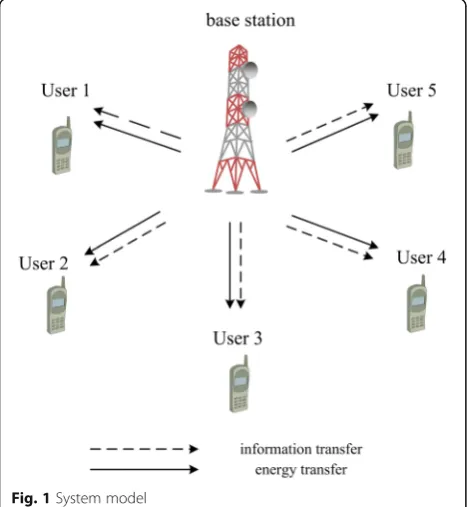
We consider a wireless OFDM downlink system consisting of one cognitive base station (CBS) andkusers. As shown in Fig. 1, each user is only equipped with one antenna. Let
Kdenote the set ofkusers. The OFDM system bandwidth is assumed to be equally divided into n (n ≥k) channels. The set of subcarriers is denoted asN(N= {1,2,⋯n}). Each subcarrier must be allocated to only one user. Parts of sub-carriers are used for energy harvesting, while the others are utilized for information decoding simultaneously. We sup-pose that the channel power gain on each subcarrier is al-ways constant in one transmission period provided by the
base station. Lethk,nrepresent the gain of thek-th user on
the n-th subcarrier. Then, the noise power of each sub-carrier is modeled as an additive white Gaussian noise (AWGN) random variable with zero mean and varianceσ2. The total transmission power is limited to the power budget P. Therefore, the power allocated on then-th sub-carrier is denoted as Pn. Let SP represent the subcarriers
used for energy harvesting to power transfer. Accordingly, the other subcarriers used for information decoding are de-noted by SI. Hence, SKI represents the subcarriers of K-th
user for information transfer. Since one subcarrier cannot be used for energy harvesting and transfer information sim-ultaneously, we haveSI∩SP=∅andSI∪SP=N.
3 Problem formulation
Our aim is to maximize the sum rate of the OFDM downlink under the constraint of the minimum har-vested energy for each user. Let Bk represent the
mini-mum harvested energy of the k-th user. Since one subcarrier can only be allocated to one user, we useαn,k
to stand for a binary channel allocation index. In other words,αn,k= 1 means that the subcarriernis only
allo-cated to the user k, while αn,k = 0 is determined on
other terms. Thus, it is written as:
XK
k¼1αk;n¼1;∀n∈N ð1Þ
The sum rate can be formulated as:
XK
Here, n∈SI. With energy harvesting efficiency ε, the harvested energy during one transmission block for user
kis determined by:
X
n∈SP εhk;nPnþσ2
ð3Þ
For∀k∈K. Therefore, the optimization model of max-imum sum rate can be expressed as:
max
Since the problem is non-convex, it is impossible to obtain the optimal solution directly. In this section, a sub-optimal algorithm is proposed for solving the non-convex problem.
The optimization task can be decomposed into three
The problem above is regarded as allocating the sub-carrier n to the assigned user for obtaining the max-imum sum rate. In other words, the subcarriern(n∈SI) is allocated to the user k which can get the maximum
hk,nPn, i.e., αk;n¼1, k¼ arg maxk∈Khk;nPn andαk,n= 0 , ∀k≠k∗,k∈K.
Secondly, Pn is optimized by αk,n and SI(SP). In this
proposition, the problem can be rewritten as:
max
verted problem is satisfied with convex model. Therefore, the Lagrange dual decomposition is adopted to solve this problem. The Lagrange dual function is as follows:
gðβ1; ;β2Þ ¼maxf gPn L Pð Þn ð7Þ
Where, β1 and β2 are the Lagrange multipliers and they are determined by the sub-gradient method. Mean-while,L(Pn) is expressed as:
Then, the dual problem can be simplified as follows:
minβ1;β2gðβ1; ;β2Þ
s:t β1;β2≥0
ð9Þ
Because the dual problem is differentiable, it can be solved by the classic sub-gradient method, which solves
the optimal problem based on the gradient and the suit-able step size [28]. The result is presented as below:
Δβ1¼
X
n∈SPεhk;nPnþσ2−Bk ð10Þ
Δβ2¼P−Xn∈NPn ð11Þ
For the given β1and β2, the optimal powerPn(n∈SI) is obtained according to KKT conditions using mathematical manipulation:
Where, (.)+denotes max(.,0).
Similarly, the allocated power Pn used for energy
har-vesting is determined as:
Pn¼ Pmaxβ1hk;nε>β2 Pminβ1hk;nε≤β2
ð13Þ
Where, Pmax and Pmin represent the maximum and minimum power constraints on information de-coding, respectively.
According to Pn and αn,k, SI(SP) can be obtained by
substituting (11) and (12) into (8). Consequently, the La-grange dual function can be rewritten as below:
Fn¼β1 εhk;nPnþσ2
−XKk¼1αn;klog 1þhk;nPn σ2
ð15Þ
When we observe the formula (13), only the first item on the right side is about toSP. Thus, the optimalSPcan be achieved by maximizing the itemFn, i.e.,
SP¼ arg max SP
X
n∈SPFn ð16Þ
SP∗can be easily obtained by substituting all theninto
Fnto find the ones which make Fnpositive. As a result,
the rest of the setNbelongs toSI∗.
The proposed algorithm to solve the optimal problem is presented as below:
5 Simulation results
In this section, the performance of the proposed sub-carrier allocation algorithm based on SWIPT for the OFDM system with multiusers is demonstrated by simula-tion results.
We denote all the channels involved follow the Rayleigh distribution. For simplicity, we suppose that the minimum harvested energy limits for all the users are
the same, i.e., Bk=B. In addition, we set N= 16,K= 5, σ2
=1,Pmax= 3 W,Pmin= 0, ε= 1, and the bandwidth is equal to 1 MHz.
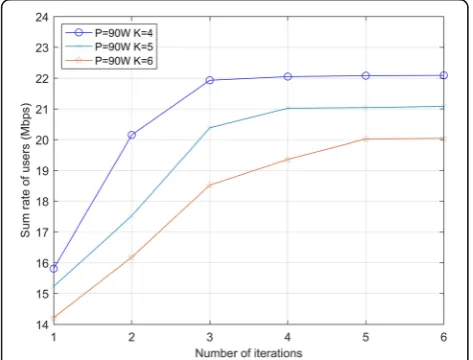
Figure 2 shows the convergence behavior of the pro-posed algorithm. It can be seen that the propro-posed algo-rithm converges fast. It indicates that the proposed algorithm can be implemented practically.
Figure 3 presents the comparison between the pro-posed optimization algorithm and the conventional algo-rithm of subcarrier allocation based on [29]. It can be observed that the proposed algorithm performs better compared with the conventional algorithm.
When the conventional algorithm allocates N subcar-riers toKusers, all the subcarriers are used for informa-tion decoding and the consumed energy comes from the system. Since the system can not produce energy by it-self, the energy comes from the finite battery. Therefore, the constraint of minimum energy harvesting can not be
Fig. 2Convergence behavior of the proposed algorithm
Fig. 3Sum rate of users vs. sum transmission power
satisfied more often than not. Since the water-filling ap-proach is used for the power allocation of the conven-tional algorithm, it would cause some power waste. What is more, all the subcarriers allocated to informa-tion decoding lead to the energy consumpinforma-tion and less power is used for information decoding. Figure 2 also demonstrates that the sum rate of users increases with the increase of sum transmit power P. It can be inter-preted as that the increase of sum transmit power brings about the more power allocated to information decoding with the same target harvested energy.
Figure 4 shows that the total transmit power used for information decoding of user k. It can be seen that the user 3 is allocated the most power, while the user 1 is
the least. This is because, in our simulation, the user 3 has the best channel condition so that it can achieve higher sum rate.
Figure 5 shows that the sum rate of users versus the minimum energy harvesting limit Bk under the fixed
power budget. It is obvious that the sum rate varies with the constraint of the harvested energy. WhenBkincreases,
the sum rate decreases. This is because when the con-straint of energy harvesting increases, more subcarriers are allocated to satisfy the constraint of the harvested en-ergy. It leads to less resources that are allocated to the in-formation decoding. It can also be observed that, with regard to the same constraint of energy harvesting, the sum rate decreases as the number of users increases. That is expected due to the fact that under the same power budget, the increasing number of users causes the de-crease of the average allocated power for each subcarrier. As a result, more subcarriers are allocated to energy har-vesting in order to satisfy the same constraint of the re-quired energy, as well as the sum rate of users increases.
Figure 6 shows the allocated power to each subcarrier under the condition of the power budget equal to 80 W. It also illustrates the average channel gain for each sub-carrier. As shown in Fig. 6, when the subcarrier has the good channel condition, it is always used for energy har-vesting. On the other hand, when the subcarrier has the bad channel condition, it is always used for information decoding and less power is allocated. The phenomenon appears because to allocate the good channel for energy harvesting leads to less subcarriers used for energy har-vesting and more subcarriers used for information de-coding to achieve maximum sum rate.
Fig. 5Sum rate of users vs. harvested energy
6 Conclusions
A subcarrier allocation algorithm based on SWIPT for the OFDM system with multiusers was proposed in this paper. Traditionally, SWIPT is used for single user in OFDM systems more often than not. How-ever, we proposed a joint optimization algorithm used for multiusers. Specifically, the OFDM subcar-riers of each user are divided into two parts whose one part is used for information decoding and the other part is used for energy harvesting. Therefore, in contrast to the conventional time or power split-ter at the receiver, the enough information rate can be obtained on the premise of the harvested energy we require. Simulation results show that the pro-posed algorithm converges fast and performs better than the conventional algorithm in the rate of infor-mation decoding.
Funding
This work was supported by the National Natural Science Foundations of China under Grant No. 61301131 and 61601221, the Natural Science Foundations of Jiangsu Province under Grant No. BK20140828, the China Postdoctoral Science Foundations under Grant No. 2015M580425 and the Fundamental Research Funds for the Central Universities under Grant No. 3132016347 and DUT16RC(3)045.
Authors’contributions
ZN designed the main body of the algorithm and completed the first simulation. XL gave the guidance on the ideas of the paper, optimized the parameters, and discussed the related problems with other authors. XL completed the remaining simulations, analyzed data, and processed simulation results. All authors read and approved the final manuscript.
Authors’information
1Zhenyu Na and Xiaotong Li are from the School of Information Science and
Technology of Dalian Maritime University (DMU), Dalian, China. Zhenyu Na is the associate professor of DMU. His research interests include OFDM communications, non-orthogonal multicarrier techniques, satellite communications, and networking. Xiaotong Li is the postgraduate of DMU whose research field is the OFDM communications and systems, information and energy transfer optimization in wireless multicarrier systems.
2
Xin Liu is the associate professor of the School of Information and Communication Engineering of Dalian University of Technology (DUT), Dalian, China. His research interests include cognitive radio, SWIPT, joint resource management in mobile communication systems, satellite communications, and space laser communications.
Competing interests
The authors declare that they have no competing interests.
Publisher’s Note
Springer Nature remains neutral with regard to jurisdictional claims in published maps and institutional affiliations.
Author details
1School of Information Science and Technology, Dalian Maritime University, Dalian, China.2School of Information and Communication Engineering, Dalian University of Technology, Dalian, China.
Received: 17 July 2017 Accepted: 17 August 2017
References
1. T. Chen, Y. Yang, H. Zhang, H. Kim, K. Horneman, Network energy saving technologies for green wireless access networks. IEEE Wirel. Commun.18(5), 30–38 (2011)
2. F. Zhao, X. Sun, H. Chen, R. Bie, Outage performance of relay-assisted primary and secondary transmissions in cognitive relay networks. EURASIP J. Wirel. Commun. Netw.2014, 60(1) (2014)
3. M. Jia, L. Wang, Q. Guo, A low complexity detection algorithm for fixed up-link SCMA system in mission critical scenario. IEEE Int Things J1(1), 99 (2017) 4. M. Jia, Z. Gao, Q. Guo, Fast compressive tracking with robust example selection based on multiple instance learning in smart and autonomous systems. Pattern Recognition.69, 325-335(2017)
5. L.R. Varshney,Transporting Information and Energy Simultaneously. IEEE International Symposium on Information Theory. IEEE(2016), pp. 1612–1616 6. P. Grover, A. Sahai,Shannon meets Tesla: wireless information and power
transfer(2010), pp. 2363–2367
7. J. Guo, N. Zhao, F.R. Yu, X. Liu, Exploiting adversarial jamming signals for energy harvesting in interference networks. IEEE Trans. Wirel. Commun.
16(2), 1267–1280 (2017)
8. W. Zhong, K. Chen, X. Liu, Joint optimal energy-efficient cooperative spectrum sensing and transmission in cognitive radio. IEEE Wirel. Commun.
14(1), 98–110 (2014)
9. M. Jia, X. Liu, X. Gu, Joint cooperative spectrum sensing and channel selection optimization for satellite communication systems based on cognitive radio. Int. J. Satell. Commun. Netw. 23(3), 139-150(2015) 10. M. Jia, X. Gu, Q. Guo, Broadband hybrid satellite-terrestrial communication
systems based on cognitive radio toward 5G. IEEE Wirel. Commun.23(6), 96–106 (2013)
11. Y. Liu, X. Wang, Information and energy cooperation in OFDM relaying: Protocols and optimization. IEEE Trans. Veh. Technol.65(7), 5088–5098 (2016) 12. L. Liu, R. Zhang, K.C. Chua, Secrecy wireless information and power transfer
with MISO beamforming. IEEE Trans. Signal Process.62(7), 1850–1863 (2014) 13. L. Liu, R. Zhang, K.C. Chua, Wireless information transfer with opportunistic
energy harvesting. IEEE Trans. Wirel. Commun.12(1), 288–300 (2012) 14. F. Zhao, L. Wei, H. Chen, Optimal time allocation for wireless information
and power transfer in wireless powered communication systems. IEEE Trans. Veh. Technol.65(3), 1830–1835 (2016)
15. L. Liu, R. Zhang, C.K. Ho, Wireless information and power transfer: a dynamic power splitting approach. IEEE Trans. Wirel. Commun.61(9), 3990–4001 (2013) 16. D.W.K. Ng, R. Schober, Spectral efficient optimization in OFDM systems with
wireless information and power transfer. IEEE Wirel. Commun.6(2), 1–5 (2013) 17. R. Zhang, C. Ho, MIMO broadcasting for simultaneous wireless information
and power transfer. IEEE Trans. Wirel. Commun.12(5), 1989–2001 (2013) 18. F. Zhao, B. Li, H. Chen, X. Lv, Joint beamforming and power allocation for
cognitive MIMO systems under imperfect CSI based on game theory. Wirel. Pers. Commun.73(3), 679–694 (2013)
19. F. Zhao, W. Wang, H. Chen, Q. Zhang, Interference alignment and game-theoretic power allocation in MIMO heterogeneous sensor networks communications. Signal Process.126(C), 173–179 (2016)
20. X. Zhou, R. Zhang, C.K. Ho, Wireless information and power transfer in multiuser OFDM systems. IEEE Trans. Wirel. Commun.13(4), 2282–2294 (2014) 21. D.W.K. Ng, E.S. Lo, R. Schober, Wireless information and power transfer:
energy efficiency optimization in OFDMA systems. IEEE Trans. Wirel. Commun.12(12), 6352–6370 (2013)
22. X. Liu, M. Jia, X.Z. Tan, Threshold optimization of cooperative spectrum sensing in cognitive radio network. Radio Sci.48(1), 23–32 (2013) 23. X. Liu, G.A. Bi, M. Jia, Y.L. Guan, Joint optimization of sensing threshold and
transmission power in wideband cognitive radio. Radio Sci.48(4), 359–370 (2013) 24. F. Zhao, H. Nie, H. Chen, Group buying spectrum auction algorithm for fractional
frequency reuses cognitive cellular systems. Ad Hoc Netw.58, 239–246 (2017) 25. L. Sibomana, H.J. Zepernick, H. Tran,Signal Processing and Communications
Systems (ICSPCS), 2014 8th international conference on, Wireless information and power transfer in an underlay cognitive radio network (2014), pp. 1–7 26. Z. Gao, B. Wang,Wireless Communication & Signal Processing (WCSP),
27. D.W.K. Ng, R. Schober,2003 IEEE GlobeconWorkshops (GC Wkshps), Resource allocation for secure communication in systems with wireless information and power transfer(2013), pp. 1251–1257
28. A. Nedic, A. Ozdaglar, Distributed subgradient methods for multi-agent optimization. IEEE Trans. Autom. Control54(1), 48–61 (2007)