NONNEGATIVE AND COMPARTMENTAL
DYNAMICAL SYSTEMS
VIJAYSEKHAR CHELLABOINA, WASSIM M. HADDAD, JAMES M. BAILEY, AND JAYANTHY RAMAKRISHNAN
Received 27 October 2003
Nonnegative and compartmental dynamical system models are widespread in biological, physiological, and pharmacological sciences. Since the state variables of these systems are typically masses or concentrations of a physical process, it is of interest to determine necessary and sufficient conditions under which the system states possess monotonic solutions. In this paper, we present necessary and sufficient conditions for identifying discrete-time nonnegative and compartmental dynamical systems that only admit mono-tonic solutions.
1. Introduction
Nonnegative dynamical systems are of paramount importance in analyzing dynamical systems involving dynamic states whose values are nonnegative [2,9,16,17]. An impor-tant subclass of nonnegative systems is compartmental systems [1,4,6,8,11,12,13,14, 15,18]. These systems involve dynamical models derived from mass and energy balance considerations of macroscopic subsystems or compartments which exchange material via intercompartmental flow laws. The range of applications of nonnegative and compart-mental systems is widespread in models of biological and physiological processes such as metabolic pathways, tracer kinetics, pharmacokinetics, pharmacodynamics, and epi-demic dynamics.
Since the state variables of nonnegative and compartmental dynamical systems typi-cally represent masses and concentrations of a physical process, it is of interest to deter-mine necessary and sufficient conditions under which the system states possess mono-tonic solutions. This is especially relevant in the specific field of pharmacokinetics [7,19] wherein drug concentrations should monotonically decline after discontinuation of drug administration. In a recent paper [5], necessary and sufficient conditions were developed for identifying continuous-time nonnegative and compartmental dynamical systems that only admit nonoscillatory and monotonic solutions. In this paper, we present analogous results for discrete-time nonnegative and compartmental systems.
The contents of the paper are as follows. InSection 2, we establish definitions and no-tation, and review some basic results on nonnegative dynamical systems. InSection 3, we introduce the notion of monotonicity of solutions of nonnegative dynamical systems. Furthermore, we provide necessary and sufficient conditions for monotonicity for lin-ear nonnegative dynamical systems. InSection 4, we generalize the results ofSection 3 to nonlinear nonnegative dynamical systems. In addition, we provide sufficient condi-tions that guarantee the absence of limit cycles in nonlinear compartmental systems. InSection 5, we use the results ofSection 3to characterize the class of all linear, three-dimensional compartmental systems that exhibit monotonic solutions. Finally, we draw conclusions inSection 6.
2. Notation and mathematical preliminaries
In this section, we introduce notation, several definitions, and some key results concern-ing discrete-time, linear nonnegative dynamical systems [2,3,10] that are necessary for developing the main results of this paper. Specifically, forx∈Rn, we writex≥≥0 (resp., x0) to indicate that every component ofxis nonnegative (resp., positive). In this case, we say thatxisnonnegativeorpositive, respectively. Likewise,A∈Rn×m isnonnegative orpositiveif every entry of Ais nonnegative or positive, respectively, which is written asA≥≥0 orA0, respectively. (In this paper, it is important to distinguish between a square nonnegative (resp., positive) matrix and a nonnegative-definite (resp., positive-definite) matrix.) LetRn+andRn+denote the nonnegative and positive orthants ofRn; that
is, ifx∈Rn, thenx∈Rn+andx∈Rn+are equivalent, respectively, tox≥≥0 andx0.
Finally, letNdenote the set of nonnegative integers. The following definition introduces the notion of a nonnegative function.
Definition 2.1. A real functionu:N→Rm is anonnegative(resp., positive)functionif u(k)≥≥0 (resp.,u(k)0),k∈N.
In the first part of this paper, we consider discrete-time, linear nonnegative dynamical systems of the form
x(k+ 1)=Ax(k) +Bu(k), x(0)=x0,k∈N, (2.1)
wherex∈Rn,u∈Rm,A∈Rn×n, andB∈Rn×m. The following definition and proposi-tion are needed for the main results of this paper.
Definition 2.2. The linear dynamical system given by (2.1) isnonnegative if for every x(0)∈Rn+andu(k)≥≥0,k∈N, the solutionx(k),k∈N, to (2.1) is nonnegative. Proposition2.3 [10]. The linear dynamical system given by (2.1) is nonnegative if and only ifA∈Rn×nis nonnegative andB∈Rn×mis nonnegative.
Next, we consider a subclass of nonnegative systems; namely, compartmental systems. Definition 2.4. Let A∈Rn×n. A is a compartmental matrix if A is nonnegative and
n
IfAis a compartmental matrix and u(k)≡0, then the nonnegative system (2.1) is called aninflow-closed compartmental system[10,11,12]. Recall that an inflow-closed compartmental system possesses a dissipation property and hence is Lyapunov-stable since the total mass in the system given by the sum of all components of the statex(k), k∈N, is nonincreasing along the forward trajectories of (2.1). In particular, withV(x)= eTx, wheree=[1, 1,..., 1]T, it follows that
∆Vx(k)=eT(A−I)x(k)=n
j=1
n
i=1
A(i,j)−1
xj≤0, x∈Rn+. (2.2)
Hence, all solutions of inflow-closed linear compartmental systems are bounded. Of course, if detA=0, where detAdenotes the determinant ofA, thenAis asymptotically stable. For details of the above facts, see [10].
3. Monotonicity of linear nonnegative dynamical systems
In this section, we present our main results for discrete-time, linear nonnegative dynam-ical systems. Specifdynam-ically, we consider monotonicity of solutions of dynamdynam-ical systems of the form given by (2.1). First, however, the following definition is needed.
Definition 3.1. Consider the discrete-time, linear nonnegative dynamical system (2.1), wherex0∈ᐄ0⊆R+n,A is nonnegative,Bis nonnegative,u(k), k∈N, is nonnegative,
andᐄ0denotes a set of feasible initial conditions contained inRn+. Let ˆn≤n,{k1,k2,...,
knˆ} ⊆ {1, 2,...,n}, and ˆx(k)[xk1(k),...,xknˆ(k)]T. The discrete-time, linear nonnegative
dynamical system (2.1) ispartially monotonic with respect toxˆ if there exists a matrix Q∈Rn×nsuch thatQ=diag[q
1,...,qn],qi=0,i∈ {k1,...,knˆ},qi= ±1,i∈ {k1,...,knˆ},
and for everyx0∈ᐄ0,Qx(k2)≤≤Qx(k1), 0≤k1≤k2, where x(k), k∈N, denotes the
solution to (2.1). The discrete-time, linear nonnegative dynamical system (2.1) is mono-tonicif there exists a matrixQ∈Rn×nsuch thatQ=diag[q
1,...,qn],qi= ±1,i=1,...,n,
and for everyx0∈ᐄ0,Qx(k2)≤≤Qx(k1), 0≤k1≤k2.
Next, we present a sufficient condition for monotonicity of a discrete-time, linear non-negative dynamical system.
Theorem3.2. Consider the discrete-time, linear nonnegative dynamical system given by (2.1), wherex0∈Rn+,A∈Rn×nis nonnegative,B∈Rn×mis nonnegative, andu(k),k∈N,
is nonnegative. Let nˆ≤n, {k1,k2,...,knˆ} ⊆ {1, 2,...,n}, and x(k)ˆ [xk1(k),...,xknˆ(k)]T.
Assume there exists a matrixQ∈Rn×nsuch thatQ=diag[q1,...,qn],qi=0,i∈ {k1,...,knˆ},
qi= ±1,i∈ {k1,...,knˆ},QA≤≤Q, andQB≤≤0. Then the discrete-time, linear
nonnega-tive dynamical system (2.1) is partially monotonic with respect toxˆ. Proof. It follows from (2.1) that
which implies that
Next, sinceA andB are nonnegative and u(k), k∈N, is nonnegative, it follows from Proposition 2.3thatx(k)≥≥0,k∈N. Hence, since−Q(A−I) and−QBare nonnega-tive, it follows thatQ(A−I)x(k)≤≤0 andQBu(k)≤≤0,k∈N, which implies that for
everyx0∈Rn+,Qx(k2)≤≤Qx(k1), 0≤k1≤k2.
Corollary3.3. Consider the discrete-time, linear nonnegative dynamical system given by (2.1), wherex0∈Rn+,A∈Rn×nis nonnegative,B∈Rn×mis nonnegative, andu(k),k∈N,
is nonnegative. Assume there exists a matrixQ∈Rn×nsuch thatQ=diag[q
1,...,qn],qi=
±1,i=1,...,n, andQA≤≤QandQB≤≤0are nonnegative. Then the discrete-time, linear nonnegative dynamical system given by (2.1) is monotonic.
Proof. The proof is a direct consequence ofTheorem 3.2with ˆn=nand{k1,...,knˆ} =
{1,...,n}.
Next, we present partial converses ofTheorem 3.2andCorollary 3.3in the case where u(k)≡0.
Theorem3.4. Consider the discrete-time, linear nonnegative dynamical system given by (2.1), wherex0∈Rn+,A∈Rn×nis nonnegative, andu(k)≡0. Letnˆ≤n,{k1,k2,...,knˆ} ⊆
{1, 2,...,n}, andxˆ(k)[xk1(k),...,xknˆ(k)]T. The discrete-time, linear nonnegative
dynam-ical system (2.1) is partially monotonic with respect toxˆif and only if there exists a matrix Q∈Rn×nsuch thatQ=diag[q
1,...,qn],qi=0,i∈ {k1,...,knˆ},qi= ±1,i∈ {k1,...,knˆ},
andQA≤≤Q.
Proof. Sufficiency follows fromTheorem 3.2 withu(k)≡0. To show necessity, assume that the discrete-time, linear dynamical system given by (2.1), withu(k)≡0, is partially monotonic with respect to ˆx. In this case, it follows from (2.1) that
Qx(k+ 1)=QAx(k), x(0)=x0,k∈N, (3.3)
Corollary3.5. Consider the discrete-time, linear nonnegative dynamical system given by (2.1), wherex0∈Rn+,A∈Rn×nis nonnegative, andu(k)≡0. The linear nonnegative
dy-namical system (2.1) is monotonic if and only if there exists a matrixQ∈Rn×nsuch that Q=diag[q1,...,qn],qi= ±1,i=1, 2,...,n, andQA≤≤Q.
Proof. The proof is a direct consequence ofTheorem 3.4with ˆn=nand{k1,...,knˆ} =
{1,...,n}.
Finally, we present a sufficient condition forweighted monotonicityfor a discrete-time, linear nonnegative dynamical system.
Proposition3.6. Consider the discrete-time, linear dynamical system given by (2.1), where Ais nonnegative,u(k)≡0,x0∈ᐄ0{x0∈Rn:S(A−I)x0≤≤0}, whereS∈Rn×nis an
invertible matrix. IfSAS−1 is nonnegative, then for everyx
0∈ᐄ0,Sx(k2)≤≤Sx(k1),0≤
k1≤k2.
Proof. Lety(k)−S(A−I)x(k) and note that y(0)= −S(A−I)x0∈Rn+. Hence, it
fol-lows from (2.1) that
y(k+ 1)= −S(A−I)x(k+ 1)= −S(A−I)Ax(k)= −SAS−1S(A−I)x(k)=SAS−1y(k).
(3.6)
Next, sinceSAS−1is nonnegative, it follows that y(k)∈Rn
+,k∈N. Now, the result
fol-lows immediately by noting that y(k)= −S(A−I)x(k)0, k∈N, and henceS(A− I)x(k)≤≤0, k∈N, or, equivalently, Sx(k+ 1)≤≤Sx(k), k∈N, which implies that
Sx(k2)≤≤Sx(k1), 0≤k1≤k2.
4. Monotonicity of nonlinear nonnegative dynamical systems
In this section, we extend the results ofSection 3to nonlinear nonnegative dynamical systems. Specifically, we consider discrete-time, nonlinear dynamical systemsᏳ of the form
x(k+ 1)=fx(k)+Gx(k)u(k), x(0)=x0,k∈N, (4.1)
wherex(k)∈Ᏸ, Ᏸis an open subset of Rn with 0∈Ᏸ,u(k)∈Rm, f :Ᏸ→Rn, and G:Ᏸ→Rn×m. We assume thatf(·) andG(·) are continuous inᏰand f(xe)=xe,xe∈Ᏸ. For the nonlinear dynamical systemᏳgiven by (4.1), the definitions of monotonicity and partial monotonicity hold with (2.1) replaced by (4.1). The following definition general-izes the notion of nonnegativity to vector fields.
Definition 4.1[10]. Let f =[f1,...,fn]T:Ᏸ→Rn, whereᏰis an open subset ofRnthat containsRn. Then f isnonnegativeif fi(x)≥0, for alli=1,...,nandx∈Rn+.
Proposition4.2 [10]. Consider the discrete-time, nonlinear dynamical systemᏳgiven by (4.1). If f :Ᏸ→Rnis nonnegative andG(x)≥≥0,x∈Rn
+, thenᏳis nonnegative.
Next, we present a sufficient condition for monotonicity of a nonlinear nonnegative dynamical system.
Theorem4.3. Consider the discrete-time, nonlinear nonnegative dynamical systemᏳgiven by (4.1), wherex0∈Rn+,f :Ᏸ→Rnis nonnegative,G(x)≥≥0,x∈R
the discrete-time, nonlinear nonnegative dynamical system Ᏻis partially monotonic with respect toxˆ.
Proof. The proof is similar to the proof ofTheorem 3.2withProposition 4.2invoked in
place ofProposition 2.3, and hence is omitted.
Corollary 4.4. Consider the discrete-time, nonlinear nonnegative dynamical system Ᏻ given by (4.1), wherex0∈Rn+, f :Ᏸ→Rnis nonnegative,G(x)≥≥0,x∈R
time, nonlinear nonnegative dynamical systemᏳis monotonic.
Proof. The proof is a direct consequence ofTheorem 4.3with ˆn=nand{k1,...,knˆ} =
{1,...,n}.
Next, we present necessary and sufficient conditions for partial monotonicity and monotonicity for (4.1) in the case whereu(k)≡0.
Theorem4.5. Consider the discrete-time, nonlinear nonnegative dynamical systemᏳgiven by (4.1), wherex0∈Rn+, f :Ᏸ→Rnis nonnegative, andu(k)≡0. Letnˆ≤n,{k1,k2,...,
knˆ} ⊆ {1, 2,...,n}, andx(k)ˆ [xk1(k),...,xknˆ(k)]T. The discrete-time, nonlinear
nonneg-ative dynamical systemᏳis partially monotonic with respect toxˆ if and only if there ex-ists a matrix Q∈Rn×n such that Q=diag[q
1,...,qn],qi=0, i∈ {k1,...,knˆ},qi= ±1,
i∈ {k1,...,knˆ}, andQ f(x)≤≤Qx,x∈Rn+.
Proof. Sufficiency follows fromTheorem 4.3 withu(k)≡0. To show necessity, assume that the nonlinear dynamical system given by (4.1), withu(k)≡0, is partially monotonic with respect to ˆx. In this case, it follows from (4.1) that
Qx(k+ 1)=Q fx(k), x(0)=x0,k∈N, (4.2)
which implies that for everyk∈N,
Qxk2=Qxk1+
k2−1
k=k1
Now, suppose,ad absurdum, there existJ∈ {1, 2,...,n}andx0∈Rn+such that [Q f(x0)]J> Corollary 4.6. Consider the discrete-time, nonlinear nonnegative dynamical system Ᏻ given by (4.1), wherex0∈Rn+,f :Ᏸ→Rnis nonnegative, andu(k)≡0. The discrete-time,
nonlinear nonnegative dynamical systemᏳis monotonic if and only if there exists a matrix Q∈Rn×nsuch thatQ=diag[q1,...,qn],qi= ±1,i=1,...,n, andQ f(x)≤≤Qx,x∈Rn
+.
Proof. The proof is a direct consequence ofTheorem 4.5with ˆn=nand{k1,...,knˆ} =
{1,...,n}.
Corollary 4.6 provides some interesting ramifications with regard to the absence of limit cycles of inflow-closed nonlinear compartmental systems. To see this, consider the inflow-closed (u(k)≡0) compartmental system (4.1), where f(x)=[f1(x),...,fn(x)] is
and where the instantaneous rates of compartmental material lossesaii(·), i=1,...,n, and intercompartmental material flowsaij(·),i=j,i,j=1,...,n, are such thataij(x)≥0, x∈Rn+,i,j=1,...,n. Since all mass flows as well as compartment sizes are nonnegative, it
follows that for alli=1,...,n, fi(x)≥0 for allx∈Rn+. Hence, f is nonnegative. As in the
linear case, inflow-closed nonlinear compartmental systems are Lyapunov-stable since the total mass in the system given by the sum of all components of the statex(k),k∈N, is nonincreasing along the forward trajectories of (4.1). In particular, takingV(x)=eTx
and assumingaij(0)=0,i,j=1,...,n, it follows that
which shows that the zero solution x(k)≡0 of the inflow-closed nonlinear compart-mental system (4.1) is Lyapunov-stable and for everyx0∈Rn+, the solution to (4.1) is
bounded.
a direct consequence ofCorollary 4.6and provides sufficient conditions for the absence of limit cycles in nonlinear compartmental systems.
Theorem4.7. Consider the nonlinear nonnegative dynamical systemᏳgiven by (4.1) with u(k)≡0 and f(x)=[f1(x),...,fn(x)] such that (4.5) holds. If there exists a matrixQ∈ Rn×nsuch thatQ=diag[q
1,...,qn],qi= ±1,i=1,...,n, andQ f(x)≤≤Qx,x∈Rn+, then
for everyx0∈Rn+,limk→∞x(k)exists.
Proof. Let V(x)=eTx, x∈Rn
+. Now, it follows from (4.6) that∆V(x(k))≤0,k∈N,
wherex(k),k∈N, denotes the solution ofᏳ, which implies thatV(x(k))≤V(x0)=eTx0,
k∈N, and hence for everyx0∈Rn+, the solutionx(k),k∈N, ofᏳis bounded. Hence, for
everyi∈ {1,...,n},xi(k),k∈N, is bounded. Furthermore, it follows fromCorollary 4.6 thatxi(k),k∈N, is monotonic. Now, sincexi(·),i∈ {1,...,n}, is bounded and mono-tonic, it follows that limk→∞xi(k),i=1,...,n, exists. Hence, limk→∞x(k) exists.
5. A Taxonomy of three-dimensional monotonic compartmental systems
In this section, we use the results ofSection 3 to provide a taxonomy of linear three-dimensional, inflow-closed compartmental dynamical systems that exhibit monotonic solutions. A similar classification can be obtained for nonlinear and higher-order com-partmental systems, but we do not do so here for simplicity of exposition. To character-ize the class of all three-dimensional monotonic compartmental systems, letᏽ{Q∈ R3×3:Q=diag[q
1,q2,q3], qi= ±1,i=1, 2, 3}. Furthermore, letA∈R3×3be a
compart-mental matrix and letx1(k),x2(k), andx3(k),k∈N, denote compartmental masses for
compartments 1, 2, and 3, respectively. Note that there are exactly eight matrices in the setᏽ. Now, it follows fromCorollary 3.5that ifQA≤≤Q,Q∈ᏽ, then the correspond-ing compartmental dynamical system is monotonic. Hence, for everyQ∈ᏽ, we seek all compartmental matricesA∈R3×3such thatq
iA(i,i)≤qi,i=1, 2, 3, andqiA(i,j)≤0,i=j,
i,j=1, 2, 3.
First, we consider the case whereQ=diag[1, 1, 1]. In this case,qiA(i,i)≤qi,i=1, 2, 3,
andqiA(i,j)≤0,i= j,i,j=1, 2, 3, if and only ifA(1,2)=A(1,3)=A(2,1)=A(3,1)=A(3,2)=
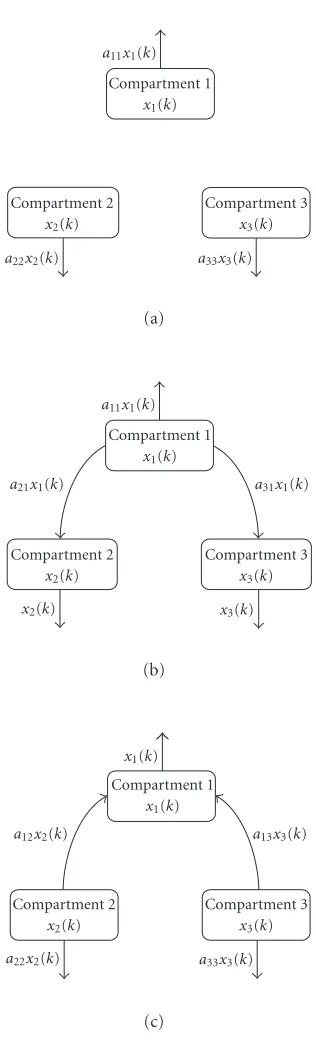
A(2,3)=0. This corresponds to a trivial (decoupled) case since there are no
intercompart-mental flows between the three compartments (seeFigure 5.1(a)). Next, letQ=diag[1, −1,−1] and note thatqiA(i,i)≤qi,i=1, 2, 3, andqiA(i,j)≤0,i=j,i,j=1, 2, 3, if and only
ifA(2,2)=A(3,3)=1 andA(1,2)=A(1,3)=A(2,3)=A(3,2)=0.Figure 5.1(b)shows the
com-partmental structure for this case. Finally, letQ=diag[−1, 1, 1]. In this case,qiA(i,i)≤qi,
i=1, 2, 3, andqiA(i,j)≤0,i=j,i,j=1, 2, 3, if and only ifA(1,1)=1 andA(2,1)=A(3,1)=
A(3,2)=A(2,3)=0.Figure 5.1(c)shows the corresponding compartmental structure.
Compartment 1
x1(k)
a11x1(k)
a22x2(k) a33x3(k)
Compartment 2
x2(k)
Compartment 3
x3(k)
(a)
Compartment 1
x1(k)
a11x1(k)
x2(k) x3(k)
a21x1(k) a31x1(k)
Compartment 2
x2(k)
Compartment 3
x3(k)
(b)
Compartment 1
x1(k)
x1(k)
a22x2(k) a33x3(k)
a12x2(k) a13x3(k)
Compartment 2
x2(k)
Compartment 3
x3(k)
(c)
6. Conclusion
Nonnegative and compartmental models are widely used to capture system dynamics in-volving the interchange of mass and energy between homogeneous subsystems. In this paper, necessary and sufficient conditions were given, under which linear and nonlinear discrete-time nonnegative and compartmental systems are guaranteed to possess mono-tonic solutions. Furthermore, sufficient conditions that guarantee the absence of limit cycles in nonlinear discrete-time compartmental systems were also provided.
Acknowledgment
This research was supported in part by the National Science Foundation under Grant ECS-0133038 and the Air Force Office of Scientific Research under Grant F49620-03-1-0178.
References
[1] D. H. Anderson,Compartmental Modeling and Tracer Kinetics, Lecture Notes in Biomathemat-ics, vol. 50, Springer-Verlag, Berlin, 1983.
[2] A. Berman, M. Neumann, and R. J. Stern,Nonnegative Matrices in Dynamic Systems, Pure and Applied Mathematics, John Wiley & Sons, New York, 1989.
[3] A. Berman and R. J. Plemmons,Nonnegative Matrices in the Mathematical Sciences, Academic Press, New York, 1979.
[4] D. S. Bernstein and D. C. Hyland,Compartmental modeling and second-moment analysis of state space systems, SIAM J. Matrix Anal. Appl.14(1993), no. 3, 880–901.
[5] V. Chellaboina, W. M. Haddad, J. M. Bailey, and J. Ramakrishnan,On the absence of oscilla-tions in compartmental dynamical systems, Proc. IEEE Conference on Decision and Control (Nevada), 2002, pp. 1663–1668.
[6] R. E. Funderlic and J. B. Mankin,Solution of homogeneous systems of linear equations arising from compartmental models, SIAM J. Sci. Statist. Comput.2(1981), no. 4, 375–383. [7] M. Gibaldi and D. Perrier,Pharmacokinetics, Marcel Dekker, New York, 1975.
[8] K. Godfrey,Compartmental Models and Their Application, Academic Press, New York, 1983. [9] W. M. Haddad, V. Chellaboina, and E. August,Stability and dissipativity theory for nonnegative
dynamical systems: a thermodynamic framework for biological and physiological systems, Proc. IEEE Conference on Decision and Control (Florida), 2001, pp. 442–458.
[10] ,Stability and dissipativity theory for discrete-time nonnegative and compartmental dy-namical systems, Proc. IEEE Conference on Decision and Control (Florida), 2001, pp. 4236– 4241.
[11] J. A. Jacquez,Compartmental Analysis in Biology and Medicine, 2nd ed., University of Michigan Press, Michigan, 1985.
[12] J. A. Jacquez and C. P. Simon, Qualitative theory of compartmental systems, SIAM Rev.35 (1993), no. 1, 43–79.
[13] H. Maeda, S. Kodama, and F. Kajiya,Compartmental system analysis: realization of a class of linear systems with physical constraints, IEEE Trans. Circuits and Systems24(1977), no. 1, 8–14.
[14] H. Maeda, S. Kodama, and Y. Ohta,Asymptotic behavior of nonlinear compartmental systems: nonoscillation and stability, IEEE Trans. Circuits and Systems25(1978), no. 6, 372–378. [15] R. R. Mohler,Biological modeling with variable compartmental structure, IEEE Trans. Automat.
[16] J. W. Nieuwenhuis,About nonnegative realizations, Systems Control Lett.1(1982), no. 5, 283– 287.
[17] Y. Ohta, H. Maeda, and S. Kodama,Reachability, observability, and realizability of continuous-time positive systems, SIAM J. Control Optim.22(1984), no. 2, 171–180.
[18] W. Sandberg,On the mathematical foundations of compartmental analysis in biology, medicine, and ecology, IEEE Trans. Circuits and Systems25(1978), no. 5, 273–279.
[19] J. G. Wagner,Fundamentals of Clinical Pharmacokinetics, Drug Intelligence Publications, Illi-nois, 1975.
VijaySekhar Chellaboina: Department of Mechanical and Aerospace Engineering, University of Missouri-Columbia, Columbia, MO 65211, USA
E-mail address:[email protected]
Wassim M. Haddad: School of Aerospace Engineering, Georgia Institute of Technology, Atlanta, GA 30332-0150, USA
E-mail address:[email protected]
James M. Bailey: Department of Anesthesiology, Northeast Georgia Medical Center, Gainesville, GA 30503, USA
E-mail address:[email protected]
Jayanthy Ramakrishnan: Department of Mechanical and Aerospace Engineering, University of Missouri-Columbia, Columbia, MO 65211, USA