R E S E A R C H
Open Access
Fog radio access network system control
scheme based on the embedded game
model
Sungwook Kim
Abstract
As a promising paradigm for the 5G wireless communication system, a new evolution of the cloud radio access networks has been proposed, named as fog radio access networks (F-RANs). It is an advanced socially aware mobile networking architecture to provide a high spectral and energy efficiency while reducing backhaul burden. In particular, F-RANs take full advantages of social information and edge computing to efficiently alleviate the end-to-end latency. Based on the benefit of edge and cloud processing, key issues of F-RAN technique are radio resource allocation, caching, and service admission control. In this paper, we develop a novel F-RAN system control scheme based on the embedded game model. In the proposed scheme, spectrum allocation, cache placement, and service admission algorithms are jointly designed to maximize system efficiency. By developing a new embedded game methodology, our approach can capture the dynamics of F-RAN system and effectively compromises the centralized optimality with decentralized distribution intelligence for the faster and less complex decision making process. Through simulations, we compare the performance of our scheme to the existing studies and show how we can achieve a better performance under dynamic F-RAN system environments.
Keywords:Fog radio access network, Service admission control, Cache placement, Embedded game model,
Radio resource allocation
1 Introduction
In the past decade, the evolution toward 5G is fea-tured by the explosive growth of traffic in the wireless network, due to the exponentially increased number of user devices. Compared to the 4G communication system, the 5G system should bring billions of user devices into wireless networks to demand high band-width connections. Therefore, system capacity and en-ergy efficiency should be improved to get the great success of 5G communications. Cloud radio access network (C-RAN) is an emerging architecture for the 5G wireless system. A key advantage of C-RAN is the possibility to perform cooperative transmissions across multiple edge nodes for the centralized cloud process-ing. However, the cloud processing comes at the cost of the potentially large delay entailed by fronthaul transmissions. It may become a major performance
bottleneck of a C-RAN system per critical indicators such as spectral efficiency and latency [1–3].
As an extension of C-RAN paradigm, fog computing is a promising solution to the mission critical tasks in-volving quick decision making and fast response. It is a distributed paradigm that provides cloud-like services to the network edge nodes. Instead of using the remoted cloud center, the fog-computing technique le-verages computing resources at the edge of networks based on the decentralized transmission strategies. Therefore, it can help overcome the resource conten-tion and increasing latency. Due to the effective coord-ination of geographically distributed edge nodes, the fog-computing approach can meet the 5G application constraints, i.e., location awareness, low latency, and supports for mobility or geographical distribution of services. The most frequently referred use cases for the fog-computing concept are related to the Internet of Things (IoT) [4, 5].
Correspondence:[email protected]
Department of Computer Science, Sogang University, 35 Baekbeom-ro (Sinsu-dong), Mapo-gu 121-742, Seoul, South Korea
Taking full advantages of fog computing and C-RANs, fog radio access networks (F-RANs) have been proposed as an advanced socially aware mobile net-working architecture in 5G systems. F-RANs harness the benefits of, and the synergies between, fog comput-ing and C-RAN in order to accommodate the broad range of Quality of Service (QoS) requirements of 5G mobile broadband communications [2]. In the F-RAN architecture, edge nodes may be endowed with caching capabilities to serve the local data requests of popular content with low latency. At the same time, a central cloud processor allocates radio and computational re-sources to each individual edge nodes while ensuring as much as various applications [6]. To maximize the F-RAN system performance, application request schedul-ing, cache placement, and communication resource allocation should be jointly designed. However, it is an extremely challenging issue.
In the architecture of F-RANs, multiple interest rele-vant system agents exist; they are the central cloud ser-ver (CS), edge nodes (ENs), and mobile users (MUs). The CS provides contents to download and allocates radio and communication resources to ENs. ENs, known as fog-computing-based access points (F-APs), manage the allocated radio resource and admit MUs to provide application services. MUs wish to enjoy different QoS services from the F-RAN system. Different system agents have their own benefits, but their benefits could conflict with each other, and each agent only cares about its own profit. Therefore, it is necessary to analyze the interactions among these conflicting system agents and design proper solutions. Although dozens of techniques have been proposed, a systematic study on the interac-tions among CS, F-APs, and MUs is still lacking [7].
Recently, game theory has been widely concerned and studied in solving conflict and cooperation in distributed optimization problems. As a branch of mathematics, it is suitable for analyzing the performance of multi-agent sys-tems. In game theory, a variety of interactive behaviors can be described by different payoff functions and the out-come of a game depends on the combinations of the deci-sions taken by each agent. Depending on the way the decisions are taken, it is possible to classify the games as cooperative or non-cooperative games. Nowadays, game theory has been widely recognized as an important tool in many fields. In the last few years, it has attracted consider-able attentions and has been investigated extensively in computer science and tele-communications [8]. This is one of the reasons why game theory is applied more and more intensively to cloud computing and network man-agement fields.
However, the traditional game theoretic analysis should rely on the perfect information and idealistic behavior as-sumptions. Therefore, there is a quite general consensus
to say that the predicted game solutions are useful but would be rarely observed in real world situations. Re-cently, specialized sub-branches of game theory have been developed to encounter this problem. The main goal of this study is also to develop a new game paradigm. To de-sign a practical game model for the F-RAN system man-agement, we adopt an online dynamic approach based on the interactive relationship among system agents. Our ap-proach exploits a partial information on the game and ob-tains an effective solution under mild and practical assumptions. From the standpoint of algorithm designers, our approach can be dynamically implemented in the real-world F-RAN environments.
Motivated by the above discussion, we propose a novel F-RAN control scheme based on the methodology of game theory. In this study, we design a new game model, called embedded game, to effectively solve the conflict problem among F-RAN system agents. From the realistic point of view, we need not the complete knowledge of the system information. Instead, our game procedure imitates the interactive sequential game process while ensuring the system practicality. To summarize, the major contribution of this study is to provide a new game-based F-RAN control algorithm. Main features of our proposed game model are as follows: (i) the adjust-able dynamics considering the current F-RAN system environment, (ii) an interactive online process based on the embedded game model, (iii) a cooperative control manner with the nested non-cooperative approach, (iv) the joint design to obtain synergistic and complementary features, and (v) a practicality under realistic system op-eration scenarios. Especially, the important novelty of our proposed scheme is obtained from the key principle of embedded game approach, which can better capture the reality of F-RAN operations. To the best of our knowledge, very little research has been done, and there is still few published work to discuss the joint F-RAN control algorithms.
This article is organized as follows. In the next section, we review some related schemes and their problems. In Section 3, we define the embedded game model consid-ered in this paper and explain in detail the proposed F-RAN control scheme. In particular, this section provides fresh insights into the benefits and design of developed control algorithms. For convenience, the main steps of the proposed scheme are also listed in Section 3. Section 4 reports the simulation results and performance ana-lysis. Lastly, we give our conclusion in Section 5. Open issues and challenges are also discussed in Section V.
2 Related work
light-weight scheme for realizing the full potential of C-RAN systems. For small cells, this scheme determined configurations that maximized the traffic demand while simultaneously optimizing the compute resource usage in the baseband processing unit pool. Briefly, the devel-oped scheme in [9] adopted a two-step approach: (i) the first-step determined the optimal combination of config-urations; it needed to support the traffic demand from a set of small cells, and (ii) the second step consolidated the configurations to further reduce the compute re-source usage [9].
The article [10] provided a brief overview of the infra-structure and logic infra-structure of C-RAN systems. In addition, a new coordinated user scheduling algorithm and parallel optimum precoding algorithm were spe-cifically designed based on the concept of a service cloud and a three-layer logical structure. This approach utilized extensive computation resources to improve the RAN system performance. Compared to traditional C-RAN algorithms, the developed scheme in [10] matched well with the C-RAN architecture while managing inter-ference efficiently and accelerating the cooperation pro-cessing in parallel.
Q. Vien et al. [11–13] proposed a non-orthogonal multiple access-based power allocation scheme for C-RAN systems. In this scheme, base stations were al-located with different power levels depending on their distances to the cloud, and the optimal number of BSs in C-RAN systems was found to achieve an improved performance. Specifically, a successive interference cancellation mechanism was designed at the cloud to lay multiple base stations over each other in the power do-main. Taking into account the constraints of the total available power and the cloud-edge throughput require-ment, this approach has shown to support a higher number of base stations when compared to the existing scheme [11–13].
The paper [14] surveyed heterogeneous C-RAN re-search achievements and challenges, and provided a summary of recent advancements in the computing con-vergence of heterogeneous wireless networks. In parti-cular, the system architecture, performance analysis, cloud-computing-based cooperative processing, network-ing techniques, key large-scale cooperative processnetwork-ing and networking techniques, including cloud-computing-based coordinated multipoint transmission, cooperative radio re-source management, and self-organizing networks have been briefly summarized. Furthermore, potential chal-lenges and open issues in heterogeneous C-RANs have been discussed as well [14].
In [15], Sengupta et al. provided a latency-centric ana-lysis of the degrees of freedom of an F-RAN by account-ing for the total content delivery delay across the fronthaul and wireless segments of the network. The
main goal of the analysis was the identification of opti-mal caching, fronthaul, and edge transmission policies. In this study, authors detailed a general model and a novel performance metric, referred to as Normalized Delivery Time (NDT), which captured the worst-case delivery latency with respect to an ideal interference-free system. Finally, they revealed optimal caching-fronthaul transmission policies as a function of the system re-sources [15].
Azimi, et al. [16] considered an online caching setup, in which the set of popular files was time-varying and both cache replenishment and content delivery could take place in each time slot. They developed online caching and delivery schemes based on both reactive and proactive caching principles, and bounds on the cor-responding achievable long-term NDTs were derived. In particular, a lower bound on the achievable long-term NDT was obtained. Using this bound, the performance loss caused by the variations in the set of popular files in terms of delivery latency was quantified by comparing the NDTs achievable under offline and online caching. Finally, numerical results were provided in which the performance of reactive and proactive online caching schemes were compared with offline caching [16].
The Traffic Balancing and Dynamic Clustering
(TBDC) scheme investigated the joint design of multi-cast beamforming, dynamic clustering, and backhaul traffic balancing [17]. To minimize the power consump-tion for higher energy efficiency, theTBDC scheme de-signed the beamforming vectors and clustering pattern in the downlink of F-RAN. This approach balanced the backhaul traffic according to individual backhaul capaci-ties, guaranteed the QoS of each user, and minimized the power consumption. Especially, the TBDC scheme dynamically excluded a radio unit from a cluster when it contributed comparatively less to the corresponding multicast group. If a radio unit contributed compara-tively more to the corresponding multicast group, it would be involved in a cluster in order to guarantee the required QoS [17].
The Joint Optimization of Cloud and Edge (JOCE) scheme introduced the joint design of cloud and edge processing for the downlink of F-RAN [3]. To design the delivery phase for an arbitrary pre-fetching strategy, transfer modes can be categorized into two classes: transfer mode and soft-transfer mode. In the hard-transfer mode, non-cached files are communicated over the fronthaul links to a subset of access points. There-fore, this approach transfers hard information of subfiles that were not cached. In the soft-transfer mode, the fronthaul links are used to convey quantized baseband signals as in a cloud RAN. Therefore, this approach transfers a quantized version of the precoded signals for the missing files in line with the C-RAN paradigm. In the JOCE scheme, a novel superposition coding ap-proach was proposed that was based on the hybrid use of the fronthaul links in both hard-transfer and soft-transfer modes. The problem of maximizing the delivery rate was tackled under fronthaul capacity and per en-hanced remote radio head power constraints. This study was concluded that the JOCE scheme based on the superposition coding provided a more effective way and could have the potential to strictly outperform both con-ventional soft-transfer and hard-transfer modes [3].
2.1 Comparison and main contributions
Some earlier studies [9–16] have attracted considerable attention while introducing unique challenges in hand-ling the cloud radio control problems. Even though these existing schemes dynamically control the cloud radio ac-cess network for the efficient system management, there are some difficulties to compare performance between these work with our proposed scheme. The scheme in [9] was developed only for small cells, i.e., houses, based on the partially centralized C-RAN model. The studies in [11–13] strongly concentrated on the non-orthogonal multiple access method to improve the spectral effi-ciency. Therefore, these studies were specially focused on the wireless downlink control problems in C-RAN systems. The papers [10, 14] surveyed various C-RAN research achievements and challenges and discussed is-sues of system architectures, spectral and energy effi-ciency performance, and promising key techniques. However, these surveys only covered research fields of traditional cloud radio access methods. In particular, the earlier studies [9–14] did not concern the issue of fog-computing paradigm. Therefore, they did not provide cloud-like services to the network edge nodes.
The studies [15, 16] considered the edge processing in F-RANs and specially investigated fundamental informa-tion theoretic limits. However, these schemes relied upon the cache-aided fog network paradigm while caus-ing the extra cost to implement control mechanisms. This architecture-oriented approach was inappropriate
to fairly compare performance under general F-RAN system operations. The schemes in [3, 6, 17] have attracted considerable attention while introducing unique challenges in handling the edge cloud control problems. In this paper, we demonstrate through exten-sive simulation and analysis that our proposed scheme significantly outperforms these existing TBDC, CSEC,
JOCEschemes.
The specific difference between the proposed scheme and the existing schemes in [3, 6, 9–17] is the decision making procedure; we designed a new embedded game model for the F-RAN system. Based on the step-by-step interactive mechanism, the proposed scheme jointly develops spectrum allocation algorithm and service ad-mission algorithm; they are interlocked and serially cor-related to capture the dynamics of F-RAN systems. Therefore, our approach is suitable in dynamically chan-ging F-RAN environments and provides a well-balanced system performance than existing schemes, which were designed as one-sided protocols.
3 Embedded game model for F-RAN control algorithms
In recent years, the F-RAN system has attracted much attention due to its significant benefits to meet the enormous 5G application demands. Based on the general F-RAN architecture, different solutions have been pro-posed. In this section, the architecture of F-RAN is firstly introduced, and then the embedded game model is defined for effective F-RAN operations. Finally, we ex-plain in detail about the proposed algorithm in the ten-step procedures.
A. Embedded game model for F-RAN systems
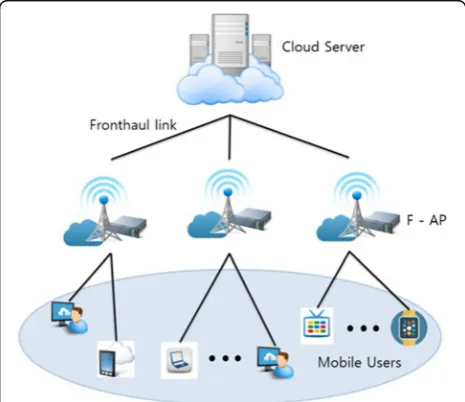
directly to the centralized CS, some local traffic should be delivered from the caching located in F-APs. Therefore, each F-AP integrates not only the front radio spectrum but also the locally distributed cached contents and computation capacity. This ap-proach can save the spectral usage of constrained fronthauls while decreasing the transmission delay. In conclusion, the main characteristics of F-RAN in-clude ubiquity, decentralized management, and co-operation [2,18]. The general architecture of a F-RAN system is shown in Fig.1.
During the F-RAN system operations, system agents, i.e., CS, F-APs, MUs, should make decisions indi-vidually by considering the mutual-interaction rela-tionship. Under the dynamic F-RAN environments, system agents try to maximize their own profits in a competitive or cooperative manner. In this study, we develop a new game model, called embedded game, for the F-RAN system. According to the decision making method, the embedded game procedure can be divided two phases. At the first phase, the CS and F-APs play a superordinated game; the CS distribute the available spectrum resource to each F-AP by using a cooperative manner. At the second phase, F-APs and MUs play subordinated games. By employ-ing a non-cooperative manner, an individual F-AP selectively admits its corresponding MUs to provide different application services. Taken as a whole, mul-tiple subordinated games are nested in the superor-dinated game.
Formally, we define the embedded game modelG
¼ Gsuper;Gsub i;1≤i≤n
n o
whereGsuper is a
superordinated game to formulate interactions between CS and F-APs, andGsubi is a subordinated
game to formulate interactions between theith F-AP and its corresponding MUs. Firstly, theGsupercan be defined asGsuper¼ N;RCS;SRCS;Ui;1≤i≤n;T
at each time periodtof gameplay.
Nis the finite set ofGsuper game playersN
¼fCS;FAP1;FAP2…FAPngwhere the
totaln+ 1 number ofGsuper players; one CS and
nF-APs.
The total spectrum resources of CS isℛCS, which
would be distributed tonF-APs.
Sℛ
CS = {δ1, δ2,…. δn} is the sets of CS’s
strategies for the spectrum resource allocation.
δt in SℛCS is the allocated spectrum amount for
the F‐ APt,1 ≤ i ≤ n.
TheUt, 1≤i≤nis the payoff received by the F‐
APt. It is estimated as the obtained outcome
minus the cost from the spectrum resource allocation.
TheT is a time period. The Gsuper is repeated
t∈ T<∞ time periods with imperfect information.
Secondly, theGsubi is theith subordinated game, and it can be defined asGsubi ¼
time periodtof gameplay.
Miis the finite set ofGsubi game playersMi= {F‐
APi,MUi1,…,MUim} whereMUij;1≤j≤mis thejth
MU in the area covered by the F‐APi.
The set of F‐APi’s resources isℜi= {δi,Ci,σi}
whereδi,Ci,σiare the allocated spectrum
resource, the computation capacity, and the placed cache files in the F‐APi, respectively.
Sδi strategies for the spectrum allocation for MUs, the computation capacity assignment for MUs, and cache placement in the F‐APi, respectively.
The Uij;1≤j≤m is the MUij’s payoff received by the F ‐ APi.
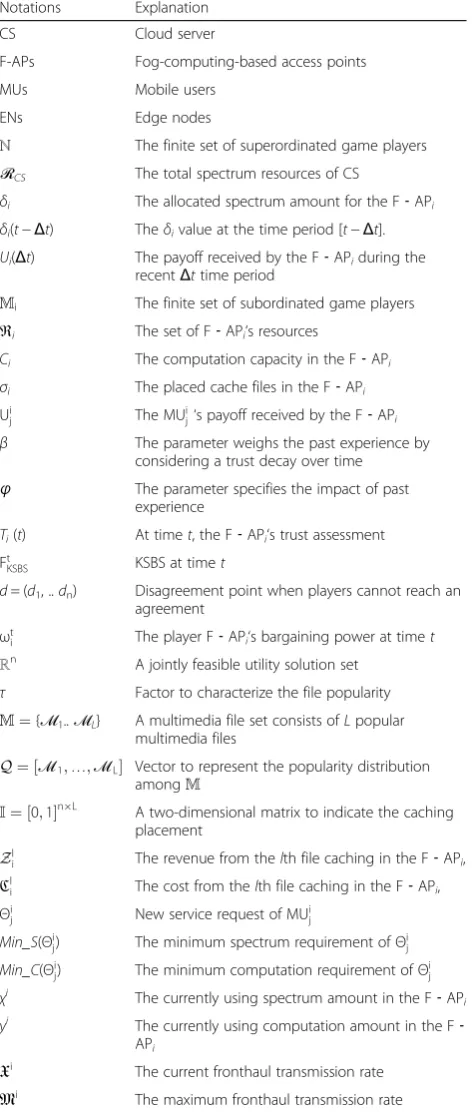
TheTis a time period. TheGsubi is repeatedt∈ T<∞time periods with imperfect information. Table1lists the notations used in this paper. B. Solution concept for the superordinated game
In the superordinated game, game players are CS and F-APs, and they are rational to reach a win-win situation. In many situations, each ra-tional agent is able to improve its objectives without preventing others from improving their objectives. Therefore, they are more prone to coordinate and willing to play cooperative games [19]. Usually, solution concepts are different in different games. For the CS and F-AP interac-tions, the Kalai and Smorodinsky Bargaining So-lution (KSBS) is an interesting solution concept. Like as the well-known Nash Bargaining
Solution (NBS), the KSBS also provides a fair and optimal solution in a cooperative manner. In addition, the KSBS can be used when the
feasible payoff set is not convex. It is the main advantage of KSBS over the NBS. Due to this appealing property, the KSBS approach has been practically implemented to solve real-world problems [8].
In order to show the effectiveness of the KSBS, it is necessary to evaluate each player’s
credibility. In this paper, we obtain the KSBS based on the F-APs’ trustworthiness. This infor-mation can be inferred implicitly from the F-APs’ outcome records. Therefore, we can en-hance the effectiveness of KSBS while restricting the socially uncooperative F-APs. At time t, the F ‐ APi’s trust assessment ðTið ÞtÞ for the spectrum allocation process is denoted by
Tið Þ ¼t fð1−βÞ Tiðt−ΔtÞg
parameterβ is used to weigh the past experience by considering a trust decay over time. In
addition, we introduce another parameter to
specify the impact of past experience on
Tiðt−ΔtÞ. Essentially, the contribution of current information increases proportionally as
increases. In this case, we can effectively adapt to the currently changing conditions while improving resiliency against credibility
fluctuations [20]. In Eq. 1, the first term means theTi value of the previous time period, and the second term represents the change ratio ofδi to
Ui at the current time period. In the point view
of CS, Tið Þt is a weighted average of these two terms.
Under the dynamic F-RAN environment, we as-sume that F-APs request individually their spectrum resources to the CS at each time period. To adaptively respond to the current F-RAN system conditions, the sequential KSBS bargaining approach gets the different KSBS at each time period. It can adapt the timely dy-namic F-RAN situations. At time t, the timed Table 1Parameters used in the proposed algorithm
Notations Explanation
CS Cloud server
F-APs Fog-computing-based access points
MUs Mobile users
ENs Edge nodes
ℕ The finite set of superordinated game players
ℛCS The total spectrum resources of CS
δi The allocated spectrum amount for the F‐APi
δi(t−Δt) Theδivalue at the time period [t−Δt]. Ui(Δt) The payoff received by the F‐APiduring the
recentΔttime period
Mi The finite set of subordinated game players
ℜi The set of F‐APi‘s resources
Ci The computation capacity in the F‐APi
σi The placed cache files in the F‐APi
Ui
j The MUij‘s payoff received by the F‐APi
β The parameter weighs the past experience by
considering a trust decay over time
ϕ The parameter specifies the impact of past
experience
Ti(t) At timet, the F‐APi‘s trust assessment
Ft
KSBS KSBS at timet
d= (d1, ..dn) Disagreement point when players cannot reach an
agreement ωt
i The player F‐APi‘s bargaining power at timet ℝn
A jointly feasible utility solution set
τ Factor to characterize the file popularity
M¼{ℳ1..ℳL} A multimedia file set consists ofLpopular
j New service request of MUij
Min_S(Θi
j) The minimum spectrum requirement ofΘij Min_C(Θi
j) The minimum computation requirement ofΘij
χi The currently using spectrum amount in the F‐AP
i
yi The currently using computation amount in the F‐
APi
Xi The current fronthaul transmission rate
KSBS (FtKSBS) for the spectrum resource problem is mathematically defined as;
whereUt
iðδið ÞtÞis the F‐APi’s payoff with the
strategyδiduring the recent time period (Δt).ℝnis a jointly feasible utility solution set, and a
disagreement point (d) is an action vectord= (d1, ..
dn)∈ℝnthat is expected to be the result if players,
i.e., F-APs, cannot reach an agreement (i.e., zero in
the system).ωt
i(0 <ωti < 1) is the player F‐APi’s
bargaining power at timet, which is the relative abil-ity to exert influence over other players.Oti is the ideal point of player F‐APiat timet. Therefore,
players choose the best outcome subject to the con-dition that their proportional part of the excess over the disagreement is relative to the proportion of the excess of their ideal gains. Geometrically, theFtKSBS
Sℛcs is the intersection point between the bargain-ing setSℛcs and the line, which is drawn from the dis-agreement point (d) to the best utilities, i.e., the ideal gains, of players. Simply, we can think that the KSBS is the maximal point which maintains the ra-tios of gains [21]. Therefore,FtKSBS Sℛcs = {δ1(t),
} is a joint strategy, which is taken by the CS at timet.
In non-deterministic settings,FtKSBS Sℛcs is a selec-tion funcselec-tion to define a specific spectrum allocaselec-tion strategy for every F-APs. Due to the main feature of KSBS, the increasing of bargaining set size in a dir-ection favorable to a specific F-AP always benefits that F-AP. Therefore, in our superordinated game, self-interested AP can be satisfied during the F-RAN system operations. To practically obtain the
Ft
KSBS Sℛcs in Eq.2, we can re-think the KSBS as a weighted max-min solution like as
Ft
C. Solution concept for the subordinated games
Edge processing is a key emerging trend in the F-RAN system. It refers to the localization of comput-ing, communication, and storage resources at the F-APs. In the F-RAN architecture, F-APs are con-nected to the CS through fronthaul links. Under this centralized structure, the performance of F-RANs is clearly constrained by the fronthaul link capacity; it incurs a high burden on fronthaul links. Therefore, a prerequisite requirement for the centralized CS pro-cessing is the high bandwidth and low latency fronthaul interconnections. However, during the op-eration of F-RAN system, unexpected growth of ser-vice requests may create a traffic congestion. It has a significant impact on the F-RAN performance. To overcome the disadvantages of F-RAN architecture imposed by the fronthaul constraints, new tech-niques have been introduced with the aim of redu-cing the delivery latency by limiting the need to communicate between the CS and MUs [6]. Currently, there are evidences that MUs’
downloading of on-demand multimedia data is the major reason for the data avalanche over F-RAN; numerous repetitive requests on the same data lead to redundant transmissions. Usually, multimedia data are located in the CS and far away from MUs. To ensure an excellent QoS provisioning, an efficient solution is to locally store these frequently accessed data into the cache memory of F-APs while reducing the transmission latency; it is known as caching. This approach can effectively mitigate the unnecessary fronthaul overhead caused by MUs’repetitive service requests. Therefore, CS, F-APs and MUs are all the beneficiaries from the local caching mechanism [22]. In the subordinated game, an efficient caching mechanism is designed by carefully considering the relations and interactions among CS, F-APs and MUs. This approach can relive the heavy traffic load at fronthaul links, and also decrease the request la-tency; it results in better QoS [6]. A practical cach-ing mechanism is coupled with the data placement. In our F-RAN architecture, we assume that a multi-media file setM= {ℳ1,…,ℳL} consists ofL
popu-lar multimedia files in the CS, and files inMcan be
possibly cached in each F-AP. The popularity
distribution amongMis represented by a vectorQ = [g1,…,gL]. Generally, the vectorQcan be modeled
by a Zipf distribution [22];
gl¼
where theτfactor characterizes the file popularity. In this study, we assume that MUs in each F-AP area request independently thelth fileℳl,1≤l≤L.
Therefore, theτvalue is different for each F-AP.
Ac-cording to (4),ℳ1(orℳL) has the highest (orlowest)
popularity. The CS intends to rent a
frequency-accessing fraction ofMfor caching to maximize the
F-RAN system performance. In this study, we can denote the caching placement strategy as a two-dimensional matrixI¼½0;1nLconsisting of binary entries where 1 is indicating the caching placement in a F-AP, and 0 is not.Iis defined as
mechanism can be defined as follows;
ℜc
total number of service requests on average.Zliand
ℭl
iis the revenue and cost from thelth file caching in the F‐APi, respectively. From the viewpoint of F
‐APi, the fraction [I1i…ILi] ofI(Qi) needs to be
optimized for maximizing theℜci.
Based on the current caching placement, Service Admission Control (SAC) algorithm should be developed to make admission decisions to maximize the spectrum efficiency while maintaining a
desirable overhead level. Especially, when the requested services are heavy, that is, the sum of the requested resource amount exceeds the currently available system capacity, the SAC algorithm comes into act whether to accept a new service request or not. Based on the acceptance condition, such as the current caching status and resource capacity, the SAC problem can be formulated as a joint
optimization problem. In this problem, we take into account the maximization of spectrum efficiency while minimizing the fronthaul overhead.
In the proposed scheme, we set out to obtain fundamental insights into the SAC problem by means of a game theoretic approach. Therefore, the subordinated game is designed to formulate the interactions of the F-AP and MUs while investigat-ing the system dynamics with imperfect information. To implement our subordinated game, we adopt the concept of dictator game, which is a game in experi-mental economics, similar to the ultimatum game, first developed by D. Kahneman et al. [23]. In the dictator game, one player, calledthe proposer, dis-tributes his resource, and the other players, called
the responders, simply accept the decision, which is made bythe proposer. As one of decision theory, the dictator game is treated as an exceptional non-cooperative game or a multi-agent system game that has a partner-feature and involves a trade-off be-tween self- and other-utility. Based on its simplicity, the dictator game can capture an essential character-istic of the repeated interaction situation [8].
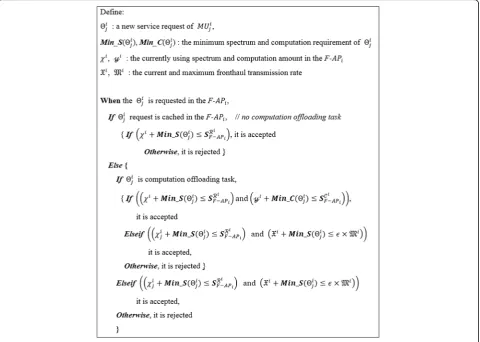
In the proposed subordinated game model, each F-AP isthe proposerand MUs arethe responders. They interact with each other and repeatedly work to-gether toward an appropriate F-RAN performance. To effectively make SAC decisions,the proposer con-siders the current system conditions such as the available spectrum amount, the current caching placement and fronthaul overhead status. By a so-phisticated combination of these conflicting condi-tion factors,the proposerattempts to approximate a temporary optimal SAC decision. The SAC decision procedure is shown in Fig.2.
According to the SAC procedure, each F‐APican
maintain the finest SAC solution while avoiding the heavy computational complexity or overheads. For the subordinated game, we propose a new solution concept,Temporal Equilibrium(TE). In the proposed scheme, all MUs follow compulsorily the decision of F-APs, and the outcome profile of our SAC process constitutes theTE, which is the current service status. APi, respectively. Therefore,TEis the status quo of
dictator game.
For 5G wireless communications, the F-RAN archi-tecture is a promising paradigm to provide high spectrum efficiency and improved QoS. The core idea of F-RAN is to take full advantages of distributed edge processing, cooperative spectrum allocation, and reduced communication latency [24–26]. However, it is questionable whether existing F-RAN control schemes are adequate in dynamically changing F-RAN environments. In this study, we have studied the joint design of spectrum allocation and SAC deci-sion in an F-RAN architecture. Focusing on the prac-tical assumption, we develop a new embedded game model while investigating the benefits and challenges of F-RAN control mechanisms. In our embedded game approach, the superordinated game for spectrum allocations and the subordinated game for SAC decisions are interlocked and serially correlated. The subordinated game depends on the outcome of the superordinated game, and the result of subordi-nated games is the input back to the superordisubordi-nated game process. Structurally, the multiple subordinated games are nested in the superordinated game, and
they are linked based on the step-by-step interactive feedback process. It may be the only realistic ap-proach to solve complex and dynamically changing F-RAN control problems. Usually, the traditional op-timal and centric algorithms have exponential time complexity. However, the proposed distributed con-trol method has only polynomial time complexity. The main steps of the proposed F-RAN control algo-rithm are given next (see Fig.3).
Step 1: At the initial time, the spectrum resource allocationSℛcs = {δ1,δ2,….δn} and trustworthiness
(T) for F-APs are equally distributed. This starting guess guarantees that each F-AP enjoys the same benefit at the beginning of the game.
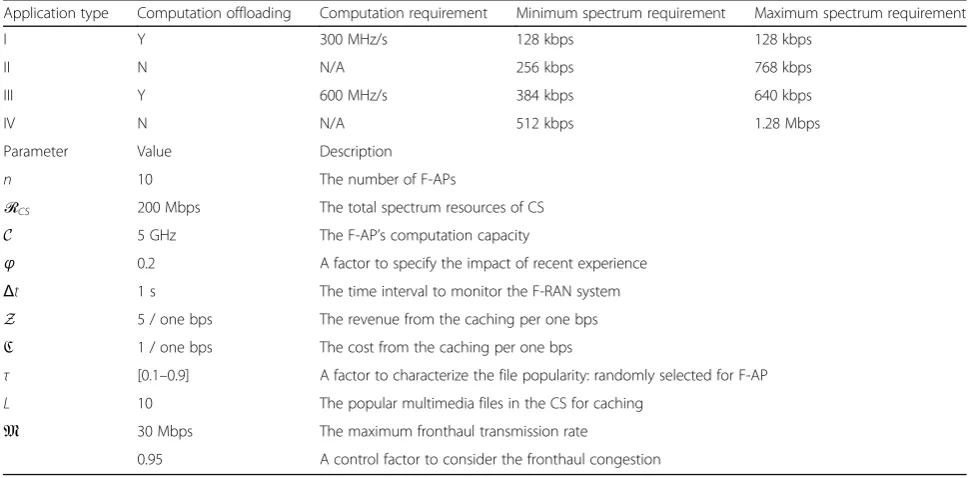
Step 2: Control parameters are given from the simulation scenario (refer to Table2). To fairly compare with the existing schemes, the system parameters are carefully selected in our simulation model.
Step 3: By taking into account the current F-RAN situations, our superordinated and subordinated games are executed in parallel.
Fig. 3The flowchart of proposed F-RAN control algorithm
Table 2System parameters used in the simulation experiments
Application type Computation offloading Computation requirement Minimum spectrum requirement Maximum spectrum requirement
I Y 300 MHz/s 128 kbps 128 kbps
II N N/A 256 kbps 768 kbps
III Y 600 MHz/s 384 kbps 640 kbps
IV N N/A 512 kbps 1.28 Mbps
Parameter Value Description
n 10 The number of F-APs
ℛCS 200 Mbps The total spectrum resources of CS
C 5 GHz The F-AP’s computation capacity
ϕ 0.2 A factor to specify the impact of recent experience
Δt 1 s The time interval to monitor the F-RAN system
Z 5 / one bps The revenue from the caching per one bps
ℭ 1 / one bps The cost from the caching per one bps
τ [0.1–0.9] A factor to characterize the file popularity: randomly selected for F-AP
L 10 The popular multimedia files in the CS for caching
M 30 Mbps The maximum fronthaul transmission rate
Step 4: The trustworthiness (T) for each F-AP is modified periodically by using (1).
Step 5: At each superordinated game period,Sℛcs = {δ1,δ2,….δn} is dynamically adjusted according to
the timed KSBS manner. According to (2), the
Ft
KSBS Sℛcs is obtained, and eachδvalue is decided for the next game period.
Step 5: At each subordinated game period, the caching placement in each F-AP occurs while maximizing theℜcaccording to Eqs.4,5and6. Step 7: In a distributed manner, each F-AP makes
MUs’admission decisions based on the service ad-mission procedure of Fig.2, and theTEis obtained using (7).
Step 8: The superordinated and subordinated games are interlocked and serially correlated. Based on the assignedδvalue, each F-AP performs its sub-ordinated game, and the result of each subordi-nated game is the input back to the
superordinated game.
Step 9: Based on the interactive feedback mechanism, the dynamics of embedded game can cause cascade interactions of game players and players can make their decisions to quickly find the most profitable solution.
Step 10: Under widely diverse F-RAN environments, the CS and F-APs are self-monitoring constantly for the next embedded game process; proceed to step 3.
4 Performance evaluation
In this section, we compare the performance of our F-RAN control scheme with other existing schemes [3, 6, 17] and can confirm the performance superiority of the proposed approach by using a simulation model. To fairly compare the system performance, the assumptions and detailed sys-tem scenario are outlined as follows.
The simulated system consists of one CS, 10 F-APs and multiple MUs. The number of MUs (m) for each F-AP is generated based on the process for new service requests.
The process for new service requests is Poisson with rateλ(services/s), and the range of offered service load was varied from 0 to 3.
There are four different service applications. They are randomly generated from MUs, and some of them are computation offloading tasks.
The durations of service applications are exponentially distributed.
The total spectrum resources of CS (ℛCS) is 200
Mbps.
For each F-AP, the computation capacity (C) is 5 GHz, and the fronthaul link capacity is 30 Mbps.
The cache size in each F-AP is the same as the file setMin the CS.
System performance measures obtained on the basis of 100 simulation runs are plotted as functions of the service generation rate.
For simplicity, we assume the absence of physical obstacles in the experiments.
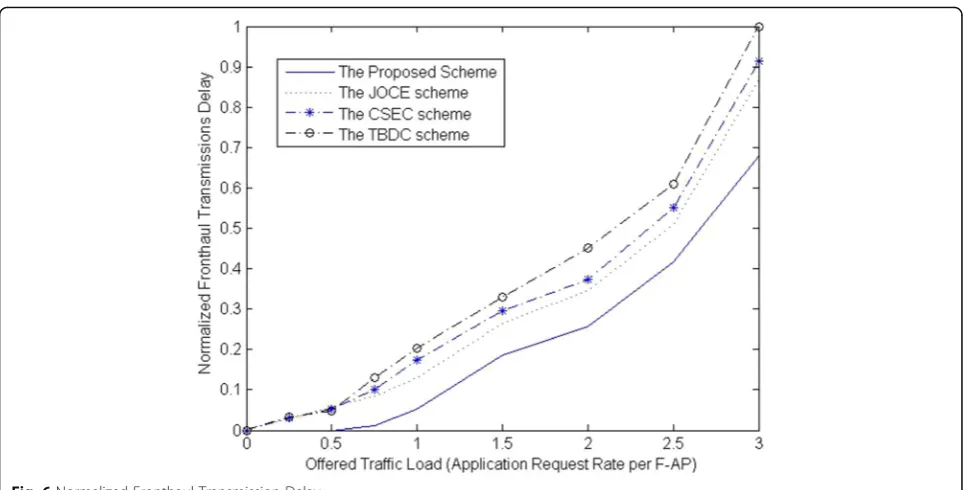
Performance measures obtained through simulation are the normalized F-RAN throughput, spectrum effi-ciency, and fronthaul transmission delay. To facilitate the development and implementation of our simulator, Table 2 lists the system control parameters.
Figure 4 shows the performance comparison of each scheme in terms of the normalized system throughput. It is estimated as the total data transmission in the F-RAN system. From the viewpoint of system operator, it is a key factor in the F-RAN management. It can be seen from Fig. 4 that the throughput of all the schemes in-creases as the service request rate inin-creases, and we can confirm the performance superiority of our scheme. The proposed scheme’s gain on performance can be obtained through (i) the effective coordination paradigm by employing an embedded game model, and (ii) the jointed design of spectrum allocation and SAC decision algorithms to obtain synergistic and complementary fea-tures. Therefore, our scheme can get a better perform-ance than other existing schemes, which were designed as one-sided protocols and did not consider the feasibil-ity to respond the current F-RAN system conditions.
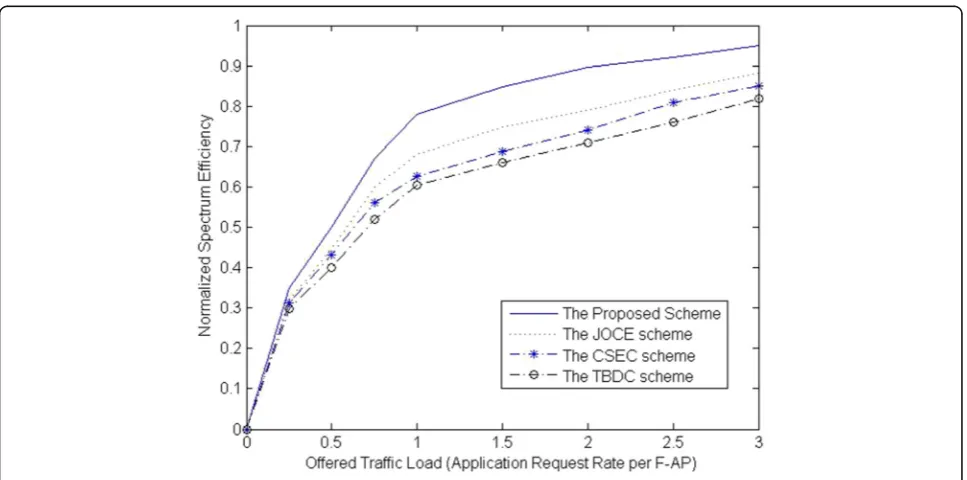
In Fig. 5, we plot the spectrum efficiency. It means a bandwidth usage ratio of F-RAN system. In general, as the service request rate increases, the spectrum effi-ciency also increases. This is intuitively correct. In our embedded game approach, all system agents adaptively interact with each other and decide their strategy based on the current F-RAN system conditions. Therefore, we allocate the spectrum resource based on the timed KSBS approach, and can maintain a higher spectrum effi-ciency. Figure 5 clearly indicates that the proposed scheme can effectively handle the resource allocation problem than the existing schemes in [3, 6, 17] from low to heavy service load distributions.
and verify that the proposed embedded game approach can strike the appropriate performance balance between system throughput, spectrum efficiency, and transmis-sion delay; the Joint Optimization of Cloud and Edge
(JOCE) scheme [3], theCloud Structure with Edge Cach-ing (CSEC) scheme [6], and the Traffic Balancing and Dynamic Clustering (TBDC) scheme [17] cannot offer such an attractive performance balance.
5 Conclusions
As a promising paradigm for the 5G communication system, the F-RAN has been proposed as an advanced socially aware wireless networking architecture to provide the higher spectral efficiency while maximiz-ing the system performance. In this study, we have studied joint design of cloud and edge processing in the F-RAN system to solve the resource allocation
and SAC problems. Based on the newly developed embedded game model, we have explored the feasibil-ity of F-RAN control decision process and the practi-cality for the real-world implementation. In our embedded game structure, the SAC algorithm is nested in the spectrum allocation algorithm to effect-ively control the conflict problem of F-RAN system agents. Based on the interactive feedback mechanism, the proposed scheme has the potential to handle mul-tiple targets without using more complex multi-target tracking algorithm. The extensive simulation result is very encouraging, showing that our embedded game-based approach provides a more effective way to con-trol the F-RAN system than the other existing schemes. Open issues for the further research are the designs and validations of the original F-RAN systems for big data mining, cognitive radio, software-defined network, and network security problems. The pro-gress of trial tests and test bed development of F-RANs can be anticipated to be promoted in the fu-ture, which makes F-RANs’ commercial rollout as early as possible.
Acknowledgements
This research was supported by the MSIP (Ministry of Science, ICT and Future Planning), Korea, under the ITRC (Information Technology Research Center) support program (IITP-2017-2014-0-00636) supervised by the IITP (Institute for Information & communications Technology Promotion), and was supported by Basic Science Research Program through the National Research Foundation of Korea (NRF) funded by the Ministry of Education (NRF-2015R1D1A1A01060835)
Author’s contribution
SK: is a sole author of this work and ES (i.e., participated in the design of the study and performed the statistical analysis).
Competing interests
The author, Sungwook Kim, declares that there is no competing interests regarding the publication of this paper.
6 Publisher’s Note
Springer Nature remains neutral with regard to jurisdictional claims in published maps and institutional affiliations.
Received: 28 January 2017 Accepted: 7 June 2017
References
1. S-C Hung, H Hsu, S-Y Lien, K-C Chen, Architecture Harmonization Between Cloud Radio Access Networks and Fog Networks. IEEE Access3, 3019–3034 (2015)
2. R Tandon, O Simeone, Harnessing cloud and edge synergies: toward an information theory of fog radio access networks. IEEE Commun. Mag.54(8), 44–50 (2016)
3. S-H Park, O Simeone, S Shamai,Joint optimization of cloud and edge processing for fog radio access networks(IEEE ISIT, 2016), pp. 315–319 4. AV Dastjerdi, R Buyya, Fog Computing: Helping the Internet of Things
Realize Its Potential. Computer49(8), 112–116 (2016)
5. P Borylo, A Lason, J Rzasa, A Szymanski, A Jajszczyk,Energy-aware fog and cloud interplay supported by wide area software defined networking(IEEE ICC, 2016), pp. 1–7
6. R Tandon, O Simeone,Cloud-aided wireless networks with edge caching: Fundamental latency trade-offs in fog Radio Access Networks(IEEE ISIT, 2016), pp. 2029-2033
7. Z Hu, Z Zheng, T Wang, L Song, X Li, Game theoretic approaches for wireless proactive caching. IEEE Commun. Mag.54(8), 37–43 (2016) 8. S Kim,Game Theory Applications in Network Design(IGI Global, Hershey,
2014)
9. K Sundaresan, MY Arslan, S Singh, S Rangarajan, SV Krishnamurthy, FluidNet: A Flexible Cloud-Based Radio Access Network for Small Cells. IEEE/ACM Trans. Networking24(2), 915–928 (2016)
10. J Wu, Z Zhang, H Yu, Y Wen, Cloud radio access network (C-RAN): a primer. IEEE Netw.29(1), 35–41 (2015)
11. Q-T Vien, N Ogbonna, HX Nguyen, R Trestian, P Shah, inNon-Orthogonal Multiple Access for Wireless Downlink in Cloud Radio Access Networks, Proceedings of European Wireless (2015), pp. 1-6
12. Q-T Vien, TA Le, B Barn, CV Phan, Optimising energy efficiency of non-orthogonal multiple access for wireless backhaul in heterogeneous cloud radio access network. IET Commun.10(18), 2516–2524 (2016)
13. HQ Tran, PQ Truong, CV Phan, Q-T Vien,On the energy efficiency of NOMA for wireless backhaul in multi-tier heterogeneous CRAN(SigTelCom, 2017), pp. 229–234
14. M Peng, Y Li, J Jiang, J Li, C Wang, Heterogeneous cloud radio access networks: a new perspective for enhancing spectral and energy efficiencies. IEEE Wirel. Commun.21(6), 126–135 (2014)
15. A Sengupta, R Tandon, O Simeone,Fog-Aided Wireless Networks for Content Delivery: Fundamental Latency Trade-Offs, (2015) [Online]. Available: https:// arxiv.org/abs/1605.01690. Accessed 16 Apr 2017.
16. SM Azimi, O Simeone, A Sengupta, R Tandon,Online Edge Caching in Fog-Aided Wireless Network, (2017) [Online]. Available: https://arxiv.org/abs/1701. 06188. Accessed 16 Apr 2017.
17. D Chen, S Schedler, V Kuehn,Backhaul traffic balancing and dynamic content-centric clustering for the downlink of Fog Radio Access Network(IEEE SPAWC, 2016), pp. 1–5
18. M Peng, S Yan, K Zhang, C Wang, Fog-computing-based radio access networks: issues and challenges. IEEE Netw.30(4), 46–53 (2016) 19. H Qiao, J Rozenblit, inFerenc Szidarovszky and Lizhi Yang, Multi-Agent
Learning Model with Bargaining, Proceedings of the 2006 Winter Simulation Conference, pp. 934-940, 2006
20. F Bao, I-R Chen,Trust management for the internet of things and its application to service composition(IEEE WoWMoM, 2012), pp. 1–6 21. K Sungwook, News-vendor game-based resource allocation scheme for
next-generation C-RAN systems. EURASIP J. Wirel. Commun. Netw.2016(1), 1–11 (2016)
22. J Li, J Sun, Y Qian, F Shu, M Xiao, W Xiang, A Commercial Video-Caching System for Small-Cell Cellular Networks using Game Theory. IEEE Access4, 7519–7531 (2016)
23. D Kahneman, JL Knetsch, RH Thaler, Fairness and the assumptions of economics. J. Bus.59(4), 285–300 (1986)
24. W Zhu, C Lee, A New Approach to Web Data Mining Based on Cloud Computing. JCSE8(4), 181–186 (2014)
25. Y Liu, Y Sun, J Ryoo, S Rizvi, AV Vasilakos, A Survey of Security and Privacy Challenges in Cloud Computing: Solutions and Future Directions. JCSE9(3), 119–133 (2015)