IN A SIMPLE INTEGER ITERATION
DEAN CLARKReceived 28 May 2005; Accepted 19 July 2005
We prove that all solutions to the nonlinear second-order difference equation in integers yn+1= ayn −yn−1,{a∈R:|a|<2,a=0,±1},y0,y1∈Z, are periodic. The first-order
system representation of this equation is shown to have self-similar and chaotic solutions in the integer plane.
Copyright © 2006 Dean Clark. This is an open access article distributed under the Cre-ative Commons Attribution License, which permits unrestricted use, distribution, and reproduction in any medium, provided the original work is properly cited.
1. Introduction
We study the nonlinear second-order difference equation in integers
yn+1=
ayn−yn−1,
a∈R:|a|<2,a=0,±1, y0,y1∈Z, (1.1)
where x denotes the smallest integer not smaller thanx (the ceiling function). The reader is already familiar with the linear casesa=0,±1, therefore we do not consider these values in this paper. Besides the natural generalization to discrete space, there are at least three reasons why (1.1) is interesting.
First, whena=3/2, (1.1) becomes
a second-order variant of the notorious “3x+ 1 iteration.” So far as we know, the ultimate convergence to 1 of the 3x+ 1 iterates remains an unproven conjecture. In contrast, we will prove an ultimate recurrence property for (1.1) for all initial states y0,y1∈Zand
parameter values−2< a <2. It is the initial state that is always recurrent. Moreover, so-lutions to (1.1) can exhibit periods of arbitrary length (Theorems2.2,3.2, below).
Hindawi Publishing Corporation Advances in Difference Equations Volume 2006, Article ID 35847, Pages1–9
Second, the method used to establish the periodicity of all solutions to (1.1) seems novel, elegant, and of potentially wider applicability. Without this method, we could not prove that solutions of the special case (1.2), above, were even bounded [1].
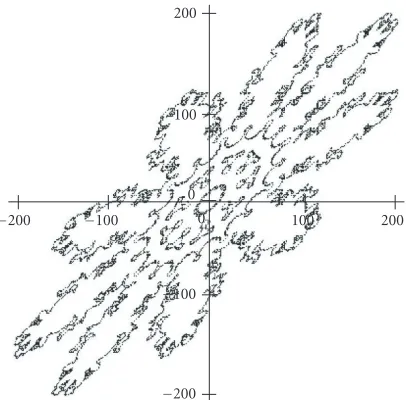
Third, (1.1) is converted to a first-order system in two variables using the mapping T(x,y)=(y,ay −x). The simplicity of T gives no hint of the startling complexity shown by scatter plots of some of the solutions. See Figures4.1–4.4, below.
2. Qualitative behavior of solutions
Henceforth, all pairs (x,y) denote points in the integer planeZ2, and the real parameter
asatisfies|a|<2. We obtain the aforementioned first-order system by letting
T(x,y)=y,ay −x, Xn=xn,yn=Tnx0,y0, n=0, 1, 2,.... (2.1)
Remark 2.1. The sequence (yn) appearing as the second coordinate in each term of (Xn) is the same sequence generated by (1.1) whenx0= ay0 −y1.
A first glimpse of the rotational motion of solutions is obtained from the powers of A=(0 1
−1a), the matrix underlyingTwithout the ceiling function. Because|a|<2,Ahas
complex eigenvalues. After diagonalizingA, we have
An=
The significance ofθfor the nonlinear equation (1.1) will become apparent later. The identityx2+y2−axy=y2+ (ay−x)2−ay(ay−x) supplies a family ofinvariant
function is inactive. The first oddynrequiring use of the ceiling isy5=33, and we expect
thatT(10, 33)=(33, 7) does not lie on this ellipse. Indeed, it does not: 332+ 72−1/2·
33·7=1022.5.
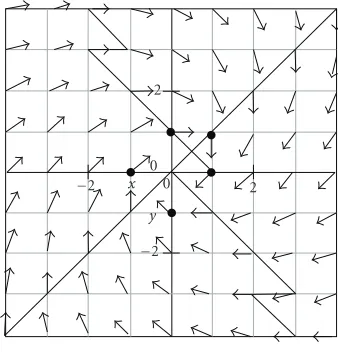
The clockwise motion inZ2of the iterates ofT is further clarified by the vector field
drawn inFigure 2.2witha=1/3. Each directed segment at (x,y) has the formT(x,y)−
X3
X2 −20
x y
0 0
−20 20
X4
20
X0 X5
X1
Figure 2.1. a=1/2,X0=(0, 32).
−2 0 0
−2 2
2
x y
Figure 2.2. a=1/3,X0=(1, 0).
Theorem2.2. For nonzero rationala=p/qwhere pandqhave no common factors, the number of distinct terms of a solution(yn)can be made arbitrarily large depending on the initial conditions.
positivem. As before,Adenotes the matrix underlying the linear system. By induction, in fnis always 1. Repeated application ofAto the initial vector (0,qm) gives the general form of the firstm+ 1 iterates: yn= fnqm−n. These are all distinct because the highest power ofqthat divides each one is different. In contrast, the following example shows that whenaisirrational, it does not follow that there are arbitrarily many distinct iterates simply because an initial condition is ar-bitrarily large (however, seeFigure 4.1below).
Example 2.3. Leta=(√5−1)/2=0.6180339..., that is, θ=2π/5 in (2.2), above. Let
The curious relation between y2 and y3 should be noted: sometimes y3= −y2 and
sometimesy3= −y2−1. It is easy to see thaty2= 10na , wherex denotes the greatest
integer not greater thanx. With a little more work, using the fact thata2+a−1=0, we
can prove thaty3= −y2if and only if 1−a <10na −10na; otherwise,y3= −y2−1.
3. Periodicity of solutions
Aninvolutionis a mapV such that the square ofVis the identity, that is,V2=V·V=I
MultiplyingVT=SV on the left and right byV yieldsTV=VS, which is used to prove thatVTVT=VVST=I. Thus,VTis an involution and similarly so areVS,TV,
andSV.
We call a solution of (1.1)invariant under V if the point setO= {Xn∈Z2:Xn= Tn(X
0), n=0, 1, 2,...}satisfiesV(O)=O. Geometrically, forV(x,y)=(y,x), this means
that the plot of iterates is symmetric about the 45◦line, for example, seeFigure 2.2, above. Forrational a, numerical experiments have shown that this invariance is so prevalent, we conjecture it occurs with probability 1. See the corollary toTheorem 3.2, below. For solutions invariant underV, the lemma establishes periodicity at once:
X0=TVTV
The general periodicity result follows, withFigure 3.1, below, providing concrete support to the proof.
inition, (Xn) and (Yk) are in one-to-one correspondence by way of reflection across the 45◦line. Thus, (Xn) is periodic. In particular, (3.3) impliesY0=V(X0)=V(Xn+k); hence, X0=Xn+k. In accordance withRemark 2.1, all solutions to (1.1) are periodic.
InFigure 3.1the points of (Xn)
(2,−3), (−3,−6), (−6,−5), (−5,−1), (−1, 4), (4, 7), (7, 6), (6, 2), (2,−3) (3.4)
are denoted by black circles. The points of (Yk), which are read from right to left in (3.4) withV applied to each pair, are denoted by open circles inFigure 3.1. The following corollary deals with the special case where the initial pair lies on the 45◦line.
X2
Y6 X1
Y5 −5 Y7
X3
X0
Y4 0
0 Y0
X4 5
Y1
X5 Y2
X6
Y3
X7
Figure 3.1. The subscripts ofXnand its image underValways sum to 8.
−60 −40 −20 0 20 40 60
−60
−40
−20 0 20 40 60
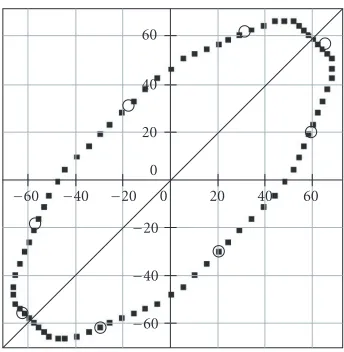
Figure 3.2. X0=(20,−30),a=7/5=1.4 (black squares);a= √
2 (open circles).
Proof. Solutions are periodic byTheorem 3.2. Suppose that, for a givenaandX0=(y0,
y0), the resulting solution has smallest periodN, so thatX0=XN. SinceV(X)=Xon the
45◦line, the lemma yields
X1=T
X0
=TVX0
=VSXN=VXN−1
−100 0 100
0
−100 100
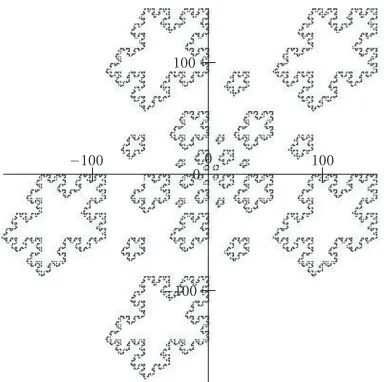
Figure 4.1. a=(√5−1)/2,θ=2π/5.
Next,
X2=TX1=TVXN−1=VSXN−1=VXN−2. (3.6)
Continuing in this way,Xk=V(XN−k) fork=0, 1, 2,...,N.
By re-indexing, it is clear that if any iterate touches the 45◦ line, the entire trajectory becomes symmetric about this line. Perhaps this explains why there are so many invariant solutions whenais rational. The rotation angleθ=arccos(a/2) ((2.2), above) is never a rational multiple ofπfor nontrivial rational a, that is,a=0,±1 [3], indicating a large number of iterations relative to the size ofX0. The more densely packed with points a
trajectory is, the greater the likelihood that one of them is located on the 45◦line. In any event, the small-period non-invariant solution with rationala=7/5 shown inFigure 3.1, above, was found by observing that 7/5=1.4 is a fair approximation of√2=2 cos(2π/8) for a small initial point; hence, the period-8 solution (3.4). Predictably, with the same a=7/5 and largerX0=(20,−30), we get the period-79,V-invariant solution shown in Figure 3.2. In this solution, indicated by the dark squares,X59=(60, 60). By the corollary,
above, the entire orbit must line up with itself when reflected about the 45◦line. Main-tainingX0=(20,−30) and changingato
√
2 gives back a period-8 non-invariant solution shown by the open circles inFigure 3.2.
4. Self-similarity and chaos
−
−100 0 100
0
−100 100
Figure 4.2. a=(1−√5)/2,θ=3π/5.
−200 −100 0 100 200
−200 −100 0 100 200
Figure 4.3. a=2 cos(2π/7),θ=2π/7.
−200 −100 0 100 200
−200 −100
0
100 200
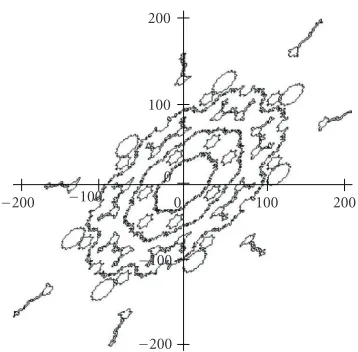
Figure 4.4. a=2 cos(2π/9),θ=2π/9.
bio-reproductive shapes inFigure 4.3as we zoom out. Evidently, only the distance from the origin of a properly chosen initial pair limits the complexity of these images.
References
[1] D. Clark and J. T. Lewis, Symmetric solutions to a Collatz-like system of difference equations, Congr. Numer.131(1998), 101–114.
[2] G. James and R. C. James,Mathematics Dictionary, 4th ed., Van Nostrand Reinhold, New York, 1976.
[3] I. Niven,Irrational Numbers, The Carus Mathematical Monographs, no. 11, The Mathematical Association of America. Distributed by John Wiley & Sons, New York, 1956.