R E S E A R C H
Open Access
Evaluation of topological planarity and reliability
for interference reduction in radio sensor
networks
Kamil Staniec
*and Grzegorz Debita
Abstract
One of the key factors in distributed sensor networks is their reliability in packets delivery even in the event of failure of one or a few nodes. Another factor–often underestimated–is the intra-network interference experienced by individual nodes from other transmitting counterparts. Common network spanning algorithms, however, neither posses the reliability feature nor keep the interference at minimum. It can be demonstrated that by enforcing a planar network topology combined with the requirement of minimum-pathloss between connections, one can achieve a gain in signal-to-noise and interference ratio (SNIR) by a few decibels with respect to standards spanning methods. The use of directional antennas and controlled duty cycle improves the situation even further–by carefully controlling the beamwidth, one may adjust the SNIR to a desired level at a high range of dynamics.
Keywords:sensor network, SNIR, ZigBee, directional antennas, duty cycle, radio interference
1. Introduction
A wireless sensor network (WSN) begins with an unor-ganized deployment of physical sensors connected to transmit/receive modules. Such a system of sensors can only be discussed in terms of a network if logical and physical connections have been established between these modules–a process called hence forth the network spanning. There are multiple spanning methods, of which two are particularly common, namely the ZigBee native method (or Minimum Spanning Tree, MST) and
Stojmenovič algorithm (or Local MST algorithms,
LMST), as described in [1-3]. The article provides a comparative analysis of these two methods with one which combines two features not encountered in the other algorithms, i.e., planarity and reliability (referred to from now on as a planar algorithm). The reliability should be an invaluable feature of sensor networks, par-ticularly in situations where the lives of humans or liv-ing stock are dependent of it, e.g., networks for early fire or flood prevention. It is therefore crucial to ensure uninterrupted network operation even upon failure of some of the network elements scattered across a given
area. However, current popular network spanning meth-ods are deficient as regards assurance of the network reliability (see [4-9]) and the topological planarity. The latter feature, particularly when combined with the use directional antenna, can greatly contribute to the mini-mization of the intra-network radio interference as will be demonstrated in the article.
The purpose of this article is therefore to present a quantitative analysis of the extent to which some improvements incorporated to the existing network spanning methods can enhance the distributed sensor network operation. These improvements are the planar network topology and reliability. All results presented here will refer to the performance of the ZigBee stan-dard based on IEEE 802.15.4 specification [10] operating in the 2.4 GHz ISM (Industrial, Scientific, Medical).
The organization of the article is as follows: Section 2 gives an introduction to standard network spanning methods (MST and LMST) and the reliable planar algo-rithm. Section 3 describes three basic parameters that will be investigated, i.e., signal-to-noise and interference ratio (SNIR), the antenna beamwidth, and duty cycle (DC). Section 4 serves as an introduction to the simula-tion environment used to generate results. Secsimula-tions 5-7 provide results of simulations indicating how some
* Correspondence: [email protected]
Institute of Telecommunications, Teleinformatics and Acoustics, Wroclaw University of Technology, Wroclaw, Poland
operational mesh network parameters react to changes in the parameters mentioned in Section 3. All outcomes are presented in a manner allowing to compare the net-work performance in LMST, MST, and the reliable pla-nar algorithm.
2. Some remarks on the topological planarity and network reliability in WSN
For the modeling of mesh systems the authors used the-orems of the graph theory, one of which is the Gabriel’s graph (GG). It is constructed by appropriately triangu-lating the network nodes: for every pair of
intercon-nected nodes uand vseparated by a distanced (along
the edgel) no other nodes can exist within the circular
area of a diagonal llocated between uand v(more on
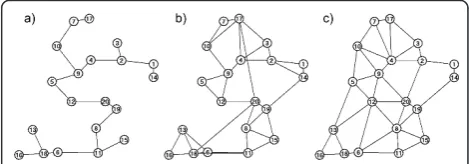
the subject can be found in [1]). An example of GG is depicted in Figure 1a where the circular area stretched between nodes nos. 1 and 2 must be free from the pre-sence of any other nodes (the same rule applies to all other pairs of connected nodes). Another important fea-ture of GG is its intrinsic topological planarity which–as will be demonstrated in later sections–is very advanta-geous for radio links with directional antennas. Also, in order to draw GG, either the nodes’locations or the dis-tances between them have to be known prior to making the graph of connections (links). As for the planarity feature, it is defined by Kuratowski theorem (see [7]) as follows:“a finite graph is planar if it does not contain a
sub-graph which is an extended graph of graph K5 (a
full graph of five vertices) or graph K3,3 (a dual full
graph of six vertices in which three vertices are con-nected with each of the remaining three)”(see Figure 2). An example of a network spanned with a classical form of GG is presented in Figure 1a. It is easy to notice that the structure does not satisfy the reliability theorem [6-8] which states (in a simplified version) that when each node has at least two neighbor nodes via which any other node in the network can be reached, such a network is regarded to be reliable. It is a vital feature to make the network survive single-node failures, whereas in Figure 1a the node no. 4 would be isolated from the rest of the network if node no. 1 failed. Clearly, this
situation could be aided by creating an additional back-up link (in this case from nodes 4 to 7–see Figure 1b) and thus providing redundancy in the network. This is the first modification incorporated to GG by the authors (details given in [9]). The second one consisted in for-cing the nodes interconnections to be set up only between the closest neighbor nodes (characterized by the smallest pathloss) rather than between those that first respond to the setup call (as is with ZigBee and
Stojmenovič algorithms). This modification protects
from establishing energy-costly links such as between nodes 17 and 20 in Figure 3b. Results of an example distributed sensor network consisting of 20 nodes and spanned with the ZigBee, Stojmenovič, and the reliable planar algorithm are shown for comparison in Figure 3.
Since it is assumed that nodes are located at some height over ground with no intervening obstacles between them, a simple (yet applicable to open-space areas) Two-Slope propagation model has been chosen (see [11] for details), given by Equation (1) wheredbrkis
defined as 4πh1h2/l, h1 andh2 denoting heights of the
transmit and receive antennas, respectively,lthe wave-length,fMHz frequency in MHz, anddbeing a distance
between both sensor antennas in km.
LdB=
32.45 + 20 logfMHz+ 20 logdkm d≤dbrk
20 log(h1h2/d2km) d>dbrk (1)
In the following sections, it will be shown quantita-tively that if the topological planarity condition is main-tained during the mesh networks design stage (taking as
Figure 1Examples of planar graphs organized with different spanning algorithms: (a) the original GG and (b) the modified (planar) GG.
Figure 2Auxiliary graphs in Kuratowski theorem: (a)K5and (b)
K3,3.
an example technology the IEEE 802.15.4, or ZigBee), a remarkably reduced intra-network radio interference level should be expected (apart from increased reliabil-ity) in comparison to standard LMST and MST methods.
3. Items of interference analysis: SNIR, directional ARP, and DC
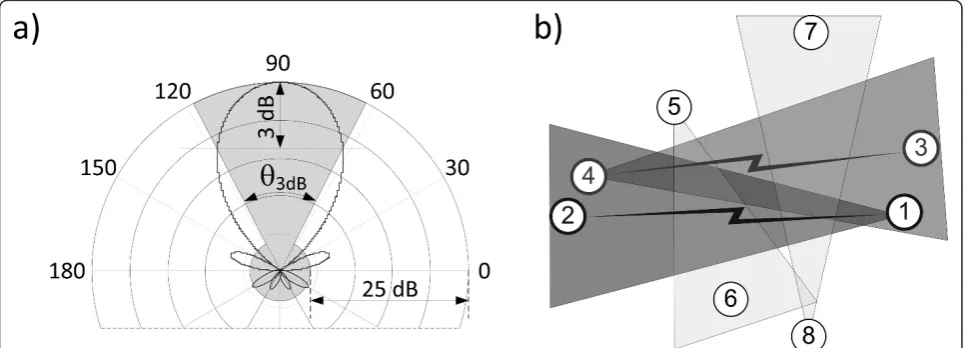
Interference in WSN occurs mainly because even if direct line-of-sight directions between communicating nodes are not interfered, radio modules in the nodes can still hear unwanted transmissions from other nodes, due to (most usually) omni-directional antennas installed on them. The use of radiators with directional Antenna Radiation Patterns (ARP), as shown in Figure 4a, could aid the situation by constraining emissions/ receptions in only specified directions thus making the desirable transmissions immune to foreign transmissions arriving from angles outside the beamwidth (marked as
θ3dBin Figure 4a). An example is provided in Figure 4b:
the communication session between nodes 1 and 2 is only affected by interference from nodes 3 to 4 trans-mission but is deaf to radio transtrans-mission between node pairs 7-8 and 5-6 by attenuating those signals lying out-side the main lobe. The topic of antenna directionality has been extensively addressed in literature (e.g., [12-19]) mostly from the point of view of the medium access control or energy-optimal routing strategies. In this article, in turn, it will be discussed in terms of its impact on the physical layer of the WSN, namely how it alleviates the intra-network radio interference. Lastly, it should be remembered that the application of direc-tional antennas requires some sort of adaptive antenna system to be installed on board each transmitting node. Every time a new packet is to be sent, a neighbor node
will randomly be selected out of the predefined set of least-pathloss nodes and the main lobe of transmitting antenna will switch its direction in order to concentrate its energy towards the selected neighbor (refer for more information on this issue to [20]).
The major metric for the intra-network radio
interfer-ence is the SNIR–a basic parameter for performance
evaluation in digital systems (in ZigBee operating at 2.4 GHz SNIR equals + 5 dB). For the kth node, it is given by Equation (2), where Sis the desired signal power in W, kBis the Boltzman’s constant in J/K,T is the
ambi-ent temperature in K, BW channel bandwidth in Hz, NF is the noise factor [-],Nis the total number of network nodes, whereas the last term in the denominator denotes the sum of radiations from all other nodes (In)
in the network (excluding, of course, the radiation from thekth node for which SNIR is being calculated and the lth node to which the nodekis transmitting, i.e.,Ikand
Il, respectively).
SNIRk|[dB]= 10 log ⎛ ⎜ ⎝N+ S
M/{k,l}Im ⎞ ⎟ ⎠= 10 log
⎛ ⎜
⎝k S
B·T·BW·NF +
M/{k,l}Im ⎞ ⎟ ⎠ (2)
The last aspect subject to investigations is the DC
expressed in percentage and understood in the following
manner: a notation DC = p% is equivalent to the
restraint that during the time periodT a given device
will transmit only for p% ofT duration. Such a bound
on DC has been officially imposed on ZigBee devices
operating at 868 MHz (DC < 1%) [10] but none such limitation exists for the other two frequency bands. There is also a broad publication coverage on this aspect although mainly from energy-saving viewpoint (as in [21-24]), whereas in this article attention is laid on its effect on the SNIR improvement in the network.
In [4], it was demonstrated how both directional ARP
and limitedDCcan lead to reduction of intra-network
interference and thus improve the network overall per-formance whereas in the investigations to follow the aim was to verify the extent to which the interference can be further reduced in the WSN if the planar topol-ogy is enforced by the spanning method in the network formation stage.
4. Notes on simulations
For the purpose of comparison between the ZigBee,
Stojmenovič, and the planar network spanning
algo-rithm, a software simulator has been created comprising two main components:
Matlab scripts to perform the network spanning algo-rithms on the random scenarios generated by the C++ application (the component described below);
a C++ Builder application for (a) generating random node distribution scenarios for each population of nodes
M (i.e., from 10, 20 up to 100). These serve as input
files to the Matlab scripts and (b) calculating SNIR based on the output files generated by the Matlab scripts.
In order to study the behavior of the ZigBee network, multiple scenarios were generated with a variable num-ber of sensor nodes (M = 10-100), each located at 1.5 m above the ground and transmitting with the power 0 dBm and 0 dBi gain. The nodes were Monte-Carlo dis-tributed over a square area of 500 × 500 m2.
5. Analysis of results: SNIR dependency on the antenna beamwidth
In the first step, the SNIR dependency on the antenna beamwidthθ3dB was investigated. Simulations were
per-formed for multiple scenarios to determine the influence of the antenna beamwidth on the level of interference experienced by a statistical network node. Next, SNIR was found for every individual node and averaged over the whole network and later–over all scenarios gener-ated for the given M(Figure 5). Such an averaging pro-cedure was intended to provide statistical robustness to results since values of SNIR obtained for individual net-work members were prone to vary considerably. As can be seen, the signal to interference obtained in networks forming planar topologies (solid lines) outperforms that achieved in networks organized with standard methods (namely ZigBee and Stojmenovič) by ca. 4-5 dB for the entire range of the antenna beamwidth θ3dB. In other
words, the planar topology allows wider beamwidth to sustain the same SNIR, which indicates that the planar network is intrinsically more resilient to the intra-net-work interference. This behavior is attributed to the fact that connections do not intersect each other therefore
the number of interference sources lying within a node’s 3-dB angle (θ3dB) is lower.
Lastly, it is noteworthy that even for a“needle”ARP (i. e., withθ3dB= 0°) the average SNIR is still a few decibels
higher in the planar network than in the other networks. This is due to the feature implemented by the authors in the planar algorithm (recall Section 2) which allows links to be established only between nodes with the low-est pathloss (i.e., with the highlow-est signal). Hence, even in the absence of any interference due to infinitely thin ARP (only the noise term remains in the denominator
of Equation 2), the average desired signal S will be
expectedly higher in planar networks.
Both these features (i.e., the planarity and the mini-mum-pathloss neighbor selection) combined in the pla-nar spanning algorithm, make the network operate at an energetic optimum as opposed to the two other meth-ods where candidate nodes are selected on the “ first-to-respond” basis where it is not guaranteed that“the first” will be equivalent to “the closest” at all times (and indeed is not, as stems from simulations and measure-ments). An immediate advantage to be taken from the least-pathloss approach is an extended sensor network longevity since less energy is now needed to transfer data to the closest neighbor instead of a remote one.
One should note that the ZigBee devices will function properly if the minimum SNIRminof 5 dB is maintained,
as given in [10] (represented by a dashed horizontal line in Figure 5). The value of the beamwidth for which a given curve crosses SNIRmin, therefore, establishes the
maximum antenna 3-dB angleθ3dB|MAXto keep
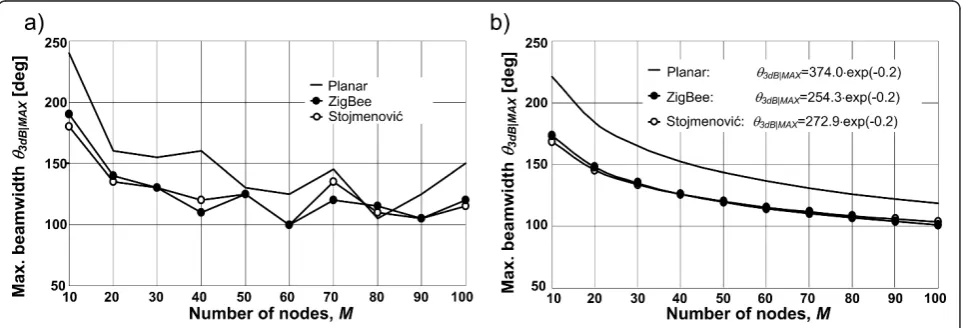
interfer-ence low compared to the desired signal. In order to cover the entire range of simulated nodes populations (10,20,...,100), curves representingθ3dB|MAXas a function
of the number o nodes M have been plotted in Figure
6a. It can be noticed that for sparsely deployed nodes (M= 10) the planarity allows to attain a statistically cor-rect network functioning for antenna beamwidths wider
by ca. 50° compared to ZigBee and Stojmenovič
algo-rithms (Figure 6b). Then, with a growing number of nodes, the best-fit trends in θ3dB|MAX decline
exponen-tially at a rate of exp(-0.2) regardless of the spanning method, to eventually converge to ca. 15° of advantage of the planar spanning algorithm over the ZigBee, Stoj-menovičcounterparts, for mostly populated networks.
6. Analysis of results: number of intereferors dependency on the antenna beamwidth
wider than in networks without this constraint. This, in turn, will affect the number of interferers (ΣI)“seen” by a statistical node within the radio visibility range (and subtended withinθ3dBangle).
As can be noticed in Figure 7a, in planar networks ΣI is apparently lower (and almost linear) than in ZigBee-or Stojmenovič-spanned netwZigBee-orks. Quite interestingly this difference becomes most distinguished as the
antenna beamwidth approaches 180°–the effect simply
obtained by mounting a reflective screen on one side of the antenna. It is also a mid-point between two extremes where planarity causes no advantage (regard-ing only the number of interferers) over non-planar solutions, namely for θ3dB = 0° (a “needle” ARP) and θ3dB = 360° (omnidirectional ARP). The plots of
differ-encesΔΣIbetween the number of interferers observed
by a statistical node in networks organized with ZigBee (ΣIZigBee) and planar (ΣIplanar) algorithms are shown in
Figure 7b. Stojmenovič case has been omitted since its performance in this test is indistinguishably similar to
that of ZigBee, as seen in Figure 7a. From the analysis ofΔΣIobtained for all investigated values ofM (10-100)
it stems that in planar topologies a statistical node will be subject to disturbances from 9% less interferers than in non-planar ones.
7. Analysis of results: DC dependency on the antenna beamwidth
A DC, as described in Section 3, can be considered as a statistical means of reducing the intra-network interfer-ence by implementing a mechanism allowing
transmis-sion opportunities with some probability DC. The
subject was given an in-depth attention in [4] where it was demonstrated that even under the most transmis-sion-intensive circumstances (such as a sudden appear-ance of fire or flood in a given area which trigger multiple sensors simultaneously) if the transmit oppor-tunity is restricted, there is a greater chance that a packet will pass through the network–otherwise it could be drowned out by numerous parallel transmissions
Figure 5A dependency of SNIR as a function ofθ3dBfor a different number of sinksM: (a)M= 20 nodes and (b)M= 90 nodes.
(carrying the same data) from other nearby sensor mod-ules. In the current investigations, similarly as in Section 6, only ZigBee algorithm plots will be presented, due to
their high similarity with the Stojmenovič method. As
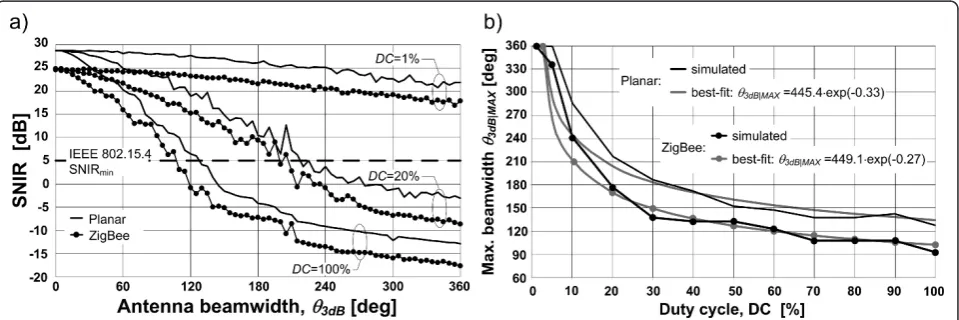
shown in Figure 8a, the expected gain in SNIR in the planar method is on average higher by 4.15 dB than in the ZigBee algorithm and this offset appears to be main-tained over the whole range of the antenna bandwidth and for all studied values ofDC(i.e., 1, 5, 10, 20, 30 up to 100%). As concerns the maximum antenna beam-widthθ3dB/MAXnecessary to sustain SNIR at or above 5
dB, results (Figure 8b) indicate an exponential relation with the DC (valid for DC≥30%). θ3dB/MAXin the
reli-able planar topology is allowed to be on average 34° wider than in ZigBee algorithm to achieve the desirable SNIR.
8. Summary and conclusions
It has been demonstrated that two most popular
net-work spanning methods, namely Stojmenovič and
Zig-Bee algorithms, possess some significant drawbacks, namely they do not assure reliability and allow for ener-getically non-optimal transmissions to distant neighbors. Moreover, the latter feature–as was also shown in simu-lations–gives rise to excessive interference in the radio network. The authors have posed a thesis that the pla-nar GG, after little modifications for reliability and a least-pathloss neighbor selection, should be an optimal
algorithm of choice for forming mesh ad hocnetworks.
The justification of this assertion is provided throughout Sections 5-7 by investigating SNIR as a function of the transmit/receive antenna directivity. It was demonstrated (Section 5) that SNIR in reliable planar networks is
Figure 7The effect of using directional antennas and planar topologies on different interference aspects: (a) the average number of interferersΣI; (b) the differenceΔΣIbetweenΣI observed by a statistical node in an MST-spanned and a planar mesh network.
improved by 4-5 dB, at the beamwidth wider by up to 50° than in ZigBee or Stojmenovičcases. An explanation of this effect is given in Section 6 where it is demon-strated that the average number of interfering nodes affecting a statistical node is lower by 9% in reliable pla-nar networks than in Stojmenovič- and ZigBee-spanned networks. Lastly, it was shown in Section 7 that when a DC is imposed on network devices, an additional gain of 4.15 dB in SNIR is obtained for the reliable planar topology over the non-planar topologies.
Acknowledgements
This paper has been written partially as a result of realization of the project entitled:“Detectors and sensors for measuring factors hazardous to environment - modeling and monitoring of threats”. The project financed by the European Union via the European Regional Development Fund and the Polish state budget, within the framework of the Operational Programme Innovative Economy 2007÷2013. The contract for refinancing No. POIG.01.03.01-02-002/08-00.
This paper has been written partially as a result of realization of the project entitled:“Research on topology, distribution of sinks and packets routing with respect to reliability and energetic optimization in wireless sensor networks”. The contract for refinancing No. B10089.
Authors’contributions
The work presented here was carried out in collaboration between both authors, all authors read and approved the manuscript. KS was responsible for the introductory part as a main contributor to Section 1. As the only author of Sections 3-8, he performed all interference investigations (together with the processing and analysis of results) which included: a) radio wave propagation aspects and b) C++ scripts for generating scenarios and computing SNIR vs. antenna beamwidth, duty cycle and the number of interferers.
GD, as a main contributor to Section 2 and a minor contributor to Section 1, created Matlab scripts for spanning network nodes with the reliable planar algorithm, the MST and LMST algorithms and performed necessary network-spanning calculations for scenarios generated by KS.
Competing interests
The authors declare that they have no competing interests.
Received: 30 October 2011 Accepted: 22 February 2012 Published: 22 February 2012
References
1. I Stojmenovič,Handbook of Sensor Networks–Algorithms and Architectures, John Wiley and Sons, Ottawa, (2004)
2. ML Shooman,Reliability of Computer Systems and Networks–Fault Tolerance, Analisys and Design, John Wiley & Sons, (2002)
3. M Pióro, D Medhi,Routing, Flow, and Capacity Design in Communication and Computer Networks, (Morgan Kaufmann Publishers, San Francisco, 2004) 4. K Staniec, G Debita, Interference mitigation in WSN by means of directional
antennas and duty cycle control. Wirel. Commun. Mobile Comput.11
(2011). doi:10.1002/wcm.1089
5. G Debita, K Staniec, Reliable mesh network planning with minimization of intra-system interference, inProceedings of Broadband Communication, Information Technology & Biomedical Applications BROADBAND-COM’09, Wrocław, Poland, 243–244 (15-July 2009)
6. H Frank, I Frisch, Analysis and design of survivable networks. IEEE Trans Commun Technol.18(5), 501–518 (1970). doi:10.1109/TCOM.1970.1090419 7. D Narsingh,Graph Theory with Applications to Engineering and Computer
Science, (Prentice-Hall, Inc, 1974)
8. LR Ford, DR Fulkerson, Maximal flow through a network. Can J Math.8, 399–404 (1956). doi:10.4153/CJM-1956-045-5
9. G Debita, Methods for optimal planning of mesh networks with consideration of reliability criteria, Doctoral dissertation, (Wroclaw University of Technology, Poland, 2010)
10. IEEE Std 802.15.4™-2006 Part 15.4,Wireless Medium Access Control (MAC) and Physical layer (PHY) Specification for Low-Rate Wireless Personal Area Networks (WPANs)
11. SR Saunders,Antennas and Propagation for Wireless Communications Systems, 2nd edn. (John Wiley & Sons, Ltd., Chichester, 2007)
12. H Jasani, K Yen, Performance improvement using directional antennas in ad hoc networks. Int J Comput Sci Netw Secur.6(6), 180–188 (2006) 13. RR Choudhury, NH Vaidya, Impact of directional antennas on ad hoc
routing, inProceedings of IFIP Personal and Wireless Communications (PWC) 2003, Venice, Italy, 590–600 (23–25 September 2003)
14. R Ramanathan, J Redi, C Santivanez, D Wiggins, S Polit, Ad hoc networking with directional antennas: a complete system solution. IEEE J Sel Areas Commun.23(3), 496–506 (2005)
15. T ElBatt, T Anderson, B Ryu, Performance evaluation of multiple access protocols for ad hoc networks using directional antennas, Proceedings of IEEE Wireless Communications and Networking Conference (WCNC), New Orleans, Louisiana, USA,2, 982–987 (16–20 March 2003)
16. A Munari, F Rossetto, M Zorzi, Cooperative cross layer MAC protocols for directional antenna ad hoc networks. ACM Mobile Comput Commun Rev.
12(2), 12–30 (2008). doi:10.1145/1394555.1394558
17. C Tran-Xuan, I Koo, An RSS-based localization scheme using direction calibration and reliability factor information for wireless sensor networks. KSII Trans Internet Inf Syst.4(1), 45–61 (2010)
18. HN Dai, Throughput and delay in wireless sensor networks using directional antennas, inProc 5th International Conference on Intelligent Sensors, Sensor Networks and Information Processing (ISSNIP), pp. 421–426 (7-10 December 2009)
19. Y Bashir, BO Jalel, Towards a classification of energy aware MAC protocols for wireless sensor networks Wirel Commun. Mobile Comput.9(12), 1572–1607 (2009)
20. D Jenn, Y Loke, TCH Matthew, YE Choon, OC Siang, YS Yam, Distributed phased arrays and wireless beamforming networks. Int J Distrib Sensor Netw.5(4), 283–302 (2009). doi:10.1080/15501320701863635 21. R Jurdak, CV Lopes, PA Baldi, A survey, classification and comparative
analysis of medium access control protocols for ad hoc networks. IEEE Commun Surv Tutor.6(1), 2–16 (2004)
22. Y Wei, J Heidemann, D Estrin, Medium access control with coordinated adaptive sleeping for wireless sensor networks. IEEE/ACM Trans Netw.12(3), 493–506 (2004). doi:10.1109/TNET.2004.828953
23. MJ Miller, NH Vaidya, A MAC protocol to reduce sensor network energy consumption using a wakeup radio. IEEE Trans Mobile Comput.4(3), 228–242 (2005)
24. AA Moshaddique, SM Riazul Islam, K Kwak, Energy saving mechanisms for MAC protocols in wireless sensor networks. Int J Distrib Sensor Netw.2010, Article ID 163413, 16 (2010)
doi:10.1186/1687-1499-2012-56
Cite this article as:Staniec and Debita:Evaluation of topological planarity and reliability for interference reduction in radio sensor networks.EURASIP Journal on Wireless Communications
and Networking20122012:56.
Submit your manuscript to a
journal and benefi t from:
7 Convenient online submission 7 Rigorous peer review
7 Immediate publication on acceptance 7 Open access: articles freely available online 7 High visibility within the fi eld
7 Retaining the copyright to your article