Volume 2007, Article ID 17826,11pages doi:10.1155/2007/17826
Research Article
Modeling of Call Dropping in Well-Established
Cellular Networks
Gennaro Boggia, Pietro Camarda, and Alessandro D’Alconzo
Dipartimento di Elettrotecnica ed Elettronica, Politecnico di Bari, Via Orabona 4, 70125 Bari, Italy
Received 8 January 2007; Revised 6 July 2007; Accepted 11 October 2007
Recommended by Alagan Anpalagan
The increasing offer of advanced services in cellular networks forces operators to provide stringent QoS guarantees. This objective can be achieved by applying several optimization procedures. One of the most important indexes for QoS monitoring is the drop-call probability that, till now, has not deeply studied in the context of a well-established cellular network. To bridge this gap, starting from an accurate statistical analysis of real data, in this paper, an original analytical model of the call dropping phenomenon has been developed. Data analysis confirms that models already available in literature, considering handover failure as the main call dropping cause, give a minor contribution for service optimization in established networks. In fact, many other phenomena be-come more relevant in influencing the call dropping. The proposed model relates the drop-call probability with traffic parameters. Its effectiveness has been validated by experimental measures. Moreover, results show how each traffic parameter affects system performance.
Copyright © 2007 Gennaro Boggia et al. This is an open access article distributed under the Creative Commons Attribution License, which permits unrestricted use, distribution, and reproduction in any medium, provided the original work is properly cited.
1. INTRODUCTION
The drop-call probability is one of the most important qual-ity of service indexes for monitoring performance of cellu-lar networks. For this reason, mobile phone operators apply many optimization procedures on several service aspects for its reduction. As an example, they maximize service coverage area and network usage; or they try to minimize interference and congestion; or they exploit traffic balancing among dif-ferent frequency layers (e.g., 900 and 1800 MHz in the Euro-pean GSM standard).
There are several papers which study performance in cel-lular networks and, in particular, how the drop call probabil-ity is related to traffic parameters.
Paper [1] is a milestone in performance analysis of mo-bile radio systems. Drop call probability is analyzed with the classical assumption of exponential distribution for the call-holding time. In particular, it puts emphasis on handover and its effects on performance. Handover is considered the main cause for call dropping.
The other classic work [2] shows how drop call and blocking probabilities are affected by user mobility, con-sidering different patterns for movements of mobile equip-ments. Again, handover is considered the cause of call drop-ping.
Authors of [3,4] have studied the performance of a cellu-lar network by considering more general distributions for the call and the channel holding times. They started from distri-butions described in the well-known papers [5,6]. Analytical expressions for drop-call probability are obtained showing the effect of more realistic assumption on system behavior.
Influence of handover on mobile network performance is analyzed in depth in [7,8], considering different patterns for user mobility. Also in [9], the relationship between handover failure and call dropping is analyzed.
In [10], handover and call dropping are studied consider-ing a cellular mobile communication network with multiple cells and different classes of calls, that is, multiple types of service are assumed. Each class has different call-holding and cell-residence times.
Paper [11] estimates the drop-call probability consider-ing a multimedia wireless network. An adaptive bandwidth allocation algorithm is exploited to improve system perfor-mance and to reduce, in particular, handover-blocking prob-ability.
The common denominator of all the previous works is assumptions about network characteristics. They implicitly consider that an appropriate radio planning has been carried out; therefore, propagation conditions are neglected. More-over, they do not deal with mobile equipment failure and network equipment outages. Such assumptions lead to con-sider that calls are dropped only due to the failure of the han-dover procedure. That is, the connection of an active user changing cell several times is terminated only due to the lack of communication resources in the new cell. For this reason, researchers have focused their attention on devel-oping analytical models which relate handovers with traffic characteristics.
Although the described models were very useful in the early phase of mobile network deployment, they are not very effective in a well-established cellular network. In such a sys-tem, network-performance optimization is carried out con-tinuously by mobile phone operators. So that, in real mo-bile networks, the call dropping due to lack of communica-tion resources is usually a rare event (i.e., blocking probabil-ity of new calls and handovers is negligible). In this paper, such a behavior has been confirmed by analyzing real tele-phone traffic data measured in the cellular network of Voda-fone (Italy). In particular, we found that many phenomena become more relevant than handover in influencing the call dropping (e.g., propagation conditions, irregular user behav-ior, and so on). Hence, new analytical tools and models to study the call dropping phenomenon in a well-established network as a function of traffic parameters (e.g., call arrival rate, call duration, and so on) are needed. This could help operators in their work for optimizing network performance and, then, for increasing revenues.
The main objective of this paper is to find a new sim-ple model to relate drop-call probability with traffic parame-ters in this well-established cellular network where handover failure becomes negligible. To the best of our knowledge, there are not similar models in literature which can eff ec-tively help operators in their analysis and predictions on this kind of networks. Thus, with respect to other related works, our main contribution is to bridge this gap.
To this aim, starting from real traffic data, we have iden-tified call-dropping causes. Then, using well-known statis-tical tools, we have characterized call arrival and drop pro-cesses together with conversation and ringing durations. These results have driven us in developing the new analytical model.
The considered approach has been validated by compar-ing model results with real GSM data. Moreover, the impact of model parameters on performance has been studied.
Even if the proposed analysis has been validated only con-sidering a GSM network, the developed approach is quite general. Indeed, following a similar procedure, model pa-rameters can be easily derived from data obtained in other cellular systems (e.g., UMTS cellular networks). This means that the model can be fruitfully exploited for performance evaluation in different cellular networks.
The rest of the paper is organized as follows.Section 2 describes measured data. InSection 3, data are statistically analyzed. Then, inSection 4the new analytical model is
de-veloped. Model validation and numerical results are reported inSection 5. Finally, conclusions are drawn inSection 6.
2. CHARACTERIZATION OF ESTABLISHED CELLULAR NETWORKS
As discussed before, the rationale of this work is related to the peculiar behavior of well established cellular networks. Herein, we characterize such a behavior by exploiting real measured data that have been collected in the GSM network of Vodafone (Italy). In particular, we have identified the main causes of call dropping. Moreover, using well-known statisti-cal tools, statisti-call process has been studied.
We refer to a cellular network as well established if the number of customers is stable assuming that the system-planning phase has been completed. In this kind of net-work, during the years, many optimization procedures have been applied to several radio and propagation aspects (e.g., the maximization of network coverage area and the min-imization of interference by a careful positioning of base transceiver stations and an accurate frequency-reuse plan-ning). Moreover, the maximization of network usage, the minimization of congestion, and the traffic balancing among surrounding cells have been obtained as a result of the net-work management.
For our analysis, a total of about one million of calls has been monitored in Vodafone network during 2003−2004 years. All data come from the main metropolitan areas in the South of Italy. Traffic has been monitored during several days, typically one week.
In order to obtain numerically significant data, several cells have been considered. In particular, these cells were cho-sen as reprecho-sentative of the whole network taking into ac-count cell extension, number of served subscribers in the area, and traffic load. Obviously, large datasets are needed to reduce errors in probability estimation from relative fre-quencies [13]. This is especially true when considering the call-dropping phenomenon which is a rare event in well-established networks. For this reason, both macro cells in an urban metropolitan environment and cell clusters in sub-urban areas were chosen. The macro cells are character-ized by high traffic load and allow us to manage sufficiently large data samples. Whereas with suburban areas, we need to group together from 5 up to 7 neighboring cells to obtain significant data samples.
2.1. Classification of drop call causes
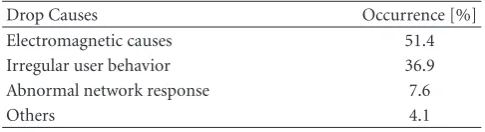
Table1: Occurrence of call-dropping causes in a reference cell.
Drop Causes Occurrence [%]
Electromagnetic causes 51.4
Irregular user behavior 36.9
Abnormal network response 7.6
Others 4.1
different network areas, allowing us to verify the absence of any seasonal or area-dependent phenomena.
As a typical example, the classification of drop-call causes for a single cell is reported inTable 1. It is straightforward to note that the call dropping is mainly due to electromagnetic causes (e.g., power attenuation, deep fading, and so on). A lot of calls are dropped due to irregular user behavior (e.g., mobile equipment failure, phones switched offafter ringing, subscriber charging capacity exceeded during the call). Other causes are due to abnormal network response (e.g., radio and signaling protocols error).
We highlight that only few calls were blocked due to lack of resources (e.g., handover failure). As a consequence, the call-blocking probability (i.e., the probability that a call does not find an available communication channel) is negligible for any dataset. Usually, this result is obtained by network operators by means of traffic-balancing policies, which allow the sharing of overloaded traffic among neighboring cells.
A classification of drop causes similar to the one reported inTable 1has been observed for both single cells or cluster of cells.
Therefore, the main conclusion of our analysis was that, in a well-established cellular network, it is not possible to find a prevailing cause for call dropping, but rather a mix of het-erogeneous and independent causes. Mainly, the handover failure is almost a rare event in such environment thanks to the reliability and the effectiveness of the deployed handover control procedure. That is why this work does not deal with blocking and handover probabilities like other papers already known in literature. Yet, we need a new model to relate drop-call probability with traffic parameters.
2.2. Analysis of stationarity
To develop our novel model for the drop call probability, we started from the statistical characteristics of measured real data. First of all, the stationarities of two processes, the traffic entering into the cell and the call duration, were analyzed.
The traffic entering in the cell follows a nonstationary trend, since its profile strictly depends on the number of ac-tive users in the system and on their requests. For example, Figure 1depicts the traffic load during the day for a cluster of seven neighboring cells. It is worthwhile noticing its typ-ical“M”shape [14,15]. That is, during the night there is a very low traffic load, while during the morning and the af-ternoon traffic load increases. Besides, two spikes are present in correspondence of the busiest hours related to business and commercial activities. InFigure 1, these two spikes are at 12:00 and 19:00, respectively.
24 20 16 12 8 4
(Hours) 0
20 40 60 80 100 120
Tr
a
ffi
c
in
the
clust
er
o
f
cells
[Erlang]
Busy hours
Figure1: Daily traffic in a cluster of 7 neighboring cells.
To identify the size of the time window that satisfies the stationarity hypothesis for the traffic entering in the cell, we used therunand thereverse arrangement tests[16] which are hypothesis tests. They check for the presence of underlying trends or other variations in random data sequences.
To perform these stationarity tests, it has been assumed that the interarrival time between calls (i.e., the time between two successive call requests) is a random process {Ti}ni=1,
wherenis the total number of calls during one day. The sta-tionarity of{Ti}ni=1can be tested by the following steps.
(1) The trace of interarrival times{Ti}ni=1is divided intom
subtraces with equal time length (for simplicity mul-tiples of one hour) obtainingmsequences{T(jm)}
Nm
j=1,
whereNm is the number of samples of themth
sub-trace.
(2) The mean value for each time interval is computed. The presence of underlying trends or variations in the sequence{T(jm)}
Nm
j=1 is tested, using both the run test
and thereverse arrangement test.
(3) If in a subtrace there is an underlying trend on the considered time scale (i.e., the considered value ofm), then the subtrace is not stationary with respect to the mean value.
(4) The size of the time window is decreased (i.e., the number,m, of subtraces is increased), repeating all the previous steps until obtaining positive response from both the tests, for all the subtraces.
T=tr+tc
Tr=tr Tc=tc Answer time Signaling
complete time Ringingphase
Conversation duration Call duration
Tc: Conversation duration
Tr: Ringing duration
Charging end time
Time
Figure2: Time diagram to describe call behavior.
InFigure 1the four hours around the busiest day hour are highlighted.
Concerning call duration, following a similar procedure (i.e., using run test and reverse arrangement tests), the sta-tionarity was verified for any size of the time window. Specifi-cally, we found that the mean call duration (evaluated in each hour) does not change appreciably during the day. Therefore, if we refer to the four hours around the busiest day hour, call duration is anyway a stationary process.
Given the aforesaid observations, unless otherwise speci-fied, in the following the analysis will be referred to the four-hour time window around the busiest four-hour.
3. DATA ANALYSIS AND CHARACTERIZATION
To characterize the call dropping, we have analyzed the call arrival process and, specifically, the interarrival time between two successive new calls. Moreover, the interdeparture time between two successive dropped calls has been studied (i.e., the interval between call dropping instants); in the following, this time will be simply referred to asinterdeparture time.
Likewise, to statistically characterize call duration, we have analyzed the durations of normally terminated calls (i.e.,not-dropped-callsin operator database) and of dropped calls, distinguishing two phases: ringing and conversation (seeFigure 2). The duration of the ringing phase is calculated as the difference between the answer time (i.e., the instant when the callee answers) and thesignaling complete time(i.e., the instant when the communication setup finishes). The conversation duration is the difference between the charging-end time(i.e., the instant when the billing account stops) and theanswer time. In our analysis, thesetup timeis not included in the evaluation of call duration because it does not depend on user behavior, but only on network characteristics.
The estimation of the mean,μ, and the variance,σ2, of
conversation duration (for both dropped and normally ter-minated calls) and of interarrival and interdeparture times were carried out. We used the following well-known conver-gent and not-polarized estimators [13]:
μ=
n
i=1xi n , σ
2=
n
i=1
xi−μ
2
(n−1) , (1)
where (x1,x2,. . .,xn) is a sample vector ofnelements.
Furthermore, the coefficient of variation, C, defined as the ratio between standard deviation and mean has been evaluated; this parameter is an index of data dispersion around the mean value. InTable 2, estimated statistical pa-rameters (referred to 4 hours around the busy hour) are re-ported for five cells and two clusters of cells.
We observed that the conversation durations of normally terminated calls and dropped calls show a value ofCgreater than 1, whereas the interarrival and the interdeparture times have a coefficient of variationC 1. This behavior holds for both cells and cluster of cells. These results can suggest the choice of the pdf (probability density function) to rep-resent each considered process. In particular, we made the hypothesis, validate by the following statistical analysis, that conversation duration of normally terminated calls and con-versation duration of dropped calls have lognormal pdfs with different parameters [13]:
fT(t)=
1
ϕ√2πte
−(lnt−ϑ)2/2ϕ2
, ϕ,θ >0, t≥0. (2)
It is worthwhile to note that this result extends and gener-alizes the one reported in [17], where a lognormal function is used to fit only the channel-holding time in a single cell. Instead, the conversation duration, considered in this paper, is the sum of the channel-holding times in all the cells visited by the user during the same call.
For interarrival and interdeparture times we made the hypotheses of exponential pdfs, which are density functions with a coefficient of variation equal to one:
fX(t)=λe−λt, λ >0, t≥0. (3)
It seems appropriate to mention that, although analysis of interarrival times has been reported in a previous scientific paper [17], the study of interdeparture time is a new result of this paper.
In the next sessions, the previous hypotheses about pdfs of conversation durations, interarrival time, and inter-departure time will be verified exploiting two suitable statis-tical methods.
3.1. Analysis with probability plots
In order to asses if a data set follows a given distribution, there are some useful graphical tools such as theprobability plot[18].
The idea is to plot, together on the same graph, the cu-mulative distribution functions of the data sample and of a specific theoretical distribution, for the same quantile values. That is, on the axes there are the ordered values of the consid-ered dataset and the theoretical distribution percentiles. For a given point on the probability plot, the quantile level is the same for both the variables on the axes. If the considered dis-tribution really fits data, the points should lie approximately on a straight line.
Table2: Estimated statistical parameters.
Number of calls μ[s] σ[s] C
Cell 1
Conversation duration of normally terminated Calls
2339
121.74 205.65 1.69
Conversation duration of dropped calls 96.01 172.09 1.79
Interdeparture time 92.44 87.67 0.95
Interarrival time 6.14 6.14 1.00
Cell 2
Conversation duration of normally terminated calls
2180
93.20 152.18 1.63
Conversation duration of dropped calls 130.20 339.70 2.61
Interdeparture time 67.72 78.23 1.16
Interarrival time 6.60 6.54 0.99
Cell 3
Conversation duration of normally terminated calls
4555
100.97 134.89 1.34
Conversation duration of dropped calls 92.86 159.35 1.72
Interdeparture time 101.08 103.33 1.02
Interarrival time 3.18 3.53 1.11
Cell 4
Conversation duration of normally terminated calls
2200
111.15 187.50 1.69
Conversation duration of dropped calls 95.64 213.47 2.23
Interdeparture time 85.01 94.28 1.11
Interarrival time 6.54 7.01 1.07
Cell 5
Conversation duration of normally terminated calls
3586
108.35 198.13 1.83
Conversation duration of dropped calls 97.27 174.25 1.79
Interdeparture time 99.65 101.27 1.01
Interarrival time 4.00 5.00 1.25
Cluster 1
Conversation duration of normally terminated calls
11748
100.41 212.21 2.10
Conversation duration of dropped calls 94.92 199.69 2.11
Interdeparture time 27.25 27.23 0.99
Interarrival time 1.25 1.41 1.13
Cluster 2
Conversation duration of normally terminated calls
4448
107.70 208.94 1.94
Conversation duration of dropped calls 91.42 161.67 1.77
Interdeparture time 74.48 79.34 1.07
Interarrival time 3.47 13.23 1.05
from this plot: shifts in location, shifts in scale, changes in symmetry, and the presence of outliers (see for details [18]). To verify our hypothesis about pdf of the conversation time, we can consider the probability plot for the logarithm of conversation duration versus the normal standard distri-bution. In fact, as well known, the normal and lognormal distributions are closely related, that is, ifXis lognormally distributed with parametersθandϕ, then log (X) is normally distributed with the same parameters [13]. For example, with reference to the normally terminated calls in a cell monitored for 4 hours,Figure 3reports the probability plot for the log-arithm of conversation duration versus normal standard dis-tribution. A similar result holds also for the conversation du-ration of dropped calls.Figure 4shows the probability plot for the interarrival time versus the exponential distribution.
From both figures, it can be noticed that data lie on a straight line, confirming our hypotheses about pdfs. We highlight that also the probability plots for the inter-departure time between dropped calls, which have not been reported for lack of space, show similar agreement.
Regarding the ringing time, Tr, measures have shown
that there are many values close to zero, a lot of values around 5 seconds, and few larger values. So that, it does not follow
any known distribution. By using again the probability plots (not reported for lack of space), it has been verified that a suitable pdf for fitting ringing time data was a weighted mix-ture of exponential and lognormal pdfs:
fTr(t)=αλe−
λt
+(1−α)
ϕ√2πte
−(1/2)((log (t)−θ)/ϕ)2
; t≥0, α∈[0, 1],
(4)
whereαis a weight coefficient.
3.2. Theχ2-goodness-of-fit-test results
The probability plot remains a qualitative graphical test. To confirm our assumption, we need to deploy also a hypothesis test such as theχ2-goodness-of-fit test (χ2-test) [19]. Such a
test requires the estimation, from the sample data, of param-eters for each distribution under testing.
We use the well-known maximum likelihood method [13]. LetXbe a random variable with its pdf dependent on the parameterγand let
f(X,γ)= fx1,γ
·fx2,γ
· · ·fxn,γ
4
Figure3: Probability plot for the logarithm of conversation dura-tion (for normally terminated calls) versus normal standard distri-bution.
Figure4: Probability plot of calls interarrival time versus exponen-tial distribution.
be the joint density function ofnsamplesxiofX. This
den-sity, considered as a function ofγ, is called thelikelihood func-tionofX.
is thelog-likelihoodfunction ofX.
From the monotonicity of logarithm, it follows thatγ∗
also maximizes the functionL(x,γ) and is the solution of the
As shown in [13], the maximum likelihood estimator is asymptotically normal, unbiased, with minimum variance.
For our purpose, the maximum likelihood estimators for the parameters of the exponential and the lognormal pdfs can be easily obtained solving (7) applied to (2) and (3). The estimators are, respectively (see [13,17]),
wheretiare the time samples.
Unfortunately, it is not possible to obtain a closed form expression for the four estimators of the parameters in (4), since from (7) we obtain a nonlinear equation system. Nev-ertheless, such a system can be solved by numerical methods. Specifically, as described in [20,21], a subspace trust region method based on the interior-reflective Newton method has been implemented.
Now, we can apply the χ2-test to check our
hypothe-ses about pdfs following the algorithm introduced by Fisher [19]. Using the significance levelα=0.01, the tests gave pos-itive results in all the trials. As in [17], also in this work it was necessary to filter data samples which showed an anomalous relative frequency. But, whereas in [17] the 26% of the sam-ple data were rejected, in our analysis never more than 5% of data have been discharged.
The obtained results show that both conversation dura-tions of normally terminated calls and dropped calls are log-normal distributed. Moreover, our statistical analysis con-firms the exponential hypothesis both for interarrival time between two successive new calls and for the interdeparture time between two successive dropped calls. Finally, χ2-test
confirms that ringing time has the pdf reported in (4). Even if some of this results are similar to previous ones [17], we highlight that, to the best of our knowledge, the analyses of interdeparture time, of conversation duration for dropped calls, and of ringing time do not appear in any previous sci-entific papers.
As an example, inFigure 5the measured data and the fit-ted lognormal pdf for the conversation duration of normal terminated calls are reported. InFigure 6, the same informa-tion is reported, but referring to the dropped calls. In Figures 7and8the interdeparture time between dropped calls and the interarrival time between calls are fitted by exponential pdfs. Finally, inFigure 9the ringing duration pdf of a clus-ter of 7 cells monitored for 4 hours is fitted by a mixture of exponential and lognormal pdfs. We point out that the con-clusions about the characterization of call durations, inter-arrival time between calls, and interdeparture time between dropped calls hold both for single cells and for cell clusters.
4. ANALYTICAL MODEL
In this section, starting from the results of data analysis, a new analytical model to predict the drop-call probability as a function of traffic parameters has been developed.
350 300 250 200 150 100 50 0
Conversation duration (s) 0
5 10 15 20 25 30 35 40
Nu
m
b
er
o
f
ca
ll
s
Samples Lognormal fitting
Figure5: Fitting of conversation duration of normally terminated calls with a lognormal pdf (cell 1 observed for 4 hours).
300 250 200 150 100 50
0
Conversation duration (s) 0
2 4 6 8 10 12
Nu
m
b
er
o
f
d
ro
p
p
ed
ca
ll
s
Samples Lognormal fitting
Figure6: Fitting of conversation duration of dropped calls with a lognormal pdf (cell 1 observed for 4 hours).
of independence for both arrival events and dropping events, we can state that these processes can be considered Poisso-nian. This result extends the one reported in [14] in which, starting from measures, the classical Poisson hypothesis is verified only for call arrivals.
In this way, we can model all the causes of call dropping as a single phenomenon which follows the Poisson statistic.
Letλtbe the total traffic entering in the generic cell. Since
in a well-established cellular network the call-blocking prob-ability is almost negligible (i.e., the system can be considered as nonblocking),λtis also the total traffic accepted in the cell.
500 400
300 200
100 0
Interdeparture time between dropped calls (s) 0
1 2 3 4 5 6 7 8 9 10
N
u
mber
of
samples
Samples
Exponential fitting
Figure7: Fitting of interdeparture time between dropped calls with an exponential pdf (cell 1 observed for 24 hours).
30 25 20 15 10 5 0
Interarrival time between calls (s) 0
50 100 150 200 250 300
N
u
mber
of
samples
Samples
Exponential fitting
Figure8: Fitting of interarrival time between calls with an expo-nential pdf (cell 1 observed for 4 hours).
The drop call probability,Pd, is equal to the fraction of this
traffic dropped due to the phenomena described inSection 2. To evaluatePd, let us consider, for sake of simplicity, the
probability that a call is normally terminated,Pnt, related to Pdby the following expression:
Pd =1−Pnt. (9)
50
Figure9: Fitting of ringing duration with a mix of exponential and lognormal pdf (cluster 1 observed for 4 hours).
in the previous section, we can state that the call duration,
T, is the sum of the two random variablesTr andTcwhich
model the ringing and conversation times, respectively. The random variable (r.v.)Tr models the ringing duration with
a pdf fTr(t), according to (4). The r.v. Tc models the
con-versation duration with a lognormal pdf fTc(t), according to
(2). Assuming thatTrandTcare independent, the pdf fT(t)
of the call duration for the normally terminated calls can be obtained as the following convolution between pdfs [13]:
fT(t)= fTr(t)∗fTc(t)=
t
0fTc(t−τ)·fTr(τ)dτ. (10)
The probabilityPnd(1) that a call, amongkactive ones, is
not involved by a single drop event (i.e., call is not dropped), during the duration timeT=t, is (k−1)/k. Obviously, given that drop events are assumed to be independent, if there are
ndrop events, this probability becomes
Pnd(n)=
On the other hand, as said before, dropping events con-stitute a Poisson process; letνd be its intensity. Hence, ifY
is the r.v. which counts the number of drops, the probability that there arendrops in the intervalT=tis [13]
By using (11) and (12), the probability that a call with durationT =tis normally terminated, in the presence ofk
contemporary calls andndrop events, is equal to the proba-bility that drop events do not affect the considered call:
Pnt(T=t,k,n)=Pnd(n)·P(Y =n)=
By applying the total probability theorem to the number of drop events, the probability that a call with durationT=t
is normally terminated, in the presence ofkcontemporary calls (i.e., the call is not dropped), can be estimated as
Pnt(T=t,k)=
Using again the total probability theorem, summing over all the possible numbers of contemporary active calls, the probability that a call is normally terminated with durationt
is
wherePa(k) is the probability that there arekactive users
(i.e.,kcalls in progress).
As experimentally verified (see Section 2), in well-established cellular networks operating in normal condi-tions, the call dropping is not due to unavailability of com-munication channels (i.e., the blocking and handover prob-abilities are negligible). Thus, we can model the system as a queue with infinite number of servers, which is a nonblock-ing queue. Considernonblock-ing as service time the call duration, we have to consider a queue with a general service time distribu-tion. This means that, by using the queuing theory notation [22], the system can be modeled as an M/G/∞queue. There-fore, the probabilityPa(k) that there arekactive users is given
by [22]
Pa(k)=cN·ρ k
k!, k≥1, (16)
whereρis the utilization factor, given by the product between the total trafficλtand the mean service timeE[T];cNis a
nor-malization coefficient which considers that there is at least one ongoing call.
Applying the normalization condition, the coefficientcN
is evaluated as
cN =
1
eρ−1. (17)
Note that exploiting the utilization factorρ, we can also evaluate the mean number of active usersE[N]:
E[N]=
Using (17) in (16), we obtain
Pa(k)= 1 eρ−1·
ρk
Substituting (19) and (14) in (15), we have
Pnt(T=t)=
∞
k=1
e−νdt/k· 1
eρ−1· ρk
k!. (20)
Now, it is straightforward to evaluate the probability of a normally terminated call,Pnt, simply considering every
pos-sible call duration:
Pnt=
∞
0Pnt(T=t)fT(t)dt
= 1
eρ−1
∞
k=1 ρk k!
∞
0 fT(t)e
−νdt/kdt,
(21)
where fT(t) is the pdf defined by (10).
Finally, from (9), it results that the drop-call probability is
Pd=1− 1 eρ−1
∞
k=1 ρk k!
∞
0 fT
(t)e−νdt/kdt. (22)
It is worth noticing that (22) depends on the drop-call rateνd, the pdf fT(t) of the call duration of normally
termi-nated calls, and the utilization factorρ (which in turn de-pends on the trafficλt).
Equation (22) can be exploited to study the effect of traf-fic parameters on drop-call probability, but it can be also ap-plied to predict such a probability starting from real data. In the latter case, equation parameters should be obtained from measured data following the same analysis described in Section 3.
The development of our model did not require any as-sumption on a particular technology. Thus, the model can be exploited to predict the drop-call probability in different cellular networks (e.g., PCS, UMTS). In fact, we need only measured datasets to find the pdfs that best fit ringing time, conversation duration, interarrival time, and interdeparture time. Then, we can characterize (10) and find the drop-call probability in this kind of systems by applying (22).
5. NUMERICAL RESULTS
The developed model has been validated by using the real data analyzed inSection 3. Moreover, it has been exploited to study the effect of its parameter on network performance (i.e., we evaluated the model sensitivity to its parameters).
For the validation, in each considered cell, the drop-call probability and its confidence interval [13] (with confidence level 1−α =0.95) have been estimated directly from mea-sured data. This is to establish the acceptance region for re-sults from our model. Then, the drop call probability has been analytically estimated just applying (22). Parameters of this equation have been obtained by the data analysis re-ported inSection 3. Results coming out from the analytical model can be considered acceptable if they fall in the confi-dence interval of the measured drop-call probability.
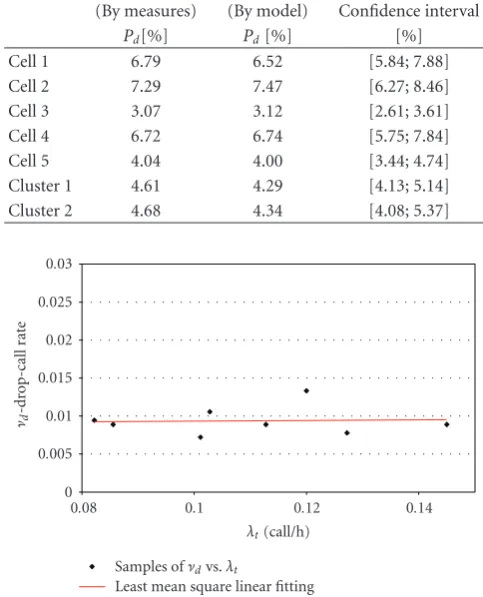
In Table 3, results of validation are reported for the same cells and cluster of cells considered inTable 2(i.e., the datasets for which we have explicitly reported numerical re-sults of statistical analysis). They show that, in every case, the
Table3: Drop-call probability results.
(By measures) (By model) Confidence interval
Pd[%] Pd[%] [%]
Cell 1 6.79 6.52 [5.84; 7.88]
Cell 2 7.29 7.47 [6.27; 8.46]
Cell 3 3.07 3.12 [2.61; 3.61]
Cell 4 6.72 6.74 [5.75; 7.84]
Cell 5 4.04 4.00 [3.44; 4.74]
Cluster 1 4.61 4.29 [4.13; 5.14]
Cluster 2 4.68 4.34 [4.08; 5.37]
0.14 0.12
0.1 0.08
λt(call/h) 0
0.005 0.01 0.015 0.02 0.025 0.03
νd
-dr
o
p-call
ra
te
Samples ofνdvs.λt
Least mean square linear fitting
Figure10: Total entering traffic in a cell,λt, versus the drop-call rate,νd.
analytical results fall in the confidence interval of measured drop-call probability. This result has been confirmed for all the sets of measured data, thus validating our model.
A better agreement between real data and model results could be achieved by using larger data sample [13]. In fact, as the dataset gets larger, the confidence interval gets smaller. Hence, the estimation of the input parameters (i.e.,νd,λt,
and so on) for the analytical model gets more accurate. It is evident from the comparison of Tables 2and3that the narrowest confidence intervals (i.e., the better estimations for our model) correspond to the largest datasets (i.e.,Cell 3and Cluster 1).
The model can be also exploited to evaluate network per-formance as a function of traffic parameters. For example, it allows us to asses the sensitivity of the drop call probability to call duration distribution, to the offered traffic load, and so on. To this aim, first the correlation betweenνdandλthas
been studied from data. We found that a linear dependence between these two parameters exists, that is,
νd=mλt+b, (23)
wheremandbcould be obtained with a least square regres-sion technique [13].
Figure 10shows that relatively large variations ofλt
0.4
Figure11: Drop-call probability versus trafficλtwith several mean conversation durations.
Hence, in (22) the effect of the drop call rateνd can be
studied by considering only the effect of the call arrival rate
λt. At the same time, the other parameter of the model (i.e.,
the utilization factorρ) is defined as the product between the mean call durationE[T] and the call arrival rateλt.
There-fore, we can simply analyze the impact on model results of the call-arrival rate and of the call duration.
InFigure 11, the drop-call probability obtained by the model is reported as a function of the total traffic entering in the cell, λt (measured in calls per second [call/s]). The
graphs are reported for several values of the mean conversa-tion duraconversa-tionE[Tc] (from 70 seconds to 130 seconds) with a
fixed coefficient of variation,C, equal to 1.3, near to the typi-cal value observed in measured data (seeTable 2). The mean ringing duration is equal to 10 seconds. The drop call rateνd
was varied accordingly with (23).
System performance improves as the traffic entering in the cell increases. Since there is a linear dependence between
λtandνd, increasing the traffic load, the number of dropped
calls remains quite constant. For this reason, the drop-call rate decreases.
Furthermore, drop-call probability remains quite con-stant when mean call duration increases. Only for small val-ues ofλt, that is, for a low traffic load, there are appreciable
differences.
InFigure 12, the drop-call probability is reported as a function of the total traffic entering in the cell,λt, with
sev-eral values for the coefficient of variation. The mean con-versation duration is assumed equal to 100 seconds, near to the typical value observed in the measured data (seeTable 2). The other system parameters have the same values used for obtainingFigure 11.
The more interesting result coming out from this figure is the effect of coefficient of variation on drop-call proba-bility, particularly at low traffic load. This probability de-creases as coefficient of variation increases; that is, fixing mean conversation duration, values more dispersed around this mean reduce drop-call probability. Similar results on
0.4
Figure12: Drop-call probability versus trafficλtwith several coef-ficients of variationC.
0.4
Figure13: Drop-call probability versusλTwith several mean ring-ing durations.
other system performance parameters are reported in liter-ature [2,23]. Such a behavior can partially explain the per-formance improvement of some well-established mobile net-works. In fact, in these networks the presence at the same time of many different services leads to a larger diff erenti-ation of call durerenti-ations; consequently, values are more dis-persed around the mean and the drop-call probability gets smaller.
Finally, Figure 13 reports the sensitivity of the pro-posed model as a function ofλT, for several values of the
mean ringing duration. The mean call duration is equal to 100 seconds. The other model parameters are the same previ-ously used. It is worth noting that ringing duration variation does not affect the drop-call probability. In fact, the curves for the differentE[Tr] values are practically
6. CONCLUSIONS
In this paper, starting from the statistical analysis of data measured in a large real well-established cellular network, a new model to study the call-dropping phenomenon has been developed.
We started from the verification that handover failure, considered prevailing in the classical cellular performance models, has become negligible in this kind of networks. With both planning optimization and fine tuning of network pa-rameters, several secondary phenomena (e.g., irregular user behaviors, abnormal network response, power attenuation, and so on) become significant. This requires new modeling of the call dropping process.
Using statistical tools on measured data from a real net-work, we have characterized dropped calls and call durations (distinguishing between ringing and conversation phases). Results of this data analysis have driven the development of a new analytical model which relates drop-call probability to the drop-call rate, the pdf of the call duration, and the traffic load.
The proposed model has been validated comparing its re-sults with the ones obtained by measures, in a wide range of traffic load conditions for both cells and cluster of neighbor-ing cells. Moreover, the impact of its parameters on drop-call probability has been studied.
The developed model can be easily extended to diff er-ent cellular networks simply characterizing the distribution of the call duration.
ACKNOWLEDGMENTS
The authors would like to thank Dr. Massimo Siviero from Vodafone, Italy, for his helpful contribution in this work; in particular, in the phase of measure collection. A preliminary version of this paper was presented at IEEE VTC’05 Spring Conference.
REFERENCES
[1] D. Hong and S. Rappaport, “Traffic model and performance analysis for cellular mobile radio telephone systems with pri-oritized and nonpripri-oritized handoffprocedures,”IEEE Trans-actions on Vehicular Technology, vol. 35, no. 3, pp. 77–92, 1986. [2] P. V. Orlik and S. S. Rappaport, “A model for teletraffic perfor-mance and channel holding time characterization in wireless cellular communication with general session and dwell time distributions,”IEEE Journal on Selected Areas in Communica-tions, vol. 16, no. 5, pp. 788–803, 1998.
[3] H. Zeng, Y. Fang, and I. Chlamtac, “Call blocking performance study for PCS networks under more realistic mobility assump-tions,”Telecommunication Systems, vol. 19, no. 2, pp. 125–146, 2002.
[4] Y. Fang, I. Chlamtac, and Y.-B. Lin, “Call performance for a PCS network,”IEEE Journal on Selected Areas in Communica-tions, vol. 15, no. 8, pp. 1568–1581, 1997.
[5] Y. Fang, I. Chlamtac, and Y.-B. Lin, “Modeling PCS networks under general call holding time and cell residence time distri-butions,”IEEE/ACM Transactions on Networking, vol. 5, no. 6, pp. 893–906, 1997.
[6] Y. Fang and I. Chlamtac, “Teletraffic analysis and mobility modeling of PCS networks,”IEEE Transactions on Communi-cations, vol. 47, no. 7, pp. 1062–1072, 1999.
[7] M. Rajaratnam and F. Takawira, “Nonclassical traffic model-ing and performance analysis of cellular mobile networks with and without channel reservation,”IEEE Transactions on Vehic-ular Technology, vol. 49, no. 3, pp. 817–834, 2000.
[8] M. Rajaratnam and F. Takawira, “Handofftraffic characteriza-tion in cellular networks under nonclassical arrivals and ser-vice time distributions,”IEEE Transactions on Vehicular Tech-nology, vol. 50, no. 4, pp. 954–970, 2001.
[9] Y. Iraqi and R. Boutaba, “Handoffand call dropping probabil-ities in wireless cellular networks,” inProceedings of Interna-tional Conference on Wireless Networks, Communications and Mobile Computing (WIRELESSCOM ’05), vol. 1, pp. 209–213, Maui, Hawaii, USA, June 2005.
[10] X. Chao and W. Li, “Performance analysis of a cellular network with multiple classes of calls,”IEEE Transactions on Communi-cations, vol. 53, no. 9, pp. 1542–1550, 2005.
[11] N. Nasser, “Enhanced blocking probability in adaptive multi-media wireless networks,” inProceedings of the 25th IEEE Inter-national Performance, Computing, and Communications Con-ference (IPCCC ’06), vol. 2006, pp. 647–652, New Orleans, La, USA, April 2006.
[12] G. Boggia, P. Camarda, and N. Di Fonzo, “Teletraffic analysis of hierarchical cellular communication networks,”IEEE Trans-actions on Vehicular Technology, vol. 52, no. 4, pp. 931–946, 2003.
[13] A. Papoulis,Probability, Random Variables and Stochastic Pro-cesses, McGraw-Hill, New York, NY, USA, 3rd edition, 1991. [14] S. Bregni, R. Cioffi, and M. Decina, “WLC09-1: an
empiri-cal study on statistiempiri-cal properties of GSM telephone empiri-call ar-rivals,” inProceedings of IEEE Global Telecommunications Con-ference (GLOBECOM ’06), pp. 1–5, San Francisco, Calif, USA, November-December 2006.
[15] A. Pattavina and A. Parini, “Modelling voice call interarrival and holding time distributions in mobile network,” in Pro-ceedings of the 19th International Teletraffic Congress (ITC ’05), Beijing, China, August 2005.
[16] J. S. Bendat and A. G. Piersol,Random Data, Analysis and Mea-surement Procedures, John Wiley & Sons, New York, NY, USA, 2nd edition, 1986.
[17] C. Jedrzycki and V. M. Leung, “Probability distribution of channel holding time in cellular telephony systems,” in Proceedings of IEEE 46th Vehicular Technology Conference (VTC ’96), vol. 1, pp. 247–251, Atlanta, Ga, USA, May 1996. [18] J. M Chambers, W. S. Cleveland, B. Kleiner, and P. A.
Tukey,Graphical Methods for Data Analysis, Chapman & Hall, Boston, Mass, USA, 1983.
[19] E. Kreyszig,Advanced Engineering Mathematics, John Wiley & Sons, New York, NY, USA, 6th edition, 1987.
[20] T. F. Coleman and Y. Li, “On the convergence of interior-reflective Newton methods for nonlinear minimization sub-ject to bounds,”Mathematical Programming, vol. 67, no. 1–3, pp. 189–224, 1994.
[21] T. F. Coleman and Y. Li, “An interior trust region approach for nonlinear minimization subject to bounds,”SIAM Journal on Optimization, vol. 6, no. 2, pp. 418–445, 1996.
[22] L. Kleinrock,Queuing Systems: Computer Applications, vol. 2, John Wiley & Sons, New York, NY, USA, 1985.