R E S E A R C H
Open Access
Interference-aware receiver structure for
multi-user MIMO and LTE
Rizwan Ghaffar
*and Raymond Knopp
Abstract
In this paper, we propose a novel low-complexity interference-aware receiver structure for multi-user MIMO that is based on the exploitation of the structure of residual interference. We show that multi-user MIMO can deliver its promised gains in modern wireless systems in spite of the limited channel state information at the transmitter (CSIT) only if users resort to intelligent interference-aware detection rather than the conventional single-user detection. As an example, we focus on the long term evolution (LTE) system and look at the two important characteristics of the LTE precoders, i.e., their low resolution and their applying equal gain transmission (EGT). We show that EGT is characterized by full diversity in the single-user MIMO transmission but it loses diversity in the case of multi-user MIMO transmission. Reflecting on these results, we propose a LTE codebook design based on two additional feedback bits of CSIT and show that this new codebook significantly outperforms the currently standardized LTE codebooks for multi-user MIMO transmission.
1. Introduction
The spatial dimension surfacing from the usage of mul-tiple antennas promises improved reliability, higher spectral efficiency [1], and the spatial separation of users [2]. This spatial dimension (MIMO) is particularly bene-ficial for precoding in the downlink of multi-user cellu-lar systems (broadcast channel), where these spatial degrees of freedom at the transmitter can be used to transmit data to multiple users simultaneously. This is achieved by creating independent parallel channels to the users (canceling multi-user interference) and the users subsequently employ simplified single-user recei-ver structures. Howerecei-ver, the transformation of cross-coupled channels into parallel non-interacting channels necessitates perfect channel state information at the transmitter (CSIT) whose acquisition in a practical tem, in particular frequency division duplex (FDD) sys-tem, is far from realizable. This leads to the precoding strategies based on the partial or quantized CSIT [3], which limit the gains of multi-user MIMO.
Ongoing standardizations of modern cellular systems are investigating different precoding strategies based on low-level quantized CSIT to transmit spatial streams to multiple users sharing the same time-frequency
resources. In third-generation partnership project long-term evolution (3GPP LTE) system [4], the CSIT acqui-sition is based on the precoder codebook approach. These LTE precoders are characterized by low resolu-tion and are further based on the principle of equal gain transmission (EGT). These precoders when employed for the multi-user MIMO mode of transmission are unable to cancel the multi-user interference thereby increasing the sub-optimality of conventional single-user detection. This has led to the common perception that multi-user MIMO mode is not workable in LTE [[5], p. 244].
Considering multi-user detection, we propose in this paper a low-complexity interference-aware receiver [6] for the multi-user MIMO in LTE. Though multi-user detection has been extensively investigated in the litera-ture for the uplink (multiple access channel), its related complexity has so far prohibited its employment in the downlink (broadcast channel). For the multiple access channel, several multi-user detection techniques exist in the literature starting from the optimal multi-user recei-vers [7] to their near-optimal reduced complexity coun-terparts (sphere decoders [8]). The complexity associated with these techniques led to the investigation of low-complexity solutions as sub-optimal linear multi-user receivers [9], iterative multi-multi-user receivers [10,11], and decision-feedback receivers [12,13]. Since in * Correspondence: [email protected]
Eurecom, 2229 route des Crêtes, B.P.193, Sophia Antipolis Cedex, 06904, France
practice, most wireless systems employ error control coding combined with the interleaving, recent work in this area has addressed multi-user detection for coded systems based on soft decisions [14,15].
Our proposed low-complexity interference-aware receiver structure not only reduces one complex dimen-sion of the system but is also characterized by exploiting the interference structure in the detection process. Con-sidering this receiver structure, we investigate the effec-tiveness of the low-resolution LTE precoders for the multi-user MIMO mode and show that multi-user MIMO can bring significant gains in future wireless sys-tems if the users resort to intelligent interference-aware detection as compared to the sub-optimal single-user detection. We further look at the second characteristic of the LTE precoders, i.e., EGT both for the single-user and multi-user MIMO modes. We show that the EGT has full diversity in the single-user MIMO mode (a result earlier derived for equal gain combining for BPSK in [16] and for EGT in MIMO systems in [17]); how-ever, it suffers from a loss of diversity in multi-user MIMO mode [18]. Based on this analysis, we propose a design criteria for the precoder codebooks and show that the additional feedback of two bits for CSIT can lead to significant improvement in the performance of the multi-user MIMO.
Regarding notations, we will use lowercase or upper-case letters for scalars, lowerupper-case boldface letters for vectors and uppercase boldface letters for matrices. The matrixInis then×nidentity matrix. |.| and ||.||
indi-cate norm of scalar and vector while (.)T, (.)*, and (.)† indicate transpose, conjugate, and conjugate transpose, respectively. (.)Rindicates the real part and (.)Iindicates
the imaginary part of a complex number. The notation
E (.) denotes the mathematical expectation while
Q(y) = √1 2π
∞
y e−x
2/2
dx denotes the Gaussian
Q-func-tion. All logarithms are to the base 2.
The paper is divided into eight sections. In Sec. II, we give a brief overview of LTE and define the system model. In Sec. III, we consider a geometric scheduling strategy for the multi-user MIMO mode in LTE and propose a low-complexity interference-aware receiver structure. In Sec. IV, we look at the information theore-tic perspective of the proposed receiver structure. Sec. V is dedicated to the performance analysis of the EGT that is followed by the simulation results. Before con-cluding the paper, we propose a design criteria for the precoder codebooks of the forthcoming standardizations of LTE. The proof details in the paper have been rele-gated to appendices to keep the subject material simple and clear.
2. LTE system model A. LTE–A brief overview
In 3GPP LTE, a 2 × 2 configuration for MIMO is assumed as the baseline configuration; however, config-urations with four transmit or receive antennas are also foreseen and reflected in the specifications [19]. LTE restricts the transmission of maximum of two code-words in the downlink that can be mapped onto differ-ent layers where one codeword represdiffer-ents an output from the channel encoder. Number of layers available for the transmission is equal to the rank of the channel matrix (maximum 4). In this paper, we restrict ourselves to the baseline configuration with the eNodeB (LTE notation for the base station) equipped with two anten-nas while we consider single and dual-antenna user equipments (UEs). Physical layer technology employed for the downlink in LTE is OFDMA combined with bit interleaved coded modulation (BICM) [20]. Several dif-ferent transmission bandwidths are possible, ranging from 1.08 to 19.8 MHz with the constraint of being a multiple of 180 kHz. Resource blocks (RBs) are defined as groups of 12 consecutive resource elements (REs -LTE notation for the subcarriers) with a bandwidth of 180 kHz thereby leading to the constant RE spacing of 15 kHz. Approximately, 4 RBs form a subband and the feedback is generally done on subband basis. Seven operation modes are specified in the downlink of LTE; however, we shall focus on the following four modes:
•Transmission mode 2. Fall-back transmit diversity.
Transmission rank is 1, i.e., one codeword is transmitted by the eNodeB. Employs Alamouti time or space-frequency codes [21].
•Transmission mode 4. Closed-loop spatial
multiplex-ing. Transmission rank is 2, i.e., two codewords are transmitted by the eNodeB to the UE in the single-user MIMO mode. UEs need to have minimum of two antennas.
•Transmission mode 5. Multi-user MIMO mode.
Sup-ports only rank-1 transmission, i.e., one codeword for each UE.
• Transmission mode 6. Closed-loop precoding for
rank-1 transmission, i.e., one codeword for the UE in the single-user MIMO mode.
LTE restricts the transmission of one codeword to each UE in the multi-user MIMO mode.
For closed-loop transmission modes (mode 4, 5 and 6), precoding mechanisms are employed at the transmit side with the objective of maximizing throughput. The precoding is selected and applied by the eNodeB to the data transmission to a target UE based on the channel feedback received from that UE. This feedback includes a precoding matrix indicator (PMI), a channel rank indi-cator (RI), and a channel quality indiindi-cator (CQI). PMI is an index in the codebook for the preferred precoder to be used by the eNodeB. The granularity for the compu-tation and signaling of the precoding index can range from a couple of RBs to the full bandwidth. For trans-mission mode 5, the eNodeB selects the precoding matrix to induce high orthogonality between the code-words so that the interference between UEs is mini-mized. In transmission modes 4 and 6, the eNodeB selects the precoding vector/matrix such that codewords are transmitted to the corresponding UEs with maxi-mum throughput.
In order to avoid excessive downlink signaling, trans-mission mode for each UE is configured semi-statically via higher layer signaling, i.e., it is not allowed for a UE to be scheduled in one subframe in the multi-user MIMO mode and in the next subframe in the single-user MIMO mode. For the case of eNodeB with two antennas, LTE proposes the use of following four preco-ders for transmission modes 5 and 6:
p=
1
√
4
1 1
, √1 4
1
−1
, √1 4
1
j
, √1
4
1
−j (1)
The number of precoders increases to sixteen in the case of four transmit antennas; however, in this paper, we restrict to the case of two transmit antennas. For transmission mode 4, LTE proposes the use of following two precoder matrices on subband basis.
P=
1 √ 4
1 1 1−1
,√1 4
1 1
j −j (2)
Note that there is a possibility of swapping the columns inPbut the swap must occur over the entire band.
B. System model
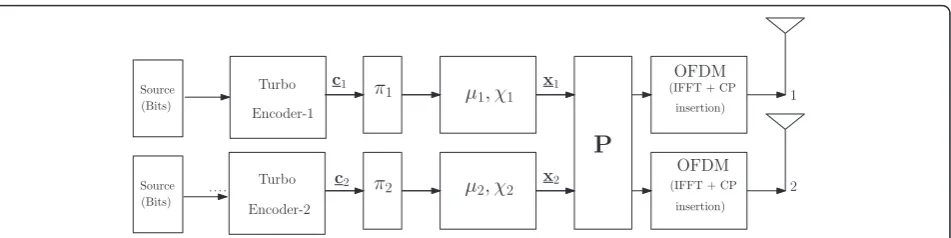
We first consider the system model for transmission mode 5, i.e., the multi-user MIMO mode in which the eNodeB transmits one codeword each to two single-antenna UEs using the same time-frequency resources. Transmitter block diagram is shown in Figure 1. During the transmission for UE-1, the code sequencec1 is inter-leaved by π1 and is then mapped onto the signal sequence x1. x1 is the symbol ofx1 over a signal set
χ1⊆Cwith a Gray-labeling map where |c1| =M1 and
x2 is the symbol of x2 over signal setc2 where |c2| =
M2. The bit interleaver for UE-1 can be modeled asπ1:
k’® (k, i) wherek’denotes the original ordering of the coded bitsck’,kdenotes the RE of the symbolx1,k, andi
indicates the position of the bitck’ in the symbolx1,k.
Note that each RE corresponds to a symbol from a con-stellation mapc1 for UE-1 andc2for UE-2. Selection of the normal or extended cyclic prefix (CP) for each OFDM symbol converts the downlink frequency-selec-tive channel into parallel flat fading channels.
Cascading IFFT at the eNodeB and FFT at the UE with the cyclic prefix extension, the transmission at the
k-th RE for UE-1 in transmission mode 5 can be expressed as
y1,k=h†1,kp1,kx1,k+h†1,kp2,kx2,k+z1,k (3)
where y1,k is the received symbol at UE-1 andz1,k is
zero mean circularly symmetric complex white Gaussian noise of varianceN0.x1,kis the complex symbol for
UE-1 with the variance σ2
1 and x2,kis the complex symbol
for UE-2 with the variance σ2
2. h†n,k∈C1×2symbolizes
the spatially uncorrelated flat Rayleigh fading MISO channel from eNodeB to the n-th UE (n = 1, 2) at the
k-th RE. Its elements can therefore be modeled as inde-pendent and identically distributed (iid) zero mean cir-cularly symmetric complex Gaussian random variables with a variance of 0.5 per dimension. Note thatℂ1 × 2 denotes a 2-dimensional complex space.pn,kdenotes the
precoding vector for the n-th UE at thek-th RE and is given by (1). For the dual-antenna UEs, the system equation for transmission mode 5 is modified as
y1,k=H1,k[p1,kx1,k+p2,kx2,k] +z1,k (4)
wherey1,k,z1,kÎ ℂ2 × 1are the vectors of the received
symbols and circularly symmetric complex white Gaus-sian noise of double-sided power spectral densityN0/2 at the 2 receive antennas of UE-1, respectively.H1,kÎℂ2 × 2
is the channel matrix from eNodeB to UE-1.
In transmission mode 6, only one UE will be served in one time-frequency resource. Therefore, the system equation for single-antenna UEs at thek-th RE is given as
yk=h†kpkxk+zk (5)
where pk is given by (1). For the dual-antenna UEs,
the system equation for mode 6 is modified as
yk=Hkpkxk+zk (6)
3. Multi-user MIMO mode
first consider a geometric scheduling strategy [22] based on the selection of UEs with orthogonal precoders.
A. Scheduling strategy
As the processing at the UE is performed on a RE basis for each received OFDM symbol, the dependency on RE index can be ignored for notational convenience. The system equation for the case of single-antenna UEs for the multi-user mode is
y1=h†1p1x1+h†1p2x2+z1 (7)
The scheduling strategy is based on the principle of maximizing the desired signal strength while minimizing the interference strength. As the decision to schedule a UE in the single-user MIMO, multi-user MIMO or transmit diversity mode will be made by the eNodeB, each UE would feedback the precoder that maximizes its received signal strength. So this selected precoder by the UE would be the one closest to its matched filter (MF) precoder in terms of the Euclidean distance.
For the multi-user MIMO mode, the eNodeB needs to ensure good channel separation between the co-sched-uled UEs. Therefore, the eNodeB schedules two UEs on the same RBs that have requested opposite (orthogonal) precoders, i.e., the eNodeB selects as the second UE to be served in each group of allocatable RBs, one of the UEs whose requested precoder p2 is 180° out of phase from the precoderp1 of the first UE to be served on the
same RBs. So if UE-1 has requestedp1= 1 √ 4
1
q
, qÎ
{±1, ±j}, then eNodeB selects the second UE that has
requested p2= √1 4
1 −q
. This transmission strategy
also remains valid also for the case of dual-antenna UEs where the UEs feedback the indices of the precoding vectors that maximize the strength of their desired sig-nals, i.e., ||Hp||2. For the multi-user MIMO mode, the eNodeB schedules two UEs on the same RE, which have
requested 180° out of phase precoders. The details of this geometric scheduling strategy can be found in [22].
Though this precoding and scheduling strategy would ensure minimization of the interference under the con-straint of low-resolution LTE precoders, the residual interference would still be significant. Single-user detec-tion, i.e., Gaussian assumption of the residual interfer-ence and its subsequent absorption in noise, would lead to significant degradation in the performance. On the other hand, this residual interference is actually discrete belonging to a finite alphabet and its structure can be exploited in the detection process. However, intelligent detection based on its exploitation comes at the cost of enhanced complexity. Here, we propose a low-complex-ity interference-aware receiver structure that on one hand reduces one complex dimension of the system while on the other hand, it exploits the interference structure in the detection process.
B. Low-complexity interference-aware receiver
First, we consider the case of single-antenna UEs. Soft decision of the bitck’ofx1, also known as log-likelihood ratio (LLR), is given as
LLRi1ck|y1,h†1,P
= logp(ck = 1|y1,h † 1,P)
p(ck = 0|y1,h†1,P)
(8)
We introduce the notation i
1(y1,ck) for the bit
metric that is developed on the lines similar to the (7) and 9 in [20], i.e.,
i
1(y1,ck) = logp
ck|y1,h†1,P
≈logpy1|ck,h†1,P
= log
x1∈χ1,ickx2∈χ2
p(y1|x1,x2,h†1,P)
≈ min
x1∈χ1,ick,x2∈χ2 1
N0
y1−h†1p1x1−h†1p2x2 2
(9) Source
Encoder-1
π1
π2
μ1, χ1
μ2, χ2
OFDM
OFDM
(IFFT + CP insertion) (IFFT + CP
insertion) (Bits)
Turbo
Encoder-2 Turbo
1
2 x1
x2
c1
c2 Source
(Bits)
P
whereχ1,ickdenotes the subset of the signal setx1Îc1 whose labels have the valueck’Î{0, 1} in the positioni.
Here, we have used the log-sum approximation, i.e., logjzj= maxjlogzj and this bit metric is therefore
termed as max-log MAP bit metric. As LLR is the dif-ference of two bit metrics and these will be decoded
using a conventional soft-decision Viterbi algorithm, 1
N0 (a common scaling factor to all LLRs) can be ignored thereby leading to
i
h†1p2indicates the
cross-correla-tion between the two effective channels. Here, we have used the relation |a- b|2= |a|2 + |b|2 - 2 (a*b)Rwhere
the subscript (.)Rindicates the real part. Note that the
complexity of the calculation of bit metric (10) is O(|χ1| |χ2|).
In (10), we now introduce two terms as the outputs of
MF, i.e., y¯1=
h†1p1∗y1andy¯2=
h†1p2∗y1. Ignoring |
y1|2 (independent of the minimization operation), the bit metric is written as
i
Note that the subscript (.)I indicates the imaginary
part.
For x1 andx2 belonging to equal energy alphabets,
h†1p1x1
2
andh†1p2x2 2
can be ignored as they are
inde-pendent of the minimization operation. The values ofx2,
R and x2,I that minimize Eq. (11) need to be in the
opposite directions of ψA and ψB, respectively, thereby
avoiding search on the alphabets ofx2 and reducing one complex dimension in the detection, i.e.,
i
As an example, we consider the case of QPSK for
which the values ofx2,Rand x2,Iare
metric is written as
i
For x1 and x2 belonging to non-equal energy
alpha-bets, the bit metric is same as (13) buth†1p1x1
can no longer be ignored thereby leading to
i
Note that the minimization is independent of c2 though x2 appears in the bit metric. The reason of this independence is as follows. The decision regarding the signs ofx2,R andx2,I in (14) will be taken in the same
manner as for the case of equal energy alphabets. For finding their magnitudes that minimize the bit metric (14), it is the minimization problem of a quadratic func-tion, i.e., differentiating (14) w.r.t |x2,R| and |x2,I| to find
the global minima that are given as
|x2,R| → |ψA|
where® indicates the discretization process in which among the finite available points of x2,Rand x2,I, the
point closest to the calculated continuous value is selected. So if x2 belongs to QAM256, then instead of searching 256 constellation points for the minimization of (14), the metric (15) reduces it to merely two opera-tions thereby trimming down one complex dimension in the detection, i.e., the detection complexity is indepen-dent of |c2| and reduces toO(|χ1|).
As a particular example of the discretization of contin-uous values in (15), we consider the case ofx2belonging to QAM16. The values of x2,Rand x2,Ifor the case of
so their magnitudes in
(14) are given as
andI(.) is the indicator function defined as
I(a<b) =
1 ifa<b
0 otherwise
Now we look at the receiver structure for the case of dual-antenna UEs. The system equation for UE-1 (ignor-ing the RE index) is
y1=H1[p1x1+p2x2] +z1 (17)
The receiver structure would remain same with h†1 being replaced by H1, i.e., the channel from eNodeB to the two antennas of UE-1. Subsequentlyy¯1= (H1p1)†y1 and y¯2= (H1p2)†y1are the MF outputs while r12 = (H1p1)†H1p2is the cross-correlation between two effec-tive channels.
For comparison purposes, we also consider the case of single-user receiver, for which the bit metric is given as
i
1(y1,ck)≈ min
x1∈χ1,ick ⎧ ⎪ ⎨ ⎪ ⎩
1
(|ρ12|2σ22+h † 1p1
2
N0)
¯y1−h†1p1 2
x1
2
⎫ ⎪ ⎬ ⎪ ⎭(18)
Table 1 compares the complexities of different recei-vers in terms of the number of real-valued multiplica-tions and addimultiplica-tions for getting all LLR values per RE/ subcarrier. Note thatnrdenotes the number of receive
antennas. This complexity analysis is independent of the number of transmit antennas as the operation of finding effective channels bears same complexity in all receiver structures. Moreover UEs can also directly estimate their effective channels if the pilot signals are also pre-coded. The comparison shows that the complexity of the interference-aware receiver is of the same order as of single-user receiver while it is far less than the com-plexity of the max-log MAP receiver. Figure 2 further shows the performance-complexity trade off of different receivers for multi-user MIMO mode in LTE. The per-formance of the receivers is measured in terms of the SNR at the frame error rate (FER) of 10-2 whereas the complexity is determined from Table 1. It shows that the performance of the single-user receiver is severely degraded as compared to that of the interference-aware receiver. In most cases, the single-user receiver fails to achieve the requisite FER in the considered SNR range.
On the other hand, interference-aware receiver achieves same performance as max-log MAP receiver but with much reduced complexity.
The interference-aware receiver is therefore not only characterized by low complexity but also resorts to intelligent detection by exploiting the structure of resi-dual interference. Moreover, this receiver structure being based on the MF outputs and devoid of any divi-sion operation can be easily implemented in the existing hardware. However, the proposed receiver needs both the channel knowledge and the constellation of interfer-ence (co-scheduled UE). As the UE already knows its own channel from the eNodeB and the requested preco-der, it can determine the effective channel of the inter-ference based on the geometric scheduling algorithm, i. e., the precoder of the co-scheduled UE is 180° out of phase of its own precoder. Consequently there is no additional complexity in utilizing this receiver structure as compared to using single-user receivers except that the UE needs to know the constellation of interference.
4. Information theoretic perspective Sum rate of the downlink channel is given as
I=I(Y1;X1|h†1,P) +I(Y2;X2|h†2,P) (19)
where P = [p1 p2] is the precoder matrix,
IY1;X1|h†1,P
is the mutual information of UE-1 once
it sees interference from UE-2 andI
Y2;X2|h†2,P
is the
mutual information of UE-2 once it sees interference from UE-1. Y1 is the received symbol at UE-1 while X1 is the symbol transmitted by the eNodeB to UE-1. Note that interference is present in the statistics ofY1 andY2. No sophisticated power allocation is employed to the two streams as the downlink control information (DCI) in the multi-user mode in LTE includes only 1-bit power offset information, indicating whether a 3 dB transmit power reduction should be assumed or not. We therefore consider equal-power distribution between the two streams. For the calculation of mutual informa-tion, we deviate from the unrealistic Gaussian assump-tion for the alphabets and consider them from discrete constellations. The derivations of the mutual
Table 1 Comparison of receivers complexity
Receiver Real multiplications Real additions
Interference-aware receiver (equal energy alphabets) 8nr+ 2√M+ 2M 8nr+ 10M+ log(M) - 4 Interference-aware receiver (non equal energy alphabets) 12nr+ 4M+72
√
M 12nr+ 18M+ log(M) - 6
Max-log MAP receiver 2M2n
r+ 8Mnr 6M2nr+ 4Mnr+ log(M) -M2
Single-user receiver (equal energy alphabets) 10nr+ 6 10nr- 3
information expressions for the case of finite alphabets have been relegated to Appendix A for simplicity and lucidity.
We focus on the LTE precoders but to analyze the degradation caused by the low-level quantization and the characteristic of EGT of these precoders, we also consider some other transmission strategies. Firstly, we consider unquantized MF precoder [23] that is given as
p= 1 |h11|2+|h21|2
h11
h21
(20)
For EGT, the unquantized MF precoder is given as
p= √1 2
1
h∗11h21/|h11||h21|
(21)
To be fair in comparison with the geometric schedul-ing algorithm for multi-user MIMO in LTE, we intro-duce a geometric scheduling algorithm for unquantized precoders. We divide the spatial space into four quad-rants according to the spatial angle between h†1andh†2, which is given as
φ= cos−1
⎛ ⎝
h†1h2
||h1|| ||h2||
⎞
⎠ 0◦≤φ≤90◦ (22)
The geometric scheduling algorithm ensures that the eNodeB chooses the second UE to be served on the same RE as the first UE such that their channelsh†1and h†2lie in the opposite quadrants.
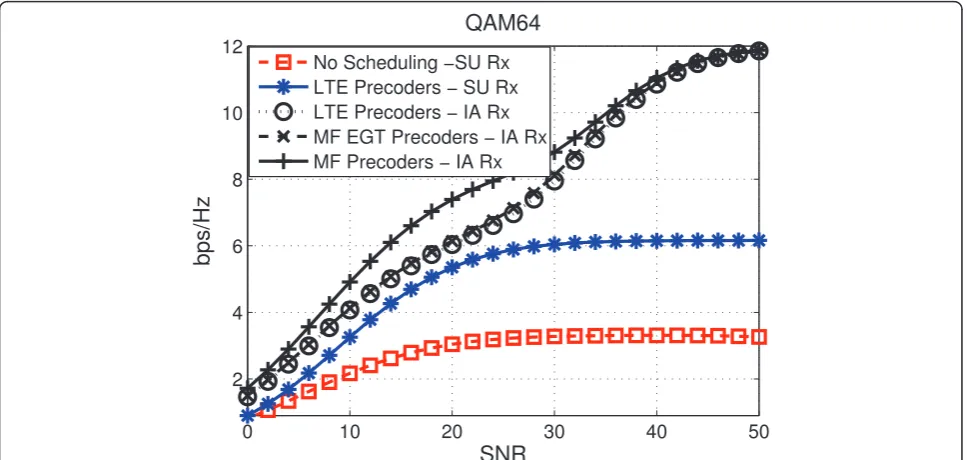
Figure 3 shows the sum rates of a broadcast channel with the dual-antenna eNodeB and two single-antenna UEs for QAM64 alphabets. SNR is the transmit SNR,
i.e., σ 2
1||p1||2+σ22||p2||2
N0
whereas the two UEs have
101 102 103 104 0
5 10 15 20 25 30 35 40
Number of real−valued multiplications for LLR per RE
SNR (dB) @ FER=10
−2
QPSK
QAM16
QAM64
Single−user Rx Interference−Aware Rx Max−log MAP Rx
Figure 2eNodeB has two antennas. Continuous lines indicate the case of single-antenna UEs while dashed lines indicate dual-antenna UEs. 3GPP LTE rate 1/2 punctured turbo code is used. Simulation settings are same as in the first part of Sec. 6.
0 10 20 30 40 50
2 4 6 8 10 12
SNR
bps/Hz
QAM64
No Scheduling −SU Rx LTE Precoders − SU Rx LTE Precoders − IA Rx MF EGT Precoders − IA Rx MF Precoders − IA Rx
Figure 3Sum rates of different transmission schemes for the downlink channel with dual-antenna eNodeB and 2 single-antenna UEs.
equal-power distribution, i.e.,σ12=σ22, MF and MF EGT precoders are the unquantized precoders given in (20) and (21), respectively, while LTE precoders are the quantized precoders given in (1). The sum rates of unquantized precoders along with those of LTE quan-tized precoders are shown for the case of single-user receivers and for the case of low-complexity interfer-ence-aware receivers. The results show that under the proposed transmission strategy, the sum rate can be sig-nificantly improved (unbounded in SNR) if the low-complexity interference-aware receivers are used as compared to the case when the UEs resort to sub-opti-mal single-user detection where rates are bounded (in SNR). The behavior of single-user detection is attributed to the fact that this detection strategy considers inter-ference as noise so the SINR is low once no geometric scheduling has been employed by the eNodeB while the SINR improves due to the reduction of interference once geometric scheduling is employed. However, the rates remain bounded in the SNR if the UEs resort to the single-user detection that is due to the fact that increasing the SNR (transmit SNR) also increases the interference strength thereby bounding the SINR at high values of the transmit SNR. On the other hand, there is significant improvement in the sum rate once UEs resort to intelligent detection by employing the low-complexity interference-aware receivers. In this case, the sum rate is unbounded if the rate (constella-tion size) of each UE is adapted with the SNR. Note that the quantized CSIT (LTE precoders) appears to have no effect at high SNR once UEs resort to intelli-gent interference-aware detection. This behavior is because the rate is not adapted with the SNR in these simulations, i.e., the constellation size is fixed to QAM64 and is not increased with the increase in the SNR. At high SNR, the rate of each UE gets saturated to its constellation size (six bits for QAM64) if the UE resorts to intelligent interference-aware detection. How-ever, the approach to this saturation point (slope of the rate curve) depends on the quantization of channel information.
Another interesting result is the effect of the two characteristics of LTE precoders, i.e., low resolution and EGT. There is a slight improvement in the sum rate at medium SNR when the restriction of low resolution (LTE quantized precoders) is relaxed, i.e., eNodeB employs MF EGT precoders; however, there is a signifi-cant improvement in the sum rate when the restriction of EGT is eliminated, i.e the eNodeB employs MF pre-coders. This shows that the loss in spectral efficiency due to the employment of LTE precoders is mainly attributed to the EGT rather than their low resolution (quantization).
5. Performance analysis
We now focus on the EGT characteristic of the LTE precoders and carry out the performance analysis of the EGT in single-user and multi-user MIMO systems. We restrict to the case of single-antenna UEs while the eNo-deB has two antennas. For single-user case, the received signal at thek-th RE is given by
y1,k=h†1,kp1,kx1,k+z1,k (23)
For EGT, the precoder vector is given by
p1,k= √1 2
1 h21,kh
∗
11,k
|h21,k||h11,k|
T
. So the received signal
after normalization by h11,k |h11,k|
is given by
yN1,k= √1
2(|h11,k|+|h21,k|)x1,k+
h11,k
|h11,k|
z1,k (24)
where yN
1,k=
h11,k
|h11,k|
y1,k. The PEP has been derived in
Appendix B and is given as
P(c1→ ˆc1)≤ 1 2
dfree
⎛ ⎜ ⎜ ⎜ ⎜ ⎜ ⎝
48
d
2
1,min
σ2 1
N0
!"2
⎞ ⎟ ⎟ ⎟ ⎟ ⎟ ⎠
(25)
where d2
1,minis the normalized minimum distance of the constellationc1,dfree is the free distance (minimum Hamming distance) of the code. Note thatc1andcˆ1are the correct and error codewords, respectively. Eq. 25 clearly shows full diversity of the EGT for single-user MIMO. Note that this result was earlier derived in [16] but was restricted to the case of BPSK. The same result was derived in [17] for EGT in MIMO systems using the approach of metrics of diversity order. Here, we have generalized this result and have adopted the nat-ural approach of pairwise error probability to show the diversity order. Analysis of the EGT for multi-user MIMO system seemingly does not have closed form solution so we shall resort to the simulations for its ana-lysis in Sec. 6.
6. Simulation results
the transmission mode 5 (multi-user MIMO) do not include the information of the constellation of the co-scheduled UE. Third part looks at the diversity order of the EGT in both single-user and multi-user MIMO modes in LTE.
For the first part (Figures 4 and 5), we consider the downlink of 3GPP LTE that is based on BICM OFDM transmission from the eNodeB equipped with two antennas using rate-1/3 LTE turbo code [24] with rate matching to rate 1/2 and 1/4. We deliberate on both the cases of single and dual-antenna UEs. We consider an ideal OFDM system (no ISI) and analyze it in the fre-quency domain where the channel has iid Gaussian
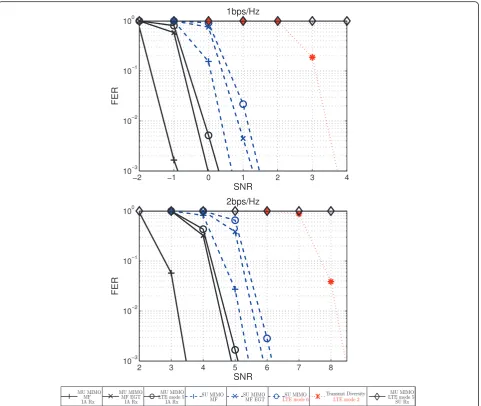
matrix entries with unit variance and is independently generated for each channel use. We assume no power control in the multi-user MIMO mode so two UEs have equal-power distribution. Furthermore, all mappings of the coded bits to QAM symbols use Gray encoding. We focus on the FER while the frame length is fixed to 1,056 information bits. As a reference, we consider the fall-back transmit diversity scheme (LTE mode 2– Ala-mouti code) and compare it with the single-user and multi-user MIMO modes employing single-user recei-vers and low-complexity interference-aware receirecei-vers. To analyze the degradation caused by the low resolution and EGT of LTE precoders, we also look at the system
−2 −1 0 1 2 3 4
10−3 10−2 10−1 100
SNR
FER
1bps/Hz
2 3 4 5 6 7 8
10−3 10−2 10−1 100
SNR
FER
2bps/Hz
MU MIMO
MF MU MIMOMF EGT LTE mode 5MU MIMO SU MIMOMF SU MIMOMF EGT LTE mode 6SU MIMO Transmit DiversityLTE mode 2 IA Rx
IA Rx IA Rx
MU MIMO LTE mode 5 SU Rx
performance employing the unquantized MF and unquantized MF EGT precoders. To be fair in the com-parison of the LTE multi-user MIMO mode (mode 5) employing the geometric scheduling algorithm with the multi-user MIMO mode employing unquantized MF and MF EGT precoders, we consider the geometric scheduling algorithm (Sec. 4) based on the spatial angle between the two channels (22). Perfect CSIT is assumed for the case of MF and MF EGT precoding while error free feedback of two bits (PMI) to the eNodeB is assumed for LTE precoders. It is assumed that the UE has knowledge of the constellation of co-scheduled UE in the multi-user MIMO mode. It is further assumed that the UE knows its own channel from the eNodeB. So in multi-user MIMO mode, the UE can find the effective interference channel based on the fact that the eNodeB schedules the second UE on the same RE
whose precoder is 180° out of phase of the precoder of the first UE. Figure 4 shows the results for the case of single-antenna UEs. It shows enhanced performance of the multi-user MIMO mode once the UEs resort to intelligent detection by employing the low-complexity interference-aware receivers. The performance is severely degraded once the UEs resort to single-user detection. An interesting result is almost the equivalent performance of the unquantized MF EGT and low-reso-lution LTE precoders, which shows that the loss with respect to the unquantized CSIT is attributed to the EGT rather than the low resolution of LTE precoders. Performance degradation is observed for LTE multi-user MIMO mode for higher spectral efficiencies. Figure 5 shows the results for the case of dual-antenna UEs and focuses on different LTE modes employing LTE preco-ders. It shows that single-user detection performs close to interference-aware detection at low spectral efficien-cies once UE has two antennas; however, its perfor-mance degrades at higher spectral efficiencies. This behavior is attributed to the fact that the rate with sin-gle-user detection gets saturated at high SNR due to the increased interference strength as was shown in Sec. 4. So the performance of single-user detection degrades for high spectral efficiencies as these spectral efficiencies are higher than the rate or mutual information of the sin-gle-user detection. For sinsin-gle-user MIMO (Mode 6), there is no saturation of the rate at high SNR as there is no interference. So mode 6 performs better than mode 5 at high SNR for higher spectral efficiencies once UEs employ single-user detection. However, if UEs resort to the intelligent interference-aware detection, the multi-user MIMO mode shows enhanced performance over other transmission modes in LTE. No degradation of LTE multi-user MIMO mode is observed at higher spec-tral efficiencies once UEs have receive diversity (dual antennas).
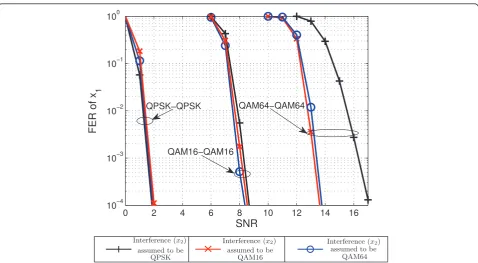
In the second part of simulations, we look at the sen-sitivity of the proposed receiver structure to the knowl-edge of the constellation of co-scheduled UE for the multi-user MIMO mode in LTE. The simulation settings are same as of the first part except that we consider the case when UE has no knowledge of the constellation of co-scheduled UE. The UE assumes this unknown inter-ference constellation to be QPSK, QAM16, or QAM64, and the results for these different assumptions are shown in Figure 6. Results show that there is negligible degradation in the performance of the proposed receiver if the interfering constellation is assumed to be QAM16 or QAM64. However, there is significant degradation if the interference is assumed to be QPSK when it actually comes from QAM64. It indicates that assuming interfer-ence to be from a higher order modulation among the possible modulation alphabets leads to the best
0 1 2 3 4 5 10−4
10−3 10−2 10−1 100
SNR
FER
2bps/Hz
Mode 5 − IA Mode 5 − SU Mode 4 Mode 6 Mode 2
6 7 8 9 10 11 12 13 14 15 10−4
10−3 10−2 10−1 100
SNR
FER
4bps/Hz
Mode 5 − IA Mode 5 − SU Mode 4 Mode 6 Mode 2
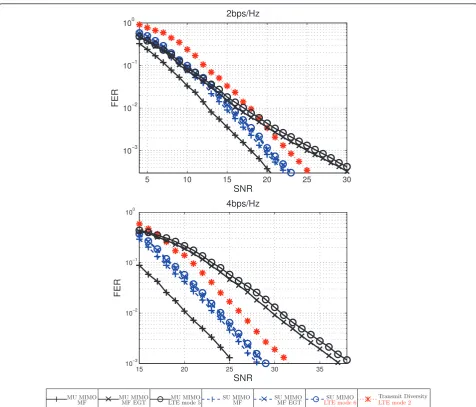
compromise as this assumption includes the lower mod-ulation orders as special cases (with proper scaling). However, the converse is not true, i.e., assuming inter-ference from lower modulation order cannot include higher order modulations. As LTE and LTE-Advanced restrict the transmission to three modulations (QPSK, QAM16, and QAM64), assuming interference to be QAM64 (or even QAM16) leads to better performance. The proposed receiver structure, therefore, can still exploit the discrete nature of the interference even if it does not know its modulation order. As the complexity of this receiver structure is independent of the constella-tion of interference, the assumpconstella-tion of higher order modulation does not add to the complexity of detection. In the third set of simulations, we look at the diversity order of the single-user MIMO and multi-user MIMO schemes in LTE. The system settings are same as in the first part, but now we consider slow fading environment, i.e., the channel remains constant for the duration of one codeword. Figure 7 shows that the MF precoders have full diversity both in multi-user MIMO and single-user MIMO modes. However, once the constraint of EGT is imposed on the MF precoders, multi-user MIMO mode loses diversity while single-user MIMO still exhibits full diversity, which is in conformity with the analytical results of Sec. 5. This fundamental result holds even when the low-level quantization of LTE is imposed on these EGT precoders. Earlier conclusion
that the performance loss in the multi-user MIMO mode in LTE is attributed to the EGT rather than the low resolution of LTE precoders is further confirmed. These results give a general guideline for the possible employment of the single-user MIMO and multi-user MIMO in LTE under different environments. Once not enough diversity is available in the channel, single-user MIMO is the preferred option while multi-user MIMO is the possible choice once the channel is rich in diversity.
7. Design of LTE precoder codebook with additional feedback
It was shown in the information theoretic analysis and was subsequently confirmed in the simulations that the loss in spectral efficiency due to the low-level quantized CSIT (LTE precoders) in the multi-user MIMO mode is more attributed to the EGT of the LTE codebook rather than its low resolution. It was also shown that EGT loses diversity in the multi-user MIMO mode. Focusing on these fundamental results, we now look at the design of the precoder codebook for future standardizations of LTE. Feedback of CSIT is expected to increase in these forthcoming wireless systems. However, the complexity associated with the feedback overhead combined with the low rate feedback channels would allow only a lim-ited increase in the feedback. We therefore consider the case of two additional feedback bits for the quantized
0 2 4 6 8 10 12 14 16
10−4 10−3 10−2 10−1 100
SNR
FER of x
1
QAM64−QAM64 QPSK−QPSK
QAM16−QAM16
Interference (x2)
assumed to be QAM16
assumed to be
QAM64 assumed to be
QPSK
Interference (x2) Interference (x2)
Figure 6Interference sensitivity for the multi-user MIMO mode in LTE. Three sets of simulations are shown. QPSK-QPSK indicates that both
CSIT (precoder codebook) and look how these addi-tional bits can be efficiently employed.
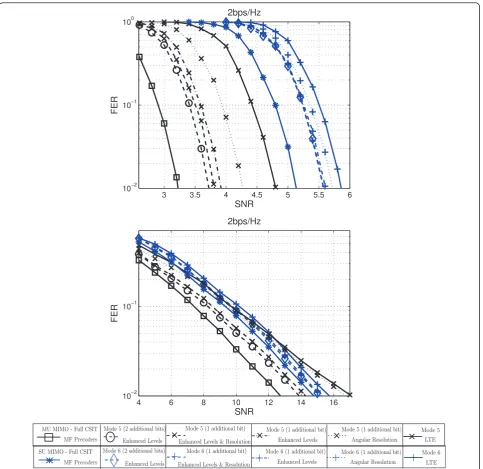
We consider two options for the employment of these additional feedback bits as illustrated in Figure 8. As the LTE precoder is [1 exp(jθ)]T, so additional bits can be used to increase the angular resolution ofθ, i.e., more points on the unit circle but restricting to EGT as shown in Figure 8a. Another option is to increase the levels of transmission, i.e., the additional feedback bits are used by the UE to indicate an increase of the power level on either of the two antennas as [1 2 exp(jθ)]Tor [2 exp(jθ) 1]T.
With this new precoding codebook design, the earlier described scheduling strategy remains same, i.e., for a UE to be scheduled in the multi-user MIMO mode, the eNodeB selects the second UE to be served on the same
time-frequency resources (co-scheduled UE) such that the desired signal strength is maximized while interfer-ence strength is minimized for both the UEs. So if UE-1 has requested the precoder p1, the eNodeB finds the precoding vectorp2 in the codebook, which minimizes their cross-correlation(p†1p2)and then schedules the second UE with UE-1, which has requested p2 as its desired precoding vector. The receiver structure being independent of the codebook design also remains same for these new precoding codebooks.
We now look at the effect of two additional bits of feedback for PMI on the performance. We focus on the two options of improved angular resolution and addi-tional levels of transmission. The simulation settings are same as of the previous section. Figure 9 illustrates the performance both in fast and slow fading channels.
5 10 15 20 25 30
10−3 10−2 10−1 100
SNR
FER
2bps/Hz
15 20 25 30 35 10−3
10−2 10−1 100
SNR
FER
4bps/Hz
MU MIMO
MF MU MIMOMF EGT LTE mode 5MU MIMO SU MIMOMF SU MIMOMF EGT LTE mode 6SU MIMO Transmit DiversityLTE mode 2
These results show significant improvement in the per-formance of the multi-user MIMO mode when the addi-tional feedback bits are employed to increase the levels of transmission as compared to the case of increasing the angular resolution. The performance is within 1.7 dB of the lower bound where lower bound is the perfor-mance curve for MF precoder without any interference. In slow fading environment, the change of the slope of FER curve with increased levels of transmission indi-cates improved diversity as compared to the case of increased angular resolution. On the other hand, little gain is observed in the single-user mode with additional feedback bits, which is expected as the standard LTE precoders have been optimized for the single-user trans-mission. These results indicate that the design of preco-ders for the forthcoming versions of LTE should consider increasing transmission levels rather than enhancing the angular resolution of the precoders. This
proposed design is not merely restricted to the frame-work of LTE but gives fundamental design guidelines for precoding in modern wireless systems.
8. Conclusions
In this paper, we have looked at the feasibility of the multi-user MIMO for future wireless systems that are characterized by low-level quantization of CSIT. We have shown that multi-user MIMO can deliver its pro-mised gains if the UEs resort to intelligent detection rather than the sub-optimal single-user detection. To this end, we have proposed a low-complexity interfer-ence-aware receiver structure that is characterized by the exploitation of the structure of residual interfer-ence. We have analyzed two important characteristics of the LTE precoders, i.e., low resolution and EGT. We have shown that the performance loss of the LTE precoders in the multi-user MIMO mode is attributed to their characteristic of EGT rather than their low resolution. We have further shown that the EGT is characterized by full diversity in the single-user MIMO mode but it loses diversity in the multi-user MIMO. Based on these fundamental results, we have proposed a design of the precoder codebook for forthcoming standardizations of LTE incorporating more levels of transmission.
Appendix A
Mutual information for finite alphabets
The mutual information for UE-1 for finite size QAM constellation with |c1| = M1 takes the form as
IY1;X1|h†1,P
=HX1|h†1,P
−HX1|Y1,h†1,P
= logM1−H(X1|Y1,h†1,P)
(26)
whereH(.) =−Elogp(.)is the entropy function. The second term of (26) is given as
H(X1|Y1,h†1,P) = x1
#
y1
#
h†
1p1
#
h†
1p2
p(x1,y1,h†1p1,h†1p2) log
1 p(x1|y1,h†1p1,h†1p2)
dy1d(h†1p1)d(h†1p2)
=
x1 x2
#
y1
#
h†
1p1
#
h†
1p2
p(x1,x2,y1,h†
1p1,h†1p2) log
x1
x2p(y1|x
1,x2,h
†
1p1,h†1p2)
x2p(y1|x1,x
2,h†1p1,h†1p2)
dy1d(h†
1p1)d(h†1p2)
(27)
wherex1∈χ1and x2∈χ2. Conditioned on the chan-nel and the precoder, there is one source of random-ness, i.e., noise. So (27) can be extended as
H(X1|Y1,h†1,P) =
1 M1M2 x
Ez1log
x’exp
−N1
0
h†
1p1x1+h†1p2x2+z1−h†1p1x1−h
†
1p2x2 2
x 2exp
−N1
0
h†
1p2x2+z1−h†1p2x2 2
= 1 M1M2 x
Ez1log
x’exp
−N1
0
h†
1P(x−x’) +z1 2
x 2exp
−N1
0
h†
1P(x−x2) +z1
2
(28)
where M2 = |c2|, x = [x1 x2]T, x’= [x1x2]T and
x2= [x1x2]T. The mutual information for UE-1 can be rewritten as
1 −1
1 −1
j
−j
−j j
(a)
2 −2
2j
−2j
1
j
−j
−1
(b)
2 −2
2j
−2j 1
j
−j
−1
(c)
I(Y1;X1|h†1,P) = logM1−
1 M1M2 x
Ez1log
x’p
y1|x’,h†1,P
x2p
y1|x2,h † 1,P
(29)
I(Y;X1|h†
1p1,h†
1p2) = logM1−
1 M1M2NzNh1x1x2
Nh1 h1 Nz z1
log
x1
x2exp
−N1
0
y1−h†
1p1x1−h†1p2x2 2
x2exp
−N1
0
y1−h†
1p1x1−h†
1p2x2 2
= logM1−
1 M1M2NzNh1x1x2
Nh1 h1 Nz z1
log
x1
x2exp
−N1
0
h†
1p1x1+h†
1p2x2+z1−h†
1p1x 1−h
†
1p2x 2
2
x2exp
−N1
0
h†
1p2x2+z1−h†
1p2x 2
2
(30)
The above quantities can be easily approximated using sampling (Monte-Carlo) methods withNzrealizations of
noise andNh1realizations of the channelh †
1where the precoding matrix depends on the channel. So we can rewrite (29) as (30).
Similarly the mutual information for UE-2 is given as
I(Y2;X2|h†2,P) = logM2−
1 M1M2 x
Ez2log
x’p
y2|x’,h†2,P
x
1p
y2|x1,h † 2,P
(31)
wherex1= [x1x2]T.
3 3.5 4 4.5 5 5.5 6
10−2 10−1 100
SNR
FER
2bps/Hz
4 6 8 10 12 14 16
10−2 10−1
SNR
FER
2bps/Hz
Mode 5 (1 additional bit) Mode 5
Mode 6 Enhanced Levels
Mode 5 (1 additional bit)
Angular Resolution
Mode 6 (1 additional bit)
Enhanced Levels
Mode 6 (1 additional bit)
Angular Resolution
LTE
LTE Mode 5 (1 additional bit)
Enhanced Levels & Resolution
Mode 6 (1 additional bit)
Enhanced Levels & Resolution Mode 5 (2 additional bits)
Enhanced Levels
Mode 6 (2 additional bits)
Enhanced Levels MU MIMO - Full CSIT
MF Precoders
MF Precoders SU MIMO - Full CSIT
For the case of single-user MIMO mode, the mutual information is given by
I(Y1;X1|h†1,p1) = logM1−H
X1|Y1,h†1,p1
(32)
where the second term is given by
HX1|Y1,h†1,p1
where Nh1are the number of channel realizations of the channel h†1. Note that the precoding vector p1 is dependent on the channelh†1.
Appendix B
Diversity analysis of EGT in single-user MIMO Consider the system equation 24, i.e.,
yN1,k= √1
be written as
i
where H¯1indicates the complete channel from the eNodeB to UE-1 for the transmission of the codeword c1. Assumed(c1− ˆc1) =dfreeforc1and cˆ1under consid-eration for the PEP analysis, which is the worst case sce-nario between any two codewords. Therefore, the inequality on the right hand side of (36) shares the same terms on all butdfreesummation points and the summa-tions can be simplified to only dfree terms for which
ˆ this leads to PEP being given as
P(c1→ ˆc1| ¯H1)≤P
where we have used Chernoff bound
Q(x)≤ 1 2exp
−x2 2
!
. Averaging over channel leads to
P(c1→ ˆc1)≤1
Eq. 39 follows from the channel independence at each RE that is the consequence of the interleaving operation.
Here we have used the notation d2
1,min=σ12d 2
1,minwith
d
2
1,minbeing the normalized minimum distance of the constellationc1. Using the moment generating function (MGF) of the SNR at the output of two branch EGC as per equations (2) and (23) in [25], PEP at high SNR is upper bounded as
Using the identitycos−1(x) = π xcloser to 1, a case that shall be occurring at high SNR in (41), first term will be dominant, i.e.,
cos−1
In the expansion of
&
terms will be dominant at high SNR thereby leading to
&
So rewriting (40), we get
P(c1→ ˆc1)≤1
At high SNR, second term converges to 4
while the third term converges to −4
PEP at high SNR is upper bounded as
P(c1→ ˆc1)≤
Eurecom’s research is partially supported by its industrial partners: BMW, Bouygues Telecom, Cisco Systems, France Télécom, Hitachi Europe, SFR, Sharp, ST Microelectronics, Swisscom, Thales. The research work leading to this paper has also been partially supported by the European Commission under SAMURAI and IST FP7 research network of excellence NEWCOM++.
Competing interests
The authors declare that they have no competing interests.
References
1. IE Telatar, Capacity of multiantenna Gaussian channels. Eur Trans Telecommun.10(6), 585–595 (1999). doi:10.1002/ett.4460100604 2. D Gesbert, M Kountouris, R Heath, C-B Chae, T Salzer, Shifting the MIMO
paradigm. IEEE Signal Process Mag.24(5), 36–46 (2007)
3. D Love, R Heath, V Lau, D Gesbert, B Rao, M Andrews, An overview of limited feedback in wireless communication systems. IEEE J Sel Areas Commun.26(8), 1341–1365 (2008)
4. LTE,Evolved Universal Terrestrial Radio Access (E-UTRA); Physical Channels and Modulation, Release 8, V.8.6.0.3GPP TS 36.211 (2009)
5. S Sesia, I Toufik, M Baker,LTE, The UMTS Long Term Evolution: From Theory to Practice(Wiley, New York, 2009)
6. R Ghaffar, R Knopp, Linear precoders for multiuser MIMO for finite constellations and a simplified receiver structure under controlled interference, inAsilomar Conference on Signals, Systems and Computers
(2009)
7. S Verdu,Multiuser Detection(Cambridge University Press, Cambridge, 1998) 8. L Brunel, Multiuser detection techniques using maximum likelihood sphere decoding in multicarrier CDMA systems. IEEE Trans Wirel Commun.3(3), 949–957 (2004). doi:10.1109/TWC.2004.827742
9. R Lupas, S Verdu, Linear multiuser detectors for synchronous code-division multiple-access channels. IEEE Trans Inf Theory.35(1), 123–136 (1989). doi:10.1109/18.42183
10. B Zarikoff, J Cavers, S Bavarian, An iterative groupwise multiuser detector for overloaded MIMO applications. IEEE Trans Wirel Commun.6(2), 443–447 (2007)
11. X Wang, H Poor, Iterative (turbo) soft interference cancellation and decoding for coded CDMA. IEEE Trans Commun.47(7), 1046–1061 (1999). doi:10.1109/26.774855
12. R de Lamare, R Sampaio-Neto, Minimum mean-squared error iterative successive parallel arbitrated decision feedback detectors for DS-CDMA systems. IEEE Trans Commun.56(5), 778–789 (2008)
13. JW Choi, A Singer, J Lee, NI Cho, Improved linear soft-input soft-output detection via soft feedback successive interference cancellation. IEEE Trans Commun.58(3), 986–996 (2010)
14. X Li, A Chindapol, J Ritcey, Bit-interleaved coded modulation with iterative decoding and 8 PSK signaling. IEEE Trans Commun.50(8), 1250–1257 (2002). doi:10.1109/TCOMM.2002.801524
15. M Speth, A Jansen, H Meyr, Iterative multiuser detection for bit interleaved coded modulation, inIEEE International Conference on Communications, ICC 2000.2, 894–898 (2000)
16. Q Zhang, Probability of error for equal-gain combiners over Rayleigh channels: some closed-form solutions. IEEE Trans Commun.45(3), 270–273 (1997). doi:10.1109/26.558680
17. D Love, R Heath Jr, Equal gain transmission in input multiple-output wireless systems. IEEE Trans Commun.51(7), 1102–1110 (2003). doi:10.1109/TCOMM.2003.814195
18. R Ghaffar, R Knopp, Diversity analysis of equal gain transmission for singleuser and multiuser MIMO, inIEEE Global Communications Conference, Globecomm 2010,Miami (Dec. 2010)
19. LTE,Evolved Universal Terrestrial Radio Access (E-UTRA); Physical Layer Procedures, Release 8, V.8.6.0.3GPP TS 36.213 (2009)
20. G Caire, G Taricco, E Biglieri, Bit-interleaved coded modulation. IEEE Trans Inf Theory.44(3), 927–946 (1998). doi:10.1109/18.669123
21. S Alamouti, A simple transmit diversity technique for wireless communications. IEEE J Sel Areas Commun.16(8), 1451–1458 (1998). doi:10.1109/49.730453
22. R Ghaffar, R Knopp, Making Multiuser MIMO work for LTE, inIEEE 21-st International Symposium on Personal, Indoor and Mobile Radio Communications (PIMRC 2010),Istanbul (September 2010)
23. R Zakhour, ZKM Ho, D Gesbert, Distributed beamforming coordination in multicellular MIMO systems, inIEEE 69th Vehicular Technology Conference, VTC-Spring. April, 26-29, 2009, Barcelona, Spain(Dec. 2009)
24. LTE, Evolved Universal Terrestrial Radio Access (E-UTRA); Channel Coding and Multiplexing, Release 8, V.8.6.0. 3GPP TS 36.212 (2009)
25. X Qi, M-S Alouini, Y-C Ko, Closed-form analysis of dual-diversity equal-gain combining over Rayleigh fading channels. IEEE Trans Wirel Commun.2(6), 1120–1125 (2003). doi:10.1109/TWC.2003.819027
26. I Gradshteyn, I Ryzhik,Table of Integrals, Series, and Products(Academic Press, San Diego, 2000)
doi:10.1186/1687-1499-2011-40
Cite this article as:Ghaffar and Knopp:Interference-aware receiver
structure for multi-user MIMO and LTE.EURASIP Journal on Wireless Communications and Networking20112011:40.
Submit your manuscript to a
journal and benefi t from:
7 Convenient online submission
7 Rigorous peer review
7 Immediate publication on acceptance
7 Open access: articles freely available online
7 High visibility within the fi eld
7 Retaining the copyright to your article