R E S E A R C H
Open Access
HCOR: a high-throughput coding-aware
opportunistic routing for inter-flow network
coding in wireless mesh networks
Long Hai, Hongyu Wang
*, Jie Wang and Zhenzhou Tang
Abstract
Coding-aware routing is an effective approach to create more coding opportunities in inter-flow network coding. To the best of our knowledge, most of the coding-aware routing schemes focus on maximizing the coding
opportunities. However, for opportunistic transmission, the throughput is not always increased with the increase of coding opportunities. In this paper, we explore why this case will happen and how to measure the benefits of network coding in the opportunistic routing. According to the above conclusions, we propose a novel
high-throughput coding-aware opportunistic routing (HCOR) to achieve the maximal throughput gain in wireless mesh networks. HCOR is based on anypath routing and takes advantage of the network coding gain to find out the route with minimal anypath cost reasonably. Meanwhile, it is also a ‘multihop’ network coding and changes the route with dynamical data loads adaptively. Simulation results demonstrate that HCOR has better performance than coding opportunity-aware routing and also obtains a significant throughput gain in wireless mesh networks.
Keywords: Inter-flow network coding; Opportunistic routing; Coding-aware routing; ‘Multihop’ network coding
1 Introduction
Network coding (NC) is gaining popularity as a new trans-mission method that can improve network performance in terms of increasing throughput at the coding level. NC was first proposed by Ahlswede et al. [1] in 2000, and is basically classified into two types. One is called intra-flow network coding (IANC) which encodes mul-tiple packets belonging to the same flow. The other is called inter-flow network coding (IRNC) which encodes multiple packets from different flows. IANC is a kind of reliable transmission method. Forn native packets sent from one flow, the sources and intermediate nodes are allowed to encode these packets together before send-ing them to the destinations. The generated encoded packets are redundant against lossy links until the destina-tion receives and decodesnindependent encoded packets for recovering all native packets. By doing this, packet losses are masked and data transmissions are robust [2].
*Correspondence: [email protected]
Faculty of Electronic Information and Electrical Engineering, DUT, Linggong Road, Dalian 116024, China
Different from IANC, IRNC is an efficient transmission method. Intermediate nodes encode the native packets from different flows and broadcast the encoded packets to different destinations. By exploiting the broadcast nature of wireless channel, destinations can overhear some of side information of the encoded packets before decod-ing them. So the coddecod-ing nodes can broadcast the encoded packets to different destinations for different flows at the same time. By making use of thisfree-ride transmis-sion [3], IRNC saves many time slots to send different flows at intermediate nodes simultaneously. In this paper, we only focus on and discuss IRNC. So the term ‘net-work coding’ which appears in the following only means IRNC.
Much work points out that the benefits of network coding are different for the same flow by using different routes. So the question of how to find out the best route with network coding is still open until now. Most of the coding-aware routing schemes are based on determinis-tic routing protocols [3,4]. Due to the characterisdeterminis-tic of network coding, these schemes cannot work well when the data flows change frequently. The reason is that route
must be preprogrammed in deterministic routing pro-tocols. However, network coding depends on the flows and routes simultaneously. So doing coding-aware rout-ing in deterministic routrout-ing protocols must bind flows and routes together. This causes low stability of routes when the state of flows (such as on or off, or the rate of flow) is changed frequently. For example, assume that the best NC-aware route is Ra for flowato be encoded with flowb. When flowbis end,Ramay not be the best route for a. The follow-on problems are that high delay will be caused if a does the rerouting at this time or the throughput will be degraded ifa still usesRa as its route.
Network coding-aware opportunistic routing (NCOR) has been proposed recently [5-8]. Unlike classical deter-ministic routing, opportunistic routing (OR) always finds potentially feasible paths as the route. In OR, every packet is forwarded by a forwarding list which is com-posed of the neighbors closer to the destination. Hence, unstable routing problem can be solved in opportunistic routing. Meanwhile, due to the forwarding list adopted, which means many nexthops can be considered in a coding structure, more coding opportunities may be found in an opportunistic transmission. Conventional NCOR schemes [5,8] only consider the maximum cod-ing opportunities as the selection mechanism for the coding node. For example, the authors in [5] propose that they use the number of the neighbor nodes that can decode a coding pattern as the coding gains of that coding pattern. In IRNC, the maximum number of the neighbor nodes that can be the decoding nodes sug-gests the maximum coding opportunities. The authors in [8] claim that if a node with the most coding oppor-tunities can be chosen as the forwarder in each packet transmission, the throughput of network will be greatly improved as a result. From our study, however, this mechanism is not very suitable for incorporating NC into OR. When multiple packets are encoded together, the receivers of this encoded packet should be deter-mined. After that, the set of ‘new receivers’ may be possibly shrunken from the set of original receivers. As we know, the shrinkage of a forwarding list will reduce the transmission gain in an opportunistic transmission. So in this case, is the network coding still beneficial for this transmission? How should we decide which is the best choice, coding or not? In addition, if we con-sider the gain of opportunistic transmission in doing network coding, how to determine the forwarder list is complicated.
In this paper, aiming to address the above problems, we study the network coding in anypath routing [9] which provides a calculation method to compute the gain of opportunistic transmission. Our main contributions are summarized as follows:
• According to the definition and coding condition of IRNC, we figure out two following solutions to help design a coding-aware opportunistic routing. The first is which nodes should be in the forwarding list for sending an encoded packet. The second is how to measure the price of network coding in an
opportunistic transmission.
• We propose a novel coding-aware opportunistic routing scheme called HCOR, which is based on anypath routing and finds out theminimal anypath cost path as the route with network coding. Compared with conventional NCOR schemes, HCOR is more feasible on choosing the coding opportunities. Meanwhile, HCOR is designed on a ‘multihop’ network coding structure, in which much more coding opportunities can be collected than with a ‘local’ coding structure [3].
• We implement the HCOR scheme in ns-2 and carry out extensive evaluation to show the performance of HCOR.
The remainder of this paper is organized as follows. Section 2 reviews some related work. Section 3 is the overview of HCOR. In Section 4, we show some basic knowledge and key technologies used in this paper. In Section 5, we discuss the characteristic of incorporat-ing NC into opportunistic routincorporat-ing and give a comput-ing method to calculate the cost of network codcomput-ing. We present the details of HCOR implementation in Section 6. The simulations performed to evaluate the performance of HCOR are discussed in Section 7. Finally, we conclude this paper in Section 8.
2 Related work
analyzed the trade-off between delay and throughput for opportunistic network coding in a two-way relay network [23]. Yang et al. gave a study of binary multiuser NC to improve the symbol error probability in a N-way relay network [24].
Coding-aware routing has been regarded as an effec-tive approach to aceffec-tively create more coding opportunities [3-5,25-27]. In [25] and [27], authors proposed coding-aware routing methods based on COPE. Their methods detect coding opportunities from a ‘local’ coding struc-ture. In [3], authors proposed a coding-aware routing method called distributed coding-aware routing (DCAR) based on (dynamic source routing) DSR [28] routing pro-tocol. DCAR works in more general cases than the COPE-based method. The coding opportunities are detected in the routing process. So more coding opportunities can be detected from ‘multiple’ coding structure. Free-ride-oriented routing metric (FORM) [4] is a variation of DCAR and also works on multiple coding structure. Most of the above coding-aware routing schemes are focused on the deterministic routing protocols. Recently, network coding-aware opportunistic routing schemes were pro-posed to achieve more throughput in wireless networks [5,8,29-31]. Authors of CORE [5] proposed an NCOR method by combining hop-by-hop opportunistic forward-ing and localized inter-flow network codforward-ing. Authors of [8] proposed a practical NCOR scheme for wireless mesh networks. Authors of [31] gave a multi-rate approach to realize NCOR in wireless mesh networks. Authors of [29] proposed a reliable multicast protocol based on NCOR to achieve high throughput and fairness in lossy wire-less networks. In [32], authors gave a general survey of coding-aware routing in wireless networks. Compared with these NCOR schemes, HCOR considers the network coding cost in an opportunistic transmission and does coding-aware opportunistic routing based on anypath cost.
3 Overview of HCOR
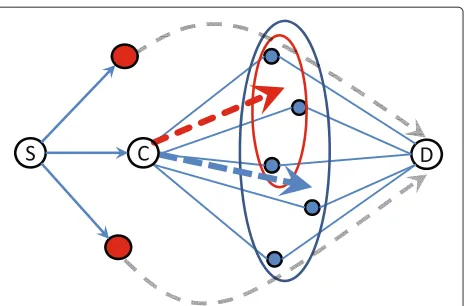
HCOR is a coding-aware opportunistic routing method. It mainly works between Internet Protocol (IP) and media access control (MAC) layers and inserts a coding layer to do the calculation of coding gain and serve the sending and receiving of encoded packets. HCOR adopts the XOR-based coding method. The foundation of HCOR is a dis-tributed system based on anypath routing. As illustrated in Figure 1, HCOR aims to solve whether the network coding should be done and which nodes should be used as the coding nodes to achieve the maximal throughput gain. To realize HCOR, every node will calculate a tem-porary anypath cost independently for each encoded flow. This temporary anypath cost is surviving on this flow and marks this node with this cost. All flows always choose the
lowest anypath cost pathas their transmission route. Each
Figure 1Conceptual view of HCOR.A flowfSDis generated fromS
toD. Assuming a multihop coding structure, nodeCis a coding node and encodesfSDinto other flows. The nodes with red color are other
potential coding nodes forfSD. The encoded flow is denoted byf.
The blue circle presents the forwarding list ofCtoD. The red circle presents the decoding set offto achievefSD. The decoding set may
be smaller than the forwarding list. So the anypath cost of forwarding fSDby the decoding set may be more expensive than that by the
forwarding list. The red dashed arrow presents doing network coding. The blue dashed arrow presents forwardingfSDwithout network
coding.
potential encoded packet uses opportunistic coding, in which a node aims to achieve the maximal throughput but not maximize the number of network coding in a single transmission. HCOR is also a ‘multihop’ network coding scheme. That means HCOR has the ability of detecting coding opportunities from a multihop network topology. The multihop coding opportunity detection is an exten-sion of local overheard information detection. HCOR uses
learning neighbor statewhich is a guessing method used in
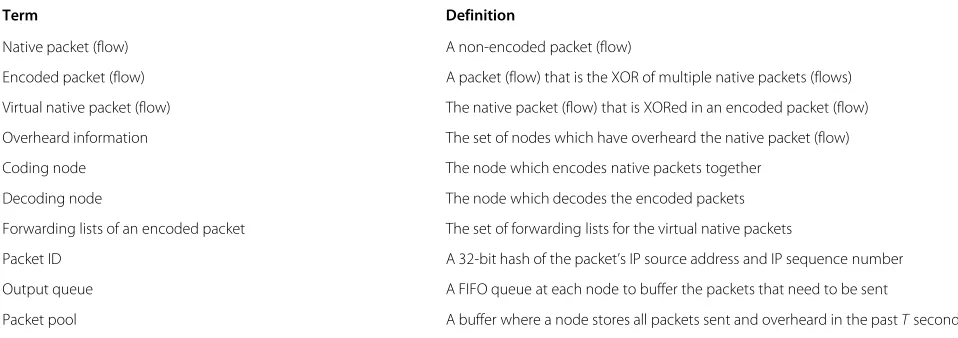
COPE for local detection and transmits this neighbor state on the path. So we need a neighbor state maintenance mechanism which is very common inad hocrouting pro-tocols. If a node makes an incorrect guess occasionally, which possibly causes the encoded packet to be undecod-able at decoding nodes, the relevant native packet should be retransmitted to help decode this encoded packet. To make HCOR easy, we leverage routing pre-computation to compute the delivery probability between every pair of nodes and use it to identify link status. Routing pre-computation works before anypath routing. That means the status of all links is known when we begin to do the anypath routing. Before delving into details, we define the terms used in the rest of the paper and list them in Table 1.
4 Network coding and anypath cost 4.1 Opportunistic transmission and anypath cost
Table 1 Definitions of terms used in this paper
Term Definition
Native packet (flow) A non-encoded packet (flow)
Encoded packet (flow) A packet (flow) that is the XOR of multiple native packets (flows)
Virtual native packet (flow) The native packet (flow) that is XORed in an encoded packet (flow)
Overheard information The set of nodes which have overheard the native packet (flow)
Coding node The node which encodes native packets together
Decoding node The node which decodes the encoded packets
Forwarding lists of an encoded packet The set of forwarding lists for the virtual native packets
Packet ID A 32-bit hash of the packet’s IP source address and IP sequence number
Output queue A FIFO queue at each node to buffer the packets that need to be sent
Packet pool A buffer where a node stores all packets sent and overheard in the pastTseconds
The forwarders are the nodes in these neighbors which have received this packet and are closer to the destina-tion. A forwarder has higher priority to do the forwarding if it is closer to the destination. A forwarding list (or say a forwarding set) is the set of forwarders. Appar-ently, more forwarders which a forwarding list has cause a higher probability of forwarding a packet successfully. In anypath routing [9], authors design a calculation method of anypath cost to present this relationship. They define an anypath cost Cpi for forwarding packet p at node iby
Cip=ciJp+CJp, (1)
whereciJpis the broadcast cost fromito a forwarding list J, andCpJ is the anypath cost ofJ. According to the ETX metric [33] and assuming that the loss for each link is independent, costciJpcan be calculated by
ciJp= 1
1−j∈J1−dij
, (2)
wheredijis the packet delivery ratio (PDR) fromitoj. The remaining anypath costCJpis defined as aweighted average of the costs of the nodes in forwarding setJby
CJp=
j∈J
wijCjp, (3)
where the weightwijis the probability of nodejbeing the relaying node ofpfrom nodeiandj∈Jwij = 1. LetJ =
{1, 2,. . .,n}with anypath costC1p ≤ Cp2 ≤ . . .≤ Cnp, the weightwijis simplified to
wij= dij
j−1
k=1(1−dik)
1−j∈J1−dij. (4)
With the above settings, some conclusions can be achieved in the anypath cost.
Lemma 4.1. For a fixed transmission rate, let CiJ be the costbof a node i via forwarding set J and set Ci,Jbe the cost via forwarding set J = J∪ {k}. We have CiJ ≤CiJif and only if Ci≥Ck.
Lemma 4.1 is the key conclusion in anypath routing. With this lemma, if we want to reduce the cost of a for-warding set, we need to add a new forwarder which has lower cost into the forwarding set. In other words, the cost of a forwarding set is optimal if and only if there is no node in the neighbors with lower cost than that of this sender.
Lemma 4.2. For a fixed transmission rate, assume a for-warding set{1, 2,. . .,k}with cost C1 ≤C2≤ . . .≤Ck. If Ci(j)is the cost from node i via forwarding set1, 2,. . .,j, for1 ≤j≤ k, then we always have Ci(1) ≥Ci(2) ≥ . . .≥
Ci(k)=δi, whereδiis the optimal cost of node i.
Lemma 4.2 shows the variation tendency of anypath cost with varying number of forwarders. It is the extension of Lemma 4.1 to demonstrate that the reduction of the for-warders in a forwarding list will cause the increase of the anypath cost of this opportunistic transmission.
4.2 Inter-flow network coding
Considering a multihop wireless network, a flow runs pos-sibly on a multihop path which starts at a source and ends at a destination. We denote a flow from sourceito destinationjbyfij. If a native flowfij is encoded into an encoded flow, we mark it as a virtual native flow byfij. A pathPij means a set of links connecting nodei to node j. We say a flow on a path Pij if and only if this flow passes the nodesiandj. According to the denotation of a flow, we distinguish a flow on a path by the start and end of this path. For example, given two flows fab and fcd, iffab is on the pathPij, we sayfcd is distinguishable fromfabonPij if and only iffcdis not onPij. Based on this setting of path distinction, we give the definition of IRNC by
Definition 4.1.For path identifiable flows, we say a net-work coding is inter-flow netnet-work coding if and only if all virtual native flows of one encoded flow are distin-guishable on the paths from coding node to the decoding nodes.
Definition 4.1 can be used as the rule to distinguish IANC and IRNC. Based on the definition of IRNC, we can achieve two following lemmas.
Lemma 4.3. In inter-flow network coding, for each encoded flow, the decoding nodes for achieving different native flows must be different.
Proof.This lemma is easy to be proved by Definition 4.1. If two virtual native flows have the same decoding node, they cannot be distinguished on the path from the coding node to decoding node.
Lemma 4.4. In inter-flow network coding, for each encoded flow, no node is both the decoding node of one vir-tual native flow and also the forwarding node of another virtual native flow.
Proof.If nodemis the decoding node of a virtual native flow fi from the encoded flow fi ⊕ fj, this suggests m has overheardfj. If mis also the forwarding node of the encoded flow for the other decoding node to obtain fj, it implies m is the potential decoding node of fj. This contradicts Lemma 4.3.
4.3 General coding condition
Considering an intermediate node k on the path Pij of flow fij, we denote the upstream part of Pij at k by Uk
fij
and the corresponding downstream part by Dk
fij
. Before doing network coding, the coding node
must guarantee that the encoded flow is decodable. That means there is at least one node in the downstream which can decode this encoded flow. For doing this, the coding node must know the decoding knowledge before mak-ing any codmak-ing decision. In inter-flow network codmak-ing, decoding knowledge is the flow’s overheard information which is defined by a set of possible nodes which had or overheard this flow. This information can be achieved
bylearning neighbor statemethod. We denote the
over-heard information of flow f before node i by Oi(f) = potential decoding nodes for the flows which are encoded withf. Hence, the general coding condition is given as follows.
Coding condition. For fk and fj intersecting at node i, if we denote that fk can be encoded into fj byifk→fj =
then fj and fk can be encoded together and the following
should hold:
For encodingm > 2 flows together, every two of them should hold the coding condition. Intuitively, the more flows are encoded together, the more NC gain can be achieved. How to encode the maximum flows together, however, can be summarized as finding the maximum clique in an undirected graph [3]. Themaximum clique
problemis NP-complete. In [19], authors point out that
the maximum number of flows that can be encoded with a given flow is bounded by a small number. Meanwhile, the probability of encodingm> 2 flows is very low with random flows in multihop networks. For example, if we assume that every flow is generated randomly and with probabilitypto encode with another flow, the probabil-ity of encodingm > 2 flows together is onlypm(m−1)/2. Moreover, from our work, encoding more flows together will cost more OR price in the transmission (we will discuss this issue in following sections). So it seems to be not worth to design an encoding multiple flow scheme for OR. Hence, in this paper, we only consider a two-flow encoding case, and we believe that the mul-tiple flow encoding case can be achieved by extending our work.
5 Network coding in anypath routing
According to characteristics of NC and anypath routing, HCOR mainly overcomes the two following challenges.
• What nodes should be contained in the forwarding set of a coding node in HCOR?
• What nodes should be the coding nodes in HCOR?
5.1 Forwarding set of a coding node
In anypath routing, when an intermediate node receives a packet from a flow, only the destination of this packet and the nexthop which implies the neighbors of the cod-ing node can be known as the downstream of this flow. According to the coding condition, the potential decod-ing nodes of this packet are only from its nexthops and destination. Hence, we have
Theorem 5.1. In opportunistic transmission (or say any-path transmission), if we denote the forwarding set of a coding node i for a virtual native flow fby J, and the for-warding set of node i for the native flow f by J, we must have J⊆J.
Proof. If the decoding node is the destination, we
eas-ily haveJ = J since all the forwarding nodes just need to forward this packet without doing the decoding. If the decoding node is not the destination, we denote the any-path cost forfat nodeibyCiand that forfat nodeibyCi. According to the anypath transmission, we should have
max j∈J
Cj≤Ci≤Ci. (6)
In Lemma 4.1, we know that each neighborjof nodeiis in the forwarding setJif and only ifCj ≤Ci. So we have J⊆J.
5.2 Network coding price in anypath transmission In this paper, we focus the issues of network coding only on the routing layer. So we study the cost of network coding on the transmission level and ignore the cost on the coding level, such as additional coding header or additional computation for network coding.
From our research, the main network coding price in anypath routing is from the shrinkage of the forwarding set. As illustrated in Figure 2, we consider a case with two-flow network coding. According to the coding condition, because some of the nodes in the forwarding setsJandK may be not the decoding nodes of this encoded flow, the forwarding setsJandKfor encoded flow are not equal to J and K possibly. Hence, the forwarding set of each native flow will be changed after doing the network cod-ing. According to Theorem 5.1, the new forwarding sets J and K are the subsets of J andK, respectively. That means, according to the Lemma 4.2, the costs ofCJ and CK will be greater than or equal to those ofCJ andCK,
respectively. So additional price should be paid by doing network coding in this anypath transmission.
LetCifj,fkbe the anypath cost of sendingfjandfkat relay
i with unicast. LetCf
j,fk
i be the anypath cost of sending encoded flowfj⊕fk with broadcast, wherefjandfjare the virtual native flows offjandfk, respectively. Based on
anypath routing, the anypath costCifj,fk can be calculated by
Cifj,fk =Cij+Cik=ciJ+ciK+CJ+CK. (7)
Similarly, we define the anypath costCf
i . To this question, we discuss from two cases. The first case is that the destinations of virtual native flows are the decoding nodes. In this case, the encoded flow will always be decoded finally whatever node is the forwarder. So the forwarding setsJandKare equal toJandK. Due to the ‘free-ride’ transmission of network coding, we know thatci{J,K} is always lower thanciJ +ciK. Hence,Cifj,fk is always more expensive in this case. The second case is that at least one of the destinations is not the decoding node. According to coding condition, decoding nodes are only from the forwarding set or destinations because the downstream is only composed of them in anypath rout-ing. So there may be a forwarding set only composed of the decoding nodes, and we call thisdecoding forwarding set. The nodes in the decoding forwarding set are called decoding forwarding nodes. Apparently, if destinations are not the decoding nodes, there is no forwarding set which contains both forwarding nodes and decoding forwarding nodes. So in the second case, at least one of the virtual native flows fj andfk has the decoding forwarding set. According to Lemma 4.4, if at least one ofJandKis the decoding forwarding set, we haveJ∩K = ∅. From this, Equation 8 is transformed to
Cf
j,fk
i =ci{J,K}+CJ+CK. (9)
According to Equation 2 of [34], we have
ci{J,K}=ciJ+ciK−
ciJciK ciJ+ciK−1
. (10)
Based on the calculation of anypath cost and the above discussion, we knowci{J,K} < ciJ +ciK andCJ +CK ≥
CJ + CK. Hence, which one of Cifj,fk and Cf
j,fk
Figure 2The change of forwarding set after doing network coding.Nodeiis a relay node. The solid line means unicast, andJandKare the forwarding sets of flowfjandfkwith unicast, respectively. The dashed line means broadcast, andJandKare the forwarding sets offjandfkafter
doing the network coding, respectively.
to the existence of network coding price in opportunis-tic routing, we should check whether it is worth to do the network coding even if a network coding opportunity is there.
6 HCOR design
In this section, we present the implementation details of HCOR in a practical distributed network system. Some definitions of terms used in the following can be found in Table 1.
6.1 Multihop overheard information
In the previous sections, we have mentioned that HCOR has a multihop coding structure. The key of realizing multihop network coding is to do multihop detection of overheard information (OI). Traditional network coding schemes use local OI detection [18], in which every node gets the OI only from its neighborhood, such as oppor-tunistic listening or learning neighbor states in COPE. We call this local detection for simplicity. As illustrated in Figure 3, local detection misses many coding opportuni-ties in the multihop networks. In [3], authors proposed a multihop OI detection method, say multihop detection for simplicity. Their multihop detection is based on local detection and works in the routing procedure. The OI of a flow is collected by local detection and transmitted with routing control packets to all the nodes on this route. The OI keeps being updated by adding some new OI from each hop. This process can be considered as a combination of two procedures, detecting OI locally and forwarding it to the route. However, this method has two defects. First, it is dependent on the routing procedure. For opportunis-tic routing methods which have no routing procedure, this method cannot work without routing control pack-ets. Second, this method is not accurate. If the route is not broken but the neighbor nodes of this route have changed,
then the OI detected by this method will be not right since the routing update does not begin.
Considering the above problems, HCOR uses each packet itself to piggyback its own OI. Before source node sending a packet, an OI list will be added into the con-trol header of this packet. When a forwarder receives this packet, the OI list will be updated by adding its own OI before forwarding. The cost of inserting an OI list into the control header may be sensitive if we con-sider a large-scale intensive network. However, compared with broadcasting the receiving reports periodically, our method is still beneficial for reducing the packet col-lisions and control packet scheduling. In HCOR, every
Figure 3Limitation of local detection in multihop topology. There are two flowsfADandfEGin this multihop topology. NodeCis a
node maintains a neighbor table. Before sending a packet, the node will guess which nodes will overhear this packet from its neighbors. Only the neighbor with high PDR will be chosen (we set 0.7 as the default). If a node makes an incorrect guess occasionally, the relevant native packet should be retransmitted to help decode this encoded packet.
6.2 Virtual flow list
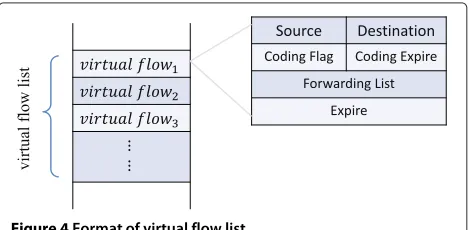
In HCOR, each node maintains a virtual flow list. The virtual flow list records the flows which are passing this node. The format of a virtual flow list is shown in Figure 4.
Source and Destination identify a flow uniquely.
Coding Flagmarks that the virtual flow is a potential encoded flow, or say being an encoded status. Coding Expireis the expired time of this flow being the encoded status. Forwarding List is the temporary forward-ing list of this encoded flow. It contains the anypath cost of every potential nexthop and is set to null if no net-work coding happens.Expireis the expired time of this virtual flow.
When a node received the first packet from a new flow, it will create a virtual flow in its virtual flow list. Every fol-lowing packet from this flow will trigger an update of this virtual flow. There are two different updates for a virtual flow in HCOR. One is normal update which is triggered by every packet from the native flow. In normal update, only the flag ofExpirewill be reset. The other is coding update which begins only after receiving an ACK packet from a coding node (we will discuss this ACK process in the following section). In the coding update, theCoding Flag will be set to 1, Coding Expire will be reset, and theForwarding Listwill be modified. In every node, there is a timer to purge the virtual flow list. The virtual flow will be removed if it is expired. TheCoding Flag will be set to 0 if this virtual flow is not being an encoded flow.
6.3 Coding procedure and coding feedback
Whenever a node i receives a new packet pk from flow fk, it executes the coding procedure illustrated in Algorithm 1.
Figure 4Format of virtual flow list.
Algorithm 1 Coding procedure
1: Get the forwarding listFk, overheard informationOk and destinationdstkof packetpk;
2: ifFk= ∅then 3: returnNO_ROUTE
4: end if
5: Pick a native packetpjin the head of output queue;
6: ifpjhas been operatedthen 7: p=pkand jump to line 36;
8: end if
9: Get the forwarding listFj, overheard informationOj and destinationdstjofpj;
10: ifdstjis inOk.then
34: Insertpjinto the trail of the output queue;
35: Repeat line 5;
36: Insertpinto the output queue;
Figure 5Illustrative scenarios.(a)Chain topology.(b)Xtopology.(c)Multihop topology.
When nodeidoes the network coding, after sendingm encoded packets in a period of time (we set 0.1 s as default in our simulation), an ACK packet is fed back fromito the previous hop ofpk. This ACK can be considered as a kind of routing feedback, and we call itcoding feedback. Coding feedback contains three attributes in its control header:
src,dst, andcost. Thesrcanddstrecord the source and destination ofpk, respectively. The pair ofsrc and
dstidentifies the flowfk. Thecostrecords the anypath cost offk after doing network coding. In Equation 8, any-path costCik,j is related to both fk and fj. Meanwhile, the gain of network coding is only from one broadcast of the encoded packetp. Hence, we define the temporary anypath cost offkafter doing network coding by
Cik= djC k,j i dk+dj
, (11)
where dk is the PDR of encoded packet p from i to
nexthopk. After the neighbor ofi receives this coding feedback, its virtual flow list will be updated. The virtual flow (src, dst) updates itsforwarding list by modifying the anypath cost of nexthopi tocost. After doing this, the anypath cost of nodeifor flowfkis updated toCki =αCik+(1−α)Cik, whereα=1 if 0<Cik <Cik, and α = 0 otherwise. Based on the update of virtual
flow list, the nexthops recorded in the virtual flow will be more competitive to achieve a high priority to forward this packet. If network coding disappears, no coding feed-back causes no virtual flow update. After reaching the expiration time, virtual flow will be purged, and then the new packet from this flow will be forwarded following its original anypath cost.
6.4 Decoding
In HCOR, every node works in the promiscuous mode and stores all packets sent and overheard by itself in the pastT seconds in its Packet Pool. The decoding process happens when an encoded packet arrives at a node and the address of this node is in thedecoding. Because we use the XOR coding method, the encoded packet can be decoded only by XORing any of the virtual native packets, such asp1=(p1⊕p2)⊕p2.
7 Experiment results
This section uses a ns-2 simulator to present the perfor-mance evaluation. We study the perforperfor-mance of HCOR by comparing with one non-NC scheme and one net-work coding scheme. The non-NC scheme is just the anypath routing scheme without doing any network cod-ing. The NC scheme is called COOR, which is a kind of
(a) (b)
Figure 7End-to-end throughput performance inXtopology.(a)Throughput performance with a fixed PDR of 0.8 and varying loads from 10 kb/s to 1 mb/s.(b)Throughput performance with a fixed rate of 400 kb/s for each load and varying PDR from 0.3 to 1.
coding opportunity-aware OR method and runs on a mul-tihop coding structure. The difference between HCOR and COOR is that COOR does the network coding when-ever a coding opportunity happens, while HCOR does network coding only if a gain can be achieved.
In our simulations, all the nodes are set to the promis-cuous mode with a modified IEEE 802.11 standard as the MAC protocol which supports the opportunistic trans-mission. We use User Datagram Protocol (UDP) traffic sources, and all the flows are constant bit rate (CBR), with a fixed packet size of 512 bytes. The transmission range is set to 250 m, and the interference range is set to 550 m with the TwoRayGround propagation model [35].
7.1 Results from illustrative scenarios
We present the performance of HCOR compared with the non-NC scheme in some basic topologies. Firstly, we study the chain topology with bidirectional flows shown in Figure 5a.
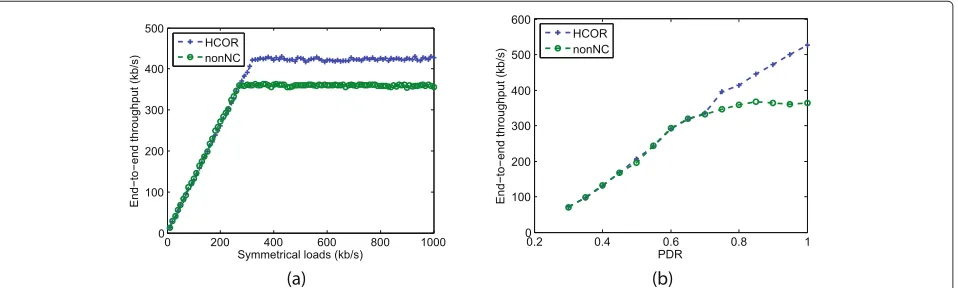
We set all links with a fixed PDR. Two symmetrical loads have the same rate fromAtoBandBtoA, respectively. The measurements of average end-to-end throughput are plotted in Figure 6. The throughput gain is about 23% after symmetrical load running in the saturation levels shown in Figure 6a. The reason why HCOR and non-NC have different variation trends in Figure 6b is because the relay node in non-NC suffers from bottleneck, and hence, the bandwidth of its output links will be saturated when the loads keep increasing. In HCOR, the relay node mixes the two flows together and sends this mixture as one flow. So the rate of output is always lower than that of input. If input and output links have the same bandwidth, there is no bottleneck problem in HCOR because output links are always starved.
Next, we studyXtopology shown in Figure 5b. The mea-surement results are plotted in Figure 7. We can see that the throughput gain is still significant and about 21% in X topology. Different from the chain scenario, there are
(a) (b)
Figure 9Cellular scenario.(a)Hexagon topology.(b)Throughput performance.
overhearing links in theXscenario. In our simulation, we set the threshold of guessing a successful overhearing to 0.7 as default. That means a node guesses one of its neigh-bors can overhear the packets it sends if the PDR from it to this neighbor is more than 0.7. Hence, we can see that the performance of HCOR and non-NC is similar when PDR is no more than 0.7 in Figure 7b. After that, a gain can be achieved by HCOR.
At last, a simple multihop scenario is studied to present the multihop structure of HCOR. This multihop topology is shown in Figure 5c. We plot the simulation results in Figure 8. The gain of HCOR is not as much as the above two scenarios. The reason may be the gain from bottle-neck is diluted by bandwidth consumption from multihop transmission. But we can still have more than 10% gain for total end-to-end throughput over non-NC. In Figure 8b, HCOR almost always has a gain over non-NC because multihop topology has multiple coding structure, such as (A,B,C), (G,F,C), and ({B,E},C,{F,D}), where (A,B,C) and (G,F,C) are not affected by the overhearing links.
7.2 Results from specific scenarios
In this section, we want to present howflexibleHCOR is. We aim to point out the benefit of HCOR compared with
COOR. To do this, we design two specific scenarios. One
iscellular scenariowith a hexagon topology. The other is
diamond scenariowith a double-diamond topology.
As shown in Figure 9a, there are seven nodes and two flowsf23andf65with the same rate in the cellular scenario. The PDR of links(2, 1),(2, 4),(1, 3),(6, 7),(6, 4), and(7, 5) is set to 0.8. The PDR of links(4, 1)and(4, 7)is set to 0.4. The PDR of links(4, 5)and(4, 3)is set to 0.5. The PDR of links(2, 5)and(6, 3)is set to 1. The potential forwarding nodes forf23are nodes 1 and 4. The potential forwarding nodes forf65are nodes 7 and 4. Apparently, there is a cod-ing opportunity at node 4 because the overhearcod-ing links
(2, 5) and (6, 3) have very good quality. But the output links of node 4 are very poor. So intuitively, it seems that there is no gain for doing network coding at node 4. The simulation results plotted in Figure 9b demonstrate that our intuition is correct. COOR shows a poor performance in this scenario and has about 30% lower throughput gain than HCOR.
In the Figure 10a, we present a diamond scenario with two symmetrical loadsf67andf21. The PDR of links(5, 7),
(2, 5),(6, 3), and(3, 1)is set to 0.9. The PDR of links(6, 4),
(2, 4),(4, 7), and(4, 1)is set to 0.7. The PDR of links(4, 5) and (4, 3) is set to 0.63. According to anypath routing,
Figure 11Throughput performance of random scenario.(a)Throughput vs. offered loads.(b)Throughput vs. PDR.
node 5(3) is the forwarder of node 4 for flowf67(f21) since node 5(3) has better PDR to the destination than node 4. The structure composed of 6, 3, 4, 2, and 5 is a basic coding structure ofXtopology. So there is still a coding opportu-nity at node 4. The simulation results show that there is no coding gain in this scenario. The performance of COOR is 28% lower than that of HCOR.
7.3 Results from random scenario
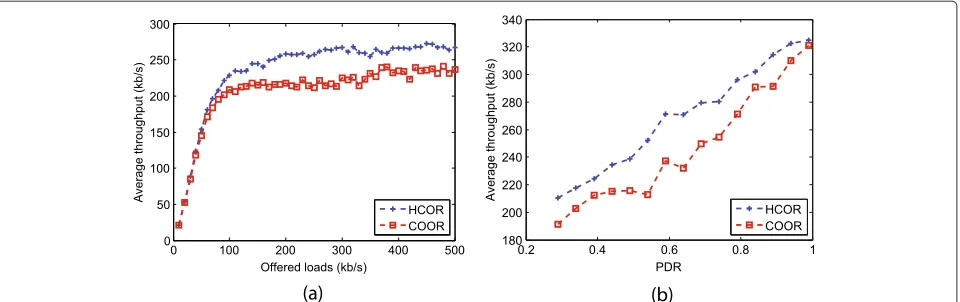
At last, we consider the performance of HCOR in a larger random mesh network. We construct ten 50-node ran-dom topologies with size 1,000× 1,000 and 20 random loads for each topology. All these loads have random sources and destinations with the same rate and random time of duration. The PDR of all links in these topolo-gies is set to the ‘lowest bound PDR’, which means the PDR of every link is set randomly but higher than the low-est bound PDR value. We compare HCOR with COOR and plot the average throughput performance of these ten topologies in Figure 11. We first set the lowest bound PDR to 0.6 and show the throughput performance with increas-ing loads in Figure 11a. The results show that HCOR has more than 25% gain over COOR in this case. In another case, we vary the lowest bound PDR from 0.3 to 1 and use a fixed load rate of 400 kb/s. The throughput per-formance of the second case is shown in Figure 11b. We can see that the gain of HCOR is 13% higher than that of COOR, and the promotion is obvious between 0.5 to 0.8 of PDR.
8 Conclusion
In this paper, we proposed a novel coding-aware oppor-tunistic routing scheme HCOR. We study the character-istic of incorporating NC into opportuncharacter-istic routing and figure out some conclusions to help design a coding-aware opportunistic routing. Taking advantage of anypath cost,
we give a computing method to calculate network cod-ing cost in opportunistic transmission. Based on the above study, we design a distributed routing scheme to realize HCOR, which considers the multihop coding structure in the design. We implement the HCOR scheme in ns-2 and carry out extensive simulations to show the good perfor-mance of HCOR. The property of our work may be useful for future coding-aware opportunistic routing design; in particular, our work leaves wide open on the design of coding-aware opportunistic schemes with encoding of more than two native flows together.
Endnotes
aSome also call it inter-session network coding.
bIn the following of this paper, we simplifyCp
i toCiif we do not emphasize the packet or flow in the calculation of anypath cost.
Competing interests
The authors declare that they have no competing interests.
Acknowledgements
This work is financially supported by National Natural Science Foundation of China under grant numbers 61301130, 61401059, 61303210, and 61172058; the Fundamental Research Funds for the Central Universities under grant numbers DUT13JS09 and DUT14QY04; and the Specialized Research Fund for the Doctoral Program of Higher Education of China under grant number 20120041110011.
Received: 22 April 2014 Accepted: 25 August 2014 Published: 11 September 2014
References
1. R Ahlswede, N Cai, SYR Li, RW Yeung, Network information flow. IEEE Trans. Inf. Theory.46(4), 1204–1216 (2000)
2. S Chachulski, M Jennings, S Katti, D Katabi, Trading structure for randomness in wireless opportunistic routing, inProc. of ACM SIGCOMM’07,(Kyoto, Japan, 27–31 August 2007)
4. B Guo, HK Li, C Zhou, Y Cheng, Analysis of general network coding conditions and design of a free-ride-oriented routing metric. IEEE Trans. Vehicular Technol.60(4), 1714–1727 (2011)
5. Y Yan, BX Zhang, J Zheng, M Jian, CORE: a coding-aware opportunistic routing mechanism for wireless mesh networks [accepted from open call]. IEEE Wireless Commun.17(3), 96–103 (2010)
6. Y Benfattoum, S Martin, K Al Agha, IROCX: interference-aware routing with opportunistically coded exchanges in wireless mesh networks, in
Wireless Communications and Networking Conference (WCNC) 2011 IEEE.
(Quinyana-roo, Mexico, 28–31 March 2011), pp. 1113–1118. doi:10.1109/WCNC.2011.5779287
7. YJ Lin, CC Huang, JL Huang, PipelineOR: a pipelined opportunistic routing protocol with network coding in wireless mesh networks, inIEEE 71st Vehicular Technology Conference, VTC 2010-Spring(Taipei, Taiwan, 16–19 May 2010), pp. 1–5. doi:10.1109/VETECS.2010.5494225
8. Y Yan, BX Zhang, HT Mouftah, J Ma, Practical coding-aware mechanism for opportunistic routing in wireless mesh networks, inIEEE International Conference on Communications, ICC ‘08(Beijing, China, 19–23 May 2008), pp. 2871–2876. doi:10.1109/ICC.2008.541
9. R Laufer, H Dubois-Ferrière, L Kleinrock, Polynomial-time algorithms for multirate anypath routing in wireless multihop networks. IEEE/ACM Trans. Netw.20(3), 742–755 (2012)
10. A Agarwal, M Charikar, On the advantage of network coding for improving network throughput, inIEEE Information Theory Workshop, ITW ‘04(San Antonio, TX, USA, 24–29 Oct 2004), pp. 247–249.
doi:10.1109/ITW.2004.1405308
11. KK Chi, XH Jiang, S Horiguchi, Network coding opportunity analysis of cope in multihop wireless networks, inIEEE Wireless Communications and Networking Conference. WCNC 2008,(Las Vegas, NV, USA, 31 March – 3 April 2008), pp. 2858–2863. doi:10.1109/WCNC.2008.500
12. R Koetter, M Medard, An algebraic approach to network coding. IEEE/ACM Trans. Netw.11(5), 782–795 (2003)
13. S Jaggi, P Sanders, PA Chou, M Effros, S Egner, K Jain, L MGM, Polynomial time algorithms for multicast network code construction. IEEE Trans. Inf. Theory.51(6), 1973–1982 (2005)
14. M Effros, H Tracey, K Sukwon, A tiling approach to network code design for wireless networks, inIEEE Information Theory Workshop, 2006(Punta del Este, Uruguay, 13–17 March 2006), pp. 62–66. doi:10.1109/ITW.2006. 1633782
15. M Baidas, A MacKenzie, Many-to-many space-time network coding for amplify-and-forward cooperative networks: node selection and performance analysis. EURASIP J. Wireless Commun. Netw.2014(1). 48 (2014). doi:10.1186/1687-1499-2014-48
16. M Nabaee, F Labeau, Quantized network coding for correlated sources. EURASIP J. Wireless Commun. Netw.2014(1). 40 (2014).
doi:10.1186/1687-1499-2014-40
17. T Lv, S Li, W Geng, Combining cooperative diversity and network coding in uplink multi-source multi-relay networks. EURASIP J. Wireless Commun. Netw.2013(1). 241 (2013). doi:10.1186/1687-1499-2013-241
18. S Katti, H Rahul, H Wenjun, D Katabi, M Medard, J Crowcroft, XORs in the air: practical wireless network coding. IEEE/ACM Trans. Netw.16(3), 497–510 (2008)
19. JL Le, JCS Lui, DM Chiu, On the performance bounds of practical wireless network coding. IEEE Trans. Mobile Comput.9(8), 1134–1146 (2010) 20. A Khreishah, I Khalil, P Ostovari, J Wu, Flow-based XOR network coding for
lossy wireless networks. IEEE Trans. Wireless Commun.11(6), 2321–2329 (2012). doi:10.1109/TWC.2012.041912.112105
21. Y Wu, Broadcasting when receivers know some messages a priori, inIEEE International Symposium on Information Theory, ISIT 2007(Nice, France, 24–29 June 2007), pp. 1141–1145. doi:10.1109/ISIT.2007.4557377 22. CC Wang, On the capacity of wireless 1-hop intersession network coding:
a broadcast packet erasure channel approach. IEEE Trans. Inf. Theory.
58(2), 957–988 (2012)
23. MH Amerimehr, F Ashtiani, Delay and throughput analysis of a two-way opportunistic network coding-based relay network. IEEE Trans. Wireless Commun.13(5), 2863–2873 (2014)
24. A Yang, ZS Fei, CW Xing, M Xiao, JH Yuan, JM Kuang, Design of binary network codes for multiuser multiway relay networks. IEEE Trans. Vehicular Technol.62(8), 3786–3799 (2013)
25. MF Jhang, SW Lin, WJ Liao, C2AR: coding and capacity aware routing for wireless ad hoc networks, inIEEE International Conference on
Communications (ICC’10)(Cape Town, South Africa, 23–27 May 2010), pp. 1–5. doi:10.1109/ICC.2010.5502401
26. LF Xie, PHJ Chong, SC Liew, YL Guan, CEO: consistency of encoding and overhearing in network coding-aware routing. IEEE Wireless Commun. Lett.2(2013), 187–190. doi:10.1109/WCL.2012.122612.120770 27. S Sengupta, S Rayanchu, S Banerjee, An analysis of wireless network
coding for unicast sessions: the case for coding-aware routing, in26th IEEE International Conference on Computer Communications, INFOCOM 2007(Anchorage, AK, 6–12 May 2007), pp. 1028–1036.
doi:10.1109/INFCOM.2007.124
28. DB Johnson, DA Maltz, Dynamic source routing in ad hoc wireless networks. The Kluwer Int. Series in Eng. Comput. Sci. Mobile Comput.
353, 153–181 (1996)
29. P Li, S Guo, S Yu, A Vasilakos, Reliable multicast with pipelined network coding using opportunistic feeding and routing. IEEE Trans. Parallel Distributed Syst.PP(99), 1–1 (2014). doi:10.1109/TPDS.2013.2297105 30. T Chen, S Zhong, An enforceable scheme for packet forwarding
cooperation in network coding wireless networks with opportunistic routing. IEEE Trans. Vehicular Technol.PP(2014), 1–1.
doi:10.1109/TVT.2014.2312171
31. M Aajami, H-R Park, J-B Suk, Combining opportunistic routing and network coding: a multi rate approach, inIEEE Wireless Communications and Networking Conference, WCNC 2013(Shanghai, China, 7–10 April 2013), pp. 2208–2213. doi:10.1109/WCNC.2013.6554904
32. MA Iqbal, B Dai, B Huang, A Hassan, S Yu, Survey of network coding-aware routing protocols in wireless networks. J. Netw. Comput. Appl.
34(6), 1956–1970 (2011)
33. D Couto, D Aguayo, J Bicket, pR Morris, A high-throughput path metric for multi-hop wireless routing, inProc. of the 9th Annual International Conference on Mobile Computing and Networking, MobiCom ‘03(San Diego, USA, 14–19 Sept 2003), pp. 134–146
34. B Ni, N Santhapuri, ZF Zhong, S Nelakuditi, Routing with opportunistically coded exchanges in wireless mesh networks, in2nd IEEE Workshop on Wireless Mesh Networks, WiMesh 2006(Reston, VA, USA, 25–28 Sept 2006), pp. 157–159. doi:10.1109/WIMESH.2006.288636
35. T Yang, G Mino, L Barolli, A Durresi, F Xhafa, Comparison evaluation for mobile and static sensor nodes in wireless sensor networks considering tworayground and shadowing propagation models, in14th International Conference on Network-Based Information Systems, NBiS 2011(Tirana, Albania, 7–9 Sept 2011), pp. 186–193. doi:10.1109/NBiS.2011.35
doi:10.1186/1687-1499-2014-148
Cite this article as:Haiet al.:HCOR: a high-throughput coding-aware opportunistic routing for inter-flow network coding in wireless mesh
networks.EURASIP Journal on Wireless Communications and Networking
20142014:148.
Submit your manuscript to a
journal and benefi t from:
7Convenient online submission
7Rigorous peer review
7Immediate publication on acceptance
7Open access: articles freely available online
7High visibility within the fi eld
7Retaining the copyright to your article