• No results found

Creating creativity in the design studio: assessing the impact of metacognitive skill development on creative abilities

N/A
N/A
Protected

Academic year: 2020

Share "Creating creativity in the design studio: assessing the impact of metacognitive skill development on creative abilities"

Copied!
235
0
0

Loading.... (view fulltext now)

Full text

(1)

ABSTRACT

HARGROVE, RYAN ANTHONY. Creating Creativity in the Design Studio: Assessing the

Impact of Metacognitive Skill Development on Creative Abilities. (Under the direction of

Art Rice.)

Design is a discipline of innovation. The very essence of design is the creation of something

new and unique. An assumption has been that, as in the case of native intelligence, the

inclination and ability of a person to respond in novel and useful ways is largely inherited.

Present research refutes this view, and it is now believed by many that, however creativity is

defined, it is a form of behavior that can be taught. If as Dr. Daniel Pesut suggests, most

creativity training programs are successful in that they encourage the development of

metacognitive abilities, then the study of creativity as a self-regulatory metacognitive process

is timely and important to design education.

Metacognitive knowledge guides people to select, evaluate, revise, or abandon cognitive

tasks, goals, and strategies in light of their own abilities and interests. Acknowledging this

point leads to questioning our understanding of the creative design process. Therefore, we

must return to the issue of cognition and recognize how little we really know about

designers’ creative processes, and seriously question how such an immensely important

component of problem solving remains absent from design education.

This study statistically tests the introduction of structured metacognitive skills on the

development of creative thinking ability for a diverse population of undergraduate design

students. Two of the most highly regarded standardized tests for convergent and divergent

thinking, structured faculty assessment, and a comprehensive review of generated outcomes

were used to assess the impact of the introduction of these skills in the design studio

(2)

(3)

CREATING CREATIVITY IN THE DESIGN STUDIO:

Assessing the impact of metacognitive skill development on creative abilities

by

RYAN ANTHONY HARGROVE

A dissertation submitted to the Graduate Faculty of

North Carolina State University

in partial fulfillment of the

requirements for the Degree of

Doctor of Philosophy

DESIGN

Raleigh, NC

2007

Approved by:

Assistant Professor Kimberly S. Weems Professor John Nietfeld

Professor Meredith J. Davis Professor Art Rice

(4)

DEDICATION

Sarah Hargrove

my wife

Dennis and Rosann Hargrove

my parents

Allison Hargrove

my sister

and to:

(5)

BIOGRAPHY

Ryan Hargrove began his design education at the University of Kentucky where he enrolled

in the Landscape Architecture program. While studying at the university he worked at

Korfhage Design in Louisville, Kentucky as a part of a supervised internship program. It

was during his senior year that Ryan became interested in the role research plays in design

and considered pursuing an area of specialized research. While studying at the University of

Kentucky Ryan was awarded a Merit scholarship and was recognized as a student award

honoree by the ASLA. He graduated magna cum laude in May of 2002 with a Bachelor of

Science in Landscape Architecture degree.

Deciding to continue his education, Ryan enrolled in the Landscape Architecture graduate

program at the University of Florida in the fall of 2002. As a teaching assistant for two years

he was able to explore future interest in teaching, while conducting research focusing on

healthcare design. His master’s thesis studying Alzheimer’s patients “Remembering the Past

Designing the Future” was recognized at the 2005 National Alzheimer’s Conference in

Chicago, Illinois. Working in collaboration with the Alzheimer’s Association and the

American Society of Landscape Architects he studied a series of memory gardens across the

country. The project involved a qualitative research design and created a set of future

guidelines that will improve current and future facilities. While at the University of Florida

he was awarded the student award scholarship and was a part of an Eco-Architecture study

abroad program in Costa Rica. He graduated on April 30

th

2004, and decided to attend the

North Carolina State University to pursue a doctoral degree in design.

(6)

director of the NCSU Design Camp for high school students pursuing academic ambitions in

design. In addition he was rewarded a graduate teaching assistantship that allowed him to

teach graduate design studios as well as design thinking courses in partnership with Marvin

Malecha, Dean of the College of Design. Ryan graduated with his doctoral degree in design

August 2007.

(7)

ACKNOWLEDGEMENTS

It is with enormous admiration that I express my gratitude to those who have taken part in

my academic journey. As this chapter in my life comes to a close I want to thank those who

have made it the most rewarding period in my life. During my studies at North Carolina

State University I grew as a scholar but more importantly as a person. This growth can be

attributed to the guidance and support of a core group of people. It is now time to

acknowledge this group of people for generously giving their time, fostering intellectual

growth and curiosity, and guiding me toward the realization of my potential.

I will be forever grateful to my dissertation committee: Professors Art Rice, Meredith Davis,

John Nietfeld and Kim Weems. Together their wisdom provided a foundation from which I

began a process of knowledge acquisition and intellectual inquiry. As a mentor and

dissertation committee chair, Art Rice was the person that first attracted me to North

(8)

counsel and friendship are things that I continue to value. My academic journey would not

be complete without the insightful Kim Weems. Her reliability and integrity were evident as

my instructor in statistics and these qualities were reinforced as a source of knowledge and

support during my research. She provided encouragement and guidance that helped me reach

my goals.

I want to express my deepest heartfelt appreciation to my wife, Sarah Hargrove. Working

toward one’s doctorate degree is a long and at times stressful journey. Sarah provided more

than can be expressed in words. She is my inspiration, my counsel, my best friend.

Knowing each day I have a wife that loves me unconditionally provides a peace and

happiness that cannot be found in any form of personal success. She has provided,

encouraged and sacrificed as I worked toward my academic goals and these goals could not

have been realized without her. My entire family and friends have supported me as I have

continued on this academic journey starting at childhood. I owe each of them a piece of my

success for without their influence this journey would not have been completed. I love you

all.

(9)

TABLE OF CONTENTS

page

List of Tables.……….

List of Figures.………

1.

Introduction: Focus of Study and Context………...……...

2. Literature Review.………...………..…

2.1 Creativity………...………..…...

2.2 The Creative Process….……….….…..

2.3 Creativity and Cognition……….……….………

2.4 Enhancing Creativity…..……..……….….…..

2.5 Creativity as a Metacognitive Process……….…….…...

2.6 Metacognition………..…….

2.7 Metacognition and Design……….…...

2.8 The Role of Metacognition in Educating Designers…………...

3. Conceptual Framework and Research Questions……...…………...…

3.1 Theoretical Perspective…...………....…….

3.2 Conceptual Framework………...…….

3.3 Research Questions and Hypothesis………..….…..

3.4 Definition of Key Terms………..….…

4. Research Methodology I.………....………….

4.1 Research Design Overview....……….….…....

4.2 Data Collection Techniques……….……....

4.2.1 Cohort Graduate Student Testing………….…....………...

(10)

4.4 Cognition……….……….

4.5 Metacognition………...

4.6 Knowledge of Cognition………..

4.7 Regulation of Cognition………...

4.8 Conceptual Level………..

4.9 Educational Practices……….…..

4.9.1 Direct Instruction………....

4.9.2 Paired Problem-Solving………..

4.9.3 Journal Keeping……….…….

4.9.4 Case Studies – Great Thinkers……….……..

4.10 A Framework Toward Effective Pedagogical Practices………….…

4.11 Assessment………..…

4.11.1 A Plan for Student Assessment……….…

4.11.2 Two Basic Questions………

4.11.3 Criteria and Indicators………..

4.11.4 Naïve Versus Sophisticated Metacognitive Thinking…...…

4.12 Steps Toward a Successful Intervention……….…

4.13 Strategies For Analysis……….…..

4.13.1 Similarities Test…..………....….….

4.13.2 Remote Associates Test…………..………..……

4.13.3 Design Thought Model………..…………..…….

4.13.4 Metacognitive Awareness Inventory…………..……..……

4.13.5 Faculty Assessment………..……….

4.14 Rationale....…...………..……

4.15 Quality Considerations…...………...……….

4.15.1 Internal Validity………..………..…

4.15.2 External Validity………..……….……...

4.15.3 Construct Validity………..………..….

4.15.4 Reliability………..……….……..

(11)

5.

Research Methodology II………

5.1 Data Analysis………..…….

5.1.1 T-test………..……….………

5.1.2 Correlation……….……….

5.2 Findings….……….………..

5.2.1 T-test……….………..

5.2.2 Correlation……….

6. Conclusions………..………

6.1 Generalizing Findings………...……….……….

6.2 Application to Design Education………..…………..…

6.2.1 Weekly Reflection Journal………

6.3 Limitations………..

6.4 Future Research Directions……….

7.

References..………..…………

8.

Appendices………...

89

89

89

91

92

92

103

107

111

112

113

120

120

(12)

LIST OF TABLES

page

(13)

LIST OF FIGURES

page

Figure 2.1

Diagram of Literature Review………...……...…...

Figure 2.2

Experience of Flow………..

Figure 2.3

Spearman’s three principles of creativity………..………..

Figure 2.4

Mednick’s Associative Hierarchy………..……….

Figure 2.5

Knowledge and Regulation of Cognition…...……….…..……...

Figure 3.1

Creativity as a Metacognitive Process………...….

Figure 4.1

Diagram of Experimental Research Design……….….…..

Figure 4.2

Research Design Overview………..………...……

Figure 4.3

Framework for Educational Intervention………..………..

Figure 4.4

Development of Creative Thinking Strategies…………..………..

Figure 4.5

Cycle of Metacognition………..…….………

Figure 4.6

Building Metacognitive Knowledge Base………..……….

Figure 4.7

Strategy Evaluation Matrix (SEM)……….

Figure 4.8

Regulation of Creative Strategies………..………..

Figure 4.9

Key Operations of Metacognition……….…………..

Figure 4.10

Regulatory Checklist (RC)………...………

Figure 4.11

Rubrics: Learning Outcomes & Measures………..……….

Figure 4.12

Thinking Like an Assessor……….………….

Figure 4.13

Facets and Levels of Metacognitive Thinking………....……….

10

13

17

19

30

49

53

57

58

59

60

61

62

63

63

64

75

76

(14)

Figure 4.14

Metacognitive Framework………..……….…

Figure 4.15

Divergent / Convergent Design Process………...………...…

Figure 5.1

Independent-sample vs. Paired-sample T-test…………..…...…

Figure 5.2

Data Sub-sets………....……...

Figure 5.3

Independent-sample T-test – Pre-test 1 and Pre-test 2……...………..

Figure 5.4

Independent T-test – Post-test………..………...…

Figure 5.5

Independent T-test – Design Thought Models……..………...……...…

Figure 5.6

Paired-sample T-test ...

Figure 5.7

Paired-sample T-test – Metacognitive Awareness Inventory….…...…

Figure 5.8

Paired-sample T-test – SIM – Treatment and Control Group….……..

Figure 5.9

Paired-sample T-test – RAT – Treatment and Control Group….……..

Figure 5.10

Model of Correlation Matrix………..…...

Figure 5.11

Pearson’s r – Similarities – Fluency / Originality...

Figure 5.12

Pearson’s r – Metacognitive Thinking / Creative Thinking………….

79

85

93

94

95

96

97

98

99

101

102

104

105

(15)

CHAPTER 1

INTRODUCTION: FOCUS OF STUDY AND CONTEXT

1.0 Introduction

One of the most critical aspects of design education is teaching creative thinking processes.

This ability enables designers to succeed in traditional practice or in other disciplines that

they choose to enter. Metacognition, the ability to be aware of, attend to, and use

information about their own cognitive processes serve designers for a lifetime and transcends

changes in design styles, materials, construction methods, and technology. Metacognitive

thinking allows designers to build a metacognitive knowledge base and apply their creative

thinking skills to an infinite number of design applications. Knowing this, design educators

should ask themselves; how effective is current design education at developing students with

strong creative thinking abilities and how can this potential connection between creativity

and metacognition be explored and tested?

With design thinking as the core competency, design school graduates have the vast potential

to add tremendous value to society through the design of a range of ideas from products,

buildings, businesses, and organizations to entire communities. Designers use these skills to

offer more services to clients, and recent graduates capitalize on this knowledge to excel in a

large variety of settings. A core value of the discipline lies in how effectively educators

prepare students to utilize the cognitive processes associated with design thinking.

(16)

Creativity is not only healthy for student projects, but also when applied to the academic

context in the larger sense. In a culture of creative thinking, design schools and educators

imagine more effective teaching methods and learning objectives. Also instructional

techniques in design remain in development and provide a framework for continued

innovation. In her book, Design Juries on Trial (1991), Kathryn Anthony wrote, “It is

indeed ironic that throughout the term, design instructors encourage their students to be

creative, go out on a limb, take risk – and then when it’s all over most of those same

instructors rely on the same technique they’ve been using for years” (p.129).

A culture of creative thinking should be embraced in order to create alternative teaching and

learning models. To create a healthier and more successful academic experience, design

schools need to rethink existing practices and develop creative alternatives. In the end, the

innovative nature of design can serve as a basis for creating an improved design education

that embraces creative thinking.

When one thinks of creativity, eminent artists or scientists such as Michelangelo or Einstein

immediately come to mind. Historically, the study of creativity began with the concept of

genius. There is a longstanding tradition of examining prominent creators, who are viewed

as “unambiguous cases” of creativity. However, these highly creative people are rare and

difficult to study in the psychological laboratory.

(17)

Contemporary pressures to meet the needs of professional offices has focused many

programs on the technical and management skills most immediately related to practice-based

performance, sometimes at the sacrifice of the development of thinking skills. Irrespective of

the specific design domain, some educational models in design education are based upon the

replication of professional task performance. The measure of learning is generally equated

with the evaluation of the design product rather than learning process or skill. The cognitive

skill sets of design are not adequately addressed by pedagogy in design education. As a

consequence, there presently exists a lack of cognitive theories that function as

underpinnings of design education (Oxman, 1999).

An examination of design education reveals the lack of instructors’ formal training in

education / learning theory. While many design instructors are accomplished professionals,

this competency does not automatically translate into the skills needed to help others reach

their creative potential. Design educators should seek out and explore effective models of

education and problem-solving that challenge creative practices in the design curriculum.

Refusing to acknowledge the shortcomings and limitations of the current educational

approach is creating inferior conditions across all design professions and continues to

suppress the designer’s ability to reach their potential. Design educators should do better

than to teach what they were taught; the standard of the profession is perpetually rising and,

without change, designers will not be prepared to meet these challenges. Sidney Parnes,

president of the Creative Education Foundation and professor of creative studies at State

University of New York at Buffalo explains (1981, p. 21):

“We may not be sure what we’ll need to know for the future, but we can be

reasonably sure that we will need increasing ability to sense and meet the challenges

and problems our changing lives present rather than using tranquilizers to deal with

them…”

(18)

complex, science more all-encompassing and choices more diverse designers need innovative

solutions that will address these challenges and provide a framework for continued

innovation.

The U.S. Department of Labor appointed a commission to determine the skills young people

need to succeed in the world of work. The purpose pf the Secretary’s Commission on

Achieving Necessary Skills (SCANS) was to encourage a high-performance economy

characterized by high-skill, high-wage employment. Although the commission completed its

work in 1992, its findings and recommendations continue to be a valuable source of

information for individuals and organizations involved in education and workforce

development. The SCANS recommendations provide curricular and pedagogical guidance

for preparing students for adult life and pose a substantial challenge to the major institutions

charged with responsibility for developing worker competencies. The report distinguishes, in

a commonsense way, the elements of being “educated” and then introduces a set of

higher-order competencies necessary for participation in future economics and politics (Davis,

1997).

The final report issued in July 1992, named five competencies and a three-part foundation of

skills and personal qualities the Commission believed is necessary for strong future job

performance. The foundation of skills consists of thinking skills, specifically creative

thinking, as well as the personal qualities associated with self-management or self-regulation,

decision-making and seeing things in the mind’s eye (U.S. Dept. of Labor, 2000).

To best promote creative reasoning in design students the dominant model of design

education should be modified to provide a robust and reflective model of design thinking.

There is no doubt that there is a great deal of room for improvement knowing that designers

must be competent in all aspects of the design process. However, it is also clear that

(19)

Design theorist J. Christopher Jones (1980) clearly articulates this distinction when

comparing what he terms “black box” thinking with the more reflective approach of “glass

box” thinking. The black box view of designing can be quite clearly expressed in cybernetic

or physiological terms: one can say that the human designer, like other animals, is capable of

producing outputs in which he has confidence, and which often succeed, without his being

able to say how these outputs were obtained. Most human actions can be explained only if

one assumes that they are largely governed by the skilled nervous system without the

intervention of conscious thought. The black box way view of thinking posits that skilled

actions are unconscious and it is irrational to expect designing to be wholly capable of

rational explanation. According to this theory, for which there is little physiological

evidence, the ‘leap of insight’ that many creative people report, is the result of the neural

network suddenly adopting, after many fruitless attempts, a pattern that is compatible with

inputs that it has recently received. This suggests that past experiences are patterned and

then re-patterned every time one tries to remember them. The brain is a semi-automatic

device that is capable of resolving incompatibilities between inputs (i.e. solving problems) by

assuming a pattern is compatible not only with current inputs but also with the many

previous inputs of which memory is composed (Jones, 1980).

There is opposition to this explanation of creative behavior. Cognitive scholars such as

Brodbent (1966) have identified mental rigidity (or a desire for certainty) as the chief enemy

of creative thinking, and caution about the production of stereotyped responses. The glass

box view of designing is concerned with externalized thinking rather than relying on

(20)

(Schraw & Moshman, 1995; Pesut, 1984). Acknowledging this point leads to questioning

our understanding of the creative design process. Therefore, one must return to the issue of

cognition and recognize the importance of designers’ creative processes, and how one can

amplify the strongest creative behaviors in the education of designers.

Design educators are faced with a unique challenge in respect to the need for increasing the

level of the creative performance of their students. Teachers have a responsibility that goes

beyond contributing to the development of creative designers. Design courses stand out as

the ones in which students not only have the time and freedom to be creative, but are required

and rewarded for such behavior. Teachers in design should develop creative strategies in all

design courses. The transfer of such strategies across the entire education of designers will

then be a consequence. To date, however, there is little indication that deliberate creative

thinking / strategies are being taught in design courses (Oxman, 1999). If creative behavior

is to be the central theme in the designer’s education, new approaches to pedagogy and

curriculum are needed.

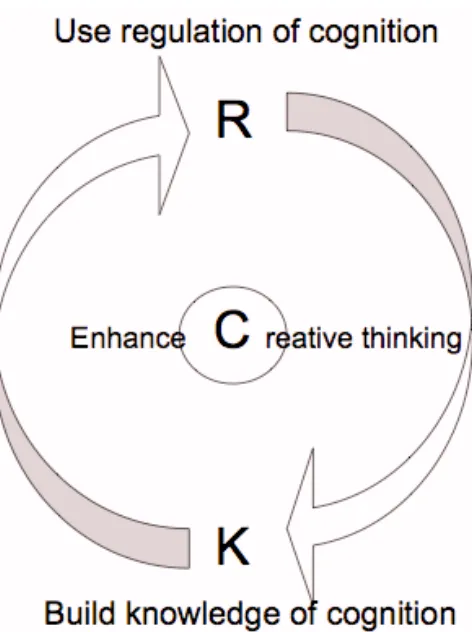
Metacognition is an essential ingredient of creative thinking (Sternberg & Williams, 1996);

therefore, it is critical to the effectiveness of designers. Creative thinking can be defined as a

metacognitive process – of generating novel or useful associations that better solve a

(21)

problem solving or learn something about what connections produce idea fluency, so when

fluency is demanded in the future, they can recreate those conditions.

Metacognitive research (Brown, 1978; Flavell, 1979, 1981) has contributed to the

psychology of teaching creative skills (Lawson, 2006), as well as the analysis of problem

solving, remembering, and thinking. In accordance with Pesut (1984) the author believes

that the fundamental skills of creativity are really action-oriented metacognitive guides that

operate in concert with metacognition to sustain and enhance creative thinking. As a

students’ level of metacognitive thinking increases so does their capacity to utilize their

creative thinking. By becoming more aware and having a greater understanding of thinking

process this clarity and comprehension allow for new and more complex modes of creative

thinking and strategy use. What effects would there be if educators taught designers to

conceptualize creative thinking as a metacognitive process?

Most creativity training programs are successful (Davis et. al., 1972; Mansfield, Busse &

Krepelka, 1978) because these programs encourage the development of “thinking about

thinking” or metacognitive abilities. These training programs provide metacognitive

experiences to participants and thereby encourage the development of an individual’s

metacognitive knowledge. Creativity training experiences affect how individuals map and or

represent experience by providing them with a generative model to guide future thinking and

behavior. One can speculate that creativity training programs install in the participants

creative strategies that are supported by metacognitve thinking skills.

Analyzing creativity from a cognitive framework enables one to gain a perspective of the

metacognitive dimensions associated with creative thinking. Pesut (1984) has

(22)

metacognitive skills. As a result of the synthesis between educators and psychologists have

developed intervention strategies designed to teach people how to “think about thinking.”

One way to achieve this synthesis is to disseminate information and develop creative

thinking skills of designers through the use of cognitive-behavioral modification techniques

(Adams, 2001; De Bono, 1973, 1992; Gordon, 1976). If knowledge is the “mapping of

experienced reality,” designers need to gain knowledge of creative thinking by “mapping the

experience” of an encounter with a creativity training program (Kaplan, 1982). Knowledge

of cognition may be very important to creativity in that one becomes aware of our biases and

preconceived ideas, allowing for an advanced level of creative thinking.

If as Pesut (1984) suggests most creativity training programs are successful because they

encourage the development of metacognitive abilities, then the study of creativity as a

metacognitive process is timely and important to design education. Building awareness an

understanding of designers thinking processes strengthens their ability to utilize various

creative thinking strategies. There is very little literature that conceptualizes creativity as a

metacognitive process. Thus, the unexplored strategy of regulating creative thought provides

many rich research possibilities. The author suggests that design education consider

metacognitive thinking with students to promote creative thinking strategies. Using this

approach students may enhance creativity and learn to break through barriers that hamper

ideation in order to increase their creative cognitive potential.

A study that focuses on the development of creative thinking skills of design students will be

a useful addition to the literature because such a study will serve as a model for the

dissemination of creativity strategies to design students. Experimental curricula need not be

the only way to disseminate creative strategies to students. If creative strategies could be

disseminated to design educators through creative training programs, perhaps it would be

better utilized for improving the context for effective design education, practice, and

(23)

However, before disseminating information about creativity, it would be useful to have

answers to the following questions:

1.

What is the most relevant dimension of creativity to design?

2.

How can one reliably evaluate this dimension of creativity?

3.

How might one systematically develop this dimension of creativity along with other

creative cognitive skills of design students?

(24)

CHATPER 2

LITERATURE REVIEW

2.0 Literature

Review

Creativity

The Creative Process

Creativity and Cognition

Enhancing Creativity

Creativity as a Metacognitive Process

Metacognition

Metacognition and Design

The Role of Metacognition in Educating Designers

(25)

2.1

Creativity

Creativity is the ability to produce work that is both novel (i.e., original and unexpected) and

appropriate (i.e., useful or meets task constraints) (Sternberg & Lubart, 1996). It is through

creativity that we cope with significant challenges in our environments in novel and

appropriate ways. Indeed, given the rate that the world is changing, the importance of

creativity to our lives is likely to increase.

Despite the range of descriptions of creativity, it seems to be a concept that has appeal and

value for designers in innovation and advancement. Gowan (1972) believes that the

development of creative talent is not an educational frill but a central issue in the

preservation of our culture. The development of creative behavior has been linked with the

ability to do work, and maintain mental health. Additionally, creativity has been identified as

an important developmental task for men and women (Maslow, 1976; Brandstader &

Schneewind, 1977; Helson, 1982).

(26)

need for self-regulated thinking.

(27)

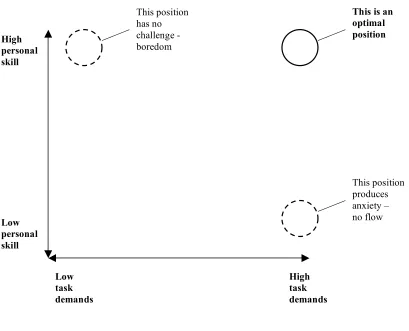
Figure 2.2: Experience of Flow (Davis, 2007)

A more recent publication, Csikszentmihalyi's

Creativity: Flow and the Psychology of

Discovery and Invention

(1996) is a compilation and in-depth reporting from interviews with

nearly one-hundred individuals, who, in the author's opinion, have demonstrated unusual

capacities for creativity. In this book, Csikszentmihalyi has brought together convincing

information about what makes for a creative mind and what kinds of lives such individuals

lead, from childhood through late in life. The list of respondents interviewed includes a wide

range of professionals from philosophers, actors, composers, psychologist and politicians to

jazz pianists. Responding to a series of detailed and complex questions, individuals revealed

to the author what qualities from childhood, parental relationships, academic preparations,

and their personal and professional relationships influenced creativity and brought them to

High

personal

skill

Low

personal

skill

Low

task

demands

High

task

demands

This position

has no

challenge -

boredom

This is an

optimal

position

(28)

understand their capabilities as leaders in the arts, humanities, politics, the sciences, or

business. Csikszentmihalyi's

Creativity

includes observations about lives of individuals and

outlines attributes that brought about successes as well as the frustrations. While this book

has some faults and reintroduces some of the same concepts discussed in earlier works, it

offers an important framework and vocabulary for thinking about the topic of creativity. Of

particular relevance is Csikszentmihalyi's insight that successful control of the way one

directs one’s mental attention is crucial both to personal satisfaction and to the successful

achievement of creative work. Although the notion of conscious thought is not supported in

the authors’ concept of flow this book seems to uncover the importance of the regulation of

cognition as it relates to creative outcomes.

Howard Gardner's

Creating Minds

(1993) delves into the lives of seven of the most

important creative individuals of the twentieth century. Gardner presents studies of Sigmund

Freud, Albert Einstein, Pablo Picasso, Igor Stravinsky, T. S. Eliot, Martha Graham, and

Mahatma Gandhi. Gardner's approach is less scientific than Csikszentmihalyi's in that his

research does not evolve from personal responses by individuals. The author's findings rely

on an abundance of biographical information to provide an understanding of the

circumstances and talents that resulted in his subjects' unique contributions. This form of

creativity research is difficult to operationalize because of its anecdotal/biographical nature.

Even so,

Creativity

and

Creating Minds

are major contributions to the research literature on

creativity, and both works are of great importance to educators, artists, as well as those across

all disciplines. Our understanding of how the most gifted have made significant contributions

can be instrumental in developing our own skills and knowledge. In all areas of life one can

benefit from the explorations of what the best and brightest developed, accomplished, and

most importantly learned on their way to success (Potter, 1998).

(29)

"one form of cognition" that "cuts across all human thinking" (Gardner, 1983). Through his

own research, Gardner observed multiple intelligences. Subsequently, Gardner wrote about

his observations of multiple intelligences in what has turned out to be a seminal book in the

educational community,

Frames of Mind

(1983). The theory of multiple intelligences, which

Gardner proposed in this book, has become a catalyst, as well as the framework, for many

current educational strategies across pre-school, higher, vocational and adult education

initiatives. The theory advances a mental paradigm in which an individual's mind can be

thought of as possessing a unique blend of intelligences. Gardner’s multiple intelligences

include language, math and logic, spatial reasoning, music, movement and inter- and intra-

personal skills. Gardner stated, “although they are not necessarily dependent on each other,

these intelligences seldom operate in isolation. Every normal individual possesses varying

degrees of each of these intelligences, but the ways in which intelligences combine and blend

are as varied as the faces and the personalities of individuals" (Gardner, 1983).

There are some significant questions and issues surrounding Howard Gardner's notion of

multiple intelligences, and the theory has not been readily accepted within academic

psychology. However, it has been embraced by a range of educational theorists and applied

by teachers and policymakers to the problems of schooling. A number of schools in North

America have looked to structure curricula according to the intelligences, and to design

classrooms and even whole schools to reflect the understandings that Gardner develops. At

the very least it has helped a significant number of educators to question their work and to

encourage them to look beyond the narrow confines of the dominant discourses of skills,

curriculum, and testing.

2.2

The Creative Process

(30)

Koestler 1964, Maltzman 1960) the ability to think creatively is a matter of utilizing a variety

of associations accessible to an individual. Unusual recombination of these bonds results in

creativity. Ribot, a forerunner of the modern associationistic approach to creativity,

described the process as one in which mental states become joined in such a way that one

state tends to evoke the other. Unlike association by contiguity, which often happens in

stereotyped responses when ideas are connected based on reflexive thought, associations by

resemblance – a reflective thought, either direct or through a mediating idea, as in analogical

thinking – are the bases for creative association. In the creative process, complementary

processes of association and disassociation occur by spontaneously causing ideas to associate

into groups through imagination (Taylor, 1975). In other words, one relies on associative

thought to bring about creative outcomes.

Spearman (1931) claimed that the generation of new ideas could be explained by three

“neogenetic processes,” each capable of generating new mental content. Two of these

processes are explained by the Principle of Relations – “When two or more items (percepts

or ideas) are given, a person may perceive them to be in various ways related”; and the

Principle of Correlates – “When any item and a relation to it are present to mind, then the

mind can generate in itself another item so related.” Spearman’s basic model (Figure 2.3)

involves an active process in which associations with an initial idea can be freed from their

relation to it and thus lead to something entirely new:

(31)

Figure 2.3: Spearman’s three principles of creativity (Brown, 1989, p.6)

Many approaches to creativity including Spearman’s, are implicitly associationistic: a

creative idea results from the novel combination of two or more ideas that have been freed

from their normal correlates. Mednick (1962) and his colleagues were the leading

associationists concerned with creativity. Mednick (1962; Mednick & Mednick 1964)

offered an explicitly associationistic theory of creativity based on introspective accounts of

creativity. Mednick (1962, p.221) defined the creative thinking process as:

the forming of associative elements into new combinations which either meet

specified requirements or are in some way useful; the more mutually remote the

elements of the new combination, the more creative the process or solution.

Mednick’s straightforward theory has stimulated a growing body of research in which

creativity is characterized by the combining of mutually distant associative elements of

thought. Creative individuals solve problems by juxtaposing a number of ideas not

previously related to one another. Creativity is a matter of novel arrangement of temporarily

contiguous, unusual associations to a given stimulus. Mednick has further defined the

creative process as the distribution of the individual’s associations around ideas that he has

called the associative hierarchy of responses (Figure 2.4) (Taylor, 1975).

(32)

This theory also arose as a result of distilling accounts from highly creative people (e.g.

Einstein, Coleridge, and Poinecare) concerning their discovery processes.

(33)

Figure 2.4: Mednick’s Associative Hierarchy (Brown, 1989, p.19)

According to Mednick's theory, for people to be creative it is necessary that they have an

abundance of associate elements (i.e., knowledge), as well as a weaker (i.e., flatter)

associative network. This means that the creative person may reach the same conclusion to a

given problem as the less creative person, but that alternative solutions are also available and

may impinge upon the conscious thoughts of the creative thinker. Mednick's theory

emphasizes loose associations that allow for unusual relationships to emerge. Mednick

explained these loose associations in terms of a hierarchy of thought.

As evidence for his theory of associative hierarchies, Mednick cites his research with

scientists rated by experts for the creativity of their work. He found that the less creative

scientists gave more stereotyped responses to 80% of the words in a standardized word

association task (Mednick, 1958).

(34)

constructed two college-level versions of the test, each consisting of 30 items (Mednick,

1968; Mednick & Mednick, 1967). The items in the RAT consist of three words that can be

associated with the solution word in a number of ways (e.g., the three words SAME /

TENNIS / HEAD are associated with the solution MATCH by synonymy (same = match), by

formation of a compound word (matchhead), and by semantic association (tennis match).

Thus, reaching a solution requires "creative thought" because the first, most-related,

information retrieved in solution attempts is often not correct, and solvers must think of more

distantly related information to connect the three words. Problem solvers’ success on items

from the original RAT reliably correlates with their success on classic insight problems

(Dallob & Dominowski, 1993; Schooler & Melcher, 1995). An insight problem is a problem

that requires the examinee to shift his or her perceptive and view the problem in a novel way

in order to achieve the solution. There are several types of insight problems. The three

predominant types are verbal, mathematical, and spatial (Dow & Mayer, 2004).

Although RAT items are not as complex as classic insight problems, they exhibit the three

properties of insight problems that distinguish insight solutions from non-insight solutions:

(1) they misdirect (or fail to direct) retrieval processes; (2) solvers often cannot report the

processing that led to the solution (Ben-Zur, 1989); and (3) upon solving RAT items, solvers

often have the Aha! experience (Bowden & Beeman, in press). This third property is

considered the centrally defining feature of insight problems. Thus, solving RAT-like items

appears to involve the same component processes that are critical for, and the same

phenomenological experience of, insight solutions to more complex problems.

(35)

The RAT has shown excellent reliability and validity (based on expert judgments of

creativity and research ability), is negatively correlated with grades and not correlated with

general intelligence, is positively associated with anagram problem-solving, and is positively

associated with creative personality and teacher’s ratings of creativity (Mednick, 1962).

Other studies have found that the preparation (Mednick, Mednick, & Jung, 1964a) and

incubation (Mednick, Mednick, & Mednick, 1964b) stages of the creative process are also

implicated in successful RAT performance implying a similarity in process among other

theories of creativity.

Another comparison to expert ratings of creative potential, this time for a group of architects,

showed that the more creative participants were better able to make the unusual associations

necessary to solve the word problems. In a further test using psychology graduate students,

Mednick found essentially the same relationship. More creative students, as rated by their

advisors, had higher Remote Associates Test scores as compared with the less creative

students (Mednick, 1962).

Associative theory (Mednick 1962; Wallach & Kogan, 1965) therefore, has something to say

about ideational creativity. In Mednick’s view, thought involves the association of ideas, and

a creative idea reflects a remote association. These remote associations represent the unique

relationships that exist among associates that result in a non-stereotype response or idea.

Mednick suggested that there are three ways to find creative ideas, namely serendipity,

similarity, and mediation. Each of these three processes functions to connect ideas or at least

bring them close together in an associative chain. Serendipity involves accidental

(36)

The associative view of thinking has a long history and the work of many have contributed to

what is presently considered associationistic theory. A specific example of an early

associative theory is that of Alexander Bain. In 1886 he wrote that “…by means of

association, the mind has the power to form new combinations or aggregates, different from

any that have been presented to it in the course of experience” (Runco, 1992).

Koestler’s (1964) approach to creativity may be considered, in certain respects,

associationistic in nature. In his book The Act of Creation, he suggested that creativity

involved “the displacement of attention to something not previously noted, that was

irrelevant in the old and relevant in the new context; the discovery of hidden analogies as a

result of the former; the bringing into consciousness of tacit axioms and habits of thought

that were implied in the code and taken for granted; the uncovering of what has always been

there” (pg.119-120). He coined the word “bisociation” to make a distinction between routine

skills of thinking which occur on a single plane and the creative act, which operates on more

than one plane (Taylor, 1975).

In his book, The Magic of Your Mind, Sidney Parnes (1981, p.59) describes what seems to be

association as the essence of creative problem solving in design:

“Creative problem solving becomes the task of finding the greatest number of

interconnections and interrelationships among our vast and diverse internal and

external resources, connecting them in both obvious and not so obvious ways. The

more seemingly remote the relationship, the more likelihood of originality in the idea.

But remember producing a highly original idea that is also a useful solution to

problem requires responsible creative action…”

(37)

asserted that the process would yield its greatest effects if given under game-like conditions

(Wallach, 1970). One test in particular, similarities, focused on associational fluency, “tell

me all the ways in which a potato and a carrot are alike” (Brown, 1989).

Wallach (1970) considered his earlier research (Wallach & Kogan 1965) and Mednick’s

(1962) work in relation to Maltzman’s (1960) approach to training creativity. He concluded

that “what matters most is the generating of associates; once produced, the evaluation of their

relevance and appropriate action in the light of this judgment seems to pose little difficulty”

(pp.1254-1255). He further suggested that the process underlying the generation of many

associates was attention deployment. Creative individuals can attend to many aspects of a

given stimulus and, thus, produce more and more varied associations (Brown, 1989). For

example, when generating creative content for a design project, ideas are expressed in larger

quantity and are more unique in the case of a creative individual. This is due to the ability to

attend to multiple possible associations based on stimulus.

2.3

Creativity and Cognition

When one thinks of creativity, eminent artists or scientists such as Michelangelo or Einstein

immediately come to mind. Historically, the study of creativity began with the concept of

genius. There is a longstanding tradition of examining eminent creators, who are viewed as

“unambiguous cases” of creativity. However, these highly creative people are rare and

difficult to study in the psychological laboratory. In his American Psychological Association

address, psychologist J.P. Guilford (1950) noted that the rarity of these individuals had

limited research on creativity. He proposed that creativity could be studied in everyday

people with a psychometric approach, using paper-and-pencil tasks. Guilford presented

several reasons for conducting this type of research in creativity, with understanding and

enhancement as two of the most important reasons (Sternberg & Lubart, 1996).

(38)

way of comparing people on a standard “creativity” scale. This psychometric revolution for

measuring creativity had both positive and negative effects on the field. On the positive side,

the tests facilitated research by providing a brief, easy-to-administer, objectively scorable

assessment device. Therefore, research was now possible with “everyday” people (i.e.,

noneminent samples). However, critics suggested that the criteria for testing suggested by

Guilford and expanded upon by Torrance (1974); fluency, flexibility, originality, and

elaboration failed to capture the holistic concept of creativity. In fact, the definition and

criteria for creativity are a matter of ongoing debate. Thus, it is hardly surprising that in the

years since the cognitive revolution began in the late 1950s and early 1960s a large number

of cognitive psychologists have concentrated more on other, more tractable cognitive

constructs, such as perception, memory, reasoning, and decision making (Sternberg &

Lubart, 1996).

Many researchers have concluded that a search for the essence of creativity is overwhelming

unless it is approached with a domain specific focus. Brown (1989) stated that it is unlikely

that there will ever be an essence of creativity, and that creativity might be a domain specific

construct due to the fact that it is so complex and multidimensional. Taylor (1987)

delineated the elements of creativity and concluded that because of the complexity of the

creative process in individuals, assessment must focus on one element in a larger

comprehensive construct. Hocevar and Bachelor (1989) have acknowledged that no single

test of creativity will accurately represent the entire construct. This supports the notion of

identifying the most relevant aspect of creativity for the particular domain under

investigation. It is critical to select a test or battery of tests to assess a particular component

or correlate of creativity that you wish to measure. Most notably by breaking down creativity

to a single element of focus a study can maintain greater validity and reliability.

(39)

creativity assessment program. Among these were analogical /metaphorical thinking and

synthesis. In more recent work, Weisberg (1993) proposed that creativity involves

essentially ordinary cognitive processes yielding extraordinary products. Referring to case

studies of eminent creators and laboratory research Weisberg attempted to show that the

insights depend on participants’ use of conventional cognitive processes (e.g. analogical

transfer) applied to knowledge already stored in memory (Feldhusen & Eng Goh, 1995).

Creative thinking and design in general can often be characterized by periods of incompatible

or at least conflicting demands. A good idea is rarely easily found and often comes after a

long periods of thought. It is hardly surprising then that good designers tend to be at ease

with the lack of resolution of their ideas for most of the design process. Characteristically

designers seem to cope with this lack of resolution through the generation of alternatives.

Creative thinkers and designers in particular seem to have the ability to change the direction

of their thinking thus generating more alternative ideas (Lawson, 2006). Elsewhere

Mansfield and Busse have proposed that creativity is a function of number of cognitive

abilities and skills as well as a number of motivational, personality, and situational factors.

Since no training program is likely to influence more than one or two of these necessary

characteristics, the success of any training program will be based on isolating a particular

component or correlate and integrating training with instruction in a particular domain

(Mansfield, Busse & Krepelka 1978).

2.4 Enhancing

Creativity

(40)

enhancing creative thinking continues to escape the vast majority of design educators (Houtz,

1994).

In all areas of education there is a need for reconsideration of educational objectives. New

concepts, new theories, and new experimental equipment supplied by the ever-expanding

technology are the very nature of education. Thus, the student in any field, trained in a

narrow discipline to be proficient in certain skills, will find that these skills become out of

date, and that he/she has acquired nothing but knowledge which, after a few years, ceases to

be of direct use (Kvashny, 1982).

To meet this challenge, many educators from different fields (Torrance 1962, Osborn 1962,

Parnes 1967, and others) suggest the cultivation of deliberate effort to enhance creative

thinking. This includes requiring every individual to have a flexible mind, and to be able to

absorb, acquire and produce new ideas. Experts suggest that a central purpose of education

should be to develop cognitive skills of creative thinking, thus preparing students for the

effective and innovative use of the mind with whatever subject matter and whatever

problems that the future may have to deal with.

Currently millions of hours are devoted to problem solving training, however, many

programs are limited in their focus on specific creative skills. While teachers may recognize

that there are creative and cognitive factors, many do not understand how to tap and

encourage them.

Parnes (1967, p.66) summarized:

(41)

Many other studies reported similar findings: Brown (1968) and Mitchell (1971) both found

that experimental groups made significantly greater gains in creative thinking scores than

control groups.

Evidence supports the notion that one can improve creativity with the proper approach to the

educational system through which designers pass. Alon Kvashny (1982) in his study on

creativity in the Landscape Architecture studio provided major implications for the training

and education of all design students. Among these implications was the conclusion that there

is a creativity shortfall under current design education pedagogy and that creativity training

should be included in courses of design in Landscape Architecture. In addition, Kvashny

stated that creativity training should be integrated into the studio education and continued

throughout the entire design education. One of the findings of the study was that creativity

training with direct involvement in exercises designed to enhance creativity produced greater

overall effects than did creativity training that consisted of only reading books on the subject

(Kvashny, 1982).

Assuming that most people have some creative potential, the next question is how to evoke,

access, stimulate, train, or develop the creative potential. The main question perhaps is

whether creativity can be taught within a large scale educational system, and if so, how.

Many researchers in the field of creativity are convinced that creativity can be taught, but

critics say that the research evidence supporting this is weak, and the instructional

approaches are so diverse that clear, solid guidelines cannot be found (Feldhusen & Eng Goh,

1995).

In general, research suggests that if creativity training strategies can be accessed, and if the

skills and strategies used in creative activities can be defined, then it should be possible to

develop curricular models for use in the classroom. However, good instructional strategies

alone do not guarantee successful real-life creative production.

At best they facilitate

(42)

of program goals would then consist of sorting among the components of these processes and

deciding on a manageable set for inclusion into the program (Feldhusen & Eng Goh, 1995).

Using this approach, educators would not try to teach “creativity” but rather isolate creative

thinking strategies and introduce metacognitive thinking in support of these skills.

Davis and Rimm (1985) reviewed many techniques and methods for accessing creativity and

combined them with Davis’s (1982) awareness, understanding, techniques, and actualization

(AUTA) model. The essential techniques or creative strategies, according to Rimm and

Davis are brainstorming, attribute listing, morphological synthesis, idea checklist, and

synectics.

After their extensive review of research, Davis and Rimm concluded that using

these strategies could definitely allow students to reach their creative potential.

Creativity is often seen as the unique human capacity to think up something new out of

nothing, a magical gift that all great creative minds possess. Creativity is surrounded by

myths about sudden inspiration, the Eureka moments and ‘aha’ experiences. One uses the

word creativity for anything experienced as new, when one cannot easily explain where it

came from. Creativity is a difficult and fascinating process, but certainly not a magical one.

Being creative doesn’t mean sitting around waiting for a sudden bolt to hit you. It is a pity

that the myths surrounding creativity tend to cloud people’s views of the work that is

necessary to be creative. Fortune favors the prepared mind (Dorst, 2003).

2.5

Creativity as a Metacognitive Process

There is a general consensus that the major components of creative thinking processes and

creativity include metacognitive skills in planning, monitoring, and evaluation (Armbruster,

1989). These metacognitive skills are also essential for effective and efficient problem

solving and creative thinking (Jausovec, 1994). In Beyer’s (1987)

basic model of

(43)

association are really action-oriented metacognitive guides that operate in concert with

self-monitoring, self-reinforcement, and self-evaluation to sustain and enhance creative thinking.

Armbruster (1989) broadened the scope of metacognition in creativity by proposing that

there are guiding skills, regulatory skills and awareness that function metacognitively in

support of creative thinking and are trainable operations.

One approach to increasing certain aspects of creativity might be through deliberate

educational programs that conceptualize creative thinking as a metacognitive process. Using

this approach students may enhance creativity and learn to break through barriers to change

habits that hamper ideation in order to increase their creative cognitive potential.

An important aspect of the growing interest in metacognition in recent years has been an

increasing emphasis on the role of self-management. Runco (1990) has stressed the

importance of self-evaluative skills and metacognition more generally to creative thinking.

Self-management involves becoming an active manager of one’s cognitive resources. It is, in

part, a matter of paying attention to one’s own thought processes and taking responsibility for

thinking. It involves learning one’s strengths and weaknesses as a creative problem solver

and finding ways to utilize the strengths to mitigate or work around the weaknesses. It

means making an effort to discover conditions that facilitate one’s own creative work

(Nickerson, 1999).

(44)

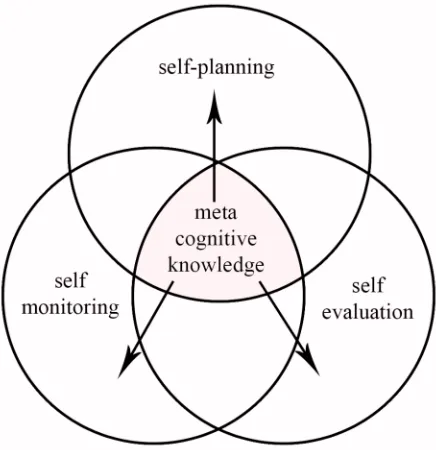
Knowledge and Regulation of Cognition

“unless you know everything, what you need is thinking”

Edward de Bono (Maclure and Davies, 1991, p. xii)

Knowledge and strategies in isolation are not sufficient for creative thinking. Students must

understand the strengths and limitations of their knowledge and strategies in order to be able

to use them efficiently. This capability builds explicit knowledge of one's own cognition

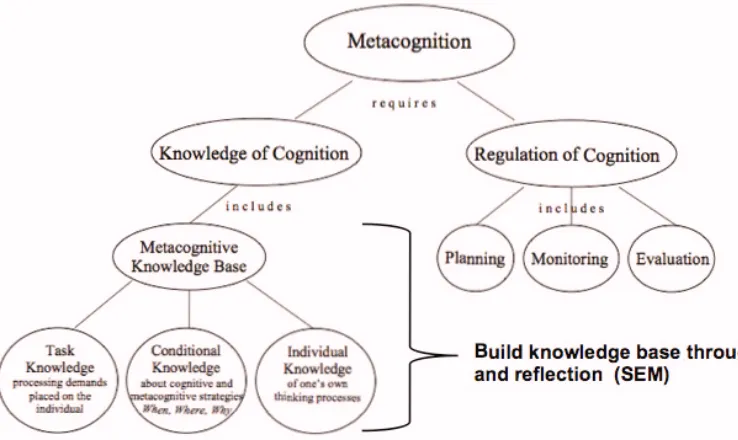
(Figure 2.5). Metacognition includes two main components referred to as knowledge of

cognition and regulation of cognition (Schraw & Moshman, 1995; Baker 1989). Knowledge

of cognition consists of explicit knowledge of one's memory, knowledge base, and strategy

repertoire, as well as what often is known as conditional knowledge, or knowledge about

why, when and where to use strategies. Regulation of cognition consists of knowledge about

planning, monitoring, and evaluation.

Figure 2.5: Knowledge and Regulation of Cognition (Schraw & Brooks, pg.199)

(45)

the interaction of these skills. To facilitate this understanding, teachers can discuss the

importance of metacognitive knowledge and regulation. Ideally, such a discussion helps

students construct an explicit mental model of a metacognitive thinking process (Schraw &

Moshman, 1995). Another way is for teachers to model their own metacognition for

students. When thinking out loud, teachers too often discuss and model their cognition (i.e.,

how to perform a task) without modeling metacognition (i.e., how they think about and

monitor their performance). A third way is to provide time for group discussion and

reflection. Peer modeling of both strategies and metacognition not only improves

performance, but increases self-efficacy as well (Schraw, 1998).

Promote Regulation of Cognition

The regulation of cognition is the way an individual monitors, controls, and directs aspects of

his or her cognitive processes and behavior for themselves by coordinating thinking skills.

The regulation of cognition involves the following processes:

Planning: involves goal-setting, developing a strategy, and identifying obstacles; the

purposeful selection of strategies for specific tasks and organized steps to execute them.

Monitoring: involves the ability to observe, acknowledge, and measure progress toward

one's objectives.

Evaluating: involves assessing outcomes, gauging progress; an ongoing assessments of

knowledge or understanding, resources, tasks, and goals.

Evaluation, planning, and regulation help students gain executive control of behavior and

should take place before, during, and after stages of tasks.

(46)

our progress, and evaluating the results is an effective way of helping students take more

control of their own thought and feeling processes (Barell, 1985).

You cannot help each student during each creative process; students must take control of the

process. After forming initial creative products and awakening the joy of creating in students,

one should teach strategies for regulation of cognition. Self-directed creating is how most of

us work throughout our lives-and especially in our lives outside of school. Some things

students can do to promote their regulation of cognition:

1. List multiple ideas (solutions) to a problem (project)

2. Assess creative strategies and pursue one

3. Defend your choice

4. Develop plans for completing the project, including how and where to find information,

and how and when you will finish the project

5. Keep a daily thinking log of progress, roadblocks, and how you surmounted problems

6. Discuss teacher feedback on finished projects

7. Assess a classmate's project and review and discuss peer evaluations.

(Sternberg & Williams, 1996)

Regulation of Problem-Solving

Students at almost any age are capable of taking charge of their own problem solving. When

faced with a problem, self-regulated problem-solvers typically do the following:

1. They begin by analyzing the task and interpreting task requirements in terms of their

current knowledge and beliefs. (Planning)

2. They set task-specific goals, that they use as a basis for selecting, adapting, and possibly

inventing strategies that will help them accomplish their objectives. (Planning)

3. After implementing strategies, they monitor their progress toward goals, thereby

generating internal feedback about the success of their efforts. (Monitoring)

4. They adjust their strategies and efforts based on their perception of ongoing progress.

(Evaluating)

Figure

Figure 2.1: Diagram of Literature Review
Figure 2.2: Experience of Flow                                                  (Davis, 2007)
Figure 3.1: Creativity as a Metacognitive Process
Figure 4.2: Research Design Overview
+7

References

Related documents

In this context, the Committee noted in the general introduction to Conclusions XIX-2 (2009) on the repercussions of the economic crisis on social rights that

The writing of PR materials, especially those intended for new media, demand a lot of creativity on the author’s part in order to make them stand out from the countless other

The calculations of these molecules reveal that pKa values varying from 12.25 to 17.25 and indicate that the acidity of these molecules in aqueous phase increases whereas the

When either αγ ≤ 1 or αγ > 1 and A ≤ A c (γ ) then the world economy converges to a symmetric steady state and thus the relatively poor country with an inefficient

Due to these widespread of violence in the state during the rerun election and couple with the incoherent figures as declared by the Independent National Electoral Commission

In 1898 , James Ivory set up British Assets Trust Ltd , an overseas investment company in Edinburgh, with a capital of £15,000 and by 1939 the trust was managing funds

When whole blood is exposed to distilled water, water is taken into red blood cells (RBC) due to the osmotic pressure differences between water and RBC

Given that the major cause or causes of increased spending varies across countries and over time, several studies have sought to identify the underlying drivers of spending trends