DIAGNOSE AND INVESTIGATION OF ANGULAR DISTRIBUTION OF COPPER PLASMA IONS
Rabia Qindeel, Noriah Bidin and Yaacob Mat Daud
Laser Technology Laboratory, Physics Department
Faculty of Science, University Teknologi Malaysia, 81310 UTM Skudai, Johor, Malaysia E-mail: [email protected]
ABSTRACT
A Q-switchedNd:YAG laser with fundamental wavelength of 1064 nm delivering pulse energy of 125 mJ and pulse duration of 8 ns was employed as a source of energy to generate plasma. The laser was focused on copper as a target material. The angular distribution of ejected ions species were collected by a developed Faraday cup. The cups were arranged radialy at the range of angles from 5o to 90o with two radiuses of 5 cm and 10 cm. The cups were coupled to high speed oscilloscope to display and measure the ion flux and charge state. The exposed Faraday cup was also studied by metallurgical technique. The results obtained show that the maximum flux of copper ion collected by Faraday cup was 11.7 x 10¹⁶ charge /sec. The maximum number of charge state was Cu+4 at 5 cm and Cu+3 at 10 cm. In general the angular distribution of ions flux is maximum in axial direction and decreases in radial direction. The temperature and density of copper is measured with electronic probe. Various elements are found deposited on Faraday cup with majority lines of copper cluster.
Keywords: Nd:YAG laser, plasma, Faraday Cup, angular distribution
INTRODUCTION
The interaction of laser with materials and properties of the plasma produced have been investigated for many years. Nevertheless, the generation of high-density and high tempe-rature plasmas by focusing high peak power laser radiation onto a solid target is still a growing field in basic science, engineering and material processing technology [1-2]. The strong interest in this field is largely due to the fact that both fundamental aspects of laser-solid interaction and consequent plasma generation, and applied technique in material processing technology and sample elemental analysis are involved in particular, plasmas evaporated by irradiating solid targets with visible and ultraviolet nanosecond laser pulses at moderate energy density are widely used for the deposition of thin solid films, are the technique has been applied successfully to a wide range of materials including metals, semiconductors, insulators and superconductors.
velocity, energy, flux and angular distribution of ions from laser induced plasma are including of Micro channel plate (MCP), Solid state nuclear track detector (SSNTD), Faraday cups (FC), Photomultiplier tube (PMT).
Torrisi et al, (2001) showed that when Nd:YAG laser is focused on different metallic targets; the interaction produces a high etching for pulsed energy higher than a threshold value typical of each metal. Near the threshold a strong neutral emission takes place; at high pulse energy a stronger ionic emission occurs. The experimental thresholds of ion emission are very similar to the threshold of the neutral emission. The atomic neutral emission is monitored by mass quadrupole spectrometer and by vapor thin film deposition technique. The ionic emission is detected through ion collectors (IC) using Faraday cups and time of flight measurements. The energy threshold, emission yields, the angular distribution, the fractional ionization, the kinetics and characteristics of the plasma pro-duction and the ion charge state are presented and discussed. Other researchers [7-10] also reported about ionic emission with different material, its characteristics and measure-ments techniques. The aim of this present paper is to investigate the anisotropic behavior of flux of Copper ions emitted from laser induced plasma.
THEORY
Whenever the laser is irradiated on the target the electromagnetic energy is firstly converted into electronic excitation and into thermal energy. Some parts of its energy converted into mechanical energy to cause evaporation, ablation, and hence plasma form-ation. This resulting plasma plume consists of atoms, ions, molecules and electrons. The electrons are more mobile than ions and neutrals, but they cannot escape the plasma due to strong space charge incurred by collectively moving away from the ions. The Coulomb’s
attraction of the ions by electrons produces a space charge field that tends to accelerate ions according to their charge eZ.
q=neZ (1)
Where q is total charge due to ions and n is the number of ions and eZ is an ion’s
charge. Therefore the rate of ions,
eZR V dt dn
(2)
Where V and R are the voltage and load resistance respectively. By using Equation (2), the ion flux at different distances and different angles can be computed. At maximum energy there is maximum probability of scattering after collision. When two high-energy ions come in close interaction with each other then large electrostatic forces of repulsion appear between them. As a result, ions are scattered at different angles.
One of the quantities of interest in plasma Physics is the temperature of the plasma. For example, when plasma is used for fusion reactions, this is the parameter that most concerns us and that we would like to predict how it varies with other parameters of the plasma. Plasma temperature is very high and as such measurement with physical objects is not feasible. The electron temperature (kTe) is calculated by taking the slope of the
e p kT e V I dV dI 2 )
( (3)
Hence 2kTe/e is the voltage at which a straight line, tangent at origin, assumes the
value of I(Vp). The density of plasma depends on plasma temperature and electron
cur-rent. Plasma density is measured by using following relation;
e e p p e kT e m A V I
n ( ) 22 (4)
Ap is the area of the probe, me is the mass of electron, e is the electron charge and kTe is the electron temperature in eV [12].
EXPERIMENT
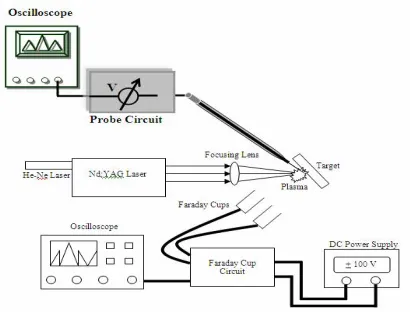
A HY200 Q-switched Nd:YAG pulsed laser with wavelength of 1064 nm and delivering energy of 125 mJ, pulse duration of 8 ns was employed as a source of ablation. A plate of copper was conducted as a target material. The laser was focused using a biconvex lens with focal length of 20 cm. The target was irradiated with Nd:YAG laser at an angle of 45o. The Langmuir probe is inserted very near to the target where rich collection of ions is present. The cups are arranged at a distance of 5cm and 10 cm. The separation of electrons and ion in the plasma plume, setup an electric field, due to which ions were accelerated away from target and made incident on cups. The ion beam entered into the cup after passing through the collimation hole that discharge the capacitor. Faraday cups were places at various angles including 5o, 30o, 45o, 60o, and 90o with respect to the target surface. The signals were displayed on Tektronix TDS 3054B Digital Storage Oscilloscope with sampling rate of 5 G/s. The exposed cup was observed under scanning Electron Microscope (SEM). The schematic diagram of whole experimental arrangement is shown in Figure 1.
RESULTS AND DISCUSSION
In this experiment the charges are attracted by using Faraday cup technique. The Faraday cups were biased by –100 V. An anisotropic behavior and flux of Cu ion were then capable to be detected and measured. The output was taken across a load resistor. The ion current signal was manifested on a 500 MHz Digital Storage Oscillo-scope through an integrated circuit. From obtainable signal, the flux or rate of arrival of ions can be estimated. The time of flight measurement of ion reaching to the Faraday cups at different angles is almost the same because the cups are located at radial direction.
The angular distribution of copper plasma was measured at two distances. The Faraday Cups were placed at radius of 5 cm and 10 cm from the target. At the work-ing distance of 5 cm the charged states obtained from copper plasma plume are Cu+4, Cu+3, and Cu+ 2 and Cu+1 while the charge states reduced to Cu+3, Cu+ 2 and Cu+1 at radius of 10 cm.
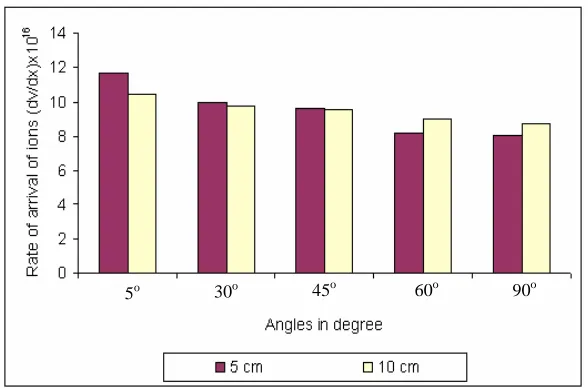
The pulse width of each of the current signal was measured as the flight time of each of the charge state. The accumulation of the flight time from each pulse was considered as the total flight time of copper ion at each radius. In average the flight time of copper at radius 5 cm is 84 ns and 92 ns at radius of 10 cm. In Figure 2shows comparison histogram of the rate of arrival of ions at a radius of 5 cm and 10 cm of Faraday cup from copper target at different angles.
Figure 2: Angular distribution of copper ion at radius of 5 cm and 10 cm.
The optimum rate of arrival of copper ion flux at 5o with respect to the target normal is 11.70 x 10¹⁶ charge/sec at radius of 5 cm. The flux of ions is almost the same at 60o and 90o which is 8.181 x 10¹⁶ and 8.05 x 10¹⁶ charge/sec. The maximum collection of ion’s
flux is again obtained at the smallest angle of 5o. The minimum of ion’s flux is collected
by Faraday Cup at the greatest tested angle of 90o. With the increasing angle from 5 to 90, the ion flux was found to be decreased from 10.42x 10¹⁶ to 8.74 x 10¹⁶ charge/sec. So the flux of ions was collected greater towards smaller angle or along the normal line of the target surface.
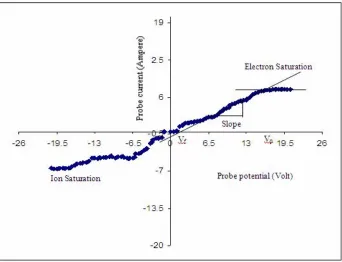
Langmuir probe was inserted in laser produced copper plasma. Both of positive and negative current signals in term of voltage amplitude are increasing via the increment of bias voltage in the range of -20 V to +20 V. The collected data upon injected bias voltage and LP current produced are used to plot graph of LP current versus probe voltage. The graph is shown in Figure 3. The trend of the graph obtained as similar as the theoretical IV characteristic. The linear part of the graph has a slope of 0.45. The space potential or plasma potential from the graph is 16.5 V, whereas the floating potential where LP potential is zero, calculated as 0.5 V. The floating potential of laser produced copper plasma is experimentally found to be positive which is in accordance with theoretical prediction. Ion current saturation occur when probe potential is greater than – 17 V, while electron saturation of graph of Figure 3 occur after plasma potential achieved more than 16.5 V. The temperature of plasma measured in air is high due to ionization of air particles. In air, the kinetic energy of electrons increase due to increased electron temperature which then cause expansion of plasma plume and in turn decrease electron density. The calculated results by Langmuir probe are tabulated in Table 1.
Figure 3: Langmuir probe I-V characteristic of copper plasma
Table 1: Calculations of copper Plasma parameters
Plasma Parameters Quantity
Floating Potential (Vf) 0.5 (V)
Plasma Potential (Vp) 16.5 (V)
Electron Temperature (kTe) 7.91 (eV)
Electron Density (ne) 3.814 x 10 14
The exposed Faraday Cup was then examined under Scanning Electron Microscope (SEM). The typical observation results are shown in Figure 4.
Figure. 4: SEM Micrograph of copper cluster on Faraday Cup.
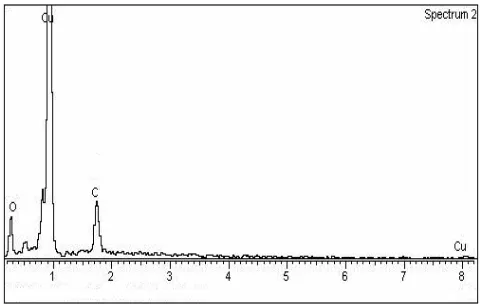
The pictures in Figure 4 are taken at different measured area with different magni-fication and positions. The copper clusters are found distributed heavily in Figure 4 (a). Picture in Figure 4(b) has been enlarged from the same picture of Figure 4(a) in order to view the clusters more clearly. The clusters comprised of various state and configuration including molten and solid state. The appearance of copper cluster is confirmed by using EDX. The typical observation from EDX result is shown in Figure 5.
Figure 5: Spectrum of ablated particles of Cu under measured area.
The major line in the spectrum of Figure 5 is copper. The other associated lines indicate the carbon and oxygen element. The existence of impurities of oxygen and car-bon elements are possibly due to the exposure is carried out in open air and involvement of contamination during ablation. The flatten structure of cluster is associated with copper molten.
mutual interaction or the Cu ions might collide with electrons or atoms during their journey to reach the Faraday cups. This also contributed to angular distribution of copper ion.
CONCLUSION
On the basis of results and discussions it can be concluded that the rate of arrival of copper ions is maximum along the normal of the target. The value of this flux dec-reases with the increasing angle with respect to the target normal. The investigation of angular distribution shows that the flux is maximum in axial direction and decreases in radial direction. The number of peaks in the signal represents the charge states in the plasma plume. With the help of Faraday cup the charge states of plasma ions are Cu+4, Cu+3, Cu+2 and Cu+1. The temperature of plasma is measured as 7.91 (eV) and density of copper plasma is 3.814 x 10¹⁴ (cm)-3.
ACKNOWLEDGEMENT
The authors would like to express their special thanks to the government of Malaysia for supporting this project through IRPA grant. Thanks are also due to UTM through RMC for supporting the performance of the project.
REFERENCES
[1] Von Allmen M and A Blatter. (1995). Laser beam interaction with material: Physical principles and applications. Springer, Berlin.
[2] Miller J C and Haglund R F (1998). Laser ablation and deposition. Academic, New York.
[3] Wolowski J, Parys P, Woryna E, Krása J, Láska L, Rohlena K, Gammino S,
Ciavola G, Torrisi L, Boody F P, Höpfl R, Hora H, Haseroth H (2000). Laser ion
sources for different applications, Optica Applicata 30: 69-82.
[4] Woryna E, Wolowski J, Králiková B, Krása J, Láska L, Pfeifer M, Rohlena K,
Skála J, Peina V, Boody F P, Höpfl R, Hora H(2000). Laser produced Ag ions for
direct implantation. Rev. Sci. Instrum. 71: 949-951.
[5] Szydlowski A, Badziak J, Parys P, Wolowski J, Woryna E, Jungwirth K, Kralikova B, Krasa J, Laska L, Pfeifer M, Rohlena K, Skala J, Ullschmied J, Boody F D, Gammino S, Torrisi L (2003). Measurements of energetic ions emitted from laser produced plasma by means of solid state nuclear track detectors of the PM-355 type, Plasma Physics and Controlled Fusion 45: (8), 1417-1422. [6] Torrisi L, Ando L, Gammino S, Krasa J, Laska L (2001). Ion and neutral emission
from pulsed laser irradiation of metals. Nucl. Instrum. and Methods. B 184: 327-336.
[7] Badziak J, Krása J, Láska L, Parys P, Wolowski J, Woryna E (1999) A study of
angular distribution of ions emitted from plasma produced by a high power laser.
Proc. Int. Conf. on Inertial Fusion Sciences and Applications. Bordeaux, France,
Eds. C Labaune, W J Hogan, K A Tanaka, Elsevier, Amsterdam, 2000: p. 1042-1045.
[9] Claeyssens F, Henley J S and Ashfold R N M (2003). Comparison of the ablation plumes arising from ArF laser ablation of graphite, silicon, copper, and aluminum in vacuum. Applied Physics. 94: 2203-2211.
[10] Baranowski J, Sadowski M, Sklandik-Sadowska E (2002). Investigation of Corpuscular Emission from the Prague Capillary Pinch. J. High Temp. Mat.
Pro-cess. 47: 27-30.
[11] Stenzel R. L. (1997). Typical Langmuir Probe Trace Evaluation. plasma Physics Laboratory. University of California.
[12] Francis F. Chen. (2001). Langmuir probe analysis for high density plasma.