MOHAMED A. ATEIA ELHABIB
A thesis submitted in fulfilment of the requirements for the award of degree of
Doctor of Philosophy
International Business School Universiti Teknologi Malaysia
iii
DEDICATION
ACKNOWLEDGEMENT
v
ABSTRACT
ABSTRAK
vii
TABLE OF CONTENTS
CHAPTER TITLE PAGE
DECLARATION ii
DEDICATION iii
ACKNOWLEDGEMENT iv
ABSTRACT v
ABSTRAK vi
TABLE OF CONTENTS vii
LIST OF TABLES xvi
LIST OF FIGURES xix
LIST OF ABBREVIATIONS xx
LIST OF APPENDICES xxiii
1 INTRODUCTION 1
1.1 Background of Study 1
1.2 Status and Comparison of Corporate Governance in Gulf
Cooperation Council Countries (GCC) 4
1.2.1 Comparison of GCC Members‘ Codes of
Governance 6
1.3 Oman‗s Economy, Stock Markets Development and
Corporate Governance 13
1.3.1 Oman Economy 13
1.3.2 Development of Oman Stock Market 13 1.3.3 Status of Corporate Governance in Oman 16
1.4 Problem Statement 19
1.5 Research Questions 26
1.7 Significance of the Study 27
1.8 Scope of the Study 28
1.9 Definition of Key Terms 29
1.10 Structure of the Thesis 34
2 LITERATURE REVIEW 35
2.1 Introduction 35
2.2 Definition of Corporate Governance 35
2.3 Models of Corporate Governance 38
2.3.1 The Main Features of Shareholding and
Stake-holding Models 38
2.3.2 The Shareholding Model and Stake-holding Model
Differentiated 40
2.4 International Initiatives 42
2.4.1 The Cadbury Committee 42
2.4.2 Sarbanes Oxley Act 43
2.4.3 Principles of Corporate Governance 44 2.5 The Causes for Calls for Improved Corporate Governance 45
2.6 Theories of Corporate Governance 47
2.6.1 Agency Theory 48
2.6.2 Stewardship Theory 49
2.6.3 Resource Dependence Theory 50
2.6.4 Stakeholders Theory 51
2.6.5 Information Asymmetry and Managerial Signaling
Theory 55
2.7 The Impact of Internal Corporate Governance Mechanisms
on Firm Performance 59
2.7.1 Review of Empirical Evidence Using
Composite-Index Approach 59
2.7.2 Empirical Evidence -Individual Variable Approach 66 2.7.2.1 The Impact of CEO-Chairman Role
Separation on Firm Performance 66 2.7.2.2 The Impact of Board Size on Firm
ix
2.7.2.3 The Impact of Non-Executive Directors
on Firm Performance 71
2.7.2.4 The Impact of Board Independence on
Firm Performance 74
2.7.2.5 The Impact of Number of Boards
Meetings on Firm Performance 76 2.7.2.6 The Impact of Board Members
Absenteeismon Firm Performance 78 2.7.2.7 The Impact of Multiple Directorships on
Firm Performance 78
2.7.2.8 The Impact of Industry Experience on
Firm Performance 80
2.7.2.9 The Impact of Board Committees on
Firms Performance 81
2.7.2.10 The Impact of Board Members Knowledge of Accounting / Finance on
Firm Performance 83
2.7.2.11 The Impact of Female Board Members
on Firm Performance 84
2.7.2.12 The Impact of Influential Board
Members on Firm Performance 86 2.8 The Impact of Ownership Structure on Firm Performance 88
2.8.1 The Impact of Institutional Investor on Firm
Performance 88
2.8.2 The Impact of Foreign Ownership on Firm
Performance 91
2.8.3 The Impact of Ownership Concentration on Firm
Performance 93
2.8.4 The Impact of Government Ownership on Firm
Performance 95
2.9 Hypothesis Development 96
2.9.1 Board Competency Index (BCI) and Firm
Performance 97
2.9.3 Non-executive Directors and Firm Performance 98 2.9.4 Board Independence and Firm Performance 99 2.9.5 Number of Boards Meetings [NBMs] and Firm
Performance 100
2.9.6 Board Members Absenteeism and Firm
Performance 100
2.9.7 Multiple Directorships and Firm Performance 101 2.9.8 Board Committees and Firm Performance 102 2.9.9 Female Board Membership and Firm Performance 103 2.9.10 Industry Experience and Firm Performance 104 2.9.11 Influential and GMT Employees Board Members
and Firm Performance 105
2.9.12 Knowledge of Accounting and Professional
Certifications and Firm Performance 105 2.9.13 Performance Based Directors‘ Remuneration and
Firm Performance 106
2.9.14 Ownership Structure and Firm Performance 107 2.9.14.1 Institutional Investors and Firm
Performance 107
2.9.14.2 Government Ownership and Firm
Performance 108
2.9.14.3 Ownership Concentration and Firm
Performance 108
2.9.14.4 Foreign Ownership and Firm
Performance 109
2.9.14.5 Quasi Government Ownership and Firm
Performance 109
2.10 Summary of Hypotheses for Each Research Objective 110
2.11 Conceptual Framework 114
2.12 Summary 116
xi
3.1 Introduction 125
3.2 Research Paradigms, Process and Methodologies 126
3.2.1 Research Paradigm 126
3.2.2 Research Process 127
3.2.3 Methodologies to Studying Corporate
Governance-Performance Relationship 129
3.3 Data Collection 131
3.3.1 Sample and Years of the Study 131
3.3.2 Data Sources 132
3.4 Construction of Board Competency Index [BCI] 132 3.4.1 Rationale for Index Construction 132 3.4.2 Steps for Constructing and Validating Board
Competency Index 134
3.4.2.1 Step 1: Determining BCI Index
Components and Basis 134
3.4.2.2 Step 2: Coding of Data 135
3.4.2.3 Step 3: Selecting Index Calculation
Approach (Weighted vs. Un-weighted) 136 3.4.2.4 Step 4: Calculation of Index Score 136 3.4.2.5 Step 5: Testing Index Validity
(Construct Validity and Contents
Validity) 137
3.4.2.6 Step 6: Testing of Index Reliability
(Stability and Reproducibility) 138 3.5 The Definition and Measurement of Independent
(hypothesis) Variables 139
3.5.1 Board Competency Index [BCI] 140
3.5.2 Board Size [BDSZE] 140
3.5.3 Board Independence [BDIND] 141
3.5.4 Non-executive Directors [NEDs] 141
3.5.5 Boards Meetings [NBM] 142
3.5.6 Members Absenteeism [ABSNP] 142
3.5.7 Multiple Directorships 142
3.5.9 Female Board Membership [FEMALE] 144 3.5.10 Accounting or Finance Experience [ACCTG] and
[PRCRT] 144
3.5.11 Directors‘ Remuneration [DIREM] 144
3.5.12 Board Members‘ Industry Experience [INDEXP] 145 3.5.13 Highly Influential Board Director [HIBD] 145 3.5.14 Institutional Investor [INSTINV] 145
3.5.15 Government Ownership [GOVOWN] 146
3.5.16 Foreign Ownership [FROWN] 146
3.5.17 Ownership Concentration [OWNCON] 146 3.5.18 Quasi Government Ownership [QGOWN] 147 3.6 The Definition and Measurement for the Dependent
Variables 147
3.6.1 Return on Assets [ROA] 148
3.6.2 Return on Equity [ROE] 148
3.6.3 Net Profit Margin Percentage [NPMP] 149
3.6.4 Current Ratio [CRATIO] 149
3.6.5 Tobin‘s Q [TOBINQ] 149
3.6.6 Altman‘s Z Score [ALTMANZ] 150
3.7 Models Specifications and Related Control Variables 151
3.7.1 Model Specifications 151
3.7.1.1 Model 1: BCI Composite-Index - Firm
Performance Model 151
3.7.1.2 Model 2: Individual BC
Components-Firm Performance Model: 152
3.7.1.3 Model 3: Ownership Structure-Firm
Performance Model: 154
3.7.2 Control Variables 155
3.7.2.1 Main Control Variables 155
3.7.2.2 Additional Control Variables 157
3.8 Data Analysis 158
3.8.1 Descriptive Statistics 158
xiii
3.8.3 Multivariate Ordinary Least Square regression
(OLS) 159
3.8.4 Additional Estimators, Robustness and Sensitivity
Analysis 161
3.9 Summary 161
4 FINDINGS 168
4.1 Introduction 168
4.2 Descriptive Statistics 169
4.3 Incremental Improvement in Board Competency (2003-2012) 173
4.4 Correlation Matrix 174
4.5 Multivariate Regression Analysis 184
4.5.1 The Impact of BCI on Firm Performance –
Objective 1(Model 1) 184
4.5.1.1 Verification for Potential Violations
OLS Assumptions for BC Index 184 4.5.1.2 Multivariate Regression Results 185 4.5.1.3 Regression Analysis Results for
Sub-indices 186
4.5.1.4 Results for Additional Control Variables 187 4.5.1.5 Additional Regression Estimators 188 4.5.1.6 Checking for Endogeneity 188 4.5.2 The Impact of the Individual Components of BCI
on Firm Performance – Objective 2 (Model 2) 202 4.5.2.1 Verifying Violations to OLS
Assumptions 202
4.5.2.2 OLS Multivariate Regression Results 203 4.5.2.3 Additional Tests for Sensitivity Analysis
and Robustness 210
4.5.2.4 Alternative Variables Definitions 210 4.5.2.5 Results of OLS with Additional Control
Variable 213
4.5.3 The Impact of Ownership Structure on Firm
Performance – Objective 3 (Model 3) 229 4.5.3.1 Verifying Validity of OLS Assumptions 229 4.5.3.2 Results for Multivariate Regression
Analysis for Model Three 230
4.5.3.3 Alternative Variables Definitions 233 4.5.3.4 Result of Robust Regression Using
Additional Control Variables 235 4.5.3.5 Checking for Endogeneity 235
4.6 Summary 245
5 DISCUSSION AND CONCLUSION 249
5.1 Introduction 249
5.2 Summary of Findings 250
5.3 Discussion of Findings 254
5.3.1 BCI Composite-Index - Firm Performance Model 254 5.3.2 Individual BC Components-Firm Performance
Model 257
5.3.2.1 Board Size 257
5.3.2.2 Board Independence 258
5.3.2.3 Non-Executive Directors 259
5.3.2.4 Number of Board Meetings 260
5.3.2.5 Board Absenteeism 261
5.3.2.6 Multiple Directorships 261
5.3.2.7 Board Committees 262
5.3.2.8 The Presence of a Female Member 264 5.3.2.9 Directors‘ Remuneration Basis 264
5.3.2.10 Industry Experience 265
5.3.2.11 Government Employee as Board
Member 266
5.3.2.12 Highly Influential Board Member 266 5.3.2.13 Knowledge of Accounting and Finance 267 5.3.3 Ownership Structure - Firm Performance Model 268
xv
5.3.3.2 Government Ownership 270
5.3.3.3 Ownership Concentration 271
5.3.3.4 Foreign Ownership 271
5.3.3.5 Quasi-Government Ownership 272
5.3.3.6 Control Variables 273
5.4 Contributions and Implications of the Study 274
5.4.1 Theoretical Implications 274
5.4.2 Practical Implications 278
Implications to Corporations: 278
Implication to Investors and Investment Advisors: 278 Implications to Policy Makers and Regulators: 279
5.4.3 Methodological Implications 279
5.5 Limitations of Study 280
5.6 Recommendations for Future Research 281
5.7 Conclusion 281
REFERENCES 284
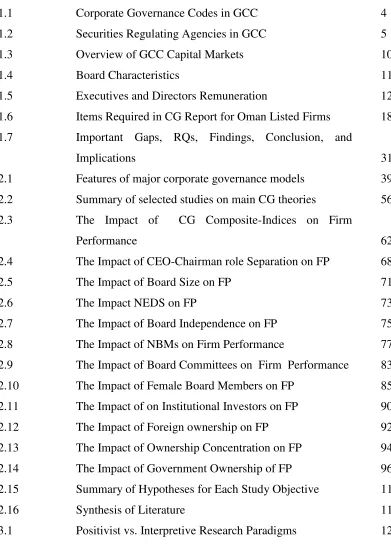
LIST OF TABLES
TABLE NO. TITLE PAGE
1.1 Corporate Governance Codes in GCC 4
1.2 Securities Regulating Agencies in GCC 5
1.3 Overview of GCC Capital Markets 10
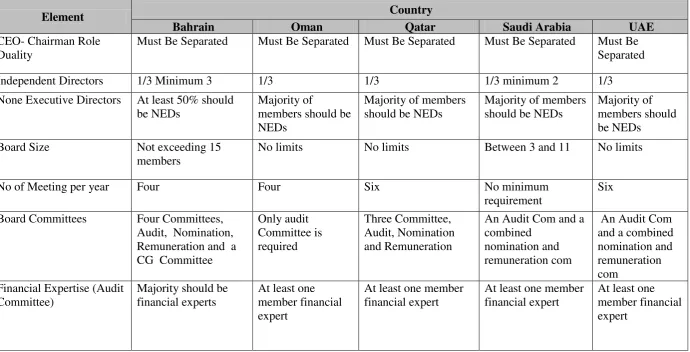
1.4 Board Characteristics 11
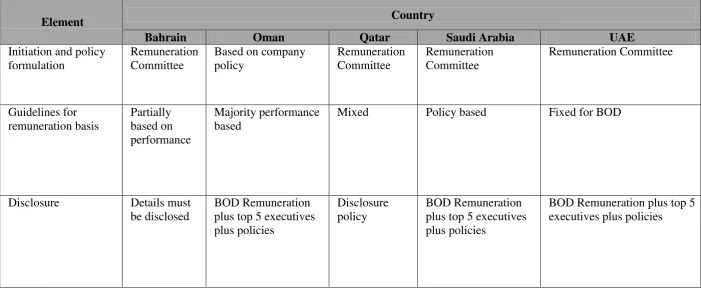
1.5 Executives and Directors Remuneration 12
1.6 Items Required in CG Report for Oman Listed Firms 18 1.7 Important Gaps, RQs, Findings, Conclusion, and
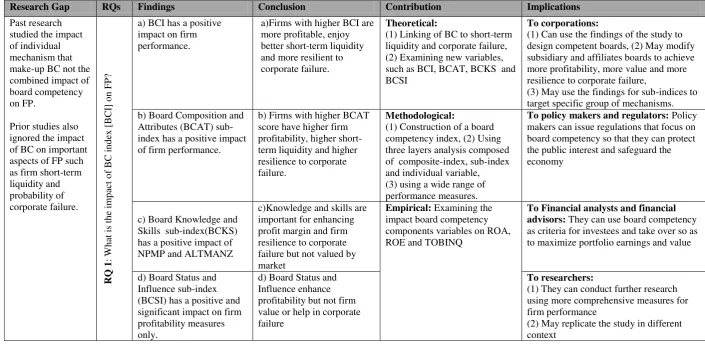
Implications 31
2.1 Features of major corporate governance models 39 2.2 Summary of selected studies on main CG theories 56 2.3 The Impact of CG Composite-Indices on Firm
Performance 62
2.4 The Impact of CEO-Chairman role Separation on FP 68
2.5 The Impact of Board Size on FP 71
2.6 The Impact NEDS on FP 73
2.7 The Impact of Board Independence on FP 75
2.8 The Impact of NBMs on Firm Performance 77
2.9 The Impact of Board Committees on Firm Performance 83
2.10 The Impact of Female Board Members on FP 85
2.11 The Impact of on Institutional Investors on FP 90
2.12 The Impact of Foreign ownership on FP 92
2.13 The Impact of Ownership Concentration on FP 94
2.14 The Impact of Government Ownership of FP 96
2.15 Summary of Hypotheses for Each Study Objective 111
2.16 Synthesis of Literature 117
xvii
3.2 Summary and Distribution of Firms under Study 131 3.3 Board Competency Index Components, Basis and
Theories 134
3.4 OLS Assumptions and Verification Tests 160
3.5 Summary of Research Variables, Labels, Measurement,
and Source 162
4.1 Descriptive Statistics for Models One, Two, Three and
Four 175
4.2 Descriptive Statistics by Year for Board Competency
Index 177
4.3 Potential Impact of a 1% Increase in BCI on FP 178 4.4 Correlation Matrix for Board Competency Index Model 179 4.5 Pairwise correlation matrix for BCI components
(N=800) 180
4.6 Pairwise Correlation Matrix for Ownership Structure
Model (N:800) 183
4.7 Test for Homoscedasticity 190
4.8 Test for Multicollinearity 190
4.9: The Result of OLS Regression for BCI Model 191
4.10 The Result of OLS for Sub-index BCAT 192
4.11 The Result of OLS for Sub-index BCKS 193
4.12 The result of OLS Regression for sub-index BCSI 194 4.13 Comparison of OLS Regression Results for Sub-indices 195 4.14 The Result of OLS Regression for BCI with Additional
Control Variables 196
4.15 The Result of Fixed Effects Robust Regression for BCI
Model 197
4.16 The Result of GLS regression for BCI Model 198 4.17 Comparison of Estimators Results for BCI Model 199
4.18 Endogeneity Test Results for BCI Model 200
4.19 The result of 2SLS Regression for BCI Model 201
4.20 Alternative Variables definitions 211
4.23 The result of OLS Regression for Individual Variable
Model (N=800) 216
4.24 The result of OLS Regression with Additional Control
Variables (N=800) 218
4.25 Lagged Regression Results for Individual Variable
Model 220
4.26 Summary Results for Board Size Alternative Variable
Definitions 222
4.27 Results for Alternative Definitions for Individual
Variable Model (N=800) 223
4.28 The GLS Regression for Individual Variable Model
(N=800) 225
4.29 The Results of Robust Regression for Individual
Variable Model (N=800) 227
4.30 Alternative Variables Definitions 233
4.31 Test for Homoscedasticity (Main variables) 237 4.32 Test for Homoscedasticity (Alternative Variables) 238 4.33 Test for Multicollinearity (Main Variables) 239 4.34 Test for Multicollinearity (ALT Definitions) 240 4.35 Robust Regression Result for Ownership Structure Main
Model (N=800) 241
4.36 Robust Regression Results for Ownership Structure
Alternative Def. Model (N=800) 242
4.37 Robust Regression Result for Ownership Structure with
Additional Control Variables (N=800) 243
4.38 Lagged Robust Regression Results for Ownership
Structure Main Model (N=800) 244
xix
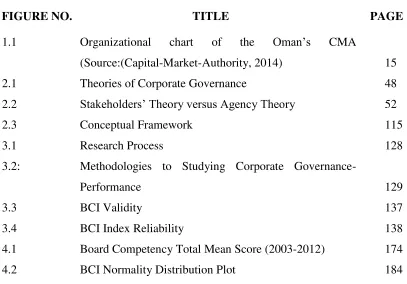
LIST OF FIGURES
FIGURE NO. TITLE PAGE
1.1 Organizational chart of the Oman‘s CMA
(Source:(Capital-Market-Authority, 2014) 15
2.1 Theories of Corporate Governance 48
2.2 Stakeholders‘ Theory versus Agency Theory 52
2.3 Conceptual Framework 115
3.1 Research Process 128
3.2: Methodologies to Studying Corporate
Governance-Performance 129
3.3 BCI Validity 137
3.4 BCI Index Reliability 138
4.1 Board Competency Total Mean Score (2003-2012) 174
LIST OF ABBREVIATIONS
2SLS - Two Stages Least Squares
ABSNP - Board Members percentage of Absence ABSNP2 - Board Absence of More than 25%
ACCA - Association of Chartered Certified Accountants ACCTG - Accounting
AGR - Accounting and Governance Risk Score ALTMANZ - Altman's Z Score
AMLTM - Average Multiple Directorships ASX - Australian Stock Exchange
BC - Board Competency
BCAT - Board Composition and Attribute Sub-index BCCI - Bank of Credit and Commerce International BCI - Board Competency Index
BCKS - Board Knowledge and Skills Sub-index BCSI - Board Status and Influence Sub-index
BD - Board
BDSZE - Board Size
BDSZE2 - Board Size less than seven (the mean) BDSZE3 - Board Size between 8 and 10
BDSZE4 - Board Size more than 10 BIB - Bahrain International Bank BIND - Board Independence
BIND2 - Board Independence Binary Variable BOD - Board of Directors
BSE - Bahrain Stock Exchange CBO - Central Bank of Oman CEO - Chief Executive Officer CFA - Certified Financial Analyst CFO - Chief Financial Officer CG - Corporate Governance CIA - Certified Internal Auditor
xxi
CISA - Certified Information Systems Auditor CLSA - Credit Lyonnais Securities Asia CMA - Capital Market Authority
CMA - Certified Management Accountant CPA - Certified Public Accountant
CRATIO - Current Ratio
CSR - Corporate Social Responsibility DIREM - Directors' Remuneration
EBITA - Earnings Before Interests Taxes and Allowances EPS - Earnings Per Share
EXCOM - Executive Committee FBS - Food and Beverage Sector FEMALE - Female Board Member
FP - Firm Performance
FROWN - Foreign ownership
GCC - Gulf Cooperation Council Countries GDP - Gross Domestic Product
GIM - Gompers Ishii and Metrick
GLS - Generalized Least Squares Regression GMI - Governance Metrics International GMM - Generalized Method of Moments
GMT - Government
GMTB - Government Board Member GOVOWN - Government Ownership
GOVOWN2 - Government Ownership Percentage HIBD - Highly Influential Directors
INDEXP - Industry Experience INDS - Industry
INSTIV - Institutional Investors
INSTIV2 - Institutional Investors' Percentage INVCOM - Investment Committee
IRRC - Investor Responsibility Research Centre ISS - Institutional Shareholders' Services
LEV - Leverage
M2CHR - More than Two Chairmanships M4M - More Than 4 Memberships
MDA - Management Discussion and Analysis
MDSRC - Muscat Depository and Securities Registration Company
NMBs - Number of Board Meetings NPMP - Net Profit Margin Percentage
OCCG - Oman Center for Corporate Governance
OECD - The Organization for Economic Cooperation and Development
OLS - Ordinary Least Squares Regression OMAN - The Sultanate of Oman
OMR - Omani Riyal
OS - Ownership Structure OWNCON - Ownership Concentration
PCAOB - Public Company Accounting Oversight Board PRCRT - Professional Certifications in Accounting QGOWN - Government Ownership
QGOWN2 - Quasi-government Ownership RMC - Risk Management Committee
RO - Riyal Omani
ROA - Return on Asset
ROIC - Return on Invested Capital ROIC - Return on Invested Capital ROs - Research Objectives RQs - Research Questions
SEC - U.S. Securities and Exchange Commission SOX - Sarbanes-Oxley Act
SRVS - Services Sector
TBCOM - Total Board Committees TCL - The Corporate Library TOBINQ - Tobin's Q
xxiii
LIST OF APPENDICES
APPENDIX TITLE PAGE
A Summary Oman code for Corporate Governance
for Listed Companies 306
B Sample Linearity Plot 313
C Instructions for BC Index Coding 315
CHAPTER 1
INTRODUCTION
1.1 Background of Study
Corporate governance has gained momentum because of the infamous corporate fraud cases that occurred during the past three decades. As consequence of fraud cases such as the cases of Enron (2000) and WorldCom (2001) in the USA, the Bank of Credit and Commerce International (1991) in the United Kingdom where thousands of jobs were lost (Kroger, 2005; Rockness and Rockness, 2005) and many have lost their equity value because of the sudden plummeting of companies‘ share price (Thomas, 2002). This thesis investigates the impact of board competency and ownership structure on firm performance based on data collected for the period 2003 to 2012 for non-financial firms listed on Muscat securities market, the lone stock market for the Sultanate of Oman. The following paragraphs highlight justifications for conducting this study in Oman. Firstly, Oman offers a context where the nexus between board competency, ownership structure, and firm performance can be investigated. Board competency has been a real issue in Oman boards, where board members lack basic skills (Dry, 2003).
2 and implement a code for corporate governance and the first to establish a capital market authority Oman also won several corporate governance awards for good corporate governance from Hawkamah Institute a regional body for corporate governance based in Dubai. Furthermore, Oman is also known for good corporate governance practices where it ranked 1st in study conducted by Baydoun et al. (2013) for five GCC countries.
Thirdly, there is paucity of research in the relationship of corporate governance and firm performance (Al-Matar et al., 2014). To the researcher‘s knowledge there are very few articles published on corporate governance in Oman. Dry (2003) published an article on development of corporate governance in Oman, the article theme is the legal development of the code. Another article was published by Shankaraiah and Rao (2005), the focus of that article is on the relationship of corporate governance and international accounting standards. In 2009 a group of researchers on the determinant of effective corporate governance, a comparative study between UAE, Oman and Singapore. None of the mentioned studies have evaluated the impact of adoption of Oman‘s corporate governance codes on firm performance. This indicate the need for a rigorous study that evaluates the impact of the adopting code articles as well as international best practice corporate governance on the financial performance of Oman‘s listed firms.
Fourthly, is the fact that as most developing countries Oman borrows from or at least bench-mark its corporate governance rules to developed countries codes, especially the UK code for corporate governance. Because of the very well and long established relationships between Oman and the UK, and also the fact that companies can adopt free what is known as best practice corporate governance. Due differences in societal values, cultural, developmental between developed and developing countries, some borrowed code articles might not be relevant or may not provide the same results, which confirms the need for this study.
2003). In addition, the recent financial crises in 2008 have further emphasized the importance of the successful corporate governance role on firm performance (Kirkpatrick, 2009). Effective corporate governance is now becoming indispensible in achieving sustainable economic growth (Oman, 2001), transparency, investor confidence and stable stock markets that are more resilient to stock market fluctuations and financial challenges. Developing countries have recently realized the need for good corporate governance for firms, financial institutions and stock markets as well (Oman and Blume, 2005), however, in such volatile economic environments, poor corporate governance may lead to economic problems escalation. Therefore, during the last three decades corporate governance has come to the forefront of knowledge as a distinct and expanding field of study. Due to the separation of ownership and management, having competent corporate boards become an indispensable mechanism in the governance of publicly traded companies (Berle and Means, 1932). Board competency is of paramount importance for boards to execute their duties in monitoring the performance of management and acting as advisor and strategic planners (Huang, 2013). In order for boards to fulfill their roles as monitors of firm performance and strategic advisors, corporate board must be of a high caliber and they must collectively have the necessary knowledge and skills that enable them to oversee management performance and to be actively involved in the strategic planning process. Furthermore, corporate boards must have the necessary organs that facilitate board duties.
4
1.2 Status and Comparison of Corporate Governance in Gulf Cooperation Council Countries (GCC)
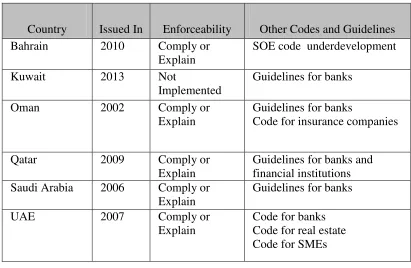
Corporate governance codes worldwide have turned into key mechanisms for gaining public and investors‘ trust as well as promoting good corporate governance. Policy makers in member countries of the GCC region are taking the lead and they are committed to secure notably high standards of corporate governance in order to achieve better corporate governance system in their countries (Baydoun et al., 2013). Better corporate governance, contributes to attracting investors and stabilizing stock markets and enhances firm value (Dharmapala and Khanna, 2008). Table 1.1exhibits information about corporate governance codes issued by GCC member states, date of issue, code enforceability and other codes or guidelines issued.
Table 1.1: Corporate Governance Codes in GCC
Country Issued In Enforceability Other Codes and Guidelines
Bahrain 2010 Comply or
Explain
SOE code underdevelopment
Kuwait 2013 Not
Implemented
Guidelines for banks
Oman 2002 Comply or
Explain
Guidelines for banks
Code for insurance companies
Qatar 2009 Comply or
Explain
Guidelines for banks and financial institutions Saudi Arabia 2006 Comply or
Explain
Guidelines for banks
UAE 2007 Comply or
Explain
Code for banks Code for real estate Code for SMEs
Source: Compiled from OECD publications (Amico, 2014)
of writing this thesis. The same table also shows that all GCC countries have separate guidelines for banks and financial institutions: Bahrain has special code for corporate governance for state owned enterprises, whereas UAE has separate codes for real estate companies and SMEs and the Sultanate of Oman has both Bank Guidelines and a separate code for insurance companies.
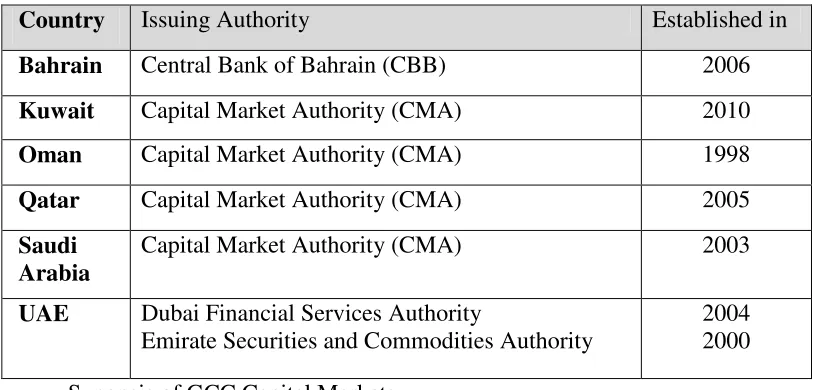
Furthermore, Table 1.2 shows that all GCC countries have separate authorities for issuing and reviewing corporate governance codes, except Bahrain where the code is issued by the Central Bank of Bahrain (CBB). It also shows that Oman is the first country in GCC to establish a capital market authority in 1998 followed by UAE in 2000 and Saudi Arabia in 2003.
Table 1.2: Securities Regulating Agencies in GCC
Country Issuing Authority Established in
Bahrain Central Bank of Bahrain (CBB) 2006
Kuwait Capital Market Authority (CMA) 2010
Oman Capital Market Authority (CMA) 1998
Qatar Capital Market Authority (CMA) 2005
Saudi Arabia
Capital Market Authority (CMA) 2003
UAE Dubai Financial Services Authority
Emirate Securities and Commodities Authority
2004 2000 Synopsis of GCC Capital Markets
6 although Kuwait is one of the first countries in GCC to establish a capital market. However, it is the last GGC state to issue and implement a corporate governance code(Amico, 2014). Although the UAE established its first stock markets in 2000, it has published and implemented several codes for corporate governance including a separate code for real estate companies and one for SMEs, which indicate the rapid pace of change that is happening in the region.
In terms of market capitalization, the Saudi Capital Market is the biggest capital market in GCC with a market capitalization of USD 515 billion, followed by Qatar Exchange with a market capitalization of USD 198 billion (Amico, 2014). However, if the three capital markets of UAE are combined together, the combined UAE capital market will be the second in terms of size with a total market capitalization of USD 254 billion. Kuwait stock market ranked third, followed by the Bahraini capital market and Muscat securities market, which is relatively small in terms of market capitalization. In terms of the number of listed companies, Muscat Securities Market ranked third (118 listed firm) after Kuwait and Saudi Arabia, which have 208 and 164 companies respectively.
1.2.1 Comparison of GCC Members’ Codes of Governance
all five countries require one third of board members to be independent directors. However, Bahrain further added that at least three members should be independent for non-controlled companies, while Saudi Arabia added that one third or two members whichever is greater must be independent. The third element of board characteristics relate to non-executive directors. By referring to the codes of governance as summarized in Table 1.4, which shows that, Oman, Qatar, Saudi Arabia and UAE codes of corporate governance, require majority of shareholders to be non-executive directors, while Bahrain code for corporate governance require that 50% of board members should be non-executive directors.
8 Competency or knowledge of finance and accounting is an important characteristic for board members, especially for members who are also members of the audit committee (Dionne and Triki, 2005). The codes for corporate governance of Oman, Qatar, Saudi Arabia and UAE require at least one member to be a financial expert. Bahrain is even more stringent since it requires audit committees to be composed of members with the majority finance experts.
Executive and directors remuneration provides incentive to the executive management and directors to focus on firms‘ business, especially if such remuneration is tied to performance. Table 1.5compares regulations concerning executives and directors‘ remuneration as per GCC countries codes of corporate governance and provides a summary of GCC countries codes for corporate governance requirements, with regard to executives and directors‘ remuneration. The following paragraphs discusses the three major issues covered by these codes regarding executives and directors‘ remuneration.
governance codes requires a fixed amount for the board of directors‘ members‘ remuneration.
10
Table 1.3: Overview of GCC Capital Markets
Country Capital Market Established
(year)
Market Capitalization (Billion USD)
Number of listed companies
Type of ownership
Bahrain Bahrain Stock Exchange 1987 53 48 State Owned
Kuwait Kuwait Stock Exchange 1983 118 208 Public
Oman Muscat Securities Market
1988 24 120 State Owned
Qatar Qatar Exchange 1997 198 42 State Owned
Saudi Arabia Tadawul 1984 515 164 State Owned
UAE Dubai Financial Market 2000 98 55 State Owned
Abu Dhabi Securities Market 2000 133 50 State Owned
11
Table 1.4: Board Characteristics
Element Country
Bahrain Oman Qatar Saudi Arabia UAE
CEO- Chairman Role Duality
Must Be Separated Must Be Separated Must Be Separated Must Be Separated Must Be Separated
Independent Directors 1/3 Minimum 3 1/3 1/3 1/3 minimum 2 1/3
None Executive Directors At least 50% should be NEDs
Majority of
members should be NEDs
Majority of members should be NEDs
Majority of members should be NEDs
Majority of members should be NEDs
Board Size Not exceeding 15
members
No limits No limits Between 3 and 11 No limits
No of Meeting per year Four Four Six No minimum
requirement
Six Board Committees Four Committees,
Audit, Nomination, Remuneration and a CG Committee
Only audit Committee is required Three Committee, Audit, Nomination and Remuneration
An Audit Com and a combined
nomination and remuneration com
An Audit Com and a combined nomination and remuneration com
Financial Expertise (Audit Committee)
Majority should be financial experts
At least one member financial expert
At least one member financial expert
At least one member financial expert
12
Table 1.5: Executives and Directors Remuneration
Element Country
Bahrain Oman Qatar Saudi Arabia UAE
Initiation and policy formulation
Remuneration Committee
Based on company policy
Remuneration Committee
Remuneration Committee
Remuneration Committee
Guidelines for remuneration basis
Partially based on performance
Majority performance based
Mixed Policy based Fixed for BOD
Disclosure Details must be disclosed
BOD Remuneration plus top 5 executives plus policies
Disclosure policy
BOD Remuneration plus top 5 executives plus policies
1.3 Oman‘s Economy, Stock Markets Development and Corporate Governance
1.3.1 Oman Economy
The Sultanate of Oman is a small, friendly, and beautiful country that is located in the Middle East bordering to Yemen and UAE (Al-Hamadi et al., 2007) the biggest trade hub in GCC region. Oman economy is growing rapidly at an exponential rate since 1970 after Sultan Qaboos took power. The backbone for Oman economy is oil and gas that represents around 65% of the countries revenues. Oman crude oil reserve is estimated at around 5.5 billion barrels, representing 0.4% of the world oil reserve. The other 35% of revenues is allocated among processing industry agriculture, fisheries and tourism. Oman has a huge potential for tourism. However the growth in this sector is meant to be gradual in order to avoid the negative impact of mass tourism and to preserve local culture (Oman, 2007). Currently Oman produces around 800 thousand barrels of crude oil per day. Oman economy witnessed a boom during the period 2003 until 2008 when the financial crisis took place.
The country enjoys a stable and growing private sector including agriculture, textile, industry, fisheries, services, retail, and tourism. Oman most important industries are copper, oil mining, cement, and steel (Shachmurove, 2009). During the recent financial crises that hardly hit most economies of the world in 2008, Oman suffered some liquidity issues but it recovered very quickly form that short fall (Bilal, 2015).
1.3.2 Development of Oman Stock Market
14 Stage 1 of Oman stock market development started when Muscat Securities Market (MSM) was established with a royal degree in 1989. During that embryonic stage of MSM the ministry of commerce and industry (MOC) administered MSM, where the minister of commerce and industry was the chairman of MSM board. This stage has witnessed very important milestones in the development of Oman stock markets. The first milestone is the flotation of shares and the start of trading activities in 1989. Less than two years (in 1991) MSM market index was formed. In December 25th 1996 a cross listing agreement was signed with the state of Bahrain. This period has also witnessed the passing of a new law in early 1997 allowing foreign investors to hold up to 49% ownership of listed companies‘ equity. Currently foreigners can own up to 65% and, in special circumstances, they can own 100% of equity in free zones (Capital Market Authority, 2014).
Stage 2 started in 1999 where MSM was restructured to three major entities. The first entity is the Capital Market Authority (CMA). Formation of the CMA is a quantum leap in Muscat Stock Market development and governance. The CMA main duties are; a) to organize stock issue and b) to organize stock trading (See
Figure 1.1) and finally c) to oversee MSM operation. The second entity is Muscat Securities Market (MSM), which is where listed companies shares are traded. The third entity is Muscat Depository and Securities Registration Company (MDSRC). MDSRC is responsible for registration and transfer of ownership and custody of ownership documents. MDSRC is linked electronically with MSM to facilitate real time information access (Capital Market Authority, 2014).
16 Stage 3 started in 2010 when Oman Center for Corporate Governance (OCCG). OCCG was established as a result of the recommendations of the first corporate governance conference that was held in 2008 in the Sultanate of Oman, under the theme ―Strengthening trust through corporate governance". OCCG was established as a separate center under the umbrella of the CMA. OCCG is a specialized corporate governance center and the first of its kind in the Sultanate of Oman. The center‘s main objective is to train directors and executives in corporate governance. OCCG renders its services to corporations, investors and to those interested in corporate governance in the Sultanate of Oman. Furthermore, it contributes to establishing the concept and practices of corporate governance through improvement and activation of the role of directors and executive managements of companies through training programs, seminars, conferences, and other services rendered by OCCG. The center also aims at disseminating awareness and good corporate governance practices in the Sultanate of Oman (Capital Market Authority, 2014).
1.3.3 Status of Corporate Governance in Oman
This section provides an overview of the status of corporate governance in Oman, a detailed analysis of GCC codes for corporate governance was given in section 1.2. In a very successful attempt to cope with the worldwide developments in capital markets regulation, the Capital Market Authority (CMA) of Oman issued a code for corporate governance in June 2002. That date marked the issuance of the first code for corporate governance in GCC. The CMA shortly revised, amended, and reissued the code in April 2003.
departure from the code. Table 1.6lists the items that need to be disclosed by Oman‘s listed firms as part of their corporate governance report. In order to promote and instill a corporate culture for good governance among listed firms, the CMA through Oman Center for Corporate Governance launched a corporate governance excellence award in 2011. This award encourages companies to focus on enhancing the role of board members and improving the transparency standards. The award targets the following; a) drawing companies‘ attention to productivity, b) augmenting investors‘ confidence, c) maximizing shareholders‘ value, d) increasing national income growth, and e) stabilizing the stock market. The objectives of the Corporate Governance Excellence Award as set by the CMA are; a) to increase awareness among stakeholders of the merits of transparency, b) to promote healthy competition among listed firms, c) to persuade companies to abide by corporate governance code, d) to enhance securities market efficiency and, e) to mobilize investment from national and international sources (Capital Market Authority, 2014).
18
Table 1.6: Items Required in CG Report for Oman Listed Firms
1.4 Problem Statement
As a result of fraud cases such as the cases of Enron and World Com in the USA, the Bank of Credit and Commerce International (BCCI) in the United Kingdom thousands of jobs have been lost (Kroger, 2005; Rockness and Rockness, 2005) and many have lost their equity value because of the sudden plummeting of companies‘ share price (Thomas, 2002). The Sultanate of Oman, was not an exception, it had its share of fraud cases, such the collapse of Oman and Emirates Investment Holding in 2001, the failure of National Rice Mills SAOG in 2002 and the devastating collapse of Oman National Investment Holding Company (Al-Matari et al., 2014; Dry, 2003). In the context of Oman ―over the years, there have been charges that companies hide information, have poor controls and have negligent, incompetent and ―bungling‖ board of directors‖ (Dry 2003, page 45). In some instances, there have been claims of fraud on the part of directors. These issues have highlighted the need for higher corporate governance standards (Dry 2003), which make having competent corporate boards become an indispensable mechanism in the governance of publicly traded companies (Berle and Means, 1932; Ntim, 2009). Due to the repercussions of corporate governance failure and loose controls, developing countries such as Oman have realized the need for good corporate governance for firms, financial institutions and stock markets as well (Oman and Blume, 2005), since in such volatile economic environments, poor corporate governance may lead to economic problems escalation. In addition, the recent financial crises in 2008 have further emphasized the importance of the successful corporate governance role on firm performance (Kirkpatrick, 2009).
20 for boards to execute their duties in monitoring the performance of executive management and while acting as advisors and strategic planners for executive management (Huang, 2013). Similarly, having a well-structured ownership is expected to enhance board effectiveness and efficiency and accordingly may lead to better firm performance. In order for boards to fulfill their roles as monitors of firm performance and strategic advisors, corporate board members must collectively have the necessary knowledge and skills that enable them to oversee management performance and to be actively involved in the strategic planning process. Furthermore, corporate boards must have the necessary committees that facilitate board duties.
In order for firms to have an effective corporate governance system, corporate boards must be highly competent so that they can play their intended roles, in mitigating agency conflict by overseeing executive management and monitoring firm performance (Jensen, 1976). According to resource dependence theory, board members with knowledge of finance are more able to exercise their role as advisors for executive management (Haniffa and Hudaib, 2006) and thus they can support executive management in taking sound decisions that may enhance firms‘ profitability. Furthermore, equity ownership should be structured in a way that helps in enhancing control and strengthening corporate boards so that firm performance can be optimized. Both board competency and ownership structure fall under the umbrella of corporate governance. The term board competency is deliberately used to reflect the scope of knowledge, skills and attributes that the board must have collectively to perform its role as a monitor to executive management performance and an advisor as well. The literature review, presented in Chapter 2, highlighted a number of gaps on the research conducted to date on the impact of both board competency and ownership structure on firm performance (see Table 1.1 pages 16-18).
2012; Agrawal and Knoeber, 2012a; Agrawal and Knoeber, 2012b; Al-Malkawi and Pillai, 2012; Al-Mashregy, 2012; Al-Shammari and Al-Sultan, 2009; Alfaraih et al., 2012; Arouri et al., 2011; Baydoun et al., 2012; Boubakri et al., 2012; Chaghadari, 2011; Ertugrul and Hegde, 2009; Hasan and Al Mutairi, 2011). These limited measures are not comprehensive enough to cover some of the major aspects of firm performance such as the risk of short-term liquidity and the risk of corporate failure (Elyasiani and Zhang, 2015). This gap has been addressed in this thesis by using more financial metrics covering firm profitability, firm short-term liquidity, and firm probability of corporate failure. Examining the relationship between corporate governance mechanisms and four important aspects of performance provide more information about the nature of the impact of corporate governance on firm performance, so that corrective actions can be taken.
22 were constructed based on these databases have been criticized for using too many variables in the index that may not be relevant, and therefore may not predict firm performance (Bebchuk et al., 2009; Daines et al., 2010). This study constructed a board competency index using data collected from published annual reports, which could be more credible than commercial corporate governance databases.
It is important to note that, several researchers have developed corporate governance indices (Bebchuk et al., 2009; Black, Jang, et al., 2006a; Brown and Caylor, 2006; Gompers et al., 2003; Zelenyuk and Zheka, 2006). However, these indices have been criticized for lacking criteria for choosing the index components, as they dump too many variables to create indices or for lacking proper justification for choices of weight for variables forming the contents (Bhagat et al., 2008). The first empirical analysis of this thesis attempted to put the fragmented pieces of the puzzle of board competency together, using an un-weighted board competency composite-index (BCI) and to examine their integral impact on firm performance.
The first of these areas is the impact of holding too many board seats concurrently. Oman code for corporate governance (2003) requires that no board member shall sit on four board seats concurrently and that no board member should act as Chairman for two companies concurrently. To the researcher‘s knowledge, no previous study has examined the impact of holding too many board seats concurrently on firm performance in Oman, GCC countries or other countries. There is some research on the impact of the directors‘ busyness on board meeting attendance e.g. (Falato et al., 2014; Jiraporn et al., 2009). A few researchers view multiple directorships as a favorable (Bammens et al., 2008; Dhaliwal et al., 2010; Ferris et al., 2008) variable that signals board members experience and some used it as a proxy for experience in corporate governance (Salam, 2013).
The second area is the impact of influential board members on firm performance. The presence of influential members on company boards such as cabinet minister, deputy ministers, and members of royal family as board members is common especially in Oman. The existence of such directors is expected to have a significant impact on firm performance, because such firms may have easy access to finance, government contracts, and insider information regarding government plans. To the researcher‘s knowledge, the impact of this category of directors has not been studied in prior literature, at least in GCC member countries. Examining the impact of influential board members on financial performance may be helpful in selecting and designing competent boards. The third area is the impact of directors‘ absence from board meetings on firm performance. Board members who have a trend of not attending board meetings are jeopardizing shareholders money. Attending board meetings is very important because it provides a formal floor for discussing strategic and operational issues concerning firm performance and business. Absenteeism of board members could weaken board‘s ability to monitor firm performance and to plan strategically for the firm.
24 directors should be compensated. Directors‘ remuneration can be effective in monitoring senior management tendency to seek their own-selfish interest at the expense of firm owners (Amess and Drake, 2003). Basing board members compensation on firm performance can provide some degree of goal congruence between firms‘ interests and directors‘ personal interests. Most prior studies focus on the amount or package paid to corporate directors not on whether it is based on financial performance or not. Although Oman code for corporate governance (2003), recommends that listed companies base majority of directors‘ remuneration on performance, there is no evidence supporting this recommendation. The second empirical analysis of this study investigated the impact of this variable on firm performance. The fifth area relates to the impact of the impact of industry experience of board members on firm performance. Having board members with experience in the core business of the company is very crucial to the success of the business (Drobetz et al., 2014a; Papakonstantinou, 2008; von Meyerinck et al., 2012). For example, the skill sets that are required for an aquaculture company are different from those required for a cement company. The second empirical analysis of this thesis investigated the impact of board members‘ industry experience on firm performance.
literature reviewed (see Chapter 2 section 2.8 pages 88-95) there is lack of studies that examine these variables to firm short-term liquidity and the risk of corporate failure. The eighth area relates to the impact of Quasi-government ownership (government soft funds) on firm performance. As explained in section 2.8.4, the government of Oman provides generous government funding in the form of soft government loans to established firms and start-ups companies in Oman. The impact of such government soft funds (which is considered quasi-government ownership) on firm performance has not been studied yet. This study examined the impact of quasi-government ownership on firm profitability, firm short-term liquidity, firm value and firm probability of corporate failure.
26
1.5 Research Questions
Based on the literature review and the identified research gaps the researcher believes that the following questions need to be addressed in order to bridge the gap and to provide better understanding of the relationship between board competency and firm performance on one side and the relationship between ownership structure and firm performance on the other side. Concisely, the study seeks to answer three main questions as follows:
1. What is the impact of Board Competency Index (BCI) on Firm Performance as measured by ROA, ROE, ROIC, NPMP, Current Ratio, Tobin‘s Q and Altman‘s Z score?
2. What is the impact of each component of the Board Competency Index (BCI) on firm performance as measured by ROA, ROE, ROIC, NPMP, Current Ratio, Tobin‘s Q and Altman‘s Z score?
3. What is the impact of institutional investor, government ownership, ownership concentration, foreign ownership, and Quasi–government ownership on firm performance as measured by ROA, ROE, ROIC, NPMP, Current Ratio, Tobin‘s Q and Altman‘s Z score?
1.6 Research Objectives
1. To examine the impact of board competency index on firm performance, as measured by ROA, ROE, ROIC, NPMP, Current Ratio, Tobin‘s Q and Altman‘s Z score
2. To assess the impact of the individual components of BCI on firm performance as measured by ROA, ROE, ROIC, NPMP, Current Ratio, Tobin‘s Q and Altman‘s Z score.
3. To examine the impact of ownership structure on firm performance as measured by ROA, ROE, ROIC, NPMP, Current Ratio, Tobin‘s Q and Altman‘s Z score.
1.7 Significance of the Study
The significance of this study stems from the panorama of important issues that this study attempts to tackle, and its contributions (see Table 1.7). Firstly, this study constitutes a comprehensive and rigorous examination of the impact of board competency and ownership structure on firm performance in the Sultanate of Oman. To the researcher‘s knowledge, this is the first and the most comprehensive study to be carried for listed firms in Oman, since the issuance and adoption of its corporate governance code in 2002.
Secondly, to the researcher‘s knowledge, this is the first study to build a comprehensive composite index for board competency, by using published information collected from companies‘ annual reports and for a period of ten years. It is worth mentioning that researcher-constructed indices are more credible in measuring the quality of corporate than commercial indices(Bebchuk et al., 2009; Daines et al., 2010).
28 Similarly, regulators and policymakers can also use the study findings to issue corporate governance regulations and design policies that could lead to efficient capital markets through better corporate governance.
Fourthly, this study provides important theoretical contributions by being the first study to examine the impact of corporate governance mechanisms impact on firm short-term liquidity and the probability of failure. Prior studies historically use, ROA, ROE and Tobin‘s Q, which measures the profitability and firm value aspects of firm performance only. This study also provides empirical contributions by re-examining impact of corporate governance variables on firm performance in the context of Oman. Furthermore, the study uses more performance measures coupled with a three-layer analysis, composed of a composite index level, a sub-index level and an individual variable level, to study the nexus between corporate governance and firm performance. This comprehensive analysis provides a deeper insight in the impact of corporate governance on firm performance.
1.8 Scope of the Study
1.9 Definition of Key Terms
This section provides the definitions of key terms used in the study. This study mainly discusses issues relating to comprehensive board competency index (BCI), its components, ownership structure and their impact on firm performance measures. The descriptions of these terminologies are shown below.
Corporate Governance: Isa set of mechanisms and rules imposed or recommended by regulators, companies‘ boards, and shareholders, so that executive management actions are monitored and directed to enhance of firm performance (Cadbury et al., 1992; Rezaee, 2008).
Board Competency: Competency has been defined as the ability to apply knowledge, skills and attributes to work place (Hoffmann, 1999; Rezgui et al., 2014). Thus, board competency can be defined as the ability of the board to utilize its collective knowledge, skills, and attributes in order to mitigate the impact of agency conflict.
Board Competency Index (BCI): The board competency is measured using a comprehensive competency index that includes variables that are expected to have a direct link or effect on overall board ability to perform. Competency refers to the ability to utilize, knowledge, skills and attributes to enhance performance (Hoffmann, 1999).
Ownership Structure: Ownership structure refers to how firm ownership is distributed among different types of shareholders (Abdullah, 2006; Blair, 1995a). Ownership structure has four major categories; i) institutional ownership(Hutchinson
et al., 2015), which refers to ownership by shareholders such as banks and mutual
30 equity owned by foreign companies or individuals (Bokpin and Isshaq, 2009; Choi and Yoo, 2006; Greenaway et al., 2014).
Firm Performance: This study defines firm performance as the ability of firm to generate profits, be able to meet its current liabilities, have a good market value and remain in a safe zone from bankruptcy (Santos and Brito, 2012; Venkatraman and Ramanujam, 1986).
Firm Short-term liquidity (Liquidity): The risk of short-term liquidity refers to the risk that a firm will not be able to face its current liabilities as they fall due (Raheman, 2012). For the purpose of this study, the risk of short-term liquidity is measured by the Current Ratio, where a current ratio of 2:1 is considered an ideal ratio.
31
Table 1.7: Important Gaps, RQs, Findings, Conclusion, and Implications
Research Gap RQs Findings Conclusion Contribution Implications
Past research studied the impact of individual mechanism that make-up BC not the combined impact of board competency on FP.
Prior studies also ignored the impact of BC on important aspects of FP such as firm short-term liquidity and probability of corporate failure. RQ 1 : Wh at is th e im p ac t o f B C in d ex [ B C I] o n FP ?
a) BCI has a positive impact on firm performance.
a)Firms with higher BCI are more profitable, enjoy better short-term liquidity and more resilient to corporate failure.
Theoretical:
(1) Linking of BC to short-term liquidity and corporate failure, (2) Examining new variables, such as BCI, BCAT, BCKS and BCSI
To corporations:
(1) Can use the findings of the study to design competent boards, (2) May modify subsidiary and affiliates boards to achieve more profitability, more value and more resilience to corporate failure,
(3) May use the findings for sub-indices to target specific group of mechanisms. b) Board Composition and
Attributes (BCAT) sub-index has a positive impact of firm performance.
b) Firms with higher BCAT score have higher firm profitability, higher short-term liquidity and higher resilience to corporate failure.
Methodological:
(1) Construction of a board competency index, (2) Using three layers analysis composed of composite-index, sub-index and individual variable, (3) using a wide range of performance measures.
To policy makers and regulators: Policy makers can issue regulations that focus on board competency so that they can protect the public interest and safeguard the economy
c) Board Knowledge and Skills sub-index(BCKS) has a positive impact of NPMP and ALTMANZ
c)Knowledge and skills are important for enhancing profit margin and firm resilience to corporate failure but not valued by market
Empirical: Examining the impact board competency components variables on ROA, ROE and TOBINQ
To Financial analysts and financial advisors: They can use board competency as criteria for investees and take over so as to maximize portfolio earnings and value
d) Board Status and Influence sub-index (BCSI) has a positive and significant impact on firm profitability measures only.
d) Board Status and Influence enhance profitability but not firm value or help in corporate failure
To researchers:
(1) They can conduct further research using more comprehensive measures for firm performance
32 Table 1.1 Continued…
Research Gap RQs Findings Conclusion Contribution Implications
Lack or paucity of rigorous
research: Holding too many board seats [AMLTM],[M4M] &[M2CHR] RQ 2 : Wh at is th e im p ac t o f ea ch co m p o n en t o f th e B o ar d C o m p eten cy I n d ex ( B C I) o n FP ? a)Multiple directorships has a negative impact on FP and the result is significant with
ALTMANZ, b) Holding more than 4 seats
concurrently has a negative Impact on FP but the result is negative and significant with NPMP only, c) Holding more than two chairmanships is insignificantly related to FP
a) Multiple directorships have a negative impact on FP and is linked to corporate failure and more than 4 directorships has a negative and significant impact on profit margin percentage, but holding more than 2
chairmanships has a non-significant Impact on FP
Theoretical:
(1) Linking BC components to Short-term liquidity and Corp failure, (2) Examining new variables such as HIBD, M4M and M2CHR.
To corporations:
(1) Boards that have higher average of multiple directorships are more susceptible to corporate failure than their counterparts, (2) Having an investment committee is not a good governance practice, whereas having an executive committee is a good corporate governance practice.
Board Members Absence [ABSNP] and [ABSNP2]
b) Absence has a negative and significant impact on FP
b) Absence of board members is detrimental to firm performance
Empirical:
(1)Examining the impact of board competency components variables on ROA, ROE and TOBINQ,
(2) examining the impact on firm performance of Alternative variable definitions such as BDSZE2, BDSZE3, BDSZE4, ABSNP2
To policy makers and regulators: Can issue regulations that limit the number of multiple directorships, the number of HIBD or reduce absence percentage Highly-influential
board
members[HIBD]
c) HIBD does not drive profitability, increase probability of failure
c) Having a highly influential director in the board does not enhance firm profitability, it may increase firm risk of failure.
To financial analysts and financial advisors:
Can advise clients to avoid investing in companies with higher rate of director absence, higher multiple directorship or both
Adhoc board committees [EXCOM][INVCO M]
d)EXCOM has positive impact on ROA, ROIC, TOBINQ and ALTMANZ
33 Table 1.1 Continued…
Research Gap RQs Findings Conclusion Contribution Implications
Examining the impact of ownership structure on firm short-term liquidity and probability of corporate failure RQ 3 : W h at i s th e im p act o f o w n er sh ip s tr u ct u re o n FP?
a) Institutional investors ownership has a positive impact on FP including short-term liquidity and probability of corp. failure.
a)The presence of Institutional ownerships enhances short-term liquidity and resilience to failure.
Theoretical: (1)Linking ownership structure variables to Short-term liquidity and Corporate failure, (2) Examining new variables such as QGOWN
To corporations: (1) More controls might be needed for higher levels of institutional investors, (2) High percentages of FROWN is also not recommend due to negative impact on CRATIO and ALTMANZ
Examining the impact of quasi-government ownership [QGOWN] on FP
b) Higher percentage GOVOWN has a positive impact on TOBINQ and ALTMANZ, but insignificant impact on CRATIO. However, the relationship becomes more significant with higher percentages of GOVOWN.
b) The presence of government ownership enhances firm value and resilience to corporate failure but it is insignificant to short-term liquidity. in contrast QGOWN has a negative impact on all four aspects of FP
Empirical: Re-examining Ownership structure variables impact on existing links with ROA, ROE and Tobin's Q
To policy makers and regulators: In order to protect the public from abuses by foreign ownership a ceiling may be implemented
To financial analysts and financial advisors:They can restructure their
investment portfolios, by including company with balanced ownership structure so that risks of abuses by majority shareholders
c) Ownership concentration has a negative and highly significant impact on FP d) Foreign ownership has a negative and significant impact on CRATIO and Altman‘s Z and a positive impact on ROE. However, for higher percentages of FROWN the relationship becomes insignificant with ROE and –tive with ROIC
c) The presence of foreign ownership enhances Altman‘s Z and ROE. However, higher percentages are detrimental to performance.
To researchers: (1) To researchers- They can replicate the study in other countries in order to see whether the impact of OS mechanism and short-term liquidity and resilience to corporate failure can hold, (2) They can conduct further research on the impact of QGOWN , INVCOM and multiple directorships impact on FP, (3) They can replicate the study using non-financial performance metrics
34
1.10 Structure of the Thesis
REFERENCES
Abdo, A., and Fisher, G. (2007). The impact of reported corporate governance disclosure on the financial performance of companies listed on the JSE.
Investment Analysts Journal(66), 43-56.
Abdullah, S., Ismail, K. K., and Nachum, L. (2012). Women on Boards of Malaysian Firms: Impact on Market and Accounting Performance. Social Science
Research Networt. Sept 2012 ( September Issue), 1-29.
Abdullah, S. N. (2004). Board Composition, CEO Duality and Performance Among Malaysian Listed Companies. Corporate Governance. 4(4), 47-61.
Abdullah, S. N. (2006). Board Structure and Ownership in Malaysia: the Case of Distressed Listed Companies. Corporate Governance. 6(5), 582-594.
Abidin, Z. Z., Kamal, N. M., and Jusoff, K. (2014). Board Structure and Corporate Performance in Malaysia. International Journal of Economics and Finance. 1(1), p150.
Adams, R., Hermalin, B. E., and Weisbach, M. S. (2008). The Role of Boards of
Directors in Corporate Governance: A Conceptual Framework and Survey:
National Bureau of Economic Researcho. Document Number)
Adams, R. B., and Ferreira, D. (2007). A theory of friendly boards. The Journal of
Finance. 62(1), 217-250.
Adams, R. B., and Ferreira, D. (2009). Women in the boardroom and their impact on governance and performance. Journal of financial economics. 94(2), 291-309.
Adams, R. B., and Mehran, H. (2012). Bank board structure and performance: Evidence for large bank holding companies. Journal of financial
Intermediation. 21(2), 243-267.
Adawi, M., and Rwegasira, K. (2014). Corporate Governance and Firm Valuation in Emerging Markets: Evidence from UAE Listed Companies Corporate
Control and Ownership, 637.
Agarwal, R., and Elston, J. A. (2001). Bank–firm relationships, financing and firm performance in Germany. Economics Letters. 72(2), 225-232.
Aggarwal, R., Erel, I., Stulz, R. M., and Williamson, R. (2007). Do US firms have the best corporate governance? A cross-country examination of the relation
between corporate governance and shareholder wealth: National Bureau of
Economic Researcho. Document Number)
Agle, B. R. (2008). Dialogue: Toward superior stakeholder theory. Business Ethics
285
Agrawal, A., and Knoeber, C. (2012a). Corporate Governance and Firm Performance.
Agrawal, A., and Knoeber, C. R. (1996). Firm Performance and Mechanisms to Control Agency Problems Between Managers and Shareholders. Journal of
Financial and Quantitative Analysis. 31(03), 377-397.
Agrawal, A., and Knoeber, C. R. (2012b). Corporate Governance and Firm Performance, Chapter 26 in Thomas, Christopher R. and William F. Shughart II, Eds.
Ahmed, S. U., Islam, Z., Mahtab, H., and Hasan, I. (2014). Institutional investment and corporate social performance: linkage towards sustainable development.
Corporate Social Responsibility and Environmental Management. 21(1),
1-13.
Aitken, B. J., and Harrison, A. E. (1999). Do Domestic Firms Benefit from Direct Foreign Investment? Evidence from Venezuela. American Economic Review, 605-618.
Akbar, A. (2015). The role of corporate governance mechanism in optimizing firm performance: A conceptual model for corporate sector of Pakistan. Journal of
Asian Business Strategy. 5(6), 109-115.
Akhigbe, A., and Martin, A. D. (2006). Valuation Impact of Sarbanes–Oxley: Evidence from Disclosure and Governance within the Financial Services Industry. Journal of Banking & Finance. 30(3), 989-1006.
Al-Ghamdi, M., and Rhodes, M. (2015). Family Ownership, Corporate Governance and Performance: Evidence from Saudi Arabia. International Journal of
Economics and Finance. 7(