A Performance Model for the
Link-Transport Layer
Serving XTP in a
High Speed Network
A. A. Nilsson
R. I.
Balay
.,-Center for Communications and Signal Processing
Department of Electrical and Computer Engineering
Department of Computer Science
Korth Carolina State University
,"
A
Perform~nce Mod~l
for the Link-Transport Layer
Serving XTP In a High Speed Network
Meejeong Lee and Arne A. Nilsson
Center for Communications and Signal Processing Department of Electrical andComputerEngineering
North CarolinaState University
Raleigh, NC27695-7911
Rajesh I. Balay
Center for Communications and Signal Processing Department of Computer Science
North Carolina State University Raleigh, NC 27695-7914
Abstract
How the traffic characteristics and the performance of a transport connection are affected at the link-transport layer is one of the important items to be studied to determine the end to end performance of a transport protocol. We model the link-transport layer that provides service to an XTP connection as a discrete time single server finite capacity queueing system at which two different arrival processes are allowed to merge, e.g., a Markov Modulated Bernoulli Process (MMBP) and a Bernoulli Process (BP). The MMBP models the bursty and correlated traffic [rom the designated XTP connection, and the BP models the external traffic, that is, the arrival of the packets [rOITI the rest of the coexisting
1. Introduction
The link-transport layer, the logical protocol layer immediately below the transport
layer [1], may serve several transport connections at the same time. Thus, the arrival
process to the link-transport layer is a superposition of multiple streams generated by
different transport connections. How the characteristic of the traffic from a designated
transport connection is influenced in the link-transport layer is an interesting problem and
will be imperative in determining the end-to-end performance of a designated transport
connection.
Heffs
and Lucantoni have proposed an effective way to analyze a system with asuperposed traffic consisting of multiple renewal processes[2]. By using their approach,
however, only a performance prediction for the whole stream superposed together is
obtained.
A per-stream analysis of a discrete-time system, where a GI(General and
Independent)-stream and a Bernoulli batch arrival process are superposed, is reported by
Murata et al in the study of how the GI-stream arrivals are affected in the system[3]. Ohba et al studied an extension of this system where they also considered a third arrival stream
which represents the aggregate ofmanyidenticalInterruptedBernoulli Processes (IBP) [4]. However, neither of the analyses can account for the possible correlation in the designated
arrival stream.
In this paper, a per-stream analysis of a discrete-time finite capacity queueing
system with superposing traffic streams consisting of a correlated arrival stream and a
Bernoulli arrival process is presented. The particular motivation for this study stemmed
from the end-to-end performance analysis of the Xpress Transfer Protocol (XTP). The
XTP, an emerging high performance protocol, is motivated by the needs of contemporary
and future real-time, transactional, and multi-media systems[5]. A simulation study
the XTP definition is reported in [6]. We model the link-transport protocol layer, servicing
several transport connections including an XTP connection, by the MMBP+BP/D(N)/I/K
queueing system. The Markov Modulated Bernoulli Process (MMBP), a non-renewal
arrival process, models the traffic from a designated XTP connection and the Bernoulli
Process (BP) models the superposition of the traffic from the rest of the connections [7],
[8], [9].
Due to the evolution in the network technology and the advent of new applications
such as distributed system and multimedia services, the usualassumptions adopted for the analytical modeling of the link-transport protocol layer are no longer valid. Most of the past
research on the performance of the packetized slotted communication networks has
assumed that the input traffic follows a Bernoulli distribution, and that the processing delay
at the communicating stations and the propagation delay are negligible compared to the
transmission time [1]. However, the traffic sources that the XTP is supposed to support are
mostly bursty andcorrelated, and thus the traffic from the XTP layer to the link-transport
layer is no longer a smooth Bernoulli Process. Furthermore. the protocol processing and
the propagation delay can be far larger than the transmission time in a high speed network.
Predominately due to the use of fiber optic cables as a transmission medium, the error rates
on communication channels have fallen significantly [10], and the dominant source of
errors
becomes packet loss due to buffer overflow. Therefore, the mathematical analysis offinite capacity queueing systems is very important for the understanding of the
performance of communication systems.
In this paper, we model the traffic stream from a designated XTP connection by an
MMBP model, and the link-transport protocol processor by a deterministic server with a
finite capacity queue. The deterministic server in our queueing model requires multiple
service slots indicating that the protocol processing may take longer time and sometimes
The MMBP+BP/D(N)/l/K queue is analyzed to obtain the queue length (number of
packets in the queue and in the server) distribution observed at arbitrary points in time and
at the arrival instances of packets Irorn the MMBP-stream. Furthermore, the probability
distribution and the autocorrclatiou coefficient of the intcrdcparture time of the queueing
system is obtained. The departure processes of queues are of special interest in the analysis
of the queueing networks because it can be the arrival process to other queues, and the
interdeparture time distribution and the autocorrelation coefficient are useful information in
characterizing the departure process [11]. We also derive the waiting time distribution and
the blocking probability for the MMBP-stream which models the traffic generated from the
designated XTP connection.
This paper is organized as follows. In section 2, the queueing model
MMBP+BP/D(N)/l/K is described and the probability density of the queue length
distribution observed at arbitrary points in time is obtained by solving a multi-dimensional
Markov chain. The probability density for the queue length distribution observed at the
arrival instances of packets from the MMBP-stream is given in section 3. In section 4, the
interdeparture time distribution for the traffic from the MMBP-stream is derived. The correlation coefficient of the interdeparture time [or the MMBP-strealll is obtained in section
5. In section 6, some numerical results obtained [rom our analysis for different traffic
parameters are presented. Finally, conclusions are given in the last section.
2. The MMBP+BP/D(N)/l/K at Arbitrary Points in Time
The two state MMBP is a doubly stochastic point process whose arrival phase
process for each slot is governed by the two state irreducible Markov chain shown in
Figure 1. If the MMB P is in state 1 (state 2) in the nth slot, it will remain in state 1 (state 2)
in the (11+l)st time slot with probability p (q), or it will change to state 2 (state 1) with
probability
I-p
(l-q). Furthermore, if the 11th time slot is in statei,(i=
1,2), arrivals occur according to a Bernoulli Process with probability cq.An MMBP arrival process captures the notion of burstiness and correlation of the
arrival stream. The burstiness of an arrival process is, in this paper, characterized by the
squared coefficient of variation of interarrival time, C2. The autocorrelation between
successive inter-arrival times (i.e. with lag 1) is also an important measure that is
considered. Given a certain offered load to the system the burstiness and the autocorrelation
may change by varying in a careful way the values of p, q, aj and a2.
The deterministic service time is assumed to beN slots, and the state of the server is
represented by the elapsed service time of the packet in service. Thus the state of the server
ranges from 0 toNwith 0 identifying the idle state. We assume that the service for a packet
may start at the earliest in the next slot following the slot with the arrival of the packet.
It is further assumed that arrivals can only occur at the beginning of each slot, and
that departing packets leave the system at the end of each slot. The state of the MMBP
changes only at the beginning of a slot just before arrivals occur, and the state of the server
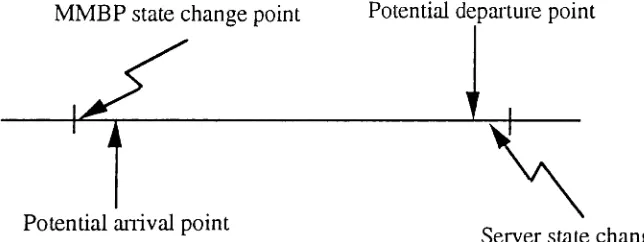
changes only at the end of a slot immediately after the potential departure time (see Figure
2). For simplicity, we assume that the MMBP-stream packet has priority over the Bernoulli Process packet in the sense that the stream packet is served first if an
MMBP-stream packet and a Bernoulli Process packet arrive in the same slot.
In order to obtain the steady state queue length distribution, we observe the system
at the slot boundaries and generate the imbedded Markov chain [12]. In this Markov chain,
there are2(K+2)(N+ 1) states denoted by (V,S,I1) representing that the state of the MMBP is
represent the buffer size, and thus at most(K+1) packets are allowed in the system. There
are only three events that can cause the Markov chain to change state: the MMBP state
change, a packet arrival or a server state change. By solving the Global Balance Equations
of the Markov chain, the queue length distribution of the MMBP+BP/D(N)/l/K queue is
obtained.
3.
The
Queue Length Distribution Observed
at the Arrival
Instances of lVIMBP-stream Packets
In this section, we obtain the queue length distribution observed by the arrivals
from the MMBP-stream.This analysis will enable us to delive the waiting time distribution,
the blocking probability, and the interdeparture time distribution for the MMBP-stream
packets. The derivation of the interdeparture time distribution is given in detail in the
following section.
The system state as defined above is represented by three parameters, the MMBP
state, the state of the server, and the queue length. We observe the system state at arrival
instances of packets from the MMBP-stream, and relate the distribution of the system state
at the (11+ l)st observation point (the arrival instance of (11+ l)st MMBP-stream packet) to
that of the previous observation point, i.e., the nth observation point [2], [3].
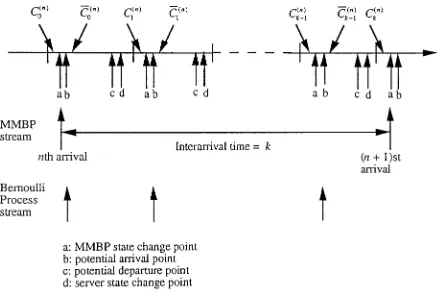
We define a random variable
Ci
n) to represent the system state observedimmediately before the potential arrival point in kthslot following the nth MMBP-stream
packet arrival given that the (n+l)st MMBP-stream packet arrival does not occur in the
precedingk-l slots. ct) is a 3-tuple variable, ctJ=(Vin).s~n),Nt»),where Nt) and
st
lrepresent the queue length and the server state respectively observed immediately before the
potential arrival point in the kth slot following the nth anival of a packet from the
MMBP-stream, and
vt
Jindicates the MMBP state in which the nth MMBP-stream packet arrivalseen by the nth MMBP-stream packet arrival. That is, V~"), N6") and S6") are the MMBP
state,the queue length and the server state accordingly seen by the nth arrival of a packet
from the MMBP-strcam. The main objective in this section is to determine the probability distribution of Cci")
For this purpose, we further introduce supplemental random variables. N~n) and
sin)
represent the queue length and the server state respectively observed immediately afterthe potential arrival point at the kth slot following the 11th arrival of a packet Irorn the MMBP-stream.
Vi
n) indicates the MMBP state in which the nth MMBP-stream packet
arrival occurred.
c»
is a 3-tuple variablecr
=(\I(n)SIn) N(n») The order ofk ' k k ' k ' k •
occurrence of the random variable observation points inaslot is presented in Figure3. Immediately afteran MMBP-stream packetarrival, there are
»:
+ 1+B packets inthe system, where B is a random variable representing the number of arrivals [rOITI the Bernoulli Process stream. Hence, we have the relation
N~n)
=
min(N6")+
1+
B, K+
1), where B=
{I
o
witli prob.
f3
witli prob. 1-
f3
(1)Next, we consider the relation between N~n) and Nt( II ) . There are only three events
h b . . f N(1I) d N(1I)· ack td tur a
that can happen between t e two0 servauon points a . 0 an 1 · a pac e epar ure,
server state change, and the MMBP state change as shown in Figure 3. A departure occurs in a slot if and only if the state of the server before the potential server state change point is equal to
N
in the given slot. Therefore, the relation is givenby
the equationo
~sci
n ) <N56")
=
N(2)
Bysimilar reasoning, we have the following recurrence equations for k
>
O.o
~ S~:)l<
NS( n ) - N
kl
-(4)
By
examining the order or events in a slot in Figure3,
the relations betweensin)
andSk
Cff) for k~
()can simply be derived as followsS(II)
=
Sen)k k '
S
- ( fI )
+
1k-l
Sen) -k
-o
0< S(fI) < N
k-l
S- ( fI ) - N N(n) 0 or
k-l - , k-l >
S(fI) = N N(n)
=
0 ork-I ' k - l
SUI)
=
o
N(ff) >a
k-l ' k - l
Sen) = 0 N(n)
=
0k-l ' k - l
(5)
(6)
Next, we consider the probability density ofthe random variables. Let c~n)(v,i,j)
and Ck(II)(v,i,}) be the probability density functions ofthe random variables cin) and ck(n)
• 0 I 0 c(n)( 0 0)-po b[V(n)- S(fI) - 0N(n) - 0] d c(n)( 0 0) P b
respective y, l.e., k V,l,J - 10 k -v, k - 1, k - J an k V,l,J
=
ro[ y en)=V sCn)
=
i N(n)= JO]k ' k ' k: •
Considering the relationship between therandom variables as given by (1) - (6), we
have
c~n)(v,i,j -1)(1-fJ)
+
Cci")(v,i,j - 2)fJCo(n)(v,i,}) = C~fI)(v,i,K)+ Ccin)(v,i,K-1)f3 + Ccin)(v,i,K
+
1)o
v
=
0 or 1, 0::; i ~ N,a
~}
~(K+
1),O~j5:K
j = K+l
i>
K +1(7)
Cifl)(v,i,})(l-
fJ)
+
Ci")(v,i,j-1)f3ck(n)(v,i,j)=
Ci
n)(v,i,K ){3+
C1n)(v,i,K+
1)o
O~j<5.K
}=K+l ,
i
>K+lC( n ) ( • • )
k V,l,}
=
Ck(~~(V,O,O)
+
Ck(~~(v,N,I)C<1I)(
0
0) C(1I)( N· 1k-l v, ,}
+
k-l v, -l+ )
Ck-l<1I )('V,l -. 1·)«]
o
i
=
O,j=
0i=l,j>O
1<i~ N,j > 0
i= O,j >0 or 1~ i 5:N,j = 0
k ~ 1, v
=
0 or1, 0 5:i ~ N,a
~ j ~ (K+
1).(9)
When a new packet from the MMBP-stream arrives in thekthslot following the last
arrival, the new packet finds the queue length
Ni
n) and the state of the server s~n) upon its
arrival. Thus, the distribution of the system state seen by the(11+l)st MMBP-stream packet arrival, by using the distribution of the system state in the kth slot following the nth MMBP-stream packet and the probabilitydistribution that the(11+J)stMMBP-stream packet arrival occurs in thekth slot, can be obtained.
Since the MMBP is not a renewal process but aMarkov renewal process, the distribution of the time interval from nth arrival to (n+l)st arrival is not exponentially distributed but depends on the MMBP state at the time of the nth arrival. Therefore, we must use the conditional interarrival time distribution ay(v',k) (Probjinterarrival time = k
slots, state of the MMBP
=
v'Istate of the MMBP for the previous arrival v]), instead of a(k) (Prob[interarrival time=
k slots]). A derivation of Qv(v',k) for a 2-state MMBP is given in Appendix. The probability density Ccin+l)(v,i,j) can be written as a function ofCin)(v,i,}) as follows
OC)
C(n+l )( , ° 0) - " ( ' k)C<1I)( ..)
o V,l,} - L..Jov v, k V,I,}.
k=l
(10)
The steady-state probability that there arej packets in the queue, the state of MMBP is v, and the state of the server is
i
upon a packetarrival from the MMBP-stream is givenby
Co(V,l,j. 0)
=
1·irnC(1l)(0 v.i.] ,0.)n~oo
Using Co(v,i,j) , the joint probability density of the MMBP state, the queue length
and the server state observed by a packet arrival from the MMBP-stream, the probability
density of the queue length observed at the arrival instances of MMBP-stream packets can
be simply obtained as follows
1 N
Prob[queue length
=
jla packet arrivalfrom MMBP streant]=
IICo(v,i,j). (12)v=O ;=0
The waiting time distribution and the blocking probability for the MMBP-stream
packets are also readily obtained using Co(v,i,j) .The waiting time for an MMBP-stream
packet is the time to serve all the packets found in the queue and in the server upon the
arrival of the given MMBP-stream packet. Since we assume that the MMBP-stream packet
has priority over the Bernoulli Process stream packet when an MMBP-stream packet and a
Bernoulli Process stream packet arrive at the same slot, the waiting time of the
MMBP-stream packet is not affected by the possible arrival from Bernoulli Process MMBP-stream in the
same slot. Given that the state of the server was
i
(>0) and that the num ber of packets in thesystem wasj upon the given MMBP-streaITI packet arrival, the packet in the server requires
N -
i
+
1 time slots before its departure and the packets in the queue require (j -1)x Ntime slots to be served. Thus the total waiting time is (N - i
+
1)+
(j-1)x N slots, given that the MMBP arrival sees that the server state was i(>0) and the queue length wasj uponits arrival. Thus, the probability density of the waiting time for the MMBP-stream packet is
given as a function of Co(v,i,}) as follows
d(k)=
1 N K+l
LLLCo(v,i,j)b(k,j
XN -,+1),v=O;=1 j=1
k>O
k=O
(13)
The blocking probability for the strealTI is the probability that an
MMBP-1 N
stream arrival sees(K+1) packets in the queue. and is given by
L L
Co
tv.i,K+
1) .v=O ;=1
4. The Interdeparture Time Distribution for
the MMBP-stream
Packets
In this section, we derive the intcrdcparturc time distribution for packets from the MMBP-stream by using Co(v,i,j), the probability density of the system state observed at
the arrival instances of the MMBP-strealTI packets, obtained in the previous section.
For this purpose, we define the two-tuple random variables, Ci~;,q=(Nk,s,q' Sk,S,q)
and
C/:~q=(Nk.s.q.
Sk'S,q). Nk,s,q' and Sk,s,q represent the queue length and the server stateaccordingly observed immediately before the potential arrival point at the kth slot following
an arrival of a packet from the MMBP-stream, and Nk .s.q , and Sk,s,q represent the queue
length and the server state respectively observed immediately after the potential anival point
at the A.1h slot following an arrival of a packet from the MMBP-stream, given that the state
of the server was s and the queue length wasq upon the arrival of the given MMBP-stream
packet, and the next MMBP-stream packet arrival does not occur inthe precedingk-I slots. By an argument similar to the one used in deriving (1) - (6), the relationships
between the above defined random variables are as follows
Nl,s,q = min(q
+
1+
B, K
+
I), (14){ Nk .S .q
Nk,s,q
=
N -1k.s.q
k ~ 1,
o
~Sk-l,s,q <NSk-l,s,q = N
Nk .s .q
=
min(q+
B, K+
1),k> 1, (16)
Sk'S,q
+
1Sk,s,q
=
1o
k ~1.
0<Sk,s,q <N
s.:
=
N ,Nk.s .q >0 or Sk,,'\,q=
O,Nk.s .q >0 Sk,s,q =N,Nt .s .q =0or
Sk'S,q =O,Nk .s .q =0(17)
The corresponding joint probability densities are denoted as Ck,s,q(i,}) =
Prob [Sk.s.q
=
i.Nk.s.q=
j] and Ck,s.qU,j)=
Prob [Sk'S,q=
i,Nk.s.q=
j] and are determinedthrough the following equations.
f3
Cl,s,O
o.»
= 1-f3
a
o
~s.i
~ N, 0~ j ~ (K+
1),C
o.» -
I
PI-f3
l.s.q I,)
-l
0s
=
O,}=
2,i =°
s = O,}=
l,i=
°
otherwise
S,*O,}=q+2,i=s
s,*O,j=q+l,i=s
otherwise
(18)
o
~s.i
s
N, 0<
q<
K, 0s }
~ (K+
1), (19)_
{I
C1.s.q(i,j)= 0
s ;t:.
O,i
=
s.]
=K
+
1otherwise
o
5:s.i
~ N,q
=
K,K+
1, 0~ j ~(K+
1),Ck-1,s,q(i,j)(l -
(3)
+
Ck-l,s,q(i,j-1)f3Ck,s.q(i,j)= Ck_l.s,/i,K)P
+
Ck-l.s.qU,K+
1)o
O~j~K
j=
K+l
i>
K+l
k
>
1,0
~s.i
s
N,°
~ q,j ~ (K+
1),Ck,s,q(O,O)
+
Ck,s,q( N , l )C Ck,S.q(O.j)
+
Ck.s,q(N.j+
1)k.s.q(i,j) =
Ck •s•q(i - 1,j)
°
k~l, O~s,i~N, 0<- q,J -o«K+1).
i = O,j =
°
i= l,j >01<
i
~ N,j >0i
= O,j >°
or 1~ i ~ N,j =°
(21)
(22)
Now, we consider the interdeparture time between two MMBP-stream packets. The
system time of a packetfrom the MMBP-st.ream is defined as the length of the time interval
starting from the slot when the arrival of the given packet occurs and ending at the slot
when the given packet departs the system. Let l-v(s,q) denote the system time of a packet
from the MMBP-stream given that the queue length was q and the server state was supon
its anival. Then
{
(q-l)N
+
(N - S+
1)+
N~v(s,q) =
N+l
q>O
q=O
(23)Using ~v(s,q),the random variable
IDk,S,q
denoting the interdeparture time betweentwo consecutively arriving packets from the MMBP-stream when the interarrival time
between two packets is k, and the server state and the queue length upon the arrival of the
first packet of the two are sand q respectively, is given by
(24)
From (23) and (24), idk,s,q(j) , the probability density of the randorn variable
ID
k ' is obtained as.s.q
idk.s,q
(j)=
N
{C,.
(i,(j - k+
i
+
qN -
s) /N)}
L
~.s,q .;=1
+C
k'S,q(O,O)8 (J,k - qN + s)N
{C
k (i,(j-k+i)/ N)}L
.s.q;=1
+C
k •o.o(O,O)8(j ,k )q>O
q=o
Finally, we remove the conditions from the above equations to obtain the probability density of the interdeparture time for the MMBP-strealn as follows
00 N K+l 1
id(j) = LLLLa.,(k)Co(v,s,q)idk.s.q(j),
k=l s=O q=O v=o
1
av(k)
=
Lav(v',k). v'=o(26)
5. The
Autocorrelation
of the
Interdeparture
Time
for
the
lVllVIBP-stream Packets
In this section, the autocorrelation coefficient of the interdeparture time for the MMBP-stream packets is derived [7]. We define two random variables:Tn' the interdeparture time between the (n-l)st and the nth packets; Tn,(v,s,q)' the interdeparture time
between the (n-l)st and the nth packets given that the state of the system upon the nth
packetarrival [rom the MMBP-stream is (v,s,q).
The autocorrelation coefficient of the interdeparture time of the MMBP-stream with lag 1is given by
Cov(T,,_1Tn) E(Tn_1Tn) - E(Tn_1)E(Tn)
qJt = Var(T,,) = £(T;) - £2(T,,) . (27)
We can easily determine E(Tn)(=E(Tn_I» by using the probability density of the
interdeparture time distribution for the MMBP-stream derived in the previous section. To obtain the term E(Tn_1Tn)' we again introduce a number of z-transforms. Let
T . . ( I )
A , .. (z) == E[z n.(v·,s.q >IC
on-
=
(v,s,q)],(V,s,q)(v .s ,q )
(z) - E[.-rTnIC(,,-I) - ( )]
B(v,S,q) c
=
~ 0 - v,s,q ,d C ( ) - E[.-rT"-1 r,Ic(n-l) - (' q)]
To derive A(v.s ,q)('.v .s ,q,)(z), we define t(v,s,q)( v, ' ..s ,q ) as the time interval beginning from a
particular slotat which a packet, whose arrival occurredwhen the state of the system was
(v,s,q), from the MMBP-streUlTI departs and ending at a slot when the next MMBP-stream
packet, upon whose arrival the state of the system was (v',s',ql), departure occurs.
t( ..S )(v' , ,)=jwith probability jJ(, ' . ,)(j)
=
prob[interdeparture time of thenth andthe. " q .s ,q ~,s,q)(v.s .q
(n+1)st MMBP-stream packets =
j,
state of the system upon the arrival of the (n+l)stMMBP-stream packet= (v',s',q') Istate of the system upon the arrival of the nth
MMBP-stream packet
=
(v,s,q)]. Therefore,ee
A(~'.s,q)(\.·',s.q). . (z)='p£..J (v,s,q)(\.".s ,q).. (J')7j
" v .
j=l
(29)
p , , . (j) can be obtained by using the conditional interarrival time distribution
(v,s,q)(v .s ,q )
a,
(v',k) and the probability distribution of the system state observed at the arrival instancesof the MMBP-stream packets Co(v,s,q)
C1('t
p .. , (j)
= "
av(v' ,k )Co(v,s,q )8 ( j , {k+
w(s'.q) -
l-v(s,q)}).( v.s ,q )(v,s ,q ) £..J
k=l
By using (28), we obtain
1 N K+I
B(v.s.qj(z) = L L LA(v.s.q)(V,.s',q'j(z), (30)
~"=Os'=Oq'=O
I N K+l
C(V,s.qj(Z"Z2)= L L LA(v,s.q)(v',s·.q)Zt)B(v·.s"q,/z2)' (31)
v'=Os'=Oq'=O
Further, we denote the matrix of A , , . (z). the vector of B(v,s,q)(z), and the vector of (V,s,q)(v .s .q )
C(V.S,qj(ZI'Z2) byA(z) ,B(z), and C(ZI'Z2) respectively. Equation (31) is then rewritten in
matrix form as follows
(32)
where
Co
is the probability vector of the probability density Co(v,s,q).Finally, we can readily derive E(T T) Irorn E(zT fI_, _TfI ) as ,,-1 " 1 ~2
E(T T) = C dA(Zt) dB(Z2)
"-1,, 0 d:
1-~l (~2 z,=1.':2=1
,and the autocorrelation coefficient of the interdeparture time for the MMBP-stream is
obtained by substituting E(Tn_1Tn) in equation (27).
6. Numerical Results
In this section, numerical examples are presented by employing the analytical
approach presented above. For the numerical computation to be tractable, we approximate
the interarrival time and the interdeparture time distribution between packets such that the
maximum time is finite. We will investigate how the traffic characteristics of the
MMBP-stream are influenced by the amount of BP-MMBP-stream traffic, the degree of the burstiness and
the correlation of the MMBP-stream.
The parameters assumed for the arrival process and the system are given in each figure. Lamda, CC, C2,
p,
K, and N represent the average probability of an arrival for theMMBP-stream, the autocorrelation coefficient of the MMBP-stream, the C2 value of the
MMBP-stream, the arrival rate of the BP-stream, the buffer capacity of the system, and the
deterministic service time respectively.
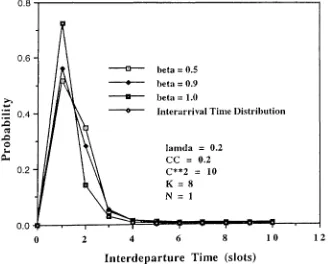
Figures 4 and 5 show how the probability densities of the interdeparture times of
the MMBP-stream change as the BP-stream traffic increases. For comparison purpose, we
also include the probability density for the interarrival time distributions of the
· In Figure 4, we observe that the probability densities are less peeked as the arrival
rate of the BP-stream increases (~
=
0.1, 0.3, 0.5). That is, the probability ofinterdeparture time equal to 1 gets smaller and that of the interdeparture time equal to 2 gets
larger as the amount of the Bf'<strcam increases. This is because the packets from the
BP-stream tend to interleave the continuously arriving packets from the MMBP-BP-stream.
In Figure 5, however, we observe the opposite phenomina, i.e., the probability
densities of intcrdeparture time gets more peeked as the amount of the traffic from the
BP-stream increases (~
=
0.5, 0.9, 1.0). Whenp
is equal to 1.0, the interdeparture timeprobability density nearly overlaps the interarrival time probability density. As the value of
p
increases the buffer gets full more frecquently and large amount of BP-stream packets arelost. This results in reducing the effect of the BP-stream to the performance of the
MMBP-stream, and thus the probability density of the interdcparture time becomes similar to the
original interarrival time distribution of the MMBP-streaITI.
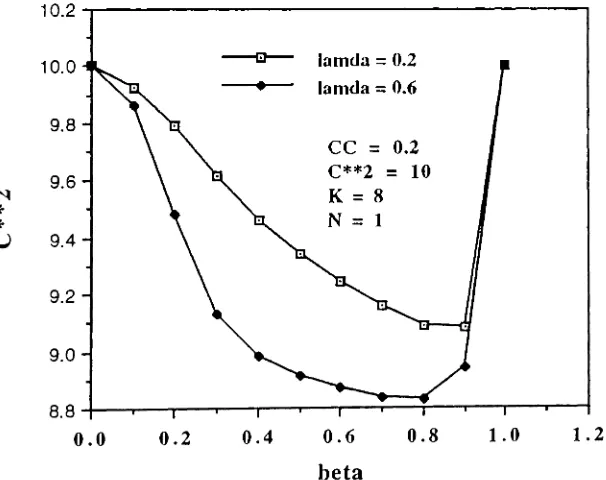
Next, we see the autocorrelation coefficient with lag 1 and the C2 of the interdeparture time of the MMBP-stream packets dependent on the amount of the traffic
from the BP-stream in Figures 6 and 7. We observe that the correlation of the interdeparture time becomes larger, and the C2of the interdeparture time gets smaller as the arrival rate of the BP-stream increases. The change is more rapid when
A
=
0.6 than whenA
= 0.2. However, the correlation starts to decrease and the C2 starts to increase as thearrival rate of the BP-stream increases to exceed a certain limit due to the BP-stream packet
loss as explained above. When A
=
().6, the value of this limit is smaller. In the extremecase, when
~
= 1.0, the correlation and the C2of the departure process approach to thoseof the arrival process of the MMBP-strealTI.
Figures 8 shows the mean waiting time for a packet from the MMBP-stream as a
function of the amount of traffic from the BP-stream. Since the deterministic service time is
1nus, tne waiting time of an MMBP-stream packet when ~ is 1.0 is equal to the buffer
capacity, K=8. We observe that the mean waiting time when A
=
0.6 grows more rapidlythan that of
A
= 0.2 asP
increases from 0.3 to 0.4, see in Figure 8. This is because thebuffer is filled up faster when the total load of the system is larger, that is, when
A
islarger: Since we have a finite capacity system, the amount of mean waiting time increase is
reduced as the total load increases to exceed a certain limit due to packet loss.
Figure 9 shows the blocking probability for the MMBP-stream packets. Similar to
the mean waiting time, the blocking probability increases rapidly as ~ increases, and as the
load of the system exceeds a certain limit the amount of increase is reduced.
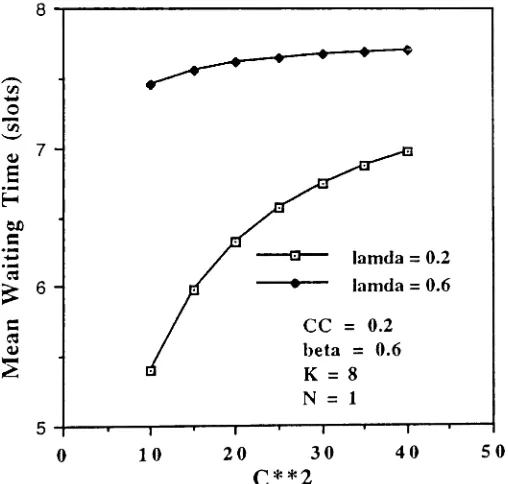
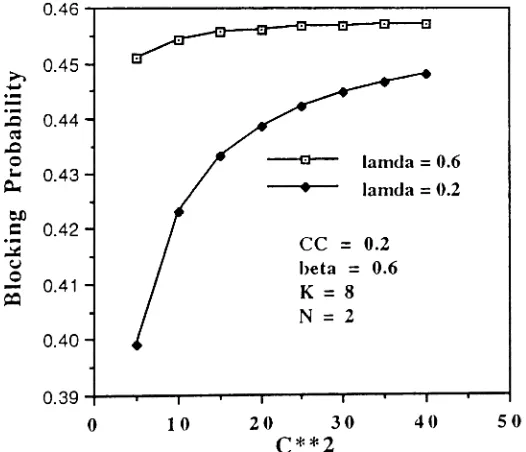
The mean waiting time and the probability of blocking for the MMBP-stream
packets dependent on the correlation and the burstiness of the MMBP-stream are shown in
Figures 10 - 13. The mean waiting time and the blocking probability for the MMBP-stream
increases in a logarithmic fashion with increase in burstiness and show an exponential type
increasewith increase in autocorrelation.
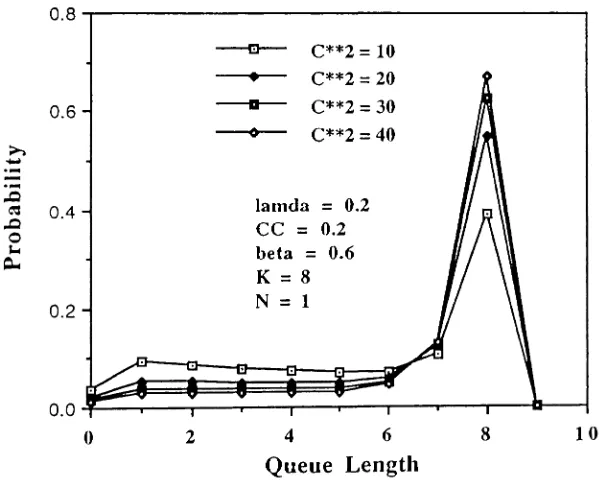
Figures 14 and 15 show the queue length distribution at arbitrary points in time.
Figures 16 and 17 show the queue length distribution at MMBP-stream packet arrival
instances dependent on the autocorrelation and the burstiness of the MMBP-strealn. We
observe that the queue length distributions at arbitrary point in time are less sensitive to the
changes of MMBP-stream characteristics.
7. Conclusion
In this paper, we studied a queueing model which is particularly motivated by the
study of the link-transport layer servicing several transport connections including an XTP
connection in a high speed network. We have analyzed a discrete time finite capacity
arrival processes, two kinds of traffic streams, MMBP and Bernoulli Process, are considered.
The queue length distribution of MMBP+BP/D(N)/1/K queue at arbitrary points in time using a multi-dimensional Markov chain analysis is obtained first. The queue length distribution observed at the MMB P-stream packet arrival instances, and the waiting time distribution and the blocking probability for the MMBP-stream are then obtained to investigate how the MMBP-strealTI is affected in the queue. The probability density and the
autocorrelation coefficient of the interdeparture time distribution [or the MMBP-streaITI, which are important in the analysis of network of queues, are also derived.
The numerical examples show that the traffic characteristics and the performance for the designated transport connection are affected by the external traffic load, the degree of burstiness and correlation of the traffic source.
References
[1] W. Stallings,Data and Computer Communications, Macmillan Publishing Company, Macmillan, Inc., NJ, pp134-147, 1991.
[2] H.Heffes and D. M. Lucantoni, "A Markov modulated characteristics of packetized voice and data traffic and related multiplexer performance," IEEEJ.on Select. Areas
C0I11111Lll1., vol. SAC-4, no.
6,
pp. 856-868, Sept. 1986.[3] Masayuki Murata, Yuji Oie, and Tatsuya Suda, "Analysis of a Discrete-Time Single-server Queue with Bursty Inputs for Traffic Controlin ATM Networks," IEEEJ.011
Select. Areas C0I11111UI1., vol. 8, no. 3, April 1990.
[4]
Yoshihiro Ohba, Masayuki Murata, and Hideo Miyahara, "Analysis of Interdeparture
Processes for bursty Traffic in ATM Networks," IEEE J. 011 Select. Areas
Co111111ll11. , vol. 9, no. 3, April 1991.
[6]
~rne
A. Nilsson and Meejeong Lee, "A Performance Study of the XTP Error Control," Proc. 4th IFIP conference on High Performance Networking, Liege, 1992.[7] W. Fischer and K. Meier-Hellstem, "The MMPP Cookbook," draft, Oct. 1990.
[8] U. Briem, T. H. Theimer and H. Kroner, "A General Discrete-Time Queueing Model: Analysis and Applications," TELETRAFFIC AND DATATRAFFIC in a
period of Cliange, ITC-13, Elsevier Science Publishers B.V. (North-Holland) lAC,
1991.
[9] J.R. Louvion, P. Boyer, and A. Gravey, "A Discrete-Time Single Server Queue with
Bernoulli Arrivals and Constant Service Time," Proc. 12th International Teletraffic
Congress, Torino, 1988.
[10] I.Jacobs, "Design considerations for long-haul lightwave systems," IEEEJ. Select. Areas CO/1l1J1UI1., vol. SAC-4, pp. 1389-1395.
[11] Dooyeong Park, Henry G. Perras, and Hideaki Yamashita, "Approximate Analysis
of Discrete-time Tandem Queueing Networks with Bursty and Correlated Input
Traffic and Customer Loss," Technical Report, Department of Computer Science,
NOlth Carolina State University, Raleigh, NC, 1992.
[12] L. Kleinrock, Queueing System, Vol. I, John Wiley & Sons, Inc., New York, NY,
Appendix
A two state MMBP is characterized by the transition probability matrix Ptand the
arrival rate matrixA defined as the following:
P
t
=
[p
1-P]
l-q q and
Lettvv'be the time interval starting [rom a particular slot when the arrival process is
instate vand ending at a slot when the nextarrivaloccurs and thearrival process is in state
v'. Then,
1
tIl
=
1+
tIl1
+
t211
fI 1= 1
+
tI 21
+
t22 1 tIl=
1+
t121
+
t22w.p. alJ
l-v.p. (1- a)p
rV.p. (1 - (3)(I- p),
w.p.
a(l- q)w.p.
(l-a)(l-q)w.p.
(1-f3)q,w.p. (3(1-p) l-v.p. (1- a)p
w.p. (1- (3)(1- p),
w.p.
f3qw.p. (l-a)(l-q)
w.p. (1- [3)(1- q).
Define
Sn
as the state of the arrival process when the nth arrival occurs, and Tn,v asthe interarrival time between the (n-l)stand nth arrivals while the nth arrival occurs in state
v. If we define
Avv' == E[,.,Tn,v'ISc, ,,-1 = v]'
then from the definition oftvv' and Tn, v we have
A
=E[,.,/
w' ]Therefore,
All(Z)
=
apZ+
(1-a)jJzA1I(z)+
(1- ,8)(1-P)~l(z),~1(z)
=
a(l-q)z+
(1-a)(I- q)zAI I(z)+
(1-{3)q~1(z),Al 2(z) =f3(1- p)z
+
(1- a)PzAl 2(z)+
(1- [3)(1-p)~2(z),~2(z)
=
f3qz+
(1-a)(I-q)zAl 2(z)+
(1-{3)q~2(z),By
solving (33) - (36) we can obtain Ayy'(z) with respect to0,b,
jJ, q as followsA (~)= ajJz + z2a (1 - {3 )( 1- p - q )
11 c 1 n 2 '
-z(p(l-a)+q(l-fJ»-z (1-a)(1-{3)(I-p-q)
~l(Z)=
a(1-;)z ,1-z(p(l-a)
+
q(1- f3» - z (1- a)(l- (3)(1-p - q)A (-) = f3(1- p)z
12 c l-z(p(1-a)+q(1-,8»-z2(1-a)(1-{3)(1-p-q)'
A ( ) _ ,8qz
+
Z2,8(1-a)(I- p - q)22 Z - 2 •
1- z(p(1- a)
+
q(l-(3» -
z
(1-a(l- f3)(1- p - q)(33)
(34)
(35)
(36)
(37)
(38)
(39)
(40)
The conditional probability density function of the interarrival time, Qv(v',k),can be
obatined by inverting the generating function, Avv'(z). Let C~,y'(k) and
b;
(k) be thecoefficient of the zk in the numerator and the denominator ofAvv'<z) respectively. Then we
have
2
"£..Jcy V '(k)zk 00
A I(~)
=
k=O=
'a
(VI k)~kvv ~ 2 £..J v ' ~
Lb,.y. (k)/ k=O
k=O
For each equation, multiplying both sides by the denominator and the equating the
coefficients ofzkon both sides, we obtain the following set of linear difference equations
min{2.k) {Cvv.(k) k = 0,1,2
L ay(v',k-n)bvv·(n)=
a
k>2n=O
We can then solve forQv(v',k) recursively as follows
1 [ m i n ( 2 , k ) ]
ay(v' ,k)
=
Cvv' (k) - Lbvv' (n)ay(v'.k-n) ,b;
(0) n=lwhere cy V'(k)=
0
for k>
2.p
I - P
1 - q
Figure 1: The Markov chain of a two-stale MMBP
q
MMBPstate change point
Potential arrival point
Potential departure point
Server state change point
nth arrival
ab
c(n)
o
MMBP stream
Bernoulli Process
stream
t
c d ab
t
c
d
Interarrival time= k
c(n)
k-l
c(n) c(n)
k-l k
a b c d ab
~t
V1
+
l)st arrivalt
a:MMBP state change point b: potential anival point
c:potential departure point d: server state change point
0 . 8 . - - - _
12 10 8 6 4lamda = 0.2 CC = 0.2
C**2 = 10
K=8
N = 1
- a - beta
=
0.1• IJeta
=
0.3a beta=0.5
o Interarrival Time Distrihution
2
0.0 . .--r-~-....;....:::::~!!!CI...
-a--a--...
--IJ----lo
0.6 ~ .......
-....
~ ~ 0.4 ~ 0 ~ c, 0.2Interdeparture Time (slots)
Figure 4: Interdeparture time distribution [or the MMBP-stream w.r.t. the amount of the
BP stream (~ = 0.1, 0.3, 0.5).
0.8
-r---0.6
~ beta
=
0.5•
beta=
0.9~
•
beta = 1.0...
....
0.4 0 Interarrival Time Distributlon-....
~
~
~
0 lamda
=
0.2~
Q.. CC = 0.2
0.2 C**2 = 10
K=8
N = 1
0.0
0 2 4 6 8 10 12
In terdeparture Time (slots)
Figure 5: Interdeparture time disttribution for the MMBP-stream w.r.t. the amount of the
0.22 ,
-§
0.21 .~...
~ Qj s... s... o ~ o :; 0.20<
--e-- lamda=0.2
• lamda
=
0.6CC
=
0.2C**2 = 10
K
=
8 N = 11.2 1.0 0.8 0.6 beta 0.4 0.2 O.19-r--,r--~-~___,.-_r____,r____r_-...,...____,.-...,.____..-_I 0.0
Figure 6: Autocorrelation of the interdeparture time distribution [or the MMBP-stream as a function of the amount of the BP stream.
1.2 1.0
0.8
CC
=
0.2C**2 = 10
K=8
N
=
1~ lamda=0.2
• larnda=0.6
0.4 0.2 10.2 10.0 9.8 9.6 N
*
*
U 9.4 9.2 9.0 8.8 0.0 0.6 betaFigure 8: Mean waiting time [or the MMBP-stream packets as a function of the amount of
the BPstream packets.
0.5
~
~
.-
~ 0.4.-
~~
~
0
~
Q..
0.3 eo
c:
.-
~~
0
~
~ 0.2
~ lamda=0.2
• lamda=0.6
CC = 0.2
C**2 = 10
K=8 N=2
1.0 0.8
0.2
O. 1-+-_ _- __-...--~-~-r_____,r___,.-__,_-_t
0.0 0.4 0.6
beta
Figure9: Blocking probability for the MMBP-stream packets as a functionof the amount of
7 ....- - - . . . ..-... til
...
0 fii ' - ' Q) 6e
~ ell C .,.....
.
;
~ 5=
~ QJ ~lamda
=
0.2 C**2=
10 beta=
0.6K=8 N
=
10.5 0.4
0.2 0.3
CC
0.1
4 - t - - - - , r - - - - . . . . - . . . - - - . . . - - . . . - - - -...
0.0
Figure 10: Mean waiting time for the MMBP-stream packets as a function of the degree of
the correlation of the MMBP-stream.
50
40
•
•
CC
=
0.2 beta=
0.6K=8 N
=
1~ lamda=0.2
• lamda
=
0.6•
10 8 ,..-... til ... 0 Vi ' - ' QJ 7e
~ eo c .,.. ....
;
~ 6 C ~ QJ....
e.
50 20 30
C**2
Figure 11: Mean waiting time for the MMBP-stream packets as a function of the degree of
0 . 4 . -0.5 0.4 0.2 0.3
CC
0.1lamda = 0.1
C**2 = 10 beta = 0.3
K=8
N = 2
o.1-t----,r----r'-.,.----r-~__,..___...,..-...____..-~
0.0 >, ~
...
-:.c
~ 0.3 ,.Q o ~ Q.. eoc:
:g ~ 0.2 o -~Figure 12: Blocking probability for the MMBP-stream packets as a function of the degree of the correlation of the MMBP-stream.
50
40
CC
=
0.2beta = 0.6
K=8
N
=
2- - e - - lamda =0.6
• lamda
=
0.210 0.46 >a 0.45 ~
...
-...
0.44 .Q ~ ,.Q 0 s. 0.43 Q.. eo c 0.42:;;
u 0 0.41-
CQ 0.40 0.390 20 30
C**2
10 8 2 0.0 -t----r---r---....,---r---.,..--...---~----.I
o
0.8- a - CC = 0.001
•
CC = 0.10.6 a CC = 0.2
~ 0 CC = 0.3
~
.~
--
•
CC = 0.4.~
~
~
"Q 0.4 lamda = 0.2
0
I-l C**2 = 10
0.- beta
0.6
= K=8
0.2 N = 1
4 6
Queue Length
Figure 16: Queue length distribution at the MMBP-stream packet arrival instances w.r.t. the
degree of the correlation of the MMBP-stream.
10
8
4 6
Queue Length
2
O.a- ¥ - - _ _- _ - . . . - - . . r - - - , . - - - , . - - - - r - - - D - - - i
o
0.8
~ C**2 = 10
•
C**2=200.6 a C**2 = 30
0 C**2 = 40
~
..-.-
-
.~"Q
lamda 0.2
~ 0.4 =
..c CC = 0.2
0
I-l beta = 0.6
Q.
K=8
0.2 N = 1
Figure 17: Queue length distribution at the MMBP-stream packet arrival instances w.r.t. the