7
FRAMEWORK OF WRITING
PROCESS: TRANFORMING
COMPUTER SCIENCE
RESEARCH INTO
PUBLISHABLE JOURNAL
ARTICLES
Sarimah ShamSudin
adlina abdul Samad
INTRODUCTION
WRITER-ORIENTED RESEARCH
Writer-oriented research theories address the issue of what a good writer actually does when he is given the task of producing texts. It also includes the formulation of methods that will assist learners to acquire these skills. Three areas of study that have contributed to the discussion on writer-oriented research are:
the expressivist view which centers on the creativity of the
•
writer and regards writing as personal expression,
the view that suggests writing as a situated act in which the
•
focus is on the writer’s immediate context, and
the cognitivist view which focuses on the cognitive process
•
of writing (Hyland, 2002).
Writing as Personal Expression
writing away from the focus on form and does not take into account “communication in the real-world contexts where writing matters” (Hyland, 2002:24).
Writing as a Situated Act
The view that proposes writing as a situated act considers writing as a social act that takes place in a particular situation. It focuses on the influence of the writer’s immediate context such as background knowledge, assumptions, expectations and environment on the form of writing that is produced. These elements should be taken into consideration during the teaching and learning of writing. Studies such as ethnographic research in writing which view writing as a situated act aims to discover in detail how writing is considered as a feature of the writer’s local situations. It is a type of research that is conducted to provide a participant or insider awareness of how and why people write, under normal circumstances, over duration of time, without getting in the way of the writing context. The methods that can be used include “detailed, longitudinal, observations of the setting and acts of writing, interviews with participants on their writing and relevant autobiographical issues, recursive analyses of students’ process logs and diaries, questionnaires and close examination of classroom interactions”, analyses of course outlines, materials and outlines, and the subjects written products (Hyland, 2002:31-32).
Writing as a Cognitive Process
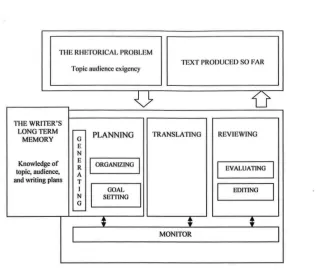
writing process and clarify the factors that may influence writing. Two influential models of the cognitive writing process are those proposed by Hayes and Flower (1980) and Bereiter and Scardamalia (1987). These models have been adopted by many researchers as a means to unravel the mystery behind the writing process. The first model focuses on the individual writer’s internal representation about writing and the latter differentiates the writing process experienced by a novice and an expert writer. These models can be used as a guide to teach and learn about the writing process.
The Hayes and Flower Model
Bereiter and Scardamalia (1987) Model
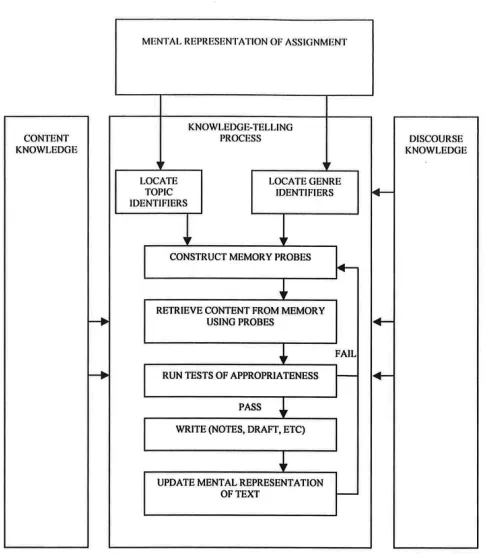
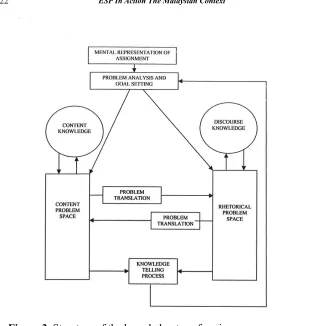
Another well known model of writing is that of Bereiter and Scardamalia (1987) who proposed two models of writing: knowledge telling (see Figure 2) and knowledge transforming (see Figure 3). The first model requires minimal thinking of planning and is achievable by anyone who can speak and write but the second model
is more complex and requires much effort and skills during the writing process. The second model is usually aimed at transforming knowledge which could result in creating new knowledge.
In Figure 2, the knowledge telling writing process model shows a progression of writing processes and the writer usually relies on himself for appropriateness such as the topic, writer’s personal writing schema and the progress of the written product. This model is usually self-reliant and the writing is not demanding as it requires minimal amount of planning and goal setting. Hence, it is not as cognitively challenging as the knowledge transforming model.
RESEARCH DESIGN
This chapter aims to report a research which adopts a case study approach to study the cognitive view of writing experienced by a writer as well as identify the cognitive process of writing for journal publication. The case study is a Computer Science lecturer who is actively publishing her research work in journals. Data for this research was obtained through a single interview which took about two hours. The interview was conducted in the researcher’s mother
tongue, the Malay Language but sometimes she code-switched from Malay to English. It took place at the lecturer’s office. The interview session was recorded and transcribed word for word. Words in Malay were translated into English and written in italic. The interview transcript was then analyzed to show how the writing process took place with reference to Bereiter and Scardamalia’s (1987) structure of the knowledge-telling process model (see Figure 2) and the knowledge-transforming process model (see Figure 3).
FINDINGS AND DISCUSSION
This section will describe the whole process of planning, writing and pre-publishing works of the writer in this case study. Data were obtained from content analysis of an interview conducted with the researcher in transforming her research into a journal publication. The initial writing process adopted in the case study appears to typify the knowledge telling writing process model. The writer shares the experience of having to undergo the different stages of writing an article for a journal publication that map onto the model.
shared by the case study in the initial writing process reflects how the cognitive activity began.
The first step that the writer undergoes in transforming or “translating” her research into publishable articles is to have a mental representation of the task to publish part of the findings of her research in an international journal. She then goes through the knowledge-telling process in which she locates the topic with reference to a chapter on one of her research findings. This can be found in the following excerpt of the interview transcript:
“like one chapter can be published by itself it means if we intend to publish take one chapter, one publication, one chapter, one publication.”
The decision to select a chapter to be published indicates that the writer has the prerogative to begin with any chapter of her research. The selection process itself shows that there is cognitive activity during the writing process before a decision is made. This could be mapped onto the stages of “memory probes” and “retrieve content from memory” in the knowledge-telling process model. The writing process incorporating these stages is recursive although the writing as a product appears to be linear. Once the decision has been made about the writing product, the writer translates the cognitive activity into words.
“If you want to publish in this journal what are the characteristic you should consider for certain journals because certain journal they are really looking at certain type of results right!”
Next she writes her paper by merging her content and discourse knowledge on the research area. To do so, she forces herself to write in which she said there were two reasons for writing:
“to force myself to write (for a journal) and also to
test my idea.”
Writing a first draft would actually utilise and synchronize the various stages in the knowledge-telling process model. Refining takes place as part of the process from which the writer rewrites more than once because it is a recursive process in which the writer constantly updates the mental representation of text.
In the context of the case study, the writer produces at least three drafts focusing on content before editing it for grammatical accuracy. This is stated as the following:
“first draft, second draft at least I have three drafts,
that is not final. Initially content after the content then
the grammar.”
The researcher then sends her writing to the publisher who then advises her on the specific area of the journal and the genre of journal writing. Upon receipt of feedback from the editors of the journal, the researcher goes through the knowledge-transforming process whereby she is required to address problems or the changes suggested by the editors. In this process, she will review the problems raised by the editors and tries to translate and resolve the problems. The knowledge transforming process at this stage refers to the whole cognitive process of reviewing the writing to conform to the context of the journal. The researcher’s experience of the knowledge-transforming process is expressed as follows:
“But when send to this journal, the feedback was very good.
They (editors) commented that if I were to extend my work,
it would be a very good idea. They said that their journal
requires that the ideas (results) be proven in a certain manner and even suggested to me that it is more appropriate for me
to send the article to the robotics and software journal. They
suggested that I send the article there. I think that is one of
the reasons why they rejected my article. Because the topic
does not match with the theme of the journal. So, this is my
first experience of being rejected. Now I understand what
they require.”
knowledge-telling writing process continues to another level of writing. This more challenging stage of writing is the knowledge-transforming writing process.
In the process of writing for a journal, our case study illustrates an exemplary case of a writing process which follows Bereiter and Scardamalia’s (1987) knowledge-telling process model followed by the knowledge-transforming process model.
CONCLUSION
As a conclusion, this case study is only part of a larger study which aims to understand how researchers transform their research into journal publication. The findings obtained from the writing process undergone by the researcher incidentally maps onto two of Bereiter and Scardamalia’s (1987) writing process models. However, further study involving other researchers would be required to substantiate the results of this case study.
REFERENCES
Bereiter, C. and Scardamalia, M. (1987). The psychology of written
composition. Hillsdale, NJ: Lawrence Erlbaum Associates.
Elbow, P. (1998). Writing with power: techniques for mastering the
writing process. New York and Oxford: Oxford University
Press.
Grabe, W. and Kaplan, R.B. (1996) Theory and Practise of Writing,
harlow, Longman
Hayes, J. R. and Flower, L. (1980). Indentifying the organization of writing processes. In L. W. Gregg and E. R. Steinberg (eds.),
Cognitive processes in writing (pp. 31-50). Hillsdale, NJ:
Hyland, K. (2002). Teaching and researching writing. Harlow: Pearson Education Limited.
Murray, D. (1985). A writer teaches writing, 2nd edn. Boston, MA:
Houghton Mifflin.
Zarqa Private University. (2006). The International Arab Journal of
Information Technology. Retrieved at http://www.iajit.org/
Porter, Kevin J. [Review of Post-Process Theory: Beyond the Writing Process Paradigm]. JAC. 20:3 (2000). Online. Viewed 6/3/04. Available at http://jac.gsu.edu/jac/20.3/ Reviews/3.htm
APPENDIX A
THE INTERNATIONAL ARAB JOURNAL
OF INFORMATION TECHNOLOGy
Aims and Scope
___________________________________________________
papers concerning formal specification, verification, and synthesis of information systems. Unpublished papers and extended versions of papers presented at conferences may be submitted for possible publication in the journal. Surveys and tutorial papers are welcome. In all cases, acceptance of papers will be based on originality and contribution.
The scope of the journal includes, but is not limited to:
AI & Expert Systems Database Systems Systems Software Computer Networks Computer Architecture
Parallel & Distributed Systems Internet & the Web
Computer Graphics Computer Simulation Digital Telecommunications Neural Networks
Software Engineering distance learning
Algorithms & Applications Image Processing
Arabic Language Processing IT & Society
Information Systems Pattern Recognition
Reliability & Fault Tolerance Computer Ethics
Human Computer Interaction Bioinformatics
Geographic Information Systems E-commerce
APPENDIX B
THE INTERNATIONAL ARAB JOURNAL
OF INFORMATION TECHNOLOGy
Instructions to Authors
___________________________________________________
Unpublished papers and extended versions of papers presented at conferences may be submitted for possible publication in IAJIT. Responsibility for the contents of a paper rests upon the authors and not upon the editors or the publisher. Surveys and tutorial papers are welcome. Please read and follow these instructions carefully. Doing so will ensure that the review and publication of your paper is as rapid and efficient as possible. The editors reserve the right to return manuscripts that are not prepared in accordance with these instructions.
Submission
submission. Authors of accepted papers should provide a photo and a brief biography of each author.
Copyright
It is a condition of publication in IAJIT that authors assign copyright to the publisher. This ensures that requests from third parties to reproduce articles are handled efficiently and consistently and will also allow the article to be as widely disseminated as possible. In assigning copyright, authors may use their own material in other publications provided that IAJIT is acknowledged as the original place of publication, and the publisher is notified in writing and in advance.download the Transfer of Copyright Agreement.
Preparation of the Manuscript
number “1”, and following sections are assigned numbers as needed. A conclusion section must be included and should indicate clearly the advantages, limitations, and possible applications. Footnotes to the main text are acceptable and should be identified by superscripted numbers. Footnotes should appear on the page of citation.
References
This section is not assigned a number. Only published articles or reports readily accessible in the general literature should be cited. The references should be numbered in alphabetical order by the first author’s last name. Internationally accepted abbreviations of journal titles may be used.
Citations in the text should be by number and enclosed in square brackets. Where there are more than three contributing authors, please list only one and use et al. The following format for references should be followed:
a) Journal papers: authors; paper title (between double quotation marks); title of journal (in Italics); volume and number; inclusive pages; and year; for example:
[1] Galton A., “Logic as a Formal Method,” Computer Journal, vol.
35, no. 2, pp. 431-440, 1992.
b) Conference papers: authors; paper title (between double quotation marks); title of proceedings (in Italics); location; inclusive pages; and year; for example:
[2] Downey A., “Predicting Queue Times on Space Sharing
Computers,” in Proceedings of the 11th International Parallel
Processing Symposium, Geneva, Switzerland, pp. 209-218, 1997.
c) Books: authors; title (in Italics); publisher; location; and year; for example:
[3] Hogger C., Essentials of Logic Programming, Clarendon Press,
Oxford, 1990.
Figures should be presented in the text of the paper. All figures should be formatted to fit into, or be reduced to, a single (85 mm) or double (178 mm) column width. Line illustration or camera-ready text must be of sufficient quality for publication as submitted i.e. clear, clean, sharp and of an even density. Figures will not be redrawn or relabeled. Any lettering or text should be in proportion to the rest of the figure. Halftones (photographs) should be of sufficient quality with respect to detail, contrast and fineness of grain to withstand the unavoidable loss of contrast inherent in the printing process.
Proofs and Offprints
One round of page proof will be sent to the corresponding author for checking. To avoid delays in publication, proofs should be checked and returned immediately by express post, email or fax to the Editor-in-Chief. Authors are sent 10 free offprints following publication of their paper. Single issues of the journal may be ordered when the corrected proofs are returned using the form provided.
APPENDIX C
THE INTERNATIONAL ARAB JOURNAL
OF INFORMATION TECHNOLOGy
Instructions for Preparing your Final Manuscript
1. Your paper must be carefully checked for correct grammar
and spelling.
2. To format your manuscript correctly, see the Page Layout Guideline for the A4 (21 cm x 29.7 cm) paper size.
3. All parts of the manuscript should be in two columns format, except the first part of the paper which includes the title,
the complete list of authors, the abstract, and the list of keywords.
4. The paper length should not exceed 8 single-spaced double column pages, including figures and tables. Margins of 15 mm should be left around the left, right, and bottom sides of the text. The top margin should be 25 mm.
5. The paper should include:
(a) Title.
(b) Author’s name(s), affiliation, and country. (c) Abstract (maximum 250 words).
(d) Keywords (maximum of six).
(e) The introduction of the paper must be clearly written and should explain the nature of the problem, previous work, purpose and the contribution of the paper. The introduction is assigned number “1”.
(f) A conclusion section must be included and should indicate clearly the advantages, limitations, and possible applications.
(g) A reference section (see below).
a) Journal papers: authors; paper title (between double quotation marks); title of journal (in
Italics); volume and number; inclusive pages; and year; for example:
[1] Galton A., “Logic as a Formal Method,” Computer Journal, vol. 35, no. 2, pp. 431-440, 1992.
b) Conference papers: authors; paper title (between double
quotation marks); title of proceedings (in Italics); location; inclusive pages; and year; for example:
[2] Downey A., “Predicting Queue Times on Space Sharing Computers,” Proc. 11th International Parallel Processing Symposium, Geneva, Switzerland, pp. 209-218, 1997.
c) Books: authors; title (in Italics); publisher; location; and year; for example:
[3] Hogger C., Essentials of Logic Programming, Clarendon Press, Oxford, 1990.
7. All figures should be formatted to fit into, or be reduced to, a single (85 mm) or double (178 mm) column width. Line illustration or camera-ready text must be of sufficient quality for publication as submitted i.e. clear, clean, sharp and of an even density. Any lettering or text should be in proportion to the rest of the figure. Halftones (photographs) should be of sufficient quality with respect to detail, contrast and fineness of grain to withstand the unavoidable loss of contrast inherent in the printing process.
Page Layout Guideline A4 Size (21 cm x 29.7
cm)
Manuscript Title
• Font size is 26 points.
• Title case.
• Font style is bold.
• Alignment is centered.
Author Information
• Font size is 12 points.
• Title case for Author’s name(s), affiliation, and country.
• Font style is regular.
• Alignment is centered under the title.
Abstract Information
• Font size is 10 points.
• Title case for the word Abstract and font style is bold
• Font style is Italic for other text.
• Alignment is justified under the author information.
Keywords Information
• Font size is 10 points.
• Title case for the word Keywords and font style is bold
• Font style is Italic for other text.
Headings
• Font size is 13 points.
• Title case.
• Font style is bold.
• Alignment is left.
Body Text
• Font size is 11 points.
• Upper and Lower case.
• Font style is regular.
• Alignment is justified in two-column format.
Illustrations and Graphs
• Font size is 9 points.
• Lower case.
• Font style is regular.
• Alignment is center under the graph.