• No results found

Coerced Confusion: Local Emergency Policy Implementation after September 11.

N/A
N/A
Protected

Academic year: 2020

Share "Coerced Confusion: Local Emergency Policy Implementation after September 11."

Copied!
199
0
0

Loading.... (view fulltext now)

Full text

(1)

!

ABSTRACT

HILDEBRAND, SEAN. Coerced Confusion: Local Emergency Policy Implementation After September 11. (Under the direction of Dr. Thomas Birkland).

This dissertation examines whether local managers choose to implement federal policies within their own departments and asks whether a significant disparity exists between the expectations of the federal government and the actions of local officials concerning how local departments implement key emergency management and homeland security policies since the September 11 attacks. The study builds on research that has claimed there is confusion among local governments about potential changes to the role local emergency management services should play before, during, and after natural, accidental, or terror related incidents.

I propose several hypotheses relating to specific actions taken by emergency

management professionals at the local level that would be compliant with the federal policy demands, along with the perception local managers have about traditional emergency management and new homeland security functions in the contemporary system of disaster management. Variables that I derived from local managers’ perception of how much control they have over the functions of emergency management under these new policies consider specific temporal stages, and the appropriate actions taken within those stages of disaster preparation and relief, that are traditionally thought to be primarily the local department’s responsibility.

(2)

!

to theories stemming from policy implementation literature. I develop a model to test these hypotheses based on the “Communications Model of Intergovernmental Policy

Implementation” proposed by Goggin and his colleagues (1990).

The results demonstrate the divide between federal demands and local actions since the September 11 attacks. Expected results related to coercion and policy clarity are not verified. Managers who have experience in the field appear to nominally comply by using their knowledge in implementing federal policies, all the while continuing to maintain their use of traditional CEM functions. Furthermore, the local officials do not perceive a greater role for federal actors throughout the hazard cycle or homeland security process. However, managers do claim to expect the federal government to continue their role in providing assistance after an event, as had been their traditional part in the process prior to the September 11 attacks.

(3)

!

(4)

!

Coerced Confusion: Local Emergency Policy Implementation After September 11

by Sean Hildebrand

A dissertation submitted to the Graduate Faculty of North Carolina State University

in partial fulfillment of the requirements for the Degree of

Doctor of Philosophy

Public Administration Raleigh, North Carolina

2012

APPROVED BY:

_________________________ _________________________

Richard Clerkin Raymond Burby

_________________________ _________________________ James Swiss Thomas Birkland

(5)

! !

""!

DEDICATION

(6)

! !

"""!

BIOGRAPHY

(7)

! !

"#!

ACKNOWLEDGEMENTS

(8)

! !

#!

TABLE OF CONTENTS

(9)

! !

#"!

23(4$*0%Z6%(7(!P#"#%&'%4&!"2P%"M4!*M*7$($"&7%(78%4*02*4$"&7%&'%2&7$0&!% 3P4&$3*#*#%++++++++++++++++++++++++++++++++++++++++++++++++++++++++++++++++++++++++++++++++++++++++++++++++++++++++++++++%WY!

(10)

! !

#""!

(BBD@A-1%*%X%M>ADJ%"@ADBD@AD@F%T9=-9IJD%*1BJ9@9F->@%+++++++++++++++++++++++++++++++++++++++++++%5QN! !

(11)

! !

#"""!

LIST OF TABLES

D,M1*!6(6!OP//,%?!-=!W*?!>-1"3"*&!,+9!>%*&"9*+'",1!I"%*3'"#*&!"+!X-/*1,+9!O*3P%"'?!55555555555555555!6A! D,M1*!L(6!8-P+'?!>-0P1,'"-+!2,+G*&!55555555555555555555555555555555555555555555555555555555555555555555555555555555555555555555!;Q! D,M1*!L(:!CP+"3"0,1"'?!>-0P1,'"-+!2,+G*&!555555555555555555555555555555555555555555555555555555555555555555555555555555555555!;H! D,M1*!L(L!>-0P1,'"-+!2,+G*&!-=!V11!YP%"&9"3'"-+&!"+!O'P9?Z&!O,/01*!5555555555555555555555555555555555555555555555!;7! D,M1*!L(@!D4*![P/M*%!-=!2*&0-+&*&!'-!OP%#*?!\"'4"+!O,/01*!M?!$BCV!2*G"-+!5555555555555555555555555!HA! D,M1*!L(Q!2*0-%'*9!./01*/*+','"-+!8-/01",+3*!U"'4!$*9*%,1!>-1"3?!I*/,+9&!M?!VPGP&'!LA]!:AAQ !55555555555555555555555555555555555555555555555555555555555555555555555555555555555555555555555555555555555555555555555555555555555555555555555!H:! D,M1*!L(;!2*0-%'*9!>*%3*0'"-+!-=!$*9*%,1!)-#*%+/*+'!2-1*!IP%"+G!B/*%G*+3?!C,+,G*/*+'!,+9! X-/*1,+9!O*3P%"'?!O',G*&!I*0*+9*+'!R,%",M1*&!555555555555555555555555555555555555555555555555555555555555555555!HQ! D,M1*!L(H!2*0-%'*9!>*%3*0'"-+!-=!S-3,1!)-#*%+/*+'!2-1*!IP%"+G!B/*%G*+3?!C,+,G*/*+'!,+9!

X-/*1,+9!O*3P%"'?!O',G*&!I*0*+9*+'!R,%",M1*&!555555555555555555555555555555555555555555555555555555555555555555!HH! D,M1*!L(N!>*%3*"#*9!>%"/,%?!2*&0-+&"M"1"'?!-=!$P+3'"-+!\"'4"+!'4*!X,<,%9!8?31*!I*0*+9*+'!R,%",M1*&!

"+!'4*!O'P9?!555555555555555555555555555555555555555555555555555555555555555555555555555555555555555555555555555555555555555555555555555!H7! D,M1*!L(7!2*0-%'*9!81,%"'?!-=!.8O!,+9![.CO!>-1"3?!I*/,+9&!5555555555555555555555555555555555555555555555555555555!N6! D,M1*!L(6A!>*%3*"#*9!$,#-%"'"&/!-=!$*9*%,1!>-1"3"*&!555555555555555555555555555555555555555555555555555555555555555555555!N:! D,M1*!L(66![P/M*%!-=!$*9*%,1!)%,+'&!2*3*"#*9!M?!S-3,1!B/*%G*+3?!C,+,G*/*+'!I*0,%'/*+'&!"+!

O,/01*!55555555555555555555555555555555555555555555555555555555555555555555555555555555555555555555555555555555555555555555555555555555555!N:! D,M1*!L(6:!2*0-%'*9!^&*!-=!S-3,1!.+9P3*/*+'&!_*=-%*!'4*!O*0'*/M*%!66!V'',3`&!555555555555555555555!NQ! D,M1*!L(6L!R,%",M1*&!C*,&P%"+G!S-3,1!)-#*%+/*+'!8,0,3"'?!5555555555555555555555555555555555555555555555555555555!N;! D,M1*!L(6@!84,+G*&!"+!S-3,1!B/*%G*+3?!C,+,G*/*+'!I*0,%'/*+'!8,0,3"'?!_*'U**+!O*0'*/M*%!66]!

(12)

! !

"K!

D,M1*!@(@!8-+'"+P*9F!8-%%*1,'"-+!D*&'"+G!-=!S-3,1!I*0,%'/*+'!>%,3'"3*&!.+9*0*+9*+'!R,%",M1*&7;! D,M1*!@(Q!8-9"+G!-=!S-3,1!I*0,%'/*+'!8,0,3"'?!.+9*0*+9*+'!R,%",M1*&!55555555555555555555555555555555555555!7N! D,M1*!@(;!8-%%*1,'"-+!D*&'"+G!-=!S-3,1!I*0,%'/*+'!8,0,3"'?!.+9*0*+9*+'!R,%",M1*&!555555555555555555!77! D,M1*!@(;!8-+'"+P*9F!8-%%*1,'"-+!D*&'"+G!-=!S-3,1!I*0,%'/*+'!8,0,3"'?!.+9*0*+9*+'!R,%",M1*&6AA! D,M1*!@(H!V9,0'*9!8-//P+"3,'"-+&!C-9*1!D*&'"+G!-=!>-1"3?!./01*/*+','"-+!I*0*+9*+'!R,%",M1*&! aT99&!2,'"-&!,+9!O"G+"="3,+3*b!55555555555555555555555555555555555555555555555555555555555555555555555555555555555555555555!6AQ! D,M1*!@(N!V9,0'*9!8-//P+"3,'"-+&!C-9*1!D*&'"+G!-=!>*%3*0'"-+!I*0*+9*+'!R,%",M1*&!=-%!$*9*%,1!

8-+'%-1!-=!O',G*&!"+!X,<,%9!8?31*!,+9!X-/*1,+9!O*3P%"'?!>%-3*&&!aT99&!2,'"-&!,+9!O"G+"="3,+3*b !555555555555555555555555555555555555555555555555555555555555555555555555555555555555555555555555555555555555555555555555555555555555555555555!6AN! D,M1*!@(N!8-+'"+P*9F!V9,0'*9!8-//P+"3,'"-+&!C-9*1!D*&'"+G!-=!>*%3*0'"-+!I*0*+9*+'!R,%",M1*&!

=-%!$*9*%,1!8-+'%-1!-=!O',G*&!"+!X,<,%9!8?31*!,+9!X-/*1,+9!O*3P%"'?!>%-3*&&!aT99&!2,'"-&!,+9! O"G+"="3,+3*b!555555555555555555555555555555555555555555555555555555555555555555555555555555555555555555555555555555555555555555555555!6A7! D,M1*!@(7!V9,0'*9!8-//P+"3,'"-+&!C-9*1!D*&'"+G!-=!>*%3*0'"-+!I*0*+9*+'!R,%",M1*&!=-%!$*9*%,1!

8-+'%-1!-=!$P+3'"-+&!"+!X,<,%9!8?31*!aT99&!2,'"-&!,+9!O"G+"="3,+3*b!555555555555555555555555555555555!666! D,M1*!@(6A!T#*%,11!2*&P1'&!-=!X?0-'4*&"&!D*&'"+G!55555555555555555555555555555555555555555555555555555555555555555555555!6:6! D,M1*!_(6F!$%*cP*+3"*&!=-%!>-1"3?!81,%"'?!.+9*K!.+9*0*+9*+'!R,%",M1*!a$*9*%,1!.+9P3*/*+'!O',G*!-=!

'4*!V9,0'*9!8-//P+"3,'"-+&!C-9*1!a+dQ@Lb!55555555555555555555555555555555555555555555555555555555555555555555!6@7! D,M1*!_(:F!$%*cP*+3"*&!=-%![,'P%,1!I"&,&'*%!.+9*K!.+9*0*+9*+'!R,%",M1*!aS-3,1!.+9P3*/*+'!O',G*!-=!
'4*!V9,0'*9!8-//P+"3,'"-+&!C-9*1!a+dQ@Lb!55555555555555555555555555555555555555555555555555555555555555555555!6@7! D,M1*!_(LF!$%*cP*+3"*&!=-%!D*%%-%"&/!.+9*K!.+9*0*+9*+'!R,%",M1*!aS-3,1!.+9P3*/*+'!O',G*!-=!'4*! V9,0'*9!8-//P+"3,'"-+&!C-9*1!a+dQ@Lb!55555555555555555555555555555555555555555555555555555555555555555555555555!6QA! D,M1*!_(@F!$%*cP*+3"*&!=-%!X,<,%9!8?31*!O',G*&!.+9*K!I*0*+9*+'!R,%",M1*&!a+dQ@Lb!5555555555555555!6Q6! D,M1*!8(6F!./01*/*+','"-+!I*0*+9*+'!R,%",M1*&!55555555555555555555555555555555555555555555555555555555555555555555555!6Q:! D,M1*!8(:F!$*9*%,1!O',G*!8-+'%-1!I*0*+9*+'!R,%",M1*&!55555555555555555555555555555555555555555555555555555555555555!6QL! D,M1*!8(LF!$*9*%,1!$P+3'"-+!8-+'%-1!I*0*+9*+'!R,%",M1*&!555555555555555555555555555555555555555555555555555555555!6Q@!

(13)

! !

K!

LIST OF FIGURES

(14)

! !

6!

CHAPTER 1: INTRODUCTION !

Background and Purpose of the Study

This dissertation is about changes in the implementation of disaster management techniques at the local level in the wake of changes in federal emergency management policy since the September 11, 2001 terrorist attacks. Following the attacks, the rapid development and implementation of federal homeland security policies altered emergency management operations at all levels of government (Waugh 2007; Tierney 2005; Scavo et al. 2008). As a result, a significant disparity may exist between the expectations of the federal government and the actions of local officials concerning how new policies should be implemented. Specifically, there may be confusion about the role of local emergency management services concerning operational management before, during, and after natural, accidental, or terror related incidents.

Col (2007) and Kweit and Kweit (2006) argue that government organizations must find a way to effectively collaborate and meet the needs of relevant jurisdictions throughout the emergency management process while also addressing the demands of homeland

(15)

! !

:!

Waugh and Sylves 2002; Birkland 2009). Changes that the federal government made in the name of standardization limited the effectiveness of resources, like those cooperative networks already in place in most locales, and reduced the ability of local governments to respond to natural or accidental disasters (Neal and Webb 2007; Waugh 2004). These differences in organizational priorities have led to conflicts between agencies within the Department of Homeland Security (DHS) and between actors at all levels of government, limiting their ability to develop improved emergency management policy and practice (Lehrer 2004; Waugh 2005). The present study addresses the effect that new federal emergency management policy demands have had on the role of local emergency management professionals.

While local managers attempt to use previously created plans and tools designed to prepare for and respond to local natural or accidental disasters, post-September 11 federal disaster policy requires local governments to spend more money and attention on

“preventing” and “protecting” citizens from potential terrorist attacks. For example, the circumstances preceding and immediately following Hurricane Katrina highlighted, throughout all levels of government, the limitations of the new federal policy's homeland security focus, specifically its tendency to centralize coordination efforts at the federal level (Waugh 2007; Neal and Webb 2008).

Significance of the Problem

(16)

! !

L!

emergency management departments and their managers’ willingness to conform to federal mandates. Specifically, my study examines how local emergency managers, as key decision makers, perceive the influence of federal mandates on their daily responsibilities in the post-September 11th policy system. Furthermore, my study offers a review of existing theories and practices of emergency management and homeland security policies at the federal, state, and local level. Specifically, this review takes into account the use of what are known as

Comprehensive Emergency Management (CEM) strategies designed to address emergencies of any kind, and the impact that the focus on terrorism at the federal level has had on pre-existing intergovernmental systems for disaster mitigation, preparedness, response, and recovery. I will report key themes from those selections of emergency management literature that draws on the disparate fields of political science, sociology, public administration and engineering as they relate to the variety of emergency incidents that a community might face. The focus of my study, however, is to relate these key themes to policy implementation literature in an effort to explain why local jurisdictions choose to implement post-September 11 federal policy demands.

Research Question

(17)

! !

@!

policies that seek to create one process for emergency preparedness and response across the nation. Researchers claim that the federal government should find a way to keep local governments from continuing pre-September 11 emergency management methods to effectively promote homeland security principles (Esinger 2006; Lehrer 2004; Wise 2002; Newmann 2002; Donley and Pollard 2002; Schneider 2008; Takeda and Helms 2006; Lester and Krejci 2007; Chertoff and Paulison 2008; Wise and Nader 2002). Based on the previous discussion, my study focuses on one primary question regarding contemporary emergency management:

What local factors and emergency management practices, and what federal

policy demands, predict the implementation practices of local emergency

management departments?

To address the primary research question, I propose several hypotheses relating to the implementation of federal homeland security and emergency management policies since the September 11 attacks. These encompass specific actions taken by emergency management professionals at the local level that would be compliant with the federal policy demands, along with the perception local managers have about traditional emergency management and new homeland security functions in the contemporary system of disaster management. Variables that derive from the manager’s perception of control over the functions of

(18)

! !

Q!

To test these hypotheses, my study adapts theories from literature relating to coercive federalism and CEM practices and applies them to theories that stem from the federal

government’s literature on implementing new policy. Here, I develop a model to test these hypotheses, using the “Communications Model of Intergovernmental Policy

Implementation” proposed by Goggin and his colleagues (1990) as a theoretical guide, in an effort to predict the degree to which local actors implement three of the new federal policy requirements specifically at the local level: the National Incident Management System (NIMS), Incident Command System (ICS), and National Response Plan (NRP)1. This model also serves to predict whether the centralization of the policy process occurs in a way that federal policy creator’s desire. This prediction is based on whom local decision makers report as having control over each stage of the emergency management hazard cycle (mitigation, preparedness, response, and recovery), and the homeland security spectrum (preparation, prevention, protection, and recovery), as well as for specific actions taken during each stage of the hazard cycle.

When considering the implementation of policy and perception of control at the local level, I propose that emergency management professionals made policy decisions designed to !!!!!!!!!!!!!!!!!!!!!!!!!!!!!!!!!!!!!!!!!!!!!!!!!!!!!!!!!!!!!

! ! !

(19)

! !

;!

meet short and long-term local demands within their realm by implementing parts of a policy at one time while waiting for either greater clarification of policy language, or waiting to receive incentives for implementation (such as grant funding) from the federal level prior to fully embracing the post-September 11 policies. Such actions represent a substantive change away from federal policy demands in a direction that better suits local demand.

Evolution of Federal Emergency Management Policy

The Carter administration established FEMA in 1979 under a reorganization plan. It was to serve as the federal government’s lead disaster agency, merging several disaster related entities that sprung up in response to various catastrophic events throughout the twentieth century. Prior to the September 11 attacks, the federal government, acting through FEMA, primarily served a supporting role to local and state officials in during a disaster (Haddow et al. 2008). However, political actors as well as those in need of assistance viewed the government's response to catastrophes in the late 1980s and early 1990s, such as

Hurricanes Hugo and Andrew and the Loma Prieta earthquake, as failures (Kweit & Kweit 2006). During these catastrophes, most aspects of emergency management operations within all levels of government, such as preparedness, coordination efforts, and the capabilities and training of many emergency managers failed to meet the demands of the public and of political officials (Quarantelli 2006; Roberts 2004). This negative reaction to FEMA’s performance almost led to its dissolution in the early 1990s.

(20)

! !

H!

local hazard mitigation and preparedness. This move, which occurred at a time that disaster declarations were at a minimum, increased the amount of federal input on local actions in disaster management, as well as the immediate financial burden for all involved through the provision of grants to develop local mitigation systems designed to hopefully limit the costs involved in future disasters deemed likely to occur within a particular jurisdiction. FEMA also established a series of performance measurement systems for the agency as part of a “reinventing government” trend (Birkland and Waterman 2008). Arguably, the changes instituted under President Clinton occurred in an effort to alter the civil defense mindset within FEMA, which proved to be inconsistent with the coordination and resource demands created by natural disasters. Studies show that the changes instituted by then-director James Lee Witt rated as successful in meeting the public’s demand for effective disaster response, starting with the Northridge earthquake and continuing with different natural disaster events during the 1990s (Haddow et al. 2008; Mycoff 2007; Roberts 2006).

The change in political leadership after the 2000 election resulted in a reduced role for FEMA with regard to traditional emergency management policy and reversed several gains made in the areas of mitigation and preparedness implemented by the previous

(21)

! !

N!

FEMA's strong, competent image led to its inclusion within DHS, but the organizational strengths that FEMA developed during the 1990s were crippled by its inclusion in the new department. Major functions like preparedness and mitigation were reduced or removed, and what remained was primarily federal support for response, which ultimately contributed to the problems revealed during the Hurricane Katrina catastrophe. But, as Carter (2001) asserts, FEMA under President Clinton minimized the threat of terrorism and its effects, instead focusing almost exclusively on natural and accidental disasters. After the Oklahoma City Bombing in 1995, President Clinton created the Office of Domestic Preparedness (ODP) in the Justice Department. ODP sought to prepare the federal government’s resources for all mass casualty incidents that were terror related. At that time, FEMA Director James Lee Witt unsuccessfully attempted to reestablish the agency’s role in terrorism preparedness, an area which FEMA distanced itself from during the early years of the Clinton administration (Birkland and Waterman 2008; Haddow et al. 2007). Only with the inception of DHS were these roles once again merged at the federal level, although only in DHS, not FEMA.

In response to the September 11 attacks, the federal government instituted a series of new policies and presidential directives that focused on terrorism in a manner similar to the days of civil defense and the nuclear threat, which downplays the basic themes of

(22)

! !

7!

protocols while working together to handle prevailing situations (Lester and Krejci 2007; Posner 2007; Department of Homeland Security 2008; Takeda and Helms 2006). This would, in theory, avoid problems that may arise from agency competition and the lack of clear lines of communication and control during disasters, as was evident on September 11 and previous crisis situations (Wise 2002; Newmann 2002; Donley and Pollard 2002; Posner 2007;

Schneider 2008).

Overall, President Bush issued 24 Homeland Security Presidential Directives relating to the direction and implementation of national homeland security policy and the “war on terrorism.” Most of these mandates address a particular concern for places within the nation’s infrastructure that could be potential targets for terrorist attack, like maritime or aviation security. For instance, Homeland Security Presidential Directive 5 (HSPD-5), Management of Domestic Incidents (2003) required all federal agencies to use the National Incident Management System (NIMS) to spur the creation of a “consistent nationwide approach for federal, state, and local governments to work effectively and efficiently together to prepare for, respond to, and recover from domestic incidents regardless of cause, size, or

(23)

! !

6A!

Table 1-1 Summary of Key Policies and Presidential Directives in Homeland Security

Key Policy or Directive Summary

HSPD-5 Established to “enhance the ability of the United States to manage domestic incidents by establishing a single, comprehensive national

incident management system (NIMS)”. The Department of Homeland Security serves as the principle actor in domestic incident

management. The directive also establishes the NRP as the structure for domestic incident management in a consistent fashion

(White House 2003).

HSPD-8 Established the “mechanisms for improved delivery of federal preparedness assistance to state and local governments, and outlining actions to strengthen preparedness capabilities of federal,

state, and local entities” (White House 2003).

ICS Established a standardized management system in five functional areas: command, operations, planning, logistics, and financing/administration. This methodology coordinates the efforts of

all layers of government and promotes joint decisions on objectives, strategies, plans, priorities, and public communications in disaster management. ICS is a portion of NIMS (Department of Homeland

Security 2004).

NIMS Established a coordinated standardized management plan and unified structure for federal, state, and local actors in disaster response. Key elements include the ICS, a focus on preparedness (via planning and standardization of efforts across jurisdictions and events), communication management, a joint information system (to

share key details about an event with stakeholders), and an assessment tool known as the NIMS Integration Center. NIMS is

part of the NRP (Department of Homeland Security 2004).

NRP Established a new centerpiece of legislation defining how the federal government will involve itself in disaster management. As local and

state resources exhaust themselves, the federal government assumes “primary responsibility” for disaster management. The purpose is to limit negative consequences that stem from a lack of resources, and communication in affected jurisdictions. NIMS and ICS are parts of the NRP (Department of Homeland Security 2004;

McGuire and Schneck 2010).

(24)

! !

66!

President Bush to President Obama, although only the actions taken by the Bush administration are included in my study.

Despite the federal government’s claim that it bases its disaster management policy on the CEM-based all-hazards approach, it is clear that terrorism remained DHS's focus (Birkland 2008; Homeland Security Strategy 2007; Waugh 2007; Tierney 2005; Waugh 2006; McEntire 2004; Demchak 2002; Scavo et al. 2008; Hite 2006; Lieberman et al. 2007; Edwards 2007; Birkland 2009; Somers and Svara 2009). Traditionally, CEM all-hazards planning bases local actions on a jurisdiction’s risk assessment (Nicholson 2007). The National Response Plan (NRP) cites the use of CEM components in creating a uniform method for disaster preparation and response, as well as a system of command and control over all actors in the process (Department of Homeland Security 2008). The policy language also stresses the importance of the partnerships emphasized in CEM literature.

However, while the NRP emphasizes a “bottom-up” model stressing local control and flexibility, it does so using federal “unifying” definitions of priorities, roles, and

responsibilities as spelled out in NIMS, creating a “top-down” (federally controlled) method and means for compliance with federal policy demands (Chertoff and Paulison 2008). Thus, through the DHS’s policy language and actions, the federal government ultimately maintains a focus on the war on terrorism and lowers the priority of natural disaster preparation and mitigation (Birkland and Waterman 2008; Homeland Security Council 2007; Edwards 2007; Birkland 2009). Focusing on one particular type of disaster (terrorism) challenges the

(25)

! !

6:!

assessment within a community, then CEM protocols do not necessarily apply to it. Ultimately, several theorists agree that the demands from the federal government did not conform to the traditional CEM, all-hazards method for mitigation, preparedness, response, and recovery that served as the prevailing theory and practice prior to September 11, even though the mandates claim to do so (Waugh 2007; Tierney 2005; Waugh 2006; McEntire 2004; Demchak 2002; Scavo et al. 2008; Hite 2006; Lieberman et al. 2007; Gerber and Robinson 2009).

However, disaster management experts need to recognize that the DHS’s claim to support a CEM approach could be an effort to garner support from the general public, who do not have a great understanding about emergency management operations and who might not discern DHS’s inconsistency. The public’s recognition of a divergence between

traditional CEM principles and the new federal policy demands may provide an outlet for local actors to rely on local methods to address hazards in each community, and to perhaps only partially implement federal priorities (if at all) if they assist the local organization’s CEM-based mission, goals, and values.

The deemphasizing of local risk assessments created by the federal government's promotion of methods to address terrorism almost exclusively has resulted in a dilemma for local emergency managers. If the perceived threat of terrorism in their jurisdiction is

(26)

! !

6L!

Additionally, what influence did the effects from Hurricane Katrina, and the use of the federal policy prescriptions in preparation for and response to the catastrophe, directly or indirectly have on these managers? Did it reaffirm the need for centralization as suggested by the NRP, or has it led more managers away from the federal prescriptions, and towards their own long-standing solutions for all types of disastrous incidents?

Importance of the Study for Public Administration

With the federal government taking a much more significant role in the direction of local emergency management activities, my study will adapt theories about the

implementation of federal policy demands in other policy fields to the newly formed

emergency management policies discussed here. While studies of policy implementation are not new, developing a model to test whether the actions taken by federal and local actors will promote federal emergency policy implementation is novel.

Since the September 11 attacks, emergency management seems to have taken the opposite route from what Cho and his colleagues (2005) describe regarding increasing levels of devolved authority as a means to promote federal policy implementation in local

(27)

! !

6@!

and Waterman 2008; Lindsay 2008; Gerber 2008). Terror-centric disaster policy seems to maintain little institutional support or any strong local advocacy. Nor is there a consensus among local officials about control over emergency management policy falling in the hands of federal actors. A locally supported CEM all-hazards philosophy allows local actors to consider the impact of terrorism based on a rational assessment of risk in their jurisdiction, rather than as the result of a federal mandate to take particular actions that may not be appropriate in a particular jurisdiction. If federal policy were to actually allow for local flexibility, then it could do so in a manner similar to welfare policy as explained by Cho and his colleagues (2005). While the NRP and NIMS claim to allow for local flexibility, the policies do so within federally prescribed boundaries, and not based on local expertise or demand, as is the case in welfare policy. Thus, implementation results may not necessarily follow the same causal path as in Cho and his colleagues’ example.

(28)

! !

6Q!

requirements and the necessary alterations to their operations whether they intend to or not. If local governments agree to comply with federal demands, but do not follow through with policy expectations, it would cause significant repercussions on government operations at all levels in preparation for and response to all types of disastrous situations, leading to a

conflated, perhaps redundant, system that is slow to respond to demand; exactly what the federal policies desire to avoid. Local governments especially are likely to be confused about their role in the system, and how these new policies designed to “prevent” terrorism fit within the traditional scheme of disaster management.

Since the new federal disaster management policies lack flexibility, and there is a lack of cohesion among the layers of government, actors, and interests involved, my study asserts that something else spurs policy implementation. Scholars argue that conflicts between federal, state, and local levels of government increase when the number of federal mandates increases without associated funding (Gormley 2006). When the federal government lacks funding as an inducement, the federal government tends to create conflict between various layers of government, which leads the federal government to a focus on enforcing policy rather than development, flexibility, and innovation (May et al. 1996). Therefore, my study seeks to determine whether coercion, in the form of federal grant receipts for preparedness functions, spurs the implementation of NIMS, the NRP, and ICS, and also alters the perception of control over actions in the disaster management field. This would verify the premise by May and his colleagues (1996) that the federal government remains more

(29)

! !

6;!

incentive would encourage local governments to take such funding, other than to purchase specific equipment or materials, if they did not agree with the premise of the federal policy demands that accompanied such grant money? The notion that local governments would use these funds and implement the post-September 11 federal policy priorities suggests that they are relinquishing control over emergency situations, something that contradicts traditional emergency management philosophy unless such actions are necessary to meet local demand during a catastrophic situation.

Summary

If the new federal policies truly do not take advantage of the skills to handle the needs of citizens honed by those at the local level, and thus constrain local officials regarding policy decision-making and the focus of activities, then new federal policy demands are inviting in new problems for those responsible for handling disastrous situations similar to the problems that disaster management professionals have always faced. My study sheds light on why local governments may be hesitant to subscribe to these federal policy demands, underscoring the potential limitations of the new policies.

(30)

! !

6H!

functional control during each stage of the hazard cycle and homeland security process in general, as well as specific functions within each phase of the hazard cycle. Chapter 5 is a summary of the conclusions drawn from the data as related to literature cited in Chapter 2. In addition, the primary research question is answered, addressing a gap in the knowledge to which the project was addressed. Recommendations for further research are suggested, as well as changes in emergency management and homeland security policy.

(31)

! !

6N!

CHAPTER 2: THEORETICAL FOUNDATION AND HYPOTHESES

Introduction

This chapter lays the theoretical foundation for this study. The chapter has four main sections. The first section reviews policy implementation theory as the foundation for the hypotheses in this dissertation. This section also considers how coercion relates to the adaptation of the “communications model” of policy implementation (Goggin et al. 1990) leading to an exploration of the potential rifts between local and federal emergency management operations. The second section situates an overview of contemporary emergency management and homeland security practices and theory within my study's adaptation of the communications model and key themes from policy implementation theory. The third section outlines the federal policy inducements, local emergency management department actions, and the capacity of local departments that my study uses as variables in its exploration of coercion. Finally, this chapter concludes with an outline of the hypotheses I will test in this study.

Policy Implementation Theory

Many scholars claim that the focus and strength of research into policy

implementation is its ability to examine specific government policies rather than general theoretical insights (Lester and Goggin 1998; deLeon and deLeon 2002; Saetren 2005). This section traces the development of policy implementation theory through its "three

(32)

! !

67!

first proposed by Goggin and his colleagues (1990) and which serves as the model for my study, updated themes from Wildavsky and Pressman’s first-generation (1973) and Mazmanian and Sabatier’s second-generation (1983) research by providing a model that sought to explain “why behavior varies across time, across policies, and across units of government and by predicting the type of implementation behavior that is likely to occur in the future” (p. 18).

First-Generation Implementation Research

Pressman and Wildavsky’s (1984) widely cited study of policy implementation in Oakland, California in the late 1960s and early 1970s serves as the model for “top-down” (federally motivated and directed) implementation theory, which Goggin and his colleagues (1990) call “first-generation” implementation research. Pressman and Wildavsky concluded that even when policymakers assume the best, the odds are still against program

implementation (Pressman and Wildavsky 1984, Alexander 1989). The authors cite the complex local organizational dynamics, as well as lack of political interest for the

(33)

! !

:A!

policy demands. The probability of progressing through these points shapes the future path for the policy that the federal government implements. Those involved in pursuing

compliance with federal policy demands can spur successful implementation through multiple attempts at clearing and perhaps packaging several “clearance points” into one concerted effort, thereby shortening the process. By eliminating or combining some of the necessary decisions within the process, policymakers can reduce delays by using a

centralized, simplified method to execute federal programs (Bowen 1982; Pressman and Wildavsky 1984).

(34)

! !

:6!

General critiques of “top-down” models emerging from this methodology focused upon those who frame policy as key actors (be they elected officials, bureaucratic leaders, or private citizens and interest groups), with others (field implementers at the local level) serving as impediments to implementation. Therefore, any initiative from those in the field was absent from the model, causing the researchers to ignore any chance these individuals had to either shirk responsibility or adapt it to local demand. Those who found success using the “top-down” model were dependent upon either a dominant policy or agency to direct the actions surrounding implementation (Sabatier 1986; Lester and Bowman 1989).

Second-Generation Implementation Research

(35)

“top-! !

::!

down” perspective. When studying implementation from the “bottom-up,” authors focused their attention on what happens when local officials have the ability to influence the policy directives’ specific characteristics. If the policy makers obtained their objectives, the authors questioned those directly involved in implementing the policy demands at the local level regarding what factors (political and policy related) spurred them on to achieve the goal they were given and if they made any changes to the policy based upon their experience in the field during the implementation process (Sabatier 1986).

In attempting to create a model to describe the policy implementation process,

Mazmanian and Sabatier (1980, 1983) identified three key characteristics that directly impact that process: tractability of the problem, the ability of the statute to structure implementation, and non-statutory variables that affect implementation (Lester and Bowman 1989). Each of these characteristics have a direct impact upon the stages of the implementation process, including the development of agency output, compliance with said output, the impacts (actual and perceived) of the output, and if any revisions of a statute occur. As defined by the three cited characteristics, this model of policy implementation calculates local actors’

understanding of the policy, as well as whether or not they think they need it, to predict the successful implementation of federal statutes. When considered within this model, local actors remain constrained by federal policy standards.

(36)

! !

:L!

ultimately defined behavior in relation to the overall policy’s desired outcomes through interpersonal interaction with those involved in the policy, whether they align themselves with the interests of the private sector or the general public.

Some critics cite how “bottom-up” studies focused on the decisions that policy implementers made, and not upon how actors dealt with the problems addressed by the policy. Thus, implementation takes a proverbial “back seat” to understanding relationships between individuals within a particular policy sector (Sabatier 1986). There are times when policy does require a great deal of command and control orientation. The “bottom-up” model undermines this idea along with the idea that implementation can take place in an expeditious manner when policymakers deem it necessary (deLeon and deLeon 2002).

What remains crucial in both first and second-generation studies is the support of key stakeholders, with particular emphasis upon the implementing agency (Albert et al. 2003). While these personal and jurisdictional factors are important, they still do not address questions regarding what drives individuals towards support of a particular policy. The models each generation developed have flaws that seem to outweigh their overall benefit when researchers use them as a framework for empirical studies.

Third-Generation Implementation Research

The “third generation” of policy implementation researchers developed their model as an attempt to provide an answer to their predecessors’ problems by determining a predictive value for the federal (top-down) and local (bottom-up) factors related to policy

(37)

! !

:@!

model to explain how and why state and local governments implemented federal policy demands. The creators of the communications model used federal clean water, hazardous waste, and family planning policies as means to test the hypotheses and outlet for

implementation research. They predicated their model on the idea of “policy clarity” as the central, driving factor for state and local implementation. Clean water policy, for instance, contained several clearly defined requirements for state and local government compliance. Local governments implemented these policies efficiently. However, when the policy’s language was not as clear as local governments needed it to be, implementation was at best hit or miss. At worst, implementation became stagnant and subject to the turmoil of the political arena (which occurred with family planning policy in the original study by the authors).

Goggin and his colleagues created the “communications model” based on the assumption that organizational management issues, such as the enforcement of

political/policy preferences, the structure of the institutions in question, and the technical competence of the actors involved have direct, primary influence on the implementation and perception of policy (Cline 2000; Cho et al. 2005). According to Goggin and his colleagues, the original model “provides a means of understanding the relationships in intergovernmental policy implementation… these implementers are the target of implementation related

(38)

! !

:Q!

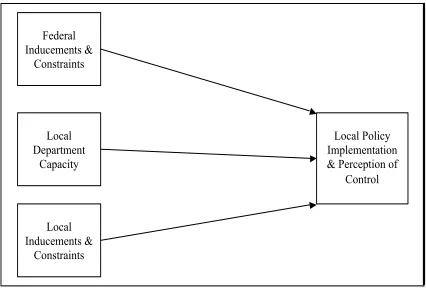
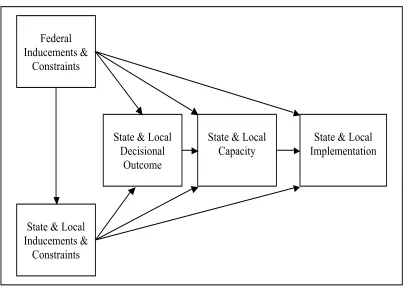
Figure 2-1 illustrates the communications model as developed by Goggin and his colleagues (1990).

Figure 2-1 The Communications Model of Intergovernmental Policy Implementation Source: Implementation Theory and Practice Toward a Third Generation, Goggin et al. 1990. Pg. 32

Borrowing from the “top-down” literature, Goggin and his colleagues indicated “better policy design” as a means to enhance control. The authors concluded that implementation can be spurred by local factors like a strong advocacy coalition and the policy actors’ consensus in regards to the importance of, and their role in, the policy’s central message. At the same time, “even the best of policies can go awry if there is resistance at the level of impact” (Goggin et al. 1990). State and local governments do have means to

Federal Inducements &

Constraints

State & Local Inducements &

Constraints

State & Local Decisional

Outcome

State & Local Capacity

(39)

! !

:;!

counteract federal policy demands, should they choose to face consequences for doing so. Beyond strong policy language, several possible actions at the federal level can support implementation, including financial coercion. Support or resistance, as well as financing, highlight the relationship between top down and bottom up theories of policy

implementation, thus leading contemporary policy researchers to combine both theories by simultaneously monitoring top-down and bottom-up impacts throughout the implementation process (Cline 2000).

In a recent adaptation, Cho and his colleagues (2005) applied themes from the Communications Model to welfare policy in North Carolina. The authors questioned local officials about how much they perceived to achieve while implementing (and with relation to) new welfare program objectives, citing professional (experience, expertise), institutional (empowerment of control), and contextual (external environment) factors as reasons for variance in results across jurisdictions of varying sizes. According to their results,

professional and institutional factors proved to be of the greatest importance in developing a local actors’ perception of effective federal policy implementation in this policy field. These factors provide greater flexibility to local actors, something that may supplement the policy’s message while continuing to account for the driving force of past experiences of those

directly involved when considering successful policy implementation. Coercive Federalism

(40)

! !

:H!

Wright 2004). As Conlan noted, “intergovernmental mandates and preemption offer the national government cheap policy tools for continued policy activism” (Conlan 1991, 44; Cho and Wright 2004). Contemporary coercive mandates from the federal level treat local governments as “regulatory agents.” Policies with coercive features contain detailed standards and rules for implementation, which the local governments administer with little-to-no discretion (May and Burby 1996).

Stoker’s “implementation regime framework” suggests that coercion is a main factor supporting the implementation of federal policy (Stoker 1991; Stone 1989). Stoker argues that coercion is a means to manipulate performance through consequences for

non-performance or rewards for cooperation (Stoker 1991). The consequences of non-compliance in contemporary emergency management policy follow Stoker’s definition and seem simple enough: the loss of the grant or support mechanism for any local action taken within the prescribed field.

But, Stoker admitted operational and opportunity costs related to coercion limit the applicability of his theory. Enforcing a penalty would directly inhibit the goals of the policy. Knowing this, local actors could be inclined to wait for a more cooperative policy or

relationship to develop rather than fully implement the federal policy prescription. Stoker claims that local autonomy works against the desires of federal policymakers by preventing the cooperation these policies both demand and need to flourish (Stoker 1991; Meyers et al. 1998).

(41)

! !

:N!

administrations centralized control at the federal level in several policy areas during this period. Posner (2007) suggested that, during the George W. Bush presidency specifically, “federalism issues were largely relegated to secondary consideration, often trumped by more compelling national issues and values (392).” He cited policies like No Child Left Behind, welfare reform re-authorization, the Help America Vote Act, and several tax policies as examples of coercive centralization efforts. These mandates used a variety of strategies designed to impose new requirements on state and local governments.

(42)

! !

:7!

government encouraged local governments to apply for several new federal grants designed to strengthen homeland security and emergency management systems. Conversely, in a more coercive way, local jurisdictions risked losing funds designated for mitigating and preparing for disasters if they did not comply with the federal government’s demand that they

implement of NIMS, the NRP and ICS by the end of fiscal year 2005. These at-risk grants covered materials, training, and other costs related to the implementation of the policies, as well as other local emergency management activities.

(43)

! !

LA!

leeway, and what effect non-compliance with terror-specific protocols will have upon other potentially necessary disaster related assistance or direction from the federal government, may be seen as confusing. While the increase of the federal government's involvement in disaster management in general cannot be disputed, the degree of preemption is partial at best, as the lines between homeland security and emergency management functions and responsibilities for specific levels of government remain blurry (Waugh 2007; Birkland and Waterman 2008; Lindsay 2008). Such confusion about the federal government’s involvement in and its policy demands for specific actions may spur local officials to report

implementation, but not fully address all necessary avenues involved with the new federal policy demands. Also, this raises questions about what kind of incentives would press local actors to comply with the new federal guidelines, particularly in the wake of the Katrina disaster, if it appeared that traditional CEM philosophies would better serve local demands during a disaster. If the NRP truly promoted a CEM all-hazards theme, it would not require all local emergency management operations to subscribe to one means to handle threats to a local community. Rather, it would allow individuals to make decisions regarding the time, money, and effort they spend addressing the specific threats that exist in the community, and what they mean for each stage of the hazards cycle. Placing greater emphasis on one

particular threat (such as terrorism), with little consideration of its perceived risk to the community, is deleterious to the limited flexibility these organizations have because of their relatively small budgets and meager personnel numbers.

(44)

! !

L6!

state government for equipment, but not for collaboration or for efforts to revamp established systems for emergency preparation and response. Thus, local actors who feel forced to use a system that dramatically alters their past practice may also feel alienated by the new policy’s coercive elements, particularly if these administrators question the legitimacy of the policy or the federal actors’ interjection into the field (Hill and Hupe 2003; May et al. 1996). These local actors may look for those particular portions of the policy that fits local needs and use them to claim compliance, even if they are not fully compliant with the federal policy (Hill and Hupe 2003; Lester and Goggin 1998; Hill 2003). Therefore, a policy’s coercive nature and its perceived necessity in its entire (or perhaps partial) format for the local jurisdiction can drive the local administrators’ decision concerning whether or not they should take part in what the policy has to offer.

Weissert’s study (2001) of primary care mandates suggested that a new policy’s implementation is not necessarily a direct result of legislative language, but that

(45)

! !

L:!

that the organizations may have had. This illustrates the importance of coercion in policy fields where the federal government seeks to alter the direction of local government behavior.

Comprehensive Emergency Management (CEM)

The use of CEM and its all-hazards philosophy has a long history of both theoretical development and practice in the emergency management field (National Governor’s

Association 1979; Drabek and Hoetmer 1991; McEntire et al. 2002; Haddow 2005; Waugh 2006; Hite 2003). CEM also demands that program management coordinate with activities (mutual aid, drills, etc.) so all elements of disaster management relate to each other and to the efforts of other public, private, and non-profit actors, creating a unified strategy to prepare for and respond to all disaster types (Drabek and Hoetmer 1991; McEntire et al. 2002). Therefore, CEM displays an inherent flexibility that accounts for a community’s vulnerability and the actors’ ability to handle situations as they arise.

While CEM and the all-hazards method has been called simplistic (Neal 1997), or ignorant of key social, political, and cultural variables that increase vulnerability when it tended to focus upon only those reactive elements within its bounds, CEM continued to serve as the basis for most public policy and developed theories on proper emergency management protocol before the September 11th attacks. Within the reform efforts by the federal

government, CEM remains supported in practice (McEntire et al. 2002).

(46)

! !

LL!

Given the heightened sensitivity, awareness, and demand for “homeland security” left in the wake of the September 11 attacks, the nation needed to change the way it prepared for a potential terrorist threat. A phenomenon that Kingdon (1995) described as an open “policy window” emerged after the terrorist attacks of September 11, 2001. During that time, new policies refocused federal emergency management prescriptions designed to prepare for, respond to, and mitigate events stemming primarily from terrorism but also, to a lesser degree, from natural or accidental elements. (Waugh 2007; Kapuçu 2009; Perry and Lindell 2007; Tierney 2005; Waugh 2006; McEntire 2004; Demchak 2002; Scavo et al. 2008; Hite 2006; Lieberman et al. 2007; Birkland 2009).

Local governments must, per the requirements of NIMS, consider “new” tasks designed to address terrorism within the traditional bureaucratic structure of preparing for and responding to disasters and catastrophes. Terrorism, while particularly frightful and historic, is just another variety of hazard for which government organizations seek to reduce negative consequences (Tierney 2006). With federal policy squarely focused on homeland security operations since the September 11 attacks, disaster management experts must ask why local governments play along with the dramatic shift in focus for their organizations, particularly when the need or methods are not clear. While there is an effective,

(47)

! !

L@!

Traditionally, counter-terrorism policies focus on using law enforcement to thwart terror plots before they occur. One main difference between counter-terrorism activity and disaster management is how disaster management organizations share information leading up to, preventing, or responding to possible terrorist attacks, specifically concerning with whom the federal policymakers expect local emergency management operations to remain in contact (such as the FBI, or military versus FEMA or other state organizations). The

consequences of natural/accidental disasters and terrorist incidents are not very different, and a jurisdiction can use similar tactics throughout the emergency management cycle when responding to these incidents (Birkland 2008). For instance, local actors must provide an immediate medical and material response to victims of a tragedy, be it natural, accidental or intentional. These local actors can create plans determining the basic direction of resources and communications with the public about the situation before/during/after any type of disastrous incident (Perry and Lindell 2003; Henstra 2010).

(48)

! !

LQ!

than a clearly run, centralized response that the new policies intend to provide. Such a reaction is not out of the ordinary in the federalist system, nor is it an uncommon

phenomenon in studies designed to monitor the success policy implementation in general. Stages of the Hazard Cycle

CEM practices fall within, though they are not exclusive to, four stages of the hazard cycle: mitigation, preparedness, response, and recovery (National Governor’s Association 1979; Haddow et al. 2008; Drabek and Hoetmer 1991; McEntire et al. 2002). Theorists have debated the definitions of each stage, their relative importance, and what role each level of government needs to undertake when implementing related policies (McEntire 2004; Waugh 2006; Comfort 2002; Mileti 1999; Wise and Nader 2003; Schneider 2005; Birkland 2009). While there is some degree of controversy about their definition and importance, these stages are the centerpiece of CEM methods in addressing hazards.

Most emergency management policy to date has been reactive, with greater local focus on the response and recovery stages (McEntire et al. 2002; Donahue and Joyce 2001). Not surprisingly, local government activities and effort seem strongest in the response and recovery phases, providing the clearest definition of control over policy formation and implementation. However, the response by all actors involved (federal, state, and local) to Katrina suggests that several shortcomings exist within the prevailing structure relating to disagreements about the control over policy, even in well-documented aspects of the process (Kweit and Kweit 2006; Neal and Webb 2007; Sobel and Leeson 2006).

(49)

! !

L;!

management and for assuming greater control over the CEM stages, particularly with regard to traditional emergency management activities versus homeland security functions. As the federal government focuses the majority of its actions on homeland security (terror-specific) related functions, which may not align with CEM stages and standard practices, local

governments may have more reason to resurrect local experiences and methods to handle all types of disasters and address the demands of each stage during the hazard cycle as it relates to threats to their jurisdiction.

For the present study, activities at the local level pertaining to homeland security are defined within four specific stages whose definitions are available in Appendix A:

(50)

! !

LH!

Variables of Interest in the Adapted Communications Model

The following section discusses the link between Goggin and his colleagues’ (1990) model of implementation, comprehensive emergency management, and coercive federalism. Post-September 11 disaster management policy has failed to repeat the level of success in promoting local policy implementation of federal policy demands because, instead of building on local strengths, the federal government has almost exclusively limited its response to the attention given to potential risks and hazards related to the September 11 attacks. Arguably, this occurred for no other reason than political gain, requiring local governments to follow suit with little account for their opinions, accomplishments, or

demands in the field of emergency management (Waugh 2006; Posner 2007). In many ways, this is the opposite of what occurred in the last ten years with welfare policy (Cho et al. 2005).

This inconsistency between the layers of government concerning policy expectations creates room for local managers to rely on their own background or expertise in the field, rather than fully implement the new federal mandates if local actors feel that these mandates do not address the needs of their particular jurisdiction. These local managers may also find ways to use certain aspects of the policy without accepting it in its entirety. While arguably still working towards the federal goal of having a nationwide system for disaster

(51)

! !

LN!

the federal policy demands. Additionally, to ensure all actors have the same goals and operational missions in mind when handling a disaster, my study considers the federal government's application of potentially coercive measures, such as eliminating available funding with little account or need for local expertise, to encourage local managers to implement their new policy. This portion of the chapter outlines the variables used to test these assertions within an adapted communications model of my own design.

Additionally, if local emergency managers do not think that the federal policy demands from NIMS, ICS, or the NRP favor traditional CEM approaches designed to address all portions of the hazard cycle, or at the very least consider incidents that are most likely to occur in their jurisdiction (rather than placing their focus disproportionately on terrorism), then it is possible that little has changed about local emergency management since the September 11 attacks. It is unknown if the federal government’s attempts at centralizing the system of emergency management are fostering a divide within the system through local governments’ nominal compliance with federal policy. If local managers see homeland security and emergency management as separate operations, they may feel that their traditional functions are being compromised at the expense of preventing terrorism, something that local operations have little or no need to spend resources on.

(52)

! !

L7!

precisely the same way or to the same degree in all cases. Several quantitative studies have queried local emergency managers about the federal policies implemented since September 11, the expansion of federal control over the emergency management process, or the inclusion of homeland security activities in local responsibilities (Baldassare and Hoene 2002; Jain 2006; Caurson and MacManus 2006; Institute for the Economy and Future 2006; Reddick 2008; Kapuçu and Van Wart 2006; Dawes et al. 2004; Brown 2005; Kincaid and Cole 2002). These studies showed that local emergency managers understood the importance of preparing for and fighting against terrorism, but expressed a notable difference in how to handle such responsibilities from the methods required by the federal mandates.

Why some jurisdictions have fully implemented the federal policy demands whereas others have not remains unclear, particularly as others continue to stall, even as the eleven-year mark following the September 11 attacks approaches. As reported by Neal and Webb (2007), following Katrina, local managers in Louisiana perceived that they had an

(53)

! !

@A!

Centralization of Policy Command and Perception of Control

Even if local emergency managers report that they have implemented federal policy demands, as Scavo and his colleagues (2008) have suggested, they may not fully understand the influence these demands have on local governments' control of different stages and tasks in emergency management and homeland security. Understanding that a disparity exists in perceived control over the different aspects of the emergency management and homeland security processes is important to this research. The lack of direction and focus over emergency management responsibilities at the federal level has led local governments to dedicate efforts toward natural or accidental disaster preparation. Part of the present study is to report whether a change in perceived control over actions taken within the field occurred as a result of the policy changes, and whether federal grant funding is a key driving factor behind the perception of control. My study also evaluates several scholars’ claims regarding the ultimate benefits or drawbacks of centralizing the control of the emergency management process

Those who support a stronger system housed in DHS cite its ability to forge

relationships, communication, and policy direction, which is the ideal scenario that the new policies promote (Wise 2002; Newmann 2002; Donley and Pollard 2002). Opponents claim that, to forge these new relationships, the DHS must be clear in its definitions and the roles for each level of government within the new emergency management process (Wise and Nader 2002).

(54)

! !

@6!

before or after a disaster occurs. Caurson and Macmanus (2006) suggested that Florida has shown stronger coordination in its relief efforts since the September 11 attacks, primarily because of centralization under the DHS. However, Florida has long been thought of as an innovator of emergency management due to the local government's experience with hurricanes and their progressive policy responses (May et al. 1996; Birkland 2006). My national-scale study exams whether centralization efforts at the federal level are being pursued locally and what the motivating factors are behind local actors cooperating with or deviating from federal priorities. The perceived centralization of control at the federal level throughout the hazard cycle and for homeland security operations suggest that some amount of coercion exists through the selective receipt of grant funding based on whether or not local governments have implemented federal policy.

(55)

! !

@:!

(56)

! !

@L!

Not understanding the language of new federal policy demands could work against the federal governments' efforts towards centralization. With the language of the new federal policy, local actors could perceive certain tasks within the federal government’s scope of control, while other, perhaps more traditional, functions in emergency management remain under local control. Local emergency management actors may feel pressure from federal policy demands to dedicate additional resources to these activities, particularly if terrorism is not a concern in that jurisdiction. However, coercion is a powerful tool used in this and many other policy fields by the federal actors, and my study suggests that the ability to maintain the receipt of grants locally supersedes other potential inputs into a local department’s decision to implement the new federal policy demands.

As a result of the local use of emergency management “tools” along with confusion as to whom among those at the local level are responsible for implementing federal policy, the varying levels of implementation suggest that there will be similar disparities regarding perception of control throughout the emergency management process. Both perception of control and active implementation concern stages of the hazard cycle – mitigation,

preparedness, response, and recovery— and the management of homeland security related functions; preparation, prevention, protection, and recovery. These variations may lead to a greater wedge between federal and local actors in emergency management operations in relation to desired federal policy outcomes.

(57)

non-! !

@@!

compliance, and the clarity of the message (Goggin et al. 1990). The following section considers which federal-level inducements relate directly to the field of disaster management. Researchers must look at the factors relating to the specific requirements of the disaster management policies local actors' are expected to implement, like the potentially subjective interpretation based on the clarity of the policy’s language or the potential that local

organizations might lose funding if they do not comply to the new mandates. For my study, ICS, NIMS, and NRP requirements and the penalties, namely the loss of grant funding, represent the objective measure of federal level inducements and constraints as independent variables. The reported vagueness or clarity of the respective policies, as expressed by those responsible for its implementation, represents the subjective measure of inducements and constraints. If those individuals implementing the policy do not understand the need for or basic point of the policy with respect to local needs, why would they choose to implement it, unless some additional factor forces them to do so? Coercion, or the loss of grant funding, is a point of interest in my study that I use to examine if local emergency managers are

(58)

! !

@Q!

manipulate compliance and do so successfully as long as they receive the specific attributes of the policy that benefit local interests. Local actors may also simply be waiting for

something clearer or another shift in policy or leadership to come about from above. Local Department Practices: CEM “Tools” Independent Variables

State and local inducements focus on the local organization, specifically how the characteristics of the organizations at these levels determine implementation (Goggin et al. 1990). My study considers how the use of training, drills, and collaborative efforts before and after the September 11 attacks function as measures of state and local inducements. These features can promote or dissuade organizations from implementing policies, as well as promote local initiatives and can be attributed to the basic fundamentals of CEM and its all-hazards philosophy, which promotes local control of emergency management based on the perceived risks within the community. The timing aspect is critical to this measure, as those who have been using such methods for an extended period (before the attacks of September 11) are believed to be more likely to perceive and maintain a local level of control over emergency management policy. If “tools” were not used until after the attacks, it is likely that their use was provoked by federal policy constraints requiring inclusion in day-to-day local emergency management operations, and as such, promoting the implementation of federal policy demands.

To better prepare for and respond to incidents of all types, local emergency

(59)

! !

@;!

provide local actors with opportunities to develop a greater understanding of policies related to homeland security and emergency management, as well as how to better prepare for those disastrous incidents that their jurisdiction may experience. Each of these functions has the potential to strengthen local operations to reduce the effects of potential disasters during each stage of the hazard cycle.

NIMS, ICS, and the NRP all contain some requirement for using these “tools” within all levels of government. Multi-jurisdictional support and responsibility is crucial for ICS support, as it was designed to avoid any power struggles or command overlap between various actors who prepare for and respond to an incident (Haddow et al. 2008; Cole 2000; Buck et al. 2008). Undergoing training or exercise programs where agencies share

responsibilities with each other under a unified ICS command structure can help promote efficient service delivery. NIMS expands ICS philosophies to the national level, which creates a standardized system for planning, response, and recovery. Some training for the new procedures became available from federal sources to promote its model for emergency management protocols. These opportunities for training, mutual aid development, and the NRP promoted exercises to educate those in critical state and local positions about FEMA and DHS’s methods and encourage their implementation. The NRP expanded these exercises when preparing for and responding to an incident (Haddow et al. 2008). These methods may or may not promote CEM strategies existing before the September 11 attacks, and while federal training and education are important, along with outlets for mutual aid, it is

Figure

Figure 2-1 The Communications Model of Intergovernmental Policy ImplementationSource: Implementation Theory and Practice Toward a Third Generation, Goggin et al
Figure 2-2 The Adapted Model of Intergovernmental Policy Implementation
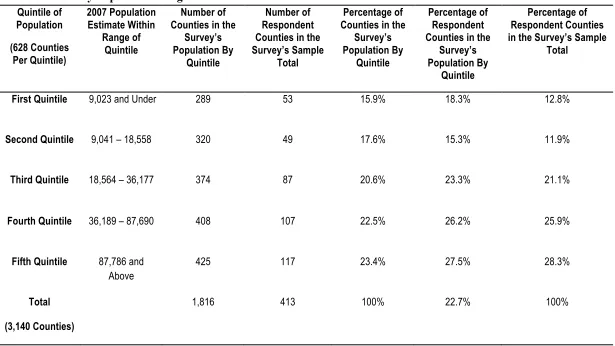
Table 3-1 County Population Ranges
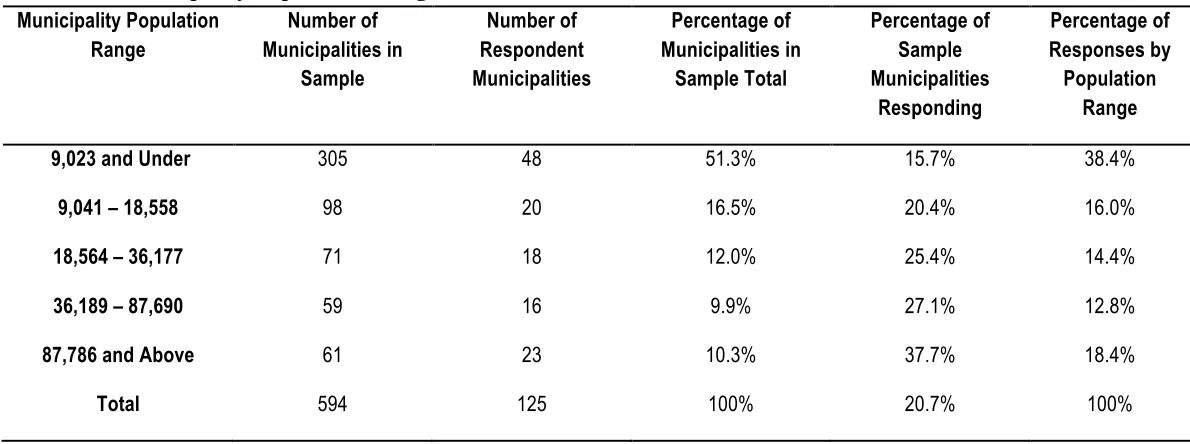
Table 3-2 Municipality Population Ranges
+7

References

Related documents

• The Security Maturity level in control systems is insufficient • Culture shock for both security- and power communities1. • Money is

offices in a National Cadastral Data Base, with literal informat ion and ion and cadastral vectorial maps for all the Spanish Territory. cadastral vectorial maps for all the

social science disciplines defined by the nation-state – history, sociology, political sci- ence – have literatures addressing various processes and effects of the war on

Personal Direct General Lumbar Puncture Personal N/A Direct X General Myelogram Personal Direct General Thoracentesis Personal N/A Direct N/A General Paracentesis

combine SIMPACK Code Export with wide spreaded application tool: Excel Plug-In.. Further Developments of SIMPACK

( www.ipm.studium.fau.de/dateien/personal-information-sheet.docx ) completed in English; work sample in English (2 A4 pages) on set topic (see website); proof of English

— Abraham Lincoln.. Before time began, there was an infinite force of Energy. This force reached as far as forever. It filled eternity. It expanded into infinity. There were no

harvest in growth medium of rocket baby leaves (A, B, C) and Swiss chard baby leaves (D, E, F) for different 639. organic