TDU 120e
User Manual
Part Numbers
1202156L1
1202155L1
Windows is a registered trademark of Microsoft Corp. T-Watch is a trademark of ADTRAN, Inc.
OpenViewR
901 Explorer Boulevard P.O. Box 140000 Huntsville, AL 35814-4000
Phone: (256) 963-8000
© 2001 ADTRAN, Inc. All rights reserved.
The following conventions are used in this manual.
Important Safety Instructions
When using your telephone equipment, please follow these basic safety precau-tions to reduce the risk of fire, electrical shock, or personal injury:
1. Do not use this product near water, such as near a bathtub, wash bowl, kitchen sink, laundry tub, in a wet basement, or near a swimming pool. 2. Avoid using a telephone (other than a cordless-type) during an electrical
storm. There is a remote risk of shock from lightning.
3. Do not use the telephone to report a gas leak in the vicinity of the leak. 4. Use only the power cord, power supply, and/or batteries indicated in the
manual. Do not dispose of batteries in a fire. They may explode. Check with local codes for special disposal instructions.
Save These Important Safety Instructions
Notes provide additional useful information.
Cautions signify information that could prevent service interruption.
er in this manual.
1. This equipment complies with Part 68 of the FCC rules. The required label is attached to the bottom of the chassis.
2. An FCC compliant telephone cord and modular plug is provided with this equipment. This equipment is designed to be connected to the telephone net-work or premises wiring using a compatible modular jack which is Part 68 compliant. See installation instructions for details.
3. If your TDU 120e causes harm to the telephone network, the Telephone Com-pany may discontinue your service temporarily. If possible, they will notify you in advance. If advance notice is not practical, you will be notified as soon as possible. You will be advised of your right to file a complaint with the FCC. 4. Your telephone company may make changes in its facilities, equipment,
oper-ations, or procedures that could affect the proper operation of your equip-ment. If they do, you will be given advance notice so as to give you an opportunity to maintain uninterrupted service.
5. If you experience trouble with the equipment TDU 120e, please contact ADT-RAN at (256) 963-8000 for repair/warranty information. The telephone com-pany may ask you to disconnect this equipment from the network until the problem has been corrected, or until you are sure the equipment is not mal-functioning.
6. This unit contains no user serviceable parts.
7. The following information may be required when applying to your local tele-phone company for leased line facilities.
8. The FCC recommends that the AC outlet to which equipment requiring AC power is to be installed is provided with an AC surge arrester.
Service Type REN/SOC FIC USOC
1.544 Mbps -SF 6.0N 04DU9-BN RJ-48C
1.544 Mbps - SF and B8ZS 6.0N 04DU9-DN RJ-48C
1.544 Mbps - ESF 6.0N 04DU9-1KN RJ-48C
Affidavit Requirements for Connection to Digital Services
• An affidavit is required to be given to the telephone company whenever digital terminal equipment without encoded analog content and billing pro-tection is used to transmit digital signals containing encoded analog content which are intended for eventual conversion into voice band analog signal and transmitted on the network.
• The affidavit shall affirm that either no encoded analog content or billing information is being transmitted or that the output of the device meets Part 68 encoded analog content or billing protection specification.
• End use/customer will be responsible to file an affidavit with the local exchange carrier when connecting unprotected CPE to a 1.544 Mbps or sub-rate digital service.
and/or Subrate Digital Services
For the work to be performed in the certified territory of ______________ (telco name)
State of ________________________________
County of ______________________________
I, _______________________ (name), ____________________ (business address), _____________________ (telephone number) being duly sworn, state:
I have the responsibility for the operation and maintenance of the terminal equip-ment to be connected to 1.544 Mbps and/or __________________ subrate digital services. The terminal equipment to be connected complies with Part 68 of the FCC rules except for the encoded analog content and billing protection specifica-tion. With respect to encoded analog content and billing protection:
( ) I attest that all operations associated with the establishment, maintenance and adjustment of the digital CPE with respect to encoded analog content and billing protection information continuously complies with Part 68 of the FCC rules and Regulations.
( ) The digital CPE does not transmit digital signals containing encoded analog content or billing information which is intended to be decoded within the tele-communications network.
( ) The encoded analog content and billing protection is factory set and is not under the control of the customer.
I attest that the operator(s) maintainer(s) of the digital CPE responsible for the establishment, maintenance and adjustment of the encoded analog content and billing information has (have) been trained to perform these functions by success-fully having completed one of the following (check appropriate blocks):
( ) A. A training course provided by the manufacturer/grantee of the equipment used to encode analog signals; or
recognized by the manufacturer/grantee of the equipment used to encode ana-log signals; or
( ) D. In lieu of the proceeding training requirements, the operator(s)/main-tainer(S) is (are) under the control of a supervisor trained in accordance with _______________ (circle one) above.
I agree to provide ____________________ (telco’s name) with proper documen-tation to demonstrate compliance with the information in the preceding para-graph, if so requested.
_____________________ Signature
_____________________ Title
_____________________ Date
Subscribed and sworn to before me
This _________ day of ___________________, 20__
_______________________________________ Notary Public
Interference Statement
This equipment has been tested and found to comply with the limits for a Class A digital device, pursuant to Part 15 of the FCC Rules. These limits are designed to provide reasonable protection against harmful interference when the equipment is operated in a commercial environment. This equipment generates, uses, and can radiate radio frequency energy and, if not installed and used in accordance with the instruction manual, may cause harmful interference to radio frequencies. Operation of this equipment in a residential area is likely to cause harmful inter-ference in which case the user will be required to correct the interinter-ference at his own expense.
Shielded cables must be used with this unit to ensure compliance with Class A FCC limits.
Canadian Emissions Requirements
This digital apparatus does not exceed the Class A limits for radio noise emissions from digital apparatus as set out in the interference-causing equipment standard entitled “Digital Apparatus," ICES-003 of the Department of Communications.
Cet appareil nuerique respecte les limites de bruits radioelectriques applicables aux appareils numeriques de Class A prescrites dans la norme sur le materiel brouilleur: "Appareils Numeriques," NMB-003 edictee par le ministre des Com-munications.
Canadian Equipment Limitations
Notice: The Canadian Industry and Science Canada label identifies certified equipment. This certification means that the equipment meets certain telecom-munications network protective, operational, and safety requirements. The Department does not guarantee the equipment will operate to the user’s satis-faction.
Before installing this equipment, users should ensure that it is permissible to be connected to the facilities of the local telecommunications company. The equip-ment must also be installed using an acceptable methods of connection. In some cases, the company’s inside wiring associated with a single line individual ser-vice may be extended by means of a certified connector assembly (telephone extension cord). The customer should be aware that compliance with the above limitations may not prevent degradation of service in some situations.
Repairs to certified equipment should be made by an authorized Canadian maintenance facility designated by the supplier. Any repairs or alterations made by the user to this equipment, or equipment malfunctions, may give the tele-communications company cause to request the user to disconnect the equip-ment.
Users should ensure for their own protection that the electrical ground connec-tions of the power utility, telephone lines and internal metallic water pipe sys-tem, if present, are connected together. This precaution may be particularly important in rural areas.
The Load Number (LN) assigned to each terminal device denotes the percent-age of the total load to be connected to a telephone loop which is used by the device, to prevent overloading. The termination on a loop may consist of any combination of devices subject only to the requirement that the total of the Load Numbers of all devices does not exceed 100.
ADTRAN warrants that for five (5) years from the date of shipment to Customer, all products manufactured by ADTRAN will be free from defects in materials and workmanship. ADTRAN also warrants that products will conform to the applica-ble specifications and drawings for such products, as contained in the Product Manual or in ADTRAN's internal specifications and drawings for such products (which may or may not be reflected in the Product Manual). This warranty only applies if Customer gives ADTRAN written notice of defects during the warranty period. Upon such notice, ADTRAN will, at its option, either repair or replace the defective item. If ADTRAN is unable, in a reasonable time, to repair or replace any equipment to a condition as warranted, Customer is entitled to a full refund of the purchase price upon return of the equipment to ADTRAN. This warranty applies only to the original purchaser and is not transferable without ADTRAN's express written permission. This warranty becomes null and void if Customer modifies or alters the equipment in any way, other than as specifically authorized by ADTRAN.
EXCEPT FOR THE LIMITED WARRANTY DESCRIBED ABOVE, THE FOREGO-ING CONSTITUTES THE SOLE AND EXCLUSIVE REMEDY OF THE CUS-TOMER AND THE EXCLUSIVE LIABILITY OF ADTRAN AND IS IN LIEU OF ANY AND ALL OTHER WARRANTIES (EXPRESSED OR IMPLIED). ADTRAN SPECIFICALLY DISCLAIMS ALL OTHER WARRANTIES, INCLUDING (WITH-OUT LIMITATION), ALL WARRANTIES OF MERCHANTABILITY AND FIT-NESS FOR A PARTICULAR PURPOSE. SOME STATES DO NOT ALLOW THE EXCLUSION OF IMPLIED WARRANTIES, SO THIS EXCLUSION MAY NOT APPLY TO CUSTOMER.
Customer Service, Product Support Information, and Training
ADTRAN will replace or repair this product within five years from the date of shipment if the product does not meet its published specification, or if it fails while in service.
A return material authorization (RMA) is required prior to returning equipment to ADTRAN. For service, RMA requests, training, or more information, see the toll-free contact numbers given below.
Presales Inquiries and Applications Support
Please contact your local distributor, ADTRAN Applications Engineering, or ADTRAN Sales:
Post-Sale Support
Please contact your local distributor first. If your local distributor cannot help, please contact ADTRAN Technical Support and have the unit serial number available.
The Custom Extended Services (ACES) program offers multiple types and levels of service plans which allow you to choose the kind of assistance you need. For questions, call the ACES Help Desk.
Applications Engineering (800) 615-1176
Sales (800) 827-0807
Technical Support (888) 4ADTRAN
If ADTRAN Technical Support determines that a repair is needed, Technical Sup-port will coordinate with the Custom and Product Service (CAPS) department to issue an RMA number. For information regarding equipment currently in house or possible fees associated with repair, contact CAPS directly at the following number:
Identify the RMA number clearly on the package (below address), and return to the following address:
ADTRAN Customer and Product Service 901 Explorer Blvd.
Huntsville, Alabama 35806
RMA # _____________
Training
The Enterprise Network (EN) Technical Training offers training on our most popu-lar products. These courses include overviews on product features and functions while covering applications of ADTRAN's product lines. ADTRAN provides a vari-ety of training options, including customized training and courses taught at our fa-cilities or at your site. For more information about training, please contact your Territory Manager or the Enterprise Training Coordinator.
CAPS Department (256) 963-8722
Training - phone (800) 615-1176, ext. 7500 Training - fax (256) 963 7941
Table of Contents
List of Figures ... xxi
List of Tables ...xxiii
Chapter 1. Introduction ... 1-1
TDU120e Overview ... 1-1 Standard Features in the TDU 120e... 1-2 TDU Option Modules... 1-3 Option Module Architecture ... 1-4 TDU 120e Configuration Applications ... 1-5 Router, PBX, Video Conferencing Application... 1-5
Chapter 2. Installation ... 2-1
Unit Level Tests ... 2-7 Board-to-Board Interface Test ... 2-7 Initialization ... 2-8 Set User Passcode ... 2-8 Set Unit Identification ... 2-8 Set Control Port ... 2-8 Chain In (PC) ... 2-8 Chain In/Chain Out ... 2-9 Normal Power-Up Procedure... 2-10
Chapter 3. Operation... 3-1
Chapter 4. Status Menu ... 4-1
Network Performance Reports... 4-2 Network Interface Errors ... 4-3 Active Alarms ... 4-3 View History ... 4-4 Port Status ... 4-4 Nx/DBU (0.1) Menu Items ... 4-4 DTE Data/Clock ... 4-4 DTE Status ... 4-5 DTE Port Rate ... 4-5 DBU Data/CNTRL ... 4-5 DBU Control ... 4-5 DBU Status ... 4-5 DS-1 (0.2) Menu Items (DS-1 Errors) ... 4-6 Remote Port... 4-6 Clear Port Alarm ... 4-6 Ethernet Status... 4-7
Chapter 5. Configuration Menu ... 5-1
Pattern Verify ... 5-18 Backup Delay ... 5-18 Restore Delay ... 5-19 Retry Delay ... 5-19 Num Retries ... 5-19 Backup Testing ... 5-19 WKEND Lockout ... 5-19 DS-1 (0.2) Menu Items ... 5-20 Format ... 5-20 Code ... 5-20 Yellow Alarm ... 5-20 Line Length (ft) ... 5-20 Inband Loopback (INBANK LPBACK) ... 5-21 Robbed Bit Signaling ... 5-21 RBS Start ... 5-21 RBS End ... 5-21
Chapter 6. Utility Menu ... 6-1
Time/Date ... 6-2 Factory Restore ... 6-2 Set Passcode ... 6-3 Change/Set a Passcode ... 6-3 Lost Passcode ... 6-3 No Passcode Desired ... 6-3 Unit ID ... 6-3 To Set the Unit Identification ... 6-4 No Unit ID Desired ... 6-4 Software Revision... 6-4 Port Utility... 6-4 Ethernet Address... 6-4
Chapter 7. Test Menu... 7-1
ATT In-Band LLB ... 7-4 ANSI FDL PLB ... 7-4 ANSI FDL LLB ... 7-4 ANSI FT1 LLB ... 7-4 No Loopback ... 7-4 Test Pattern ... 7-4 All Ones ... 7-4 All Zeros ... 7-4 QRSS Pattern ... 7-5 Pattern Result ... 7-6 ES ... 7-6 BES ... 7-6 SES ... 7-6 *SYNC ... 7-6 Run Self-Test ... 7-7 Port Tests ... 7-8 Port Test Menu Items Nx/DBU (0.1) ... 7-9 DTE LOOPBACK ... 7-9 PORT/LOCAL ... 7-9 REMOTE ... 7-9 OFF ... 7-9 REM V.54 Cont. ... 7-9 511 PATTRN ... 7-10 511 RESULTS ... 7-10 DBU LOOPBACK ... 7-10 DBU TEST ... 7-10 DBU DATA/CNTRL ... 7-11 DBU TST RESULT ... 7-11 DS-1 (0-2) Option Ports ... 7-11 Loopback ... 7-11 Cancel Tests... 7-11
Chapter 8. Remote/Management Menus... 8-1
Host 4 Trap IP Address ... 8-5 System Name ... 8-5 System Contact ... 8-5 System Location ... 8-5 Auth. Fail Traps Sent ... 8-5 Poll Link Status Traps Sent ... 8-5 Ping IP Host ... 8-5 Telnet/Terminal Timeout ... 8-6 Telnet/Terminal Password ... 8-6 Exit ... 8-6 Flash Download... 8-6 XMODEM ... 8-6 Trivial File Transfer Protocol (TFTP) ... 8-6 TFTP Server IP Address: 0.0.0.0. ... 8-6 TFTP Server File name: T120e.biz ... 8-7 Begin Firmware update. ... 8-7 Quit Session... 8-7
Appendix A. SNMP ... A-1
Appendix B. Connector Pinouts ... B-1
Appendix C. System Messages... C-1
Appendix D. Specifications... D-1
List of Figures
List of Tables
Chapter 1
Introduction
TDU120e OVERVIEW
The TDU 120e is a T1/FT1 multiplexer with the following features:
• Nx56/64 V.35 data port • DS-1 (PBX) interface • option slot
• embedded SNMP management
The TDU 120e’s option slot accepts one of many available option modules for voice and data applications.
The TDU 120e serves as the link between user data sources such as:
• local area network (LAN) bridges and routers
• computers
• CAD systems
• teleconferencing equipment
• PBXs.
Through the use of multiple data ports, the TDU 120e can simultaneously connect one or more of these devices to a T1 circuit. The amount of bandwidth allocated to each port is custom-programmable. You can manually allocate
The TDU 120e offers a wide variety of network management options. You can manage via SNMP through the 10BaseT or chain-in ports. If you are using T-Watch Pro, a Microsoft Windows® program, you can manage the TDU 120e via the same 10BaseT or chain-in ports. An enhanced VT-100 terminal interface is also provided.
Standard Features in the TDU 120e
The following list describes the standard features the enhanced TDU 120e.
• A single T1 interface.
• A Nx/DBU V.35 port and DS-1 (PBX) interface.
• An inband communication channel requiring only 8k of bandwidth from a single DS0.
• One option slot to house option modules with up to four additional ports, including voice and data.
• Allows mix of port types to meet the data interface requirements.
• Easy configuration capabilities using simplistic menus displayed on a terminal or computer connected to the control port or the Craft Jack on front of the unit. • Two programmable configuration maps that define the
bandwidth allocation between data ports.
• Data drop and insert, as well as full drop and insert. • Flash memory for software updates.
• Timing is selectable from the network, from the Nx56/64 or DS-1 ports, internally, or from a secondary interface. • QRSS; 511 test patterns using Nx option.
• Extensive self-testing and monitoring provides assurance of proper operation.
• SNMP, Telnet, and T-Watch Pro management via SLIP or 10-BaseT
• Fractional T1 loopbacks as defined in annex B of ANSI T1.403-1995
• Software configurable long-haul or short-haul DS-1 port • External alarm connector
TDU Option Modules
Table 1-1 shows a list of option modules and their descriptions for the TDU 120e.
Table 1-1. TDU 120e Option Modules
Module Description
DSX-1 Short haul T1 interface for operation with a PBX (Terminal Interface)
Full Drop and Insert
Permits the dropping of data and insertion of new data into the same DS0 time slot
This module includes a long haul DS-1 interface. It can also be used as a second DS1 interface to provide an up to 3 MB aggregate throughput
Nx56/64 serial interface
Provides a V.35 serial interface in either single or dual ver-sions
Voice interface 2/4 channel FXS/FX0/E&M
OCU DP Interfaces to DDS or 4-wire Switched 56, dual or single versions
Option Module Architecture
The TDU 120e features a unique architecture that allows the addition of one option module and plug-on board providing an opportunity for growth to accommodate another
application. See Figure 1-1.
Figure 1-1. TDU 120e Option Modules
DSX-1 Module Plug on V.35 Plug on OCU DP Plug on Dual Voice OCU-DP Module V.35 Module D&I Module DUAL Voice ACO REMOTE ACCESSCRAFT TDU 120eAC NETWORK MON
IN OUTIN OUTIN OUTIN OUT PORT 0.2 MON
IN OUTIN OUT PORT 1.1 MON TESTOKYELRED ALARMERROR NETWORK STATUS TESTOK ALARM PORT STATUS 0.10.21.11.21.31.4
TDU 120e CONFIGURATION APPLICATIONS
The following examples illustrate possible configurations of TDU 120e applications.
Router, PBX, Video Conferencing Application
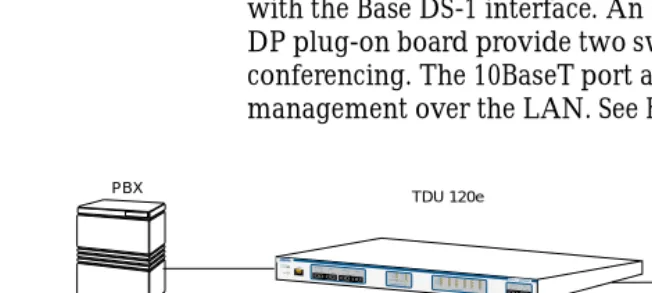
In this application, the Base Nx/DBU provides a V.35 interface to a router. The PBX is interfaced to the TDU 120e with the Base DS-1 interface. An OCU DP module and OCU DP plug-on board provide two switched 56 circuits for video conferencing. The 10BaseT port allows SNMP network management over the LAN. See Figure 1-2.
Figure 1-2. Bridge, PBX, Video Conferencing Application Set Up
TDU 120e PBX
VIDEO CONFERENCING
ROUTER
10 BaseT LAN
SNMP NETWORK MANAGEMENT WORKSTATION
ACO REMOTE ACCESS CRAFT
TDU 120eAC NETWORK MON
IN OUTIN OUTIN OUTIN OUT PORT 0.2 MON
IN OUTIN OUT PORT 1.1 MON TEST
OK YEL RED ALARMERROR NETWORK STATUS TEST
Chapter 2
Installation
UNPACK, INSPECT, POWER UP
Receipt Inspection
Carefully inspect the TDU 120e for any shipping damages. If you suspect damage, file a claim immediately with the carrier and then contact ADTRAN Customer Service (see the front section of this manual for contact information). If possible, keep the original shipping container for use in shipping the TDU 120e back for repair or for verification of damage during shipment.
ADTRAN Shipments Include
The following items are included in the ADTRAN shipment:
• The TDU 120e
• 2-line interface cables: A 15-foot, position modular to 8-position modular
• A DB-25 to modular adapter
• A 6-foot, 8-position modular cable for connection to the chain-in port
• The User Manual
Customer Provides
• Cables for any expansion modules to be used with the TDU 120e
Power Connection
AC powered units: Each TDU 120e AC is equipped with a
captive eight-foot power cord, terminated by a three-prong plug which connects to a grounded power receptacle.
DC powered units: Each TDU 120e DC unit is provided with
a two-pin power receptacle and mating plug. Power to the TDU 120e DC is + 48 VDC or +24 VDC.
GROUNDING INSTRUCTIONS
Grounding instructions from the Underwriters' Laboratory UL
1950 3rd Edition are provided in this section.
An equipment grounding conductor that is not smaller in size than the ungrounded branch-circuit supply conductors is to be installed as part of the circuit that supplies the product or system.
• Bare, covered, or insulated grounding conductors are acceptable.
• Individually covered or insulated equipment grounding conductors shall have a continuous outer finish that is either green, or green with one or more yellow stripes. • The equipment grounding conductor is to be connected
to ground at the service equipment.
• The attachment-plug receptacles in the vicinity of the product or system are all to be of a grounding type. • The equipment grounding conductors serving these
• A supplementary equipment grounding conductor shall be installed between the product or system and ground that is in addition to the equipment grounding conductor in the power supply cord.
• The supplementary equipment grounding conductor shall not be smaller in size than the ungrounded branch-circuit supply conductors.
• The supplementary equipment grounding conductor shall be connected to the product at the terminal provided.
• It shall be connected to ground in a manner that will retain the ground connection when the product is unplugged from the receptacle.
• The connection to ground of the supplementary
equipment grounding conductor shall be in compliance with the rules for terminating bonding jumpers at Part K or Article 250 of the National Electrical Code, ANSI/ NFPA 70.
• Termination of the supplementary equipment grounding conductor is permitted to be made to building steel, to a metal electrical raceway system, or to any grounded item that is permanently and reliably connected to the electrical service equipment ground.
• The supplemental grounding conductor shall be connected to he equipment using a number 8 ring terminal.
• The terminal should be fastened to the grounding lug provided on the rear panel of the equipment.
• The ring terminal should be installed using the appropriate crimping tool (AMP P/N 59250 T-EAD Crimping Tool or equivalent).
Do not use this product near water, such as in a wet base-ment.
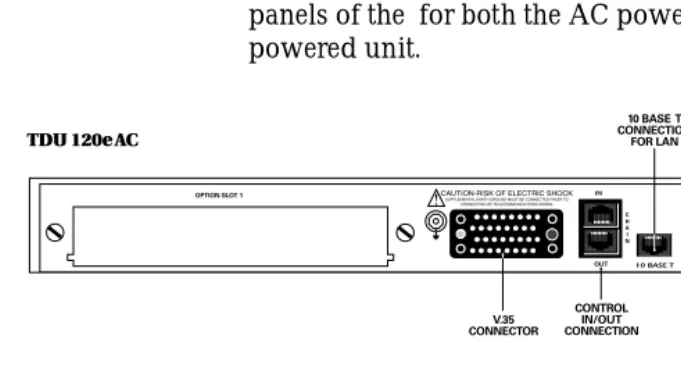
REAR PANEL LAYOUT
Figure 2-1 shows the configuration of the TDU 120e rear panels of the for both the AC powered unit and the DC powered unit.
TDU 120e Interfaces
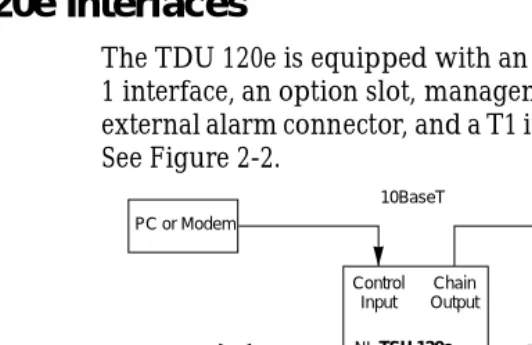
The TDU 120e is equipped with an Nx/DBU data port, a DS-1 interface, an option slot, management interfaces, an external alarm connector, and a T1 interface, in the rear panel. See Figure 2-2.
Figure 2-2. TDU 120e Interfaces
Network Interface
The Network Interface (NI) port provides the connection to the T1. This port complies with the applicable ANSI and AT&T standards. For more information, see Wiring on page B-1.
Nx56/64 Serial Interface
The Nx56/64 provides a serial V.35 port that operates from 56kbps to 1.536Mbps. This port provides 511 pattern generation and detection and remote loopback capability.
DS-1 (PBX) Interface
The DS-1 Interface provides a T1 for a PBX or other equipment. This port complies with ANSI T1.102. It can be software configured for either long-haul or short-haul.
Control Port Input
The control port input provides an EIA-232 input from a PC or a modem for control of the TDU 120e. You can also use it
TSU 120e
PC or Modem
Network
Control Input
Chain Output
NI TSU 120e
Chain Input Chain Output NI Option Option DS-1 Nx56/64 Nx56/64 DS-1
PBX V.35 DS-1 V.35
as a chain input from another TDU 120e or TSU 100. For more information, see Wiring on page B-1.
Craft Port
The craft port provides the same functionality as the Control Port Input. Both the craft port and the control port input may be connected simultaneously, but only one port may be active at a time. For more information, see Wiring on page B-1.
Chain Port Output
The chain port output provides an EIA-232 output to chain control to other TDUs or to TSUs. For more information, see
Wiring on page B-1.
10BaseT Interface
The 10BaseT interface provides the LAN interface for managing the TDU 120e with SNMP or T-Watch Pro. For more information, see Wiring on page B-1.
External Alarm Connector
POWER UP TESTING
When shipped from the factory, the TDU 120e is set to factory default conditions. At the first application of power, the unit automatically executes a memory self-test. A full self-test can be run from the terminal. A passcode and unit ID may be set using the UTIL menu.
Self-Test
The full self-test procedure (invoked from the terminal or T-Watch PRO) consists of the following tests:
Board Level Tests
The TDU 120e contains an on-board processor which exe-cutes a series of tests checking the circuitry on the board.
RAM and EPROM Tests
Verify on-board circuitry
Unit Level Tests
Front panel LED verification.
Board-to-Board Interface Test
A test pattern is sent from the controller through a loopback on all other boards and checked on the controller.
This verifies the data path, clocks, and control signals for the entire chassis.
When... Then...
Initiating a self-test The terminal displays System Self-test Now Testing and Memory Test Now Testing. The test leds are illuminated.
The self-test is completed All LEDs go back to their normal state. The ter-minal momentarily displays System Self-test Tests passed.
Initialization
Set User Passcode
The TDU 120e is designed to operate with or without the use of a passcode. The default condition is without a passcode.
The passcode should be a number easily remembered. Once entered, the passcode is required to access any operation other than viewing. See Set Passcode on page 6-3 for details.
Set Unit Identification
The Unit ID sets the unit to respond to remote control (controlled by a device other than the front panel or terminal). If no Unit ID is recorded, it is not possible to operate from any remote control device, including the local PC for T-Watch PRO or SNMP. See Unit ID on page 6-3 for details.
Set Control Port
The TDU 120e can be configured from the control port when T-Watch PRO, SNMP, or the terminal interface are being used. If the control port is to be used, the control port baud rate must also be selected.
Chain In (PC)
The unit can be controlled from an external PC connected directly or via modem to the Chain-In port. When using Chain-In, the selection of the Control Port baud rate from 9600 (factory default), 1200, 2400, or 4800, 19200, or 38400 must be made using the UNIT CONFIGURATION menu. See Unit
Menu on page 5-8 for details.
Chain In/Chain Out
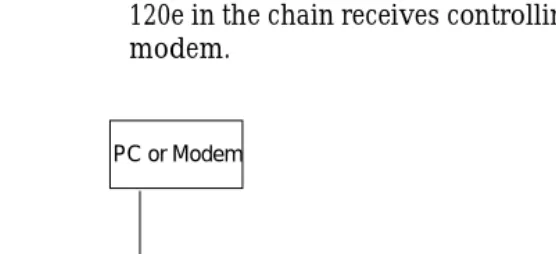
TDU 120e units and other TDUs and TSUs can be linked together to form a chain. Figure 2-3 shows an example of a chain-in arrangement with a PC or a modem. The first TDU 120e in the chain receives controlling input from the PC or modem.
Figure 2-3. Example of Chain-in
Subsequent TDU/TSUs in the chain are in a position to intake information from another TDU or TSU. This intaking of information from another TDU in the chain is identified as Chain In. The baud rate for the chained units must match that of the first unit.
Unless locked out externally, the front panel can also control the unit.
At this point, the Unit Initialization procedure is concluded. If the unit is to be configured remotely, there are no
additional items necessary to complete prior to executing remote configuration.
The Passcode, the Unit ID, and the Control Port settings are stored in a nonvolatile memory. This ensures they are operable for subsequent power-up sequences.
TDU 120e PC or Modem
Control Input
Chain Out
TDU 120e / TSU 100/TSU Chain
In
Chain Out
TDU 120e / TSU 100/TSU Chain
In
Normal Power-Up Procedure
After the unit has been put into operation with the initial power-up and initialization, subsequent power-up procedure includes only the Power-Up self-test followed by the request for a passcode (password) if this option was selected during initialization.
Chapter 3
Operation
MENU FEATURES
The TDU 120e uses a VT 100 type terminal to display control and monitor menus. Initiate this mode by keying in <CTRL> PTT on the terminal once it is connected to the Control In or Craft port.
When you begin the telnet session, you will be prompted for a password. The default password is ADTRAN. You can change this password using the MANAGEMENT submenu.
For detailed information on this method of control, see
Telnet/Terminal Main Menu on page 3-6.
You can also connect to the TDU 120e via telnet. Before attempting to connect via telnet, first define the IP address, the default gateway, and the subnet mask.
See DEFAULT UNIT PASSCODE in Table 8-1 on page 8-3 for details. The telnet session will time-out after a predefined value that is also set in the MANAGEMENTmenu.
Sample Terminal Screen with TDU 120e Menu
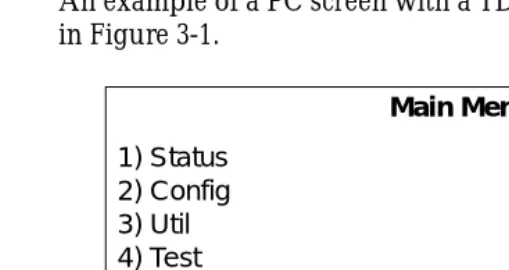
An example of a PC screen with a TDU 120e menu is shown in Figure 3-1.
Figure 3-1. Sample Terminal Screen with TDU 120e Menu
General Menu Operation
The TDU 120e uses a multilevel menu structure containing both menu items and data fields. All menu operations and data are displayed on the terminal.
Select and Activate a Menu Item
To choose a menu item, place the cursor on the desired menu item by:
• pressing the number corresponding to the menu item, or • using the up and down arrows.
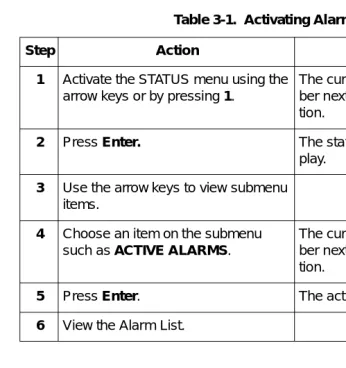
Table 3-1 on page 3-3 describe how to activate the alarm list option from the Status Menu.
Figure 3-2 on page 3-3 shows an example of basic menu travel.
Main Menu
1) Status 2) Config 3) Util 4) Test
.
Figure 3-2. Example of Basic Menu Travel Table 3-1. Activating Alarm List from Status Menu
Step Action Result
1 Activate the STATUS menu using the arrow keys or by pressing 1.
The cursor will flash on the num-ber next to the activated selec-tion.
2 Press Enter. The status submenus will dis-play.
3 Use the arrow keys to view submenu items.
4 Choose an item on the submenu such as ACTIVE ALARMS.
The cursor will flash on the num-ber next to the activated selec-tion.
5 Press Enter. The active alarm list will display. 6 View the Alarm List.
1) NETWORK (NI) PERFORMANCE REPORTS 2) NETWORK (NI) ERRORS
3) ACTIVE ALARMS (ALARM LIST)
4)VIEW HISTORY END OF LIST
You can edit data fields preceded by a colon (:). To edit a data field, perform the steps in Table 3-2:,
Exit Any Menu Field Operation Or Display
Press Escape as many times as required to return to the desired menu level.
Table 3-2. Editing a Data Field
Step Action Result
1 Position the cursor on the sub-menu item number and press
Enter.
The cursor moves to the data field (to the right of the sub-menu item name).
2 Using the space bar, scroll to scan the available value settings.
The value settings display one-at-a-time in the data field position.
3 When the desired value is dis-played in the data field position, press Enter to set that value. Another submenu field may be selected, or press ESCAPE to return to the submenu.
Data Port Identification
When configuring the unit, menu selections will include options from data port submenus. Selecting of data ports is necessary because the TDU 120e uses a Slot-Port method to identify the data port the menu item is referencing. If a module containing a PBX DSX-1 option card with an Nx56/ 64 plug-on interface is installed in the option slot, it would be designated as:
DSX-1 Passthru (1.1)
Where slot=1 and port =1.
The DSX-1 is located in the option slot and is the first port in that slot.
Nx56/64 (1.2)
Where slot=1 and port=2.
The Nx is located in the slot and is the second port in that slot.
Menu Structure
Telnet/Terminal Main Menu
The TDU 120e uses a multilevel menu structure containing both menu items and data fields. All menu operations and data display in the terminal window.
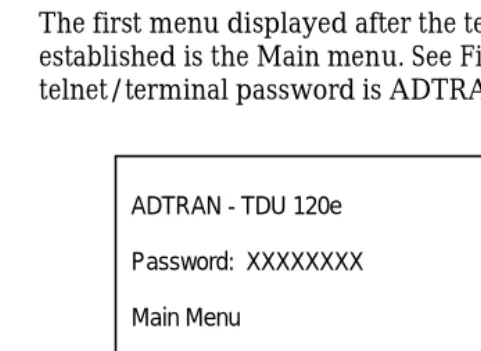
The first menu displayed after the telnet/terminal session is established is the Main menu. See Figure 3-3. The default telnet/terminal password is ADTRAN.
Figure 3-3. Telnet/Terminal Main Menu
.
ADTRAN - TDU 120e
Password: XXXXXXXX
Main Menu
1) Status 2) Config 3) Util 4) Test
5) Remote Menu Access 6) Management Config 7) Flash Download 8) Quit Session
Menu Options
The opening menu is the access point to all other operations. Each Main menu item has several functions and submenus to identify and access specific parameters.
Status
Displays all relevant information for the network and DTE interfaces. For detailed information on status options, see
Chapter 4, Status Menu on page 4-1.
Config (Configuration)
Displays sets the TDU 120e operational configuration, including all network interface parameters, the allocation of the DS0s, and the port parameters. For detailed information on configuration options, see Chapter 5, Configuration Menu on page 5-1.
Util (Utilities)
Displays and sets system parameters. For detailed informa-tion on utility opinforma-tions, see Chapter 6, Utility Menu on page 6-1.
Test
Initiates different types of unit tests and displays test results in the terminal window. For detailed information on test options, see Chapter 7, Test Menu on page 7-1.
Remote Menu Access
Displays Telnet menus for a remote device. For detailed information, see Remote Menu Access on page 8-1.
Management Configuration
Displays management information. For detailed information, see Management Configuration on page 8-1.
Flash Download
Allows you to manually perform a Flash download. For detailed information, see Flash Download on page 8-6.
Quit Session
FRONT PANEL
The TDU 120e front panel monitors operation and controls the configuration of the unit. The TDU 120e front panel is shown in Figure 3-4.
Figure 3-4. TDU 120e Front Panel Layout
Descriptions of each part of the front panel follow.
ACO Switch
The Alarm Cut-Off switch deactivates the alarm relay after an alarm condition has occurred. If the alarm that activated the alarm relay is cleared, then reoccurs, the alarm relay will reenergize.
Remote LED
The remote LED (yellow) indicates a management session (terminal mode or telnet) is active. The LED does not activate (turn on) during SNMP sessions.
Craft Port
The Craft Port is used as an EIA-232 port to connect the unit to a computer, a modem, or to another TDU/TSU
multiplexor or a TSU 100.
Network Monitor Jack
ACO REMOTE ACCESS CRAFT
TDU 120eAC
NETWORK MON
IN OUT IN OUT IN OUT IN OUT PORT 0.2 MON
IN OUT IN OUT PORT 1.1 MON TEST OK YEL RED ALARM ERROR NETWORK STATUS TEST OK ALARM PORT STATUS 0.1 0.2 1.1 1.2 1.3 1.4
Alarm Cut Off
Control Port
Active Unit Monitor JackNetwork Connection
For
Terminal Monitor JackDS-1 Status LED'sNetwork Port StatusLED's
DS1 Monitor Jack
This jack connects the unit to a PBX or other terminal equipment.
Network Status LEDs
The Network status LEDs display the operational condition of the network interface located on the controller board in the unit.
Network Status LED Display Indicates that...
OK (green) the operation is in the normal mode and no errors have been detected.
Test (yellow) the network interfaces is operating in a test mode. This includes a self-test or a test loop-back. When illuminated, this LED also indi-cates that normal data flow is not occurring on the network interface.
Error (red) an error has occurred, such as BPV, OOF, or CRC.
Alarm (red) an alarm condition has been detected. Any alarm condition will activate the alarm relay for the external alarm device. When the alarm condition is no longer valid, the OK LED acti-vates (turns on). To view an alarm condition, select the active alarm menu item.
Port Status LEDs
Port 1.1 Option Card Monitor Jacks
These are used to connect option cards to the computer.
Port Status LED Display Indicates that...
OK (green) the operation is in the normal mode and no errors have been detected.
Test (yellow) one of the interfaces is operating in a test mode. This includes a self-test or a test loop-back.
When illuminated, it also indicates that normal data flow is not occurring in at least one of the module ports.
Alarm (red) an alarm condition has been detected. Any alarm condition will activate the alarm relay for the external alarm device. When the alarm condition is no longer valid, the OK LED acti-vates (turns on).
To view an alarm condition, select the active alarm menu item.
If the alarm conditions have been corrected, the alarm which caused the activation of the Alarm LED can be viewed under the UNIT HIS
ALTERNATE METHODS OF CONTROL
T-Watch Pro (ADTRAN PC Program)
T-Watch PRO is the ADTRAN PC control program. It
provides complete control over the configuration of the TDU 120e using a graphical interface. The T-Watch Pro program displays the same status and performance data as the terminal screen. This data is displayed in tables and graphs.
The T-Watch Pro program has the following capabilities:
• Interfaces with a modem which permits dialing into a remote TDU 120e location to configure the unit or read the status or performance of the unit.
• Receives traps from any TSU product.
• Records and creates display performance data over a 30 day period.
• Accesses units via the local area network.
Setting up the TDU 120e to Work Over a LAN
To set up the TDU 120e to work with T-Watch Pro over the LAN, follow these steps:
Step Explanation
1 Set the Unit ID using the Terminal or Telnet. See Unit ID on page 6-3 for details.
2 Set control port interface to Normal (10BaseT) or SLIP (chain-in port).
3 Configure the IP address, default gateway, and sub-net mask.
Setting up the TDU 120e to Work Over an EIA-232 Connection
To set up the TDU 120e to work with T-Watch PRO over a direct EIA-232 connection, follow these steps:
SNMP
The ADTRAN TDU 120e supports the Simple Network Management Protocol (SNMP) through the 10BaseT or chain in (SLIP) interface. See Appendix A SNMP, on page A-1, for more information.
To use SNMP with the TDU 120e, follow these steps:
Step Explanation
1 Set the Unit ID and set a passcode. See Set Passcode on page 6-3.
2 Set the control port rate to the same setting as the PC Com port.
3 Connect the PC Com port to the Chain-In port on the TDU 120e using the DB-25 adapter and mod-ular cable provided.
4 Follow the installation instructions for T-Watch PRO to start the program and connect to the unit.
Step Explanation
1 Set the control port to either Normal (10BaseT) or SLIP (Chain-in port)
2 Set the IP address, default gateway, and subnet mask through the Terminal mode.
Chapter 4
Status Menu
The STATUSmenu branch allows you to view the status of the TDU 120e operation. See Figure 4-1.
Figure 4-1. Status Menu Tree
Menu flow is normally depicted from left to right. At every level of the menu, pressing Escape returns the system to the previous menu level. Press Escape repeatedly to return the system to the MAIN menu.
%AS
1) NETWORK (NI) %EF
PERFORMANCE REPORTS ES
SES
2) NETWORK (NI) ERRORS UAS NETWORK (NI)
1)STATUS RED ALARM
3) ACTIVE ALARMS LOSS OF SIGNAL
END OF LIST
4)VIEW HISTORY (HISTORY LIST)
END OF HISTORY
1) DTE DATA CLOCK
5) PORT STATUS Nx/DBU (0.1) 2) DTE STATUS
3) DTE PORT RATE
6) REMOTE PORT 4) DBU DATA/CNTRL
5) DBU CONTROL
6) DBU STATUS
DS-1 (0.2) DS-1 ERRORS
7) CLEAR PORT ALARM
Network Performance Reports
The Network Interface Performance Reports display the user copy of the performance data. The TDU 120e maintains this performance data on the network in compliance with ANSI T1.403 and AT&T document TR54016. The data displayed is data accumulated over the last 15 minutes and over the last 24 hours.
Figure 4-2. Network Interface Performance Report 15MIN/24 HR
%AS %EF ES SES UAS
-0.0/NA 0.0/NA 0/NA 0/NA 900/NA
Where Means
%AS Percentage of available seconds
%EF Percentage of error free seconds
ES Number of errored seconds (1 or more errors/second
SES Number of severely errored seconds (more than 320 errors/second)
UAS Number of unavailable seconds (10 or more consecutive seconds)
Network Interface Errors
The NI ERRORS submenu displays the types of errors the Net-work Interface (NI) detects. A blinking CSU error LED indi-cates that network errors are detected.
The asterisk (*) above an item indicates the type of errors detected. The error types are shown in Table 4-1.
Active Alarms
This menu item displays a list of current alarms reported by either the base controller or any of the ports. If no alarms are current, using this menu item displays End of List.
The display in Table 4-2 on page 4-3 includes two text fields. The left field is the alarm source. The right field is the alarm message. A list of alarm messages is found in Appendix C,
System Messages on page C-1.
If one or more of the Alarm LEDs are illuminated, an alarm is present. Press Escape to return to the previous menu item.
Table 4-1. NI Error Types
Error Type Description
CRC CRC-6 bit errors based on the FDL. This is valid only in ESF mode.
BPV Bipolar violations XSO Excess zeros FER Framing errors
Table 4-2. Alarm Message Display
ACTIVE ALARMS NETWORK (NI) NETWORK (NI) END OF LIST
View History
This menu item both displays and clears the accumulated status changes of the unit.
VIEW HISTORY displays a history of the last 20 status changes in the unit, including the date, time, and type of change. The unit also records for viewing the date and time an alarm became active and inactive, as well as the date and time of test activation and deactivation.
To clear the VIEW HISTORY display, press C.
Port Status
PORT STATUS displays the signals monitored on the data ports. For example, the Nx/DBU interface monitors the RTS, CTS, TD, and RD, along with other signal lines. When a port is selected, the terminal indicates if the signal is present.
The base Nx interface offers the status screen listed in this section. When using other option cards, refer to the appropriate separate manual for a definition of any status screens offered.
The Port Status of Nx/DBU shows how to use this item.
Nx/DBU (0.1) Menu Items
DTE Data/Clock
An asterisk (*) indicates an active status of the following lines:
• TXD -Transmit data from the DTE • RXD - Receive data toward the DTE • XSO - Excess zeros from the DTE
DTE Status
An asterisk (*) indicates an active status of the following lines:
• RTS - Request to send from DTE • CTS - Clear to send to DTE • DCD - Data carrier detect to DTE • DSR -Data set ready to DTE
DTE Port Rate
The Port Rate displays the current setting of the Nx port. Continue with standard operating procedures to exit the display.
DBU Data/CNTRL
An asterisk (*) indicates an active status on the following lines:
• TXD - Transmit data to the DCE • RXD - Receive data from the DCE • DCD - Data carrier detect from the DCE • RI - Ring Indicate from the DCE
DBU Control
An asterisk (*) indicates an active status on the following lines:
• RTS - Request to send the DCE • CTS - Clear to send from the DCE • DTR - Data terminal ready to the DCE • DSR - Data set ready from the DCE
DBU Status
DS-1 (0.2) Menu Items (DS-1 Errors)
• CRC - An asterisk displays under the CRC if there are CRC errors in extended superframe format (ESF) mode. If the DS-1 is configured for D4 Frame format, the terminal displays N/A.
• BPV - An asterisk displays under the BPV if the DS-1 detects bipolar violations.
• SLIP - An asterisk displays under the SLIP if the DS-1 detects frame slips. This is caused by multiple clock sources in the application.
• FER - An asterisk displays under the FER if the DS-1 detects frame bit synchronization errors.
Remote Port
REMOTE PORT displays the status of activity on the Control In remote port. This is useful for troubleshooting
communication sessions, and for verifying cabling.
• RX -Characters received at remote port • ID - Unit ID received at remote port • CRC - Correct CRC received
• PC - Correct passcode received
• TX - Characters transmitted from the remote port
Clear Port Alarm
Ethernet Status
• TX - Indicates that data is being transmitted from the 10BaseT port.
• RX - Indicates that data is being received by the 10BaseT port.
• LNK - Indicates the current status of the 10BaseT link integrity test (this should always be on when the unit is connected to a functional 10BaseT hub).
Chapter 5
Configuration Menu
The CONFIGURATIONmenu sets the TDU 120e operational configuration, including all network interface parameters, the allocation of the DS0s, and the port parameters. See the Figure 5-1 on page 5-2.
1) FORMAT
2) CODE 1) CONTROL PORT RATE
3) YELLOW ALARM 2) TRAPS
4)TRANSMIT PRMS 3) ACCESS
5) TIMING MODE 4) INIT MODEM
6) UBRiTE 5) CONTROL PORT
6) SET LINE BUILD OUT 6) IP ADDRESS
1) NETWORK (NI) 7) INBAND L00PBACK 7) SUBNET MASK
8) BIT STUFFING 8) DEFAULT ROUTER
2) UNIT 9) SLIP RATE
10) SLIP FLOW CONTROL
3) MAP EXCHANGE OFF 11) PROXY TRAPS
4) MAP IN USE 1) MAP A @:HH:MM
AUTO 2) MAP B @:HH:MM
3) CONFIG 5)DS0 MAPS 1) COPY MAP A TO TEMP MAP
2) COPY MAP B TO TEMP MAP
3) CREATE TEMP MAP 1) DSO RATE
4) REVIEW MAP A 2) TX CLK CONTROL
5) REVIEW MAP B 3) DATA
6) REVEIW TEMP MAP 4) CTS
7) EDIT TEMP MAP 5) DCD
8) APPLY TEMP MAP TO MAP A 1) Nx56/64 CONFIG 6) DSR
9) APPLY TEMP MAP TO MAP B 7) “0” INHIBIT
8) INBAND MODE
1) Nx/DBU (0.1) 9) TX CLK SOURCE
2) DBU CONFIG 1) BACKUP MODE
6) PORT CONFIG 2) BACKUP ON
2) DS-1 (0.2) OPTION PORTS 1) FORMAT 3) PATTERN VERIFY
2) CODE 4) BACKUP DELAY
3) YELLOW ALARM 5) RESTORE DELAY
4) LINE LENGTH 6) RETRY DELAY
5) INBAND L00PBACK 7) NUM RETRIES
6) ROB BIT SIGNL 8) BACKUP TESTING 1) BACKUP TEST
7) RBS START 9) WKEND LOCKOUT 2)TEST HOUR
8) RBS END A) ENABLE HR 3)TEST DAY
NETWORK (NI)
This menu item accesses the configuration of parameters associated with the network interface in the base unit. There are eight submenu items that include setting the format, the line build out (LBO), and the timing mode. Submenu items do not include setting the parameters which may be necessary for a secondary interface (DS-1 Passthrough, etc.).
Network (NI) Menu Items
FORMAT
Sets the frame format for the NI. Choices: D4 and ESF.
CODE
Sets the line code for the NI. Choices: AMI and B8ZS.
YELLOW ALARM
Enables and disables the transmitting of yellow alarms. Choices: ENABLED and DISABLED.
TRANSMIT PRMS
Enables and disables the sending of PRM data on the facility data link (FDL). The PRM data continues to be collected even if Transmit PRMS are disabled (possible only with ESF For-mat).
Choices: Off and On.
TIMING MODE
Selects the clock source for transmission toward the network from the NI. See TDU 120e Clock Sources on page 5-4 for a description of the timing choices.
Choices: Network, Base DTE, Base DS-1, Normal (CSU), U-BR1TE, Internal, and Secondary (SI).
TDU 120e Clock Sources
The TDU 120e is operable from various clock sources, permitting it to perform properly in many different
applications. Set the network interface clocking options with the clocking options set by the Network (NI) Configuration menu options.
The following clock source options are available:
• Network Timed • Base DS-1 • Base DTE Timing • Internal Timing • Secondary Timing
• Normal (CSU)
• U-BR1TE
Network Timed
The network is the source of timing. The received data clocking is looped back to the network where it is used to determine the transmission timing. This option is also referred to as loop timed as the transmission clock is derived from the received clock. See Figure 5-2.
The selected clock option always designates the clock source for transmission. Clocking necessary for receiving data is always re-covered from incoming data.
OSC
Secondary Interface
( O P T I O N )
Network Interface T1 XMIT
T1 Receive
( D S 1 )
Nx56/64
DTE CLOCK
Based DS-1
The PBX is the source of timing. The TDU 120e uses the clock derived by the Base DS-1 interface for transmission timing. See Figure 5-3.
Figure 5-3. DS-1 Timed Clock Source
Base DTE Timing
The Base DTE is the source of timing. The TDU 120e uses the incoming DTE clock to determine the transmission timing. This is typically used in applications where it is necessary to have the DTE as the primary clock source (such as limited distance line drivers). See Figure 5-4.
Figure 5-4. Base DTE Timing Clock Source
DTE OSC
( O P T I O N )
Network Interface T1 XMIT
T1 Receive
( D S 1 )
Nx56/64
DTE CLOCK
DS-1
PBX
DTE OSC
( O P T I O N ) Network
Interface T1 XMIT
T1 Receive
( D S 1 )
Nx56/64
DTE CLOCK
DS-1
Internal Timing
The TDU 120e is the source of timing. The TDU 120e is configured to use its own internal oscillator as the source of timing. Applications include private line driver circuits where one end is set to network and the other to internal. See Figure 5-5.
Figure 5-5. Internal Clock Source
Secondary Timing
The secondary interface is the source of timing. The TDU 120e uses the clock derived by the secondary interface for transmission timing. See Figure 5-6.
DTE OSC
( O P T I O N ) Network
Interface T1 XMIT
T1 Receive
( D S 1 )
Nx56/64
DTE CLOCK
DS-1
Normal (CSU) Timing
The typical timing option arrangement is shown in
Figure 5-7. The PBX is looped timed sending data to the TDU 120e which is actually synchronous to the received data. The Network Interface (NI) is the actual source of all timings. This timing option is the same as that typically used for CSUs. This is the preferred mode for use with a PBX application.
This timing mode works equally well when the PBX is the source of timing. In that configuration the network would not be providing timing.
Figure 5-7. Normal (CSU) Timing
U-BR1TE
The U-BR1TE timing selection works like Normal (CSU) except that timing is derived from the U interface on port 1.1.
Set Line Buildout
Selects the line build-out for the network interface. In AUTO mode, the TDU 120e sets the LBO based on the strength of the receive signal and displays the selected value. Choices: 0.0 dB, 7.5 dB, 15 dB, 22 dB, and Auto.
DTE OSC
Secondary Interface
(SI)
( O P T I O N ) Network
Interface
(NI)
T1 XMIT
T1 Receive ( D S 1 )
Nx56/64 DTE CLOCK DS-1 PBX (IO PB) PBX
Inband Loopback
Sets unit to accept or reject the network interface loop-up and loop-down codes as defined in ANSI T1.403.
Choices: Accept or Reject.
Bit Stuffing
When enabled, bit stuffing causes the TDU 120e to monitor for ones (1s) density violations and insert a one (1) when needed to maintain 1s at 12.5%.
Choices: Enable or Disable.
Unit Menu
The UNITmenu changes the baud rate of the Control In port and the setup of the Dial Out port.
The menu items are:
Control Port Rate
Sets the baud rate for communication with the PC or modem. Choices: 1200, 2400, 9600, 19200, and 38400 kbps.
Traps
Enables or disables the transmission of trap messages. Choices: Enable and Disable
Access
Sets the method of connection from the TDU 120e to T-Watch or SNMP.
Choices:
Direct - Used if connected directly to the PC.
Init Modem
Allows you to choose an industry standard or a custom ini-tialization string for a modem connected to the control port. Choices: Industry standard and Custom Initialization String
Control Port
Selects the TCP/IP physical interface; Normal (10BaseT Ethernet) or SLIP using the EIA-232 serial port.
Choices: Normal or SLIP
IP Address
This is the IP address that uniquely identifies the TDU 120e on a TCP/IP network. This address is composed of four deci-mal numbers, each in the range of 0 to 255, separated by peri-ods. This value is used for either the 10BaseT Ethernet or SLIP interface, depending on the IP interface setting.
Subnet Mask
This defines which part of a destination IP address is the Net-work number. It is used along with the TDU 120e IP address to determine which nodes must be reached through the default IP Gateway. This value is set to 0.0.0.0 when the IP interface option is set to SLIP.
Default Router
All IP Packets destined for nodes not on the TDU 120e unit’s local network are not forwarded through this IP address. Normally, this address defines a router connected to the TDU 120e unit’s local network. This value is ignored when the IP interface is set to SLIP.
SLIP Rate
This sets the baud rate for the Chain-In port when used as the SLIP connection for SNMP management.
Choices: 1200, 2400, 4800, 9600, 19200, 38400
SLIP Flow CTL
This is used to activate flow control on the Chain-In port when used as the SLIP interface. Hardware mode uses RTS and CTS.
Choices: None, Hardware
Proxy Traps
This determines whether traps are forwarded to the IP Inter-face from units being “proxied” for.
Choices: Enable, Disable
Map Exchange
The MAP EXCHANGE menu enables and sets the automatic time of day map switch. The unit provides selection of the hour, minute, and seconds for the map switching to take place.
The menu items are:
OFF
Indicates the map in use does not change. The Automatic Map Change feature is disabled.
AUTO
Indicates that the map in use will change at a user-selected time of day. The Automatic Map Change feature is enabled.
Explanation:
When AUTO is selected, the unit displays the screens to set times for switching.
After editing Map A, press Enter to record the Map A settings and activate the selection fields for Map B. Use the same operation to edit switching time for Map B.
Map In Use
This menu item controls the DS0 map the TDU 120e uses and displays the map in current use.
DS0 Maps
The DS0 maps designate which DS0s are assigned to which port. The three maps are:
DS0 Map A - Default Map
DS0 Map B - Alternate Map
Temp - Temporary map used as a scratch pad
DS0 Maps Configuration Menu
The DS0 maps configuration menu takes advantage of the 24-line VT 100 display. Upon entering this menu, the current Temp (temporary) map displays and is followed by nine selections that you can use for configuring and reviewing map information. See Figure 5-8.
Figure 5-8. DS0 Temp Map
TEMP MAP DS0# 1 2 3 4 5 6 7 8 9 10 11 12 PORT IDLE IDLE IDLE IDLE IDLE IDLE IDLE IDLE IDLE IDLE IDLE IDLE DS0# 13 14 15 16 17 18 19 20 21 22 23 24 PORT IDLE IDLE IDLE IDLE IDLE IDLE IDLE IDLE IDLE IDLE IDLE IDLE
You can use the up and down arrows or number keys to move the cursor from one selection to another. Press Enterto perform the action displayed to the right of the cursor.
Creating a DSO Map
Map configuration involves these steps.
Initializing the Temp Map
Upon entering the DS0 maps configuration menu, the Temp map reflects its last configured state.
Step Explanation
1 Intializes the Temp map to one of three configurations (current Map A, current Map B, or all IDLES). This step is optional.
2 Edits the Temp map so that it reflects the desired map configuration.
3 Replaces the current DS0 map A or B configuration with the Temp map configuration.
If you want to... Enter selections...
initialize the Temp map from its cur-rent configuration to one which reflects the currently stored Map A or B configurations, respectively.
1 - 2
initialize the Temp map to an all IDLE state.
Editing the Temp Map
If further changes to the Temp map are needed, do the following:
Applying the Temp Map
Once the Temp map reflects the desired configuration, use selections 8 or 9 to apply this configuration to Map A or B, respectively.
Step Action Explanation
1 Use selection 7 to enter the Temp map edit mode.
Upon entering this mode, the cursor location moves to DS0 number one in the DS0 field of the Temp map. 2 Move the cursor from one
DS0 to another by using the up and down arrows.
Locate the DS0 number whose assigned port needs to be changed.
3 Press Enter. The cursor will move into the Port field. 4 Use the up and down
arrows or space bar to scroll through the possible port selections.
To restore the previous port assign-ment and return to the DS0 field, press
ESC.
Copying Map
To copy Map A to Map B, copy Map A to the Temp Map; then apply the Temp Map to Map B. See Figure 5-9.
Figure 5-9. DS0 Map Designations
Reviewing Maps
Selections 4 through 6 give a summary of the number of ports assigned to Map A, Map B, and the Temp map, respectively. The menu items and their descriptions are listed below.
Copy Map A (B) to Temp Map
Copies the current map A (B) into a TEMP map area. This permits modification without disturbing the existing map. When the modifications are completed, the TEMP map is written to current Map A (B) by selecting APPLY TEMP MAP TO MAP A (B).
Create Temp Map
Creates a map by defining a port or Idle for all DS0s. When
CREATE TEMP MAPis first selected, all DS0s are set to Idle. Possible port selections include IDLE, TST, + option module ports. TST designates which DS0s are used for QRSS testing when activated under the TESTmenu. When not used for testing, the TST designation is identical to IDLE.
T E M P
M a p A M a p B
Review Map A(B)
Permits a quick review of the number of DS0s assigned to each port and the number of unassigned DS0s (IDLE or TST) as defined in the currently applied Map A(B).
Review Temp Map
This menu item is operated the same as REVIEW MAP A (B).
Edit Temp Map
The map in the TEMP file can be edited to whatever configu-ration is desired. If Map A had been copied into the TEMP file, then after editing, the TEMP file could be applied to Map A or Map B.
Apply Temp to Map A(B)
Writes the TEMP map into Map A (B). Apply is usually the last step in updating a map.
Port Configuration (Port Config)
PORT CONFIGURATION is used to select and configure the parameters associated with any data port in the unit. For example, parameters for the DS-1 (PBX) interface are set through this menu. The items that can be set depend on which option module is installed. The list of option ports will vary with the configuration.
The TDU 120e is designed so that any additional ports developed in the future will contain the appropriate menu selections to provide access by use of this menu item.
The Configuration menus for options ports are described in separate sections of the manual supplied with the option card.
Nx/DBU (0.1) Menu Items
Nx/DBU (0.1)
The Nx/DBU port has two main menus:
DBU config -- DBU operation
Under Nx56/64 config, the menu items are:
DSO Rate
This sets the base rate of the interface. The actual data rate depends on the number of DS0s assigned to the Nx port. Choices: 56K or 64K
TX CLK CNTRL
Controls the clock used by the TDU 120e to accept transmit (TX) data from the DTE. The default is normal. If the interface cable is long, causing a phase shift in the data, the clock can be selected as INVERT. This switches the phase of the clock which should compensate for a long cable.
Choices: Normal, Invert
Data
Used to control the inverting of the DTE data. This inversion can be useful when operating with an HDLC protocol. Often used as a means to ensure 1s density.
Choices: Normal or Invert
CTS
Used to control characteristics of CTS. Choices: Normal, (see Table 5-1) or Force On
DCD
Data Carrier Detect. Indicates to the DTE when a valid signal is being received at the Network Interface.
Choices: Normal (see Table 5-1) or Force On
DSR
“O” INHIB
The Nx interface will detect an uninterrupted string of zeros (0s) being transmitted toward the network. If 0s are transmit-ted for >1 second, the TDU 120e will force 1s.
Choices: On or Off
INBAND MODE
The Nx56/64 port is capable of providing an inband commu-nications channel (for T-Watch and SNMP) between units. This is accomplished by using 8 kbps of the first DS0
assigned to that particular Nx56/64 port. If in 56 K mode, no data bandwidth will be used. Inband must also be enabled at the destination port.
Choices: On or Off, On Demand
TX CLK SOURCE
Controls the source of the clock used by the TDU 120e to accept transmit data from the DTE.
Default: Internal.
If the application requires that the DTE device provide the clock with the transmit data, the EXTERNAL setting is used. Choices: Internal, External
This table indicates conditions which cause the Port Control Signals to be deactivated.
Table 5-1. Normal Mode of Operation
RTS V.54 Loopback 511 TST ON Self Test Active Netwk Test Active No DS0 Mapped Network Alarm
CTS Follows OFF OFF OFF OFF OFF
DCD — — OFF — OFF OFF
DSR — OFF OFF OFF OFF —
Where “—” = don’t care
Dial Backup Configuration
Under Dial Backup (DBU) configuration, the menu items are:
Backup Mode
In a backup condition, both ends of the circuit must detect backup conditions before backup is activated. One DBU is set to ORIGINATEand the other to ANSWER. Upon a network fail-ure, only the Originate DBU initiates backup by dialing the Answer end. Once called, the Answer DBU goes into backup mode only if a backup condition is detected. This is ideal for controlling where calls originate.
Choices: Disable, Originate, Answer
Backup On
Selects the conditions that cause the Nx/DBU to initiate Backup.
NET FAIL
Backup occurs on RED ALARM, YELLOW ALARM, BLUE ALARM and LOS.
NET/DATA FAIL
Backup occurs on the same conditions as NET FAIL plus loss of data transitions on the data the Nx56/64 receives from the network.