Abstract
VERRUTO, VINCENT JAMES. Asphaltene Self-Assembly. (Under the direction of Peter K. Kilpatrick).
Despite a strong push for alternative energy, fossil fuels remain an important energy source given an ever-increasing global energy demand. As crude oil prices continue to soar, petroleum producers and refiners are looking to “unconventional” crudes, such as bitumen and heavy crude oils, to meet their needs. Unlike light-sweet “conventional” feedstocks, heavy crudes are often rich in a fraction that is characteristically polydisperse, of high-MW, polyaromatic, polar, and surface-active. Consequently, asphaltenes present expensive challenges associated with aggregation, flocculation, precipitation, deposition, and emulsion stabilization.
thickness, which was nearly constant among the three solvents. In the Part II we seek a more thorough definition of the interfacial film composition by using neutron contrast variation to illuminate not just the asphaltenic makeup, but the solvent, water, and, when applicable, additive composition within the films.
Asphaltene Self-Assembly
by
Vincent James Verruto
A dissertation submitted to the Graduate Faculty of North Carolina State University
in partial fulfillment of the requirements for the degree of
Doctor of Philosophy
Chemical Engineering
Raleigh, North Carolina 2008
APPROVED BY:
_______________________________ ______________________________ Dr. Peter K. Kilpatrick Dr. Orlin D. Velev
Chair of Advisory Committee
________________________________ ______________________________
Dedication
This dissertation is dedicated to my family, the most important people in my life, who have been waiting a long time to address someone as Dr. Verruto. Rose, Phil, Michael, Claire,
Biography
Vincent James Verruto was born on July 7, 1981 in Doylestown, PA to two very loving parents. The youngest of six children, with the eldest 20 years his senior, Vinnie learned early how to grab and maintain an audience’s attention. Despite his academic achievements, Vinnie is usually remembered for his ebullient and outgoing personality.
Acknowledgments
The work described in this dissertation could not have been accomplished without the help of several parties that deserve recognition. First and foremost, I have to thank Dr. Peter Kilpatrick for taking a chance on a gangly Italian Blue Hen. I know that I have grown tremendously under your tutelage, not only as an engineer and research scientist, but also as a human being. You always treated me with respect and challenged me with responsibility. Peter, you have been a wonderful influence over the past five years. I wish you nothing but success as Dean of Engineering at Notre Dame, and I expect our personal and professional relationships to last for many years to come.
To the staff of the Department of Chemical and Biomolecular Engineering at NCSU, I say THANK YOU! In particular, Sandra Bailey, Saundra Doby, Sheila Hayes, Diane Harper, and Clarice Whitmarsh have all been instrumental in many behind-the-scenes aspects of graduate school that you don’t read about in the brochure.
To my many friends at NCSU, I could not have survived without you. Simply having the opportunity to spend time with so many wonderful people kept me sane through the most challenging times. There are so many names to list, and I hope I don’t forget any. To Omon, Andy, Stoner, Woodhead, Young, and Sachin, you all made our first year in Riddick fun and memorable, and you have continued to be good friends thereafter. To Joan, Jim, and Courtney, you all expected me to spike the heck out of a volleyball, even in my yellow UD sweatpants. Thanks for getting me into the volleyball scene in Raleigh, as it was often a welcome departure from the daily grind. Many of those who started graduate school after me have been great friends to me, including: Josh, Brax, Aberg, Turkish, Salo, Evren, Annie, Kristen, and Sara.
been there for me in some capacity. To my many nieces, nephews, cousins, aunts, uncles, sisters-in-law, and brother-in-law, I say thanks for your loving support and interest in all that I do in life.
Table of Contents
List of Tables ...xi
List of Figures ...xii
CHAPTER 1 Introduction and Overview of the Dissertation...1
1.1 Background & Definition of the Field...1
1.1.1 Asphaltene Chemistry ...2
1.1.2 Asphaltene Aggregation...6
1.1.3 Asphaltene Interfacial Activity...8
1.2 Goals of the Dissertation...13
1.3 References ...15
CHAPTER 2 Preferential Solvent Partitioning within Asphaltenic Aggregates Dissolved in Binary Solvent Mixtures ...26
Abstract...26
2.1 Introduction ...27
2.2 Materials & Methods ...30
2.2.1 Sample Preparation...30
2.2.2 Small Angle Neutron Scattering (SANS)...33
2.2.3 Data Reduction and Analysis ...35
2.3 Results & Discussion...37
2.3.1 1% HOW in 40:60 (v:v) Decalin:Toluene ...37
2.3.2 1% HOS-10 in 40:60 (v:v) n-Heptane:Toluene...40
2.3.3 1% HOW in 50:50 (mol:mol) 1-Methylnaphthalene:Toluene ...40
2.3.4 Rationale for Observed Selective Partitioning ...41
2.4 Conclusions ...46
2.5 References ...48
CHAPTER 3 Water-in-Model Oil Emulsions Studied by SANS I: Solvent Influence on Film Thickness, Asphaltenic Composition, and Emulsion Stability ...63
Abstract...63
3.1 Introduction ...64
3.2.1 Asphaltene Preparation ...67
3.2.2 Model Oil Preparation...67
3.2.3 Emulsion Preparation...68
3.2.4 Neutron Scattering ...68
3.2.5 Data Reduction ...69
3.2.6 Model Fitting and Data Analysis...71
3.2.7 Rinsing of Emulsions for SANS...75
3.2.8 Emulsion Stability to Centrifugation ...76
3.2.9 Interfacial Rheology...76
3.3 Results & Discussion...77
3.3.1 SANS of Non-rinsed Emulsions...77
3.3.2 SANS of Rinsed Emulsions ...79
3.3.3 Emulsion Stability...82
3.3.4 Validity of Analyses ...83
3.4 Conclusions ...85
3.5 References ...86
CHAPTER 4 Water-in-Model Oil Emulsions Studied by SANS II: Interfacial Film Composition ... 103
Abstract... 103
4.1 Introduction... 104
4.2 Materials & Methods ... 107
4.2.1 Sample Preparation...107
4.2.2 Neutron Scattering ...109
4.2.3 Data Reduction and Analysis ...110
4.2.4 Interfacial Tensiometry ...116
4.3 Results & Discussion... 117
4.3.1 Special Scattering Approximations vs. Core/Shell Modeling...117
4.3.2 Core/Shell Fitting – Interfacial Composition ...121
4.4 Conclusions ... 128
4.5 References ... 129
4.6.1 Remaining Core/Shell Fits ...146
4.6.2 Erroneous Determination of Drop Radius from S/V ...147
4.6.3 !2Red Dependence on Film Composition...148
CHAPTER 5 The Role of Electrostatics in Asphaltenic Self-Assembly at the Oil/Water Interface... 153
Abstract... 153
5.1 Introduction ... 154
5.2 Materials & Methods ... 158
5.2.1 Sample Preparation...158
5.2.2 Interfacial Shear Rheology...159
5.3 Results & Discussion... 164
5.3.1 Film Consolidation: Salt Induced Retardation ...164
5.3.2 Drop Tensiometry – pH and Salt Dependence ...169
5.3.3 Comparison of Shear and Dilatational Rheology...174
5.3.4 Implications on Emulsion Stability...176
5.4 Conclusions ... 178
5.4 References ... 180
CHAPTER 6 Elucidating Asphaltene Interfacial Adsorption and Rheology Using Model Fused-Ring Species... 197
Abstract... 197
6.1 Introduction ... 198
6.2 Materials & Methods ... 199
6.2.1 Sample Preparation...199
6.2.2 Interfacial Drop Tensiometry ...200
6.2.3 Interfacial Shear Rheology...200
6.3 Results & Discussion... 201
6.4 Conclusions ... 210
6.5 References ... 211
CHAPTER 7 Concluding Comments and Looking Ahead... 226
7.1 Lessons Learned ... 226
Appendix……... 232
A: Dynamic Asphaltene-Resin Exchange at the Oil/Water Interface: Time-Dependent W/O Emulsion Stability for Asphaltene/Resin Model Oils... 233
Abstract... 233
A1. Introduction ... 234
A.2 Experimental ... 237
A.2.1 Materials...237
A.2.2 Water-in-Model Oil Emulsion Preparation (Asphaltenes)...238
A.2.3 Water-in-Model Oil Emulsion Preparation (Asphaltenes/Resins) ...238
A.2.4 Critical Electric Field Measurement ...239
A.2.5 Dilatational Rheology ...240
A.3 Results & Discussion... 241
A.3.1 CEF of Water-in- Oil Emulsions (Asphaltenes) as a Function of Time...241
A.3.2 CEF of Water-in-Oil Emulsions (Asphaltenes/Resins) as a Function of Time ...242
A.3.3 Dilatational Rheology ...244
A.4 Conclusions ... 246
List of Tables
List of Figures
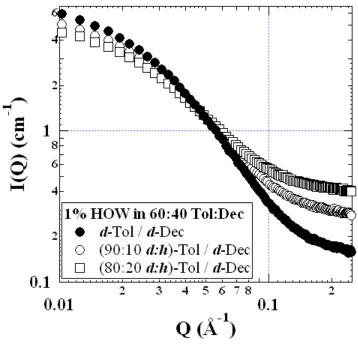
Figure 2.1. Reduced absolute scattering intensity for a few of the 1 wt% HOW in 40:60 Dec:Tol series. Note the increasing incoherent background and decreasing low-Q intensity with increasing hydrogenation (decreasing contrast)...54 Figure 2.2. Typical background subtraction for 1 wt% HOW in 40:60 Dec:Tol samples.
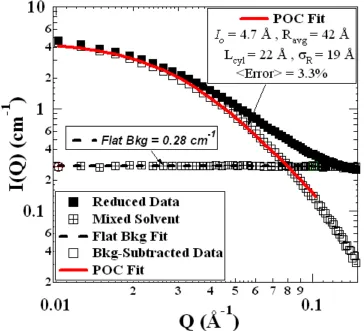
Asphaltene data were reduced in IGOR Pro and are represented as absolute scattering intensity (!) versus Q. Mixed solvent blanks (") were fit with to a flat profile (#). Subtraction of the flat bkg from the reduced data yielded a background-free scattering curve ($), for which a POC fit (%) was applied.
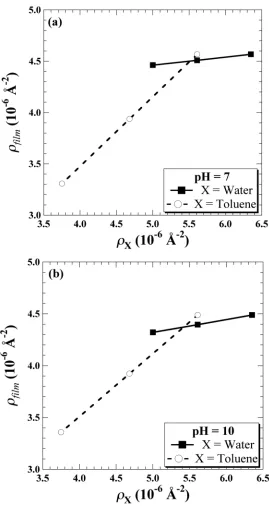
properties such as Ravg, p, and &film were fixed at their corresponding values from the optimized fit (Table 4.3). ... 142 Figure 4.10. Core/shell contrast ratio term, ", as a function of (a) !Tol,film and (b) !Asph,film for pH10/HOW-only emulsion contrast variation series. Sample conditions corresponding to the CV-A to CV-E designations can be found in Table 4.4.
the frequency at which all subsequent reported shear moduli were obtained. ... 187 Figure 5.3. Time-dependence of elastic shear modulus (G() for 1% HOW in heptol contacted with pH 7 DI H2O with no salt (.) and 2% NaCl (,)... 188 Figure 5.4. Salt dependence for the interfacial aging time required to achieve G( ~ 10 mN/m (tfilm,o). The oil phase was 1% HOW in heptol, with data presented for NaCl (() and CaCl2 (/) as the salts. The dashed curve is drawn only to lead the eye and does not represent a fit... 189 Figure 5.5. Dependence of tfilm,o on the Debye parameter, $, of pH 7 aqueous phases.
Figure 5.10. Dynamic interfacial tension for drops of 1% HOW in heptol in DI H2O (*) or 1% NaCl (* + *) at (a) pH 3, (b) pH 7, and (c) pH 10. Corresponding dilatational modulus evolution (d) – (f) of the same droplets from (a) – (c), respectively. Half-filled symbols (e.g., 1) represent samples where the aqueous phase was DI H2O and open symbols (e.g., 2) are for those with 1% NaCl. Vdrop = 15 µL for pH 3 and 7 and 3-10 µL for pH 10. Vosc = 1.5 µL for pH 3 and 7 and 1 µL for pH 10, with # = 0.1 Hz for all samples. ... 195 Figure 6.1. Time-dependent evolution of (a) interfacial tension and (b) dilatational modulus for AH asphaltenes at pH 3, 7, and 10... 217 Figure 6.2. Comparisons of dynamic interfacial tension, %(t) (lines), and dilatational modulus, |&|(t) (lines and points), for (a) 1 wt% AHW asphaltenes, (b) 9-anthracene carboxylic acid, and (c) 5'-cholanic acid in toluene contacted with DI H2O at pH 10. The more “asphaltene-like” model acidic compound in this series, 9-ACA appears to contribute positively to dilatational elasticity, compared with cholanic acid, which detracts from the elastic nature of the interface... 218 Figure 6.3. Comparisons of dynamic interfacial tension, %(t), and dilatational modulus, |&|(t), for (a) 1 wt% AHW asphaltenes, (b) phenanthridine, and (c) 1,10-phenanthroline in toluene contacted with DI H2O at pH 3. Both organic model compounds can be considered “asphaltene-like” as they contribute positively to dilatational elasticity. The unique interfacial tension profile for phenanthroline arises from it having non-negligible solubility in water. ... 219 Figure 6.4. Interfacial rheology comparison of films from 2-aminoanthracene (50 ppm in toluene) and the strongest films from HOW asphaltenes (1 wt% in 40:60 heptane:toluene) contacted with deionized water at pH 3 and 7, respectively. Film “strength” as determined by (a) dilatational rheology and (b) interfacial shear rheology. Both measures indicate much more elastic interfaces arise from 2-aminoanthracene. ... 220 Figure 6.5. (a) Evolution of the dilatational modulus at pH 10 for toluene solutions of
Note the decreasing phase angle with increasing modulus, indicative of an increasingly elastic contribution to the total modulus. ... 260 Figure A.7. Dilatational modulus for two runs of 2% B asphaltenes (BA) and 1% B resins (BR) in 50:50 heptol mixture in pH 6 deionized water. Vdrop ~ 5 µl, Vosc ~0.5 µl, # = 0.1 hz, and T ~ 30ºC. Also presented are the dilatational moduli for the BA-only and BR-only in 50:50 heptol drops in pH 6 deionized water.
CHAPTER 1
Introduction and Overview of the Dissertation
1.1 Background & Definition of the Field
significant resources to addressing these issues related with unconventional heavy crudes and bitumen. Some of these fouling issues include instability/precipitation, pipeline deposit buildup, and the formation of stable water-in-oil emulsions. These issues are related to surface and interfacial activity of colloidal materials in the complex crude mixture. This attention is well received in North America, particularly in Alberta, Canada, where the world’s largest proven heavy oil reserves rest.4, 5
So then, what makes a heavy crude oil heavy? In addition to the valuable gasoline, diesel, kerosene fractions with which many are familiar, crude petroleum often contains a host of other hydrocarbons. A popular rough characterization method is the so-called SARA fractionation, in which a crude is separated into four main fractions: Saturates, Aromatics, Resins, and Asphaltenes. Asphaltenes have been defined in a number of ways, but are most frequently described as a solubility class of molecules.6 Asphaltenes are insoluble in paraffinic solvents such as n-pentane or n-heptane, yet soluble in aromatic solvents like benzene or toluene and polar solvents like methylene chloride. As a solubility class, asphaltenes contain a wide range of molecular chemistries, and thus are polydisperse and chemically heterogeneous. Consequently, researchers have put forth tremendous effort into asphaltene characterization.
1.1.1 Asphaltene Chemistry
(% w/w) for asphaltenes typically fall in the range of 75-85% C, 8-12% H, 1-2% N, 1-3% O, and 5-10% S. Many researchers report the atomic H/C ratio as an “aromaticity index,” such that benzene and larger fused aromatics (e.g., naphthalene, anthracene, and pyrene) have H/C
- 1. Asphaltenes usually exhibit H/C between 1.0-1.3, in contrast to 1.4-1.6 for resins and H/C > 1.8 for saturated hydrocarbons. McLean and Kilpatrick identified a variety of FTIR absorption peaks associated with stretching of phenolic OH (3580 cm-1), carbonyl C=O (~1700 cm-1), and pyrrolic NH (3462 cm-1), in addition to a strong S=O stretch (1040-1045 cm-1) peak related primarily to readily oxidized thiophene groups.7 These findings agreed well with those of Boduszynski et al., whom had previously observed these functional groups as well as pyridines and amides in asphaltene subfractions.8 Additionally, XANES has been used to specifically key in on different nitrogen- and sulfur-containing species in asphaltenes9, 10. Such studies found pyrroles and pyridines as the dominant nitrogen groups, while thiophenes and sulfides were key sulfur moieties. Fourier transform ion-cyclotron resonance mass spec (FT-ICR-MS) is a technique used heavily by Marshall and Rodgers that has garnered a lot of interest over the past 5 years from the petroleum community.11, 12 Armed with the ultra-high resolution of their MS system, these researchers have identified various Nx, NxOy, NxOySz, and OxSy functional groups in crude oils and their asphaltene subfractions, many of which are of low relative abundance.13
The scholarly debate over asphaltene molecular weight is accompanied by a similar argument over molecular structure. The two sides of the structure debate agree on the generally accepted chemical properties of asphaltenes, i.e., fused aromatic rings with aliphatic side chains, and substituted polar heteroatom functional groups. Where they differ is in the size and number of the fused ring systems. In the continental (or hand) model, a single large ring system (6-8 fused aromatic rings) is decorated with aliphatic chains on its periphery. Alternatively, the archipelago model contends that smaller fused ring systems are attached through aliphatic and sulfidic bridges. The arguments for the continental model largely depend on the aforementioned oft-criticized FD experiments. Support for the archipelago structure is growing in the literature, particularly from the ruthenium-ion-catalyzed-oxidation (RICO), nickel boride reduction, thermolytic decomposition of asphaltenes succinctly reviewed by Strausz.31 Additionally, while interpretations of previous FT-ICR-MS data led researchers to lend unequivocal support to the continental structure, this stance has recently been relaxed to include the archipelago model.33 Thermodynamic molecular modeling approaches have been employed using variations of each molecular architecture, although “successful” simulations for both types structures have not helped to settle the debate.34-36 Consequently, petroleum scholars seem to rely more on their laboratory observations to support asphaltene structures.
mimic’s entirely the spectrum of experimental observations for asphaltenes – a direct result of the heterogeneous and polydisperse nature of asphaltenes – though ongoing efforts with archipelago-like molecules continue to impress.39 Again, the actual asphaltene molecular architecture(s) must be consistent with observed asphaltene macroscopic behavior. One well-documented feature of asphaltenes is their propensity for aggregation.
1.1.2 Asphaltene Aggregation
Asphaltenes self-assemble into nano-scale aggregates, and, under increasingly poor solvent conditions, higher order micro-scale flocs and precipitates.40 Yarranton and co-workers have used VPO extensively to measure the aggregate “molar mass” at different temperatures in toluene, 1,2-dichlorobenzene, and as a function of asphaltene bulk concentration. They found that aggregate mass asymptotically approached a plateau after a few mass percent in bulk concentration, and that this aggregate mass limit decreased with increasing temperature, solvent polarity, and the presence of resins.41, 42 Several studies have observed similar dependence on temperature, solvent, and resin conditions using small angle neutron scattering (SANS). For example Spiecker et al. fitted correlation lengths (() from a Lorentzian lineshape applied to SANS data on asphaltene fractions from four different crude oils at 25ºC and 80ºC in mixtures of heptane and toluene. They observed consistently lower
( with increasing toluene concentration and at elevated temperature, which suggested the aggregates were not stabilized by formation of covalent bonds.
1.1.3 Asphaltene Interfacial Activity
The stable water-in-oil emulsions formed in heavy petroleum systems are often attributed to the formation of a physically crosslinked interfacial network or film. In bitumen or crude oil emulsions, a variety of interfacially active species populate the interface including asphaltenes, resins, and napthenates.53-55 While the formation of stable emulsions and interfacial films have been observed from naphthenic acid solutions56 and deasphalted crude oils at high pH57, asphaltenes are often regarded as the critical component in the stabilizing films associated with water-in-crude oil emulsions.
for this was afforded through SANS measurements performed by Spiecker et al. in which more stable emulsions corresponded with stable aggregates of larger correlation lengths.60
Emulsion stability has also been measured using the critical electric field (CEF) technique.61-63 In a CEF experiment, a water-in-oil emulsion containing electrolyte (often 1% NaCl) is placed between two electrodes separated by a known gap distance (typically a few hundred µm). One then measures the current as a DC voltage is applied. After a particular critical voltage the current signal follows a rapid ascent. The ratio of this voltage to the electrode gap is referred to as the CEF, with larger CEF values identifying more stable emulsions. This can be considered an industrially relevant measure of stability as production facilities often use similar, but much larger, electrostatic desalters. Sjöblom and co-workers coupled optical microscopy with the CEF measurements and observed chains of polarized droplets that spanned the electrode gap with increasing voltage.61 After considerable voltage was applied, the stabilizing films broke and the droplets formed a water bridge between the electrodes, causing a dramatic upturn in the measured current. Sullivan et al. used the CEF technique to relate emulsion stability to measurable chemical properties of 11 different crude oils.62 Supporting the critical importance of asphaltenes in petroleum emulsion stability, they observed a linear correlation between the CEF and the parent crude asphaltene concentration, which was further augmented by incorporation of a differential aromaticity index.
to reduce tension gradients formed by the convective evacuation of solvent between colliding droplets (i.e., the Gibbs-Marangoni effect). In asphaltenically stabilized water-in-oil emulsions, a fourth mechanism is postulated to dictate stability: the formation of a third-phase film from assembled multilayers. Several researchers have explored various interfacial probes evaluate the development of this so-called interphase.
In early interfacial rheology experiments, researchers evaluated interfacial viscosity and creep compliance using a cylindrical or biconical torsion bob placed at the crude oil/water interface.55, 64 In one such study, in which the interface between Ninian crude oil and distilled water was tested over a pH range of 2 to 10, low interfacial viscosity and low creep compliance (high viscoelasticity) were observed at pH 6; conditions corresponding to interfacial skins and high emulsion stability.64 Controlling the strain by rotating the sample cup can be more disruptive to the interface than rotating the bob, and recently bob stress-controlled methods have been employed, though some researchers still use the strain-controlled design.71 Spiecker and Kilpatrick used such a stress-controlled rheometer equipped with a serrated biconical bob (for better film attachment) to evaluate the kinetics of film elasticity development with four different asphaltene chemistries in solvent mixtures of varying aliphatic/aromatic composition.72 Measurements of the elastic shear modulus (G') with interfacial aging demonstrated continued monotonic film growth, often for more than 24 h. Furthermore, when the asphaltene solution was replaced with fresh solvent G' did not decrease noticeably and, in fact, G' continued to increase for another 8 h or so before reaching a plateau value. This signified two revealing phenomena: (i) asphaltenes do not appreciably desorb after solvent replacement and (ii) interfacial consolidation is a lengthy process and largely responsible for the mechanical stability of aged emulsion films.
researchers can perform oscillatory area deformations and measure the resulting effect on the interfacial tension, which is calculated using the droplet profile. The result is an interfacial analog to the bulk strain-controlled rheometer, which has been used in many petroleum and asphaltene interfacial studies.57, 69, 73-76 Aske et al. tracked the evolution of the interfacial dilatational modulus (&) with interfacial aging of several crudes diluted in toluene, heptane, or a mixture of the two.76 They observed a general monotonic growth toward a plateau value – though they only measured up to 20 min after drop formation – which increased with increasingly aliphatic diluent, consistent with the shear rheology experiments of Spiecker and Kilpatrick.72 In another study, Sztukowski and Yarranton measured the dilatational modulus for asphaltenes-in-toluene solutions of varying concentration contacted with water. They observed a maximum in the modulus at intermediate concentrations (~0.1 kg/m3), which they attributed from a shift of purely elastic interface to one with appreciable interfacial viscosity relaxation effects at higher concentrations. Also, the authors noted the inapplicability of the Lucassen-van den Tempel (LVDT) and Butler surface equation of state (SEOS) modeling to the tension and elasticity data resulting from the formation of irreversibly adsorbed mechanical films. In pendant drop experiments of water in a 0.005% (w/w) asphaltene-in-toluene solution, who decided to add a Maxwell viscoelastic description to complement the LVDT diffusional exchange.75
using a combination of experimental techniques particularly SANS, CEF, drop tensiometry, and interfacial shear rheology. The following section provides a brief description of the overarching goal of each ensuing chapter.
1.2 Goals of the Dissertation
Much discussion around asphaltene aggregation is centered on the intermolecular association between asphaltene molecules, but the asphaltene-solvent interactions must be considered to understand the equilibrium aggregate properties. In Chapter 2, we employ SANS to study solutions of asphaltenes from a California offshore crude in binary solvent mixtures of toluene with n-heptane, decalin, and 1- methylnaphthalene. Through selective deuteration of each solvent, the evaluation of the entrained solvent is expanded beyond only the total amount of entrainment to also include the entrained solvent composition. The resulting characterization will act to illuminate the role of solvent-asphaltene association in mediating the average aggregate size and internal composition, particularly regarding the extent of solvent swelling.
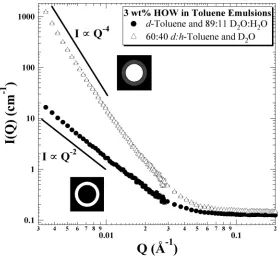
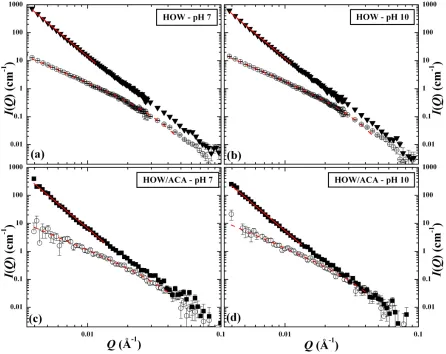
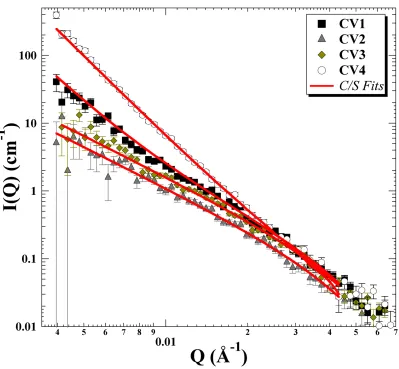
Chapter 3, we will demonstrate the ability to evaluate film thickness, the percentage of the film that is asphaltenic, and the total asphaltene interfacial composition using simple but relevant models for SANS data analysis. We enhance our SANS protocol in Chapter 4 to enable be a more independent and complete characterization for asphaltenic emulsions and their films, with the primary goal being the elucidation of not only the asphaltenic nature in the films, but the solvent and water composition as well. By imposing pH variation and aromatic acid addition we show how changes in film composition, as well as thickness and specific droplet surface area, reveal valuable information about the underlying mechanisms of film formation.
separate asphaltene molecules from the model compounds used in the study, i.e., good solubility, intramolecular rotation, and the ability to interact with many nearest neighbors.
Finally, in Chapter 7 we review our findings and discuss the impact of our work on the petroleum research community. Furthermore, we offer some insight on future experimental investigations that can build upon the work presented in the dissertation.
1.3 References
(1) United States.Energy Information Administration. Annual Energy Outlook 2008. <http://www.eia.doe.gov/oiaf/aeo/pdf/0383(2008).pdf>. 2008.
(2) United States. Energy Information Administration. “World Crude Oil Prices.” July 2, 2008. <http://tonto.eia.doe.gov/dnav/pet/pet_pri_wco_k_w.htm>.
(3) Speight, J. G. Handbook of Petroleum Analysis. 2001, 512.
(4) British Petroleum, BP Statistical Review of World Energy 2008.
(5) Saniere, A.; Henaut, I.; Argillier, J. Pipeline Transportation of Heavy Oils, a Strategic, Economic and Technological Challenge. Oil Gas Sci. Technol. 2004, 59, 455-466.
(7) McLean, J.; Kilpatrick, P. Comparison of Precipitation and Extrography in the Fractionation of Crude Oil Residua. Energy Fuels 1997, 11, 570.
(8) Boduszynski, M. M.; McKay, J. F.; Latham, D. R. Asphaltenes, Where are You? Proc. - Assoc. Asphalt Paving Technol. 1980, 49, 123-143.
(9) Mitra-Kirtley, S.; Mullins, O.; Branthaver, J.; Cramer, S. Nitrogen Chemistry of Kerogens and Bitumens from x-Ray Absorption Near-Edge Structure Spectroscopy. Energy Fuels 1993, 7, 1128-1134.
(10) Waldo, G.; Mullins, O.; Pennerhahn, J.; Cramer, S. Determination of the Chemical Enviroment of Sulfur in Petroleum Asphaltenes by X-Ray Absorption-Spectroscopy. Fuel 1992, 71, 53-57.
(11) Rodgers, R.; Schaub, T.; Marshall, A. Petroleomics: MS Returns to its Roots. Anal. Chem. 2005, 77, 20A-27A.
(12) Marshall, A.; Rodgers, R. Petroleomics: The Next Grand Challenge for Chemical Analysis. Acc. Chem. Res. 2004, 37, 53-59.
(14) Wiehe, I.; Yarranton, H.; Akbarzadeh, K.; Rahimi, P.; Teclemariam, A. The Paradox of Asphaltene Precipitation with Normal Paraffins. Energy Fuels 2005, 19, 1261.
(15) Leon, O.; Rogel, E.; Espidel, J.; Torres, G. Asphaltenes: Structural Characterization, Self-Association, and Stability Behavior. Energy Fuels 2000, 14, 6-10.
(16) Ancheyta, J.; Centeno, G.; Trejo, F.; Marroquin, G.; Garcia, J.; Tenorio, E.; Torres, A. Extraction and Characterization of Asphaltenes from Different Crude Oils and Solvents. Energy Fuels 2002, 16, 1121-1127.
(17) Hortal, A.; Martinez-Haya, B.; Lobato, M.; Pedrosa, J.; Lago, S. On the Determination of Molecular Weight Distributions of Asphaltenes and their Aggregates in Laser Desorption Ionization Experiments. J. Mass Spec. 2006, 41, 960.
(18) Rizzi, A.; Cosmina, P.; Flego, C.; Montanari, L.; Seraglia, R.; Traldi, P. Laser desorption/ionization Techniques in the Characterization of High Molecular Weight Oil Fractions. Part 1: Asphaltenes. J. Mass Spec 2006, 41, 1232-41.
(20) Tanaka, R.; Sato, S.; Takanohashi, T.; Hunt, J.; Winans, R. Analysis of the Molecular Weight Distribution of Petroleum Asphaltenes using Laser Desorption-Mass Spectrometry. Energy Fuels 2004, 18, 1405-1413.
(21) Badre, S.; Carla Goncalves, C.; Norinaga, K.; Gustavson, G.; Mullins, O. Molecular Size and Weight of Asphaltene and Asphaltene Solubility Fractions from Coals, Crude Oils and Bitumen. Fuel 2006, 85, 1-11.
(22) Buenrostro-Gonzalez, E.; Groenzin, H.; Lira-Galeana, C.; Mullins, O. The Overriding Chemical Principles that Define Asphaltenes. Energy Fuels 2001, 15, 972-978.
(23) Groenzin, H.; Mullins, O. Molecular Size and Structure of Asphaltenes from various Sources. Energy Fuels 2000, 14, 677.
(24) Sato, S.; Takanohashi, T.; Tanaka, R. Molecular Weight Calibration of Asphaltenes using Gel Permeation Chromatography/Mass Spectrometry. Energy Fuels 2005, 19, 1991-1994.
(25) Dabir, B.; Nematy, M.; Mehrabi, A.; Rassamdana, H.; Sahimi, M. Asphalt Flocculation and Deposition. III. the Molecular Weight Distribution. Fuel 1996, 75, 1633-1645.
(27) Yarranton, H. Asphaltene Self-Association. J. Dispersion Sci. Technol. 2005, 26, 5-8.
(28) Wiehe, I. In Defense of Vapor Pressure Osmometry for Measuring Molecular Weight. J. Dispersion Sci. Technol. 2007, 28, 431-435.
(29) Hortal, A.; Hurtado, P.; Martinez-Haya, B.; Mullins, O. Molecular-Weight Distributions of Coal and Petroleum Asphaltenes from Laser desorption/ionization Experiments. Energy Fuels 2007, 21, 2863-2868.
(30) Schneider, M.; Andrews, A.; Mitra-Kirtley, S.; Mullins, O. Asphaltene Molecular Size by Fluorescence Correlation Spectroscopy. Energy Fuels 2007, 21, 2875-2882.
(31) Strausz, O.; Safarik, I.; Lown, E.; Morales-Izquierdo, A. A Critique of Asphaltene Fluorescence Decay and Depolarization-Based Claims about Molecular Weight and Molecular Architecture. Energy Fuels 2008, 22, 1156-1166.
(32) Strausz, O.; Peng, P.; Murgich, J. About the Colloidal Nature of Asphaltenes and the MW of Covalent Monomeric Units. Energy Fuels 2002, 16, 809.
(33) Rodgers, R. P. Asphaltene Structure Determined by Mass Spectrometry: Island Vs. Archipelago Models. 8th International Conference on Petroleum Phase Behaviour and Fouling. 2007. Pau, France.
(35) Merino-Garcia, D.; Murgich, J.; Andersen, S. Asphaltene Self-Association: Modeling and Effect of Fractionation with a Polar Solvent. Pet. Sci. Technol. 2004, 22, 735.
(36) Rogel, E. Thermodynamic Modeling of Asphaltene Aggregation. Langmuir 2004, 20, 1003-12.
(37) Rakotondradany, F.; Fenniri, H.; Rahimi, P.; Gawrys, K.; Kilpatrick, P.; Gray, M. Hexabenzocoronene Model Compounds for Asphaltene Fractions: Synthesis & Characterization. Energy Fuels 2006, 20, 2439-2447.
(38) Akbarzadeh, K.; Bressler, D.; Wang, J.; Gawrys, K.; Gray, M.; Kilpatrick, P.; Yarranton, H. Association Behavior of Pyrene Compounds as Models for Asphaltenes. Energy Fuels 2005, 19, 1268-1271.
(39) Tan, X.; Fenniri, H.; Gray, M. Pyrene Derivatives of 2,2 '-Bipyridine as Models for Asphaltenes: Synthesis, Characterization, and Supramolecular Organizations. Energy Fuels 2008, 22, 715-720.
(40) Spiecker, P.; Gawrys, K.; Kilpatrick, P. Aggregation and Solubility Behavior of Asphaltenes and their Subfractions. J. Colloid Interface Sci. 2003, 267, 178-193.
(42) Sztukowski, D.; Jafari, M.; Alboudwarej, H.; Yarranton, H. Asphaltene Self-Association and Water-in-Hydrocarbon Emulsions. J. Colloid Interface Sci. 2003, 265, 179-186.
(43) Hunter, C.; Lawson, K.; Perkins, J.; Urch, C. Aromatic Interactions. J. Chem. Soc. Perk T 2 2001, 651-669.
(44) Murgich, J. Intermolecular Forces in Aggregates of Asphaltenes and Resins. Pet. Sci. Technol. 2002, 20, 983-997.
(45) Savvidis, T.; Fenistein, D.; Barre, L.; Behar, E. Aggregated Structure of Flocculated Asphaltenes. AIChE J. 2001, 47, 206-211.
(46) Tanaka, R.; Hunt, J.; Winans, R.; Thiyagarajan, P.; Sato, S.; Takanohashi, T. Aggregates Structure Analysis of Petroleum Asphaltenes with Small-Angle Neutron Scattering. Energy Fuels 2003, 17, 127.
(47) Thiyagarajan, P.; Hunt, J.; Winans, R.; Anderson, K.; Miller, J. Temperature-Dependent Structural-Changes of Asphaltenes in 1-Methylnaphthalene. Energy Fuels 1995, 9, 829.
(49) Gawrys, K.; Blankenship, G.; Kilpatrick, P. Solvent Entrainment in and Flocculation of Asphaltenic Aggregates Probed by Small-Angle Neutron Scattering. Langmuir 2006, 22, 4487-4497.
(50) Murgich, J.; Rodriguez, J.; Aray, Y. Molecular Recognition and Molecular Mechanics of Micelles of some Model Asphaltenes and Resins. Energy Fuels 1996, 10, 68-76.
(51) Fenistein, D.; Barre, L.; Broseta, D.; Espinat, D.; Livet, A.; Roux, J.; Scarsella, M. Viscosimetric and Neutron Scattering Study of Asphaltene Aggregates in Mixed toluene/heptane Solvents. Langmuir 1998, 14, 1013.
(52) Barre, L.; Simon, S.; Palermo, T. Solution Properties of Asphaltenes. Langmuir 2008, 24, 3709-3717.
(53) Moran, K.; Czarnecki, J. Competitive Adsorption of Sodium Naphthenates and Naturally Occurring Species at Water-in-Crude Oil Emulsion Droplet Surfaces. Coll. Surf. A: Physicochem. Eng. Aspects 2007, 292, 87-98.
(54) Czarnecki, J.; Moran, K. On the Stabilization Mechanism of Water-in-Oil Emulsions in Petroleum Systems. Energy Fuels 2005, 19, 2074-2079.
(56) Ese, M.; Kilpatrick, P. Stabilization of Water-in-Oil Emulsions by Naphthenic Acids and their Salts: Model Compounds, Role of pH, and Soap: Acid Ratio. J. Dispersion Sci. Technol. 2004, 25, 253.
(57) Poteau, S.; Argillier, J.; Langevin, D.; Pincet, F.; Perez, E. Influence of pH on Stability and Dynamic Properties of Asphaltenes and Other Amphiphilic Molecules at the Oil-Water Interface. Energy Fuels 2005, 19, 1337.
(58) McLean, J.; Kilpatrick, P. Effects of Asphaltene Aggregation in Model Heptane-Toluene Mixtures on Stability of Water-in-Oil Emulsions. J Colloid Interface Sci. 1997, 196, 23.
(59) Elsharkawy, A.; Yarranton, H.; Al-Sahhaf, T.; Fahim, M. Water-in-Crude Oil Emulsions in the Burgan Oilfield: Effects of Oil Aromaticity, Resins to Asphaltenes Content (R/(R+A)), and Water pH. J. Dispersion Sci. Technol 2008, 29, 224-229.
(60) Spiecker, P.; Gawrys, K.; Trail, C.; Kilpatrick, P. Effects of Petroleum Resins on Asphaltene Aggregation and Water-in-Oil Emulsion Formation. Coll. Surf. A: Physicochem. Eng. Aspects 2003, 220, 9.
(62) Sullivan, A.; Zaki, N.; Sjöblom, J.; Kilpatrick, P. The Stability of Water in Crude and Model Oil Emulsions. Can. J. Chem. Eng. 2007, 85.
(63) Beetge, J.; Horne, B. Chemical Demulsifier Development Based on Critical Electric Field Measurements. SPE International Symposium on Oilfield Chemistry 2004.
(64) Jones, T.; Neustadter, E.; Whittingham, K. Water-in-Crude Oil Emulsion Stability and Emulsion Destabilization by Chemical Demulsifiers. J. Can. Pet. Technol. 1978, 17, 100.
(65) Chandra, M.; Xu, Z.; Masliyah, J. Interfacial Films Adsorbed from Bitumen in Toluene Solution at a Toluene-Water Interface: A Langmuir and Langmuir-Blodgett Film Approach. Energy Fuels 2008, 22, 1784-1791.
(66) Zhang, L.; Breen, P.; Xu, Z.; Masliyah, J. Asphaltene Films at a Toluene/Water Interface. Energy Fuels 2007, 21, 274-285.
(67) Zhang, L.; Lawrence, S.; Xu, Z.; Masliyah, J. Studies of Athabasca Asphaltene Langmuir Films at Air-Water Interface. J. Colloid Interface Sci. 2003, 264, 128-140.
(68) Strassner, J. Effect of pH on Interfacial Films and Stability of Crude Oil-Water Emulsions. J. Pet. Technol. 1968, 20, 303.
(70) Yarranton, H.; Urrutia, P.; Sztukowski, D. Effect of Interfacial Rheology on Model Emulsion Coalescence - II. Emulsion Coalescence. J. Colloid Interface Sci. 2007, 310, 253-259.
(71) Li, M.; Xu, M.; Ma, Y.; Wu, Z.; Christy, A. Interfacial Film Properties of Asphaltenes and Resins. Fuel 2002, 81, 1847-1853.
(72) Spiecker, P.; Kilpatrick, P. Interfacial Rheology of Petroleum Asphaltenes at the Oil-Water Interface. Langmuir 2004, 20, 4022-4032.
(73) Dicharry, C.; Arla, D.; Sinquin, A.; Graciaa, A.; Bouriat, P. Stability of water/crude Oil Emulsions Based on Interfacial Dilatational Rheology. J. Colloid Interface Sci. 2006, 297, 785-791.
(74) Bouriat, P.; El Kerri, N.; Graciaa, A.; Lachaise, J. Properties of a Two-Dimensional Asphaltene Network at the Water - Cyclohexane Interface Deduced from Dynamic Tensiometry. Langmuir 2004, 20, 7459.
(75) Freer, E.; Radke, C. Relaxation of Asphaltenes at the toluene/water Interface: Diffusion Exchange and Surface Rearrangement. J. Adhes. 2004, 80, 481.
CHAPTER 2
Preferential Solvent Partitioning within Asphaltenic Aggregates
Dissolved in Binary Solvent Mixtures
Chapter 2 is essentially a manuscript by Vincent J. Verruto and Peter K. Kilpatrick that was published in Energy and Fuels (Volume 21, Issue 3, pp. 1343-1349 (2007)).
Abstract
bulk composition (~57%). This is the first such in situ experimental determination of the aggregate composition for asphaltenes dissolved in binary solvents, reinforcing the important role of asphaltene-solvent interactions in asphaltene self-assembly.
2.1 Introduction
Asphaltenes comprise a crude oil fraction to which many attribute the stabilization of water-in-crude oil emulsions. The toluene-soluble/n-heptane-insoluble fraction of crude oil, asphaltenes characteristically exhibit fused ring aromaticity with polar heteroatom functionality (pyrroles, phenols, carbonyls, and carboxylic acids)1-3. Asphaltenes are inherently heterogeneous and polydisperse in molecular chemistry and size, respectively4, 5. Asphaltenes start to self-assemble at modest concentrations (10-50 mg/L)6-8, forming interfacially active nanoscale aggregates that diffuse to the oil/water interface and consolidate as an elastic interfacial film that prevents or retards coalescence. Intermolecular and intraaggregate interactions are largely due to van der Waals (dispersion) forces and include /0/ overlap between aromatic-rich regions of asphaltenes, with possible enhancement of association by Coulombic interactions (H-bonding) among polar oxygenic and nitrogenous moieties1, 9. These aggregates, and the emulsions and deposits which result from their properties, have garnered much attention from the petroleum scientific community for their detrimental impact on crude oil transport and processing.
curves. In addition, only the POC model returned values for Io and RG within a mean 10% of the geometry-independent Guinier approximation.
It is important to note that Gawrys and Kilpatrick assumed that the bulk and entrained solvent compositions were equivalent, and for certain solvent mixtures this is likely to be a reasonable assumption. One might expect, however, that for a nearly equimolar mixture of good and poor solvents, the good solvent will preferentially entrain within the porous aggregate structure over the poor solvent. In such a system, the assumption of equivalent bulk and entrained solvent composition may be a poor one and thus describe inadequately the precise nature of the aggregate. While others have considered occlusion of hydrocarbons in asphaltenic aggregates using complex fractionation techniques37 or inferring asphaltenic aggregate porosity by settling measurements8, this work is a first regarding this level of asphaltenic aggregate description by an in situ characterization technique like SANS. Here, we describe the use of SANS in the assessment of selective solvent partitioning in asphaltenic aggregates dissolved in binary mixtures of toluene with n-heptane, decalin, and 1-methylnaphthalene.
2.2 Materials & Methods
2.2.1 Sample Preparation
Soxhlet until the return to the boiling flask was visually clear. The asphaltenes were recovered by evaporation of the toluene in a rotary evaporator (Büchi EL-131) under partial vacuum at 50-60 °C until almost all of the solvent was removed. The asphaltenes were then redissolved with a minimum volume of methylene chloride and transferred to a weighed jar and placed in an exhaust hood. The vapor in the jar was routinely flushed out with argon to minimize oxidation of the asphaltenes. The jar was weighed daily until the mass remained unchanged for consecutive days. These recovered asphaltenes from the whole crude will be referred to as Hondo Whole (HOW) asphaltenes.
Elemental Analyzer. Enough of each sample was sent in order to perform triplicate measurements. The resulting elemental compositions (C, H, N, S, and O) from HOW and HOS-10 are presented in Table 2.1. It is apparent from the table that the precipitation removes some of the most polar asphaltenes, as the sulfur and oxygen content was lower for HOS-10 than HOW, which is consistent with the recent asphaltene sub-fractionation work of Gawrys, Blankenship, and Kilpatrick38.
compositions for A and B samples to sample 1, the perdeuterated solvent mixture, the hydrogenated/deuterated composition for a particular solvent in the mixture requires only a simple calculation and is in accord with the sample preparation description above.
For all mixed solvent systems, the appropriate masses of asphaltenes were first weighed out in small glass jars on an Ohaus Explorer (E12140) laboratory balance. This was followed by the addition of toluene-d8 (CDN Isotopes, 99.7 atom% D) and, when necessary, HPLC grade hydrogenated toluene (Fisher Scientific). Following overnight agitation was the addition of decalin-d18 (CDN Isotopes, 98.8 atom% D) and hydrogenated decalin (Acros Organics) to the HOW samples or n-heptane-d16 (CDN Isotopes, 99.0 atom % D) and HPLC grade hydrogenated n-heptane (Fisher Scientific) to the HOS-10 samples. For the 1-methylnaphthalene:toluene samples, either hydrogenated 1-methylnaphthalene (Aldrich) or 1-methylnaphthalene-d10 (CDN Isotopes, 98.9 atom% D) was added after initially dissolving HOW in toluene.
2.2.2 Small Angle Neutron Scattering (SANS)
between the incident and scattered neutron wavevectors. Here |Q| = 4)*-1sin1, in which * is the neutron wavelength and 21 is the scattering angle (this magnitude will be subsequently referred to as Q). The scattering intensity is often expressed simply as the following:
) ( ) ( )
(Q N P Q S Q
I = s (2.1)
where Ns is the number density of scattering bodies, P(Q) is the scatterer geometric form factor, and S(Q) is the structure factor, a description of the interactions between scatterers. In the dilute-scatterer limit S(Q) is unity, where modeling efforts are focused on the P(Q). For a detailed mathematical description and derivation of the polydisperse oblate cylindrical form factor used in this study the reader should be directed to the work of Gawrys and Kilpatrick12.
Å-1 (+Q/Q = 0.091). These solvent mixtures and asphaltene solutions were run on NG7 for 10 min each. Transmissions on all runs at NIST were collected over 2 min.
The heptane:toluene samples were run on the SAND instrument at the Intense Pulsed Neutron Source (IPNS) at Argonne National Lab (Argonne, IL). The IPNS uses a spallation neutron source, in which neutrons of different energies are produced upon the collision of high-energy H– ions with a depleted uranium target. The SAND is a time-of-flight (TOF) instrument, capable of probing Q values of 0.0035 – 0.6 Å-1. All samples were run in quartz cells having 2-mm path length. Solutions with heptane and toluene were run for 45 min to 1 h of scattering and background solvent blanks were run for 45 min. Transmission for each run was collected over 15 min.
2.2.3 Data Reduction and Analysis
background profile up to Q = 0.1 Å-1 to smooth the scattering curve. Because the incoherent cross-section of hydrogenated materials are wavelength-dependent39, 40, the background scattering of the partially hydrogenated samples from the SAND instrument did not have a flat background profile, so the curves were fit with an arbitrary equation over the Q range 0.01-0.5 Å-1, only for the purposes of smoothing the data.
To conserve valuable beam time, we only prepared mixed solvent backgrounds at every 10% hydrogenation of each solvent with the intent of interpolating the intermediate background samples for the decalin:toluene series. This was easily achieved with the flat data of the decalin:toluene solvent samples in the relevant Q range. Plotting the incoherent intensity (Iinc) as a function of the h-decalin or h-toluene mole fraction, we then fit this data with an arbitrary function for interpolative use. Using the mole fraction of the hydrogenated solvent from the solution sample preparation, the appropriate Iinc could then be calculated from the fit for the intermediate solvent blanks that were not subjected to scattering. For the smoothed Iinc(Q) for the heptane:toluene solvent mixture backgrounds, entire curves were used to interpolate the background contribution of intermediate solvent mixtures.
(e.g., shape and solvent entrainment) and is the basis for much of the interpretation regarding the scattering data reported in the next section.
2.3 Results & Discussion
2.3.1 1% HOW in 40:60 (v:v) Decalin:Toluene
A small set of scattering curves for 1% HOW in 40:60 decalin:toluene are shown in Figure 2.1, for which we see the effects of partially hydrogenating the solvent mixture. As expected, we observed an increase in the incoherent background (high Q) as the hydrogen content was increased, as well as a reduction in the low-Q intensity (Io) as a result of the reduced aggregate/solvent contrast. Model representations of the background subtraction and the subsequent optimized POC curve are presented in Figure 2.2. Expecting that chemically identical HOW solutions – only the degree of hydrogenation of the solvent differed – would have identical aggregate dimensions, we simultaneously fit all of the curves with the constraint that Rcyl, +R, and Lcyl were the same for all samples. The resulting fitted parameters minimized the average percent error over all of the data points used in the fit, i.e.,
100 * %
n I
I I
Error n data i
POC data
!
"= (2.2)
returned Rcyl = 42.1 Å, +R = 19.2 Å, and Lcyl = 22.4 Å, having a minimized average error of 4.4%.
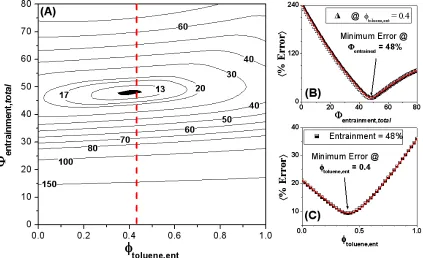
In order to assess the entrained solvent composition, we initially sought to solve for the total entrainment as a function of the toluene volume fraction in the entrained solvent. This was achieved by solving the objective function shown below.
7 , , , 10 ) ( ) ( ) ( ! " ! fit o calc o fit o I Mw I Mw I Mw (2.3)
Mw(Io,fit) and Mw(Io,calc) are the apparent aggregate molecular weights determined by the fitted POC Io value and the calculated Io using the POC parameters, respectively, defined by:
( )
2 , ) ( ! " ! # = agg agg m A o o N I I Mw (2.4)( )
22 2 , ) 1 ( ) 3 )( 4 ( + + + ! = z z z L R
Iocalc $agg # " cyl cyl (2.5)
where !agg is the aggregate volume fraction, NA is Avogadro’s number, ,m,agg is the mass density of the aggregate, (&,)2 is the squared difference of the aggregate and solvent scattering length densities, Rcyl is the average cylinder radius, Lcyl is the cylinder length, and z is the radial polydispersity index defined as z = (Rcyl/+R)2 – 1. Note that the total amount of entrained solvent and its composition should affect ,m,agg, (&,)2, and !agg.
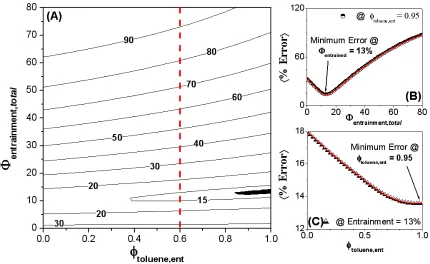
total solvent entrainment and the entrained solvent composition. However, no single locus was observed for the intersection of all of the curves.
2.3.2 1% HOS-10 in 40:60 (v:v) n-Heptane:Toluene
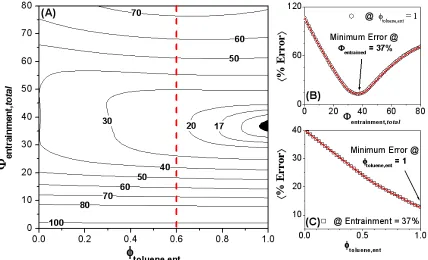
A similar optimization was performed on the HOS-10 samples in 40:60 hetpane:toluene, for which all background subtracted data were simultaneously fit to share Rcyl, +R, and Lcyl while allowing Io and background to vary independently. The resulting optimized parameters yielded Rcyl = 51.0 Å, +R = 23.6 Å, and Lcyl = 25.9 Å, with an average error of 6.1%. Having been dispersed in a poorer solvent mixture, even though they were of a more soluble subfraction, the aggregates were ~70% larger than those for the HOW in 40:60 decalin:toluene samples, with comparable polydispersity. As was observed in the decalin:toluene series, there was no single intersection point for all of the samples regarding the total entrainment as a function of entrained solvent composition. However, Figures 2.4A-C illustrate that the minimum average error indicates a total solvent entrainment of 37 % (Vent/Vagg) that appears to be nearly pure toluene (95-100%).
2.3.3 1% HOW in 50:50 (mol:mol) 1-Methylnaphthalene:Toluene
Data for the equimolar 1-methylnaphthalene/toluene mixture series were subjected to the same aforementioned optimization routine. Here background-subtracted data were simultaneously fit to share Rcyl, +R, and Lcyl while allowing Io to vary and bkg to remain zero. The optimization yielded Rcyl = 38.5 Å, +R = 17.6 Å, and Lcyl = 22.4 Å, with an average error of 8.8%. Of the three solvent mixtures, asphaltenic aggregates in this series had the smallest geometric dimensions and overall "RG#. Presented in Figure 2.5A is the calculated minimum
plots in Figures 2.5A-C that the methylnaphthalene composition in the entrained solvent is marginally greater than that of the bulk, 60 to 57% (v/v), respectively.
2.3.4 Rationale for Observed Selective Partitioning
In each of the three asphaltenic aggregate systems presented above, the bulk solvent contained a mixture of toluene and a cosolvent of varying quality (cf. Table 2.3). Calculations of POC aggregate average radius of gyration were performed using,
2 2 2 2 ) 1 ( ) 5 )( 6 ( 2 3 + + + + = z z z R L
RG cyl cyl (2.6)
These cosolvents differ in several ways including their solubility parameters, density, and molecular size and shape. Of these solvents, 1-methylnaphthalene is considered to be the best solvent for asphaltenes, which is consistent with the observation that HOW aggregates have the smallest "RG# and "Vagg# in this solvent. By this criterion, solvent quality or asphaltene solvency decreases in the sequence methylnaphthalene, toluene, decalin, and n-heptane, which, by definition, is an asphaltene antisolvent (precipitant). Considering the solvent H/C molar ratio, which we use as an “aromaticity index”, we observe that with decreasing H/C the solvents used here become increasingly aromatic, as well as increasingly better solvents for asphaltenes. Presented in Table 2.4, in which the solvents are listed from left-to-right with respect to increasing asphaltene solvency, are some of these defining attributes of the solvents used in this study.
experiments. From Tables 2.3 and 2.4 we see that HOW aggregates in toluene have an "RG# of roughly 51 Å, with aggregates of the HOS-10 fraction expected to be slightly smaller. At the compositions studied, adding a solvent like n-heptane or decalin results in individual aggregates with increased average volume (1.3-2.1X) and average surface area (1.7-2.5X). On the basis of a mass balance, this would decrease the total number of aggregates as well as the total aggregate surface area in contact with the solvent. It is understood that aggregate size grows with the addition of n-heptane until the aggregates flocculate and subsequently precipitate when they become too large to remain suspended by the thermal energy of the system1. This response by the asphaltenes is driven by the minimization of the free energy resulting from solvent/aggregate interactions. It is possible that the aliphatic portions of the asphaltenes present at the aggregate surface rearrange and extend into the bulk to further reduce the solvent/aggregate interaction free energy. Since asphaltenes are prepared by heptane-induced precipitation from a crude oil, the interaction between the polynuclear aromatic moieties on the asphaltene and n-heptane must be thermodynamically unfavorable. Rearrangement of the flexible aliphatic chains could minimize association with the condensed aromatic groups in the aggregate, effectively shielding the inner aggregate from n-heptane exposure.
When decalin was paired with toluene, we observed only a slight amount of decalin entrained within the aggregates. While decalin is aliphatic in nature, its cyclic structure renders it a solvent for asphaltenes, albeit a weak one. Table 2.3 shows a comparison of the
1-methylnaphtalene. Unlike n-heptane, however, decalin does not induce asphaltene precipitation upon addition. This suggests that the interactions between decalin and the polynuclear moieties in the asphaltenic aggregate are more favorable than the same interactions between these moieties and n-heptane. This is likely a result of the presence of fused naphthenic and alicyclic rings observed in asphaltenes5. We see in Table 2.4 that for decalin the Hansen solubility parameter related to dispersion has a value nearly equivalent to toluene yet substantially larger than that of n-heptane. However, polar or H-bonding contributions to the solubility parameters, which are present in toluene and 1-methylnaphthalene, are absent in decalin and hence limit its asphaltene solvency. It should be noted that although it is drawn flat in Table 2.4, decalin actually exists in cis and trans forms, neither of which are planar molecules like methylnaphthalene or toluene, and each occupy molecular volume differently. Additionally, lacking delocalized / orbital electrons ubiquitous in aromatic species, decalin does not associate with fused aromatic moieties as favorably as toluene or methylnaphthalene. This is consistent with solubility data for naphthalene, the simplest fused aromatic ring molecule, in benzene41 (38 mol %) versus cis-decalin42 (27 mol %) at ~35 °C, as well as a comparison of the universal quasichemical (UNIQUAC) activity coefficient model binary interaction parameters for naphthalene in cis-decalin versus tetralin42. As a result, entrained decalin within an aggregate is unlikely to reside stacked between condensed aromatic regions of asphaltenes when toluene is also present.
is 3/4 the value obtained for pure toluene. This effect may be amplified in this mixture as the decalin likely interferes with the toluene/asphaltene and toluene/toluene stacking interactions, negatively impacting the total entrainment.
Intuitively, when two aromatic solvents were paired together in equimolar contribution, toluene and 1-methylnaphthalene, the contour plot in Figure 2.5A describes only a slight enhancement of the methylnaphthalene composition within the aggregates. Again, from Tables 2.3 and 2.4 we have inferred that 1-methylnaphthalene is the strongest solvent of those tested, i.e., it induces aggregates of the smallest dimensions. This should be expected using a “like dissolves like” interpretation coupled with inspection of the dispersion, polar, and H-bonding Hansen solubility parameters (Table 2.4) in comparison to those for toluene. Although noticeable, the enhanced solvency of asphaltenes in methylnaphthalene versus toluene is small, and as a result the extent to which it is preferentially entrained also is small. This is an encouraging result, as the ordering of preferential entrainment seems to agree with the ordering of solvents in Table 2.4. This means that the preferential entrainment of toluene decreases as toluene is paired with solvents of increasing asphaltene solvency, solvents listed from left-to-right in Table 2.4, and when paired with an even better solvent, the better solvent is preferentially entrained.
Overall, the results suggest that by considering a few simple, yet important, properties of individual solvents, we can better understand, and perhaps predict, how they impact the aggregation state of asphaltenes dissolved in binary or higher order solvent mixtures.
2.4 Conclusions
Acknowledgements
2.5 References
(1) Spiecker, P. M.; Gawrys, K. L.; Kilpatrick, P. K., Aggregation and solubility behavior of asphaltenes and their subfractions. J. Colloid Interface Sci 2003, 267, (1), 178-193.
(2) McLean, J. D.; Kilpatrick, P. K., Comparison of precipitation and extrography in the fractionation of crude oil residua. Energy Fuels 1997, 11, (3), 570.
(3) Speight, J. G., The chemistry and technology of petroleum, 2nd ed.; M. Dekker: New York, 1991; Part xi, p 760.
(4) Yarranton, H. W.; Masliyah, J. H., Molar mass distribution and solubility modeling of asphaltenes. AIChE Journal 1996, 42, (12), 3533.
(5) Strausz, O. P.; Peng, P.; Murgich, J., About the colloidal nature of asphaltenes and the MW of covalent monomeric units. Energy Fuels 2002, 16, (4), 809.
(6) Acevedo, S.; Ranaudo, M. A.; Pereira, J. C.; Castillo, J.; Fernandez, A.; Perez, P.; Caetano, M., Thermo-optical studies of asphaltene solutions: evidence for solvent-solute aggregate formation. Fuel 1999, 78, (9), 997-1003.
(7) Goncalves, S.; Castillo, J.; Fernandez, A.; Hung, J., Absorbance and fluorescence spectroscopy on the aggregation behavior of asphaltene-toluene solutions. Fuel 2004, 83, (13), 1823-1828.
(9) Murgich, J., Intermolecular forces in aggregates of asphaltenes and resins. Pet. Sci. Technol. 2002, 20, (9-10), 983-997.
(10) Fenistein, D.; Barre, L.; Broseta, D.; Espinat, D.; Livet, A.; Roux, J. N.; Scarsella, M., Viscosimetric and neutron scattering study of asphaltene aggregates in mixed toluene/heptane solvents. Langmuir 1998, 14, (5), 1013.
(11) Gawrys, K. L.; Kilpatrick, P. K., Asphaltene aggregation: Techniques for analysis. Instrum. Sci. Technol. 2004, 32, (3), 247.
(12) Gawrys, K. L.; Kilpatrick, P. K., Asphaltenic aggregates are polydisperse oblate cylinders. J. Colloid Interface Sci 2005, 288, (2), 325-334.
(13) Liu, Y. C.; Sheu, E. Y.; Chen, S. H.; Storm, D. A., Fractal Structure of Asphaltenes in Toluene. Fuel 1995, 74, (9), 1352-1356.
(14) Ravey, J. C.; Ducouret, G.; Espinat, D., Asphaltene Macrostructure by Small-Angle Neutron-Scattering. Fuel 1988, 67, (11), 1560-1567.
(15) Roux, J. N.; Broseta, D.; Deme, B., SANS study of asphaltene aggregation: Concentration and solvent quality effects. Langmuir 2001, 17, (16), 5085-5092.
(16) Sheu, E. Y.; Liang, K. S.; Sinha, S. K.; Overfield, R. E., Polydispersity Analysis of Asphaltene Solutions in Toluene. J Colloid Interface Sci. 1992, 153, (2), 399-410.
(18) Tanaka, R.; Hunt, J. E.; Winans, R. E.; Thiyagarajan, P.; Sato, S.; Takanohashi, T., Aggregates structure analysis of petroleum asphaltenes with small-angle neutron scattering. Energy Fuels 2003, 17, (1), 127.
(19) Tanaka, R.; Sato, E.; Hunt, J. E.; Winans, R. E.; Sato, S.; Takanohashi, T., Characterization of asphaltene aggregates using ray diffraction and small-angle X-ray scattering. Energy Fuels 2004, 18, (4), 1118-1125.
(20) Hung, J.; Castillo, J.; Reyes, A., Kinetics of asphaltene aggregation in toluene-heptane mixtures studied by confocal microscopy. Energy Fuels 2005, 19, (3), 898-904.
(21) Jeribi, M.; Almir-Assad, B.; Langevin, D.; Henaut, I.; Argillier, J. F., Adsorption kinetics of asphaltenes at liquid interfaces. J Colloid Interface Sci. 2002, 256, (2), 268.
(22) Ese, M. H.; Yang, X.; Sjöblom, J., Film forming properties of asphaltenes and resins. A comparative Langmuir-Blodgett study of crude oils from North Sea, European continent and Venezuela. Colloid Polym. Sci. 1998, 276, (9), 800.
(23) Yeung, A.; Dabros, T.; Czarnecki, J.; Masliyah, J., On the interfacial properties of micrometre-sized water droplets in crude oil. Proc. R. Soc. London, Ser. A: Math. Phys. Eng. Sci. 1999, 455, (1990), 3709.
(25) Dodd, C. G., The Rheological Properties of Films At Crude Petroleum-Water Interfaces. J. Phys. Chem. 1960, 64, (5), 544.
(26) Freer, E. M.; Radke, C. J., Relaxation of asphaltenes at the toluene/water interface: Diffusion exchange and surface rearrangement. J. Adhes. 2004, 80, (6), 481.
(27) Spiecker, P. M.; Kilpatrick, P. K., Interfacial rheology of petroleum asphaltenes at the oil-water interface. Langmuir 2004, 20, (10), 4022.
(28) Thiyagarajan, P.; Hunt, J. E.; Winans, R. E.; Anderson, K. B.; Miller, J. T., Temperature-Dependent Structural-Changes of Asphaltenes in 1-Methylnaphthalene. Energy Fuels 1995, 9, (5), 829.
(29) Mason, T. G.; Lin, M. Y., Asphaltene nanoparticle aggregation in mixtures of incompatible crude oils. Phys. Rev. E 2003, 67, (5), 2165.
(30) Hu, X. J.; Littrel, K.; Ji, S.; Pickles, D. G.; Risen, W. M., Characterization of silica-polymer aerogel composites by small-angle neutron scattering and transmission electron microscopy. J. Non-Cryst. Solids 2001, 288, (1-3), 184-190.
(31) Chen, S. H.; Teixeira, J., Structure And Fractal Dimension Of Protein-Detergent Complexes. Phys. Rev. Lett. 1986, 57, (20), 2583-2586.
(33) Groenzin, H.; Mullins, O. C., Molecular size and structure of asphaltenes from various sources. Energy Fuels 2000, 14, (3), 677.
(34) Murgich, J.; Abanero, J. A.; Strausz, O. P., Molecular recognition in aggregates formed by asphaltene and resin molecules from the Athabasca oil sand. Energy Fuels 1999, 13, (2), 278.
(35) Gray, M. R., Consistency of asphaltene chemical structures with pyrolysis and coking behavior. Energy Fuels 2003, 17, (6), 1566.
(36) Gawrys, K. L.; Blankenship, G. A.; Kilpatrick, P. K., Solvent entrainment in and flocculation of asphaltenic aggregates probed by small-angle neutron scattering. Langmuir 2006, 22, (10), 4487-4497.
(37) Liao, Z. W.; Zhou, H. G.; Graciaa, A.; Chrostowska, A.; Creux, P.; Geng, A., Adsorption/occlusion characteristics of asphaltenes: Some implication for asphaltene structural features. Energy Fuels 2005, 19, (1), 180-186.
(38) Gawrys, K. L.; Blankenship, G. A.; Kilpatrick, P. K., On the distribution of chemical properties and aggregation of solubility fractions in asphaltenes. Energy Fuels 2006, 20, (2), 705-714.
(39) May, R. P.; Ibel, K.; Haas, J., The Forward Scattering of Cold Neutrons by Mixtures of Light and Heavy-Water. J. of App. Cryst. 1982, 15, (Feb), 15-19.
(41) Mclaughlin, E.; Zainal, H. A., The Solubility Behaviour of Aromatic Hydrocarbons in Benzene. J. Chem. Soc. 1959, (Mar), 863-867.
(42) Gupta, A.; Gupta, S.; Groves, F. R.; Mclaughlin, E., Correlation of Solid Liquid and Vapor-Liquid-Equilibrium Data for Polynuclear Aromatic-Compounds. Fluid Phase Equilibria 1991, 64, 201-211.
(43) Smallwood, I. M. Handbook of Organic Solvents; Wiley & Sons: New York, 1996.
Table 2.1. Elemental mass composition of asphaltenes (C, H, N, S, and O) determined by combustion analysis.a
Sample %C %H %N %S %O (by diff) H/C b
HOW 79.1 ± 0.1 8.1 ± 0.0 2.0 ± 0.0 8.2 ± 0.1 2.6 ± 0.1 1.23 HOS-10 79.4 ± 0.1 8.4 ± 0.0 2.0 ± 0.0 7.8 ± 0.2 2.4 ± 0.1 1.25
Table 2.2. Hydrogenated/deuterated solvent compositions for each solvent mixture series.a,b
# !