FUNCTIONS OF LANGUAGE IN FOREST RESOURCE REPORT GENRE FROM A SYSTEMIC FUNCTIONAL LINGUISTICS PERSPECTIVE
WAN FARAH WANI BINTI WAN FAKHRUDDIN
A thesis submitted in fulfilment of the requirements for the award of the degree of
Doctor of Philosophy
To my beloved parents,
Azaini binti Arifin and Wan Fakhruddin bin Ali, my dearest husband,
Md Nurrahiem bin Mohd Ali and my two beautiful daughters,
Noor Amni Rahwani and Noor Aliesya Rahwani,
whose love, support and their faith in my abilities have made me a better person, and it is only fitting that this thesis, which is little
enough repayment, be dedicated to them.
iv
ACKNOWLEDGEMENT
In the name of Allah SWT, the Most Glorified, the Most High. All the praises and thanks be to Allah, the Lord of the ‘Alamin (mankind, jinns and all that exists). I would like to express my utmost gratitude to Universiti Teknologi Malaysia (UTM) and Language Academy for giving me the opportunity to pursue my doctoral study. Their support, both financially and emotionally, allowed me to dream big and to travel the world in pursuit of seeking knowledge. I am indebted to UTM for their scholarship which allowed me to present my work at University of Geneva, Switzerland and to spend my three-month attachment at Cardiff University, United Kingdom.
I could not find the words to express my gratitude to my supervisor, Dr. Hanita Hassan, for the patient guidance, encouragement and advice she has provided me throughout my time as her student. I have been extremely lucky to have a supervisor who not only cared so much about my work but was also concerned about my personal life when it matters most and who responded to my queries and questions so promptly.
This thesis would not have been materialised were it not for the strong support provided by my parents, my husband and my children. Their constant prayers, encouragement and willingness to give a helping hand in times of need, gave me the strength I need to persevere to complete this thesis. To my dearest friends; Kak Amina, Kak Yasmin, Balqis, Eidhah, Arfin, Mardiana, Ali, Kak Nora, Syura, and those who I fail to mention, thank you for being my companion through this time.
v
ABSTRACT
ABSTRAK
Walaupun kajian genre terdahulu mengkaji pelbagai genre laporan profesional dalam konteks, disiplin dan bahasa yang berbeza, genre laporan profesional dalam disiplin perhutanan masih kurang diterokai terutamanya dari perspektif nahu sistemik fungsional (SFL). Sehingga kini, penemuan yang terhad telah dilaporkan mengenai bagaimana bahasa Melayu digunakan dalam konteks profesional perhutanan. Kajian ini mengkaji elemen-elemen yang membentuk struktur generic (GSP) untuk laporan sumber hutan (FRR) dalam disiplin perhutanan, bagaimana bahasa digunakan untuk mewakili makna pengalaman dan tekstual dan peranan genre FRR. Enam FRR yang ditulis dalam bahasa Melayu dan tiga temuramah dengan pegawai perhutanan telah digunakan sebagai data penyelidikan dalam kajian ini. Kajian kaedah kualitatif ini menggunakan analisis SFL dan temubual separa berstruktur. Dapatan kajian menunjukkan bahawa genre FRR adalah genre hybrid yang dibentuk oleh 10 elemen utama dan 17 sub-elemen yang menggambarkan elemen-elemen khas dalam surat dan genre berkaitan perhutanan. Selain itu, makna pengalaman genre FRR secara utamanya mewakili aktiviti yang dilakukan oleh pegawai perhutanan melalui proses lakuan yang dominan di mana kawasan hutan dilihat sebagai entiti yang paling terjejas oleh aktiviti-aktiviti yang berlaku. Sebaliknya, penerangan mengenai kawasan hutan ditambah terutamanya melalui kaedah suasana Lokasi. Dapatan kajian makna tekstual menunjukkan bahawa genre FRR mengekalkan topik mengenai kawasan hutan sebagai pilihan tema, dan organisasi keseluruhan dicapai melalui Tema aliran kekal untuk meletakkan maklumat khusus berkaitan kawasan hutan serta sumbernya. Sementara itu, dapatan kajian berkaitan peranan genre FRR menunjukkan bahawa FRR memberikan pemerhatian dan maklumat awal dalam membantu jabatan perhutanan membuat keputusan dan perancangan untuk hala tuju masa depan dalam perkara berkaitan perhutanan. Implikasi kajian ini menunjukkan tentang penerokaan elemen-elemen genre, representasi fungsi pengalaman dan tekstual dan peranan boleh diteroka dari perspektif genre dan metafungsi SFL dalam mengkaji penggunaan bahasa Melayu.
TABLE OF CONTENT
CHAPTER TITLE PAGE
DECLARATION ii
DEDICATION iii
ACKNOWLEDGEMENT iv
ABSTRACT v
ABSTRAK vi
TABLE OF CONTENTS vii
LIST OF TABLES xiv
LIST OF FIGURES xvi
LIST OF ABBREVIATIONS xix
LIST OF APPENDICES xx
1 INTRODUCTION 1
1.0 Introduction 1
1.1 Background of the Study 3
1.2 Statement of the Problem 5
1.3 Purpose of the Study 7
1.4 Research Objectives 8
1.5 Research Questions 9
1.6 Scope of the Study 9
1.7 Significance of the Study 11
1.8 Theoretical Framework of the Study 14
1.9 Conceptual Framework of the Study 18
1.10 Definition of Terms 20
1.12 Summary 24
2 LITERATURE REVIEW 25
2.0 Introduction 25
2.1 The Evolution of Genre Theory and Linguistic
Approaches to the Study of Genre 26 2.2 The Concept of Genre in Systemic Functional
Linguistics (SFL) 33
2.2.1 The Concept of Generic Structure 36 2.2.2 Hasan’s (1985) Generic Structure Potential
(GSP) Model 39
2.3 Approaches to Analysis of Professional Genres from
Systemic Functional Linguistics (SFL) Perspective 42 2.4 Systemic Functional Linguistics (SFL): Language
as Social Semiotics 51
2.4.1. The Architecture of Language: Metafunctions 58 2.4.1.1 Ideational Metafunction 60 2.4.1.2 Textual Metafunction 62 2.5 The Multidisciplinary Nature of Forestry Discipline
as a Scientific Discipline 64
2.5.1 Previous Studies in Forestry-related Genre 67 2.6 The Nature of Malay as an Austronesian Language 72
2.6.1 Previous Studies on Malay from SFL
Perspective 77
3 METHODOLOGY 82
3.0 Introduction 82
3.1 Research Design 83
3.2 Research Data and Participants 87
3.2.1 Forest Resource Reports (FRR) 88 3.2.2 Semi-structured Interviews with Forestry
Professionals 91
3.3 Research Procedure 93
3.4 Preliminary Study 95
3.5 Data Analysis Procedure 101
3.5.1 Phase 1: Analysis of Elements and Generic
Structure Potential of Forest Resource Reports 104 3.5.2 Phase 2: Analysis of Language Metafunctions 108
3.5.2.1 Phase 2.1: Identification of Clause
Boundaries 109
3.5.2.2 Phase 2.2: Coding of Clauses in
Forest Resource Reports 112 3.5.2.3 Phase 2.3: Glossing Rules for
Translation of Malay in Forest
Resource Reports 113 3.5.2.4 Phase 2.4: Clause Analysis using
Fontaine’s (2013) Ten Steps for
Analysing the Clause 116 3.5.2.5 Phase 2.5: Identification of Thematic
Progression in forest resource reports 139 3.5.3 Phase 3: Analysis of Roles of Forest Resource
Reports 143
3.6 Summary 145
4 ELEMENTS AND GENERIC STRUCTURE
POTENTIAL OF FOREST RESOURCE REPORTS 146
4.1 The Generic Convention of Forest Resource Reports 147 4.2 Elements of Forest Resource Reports 152
4.2.1 Letterhead 153
4.2.2 Reference 155
4.2.3 Date 156
4.2.4 Security Marker 157
4.2.5 Inside Address 158
4.2.6 Salutation 159
4.2.7 Subject Line 160
4.2.8 Introductory Paragraph 161
4.2.9 Body Paragraph 163
4.2.9.1 Area Location 164
4.2.9.2 Terrain/Topographical Condition 165
4.2.9.3 Area Size 166
4.2.9.4 Forest Status 166
4.2.9.5 Forest Density 167
4.2.9.6 Effects of Forest Harvesting
Activities 167
4.2.9.7 Log Access Road 168
4.2.9.8 Fieldwork Monitoring 169 4.2.9.9 General Information 169
4.2.9.10 Review 170
4.2.10 Closure 172
4.2.10.1 Preclose 172
4.2.10.2 Close 173
4.2.10.3 Government Slogan 174
4.2.10.4 Department Slogan 175
4.2.10.5 Sign-off 175
4.2.10.6 Signature and Sender Details 176
4.2.10.7 File Data 176
4.3 Generic Structure Potential (GSP) for Forest Resource
Reports 180
5 REALISATIONS OF EXPERIENTIAL MEANING IN
REPRESENTING THE FUNCTIONS AND ROLES OF
FOREST RESOURCE REPORTS 183
5.0 Introduction 183
5.1 Functions of Genre Elements and Realisations of
Experiential Meaning in Forest Resource Reports 184
5.1.1 Introductory Paragraph 189
5.1.2 Body Paragraph 195
5.1.2.1 Area Location 192
5.1.2.2 Terrain/ Topographical Condition 196
5.1.2.3 Area Size 200
5.1.2.4 Forest Status 203
5.1.2.5 Forest Density 206
5.1.2.6 Effects of Forest Harvesting Activities 210
5.1.2.7 Log Access Road 215
5.1.2.8 Fieldwork Monitoring 219
5.1.2.9 General Information 221
5.1.2.10 Review 225
5.1.3 Preclose 237
5.2 Roles of Forest Resource Reports 239
5.3 Summary 252
6 THEME SELECTION AND MEANING ORGANISATION
IN FOREST RESOURCE REPORTS 253
6.0 Introduction 253
6.1 Theme Selection in Forest Resource Reports: Analysis
on Experiential / Unmarked Themes 254 6.2 Theme Selection in Forest Resource Reports: Analysis
on Marked Themes 261
6.2.1 Complement as Marked Themes in Forest
6.2.2 Process as Marked Themes in Forest Resource
Reports 267
6.2.3 Adjunct as Marked Themes in Forest Resource
Reports 271
6.2.4 Subject Ellipsis as Marked Themes in Forest
Resource Reports 273
6.3 Establishing Relevance in Forest Resource Reports:
Analysis on Textual Themes 277
6.4 Development of Message and Meaning in Forest
Resource Reports: Analysis on Thematic Progression 290 6.4.1 Linear Theme Progression Pattern 292 6.4.2 Constant Theme Progression Pattern 294 6.4.3 Derived Theme Progression Pattern 295 6.4.4 Split Rheme Progression Pattern 299
6.5 Summary 301
7 IMPLICATIONS, LIMITATIONS AND CONCLUSIONS 302
7.0 Introduction 302
7.1 Overview of the Study 303
7.2 Summary of Findings 303
7.2.1 Elements and Generic Structure Potential of
Forest Resource Reports 304
7.2.2 The Functions and Roles of Forest Resource Reports Represented through Experiential
Meaning 305
7.2.3 Theme Selection and Meaning Organisation
(Textual Meaning) in Forest Resource Reports 307 7.2.4 Roles of Forest Resource Reports in Achieving
its Communicative Purpose 308
7.3 Implications 309
7.3.3 Pedagogical Implications 312
7.4 Limitations of the Study 313
7.4.1 Report Genre 313
7.4.2 Participants and Sample Size 314
7.4.3 Linguistic Analysis 315
7.5 Recommendations for Future Research 315 7.5.1 Analysis of Generic Structure Potential and
Theme Selection in Malay Professional Texts 316 7.5.2 Types of Professional Forestry Genre 316 7.5.3 Utilisation of SFL Analysis on Malay Texts 317
REFERENCES 318
xiv
LIST OF TABLES
TABLE NO. TITLE PAGE
1.1 Definition of terminology used in the study 20
2.1 Genre within literary traditions 27
2.2 Traditional and modern conception of genre 29
2.3 Formal and functional criteria of labelling stages of genre 37
2.4 Possible SFL applications 52
2.5 Language metafunctions and their realisations 59 3.1 Research questions, methods and analytical framework 86 3.2 Question matrix for semi-structured interview 92
3.3 Liepzig glossing rules used in the study 114
3.4 Abbreviations and notations used in the study 115 3.5 Summary of Malay process types (Idris, 2012;2013) 121
3.6 Types of circumstantial element 131
3.7 Identification of experiential theme in forest resource
reports 133
3.8 Asmah’s (2015) categorisation of Malay conjunctive
adjuncts 134
3.9 Categorisation of theme markedness in forest resource
reports 138
4.1 Summary of the elements in forest resource reports and
their general function 178
5.1 Process types in forest resource reports 184
5.2 Summary of roles of process types in forest resource
5.3 Summary of participant roles in forest resource reports 242 5.4 Summary of roles of circumstantial elements in forest
resource reports 243
6.1 Frequency and category of nominal groups realising
experiential theme 255
6.2 Complement as marked theme in forest resource reports 262 6.3 Circumstantial adjuncts as themes in the reports 271 6.4 Frequency of conjunctive adjunct and conjunction realising
xvi
LIST OF FIGURES
FIGURE NO. TITLE PAGE
1.1 UTM research niche areas to support national priorities 13
1.2 Theoretical framework of the study 17
1.3 Conceptual framework of the study 19
2.1 Language in relation to stratified model of social context 34 2.2 Hasan’s (1985) GSP formula of sales encounter 41 2.3 Bhatia’s (2004) colony of reporting genres across
disciplinary boundaries
disciplinary boundaries 43
2.4 Chakorn’s (2010) rhetorical move pattern of MFTCs 46 2.5 Taib’s (2010) GSP of b2b brochure disciplinary
boundaries
49
2.6 Impacts of language as a system of meaning 54
2.7 Pillars of sustainable forest management 66
3.1 Overview of the research procedure 94
3.2 Procedures of the data analysis 103
3.3 Van Nus’(1999) structural units of business letters 105 3.4 Jalilifar and Beitsayyah’s (2011) labelling of sub-steps in
business letter 105
3.5 Hasan’s (1985) GSP formula of sales encounter 106 3.6 Systematic coding of forest resource reports sub-element 112 3.7 Fontaine’s (2013) ten steps for analysing the clause 117
3.8 Linear theme progression pattern 140
3.9 Constant theme progression pattern 140
3.10 Derived theme progression pattern 141
3.12 Analysis of roles of forest resource reports 143
4.1 First page of forest resource reports 148
4.2 Second page of forest resource reports 149
4.3 Third page of forest resource reports 150
4.4 Final page of forest resource reports 151
4.5 Letterhead element in forest resource reports 154 4.6 Reference element in forest resource reports 155
4.7 Date element in forest resource reports 156
4.8 Security marker element in forest resource reports 157 4.9 Inside address element in forest resource reports 159 4.10 Salutation element in forest resource reports 159 4.11 Subject line element in forest resource reports 160 4.12 Introductory paragraph element in forest resource
reports 161
4.13 Body paragraph element in forest resource reports 163 4.14 Area location element in forest resource reports 164 4.15 Terrain/Topographical condition element in forest resource
reports 165
4.16 Area size element in forest resource reports 166 4.17 Forest status element in forest resource reports 166 4.18 Forest density element in forest resource reports 167 4.19 Effects of forest harvesting activities element in forest
resource reports 168
4.20 Log access road element in forest resource reports 168 4.21 Fieldwork monitoring element in forest resource reports 169 4.22 General information element in forest resource reports 170
4.23 Review element in forest resource reports 171
4.24 Preclose element in forest resource reports 172
4.25 Close element in forest resource reports 173
4.29 Signature and sender details element in forest resource
reports 176
4.30 The generic structure potential for forest resource reports 180 5.1 Roles of FRR genre elements in addressing key pillars
of SFM 249
6.1 Linear theme progression pattern in forest resource reports 292 6.2 Use of linear theme progression pattern in fieldwork
Monitoring element 293
6.3 Constant theme progression pattern in forest resource
Reports 294
6.4 Use of derived theme progression pattern related to
xix
LIST OF ABBREVIATIONS
ESP - English for Specific Purposes
FDPM - Forestry Department of Peninsular Malaysia FRR - Forest Resource Reports
GSP - Generic Structure Potential RGS - Rhetorical Genre Studies
RX.A.Cb - Rx = Report number, A= Element,
Cb = Clause number
xx
LIST OF APPENDICES
APPENDIX TITLE PAGE
A Perspective of genre from various linguistic approaches 330 B Hasan’s (2014) SFL applications in various domains 331
C Forest resource report 332
D Translated version of forest resource report 336
E Interview questions 340
F Sample of metafunctional analysis of forest resource report 341
G Types of circumstantial element 349
CHAPTER 1
INTRODUCTION
1.0 Introduction
Most genre studies advocated the advantages in exploring specific uses of
language, the textual organisation and sociocultural factors affecting the
construction, purpose and language use within a genre (Bawarshi and Reiff, 2010;
Halliday, 1978; Martin, 1985; Eggins, 2007). The concept of genre, aptly defined by
Martin (1985:248) as ‘how things get done, when language is used to accomplish them’, becomes the starting point of the exploration of language and its use in
specific situations or contexts. In order to relate how language is being used to
accomplish various communicative purposes, analysis of genre sets out to identify
text structures in terms of its functional stages or moves. In addition, it also aims at
identifying features that help characterise the text and realise communicative
purposes. Therefore, studies investigating genre could help uncover how a text is
accomplished with regard to its social and cultural context and communicative
purpose by exploring the language use, structure and functions that the genre serves
2
Genre analysis observed from the Systemic Functional Linguistics (SFL)
perspective thus far has been successful at interpreting the functions of genre in
terms of how language helps to realise its communicative purpose through analysis
of the generic structure (Patpong, 2013, Osat, 2012; Fauziah, 2010) and language
metafunctions (Forey, 2002; Patpong, 2013; Chakorn, 2010; Idris and Benazir
Tanjung, 2014). Language is viewed in SFL as a social semiotic in which language
is regarded as a system of meaning-making (Halliday, 1978) which focuses on the
relationship between language, text and context (Coffin and Donohue, 2012). Birch
(1989:1) proposes that:
‘In a functional theory of language, analysts are not just interested in what
language is, but why language is; not just what language means, but how
language means’.
(Birch, 1989:1)
SFL both as a language theory and methodological approach has been
successful at describing a wide range of domains and disciplines in various
languages. Studies investigating professional genres in English (Helan, 2012;
Fauziah, 2010; Forey, 2002), French (Caffarel-Cayron and Rechniewski, 2014),
Japanese (Mizusawa, 2008) and Thai (Chakorn, 2010) have been successful in
obtaining insights on the structure and linguistic features of the respective languages.
Differences in terms of the textual and linguistic patterns and realisations are found
which add to the body of knowledge on how particular language operates in
accomplishing a genre’s purpose. However, studies focusing on professional genres
in Malay from SFL perspective is still very much in its infancy. Although studies
focusing on Malay literary texts have been explored (Idris, 2012; 2013; Mohammad
Fadzeli, 2012), only few studies attempted to investigate professional genres written
in Malay (Idris and Benazir Tanjung, 2014). The apparent lack of insights on
analysis of professional report genre in Malay acts as an impetus for this study to be
conducted. Thus, this study attempted to fill in the gap in this area by analysing one
type of Malay professional forestry report genre which is FRR from the SFL
3
Previous studies investigating professional report genres have been
approached mainly from the English for Specific Purposes (ESP) perspective.
Although both ESP and SFL approaches take on a linguistic approach to the study of
genre and that both share a fundamental view that linguistic features are connected to
social context and function (Yunick, 1997; Hyon, 1996), SFL regards genre as the
cultural purpose of text that is expressed through their structural and realisational
patterns (Eggins, 1997). Regardless of the differing approaches to the study of
professional genres, studies investigating professional report genres are more
inclined towards observing the report genre in business disciplines (Mizusawa, 2008;
Forey, 2002, Flowerdew and Wan, 2006; 2010; Chakorn, 2010) compared to reports
from other disciplines. Despite their similarities, differences and/or overlapping
features across disciplinary domains, the report genre is the most common genre
found across various professional contexts (Bhatia, 2004). Thus, more studies
investigating the report genre in other disciplines are required in order to observe
distinctive features of the report genre across all disciplines. Based on the review of
literature, investigation on professional report genre in forestry discipline remains
undiscovered. This study investigated the FRR genre used in the Malaysian
professional forestry context which look into the generic structure, functions, roles
and textual organisation that make up the genre from SFL perspective.
1.1 Background of the Study
In recent years, sustainable forest management (SFM) has become the
primary goal of forestry institutions worldwide (Jalilova, Khadka, and Vacik, 2012).
More recently, forestry discipline has received an increased interest from
anthropologists and those outside of the forestry community particularly among
scholars and graduate students in European universities which mainly explore forest
policies and forest governance and its impact on the communities (Arts and Buizer,
4
Buizer and Herzele, 2012; Jalilova, Khadka and Vacik, 2012; Leipold, 2014).
However, these studies, which claim to have been approached from a discourse
analysis perspective, have received criticisms in terms of the concept of discourse
and the methods used in exploring forest discourses (Winkel, 2012; Leipold, 2014;
Arts and Buizer, 2009, Arts et al., 2010). Most of the forestry discourse studies
investigating forest policies and governance were based on diverse theoretical
orientations and disciplines which resulted in inconsistent and unsystematic
definitions of discourse concepts and interpretations (Leipold, 2014; Winkel, 2012;
Arts et al., 2010). Consequently, the study of forestry genres from a linguistic
perspective remains unexplored and unknown. Further discussions on forestry
studies are presented in Chapter 2.
In the local context, it is believed that no attempt has been made on the
exploration of professional forestry report genre from a linguistic perspective.
Although studies on forest management, its resources and forest management
practices have been conducted by forestry professionals and graduate students
(Islam, et al., 2010; Mohd. Gani, Wahab and Rasat, 2013; Kamaruzaman and Wan
Ahmad, 2003; Mohd Zukki, Abd Manaf and Abu Samah, 2010; Che Muda and
Yusoff, 2009), these studies were more theoretically and statistically-oriented. Most
of forestry-related studies conducted focused on valuation of forest resources thus
providing very little accounts on how forestry management practices are performed
with empirical evidences to show the significance of such practices and its direct
impact on the forestry community and to others. Leipold (2014:19) acknowledges
that forest discourses lack insights from a sociological perspective in which she
contends that deeper insights into ‘how control over forests and people is and can be
organised through the application of language’. To date, studies within the forestry
discipline lack empirical findings on evidences of how forestry-related genres are
written in such a way that they are able to achieve the communicative purposes of
planning, managing and executing the practice of SFM that is of outmost importance
to forestry professionals working at the government department responsible for
managing forest resources in Malaysia, such as in the case of the FRR genre. Thus,
5
accounting for how language is used in the context of forestry discipline, there seems
to be a gap which hindered further understanding to be acquired on how the report
genre in forestry discipline is constructed and how Malay is used to achieve its
purpose.
The motivation for the researcher to embark on this study is to contribute to
the developing literature in professional forestry report genre and Malay language
use in professional context. Specifically, four key concerns were identified which
are: (1) there is a scarcity in empirical research on the nature of forestry professional
texts and how genres in the forestry discipline function in the discourse community,
(2) there seems to be limited evidence on the structure and functions of
forestry-related report genre which could potentially yield insights into how forestry-forestry-related
concerns are discussed and portrayed in forestry report genre, (3) limited findings on
the ways in which Malay is used in the professional context and (4) how does FRR
investigated in the study assumes its roles in the forestry discourse communities
specifically and to others in general. The gaps identified thus guided the current
study to enrich literature in these areas.
1.2 Statement of the Problem
In forestry discipline, sustainable forest management (SFM) has become a
global concern of forest institutions worldwide (Jalilova, Khadka and Vacik, 2012)
whereby implementation of SFM practices in tropical forests such as Malaysian
forests are considered as highly prioritised (Boscolo, Snook and Quevedo, 2009).
Being one of the genres that embodies SFM practices implemented by the forestry
department responsible for protecting, managing and administering forest resources
in Peninsular Malaysia, analysing the roles and functions of FRR genre is deemed to
6
forestry professionals. Although analysing FRR genre may not provide the overall
outlook on SFM practices implemented by the forestry department investigated in the
current study, the findings obtained may provide a glimpse of how these practices are
exemplified through the roles and functions of FRR genre in addressing SFM
concerns which are of utmost importance to forestry communities both in the local
and global contexts. This indeed shows that there is a significant gap that need to be
addressed on the exploration of the functions and roles of forestry-related genres.
The functions and roles of a genre can be observed by means of linguistic
analysis from SFL perspective by analysing how language is used to serve the
genre’s communicative purpose looking into various kinds of meanings represented
in the genre. Previous studies (Idris and Benazir Tanjung, 2014; Patpong, 2013;
Forey, 2002; Mizusawa, 2008) investigating various kinds of meanings in different
genres were successful at deriving findings on the functions of the respective genres.
Since concerns have been raised by forestry professionals on the need to explore how
genres in forestry discipline serve their functions, roles and the ways in which
information are presented and used in the discipline, there is a need to figure out how
information presented in FRR genre is structured which contributes to the functions
and roles of the genre in its context of use. It is believed that only a limited number
of studies investigated forestry genres from a linguistic perspective (Jason, Joseph
and Nor Arifah, 2014; Friginal, 2013) and none so far has attempted analysing
forestry texts from the SFL perspective. Since this seems to be the existing gap from
previous studies, the current study was aimed at investigating the generic structure,
functions, meanings and roles of FRR from the SFL perspective.
Thirdly, studies investigating the ways in which Malay is used in a
professional context are scarce. Studies focusing on Malay professional texts from a
functional perspective are also limited (Idris, 2012). Furthermore, despite the fact
that Malay is ranked as one of the top ten most spoken languages in the world
(Zuraidah, Knowles and Yong, 2008), being recognised as the official languages of
7
250 million people around the world (Yap, et al., 2010), Malay has not been
researched extensively as compared to English, Chinese and Tagalog (Zuraidah,
Knowles and Yong, 2008). At this juncture, empirical findings on how Malay is
used to realise the communicative functions in a text are crucial and that the results
obtained would contribute to new discoveries on the use of Malay as a means for
making meanings and accomplishing various communicative purposes from SFL
perspective. As Malay scholars strive to uphold Malay to be the language of
knowledge – bahasa ilmu (Idris, 2012; Asmah, 2014), the need to explore Malay
language is of paramount importance. This can be achieved by exploring the ways in
which Malay is used to accomplish a genre’s purpose. This involves looking into
how Malay is used to establish a genre’s generic structure and how the roles and
functions of a genre are realised in Malay. Thus, the current study is not only
motivated to investigate the professional report genre in forestry discipline, but is
also inspired to explore the use of Malay in the context of forestry professional texts
using SFL theory of language. Overall, based on the existing gap, the current study
attempted to explore and investigate the genre of FRR in these three aspects.
1.3 Purpose of the Study
The primary purpose of the current study was to explore the FRR genre in
forestry discipline using SFL as a theory of language and as an analytical tool to
analyse its generic structure potential, linguistic functions and realisations as well as
the roles the genre plays in the context of its use. In order to obtain a complete
understanding on the nature of FRR, this study also explored forestry professionals’
experience and engagement with FRR genre. The elements that constitute the
generic structure potential (GSP) of FRR that help to accomplish the genre were
identified in the study. Additionally, the functions of FRR were also analysed which
are derived from the analysis of experiential elements to realise experiential meaning
8
understanding of how the genre serves its functions and roles which are
accomplished through language. Finally, this study also aimed at exploring the ways
in which FRR is structured in establishing relevance and coherence of the genre to
accomplish its functions and roles in the forestry discipline to realise textual meaning
in FRR. Although this study focused only one type of forestry professional report
genre written in Malay, it is hoped that findings of the current study may contribute
to the advancement of knowledge (Larivière, 2011) in Malay professional texts from
SFL perspective.
1.4 Research Objectives
The following objectives were outlined to guide the current study:
1. To identify the elements that constitute the generic structure potential (GSP) of
forest resource reports (FRR).
2. To examine the functions of forest resource reports (FRR) genre elements
realised through the experiential meaning.
3. To explain the roles of forest resource reports (FRR) genre within the forestry
discipline in achieving its communicative purpose.
4. To describe the text structure of forest resource reports (FRR) in realising the
9
1.5 Research Questions
Consistent with the research objectives outlined, four research questions were
formulated based on the existing gaps identified and posed as follows:
1. What are the elements that constitute the generic structure potential (GSP) of
forest resource reports (FRR)?
2. What are the functions of forest resource reports (FRR) genre elements
realised through the experiential meaning?
3. What are the roles of forest resource reports (FRR) genre within the forestry
discipline in achieving its communicative purpose?
4. How is the text structured in realising the textual meaning of forest resource
reports (FRR)?
1.6 Scope of the Study
This study was conducted in order to obtain deeper insights into the generic
structure potential, linguistic functions and realisations as well as the roles of FRR.
To fulfill the objectives of this study, a qualitative research paradigm that utilised a
genre analysis approach was employed whereby four criteria were used to limit the
scope of this study. First is the type of genre investigated in the study. This study
investigated FRR genre written and issued by forestry professionals working at one
of the forestry district offices in the southern region of Peninsular Malaysia
representing the state forestry department. This report is written in the form of an
extended letter but elements within the genre show writing conventions that were
similar to a conventional report writing style although it is written in a letter form.
Most importantly, it is regarded as a report as forestry professionals refer to FRR
10
this study, the report genre which is written in the form of a letter was acknowledged
as a report rather than a letter.
Due to confidentiality issues and limited access to all the documents
produced by forestry professionals in the field, the genre investigated includes only
those reporting on forest resources. These reports are perceived to be crucial for the
forestry department in their decision-making process in order to decide on necessary
actions that need to be taken thereby indicating the relevance of the reports to be
investigated. FRR is also one of the most important and frequent report genres that
forestry officers need to write in their profession and thus would yield significant
findings on the common practices of forestry professionals in professional report
genre.
The second limiting scope concerned the theoretical orientation of the study.
This study was conducted by applying SFL both as a theory of language as well as an
analytical tool to investigate how language is used within the field of forestry
discipline. As argued by Eggins (2007), the distinct feature of SFL is that it aims at
developing both a theory of language as a social process and an analytical
methodology that could allow a comprehensive and systematic description of
language patterns within its context of use. In SFL, it is claimed that language has
three metafunctions that relate to meanings that people need to make in their
everyday interaction; experiential (construing human experience), interpersonal
(enacting human relationships) and textual (creating discourse) (Halliday, 1994).
The current study investigated how experiential and textual meanings are realised in
FRR genre through analysis of linguistic features.
The final criterion is the research participants that were involved in the study.
Forestry officers that were involved in the semi-structured interviews were those who
are familiar with the writing and issuing of FRR as well as executive forestry officers
11
the southern region of Peninsular Malaysia. A purposive sampling for the interview
sessions were employed so as to obtain rich data with regard to the nature and
context of the genre investigated and to ensure that thick descriptions on the
structure, linguistic functions and roles of FRR genre could be obtained from those
directly in charge of producing FRR.
1.7 Significance of the Study
In the Malaysian context, specifically in the study of Malay language from
the SFL perspective, investigation on Malay professional texts has not been
researched extensively and through extensive search on MyTo (Malaysian Theses
Online), Google Scholar, as well as online journal databases, only few studies
(Fauziah, 2010; Yee, 2012) on Malay professional texts were found to be approached
from an SFL perspective. Therefore, apart from contributing to existing empirical
research on professional texts, enriching limited literature on the forestry
professional report genre and contributing to the body of knowledge on SFL
explorations of Malay professional texts, findings of the study are significant to (i)
forestry professionals and other related parties, (ii) forestry community, (iii) concerns
on resource sustainability, (iv) SFL community, and (v) professional report genre
literature.
To reiterate, concerns have been raised by forestry professionals on the need
to include more sociological perspective on the forestry discipline to investigate the
kind of genres that exist in the discipline and the extent to which these genres serve
their functions and roles within the forestry community. Firstly, findings of the study
may be of value to forestry professionals particularly those who are directly and
indirectly involved or responsible for the FRR genre written by and addressed to
12
professionals and other related parties who may benefit from the findings of the
study include i) forestry professionals involved in the writing process of FRR, ii)
officers from the district, state and headquarters division involved in the
decision-making process of FRR, iii) the Forestry Department of Peninsular Malaysia, iv) the
state government, v) the Malaysian government as well as vi) research institutions
who are interested in obtaining insights on the practice and planning of sustainable
forest management (SFM).
Forestry professionals who are involved in the writing and decision-making
process as well as those from the district, state and headquarters divisions may
benefit from the findings obtained from the study which make explicit how the
functions and roles of FRR genre are represented and accomplished through
language. This will allow them to identify whether the standard operating
procedures (SOP) of FRR writing and its conventions are conformed to by forestry
professionals in charge of the genre which would allow sound evaluation of forest
areas to be made judiciously. The state and Malaysian governments as well as
research institutions may also benefit from the results of the study as FRR genre is
one of the genres that provides a transparent evidence on the implementation of SFM
practices conducted by the forestry department as reported and presented in the
genre. Thus, this will ultimately help to ensure that necessary actions are taken to
ensure that forest areas and its resources are protected, managed and administered
accordingly by the forestry department in achieving successful implementation of
SFM practices in Malaysia. As SFM is considered a primary concern of forest
institutions worldwide (Jalilova, Khadka and Vacik, 2012), results obtained on the
analysis of FRR genre which is also a genre which addresses SFM concerns in
Malaysian forestry context thus may be of value to the forestry communities at large.
Secondly, findings of the study contributes to one of the niche areas of
Universiti Teknologi Malaysia’s (UTM) research which aimed at supporting not only
the national agenda concerning the Malaysian education blueprint and National Key
13
well as bridging university research that stimulates innovation, encourages
collaboration and commercialisation. Figure 1.1 depicts the niche areas of UTM
research which support the Malaysian education blueprint, NKEA and the global
agenda.
Figure 1.1: UTM research niche areas to support national priorities
Figure 1.1 illustrates five niche areas of UTM research which aim to support
national priorities. Specifically, findings of the study contribute to the area of
resource sustainability which is regarded as an area which ‘deals with local, national
and global sustainability issues concerning human interactions with the environment’
(UTM website, 2016). Resources are regarded as the backbone of every economy
whereby forests are classified as one of the slowly renewable natural resources
(Zaharia and Şuteu, 2011). In this study, the ways in which forests are managed and
administered by the district forestry department were analysed. Consequently, the
ways in which forestry professionals deal with issues of SFM were highlighted in the
study. It is hoped that the results obtained from the study would contribute to the
outlook on forest sustainability practices by forestry professionals in charge of
managing Peninsular Malaysia’s forest resources thus contributing to a better
understanding on pertinent national and global issues on sustainability. Additionally,
findings of the study may also be worthy to other research communities outside the
14
interested in exploring the nature of the discipline and understanding the values and
cultures of forestry discipline and how texts are constructed within the discipline.
Thirdly, the current study explored the forestry professional reports that to
date, have not been explored from the SFL perspective. Thus, analysing professional
report genre in the field of forestry would contribute to new knowledge within SFL
community while simultaneously provide insights to the forestry community from a
linguistics point of view. This study is hoped to make an original contribution to
knowledge within SFL perspective into how forestry professional report genre is
structured and how the functions and meanings are realised by employing the
analysis on language metafunctions proposed by Halliday (1994). New knowledge
thus will emerge for analysis of forestry professional report genre from the
perspective of SFL in terms of its use in formal settings in achieving the genre’s
communicative purpose. To date, research within this scope is limited with few
studies focusing on professional forestry research articles (Joseph, Jason and Nor
Arifah; 2014, Friginal, 2013) rather than professional forestry genres used in the
workplace context therefore indicating the significance for this study to be carried
out. Therefore, this study aims to enrich and expand the present knowledge on SFL
professional forestry report genre literature.
1.8 Theoretical Framework of the Study
This section presents the theoretical framework which guided the study. SFL
theory proposed by Halliday (1978) which is a branch of social semiotics theory was
chosen as the overarching theory that steered the study. SFL was proposed in this
study since systemic linguists view language as a system of meaning-making in
which language and context are highly interrelated in terms of its influence on one
15
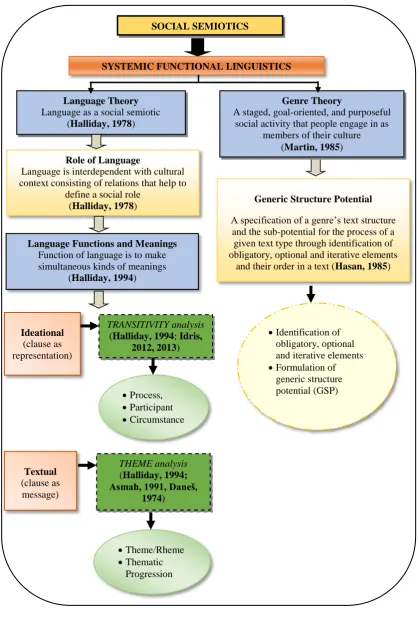
There are three integral theoretical foundations that guide the study which are
SFL’s theory on social semiotics (Halliday, 1978), language functions (Halliday,
1994) and genre (Martin, 1985). Firstly, analysis of FRR genre capitalised on the
belief that language is influenced by social and cultural contexts in which it is used
and that the entire process of language use is a semiotic process that involves making
meaning by choosing (Halliday, 1978). Halliday (1978) advocates that language is
the means by which people interact that must be considered in a social context.
Following Halliday’s (1978) notion on social semiotics, it is essential to take into
account the ways in which language is used to achieve communicative purpose by
assuming useful roles in situations where culture and context are key issues
presented in particular text types. Therefore, the current study investigated the roles
of FRR genre in relation to its context of use and how language is used to accomplish
these roles following Halliday’s (1978) notion on social semiotics.
The second theoretical foundation of the study is based on Halliday’s (1994)
notion on language functions. Halliday (1978; 2004) postulates that language
evolves across cultures to express simultaneous kinds of meanings to perform three
generalised functions referred to in SFL as metafunctions (Halliday, 1978). The
metafunctions are (i) ideational or experiential (clause as representation), (ii)
interpersonal (clause as exchange) and (iii) textual (clause as message) which express
three independent semantic choices. In these study, experiential and textual
meanings were analysed in order to investigate how language is used to accomplish
FRR genre’s roles, functions and meaning realisations. The experiential metafunction expresses representational meaning of speaker’s particular situation
through Transitivity analysis involving analysis of process (verbal group),
participants (nominal group) and circumstantial elements (prepositional phrases or
adverbials) (Halliday, 1994) while the textual metafunction expresses the
organisation of the message in terms of the speaker’s means of organising the
message and creating text through Theme analysis involving the analysis of Theme
and Rheme (Halliday, 1994; Asmah 1991) and thematic progression (Daneš, 1974).
Further discussions on the theory of language from the SFL perspective and analysis
16
The third and final theoretical foundation that sets the study is the genre
theory proposed by Martin (1985). In SFL, genre is interpreted by Martin
(1992:503) as ‘a staged, goal-oriented social process’ by which a genre is understood
to be structured into several stages and steps whereby each genre aims to realise
particular communicative goals within a socially-determined context and practices
(Martin, 1992). Apart from the concept of genre coined by Martin (1985), Hasan’s
(1985) influential work on generic structure potential along with the works of
Halliday and Hasan (1985) also sets the theoretical foundation on the analysis of
GSP. The generic structure concerns the development of the text which is
surrounded by the given context (Takahashi et al., 2004) which refers to the stages
that serve particular functions and is embedded within a text to accomplish its social
purpose. Further explanations on the concepts of genre and generic structure from
SFL perspective are included in Chapter 2. The theoretical framework illustrated in
17
Figure 1.2: Theoretical framework of the study
SYSTEMIC FUNCTIONAL LINGUISTICS
Language Theory
Language as a social semiotic (Halliday, 1978)
Ideational
(clause as representation)
SOCIAL SEMIOTICS
Language Functions and Meanings
Function of language is to make simultaneous kinds of meanings
(Halliday, 1994)
Genre Theory
A staged, goal-oriented, and purposeful social activity that people engage in as
members of their culture (Martin, 1985)
TRANSITIVITY analysis (Halliday, 1994; Idris,
2012, 2013)
Generic Structure Potential
A specification of a genre’s text structure and the sub-potential for the process of a given text type through identification of obligatory, optional and iterative elements
and their order in a text (Hasan, 1985)
Textual
(clause as message)
Identification of obligatory, optional and iterative elements
Formulation of generic structure potential (GSP)
THEME analysis (Halliday, 1994; Asmah, 1991, Daneš,
1974)
Theme/Rheme
Thematic Progression
Role of Language
Language is interdependent with cultural context consisting of relations that help to
define a social role (Halliday, 1978)
Process,
Participant
18
1.9 Conceptual Framework of the Study
In order to narrow down the theoretical framework discussed in the previous
section, this section presents the conceptual framework of the overall study which
helps in defining the research problem, establishing theoretical coherence as well as
organising the research design and implementation. To investigate the FRR genre in
terms of its generic structure potential, linguistic functions and realisations as well as
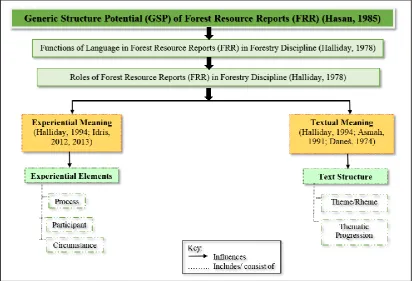
the roles of FRR genre, several key concepts shown in Figure 1.3 are addressed.
This study investigated FRR genre in forestry discipline. Genre theory
drawing on from the SFL perspective formed the basis of the theoretical framework
of the study as highlighted in Section 1.8. SFL as a theory of language regards
language as a system of meaning-making resource was used as a guide to the study
of genre in relation to its meanings and functions. The current study explored FRR
genre in terms of its language use within the context which probed into analysing
how language construes experience by looking at the social actions that are taking
place (experiential meaning) as well as how language is organised and playing its
part by analysing the coherence of the text with its context of situation (textual
meaning).
Apart from analysing the report genre through its functions and meaning
portrayal, FRR genre was also analysed to derive findings on the generic structure
potential (GSP) for FRR genre following Martin’s definition of genre as ‘a staged,
goal-oriented social processes’ (Martin, 1985:25) and Hasan’s (1985) concept of
GSP. Thus, identification of the GSP for FRR genre also probed into how meanings
are achieved and presented through its goal-oriented social processes and linguistic
19
This study explored the GSP, functions and meanings through its linguistic
realisations in FRR and the significant roles the genre plays within its context of use.
To achieve the aims of the study, document analysis and semi-structured interviews
were employed to critically analyse FRR genre. It is hoped that from the findings
obtained, the study could obtain valuable insights on FRR genre written by
professionals in e forestry discipline thus filling the gap that is currently present both
within forestry and SFL communities previously deliberated in the chapter. The
mapping between GSP for FRR, its linguistic functions, meanings and realisations as
well as the roles of FRR genre in forestry discipline is summarised in the conceptual
framework illustrated in Figure 1.3.
20
1.10 Definition of Terms
The operational definitions of key terms employed in the context of this study
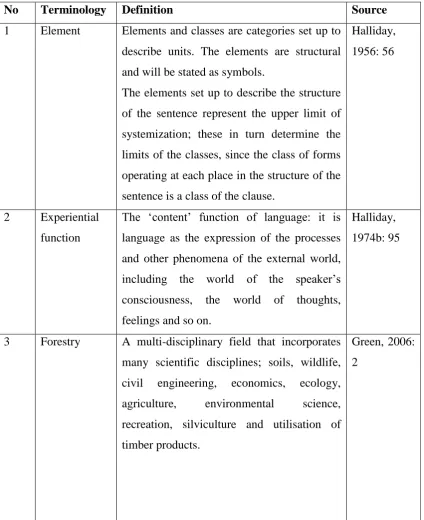
are sequenced in alphabetical order for ease of reference and are presented in Table
1.1.
Table 1.1: Definition of terminology used in the study
No Terminology Definition Source
1 Element Elements and classes are categories set up to
describe units. The elements are structural
and will be stated as symbols.
The elements set up to describe the structure
of the sentence represent the upper limit of
systemization; these in turn determine the
limits of the classes, since the class of forms
operating at each place in the structure of the
sentence is a class of the clause.
Halliday,
1956: 56
2 Experiential
function
The ‘content’ function of language: it is
language as the expression of the processes
and other phenomena of the external world,
including the world of the speaker’s
consciousness, the world of thoughts,
feelings and so on.
Halliday,
1974b: 95
3 Forestry A multi-disciplinary field that incorporates
many scientific disciplines; soils, wildlife,
civil engineering, economics, ecology,
agriculture, environmental science,
recreation, silviculture and utilisation of
timber products.
Green, 2006:
21
No Terminology Definition Source
4 Functional
approach
The essential feature of a functional theory is
not that it enables us to enumerate and
classify the functions of speech acts, but that
it provides a basis for explaining the nature
of the language system, since the system
itself reflects the functions that it has evolved
to serve.
Halliday,
1971a:65-66
5 Genre A staged, goal-oriented, and purposeful
social activity that people engage in as
members of their culture.
Genres are how things get done, when
language is used to accomplish them.
Martin, 1985
6 Generic
Structure
Potential
A specification of a genre’s text structure and
the sub-potential for the process of a given
text type through identification of optional,
obligatory and iterative elements and their
order in a text.
Hasan, 1985:
56
7 Ideational
Function
The ideational function is that part of the
grammar concerned with the expression of
experience; including both the processes and
those of consciousness – and the logical
relations deducible form them. The ideational
component thus has two sub-components, the
experiential and the logical.
Halliday,
1973:99
8 Language Language is best regarded as a form of
activity. Specifically, it is a form of activity
of human beings in societies; and it has the
property of being patterned.
Halliday,
22
No Terminology Definition Source
9 Meaning Meaning is at the same time both a
component of social action and a symbolic
representation of the structure of social
action. The semiotic structure of the
environment – the ongoing social activity,
the roles and the statuses, and the
interactional channels – both determines the
meanings exchanged and is created by and
formed out of them.
Halliday,
1976:143
10 Realisation The concept of realisation is called by
different names in English, exponence,
implementation, manifestation as well as
realisation.
Halliday,
1976a:4
11 Report A text that classifies and describes a
phenomenon. In this study, the report refers
to the forest resource report (FRR) that is
written in a form of an extended letter but
contains elements of a report.
Martin and
Rose, 2008:
125
12 Roles Refers to the context of situation in which
culture and context are presented in texts.
Halliday,
1978: 85
13 Social
Semiotic
The general science of signs which has its
basic discipline linguistics, the science of
verbal signs.
Jakobson,
1960:289
14 Systemic
Functional
Linguistics
A useful descriptive and interpretive
framework for viewing language as a
strategic, meaning making resource.
Eggins,
2007:20
15 Texts Highest unit on the rank scale of semantics
operating in a context of situation; it is
language functioning in context.
Halliday,
23
No Terminology Definition Source
16 Textual
function
The textual component is concerned with the
creation of text; it expresses the structure of
information, and the relation of each part of
the discourse to the whole and to the setting.
Halliday,
1973:99
17 Theme/Rheme The Theme is what is being talked about, the
point of departure for the clause as a
message: and the speaker has within certain
limits the option of selecting any element in
the clause as thematic. What the speaker
puts first is the Theme of the clause, the
remainder being Rheme.
Halliday,
1976: 212
18 Transitivity Transitivity is the representation in language
of Processes, the Participants therein, and the
Circumstantial features associated with them.
Halliday,
1976: 159
19 Thematic
Progression
A sequence of Themes in a text which are
chosen by the writer to create a coherent text.
Daneš, 1974:
114
1.11 Thesis Overview
This thesis is organised into seven chapters. The content of the first chapter
had been summarised at the beginning of this chapter. In the second chapter,
comprehensive reviews of literature on SFL, genre theories, professional report
genres as well as the nature of forestry discipline and Malay language are presented.
In the third chapter, methodological approach concerning research design, research
data and participants, research procedure, results of preliminary study and data
analysis procedure are described and justified. In Chapter 4, results of the study
24
the results of the study related to the representation of experience (Experiential
meaning) and the roles of FRR. Chapter 6 is also reporting on the results of the
study related to theme selection and meaning organisation (Textual analysis) in FRR.
The final chapter (Chapter 7) concludes the study and marks the end of this thesis.
1.12 Summary
This chapter provides an overall view on significant insights into the
relevance of the current study. It discusses established acknowledgements with
regard to literature in general and presented the probable ways in which genre can be
understood and explored. Additionally, there is also a discussion on the general view
of genre and SFL theory of language. Additionally, the chapter serves as a guideline
of this study where the introduction, background of the study, statement of problem,
statement of purpose, research objectives, research questions, significance of the
study, scope of the study, theoretical and conceptual frameworks as well as the
definition of terms are presented. The next chapter presents an in-depth account of
relevant theories on SFL and genre analysis along with a discussion on relevant
studies addressing these areas which have contributed to the construction of the
318
REFERENCES
Ab Razak, A. K., & Nurul Ain, A. (2016). Pantun Melayu: Ayat majmuk gabungan
bahasa Melayu. International Journal of the Malay World and Civilisation
(Iman). 4 (2). 23-36.
Ab. Razak, Ab. Karim. (2005). Warkah-warkah kesultanan Melayu lama koleksi
perpustakaan negara Malaysia: Analisis komponen dan binaan warkah. Jurnal
Pengajian Melayu. 15 (1). 183-201.
Ab. Razak, Ab. Karim. (2009). Warkah-warkah Farquhar 1818-1822: Aspek
penggunaan kata-kata pujian. In Rohani Mohd Yusof, Noor Hasanoor Mohamad
Nor and Muhamad Aidi Mat Yusof (Eds.). Segunung budi selautan kenangan.
Kuala Lumpur: Universiti Malaya. 1-13.
Arts, B. & Buizer, M. (2009). Forests, discourses, institutions. A discursive-institutional analysis of global forest governance. Forest Policy and Economics. 11 (5). 340–347.
Arts, B., et al,. (2010). Discourses, actors and instruments in international forest governance. In: Jeremy Rayner, Alexander Buck, Pia Katila (Eds.), Embracing complexity: Meeting the challenges of international forest governance,A global
assessment report. 28 (1). 57–73.
Askehave, I. (1997). A functional interpretation of company brochures: From context
to text. HandelshØjskolen.
Asma, Yusoff. (2003). Berita politik dalam akhbar bahasa Melayu: Analisis struktur
dan kohesi. Unpublished PhD dissertation. Universiti Malaya.
Asmah Hj. Omar. (1968). Word classes in Malay. Anthropological Linguistics. 12-22.
Asmah Hj. Omar. (1991). Bahasa Melayu abad ke-16: Satu analisis berdasarkan teks
319
Asmah Hj. Omar. (2013). Sejarah ringkas Bahasa Melayu. Kuala Lumpur: Department of Museums Malaysia.
Asmah Hj. Omar. (2014). Processing Malaysian indigenous languages: A focus on
phonology and grammar. Open Journal of Modern Linguistics. 4 (5). 728-738.
Asmah Hj. Omar. (2015). Nahu Melayu mutakhir. Edisi Kelima. Kuala Lumpur: Dewan Bahasa dan Pustaka.
Asmah, Hj. Omar. (2016). Pengunaan bahasa dalam surat rasmi: Bahasa dalam komunikasi. Edisi Keenam. Kuala Lumpur: Dewan Bahasa dan Pustaka.
Azhar, Mat Simin. (1993). Sintaksis wacana ‘yang’ dalam bahasa Melayu. Kuala
Lumpur: Dewan Bahasa dan Pustaka.
Banks, D. (2010). The interpersonal metafunction in French from a Systemic Functional perspective. Language Sciences. 32 (3). 395-407.
Bardi, M.A. (2008). A Systemic functional description of the grammar of Arabic.
Unpublished PhD dissertation. Macquarie University.
Bartlett, T. (2014). Analysing power in language: a practical guide. London:
Routledge.
Bawarshi, A. S., & Reiff, M.J. (2010). Genre: An introduction to history, theory, research and pedagogy. West Lafayette: Parlor Press.
Bawarshi, A.S., & Reiff, M.J. (2010). Genre: An introduction to history, Theory, research and pedagogy. West Lafayette, Indiana: Parlor Press LLC.
Bazerman, C. (2003). Textual performance: Where the action at a distance is. JAC: Journal of Advanced Composition. 23 (2). 79-96.
Bhatia, V. K. (1993). Analyzing genre: Language use in professional settings. London: Longman.
Bhatia, V.K. (1999). Integrating products, processes, purposes and participants in professional writing. In C.N. Candlin, & K. Hyland (eds.) Writing: Texts, Processes and Practices. London: Longman. 21-39.
Bhatia, V.K. (2004). Worlds of written discourse: A Genre-based View. In Advances in Applied Linguistics. Eds. Chris Candlin and Srikant Sarangi. London: Continuum.
320
Borg, S. (2006). Teacher cognition and teacher education: Research and practice. London: Continuum.
Boscolo, M., Snook, L., & Quevedo, L. (2009). Adoption of sustainable forest
management practices in Bolivian timber concessions: a quantitative
assessment. International Forestry Review. 11 (4). 514-523.
Bowen, G. A. (2009). Document analysis as a qualitative research method. Qualitative Research Journal. 9 (2). 27-40.
Bruce, I. (2008). Academic writing and genre: A systematic analysis. London:
Continuum.
Buizer, M. and Van Herzele, A. (2012) Combining deliberative governance theory and discourse analysis to understand the deliberative incompleteness of centrally formulated plans.Forest Policy and Economics. 16 (1). 93-101.
Butt, D., Fahey, R., Spinks, S., & Yallop, C. (2000). Using functional grammar: An
explorer's guide. National centre for English language teaching and
research. Macquarie University, Sydney.
Caffarel-Cayron, A. & Rechniewski, E. (2014). Exploring the generic structure of French editorials from the perspective of systemic functional linguistics. Journal of World Languages.1 (1). 18-37.
Candlin, C.N. (2002) Introduction: Research & practice in professional discourse. In C.N. Candlin (Ed) Research and Practice in ProfessionalDiscourse. Hong Kong. City University of Hong Kong Press.
Castillo-Montoya, M. (2016). Preparing for interview research: The interview protocol
refinement framework. The Qualitative Report. 21 (5). 811-831.
Chakorn, O. (2010). Understanding professional English texts through Systemic Functional Linguistics: An analysis of the metafunctions in corporate business discourse.
Che Muda, Che Hamat and Yusoff, Mohd Kamil. (2009). Natural resources management towards the sustainable development in Lojing, Gua Musang, Kelantan. In: Proceedings of postgraduate colloquium. Faculty of Enviromental Studies, Universiti Putra Malaysia.