FEASIBILITY TO DEVELOP THREE DIMENSIONAL NATIONAL DIGITAL CADASTRE DATABASE USING REMOTE SENSING DATA
SITI ZAINUN BINTI MOHAMAD
A thesis submitted in fulfilment of the requirements for the award of the degree of Master of Science (Geomatic Engineering)
Faculty of Geoinformation and Real Estate Universiti Teknologi Malaysia
Specially dedicated to Mak and Abah (Rapiah binti Mat Sam dan Mohamad bin Yaakob)
Ini kali keduakan dan doakan pasti ada untuk kali ketiga….
To my beloved husband (Mohd Jeffri bin Nurul Huda)
You mean everything to me
To 3Sitiku
Siti Aisyah, Siti Balqis dan Siti Hajjar
ACKNOWLEDGEMENT
Alhamdulillah. First and foremost, I wish to express my heartiest appreciation to my main thesis supervisor, Assoc. Prof. Kamaludin bin Mohd Omar and my Co-Supervisor Dr. Abdullah Hisam bin Omar for support, enthusiasm and the valuable guidance throughout the period of supervision, the Department of Geoinformation staffs, members for the support and Department of Survey and Mapping Malaysia (DSMM) for providing valuable data used in this study. Special thanks to DSMM State of Johor in assisting me to complete my study. Also for all the invaluable excellent guidance, technical support, encouragement, concern and critics advices and friendship.
ABSTRACT
ABSTRAK
TABLE OF CONTENTS
CHAPTER TITLE PAGE
DECLARATION ii
DEDICATION vi
ACKNOWLEDGEMENT vii
ABSTRACT viii
ABSTRAK ix
TABLE OF CONTENTS x
LIST OF TABLES xv
LIST OF FIGURES xvi
LIST OF ABBREVIATION xx
LIST OF APPENDICES xxii
1.0 INTRODUCTION 1
1.1 General Background 1
1.2 Research Motivation 4
1.3 Problem Statement 6
1.4 Research Objective 8
1.5 Significance of Research 8
1.6 Organization of Thesis 10
2.0 LITERATURE REVIEW 11
2.1 Introduction 11
2.2.1 3D Cadastre 13 2.2.2 Needs for Third-Dimensional Information in
3D Cadastre 14
2.3 Malaysian Cadastre System 14
2.3.1 Cadastre Survey Modernization in Malaysia 15
2.3.2 Reform in Cadastre Survey 17
2.3.3 Use of Global Navigation Satellite System 17
2.3.4 Geocentric Datum of Malaysia 18
2.3.4.1 Malaysian Active GPS System 19 2.3.4.2 Malaysian Primary Geodetic Network
2000 19
2.3.4.3 Malaysian Real-Time Kinematic GNSS
Network 19
2.3.4.4 Development of Cadastre Control
Infrastructure 21
2.3.5 eCadastre 23
2.3.5.1 eCadastre Components 23
2.3.5.2 eCadastre Application Module 26 2.3.5.3 Cadastre Reference Mark as a Datum in
eCadastre 28
2.3.6 Cadastre Database 29
2.4 Height Reference System in Malaysia 31
2.4.1 Height System Components 31
2.4.1.1 The Geoid 32
2.4.1.2 Mean Sea Level 32
2.4.1.3 Ellipsoid 33
2.4.2 Vertical Datum Infrastructure in Peninsular Malaysia 34
2.4.2.1 Tidal Station Network 34
2.4.2.2 Vertical Datum and Levelling Network 35
2.4.2.3 MyGEOID 35
2.5 Height Determination Technique 36
2.5.1 Trigonometric Levelling 37
2.5.2 Global Positioning System 38
2.6.1 LiDAR 40
2.6.2 IFSAR 42
2.6.3 Comparison between LiDAR and IFSAR 43 2.6.4 The Implementation of Remote Sensing Technique
In Cadastre 46
2.7 3D Surfaces Model 46
2.7.1 Raster Surfaces 47
2.7.1.1 Digital Terrain Model 47
2.7.2 Triangulated Irregular Network Surfaces 48
2.8 Interpolation 49
2.9 Geospatial Information Standards Compliance Guideline 50
2.9.1 Metadata 51
2.10 Summary 51
3.0 RESEARCH METHODOLOGY 52
3.1 Introduction 52
3.2 Planning 53
3.2.1 Area of Study 54
3.2.2 Data Sources and Survey Technique 54
3.2.3 Equipment and Software 55
3.3 Data Acquisition 56
3.3.1 Existing Cadastre Boundary Marks 56
3.3.2 New Cadastre Boundary Marks 62
3.3.2.1 Field Data Acquisition 62 3.3.2.2 Observation Record Format 64
3.4 Data Processing 65
3.4.1 Existing Cadastre Boundary Marks 65 3.4.1.1 Importing from an ASCII Text File *.asc
For Creating DTM 66
3.4.1.2 Mosaicking DTM Tiles of LiDAR Data 69 3.4.1.3 Extracting Height Values 72 3.4.1.4 Generation of TIN Surface 74
3.4.2 New Cadastre Boundary Marks 76
Data 76 3.4.2.2 Output Structure of the Data Collection
and NDCDB 79
3.4.2.3 Preparation of 3D Certificate Plan 81
3.5 Vertical Accuracy Assessment 81
3.6 Metadata Template 84
3.7 Visualization 85
3.8 Summary 85 4.0 RESULT AND ANALYSIS 86
4.1 Introduction 86
4.2 Result and Analysis for Existing Cadastre Boundary Marks 86
4.2.1 3D NDCDB Overlay Analysis and Extraction For LiDAR and IFSAR 86 4.2.2 3D NDCDB Generation for LiDAR and IFSAR 91 4.2.3 3D NDCDB Visualization for LiDAR and IFSAR 93
4.2.4 Vertical Accuracy Assement of LiDAR and IFSAR 97
4.2.4.1 LiDAR 98 4.2.4.2 IFSAR 101
4.3 Result and Analysis for New Cadastre Boundary Marks 103
4.3.1 Output Structure 103
4.3.1.1Output of Data Collection 104
4.3.1.2Output of DFB 108
4.3.1.3Output of NDCDB Data Structure 109
4.3.2 3D Certificate Plan 110
4.3.3 Perspective Visualization 112
4.3.4 Accuracy of Height Information Derived from New Cadastre Survey 113
4.4 Metadata of Stone Layer in NDCDB 118
4.5 Issues in Creating Height Information into NDCDB 118
4.5.1 DFB Data Structure 119
4.5.3 General Director Survey and Mapping Circular 120
4.5.4 Enhancing in the Existing eCadastre Application 121
4.6 Summary 121
5.0 CONCLUSION AND RECOMMENDATIONS 122
5.1 Introduction 122
5.2 Conclusions 122
5.2.1 The Feasibility of Developing the 3D NDCDB 123
5.2.2 Development of the New Methods for Generating Height Information in Cadastre Survey 124
5.2.3 Accuracy Assessment of Height Information Generated from LiDAR, IFSAR and New Cadastre Survey 125
5.3 Recommendations 126
REFERENCES 128-136
APPENDICES A-D 137-158
LIST OF TABLES
TABLE NO. TITLE PAGE
Table 2.1 Design Accuracy 21
Table 2.2 eCadastre Application Module 26
Table 2.3 Parameter Defining the Ellipsoids 34
Table 2.4 Comparison of Airborne LiDAR and IFSAR 43
Table 3.1 LiDAR Acquisition Data for Urban Area 56
Table 3.2 LiDAR Acquisition Data for Rural Area 60
Table 4.1 LiDAR-derived DTM against CRMs 99
Table 4.2 IFSAR-derived DTM against CRMs 101
Table 4.3 Height Information of CRMs in the Study Area 104 Table 4.4 The Current File in eTSM and Suggestion of the
Amendment of the Existing Output Files 106 Table 4.5 The Error in the Height Difference 115 Table 4.6 Influence of Air Refraction Coefficient Changes between
Two Points on Height Difference 117 Table 4.7 Suggestion Code of Height Information in Cadastre
LIST OF FIGURES
FIGURES NO. TITLE PAGE
Figure 1.1 The Enhancement of Delivery System to the Public 3
Figure 1.2 MPC Components 4
Figure 2.1 FIG Cadastre Concept 12
Figure 2.2 Conceptual Diagram of MyRTKnet System 20 Figure 2.3 Primary and Secondary Cadastre Control Network 22 Figure 2.4 The Conceptual Model of Cadastre Control Infrastructure
Development 22
Figure 2.5 The Methodology of NDCDB Creating 24
Figure 2.6 eCadastre Application Modules Diagrams 27
Figure 2.7 The Digital Cadastre Database Data Structure 30
Figure 2.8 The New Data Structure of NDCDB 30
Figure 2.9 Various Reference Surface 33
Figure 2.10 Peninsular Malaysia Geoid 2004 36
Figure 2.11 The Historical Development of Heights Determination
Techniques 37
Figure 2.12 Relationship between Topography, Geoid and Ellipsoid 38
Figure 2.13 Illustration of Airborne LiDAR 41
Figure 2.14 Concept of IFSAR Mapping 42
Figure 2.15 TIN Surface 49
Figure 2.16 The Nearest Neighbor Interpolation Algorithm Diagram 50
Figure 3.1 The Methodology Framework 53
Figure 3.2 The Location of Study Areas 54
Figure 3.4 Sheet of LiDAR 58 Figure 3.5 NDCDB Layers Mukim of Setapak, Kuala Lumpur 58 Figure 3.6 Contour and CRMs in Mukim of Setapak, Kuala Lumpur 59
Figure 3.7 IFSAR as DTM and Sheet of IFSAR 60
Figure 3.8 NDCDB Layers Mukim of Simpang Kiri, Batu Pahat 61 Figure 3.9 Contour and CRMs Mukim of Simpang Kiri, Batu Pahat 61
Figure 3.10 CRMs Point in Study Area 63
Figure 3.11 The Traversing in Study Area 64
Figure 3.12 The New Fields Attribute 65
Figure 3.13 The Flow Chart of Generating Height Information from
LiDAR and IFSAR 66
Figure 3.14 The Process of ASCII 3D to Feature Class 67 Figure 3.15 Importing from an ASCII File *.asc Creating DTM 68
Figure 3.16 DTMs from LiDAR and IFSAR Data 69
Figure 3.17 The Mosaicking Process 70
Figure 3.18 The Output of Mosaicking 71
Figure 3.19 Extracted Z Values to Points Process 72
Figure 3.20 Extracted Z Values to Points 73
Figure 3.21 Height Information in CBMs 73
Figure 3.22 TIN Creation using 3D Analysis Tool 74
Figure 3.23 TIN as the Triangles Line that Connected between
the Points 75
Figure 3.24 TIN/DTM 75
Figure 3.25 GRAVSOFT Software Interface 77
Figure 3.26 Converted Process using GRAVSOFT Software 77 Figure 3.27 Trigonometric Levelling Technique to Determine Height
Differences 78
Figure 3.28 Universal Translator Tool 80
Figure 3.29 TIN of New CBMs 80
Figure 3.30 DTM of New CBMs 81
Figure 3.31 The Validation Process 83
Figure 3.32 Metadata Template ISO 19115 84
Figure 4.2 Overlay Analysis between NDCDB, DTM of LIDAR and
Point Clouds 88
Figure 4.3 Extraction Nearest Point of NDCDB, DTM of LiDAR and
Point Clouds 89
Figure 4.4 Overlay Analysis between NDCDB, DTM of IFSAR and
Point Clouds 90
Figure 4.5 Extraction Nearest Point of NDCDB, DTM of IFSAR and
Point Clouds 90
Figure 4.6 Existing NDCDB Data Structure without Elevation
Information from LiDAR 91
Figure 4.7 Existing NDCDB Data Structure with Elevation
Information from LiDAR 92
Figure 4.8 Existing NDCDB Data Structure without Elevation
Information from IFSAR 92 Figure 4.9 Existing NDCDB Data Structure with Elevation
Information from IFSAR 93
Figure 4.10 3D NDCDB Mukim of Setapak, Kuala Lumpur 94 Figure 4.11 3D NDCDB of Mukim Simpang Kiri, Batu Pahat, Johor 94
Figure 4.12 NDCDB and DTM of LiDAR 95
Figure 4.13 NDCDB and DTM of IFSAR 95
Figure 4.14 NDCDB, DTM of LiDAR and Contour 96
Figure 4.15 NDCDB, DTM of IFSAR and Contour 97
Figure 4.16 CRMs Location in Mukim of Setapak, Kuala Lumpur 98 Figure 4.17 Scatter Plot of the Difference between Orthometric
Heights Derived CRM and LIDAR 99
Figure 4.18 CRMs Location in Mukim of Simpang Kiri, Batu Pahat,
Johor 101
Figure 4.19 Scatter Plot of the Difference between Orthometric
Heights Derived CRM and IFSAR 102
Figure 4.20 Height Information of CRMs 105
Figure 4.21 Height Information of Each Point in Cadastre Survey 105
Figure 4.22 The *.fbk ascii File 107
Figure 4.23 The *.coo ascii File 107
Figure 4.25 The New Digital Field Book 109 Figure 4.26 The Current NDCDB Stone Layer without Height
Information 109
Figure 4.27 The New NDCDB Stone Layer with Height Information 110
Figure 4.28 3D Certificates Plan 111
Figure 4.29 Visualization 3D NDCDB of the Study Area 112 Figure 4.30 The Distances between A and B with Accumulated Errors
Introduced 113 Figure 4.31 Metadata of the Stone layer in NDCDB 118
Figure 4.32 Suggestion Code of Height Information in Stone Layer
LIST OF ABBREVIATION
ARS Active Remote Sensing
BT68 Borneo Triangulation 1968
CALS Computer Assisted Land Survey System CBMs Cadastre Boundary Marks
CCI Cadastre Control Infrastructure CCS Coordinated Cadastre System CDIS Cadastre Data Integrity System CDMS Cadastre Data Management System
CP Certified Plan
CRM Cadastre Reference Mark
DCDB Digital Cadastre Database
DFB Digital Field Book
DRP Digital Raster Plan
DSMM Department of Surveying and Mapping Malaysia DTM Digital Terrain Model
eTSM Electronic Total Station
FC Field Communicators
FIG International Federation of Surveyors GDM2000 Geocentric Datum of Malaysia GDQA Geospatial Data Quality Assessment GeoNAMES Geographical Names
GIS Geographical Information System GNSS Global Navigation Satellite System GPS Global Positioning System
GRAVSOFT Geodetic Gravity Field Modelling Programs GRS 80 Geodetic Reference System 1980
IMU Inertial Measurement Units
IT Information Technology
ITRF International Terrestrial Reference Frame LiDAR Light Detection and Ranging
LIS Land Information Systems
MASS Malaysian Active GPS System
MPC Multipurpose Cadastre
MPGN2000 Malaysian Primary Geodetic Network 2000 MRT 48 Malayan Revised Triangulation
MS 1759 Feature and Attribute Codes
MSL Mean Sea Level
MyGEOID Malaysian Geoid Model
MyRTKnet Malaysian Real-Time Kinematic GNSS Network NDCDB National Digital Cadastre Database
PMGVD Peninsular Malaysia Geodetic Vertical Datum PLN Precise Levelling Network
RMSE Root Mean Square Error
RRR Rights, Restrictions and Responsibilities
RTK Real-Time Kinematic
SDI Spatial Data Infrastructure
SPID Image Document Management System TIN Triangulated Irregular Network
TON Tidal Observation Network UPI Unique Parcel Identifier
3 D Three-Dimensional
2 D Two-Dimensional
VSS Virtual Survey System
LIST OF APPENDICES
APPENDIX TITLE PAGE
A LiDAR-derived DTM against CRMs 137
B IFSAR-derived DTM against CRMs 141
C Current Digital Field Book 143
CHAPTER 1
INTRODUCTION
1.1 General Background
Over the past decades, Malaysian cadastre systems have endured drastic changes from various aspects intechnically, operationally, structurally and institutionally. The inspirations for these changes are important due to the necessity for the increasing service provision and competence and the huge demand of the client (e.g. agencies, private sector, user) and governments. There are two (2) main organizations controlling the cadastre system in Malaysia. The cadastre survey is the responsibility of the Department of Surveying and Mapping Malaysia (DSMM) as a federal agency to further modernize the cadastre system in Peninsular Malaysia. In addition, DSMM is also accountable for providing, producing and managing the spatial element comprising the surveying and mapping of the cadastre land parcels (Zulkifli et al., 2013). Secondly, the Land Office is responsible for non-spatial component in Land Registration System.
In this regard, under this project, DSMM has generated a homogeneous and accurate National Digital Cadastre Database (NDCDB) by capturing the survey accurate information of all land parcels on new geocentric datum concept nation, except for Sabah and Sarawak. The NDCDB is the vital element in the development of large-scale geospatial database in Malaysia and it also a base-map for the development of Multipurpose Cadastre (MPC) in Malaysia (Taib, 2012).
In recent years, cadastre systems have been influenced by the introduction of the web and Cadastre 2014 that have deeply impacted on the geoinformation stage through the development of the MPC concept (Shamsul Abdul Majid, 2000). The concept is defined as:
‘A framework that supports continuous, readily available and comprehensive land-related information at the parcel level (Panel on a Multipurpose Cadastre, 1980)’.
A Multipurpose Cadastre (MPC) is designed to record, store and provides not only land records information but also a wide variety of parcel-object related information using large scale base map (Jamil et al., 2014). MPC also has a capability to support spatially enabled government, private sectors and society and to expand computer support in the process of visualization, organization and management of useful land information (Taib, 2012).
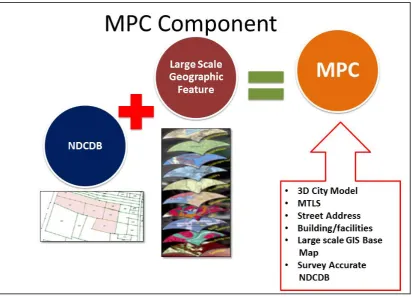
populated, adjusted through a process of quality review at every level of its establishment. As explained by Taib (2012), the survey accurate MPC is one of the spatially enabled system is used to integrate a system of land information contains various information like survey-accurate cadastre, man-made features, topography surface and accurate reference framework. Figure 1.1 shows the MPC components provide the enhancement of delivery system to the public as well as realization of connected government.
Figure 1.1: The Enhancement of Delivery System to the Public (Taib, 2012).
and also a wide variety issues related to the formation of this database crucial to be addressed (Choon and Seng, 2014).
Figure 1.2: MPC Components (Taib, 2012)
1.2 Research Motivation
Over the years, cadastre systems have inclined to acquire a reputation for reliability, well defined prosedure and ‘cast iron’ guarantees of rights in land parcel (Ragunah, 2006). Tremendous pressure on scarce land because of increasing population and consequently infrastructure development activities on, above and below the land surface are main driving forces for emergence of 3D Cadastre.
the development of competent approaches for the attachment of the 3D to the existing 2D systems (Filin et al., 2005).
According to the report of Cadastre 2014, feature cadastres will show the complete legal situations of land, including public rights and restrictions (Kaufmann and Steudler, 1998). All these rights, restrictions and responsibilities related to land are often overlapping, therefore, current 2D cadastre systems have revealed limitations in certain 3D circumstances (Doner and Biyik, 2007). From the perspective of scientific and technological, the principal challenge in developing a 3D Cadastre lies in collecting, processing and managing the 3D data.
One of the main principles of the development of cadastre system is the fully 3D land parcel information surface. Previous study that has been executed by Stoter and Gorte (2003), to integrate of 2D data and elevation information in cadastre land parcel. Moreover, Doner and Biyik (2007) stated that, in 3D Cadastre, surface models are used to generate elevation surfaces of cadastre land parcels.
Nowadays, with the recent technologies in surveying such as active remote sensing and Global Positioning System (GPS) enable to be collected the 3D data with high accuracy. Although it is possible to collect 3D data by means of several techniques, it entails huge amount of time and budget to resurvey all the data which is already available today (Doner and Biyik, 2007). In terms of the observational time is too lengthy, making it a slow, labour-intensive, painstaking and costly operation, resurveying of 2D parcels may not be practical to locate them in 3D space and elevation information.
regard LiDAR that offers direct acquisition of dense and accurate 3D data for integrating airborne laser scanning data and existing 2D cadastre system.
The primary motivation of this research is to explore and examine a feasibility development of 3D NDCDB with several data sources. The addition elevation data into cadastre boundary marks (CBMs) in the NDCDB would produce a 3D NDCDB. The 3D NDCDB is a mixture of the land parcel boundary and elevation information into cadastre boundary marks in order to acquire a parcel surface and it can be integrated with 3D objects like tunnel, cables, pipelines and etc. Moreover, this can be one way of the solutions to determine parcels in 3D space with integration of 2D Cadastre data and elevation information.
1.3 Problem Statement
DSMM has initiated the modernization programme of the cadastre survey system in stages in line with the advancement of current technologies. eCadastre is the latest venture in empowering the digital cadastre database of DSMM in order to accelerate the delivery system for land title surveys. It is implemented with new fully GIS-ready database, namely the NDCDB. At present, NDCDB is contains 40 million CBMs based on Geocentric Datum of Malaysia 2000 (GDM 2000) for Peninsular Malaysia and Federal Territories of Malaysia (Taib, 2012). Recently, NDCDB is adopted a database of dimensional, where the information is stored in two-dimensional planimetric coordinate (North (N), East (E)) without vertical information (Height (H)). However, in the future, 2D information may no longer capable to serve the community owing to the high demands for enriching information from the NDCDB, notably in more complex high-density developments in urban areas.
on 2D mapping (Choon and Seng, 2013). Enhancement of existing NDCDB is required to suit the current circumstances. One way to deal with this situation is by having more 2D Cadastre database which include the 3D information about land information to NDCDB by using a wide variety of data sources. This research is carried out to create height information to 2D land parcels and generate the terrain surface in 3D space. However, the delimitation this study only concentrates on vertical element. The problem is divided to two (2) main categories which are as follows:
i. Generated height information for existing cadastre boundary marks (CBMs) by using several data sources, i.e. LiDAR in urban area and IFSAR in rural area;
a) The stage of processing LiDAR and IFSAR data using the ESRI 3D software package; and
b) The accuracy of height information derived from LiDAR and IFSAR.
ii. The determination of height information for new cadastre boundary marks (CBMs). The detailed studies should be conducted for;
a) Field data acquisition using Digital Field Book (DFB). b) Adjustment and calculation of observed data;
c) Changes of format and structure of the existing system; d) 3D NDCDB with height information of each boundary
mark, Digital Terrain Model (DTM) and 3D Certificated Plan (CP); and
1.4 Research Objective
The aim of this study is to investigate feasibilities development of the 3D NDCDB with various data sources and assessment the quality of the generated elevation.
The specific objectives of this research include:
i. To investigate and to examine the feasibility of developing the 3D NDCDB;
ii. To develop a new method for generating height information in cadastre survey; and
iii. To evaluate the accuracy of height information generated from LiDAR, IFSAR and a new cadastre survey.
1.5 Significance of Research
One of the vital principles in the development of a 3D Cadastre system is to provide land with elevation data. Combination of elevation information and 2D land parcel enables to locate the cadastre land parcel in 3D space. Currently, NDCDB is two-dimensional in nature. As mentioned earlier, it does not contain elevation information within the land parcel area. Solution towards 3D Cadastre is to study possible solutions in adding a 3D component (N, E, H) in the current situation. This enhancement will be used as a platform to suit with the Malaysian Cadastre System. For the future, the NDCDB is capable of storing, visualizing and manipulating accurate legal records of 3D data.
is a paradigm shift for modern cadastre system and a step towards the MPC concept. It is not only enhancing the government frameworks but also providing more realistic and useful information for all levels generally (Ajibah, 2014).
The need for height information for approaching urban problems has grown rapidly. The requirements comprise design and inspection of utilities such as water mains, tunnels, sewer systems, bridges, railroads, roads and power lines and also for city planning and development purposes (Mathias, 2001). In the past, the determination of height information would usually suffice with contour lines. Currently, the demands with respect to accuracy are far beyond this point. The latest remote sensing methods have emerged which are capable to react to these demands. This situation shall trigger a good basis for the integration of height information from the remote sensing data and 2D cadastre data.
The significances of this study include:
i. Enhancing NDCDB;
ii. The elevation of land surface is used for computation of land area and volume more efficiently;
iii. Guideline to authorities to form a strategy toward 3D NDCDB;
iv. The height information derived can expand the application of NDCDB especially for urban area; and
1.6 Organization of Thesis
In this research, there are total of five (5) chapters, each overview plays a vital part in describing the development of 3D NDCDB. The description of each chapter has designated as follows:
Chapter 1 provides a general overview of the research. It contains the description of the background study and clarify the general idea of this study. This chapter comprises background of study, research motivation, problem statement, aims and research objectives, research question and significance of this research.
Chapter 2 reviews the literature on the basic understanding of the research before conducting the study. In this chapter, explanation an overview on cadastre, 3D Cadastre, Malaysian Cadastre System, height reference system, height determination techniques, remote sensing technologies and 3D surface model. In a literature review, materials that are relevant to the research are obtained from various sources and have been used as a reference to enhance understanding of the theories in order to complete this study.
Chapter 3 introduces the flow of work of this study and it is shown in the form of flow chart. This chapter will involves technical processes to create the 3D NDCDB. All techniques used are discussed in this chapter. In performing these processes the researcher has to use ESRI’s 3D software package. There are five (5) main processes in the methodology, which are data acquisition, data processing, data analysis, data validation and result and analysis.
Chapter 4 shows the results obtained from this study. This chapter discusses on accuracy assessment of each result for LiDAR, IFSAR data and new cadastre survey. Meanwhile, defines the analysis in the form of graphical presentation. Finally, the results will be analyzed and been discussed.
REFERENCES
Abu, S. (2005a). Geocentric Datum of Malaysia 2000 (GDM2000) and CCS Infrastructure. In Seminar and Bengkel Coordinated Cadastral System (CCS) Melaka 26 – 27 Julai 2005.
Abu, S. (2005b). JUPEM Geodetic Infrastructure for GNSS Application. Geodesy Section Mapping Division, DSMM.
Acharya, B. R. (2011). Prospects of 3D Cadastre in Nepal Prospects of 3D Cadastre in Nepal. In 2nd International Workshop on 3D Cadastre, 16-18 November 2011, Delft, The Netherlands (pp. 241–254).
Aguilar, F. J., Mills, J. P., Delgado, J., Aguilar, M. a., Negreiros, J. G., and Pérez, J. L. (2010). Modelling Vertical Error in LiDAR-Derived Digital Elevation Models. ISPRS Journal of Photogrammetry and Remote Sensing, 65(1), 103– 110.
Aien A. et al. (2012). Developing and Testing a 3D Cadastral Data Modela Case Study In Australia. ISPRS Annals of the Photogrammetry, Remote Sensing and Spatial Information Sciences, Volume I-4, 2012 XXII ISPRS Congress, 25 August – 01 September 2012, Melbourne, Australia.
Ajibah. (2014). The Implementation of 3D Coordinates into Land Parcel Data can Solve some Complications of 3D Property Situations. Msc. Thesis UTM.
Ali, H., Nordin, A. F., Abu, S., and Hua, C. L. (2006). MyRTKnet: Get set and go ! Coordinates, II(6), 6–13.
Ayeni. B and Kayode J.S (2014). An Evaluation of Digital Elevation Modeling in GIS and Cartography. Geo-spatial Information Science. Vol. 17, No. 2, 139– 144
Colin Childs (2004). Interpolating in ArcGIS Spatial Analyst. ArcUser July-September 2004.
Arun P.V. (2013). A Comparative Analysis of Dfferent DEM Interpolation Methods. The Egyptian Journal of Remote Sensing and Space Sciences (2013) 16, 133– 139.
Ave, H. (2000). Basic Surveying - Theory And Practice (pp. 1–162). Bend, Oregon. Azman. (2014). Penolong Pengarah Ukur. Seksyen Pengurusan Maklumat dan
Pembangunan Sistem, Bahagian Pangkalan Data Geospatial Negara. Jabatan Ukur dan Pemetaan Malaysia.
Benhamu, M., & Doytsher, Y. (2001). Research Toward A Multilayer 3-D Cadastre : Interim Results. In Proceedings of International Workshop on 3D Cadastres, Registration of Properties in Strata, Delft, The Netherlands, November 2001.
Benhamu, M., & Doytsher, Y. (2003). Toward a Spatial 3D Cadastre in Israel. Computers, Environment and Urban Systems, 27(4), 359–374.
Caulfield, B. (2014). Total Stations. Belfield Dublin 4: University College Dublin. Retrieved from ttp://www.tcd.ie/civileng/Staff/Brian.Caulfield
Ceylan, A., Inal, C., and Sanlioglu, I. (2005). Modern Height Determinatio n Techniques and Comparison of Accuracies Mo. In FIG Working Week 2005 and GSDI-8, Cairo Egypt, 16-21 April 2005 (pp. 1–14).
Che Cob, A. S., Mat Yasin, A. T., and Adimin, M. K. (2011). Application Of Ifsar Technology In Topographic Mapping: JUPEM’s Experience. In 11th South East Asian Survey Congress and 13th International Surveyors’ Congress Innovation towards Sustainability (pp. 1–8).
Choon, T. L., and Seng, L. K. (2014). Developing Infrastructure Framework for 3D Cadastre. In FIG Congress 2014, Engaging the Challenges- Enhancing the Relevance, 16-21 June 2014, Kuala Lumpur, Malaysia (pp. 1–13).
Cunningham, K. W. (2007). The Use of Lidar for Change Detection and Updating of the CAMA Database. Journal of Property Tax Assessment and Administration, 4(3), 5–12.
Davis, P. A., Mietz, S. N., Kohl, K. A., Rosiek, M. R., and Gonzales, F. M. (2002). Evaluation Of Lidar And Photogrammetry for Monitoring Volume Changes In Riparian Resources Within The Grand Canyon, Arizona. In Pecora 15/ Land Satellite Information IV/ISPRS Commission I/FIEOS 2002 (Vol. C, pp. 1–5).
Doner, F., and Biyik, C. (2007). Defining 2D Parcels in 3D Space by Using Elevation Data. In Strategic Integration of Surveying Services, FIG Working Week 2007, Hog Kong SAR, China, 13-17 May 2007 (pp. 13–17).
Dong, H. J. et al. (2012). Initial Design of an LADM-based 3D Cadastre –Case Study from Korea.3rd International Workshop on 3D Cadastres: Developments and Practices, 25-26 October 2012, Shenzhen, China.
Dowman, I. (2004). Integration of LiDAR And IFSAR for Mapping. In ISPRS Proceedings, XXXV Congress (pp. 1–12). ISPRS.
DSMM. (2005a). Director General Survey and Mapping Secular 10/2005. KPUP Circular 10/2005, 148(September), 1–17.
DSMM. (2005b). Director General Survey and Mapping Secular 9/2005. KPUP Circular 9/2005, 148(September), 1–18.
DSMM. (2009a). Director General Survey and Mapping Secular 5/2009. KPUP Circular 5/2009, 148(Julai).
DSMM. (2009b). Director General Survey and Mapping Secular 6/2009. KPUP Circular 6/2009, 148(Disember).
DSMM. (2012). Status of Surveying and Mapping in Malaysia. In Nineteenth United Nations Regional Cartographic Conference for Asia and the Pacific Bangkok, 29 October-1 November 2012 (Vol. 6, pp. 1–13). United Nation.
Featherstone, W. E., and Kuhn, M. (2006). Height Systems and Vertical Datums: A Review in the Australian context. Journal of Spatial Science, 51(1), 21–41.
Filin, S., Kulakov, Y., and C Doytsher, Y. (2005). Application of Airborne Laser Technology to 3D Cadastre. In FIG Working Week 2005 and GSDI-8, Cairo, Egypt 16-21 April 2005 (pp. 1–13).
Fraczek, W. (2003). Mean Sea Level, GPS and the Geoid. ArcUser, 36–41. Retrieved from www.esri.com
Gary, J. H., and Ian, P. W. (1990). The Development of a Historical Digital Cadastral Database. Int. J. Geographical Information Systems, Vol.4(2), 169– 179.
Giannaka, O., Dimopoulou, E., and Georgopoulos, A. (2014). Investigation on the Contribution of LiDAR data in 3D Cadastre. In Second International Conference on Remote Sensing and Geoinformation of the Environment (RSCy2004) (Vol. 9229, pp. 1–11).
Gomes Pereira, L. ., and Janssen, L. L. . (1999). Suitability of Laser Data for DTM Generation: A Case Study In The Context of Road Planning and Design. ISPRS Journal of Photogrammetry and Remote Sensing, 54(4), 244–253.
Hassan, M., Yaakop, I. A., Ahmad Nasruddin, M. ., and Abdul Rahman, A. (2008). An Integrated 3-D Cadastre – Malaysia as an Example. The International Archives of the Photogrammetry, Remote Sensing and Spatial Information Sciences, Vol. XXXVI, 121–126.
Hazri.H. (2016). Pengarah Ukur Seksyen Kawalan Kualiti, Bahagian Pangkalan Data Geospatial Negara. Jabatan Ukur dan Pemetaan Malaysia.
Higgins, M. B. (1999). Heighting with GPS: Possibilities and Limitations. In Commission 5 of the International Federation of Surveyors (FIG) (pp. 1–10).
Hodgson, M. E., and Bresnahan, P. (2004). Accuracy of Airborne Lidar-Derived Elevation: Empirical Assessment and Error Budget. Photogrammetric Engineering & Remote Sensing, 70(3), 331–339.
Höfle, B., and Rutzinger, M. (2011). Topographic Airborne LiDAR in Geomorphology: A Technological Perspective. Zeitschrift Für Geomorphologie, Supplementary Issues, 55(2), 1–29.
and Filling Back Points. Photogrammetric Engineering & Remote Sensing, 65(6), 713–719.
Jamil, H. (2011). GNSS Heighting and Its Potential Use in Malaysia GNSS Heighting and Its Potential Use in Malaysia. In FIG Working Week 2011, Bridging the Gap between Cultures, Marrakech Morocco, 18-22 May 2011 (pp. 1–19).
Jamil, H., Mohamed, A., and Chang, D. (2010). The Malaysia Real-Time Kinematic GNSS Network (MyRTKnet) in 2010 and Beyond. In FIG Congress 2010, Facing the Challenges, 11-16 April 2010, Sydney, Australia (pp. 1–15).
Jamil, H., Yunus, M., and Zurairah, N. (2014). Implementing Multipurpose Cadastre in Malaysia. Coordinates Jun 2014, X(06), 24–28.
Jedlika, K. (2009). Accuracy of Surface Models Acquired from Different Sources — Important Information for Geomorphological Research. Geomorphologia Slovaca Et Bohemica, 17–28.
Kaufmann, J., and Steudler, D. (1998). A Vision For A Future. Working Group 1 of FIG Commission 7, (July), 1–44.
Kenduiywo, B. K., Odera, P. A., and Hunja, E. (2013). Orthometric Height Determination using GPS to Fast Track Development : a Case study of Nairobi County, Kenya. In Proceedings of Global Geospatial Conference 2013 (pp. 1– 11), Ethiopia.
Kuzevicova et al. (2014). Spatial Interpolation and Calculation of the Volume an Irregular Solid. International Journal of Engineering and Applied Sciences. (Vol.4 pp. 14-21).
Lemmen, C., and Van Oosterom, P. (2003). 3D Cadastres. Computers, Environment and Urban Systems, 27(4), 337–343.
Letourneau, F. (1998). Different Approaches for the Creation and Exploitation of 3D Urban Models (Vol. 5, pp. 1–15).
Li, X., Baker, A. B., and Thomas Hutt. (2002). Accuracy of Airborne IFSAR Mapping. In FIG/ASPRS (pp. 1–11). Ontario, Canada: Intermap Technologies Corp.
Lohmann, P., Koch, A., and Schaeffer, M. (2000). Approaches to the Filtering of Laser Scanner Data. In International Archives of Photogrammetry and Remote Sensing (Vol. XXXIII, pp. 540–547).
Majid, A. D. (1997). Cadastral Reforms In Malaysia. Retrieved from https://www.fig.net/commission7/ reports/ events/penang97/ penang973.htm Mohamed, A. (2003). An Investigation Of The Vertical Control Network Of
Peninsular Malaysia Using A Combination Of Levelling, Gravity, GPS And Tidal Data. Phd. Thesis, UTM.
Mathias J.P.M. Lemmens. (2001). Height Information from Laser-Altimetry for Urban Areas. In Map India 2001, New Dehli, 7-9 February, pp. 131-135.
Morska, A., Sanecki, J., Klewski, A., Beczkowski, K., Pokonieczny, K., & Stępień, G. (2013). Zeszyty Naukowe The usage of DEM to create the 3D cadastre. Scientific Journals, 33(105), 86–90.
Nestorović, Ž., and Delčev, S. (2015). Comparison of Height Differences obtained by Trigonometric and Spirit Leveling Method. Geonauka, 02(04), 30–37. Nidal, A. D., and Yangdong, W. (2002). Geospatial Solutions - Active Sensors and
Modern Photogrammetry. Retrieved from http:// www.geospatial-online.com /geospatialsolutions.
NOAA. (2012). Lidar 101: An Introduction to Lidar Technology , Data and Applications. NOAA Coastal Services Center (pp. 1–76).
Nordin, A. F. (2003). Institutional Issues On The Implementation Of The Coordinated Cadastral System For Peninsular Malaysia: A Study On The Legal And Organisational Aspects. Msc. Thesis UTM.
Omar, A. H. (2004). Development of A Coordinated Cadastral System for Peninsular Malaysia. Phd. Thesis. Universiti Teknologi Malaysia.
Omar, A. H., Kadir, A. M. A., and Shah, R. M. (2006). Development of Automated Cadastral Database Selection and Visualization System to Support the Realization of Modern Cadastre In Malaysia (Vol. IRPA VOTE, pp. 1–142). FKSG, UTM.
Panel on a Multipurpose Cadastre. (1980). Need for a Multipurpose Cadastre. Committee on Geodesy, Assembly of Mathematical and Physical Sciences, National Research Council. National Academic Press. Washington.
Peng, M., and Shih, T. (2006). Error Assessment in Two Lidar-derived TIN Datasets. Photogrammetric Engineering & Remote Sensing, Vol. 72(August), 933–947.
Pourali, S., Arrowsmith, C., and Chrisman, N. (2014). Vertical Accuracy Assessment of LiDAR Ground Points using Minimum Distance Approach. In Research@Locate 14, Canberra Australia, 7-9 April 2014 (pp. 86–96).
Radhie, M. (2014). Accuracy Assessment of LiDAR Derived Digital Elevation (DEM) with Different Slope and Different Canopy Density. Bsc. University Technology Malaysia.
Ragunah, M. (2006). Application of Remote Sensing and GIS in Urban Land Suitability Modeling at Parcel Level using Multi-criteria Decision Analysis. The Andhra University, Visakhapatnam.
Schenk, T. (2005). Introduction to Photogrammetry (No. 2070 Neil Ave, Columbus) (pp. 1–100).
Seng Chai, C. (2006). Towards a 3D Cadastre in Malaysia- An Implementation Evaluation. Delf University of Technology, Netherlands.
Setan, H., and Othman, R. (2006). Monitoring of Offshore Platform Subsidence Using Permanent GPS Stations. Journal of Global Positioning Systems, 5(1), 17–21.
Shamsul Abdul Majid. (2000). Benefits and Issues of Developing a Multi-Purpose Cadastre. In International Archives of Photogrammetry and Remote Sensing. Vol. XXXIII, Supplement B4, Amsterdam 2000 (Vol. XXXIII, pp. 15–22).
Sim, C. Y. (2012). Investigation of Data Models and Related Requirements Affecting The Implementation of a Multipurpose Cadastre System in Malaysia. Msc.Thesis. University of Glasgow.
Stoter, J.E., and Gorte, B., (2003), Height in the Cadastre: Integrating Point Heights and Parcel Boundaries, In Proceedings of the FIG Working Week 2003, April 13-17, Paris, France.
Stoter, J. E. (2004). 3D Cadastre (No. ISBN 90 6132 286 3) (pp. 1–342). Delft, Netherlands.
Stoter, J. E., and Ploeger, H. D. (2003). Registration of 3D Objects Crossing Parcel Boundaries. In FIG Working Week 2003, Paris, France, 13-17 April 2003 (pp. 1–16).
Stoter, J., and Gorte, B. (2003). Height in the Cadastre Integrating Point Heights and Parcel Boundaries. In FIG Working Weeks 2003, Paris, France, 13-17 April 2003 (pp. 1–12).
Sulaiman, N. S., Majid, Z., and Setan, H. (2010). DTM Generation From LiDAR Data by using Different Filters In Open – Source Software. Journal, Geoinformation Science, 10(2), 89–109.
Taib, A. K. (2010). Initiatives Toward Digital Malaysia. In National Geospatial Information Symposium (p. 59). DSMM.
Taib, A. K. (2012). Developing a Multi-purpose Cadastre in Malaysia. In Malaysia Geospatial Forum 2012, Melaka, 6-7 March 2012 (pp. 1–29).
Teng, C. H. (2009). DCDB 2 NDCDB. In In: International Federation of Surveyors ed. 2009 FIG Commission 7 Annual Meeting. Kuala Lumpur, Malaysia: International Federation of Surveyors. (pp. 1–106).
Tomaž, P., Stancic, Z., and Oštir, K. (2000). Data Integration For The DTM Production. In ISPRS WG VI/3 and IV/3 meeting: Bridging the Gap, Ljubljana, 2-5 February 2000 (pp. 1–7).
Wang, Y., Mercer, B., Tao, V. C., Sharma, J., Crawford, S., and Corporation, I. T. (2001). Automatic Generation of Bald Earth Digital Elevation Models from Digital Surface Models Created using Airborne IFSAR. ISPRS 2001 (pp. 1–11).
Wei, M., and Coyne, T. (2008). Integrated Airborne IFSAR Mapping System. In The International Archives of the Photogrammetry, Remote Sensing and Spatial Information Sciences, Beijing 2008 (Vol. Vol. XXXVI, pp. 367–372).
Xiaopeng Li et al. (2002). Accuracy of Airborne IFSAR Mapping. Intermap Technologies Corp. Nepean, Ontario, Canada.
Yunus, M., Yusoff, M., and Abdul Halim, Z. N. (2012). Unleashing the Full Potential of eKadaster on The Cadastral System of Malaysia. In Nineteenth United Nations Regional Cartographic Conference for Asia and the Pacific Bangkok, 29 October-1 November 2012 (pp. 1–11).
Yunus, M., Yusoff, M., Jamil, H., Zurairah, N., and Halim, A. (2013). eKadaster : A Learning Experience for Malaysia Ekadaster : A Learning Experience for Malaysia. In FIG Pacific Small Island Developing States Symposium, Suva, Fiji 18-20 September 2013 (pp. 18–20).
Zhenglu, Z., Kun, Z., Yong, D., and Changlin, L. (2005). Research On Precise Trigonometric Leveling In Place of First Order Leveling. Geo-Spatial Information Science, 8(4), 235–239.
Zhou, X. P., and Sun, M. (2013). Study on Accuracy Measure of Trigonometric Leveling. Applied Mechanics and Materials, 329, 373–377.