X. Li, S. Wang, and Z.Y. Dong (Eds.): ADMA , LNAI 3584, pp. 59–66, 2005. © Springer-Verlag Berlin Heidelberg 2005
Mining Least Relational Patterns from
Multi Relational Tables
Siti Hairulnita Selamat1, Mustafa Mat Deris2, Rabiei Mamat 1, and Zuriana Abu Bakar1
1
Department of Computer Science, University College of Science and Technology,
21030 Kuala Terengganu, Malaysia {rab, zuriana}@kustem.edu.my 2
Faculty of Information Technology and Multimedia, College University Technology Tun Hussein Onn,
86400 Parit Raja, Batu Pahat, Johor, Malaysia [email protected]
Abstract. Existing mining association rules in relational tables only focus on discovering the relationship among large data items in a database. However, association rule for significant rare items that appear infrequently in a database but are highly related with other items is yet to be discovered. In this paper, we propose an algorithm called Extraction Least Pattern (ELP) algorithm that using a couple of predefined minimum support thresholds. Results from the implementation reveal that the algorithm is capable of mining rare item in multi relational tables.
1 Introduction
Nowadays, the quantity of data is expanding rapidly. Most of the data are stored in a relational table in order to support a variety of administrative management where it provides valuable input for organizational decision-making [11]. It will be extracted from the tables through various techniques to obtain valuable information and knowledge from those vast amounts of data. Currently, mining association rules in relational tables only focus on discovering the relationship among large itemsets in the tables that satisfy the support and confidence set by the users [4]. Nevertheless, the existing association rule discovery techniques do not consider the occurrence frequency pattern of data, and discover the association rules using the same support on the whole data, so the discovered rules with regard to rare data may be redundant and as a result, unnecessary rules may be generated.
In this paper, a new algorithm called Extraction Least Pattern (ELP) algorithm to extract least relational patterns of data items from multi relational tables is proposed. Least data items are referred to the data items that its frequency in the relational tables does not satisfy the minimum support but are highly associated with the specific [16]. This enables us to identify significant rare data associated with specific data in a way that rare data occur simultaneously with specified data more frequently that the
average co-occurrence frequency in the relational tables. A range of predefined minimum support thresholds are used to discover the least data. By using a couple of minimum support thresholds, it captured more meaningful data to discover interesting patterns. This paper is organized as follows. In section 2, the related wok will be discussed. In section 3, we discuss the background of this project. ELP (Extraction Least Pattern) algorithm and its detail experiments are present in section 4. Finally, we conclude this paper in section 5.
2 Related Work
The concept of relational patterns and the utilized elements of Apriori [10] algorithm to extract the relational patterns from multiple relational tables have been proposed in [1], which used bottom-up approach. Another previous works focus on advanced association rules problems that involved relational tables have been briefly discussed in [2], [3], [8], [20] and [21]. However, the model used in these studies only focus on providing an approach to generate the large datasets that satisfied predefined minimum support threshold. In other cases, there are also researches discovering on significant rare data in the table that have been studied extensively in [14], [15] and [16] but, unfortunately all these models only discovering the rare data in a single table instead of multi relational tables.
3 Background
Association rule mining is one of the processes of discovering hidden patterns in data. It also known as finding association, correlation or causal structures among sets of data items or objects in transaction tables, relational tables or other information repositories. Thereupon, one of its mining algorithms, Apriori algorithm is an influential algorithm used to mine all frequent data items in a table that satisfy the user predefined minimum support and minimum confidence constraints. A frequent data item is the data whose support is greater than user predefined minimum support threshold.
Relational data mining is one of data mining techniques for relational tables. Most existing traditional data mining approaches which are look for patterns in a single table are called propositional patterns. In contrast, relational data mining approaches that are seek for patterns among multiple tables are called relational patterns. That is, relational pattern involve multiple relations that represent the information as a set of relations. This is because, a relational table consists of a set of multiple tables and a set of associations (i.e. constraints) between pairs of tables describing how records in one table relate to records in another table. An association between multiple tables describes the relationships between records in these tables. In relational model, the association between these relational tables is defined through primary and foreign key attributes. If relation Rj includes, among its attributes, relation Rj+1’s primary key, then a tuple t1 in Rj and a tuple t2 in Rj+1 refer to one another if t1[Foreign_Key] =
4 Approach
The bottom-up approach used in this paper to extract the least patterns beginning from the leaf relation Ri up to relation Ri-n, where the leaf relation Ri is n levels downward in
the path. In addition, based on hierarchical concept, the leaf relation Ri is a leaf tuple.
Thus, the relations composing the path are considered as Ri-n, Rj-n+1, …, Ri. Our
approach is only considered the least data items that occur infrequently but appear simultaneously with specific data items in high proportion. In brief, the least items are data items that rarely occur in a table. Hence, the least data items can only be found in the data if the predefined minimum support threshold has to be set very low. However, this situation would cause too many rules generated, which most of them are not important. If a higher minimum support threshold is used, we might miss out on generating important association rules. This problem is known as the rare item problem. Despite these drawbacks, our approach introduces usage of a range of two predefined minimum support thresholds that may overcome these problems. The extracted least data items must be satisfied the range of predefined minimum support thresholds, that is data items must be contained in between first and second user-predefined minimum support threshold. Four phases are involved in ELP algorithm in mining least data items on multiple relational tables. Those are Extract least data items, Extract sibling patterns, Extract join patterns, and Extract least relational patterns.
Phase 1: Extract Least Data Items
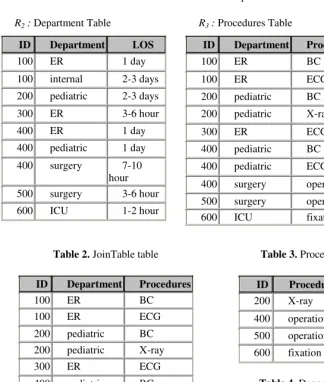
Basically, in normalized relational tables design, it would be to have three tables that is first table for contact, second table for groups, and the third table called ‘joiner’ table depicting what groups a contact belongs to. In this phase, we select the related attributes from the ‘joiner’ table, and construct a table called JoinTable as shown in Table 2. For example, we extract relational patterns from the sample hospital database as shown in Table 1, where the sample database has two main tables, i.e., Department Table, and Procedures Table. Assume that the first minimum support parameter,
fminsup is 25%, and the second minimum support parameter, sminsup is 10%. Those least data items are only extracted if they are satisfying a range of two predefined minimum support thresholds. Using bottom-up approach starting from the leaf level tuple
L
i nj− , each extracted least data item is mapped to a unique key and stored in a set that is split up into a few tables according to the field name. Eventually, from this example, two tables as shown in Table 3 and Table 4 will be generated.Algorithm 1.Algorithm applied to JoinTable in order to extract least data items matched
for each fj∈D do // each field, f in table, D
for each in∈I // I = i1,i2,…,in (A set of data items)
if (sminsup≤ in.support
<
fminsup) thenin∈I
k=k+1 // increase unique key,k end
L=LULj // L Least data items
Table 1. Two tables from Hospital Database
R2 : Department Table
ID Department LOS
100 ER 1 day
100 internal 2-3 days
200 pediatric 2-3 days
300 ER 3-6 hour
400 ER 1 day
400 pediatric 1 day
400 surgery 7-10 hour 500 surgery 3-6 hour
600 ICU 1-2 hour
R3 : Procedures Table
ID Department Procedures Cost($)
100 ER BC 2-5K
100 ER ECG 1-2K
200 pediatric BC 1-2K
200 pediatric X-ray 5-7K
300 ER ECG 1-2K
400 pediatric BC 1-2K
400 pediatric ECG 5-7K
400 surgery operation 7-9K
500 surgery operation 2-5K
600 ICU fixation 1-2K
Table 3.Procedures table
ID Procedures Key
200 X-ray 1
400 operation 2
500 operation 2
600 fixation 3 Table 2. JoinTable table
ID Department Procedures
100 ER BC
100 ER ECG
200 pediatric BC
200 pediatric X-ray
300 ER ECG
400 pediatric BC 400 pediatric ECG
400 surgery operation
500 surgery operation
600 ICU fixation
Table 4. Department table
ID Department Key
400 surgery 4
500 surgery 4
600 ICU 5
Phase 2:Extract Sibling Patterns
sub-trees of tuples in Rj. Each extracted least
(
n
≥
2)
-Sibling pattern is mapped to a unique key and stored in setS
i nj−
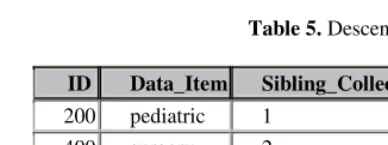
. Algorithm 2 is the algorithm used for extracting any sibling pattern that exists in generated table. For example, based from result of our implementation, there is no sibling pattern extracted from Table 5 but there is one sibling pattern extracted from Table 7.
Table 5.Descendant table
ID Data_Item Sibling_Collection 200 pediatric 1
400 surgery 2
500 surgery 2
600 ICU 3
Algorithm 2. Algorithm that used to generate sibling pattern
for each lj∈L do
for each tm∈T do // T data items in sibling collection
if (PID= tm.ID) and (tm.duplicate = True) then
tm∈Sj
k=k+1 // increase unique key,k end
S=SUSj
end
Phase 3:Extract Join Patterns
If the tuple is a leaf relation, its tuples have no join pattern and thus, this phase is skipped. These join patterns generated by joining all descendant patterns in Descendant table with all the least data items in least table using Algorithm 3. Each generated least join pattern is then mapped to a unique key and stored in a set
J
i nj− as shows in Table 6. An extracted join pattern is represented with an ordered list of two members<
l ds
,
>
, wherel
L
i nj−
∈
andds
DS
i nj 1− +
∈
, which these data items are contained in tuple t’s sub tree and following criteria are satisfying:1. t contains l
2. there exist
PID P
,
{ }
PIDDS
i nj 1− +
<
>∈
, such that PID = t.ID, and{ }
PIDds
⊆
P
, where t.ID is tuple t’s ID.Table 6.JoinPattern table
Join_Pattern Key
4 , 2 6
5 , 3 7
Algorithm 3. Algorithm that used to generate join pattern
for each lj∈L do
for each tm∈T do
if (PID= tm.ID) then
<lj,tm> ∈Jj
k=k+1 // increase unique key end
J=JUJj
end
Table 7.Transformed table
ID Sibling_Collection
400 {4 , 2 , 6}
500 {4 , 2 , 6}
600 {5 , 3 , 7}
Table 8.S2Pattern table
Sibling_Pattern Key
{4 , 2 , 6} 8
Phase 4:Extract Least Relational Patterns
This final phase construct the sets that contained all least patterns in the Department table, Procedures table, SiblingPattern table and JoinPattern table. In other form of results generated from phase one to four are: j
L
i nj,
jS
i nj,
jJ
i nj− − −
h
h
h
, where jstarting from the leaf relation’s index i to i-n, as shown in Table 9. These set contains unique keys representing all least relational patterns that have been removed all redundant patterns. In addition, these patterns are encapsulated in their respected parent tuples (i.e., ID tuple).
Table 9. LeastPattern table
ID Set_Patterns 400 8 , 4 , 2 , 6
500 8 , 4 , 2 , 6
600 5 , 3 , 7
Based on the implementation results, the extracted least relational patterns contains unique keys that represented each of its nodes having a number pointer to its parent data items, which indicate that the data items are related in each other. Specifically,
the least relational patterns captured relationships between the tuples across multi relational tables from which co-occurrence of attributes were extracted. Although these least relational patterns are rarely occur in a database, it is special interesting cases to be discovered. Therefore, the least data items should not totally ignore to avoid potentially valuable information loss. These extracted least relational patterns can be used to improve and support variety of organizational decision-making tasks such as hospitalization administrative databases. For instance, least relational patterns may be used to support hospitalization’s decision making by identifying their patient behavior. More precisely, this implementation may used to discover unexpected data into an interesting pattern.
5 Conclusion
In this paper, we presented an ELP algorithm and discussed the approach used to discover the least relational patterns from multi relational tables. The ELP algorithm generated all least data items that satisfied a couple of predefined minimum support thresholds. Specifically, we used a couple of predefined minimum support threshold to extract least patterns be more meaningful and avoid valuable ‘nuggets’ of information from loss. The implementation results indicate that the introduced algorithm is capable of mining rare items for multi relational tables.
References
[1] M. Saar-Tsechansky, N. Pliskin, G. Rabinowitz, A. Porath, “Mining Relational Patterns from Multiple Relational Tables”. Decision Support Systems, v.27, n.1-2, 177-195. [2] R. Agrawal, R. Srikant, “Mining Qualitative Association Rules in Large Relational
Tables”. SIGMOD’96, Montreal, Canada, June 1996.
[3] X. Shang, K. Sattler, I. Geist, “Efficient Frequent Pattern Mining in Relational Databases”. Workshop GI Working Group of the Knowledge Discovery (AKKD) in the context of the LWA 2004.
[4] R. Agrawal, R. Srikant, “Mining Association Rules Between Sets of Items in Large Databases”. Proceedings of ACM SIGMOD, 207-216.
[5] R. Agrawal, R. Srikant, “Mining Sequential Patterns”. In Proc. Of the 11th International Conference Data Engineering 1995.
[6] R. Agrawal, R. Srikant, “Fast Algorithms for Mining Association Rules”. Proceedings of the VLDB Conference, 487-499.
[7] U.M. Fayyad, G. Piatetsky-Shapiro, P. Smyth, “From data mining to knowledge discovery: an overview”, in: U.M. Fayyad, G. Piastetsky-Shapiro, P. Smyth, R. Uthurusamy (Eds.), Advances in Knowledge Discovery and Data Mining, AAAI/MIT Press, 1996.
[8] A Swami, M. Houtsma, “Set-oriented Data Mining in Relational Databases”. In International Conference Management of Data Engineering, Taipei, Taiwan, March 1995.
[10] R. Agrawal, H. Mannila, R. Srikant, H. Toivonen, A. I. Verkamo, “Fast Discovery of Association Rules”, in: U.M. Fayyad, G. Piastetsky-Shapiro, P. Smyth, R. Uthurusamy (Eds.), Advances in Knowledge Discovery and Data Mining, AAAI/MIT Press.
[11] U.M. Fayyad, G. Piatetsky-Shapiro, P. Smyth: “From Data Mining to Knowledge Discovery in Databases”. In: Fayyad et al: Advances in Knowledge Discovery and Data Mining. AAAI Press/The MIT Press, Menlo Park 1996.
[12] M.H. Dunham, “Data Mining: Introductory and Advanced Topics”, New Jersey, Prentice Hall, 2003.
[13] B. Liu, W. Hsu, Y. Ma, “Mining Association Rules with Multiple Minimum Supports”, Proceedings of the 5th ACM SICKDD International Conference on Knowledge Discovery and Data Mining, San Deigo, California, United States, 337-341, Aug 1999.
[14] H. Yun, D. Ha, B. Hwang, K.H. Ryu, “Mining Association Rules On Significant Rare Data Using Relative Support”, The Journal of Systems and Software, Elsevier, v.67. n.3. 181-191, Sept 2003.
[15] N.F. Nabila, M.M. Deris, M. Y. Saman, A. Mamat, “Association Rules On Significant Rare Data Using Second Support”, (forthcoming).
[16] P.S.M. Tsai, C.-M. Chen, “Mining Interesting Association Rules From Customer Databases and Transaction Databases”, Information Systems, Elsevier, v.29. n.8. 685-696, Dec 2004.