A FRAMEWORK FOR COMPONENT-BASED REUSE FOR AUTONOMOUS MOBILE ROBOT SOFTWARE
DAYANG NORHAYATI ABANG JAWAWI
A FRAMEWORK FOR COMPONENT-BASED REUSE FOR AUTONOMOUS MOBILE ROBOT SOFTWARE
DAYANG NORHAYATI ABANG JAWAWI
A thesis submitted in fulfilment of the requirements for the award of the degree of
Doctor of Philosophy
Faculty of Computer Science and Information System Universiti Teknologi Malaysia
ACKNOWLEDGEMENTS
I wish to express my thanks and gratitude to my supervisor, Professor Dr. Safaai Deris, for his guidance during course of this work.
I would like to acknowledge the Public Service Department of Malaysia and Universiti Teknologi Malaysia for their financial support.
I would like to thanks the Mobile Robotics Research Group in Universiti Teknologi Malaysia for their helps and support.
ABSTRACT
ABSTRAK
TABLE OF CONTENTS
CHAPTER TITLE PAGE
1 INTRODUCTION
1.1 Overview
1.2 Background of the Problem
1.2.1 Some Challenges in Embedded Real-Time Software
1.2.2 Challenge in Autonomous Mobile Robot Software
1.3 Statement of the Problem 1.4 Objectives
1.5 Scope of the Study 1.6 Thesis Outline
1 1 3 3 5 9 10 11 12
2 SOFTWARE REUSE AND COMPONENT-BASED
SOFTWARE ENGINEERING FOR AUTONOMOUS
MOBILE ROBOT SYSTEMS
2.1 Introduction
2.2 Software Reuse Strategies
2.2.1 Substance of Reuse and Product of Reuse 2.2.2 Technique of Reuse
2.2.3 Scope of Reuse
2.2.4 Mode of Reuse and Intention of Reuse 2.3 Software Reuse in Robotic Applications
2.3.3 Software Patterns
2.3.4 Component-Oriented Programming
2.3.5 Component Reuse in Commercial Robotics Product
2.3.6 Summary of Robotic Reuse Strategies 2.4 Component-based Software Engineering
2.4.1 Component Technology
2.4.2 Component Model for
Resource-Constrained Embedded Real-Time Systems 2.5 Software Patterns in Component Reuse
2.5.1 Pattern-Oriented Development Methodology
2.6 Software Architecture in Component Reuse 2.7 Predictable Real-Time Software in
Component-Based Software Development
2.7.1 Real-Time Scheduling Theory as Analytical Model 2.8 Discussion 2.9 Summary 25 27 28 29 30 31 33 35 37 39 40 41 44 47
3 RESEARCH METHODOLOGY
3.1 Introduction 3.2 Research Design 3.3 Research Processes
3.3.1 Determine Reusable Components
3.3.2 Evaluate and Enhance Embedded Real-Time Component Model
3.3.3 Determine Timing Analysis Approach 3.3.4 Develop Framework for Component-Based
Reuse
3.4 The Software Engineering Research 3.5 Autonomous Mobile Robot Case Studies
3.5.1 IMR71848 Robot
3.5.2 APIBOT Robot 3.6 Summary
59 61
4 COMPONENT-BASED ANALYSIS PATTERN FOR
AUTONOMOUS MOBILE ROBOT SYSTEMS
4.1 Introduction
4.2 Analysis Pattern for Autonomous Mobile Robot Software
4.2.1 Analysis Patterns Mining Process
4.2.2 Defining Analysis Pattern at Reactive Layer 4.2.3 Defining Component-Based Analysis
Patterns
4.3 Deployment of the Analysis Patterns in Component-Based Development
4.3.1 The Mobile Robot Software Analysis 4.3.2 The Mobile Robot Software Early Design 4.4 Application of the Analysis Patterns for
Pattern-Based Reverse Engineering 4.4.1 Reverse to Class Phase 4.4.2 Reverse to Pattern Phase
4.4.3 Reverse to Pattern Interface Phase 4.5 Discussion 4.5 Summary 62 62 63 65 66 69 71 72 75 77 79 80 82 85 86
5 COMPONENT-MODEL SELECTION AND A
COMPONENT-ORIENTED PROGRAMMING
FRAMEWORK
5.1 Introduction
5.2 Methodology for Evaluating the PECOS and ReFlex Component Models
5.3 Evaluation of ReFlex and PECOS Component Models
5.3.1 Component Model
87
87 88
91
5.3.2 Connection Model 5.3.3 Deployment Model
5.3.4 Summary of the Evaluation 5.4 Assessing of PECOS Component Model
5.4.1 Component Integration 5.4.2 Component Composition 5.4.3 Implementation
5.5 Modification of PECOS Component Model 5.5.1 Allowing Constant Connection to Input
Ports
5.5.2 Mapping of Component Behavior to Tasks 5.6 Component-Oriented Programming Framework
with PECOS
5.6.1 Component Engineering 5.6.2 Application Engineering 5.7 Implementation Results
5.8 Discussion 5.9 Summary 95 98 99 100 102 103 105 106 106 107 109 110 112 116 116 117
6 AN APPROACH FOR PREDICTABLE REAL-TIME
PERFORMANCE OF AUTONOMOUS MOBILE
ROBOT SOFTWARE
6.1 Introduction
6.2 Experiences from a Predictable Assembly of Component
6.3 Temporal Modeling of Autonomous Mobile Robot Software
6.3.1 Temporal Properties in Analysis Models 6.3.2 Temporal Properties in Design Models 6.4 An Approach for Prediction of Robot Behaviors
from Components Assembly
6.4.1 Utilization Feasibility Analysis 6.4.2 Exact Feasibility Analysis
6.5 Experimental Results
6.5.1 Utilization Feasibility Analysis 6.5.2 Exact Feasibility Analysis 6.6 Discussion 6.7 Summary 131 132 134 136 137
7 A FRAMEWORK FOR COMPONENT-BASED
REUSE
7.1 Introduction
7.2 A Framework for Software Reuse
7.3 Transforming POAD Pattern-oriented Models to PECOS Component-based Models
7.3.1 The Enhanced POAD Construct
7.3.2 The Modified PECOS Component Model 7.3.3 Mapping POAD to PECOS Model
7.4 Application of the Framework 7.4.1 Analysis Phase
7.4.2 Early Design Phase 7.4.3 Detailed Design Phase 7.4.4 Implementation Phase 7.5 Discussion 7.6 Summary 138 138 139 141 141 145 147 149 150 153 157 160 161 162
8 MEASUREMENT OF SOFTWARE REUSE AND
RESULTS ON THE DEVELOPED FRAMEWORK
8.1 Introduction
8.2 Measurement of Software Reuse through Metrics 8.3 Measuring Component Reusability
8.4 Measuring Component Amount of Reuse 8.4.1 Platform Independent Components
8.6 Summary 176
9 CONCLUSION
9.1 Summary
9.2 Research Conclusion 9.3 Research Contribution 9.4 Future Works
177 177 180 182 183
REFERENCES
APPENDICES A-C
185
LIST OF TABLES
TABLE NO. TITLE PAGE
2.1 Summary on two previous evaluations on ERT
component model 35
2.2 PECT technology for different prediction activities
41
3.1 Summary of the research process 54
3.2 Research strategies for this research in Shaw’s model
55
4.1 Summary of purpose for each pattern 67
4.2 Number of components from the pattern used in both software
85
5.1 Evaluation summary 100
5.2 The result of PECOS component mapping for the AMR system
104
5.4 Performance and price of the short listed RTK. 108 6.1 The AMR threads and their timing properties 126 6.2 The mapping between UML-RT and PECOS
model elements
127
6.3 Various setting for Ta and Tb 132
6.4 Intersection point of Ta group when u1 and u2 133
6.5 MobileRobot’stemporal properties 134
6.6 The timing results 135
7.1 General mapping of POAD and PECOS model elements
147
8.1 Washizaki’s metrics applied on the AMR component-based analysis pattern
168
8.2 The AMR systems processor platform and size 170
8.3 The AMR systems sensors and actuators 170
LIST OF FIGURES
FIGURE NO. TITLE PAGE
1.1 Examples of embedded systems 3
2.1 VRF limiting the effects of diversity 19
2.2 Component-based framework for AMR 20
2.3 CLARAty architecture 23
2.4 LAAS architecture 24
2.5 The STESCA pattern overview 26
2.6 Software architecture of the pattern-oriented framework
26
2.7 PBO component model 27
2.8 Two main activities in CBSE 31
2.9 Relations between basic concepts of component technology
32
3.1 Overview of the research processes in developing the framework
51
3.2 The IMR71848 robot 58
3.3 Block Diagram of the IMR71848 robot controller
59
3.4 The APIBOT robot 60
3.5 Block Diagram of the APIBOT 60
4.1 Analysis patterns in the software development process
64
4.2 Behavior-based robotic control 67
4.3 Analysis pattern for reactive layer 68
4.4 Behavior-based control pattern catalogue 70
4.6 Analyzed subsystems and AMR patterns matching
74
4.7 Pattern-level diagram for the AMR software 75 4.8 Pattern-level with interface diagram for AMR
intelligence behavior
76
4.9 Detailed internal classes representation of the AMR for intelligence behavior
76
4.10 Pattern-level with control interface diagram for intelligence behavior
77
4.11 Fire Marshal Bill class diagram 79
4.12 The Arbitration and Motor packages 81
4.13 Pattern Level diagram for Fire Marshal Bill mobile robot
81
4.14 Pattern-Level with Functional Interface diagram for the AMR
83
4.15 Pattern-Level with Control nterface diagram for the intelligent mobile robot
83
5.1 Behavior Layers in AMR software 89
5.2 Components assembly for the AMR case study 90
5.3 The ReFlex component model 92
5.4 The PECOS component model 93
5.5 Definitions of ports and interfaces using ART-ML for PI component
94
5.6 PI task and PI component using ART-ML in
ReFlex
94
5.7 PI component definition using PECOS
diagrammatical expression
94
5.8 PI component definition using PECOS CoCo
language
95
5.9 Component instances and components’ connection using ART-ML
96
5.10 Example of components assembled for motor speed control subsystem in PECOS
5.11 MSC component definition using PECOS CoCo language
97
5.12 Petri net of motor speed control subsystem 97 5.13 Components integration using PECOS model 102 5.14 Hierarchical view of the AMR components 103 5.15 Components integration of an AMR application
case study
107
5.16 Hardware and RTOS abstraction layers of the proposed COP framework
110
5.17 A PID component documented in block form 111
5.18 MotorControl composite component 112
5.19 Code template for MotorControl composite component
112
5.20 The code skeleton for MobileRobot component task execution
113
6.1 The predictable assembly of components approach based on PECT
119
6.2 The AMR behavior layer architecture 120
6.3 Relationship between the capsules in the AMR system
123
6.4 UML-RT structure model of the AMR system 123 6.5 Sequence diagram representing message
sequences between the capsules
123
6.6 Protocol used to connect ports between Switches and Stop capsules
127
6.7 Components composition of the AMR using PECOS model
128
6.8 Solution for number of maximum Nb for the
case-study AMR in terms of utilization U and 100% for nine various setting of Ta and Tb
133
6.9 MobileRobot’s task schedule 135
7.1 The Framework overview 140
7.3 An application engineering activities based on the framework
150
7.4 The APIBOT use case diagram 151
7.5 Pattern-level diagram for the APIBOT software 152 7.6 Pattern-level diagram with interface for the
APIBOT software
153
7.7 The APIBOT classes in pattern component group
154
7.8 Pattern-level diagram with control interface for the APIBOT software
154
7.9 Relationship between capsules 155
7.10 Structure model of the APIBOT system 156
7.11 State machine to define Avoid behavior of the APIBOT system
156
7.12 APIBOT component integration using PECOS model
158
7.13 The APIBOT composition based in design components artifact
158
8.1 Actuator pattern component 168
8.2 Reuse on APIBOT system 171
8.3 Components and modules in APIBOT software composition
172
8.4 APIBOT platform-independence software 173
8.5 Percentage of components in each APIBOT component groups
174
8.6 APIBOT platform-independence with platform dependent software
175
8.7 Percentage reuse of components in each APIBOT component group with platform-dependence component
LIST OF ABBREVIATIONS
ERT - Embedded Real-Time
AMR - Autonomous Mobile Robot
ART-ML - Architecture and Real-Time behavior Modeling Language
BBC - Behavior-Based Control
CBD - Component-Based software Development CBSE - Component-Based Software Engineering CCM - CORBA Component Model
CLARAty - Coupled Layered Architecture for Robotic Autonomy
CoCo - Component Composition
COM - Component Object Model
CoolBOT - Component-Oriented Programming Framework for Robotics
COP - Component-Oriented programming
CORBA - Common Object Request Broker Architecture COTS - Commercial off-the-shelf
DC - Direct-Current
DCOM - Distributed Component Object Model
DX - Data Exchange
EDF - Earliest Deadline First EJB - Enterprise JavaBeans FBD - Function Block Diagram HAL - Hardware Abstraction Layer HLRC - High Level Robot Control
HRI - Human-Robot Interface
IDL - Interface Definition Language
IR - Infra-Red
LCD - Liquid Crystal Display LOC - Line Of Code
NiMH - Nickel-Metal Hydride
OO - Object-Oriented
OPEN-R - open architecture OROCOS - Robot Control Software
OSCAR - Operating System for the Control of Autonomous Robots
PBO - Port-based Object
PD - Proportional-Derivative
PDMA - Pattern-Driven Modeling and Analysis PECOS - PErvasive COmponent Systems
PECT - Predictable Enable Component Technology PID - Proportional-Integral-Derivative POAD - Pattern-Oriented Analysis and Design
PWM - Pulse-Width Modulation
QoS - Quality of Services
RCC - Rate of Component Customizability RCO - Rate of Component Observability ReFlex - Flexible real-time component model rHAL - robotic Hardware Abstraction Layer RMA - Rate Monotonic Algorithm
ROPES - Rapid Object-Oriented processing for Embedded Systems
RTE - RunTime Environment
RTEMS - Real Time Executive for Multiprocessor Systems
RTK - Real-Time Kernel
RTOS - Real-Time Operating System RWI - Real World Interface
SEI - Software Engineering Institute
STESCA - Strategic-Tactical-Execution Software Control Architecture UML - Unified Modeling Language
UML-RT - Unified Modeling Language for Real-Time UTM - Universiti Teknologi Malaysia
LIST OF APPENDICES
APPENDIX TITLE PAGE
A Autonomous Mobile Robot Component-Based Analysis Pattern
197
B Autonomous Mobile Robot Design Components 202
CHAPTER 1
INTRODUCTION
1.1 Overview
The trend of software system development is changing from traditional software development approach, which focuses on building software systems from scratch to extension and integration with preexisting systems software development approach (Finkelstein and Kramer, 2000). This is due to the rapid changes in modern software requirements, which make the software becoming large, complex and highly unmaintainable. The increment in the scale and the complexity of software may lead to problems such as failure of software projects to meet their deadline, budget, quality requirements and the continual increase of the costs associated with software maintenance.
industrial robots is about 75% of total costs, while in car industry is about 30% of total costs (Crnkovic, 2004). Ten to fifteen years ago this number was about 25% for industrial robots and insignificant for cars.
Implementing every system from scratch does not guarantee the productivity and quality of the software systems. Software reuse has been promoted as a promising approach to improve quality and productivity. Software reuse is the use of existing software or software knowledge to construct new software (Frakes and Kang, 2005). Software reuse has been practiced and studied for a long time, and a broad reuse classification and approaches have been proposed in the area (Prieto-Diaz, 1993; Frakes and Kang, 2005). Despite the variety approaches and strategies, systematic reuse and component-based reuse are among the promising ways to improve software development efficiency and quality (Prieto-Diaz, 1993; Jacobson et al., 1997; Rothenberger et al., 2003; Ravichandran, and Marcus, 2003).
The commitment to quality is the focus of any engineering approach and in software engineering, integration of process, methods and tools for the development of quality software is also the practice (Pressman, 2005). Component-Based Software Engineering (CBSE) is a sub-discipline of software engineering, which share same strengths and weaknesses of software engineering. The general purpose of CBSE is to decrease development time and costs by creating application from reusable, easily connectable and exchangeable components. The systematic reuse can benefit from CBSE discipline by considering software component technology (Bachmann, et al., 2000) in tools, methods and processes for development of systematic reuse framework. The component-based reuse refers to bottom-up development or compositional reuse approach using reusable asset components.
in ERT systems may contain highly sophisticated algorithms, require a deep understanding in the domain and support technologies, such as the signal processing. The reuse of the domain specialized software knowledge can reduce the software development curve.
1.2 Background of the Problem
1.2.1 Some Challenges in Embedded Real-Time Software
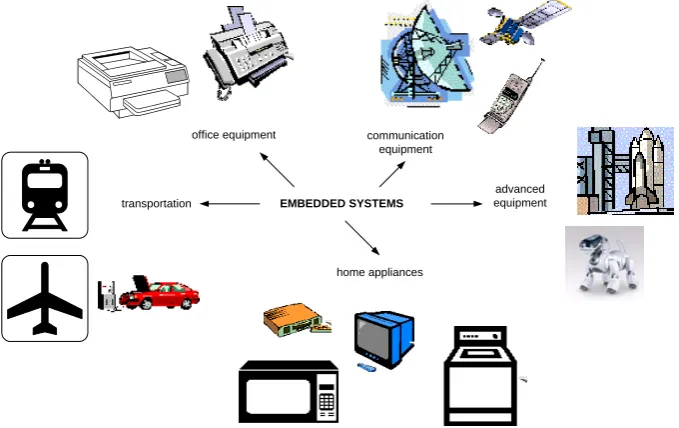
Embedded system is a system, which contains microcomputer as a component to perform some of the requirements of that system, but the user does not see the system as a computer. Most embedded systems are real-time systems. In real-time systems timing correctness is critically important in majority of these systems as failure to meet the timing requirement can result in system malfunction or disaster. ERT systems cover a broad range of applications ranging from small–scale microwave ovens and watches to telecommunication network management and mission critical military control systems; some examples of embedded systems are given in Figure 1.1.
EMBEDDED SYSTEMS
transportation
home appliances
advanced equipment communication
equipment office equipment
Due to the diversified nature of the ERT systems domain, as can be seen in Figure 1.1, the requirement placed on the software of ERT systems will be different from one application to another application. For example, the software requirements for consumer products, telecom switches, and avionics are quite different. The diversified nature of the ERT systems is also a reason why the software development support tools for ERT systems are much more primitive compare to the data processing domain. Tools vendors will not make much profit in a diversified ERT markets with scattered platforms and different software requirements compared to data processing market running on a uniform platform such as Windows.
In many ERT systems, requirement on low product cost is paramount. The customers are very cost sensitive, thus the developer of the hardware rarely takes the extra cost to extend the hardware resources, since the margin of profit on electronics development usually is low. Therefore the hardware is designed just enough for anticipated use but not more. Consequently, many ERT systems are resource constrained to lower the production cost and thereby increase profit. The resources here refer to power, memory consumption, computation (CPU) power, execution (CPU) time communication bandwidth etc. In their work on component technologies for Volvo vehicular industry, Möller et al. (2004) stated that resource-constrained is an important industrial requirement for automotive industries. Strong requirements for low and controlled consumption of these resource constraints create new challenges for software development in ERT systems. Coupled with the timing constraints in ERT systems, resource-constrained and timing constraints have becoming extra-functional properties which need to be addressed in the software development for many ERT systems. Many works (Ota, 2006; Hanninen and Maki-Turja, 2004; Malek et al. 2005; Cnrkovic, 2004; Nierstrasz, 2002; Hammer and Chaudron, 2001; Ommering et al. 2000) have been conducted to address the resource-constrained issue in the software development of ERT systems.
Model (COM+) or Distributed COM (DCOM) family, and SUN Microsystems’ JavaBeans and Enterprise JavaBeans (EJB) are generally complex, require large resources such as memory and computation power, and are platform dependent for ERT component-based development (Lüders, 2003; Rastofer and Bellosa, 2001). Furthermore, they do not address the non-functional properties such as how much memory it consumes and timing constraints which are important in ERT systems. Consequently, a number of component technologies such as Port-based Object (PBO) (Stewart et al., 1997), Koala (Ommering et al., 2000), PErvasive COmponent Systems (PECOS) (Nierstrasz et al., 2002) and ReFlex (Wall, 2003) have been developed to address requirements of ERT software. All these ERT component models have their own unique strengths to support their nature of ERT problem domain.
1.2.2 Challenges in Autonomous Mobile Robot Software
in the markets will force the mobile robots manufacturers to reduce the cost while at the same time try to satisfy more functionalities demands from users. This in return will increase the reliance on software.
AMR systems share similar requirements with ERT systems, hence inherit the challenge in applying software reuse for general ERT systems. As the complexity and functionality of the AMR is increased, such as adding more sensors to the robot so as to increase its reactivity and intelligence, designing and developing software for this type of robot can be very difficult and a challenging task. As, AMR systems and software are becoming more and more complex (Mallet et al, 2002), the need of highly modular software design is desirable (Seward and Garman, 1996; Messina et al., 1999; Oreback and Christensen, 2003). On top of this, software development in AMR systems is challenged by the diversities in terms of robot designated tasks, robot physical size and shape, environmental interaction and implementation platform such as real-time operating systems, hardware and communication protocol. Furthermore, to develop AMR software involves multi-disciplines of expert knowledge which include embedded systems, real-time software, mechanics, control theories and artificial intelligence aspects. Thus, it is envision that component-based reuse will be the suitable way to capture software models in this multi-disciplines domain in order to allow reuse across applications, particularly at the early stage of software development process. Reuse of early life-cycle of ERT systems is more effective and it allows engineering teams to tailor reused components and designs to fit their needs (Leveson and Weiss, 2004).
environment size, economical aspects and safety issues do not allow off-board computing. They further emphasized that real-world AMR must be self-contained and able to meet timing constraints. Autonomy with respect to perception, energy and processing for fully self-contained autonomous decision-making is not an option but should be addressed in its full complexity already as a research topic. When on-board or embedded computation is required AMR software development is typically confronted with limited resources such as computing power and memory. Hence, meeting timing constraints becomes a problem which is present but only hidden when using off-board processing (Brega et al., 2000). Resource-constrained are especially relevant for self-contained AMR systems. Limited computing power is a typical complexity need to be confronted by on-board computation of AMR systems. With the limited computing power, a precise observation of the timing constraints of the AMR systems is a necessary to make complex robot systems more reliable. Most important, a predictable real-time performance on a robotic system is a necessary condition for guaranteeing a stable behavior of the robot (Buttazzo, 1996).
A component-based reuse solution would help in the following aspects of AMR software development (Oreback and Christensen, 2003):
i. exchange of software parts or components between robotics labs, allowing specialists to focus on their particular field,
ii. comparison of different solutions would be possible from the available components,
iii. startup in robot research can be accelerated using the available components, and iv. speed up the transfer of research labs works in mobile robot to commercial
business application.
i. Embeddable and self-contained. Typically, the AMR software or firmware is embedded in the on-board controller. A self-contained AMR system requires on-board computation and the system is typically constrained by limited processing power and memories.
ii. Modular or component-based software. Component modularity is to provide artifact to be reused that contain domain knowledge from different disciplines. iii. Portable across different platform. Platform-independent where the
component implementation does not depends on hardware, Real-Time Operating System (RTOS) or communications protocol.
iv. Predictable real-time performance. The abilities to predict and analyze timing are key requirements for AMR system. The reliability and reactivity of the robot behavior depend on how the robot responses to the dynamic environment events by executing a set of concurrent tasks with its timing requirements.
One of the major problem in AMR software reuse is lacking of framework that enable the domain experts to document their knowledge and plug their work in a reusable artifact and a systematic reuse process for the application robotic engineer to develop their AMR software from the reuse artifacts (Oreback, 2004; Domínguez-Brito et al., 2004). Based on the literature review conducted so far, most of the existing frameworks do not address in parallel the three issues: self-contained, platform-independent and real-time predictable, for resource-constrained AMR systems in their reuse framework.
Portability of AMR components across different hardware, RTOS and communications platform is important to enable software reuse in AMR software. This can be done by minimizing the dependencies of the components with the platforms. The set of hardware component types for a robot composition is extensive. For example the input that a robot receives can be derived from a wide variety of sensors (infrared sensor, sonar sensor, video camera etc.) and each kind of sensors there are typically many variations.
libraries; architectures; generative methods; and reliability and safety. From these nine areas, three research areas were identified to be important in developing a framework for AMR component-based reuse, i.e. componentry, domain engineering and reliability. Componentry concerns with CBSE technologies to provide important platform or framework on which reusable AMR components can be developed and applications can be created by integrating the components. Domain engineering enables building of AMR system variants repeatedly within the same domain. The ability to predict the reliability of the integrated AMR components through timing performance analysis is one of key success of software reuse in AMR software. The research problems in these three software reuse research areas need to be solved before the AMR framework can be developed.
1.3 Statement of the Problem
In order to develop the component-based reuse framework for AMR domain there are numbers of software reuse research problems need to be solved in the three research areas: componentry, domain engineering and reliability, as identified above. The research problems need to be answered in determining how to support robotics programmers and engineers in creating reusable artifacts, and in the application of the reuse artifact. The problems to be solved are:
i. What should be made reusable in AMR software?
ii. What are the methods to specify reuse components and how to use the reuse components in developing AMR software?
iii. How to predict the reliability of AMR component composition?
robot systems the solution must have a systematic reuse framework to enable the robotic engineers to plug their work in the framework with consideration to the three basic requirements: self-contained, platform-independent and real-time predictable AMR systems. Thus, the research goal is:
To develop a framework for component-based systematic reuse of autonomous
mobile robots (AMR) software which emphasized on requirements to be
self-contained, platform-independent and real-time predictable.
Software framework is a general word whose meaning depends heavily on the context in software engineering discipline. There are different types of frameworks in various software discipline literature which include conceptual framework (Schneider, 1999), architecture framework (Zachman, 1987), application framework (Fayad and Schmidt, 1997), development framework (Bass et al., 1994) and component framework (Bachmann et al., 2000). The development framework as proposed by Bass et al. (1994) work is suitable to support systematic reuse in AMR CBSE since the development framework translates application-specific system specifications using methods that familiar to developers and optimal for the application. The development framework can be used to emphasize the optimization of the three AMR requirements: self-contained, platform-independent and real-time predictable. The framework covers at least three phases of software development: specification, design and implementation and the framework highlights the software techniques, strategies and tools in order to achieve the optimizations aimed in using the framework.
1.4 Objectives
The main objectives of this research work reported in this thesis are:
2. To assess and evaluate the applicability of the existing ERT component models and their implementation frameworks for the use in AMR software development.
3. To determine how existing real-time theories can be used for predicting timing performance of an AMR components composition.
4. To develop a CBSE framework that consists of AMR reuse artifacts, ERT component model and timing analysis approach.
5. To experimentally evaluate effectiveness of the proposed framework on some real existing AMR systems, and to measure some of the reuse qualities produce by the framework.
1.5 Scope of the Study
The scope of this research will be limited to the following:
• This research focuses on resource-constrained AMR applications.
• The AMR reusable asset documented in this thesis is assumed to be a starting set of reuse components. These components will continue to evolve as the domain expert from academia and industry involve in the assets development.
• The modeling of the reuse components will only consider structural modeling and real-time behavior modeling in order to illustrate the component-level modeling.
• The implementations on the existing AMR systems in this work are aimed to prove experimentally the proposed framework and the applicability of the elements in the framework.
requirements.
1.6 Thesis Outline
Chapter 2 discusses strategies and challenges in software reuse and CBSE in ERT generally and AMR specifically. The state-of-the-art of software reuse and CBSE in AMR software is reviewed in Chapter 2.
In Chapter 3, the research methodology conducted in achieving the objectives of this research is presented. Specifications two real AMR systems which were used in case studies, implementation of embedded software and verifications of techniques proposed are described in this chapter.
The three main elements supporting the developed component-based reuse framework in this thesis are described in details in Chapter 4 through 6. Chapter 4 describes the component-based AMR analysis patterns. The evaluation of a component model and the extension to the component model to support the required AMR software development environment are discussed in Chapter 5. In Chapter 6 a detailed timing analysis based on component-based reuse for AMR timing prediction at design phase is proposed.
REFERENCES
Åkerholm, M. and Fredriksson, J. (2004). A Sample of Component Technologies for Embedded Systems. Mälardalen Research and Technology Centre (MRTC), Mälardalen University: Technical Report.
Alami, R., Chatila, R., Fleury, S., Ghallab, M. and Ingrand, F. (1998). Architecture for Autonomy. Journal of Robotics Research. 17(4): 315-337.
Amin S. H. M., Mamat R., Khessal N. O. and Rudas I. J. (1999) Intelligent Behaviour-Based Climbing-Robot. Proceeding of IEEE International Conference on Intelligent Engineering System 1999 (INES’99). November 1999. Slovak Republic. 78-92.
Amnell, T., E. Fersman, L. Mokrushin, P. Pettersson, and Yi, W. (2003). TIMES: a Tool for Schedulability Analysis and Code Generation of Real-Time Systems. in Proceedings of the 1st International Workshop on Formal Modeling and Analysis of Timed Systems FORMATS 2003. September 6-7. Marseille, France:IEEE, 60-72.
Audsley, N., Burns, A., Richardson, M., Tindell, K. and Wellings, A. (1993). Applying New Scheduling Theory to Static Priority Pre-emptive Scheduling. Software Engineering Journal. 8(5): 284-292.
Bachmann, F., Bass, L., Buhman, S., Comella-Dorda L. S., Seacord, R. C. and Wallnau, K. C. (2000). Technical Concept of Component-Based Software Engineering. Software Engineering Institute, Carnegie Mellon University: Technical Report CMU/SEI-2000-TR-008.
Bass, L., Clements, P. and Kazman, R. (1998). Software Architecture in Practice, Reading: Addison-Wesley.
Blum, S. (2001). Towards a Component-based System Architecture for Autonomous Mobile Robots. Proceedings of IASTED International Conference Robotics and Applications (RA’01). November 19-22. Tampa, Florida, 220-225.
Bouyssounouse, B. and Sifakis, J. (2005). Embedded Systems Design: The ARTIST Roadmap for Research and Development. In: Bouyssounouse, B. and Sifakis, J. Lecture Notes in Computer Science. Volume 3436/2005, Berlin, Heidelberg:Springer-Verlag GmbH. 160-194.
Braunl, T. (2003). Embedded Robotics: Mobile Robot Design and Applications with Embedded Systems. New York: Springer-Verlag.
Brega, R., Tomatis, N. and Arras, K.O. (2000). The Need for Autonomy and Real-Time in Mobile Robotics: A Case Study of XO/2 and Pygmalion. Proceedings IEEE/RSJ International Conference on Intelligent Robots and Systems (IROS 2000), Volume 2. October 30- November 5. Takamatsu, Japan:IEEE, 1422 – 1427.
Brooks, A., Kaupp, T., Makarenko, A., Orebäck, A. and Williams, S. (2005) Towards Component-Based Robotics. IEEE/RSJ International Conference on Intelligent Robots and Systems (IROS 2005). August 2-6. Edmonton, Alberta:
IEEE, 163 – 168.
Brooks, R.A. (1986). A Robust Layered Control System for a Mobile Robot, IEEE Journal of Robotics and Automation. RA-2(1): 14-23.
Brown, A.W. and Wallnau, K.C. (1998). The Current State of Component Based Software Engineering. IEEE Software. 15(5): 37 –46.
Bruyninckx, H. (2001). Open Robot Control Software: the OROCOS Project. Proceedings IEEE International Conference on Robotics and Automation (ICRA) 2001, Volume 3. May 21-26. Seoul, Korea: IEEE, 2523 – 2528.
Buschmann, F, Meunier, R., Rohnert, H. Sommerlad, P. and Stal, M. (1996). Pattern-Oriented Software Architecture A System of Pattern. England: John Wiley and Sons.
Buttazzo, G. C. (2005). Rate Monotonic vs. EDF: Judgment Day. Real-Time Systems Journal, 29: 5–26.
Cheesman, J. and Daniels, J. (2001). UML Components. Boston: Addison-Wesley. Chikofsky, E. J. and Cross II, J. H. (1990). Reverse Engineering and Design
Recovery: A Taxonomy. IEEE Software, 7(1), 13-17.
Coad, P., North, D. and Mayfield, M. (1997). Object Models: Strategies, Patterns, and Applications, New Jersey: Yourdon Press.
Creps, R. E. (1992). The STARS Conceptual Framework for Reuse Processes. Software Engineering Notes for The Fifth Annual Workshop on Institutionalizing Software Reuse (WlSB’92). 18(2): 74-85.
Crnkovic, I. (2004). Component-based Approach for Embedded Systems, Proceedings of the Ninth International Workshop on Component-oriented Programming, Session 4 – Application of CBSE. June 14–18. Oslo, Norway. Crnkovic, I., and Larsson, M. (2002). Building Reliable Component-based Software
Systems. Norwood: Artech House, 2002.
Crnkovic, I., Hnich, B. Jonsson, T. and Kiziltan, Z. (2002). Specification, Implementation, and Deployment of COMPONENTS. Communication of the ACM. 45(10): 35-40.
Cybulski, J. L., Neal, R. D., Kram, A. and Allen J. C. (1998). Reuse of Early Life-Cycle Artifacts: Workproducts, Methods and Tools. Annals of Software Engineering. 5: 227–251.
Domínguez-Brito, A. C. (2003). CoolBOT: a Component-Oriented Programming Framework for Robotics. Univiversity de Las Palmas de Gran Canaria: Ph.D. Thesis.
Dominguez-Brito, A.C., Hernandez-Sosa, D., Isern-Gonzalez, J., and Cabrera-Gamez, J. (2004). Component software in robotics. Proceedings of the 2nd International IEEE Conference Intelligent Systems 2004, Volume 2. 22-24 June 2004. Varna, Bulgaria: IEEE, 560 – 565.
Douglass, B. P. (2002). Real-Time Design Patterns: Robust Scalable Architecture for Real-Time Systems. Boston: Addison Wesley.
Douglass, B. P. (2004). Real-Time UML. Boston: Addison Wesley. 2004.
Fernandez, J.A. and Gonzalez, J. (1998). NEXUS: a flexible, efficient and robust framework for integrating software components of a robotic system, Proceedings of the IEEE International Conference on Robotics and Automation, Volume 1. May 16-20. Leuven, Belgium:IEEE, 524 – 529.
Finkelstein, A. and Kramer, J. (2000) Software Engineering: A Roadmap. Proceedings of the conference on The future of Software Engineering. May 2000. Limerick, Ireland:ACM, 5-22.
Fire Marshall Bill (2004). at www.dragonflyhollow.org/matt/robots/firemarshallbill/ available August 2004.
Fowler, M. (1997). Analysis Patterns: Reusable Object Models. Boston: Addison-Wesley.
Frakes, W. B., and Kang, K. (2005). Software Reuse Research: Status and Future. IEEE Transaction On Software Engineering. 31(7): 529-536.
Frakes, W., and Terry C. (1996). Software Reuse: Metrics and Models. ACM Computing Surveys (CSUR). 28(2): 415 – 435.
Frakes, W.B. and Isoda, S. (1994). Success factors of systematic reuse. IEEE Software. 11(5):14 – 19.
Fujita, M. and Kageyama, K. (1997). An Open Architecture for Robot Entertainment. Proceedings of the First International Conference on Autonomous Agents, February 5-8. Marina Del Rey, USA:ACM, 435-442.
Gamma, J., Helm, R., Johnson, R. and Vlissides, J. (1995). Design Patterns: Elements of Reuse Object-Oriented Software. Reading: Addison-Wesley.
Genssler, T. Christoph., A., Schulz B, Winter, M., Stich, C. M., Zeidler C., Muller, P., Stelter, A., Nierstrasz, O., Ducasse, S., Arevalo, G., Wuyts, R., Liang, P., Schonhage, B., van den Born, R. (2002). PECOS in a Nutshell. PECOS Project: Technical Handbook.
George, R. and Kanayama, Y. (1996). A Rate-Monotonic Scheduler for Real-time Control of Autonomous Robots. Proceeding of the 1996 IEEE International Conference on Robotics and Automation. April 22-28. Minneapolis, Minnesota:IEEE, 2804-2809.
Goulão, M. and Brito-e-Abreu, F. (2004). Software Components Evaluation: an Overview. Proceeding of the 5th Information Systems Portuguese Association Conference (CAPSI'2004). November. Lisbon, Portugal.
Graves, A. R., and Czarnecki, C. (2000). Design Patterns for Behaviour-Based Robotics. IEEE Transactions on Systems, Man, and Cybernetics-Part A: Systems and Human. 30(1): 36-41.
Gu, Z. and He, Z. (2005). “Real-Time Scheduling Techniques for Implementation Synthesis from Component-Based Software Models”, In: Heineman, G. T., Crnkovic, I., Schmidt, H. W., Stafford, J. A., Szyperski, C. and Wallnau, K. Component-Based Software Engineering 2005, Lecture Notes in Computer Science 3489. Berlin, Heidelberg:Springer-Verlag, 235–250.
Hänninen, K. and Mäki-Turja J. (2004). Component technology in Resource Constrained Embedded Real-Time Systems. Mälardalen Research and Technology Centre (MRTC), Mälardalen University: Technical Report.
Hammer, D.K. and Chaudron, M.R.V. (2001). Component-Based Software Engineering for Resource-Constraint Systems: What are the Needs?. Proceedings of the Sixth International Workshop on Object-Oriented Real-Time Dependable Systems. January 8-10. Rome, Italy:IEEE, 91 – 94.
Hassan, H., Simo, J. and Crespo A. (2001). Flexible Real-Time Mobile Robotic Architecture Based on Behavioural Models. Journal of Engineering Applications of Artificial Intelligence. 14(5): 685-702.
Heinenam, G. T. and Councill, W. T. (2001). Component-Based Software Engineering. Canada: Addison-Wesley.
Hissam, S. and Ivers, J. (2002). PECT Infrastructure: A Rough Sketch. Software Engineering Institute, Carnegie Mellon University: Technical Note CMU/SEI-2002-TN-033.
Hissam, S., Moreno, G. Stafford, J. and Wallnau. K. (2003). Enabling Predictable Assembly. The Journal of Systems and Software. 65: 185-198.
IBM Rational Software Corporation, Rational Rose Real-Time, Available from http:www-8.ibm.com/developerworks/rational/products/rosetechnicaldeveloper. iRobot Corporation, (2002). Mobility Robot Integration Software User’s Guide,
Jaffrey: iRobot Corporation.
Isovic, D. and Norstrom, C. (2002). Components in Real-Time Systems. Proceeding of the 8th International Conference on Real-Time Computing Systems and Applications (RTCSA’2002). March 18-20. Tokyo, Japan.
Jacobson, I., Griss, M. and Jansson, P. (1997). Software Reuse: Architecture, Process and Organization for Business Success. New York: ACM Press/Addison-Wesley.
Jawawi D. N. A. (2000). The Development of Real-time Control Firmware for A Wall Climbing Robot - A Small-Scale Embedded Hard Real-time System. Universiti Teknologi Malaysia: Master Thesis.
Jones, L.J., Seiger, B.A., and Flynn, A.M. (1999). Mobile Robots Inspiration to Implementation. Second edition. Natick: A K Peters.
Kara, D. (2005). Sizing and Seizing the Robotics Opportunity. Available from http://www.robonexus.com/roboticsmarket.htm.
Kirchner L. (2005). Carnegie Mellon University in Qatar Launches First International Botball Robotics Club. Carnegie Mellon Press Release at http://www.cmu.edu/PR/releases05/050516_botball.html available May 16, 2005.
Klien, M., Ralya, T., Pollak, B. and Obenza, R. (1993). A Practitioner’s Handbook for Real-time Analysis, Massachusetts: Kluwer Academic Publisher.
Konrad S., Cheng B. H. C. and Campbell L. A. (2004). Object Analysis Patterns for Embedded Systems. IEEE Transactions on Software Engineering. 30(12): 970-991.
Krueger, C. W. (1992). Software Reuse. ACM Computing Surveys. 24(2): 131-183. Kwong T. C., Amin S. H. M., Mamat R. and Rudas I. J. (2004). An Intelligent
Voting Technique in Behavior-based Autonomous Mobile Robot for Goal-Directed Navigation. In: Current Trends in Artificial Intelligence and Application. Kuala Lumpur: UMS. 249-256.
Larsson, M. (2004). Predicting Quality Attributes in Component-based Software Systems. Mälardalen University: Ph.D. Thesis.
Lehoczky, J., Sha, L. and Ding, Y. (1989). The Rate Monotonic Scheduling Algorithm: Exact Characterization and Average Case Behavior. Proceedings of Real Time Systems Symposium. December. Santa Monica, California:IEEE, 66 – 171.
Lehoczky, J.P. (1990). Fixed Priority Scheduling of Periodic Task Sets with Arbitrary Deadlines. Proceedings of the 11th Real-Time Systems Symposium. 5-7 December, 201 – 209. Lake Buena Vista, Florida:IEEE, 201-213.
Leveson, N. G. and Weiss, K. A. (2004). Making Embedded Software Reuse Practical and Safe. Proceedings of the 12th ACM SIGSOFT twelfth International Symposium on Foundations of Software Engineering. November 2-4. Newport Beach, California:ACM, 171 – 178.
Lim C. S. (2004). Development and Implementation of Internet-Based Task-Oriented Telerobotic System. Universiti Teknologi Malaysia, Malaysia: Master Thesis. Lüders, F. (2003). Adopting a Software Component Model in Real-Time Systems
Development. Proceedings 28th Annual NASA Goddard Software Engineering Workshop. December 3-4. Greenbelt, Maryland:ACM, 114 – 119.
Lui, C. L. and Layland, J. (1973). Scheduling Algorithms for Multiprogramming in a Hard Real-Time Environment. Journal of the ACM. 20(1): 46-61.
Majid A. M., Amin S. H. M. and Mamat R. (2001), Development of the Internet Interface for Leg Motion Control of A Mobile Robot, Proceedings of the First International Conference on Mechatronics (ICOM'01). 12th – 13th February 2001. Kuala Lumpur. 665-675.
Malek, S., Mikic-Rakic M. and Medvidovic N. (2005). A Style-Aware Architectural Middleware for Resource-Constrained, Distributed Systems. IEEE Transactions on Software Engineering. 31(3). 256-272.
Mallet, A. Fleury, S. and Bruyninckx, H. (2002). A Specification of Generic Robotics Software Components: Future Evolutions of GenoM in the Orocos Context. Procceding of the IEEE International Conference on Intelligent Robots and System, Vol. 3. September 30 - October 4. EPFL, Switzerland:IEEE, 2292 – 2297.
Proceeding of Real-Time and Embedded Technology and Applications Symposium. May 27–30. Toronto, Canada:IEEE, 70–77.
Messina, E., Horst, J., Kramer, T., Huang, H. and Michaloski, J. (1999). Component Specifications for Robotics Integration, Autonomous Robots, 6: 247-264.
Minoura, T., Pargaonkar, S. and Rehfuss, K. (1993). Structural Active Object Systems for Simulation. Proceedings of the Eighth Annual Conference on Object-oriented Programming Systems, Languages, and Applications. September 26 - October 1. Washington: SIGPLAN Notices, 338-355.
Mohd. Ridzuan Bin Ahmad (2003). Development of Reactive Control Algorithm for
Multi-Agent Robotics System in Cooperative Task Achievement. Universiti
Teknologi Malaysia: M.Eng. Thesis.
Möller, A., Åkerholm, M., Fredriksson, J. and Nolin, M. (2004). Evaluation of Component Technologies with Respect to Industrial Requirements. Proceedings of the 30th EUROMICRO Conference on Component-Based Software Engineering Track. September 1 – 3. Rennes, France, 56-63.
Müller, P. Stich, C. and Zeidler, C. (2001). Components @ Work: Component Technology for Embedded Systems. Proceedings of the 27th Euromicro Conference 2001: A Net Odyssey. 4-6 September. Warsaw, Poland:IEEE, 64 – 71.
Nelson, M. L. (1999). A Design Pattern for Autonomous Vehicle Software Control Architectures. Proceeding of 23rd International Conference on Computer Software and Applications, October 27-29. Phoenix, AZ:IEEE, 172-177.
Nesnas, I.A., Volpe, R., Estlin, T., Das, H., Petras, R. and Mutz, D. (2001). Toward Developing Reusable Software Components for Robotic Applications. Proceedings of the International Conference on Intelligent Robots and Systems (IROS). October 29 – November 3, Maui, Hawaii:IEEE, 2375 - 2383.
Nesnas, I.A., Wright, A., Bajracharya, M., Simmons, R., Estlin, T., Kim W. S. (2003). CLARAty: An Architecture for Reusable Robotic Software. Proceedings of SPIE Aerosense Conference, Volume 5083 - Unmanned Ground Vehicle Technology V. April 21-25. Orlando, FL, 253-264.
Component Deployment. June 20-21. Berlin: Springer-Verlag Heidelberg, 200-209.
Ota, J. (2006). Search Methodology with Goal State Optimization Considering Computational Resource Constraints. Proceedings of the IEEE International Conference on Robotics and Automation (ICRA) 2006. May 15-19. Orlando, Florida: IEEE, 2023 – 2028
OMG Object Management Group (2003). Reusable Asset Specification: Version 2.2. Needham: Object Management Group.
OMG Object Management Group (2002). Unified Modeling Language Specifications. Version 1.3. Needham: Object Management Group.
Ommering, R., Linden, F., Kramer, J. and Magee, J. (2000). The Koala component model for consumer electronics software. IEEE Computer, 33(3): 78 –85.
Orebäck A. (2004). A Component Framework for Autonomous Mobile Robots. KTH Stockholm: Ph.D. Thesis.
Orebäck, A., and Christensen, H. I. (2003). Evaluation of Architecture for Mobile Robotics. Autonomous Robots. 14: 33-49.
Paradigm Systems (2000). Paradigm C++ Reference Manual Version 5.0, Endwell. Pont, F., and Siegwart, R. (2005). A Real-Time Software Framework for Indoor
Navigation. Proceedings of the IEEE/RSJ Intenational Conference on Intelligent Robots and Systems (IROS). August 2-6. Edmonton, Canada: IEEE, 2085 - 2090. Pont, M. J. and Banner, M. P. (2004). Designing embedded systems using patterns:
A case study, Journal of Systems and Software, 71(3): 201-213.
Purnomo D. S. (2004). Active Force Control of A Nonholonomic Wheeled Mobile Robot. Universiti Teknologi Malaysia, Malaysia: Master Thesis.
Poulin, J. S. (1997). Measuring Software are Reuse: Principles, Practices, and EconomicModels. Reading: Addison-Wesley.
Pressman, R. S. (2005). Software Engineering: A Practitioner's Approach. 6th ed. New York: McGraw-Hill Higher Education.
Prieto-Diaz, R. (1993). Status Report: Software Reusability. IEEE Software. 10(3). 61-66.
Ravichandran, T. and Marcus, A. R. (2003). Software Reuse Strategies and Component Markets. Communications of the ACM. 46(8): 109-114.
Redwine, S. T. and Riddle, W. E. (1985). Software Technology Maturation. Proceedings of the 8th international Conference on Software Engineering Conference. August 28-30. London, England: IEEE, 189 - 200.
Riehle, D. and Zullighoven, H. (1996). Understanding and Using Patterns in Software Development. Theory and Practice of Object Systems, 2(1): 33-13. Rine, D. C. and Nada, N. (2000). An empirical study of a software reuse reference
model. Information and Software Technology. 42(1): 47-65.
Rivero, D. M., Khamis A. Rodriguez F. J. and Salichs M. A. (2003). A Patterns-Oriented Framework for the Development of Automatic and Deliberative Skills for Mobile Robots. Proceedings of the 11th International Conference on Advanced Robotics. June 30 - July 3. Portugal:IEEE, 3284 - 3289.
Rothenberger, M. A. and Hershauer, J. C. (1999). A Software Reuse Measure: Monitoring an Enterprise-Level Model Driven Development Process. Journal of Information & Management. 35(5): 283-293.
Rothenberger, M.A., Dooley, K.J., Kulkarni, U.R., and Nada, N. (2003). Strategies for Software Reuse: A Principal Component Analysis of Reuse Practices. IEEE Transactions on Software Engineering. 29(9). 825 – 837.
Saksena, M. and Karvelas, P. (2000). Designing for Schedulability: Integrating Schedulability Analysis with Object-Oriented Design. IEEE Proceeding of EuroMicro Conference on Real-Time Systems. June 19 - 21. Stockholm, Sweden:IEEE, 101–108.
Schneider J. (1999). Components, Scripts, and Glue: A Conceptual Framework for Software Composition. der Universit¨at Bern: Ph. D. Thesis.
Selic, B. and Ward, P. T. (1996). “The Challenges of Real-time Software Design.” Embedded Systems Programming, 9.(11).
Seward, D. W. and Garman, A. (1996). The Software Development Process for an Intelligent Robot. IEEE Computing and Control Engineering Journal, 7(2): 86 – 92.
Sha, L., Rajkumar, R. and Lehoczky, J. P. (1990). Priority Inhetitance Protocols: An Approach of Real-Time Synchronization. IEEE Transaction Computer. 39(9): 175-185.
Shaw, M. (2002). What Makes Good Research in Software Engineering?. International Journal of Software Tools for Technology Transfer. 4(1): 1-7. Shi, J., Goddard, S., Lal, A., Dumpert, J. and Farritor, S. (2005). Global Control of
Robotic Highway Safety Markers: A Real-time Solution. Real-Time Systems Journal. 29: 183-204.
Sindre G. and Conradi R. (1995). The REBOOT Approach to Software Reuse. Journal of Systems Software. 30: 201-212.
Smith, G., Smith, R. and Wardhani, A. (2005). Software Reuse across Robotic Platforms: Limiting the Effects of Diversity. Proceedings of the Australian Software Engineering Conference. March 31 - April 1. Brisbane, Australia:IEEE, 252 – 261.
Stankovic, J. A. and Ramamritham, K. (1990). What if Predictability for Real-Time Systems. Real-Time Systems Journal. 2: 247–254.
Stewart, D. B., Volpe, R. A., and Khosla, P. K. (1997). Design of Dynamically Reconfigurable Real-time Software Using Port-Based Objects, IEEE Transaction on Software Engineering, 23(12): 759 –776.
Su E. L. M., Amin S. H. M., Mamat R. and Yeong C. F. (2005). Room Recognition for Mobile Robot Using Appearance-Based Method. The Proceeding of 9th International Conference on Mechatronics Technology 2005. 5-8 December 2005. Kuala Lumpur. ICMT-185.
Szyperski, C. (2002). Component Software: Beyond Object-Oriented Programming. 2nd Edition. London:Addison-Wesley / ACM Press.
Thrun S. (2000). Towards Programming Tools for Robots That Integrate Probabilistic Computation and Learning. Proceedings of the IEEE International Conference on Robotics and Automation. April 2000. San Francisco, CA: IEEE, 306-312.
Volpe R., Nesnas I.A.D., Estlin T., Mutz D., Petras R., and Das H. (2000). CLARAty: Coupled Layer Architecture for Robotic Autonomy. Jet Propulsion Laboratory, California Institute of Technology: Technical Report D-19975.
Wang, A. J. A. and Qian, K. (2005). Component-Oriented Programming. New Jersey: John Wiley and Sons.
Washizaki, H., Yamamoto, H. and Fukazawa, Y. (2003). “A Metrics Suite for Measuring Reusability of Software Components”, Proceedings of the Ninth International Software Metrics Symposium. September 3-5. Sydney, Australia:IEEE, 211 – 223.
Winn, T. and Calder, I. (2002). This a Pattern?. IEEE Software. 59-66. WinAVR (2006). Available from http://sourceforge.net/projects/winavr/
Wuyts, R., Ducasse, S. and Nierstrasz, O. (2005). A Data-centric Approach to Composing Embedded, Real-time Software Components. The Journal of Systems and Software, 74: 25-34.
Yacoub, S. M. and Ammar, H. H. (2004). Pattern-Oriented Analysis and Design: Composing Patterns to Design Software Systems. Boston: Addison-Wesley. Yeong C. F., Amin S. H. M., Mamat R., Fisal N. and Su E. L. M. (2005).
Development and Evaluation of Various Modes of Human Robot Interface for Mobile Robot. The Proceeding of 9th International Conference on Mechatronics Technology 2005. 5-8 December 2005. Kuala Lumpur. ICMT-184.