Bioavailability of PAHs in Aquatic Systems Using Passive Sampling: An Informative Piece
By: Dennis Gilfillan
Submitted to the Graduate Faculty of North Carolina State University
In partial fulfillment of the requirements for the Degree of Master of Environmental Assessment
Raleigh, NC
2014
Approved by advisory committee: Linda Taylor, Damian Shea
Abstract
Bioavailability of PAHs in Aquatic Systems Using Passive Sampling: An Informative Piece.
Dennis Gilfillan 2014
Polycyclic aromatic hydrocarbons are persistent contaminants in the aquatic environment that can cause both acute and chronic health effects, and in some forms are determined to be
carcinogenic. They also can bioaccumulate in organisms that exist in contaminated ecosystems through ingestion and diffusive transport systems. Traditional methods of assessment of
bioavailability –that is, the amount that is readily available for biological uptake and to circulate in the system -‐ requires grab sampling and solvent extraction methods that although quick and easy to perform can lead to over estimates of bioavailable concentrations. This can lead to conservative risk assessment with consequences in cost, delayed development of remediated sites,
misidentified at risk sites, and misinterpreted information due to inaccuracies in the assessment. These traditional methods are countered with using passive samplers. These are based on
diffusion uptake and once equilibrium is reached, a bioavailable concentration can be ascertained. These have been shown in the literature to be slower in attaining equilibrium, but have a benefit that the predicted concentrations are closer to actual bioaccumulated values in benthic
organisms, With the use of performance reference compounds as well as site specific portioning coefficients and bioconcentration factors, estimates of risk due to contamination can be less conservative. The scope of this paper is to introduce passive samplers into the framework of modern risk assessment, review the previous literature on the subject of passive samplers use in both in-‐situ and ex-‐situ environments, and identify sources of future research to better assess
Biography
West Virginia born and North Carolina-‐bred, Dennis Gilfillan was a 2004 recipient of the North Carolina Teaching Fellows Scholarship to attend Appalachian State University. In Boone, Dennis embraced the mountain lifestyle as he received his degree in Physics – Secondary Education. He also minored in math and began a teaching career in Western North Carolina.
During this time, Dennis paddled rivers all across the United States, organized a self-‐support kayak trip down the Grand Canyon, and developed into a impromptu high school coach who helped earn a team state runner-‐up finish in track and field as well as mentored 8 individual state titles in track and field and cross-‐country. He also learned the value of a multi-‐sensory kinetic learning experience for mathematics as a math instructor Camp Spring Creek, an Orton-‐Gillingham approach summer camp and training facility for students and teachers to aid in instructing
dyslexics.
His Masters of Environmental Assessment began in the spring of 2011. He was a part time student while he still taught at Mitchell High School. During this time, he began interested in
environmental modeling and Geographic Information Systems, and decided to finish a graduate certificate in GIS while enrolled in the masters program. As he began more interest in
environmental issues governing both evaluation and community perception, he enrolled in a Ph.D. program in Environmental Health Sciences at East Tennessee State University.
Acknowledgements
I first would like to acknowledge my highly supportive parents and awesome siblings for the positive words of encouragement through my paradigm shift. Though I may not fly the straightest route, you’ve helped me keep to the good path for my creativity. You’ve always been there and will always be there for me, and I reciprocate whole-‐heartedly.
I also would like to thank to faculty of Mitchell High School for putting up with me as a disgruntled graduate student. Without a lot of you, my path might be distinctly different and your sound advice mitigated a lot of stress. To my former students, thanks for challenging me to be a better teacher and allowing me to have a little fun in the process. Some of you will do great things; some of you I hope will prove me wrong in some ways. To my runners, I glad we could experience some distinct highs and lows through athletics. We all survived the “coaching experiment” together and in one piece.
To Susie and Steve van der Vorst, I appreciate the time at camp, although it will be at an end this year. Thanks for the good laughs and thorough feedback throughout my tenure at camp. I’ll look at those years as a positive growing experience and a catalyst to my current situation.
I also would like to thank Kurt Meier and the department of Environmental Health Sciences for taking a big chance on me. Although it’s been a stressful semester, this is the place I need to be.
Table of Contents
Introduction 6
Background Information on Polycyclic Aromatic Hydrocarbons 8 Current Methods of PAHs Bioavailability Studies 10
Methods Utilizing Bioaccessibility 10
Methods Utilizing Chemical Activity 11
Results from Bioavailability Studies 15
Discussion about Bioavailability Studies 19 Future Utilization of Passive Sampling Devices 25
Tables
Table 1 – Estimated PAH emissions in the US, Sweden, and Norway 2005 9 Table 2 -‐ Bioavailability Determination Techniques: Advantages and Disadvantages 13 Table 3 –Applications of Passive Samplers in Environmental Studies 26
Introduction
Determining bioavailability with respect to concentrations of chemicals in an ecosystem is a factor in evaluating environmental risk. The chemicals can be detrimental in both the chronic and acute survival of organisms within the contaminated ecosystem. Hydrophobic organic chemicals (HOC) are persistent contaminants that can become bioavailable to organisms due to exposure and diffusional uptake. A majority of the current procedures to determine concentration in sediments are based off of the concept of bioaccessibility. A chemical is said to bioaccessible when it is able to crossover the cellular membrane in an organism and what is typically desorbed from the
sediment or soil. It also can be defined as both what currently bioavailable and what has potential to be bioavailable (18). These methods are based on grab sampling over a small interval of time and using solvent extraction methods to determine total concentration in the sediment.
Scientists recognize sediments as both a source and a sink of sediments and have focused their efforts on the impact of these sediment-‐based contaminants by determining sediment quality thresholds from total concentrations of contaminant (12). By extracting the total concentrations of a chemical of concern, such as polycyclic aromatic hydrocarbons (PAH), scientists can quantify bioavailability in organisms through the concept of bioaccessibility. Research has shown that this typically results in over-‐conservative estimates (14).
effects. This can lead to better identification of areas of concerns and minimize the occurrence of negative consequences due to inaccurate methods or expensive implementation. Since the current methods use sediments to determine total concentrations, this causes a misunderstanding of true concentrations of PAHs available to the environment, and these over-‐conservative estimates can have ramifications such as delay of development of brownfield sites (11).
Although historically the basis for determining pollutant fate, transport, bioaccumulation, and other issues related to toxicity of chemicals in contaminated arenas, these sampling and extraction methods have been challenged by a better understanding of the chemical sequestration of
sediments and the interaction of various geochemical phases such as black carbons that are
challenging to quantify and characterize (15). These other methods, many of which utilize passive sampling devices (PSDs) as their method of data collection, have gained ground due to their
relative inexpensive nature as well as the ability to better predict actual bioavailable
concentrations due to taking into account the sorption properties for the HOCs (11). Based off of an understanding of chemical activity, these polymer-‐based sampling devices exhibit similar sorption capabilities to organisms and have verified the ability to effectively measure freely dissolved concentrations (Cfree ) for a wide variety of HOCs in sediment. Cfree is integral for calculating bioavailability because it is the actual concentration that is available for biological uptake in organisms (15).
environments will also be discussed. Although these methods work for many HOCs, the chemicals of concern will be polycyclic aromatic hydrocarbons and their role in fully understanding the abilities of PSDs to better manage contaminated sediments and pore water.
Background Information on Polycyclic Aromatic Hydrocarbons
PAHs are made up of multiple aromatic rings composed of only carbon and hydrogen, the simplest form being naphthalene. These have been contaminants since the advent of humanity using combustion for fires as warmth and cooking. PAHs were looked at as early as 1775 as
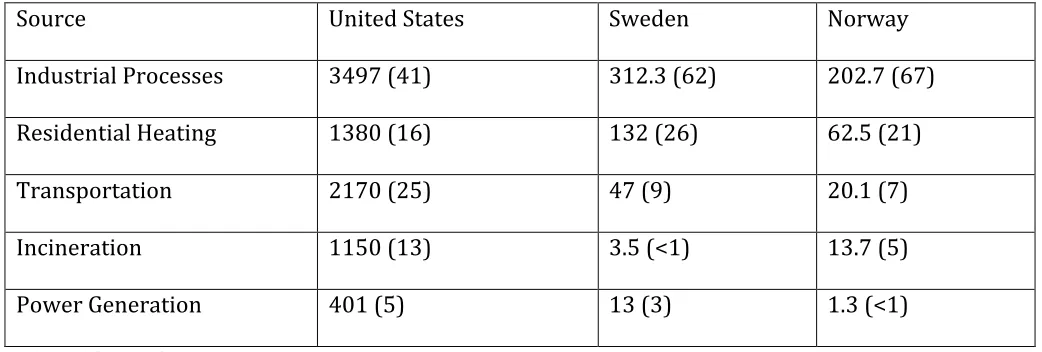
carcinogenic contaminants when Sir Percival Pott attributed scrotum cancer in chimney sweeps to soot and ash which were later learned to contain these hydrophobic organic contaminants. Direct correlations with PAHs and cancer were first produced in the 1930s (7). The chemicals exist in an ecosystem either through combustion, pyrolysis processes, or in the spills of chemicals containing such compounds such as diesel and oil. Petrogenic PAHS – those derived from petroleum sources – are released in a nonaqueous phase liquid that allows them to be sorbed to different types of particulate and colloidal structures that can reduce their bioavailability to benthic organisms. The same can be said for pyrogenic PAHs, although these are emitted within a tar, pitch, and soot matrix of black carbon-‐like products (11). Table 1 summarizes sources of PAHs and industrial use from different countries. Industrial processes that use or indirectly emit PAHs include such avenues as aluminum and asphalt production, petroleum cracking, and iron and steel works. (7).
Table 1 – Comparison of PAH Emissions in US, Sweden and Norway 2005
Source United States Sweden Norway
Industrial Processes 3497 (41) 312.3 (62) 202.7 (67)
Residential Heating 1380 (16) 132 (26) 62.5 (21)
Transportation 2170 (25) 47 (9) 20.1 (7)
Incineration 1150 (13) 3.5 (<1) 13.7 (5)
Power Generation 401 (5) 13 (3) 1.3 (<1)
Adapted from reference 7
PAH exposure can occur through inhalation, ingestion and skin contact. It is not fully clear to health effects, but occupational exposures to high levels of pollutant mixtures can result in nausea, vomiting, diarrhea, and confusion. Exposure to skins can also cause irritation (19). A variety of PAHs have been found to be carcinogenic in animals, including benzo(a)anthracene and
benzo(a)pyrene, but many are unclassified; although all PAHs are suspected to be carcinogenic to some degree, some might have low levels of toxicity (7). The PAHs with four or more rings are both carcinogenic and mutagenic in relation to their metabolic transfer capacity (20). In addition to being carcinogenic, the chronic effects of continual exposure are cataracts, kidney and liver damage and jaundice. Naphthalene can cause red cell breakdown if inhaled or ingested in large amounts (19).
PAHs are of concern because they remain in soil for long periods of time, posing a direct threat to benthic life as well as indirect effects on other organisms and humans. This is due to
in both fossil fuel combustion and the direct release of oil and oil products, it makes them a common contaminant in industrialized nations. Even low molecular weight PAHs are produced from low to moderate temperature combustion processes, such as heating a home with biomass and coal-‐burning or small factories (20).
Current Methods of PAHs Bioavailability Studies: Methods Utilizing Bioaccessibility
Standardized bioavailability assessments involving sediments are used in a variety of ways to determine relative bioavailability with regards to sediment concentrations as well as to guide options in disposal, site remediation, or future testing. These standardized testing methods aren’t without their drawbacks to assess bioavailability and bioaccumulation in organisms. Different organisms can be subject to difference characteristics in mortality, feeding habits, chemical stressors, and reproductive development in addition to other such biological and environmental factors (1). However, since bioaccumulation cannot be measured directly, it can be looked at from the bioavailable concentration, what has potential to be taken from the environment to an organism. This is summarized with two conceptual frameworks; bioaccessibility, which is the measurement fraction of contaminant that is weakly sorbed and can undergo desorption from the solid phase to the aqueous phase quickly, and chemical activity, which is the potential of the contaminant to partition within organism due to diffusive transport (8).
The bioaccessibility methods use bulk sediment concentrations of PAH (Ctotal) (16). The
the sum of the freely dissolved concentration (Cfree) and the concentration that is sorbed to particulate and colloid matter within the pore water system (10).
For mild solvent extraction, acetone/hexane mixtures are standard as well as butanol, and procedure involves solvent extraction by either vortex mixing and centrifuging or shaker-‐plate mixing and analysis using a GC-‐MS or HPLC. In HCPD extractions, the method involves mixing a standard amount of soil and extracting the available contaminants within the sample space by using various mixing techniques to create a soil pellet. After the pellet is made, another acetone/ hexane extraction is used to obtain any PAHs left in the soil pellet (11). These compounds are then analyzed by gas chromatography with mass spectroscopy or electron capture detection (10).
Current Methods of PAHs Bioavailability Studies: Methods Utilizing Chemical Activity
“Passive sampling can be defined in its broadest sense as any sampling technique based on free flow of analyte molecules from the sampled medium to a receiving phase in a sampling device, as a result of the difference between the chemical potentials of the analyte in the two media.”
Branislav Vrana et al. 2005
calculations using passive sampling is that the sediment and pore water have also reached equilibrium. Since the later equilibrium is a slower process than the pore water and PSD, the equilibrium between pore water and sediment has to be reached first (11). Passive sampling techniques are any sampling techniques that are based on the principle of free flow of analyte molecules from the sampled arena to the sampling device, as a result of diffusion and the
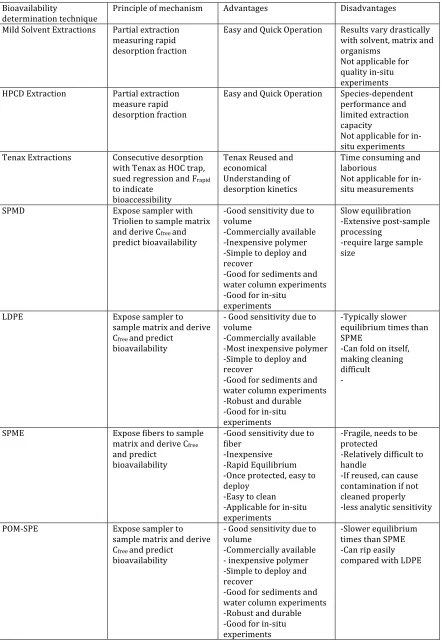
difference between the chemical potentials of the analyte in the respective mediums (3). Table 2 summarizes the methods mentioned in this paper.
To determine freely dissolved concentrations in pore water, the following equation is used
Cfree = !!"#$%&'
!! (1)
Where Csampler is the concentration in the sampler and Ks is the sampler to contaminant partitioning coefficient (8). The most common samplers are polyethylene samplers (PE), polyoxymethylene solid phase extraction (POM-‐SPE), solid phase micro-‐extraction (SPME) and semipermeable membrane devices (SPMD) that are all organic polymers that are simplistic in design and implementation (10).
Table 2 – Bioavailability Determination Techniques: Advantages and Disadvantages Bioavailability
determination technique Principle of mechanism Advantages Disadvantages Mild Solvent Extractions Partial extraction
measuring rapid desorption fraction
Easy and Quick Operation Results vary drastically with solvent, matrix and organisms
Not applicable for quality in-‐situ experiments HPCD Extraction Partial extraction
measure rapid desorption fraction
Easy and Quick Operation Species-‐dependent performance and limited extraction capacity
Not applicable for in-‐ situ experiments Tenax Extractions Consecutive desorption
with Tenax as HOC trap, sued regression and Frapid
to indicate bioaccessibility
Tenax Reused and economical Understanding of desorption kinetics
Time consuming and laborious
Not applicable for in-‐ situ measurements
SPMD Expose sampler with
Triolien to sample matrix and derive Cfree and
predict bioavailability
-‐Good sensitivity due to volume
-‐Commercially available -‐Inexpensive polymer -‐Simple to deploy and recover
-‐Good for sediments and water column experiments -‐Good for in-‐situ
experiments
Slow equilibration -‐Extensive post-‐sample processing
-‐require large sample size
LDPE Expose sampler to
sample matrix and derive Cfree and predict
bioavailability
-‐ Good sensitivity due to volume
-‐Commercially available -‐Most inexpensive polymer -‐Simple to deploy and recover
-‐Good for sediments and water column experiments -‐Robust and durable -‐Good for in-‐situ experiments
-‐Typically slower equilibrium times than SPME
-‐Can fold on itself, making cleaning difficult -‐
SPME Expose fibers to sample matrix and derive Cfree
and predict bioavailability
-‐Good sensitivity due to fiber
-‐Inexpensive -‐Rapid Equilibrium -‐Once protected, easy to deploy
-‐Easy to clean -‐Applicable for in-‐situ experiments
-‐Fragile, needs to be protected
-‐Relatively difficult to handle
-‐If reused, can cause contamination if not cleaned properly -‐less analytic sensitivity
POM-‐SPE Expose sampler to sample matrix and derive Cfree and predict
bioavailability
-‐ Good sensitivity due to volume
-‐Commercially available -‐ inexpensive polymer -‐Simple to deploy and recover
-‐Good for sediments and water column experiments -‐Robust and durable -‐Good for in-‐situ experiments
Polyethylene samples can be used in varying thicknesses (15 μm to 100 μm) and can be cut quite easily with scissors. The material from drop cloth available in common hardware stores can be used as an inexpensive PE sampler (10). PE’s are easily deployable, relatively inexpensive, and able to be applied to various sensitivity needs. Although it has a longer equilibrium time than some passive sampling methods, the use of a performance-‐reference compound (PRC) can mitigate this problem of equilibration (8). A PRC is a compound that has nearly identical properties to the analyte, the desorption rate of the PRC can be used to predict the equilibrium conditions for the sampling based on the approximation of the absorption constant (21).
SPMDs are very similar to a PE in that both use the same polymer as the sampler. However, in addition to the polyethylene, the SPMD is filled typically with triolein. The uptake of organic chemicals such as PAHs that is concentrated in the SPMD can readily be recovered through dialysis; the extract often has to be further cleaned to minimize contamination from the triolein and polyethylene (8). Although used in water column experiments for decades, these types of samplers have not been used extensively in sediment concentration experiments (1). Although the equilibrium time is the longest for this type of sampler, the use of PRC can hasten the uptake process if there are time limits attached to the sampling. It can also be effective in environments with high contamination.
POM-‐SPE’s are also similar to PE but the material used is a different type of polymer,
methods (8). Like polyethylene, it can be purchased in large sheets of various thicknesses (10). The solvent extracts for POM-‐SPEs are more straightforward than the previous two passive samplers; this is due to the low diffusion coefficients for both analytes and impurities (8). SPMEs are fiber-‐optic cables surrounding by a thin layer of polydimethylsiloxane (PDMS) as the polymer. Since it is so thin, equilibration times are quick and the sample requires minimal use of a solvent in sample preparation. The thickness of the cables can range from 10 to 100 μm and they can be cut to various lengths of cable (10).
There are three mechanisms to be aware of when analyzing equilibrium status that can lead to underestimations of equilibration times. The rate at which the analyte enters into the polymer can be fast at the beginning but then slow, leading to complex uptake curves where equilibrium can be misconstrued from slower changing data. Another mechanism is the local depletion that can slow the overall exchange in the environment leading to difficulties identifying the actual equilibration times. If kinetics of the diffusion is determined in depletive conditions, this can represent shorter equilibration times as opposed to nondepletive conditions and care is required to transfer to these types of conditions (6). For sample processing, the use of a GC/MS is effective in determining concentrations in the sampler and that can be used to estimate the Cfree. However, in POM-‐SPE and SPME extractions, the HPLC will be used to determine concentrations (11).
Results from Bioavailability Studies
In a study by Gomez-‐Eyles sampling and extraction methods were used to make comparisons of the two types of approaches. The first types of extractions were acetone/hexane exhaustive extractions, mild solvent extractions – in this case, butanol – and HPCD extractions. These were compared with PSDs of POM-‐SPEs and SPMEs. These concentrations were compared with samplers from known contaminated soils to concentrations in earthworms and ryegrass in the same respective sample. From this study, it was shown that the solvent traditional methods overestimated biotic concentrations by factors ranging from 10 -‐10,000, whereas the PSDs generally predicted within a factor of 10 in a laboratory setting (11).
A key difference in analysis of sample extraction to realize is that one is a direct measurement (Ctotal) whereas the other is a predicted measure based on uptake of the passive sampler (Cfree). Although direct measurements of Cfree do exist and have demonstrated some success at measuring the free concentration, they are not without their own set of challenges such as interference from particulates and losses to glassware. Even with the separation techniques such as centrifugation and alum flocculation showing moderate success, accurate measurement of low concentrations organic chemicals with high octanol-‐water partition coefficients still remains problematic to these direct methods (15). It is logical that the Ctotal methods overestimate bioavailability because they include all PAHs, not what is only transported through diffusion and chemical potentials.
were compared with the generic coefficients used in current risk assessment and were seen to better predict bioaccumulation in earthworms.
The limitations in SPMD devices is that it can take up to 60 days to reach equilibrium with organic contaminants in water, which is the reason that these are more applicable to integrative samples that can determine bioavailable aqueous concentrations with time-‐weighted averages. In the 2004 study by Vinturella assessing bioavailability of benthic organisms, the researchers made a trade-‐off with the use of triolein; understanding that the equilibrium times would be much longer with a SPMD using triolein as opposed to their polyethylene device. They still were able to mimic the uptake of PAHs into benthic polychaetes in a statistically significant way (1). Therefore, PEs could be a more-‐effective substitute for SPMDs in field experiments.
Tissues measurements used to determine actual bioaccumulation presented challenges with regards to the size of the organism as well as the lipid fractions that must be allocated in the extraction process. The tissue extract typically contain compounds that can confound results, so exhaustive cleanup procedures must be utilized (1). This can also be reasoning for the
discrepancy between the experimentally determined values for bioavailability and the actual accumulation of PAHs within the organism. Since bioavailability cannot truly measure bioaccumulation due to it’s inability to mimic various biological processes, it will never truly match the bioavailability from either type of method, but these biological processes have been shown to not affect the bioaccumulation to make too large of a difference (11).
molecular weight PAHs where present in higher concentrations than the higher weight PAHs and the conventional methods demonstrate consistency with these lower molecular weight PAHs; however, the larger PAH concentrations showed large discrepancies with each of the conventional methods, with bailing showing the larger quantities. SPMDs tend to over-‐estimate the low-‐MW PAHs but this is probably to the poorly quantified and extracted nature of the conventional techniques. A benefit is that SPMDs possess LOQ (Limits of quantification) that are as much as 70 times lower than the conventional methods used (2).
Although the study by Gustavson and Harkin states that SPMDs has a high potential for use in groundwater monitoring, their difference in equilibrium times suggest they are not as effective as PEs in terms of bioavailability assessments (1). Although high diffusion coefficients for
experiments means a shorter equilibrium time is needed, it is not always necessary to utilize the more diffusive membranes and lower coefficients can still yield quality results (6).
In regard to the other negative aspect of SPMDs, the Gustavson study hypothesized that SPMDs might only offer distinct advantages in highly contaminated pieces of groundwater (2). Another limitation in SPMD devices is such that it can take up to 60 days to reach equilibrium with organic contaminants in water, which is the reason that these are more applicable to integrative samples that can determine bioavailable aqueous concentrations with time-‐weighted averages.
In bioavailability assessments, the research indicates that the water soluble fraction of PAHs is the most important route of exposure for lower trophic level organisms, which is represented by the PSD used to determine Cfree (4). This quantity is an indicator of the amount of freely available contaminant that has the potential to be moved from bedded sediments into the water column and can result in bioconcentration, bioaccumulation, and direct toxicity (16).
Either varying the area to volume ratios of the samplers or following the elimination of
performance reference compounds (PRC) can confirm equilibrium concentrations to minimize error. These approaches possess an advantage to parallel kinetic studies in the sense that they can be confirmed as a part of the actual concentration measurements that saves time and can give additional confidence in the measurements. Area to volume ratios can also allow confidence in lack of depletion as well as an absence of fouling abrasion and adsorption. This confirmation of equilibrium by using polymers of various thicknesses over a fixed deployment time may provide a simple but assurable way to confirm equilibrium has been fulfilled (6). Table 2 summarizes the types of methods and their strengths and weaknesses.
Discussion of Bioaccessibility to Chemical Activity to Mimic Bioavailability
It has been noted in literature that the solvent extraction methods used in earlier bioaccumulation experiments have some limitations. First, large samples of water or sediment need to be extracted from the field site in order to detect the trace amounts of contaminants. This along with the
can cause problems in trying to accurately model the sediment matrix in terms of the chemicals of concern (10). In addition to this, these large samples are costly to process, and have been shown to inaccurately predict concentrations of PAHs by as much as a factor of 10000 (11). They do provide the benefit of easy operation and usually quick results, but their inconsistency can render them ineffective during in-‐situ experiments.
SPMDs and other PSDs have a few benefits over traditional grab sampling methods such as peristaltic pumps because of these pumps remove water slowly which can cause sorption of nonpolar analytes because of the their long tubing and the volatilization of certain compounds. These PSDs have distinct advantages of conventional sampling methods with regards to low concentrations as well as the ability to only sample truly dissolved constituents, making dissolved concentrations calculations more accurately reflect the amount affecting bioavailability (2).
In bioavailability assessments, the research indicates that the water soluble fraction of PAHs is the most important route of exposure for lower trophic level organisms, which is best determined by estimating Cfree (4). Although estimated, it still demonstrates the aspect of the chemical that these organisms can be exposed to through diffusive processes. The passive sampler may not provide the same response as observed in the organism when certain conditions dictate bioaccumulation. However, the concentrations found will be proportional to the observed bioaccumulated
Determining the spatial scale and transport of PAHs can also be accomplished by passive sampling with less environmental disturbance than traditional methods. Samplers can be implemented both horizontally and vertically in contaminated sediment, and then utilized to develop depths of concentrations as well as relationship between distance and concentration with respect to a source of contamination (4). One of the great benefits of determining concentrations through SPMD use is the ability of its effectiveness in providing early detection of contaminant migration especially with those lower MW species that are highly aqueous and have more potential for transport in groundwater. Many of these concentrations cannot be identified using conventional means due to the low limits of quantification of SPMDs (2).
Bioaccessibility does not truly reflect actual bioavailable to the organisms, but rather actual and potential bioavailable concentrations. Some contaminants might exist in forms that are present in an environment but cannot be transported into the organism because they have sorbed with other materials in the sediments. In this manner, passive samplers have an advantage because they can represent what is actually able to be accumulating in the organism (10).
It should be noted that none of the methods used in the Gomez-‐Eyles study from 2011, whether direct extraction methods or passive in regards to sampling, accurately predicted PAH uptake in earthworms; the data it shows large deviations from the 1:1 relationships and data point are noticeable scattered. Many times the cause of this overestimation is the use of generic rather than specific Koc values; however, the generic values typically are assumed to capture the quickly desorbing fraction as it exchanges with water described by such Koc values (11).
Temperature and salinity can also effect the measurement of Koc values, but these can be adjusted accordingly by using excess enthalpy measurements with regards to a PAH and water solution or by using the Setschenow correlation to adjust measurements for different salinities. Also, as the molecular size of different molecules increases, the partitioning coefficient between the sampler and the water increased as well, which makes sense since the larger the hydrophobic contaminant, a decreasing affinity for water exists (5). By correcting for Koc values for compound specific and temperature and salinity specific scenarios, the overestimation will minimize which will put greater certainty in passive sampling’s use in risk assessment.
Bioaccessability and chemical activity derive similar measurements but different
conceptualizations of the ecological matrices. Bioaccessability is dependent on specific scenarios with regards to chemical matrices and organisms, desorption time, and conditions, whereas chemical activity is a simplified operations dealing with a singular value (Cfree) in a given sample. However, both parameters have been able to successfully describe bioaccumulation of HOCs in lower trophic level organisms. The confusion in bioavailability measurements might be attributed to the overlapping applications since both report different quantities and arrive at those
measurements in a different approach (8). One needs to also realize that passive sampling is better suited to in-‐situ experiments, but there is a lack of field studies based on in situ
bioaccumulation (14).
laboratory. Even in the Muijs and Jonker study on in-‐situ bioaccumulation, there was evidence of various sorts of haphazard occurrences that caused a loss of potential data (i.e. escaped worms) (14). However, field and in-‐situ employments of passive samplers can more realistically reflect the dynamic environmental conditions and thus more accurately reflect bioavailability estimates (6). A passive sampler also allows for a time-‐integrated component to its use. In addition to temporal weakness, ex-‐situ studies typically cannot reflect such phenomenon as biodegradation, bioirrigation, or analyte flushing due to groundwater discharge (6).
Although ex-‐situ methods allow for experiments to be lacking in labor intensity and expense in a relative sense in addition to affording control and standardization, they are still limited in their ability to mimic true field conditions, since the sample is no longer part of the original
environment (6). However, traditional grab sampling and extraction methods are unsuited to accurately assess concentrations in sediments due to the large sample size needed and the heavy disturbance of the ecosystem in order to get those samples. Although typically easy to operate and quick in analysis compared to passive samplers, they are generally not suited for in-‐situ experiments (8). This ability of PSDs to integrate exposure over time coupled with the ability to concentrate trace quantities from water in-‐situ provides a distinct advantage over traditional discrete water sampling (17). Passive sampling methods are simpler and less disruptive approach than conventional pore water collection techniques and extractions as well (15).
A problematic situation in in-‐situ experiments is the issue of determining equilibrium in
bioturbations, currents, and depth-‐varying contaminant pore water concentrations though, the in-‐situ approach is the only way to accurately attempt to model them (1).
Therefore, for any in-‐situ experiment, passive samplers are integral to truly assessing time-‐ integrated concentrations. Passive sampling presents a way to better show the dynamic yet predictable conditions in determining concentrations of PAHs by collecting a prolonged sample so that equilibrium is reached, whereas the current methods of analysis and collection reveal data from a single instance in time. Passive samplers can contribute real-‐time data and allow
concentrations to reach equilibrium for more accurate data measurements (10).
Through the use of passive samplers, the development of new trends unidentified could be ways in which to further understand bioaccumulation of PAHs in soils. These passive samplers can be used to modeling increasingly complex sampling environments as well as all scales of geospatial environments (12). One such trend is the phenomenon of decreasing Biota-‐Sediment
accumulation factors with regards to increasing hydrophobicity, which can be attributed to the sediment becoming stronger due to the increase of hydrophobicity because of sorption (14).
Without an understanding of the chemical concentrations that are bioavailable, risk assessments hold a high level of uncertainty and therefore, it trickles down to the risk management decisions and actions associated with these assessments (16). Since the current methods using sediments to determine total concentrations cause an overrepresentation of true concentrations of PAHs available to the environment, passive samplers can minimize the uncertainty as well as build confidence in the science used to support remediation and management of contaminated sediments (13).
Future Utilization of Passive Sampling Devices
Passive sampling methods have a distinct potential to create a shift in traditional practice to reduce uncertainty in risk assessment as well as build confidence in the management of contaminated sediments. Although PSMs have advanced technologically and in its recent applications, practical use of these tools in management decisions surrounding contaminating sediment has been limited. This is primarily due to the lack of understanding with regards to the workings of PSDs, partly due to a lack of knowledge and a general lack of consensuses associated with derived constants in the use of PSDs. Also of note is the problems due to the lack of
consistent in-‐situ pore water values to better determine concentrations against the missing standards and exposure to such techniques in research setting (13). Cfree provides greater
organism and a passive sampler, they are a useful relationship so long as equilibrium has been reached between the sampler and the sediment (1).
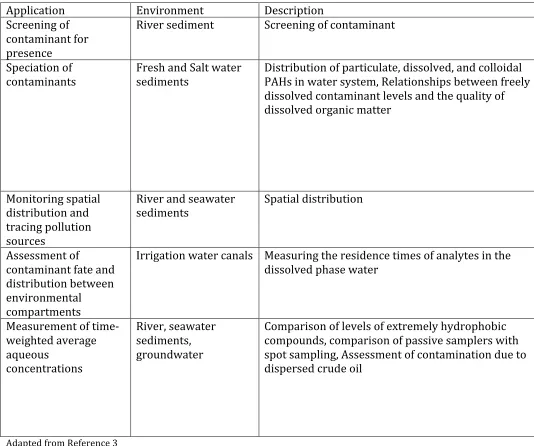
Table 3 – Applications of Passive Samplers in Environmental Studies
Application Environment Description
Screening of contaminant for presence
River sediment Screening of contaminant
Speciation of
contaminants Fresh and Salt water sediments Distribution of particulate, dissolved, and colloidal PAHs in water system, Relationships between freely dissolved contaminant levels and the quality of dissolved organic matter
Monitoring spatial distribution and tracing pollution sources
River and seawater
sediments Spatial distribution
Assessment of
contaminant fate and distribution between environmental compartments
Irrigation water canals Measuring the residence times of analytes in the dissolved phase water
Measurement of time-‐ weighted average aqueous
concentrations
River, seawater sediments, groundwater
Comparison of levels of extremely hydrophobic compounds, comparison of passive samplers with spot sampling, Assessment of contamination due to dispersed crude oil
Adapted from Reference 3
Further research in bioavailability in aquatic environments needs to focus on higher trophic levels of organisms, such as fish, to determine if the correlation exists within all organisms in an
(4). An outline of potential uses of passive samplers with regards to PAHs is presented in table 3. One should note that this was based only on SMPD studies, but could be extended to the others given the consistency of data within the methods.
In the 2013 overview by Parkerton, there are a few key points that are mention to expand use of PSMs for more effective contaminated sediments management including the standardization of laboratory procedures associated with PSMs, communication regarding sources of uncertainty with regards to both ex situ and in situ applications, engaging various arenas that can broader availability of PSM understanding, and bettering linkages between PSM measurements in model-‐ building to better develop of comprehensive understanding of the chemical(s) of concern.
Works Cited
1. Vinturella, Amy; Burgess, Robert; Coull Brent; Thompson, Kimberly; Shine, James. 2004. Use of Passive Samplers to Mimic Uptake of Polycyclic Aromatic Hydrocarbons by Benthic Polychaetes. Vinturella , Environmental Science and Technology., 38, 1154 -‐ 1160.
2. Gustavson, Karl and Harkin, John. 2000. Comparison of Sampling Techniques and Evaluation of Semipermeable Membrane Devices (SPMDs) for Monitoring Polynuclear Aromatic
Hydrocarbons (PAHs). Environmental Science Technology 34, 4445 – 4451.
3. Vrana, Branislav; Mills, Graham. Allan, Ian; Dominiak, Ewa; Svensson, Katarina; Knutsson, Jesper; Morrison, Gregory; Greenwood, Richard. 2005. Passive Sampling Techniques for Monitoring Pollutants in Water. Trends in Analytical Chemistry.. 24. 10. 845 – 865.
4. Utvik, Toril and Johnsen, Stale. 1999. Bioavailability of Polycyclic Aromatic Hydrocarbons in the North Sea. Environmental Science and Technology. 33. 1963 – 1969.
5. Adams, Rachel; Rainer, Lohmann; Fernandez, Loretta; Macfarlane, John; Gschwend, Philip. 2007. Polyethylene Devices: Passive Samplers for Measuring Dissolved Hydrophobic Organic Compounds in Aquatic Environments. Environmental Science and Technology. 41. 1317 -‐ 1323.
6. Mayer, Philipp; Parkerton, Thomas; Adams, Rachel; Cargill, John; Gan, Jay; Gouin, Todd; Gschwend, Philip; Hawthorne, Steven; Helm, Paul; Witt, Gesine; Jing, You; Escher, Beate. 2014. Passive Sampling Methods for Contaminated Sediments: Scientific Rationale
Supporting Use of Freely Dissolved Concentrations. Integrated Environmental Assessment and Analysis. 10. 2. 197 – 209.
8. Cui, Xinyi; Mayer, Philipp; Gan, Jay. 2013. Methods to Assess Bioavailability of Hydrophobic Organic Contaminants: Principles, Operations, and Limitations. 172. 223-‐ 234.
9. Booij, Kees; Smedes, Foppe; Weerlee, Evaline. 2002. Spiking of Performance Reference Compounds in Low Density Polyethylene and Silicone Passive Water Samplers. Chemosphere. 46. 1157 -‐1161.
10. US Environmental Protection Agency. 2012. Guidelines for Using Passive Samplers to Monitor Organic Contamination at Superfund Sediment Sites.
11. Gomez-‐Eyles, Jose; Jonker, Michiel; Hodson, Mark; Collins, Chris. 2011. Passive Samplers Provide a Better Prediction of PAH bioaccumulation in Earthworms and Plant Roots than Exhaustive, Mild Solvent, and Cyclodextrin Extractions. Environmental Science and Technology, 46. 962 – 969.
12. Lydy, Michael; Mandrum, Peter; Oen, Amy; Allinson, Mayumi; Smedes, Foppe; Harwood, Amanda; Li, Huizhen, Maruya, Keith; Liu, Jingfu. 2014. Passive Sampling Methods for Contaminated Sediments: State of the Science for Organic Contaminants. Integrated Environmental Assessment and Management. 10. 2. 167 – 178.
13. Parkerton, Thomas and Maruya, Keith. Passive Sampling in Contaminated Sediment Assessment: Building Consensus to Improve Decision Making. Integrated Environmental Assessment and Management. 10. 2. 163 – 166.
14. Muijs, Barry, and Jonker, Michiel. 2012. Does Equilibrium Passive Sampling Reflect Actual in Situ Bioaccumulation of PAHs and Petroleum Hydrocarbon Mixtures in Aquatic Worms? Environmental Science and Technology. 46. 937 – 944.
15. Ghosh, Upal; Driscoll, Susan; Burgess, Robert; Jonker, Michiel; Reible, Danny; Gobas, Frank; Choi; Apitz, Sabine; Maruya, Keith; Gala, William; Mortimer, Munro. 2014. Passive
and Implementation. Integrated Environmental Assessment and Management. 10. 210 – 223.
16. Greenberg, Marc; Chapman, Peter; Allan, Ian; Anderson, Kim; Apitz, Sabine; Beegan, Chris; Bridges, Todd; Brown, Steve; Cragill IV, John; McCulloch; Menzie, Charlie; Shine, Jim;
Parkerton, Tom. 2014. Passive Sampling Methods for Contaminated Sediments: Risk
Assessment and Management. Integrated Environmental Assessment and Management. 10. 2. 224 – 236.
17. Shea, Damien and Luellen, Drew. 2002. Calibrations and Field Verification of Semipermeable Membrane Devices for Measuring Polycyclic Aromatic Hydrocarbons in Water.
Environmental Science and Technology. 36. 1791 -‐1797.
18. Semple, Kirk. T.; Doick, Kieron J.; Jones, Kevin C.; Burauel, Peter; Craven, Andrew; Harms, Hauke 2004. Peer Reviewed: Defining Bioavailability and Bioaccessibility of Contaminated
Soil and Sediment is Complicated. Environmental Science & Technology 38 (12): 228A–31A. 19. Polycyclic Aromatic Hydrocarbons (PAHs): Health Effects. 2009. Department of Health,
Government of South Africa.
20. Booij, Kees; Smedes, Foppe; Weerlee, Evaline. 2002. Spiking of Performance Reference Compounds in Low Density Polyethylene and Silicone Passive Water Samplers. Chemosphere. 46. 1157 -‐1161.