Commitment Machines
Pınar Yolum and Munindar P. Singh
Interaction, Media, and Commerce Laboratory
Department of Computer Science
North Carolina State University
Raleigh, NC 27695-7535, USA
f
pyolum, mpsingh
g@eos.ncsu.edu
Abstract
Protocols are structured interactions among communicating agents. Protocols are essential in applications such as electronic commerce where it is necessary to constrain the behaviors of autonomous agents. Traditional representations of protocols specify legal sequences of actions but define neither the content of the actions nor of the intervening states. Thus traditional rep-resentations are inadequate in open settings where autonomous agents must flexibly interact, e.g., to handle exceptions and exploit opportunities.
We develop an approach in which we model communication protocols via commitment
machines. Commitment machines supply a content to the protocol states and actions in terms
of the social commitments of the participants to one another. The content can be reasoned about by the agents thereby enabling flexible execution. We provide reasoning rules to capture the evolution of commitments through the agents’ actions. Because of its representation of content and its operational rules, a commitment machine effectively encodes a systematically enhanced version of the original protocol, which allows the original sequences of actions as well as other legal moves to accommodate exceptions and opportunities.
1
Introduction
Key agent applications in open environments rely crucially upon communication among interacting participants (Fisher & Wooldridge, 1997). Protocols streamline this communication and enable the development of interoperable software components by independent vendors. Unfortunately, current techniques for specifying and enacting protocols result in protocols that are more rigid than traditional, human-oriented protocols. This rigidity subverts some of the motivations behind why agents are attractive application in the first place.
In ideal circumstances, agents participating in a protocol would be able to identify and take valid shortcuts, exploit opportunities offered by the environment, negotiate and benefit from special relationships with other agents, and handle certain kinds of exceptions. Agents that are forced to follow rigid protocols cannot readily exercise any of the above possibilities and cannot adapt their behavior in light of their interactions with one another.
We develop an approach that enables the flexible execution of protocols. This approach is based on the following key conceptual definitions. Agents are persistent computations that can perceive, reason, act, and most importantly communicate. Agents can be autonomous and heterogeneous, and can represent different interacting components. The agents enter into social commitments with other agents. The agents’ communications affect, and are affected by, their commitments. In turn, the agents’ commitments reflect the protocols they are following and the communications they have already made or received. There are three main contributions of this paper.
We propose a new formalism, the commitment machine (CM), to formally specify and
exe-cute protocols. A commitment machine attaches specific declerative meanings to states and actions within a protocol. These meanings are based on commitments of the participating agents. When the meanings of states and actions are formally defined, the legal computations can be logically inferred. This enables the protocols to be systematically enhanced with addi-tional transitions, allowing a broader range of interactions. The enhancement enables agents to exploit opportunities and handle exceptions.
We show how a commitment machine may be automatically compiled into a finite state
machine (FSM) in which no commitments or other declerative meanings are explicitly men-tioned, but which can be efficiently executed.
We give technical results proving that the compilation procedure, sometimes with additional
restrictions, produces an FSM that is deterministic (easy to execute), sound (never produces a computation not allowed by the commitment machine), and complete (can produce the effect of any computation allowed by the commitment machine).
2
Technical Motivation
Our approach applies to multiagent protocols in general. However, for concreteness, we consider e-commerce as a running theme and study an e-commerce protocol as a running example in this paper. Multiagent protocols have traditionally been modeled by formalisms similar to those used to specify protocols in distributed computing and computer networks. Although these protocol specifications in general model communication among entities, traditional formalisms cannot ade-quately represent the interactions required in open applications such as e-commerce where agents are most useful. Consequently, protocols tend to suffer from unnecessary rigidity in execution, re-sulting in redundant interactions and avoidable failures. We now investigate the desired properties of the agents and the underlying components that our protocol representation must preserve. Next we analyze a well-known e-commerce payment protocol to understand what enhancements we can seek through our approach.
2.1
Dynamic Properties
Current formalisms used in modeling networking protocols, such as finite state machines and Petri Nets, specify protocols merely in terms of legal sequences of actions without regard to the mean-ings of those actions. For this reason, protocols tend to be over-constrained to the level of specific sequences of actions. However, protocols should not only constrain the actions of the participants, but also recognize the open, dynamic nature of interactions by accommodating the key aspects of autonomy, heterogeneity, opportunities, and exceptions.
Autonomy: Enabling participants to exercise autonomy as much as they can in the social
environment in which they are situated is a crucial factor in creating effective multiagent systems. The components should be able to exercise autonomy in deciding what actions they want to perform, who they want to interact with, or how they want to carry out their tasks. Thus, in an e-commerce setting, components must be constrained in their interactions only to the extent necessary to carry out the given protocol and may negotiate and adapt their behavior as they like.
Heterogeneity: Agents can be diverse and may adopt different strategies in their interactions.
For example, in many e-commerce protocols, all participants are assumed to be untrustwor-thy, and each step of the protocol ensures that appropriately safe actions are taken by the various participants. This assumption degrades the performance of the protocols since the actions could be better selected based on who the agent is dealing with. In particular, agents that have established trust with each other could safely skip certain steps in the given proto-col.
Opportunities: Agents should be able to take advantage of opportunities to improve their
Exceptions: Agents must be able to modify their interactions to handle unexpected
condi-tions. The sort of exceptions of interest here are not programming or networking exceptions such as loss of messages and network delays, but are higher-level exceptions that result from the unexpected behavior of the participants.
2.2
Semantic Analysis
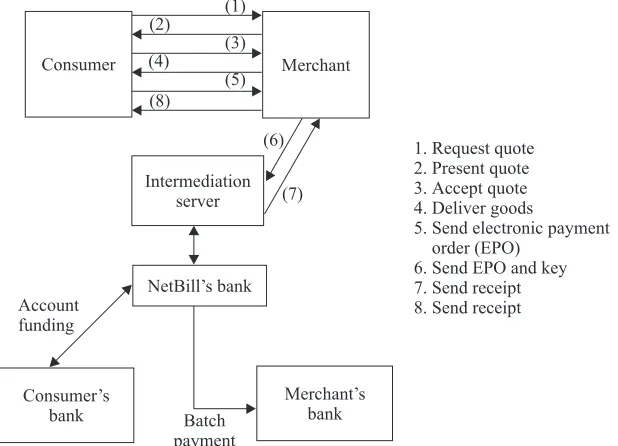
We now analyze the concepts and challenges underlying communication protocols from the stand-point of open environments. As a running example, we consider the NetBill protocol which was developed to handle the buying and selling over the Internet of electronic goods, such as software and electronic documents (Sirbu, 1998).
(1)
(3)
(5) (2)
(4)
(8)
1. Request quote 2. Present quote 3. Accept quote 4. Deliver goods
5. Send electronic payment order (EPO)
6. Send EPO and key 7. Send receipt 8. Send receipt Intermediation
server
Consumer Merchant
NetBill’s bank Account
funding
(7) (6)
Consumer’s
bank Batch
payment
Merchant’s bank
Figure 1: The NetBill payment protocol
Example 1 As shown in Figure 1, the protocol begins with a customer requesting a quote for some desired goods, followed by the merchant sending the quote. If the customer accepts the quote, then the merchant delivers the goods and waits for an electronic payment order (EPO). The goods delivered at this point are encrypted, that is, not usable. After receiving the EPO, the merchant forwards the EPO and the key to the intermediation server, which then contacts the bank to take care of the funds transfer. When the funds transfer completes, the intermediation server sends a receipt back to the merchant. The receipt contains the decryption key for the sold goods. As the last step, the merchant forwards the receipt to the customer, who can then successfully decrypt and use the goods.
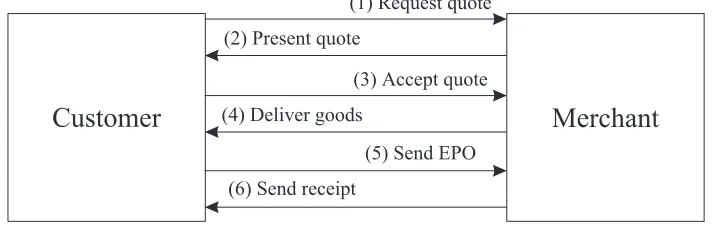
the protocol by assuming that once the merchant receives an EPO, the funds transfer will succeed. Figure 2 shows this simplified version of the NetBill protocol. We use this simplified version as our running example. We later discuss how to add some of the details back to the protocol when desired.
Merchant
Customer
(4) Deliver goods(3) Accept quote
(6) Send receipt
(5) Send EPO (2) Present quote
(1) Request quote
Figure 2: Simplified version of the NetBill protocol
The parties participating in an e-commerce protocol are self-interested and eager to interact in any way that would benefit them. Thus, the parties should be permitted a choice of actions, and be able to select the actions that benefit them the most.
Example 2 The rigid specification of Figure 2 cannot handle some of the natural situations that arise in e-commerce:
Instead of waiting for a customer to request a quote, a merchant may proactively send a
quote, mimicking the idea of advertising.
(1) Accept
(2) Send goods
(3) Send EPO (4)
Send receipt
Merchant
Customer
Figure 3: Alternative execution where the customer accepts any price prior to receiving a quote
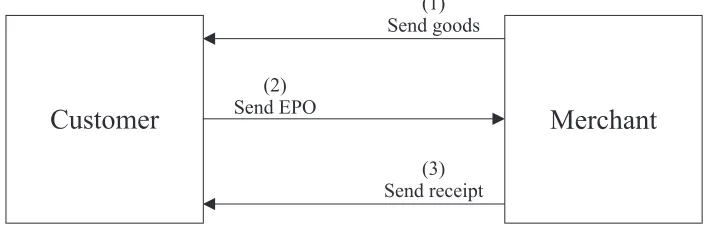
The customer may send an “accept” message without first exchanging explicit messages
customer’s lack of interest in the price, the emergency of the transaction, the insignificance of money to the customer, and so on. This scenario is shown in Figure 3.
Figure 4: Alternative execution where the merchant sends the goods first
As shown in Figure 4, a merchant may send the goods without an explicit price quote.
Send-ing unsolicited goods would correspond to “try before you buy” deals, common in the soft-ware industry. Here after a certain period the customer is expected to pay to continue using the software.
After receiving the goods, the customer may send the EPO to the bank instead of the
mer-chant. By delegating the payment to the bank, the customer makes the bank responsible for ensuring that the money gets to the merchant.
3
Technical Framework
Our approach to accommodating flexible execution of e-commerce protocols combines ideas from social commitments and finite state machines. Accordingly, we introduce the key concepts from these areas here.
Following speech act theory, we view communication as a form of action (Austin, 1962). Specifically, by making an utterance, an agent may not only describe the current state of the world, but may also change it. The changes of interest here reflect the progress in the given protocol and may be captured in terms of modifications to the participants’ commitments. Each utterance results in an action (such as creation or discharge) on one or more commitments.
3.1
Social Commitments
Social commitments are different from both internal and collective commitments. An internal com-mitment relates an agent and a particular action or a condition that it commits to bringing about. A collective commitment relates a group of agents to a particular action or condition that they will bring about (Castelfranchi, 1995). Social commitments, on the other hand, are commitments made from one agent to another agent to carry out a certain course of action (Singh, 1999).
Definition 1 A social commitmentC(x, y, G, p) relates a debtor x, a creditor y, and a condition p,
in the scope of a context group G.
When a social commitment of this form is created, x becomes responsible to y for satisfy-ing p. The context group G is the organization within which the commitment exists. Maksatisfy-ing the context explicit enables us to control the evolution of the commitments and to accommodate compliance and resolution of disputes. The condition p may involve relevant predicates and com-mitments, allowing the commitments to be nested or conditional. In contrast with databases, here the commitments are flexible and can be revoked or modified. Almost always, the revocation or modification is constrained through metacommitments.
Definition 2 A commitment
c
=C(x, y, G, p) is base-level ifp
does not refer to any other commit-ments;c
is a metacommitment ifp
refers to a base-level commitment.Viewing a commitment as an abstract data type, the creation and the manipulation of the com-mitments can be described using the following operations (Singh, 1999; Venkatraman & Singh, 1999). Here,
x
,y
,z
denote agents, andc
andc
0denote commitments of the formC(x, y, G, p).
1. Create(x, c) establishes the commitment
c
. The create operation can only be performed by the debtor of the commitment.2. Discharge(x, c) resolves the commitment
c
. Again, the discharge operation can only be performed by the debtor of the commitment to mean that the commitment has successfully been carried out. Thus, after the discharge operation the conditionp
starts to hold.3. Cancel(x, c) cancels the commitment
c
. Usually, the cancellation of a commitment is fol-lowed by the creation of another commitment to compensate for the former one.4. Release(y, c) or Release(G, c) releases the debtor from the commitment
c
. It can be per-formed either by the creditor or the context group, to mean that the debtor is no longer obliged to carry out his commitment.5. Assign(y, z, c) eliminates the commitment
c
, and creates a new commitmentc
0for which
z
is appointed as the new creditor.6. Delegate(x, z, c) eliminates the commitment
c
, and creates a new commitmentc
03.2
Finite State Machines
One of the most common methods of specifying protocols is through the use of the deterministic finite state machines (DFSMs). DFSMs are also extensively used to specify e-commerce protocols. Definition 3 A finite state machine is a five-tuple,
M
= hS,;s
0, Q,
i, where S is the set of
states, is the input alphabet,
s
02 S is the start state, QS is the set of final states, and
SS is the transition relation.A protocol execution starts from the start state
s
0. With every action performed, the executionmoves to a new state based on the transition function. An FSM accepts a sequence of actions if the execution ends in one of the final states in Q.
An FSM can be represented graphically by a labeled directed graph, where nodes represent the states and the arcs represent the transitions. In a protocol specification, the alphabet of the FSM is given by the set of possible actions. The transition relation describes how an execution of the protocol may progress as the agents perform legal actions resulting in new states.
Definition 4 A finite state machinehS
;
;s
0, Q,iis deterministic if any action has at most one
transition from a state, i.e.,(8
s;s
0;s
002S
;a
2:(s;a;s
0)
;
(s;a;s
00)2
)s
0=
s
00).
1
2 3
4 5
6 7
C: Send request
M: Send quote
M: Send goods
M: Send receipt C: Send accept
C: Send EPO
Figure 5: FSM representation of the NetBill protocol
Example 3 Figure 5 shows the simplified version of the NetBill payment protocol as an FSM labeled with the actions of merchant agent M and customer agent C.
4
Commitment Machines
the possible states an executing protocol can be in.
the actions that are used for a transition from one state to another. the possible final states of the protocol.
The meaning associated with each state specifies which commitments are in force in that particular state, and the meaning associated with each action defines how the commitments are affected by that action (thereby leading to a state change).
Like an FSM, a CM has a current state; zero or more actions are allowed in each state; every allowed action causes the CM to transition to a new state. Unlike an FSM, the representation of a CM does not specify a starting state. The participants may start the protocol from a state by accepting the commitments that are in force in that state. Usually, the protocol will have some states where no commitments are in force. A CM also has final states, which reflect the acceptable or desirable termination states of the protocol. Recall that liveness means that progress will be made. Starting from a particular state does not guarantee liveness.
Importantly, unlike in an FSM, the transitions between the states are not explicitly specified. The meanings of the states and the actions are logically represented. Based on the intrinsic meaning of the actions, the new state that is reached by performing an action at a particular state can be logically inferred. Thus, instead of specifying the sequences of actions that can be performed, a CM simply specifies the meanings that are legal in the protocol and, of these, the meanings that are final.
A CM specification of an e-commerce protocol emphasizes that the aim of executing the pro-tocol is not merely to perform certain sequences of actions, but to reach a state that represents the result of performing these sequences of actions. With this in mind, we can come up with different paths that accomplish the same goal as the original path. Thus, a protocol can be reconfigured (enhanced or abbreviated) by finding alternative paths between states.
Example 4 We define the semantic content of each state in Figure 5 based on the participants’ commitments:
In state 3, having sent a quote to a customer, the merchant commits to delivering goods and
sending a receipt afterwards, if the customer promises to pay.
In state 4, having sent an accept to a merchant, the customer agrees to pay, but only if the
merchant promises to send a receipt afterwards.
In state 5, the merchant has fulfilled the first part of his promise by sending the goods. In state 6, the customer has discharged his commitment of sending the EPO.
In state 7, the merchant has discharged his commitment of sending the receipt.
Run time. A CM specification of a protocol gives the states and the effects of performing
the various actions. Given a CM, an agent that can process logical formulas can compute the transitions between states. In this respect, the choice of actions is a planning problem for each agent. That is, from the possible final states, the agent first decides on the desired final state, and then logically infers a path that will take it from the current state to the desired final state. Effectively, the agent interprets the CM directly at run time.
Compile time. To reduce the computation required at run time, a CM can be compiled into an
FSM that abstracts out the meanings of the states and actions. An FSM can be mechanically executed without explicit logical inference. This transformation is based on systematically producing paths between pairs of meanings. The meanings in the CM map to states in the FSM. The set of actions remains the same. The transitions between the FSMs states follow from the transitions in the CM. The set of final states will be the designated final meanings in the CM.
Section 4.1 formalizes CMs including the main reasoning rules for operationalizing commitments. Section 4.2 shows how CMs help capture an enhanced protocol. Section 4.3 shows how CMs support flexible execution.
4.1
Formalization
We now look more closely at how CMs can be applied in the above two ways. Our formalization is based on a language used to represent the legal meanings in a CM. Our formal language, P,
is based on the language of propositional logic with the addition of a commitment operator to represent commitments, and a leads to operator to capture strict implication.
The following Backus-Naur Form (BNF) grammar with a distinguished start symbolProtocol gives the syntax ofP. In this grammar,slant typeface indicates nonterminals;?! is a metasymbol
of BNF specification; and delimit comments; f and g indicate that the enclosed item is
repeated0or more times; the remaining symbols are terminals.
Protocol?! fActiongset of actions
Action?! Token: Ltoken is a label;L is the associated meaning
Commitment?! Cx (L)jCx (M)simplified as explained below
L?! Commitment
M?! L;Lleads to, indicating a strict implication
L?! L^Lconjunction
L?! :Lnegation
The logical operators are given the usual semantics. The strict implication,
p
;q
, requiresq
tohold when
p
holds. Contrary to the material implication (p
!q
), which istruewhenp
isfalse, thestrict implication isfalseif
p
isfalse. The strict implication is used in representation of participants’metacommitments. For expository ease, we use a simplified notation to represent commitments in the remainder of this paper. Here Cx
p
means thatx
(which can be the customer or the merchantin NetBill) is committed to the other party to carry out
p
(the group is implicit). Furthermore, we only restrict the nesting of commitments to one level.Definition 5 A metacommitment is a commitment of the formCx(
p
; Cxr
). This expresses theconditional commitment where if the proposition
p
becomes true, then the debtorx
will become committed to bringing aboutr
. Thus,Cx(p
; Cxr
)is operationally the same asCx(p
;r
)andwe use the latter, simpler form in the remainder of this paper.
The meaning of a state is given by any formula derivable from the nonterminal L. We define two logical relations among meanings: logical derivation and equivalance.
Definition 6
p
`q
means thatq
can be logically derived fromp
.Definition 7
p
q
means thatp
andq
are logically equivalent, that is,p
`q
andq
`p
.A minimal set of meanings is one in which all meanings are logically distinct. A set of final meanings is consistent if it is well-behaved with respect to logical consequence.
Definition 8 A set M of meanings is minimal if and only if the following conditions hold:
(8
m
i;m
j 2M:(m
im
j))(m
i =m
j)) true2M.false62M.
Definition 9 A set of final meanings F is consistent with respect to a set of meanings M if and only if any meaning that is stronger than a final meaning is also final. That is,(8
m
i 2F,m
j 2M: (m
j `m
i))(m
j 2F)).Actions are represented as a pair whose first element is the token (name) of the action, and whose second element is the effect of the action.
Definition 10 h
a
:e
iis an action, ifa
is the token ande
is the meaning (effect) of the action.Definition 11 A CM is a triplehM,, Fi, where M is a finite minimal set of meanings,is a finite
set of actions defined in terms of commitments, and FM is a consistent set of final meanings.
A CM transitions from meaning
q
to meaningr
under actionha
:e
iif and only if after applyingDefinition 12
q
j= ha:eir
4
(
q
^e
)`r
.Thus, deriving the resulting meaning from a given meaning and action involves computing the logical consequence (that is, the ` relation). For the propositional part of the language this
is as usual. For commitments and metacommitments, we now present some important rules for reasoning about their consequences. These rules capture the operational semantics of our approach.
Reasoning Rule 1 A commitmentCx
p
ceases to exist when the propositionp
becomes true.Reasoning Rule 2 A metacommitmentCx(
p
;r
)ceases to exist when the propositionp
becomestrue, but a new base-level commitmentCx
r
is created to capture the fact thatx
has to satisfy theoriginal metacommitment by bringing about the proposition
r
.Reasoning Rule 3 A metacommitmentCx(
p
;r
) ceases to exist when the propositionr
holds(before
p
is initiated), and no additional commitments are created.The following example illustrates the applicability of the above reasoning rules.
Example 5 Consider the metacommitmentCm(pay ; receipt), which denotes the commitment
that the merchant is willing to send a receipt if the customer pays. After the creation of this metacommitment, the following scenarios may take place:
The customer pays, making the proposition pay true. In this case, the metacommitment is
terminated and a new commitment, Cmreceipt, is created in its stead (Reasoning Rule 2).
When the merchant actually sends the receipt, i.e., when the proposition receipt becomes true, then the commitmentCmreceipt is discharged (Reasoning Rule 1).
Before the customer pays, the merchant sends the receipt, making the proposition receipt
true. In this case, the metacommitment is terminated, but no other commitment is created since the customer did not commit to paying in the first place (Reasoning Rule 3).
The following example describes the atomic propositions and commitments used in the NetBill protocol, and then defines the NetBill protocol formally as a CM.
Example 6 Following Figure 5, the messages and the states can be given a content based on the following definitions:
Atomic propositions
Abbreviations for the metacommitments
– acceptan abbreviation forCc(goods ;pay)meaning that the customer is willing to
pay if he receives the goods.
– promiseGoodsan abbreviation forCm(accept ;goods)meaning that the merchant
is willing to send the goods if the customer promises to pay.
– promiseReceiptan abbreviation forCm(pay ; receipt)meaning that the merchant
is willing to send the receipt if the customer pays.
– offeran abbreviation for(promiseGoods^promiseReceipt)
Based on the above definitions, we can now define the NetBill protocol formally as a CM. Since each action can be performed by only one party, we do not specify the performers explicitly.
Meanings (M):
1. true
2. requestThe customer has requested a quote.
3. offerThe merchant has made an offer.
4. Cmgoods ^ accept ^ promiseReceipt The customer has accepted the merchant’s
offer.
5. goods^Ccpay^promiseReceiptThe merchant has delivered the goods, and
there-fore the customer is committed to paying and the merchant is willing to send the receipt after the customer pays.
6. goods ^pay^ CmreceiptThe merchant has delivered the goods, the customer has
paid, and the merchant is committed to sending the receipt.
7. goods^pay^receiptThe merchant has delivered the goods and the receipt, and the
customer has paid.
Actions ():
1. hsendRequest: requestisending a request for quote.
2. hsendQuote: offerisending a quote.
3. hsendAccept: acceptisending an accept.
4. hsendGoods: goods^promiseReceiptidelivering the goods.
5. hsendEpo: payisending an EPO.
6. hsendReceipt: receiptisending the receipt.
Final meanings (F):
1. request 2. offer
4.2
Enhancement
One of the main advantages of specifying e-commerce protocols using CMs is their ease of en-hancement. By adding new meanings to the meaning set, M, and appropriately, to the final mean-ing set, F, the protocol can be enhanced to allow additional computations. Similarly, by reducmean-ing the meanings set M and F the possible computations can be restricted. The following example depicts how an existing CM specification can be enhanced.
1
2 3
4 5
6 7
C: Send request
M: Send quote
M: Send goods
M: Send receipt C: Send
accept
C: Send EPO
8
9
M: Send goods
M: Send goods
C: Send EPO
C: Send accept C: Send
accept
M: Send goods M: Send
quote
Figure 6: Enhanced commitment machine
Example 7 We now reconsider the shortcomings of Figure 2. In order to remedy these shortcom-ings, we introduce two new meanshortcom-ings, accept and (goods^promiseReceipt). The first meaning
denotes the state where the customer is accepting any price, and the second meaning denotes the state where the merchant has delivered the goods and is willing to send the receipt if the customer pays. We now add these two new meanings to the meaning set, M, and the final meaning set, F, defined in an example in Section 4.1, the previous specification of our protocol.
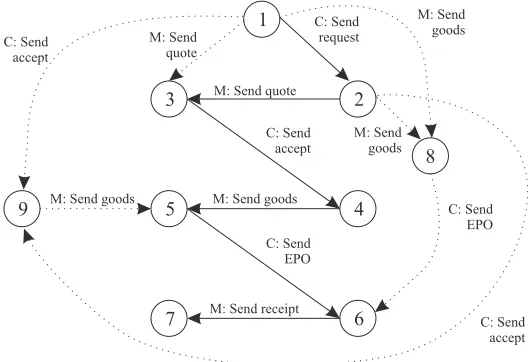
Although the formal descriptions of CMs and FSMs are quite different, we can use the same pictorial representation for both. Thus, we use the graphical representation in Figure 6 to show the additional possible moves that can be achieved by enhancing the CM specification of the NetBill protocol.
The merchant can now start the protocol by sending a quote to a customer. As was the case
in Section 4.1, by performing this action the merchant creates a metacommitment in state 3, namely that he is willing to send the goods and the receipt if the customer agrees to pay.
By sending an accept message without prior conversation about the quote, the customer
this point. On the other hand, if the merchant makes an offer by sending the goods, then both parties have to carry out their commitments, so the protocol moves to state 5.
By sending the goods without an explicitaccept message, the merchant makes an offer to
send the receipt if the customer agrees to pay. Thus, we move from state 1 to a state where the merchant is making an offer (state 8). If the customer does not accept the offer, then the protocol ends at this point. Conversely, if the customer actually sends an accept message, then both parties need to fulfill their commitments, so the protocol moves to state 5.
Compared to the original version of the protocol in Figure 5, we have introduced two new states, state 8 and state 9, for the new added meanings.
State 8: goods^promiseReceipt
State 9: accept
In addition to the above states, we have added new transitions from state 1 to states 3, 8, and 9; from state 2 to states 8 and 9; from state 8 to state 6 and from state 9 to state 5. The new transitions are shown with dashed lines in Figure 6.
No matter what path is chosen to reach a state, each state captures a well-defined meaning in terms of commitments. Once, a state is reached, the path that took us there can be discarded, making the choice of action independent of the previous actions performed. At any state, the reasoning can be based solely on the meaning associated with that state.
4.3
Flexible Execution of Commitment Machines
At this point, it is important to restate what we mean by flexibility. Although we want the agents to enact a flexible protocol, we still want to preserve an ordering that will allow only meaningful conversations. For example, a merchant should not send a quote after sending the goods, and the customer should not start the conversation by sending an EPO.
Importantly, flexibility can be introduced only to the point where the intended meanings of the actions are not violated. The interactions among the parties can be given a meaning based on their commitments to each other. When we allow more flexible interactions, we need to ensure that the original commitments are in force or that they are altered by mutual agreement. The execution of a protocol is then minimally constrained only to satisfy those metacommitments. This is a major advantage over low-level representations, which require specific execution sequences and provide no basis for deciding on the correct state independent of the execution sequence.
4.3.1 Opportunism
in this way, the agent accepts the commitments that are in force in that particular state. Similarly, during the execution of a protocol an agent may be able to jump across several steps at once. In our running example, the merchant may send a price quote proactively. We discussed such cases in Section 2.2.
4.3.2 Composition
Protocols may be combined into larger protocols, as long as one protocol ends in a commitment state that another protocol can accommodate. This can be applicable in two cases, first to combine protocols to be executed one after the other, and second to allow a side protocol to be followed during the execution of the first protocol.
A protocol can be composed by combining modules of subprotocols through a common com-mitment state. This common state need to be one of the final states of the first CM, and a possible state in the second CM. If the execution of the first protocol ends at the common commitment state, the execution can continue from that particular state present in the second protocol, provided that the execution of the protocol never goes back to a state in the first protocol.
Alternatively, participants of a protocol can interact with agents that are not taking place in the protocol through side protocols. In this case, the crucial point is to ensure that the agent that gets into a side protocol needs to returns to the point where it left off in the main protocol.
Example 8 In Section 2.2, we abstracted out the banking procedures to simplify the NetBill pro-tocol, although there is a convention used between the merchant and the bank to deal with the EPO processing. If we consider the banking operations as a separate protocol, we can see that the banking protocol may be combined with our protocol through state 6. Recall that at state 6, the customer has discharged his commitment of sending an EPO, but the merchant still has to send the receipt. The merchant at this state can participate in a side protocol with a bank to verify that the EPO has actually cleared. After taking part in this side protocol, the merchant will come back to state 6 to send the receipt to the customer. Since the commitments of the main protocol are preserved in the side protocol, the composition of the two protocols yields a valid protocol.
5
Compiling Commitment Machines
A protocol specification that allows the above characteristics can drastically improve the flexibility and thus the quality of the solution provided by agent-based applications. However, the flexibility comes at the price of reasoning with declerative representations at run-time, which can be expen-sive and may increase the code footprint of the agents who implement such reasoning. Fortunately, it is possible to compile a CM into an FSM so that the desired affect can be obtained without representing and reasoning about declerative meanings at run time.
However, the execution of the FSM follows the usual regime of state-transition-state without regard to the formulas that exist in CM meanings on which the FSM states are based.
To infer the valid transitions in the FSM, we consider the possible entailments between the meanings. To ensure determinism and efficiency, we constrain the allowed transitions with two major restrictions.
Restriction 1 h
m
i;a;m
ji2entails thatm
i 6`m
j.If the source meaning already entails the content captured in the target meaning, no transition from the source to the target is necessary. This restriction ensures that the meaning that will be reached is not already captured at the current state, and that the FSM has no transitions that do not add to the content.
Restriction 2 h
m
i;a;m
ji2entails that (8m
k 2M:m
ij=ha:ei
m
k)
m
j `m
k).This is to ensure that if applying an action at a particular meaning entails several possible meanings, then the transition will end in a state that contains the maximal information. Later we will restrict our CMs so that a maximal meaning always exists.
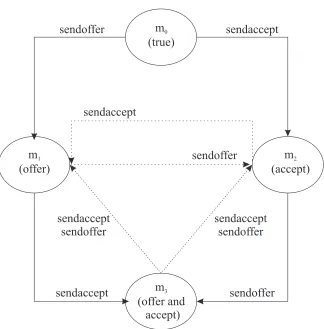
Example 9 Let us assume that the meanings depicted in Figure 7 constitute the meaning set M of a CM (it is easy to verify that M is minimal). Among these four meanings, F contains
m
2 andm
3.Let the action setcontain two actions:hsendaccept: acceptiandhsendoffer: offeri.
We now look at some possible entailments and demonstrate which of these entailments result in a valid transition converting a CM to an FSM.
h
m
0,sendoffer,
m
1i:truej=
hsendoffer:offeri offer h
m
0,sendaccept,
m
2i: truej=
hsendaccept:acceptiaccept
Since neither restriction applies to these entailments, both transitions are accepted.
h
m
1,sendoffer,
m
1i: offerj=
hsendoffer:offerioffer h
m
1,sendaccept,
m
1i: offerj=
hsendaccept:acceptioffer
These two transitions will not be allowed due to Restriction 1, which does not allow transi-tions where the starting state already entails the end state.
h
m
1,sendaccept,
m
2i: offerj=
hsendaccept:acceptiaccept h
m
1, sendaccept,
m
3i: offerj=
hsendaccept:accepti(offer
^accept)
Based on Restriction 2, only the latter transition will be allowed.
h
m
2,sendaccept,
m
2i: acceptj=
hsendaccept:acceptiaccept h
m
2,sendoffer,
m
2i: acceptj=
hsendoffer:offeriaccept
Again, based on Restriction 1, these two transitions will not be allowed.
h
m
2,sendoffer,
m
1i: acceptj=
hsendoffer:offerioffer h
m
2,sendoffer,
m
3i: acceptj=
hsendoffer:offeri(offer
^accept)
sendaccept sendoffer sendaccept
sendoffer
sendaccept sendoffer sendaccept
sendoffer
sendoffer sendaccept
m (offer and
accept) 3
m (accept)
2 m
(true) 0
m (offer)
1
Figure 7: Sample transitions in CMs
h
m
3,sendaccept,
m
2i: (offer^accept)j=
hsendaccept:acceptiaccept h
m
3,sendaccept,
m
3i: (offer^accept)j=
hsendaccept:accepti(offer
^accept) h
m
3,sendaccept,
m
1i: (offer^accept)j=
hsendaccept:acceptioffer h
m
3,sendoffer,
m
2i: (offer^accept)j=
hsendoffer:offeriaccept h
m
3,sendoffer,
m
3i: (offer^accept)j=
hsendoffer:offeri(offer
^accept) h
m
3,sendoffer,
m
1i: (offer^accept)j=
hsendoffer:offerioffer
It is easy to see that no transitions can start from
m
3, sincem
3already entails all the meaningsassociated with the other states.
5.1
Compilation Formalized
We now show how a CM can be formally compiled into an FSM. We establish soundness and completeness results regarding our compilation procedure. The compilation procedure can be realized in an automatic tool. Recall that a CM allows multiple starting states, whereas an FSM allows only one. In the compilation below, we show how an FSM can be constructed after choosing a start state for the CM, namely,true.
Procedure 1 Let
X
=hM,, Fibe a CM. Construct an FSMY
=hS,;s
0, Q,ias follows.
S = M
=f
a
:ha
:e
i2g
s
0 =true
Q = F
=fh
m
i;a;m
ji:m
i,m
j 2M,ha
:e
i2and (m
i j=ha:ei
m
j,m
i6`
m
j and (8m
k2M:m
i j=ha:ei
m
k)
m
j `m
k))gNotice that
is defined so as to satisfy Restrictions 1 and 2.When an FSM Y is produced from a CM X by Procedure 1, we say that X is compiled into Y. A compiled FSM can be directly executed by an agent with a single thread, using only constant space. Theorem 1 establishes this result.
Theorem 1 An FSM produced by compiling a CM according to Procedure 1 is deterministic. Proof. Let
X
=hM,, Fibe a CM compiled intoY
=hS,;s
0, Q,
i. Leth
m
i;a;m
ji2and hm
i;a;m
ki2be two transitions ofY
. From Restriction 2, we knowm
j `m
k andm
k `m
j,that is,
m
jm
k. Then, by Definition 8,m
j =m
k. Thus, by Definition 4,Y
is deterministic.The correctness of a compilation procedure must be based on the computations that can result from it. Therefore, we formalize the notion of a computation, how a computation may be generated by a CM, and how a computation may be realized by an FSM.
For the following discussion, let
f
2 N be a finite ordinal. Let I be the set of indices f0;
1;:::;
(f
?1)g(I is empty whenf
=0). Let J be the set of indicesf0;
1;:::;f
g.Definition 13
=hm
0
;a
0;m
1;a
1;:::;a
f?1;m
fiis a computation if(8
i
2 I;j
2 J :a
i 2 andm
i 2M). Intuitively, the action labels that occur in ,ha
0
;a
1;:::;a
f?1i, describe the externally
visible part of the computation because these are the actions seen by other agents.
Definition 14
=hm
0
;a
0;m
1;:::;m
fiis generated by a CM
X
=hM,, Fiif and only ifm
f 2 F, and (8i
2I:m
i 2M and(9e
i;
ha
i :e
ii2:m
i j=ha i
:e i
a1 a2
a0
mf
m2
m1
m0
af-1
Figure 8: A sample computation
Definition 15
=hm
0
;a
0;m
1;:::;m
fiis realized by an FSM
Y
=hS,;s
0, Q,iif and only if
m
0 =s
0,
m
f2Q, and(8
i
2I,hm
i;a
i;m
i +1i2
).Notice that our definition of a computation includes the meanings associated with the states along with an action sequence. Therefore, a computation can only be generated by a machine that can manipulate these meanings, that is, a CM. By constrast, an FSM can only realize this computa-tion by following the accomputa-tion sequence. With this distinccomputa-tion in mind, we define two main aspects of correctness. Soundness means that only allowed computations are realized. Completeness means that all allowed computations can be realized. A compilation procedure that produced an FSM
hS,
;s
0, Q,iwith S=fgcould be sound, whereas one that produced an FSM with S=MM
would be complete. That is, it is trivial to ensure one of soundness or completeness, but it is not helpful to ensure both. [helpful ] Theorem 2 establishes the soundness of our compilation method. (
Effectively, it states that the compiled FSM won’t produce a computation that was not allowed by the original CM.
Theorem 2 Let
X
=hM,, Fibe compiled intoY
=hS,;s
0, Q,i. Then any computation
realized by
Y
is generated byX
. Proof. Let =hm
0
;a
0;m
1;:::;m
fibe a computation generated by
Y
. By Procedure 1 S = M, (8i
2I;m
i 2M), andm
f 2F. Consider thei
th transition in,hm
i;a
i;m
i+1
i2
. This implies, (9e
i :ha
i :e
ii2andm
i j=ha i
:e i
i
m
i+1). By Definition 14,
X
generates .5.2
Completeness
Interestingly, with the general definition of a CM, our compilation is not complete. First, a com-putation that is generated by a CM may begin from any arbitrary meaning. Second, there may be no transitions in the FSM corresponding to some transition in the CM. Restriction 2 forces the transitions to yield a meaning that carries maximal information among the possible meanings. It might be the case that a transition emanating from a source state entails several meanings, none of which entails the rest. In this case, no meaning has the maximal information, and no corresponding transition is included in
. In order to ensure that there is always a meaning with the most infor-mation, we need to ensure that the meaning set M of the CM is closed under antecedence, that is, for any set of meanings there is a meaning that is stronger than each meaning in the set.A complete CM guarantees that in any subset of both the meaning set M and the final mean-ing set F, there exists a meanmean-ing that entails all the meanmean-ings in the subset. A more restrictive requirement is that the conjunction of any set of meanings is also a meaning.
Definition 17 A conjunctive CM is a CM whose meaning set M and final meaning set F are closed under conjunction. Formally,(8
R
M:(9m
k 2M:m
kV
mi 2R
m
i))and(8
R
F:(9m
k 2F:m
kV
mi 2R
m
i)).
Lemma 1 Every conjunctive CM is complete.
The main idea underlying a CM execution is that instead of specifying protocols in terms of legal sequences of actions, a CM specifies them in terms of meanings to reach. Thus, two computations may follow different sequences of actions but still achieve the same meaning. Since the computations are characterized with the achieved meanings, rather than pure sequences of actions, computations generated by a CM can be compared semantically.
Definition 18 A computation
0=h
m
0 0;a
0;m
0 1;:::;m
0fiis semantically superior to a computation
=hm
0
;a
0;m
1;:::;m
fiif and only if (8
i
2J:m
0i `
m
i). This is written as 0 .Definition 19 A computation
0=h
m
0 0;a
0;m
0 1;:::;m
0figenerated by a CM
X
is the semanticallystrongest computation if and only if for all computations
= hm
0
;a
0;m
1;:::;m
fi generated by
X
(that involve the same action sequence as0),
0is semantically superior to
.Definition 20 A CM
X
0is semantically superior to a CM
X
, writtenX
0
X
, if and only if(8
: is generated byX
)(9 0:
0is generated by
X
0and
0 )).In the following discussion, we provide two procedures to convert one computation into an-other. First, Procedure 2 transforms a given computation into the semantically strongest computa-tion based on a particular accomputa-tion sequence.
Procedure 2 Let
= hm
0
;a
0;m
1;:::;m
fibe a computation generated by a complete CM
X
= hM, , Fi. We construct the computation0
= h
m
0 0;a
0;m
0 1;:::;m
0fi in which
m
0 0=
m
0 and
m
0i+1 is the strongest state that follows
m
0i and h
a
i :e
ii. By the definition of a complete CM(Definition 16), we know that such an
m
0i+1 exists.
Lemma 2 Let
X
=hM,, Fibe a complete CM and let =hm
0
;a
0;m
1;:::;m
f ibe acomputation generated by
X
. Then Procedure 2 on yields a computation0= h
m
0 0;a
0;m
0 1;:::;m
0fiwhich is the semantically strongest computation (Definition 19) on h
a
0
;a
1;:::;a
f?1 i.Proof. In Procedure 2, after each action
a
i at statem
0i,
0will move to a new state
m
0i+1, such
that
m
0i+1
is the strongest state that can result from doing action
a
i inm
0i. Since each
m
0i is the
strongest state (by the inductive hypothesis),
0i is the strongest computation for the given
sequence of actions.
allow it. In other words, a CM may possibly contain redundant transitions. To classify compu-tations that do not have redundant transitions, we introduce the concept of efficient compucompu-tations. Procedure 3 transforms a given computation into an efficient computation.
Definition 21 A computation is efficient if and only if it contains no consecutively repeated states.
Procedure 3 Let
= hm
0
;a
0;m
1;:::;m
fi be a computation generated by CM
X
= hM, , Fi. We produce the computation0
= h
m
0 0;a
0;m
0 1;:::;m
0fi that does not have any equivalent
consecutive states. That is, we start by copying
m
0 to 0. Iteratively, we check whether applying
a
i from statem
i move the computation to a new meaningm
i+1. If that is the case, we copy botha
i andm
i+1to 0. Otherwise, we skip
a
i and continue the iteration witha
i+1.Lemma 3 Procedure 3 yields an efficient computation.
Proof. Since Procedure 3 removes consecutively repeated states, the resulting computation is efficient.
Procedure 3 can transform a computation into one that is shorter. Thus, step-by-step compar-isons among computations would not apply. For this reason, we introduce the notion of endpoint equivalance. This notion matches our basic intuition of flexible execution because we only care about where a computation ends, not what intermediate states it went through.
Definition 22 A computation
= hm
0
;a
0;m
1;:::;m
fi is endpoint equivalent to computation
0 = hm
0 0
;a
0;m
0 1;:::;m
0f0iif and only if
m
0
m
0 0
and
m
fm
0
f0. Notice that
f
andf
0may be different, i.e., the computations may be of different lengths.
Lemma 4 Procedure 3 preserves endpoint equivalence of computations. Proof. Procedure 3 produces a computation
0by removing redundant transitions from a computation
. Any transition that results in a new meaning is kept. Thus, the last state in0equals the last state in
. Hence, endpoint equivalence is preserved.Importantly, Lemma 4 shows that Procedure 3 preserve the property of a computation being the semantically strongest for its actions. That is, although the resulting computation has fewer actions, it is the strongest for the actions in it if the input computation had that property.
Lemma 5 If the computation
given as input to Procedure 3 is semantically strongest (Definition 19), the computation0produced by Procedure 3 is also semantically strongest.
Lemma 6 Let
X
=hM,, Fibe a complete CM compiled into an FSMY
=hS;
;s
0, Q,i
according to Procedure 1. Let
=hm
0
;a
0;m
1;:::;m
fibe a computation generated by
X
, suchthat
is efficient (Definition 21), semantically strongest (Definition 19), and begins fromtrue.Then
can be realized byY
. Proof. By Procedure 1,s
0=true. Since
is efficient, we know there are no consecutivelyRestriction 2 enforces this requirement on transitions of FSMs. Since Restriction 1 is never exercised, and Restriction 2 does not cause deviation from the flow of
, can be realized byY
.We pointed out above that with the general definition of CMs, our compilation is not com-plete. However, after restricting the class of CMs to complete CMs, we can achieve the following completeness result.
Theorem 3 Let
X
=hM,, Fibe a complete CM compiled into an FSMY
=hS;
;s
0, Q,i.
Then for any computation that is generated by
X
and begins fromtrue, there exists an efficient(Definition 21), semantically strongest (Definition 19) computation realized by
Y
. Proof. Let =hm
0
;a
0;m
1;:::;m
fibe a computation generated by
X
. Let 0 = hm
0 0;a
0;m
0 1;:::;m
0fibe a computation produced by Procedure 2 when given
as input. ByLemma 2, we know
0is semantically strongest. Now, if we give
0as input to Procedure 3, this yields a computation that is efficient (Lemma 4). Further, the computation is semantically strongest (Lemma 5), and can be realized by
Y
(Lemma 6).5.3
Finding Complete CMs
The above development has established the soundness and completeness of the compilation proce-dure from CMs to FSMs. That is, we have imposed some restrictions on the kinds of CMs we can consider. But what about an arbitrary CM? Given an arbitrary CM
X
, can we find a conjunctive CMX
0such that
X
0
X
? And how large wouldX
0
have to be to support our completeness result? To answer these questions, consider the following procedure meant to produce conjunctive CMs.
Procedure 4 Starting with a CM
X
=hM,, Fi, construct M 0,
0
, and F0
as follows:
M
0
will contain all the meanings present in M and all the new meanings that can be generated by applying every action into every meaning in M.
M0
=M
for all m2M do
for all a2
if(69
m
02M 0
:
m
j=am
0) then M0
=M 0
[f
m
0 g 0 = F 0will contain all the meanings in F and all the new meanings in M that entail the meanings in F.
Lemma 7 Procedure 4 must terminate.
Proof. Follows directly from the fact that the set of possible meanings is finite because the set of atomic propositions is finite.
incompatible. This would have the risk that the participating agents will end up in incompatible states leading to the breakdown of their interaction.
Definition 23 A CM is coherent if and only if(8
m
i, a, e: fm
j:m
ij=ha:ei
m
jg6=false)
Lemma 8 If
X
is coherent, then Procedure 4 onX
yields a CM that is conjunctive. Proof. Follows from the definition of conjunctive CMs (Definition 17).Lemma 9 ensures that the CM created by the above procedure is meaningfully related to the original CM.
Lemma 9 Let Procedure 4 map CM
X
to CMX
0. Then every computation generated by
X
is generated byX
0and for every computation
0generated by
X
0, there is a computation
generated byX
such that0 . Proof.Definition 24 The size of a CM
X
=hM,, Fiis given by(jM
j+jj).Theorem 4 Given an input CM
X
=hM,, Fi, Procedure 4 yields a CM that is conjunctive andwhose size is bounded from above by(j
M
jjj).Proof. The worst case happens when we must create a new state in
X
0for each state and out edge in
X
. This increases the cardinality of the meaning set and doesn’t affect the cardinality of the transition relation.Now we can answer the above question in the affirmative. For any CM, a corresponding con-junctive CM can always be found. Moreover, we suffer at most a quadratic blowup in creating the conjunctive CM. As a result, the restrictions on CMs applied by Theorem 3 are not a practical problem.
6
Conclusions
Agents can provide the autonomy and heterogeneity required from participants in open, dynamic applications. However, in order to fully exploit the agents’ capabilities, the underlying communi-cation protocols must be flexible yet easy to execute, so as to accommodate the varying interactions that can take place among agents. Traditionally, communication protocols are specified by defin-ing only the allowed orders in which communicative acts may take place. This holds for protocol formalisms such as FSMs, formal grammars, and Petri Nets. Some of these formalisms are quite powerful, but they are used only to specify allowed sequences of actions. The actions are just labels, and the states, if explicit, do not capture the conceptual meaning of a protocol.
6.1
Literature
There is a substantial body of literature on agent communication languages (ACLs) and their se-mantics. The Foundation for Intelligent Physical Agents (FIPA) has been standardizing an ACL along with a formal semantics based on a logic of beliefs and intentions. FIPA also includes inter-action protocols, which are characterized purely operationally. Labrou and Finin (1998) describe a grammar for constructing conversations or protocols. This is a formal grammar but it only de-scribes the sequencing of tokens. Labrou and Finin also give a belief and intention based semantics for Knowledge Query Manipulation Language (KQML). There is thus a major disconnect between the FIPA ACL semantics and protocol operationalization, and likewise between Labrou and Finin’s ACL semantics and protocol execution. By contrast, in our approach the semantics given to the messages is directly operationalized. In our approach, the tokens are chosen for each protocol. We don’t attempt to give a semantics for tokens like inform that can apply in all possible protocols. Recently, Moore (2000) has developed an ACL called Formal Language for Business Communica-tion (FLBC) that offers a first-order syntax and specialized terms for describing business contracts. FLBC has not been applied as widely as KQML. However, FLBC can be a useful content lan-guage for business communication. It complements our approach, which by contrast, emphasizes protocols.
Commitments have been studied before (Castelfranchi, 1995; Gasser, 1998), but were not used for protocol specification as we have done here. Tambe (1997) apply commitments as part of a general architecture for teamwork. In order to achieve flexible teamwork, he develops an agent architecture, STEAM which is based on joint-intentions theory. STEAM utilizes team and com-munication operators to represent the team goals, and joint commitments explicitly. This explicit representation brings along flexibility by enabling modification of goals and commitments at run time.
Verharen (1997) develops a contract specification language, CoLa, to specify transactions and contracts. Verharen’s approach benefits from commitments in expressing actions, but it treats commitments as obligations, and does not allow manipulation of commitments as in our approach. Further, Verharen only considers base-level commitments, without capturing conditional commit-ments as we have done through metacommitcommit-ments.
Barbuceanu and Fox (1995) develop a language, COOL, for describing coordination among agents. Their approach is based on modeling conversations through FSMs, where the states denote the possible states a conversation can be in, and the transitions represent the flow of the conver-sation through message exchange. Barbuceanu and Fox handle exceptions through error recovery rules. They give content to messages based on speech acts, but they allow only predefined transi-tions, disallowing dynamic transitions based on the meaning of messages.
employ an authority relation between agents to decide on the success of directions and declarations. In our work, we assumed peer-to-peer interactions, in that we do not consider the interactions based on different authority among agents. But it would be a simple matter to handle various authority relations, e.g., to require that requests from one agent are always honored by the other.
Haddadi (1998) develops a formal semantics based on beliefs, desires and intentions of agents. She describes the means-ends reasoning process of agents, through the concepts of chance, choice, and commitment. Haddadi’s description of chance is similar to our description of opportunity, but her treatment of commitments varies from our treatment, in that she focuses on formation of commitments whereas we study how commitments can be applied. Haddadi’s emphasis on architectures for agents who can interact flexibly is crucial, and complements our emphasis on the interactions themselves.
6.2
Future Directions
In order to present commitment machines in the simplest form, this research has simplified the concept of meanings and transitions. First, the meanings as presented here do not capture temporal relations, and secondly meanings transition monotonically. Investigating extensions to enabling non-monotonic transitions and temporal relations among meanings are two directions of research. The reasoning rules that are supplied here benefit only from two operations on commitments (create and discharge). It would be very useful to develop reasoning rules to manipulate the re-maining operations on commitments. Similarly, enhancing the reasoning rules to handle the trans-formation of commitments as the context group changes is another direction of research.
Although we believe in the importance of context group in commitments, this study has not investigated how commitments would be modified based on varying context group. Yet another direction would be extending the reasoning rules we have developed here, to handle the transfor-mation of commitments as the context group changes. These are all interesting topics, which we defer to future research.
Acknowledgments
We would like to thank James Lester and Peter Wurman for helpful comments. This research was supported by the National Science Foundation under grant IIS-9624425 (Career Award). A previous version of this paper appears in the WET ICE 2000 Workshop proceedings.
References
Austin, J. L. (1962). How to Do Things with Words. Clarendon Press, Oxford.
Castelfranchi, C. (1995). Commitments: From individual intentions to groups and organizations. In Proceedings of the International Conference on Multiagent Systems, pp. 41–48.
Dignum, F., & van Linder, B. (1997). Modelling social agents: Communication as action. In
Intelligent Agents III: Agent Theories, Architectures, and Languages, pp. 205–218.
Springer-Verlag.
Fisher, M., & Wooldridge, M. (1997). On the formal specification and verification of multi-agent systems. International Journal of Intelligent and Cooperative Information Systems, 6(1), 37–65.
Gasser, L. (1998). Social conceptions of knowledge and action: DAI foundations and open systems semantics. In (Huhns & Singh, 1998), pp. 389–404. (Reprinted from Artificial Intelligence,
1991).
Haddadi, A. (1998). Towards a pragmatic theory of interactions. In (Huhns & Singh, 1998), pp. 443–449. (Reprinted from Proceedings of the International Conference on Multiagent
Systems, 1995).
Huhns, M. N., & Singh, M. P. (Eds.). (1998). Readings in Agents. Morgan Kaufmann, San Francisco.
Labrou, Y., & Finin, T. (1998). Semantics and conversations for an agent communication language. In (Huhns & Singh, 1998), pp. 235–242. (Reprinted from Proceedings of the International
Joint Conference on Artificial Intelligence, 1997).
Moore, S. A. (2000). KQML and FLBC: Contrasting agent communication languages.. To appear in International Journal of Electronic Commerce.
Singh, M. P. (1999). An ontology for commitments in multiagent systems: Toward a unification of normative concepts. Artificial Intelligence and Law, 7, 97–113.
Sirbu, M. A. (1998). Credits and debits on the internet. In (Huhns & Singh, 1998), pp. 299–305. (Reprinted from IEEE Spectrum, 1997).
Tambe, M. (1997). Agent architectures for flexible, practical teamwork. In Proceedings of the
National Conference on Artificial Intelligence, pp. 22–28.
Venkatraman, M., & Singh, M. P. (1999). Verifying compliance with commitment protocols: En-abling open web-based multiagent systems. Autonomous Agents and Multi-Agent Systems,
2(3), 217–236.
Verharen, E. M. (1997). A Language-Action Perspective on the Design of Cooperative Information
Agents. Catholic University, Tilburg, Holland.
Winograd, T., & Flores, F. (1987). Understanding Computers and Cognition: A New Foundation