An Inverse Problem Statistical Methodology Summary
H.T. Banks, M. Davidian, J.R. Samuels, Jr. and Karyn L.Sutton
Center for Research in Scientific Computation
and
Center for Quantitative Sciences in Biomedicine
North Carolina State University
Raleigh, NC 27695-8205
and
Department of Mathematics & Statistics
Arizona State University
Tempe, AZ, 85287-1804
January 12, 2008
Abstract
We discuss statistical and computational aspects of inverse or parameter estima-tion problems based on Ordinary Least Squares and Generalized Least Squares with appropriate corresponding data noise assumptions of constant variance and noncon-stant variance (relative error), respectively. Among the topics included here are math-ematical model, statistical model and data assumptions, and some techniques (residual plots, sensitivity analysis, model comparison tests) for verifying these. The ideas are illustrated throughout with the popular logistic growth model of Verhulst and Pearl as well as with a recently developed population level model of pneumococcal disease spread.
Keywords: Inference, least squares inverse problems, parameter estimation, sensi-tivity and generalized sensisensi-tivity functions.
1
Introduction
In this Chapter we discuss mathematical and statistical aspects of inverse or parameter
estimation problems. While we briefly discuss maximum likelihood estimators (MLE), our
focus here will be onordinary least squares(OLS) andgeneralized least squares(GLS)
general nonlinear ordinary differential equation mathematical model to discuss concepts and ideas, the discussions are also applicable to partial differential equation models and other
deterministic dynamical systems. As we shall explain, the choice of an appropriate
statisti-cal model is of critical importance, and we discuss at length the difference between constant
variance and nonconstant variance noise in the observation process, the consequences for incorrect choices in this regard, and computational techniques for investigating whether a good decision has been made. In particular, we illustrate use of residual plots to suggest whether or not a correct statistical model has been specified in an inverse problem formu-lation. We illustrate these and other techniques with examples including the well known Verhulst-Pearl logistic population model and a specific epidemiological model (a pneumo-coccal disease dynamics model). We discuss the use of sensitivity equations coupled with the asymptotic theory for sampling distributions and the computation of associated covariances, standard errors and confidence intervals for the estimators of model parameters. We also
discuss sensitivity functions(traditional andgeneralized) and their emerging use in design of
experiments for data specific to models and mechanism investigation. Traditional sensitivity involves sensitivity of outputs to parameters while the recent concept of generalized sensi-tivity in inverse problems pertains to sensisensi-tivity of parameters (to be estimated) to data or observations. That is, generalized sensitivity quantifies the relevance of data measurements for identification of parameters in a typical parameter estimation problem. In a final section we present and illustrate some methods for model comparison.
2
Parameter Estimation: MLE, OLS, and GLS
2.1
The Underlying Mathematical and Statistical Models
We consider inverse or parameter estimation problems in the context of a parameterized
(with vector parameter ~θ) dynamical system ormathematical model
d~x
dt(t) =~g(t, ~x(t), ~θ) (1)
with observation process
~y(t) =C~x(t;~θ). (2)
Following usual convention (which agrees with the data usually available from experiments),
we assume a discrete form of the observations in which one hasn longitudinal observations
corresponding to
~y(tj) =C~x(tj;~θ), j = 1, . . . , n. (3)
In general the corresponding observations or data {~yj} will not be exactly ~y(tj). Because of
2.2
Description of Statistical Model
In our discussions here we consider a statistical model of the form
~
Yj =f~(tj, ~θ0) +~ǫj, j = 1, . . . , n, (4)
where f~(tj, ~θ) = C~x(tj;~θ), j = 1, . . . , n, corresponds to the solution of the mathematical
model (1) at the jth covariate for a particular vector of parameters~θ∈Rp, ~x∈RN, ~f ∈Rm,
and C is an m ×N matrix. The term ~θ0 represents the “truth” or the parameters that
generate the observations {Y~j}n
j=1. (The existence of a truth parameter ~θ0 is standard in
statistical formulations and this along with the assumption that the means E[~ǫj] are zero
yields implicitly that the (1) is a correct description of the process being modeled.) The terms
~ǫj are random variables which can represent measurement error, “system fluctuations” or
other phenomena that cause observations to not fall exactly on the points f~(tj, ~θ) from the
smooth pathf~(t, ~θ). Since these fluctuations are unknown to the modeler, we will assume~ǫj
is generated from a probability distribution (with mean zero throughout our discussions) that reflects the assumptions regarding these phenomena. For instance, in a statistical model for
pharmacokinetics of drug in human blood samples, a natural distribution for~ǫ= (ǫ1, . . . , ǫn)T
might be a multivariate normal distribution. In other applications the distribution for~ǫmight
be much more complicated [22].
The purpose of our presentation here is to discuss methodology related to the
estima-tion of the true value of the parameters ~θ0 from a set Θ of admissible parameters, and its
dependence on what is assumed about the variance var(~ǫj) of the error~ǫj. We discuss two
inverse problem methodologies that can be used to calculate estimates ˆθfor ~θ0: the ordinary
least-squares (OLS) and generalized least-squares (GLS) formulations as well as the popular maximum likelihood estimate (MLE) formulation in the case one assumes the distributions
of the error process {~ǫj} are known.
2.3
Known error processes: Normally distributed error
In the introduction of the statistical model we initially made no mention of the probability
distribution that generates the error ~ǫj. In many situations one readily assumes that the
errors ~ǫj = 1, . . . , n, are independent and identically distributed (we make the standing
assumptions of independence across j throughout our discussions in this Chapter). We
discuss a case where one is able to make further assumptions on the error, namely that the distribution is known. In this case, maximum likelihood techniques may be used. We
discuss first one such case for a scalar observation system, i.e., m= 1. If, in addition, there
is sufficient evidence to suspect the error is generated by a normal distribution then we may
be willing to assume ǫj ∼ N(0, σ02), and hence Yj ∼ N(f(tj, ~θ0), σ20). We can then obtain an
the likelihood function for ǫj =Yj−f(tj, ~θ) which is defined by
L(~θ, σ2|Y~) =
n
Y
j=1 1
√
2πσ2 exp{−
1
2σ2[Yj−f(tj, ~θ)]
2}. (5)
The resulting solutionsθMLEandσ2
MLEare the maximum likelihoodestimators(MLEs) for~θ0
andσ2
0, respectively. We point out that these solutions θMLE=θMLEn (Y~) andσ
2
MLE =σ
2n
MLE(Y~)
are random variables by virtue of the fact that Y~ is a random variable. The corresponding
maximum likelihood estimates are obtained by maximizing (5) with Y~ = (Y1, . . . , Yn)T
replaced by a given realization ~y = (y1, . . . , yn)T and will be denoted by ˆθMLE = ˆθnMLE and
ˆ
σMLE = ˆσn
MLErespectively. In our discussions here and below, almost every quantity of interest
is dependent on n, the size of the set of observations or the sampling size. On occasion we
will express this dependence explicitly by use of superscripts or subscripts, especially when we wish to remind the reader of this dependence. However, for notational convenience we
will often suppress the notation of explicit dependence on n.
Maximizing (5) is equivalent to maximizing the log likelihood
logL(~θ, σ2|Y~) = −n
2 log(2π)−
n
2logσ
2− 1 2σ2
n
X
j=1
[Yj−f(tj, ~θ)]2. (6)
We determine the maximum of (6) by differentiating with respect to~θ (with σ2 fixed) and
with respect to σ2 (with ~θ fixed), setting the resulting equations equal to zero and solving
for ~θ and σ2. With σ2 fixed we solve ∂
∂~θlogL(~θ, σ
2|Y~) = 0 which is equivalent to
n
X
j=1
[Yj−f(tj, ~θ)]∇f(tj, ~θ) = 0, (7)
where as usual ∇f = ∂
∂~θf = f~θ. We see that solving (7) is the same as the least squares
optimization
θMLE(Y~) = arg min
~ θ∈Θ
J(Y , ~θ~ ) = arg min
~ θ∈Θ
n
X
j=1
[Yj −f(tj, ~θ)]2. (8)
We next fix~θ to beθMLE and solve ∂σ∂2 logL(θMLE, σ2|Y~) = 0, which yields
σMLE2 (Y~) =
1
nJ(Y , θMLE~ ). (9)
Note that we can solve for θMLE and σ2
MLE separately – a desirable feature, but one that does
not arise in more complicated formulations discussed below. The 2nd derivative test (which
is omitted here) verifies that the expressions above for θMLE and σ2
MLE do indeed maximize
If, however, we have a vector of observations for the jth covariate t
j then the statistical
model is reformulated as
~
Yj =f~(tj, ~θ0) +~ǫj (10)
where f~∈Rm and
V0 = var(~ǫj) = diag(σ02,1, . . . , σ20,m) (11)
for j = 1, . . . , n. In this setting we have allowed for the possibility that the observation
coordinatesYi
j may have different constant variances σ02,i, i.e., σ02,i does not necessarily have
to equal σ2
0,k. If (again) there is sufficient evidence to claim the errors are independent and
identically distributed and generated by a normal distribution thenǫ~j ∼ Nm(0, V0). We thus
can obtain the maximum likelihood estimatorsθMLE({Y~j}) and VMLE({Y~j}) for θ0 and V0 by
determining the maximum of the log of the likelihood function for~ǫj =Y~j−f~(tj, ~θ) defined
by
logL(~θ, V|{Yj1, . . . , Yjm}) = −n 2
m
X
i=1
logσ02,i− 1
2
m
X
i=1 1
σ2 0,i
n
X
j=1
[Yji−fi(tj, ~θ)]2
=−n
2
m
X
i=1 logσ2
0,i− n
X
j=1
[Y~j −f~(tj, ~θ)]TV
−1
[Y~j −f~(tj, ~θ)].
Using arguments similar to those given for the scalar case, we determine the maximum
likelihood estimators for ~θ0 and V0 to be
θMLE = arg min
~ θ∈Θ
n
X
j=1
[Y~j −f~(tj, ~θ)]TVMLE−1[Y~j −f~(tj, ~θ)] (12)
VMLE = diag 1
n
n
X
j=1
[Y~j−f~(tj, θMLE)][Y~j −f~(tj, θMLE)]T
!
. (13)
Unfortunately, this is a coupled system, which requires some care when solving numerically. We will discuss this issue further in Sections 2.4.2 and 2.4.5 below.
2.4
Unspecified Error Distributions and Asymptotic Theory
In Section 2.3 we examined the estimates of ~θ0 and V0 under the assumption that the error
is normally distributed, independent and constant longitudinally. But what if it is suspected
that the error is not normally distributed, or the error distribution is unknown to the modeler
beyond the assumptions on E[Y~j] embodied in the model and the assumptions made on
var(~ǫj) (as in most applications)? How should we proceed in estimating ~θ0 and σ0 (or V0)
2.4.1 Ordinary Least Squares (OLS)
The statistical model in the scalar case takes the form
Yj =f(tj, ~θ0) +ǫj (14)
where the variance var(ǫj) = σ02 is assumed constant in longitudinal data (note that the
error’s distribution is not specified). We also note that the assumption that the observation
errors are uncorrelated across j (i.e., time) may be a reasonable one when the observations
are taken with sufficient intermittency or when the primary source of error is measurement error. If we define
θOLS(Y~) =θOLSn (Y~) = arg min
~ θ∈Θ
n
X
j=1
[Yj −f(tj, ~θ)]2 (15)
then θOLS can be viewed as minimizing the distance between the data and model where all
observations are treated as of equal importance. We note that minimizing in (15) corresponds
to solving for ~θin
n
X
j=1
[Yj −f(tj, ~θ)]∇f(tj, ~θ) = 0. (16)
We point out that θOLS is a random variable (ǫj =Yj−f(tj, ~θ) is a random variable); hence
if {yj}nj=1 is a realization of the random process {Yj}nj=1 then solving
ˆ
θOLS = ˆθOLSn = arg min
~ θ∈Θ
n
X
j=1
[yj−f(tj, ~θ)]2 (17)
provides a realization for θOLS. (A remark on notation: for a random variable or estimatorθ
we will always denote a corresponding realization or estimate with an over hat, e.g., ˆθ is an
estimate for θ.)
Noting that
σ02 = 1
nE[
n
X
j=1
[Yj −f(tj, ~θ0)]2] (18)
suggests that once we have solved for θOLS in (15), we may obtain an estimate ˆσ2
OLS = ˆσ
2n
MLE
for σ2 0.
Even though the error’s distribution is not specified we can use asymptotic theory to
approximate the mean and variance of the random variable θOLS [31]. As will be explained
in more detail below, as n→ ∞, we have that
θOLS =θOLSn ∼ Np(~θ0,Σ
n
0)≈ Np(~θ0, σ20[χnT(~θ0)χn(~θ0)]
−1
where the sensitivity matrix χ(~θ) =χn(~θ) ={χn
jk} is defined as
χnjk(~θ) = ∂f(tj, ~θ)
∂~θk
, j = 1, . . . , n, k= 1, . . . , p,
and
Σn0 ≡σ20[nΩ0]
−1
(20)
with
Ω0 ≡ lim
n→∞ 1
nχ
nT(~θ0)χn(~θ0), (21)
where the limit is assumed to exist–see [31]. However,~θ0 and σ20 are generally unknown, so
one usually will instead use the realization ~y = (y1, . . . , yn)T of the random process Y~ to
obtain the estimate
ˆ
θOLS = arg min
~ θ∈Θ
n
X
j=1
[yj −f(tj, ~θ)]2 (22)
and thebias adjustedestimate
ˆ
σOLS2 =
1
n−p
n
X
j=1
[yj−f(tj,θˆ)]2 (23)
to use as an approximation in (19).
We note that (23) represents the estimate for σ2
0 of (18) with the factor 1n replaced by
the factor 1
n−p (in the linear case the estimate with
1
n can be shown to be biased downward
and the same behavior can be observed in the general nonlinear case– see Chap. 12 of [31] and p. 28 of [22]). We remark that (18) is true even in the general nonlinear case (it does not rely on any asymptotic theories although it does depend on the assumption of constant variance being correct).
Both ˆθ = ˆθOLS and ˆσ2 = ˆσ2
OLS will then be used to approximate the covariance matrix
Σn0 ≈Σˆn ≡ˆσ2[χnT(ˆθ)χn(ˆθ)]−1. (24)
We can obtain the standard errorsSE(ˆθOLS,k) (discussed in more detail in the next section) for
the kth element of ˆθOLS by calculating SE(ˆθOLS
,k)≈
q
ˆ
Σn
kk. Also note the similarity between
the MLE equations (8) and (9), and the scalar OLS equations (22) and (23). That is, under a normality assumption for the error, the MLE and OLS formulations are equivalent.
If, however, we have a vector of observations for the jth covariate t
j and we assume the
variance is still constant in longitudinal data, then the statistical model is reformulated as
~
where f~∈Rm and
V0 = var(~ǫj) = diag(σ02,1, . . . , σ20,m) (26)
for j = 1, . . . , n. Just as in the MLE case we have allowed for the possibility that the
observation coordinates Yi
j may have different constant variances σ02,i, i.e. σ02,i does not
necessarily have to equalσ2
0,k. We note that this formulation also can be used to treat the
case where V0 is used to simply scale the observations, i.e., V0 = diag(v1, . . . , vm) is known.
In this case the formulation is simply avector OLS (sometimes also called a weighted least
squares (WLS)). The problem will consist of finding the minimizer
θOLS = arg min
~ θ∈Θ
n
X
j=1
[Y~j −f~(tj, ~θ)]TV0−1[Y~j −f~(tj, ~θ)], (27)
where the procedure weights elements of the vector Y~j−f~(tj, ~θ) according to their variability.
(Some authors refer to (27) as a generalized least squares (GLS) procedure, but we will make use of this terminology in a different formulation in subsequent discussions). Just as in the
scalar OLS case, θOLS is a random variable (again because ~ǫj = Y~j −f~(tj, ~θ) is); hence if
{~yj}nj=1 is a realization of the random process {Y~j}nj=1 then solving
ˆ
θOLS = arg min
~ θ∈Θ
n
X
j=1
[~yj−f~(tj, ~θ)]TV0−1[~yj −f~(tj, ~θ)] (28)
provides an estimate (realization) ˆθ = ˆθOLS for θOLS. By the definition of variance
V0 = diagE
1
n
n
X
j=1
[Y~j −f~(tj, ~θ0)][Y~j−f~(tj, ~θ0)]T
!
,
so an unbiased estimate of V0 for the realization {~yj}nj=1 is
ˆ
V = diag 1
n−p
n
X
j=1
[~yj−f~(tj,θˆ)][~yj −f~(tj,θˆ)]T
!
. (29)
However, the estimate ˆθ requires the (generally unknown) matrix V0 and V0 requires the
unknown vector ~θ0 so we will instead use the following expressions to calculate ˆθ and ˆV:
~θ0 ≈θˆ= arg min
~ θ∈Θ
n
X
j=1
[~yj −f~(tj, ~θ)]TVˆ−1[~yj−f~(tj, ~θ)] (30)
V0 ≈Vˆ = diag
1
n−p
n
X
j=1
[~yj−f~(tj,θˆ)][~yj −f~(tj,θˆ)]T
!
Note that the expressions for ˆθ and ˆV constitute a coupled system of equations, which will require greater effort in implementing a numerical scheme.
Just as in the scalar case we can determine the asymptotic properties of the OLS estimator
(27). As n → ∞,θOLS has the following asymptotic properties [22, 31]:
θOLS ∼ N(~θ0,Σn0), (32) where
Σn0 ≈
n
X
j=1
DjT(~θ0)V
−1
0 Dj(~θ0)
!−1
, (33)
and the m×p matrix Dj(~θ) =Dnj(~θ) is given by
∂f1(tj,~θ)
∂θ1
∂f1(tj,~θ)
∂θ2 · · ·
∂f1(tj,~θ)
∂θp
... ... ...
∂fm(tj,~θ)
∂θ1
∂fm(tj,~θ)
∂θ2 · · ·
∂fm(tj,~θ)
∂θp .
Since the true value of the parameters ~θ0 and V0 are unknown their estimates ˆθ and ˆV will
be used to approximate the asymptotic properties of the least squares estimator θOLS:
θOLS ∼ Np(~θ0,Σn0)≈ Np(ˆθ,Σˆn) (34)
where
Σn0 ≈Σˆn =
n
X
j=1
DjT(ˆθ) ˆV−1D
j(ˆθ)
!−1
. (35)
The standard errors can then be calculated for the kth element of ˆθOLS (SE(ˆθOLS
,k)) by
SE(ˆθOLS,k) ≈
p
ˆ
Σkk. Again, we point out the similarity between the MLE equations (12)
and (13), and the OLS equations (30) and (31) for the vector statistical model (25).
2.4.2 Numerical Implementation of the OLS Procedure
In the scalar statistical model (14), the estimates ˆθ and ˆσ can be solved for separately (this
is also true of the vector OLS in the case V0 =σ02Im, where Im is the m×m identity) and
thus the numerical implementation is straightforward - first determine ˆθOLS according to (22)
and then calculate ˆσ2
OLS according to (23). The estimates ˆθ and ˆV in the case of the vector
statistical model (25), however, require more effort since they are coupled:
ˆ
θ = arg min
~ θ∈Θ
n
X
j=1
[~yj−f~(tj, ~θ)]TVˆ
−1
[~yj −f~(tj, ~θ)] (36)
ˆ
V = diag 1
n−p
n
X
j=1
[~yj−f~(tj,θˆ)][~yj −f~(tj,θˆ)]T
!
. (37)
1. Set ˆV(0) =I and solve for the initial estimate ˆθ(0) using (36). Setk = 0.
2. Use ˆθ(k) to calculate ˆV(k+1) using (37).
3. Re-estimate~θ by solving (36) with ˆV = ˆV(k+1) to obtain ˆθ(k+1).
4. Set k =k+ 1 and return to 2. Terminate the process and set ˆθOLS = ˆθ(k+1) when two
successive estimates for ˆθ are sufficiently close to one another.
2.4.3 Generalized Least Squares (GLS)
Although in Section 2.4.1 the error’s distribution remained unspecified, we did however require that the error remain constant in variance in longitudinal data. That assumption may not be appropriate for data sets whose error is not constant in a longitudinal sense. A common relative error model that experimenters use in this instance for the scalar observation case [22] is
Yj =f(tj, ~θ0) (1 +ǫj) (38)
whereE(Yj) =f(tj, ~θ0) and var(Yj) =σ02f2(tj, ~θ0) which derives from the assumptions that
E[ǫj] = 0 and var(ǫj) = σ02 . We will say that the variance generated in this fashion is
non-constant variance. The method we will use to estimate ~θ0 and σ02 can be viewed as a
particular form of the Generalized Least Squares (GLS) method.
To define therandom variableθGLSthe following equation must be solved for the estimator
θGLS:
n
X
j=1
wj[Yj−f(tj, θGLS)]∇f(tj, θGLS) = 0, (39)
where Yj obeys (38) and wj =f−2(tj, θGLS). The quantity θGLS is a random variable, hence
if {yj}nj=1 is a realization of the random process Yj then solving
n
X
j=1
f−2(t
j,θˆ)[yj −f(tj,θˆ)]∇f(tj,θˆ) = 0, (40)
for ˆθ we obtain an estimate ˆθGLS for θGLS.
The GLS estimatorθGLS =θn
GLS has the following asymptotic properties [22]:
θGLS ∼ Np(~θ0,Σn0) (41)
where
Σn0 ≈σ20Fθ~T(~θ0)W(~θ0)F~θ(~θ0)
−1
F~θ(~θ) = F~θn(~θ) =
∂f(t1,~θ)
∂θ1
∂f(t1,~θ)
∂θ2 · · ·
∂f(t1,~θ)
∂θp
... ...
∂f(tn,~θ)
∂θ1
∂f(tn,~θ)
∂θ2 · · ·
∂f(tn,~θ)
∂θp =
∇f(t1, ~θ)T ...
∇f(tn, ~θ)T
andW−1(~θ) = diagf2(t
1, ~θ), . . . , f2(tn, ~θ)
. Note that because~θ0 and σ20 are unknown, the
estimates ˆθ= ˆθGLS and ˆσ2 = ˆσ2
GLS will be used in (42) to calculate
Σn0 ≈Σˆn= ˆσ2Fθ~T(ˆθ)W(ˆθ)F~θ(ˆθ)
−1
,
where [22] we take the approximation
σ02 ≈σˆ2GLS =
1
n−p
n
X
j=1 1
f2(t
j,θˆ)
[yj−f(tj,θˆ)]2.
We can then approximate the standard errors of ˆθGLS by taking the square roots of the
diagonal elements of ˆΣ. We will also mention that the solutions to (30) and (40) depend
upon the numerical method used to find the minimum or root, and since Σ0depends upon the
estimate for ~θ0, the standard errors are therefore affected by the numerical method chosen.
2.4.4 GLS motivation
We note the similarity between (16) and (40). The GLS equation (40) can be motivated by examining the weighted least squares (WLS) estimator
θWLS= arg min
~ θ∈Θ
n
X
j=1
wj[Yj−f(tj, ~θ)]2. (43)
In many situations where the observation process is well understood, the weights{wj}may be
known. The WLS estimate can be thought of minimizing the distance between the data and model while taking into account unequal quality of the observations [22]. If we differentiate
the sum of squares in (43) with respect to ~θ, and then choose wj = f−2(tj, ~θ), an estimate
ˆ
θGLS is obtained by solving
n
X
j=1
wj[yj−f(tj, ~θ)]∇f(tj, ~θ) = 0
for ~θ. However, we note the GLS relationship (40) does not follow from minimizing the
weighted least squares with weights chosen aswj =f−2(tj, ~θ).
Another motivation for the GLS estimating equation (40) can be found in [18]. In the text the authors claim that if the data are distributed according to the gamma distribution,
then the maximum-likelihood estimator for ~θis the solution to
n
X
j=1
f−2(t
which is equivalent to (40). The connection between the MLE and our GLS method is reassuring, but it also poses another interesting question: What if the variance of the data
is assumed to not depend on the model output f(tj, ~θ), but rather on some functiong(tj, ~θ)
(i.e., var(Yj) =σ02g2(tj, ~θ) = σ20/wj)? Is there a corresponding maximum likelihood estimator
of ~θwhose form is equivalent to the appropriate GLS estimating equation (wj =g−2(tj, ~θ))
n
X
j=1
g−2(t
j, ~θ)[Yj−f(tj, ~θ)]∇f(tj, ~θ) = 0 ? (44)
In their text, Carroll and Rupert [18] briefly describe how distributions belonging to the expo-nential family of distributions generate maximum-likelihood estimating equations equivalent to (44).
2.4.5 Numerical Implementation of the GLS Procedure
Recall that an estimate ˆθGLS can either be solved for directly according to (40) or iteratively
using the equations outlined in Section 2.4.3. The iterative procedure as described in [22] is summarized below:
1. Estimate ˆθGLS by ˆθ(0) using the OLS equation (15). Set k = 0.
2. Form the weights ˆwj =f−2(tj,θˆ(k)).
3. Re-estimate ˆθ by solving
ˆ
θ(k+1)= arg min
θ∈Θ
n
X
j=1 ˆ
wj
yj −f tj, ~θ
2
to obtain the k+ 1 estimate ˆθ(k+1) for ˆθGLS.
4. Set k = k + 1 and return to 2. Terminate the process when two of the successive
estimates for ˆθGLS are sufficiently close.
We note that the above iterative procedure was formulated by minimizing (over ~θ∈Θ)
n
X
j=1
f−2(t
j,θ˜)[yj−f(tj, ~θ)]2
and then updating the weights wj = f−2(tj,θ˜) after each iteration. One would hope that
after a sufficient number of iterations ˆwj would converge to f−2(tj,θGLSˆ ). Fortunately, under
3
Computation of
Σ
ˆ
n, Standard Errors and Confidence
Intervals
We return to the case of n scalar longitudinal observations and consider the OLS case of
Section 2.4.1 (the extension of these ideas to vectors is completely straight-forward). These
n scalar observations are represented by the statistical model
Yj ≡f(tj, ~θ0) +ǫj, j = 1,2, . . . , n, (45)
where f(tj, ~θ0) is the model for the observations in terms of the state variables and ~θ0 ∈Rp
is a set of theoretical “true” parameter values (assumed to exist in a standard statistical
approach). We further assume that the errorsǫj,j = 1,2, . . . , n,are independent identically
distributed (i.i.d.) random variables with meanE[ǫj] = 0 and constant variance var(ǫj) = σ02,
where σ2
0 is unknown. The observations Yj are then i.i.d. with mean E[Yj] = f(tj, ~θ0) and
variance var(Yj) =σ02.
Recall that in the ordinary least squares (OLS) approach, we seek to use a realization
{yj}of the observation process {Yj}along with the model to determine a vector ˆθOLSn where
ˆ
θnOLS = arg minJn(~θ) =
n
X
j=1
[yj−f(tj, ~θ)]2. (46)
Since Yj is a random variable, the corresponding estimator θn = θnOLS (here we wish to
em-phasize the dependence on the sample size n) is also a random variable with a distribution
called the sampling distribution. Knowledge of this sampling distribution provides
uncer-tainty information (e.g., standard errors) for the numerical values of ˆθn obtained using a
specific data set {yj}. In particular, loosely speaking the sampling distribution characterizes
the distribution of possible values the estimator could take on across all possible realizations
with data of sizen that could be collected. The standard errors thus approximate the extent
of variability in possible values across all possible realizations, and hence provide a measure
of the extent of uncertainty involved in estimating θ using the specific estimator and sample
size n in actual data collection.
Under reasonable assumptions on smoothness and regularity (the smoothness require-ments for model solutions are readily verified using continuous dependence results for dif-ferential equations in most examples; the regularity requirements include, among others,
conditions on how the observations are taken as sample size increases, i.e., as n → ∞), the
standard nonlinear regression approximation theory ([22, 26, 29], and Chapter 12 of [31]) for asymptotic (as n → ∞) distributions can be invoked. As stated above, this theory
yields that the sampling distribution for the estimator θn(Y~), where Y~ = (Y1, . . . , Yn)T, is
approximately a p-multivariate Gaussian with mean E[θn(Y~)] ≈ ~θ
0 and covariance matrix
var(θn(Y~)) ≈ Σn
0 = σ02[nΩ0]−1 ≈ σ02[χnT(~θ0)χn(~θ0)]−1. Here χn(~θ) = F~θ(~θ) is the n × p
sensitivity matrix with elements
χjk(~θ) =
∂f(tj, ~θ)
∂θk
wherefj~θ(~θ) = ∂f
∂~θ(tj, ~θ).That is, fornlarge, the sampling distribution approximately satisfies
θnOLS(Y~)∼ Np(~θ0,Σ
n
0)≈ Np(~θ0, σ02[χnT(~θ0)χn(~θ0)]
−1). (47)
There are typically several ways to compute the matrix Fθ~. First, the elements of the
matrix χ= (χjk) can always be estimated using the forward difference
χjk(~θ) =
∂f(tj, ~θ)
∂θk ≈
f(tj, ~θ+hk)−f(tj, ~θ) |hk| ,
where hk is a p-vector with a nonzero entry in only the kth component. But, of course, the
choice of hk can be problematic in practice.
Alternatively, if the f(tj, ~θ) correspond to longitudinal observations ~y(tj) =C~x(tj;~θ) of
solutions~x ∈ RN to a parameterized N-vector differential equation system ˙~x =~g(t, ~x(t), ~θ)
as in (1), then one can use the N ×p matrix sensitivity equations (see [4, 9] and the
references therein)
d dt
∂~x ∂~θ
= ∂~g
∂~x ∂~x ∂~θ +
∂~g
∂~θ (48)
to obtain
∂f(tj, ~θ)
∂θk
=C∂~x(tj, ~θ)
∂θk
.
Finally, in some cases the function f(tj, ~θ) may be sufficiently simple so as to allow one to
derive analytical expressions for the components of F~θ.
Since ~θ0, σ0 are unknown, we will use their estimates to make the approximation
Σn0 ≈σ02[χnT(~θ0)χn(~θ0)]−1
≈Σˆn(ˆθnOLS) = ˆσ
2[χnT(ˆθn
OLS)χ
n(ˆθn
OLS)]
−1, (49)
where the approximation ˆσ2 to σ2
0, as discussed earlier, is given by
σ02 ≈σˆ2 = 1
n−p
n
X
j=1
[yj −f(tj,θˆOLSn )]
2. (50)
Standard errors to be used in the confidence interval calculations are thus given bySEk(ˆθn) =
q
Σkk(ˆθn),k = 1,2, . . . , p (see [19]).
In order to compute the confidence intervals (at the 100(1−α)% level) for the estimated
parameters in our example, we define the confidence level parameters associated with the estimated parameters so that
P{θˆkn−t1−α/2SEk(ˆθn)< θ0k<θˆkn+t1−α/2SEk(ˆθn)}= 1−α, (51)
where α ∈ [0,1] and t1−α/2 ∈ R+. Given a small α value (e.g., α =.05 for 95% confidence
n −p degrees of freedom. The value of t1−α/2 is determined by P{T ≥ t1−α/2} = α/2
where T ∼ tn−p. In general, a confidence interval is constructed so that, if the confidence
interval could be constructed for each possible realization of data of size n that could have
been collected, 100(1 −α)% of the intervals so constructed would contain the true value
θ0k. Thus, a confidence interval provides further information on the extent of uncertainty
involved in estimating θ0 using the given estimator and sample size n.
When one is taking longitudinal samples corresponding to solutions of a dynamical
sys-tem, the n×p sensitivity matrix depends explicitly on where in time the observations are
taken whenf(tj, ~θ) =Cx(tj, ~θ) as mentioned above. That is, the sensitivity matrix
χ(~θ) = F~θ(~θ) =
∂f(tj, ~θ)
∂θk
!
depends on the number n and the nature (for example, how taken) of the sampling times
{tj}. Moreover, it is the matrix [χTχ]−1 in (49) and the parameter ˆσ2 in (50) that ultimately
determine the standard errors and confidence intervals. At first investigation of (50), it
appears that an increased numbern of samples might drive ˆσ2 (and hence the SE) to zero
as long as this is done in a way to maintain a bound on the residual sum of squares in (50).
However, we observe that the condition number of the matrix χTχ is also very important
in these considerations and increasing the sampling could potentially adversely affect the
inversion of χTχ. In this regard, we note that among the important hypotheses in the
asymptotic statistical theory (see p. 571 of [31]) is the existence of a matrix function Ω(~θ)
such that
1
nχ
nT(~θ)χn(~θ)
→Ω(~θ) uniformly in~θasn→ ∞,
with Ω0 = Ω(~θ0) a nonsingular matrix. It is this condition that is rather easily violated in
practice when one is dealing with data from differential equation systems, especially near an equilibrium or steady state (see the examples of [4]).
All of the above theory readily generalizes to vector systems with partial, non-scalar observations. Suppose now we have the vector system (1) with partial vector observations
given by (5.1), that is, we have m coordinate observations where m ≤ N. In this case, we
have
d~x
dt(t) =~g(t, ~x(t), ~θ) (52)
and
~yj =f~(tj, ~θ0) +~ǫj =C~x(tj, ~θ0) +~ǫj, (53)
whereC is anm×N matrix andf~∈Rm, ~x∈RN. As already explained in Section 2.4.1, if we
assume that different observation coordinatesfi may have different variances σi2 associated
with different coordinates of the errors ǫj, then we have that~ǫj is anm-dimensional random
vector with
where V0 = diag(σ02,1, ..., σ02,m), and we may follow a similar asymptotic theory to calculate
approximate covariances, standard errors and confidence intervals for parameter estimates.
Since the computations for standard errors and confidence intervals (and also model
comparison tests) depend onan asymptotic limit distribution theory, one should interpret the
findings as sometimes crude indicators of uncertainty inherent in the inverse problem findings. Nonetheless, it is useful to consider the formal mathematical requirements underpinning these techniques.
Among the more readily checked hypotheses are those of the statistical model requiring
that the errorsǫj,j = 1,2, . . . , n,are independent and identically distributed (i.i.d.) random
variables with mean E[ǫj] = 0 and constant variance var(ǫj) =σ02.
• After carrying out the estimation procedures, one can readily plot the residuals rj =
yj −f(tj,θˆOLSn ) vs. time tj and the residuals vs. the resulting estimated model/
obser-vation f(tj,θˆOLSn ) values. A random pattern for the first is strong support for validity
of independence assumption; a non increasing, random pattern for latter suggests as-sumption of constant variance may be reasonable.
• The underlying assumption that sampling size n must be large (recall the theory is
asymptotic in that it holds as n→ ∞) is not so readily “verified”–often ignored (albeit
at the user’s peril in regard to the quality of the uncertainty findings).
Often asymptotic results provide remarkably good approximations to the true sampling
distributions for finite n. However, in practice there is no way to ascertain whether theory
holds for a specific example.
4
Investigation of Statistical Assumptions
The form of error in the data (which of course is rarely known) dictates which method from those discussed above one should choose. The OLS method is most appropriate for constant
variance observations of the form Yj = f(tj, ~θ0) +ǫj whereas the GLS should be used for
problems in which we have nonconstant variance observations Yj =f(tj, ~θ0)(1 +ǫj).
We emphasize that in order to obtain the correct standard errors in an inverse problem
calculation, the OLS method (and corresponding asymptotic formulas) must be used with
constant variance generated data, while the GLS method (and corresponding asymptotic
formulas) should be applied to nonconstant variance generated data.
Not doing so can lead to incorrect conclusions. In either case, the standard error cal-culations are not valid unless the correct formulas (which depends on the error structure) are employed. Unfortunately, it is very difficult to ascertain the structure of the error, and
hence the correct method to use, without a priori information. Although the error
struc-ture cannot definitively be determined, the two residuals tests can be performed after the
4.1
Residual Plots
One can carry out simulation studies with a proposed mathematical model to assist in understanding the behavior of the model in inverse problems with different types of data with respect to mis-specification of the statistical model. For example, we consider a statistical model with constant variance noise
Yj =f(tj, ~θ0) +
k
100ǫj, Var(Yj) =
k2
10000σ
2,
and nonconstant variance noise
Yj =f(tj, ~θ0)(1 +
k
100ǫj), Var(Yj) =
k2
10000σ
2f2(t
j, ~θ0).
We can obtain a data set by considering a realization{yj}nj=1 of the random process {Yj}nj=1
through a realization of {ǫj}n
j=1 and then calculate an estimate ˆθof~θ0 using the OLS or GLS
procedure.
We will then use the residualsrj =yj−f(tj,θˆ) to test whether the data set is i.i.d. and
possesses the assumed variance structure. If a data set has constant variance error then
Yj =f(tj, ~θ0) +ǫj or ǫj =Yj−f(tj, ~θ0).
Since it is assumed that the error ǫj is i.i.d. a plot of the residuals rj =yj −f(tj,θˆ) vs. tj
should be random. Also, the error in the constant variance case does not depend onf(tj, θ0),
and so a plot of the residualsrj =yj−f(tj,θˆ) vs. f(tj,θˆ) should also be random. Therefore,
if the error has constant variance then a plot of the residuals rj = yj −f(tj,θˆ) against tj
and againstf(tj,θˆ)) should both be random. If not, then the constant variance assumption
is suspect.
We turn next to questions of what to expect if this residual test is applied to a data set that has nonconstant variance generated error. That is, we wish to investigate what happens if the data are incorrectly assumed to have constant variance error when in fact they have
nonconstant variance error. Since in the nonconstant variance example,Rj =Yj−f(tj, ~θ0) =
f(tj, ~θ0)ǫj depends upon the deterministic model f(tj, ~θ0), we should expect that a plot of
the residualsrj =yj−f(tj,θˆ) vs. tj should exhibit some type of pattern. Also, the residuals
actually depend onf(tj,θˆ) in the nonconstant variance case, and so as f(tj,θˆ) increases the
variation of the residuals rj = yj −f(tj,θˆ) should increase as well. Thus rj = yj −f(tj,θˆ)
vs. f(tj,θˆ) should have a fan shape in the nonconstant variance case.
In summary, if a data set has nonconstant variance generated data, then
Yj =f(tj, ~θ0) +f(tj, ~θ0)ǫj or ǫj =
Yj −f(tj, ~θ0)
f(tj, ~θ0)
.
If the distributionǫj isi.i.d., then a plot of themodified residualsrmj = (yj−f(tj,θˆ))/f(tj,θˆ)
vs. tj should be random in nonconstant variance generated data. A plot of rmj = (yj −
Another question of interest concerns the case in which the data are incorrectly assumed to have nonconstant variance error when in fact they have constant variance error. Since
Yj −f(tj, ~θ0) = ǫj in the constant variance case, we should expect that a plot of rmj =
(yj −f(tj,θˆ))/f(tj,θˆ) vs. tj as well as that forrjm = (yj −f(tj,θˆ))/f(tj,θˆ) vs. f(tj,θˆ) will
possess some distinct pattern.
Two further issues regarding residual plots: As we shall see by examples, some data sets might have values that are repeated or nearly repeated a large number of times (for example when sampling near an equilibrium for the mathematical model or when sampling a periodic
system over many periods). If a certain value is repeated numerous times (e.g., frepeat) then
any plot with f(tj,θˆ) along the horizontal axis should have a cluster of values along the
vertical line x = frepeat. This feature can easily be removed by excluding the data points
corresponding to these high frequency values (or simply excluding the corresponding points in the residual plots). Another common technique when plotting against model predictions is to plot against logf(tj,θˆ) instead of f(tj,θˆ) itself which has the effect of “stretching out”
plots at the ends. Also, note that the model valuef(tj,θˆ) could possibly be zero or very near
zero, in which case the modified residuals Rm
j =
Yj−f(tj,θˆ)
f(tj,θˆ) would be undefined or extremely
large. To remedy this situation one might exclude values very close to zero (in either the plots or in the data themselves). We chose here to reduce the data sets (although this sometimes could lead to a deterioration in the estimation results obtained). In our examples
below, estimates obtained using a truncated data set will be denoted by ˆθtcv
OLS for constant
variance data and ˆθtncv
OLS for nonconstant variance data.
4.2
Example using Residual Plots
We illustrate residual plot techniques by exploring a widely studied model - the logistic population growth model of Verhulst/Pearl
˙
x=rx(1− x
K), x(0) =x0. (54)
Here K is the population’s carrying capacity, r is the intrinsic growth rate and x0 is the
initial population size. This well-known logistic model describes how populations grow when constrained by resources or competition. The closed form solution of this simple model is given by
x(t) = K x0e
rt
K+x0(ert−1)
. (55)
The left plot in Figure 1 depicts the solution of the logistic model forK = 17.5,r =.7 and
x0 = 1 for 0 ≤ t ≤ 25. If high frequency repeated or nearly repeated values (i.e., near the
initial value x0 or near the the asymptote x = K) are removed from the original plot, the
Figure 1: Original and truncated logistic curve with K = 17.5, r=.7 andx0 =.1.
0 5 10 15 20 25
0 2 4 6 8 10 12 14 16 18
Time
True Model
True Solution vs. Time
3 4 5 6 7 8 9 10 11 12 13
0 2 4 6 8 10 12 14 16 18
Time
Truncated True Model
Truncated True Solution vs. Time
For this example we generated both constant variance and nonconstant variance noisy
data ( we sampled fromN(0,1) random variables to obtain realizations ofǫj ) and obtained
estimates ˆθ of ~θ0 = (K, r, x0) by applying either the OLS or GLS method to a realization
{yj}nj=1 of the random process {Yj}nj=1. The initial guesses ~θinit = ˆθ(0) along with estimates
for each method and error structure are given in Tables 1-4 (the superscript tcv and tncv denote the estimate obtained using the truncated data set). As expected, both methods do
a good job of estimating ~θ0, however the error structure was not always correctly specified
since incorrect asymptotic formulas were used in some cases.
Table 1: Estimation using the OLS procedure with constant variance data for k = 5.
k ~θinit ~θ0 θˆcvOLS SE(ˆθ
cv
OLS) θˆ
tcv
OLS SE(ˆθ
tcv
OLS)
5 17 17.5 1.7500e+001 1.5800e-003 1.7494e+001 6.4215e-003
5 .8 .7 7.0018e-001 4.2841e-004 7.0062e-001 6.5796e-004
5 1.2 .1 9.9958e-002 3.1483e-004 9.9702e-002 4.3898e-004
Table 2: Estimation using the GLS procedure with constant variance data for k = 5.
k ~θinit ~θ0 θˆcvGLS SE(ˆθ
cv
GLS) θˆ
tcv
GLS SE(ˆθ
tcv
GLS)
5 17 17.5 1.7500e+001 1.3824e-004 1.7494e+001 9.1213e-005
5 .8 .7 7.0021e-001 7.8139e-005 7.0060e-001 1.6009e-005
Table 3: Estimation using the OLS procedure with nonconstant variance data fork = 5.
k ~θinit ~θ0 θˆncvOLS SE(ˆθ
ncv
OLS) θˆ
tncv
OLS SE(ˆθ
tncv
OLS)
5 17 17.5 1.7499e+001 2.2678e-002 1.7411e+001 7.1584e-002
5 .8 .7 7.0192e-001 6.1770e-003 7.0955e-001 7.6039e-003
5 1.2 .1 9.9496e-002 4.5115e-003 9.4967e-002 4.8295e-003
Table 4: Estimation using the GLS procedure with nonconstant variance data fork = 5.
k ~θinit ~θ0 θˆncvGLS SE(ˆθ
ncv
GLS) θˆ
tncv
GLS SE(ˆθ
tncv
GLS)
5 17 17.5 1.7498e+001 9.4366e-005 1.7411e+001 3.1271e-004
5 .8 .7 7.0217e-001 5.3616e-005 7.0959e-001 5.7181e-005
5 1.2 .1 9.9314e-002 4.4976e-005 9.4944e-002 4.1205e-005
When the OLS method was applied to nonconstant variance data and the GLS method was applied to constant variance data, the residual plots given below do reveal that the error
structure was misspecified. For instance, the plot of the residuals for ˆθncv
OLS given in Figures
4 and 5 reveal a fan shaped pattern, which indicates the constant variance assumption is
suspect. In addition, the plot of the residuals for ˆθcv
GLS given in Figures 6 and 7 reveal
an inverted fan shaped pattern, which indicates the nonconstant variance assumption is
suspect. As expected, when the correct error structure is specified, the i.i.d. test and the
model dependence test each display a random pattern (Figures 2, 3 and Figures 8, 9). Also, included in the right panel of Figures 2 - 9 are the residual plots with the truncated data sets. In those plots only model values between one and seventeen were considered (i.e.
1≤yj ≤ 17). Doing so removed the dense vertical lines in the plots with f(tj,θˆ) along the
Figure 2: Residual plots: Original and truncated logistic curve for ˆθcv
OLS with k = 5.
0 5 10 15 20 25
−0.2 −0.15 −0.1 −0.05 0 0.05 0.1 0.15 0.2
Time
Residual
Residual vs. Time with OLS & CV Data
3 4 5 6 7 8 9 10 11 12 13
−0.2 −0.15 −0.1 −0.05 0 0.05 0.1 0.15 0.2
Time
Truncated Residual
Residual vs. Time with OLS & Truncated CV Data
Figure 3: Original and truncated logistic curve for ˆθcv
OLS with k = 5.
0 2 4 6 8 10 12 14 16 18
−0.2 −0.15 −0.1 −0.05 0 0.05 0.1 0.15 0.2
Model
Residual
Residual vs. Model with OLS & CV Data
0 2 4 6 8 10 12 14 16 18
−0.2 −0.15 −0.1 −0.05 0 0.05 0.1 0.15 0.2
Truncated Model
Truncated Residual
Figure 4: Original and truncated logistic curve for ˆθncv
OLS with k = 5.
0 5 10 15 20 25
−3 −2 −1 0 1 2 3
Time
Residual
Residual vs. Time with OLS & NCV Data
3 4 5 6 7 8 9 10 11 12 13
−3 −2 −1 0 1 2 3
Time
Truncated Residual
Residual vs. Time with OLS & Truncated NCV Data
Figure 5: Original and truncated logistic curve for ˆθncv
OLS with k = 5.
0 2 4 6 8 10 12 14 16 18
−3 −2 −1 0 1 2 3
Model
Residual
Residual vs. Model with OLS & NCV Data
0 2 4 6 8 10 12 14 16 18
−3 −2 −1 0 1 2 3
Truncated Model
Truncated Residual
Figure 6: Original and truncated logistic curve for ˆθcv
GLS with k = 5.
0 5 10 15 20 25
−1 −0.8 −0.6 −0.4 −0.2 0 0.2 0.4 0.6 0.8 1
Time
Residual/Model
Residual/Model vs. Time with GLS & CV Data
3 4 5 6 7 8 9 10 11 12 13
−0.15 −0.1 −0.05 0 0.05 0.1
Time
Truncated Residual/Model
Residual/Model vs. Time with GLS & Truncated CV Data
Figure 7: Original and truncated logistic curve for ˆθcv
GLS with k = 5.
0 2 4 6 8 10 12 14 16 18
−1 −0.8 −0.6 −0.4 −0.2 0 0.2 0.4 0.6 0.8 1
Model
Residual/Model
Residual/Model vs. Model with GLS & CV Data
0 2 4 6 8 10 12 14 16 18
−0.15 −0.1 −0.05 0 0.05 0.1
Truncated Model
Truncated Residual/Model
Figure 8: Original and truncated logistic curve for ˆθncv
GLS with k = 5.
0 5 10 15 20 25
−0.2 −0.15 −0.1 −0.05 0 0.05 0.1 0.15 0.2
Time
Residual/Model
Residual/Model vs. Time with GLS & NCV Data
3 4 5 6 7 8 9 10 11 12 13
−0.2 −0.15 −0.1 −0.05 0 0.05 0.1 0.15 0.2
Time
Truncated Residual/Model
Residual/Model vs. Time with GLS & Truncated NCV Data
Figure 9: Original and truncated logistic curve for ˆθncv
GLS with k = 5.
0 2 4 6 8 10 12 14 16 18
−0.2 −0.15 −0.1 −0.05 0 0.05 0.1 0.15 0.2
Model
Residual/Model
Residual/Model vs. Model with GLS & NCV Data
0 2 4 6 8 10 12 14 16 18
−0.2 −0.15 −0.1 −0.05 0 0.05 0.1 0.15 0.2
Truncated Model
Truncated Residual/Model
In addition to the residual plots, we can also compare the standard errors obtained for
each simulation. At a quick glance of Tables 1 - 4, the standard error of the parameter K in
the truncated data set is larger than the standard error of K in the original data set. This
behavior is expected. If we remove the “flat” region in the logistic curve, we actually discard
measurements with high information content about the carrying capacity K [4]. Doing so
reduces the quality of the estimatorK. Another interesting observation is that the standard
5
Pneumococcal Disease Dynamics Model
To explore these ideas in the context of epidemiology, we discuss a population level model of pneumococcal disease dynamics as an example. This model has previously been applied to surveillance data available via the Australian National Notifiable Diseases Surveillance System in [32]. Monthly case notifications of invasive pneumococcal disease (IPD) and annual vaccination information were used to estimate unknown model parameters and to assess the impact of a newly implemented vaccination policy. Here we illustrate, with this example, the effects of incorrect versus correct statistical models assumed to represent observed data in reporting parameter values and their corresponding standard errors. Most importantly, we discuss relevant residual plots and how to use these to determine if reasonable assumptions on observed error have been made.
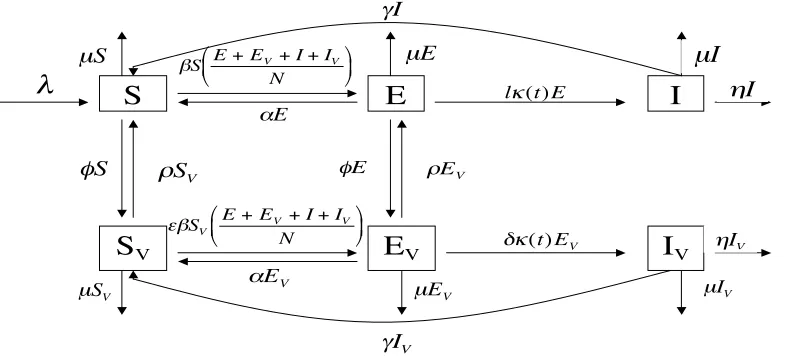
Figure 10: Pneumococcal infection dynamics with vaccination.
"
"S E+EV+I+IV
N
# $
% &
' (
"E
"#SV E+EV+I+IV
N $
%
& '
( )
"E
V
S
S
VE
E
VI
"S "E
"#(t)EV
l"(t)E
"I
"I
"S
V "EV
I
V "IV"IV
µI
µS µE
µS
V µEV µ
I V
In this model, shown in Figure 10, individuals are classified according to their epidemi-ological status with respect to invasive pneumococcal diseases, which include pneumonia,
bacteremia, meningitis and are defined as the presence of Streptococcus pneumoniae in any
normal sterile fluid in the body. Individuals are considered susceptible, or in the S class,
in the absence of this bacteria. The E class represents individuals whose nasopharyngeal
regions are asymptomatically colonized byS. pneumoniae, a stage that is typically transient,
but always precedes infection. Should a colony ofS. pneumoniaebe successful in establishing
an infection, the individual then exhibits a clinical condition described above, and is then
considered infected or in the I class. We consider vaccines which prevent progression to
infection, or possibly, asymptomatic colonization. This protection is not complete, and the
efficacy with which this is accomplished is 1−δ and 1−ǫ, respectively. Once vaccinated,
individuals may enter any of the epidemiological states, SV, EV, and IV, although they do
dS
dt =λ−βS
E+EV +I+IV
N +αE+γI−φS+ρSV −µS (56) dE
dt =βS
E+EV +I+IV
N −αE−lκ(t)E−φE+ρEV −µE (57) dSV
dt =φS−ǫβSV
E+EV +I+IV
N +αEV +γIV −ρSV −µSV (58) dEV
dt =ǫβSV
E+EV +I+IV
N −αEV +φE−ρEV −δκ(t)EV −µEV (59) dI
dt =lκ(t)E−(γ+η+µ)I (60) dIV
dt =δκ(t)EV −(γ+η+µ)IV. (61)
Seasonality of invasive pneumococcal diseases has been observed and studies support a
seasonal infection rate,κ, rather than a seasonal effective contact rate,β. Thus, we assume
the form
κ(t) =κ0(1 +κ1cos[ω(t−τ)]),
forκ(t) to reflect seasonal changes in host susceptibility to pneumococcal infection.
5.1
Statistical Models of Case Notification Data
Monthly case notificationsf(tj, ~θ) are best represented as integrals of the new infection rates,
f(tj, ~θ) =
Z tj+1
tj
[lκ(s)E(s) +δκ(s)EV(s)]ds,
(including those in the vaccinated class) over each month, since they represent the number of cases reported during the month and do not provide any information on how long individuals
remain in an infected state. We use these data to estimate~θ= (β, κ0, κ1)T. Before using the
model with surveillance data, we test the model and methodology capabilities with simulated “data”. Following the procedures in the logistic example discussions in Section 4, we generate data according to two statistical models:
Yj =f(tj, θ0) +ǫj, (62)
Yj =f(tj, θ0)(1 +ǫj), (63)
for j = 1, ..., n, where ~θ0 are the ‘true’ values of the parameters used to generate the data.
In both (62) and (63), the ǫj are independent and identically distributed (i.i.d.) random
variables with E[ǫj] = 0 and var(ǫj) = σ02. In model (62), however, the residual is then
will refer to this error with constant variance, or CV. The second case, (63), has residuals
of the form Rj =Yj−f(tj, ~θ0) = ǫjf(tj, ~θ0), so the residual is actually proportional to the
model, f(tj, ~θ0), at each time pointtj, and thus this is an example of error withnonconstant
variance, or NCV. We note that in this case E[Rj] = 0 and var(Rj) =σ02f2(tj, ~θ0) or f(tRj
j,~θ0)
has mean zero and variance σ2
0.
For illustration, we consider the same four cases as with the logistic example in Section 4:
1. OLS estimation of ˆθ using data generated by model (62) with constant variance
obser-vational error: θOLS(YCV),
2. OLS estimation of ˆθ using data generated by model (63) with nonconstant variance
observational error: θOLS(YN CV),
3. GLS estimation of ˆθ using data generated by model (62) with constant variance
obser-vational error: θGLS(YCV),
4. GLS estimation of ˆθ using data generated by model (63) with nonconstant variance
observational error: θGLS(YN CV).
We compare the parameter estimates ˆθ and standard errors SE(ˆθ) obtained in each case.
Further we discuss how to interpret plots of rj =yj−f(tj,θˆ) versus tj and f(tj,θˆ) to assess
whether reasonable assumptions have been made in assuming the statistical model for the data.
5.2
Inverse Problem Results: Simulated Data
Data were generated with n = 60 time points (equivalent to five years of data), with the set
of parameters
~θ0 =
β κ0
κ1
=
1.5 1.4e−3
0.55
.
Error was added to the forward solution according to two statistical models, as described in Section 5.1. In the case of constant variance observational error, the error is scaled to the magnitude of the model but not in a time-dependent manner. In this case we generated noisy
data by sampling from a N(0,1) distribution (we could of course have sampled from any
other random variable). Therefore, for constant variance error of about k% of the average
magnitude of the f(tj, ~θ0),
ǫj ∼
k
100avgjf(tj, ~θ0)N(0,1).
So in this caseǫj ∼ N(0,[100k avgjf(tj, ~θ0)]2) withǫj (and also Rj)i.i.d.In the second
statis-tical model, the error depends on time and is scaled by the model at each time point, i.e.,
Table 5: Parameter estimates from data with constant variance CV error.
~θ ~θ0 ~θinit θˆOLS SE(ˆθOLS) θˆGLS SE(ˆθGLS)
β 1.5 1.55 1.4845 0.038 1.51186 0.017
κ0 1.4e−3 1.3e−3 1.4188e−3 2.1e−4 1.3203e−3 1.2e−4
κ1 0.55 0.65 0.56203 0.050 0.56047 0.019
RSS 1.6831e4 1.722e4
Rj =f(tj, ~θ0)ǫj ∼f(tj, ~θ0)
k
100N(0,1),
with ǫj ∼ N(0,[100k f(tj, ~θ0)]2), and again the ǫj are i.i.d.,but now the Rj are not i.i.d.This
enables us to compare different types of error on the same scale: one independent of time and observation magnitude, and one dependent on observation magnitude, and thus time.
With the present examples, we have taken k = 10.
The results from using an OLS and GLS estimator with data generated with constant variance error are displayed in Table 5, and the fitted model solutions displayed in Figure
11. Both estimators do an arguably similar job at producing the true values, that is ˆθOLS
and ˆθGLS are comparably close to θ0. The standard errorsSE(ˆθGLS) for the GLS estimator
however, are all smaller, and seem to indicate that the corresponding estimates are more “reliable”. This, however, is not true because they are based on incorrect formulae, as we shall see in our examination of the error plots for both of these cases. Note that from Figure
11 and the residual sum of squares, RSS, in both cases, there is no clear argument from
these results as to which estimator is better suited for use with the data.
Figure 11: Best fit model solutions to monthly case notifications with constant variance CV error.
0 10 20 30 40 50 60
0 50 100 150 200 250 300 350
Best fit model solution using OLS estimation
Time t
j (months)
Cases
0 10 20 30 40 50 60
0 50 100 150 200 250 300 350
Best fit model solution using GLS estimation
Time t
j (months)
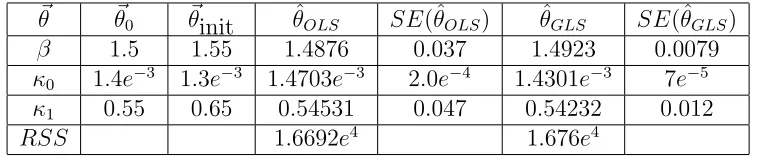
Table 6: Parameter estimates from data with nonconstant variance NCV error.
~θ ~θ0 ~θinit θˆOLS SE(ˆθOLS) θˆGLS SE(ˆθGLS)
β 1.5 1.55 1.4876 0.037 1.4923 0.0079
κ0 1.4e−3 1.3e−3 1.4703e−3 2.0e−4 1.4301e−3 7e−5
κ1 0.55 0.65 0.54531 0.047 0.54232 0.012
RSS 1.6692e4 1.676e4
Figure 12: Best fit model solutions to monthly case notifications with nonconstant variance NCV error.
0 10 20 30 40 50 60
50 100 150 200 250 300 350
Best fit model solution using OLS estimation
Time tj (months)
Cases
0 10 20 30 40 50 60
50 100 150 200 250 300 350
Best fit model solution using GLS estimation
Time tj (months)
Cases
When OLS and GLS estimation are each used with data with nonconstant variance error, the parameters and standard errors in Table 6 are obtained, and the plot of these model solutions over the generated data is given in Figure 12. Again, one estimator does not do a clearly better job over the other in terms of predicting parameter values closer to those used to generate the data. However, again, the standard errors from the GLS estimation are smaller as compared to those of the OLS estimation. From this, it would seem that the GLS estimation would always give ‘better’ parameter values, or do a better job at producing reliable results. However, we know that in the case of constant variance error, the GLS estimation makes some incorrect assumptions on the data generation and therefore, the standard errors reported there would give a false sense of confidence in the values (indeed they are based on incorrect asymptotic formulae).
5.2.1 Residual Plots
Here we illustrate use of residual plots to investigate whether our assumptions on the errors
incurred in observation of data are correct - that is, whether theǫjarei.i.d.for allj = 1, ..., n,
Section 4, if the errors are i.i.d. then a plot of the residuals rj = yj −f(tj,θˆ) versus time
tj should show no discernible pattern. Similarly, a plot of the residual rj as a function of
the model values f(tj,θˆ) should be random if there is no relationship between these two
quantities. While use of the OLS estimation tacitly assumes the statistical model (62), and therefore the residual is a realization of the error random variable, this is not true of the
GLS estimation. In that case, the assumed statistical model is shown in (62) with ǫj i.i.d.
but the residualrj are not i.i.d.for all j = 1, ..., n. Therefore, in the case of GLS we should
investigate plots of the the residual/model values,Rj = Yj
−f(tj,θ0)
f(tj,θ0) instead of the residuals.
Figure 13: Residual (rj = yj −f(tj,θˆ)) plots of the OLS estimation with CV data (ǫj =
Yj−f(tj, ~θ0)); Left: nontruncated, Right: truncated.
0 10 20 30 40 50 60
−50 −40 −30 −20 −10 0 10 20 30 40
OLS estimation with CV Data
Time t
j (months)
Residual
0 2 4 6 8 10 12
−20 −15 −10 −5 0 5 10 15 20 25
OLS estimation with CV Data
Time t
j (months)
Residual
50 100 150 200 250 300
−50 −40 −30 −20 −10 0 10 20 30 40
OLS estimation with CV Data
Model f(t
j, θ)
Residual
50 100 150 200 250 300
−20 −15 −10 −5 0 5 10 15 20 25
OLS estimation with CV Data
Model f(t
j, θ)
Residual
In Figure 13, we see the relationship between the residuals and time, and that between residuals and the model values when the OLS estimation procedure is applied to data which has been generated with constant variance error. In both the top and bottom panels on
the left, the full set of n = 60 points are used, while on the right hand side, only one
pattern, so the errors are clearly i.i.d. But in the bottom left plot, we observe clustering of residuals around certain model values, although there is no clear pattern in the dependent
variable, just in the independent variable, f(tj,θˆ). However, we recognize that this is due
to the seasonality of the data and model, so that at regular repeated time points over many periods, there are going to be repeated values of the model. As evidence of this, we see that when only one period is plotted (the bottom right panel), a random pattern is seen, and we confirm that the errors are not dependent on the model values. Thus, if there are vertical bands on a plot such as this, it can be attributed to certain model values repeating and does not indicate any dependence of the error on the model value. To check, one can simply reduce the number of data points used in the estimation so that there are few or no repeated values.
Figure 14: Residual (rj = yj −f(tj,θˆ)) plots of the OLS estimation to NCV data (ǫj =
Yj−f(tj,~θ0)
f(tj,~θ0) ); Left: nontruncated, Right: truncated.
0 10 20 30 40 50 60
−60 −40 −20 0 20 40 60
OLS estimation with NCV Data
Time t
j (months)
Residual
0 2 4 6 8 10 12
−30 −20 −10 0 10 20 30
OLS estimation with NCV Data
Time t
j (months)
Residual
80 100 120 140 160 180 200 220 240 260 280
−60 −40 −20 0 20 40 60
OLS estimation with NCV Data
Model f(t
j, θ)
Residual
80 100 120 140 160 180 200 220 240 260 280
−30 −20 −10 0 10 20 30
OLS estimation with NCV Data
Model f(t
j, θ)
Residual
these graphs (Figure 14) do not show a random pattern. While there is no clear relation-ship, there is some randomness in the residuals, and the band of residuals are tighter, not homogeneously distributed across the plot as in Figure 13. The dependence of the residuals
on model value magnitude (seen in the bottom panels) is apparent as the rj clearly increase
with increasing model values, producing a fan shape. In this case the OLS estimation is used incorrectly, and the residual plots exhibit a clear dependence on model values and do not confirm independence from time.
Figure 15: Residual/Model ( rj
f(tj,θˆ)) plots of the GLS estimation to CV data (ǫj = Yj −
f(tj, ~θ0)); Left: nontruncated, Right: truncated.
0 10 20 30 40 50 60
−8 −6 −4 −2 0 2 4
6x 10
−3 GLS estimation with CV Data
Time t
j (months)
Residual/Model
0 2 4 6 8 10 12
−1.5 −1 −0.5 0 0.5 1 1.5 2 2.5
3x 10
−3 GLS estimation with CV Data
Time t
j (months)
Residual/Model
50 100 150 200 250 300
−8 −6 −4 −2 0 2 4
6x 10
−3 GLS estimation with CV Data
Model f(t
j, θ)
Residual/Model
50 100 150 200 250 300
−1.5 −1 −0.5 0 0.5 1 1.5 2 2.5
3x 10
−3 GLS estimation with CV Data
Model f(t
j, θ)
Residual/Model
plots in Figure 15 reveal a tight band of points in the rj
f(tj,θˆ) versus tj plots and the reverse
fan shape of the plot of the residual/model rj
f(tj,θˆ) versus the model values f(tj,
ˆ
θ). This
indicates that the relations which give us the parameter estimates and their standard errors no longer hold and we are essentially reporting incorrect values. As we saw in Section 5.2, while the parameter estimates may not necessarily be poor, the reliability provided by the standard errors is incorrect.
Figure 16: Residual/Model ( rj
f(tj,θˆ)) plots of the GLS estimation to NCV data (ǫj =
Yj−f(tj,~θ0)
f(tj,~θ0) ); Left: nontruncated, Right: truncated.
0 10 20 30 40 50 60
−0.2 −0.15 −0.1 −0.05 0 0.05 0.1 0.15 0.2
GLS estimation with NCV Data
Time t
j (months)
Residual/Model
0 2 4 6 8 10 12
−0.2 −0.15 −0.1 −0.05 0 0.05 0.1 0.15
GLS estimation with NCV Data
Time t
j (months)
Residual/Model
80 100 120 140 160 180 200 220 240 260 280
−0.2 −0.15 −0.1 −0.05 0 0.05 0.1 0.15 0.2
GLS estimation with NCV Data
Model f(t
j, θ)
Residual/Model
80 100 120 140 160 180 200 220 240 260 280
−0.2 −0.15 −0.1 −0.05 0 0.05 0.1 0.15
GLS estimation with NCV Data
Model f(t
j, θ)
Residual/Model
When the GLS estimator is used appropriately, however, the randomness of the error plots suggest reasonability of assumptions, as seen in Figure 16. Here, the error in the data has been generated proportional to the model values, and therefore, not longitudinally
constant. So when we plot the ratios yj−f(tj,θˆ)
f(tj,θˆ) , we allow for this dependence and see the
seen by the bottom right panel, where the repetitions have been excluded from the data set.
5.3
Inverse Problem Results: Australian Surveillance Data
Using the iterative weighted least squares procedure described in Section 2.4.2, we carried out inverse problem calculations with the model and observations as outlined in the previous section using Australian IPD data in place of the simulated data. In this case we assumed constant variance noise in the data and hence used WLS , e.g., see (27), for our estimation procedure. Details are given in [32]. We discuss here the case where we used data for the
period 2002-2004 (36 months of monthly data n1 = 36, and n2 = 6 of annual vaccinated or
unvaccinated cases) and e