9: 1-4 (2017) 27–32 | www.sainshumanika.utm.my | e-ISSN ISSN: 2289-6996
Full paper
Sains
Humanika
The Roles of Teacher and Students in Self-directed Learning Process
Through Blended Problem-Based Learning
Mohd Mokhzani Ibrahim, Mohammad Yusof Arshad*, Mohd Shafie Rosli, Nurbiha A.Shukor
Faculty of Education, Universiti Teknologi Malaysia, 81310 UTM Johor Bahru, Johor, Malaysia
*Corresponding author: [email protected]
Abstract
Self-directed learning is an important skill highlighted in the 21st century learning. Hence, developing this skill through problem-based learning (PBL) is deemed to be potentially effective. However, PBL is still not widely implemented in Malaysian classrooms. The integration of face-to-face and online learning known as blended problem-based learning (BPBL) is potentially effective in improving PBL by enhancing teacher’s and students’ roles in self-directed learning. Thus, this research aims to investigate the roles of teacher and students in the process of self-self-directed learning (formulating learning issues) in BPBL by using basic qualitative approach. Data was collected from observations, interviews and documents (FILA chart). By using purposive sampling, twenty-five (25) students and a teacher from a school in Johor district were selected as the sample. The students were divided into five groups. The teacher and students’ roles in two randomly selected groups were compared. The results indicated that the teacher faced difficulties in monitoring students’ progress and some students were passive in the BPBL.
Keywords: Problem-based learning; blended problem-based learning; self-directed learning; learning issues
© 2017 Penerbit UTM Press. All rights reserved
1.0 INTRODUCTION
Teaching and learning in the Malaysian schools are teacher-centered; highly depending on teachers to maximize learning process and its outcomes. In addition, the two-way interactions between teacher and students and among students are very limited [1]. This condition does not encourage social interactions that are deemed to be helpful in promoting effective learning [2], [3]. Hence, student-centered learning approach such as Problem-based learning (PBL) is highly potential to overcome these issues.
Problem-based learning (PBL) uses real-world [4], unstructured problems [5] with infinite solutions to a problem [6]. Through this approach, the roles of teachers and students can be enhanced. The teacher acts as a facilitator while students will be given an important role in determining the course of learning and teaching sessions. This teaching approach is proven to be effective in nurturing students' self-directed learning [7], [8], which in turn will lead to effective learning. In line with the Malaysian Education Blueprint, the importance of ICT integration has been emphasized in enhancing teaching and learning. Thus, the integration of online learning in the PBL approach (known as Blended problem-based learning, BPBL) has promising potential to improve the existing self-directed learning practice in schools.
The current study implemented the BPBL model proposed by Mohd Mokhzani [9] using an authentic problem on toothache (Appendix 1). For this study, only the process of self-directed learning during the Problem Scenario Step is being investigated. According to the literature, self-directed learning constitutes of five constructs: (i) identify the aim of the problem, (ii) formulate learning issue (iii) design learning strategies, (iv) integrate and justify the solution to the problem and (v) reflect the whole problem solving process. However, in this paper, self-directed learning will only be discussed as the process in which students learn to formulate learning issue. In the current practice, formulating learning issue is a concept that is poorly understood and thus, affecting their mastery of problem solving [3]. A number of studies have similarly appointed that students faced difficulties in constructing learning issues [10]. In order to ease students to record the problem solving process, a chart known as FILA chart (Fact, Idea, Learning Issues and Action) was introduced [11]. Tan Yin Peen and Muhammad Yusof [3] have improvised the initial version of FILA chart that is specifically implemented in chemistry subject. Therefore the current study adapted it and is presented in Appendix 2.
Since both students and teacher play an important role to learning success, it is relevant to explore their roles on how the formulation of learning issues through BPBL strategy. Generally, in BPBL, teacher and students’ roles can be observed during the formulation of the learning issues at two different phases, which are during:
i. The discussion between members of the group face to face with FILA chart I
2.0 RESEARCH OBJECTIVES AND QUESTIONS
The current study aims to investigate the roles of teacher and students in the process of self-directed learning (formulating learning issues). The research questions are as below:
i. To compare teacher and students' roles across groups during the implementation of BPBL.
ii. To compare learning issues formulated by both groups in FILA chart 1 and the modification of FILA chart according to the learning objectives.
3.0 RESULTS AND DISCUSSION
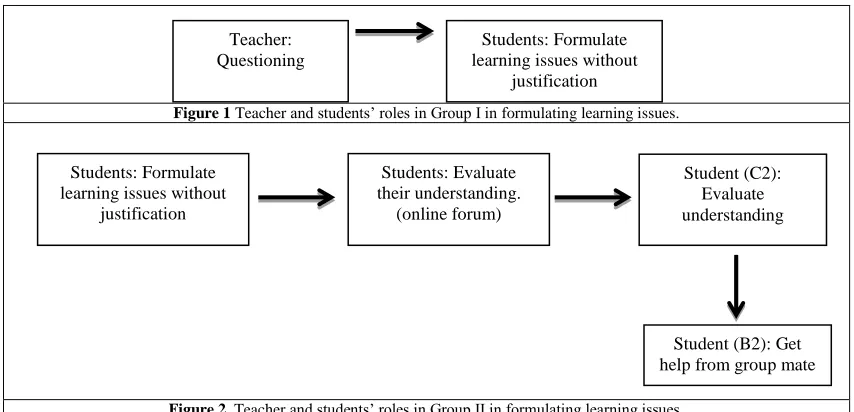
Based on Figure 1 and 2, Group II formulated learning issues without the help of the teacher, even though they were new to BPBL. Evidently, Group I required helps from the teacher in listing the learning issues through a series of questions prosed by the teacher in completing FILA chart I. As a result, Group I was only able to generate learning issues without solid justification. This situation reflects poor mastery of thinking skills as outlined in the literature [6], [9], [10]. In the FILA chart I phase, Group I formulated seven issues but only two were relevant to the learning objectives as shown in Figure 3. After going through the stages of learning of FILA chart I, Group I did not improve their learning issues as highlighted in the online discussion forum and modified FILA chart in BPBL strategy. This is because the learning issue has been previously listed and not deliberately discussed in both learning stages. Supposedly, the teacher should encourage Group 1 to discuss and improve their learning issue.
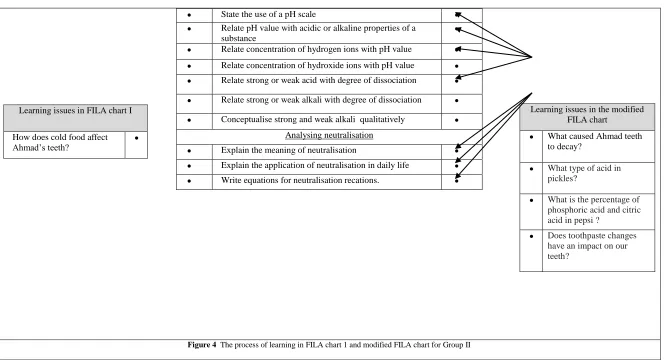
On contrary, Group II initially formulated their learning issues without solid justification. During the online forum, they failed to prvide elaborated discussion on the learning issues. However, at the stage of modifying FILA chart, the discussion has become detailed and in-depth, and was in line with the learning objective as in Figure 4. The evidence is as below:
Research : “How did your group make some amendments in second FILA chart compared to the first one?”
C2 : “We can only detect one learning issue for the first FILA chart but when we saw others’ group learning issues, we got many ideas. There is a lot of things that need to be studied”.
In addition, one student from Group II (C2) has evaluated the understanding of the given problem, which has allowed him to identify the weakest concepts. This is because this group has outlined the learning issues based on the learning ideas that are previously listed (macro and microscopic). Also, student B2 has re-evaluated the listed learning issues and only selected the relevant ones. Here is an example of supervision carried out by him:
E2 : Why do frequent changes of the toothpaste can lead to teeth decay ? C2 : Wait, I am writing this. Wait, wait. Do this first. Hahaha
B2 : We have to ask questions that are based on chemistry
Clearly, Group II has identified relevant learning issues to chemistry and listed them accordingly. This is a strong evidence to represent active thinking in teaching and learning settings.
Figure 1 Teacher and students’ roles in Group I in formulating learning issues.
Figure 2 Teacher and students’ roles in Group II in formulating learning issues. Teacher:
Questioning
Students: Formulate learning issues without
justification
Students: Formulate learning issues without
justification
Students: Evaluate their understanding.
(online forum)
Student (B2): Get help from group mate
Outlined Learning Objectives
Analysing characteristics and properties of acids and bases
State the meaning of acid, base and alkali State the use of acids, bases and alkalis in daily life Explain the role of water in the formation of hydrogen ions
to show the properties of acids
Explain the role of water in the formation of hydroxide ions to show the properties of acid
Describe chemical properties of acid and alkali.
Synthesising the concepts of strong acids, weak acids, strong alkalis and weak alkalis
State the use of a pH scale
Relate pH value with acidic or alkaline properties of a substance
Relate concentration of hydrogen ions with pH value Relate concentration of hydroxide ions with pH value Relate strong or weak acid with degree of dissociation
Relate strong or weak alkali with degree of dissociation
Conceptualise strong and weak alkali qualitatively Analysing neutralisation
Explain the meaning of neutralisation
Explain the application of neutralisation in daily life Write equations for neutralisation recations. Learning issues in FILA chart I
Why did Ahmad tooth in pain?
What are the ingredients of Pepsi?
What does Ahmad love to eat?
What type of acid contained in pickles?
How does Pepsi can quench his thirst?
What type of toothpaste is suitable for Ahmad?
What are the alternative ways to help Ahmad?
Learning issues in the modified FILA chart
Why did Ahmad tooth in pain?
What are the ingredients of Pepsi?
What does Ahmad love to eat?
What type of acid contained in pickles? How does Pepsi can
quench his thirst?
What type of toothpaste is suitable for Ahmad?
What are the alternative ways to help Ahmad?
Figure 3 The process of learning in FILA Outlined Learning Objectives chart 1 and modified FILA chart for Group I
Analysing characteristics and properties of acids and bases
State the meaning of acid, base and alkali State the use of acids, bases and alkalis in daily life Explain the role of water in the formation of hydrogen ions
to show the properties of acids
Explain the role of water in the formation of hydroxide ions to show the properties of acid
Describe chemical properties of acid and alkali.
State the use of a pH scale Relate pH value with acidic or alkaline properties of a
substance
Relate concentration of hydrogen ions with pH value Relate concentration of hydroxide ions with pH value Relate strong or weak acid with degree of dissociation
Relate strong or weak alkali with degree of dissociation
Conceptualise strong and weak alkali qualitatively
Analysing neutralisation
Explain the meaning of neutralisation
Explain the application of neutralisation in daily life Write equations for neutralisation recations.
Learning issues in the modified FILA chart
What caused Ahmad teeth to decay?
What type of acid in
pickles?
What is the percentage of
phosphoric acid and citric acid in pepsi ?
Does toothpaste changes
have an impact on our teeth?
Learning issues in FILA chart I
How does cold food affect Ahmad’s teeth?
6.0 CONCLUSION
In a bigger picture, it is found that the teacher faced difficulties in monitoring students in formulating the learning issue through self-directed learning, especially during online learning experiences. This situation opposes the advantages of online learning in monitoring large classroom learning [14][15]. In addition, in Group 1, the teacher’s continuous feedbacks and questioning have directed learning to be teacher centered. This is in contrast to the role of teacher as a facilitator, as proposed in BPBL.
On the other hand, the online learning platform should encourage students to actively participate and cooperate effectively in formulating the learning issues. However, the evidences were on the opposite. In dealing with this, the appointed group leader should be advised and encouraged to take firm responsibility to maximize the participation among the members in learning process.
In short, the implementation of BPBL in Malaysia is still at its infancy. Numerous efforts and research should be conducted in proposing an alternative to above problems. The focus should be given not only on the resources and learning platforms, but also the roles of teachers and students during the teaching and learning process.
References
Abu Hassan Kassim. (2013). Pengajaran-pembelajaran Kimia di Sekolah Menengah: Ke Manakah Arah Tujunya?. Seminar Memperkasakan Sistem Pendidikan, 2013. G. P. Thomas and C. J. McRobbie. (2012). Eliciting Metacognitive Experiences and Reflection in a Year 11 Chemistry Classroom: An Activity Theory Perspective.
Journal of Science Education and Technology, 22(3), 300–313.
Tan, Y. P. and Muhammad Yusof. (2013). FILA-MMS Chart in Chemistry PBL Lesson : A Case Study of Its Implementation During Problem Analysis.
Faaizah Shahbodin and Badioze,H. (2008). Evaluating the Effectiveness Problem Based Learning in Science Teaching: Hybrid Approach. International Symposium on Information Technology (ITSim 2008). 1–7 August 2008.
Brownell, J. (2004). Problem-Based Learning in Graduate Management Education: An Integrative Model and Interdisciplinary Application. Journal of Management Education, 28(5), 558–577.
Graaff, E. D. E. (2003). Characteristics of Problem-Based Learning*. International Journal of Engineerinf Education, 19(5), 657-662. Hmelo-Silver, C.E. (2004). Problem-Based Learning: What and How Do Students Learn?. Educational Psychology Review, 16(3), 235–266. Tan, O.S. (2003). Problem-Based Learning Innovation. Singapore: Thomson Learning.
Ibrahim, M.M., Yusof Arshad, M., Rosli, M. S., and Shukor, N. A. (2016). The Process of Self-Directed Learning In Blended Problem-Based Learning: The Roles of Teacher & Students. Proceedings of The Internatiomal Conference on Education and Higher Order Thinking Skills (ICE-HOTS 2016), 534–546.
Hung, W. (2011). Theory to Reality: A Few Issues in Implementing Problem-Based Learning. Educational Technology Research and Development, 59(4), 529–552. Hmelo-silver, C. and Ferrari, M. (1997). The Problem-Based Learning Tutorial: Cultivating Higher Order Thinking Skills. Journal for the Education of the Gifted,
20(4), 401–422.
Schmidt, H. G. (1993). Foundations of Problem-Based Learning: Some Explanatory Notes. Medical Education, 27(5), 422–432. Barrows, H. (1988). The Tutorial Process. Springfield: Southern Illinois University.
Chernobilsky, E., Nagarajan, A. and Hmelo-Silver, C. E. (2005). Problem-Based Learning Online: Multiple Perspectives on Collaborative Knowledge Construction. Proceedings of the 2005 Conference on Computer Support for Collaborative Learning: Learning 2005: The Next 10 years! (CSCL ’05), 53–62.
Appendix
Appendix 1 Example of problem scenario on toothpaste
You are a dentist who is assigned to perform dental examinations in all schools in Kluang. Ahmad, a student came to you for advice regarding to toothache. Here is the dialogue:
Doctor : Hello, may I help you? What is your problem?
Ahmad : I am having a toothache especially when eating something cold like
an icy drink.
Doctor : Can you explain how your everyday diet?
Ahmad : I eat five times a day and most of the food is based on rice. I also
Love to eat pickles and pepsi should always be my drink, especially
during the hottest hours.
Doctor : How many times a day do you brush your teeth?
Ahmad : Not necessarily. I'm just brushing my teeth when I get the chance. I
also often switch brands of toothpaste because do not know which brand is the best.
As a doctor, how could you help Ahmad to solve his problem?
Appendix 2 Example of FILA Chart
FACT IDEA Learning Issues Action