A New AFR Algorithm for Improving Wind
Farm FRC using VSC-HVDC and IFSIC
Shaik Soniya Parveen
1, Shaik Hameed
2P.G. Student, Dept. of Electrical and Electronics Engineering, QCET, Nellore, Andhra Pradesh, India1
Associate Professor, Dept. of Electrical and Electronics Engineering, QCET, Nellore, Andhra Pradesh, India2
ABSTRACT: Now a days, because of increased consumption, the quantity of non-renewable energy resources like coal, gas and crude oil is keep on diminishing at a very rapid rate, which created a remarkable essence of renewable energy based power generation systems. Wind-Farm System(WFS)s are one of the most popular renewable electrical power generation systems, which accept renewable wind energy as input. Frequent operational faults in WFS can cause a huge loss of power outage and network malfunction. In general the electrical power distribution and generation systems are extremely large and complex. As a result the system should be shut-down until or unless the faulted line or faulted section is located and isolated efficiently. In a Solution to this ever teasing problem a new control approach is proposed for enhancing the Fault Ridethrough Capability (FRC) of WFS connected to the grid through a Voltage-Source-Converter-based High-Voltage DC(VSC-HVDC)transmission line using an Intelligent Fault Sensing and Isolation Circuit(IFSIC) which will detect and locates the faults and faulted sections in Wind Farm System(WFS) by sensing the spurious fluctuations in line voltage and currents. IFSIC controls the voltage drop in the wind farm collected grid upon occurrence of fault in the high voltage grid to achieve faster power reduction to decrease the resulting power wastage due to the occurrence of fault.IFSIC has its associated circuitry which will monitors each section of the WFS to detect operational deviation and to counteract accordingly. This project is practically implemented and tested in MATLAB environment and the simulation results proved that the proposed method best in all aspects and outperforms all the existing methods and techniques.
KEYWORDS: WFS, FRC, IFSIC, VSC-HVDC, WF-HVGS and AFR.
I.INTRODUCTION
stored in the form of electric-field energy in the capacitance of the HVDC line. In the absence of suitable countermeasures, this would lead to increased dc voltage and potential equipment damage in the installation.
In this project we focused on the methods and techniques used to generate the power using the reliable and fault free operation of the Wind Farm System(WFS)s which will consumes the natural renewable energy resource as the raw input and generate the power proportional to the WFS generator rotation speed. Generally all the WFS systems are Hybrid Power System (HPS)s which will generates the hybrid power from the natural renewable energy resources. These HPS will find their extensive use in forest,hilly,terrain and geographically remote areas to where the power from the conventional grid systems cannot reach due to geographical irregularities and discontinuities. The Domestic grids are constructed in such remote areas to distribute the power to all power consumption units and utilities. Such domestic grids are called Off-Grids or Hybrid Grids. Wind Farm based High Voltage Grid System (WF-HVGS) is a best example for widely used Off-Grid Hybrid Power System (OG-HPS)[5] in hilly, terrain and geographically irregular and discontinuous remote areas. Generally the electrical power distribution and generation systems are extremely large and very complex. Due to their inherent complex architecture a small fault in a corner part of the wind farm power generation and distribution system can impact the entire wind farm system, there by destructing it structure and normal operation. As a result the system must be shut-down until or unless the faulted line or faulted section is located and isolated efficiently. The line faults will occur in the VSC-HVDC transmission lines[1][15] which are used to route the power from WFS to the power grid. The Line-to-Line and Line-to-Ground faults are the two major categories of line faults that may occur in the VSC-HVDC transmission lines [1][2]. Employing an Adaptive Fault Ridethrough(AFR) algorithm for real time detection and isolation of above faults is appreciated and this will improves the operational effectiveness of the WFS[6].In this scenario we proposed an Adaptive Fault Ridethrough(AFR) algorithm for enhancing the Fault Ridethrough capability of WFS connected to the grid through VSC-HVDC transmission lines[1][2] using IFSIC modules.IFSIC controls the voltage drop in the grid upon occurrence of faults thereby reducing the resulting power wastage. IFSIC has its associated circuitry which will monitors each section of the WFS to detect operational deviation and to counteract accordingly.
II.PROPOSED WORK
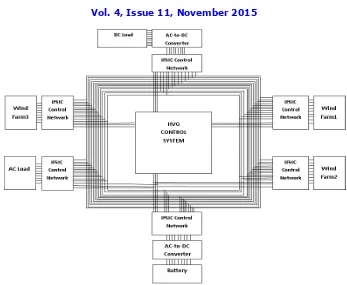
Fig (1): Schematic block diagram of the proposed WF-HVGS System.
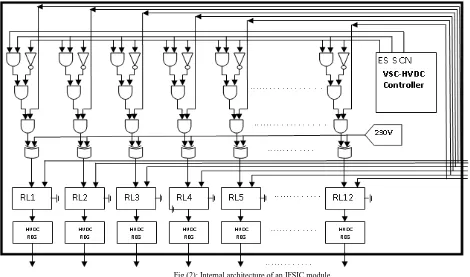
Fig (2): Internal architecture of an IFSIC module.
III.RESULTS AND DISCUSSION
The operational characteristics of the proposed AFR algorithm are practically verified with the help of computer simulations performed using MATLAB software. The proposed AFR algorithm is designed, programmed and simulated using Matlab.As a first task after starting its operation the WF-HVGS initializes all its IFSIC Units for fault free operation. This initialization includes loading the rated parameter values of line voltage, line currents and associated phase deviations into the individual IFSIC Units. The initialization data of the WF-HVGS is given as follows.
Table(1):VSC-HVDC Standard bus parameters.
Table(2):VSC-HVDC standard strobe signals.
The above table(1) presents the VSC-HVDC network‟s standard bus line parameter values,where as table(2) represents the VSC-HVDC network‟s strobe signals for standard fault free operation.
Fig(4): VSC-HVDC based Wind Farm HVGS Rated Current Waveforms.
The above figures figure(3) and figure(4) shows the rated voltage and current waveforms of VSC-HVDC based Wind Farm HVGS system.
Fig(5): VSC-HVDC based Wind Farm HVGS Rated Phase Levels.
Fig(6):IFSIC Module Sensed Voltage Waveforms.
The rated phase levels of VSC-HVDC based Wind-Farm HVGS system are shown in figure(5),where as the sensed voltage waveforms of IFSIC module are shown in figure(5).
IV.CONCLUSION
device. The proposed algorithm is implemented and tested in MATLAB 2012b environment. The simulation results adjudged that the proposed IFSIC module is very efficient in improving the Fault Ridethrough Capability (FRC) of the WF-HVGS systems and also the proposed algorithm is working well and outperforms all the existing algorithms.
V.FUTURE SCOPE
The proposed AFR algorithm is proven to be the best in performance. In this project in order to reduce the complexity of implementation, the proposed algorithm is practically implemented with 12-line ring bus architecture. But there are no practical constraints on the size of the network and hence it can be extended to any large size WF-HVGS with increased number of operational zones and any higher order bus. Increase in the physical size of the network doesn‟t cause any performance dissimilarities and extra limitations. As a consequence the physical size and processing capability of the internal components has to be justified with the proper selection of the internal components of matched capacity and efficiency.
REFERENCES
[1] N Flourentzou, V Agelidis, and G Demetriades. VSC-based HVDC power transmission systems: An overview. Power Electronics Transaction, 24(3):592{602, April 2009.
[2] L Tang and B.T. Ooi. Protection of VSC-multi-terminal HVDC against DC faults. 33rd Annual IEEE Power Electronics Specialist Conference,2:719{724, November 2002.
[3] H Chen. Research on the control strategy of VSC based HVDC systems supplying passive network. Power & Energy Society General Meeting, pages 1{4, October 2009.
[4] X Fu, K Zhou, and M Cheng. Predictive current control of the VSC-HVDC system. International Conference on Electrical Machines and Systems, pages 3892{3896, 2008.
[5] Fairley P. Edison vindicated. IEEE Spectrum, N/A:14{16, February 2011.
[6] R.M. Cuzner and G. Venkataramanan. The status of dc micro-grid protection. pages 1 {8, oct. 2008.
[7] Salim, R.H.; Resener, M.; Filomena, A.D.; Rezende Caino de Oliveira, K.; Bretas, A.S., “Extended Fault-Location Formulation for Power Distribution Systems,” Power Delivery, IEEE Transactions on , vol.24, no.2, pp.508,516, April 2009.
[8] Senger, E.C.; Manassero, G.; Goldemberg, C.; Pellini, E.L., “Automated fault location system for primary distribution networks,” Power Delivery, IEEE Transactions on , vol.20, no.2, pp.1332,1340, April 2005.
[9] Yimai Dong; Kezunovic, M., “Fault location algorithm for radial distribution systems capable of handling insufficient and inaccurate field data,” North American Power Symposium (NAPS), 2009 , vol., no., pp.1,6, 4-6 Oct. 2009.
[10] Dugan, R. C.; McDermott, T. E. “Operating conflicts for Distributed Generation interconnected with Utility Distribution Systems, “ IEEE Industry Applications Magazines, 19-25, Mar/Apr. 2002.
[11] Barker, P . P . ; de Mello, R . W. “ Determining the impact of distributed generation on power systems: part1-radial distribution systems,” IEEE Trans. Power Delivery, vol. 15,pp. 486–493, Apr. 2000.
[12] Javadian, S. A M; Nasrabadi, A.M.; Haghifam, M.-R.; Rezvantalab, J., “Determining fault's type and accurate location in distribution systems with DG using MLP Neural networks,” Clean Electrical Power, 2009 International Conference on , vol., no., pp.284,289, 9-11 June 2009.
[13] Thukaram, D.; Khincha, H. P.; Vijaynarasimha, H. P., “Artificial neural network and support vector Machine approach for locating faults in radial distribution systems,” Power Delivery, IEEE Transactions on , vol.20, no.2, pp.710,721, April 2005.
[14] Faradonbeh, M.A.; Bin Mokhlis, H., “Unbalance fault location in electrical distribution system,” Electrical Power Distribution Networks (EPDC), 2011 16th Conference on , vol., no., pp.1,8, 19-20 April 2011.