Solution of Boundary and Mixed Problems in Arbitrary Domains Using Fourier Transforms
Gilnei Gonçalves Furtado
, Marco Túllio de Vilhena
, Telmo Roberto Strohaecker
and Rubem Panta Pazos
1) PPGEM/UFRGS, R. Oswaldo Aranha, 99, 6oandar, Porto Alegre / RS, 90035-190, Brazil, [email protected] 2) PPGEM/UFRGS, E-mail: [email protected]
3) PPGEM/UFRGS, E-mail: [email protected] 4) FAMAT/PUCRS, E-mail: [email protected]
ABSTRACT
In this work, we develop a method to solve partial differential equations in arbitrary domains by applying Fourier Transform technique. The main target of this work are the linear elastic problem. For such, the Fourier Transform technique is developed in domains with compact support, i.e. with the assumption that the unknown vanishes outside the domain. This approach establish an alternative procedure to determine the integral formulation for the boundary element method. We report solutions for the two-dimensional elastic linear equation.
INTRODUCTION
In a recent work Furtado, Vilhena and Strohaecker [1] proposed a closed-form solution for the general linear partial differ-ential equation with constant coefficients defined over a finite domain using the Fourier transform technique. Briefly speaking, the Fourier transform was applied to this problem, assuming that the solution vanishes outside the domain. After solving the transformed equation, the closed-form solution was obtained making the Fourier transform inversion.
In this work, we apply this approach to solve the two-dimensional linear elastic problem considering small strains, planar stress and isotropic material. To reach this goal, we outline the paper as follows: initially, we present the closed-form solution for the elastic problem. Afterward we report comments and simulation for the stress.
TWO-DIMENSIONAL LINEAR ELASTIC PROBLEM
We express the two-dimensional linear elastic problem considering small strains, planar stress and isotropic material, by the following partial differential equations
(1)
!
"
#
(2)
defined over an arbitrary finite domain$&%(' (figure (1)), where and are displacements in the and directions, and
and
are constants that depend on elastic material properties (
)
*
+-,! and
)
/.0,1 ,
2 is the modulus of elasticity and
3
is Poisson’s ratio) [2].
To solve this problem applying the Fourier Transform, we follow the idea of Furtado et al [1]. To this end, we begin with the application of the Fourier transform technique defined over finite domain in Eq. (1) and (2). It turns out:
54 687
4
9 ;:
=<
>
:
<
@?ACBEDF
HGJI *LKNM
+-OQPSR
TUBEDF
VGJI *LKNM
+-OQPSR
W
:
XBED
GYI *ZK[M
+\OQPSR
W
<
UB]D
GJI *ZKNM
+-OQP!^R
_B`D
aGJI *ZK[M
+-OQPQR
W
:`
b_B D
G I *LKNM
+-OQPR dc
"
:8<
?
_B DF
G I *ZKNM
+-OQP!R
W
:`
b_B`D
GJI *LKNM
+-OQPSR
XBED
eGJI *ZKNM
+-OQP!QR
UBED
fGJI *LKNM
+-OQPQR
W
<
=B D
G I *ZK[M
+\OQPR
W
:
UB D
G I *ZKNM
+-OQP!R
cag (3)
and
4 6 7
4
:
X<
>
:8<
?;XB D
G I *ZK[M
+\OQP R
TB D
VG I *ZK[M
+\OQP R
W
:
XB D
G I *ZKNM
+-OQP! R
W
<
TB D
G I *ZK[M
+-OQPR
"
_B D
aG I *ZK[M
+-OPR
W
:`
_B D
GJI *ZK[M
+-OPQR c
:
<
?
_B D
VGJI *ZK[M
+-OPQR
W
:`
T_B D
G I *ZK[M
+-OP
R
XB D
aG I *ZK[M
+\OQP
R
UB D
fG I *ZK[M
+-OP
R
W
<
=BED
GJI *LKNM
+-OQPSR
W
:
UBED
GYI *ZK[M
+\OQPQR
ceg (4)
For sake of simplification, we define the ensuing Fourier transformed functions
:
<
:
<
9 :
=<
(5)
:
<
:
<
9 :
=<
(6)
:
<
:8<
9 :
=<
(7)
Here we adopt the notation: ,
and
stand for the Fourier transform of the functions ,
and
. Furthermore,
,
,
,
,
M
and
P
denote partial derivatives respect to variables and .
c
b
A
B
Γ
a
C
D
x
y
d
Figure 1: Domain$ .
Next we perform the inverse Fourier transform of the functions , ,
,
,
M
and
P . For such, applying the
theorem of residue we get:
4
6
b]
(8)
4
6
&
(9)
4
6
&
P 6 (11) M 6 (12) P 6 (13)
On the other hand, integrating Eq. (8)—(13), we readily obtain the functions ,
and : 4 6 ? 6 6 c (14) 4 6 ?Q 6 6 c (15) 6 9 _ (16)
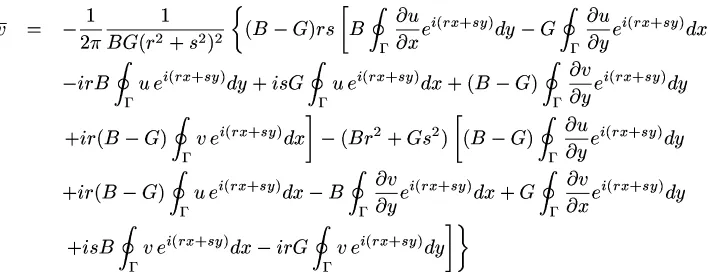
Now, we are in position to write down a closed-form solution for the problem (1)—(2). We reach this goal, making the Fourier inversion of and given by Eq. (3) and (4). This procedure leads to
54 687 > XBEDF R TB`DF R XB D R TB D R B D R B D R B DF R _B D M R B D R B D R XB D P R UBED M R g (17) and 4 6 7 > B D R B D R B D M R B D P R _B`D R _B D M R B D R " B D R =BED R UBED R =B D R UB D R g (18)
Recasting the above ansatz in matrix fashion we have
BED R BED R (19) where , and
(20) (21) (22)
and the vectors
and
have the entries
54 687 M !P M P P P !P M M M M P P P M P P M (23) 4 687 M P M M b M P M P M M b M P (24) evaluated at and . Here R
is given by
P R R M R R (25) and M P
are the director cosines of the normal to the contour of the domain.
Noticing that the boundary conditions are prescribed for the force intensity at boundary, we consider the ensuing relationship between M P M P and M P where M
P are the force intensities at boundary in the
and directions and
are tangential derivatives of and . Writing this relationship in matrix notation we have
(26)
where the matrix
has the entries
P M P M M P P 6 M 6 P M M P (27)
and the column vectors
, and
are given by
(28) M P (29) (30)
Replacing Eq. (26) in Eq. (19) we obtain
BED R BED . R (31) We define . (32) and rewrite
as block matrix
(33) where
is6 "!
matrix and
and
are6 6
matrices. Therefore, the Eq. (31), using this definition, has the form
B D$# % R B D R (34)
Next, we simplify the Eq. (34). For such using the result
B D
R
B D
R
(35)
combined with the definition
(36)
we quote the Eq. (34) as
B D R
B D
R
(37)
To this point it is important to remember that and
coincide with and
inside the domain$ and vanish outside the
domain$ .
In order to get the unknown boundary conditions for the and components of
and for the
M
and
P
components of
we proceed in similar manner as in Boundary Integral Method. In what follows, we briefly discuss this procedure:
1. We firstly begin expanding the components of
and in terms of some known basis functions;
2. We select a set of auxiliary points (positioned inside or outside the domain), where is the number of unknown
coefficients in the expansion of
and components. For more details see Furtado et all [1];
3. Finally, we set up the linear system to determine the expansion coefficients, substituting the functions basis expansion into Eq. (37) (or (34)) and evaluating this equation at auxiliary points.
NUMERICAL SIMULATION AND CONCLUSION
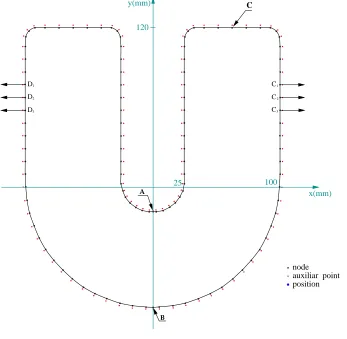
To illustrate the capability of the proposed approach to solve two-dimensional linear elastic problem, let us consider the problem and boundary conditions defined in the domain, depicted in figure (2). The material properties are2
6
4
, for elasticity modulus and3
, for Poisson’s coefficient. Furthermore, we assume as basis functions, first degree polynomials and evaluate the unknown functions , ,
M
and
P at boundary using Eq. (37). To this point, it is important to mention that
the auxiliary points are positioned outside the domain, apart from the nodes at boundary, a distance of 20% the length of the discretization step. This procedure allow us to avoid the singularity in the integral evaluated at boundary. In order to show the numerical convergence of the proposed approach we report numerical results for the following averaged distances between nodes 4
, and 6
mm and we compare the results with the ones attained by the finite element method (ABAQUS version
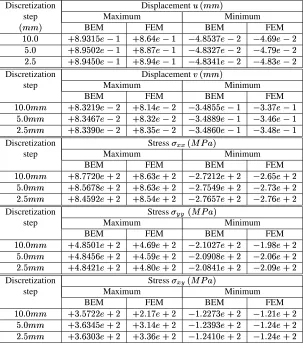
5.8.1). For the finite element results we take advantage of the problem symmetry. However, symmetry can not be considered in our approach because the nodes at the corner of the domain. Numerical comparisons for the maximum and minimum values for and (
) as well the values of the stress MYM
PP
and
M
P
, the values of stress MYM
at points and
(see figure (2)) and the values of displacements and at point (see figure (2)) are reported in tables (1) to (3). From the previous results
we readily notice the numerical convergence of the results encountered by this method and the good comparison with the ones achieved by the finite elements method, when we refine the mesh size of the discretized domain. For sake of completeness in figure (3) we report the results for stress distribution in direction by discussed methods for the mesh size of
6
. Given a
closer look in these results we promptly observe a very good agreement.
Now, let us assume assume that the considered problem has unique solution. Furthermore, we have previously shown that the achieved integral formulation for the solution, through the Fourier Transform technique, is the solution of the problem under consideration. Therefore, we are confident to affirm that the results encountered, actually are solutions of the problem discussed. This argument is reinforced by the good coincidence with finite elements results.
Table 1: Maximum and minimum for the displacement and and for the stress MM
, P!P
and
M
P
.
Discretization Displacement
step Maximum Minimum
BEM FEM BEM FEM
!""#%$ !&"%$
' "$ "# !$#%$ !&#"%$
$' ( !%$ !&"%$
Discretization Displacement)
step Maximum Minimum
BEM FEM BEM FEM
'
"$'*$ +,%$ -'" -"# (
#*$ "$%$ -'""" -"" $(
""*$ "%$ -'""" -""
Discretization Stress.0//
21435&
step Maximum Minimum
BEM FEM BEM FEM
'
##"$!$ "6 $ $(#$'$! $ $'"6 $ (
#!$ "6 $ $(#""! $ $'#"6 $ $(
$!$ 6 $ $(##! $ $'#"6 $
Discretization Stress.0787
21435&
step Maximum Minimum
BEM FEM BEM FEM
'
&"8!$ &"6 $ $(98$#! $ :""6 $ (
&(!$ &"6 $ $(""! $ $'"6 $ $(
&($'8!$ &"6 $ $(! $ $'"6 $
Discretization Stress.0/ 7
21435&
step Maximum Minimum
BEM FEM BEM FEM
'
#"$"$!$ :$'+#6 $ :$$"#"! $ :"$(6 $ (
(!$ +,6 $ :$""! $ :"$6 $ $(
""!$ "6 $ :$&8"! $ :"$6 $
Table 2: Stress MYM
at positions d
6
and d
4
.
Location Discretization . //
21;35<
x y step BEM FEM
8
'##"$"! $ "$"#=>$ '
$"(
(
'#"! $ "$"=>$ $(
'"$! $ ""=>$ 8
$(#$(! $ $'"=>$ '
:
(
$(###! $ $'#$"#=>$ $(
$(#"$(! $ $'#""=>$
Table 3: Displacements and at positions @?
6
4
6
.
Location Discretization
)
x y step BEM FEM BEM FEM
$ ' :"( :"""$ $'
$'
'
" '"" :"" :"8" $'
C
!"
#$
%&
'(
)*
+,
--.
//0
112 334 556 778
99: ;;< ==>
??@
AAB CD EF GH IJ KL MNOO
PPQQRR ST
UV
WX
YYZ [[\
]^
__ ``
ab
cd
ef
gg hh
ij
kkl
mm nn
op
qq rr
st
uuv
wx
yz
{|
}~
¡¡¢
£¤
¥¦
§¨
©ª
«¬
®
¯°
±²
³´
µ¶
·¸
¹¹
ºº »»¼¼
½½¾¿À
ÁÂ
ÃÃ ÄÄ ÅÅ
ÆÆ ÇÈ
ÉÉ ÊÊ
ËËÌ ÍÎ ÏÏÐ ÑÒ
ÓÔ
ÕÖ
×Ø ÙÚ
ÛÜ
ÝÞ
ßà
ááâ
120
25 100
B A
C
C
2
3 1
D
3
D D
2
1
C
node auxiliar point position
y(mm)
x(mm)
Figure 2: Discretized domain.
Boundary conditions at nodes: ãåäçæéèëêíìïîíðñèòêôó, õöäçæ÷èòêíìùøúèëêûó, üþýïÿ ÿ äîúè ê ê ì î ð èëêûó, ý ÿ ÿ äî è
(a) BEM.
X Y
Z
8.54+01
-2.76+01
8.54+01
7.79+01 7.03+01
6.28+01 5.53+01 4.77+01
4.02+01 3.27+01
2.51+01 1.76+01
1.01+01 2.53+00
-5.00+00 -1.25+01 -2.01+01
-2.76+01 default_Fringe : Max 8.54+01 @Nd 1584 Min -2.76+01 @Nd 1520 MSC/PATRAN Version 9.0 28-Jun-00 19:16:46
Fringe: Static, Step1,TotalTime=1.: Stress, Components-(NON-LAYERED) (XX)
X Y
Z
(b) FEM.
Figure 3: Color map for stress distribution MM
(color scales
4
) obtained for6
size step.
ACKNOWLEDGMENT
The second author is indebted to CNPq/Brazil (Conselho Nacional de Desenvolvimento Científico e Tecnológico) for partial financial support of this work.
REFERENCES
1. G. G. Furtado, M. T. de Vilhena, and T. R. Strohaecker, “An approach to boundary integral elment via fourier transforms”, Eng. Anal. Bound. Elem., 22(3):215-220, 1998.