ABSTRACT
BURR, MICHAEL J. Source Apportionment of PM2.5 using Three-Dimensional Air Quality Models: Analysis and Inter-Comparison of Two Source Apportionment Methods. (Under the direction of Dr. Yang Zhang).
Source apportionment is a vital first step in creating the most effective reduction
strategies in non-attainment areas. Receptor-based models that utilize observational data
have been the traditionally-used source apportionment methods. More recent studies have
made use of 3-dimensional air quality models to conduct source apportionment. These
source-oriented methods have the potential to provide a much more robust source
apportionment dataset, both spatially and temporally. This research evaluates two
source-oriented source apportionment methods, the Particle Source Apportionment Technology
(PSAT) and the Brute-Force direct sensitivity analysis Method (BFM). PSAT is
implemented in the Comprehensive Air Quality Model with extensions (CAMx) while the
Community Multiscale Air Quality (CMAQ) modeling system is utilized to conduct source
apportionment via the BFM. Source apportionment is conducted for 10 source categories
(i.e., biogenic, biomass burning, coal combustion, diesel vehicles, gasoline vehicles,
industrial processes, miscellaneous area sources, other combustion, other mobile sources, and
waste disposal and treatment ) over the eastern U.S. at a horizontal grid spacing of 12-km for
both January and July of 2002 using both BFM and PSAT.
In the baseline simulation, O3 and PM2.5 are overpredicted by both models in January
and underpredicted by both models in July, with CAMx generally predicting higher values
than CMAQ in both months. When compared to satellite data, CMAQ shows good
underpredicts all column variables, with the largest bias occurring for AOD. In January,
CMAQ gives biomass burning as the most important source of PM2.5, with a contribution of
13.7% to domain-wide monthly-mean PM2.5. Miscellaneous area sources and coal
combustion are the next two largest contributors to domain-wide PM2.5 from the BFM, with
contributions of 11.8% and 10.8%, respectively. PSAT, however, gives different rankings in
terms of the most important sources of PM2.5 in January. PSAT identifies coal combustion as
the most important source in January, with a monthly-mean percentage contribution of 14.0%
to domain-wide PM2.5. The next two largest sources from PSAT are biomass burning and
other mobile sources, with contributions of 11.3% and 6.8%, respectively. The two methods
are in agreement that coal combustion is the most important source of PM2.5 in July, with
contributions of 30.8% and 21.0% to domain-wide PM2.5 from BFM and PSAT, respectively.
The BFM and PSAT also agree on miscellaneous area sources being the next largest source
in July, with contributions of 8.9% and 8.1%, respectively. The next most important source
from both the BFM and PSAT is industrial processes, with monthly-mean percentage
contributions of 6.9 and 6.2%, respectively.
While PSAT is found to be more computationally efficient than BFM and also has the
ability to account for 100% of the baseline PM2.5, BFM can better able capture the indirect
effects that result from interactions between secondary PM species and their gaseous
precursors. However, BFM is also subject to limitations, including its relative computational
inefficiency and its assumption that the emissions of all the source categories are linear and
additive. It is found that for primary PM species whose concentrations are linearly related to
emissions, BFM and PSAT are equivalent. However, the two methods differ significantly for
concentrations and lower concentrations of radical species. It is important to exercise caution
when using each of these tools while being mindful of the strengths and weaknesses of each
Source Apportionment of PM2.5 Using Three-Dimensional Air Quality Models: Analysis and Intercomparison of Two Source Apportionment Methods
by Michael J. Burr
A thesis submitted to the Graduate Faculty of North Carolina State University
in partial fulfillment of the requirements for the degree of
Master of Science
Atmospheric Sciences
Raleigh, North Carolina
2010
APPROVED BY:
_____________________________ ___________________________
Dr. Christopher Frey Dr. Viney Aneja
_________________________________ Dr. Yang Zhang
ii
BIOGRAPHY
Michael Burr was born and raised in Perry, OH where his interest in meteorology
began as a childhood fear of thunderstorms. He graduated from Perry High School in 2003
upon which he entered Ohio University to pursue a Bachelor‟s degree in meteorology. During his undergraduate studies, he was an active member of the Ohio University‟s
meteorology club. During his first three years at Ohio University, he was a staff forecaster
for the Scalia Lab for Atmospheric Analysis where he provided detailed daily 5-day weather
forecasts for resident of Southeast Ohio. In the spring of 2007, he was awarded the
Voinovich scholarship for outstanding students and began funded research with the Ohio University‟s Center for Air Quality. As an undergraduate research assistant, he provided
daily fine particulate matter forecasts for Northeast Ohio. In addition to forecasting PM2.5, he assisted in daily maintenance of the Center‟s air quality monitoring station while assisting in
researching the effects of wet deposition of mercury throughout the Ohio River Valley. This
research experience shifted his interests from operational forecasting to air quality. He
graduated from Ohio University in June 2008 with a Bachelor of Science degree in
meteorology with minors in physics and mathematics. He was accepted to North Carolina State University‟s Marine, Earth, and Atmospheric Science Graduate Program in March 2008
and began working in Dr. Yang Zhang‟s Air Quality Forecasting Laboratory in August 2008.
Before he began working with Dr. Zhang, he served as an intern during the summer of 2008
at the U.S. EPA National Center for Environmental Assessment. He also worked as an intern
iii
ACKNOWLEDGEMENTS
I would first like to thank my committee members, Drs. Yang Zhang, Christopher
Frey, and Viney Aneja. I would like to extend further gratitude to Dr. Zhang for giving me
the opportunity to further my studies at North Carolina State University while conducting
this research. She gave me endless support and guidance while providing me with numerous
opportunities to advance my scientific knowledge and experience throughout my graduate
studies, all of which I am extremely grateful for. I would also like to thank my
undergraduate professors (Dr. Ronald Isaac, Christopher Towe) in the meteorology
department at Ohio University as well as my advisors at the Ohio University Center for Air
Quality (Dr. Kevin Crist, Gary Conley, Myoungwoo Kim) for providing me with the
knowledge base required to further my education through my graduate studies.
I would like to acknowledge and thank the U.S. EPA for funding this project through
the Science to Achieve Results grant # R833863 and the USDA National Research Initiative
Competitive grant # 2008-35112-18578. Thanks are also due to numerous people who have
contributed to this research in one way or another: Dennis McNally, Cyndi Loomis, and
regory Stella, Alpine Geophysics, Inc; Pat Brewer, Michael Abraczinksas, George Bridgers,
Bebhinn Do, and Chris Misenis, North Carolina Department of Environmental and Natural
Resources; and Gary Wilson, Ralph Morris, and Greg Yarwood, ENVIRON, Inc.
I wish to extend special gratitude to all the members of the Air Quality Forecasting
Lab, past and present. Each has provided endless guidance and assistance throughout my
iv
hard work in the lab. Extra thanks go to Kristen Olsen, who took extra time and went far
beyond what was required in helping me with my research. Lastly, to my family: my mom,
dad, and sisters, thank you for everything. It is with your love and support throughout my
entire life that I am able to be where I am today. And to Renee, your love, encouragement,
support, and most importantly your patience throughout this long and challenging experience
v
TABLE OF CONTENTS
LIST OF TABLES... viii
LIST OF FIGURES... xi
LIST OF ACRONYMS... xx
1 CHAPTER 1. INTRODUCTION... 1
1.1 Background and Motivation... 1
1.2 Impacts of PM2.5... 1
1.3 State Implementation Plans... 2
1.4 Objectives... 4
2 CHAPTER 2. LITERATURE REVIEW... 5
2.1 Theoretical Basis of Source Apportionment Methods... 7
2.1.1 Receptor Based Methods... 7
2.1.1.1 Chemical Mass Balance... 7
2.1.1.2 Positive Matrix Factorization... 9
2.1.2 Source-Oriented Methods... 10
2.1.2.1 Sensitivity Analysis Methods... 11
2.1.2.1.1 The Brute-Force Method (BFM)... 11
2.1.2.1.2 The Decoupled Direct Method (DDM)... 12
2.1.2.2 Reactive Tracers Method... 13
2.1.2.2.1 The Particulate Source Apportionment Technology (PSAT)... 13
2.1.2.2.2 Tagged Species Within CMAQ... 16
2.1.2.2.3 Comparisons of Source Apportionment and Source Sensitivity... 17
2.2 Current Status and Major Challenges of Source Apportionment Studies... 25
2.2.1 Major Sources of Fine Particulate Matter over the Eastern U.S... 25
vi
3 CHAPTER 3. SOURCE APPORTIONMENT METHODOLOGIES AND
BASELINE SIMULATIONS... 31
3.1 Modeling System... 31
3.1.1 MM5... 31
3.1.2 SMOKE... 34
3.1.3 CMAQ/BFM... 34
3.1.4 CAMx/PSAT... 35
3.2 Episode Description... 35
3.3 Evaluation of Baseline Simulations... 38
3.3.1 Observational Datasets... 38
3.3.2 Evaluation Protocol... 39
3.3.3 Surface Evaluation of O3 and PM2.5... 41
3.3.4 Spatial Distribution of O3 and PM2.5... 63
3.3.5 Wet Deposition Fluxes... 64
3.3.6 Column Variables... 67
3.4 Summary... 76
4 CHAPTER 4. SOURCE APPORTIONMENT SIMULATIONS USING CMAQ... 78
4.1 Source Selection and Analysis Method... 78
4.2 Source Apportionment Results using CMAQ/BFM... 80
4.2.1 Domain-Wide Analysis... 80 4.2.2 Spatial Distribution of Emissions and Source Contributions... 88
4.3 Site Specific Analysis... 138
4.4 Summary... 150
vii
5.1 Simulation Setup... 152
5.2 Source Apportionment Results and Intercomparison with CMAQ/BFM... 152
5.3 Spatial Distribution of CAMx/PSAT Source Contributions... 155
5.4 Site Specific Analysis... 192
5.5 Comparison of Computational Speeds of BFM and PSAT... 219
5.6 Implications of Source Apportionment to the State Implementation Plan (SIP) and Human-Health Based Epidemiological Studies... 219
6 CHAPTER 6. CONCLUSIONS AND RECOMMENDATIONS... 224
viii
LIST OF TABLES
Table Page
Table 2.1 Summary of existing source apportionment methods...
6
Table 2.2 Contributions of major sources of PM2.5 as resolved by previous studies in the southeastern U.S. in the winter months (expressed in percentage)……
19
Table 2.3 Contributions of major sources of PM2.5 as resolved by previous studies in the southeastern U.S. in the spring months (expressed in percentage)... 20
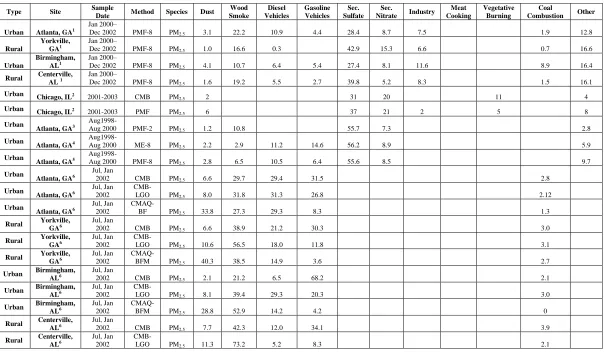
Table 2.4 Contributions of major sources of PM2.5 as resolved by previous studies in the southeastern U.S. in the summer months (expressed in percentage)...
21
Table 2.5 Contributions of major sources of PM2.5 as resolved by previous studies in the southeastern U.S. in the autumn months (expressed in percentage)...
22
Table 2.6 Contributions of major sources of PM2.5 as resolved by previous studies in the southeastern U.S. (multi-month, expressed in percentage)...
23
Table 3.1 MM5 Model Configurations... 33
Table 3.2 CMAQ and CAMx configurations used in this research... 36
Table 3.3 The observational networks and satellites used in model evaluation, as well as the variables evaluated, the sampling frequency, and the number of sites within the 12-km domain...
40
Table 3.4 Performance statistics for O3 in January 2002... 42
ix
Table 3.6 Performance statistics for monthly-mean BCin January 2002... 44
Table 3.7 Performance statistics for monthly-mean OCin January 2002... 45
Table 3.8 Performance statistics for monthly-mean TCin January 2002... 46
Table 3.9 Performance statistics for monthly-mean NO3- in January 2002... 47
Table 3.10 Performance statistics for monthly-mean SO42- in January 2002……... 48
Table 3.11 Performance statistics for monthly-mean NH4+ in January 2002………... 49
Table 3.12 Performance Statistics for O3 in July 2002... 50
Table 3.13 Performance statistics for monthly-mean PM2.5 in July 2002... 51
Table 3.14 Performance statistics for monthly-mean BC in July 2002... 52
Table 3.15 Performance statistics for monthly-mean OC in July 2002... 53
Table 3.16 Performance statistics for monthly-mean TC in July 2002... 54
Table 3.17 Performance statistics for monthly-mean NO3- in July 2002... 55
Table 3.18 Performance statistics for monthly-mean SO42- in July 2002... 56
Table 3.19 Performance statistics for monthly-mean NH4+ in July 2002………... 57
Table 3.20 Performance statistics for wet deposition in January 2002...
65
x
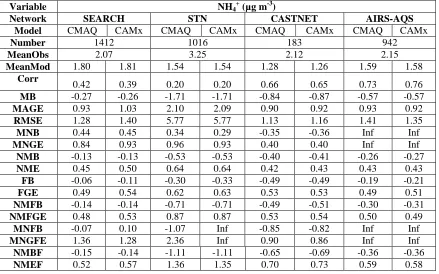
Table 3.22 Performance statistics for satellite-derived variables in January 2002 (simulated values are from CMAQ)...
68
Table 3.23 Performance statistics for satellite derived variables in July 2002 (simulated values are from CMAQ)...
69
Table 4.1 Source categories analyzed in this study... 79
Table 4.2 Monthly-mean percentage contributions of each source category to speciated emissions in January...
82
Table 4.3 Monthly-mean percentage contributions of each source category to speciated emissions in July...
82
Table 4.4 Domain-wide monthly-mean percentage contributions to PM2.5 in January from BFM...
83
Table 4.5 Domain-wide monthly-mean percentage contributions to PM2.5 in July from BFM...
83
Table 4.6 Monthly-mean percentage contributions to PM2.5 at representative sites in July (top 3 sources in red, bottom 3 in green)...
136
Table 4.7 Monthly-mean percentage contributions to PM2.5 at representative sites in July (top 3 sources in red, bottom 3 in green)...
137
Table 5.1 Domain-wide monthly-mean percent contributions to PM2.5 in January from PSAT...
154
Table 5.2 Domain-wide monthly-mean percent contributions to PM2.5 in July from PSAT...
154
xi
LIST OF FIGURES
Figure Page
Figure 1.1 U.S. EPA area designations for 2006 24-hour fine particle (PM2.5) standards (http://www.epa.gov/pmdesignations/index.htm)...
3
Figure 3.1
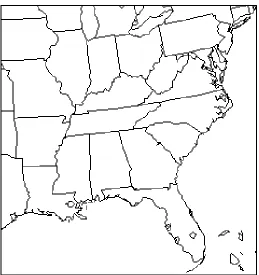
The domain used in this research: 12-km horizontal grid spacing over the
eastern U.S………. 32
Figure 3.2 Wet deposition of SO42- from CMAQ (left) and CAMx (right) in
January………... 58
Figure 3.3 Spatial distribution monthly mean maximum 8-hour average O3 concentrations simulated by CMAQ (left) and CAMx (right) overlaid with observations from AIRS-AQS, CASTNET, and SEARCH in January (top) and July (bottom)...
61
Figure 3.4 Spatial distribution monthly mean PM2.5 concentrations simulated by CMAQ (left) and CAMx (right) overlaid with observations from AIRS-AQS, IMPROVE, STN, and SEARCH in January (top) and July (bottom)...
62
Figure 3.5 Monthly-mean column CO from MOPITT (top) and CMAQ(bottom) for January (left) and July (right)...
70
Figure 3.6 Monthly-mean column NO2 from GOMES (top) and CMAQ(bottom) for January (left) and July (right)...
71
Figure 3.7 Monthly-mean column O3 from TOMS (top) and CMAQ(bottom) for January (left) and July (right)...
xii
Figure 3.8 Monthly-mean column AOD from MODIS (top) and CMAQ(bottom) for January (left) and July (right)...
73
Figure 4.1 Spatial distribution of monthly-mean percentage contributions of coal combustion emissions to baseline emissions in January (top) and July (bottom)...
89
Figure 4.2 Domain-wide monthly-mean contributions of coal combustion emissions to PM2.5 and its individual components in January... 90
Figure 4.3 Domain-wide monthly-mean contributions of coal combustion emissions to PM2.5 and its individual components in the first 6 layers in January………...
91
Figure 4.4 Domain-wide monthly-mean contributions of coal combustion emissions to PM2.5 and its individual components in July... 92
Figure 4.5 Domain-wide monthly-mean contributions of coal combustion emissions to PM2.5 and its individual components in the first 6 layers in July...
93
Figure 4.6 Spatial distribution of monthly-mean percentage contributions of diesel vehicle emissions to baseline emissions in January (top) and July (bottom)...
94
Figure 4.7 Domain-wide monthly-mean contributions of diesel vehicle emissions to PM2.5 and its individual components in January... 95
Figure 4.8 Domain-wide monthly-mean contributions of diesel vehicle emissions to PM2.5 and its individual components in July... 96
xiii
Figure 4.10 Domain-wide monthly-mean contributions of biomass burning emissions to PM2.5 and its individual components in January... 98
Figure 4.11 Domain-wide monthly-mean contributions of biomass burning emissions to PM2.5 and its individual components in July... 99
Figure 4.12 Spatial distribution of monthly-mean percentage contributions of gasoline vehicle emissions to baseline emissions in January (top) and July (bottom)...
100
Figure 4.13 Domain-wide monthly-mean contributions of gasoline vehicle emissions to PM2.5 and its individual components in January... 101
Figure 4.14 Domain-wide monthly-mean contributions of gasoline vehicle emissions to PM2.5 and its individual components in July... 102
Figure 4.15 Spatial distribution of monthly-mean percentage contributions of industrial processes emissions to baseline emissions in January (top) and July (bottom)... 103
Figure 4.16 Domain-wide monthly-mean contributions of industrial processes emissions to PM2.5 and its individual components in January... 104
Figure 4.17 Domain-wide monthly-mean contributions of industrial processes emissions to PM2.5 and its individual components in July... 105
Figure 4.18 Spatial distribution of monthly-mean percentage contributions of waste disposal and treatment emissions to baseline emissions in January (top) and July (bottom)...
106
xiv
Figure 4.20 Domain-wide monthly-mean contributions of waste disposal emissions to PM2.5 and its individual components in July………. 108
Figure 4.21 Spatial distribution of monthly-mean percentage contributions of biogenic emissions to baseline emissions in January (top) and July
(bottom)………. 109
Figure 4.22 Domain-wide monthly-mean contributions of biogenic emissions to PM2.5 and its individual components in January... 110
Figure 4.23 Domain-wide monthly-mean contributions of biogenic emissions to PM2.5 and its individual components in July... 111
Figure 4.24 Spatial distribution of monthly-mean percentage contributions of other combustion emissions to baseline emissions in January (top) and July (bottom)...
112
Figure 4.25 Domain-wide monthly-mean contributions of other combustion emissions to PM2.5 and its individual components in January... 113
Figure 4.26 Domain-wide monthly-mean contributions of other combustion emissions to PM2.5 and its individual components in July... 114
Figure 4.27 Spatial distribution of monthly-mean percentage contributions of other mobile source emissions to baseline emissions in January (top) and July (bottom)...
115
Figure 4.28 Domain-wide monthly-mean contributions of other mobile source emissions to PM2.5 and its individual components in January... 116
xv
Figure 4.30 Spatial distribution of monthly-mean percentage contributions of miscellaneous area sources emissions to baseline emissions in January (top) and July (bottom)………..
118
Figure 4.31 Domain-wide monthly-mean contributions of miscellaneous area source emissions to PM2.5 and its individual components in January... 119
Figure 4.32 Domain-wide monthly-mean contributions of miscellaneous area source emissions to PM2.5 and its individual components in July... 120
Figure 4.33 Monthly-mean baseline NH3 emissions in January (left) and July
(right)………. 122
Figure 4.34 Monthly mean PBL Height in January (left) and July (right) as well as monthly-mean daytime (8am – 7pm) and nighttime (8pm – 7am) PBL heights in January and July...
126
Figure 4.35 Monthly-mean contribution (in ppb) of miscellaneous areas sources to HNO3 in January (left) and July (right) (Note that negative numbers indicate an increase of HNO3 when miscellaneous area source emissions are eliminated)...
133
Figure 4.36 Monthly-mean percentage contributions to PM2.5 at urban, rural, remote, and coastal sites in January (top) and July (bottom)...
140
Figure 4.37 Comparison of SA results with other studies at JST in January (top) and July (bottom)...
141
Figure 4.38 Comparison of SA results with other studies at CTR in January (top) and July (bottom)...
142
Figure 4.39 Temporal variations of source contributions at JST in January (top) and July (bottom)...
xvi
Figure 4.40
Weekend effect for each source category in January (top) and
July (bottom)... 147
Figure 5.1 Domain-wide monthly-mean contributions of coal combustion emissions to PM2.5 and its individual components in January... 156
Figure 5.2 Domain-wide monthly-mean contributions of coal combustion emissions to PM2.5 and its individual components in July... 157
Figure 5.3 Domain-wide monthly-mean contributions of diesel vehicle emissions to PM2.5 and its individual components in January... 158
Figure 5.4 Domain-wide monthly-mean contributions of diesel vehicle emissions to PM2.5 and its individual components in July... 159
Figure 5.5 Domain-wide monthly-mean contributions of biomass burning emissions to PM2.5 and its individual components in January... 160
Figure 5.6 Domain-wide monthly-mean contributions of biomass burning emissions to PM2.5 and its individual components in July... 161
Figure 5.7 Domain-wide monthly-mean contributions of gasoline vehicle emissions to PM2.5 and its individual components in January... 162
Figure 5.8 Domain-wide monthly-mean contributions of gasoline vehicle emissions to PM2.5 and its individual components in July... 163
Figure 5.9 Domain-wide monthly-mean contributions of industrial processes emissions to PM2.5 and its individual components in January... 164
xvii
Figure 5.11 Domain-wide monthly-mean contributions of waste disposal and treatment emissions to PM2.5 and its individual components in January.. 166
Figure 5.12 Domain-wide monthly-mean contributions of waste disposal and treatment emissions to PM2.5 and its individual components in July... 167
Figure 5.13 Domain-wide monthly-mean contributions of biogenic emissions to PM2.5 and its individual components in January... 168
Figure 5.14 Domain-wide monthly-mean contributions of biogenic emissions to PM2.5 and its individual components in July... 169
Figure 5.15 Domain-wide monthly-mean contributions of other combustion emissions to PM2.5 and its individual components in January... 170
Figure 5.16 Domain-wide monthly-mean contributions of other combustion emissions to PM2.5 and its individual components in July... 171
Figure 5.17 Domain-wide monthly-mean contributions of other mobile source emissions to PM2.5 and its individual components in January... 172
Figure 5.18 Domain-wide monthly-mean contributions of other mobile source emissions to PM2.5 and its individual components in July...
173
Figure 5.19 Domain-wide monthly-mean contributions of miscellaneous area source emissions to PM2.5 and its individual components in January... 174
Figure 5.20 Domain-wide monthly-mean contributions of miscellaneous area source emissions to PM2.5 and its individual components in July... 175
Figure 5.21 Monthly-mean PM2.5 contributions (µg m-3) from coal combustion from BFM (left) and PSAT (right) in January...
xviii
Figure 5.22 Wet deposition fluxes of PSO4 from CMAQ (left) and CAMx (right) in January and July and the monthly-mean absolute difference in PSO4 wet deposition (CAMx – CMAQ)...
178
Figure 5.23 Monthly-mean biogenic VOC emissions and baseline SOA concentrations from CMAQ and CAMx in January (top) and July (bottom)……….
185
Figure 5.24 Simulated baseline H2O2 concentrations (ppb) from CMAQ (left) and CAMx (right)...
188
Figure 5.25 Absolute difference in monthly-mean baseline O3 (ppb) between CAMx and CMAQ in July...
189
Figure 5.26 Monthly-mean simulated cloud fraction from MM5 in July 2002…….... 189
Figure 5.27 Monthly-mean PM2.5 contributions at Jefferson Street (Atlanta), GA (top) and Yorkville, GA (bottom) in January (left) and July (right) of 2002 from PSAT and BFM... 193
Figure 5.28 Monthly-mean PM2.5 contributions at Birmingham, AL (top) and Centreville, AL (bottom) in January (left) and July (right) of 2002 from PSAT and BFM...
194
Figure 5.29 Monthly-mean PM2.5 contributions at Gulfport, MS (top) and Oak Grove, MS (bottom) in January (left) and July (right) of 2002 from PSAT and BFM...
195
Figure 5.30 Monthly-mean PM2.5 contributions at Pensacola, FL (top) and Outlying Landing, FL (bottom) in January (left) and July (right) of 2002 from PSAT and BFM...
xix
Figure 5.31 Monthly-mean PM2.5 contributions at Great Smoky Mountain National Park (top) and Charlotte, NC (bottom) in January (left) and July (right) of 2002 from PSAT and BFM………...
197
Figure 5.32 Monthly-mean PM2.5 contributions at Jamesville, NC (top) and Chicago, IL (bottom) in January (left) and July (right) of 2002 from PSAT and BFM...
198
Figure 5.33 Monthly-mean PM2.5 contributions at New York City, NY (top) and New Orleans, LA (bottom) in January (left) and July (right) of 2002 from PSAT and BFM... 199
Figure 5.34 Monthly-mean PM2.5 contributions at Cincinnati, OH (top) and Knoxville, TN (bottom) in January (left) and July (right) of 2002 from PSAT and BFM...
200
Figure 5.35 Monthly-mean PM2.5 contributions at Norfolk, VA (top) and Nashville, TN (bottom) in January (left) and July (right) of 2002 from PSAT and BFM………...
201
Figure 5.36 Miscellaneous area source contributions to NO3- and NH4- from CMAQ and CAMx at JST (top left), YRK (top right), BHM (bottom left) and CTR (bottom right) in January...
209
Figure 5.37 Comparison of PSAT and BFM results at urban sites (top) and rural sites (bottom) in January (left) and July (right)... 213
Figure 5.38 Comparison of PSAT and BFM results at remote sites (top) and coastal sites (bottom) in January (left) and July (right)...
xx
LIST OF ACRONYMS
3-D Three-Dimensional
AIRS-AQS Aerometric Information Retrieval System – Air Quality Subsystem
AOD Aerosol Optical Depth
AQM Air Quality Model
BC Black Carbon
BCON Boundary Conditions
BEIS Biogenic Emissions Inventory System
BFM Brute-Force Method
BHM Birmingham, Alabama
CAMx Comprehensive Air Quality Model with Extensions
CASTNET Clean Air Status and Trends Network
CB-IV Carbon Bond IV
CHI Chicago, Illinois
CIN Cincinnati, Ohio
CLT Charlotte, North Carolina
CMAQ Community Multiscale Air Quality modeling system
CMB Chemical Mass Balance
CO Carbon Monoxide
CTR Centreville, Alabama
xxi
DU Dobson Unit
EC Elemental Carbon
FB Fractional Bias
FDDA Four Dimensional Data Assimilation
FGE Fractional Gross Error
GOME Global Ozone Monitoring Experiment
GFP Gulfport, Mississippi
GRM Great Smoky Mountains National Park
H2O2 Hydrogen Peroxide
H2SO4 Sulfuric Acid
Hg Mercury
HNO3 Nitric Acid
IMPROVE Interagency Monitoring of Protected Visual Environments
IPCC International Panel on Climate Change
JMS Jamesville, North Carolina
JST Jefferson Street (Atlanta), Georgia
KNX Knoxville, TN
LGO Lipschitz Global Optimization
LRT Long Range Transport
M3DRY Models 3 Dry Deposition Module
MAGE Mean Absolute Gross Error
xxii
MCIP Meteorology-Chemistry Interface Processor
MM5 PSU/NCAR 5th generation Mesoscale Model
MNB Mean Normalized Bias
MNGE Mean Normalized Gross Error
MNGFE Mean Normalized Gross Fractional Error
MODIS Moderate Resolution Imaging Spectroradiometer
MOPITT Measurements of Pollutants in the Troposhpere
NAAQS National Ambient Air Quality Standards
NC North Carolina
NCAR National Center for Atmospheric Research
NCDENR North Carolina Department of Environmental and Natural Resources
NEI National Emissions Inventory
NEO New Orleans, Louisiana
NH3 Ammonia
NH4+ Ammonium
(NH4)2SO4 Ammonium Sulfate
NH4NO3 Ammonium Nitrate
NMB Normalized Mean Bias
NMBF Normalized Mean Bias Factor
NME Normalized Mean Error
NMEF Normalized Mean Error Factor
xxiii
NMFGE Normalized Mean Fractional Gross Error
NO Nitric Oxide
NO2 Nitrogen Dioxide
NO3- Nitrate
NOR Norfolk, Virginia
NOx Nitrogen Oxides
NYC New York City, New York
O3 Ozone
OAK Oak Grove, Mississippi
OC Organic Carbon
OIN Other Inorganics
OLF Outlying Landing, Florida
OM Organic Matter
OSAT Ozone Source Apportionment Technology
ORV Ohio River Valley
PA Process Analysis
PBL Planetary Boundary Layer
PM Particulate Matter
PMF Positive Matrix Factorization
PNS Pensacola, Florida
POA Primary Organic Aerosols
xxiv
PPTM Particle and Precursor Tagging Methodology
PSAT Particle Source Apportionment Technology
PSU Pennsylvania State University
RADM Regional Acid Deposition Model
RMSE Root Mean Square Error
RRTM Rapid Radiative Transfer Model
SA Source Apportionment
SEARCH Southeastern Aerosol Research and Characterization
SIP State Implementation Plan
SMOKE Sparse Matrix Operator Kernel Emissions
SO2 Sulfur Dioxide
SO42- Sulfate
SOA Secondary Organic Aerosol
SOAP Secondary Organic Aerosol Partitioning
SORGAM Secondary Organic Aerosol Model
STN Speciation Trends Network
TC Total Carbon
TOC Total Organic Compound
TOMS Total Ozone Mapping Spectrometer
TOR Thermal Optical Reflectance
TOT Thermal Optical Transmittance
xxv
U.S. United States
U.S. EPA U.S. Environmental Protection Agency
VISTAS Visibility Improvement State and Tribal Association of the Southeast
VOC Volatile Organic Compound
1
CHAPTER 1. INTRODUCTION
1.1 Background and Motivations
Particulate matter with an aerodynamic diameter of less than or equal to 2.5 microns
(PM2.5) is a well researched and documented pollutant due to its adverse health effects and
contributions to visibility degradation and climate change. In December 2006, the U.S.
Environmental Protection Agency (EPA) lowered the 24-hour National Ambient Air Quality
Standards (NAAQS) for PM2.5 from 60 to 35 µg m-3. In order to attain this standard, the 3-year
average of the 98th percentile of 24-hour average PM2.5 concentrations must not exceed 35 µg/m3
(http://www.epa.gov/air/criteria.html). In order to develop the most cost-effective reduction
strategies, it is essential to have an understanding of which sources are contributing to these
elevated PM2.5 concentrations. The research presented in this thesis work will focus on source
apportionment of PM2.5 using two commonly used three-dimensional air quality models (3-D
AQMS): the Models-3 Community Multiscale Air Quality (CMAQ) model (Byun and Ching, 1999; Binkowski and Roselle, 2003; Byun and Schere, 2006) and ENVIRON‟s Comprehensive
Air Quality Model with extensions (CAMx) (ENVIRON, 2006). The brute-force method (BFM)
is used within CMAQ along with the Particle Source Apportionment Technology (PSAT) within
CAMx in order to assess the impacts of 10 prescribed source categories on PM2.5 concentrations
over the eastern U.S.
1.1.1 Impacts of PM2.5
PM2.5 is of particular concern with respect to human health because they have the ability
2
can be trapped and potentially removed in the upper respiratory system (Brunekereef and
Holgate, 2002). Acute and chronic exposure to elevated levels of PM2.5 has been linked to
increased mortality rates, heart attacks, decreased lung function, increased asthma attacks, and
even premature death (Dockert et al., 1993; Ebelt et al., 2000; Laden et al., 2000; Peters et al.,
2001). PM2.5 also scatters and absorbs light in the atmosphere, thus altering the amount of solar radiation that reaches the Earth‟s surface. The International Panel on Climate Change‟s (IPCC)
2007 synthesis report (IPCC, 2007) stated that anthropogenic contributions to aerosol particles
produce a cooling effect with a total direct radiative forcing of -0.5 W/m2. In addition to the
direct effects, smaller particles can lead to more reflective clouds, thus increasing the albedo of the Earth‟s surface. The IPCC reported that this indirect cloud albedo forcing is on the order of
-0.7 W/m2. Additionally, particles can lead to visibility degradation by scattering and absorbing
light at wavelengths similar to the particle size. These fine particles are thus important in
degradation of visible light which have wavelengths of 0.4 to 0.7 µm.
1.1.2 State Implementation Plans
Because of the aforementioned adverse effects, the U.S. EPA has designated PM2.5 as one
of the six criteria pollutants regulated under the NAAQS. Any area that fails to meet these
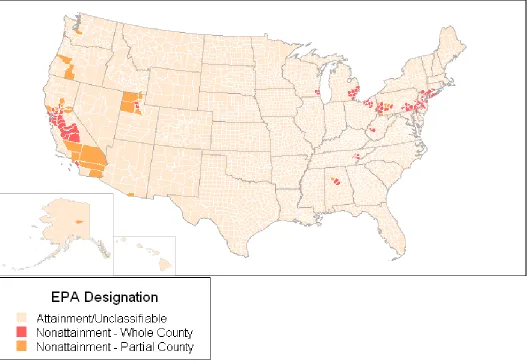
standards based on ambient monitoring data is designated as a non-attainment area. Figure 1.1
shows the PM2.5 nonattainment areas designated by the EPA as of October, 2009. As the figure
shows, the most problematic regions in terms of particle pollution are the northeastern U.S. and
southern California. When an area is designated as nonattainment, the state where that
3
4
outlines a plan to achieve compliance within a nonattainment area. Failure to successfully
achieve this task can result in economic sanctions imposed by the federal government on that
state. In order for the state governments to develop the most effective reduction strategies,
there must be an understanding of which emission sources are contributing the greatest to
PM2.5.formation. The work in this thesis will contribute to a broad body of work in the
scientific community apportioning PM2.5 to potential emission sources that can be used as a
reference in formulation of the aforementioned reduction strategies
1.2 Objectives
The objectives of this research are to:
(1) conduct source apportionment of PM2.5 for 10 major source categories for
January and July 2002 using CMAQ with the brute force direct sensitivity
analysis method and the CAMx/PSAT reactive tracer method in order to
determine the major sources of PM2.5 over the eastern U.S.
(2) analyze predicted contributions from each source category for both methods
and discuss the relative importance of each source along with potential
implications for emission reduction strategies and component-based
epidemiological PM2.5 studies.
(3) compare and contrast simulated source contributions from each method, and
identify sources of major discrepancies in results obtained with both methods
5
CHAPTER 2. LITERATURE REVIEW
The determination of major sources of fine particulate matter in the United States has
become an increasingly important area of research, particularly over the past decade. Several
different methods of apportioning PM2.5 mass to probable emission sources exist, each with
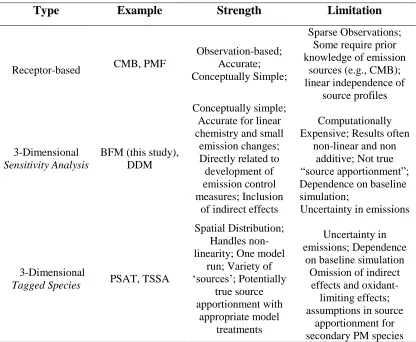
their own inherent strengths and limitations. Table 2.1 lists some of the major source
apportionment methods currently used along with their merits and limitations. Perhaps the
most widely-used source apportionment tools are receptor-oriented methods that aim to infer
contributions from different emission sources using measurements taken at a specific
receptor site. These methods have been well-documented in terms of their mathematical
formulation and development (Cooper and Watson, 1980; Waston, 1984; Hopke, 1991;
Henry, 1997; Watson et al., 2002; Hopke, 2003). More recent studies have implemented
3-dimensional air quality models (3-D AQMs) as a source-oriented method for apportioning
fine particle mass to potential sources. This thesis will compare two source apportionment
methods that utilize 3-D AQMs. An overview of the theoretical basis of two widely-used
receptor-oriented approaches as well as two classes of source-oriented methods for source
apportionment is given in section 2.1. Section 2.2 provides an overview of major sources of
fine particulate matter as resolved by other studies, with a particular emphasis on the sources
of PM2.5 over the eastern U.S. Also, the current status and major challenges with respect to
6
Table 2.1. Summary of existing source apportionment methods.
Type Example Strength Limitation
Receptor-based CMB, PMF
Observation-based; Accurate; Conceptually Simple;
Sparse Observations; Some require prior knowledge of emission
sources (e.g., CMB); linear independence of
source profiles
3-Dimensional
Sensitivity Analysis
BFM (this study), DDM
Conceptually simple; Accurate for linear chemistry and small
emission changes; Directly related to development of emission control measures; Inclusion
of indirect effects
Computationally Expensive; Results often
non-linear and non additive; Not true “source apportionment”; Dependence on baseline simulation;
Uncertainty in emissions
3-Dimensional
Tagged Species PSAT, TSSA
Spatial Distribution; Handles non-linearity; One model
run; Variety of „sources‟; Potentially true source apportionment with appropriate model treatments Uncertainty in emissions; Dependence
on baseline simulation Omission of indirect
effects and oxidant-limiting effects; assumptions in source
7
2.1 Theoretical Basis of Source Apportionment Methods
2.1.1 Receptor-Based Methods
Receptor-oriented source apportionment methods are widely-used tools throughout
the atmospheric science community that aim to resolve possible emission sources of a
particular PM2.5 sample based on its mass and chemical composition, which can then be
linked to the composition of possible emission sources. These receptor-based methods are
based on the conservation of mass of species, whose general form is given by:
1
,
nik kj ij
k
xij
g f
e
(2.1)
where xij is the ambient concentration of species j in sample i, fkj is the mass fraction of
species j in source k, gik is the source contribution of source k in sample i, and eij is the error
(Ke et al., 2008). Two of the most widely-used receptor models are positive matrix
factorization (PMF) and chemical mass balance (CMB), which will be discussed in the
following sections.
2.1.1.1Chemical Mass Balance
CMB uses a least-squares fitting method to minimize the difference between
measurements and modeled concentrations. CMB is a single sample receptor model to solve
equation 1, assuming that emission source profiles (fjk) are known. Similar to the object
8
2
2 2 2
1 1 1
2
[(
jk) / (
jk)]
jk
n N N
jk
ij xj f
j k k
x
f g
g
(2.2)where xij is the ambient concentration of species j in sample i,fjk is the mass fraction of
species j in source k, gjkis the source contribution of source k in sample i, σxj is the
uncertainty of the ambient concentration of species j, and σfjk is the uncertainty in the fraction
of species j in the source profile k.
CMB is a powerful tool for solving the mass balance equation for source
apportionment, given that there is knowledge of all sources impacting a receptor. CMB has
been widely used and documented, making it widely available and fairly simple to
implement. CMB is also observation-based, and is thus generally believed to be accurate,
though sparse observational data can often limit the robustness of the dataset. However,
CMB models are based on assumptions (among others) that all sources with a potential for
significantly contributing to the receptor are included in the analysis, and also that the source
compositions are linearly independent of each other (U.S. EPA, 1998). This linear
independence of source profiles is one of the major assumptions that limit the ability of CMB
to accurately identify and apportion mass between sources that share relatively similar
profiles (Marmur et al., 2005). To help address this issue, Schauer et al. (1996) developed a
CMB receptor model based on the use of organic compounds as tracers. Organic markers
within CMB have been widely-used in PM2.5 source apportionment studies (Schauer et al.,
2000; Zheng et al., 2002; Robinson et al., 2006; Zheng et al., 2006; Ke et al., 2008). Marmur
9
particle ratios with the hypothesis that sources with fairly similar PM2.5 emissions may have
significantly different gaseous emissions. The extended CMB is useful in addressing the
problem of co-linearity between source profiles. In addition to issues with co-linearity, CMB
approaches do not typically account for species transformations from the source to the
receptor (Lee et al., 2009). CMB is also limited by the requirement of previous knowledge
of the composition of emission sources impacting a receptor site. Additionally, sparse
observations available for CMB analysis limit spatial coverage of source contributions that is
often desired, particularly in the case of exposure modeling.
2.1.1.2 Positive Matrix Factorization
PMF (Paatero, 1997) aims to iteratively solve the equation
1
ij ij ij ij ih hj
p
h
E
X
Y
X
G F
(2.3)
where G and F are the left and right factor matrices to be determined, and E is the difference
matrix between measurement Xij, and model, Yij (Rizzo and Scheff, 2007). The solution
provided by PMF minimizes an object function, Q (E), based on uncertainties for each
observation (Paatero, 1997; Polissar et al., 1998). This function is defined as (Kim et al.,
2004): 2 1 1
(
)
m n iji j ij
E
Q E
(2.4)
With regards to equation (1), PMF is advantageous as it does not require prior
10
equation (2.1) (Maykut et al., 2003). Another major advantage of PMF is its ability to handle
missing and below detection limit data (Liu et al., 2005). However, because PMF does not
require prior knowledge of the composition of emission sources, a large number of samples
are required in order to resolve source factors (Lee et al., 2008). PMF is also limited by its
inability to link observed factors directly with actual sources due to the fact that PMF is
based on statistical patterns of correlations, rather than source profiles (Sarnat et al., 2008).
However, PMF has shown to be a valuable alternative to traditional receptor models, and has
been widely applied in source apportionment of PM2.5 (Kim et al., 2003; Kim et al., 2004;
Liu et al., 2005; Liu et al., 2006; Hwang et al., 2007; Jaeckels et al., 2007).
2.1.2 Source-Oriented Methods
A second group of source apportionment tools used is based on 3-D AQMs. These
emission-based models, as opposed to receptor-based models, use a processed emission
inventory as the starting point. The continuity equation, given as (Byun and Ching, 1999):
1 2
(
)
( /
( , ,..., , , )
( , )
i
i i i i n i
dc
Uc
D
c
R c c
c T t
S x t
dt
(2.5)is then solved to simulate the fate and transport of pollutants. In equation (2.5), ci is the
concentration of species i, U is the wind velocity vector, Di is the molecular diffusivity of
species i, Ri is the rate of concentration change of species i by chemical reactions, Si(x,t) is
the source/sink of i at location x and time t, ρ is the air density, and n is the number of
11
the temporal variation in source impacts a specific receptor site, while emission-based
models may be more spatially representative. Two classes of source apportionment methods
using 3-D AQMs are discussed in the following sections.
2.1.2.1Sensitivity Analysis Methods
Sensitivity analysis methods measure the model output response to a change in input.
While these methods are a valuable tool for policy-makers in analyzing the effects of
emission reductions on the atmosphere, they will not provide true source apportionment if the
relationship between the model input and output is non linear (Yarwood et al., 2005), as is
often the case (Ansari and Pandis, 1998, 1999; Hakami et al., 2004; Cohan et al., 2005;
Dennis et al., 2008). Two widely-used sensitivity analysis methods within 3-D AQMs are
discussed in the following section.
2.1.2.1.1 The Brute-Force Method (BFM)
The brute-force method (BFM) is the most straight-forward sensitivity analysis
method, in which a baseline simulation is compared against a sensitivity simulation in which
emissions of a certain source category are eliminated. The difference in simulated PM2.5
between the baseline and sensitivity simulation can be attributed as the contribution of the
source to PM2.5 concentrations. A mathematical representation of this concept is:
,
i base sen i
S
C
C
(2.6),
100 *
base sen ipi
base
C
C
S
12
1 n
tot i
i
S
S
(2.8)where Si is the absolute contribution of source i in the same unit as the concentration, Spi is
the percentage contribution of source i, Cbase is the PM2.5 concentration from the baseline
simulation, and Csen,i is the PM2.5 concentration from the sensitivity simulation in which the
emissions from source i are eliminated, and Stot is the total contribution from n number of
sources.
This method is simple and can be applied to any model, but is inefficient and
computationally expensive, as a complete model simulation is required for each source
category. This method is also rooted in the assumption that the emissions from all source
categories within the emission inventory are linear and additive; this assumption may not
hold in highly non-linear systems. However, BFM is advantageous in its ability to capture
the indirect effects that result from the interactions between secondary PM species due to
their thermodynamic relationships. Also, the smaller concentration changes between
simulations may be influenced more by numerical noise within the model than by the change
in emissions (Koo et al., 2009a).
2.1.2.1.2 The Decoupled Direct Method (DDM)
The decoupled direct method (DDM) (Dunker, 1981, 1984) is an efficient and accurate alternative to the BFM. In the DDM, the model‟s governing equations are
differentiated with respect to a particular sensitivity parameter. The resulting set of equations
13
advantage of DDM is that it decouples the sensitivity equations from the governing model
equations, thus enhancing computational efficiency (Koo et al., 2007). DDM has generally
been applied to calculate first-order sensitivities of gaseous species (Dunker et al., 2002a,
2002b). Its use has recently been extended to PM (Napelenok et al., 2006; Koo et al., 2007).
While DDM has been applied to solve higher order sensitivities for gaseous species (Hakami
et al., 2003, 2004; Cohan et al., 2005; Koo et al., 2008), its use for PM is currently limited to
first order sensitivities. Therefore, DDM is limited in its ability to represent higher order
sensitivities associated with the formation of secondary PM species. Yang et al. (1997)
developed a version of DDM known as DDM-3D that has been applied in 3-D AQMs
(Mendoza-Dominguez et al., 2000; Hakami et al., 2004). While DDM directly solves
sensitivity equations derived from the governing equations of the model while using the same
time steps as the chemistry routine, DDM-3D uses separate, less complex algorithms with
different time steps to solve the chemistry sensitivity equations (Koo et al., 2007, 2009a).
2.1.2.2 Reactive Tracers Method
More recent studies have implanted a reactive tracers (or tagged species) method for
source apportionment of PM2.5. These reactive tracers are extra species added to a 3-D AQM
that track contributions of pollutants from specific source categories. These tagged species
undergo the same processes (i.e., wet, dry deposition) within the model as the bulk chemical
species (Baker and Timin, 2008). For a pollutant with a total concentration of X with i
number of sources, a reactive tracer xi is assigned to each source such that the sum of the
reactive tracers will equal the total concentration of the species (X = ∑xi). The reactive
14
source apportionment (Yarwood et al., 2005). Two recently-developed tagged species source
apportionment methods implemented in two widely-used 3-D AQMs are described further in
the following sections.
2.1.2.2.1 The Particulate Source Apportionment Technology (PSAT)
The Particulate Source Apportionment Technology (PSAT) is a reactive tracers
algorithm that has been implemented in the Comprehensive Air Quality Model with
Extensions (CAMx) and is publicly available (Yarwood et al., 2004; Wagstrom et al., 2008).
PSAT calculates source apportionment using tagged species that undergo the same
atmospheric processes as the bulk chemical species within the main model, closely
resembling the methodology of the Ozone Source Apportionment Technology (OSAT)
(ENVIRON, 2009), also developed by ENVIRON. PSAT aims to conduct source
apportionment by solving the change in concentrations of the reactive tracers over each time
step. This is accomplished by solving for the production and destruction of the reactive
tracers due to different processes, as described in equations (2.9) and (2.10), respectively
(ENVIRON, 2009):
(
)
( )
ii i
i
a
a t
t
a t
A
a
(2.9)(
)
( )
ii i
i
b
b t
t
b t
B
b
(2.10)where ai is the reactive tracer for species A, biis the reactive tracer for species B, and t is the
15
PSAT is designed to apportion sulfate (SO42-), nitrate (NO3-), ammonium (NH4+),
mercury (Hg), secondary organic aerosol (SOA), and six primary PM species (e.g., elemental
carbon (EC), primary organic aerosol (POA), fine crustal particles, other fine particles,
coarse crustal particles, and other coarse particles. Yarwood et al. (2005) provide a complete
description of the reactive tracers added for each species for the source category of interest along with a detailed description of the algorithm‟s formulation. PSAT is an offline source
apportionment method that calculates source contributions with separate source
apportionment algorithms rather than by the host model routines (Baker and Timin, 2008).
PSAT is advantageous in that it is an efficient method in comparison to the sensitivity
methods, allowing for source apportionment for several different source categories in a single
model simulation. Additionally, it can handle the issues of non-linearity that often limit
sensitivity methods, and thus have the potential to provide true source apportionment.
However, a major challenge of PSAT is the development of a feasible manner to assign
concentration changes to the reactive tracers due to non-linear processes, as there is no
unique way to accomplish this. Additionally, because PSAT is designed to apportion each
PM species to its primary precursor, it is unable to capture the indirect effects and oxidant
limiting effects that result from interactions between secondary PM species and their gaseous
precursors. Wagstrom et al. (2008) developed an online particulate source apportionment
algorithm (OPSA) that was implemented into a 3-D aerosol chemical transport model
(PMCAMx) (Gaydos etal., 2007) and compared it with the offline PSAT implemented by
Yarwood et al. (2005). The offline PSAT algorithm uses the same equations as the on-line
16
of tracking the source specific species separately, the offline algorithm uses the
apportionment of the upwind grid cell to apportion each species after the transport
calculations (Wagstrom et al., 2008). Wagstrom et al. (2008) found that the offline version
of PSAT compared well to the more rigorous online algorithm and has the advantage of
being more computationally efficient and simpler to implement.
2.1.2.2.2 Tagged Species within CMAQ
Similar tagged species source apportionment algorithms have also been implemented
in CMAQ. The Particle and Precursor Tagging Methodology (PPTM) was initially
implemented into CMAQ with the capabilities of tagging sulfur, nitrogen, and mercury
(Myers et al., 2006; ICF International, 2007a, 2007b). Bhave et al. (2007) later implemented
tracking of primary organic and elemental carbon. The Tagged Species Source
Apportionment (TSSA) algorithm was subsequently developed and implemented into CMAQ
with the capability of tagging approximately 20 new species (Tonnesen et al., 2005; Wang et
al., 2009). Like PSAT, TSSA is advantageous in its efficiency and ability to handle
non-linearity. Wang et al. (2009) compared TSSA to PSAT and found that the two algorithms
produced similar results in terms of ranks of source contributions. They did, however, find
differences between the source apportionment results from the two algorithms that in many
cases can be attributed in large part to differences in underlying model formulation (e.g.
vertical advection scheme, vertical eddy diffusivity values) as opposed to differences in the
source apportionment methodologies. Baker and Timin (2008) also found that the two
17
2.1.2.2.3 Comparisons of Source Apportionment and Source Sensitivity
While comparisons of different sensitivity methods have been widely conducted
(Dunker et al., 2002a; Hakami et al., 2004; Cohan et al., 2005; Napelenok et al., 2006; Koo et
al., 2007), as well as a few attempts at comparing different source apportionment methods
(Baker and Timin, 2008; Wagstrom et al., 2008; Wang et al., 2009), there have been limited
studies comparing recent tagged species (or “source apportionment”) methods with source
sensitivity methods. Dunker et al. (2002b) compared source apportionment of ozone using
OSAT with first order DDM sensitivities in terms of emissions and initial and boundary
conditions. They found that OSAT and DDM agreed reasonably well on the most important
contributors to the highest ozone concentrations but disagreed on about 20% of the important
contributors. Zhang et al. (2005) also compared OSAT with DDM and Process Analysis
(PA). They found that the NOx versus VOC-sensitivity of ozone chemistry predicted by the
three probing tools was similar over most of the domain, except in a few areas where O3
formation was predicted to be VOC-sensitive by PA and DDM but NOx-limited by OSAT.
In terms of ranks of O3 contributors, they found that DDM and PSAT agreed well on the sets
of top 10 O3 contributors, but predicted different rankings among those sets of top 10
contributors to the highest 1- and 8- hour average O3 concentrations.
Baek et al. (2005) compared the brute force method with a tagged species algorithm
in CMAQ (CMAQ-TR) for predicted contributions of 5 source categories to primary organic
aerosols (POA). They found that predicted contributions to POA of the 5 source categories
agreed well between the two methods, as is expected due to the linear relationship between
18
comparisons of source apportionment and source sensitivity for PM. They compared PSAT
and DDM to brute-force predicted contributions of point source SO2 emissions, on-road
mobile source emissions, and anthropogenic NH3 and NOx emissions to PM2.5 contributions
within CAMx. PSAT and DDM were compared to the brute-force method for various
emission reductions of 20 and 100%. They found that PSAT agreed well with the brute-force
method in situations where the emissions-concentration relationship was linear (e.g., primary
aerosols). They also found that PSAT agreed well with the brute-force method in situations
where the emission-concentration relationship was highly non-linear but there were no
indirect effects. PSAT and BFM disagreed in situations where the emission-concentration
relationship is highly non-linear and there are significant indirect effects and oxidant-limiting
effects. For example, contributions of PSAT to sulfate formation near a large point source
of SO2 were found to be smaller than the brute-force predicted contributions. This is due to
more availability of oxidants when an emission source is completely removed (as is the case
for BFM); PSAT does not take this indirect effect into account (Koo et al., 2009b). This is
19
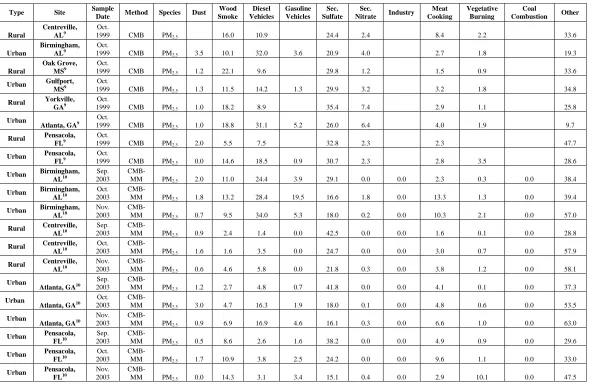
Table 2.2. Contributions of major sources of PM2.5 from previous studies in the southeastern U.S. in the winter months (expressed in percentage).
Type Site Sample
Date Method Species Dust Wood Smoke Diesel Vehicles Gasoline Vehicles Sec. Sulfate Sec.
Nitrate Industry
Meat Cooking
Vegetative Burning
Coal
Combustion Other Urban Atlanta,
GA8
Jan.
2002 PMF-1 PM2.5 2.0 31.9 9.6 11.6 16.0 17.3 3.0 1.7 6.9 Urban Atlanta,
GA8
Jan.
2002 PMF-2 PM2.5 1.2 23.8 19.5 15.2 7.0 3.2 4.9 Rural Centreville,
AL9
Jan.
2000 CMB PM2.5 1.4 19.3 10.1 3.4 23.8 10.9 5.1 0.8 24.8 Urban Birmingham
, AL9
Jan.
2000 CMB PM2.5 2.5 27.4 24.1 4.1 17.1 12.1 2.8 1.4 7.3
Rural Oak Grove, MS9
Jan.
2000 CMB PM2.5 3.4 32.5 12.8 28.6 8.0 5.0 1.6 8.4
Urban Gulfport, MS9
Jan.
2000 CMB PM2.5 19.7 17.0 20.7 5.1 2.3 2.1 33.9
Rural Yorkville, GA9
Jan.
2000 CMB PM2.5 23.1 13.5 29.8 14.7 5.6 3.8 12.0 Urban Atlanta, GA9
Jan.
2000 CMB PM2.5 31.3 23.2 7.1 17.4 11.5 2.6 4.2 8.1 Rural Pensacola,
FL9
Jan.
2000 CMB PM2.5 19.5 19.4 23.5 5.0 3.8 11.4 23.1 Urban Pensacola,
FL9
Jan.
2000 CMB PM2.5 3.7 64.2 22.6 5.0 24.3 5.6 4.7 6.4 Urban Birmingham
, AL10
Dec. 2003
CMB-MM PM2.5 0.0 23.3 15.7 18.2 24.5 1.9 0.0 6.4 3.2 0.0 21.9 Urban Birmingham
, AL10
Jan. 2004
CMB-MM PM2.5 0.8 9.0 25.0 8.9 13.5 4.8 0.0 4.7 0.5 0.0 59.5 Rural Centreville,
AL10
Dec. 2003
CMB-MM PM2.5 2.4 5.8 6.6 1.0 34.6 0.6 0.0 3.8 1.0 0.0 47.8 Rural Centreville,
AL10
Jan. 2004
CMB-MM PM2.5 0.1 30.4 1.8 1.4 16.2 1.7 0.0 2.5 3.9 0.0 41.6 Urban Atlanta,
GA10
Dec. 2003
CMB-MM PM2.5 1.1 9.6 12.7 3.4 32.5 0.8 0.0 3.2 1.1 0.0 49.7 Urban Atlanta,
GA10
Jan. 2004
CMB-MM PM2.5 0.8 27.7 9.3 12.8 13.9 5.3 0.0 7.6 3.8 0.0 41.7 Urban Pensacola,
FL10
Dec. 2003
CMB-MM PM2.5 0.3 21.3 4.0 3.4 23.5 0.5 0.0 9.1 9.6 0.0 39.5 Urban Pensacola,
FL10
Jan. 2004
CMB-MM PM2.5 0.1 21.2 7.1 5.2 17.2 1.0 0.0 5.4 14.7 0.0 38.1
Urban Atlanta, GA15
Jan. 2002
20
Table 2.3. Contributions of major sources of PM2.5 from previous studies in the southeastern U.S. in the spring months (expressed in percentage).
Type Site Sample
Date Method Species Dust Wood Smoke Diesel Vehicles Gasoline Vehicles Sec. Sulfate Sec.
Nitrate Industry
Meat Cooking
Vegetative Burning
Coal
Combustion Other
Rural
Centreville, AL9
Apr.
1999 CMB PM2.5 4.3 9.7 12.2 3.6 38.0 2.1 6.3 1.4 22.1 Urban
Birmingha m, AL9
Apr.
1999 CMB PM2.5 2.9 16.3 25 5.8 29.6 4.0 2.4 1.4 11.4 Rural
Oak Grove, MS9
Apr.
1999 CMB PM2.5 2.6 20.7 11.4 37.9 2.5 2.7 1.0 21.4 Urban Gulfport,
MS9
Apr.
1999 CMB PM2.5 2.6 6.0 10.1 0.6 31.5 2.9 0.7 2.0 44.6 Rural Yorkville,
GA9
Apr.
1999 CMB PM2.5 6.7 15.2 34.1 4.7 3.0 0.9 32.9 Urban Atlanta,
GA9
Apr.
1999 CMB PM2.5 1.9 11.3 29.9 4.3 31.7 5.2 3.4 1.9 18.6 Urban Pensacola,
FL9
Apr.
1999 CMB PM2.5 3.0 2.1 13.1 44.1 2.5 1.3 0.5 33.4 Urban Pensacola,
FL9
Apr.
21
Table 2.4. Contributions of major sources of PM2.5 from previous studies in the southeastern U.S. in the summer months (expressed in percentage).
Type Site Sample
Date Method Species Dust Wood Smoke Diesel Vehicles Gasoline Vehicles Sec. Sulfate Sec.
Nitrate Industry Meat Cooking
Vegetative Burning
Coal
Combustion Other - 36-km domain7 Jul. 2001
PM-CAMx EC 0 11.7 77.7 4.7 8
- 36-km domain7 Jul. 2001
PM-CAMx OM 4 10.5 18.3 19 38.3
Urban Atlanta, GA8
Jul.
2001 PMF-1 PM2.5 5.1 9.7 11.6 1.3 41.3 2.9 3.7 1.5 22.9 Urban
Atlanta, GA8
Jul.
2001 PMF-2 PM2.5 3.2 4.6 51.9 2.5 5.8 2.9 19.8 Rural Centerville,
AL9
Jul.
1999 CMB PM2.5 3.1 1.7 7.5 25.7 0.7 0.2 61 Urban Birmingham,
AL9
Jul.
1999 CMB PM2.5 3.8 3.9 25.5 1.1 33.6 2.4 3.6 0.9 25.3 Rural Oak Grove,
MS9
Jul.
1999 CMB PM2.5 9.9 14.1 10.9 31.8 1.1 9.5 0.7 22.1 Urban
Gulfport, MS9
Jul.
1999 CMB PM2.5 8.4 5.8 11.3 0.8 30.9 1.4 3.0 1.0 38.2 Rural
Yorkville, GA9
Jul.
1999 CMB PM2.5 2.0 1.8 7.7 35.2 1.8 1.1 0.3 50.3 Urban
Atlanta, GA9
Jul.
1999 CMB PM2.5 3.1 2.7 13.7 0.4 35.3 2.8 1.1 41.4 Urban
Pensacola, FL9
Jul.
1999 CMB PM2.5 3.3 2.7 9.6 31.8 1.4 0.8 0.7 50.2 Urban
Pensacola, FL9
Jul.
1999 CMB PM2.5 5.6 5.1 13.9 0.6 29.8 1.2 4.7 2.2 38.4 Urban
Gulfport, MS14
Jul. 1999
CMAQ-BFM TC 5.4 20.0 22.3 6.9 3.1 3.8 0.8 36.9
Rural Oak Grove, MS14
Jul. 1999
CMAQ-BFM TC 1.6 20.3 8.9 2.4 12.2 1.6 0.8 51.2
Urban Birmingham, AL14
Jul. 1999
CMAQ-BFM TC 2.3 21.4 13.9 3.3 12.1 3.3 4.3 39.8
Rural Centreville, AL14
Jul. 1999
CMAQ-BFM TC 1.5 17.3 7.5 1.5 3.0 0.8 3.0 63.2
Urban
Atlanta, GA14
Jul. 1999
CMAQ-BFM TC 2.8 14.2 23.9 7.1 11.6 8.0 0.7 32.6
Rural Yorkville, GA14
Jul. 1999
CMAQ-BFM TC 2.4 22.6 12.2 2.7 8.1 2.4 1.7 48.3
Urban Pensacola, FL14
Jul. 1999
CMAQ-BFM TC 3.7 42.6 13.8 4.8 2.7 3.2 1.6 28.2
Urban
Atlanta, GA15
Jul. 2001