
Mutational Analysis of the mRNA Operator for T4 DNA Polymerase
Mark D. Andrake’ and Jim D. Karam‘
Department of Biochemistry and Molecular Biology, Medical University of South Carolina, Charleston, South Carolina 29425 Manuscript received October 29, 1990
Accepted for publication February 8, 199 1
ABSTRACT
Biosynthesis of bacteriophage T4 DNA polymerase is autogenously regulated at the translational level. The enzyme, product of gene 43, represses its own translation by binding to its mRNA 5’ to the initiator AUG at a 36-40 nucleotide segment that includes the Shine-Dalgarno sequence and a putative RNA hairpin structure consisting of a 5-base-pair stem and an 8-base loop. We constructed mutations that either disrupted the stem or altered specific loop residues of the hairpin and found that many of these mutations, including single-base changes in the loop sequence, diminished binding of purified T 4 DNA polymerase to its RNA in vitro (as measured by a gel retardation assay) and derepressed synthesis of the enzyme in vivo (as measured in T4 infections and by recombinant- plasmid-mediated expression). In vitro effects, however, were not always congruent with in vivo effects. For example, stem pairing with a sequence other than wild-type resulted in normal protein binding
in vitro but derepression of protein synthesis in vivo. Similarly, a C-+A change in the loop had a small effect in vitro and a strong effect in vivo. In contrast, an A+U change near the base of the hairpin that was predicted to increase the length of the base-paired stem had small effects both in vitro and in vivo. The results suggest that interaction of T4 DNA polymerase with its structured RNA operator depends on the spatial arrangement of specific nucleotide residues and is subject to modulation in vivo.
T
HE importance of translational repressors in pro- karyotic gene regulation is becoming well rec- ognized (GOLD 1988; MCCARTHY and GUALERZI1990). In bacteriophage T4, three such repressors have been implicated in the control of DNA replica- tion: the gene 32 protein (gp32, Ssb protein), the gene 43 protein (gp43, DNA polymerase), and the RegA protein (gpregA). T 4 gp32 and gp43 can bind to both DNA and RNA, with their RNA binding being spe- cific to sites ( i e . , translational operators) on their own transcripts (ANDRAKE et al. 1988; MCPHEETERS, STORMO and GOLD 1988). In contrast, T 4 RegA pro- tein, which is also autogenously regulated at the trans- lational level (LIANG et al. 1988; WIBERG and KARAM
1983), does not bind to DNA (MILLER et al. 1985) a n d has the capacity to interact with a number of
different translational operators in addition to the target on its own message (UNNITHAN et al. 1990; WIBERG and KARAM 1983). Several of the T4-induced proteins whose synthesis is regulated by the RegA repressor are essential for phage DNA replication.
All three known T4-induced translational repres- sors contact their mRNA substrates within translation initiation domains and probably inhibit specific trans- lation by blocking ribosomes at these sites (GOLD 1988). On the basis of studies that mapped the
search. Philadelphia, Pennsylvania 191 11.
’
Present address: Fox Chase Cancer Center, Institute for Cancer Re-‘
To whom correspondence should be addressed.Genetics 128: 203-213 (June, 1991)
mRNA-binding sites of T 4
gp32
(MCPHEETERS, STORMO and GOLD 1988), T 4 gp43 (ANDRAKE et al.1988; TUERK et al. 1990) and T 4 gpregA (KARAM et
al. 1981; UNNITHAN et al. 1990; WESTER, ADARI a n d SPICER 1989; WINTER et al. 1987), it is clear that each of these proteins recognizes its own set of fea- tures in RNA sequence or structure. The precise characteristics of these features remain largely un- known, especially within the context of the three- dimensional structures of folded RNA and protein molecules. T 4 gp32 utilizes RNA folding (“pseudo- knot” formation), single-strandedness, and sequence specificity (FULFORD a n d MODEL 1984; MCPHEETERS, STORMO and GOLD 1988), whereas RegA protein
mainly seems to utilize nucleotide sequence elements around an initiator AUG (UNNITHAN et al. 1990). In the case of T 4 DNA polymerase, the mRNA binding site includes about 40 nucleotides immediately up- stream of the initiator AUG for gene 43 and harbors a putative hairpin structure consisting of a 5-base-pair stem and an 8-base loop (ANDRAKE et al. 1988; TUERK et al. 1990). We describe here a mutational fine- structure analysis aimed at identifying features and residues of the hairpin that are important for specific- ity of the gp43-mRNA interaction.
We constructed mutations that either disrupted the stem or altered specific loop residues of the gp43
204 M. D. Andrake and J. D. Karam
DNA polymerase to the RNA in vitro and derepressed wild-type gp43 synthesis in vivo. Our results are largely consistent with results recently reported by TUERK et
al. ( 1 990) on other types of stem-and-loop mutants in this translational operator, and support the notion that the nucleotide sequence of the loop is important for binding (TUERK and GOLD 1990). Some mutations had minimal effects on gp43-RNA binding in vitro, but strong effects on gene 43 expression (translational derepression) in vivo. The results suggest that inter- action of gp43 with its mRNA operator is subject to modulation by other factors that may be involved in control of translation or RNA folding.
MATERIALS AND METHODS
Bacterial and phage strains: The Escherichia coli BL21 (DE3) strain, which was used for expressing cloned T 4 genes under the control of the T7410 promoter (PT7), was pro- vided by F.
w.
Studier. This strain harbors a chromosomally integrated phage T 7 gene I (RNA polymerase) under the control of an inducible E. coli lacUV5 promoter (STUDIER and MOFFATT 1986). Because the lacUV5-controlled T 7 gene I is expressed at low levels in BL2 l(DE3) in the absence of lac operon inducers, the PT7-bearing plasmids we used here to clone T 4 gene 43 residually expressed the cloned gene in this bacterial strain under standard growth condi- tions. This low level of expression was nontoxic to the cells, although it was sufficiently high to allow normal plaque formation and nearly 100% plating efficiencies of T 4 gene 43 mutants that are completely defective in T 4 DNA polym- erase production (M. DAWSON and J. KARAM, unpublished results). Other bacterial strains used included E. coli K802 (UAG suppressor supE: glutamine-insertion, hsdR hsdM+ galmet) (WOOD 1966), E. coli NapIV (hsdRK+, hsdMK+, hsdSK+, thi (sup')) (NELSON et al. 1982), and E. coli CAJ70 (UGA suppressor supU: tryptophan-insertion) (SHULTZ et al. 1982). We also used the temperature-sensitive T 4 gene 43 mutant 43tsYN13 (Hsu and KARAM 1990; HUGHES et al. 1987) and the T 4 gene 43 double-amber mutant 43amE4301-E4322 (KARAM and O'DONNELL 1973).
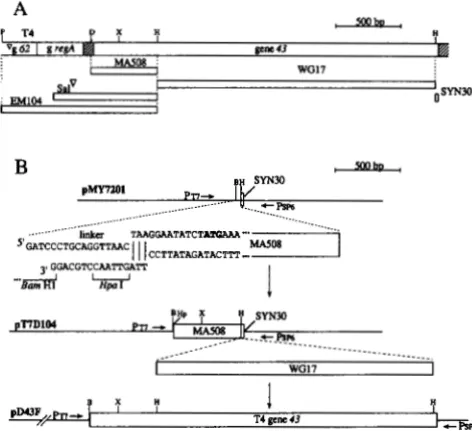
Cloning an autogenously regulated T4 gene 43 in a T7 expression vector: Figure 1 depicts the approach we used to clone the wild-type T 4 gene 43 in the T7/SP6 dual- promoter expression plasmid pSP72 (Promega LKB Bio- technology Inc., Madison, Wisconsin) under control of wild- type and mutant translational operators. Previous work had shown that all but the 3"terminal 30 base pairs of the protein-encoding portion of this gene could be retrieved from lambdoid or plasmid T 4 DNA libraries (HSU et al.
1 9 8 7 ; H u ~ ~ ~ s e t a l . 1 9 8 7 ; S ~ 1 ~ ~ ~ e t a l . ~ ~ ~ ~ ; T R O J A N O W S K A et al. 1984). A synthetic DNA duplex (SYNSO, Figure 1)
served as a source of the 3"terminal region of the gene in the design of pMY720 1, a cloning vector that was specifically designed for reconstructing the complete gene 43 from DNA fragments (Figure 1; M. DAWSON and J. KARAM, unpublished results). In Figure 1, the MA508 DNA used for the construction of pT7D 104 originated from EM 104 DNA that had been digested with endonucleases DdeI and
HindIIl; DdeI cleaves EM104 DNA at a site just upstream of the Shine-Dalgarno sequence for gene 43. MA508 DNA was subsequently inserted into the BamHI-Hind111 interval of pMY720 1, together with a synthetic DNA linker contain- ing a BamHI sticky end and a complete HpaI site. This yielded pT7D104, which carries the T 4 DNA segment
A ? T4
1
t
T4 gcn 43
cF8
FIGURE 1 .-Cloning T 4 gene 43 under the control of T 7 RNA polymerase. Panel A depicts the T 4 genetic region under study and shows relevant restriction sites. Open boxes denote structural genes and striped boxes denote intercistronic regions. The DNA frag- ments that were used for cloning gene 43 are also shown. Panel B diagrams the strategy used for cloning the wild-type gene. Experi- mental details are given in the text. Abbreviations: PT, = T71#110 promoter, PSPG = SP6 promoter (horizontal arrows indicate the direction of transcription), P = PstI, D = DdeI, X = XhoI, H =
HindIII, B = BamHI, Hp = HpaI.
corresponding to nucleotides -15 to +501 relative to the gene 43 initiator AUG fused to SYN3O (Figure 1). Cloning the internal gene 43 fragment WG17 into pT7D104 yielded pD43F, which has a wild-type structural gene and a trun- cated translational operator for T 4 DNA polymerase. The pD43F clone was used in preliminary studies to confirm that the reconstruction of gene 43 from DNA fragments could indeed yield wild-type T 4 DNA polymerase as judged by biological assay (complementation of T 4 gene 43 double- amber mutants) and by comparative enzymological and RNA-binding assays with preparations of enzyme made by others from standard T 4 infections, e.g., some of the p r e p arations used by Andrake et al. (1988) (results not shown).
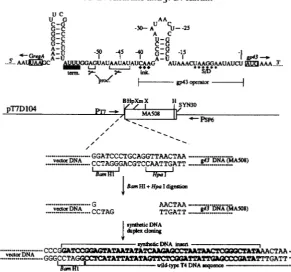
pT7D104 (Figure 1) also served as a cloning vector for synthetic DNA duplexes that provided wild-type and mutant operator sequences in the region from
-
16 through -54 relative to the AUG (see below and Figure 2, RESULTS).Subsequent insertion of WG17 DNA into these operator clones generated a family of expression plasmids like pD43F (Figure 1) in which T 4 DNA polymerase biosynthesis could be induced in vivo under transcriptional control from the T 7 promoter and translational control from different gene 43 operator sequences.
For the preparation of DNA stocks, all plasmids were propagated in E. coEi K802, where no activity from the plasmid-borne T 7 promoter and no expression of the cloned T 4 gene 43 could be detected.
Cloning synthetic DNA duplexes: All synthetic deoxy- ribonucleotides were prepared in an Applied Biosystems (Foster City, California) Model 380B DNA synthesizer, and were deprotected and desalted according to the manufac- turer's instructions. T o anneal duplexes for cloning pur- poses, equal amounts of complementary strands (at O.D. =
allowed to slowly cool to room temperature. Ligations were carried out with a 35: 1 molar excess of annealed duplex to appropriately digested cloning plasmid (100-200 ng DNA) in 10 pl mixtures containing 100 mM Tris-CI, pH 7.5, 10
mM MgCln, 10 mM dithiothreitol, 1 mM ATP, and 9 units
of T 4 DNA ligase (Boehringer-Mannheim, catalog NO. 799009). After overnight incubation at 14-16', 5-10 ~1 of the ligation mixture was used to transform E. coli K802. Ampicillin-resistant colonies from transformations were screened for cloned synthetic DNA by a colony hybridiza- tion assay (PADDOCK 1987) and the nucleotide sequence of the inserts was subsequently confirmed by double-stranded plasmid DNA sequencing (KRAFT et al. 1988).
Introducing gp43 operator mutations into phage: The T 4 gene 43 mutation 4 3 t s Y N l 3 (Glu-Lys at codon 26) is closely linked to the translational operator. This mutant phage was used to infect E . coli hosts harboring recombinant plasmids containing the mutant operators. Phage lysates were then plated on plasmid-free E . coli CAJ70 at 42" to recover temperature-resistant recombinants, i e . , rescue
43tsYN13+ from the plasmids. The recombinants were sub- sequently assayed for co-rescue of mutant operator se-
quences by two methods (ANDRAKE et al. 1988): measure- ment of gp43 synthesis after phage infection, and sequenc- ing of gene 4 3 mRNA isolated from infections with the recombinants.
In vitro transcription with T7 RNA polymerase: Line-
arized plasmid DNA templates containing a PT7 promoter were transcribed in vitro by using methods based on the studies of MELTON et al. (1984) and MILLICAN et al. (1987). We obtained optimal RNA synthesis in mixtures (usually 100 P I ) containing 40 mM Tris-CI, pH 7.5, 6 mM MgC12, 2 mM spermidine, 10 mM NaCI, 10 mM dithiothreitol, 200 units RNasin (40 units/pI; Promega, catalog No. N2512), four ribo-NTPs at 1.25 mM each (prepared from 100 mM stocks pH 7.0; Pharmacia, catalog No. 27-20)36-01), 6 pCi ["2P]UTP (10 mCi/ml; 800 Ci/mmole; Du Pont NEN, Bos- ton, catalog No. NEG007X; final specific activity 480 mCi :"P/mmol UTP), 4% polyethylene glycol (PEG MWSOOO),
10 units T 7 RNA polymerase, and 20 nM linearized DNA. Incubations were at 37" for 2 hr before RNase-free DNase 1 (60 units, Boehringer-Mannheim, catalog No. 776785) was added to hydrolyze the DNA templates at 37" for 30 min. After phenol (pH5.2):chloroform (1: 1) extraction, the '"P-labeled RNA was ethanol-precipitated in the presence of 0.2 M sodium acetate, pH 5.2 and 0.5 pg tRNA carrier. T h e RNA pellet was dissolved in 50 p1 diethylpyrocarbonate (DEPC)-treated HnO and centrifuged through a Sephadex G-50 spun column (RNA grade; Boehringer-Mannheim, catalog No. 1004 1 1) to remove unincorporated nucleotides. Acid-precipitable radioactivity was determined by liquid scintillation counting and was usually (6-10) x l o 4 cpm/pI. T h e RNA concentration ranged between 1 and 2 pmoles/ pi. In vitro transcription products of all operator constructs consisted of 56 nucleotides of vector sequence at the 5' end followed by the 151-nucleotide T 4 sequence from position -54 to position +97 relative to the initiator AUG.
Measurement of protein-mRNA binding in vitro: The purified DNA polymerase (gp43) used in this study was prepared from the pD43F clone (Figure 1) by a purification scheme involving anion-exchange, phosphate-affinity and polyribonucleotide-affinity chromatogr;Fhy (our unpub- lished results). The binding of gp43 to P-labeled in vitro RNA was analyzed by using an RNA gel mobility shift assay that emulated the use of such assays in the determination of equilibrium binding constants for DNA-protein complex formation; see FRIED (1 989) and REVZIN (1 989) for reviews. T h e gel-shift technique has also been used to determine
kinetic constants in DNA-protein interactions (FRIED and CROTHERS 1984; SHANBLATT and REVZIN 1984). In com- parison to the more commonly used filter-binding assay, gel autoradiography provides visual cues to various aspects of an interaction between protein and nucleic acid @e., speci- ficity of binding, aggregation of protein or ligand, and possible formation of complexes with different RNA.protein stoichiometries). Also, one limitation of the filter technique is that maximal retention ranges between 60 and 80% of possible binding, even at high protein:RNA ratios (BECKETT and UHLENBECK 1988; CAREY et al. 1983).
All solutions used for our gel-retardation assays were pretreated with DEPC (BLUMBERG 1987). Binding reactions were carried out in 10 p1 of a solution containing 42 mM Tris-acetate, pH 7.8, 200 mM potassium acetate, 5 mM dithiothreitol, 1 mM MgC12, 50 ng tRNA (in addition to the tRNA used as carrier in ethanol precipitation after in vitro transcription), and 35% (v/v) glycerol. Equal volumes of an RNA mix (containing labeled RNA, buffer, salts, and tRNA) and a protein mix (containing purified T 4 DNA polymerase at the desired concentration in 70% glycerol) were com- bined, and incubated for 1 hr at room temperature. Reac- tion mixtures generally contained 0.5 pmole of '*P-labeled RNA (50 nM) while gp43 concentrations ranged from IO"' to M. In each case, 5 PI of binding reaction was subjected to electrophoresis in a composite gel consisting of 4% polyacrylamide (8O:l ratio of acrylamide to bis-acryl- amide) and 0.5% agarose, formed in a 20-cm cell of a Bio- Rad Protean I1 apparatus that was prewashed with Absolve" (Du Pont NEN catalog No. NEF971) to minimize RNase contamination. Gels were electrophoresed in 50 mM Tris base-50 mM glycine (pH 8.8) buffer for at least 30 min before samples were loaded in wells under the buffer. RNA- protein complexes were subsequently resolved at 13 volts per cm for 2 or 2.5 hr at 8" and the gels were dried and packaged for autoradiography with pre-flashed Kodak XAR-5 X-ray film. Densitometric tracings of autoradiogram bands were carried out on a Joyce-Loebl Microdensitometer (Model 3CS). The relative amounts of "free" (electropho- retic mobility unaffected) and "bound" (electrophoretic mo- bility retarded) RNA were determined from the densito- metric scans and used in the calculation of dissociation constants (Kd values) for the gp43-RNA complexes, assum- ing a bimolecular interaction between gp43 and its RNA substrate. Kd values were obtained by using an algebraic rearrangement of the defining equation for the Kd of the reaction:
gp43-RNA complex e free gp43
+
free RNA, i.e.,Kd = [free gp43] [free RNA] [gp43-RNA complex] ' Or
where F is the fraction of total RNA bound as determined from the gel assay, ie., F = [bound RNA]/[total RNA], and because [gp43-RNA complex] is equal to [bound RNA], then [gp43-RNA complex] = F[RNA]r; [RNA], and [gp43], are the input concentrations of operator RNA and gp43, respectively. A Kd was calculated for each data point from a binding curve. Then, an average Kd was determined for each curve and an overall average Kd derived for each operator from the results of several experiments.
Measurement of gene expression in phage-infected or
206 M. D. Andrake and J. D. Karam
pT7D104
1
&pla synhaic dadng DNAI a y n W c DNA insul f
...-
...
v c a a D N A C C C G C I ~ A T A A T A T A ~ A A T ~ A T A A A C T A A
-.
.............-..-....GGGCC
,
TA V T A n A l r A T A n r C r c o o A T n r r o A o c c c o A T A T T T"-
rnlCtrpc T4 DNA y9uc"a
".
E m n1FIGURE 2.-Cloning synthetic operators for gp43 translation. The upper portion of the figure shows the mRNA sequence of the regA-43 intercistronic region, including putative RNA hairpin structures. The Shine-Dalgarno complementary sequence is marked with asterisks, and termination and initiation codons are boxed. Nucleotides protected from RNase digestion by gp43 are bracketed and define the gp43 operator (ANDRAKE et ai. 1988). Diamonds denote 5' ends of transcripts that arise from initiation at the MotA-dependent promoter in this region, scissors denote 5' ends of transcripts that arise from RNA processing, and the shaded bar marks bases at which transcription from upstream cistrons is terminated (Hsu and KARAM 1990). Nucleotides are numbered relative to the gene 4 3 initiation codon. The lower portion of the figure diagrams the strategy used for inserting synthetic DNA duplexes that specify gp43 translational operators. The pT7D104 recombinant plasmid harbors two HpaI sites, the one shown to the downstream of PT? and the other (not shown) to the 5' side of the promoter. This plasmid was digested partially with HpaI and completely with BamHI. Synthetic DNA duplexes, each possessing a BamHI overhang, were then directionally inserted into the double-digested pT7D104. Clones of the duplexes that retained P T ~ were identified by colony hybridization and in vivo expression assays (see text). In the example shown (the wild-type T 4 operator sequence), bases originating from the synthetic DNA are bolded. Abbreviations: Hp = HpaI, Xm = XmnI, B = BamHI, X = XhoI, H = HzndIII.
initiated b adding 3 ml of cells to 1.5 mi of M9-19 con- taining 10
7"
phage (multiplicity of infection about 10). In- fection mixtures were aerated at 30" and, at specific time intervals thereafter, 1 mi aliquots were mixed with 0.1 mi M9-19 containing 5 PCi of Trans 35S-labei (ICN Biochemi- cals, catalog No. 5 1006) and the mirtures were aerated for 5 min at 30" before isotope incorporation was quenched in an ice slurry. To label proteins in plasmid-bearing cells, E . coli BL21(DE3) cells harboring plasmid-borne mutant or wild-type gp43 translational operators under PT7 promoter control were grown in M9-19 media to 2 X 10' cells/mi at 37" in the presence of 20 rg/ml of ampicillin. Plasmid- directed gene expression was then induced by the additionof isopropyl-P-D-thiogalatoside (IPTG) to a final concentra- tion of 10 mM. After aerating at 37" for 20 min, 5 &i of Trans "Slabel was added and aeration was continued at 37" for another 20 min before isotope incorporation was stopped by chilling the culture on ice. Analysis of 35S-labeled proteins by SDS-gel electrophoresis and autoradiography was carried out as described (Hsu et al. 1987; KARAM,
MCCULLEY and LEACH 1977).
RESULTS
Constructing and cloning mutant translational operators for gp43: Figure 2 diagrams RNA primary and putative secondary structure in the 78-nucleotide region between T4 genes 4 3 and regA (Figure l), as
derived from a number of studies that included RNase protection assays and nucleotide sequence determi- nations (ANDRAKE et al. 1988; Hsu and KARAM 1990; TUERK et al. 1988). In T4-infected cells, gene 43 is normally transcribed in several overlapping modes, some of which initiate far to the upstream of the regA- 43 intercistronic region. Processing of readthrough mRNA and transcription initiation within this region yield a population of mRNA species with overlapping 5' ends that map at nucleotide positions -38 to -52
relative to the initiator AUG for gp43 biosynthesis (Figure
2).
Thus, in such infections all gp43-encoding mRNAs contain the binding site for autogenous trans- lational repression, i e . , residues -40 to approximately -1 relative to the AUG (Figure 2; ANDRAKE et al.207
' A A U A A C U C ) ' W T
A A A A A C U C U r n
SD SR
uA A c u c
A A
U A U
W T SD SR UA29 CA26 AU18
mnmmmm
F-A A U A A C A C urn
A A A A A C A C NOU
A A U A A A U C CA26
A C A C
U G U - G G G"D 0 - C G G G - C C C C - C A U A - U A A
C U C A A U A A LR -Y)-A u cu - - ~
A,, - 0 C
FIGURE 3.-A summary of translational operator mutants con- structed in this study. The upper right portion of the figure high- lights the altered residues of mutants in the operator stem pairing, and the upper left lists mutants of the loop segment. Changed residues are bolded. Symbols, designations and nomenclature are the same as in Figure 2. Abbreviations: WT = wild-type sequence, UA29 = U-A at position -29, UA25 = U+A at position -25, NoU = both U's changed to A, CA26 = C-rA at position -26, LR = entire !oop sequence leversed, AU18 = A+U at position -18,
SD = ztem destroyed, and SR = ztem lestored.
region upstream of the putative hairpin (i.e., 5' to positions -36 to -19 relative to the AUG). In our cloning scheme, pT7D104 DNA (Figure 1) was used to insert synthetic DNA duplexes containing either wild-type or the desired differences from wild-type operator sequence between the BamHI and HpaI sites at the 5' edge of position -15 from the AUG (Figure
2). Thus, mutant (or wild-type control) sequences
were introduced into the -16 to -38 segment of the RNA, while the other regions (-38 to -54 and down- stream of the residue at -16) contained wild-type T 4 sequences. Figure 3 summarizes the list of gp43 trans- lational operators we constructed for this study.Plasmid-mediated expression of
T4
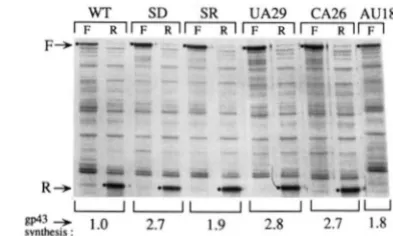
gene 43: Fig- ure 4 shows examples of plasmid-mediated expressionof cloned gene 43 sequences in the presence of some of the operator constructs listed in Figure 3. In clones expressing the wild-type structural gene (clones as- signed the F designation in Figure 4), it was easy to distinguish between derepressed and autogenously re- pressed constructs. Differential effects by the various operator mutations were also evident in this in vivo assay. In contrast, clones that specified NH2-terminal gp43 peptides (due to reversed orientation of the internal WG17 genetic segment, Figure 1) exhibited similar levels of derepressed synthesis of the truncated protein (clones assigned the R designation in Figure 4). All the clones encoding a complete gp43 polypep- tide (F constructs, Figure 4) yielded 100% plating efficiencies in platings of the gene 43 double amber mutant 43amE4301-E4322 under uninduced condi- tions, suggesting that derepression was not caused by inadvertent mutations in the cloned structural gene (data not shown). We show later other in vivo results that are consistent with the plasmid expression data.
R-
$k$:
1.0 2.7 1.9 2.8 2.7 1.8"""
FIGURE 4.-Effects of translational operator mutations on plas- tniddirected gp43 biosynthesis. Recombinant-plasmid-bearing E.
coli BL21(DE3) cells were grown, induced with IPTG. labeled for proteins, and analyzed by SDS gel-electrophoresis and autoradiog- raphy as described in MATERIALS AND METHODS. F denotes plasmid clones in which the internal WG17 fragment was inserted in a normal (forward) orientation (see Figure 1); R denotes a reversed orientation for WG17. The full-length 103.5-kD gp43 produced by F clones is marked by F+ and the truncated N-terminal protein produced by R clones is marked by R-, on the autoradiogram. The mutant operators analyzed are described in Figure 3.
In vitro binding of gp43 to the translational op-
erator: Operator constructs were transcribed in vitro with
T7
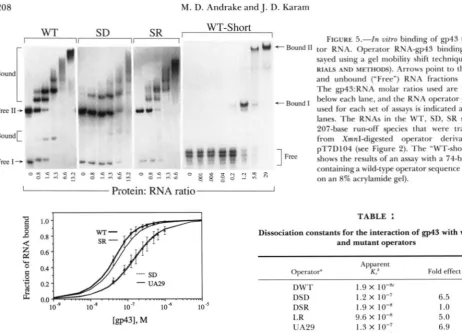
RNA polymerase and the '*P-labeled R N A products were assayed for binding to purified T 4 DNA polymerase by using the R N A gel-retardation assay described in MATERIALS AND METHODS. Results in which the wild-type (WT, Figure 3), stem-destroyed (SD, Figure 3), and stem-restored (SR, Figure 3) op- erators were compared are shown in Figure 5. In the native gel system used for these assays, each of the 207-nucleotide transcripts we analyzed resolved into two widely separate bands (marked Free I and Free 11, Figure 5) that probably represent alternate confor- mations of the same RNA because identical samples yielded single species on denaturing urea gels (not shown). Also, analysis of a much shorter (74-nucleo- tide) RNA harboring the wild-type operator sequence exhibited a simpler electrophoretic pattern on an 8% acrylamide gel (WT-short, Figure 5); the doublet "Free" band seen in this analysis might be due to the template-independent addition by T 7 RNA polymer- ase of a nucleotide to the end of the transcript (MIL-LIGAN et al. 1987). W T samples that were pre-incu- bated with increasing amounts of purified gp43 exhib- ited correspondingly decreasing intensities of the "Free" bands as well as the appearance of new, slower migrating bands (labeled "Bound" in Figure 5). The protein:WT RNA molar ratio that was required to effect a complete shift from "Free" bands to discrete, more slowly migrating bands was about 3: 1. In con- trast, electrophoretic migration of the SD mutant operator RNA was much less sensitive to pre-incuba- tion with protein, although this RNA did ultimately yield a smear when protein:RNA ratios in excess of
208 M. D. Andrake and J. D. Karam
Bound
I
Free 11 +
Bound[
Free I +
WT
SD
SR
I WT-Short IBound 11
+ Bound I
]
Free. ..
1 0 . ~ lod 10” 10”
tgP431. M
FIGURE 6.-Equilibrium binding of gp43 with WT, SD, SR, and UA29 mRNA operators. Densitometric scans of autoradiograms from gel-shift experiments, such as those depicted in Figure 5, were used to plot the fraction of RNA bound vs. increasing gp43 con- centrations. The squares and triangles mark the actual data points for the WT and SD operators, respectively, with standard deviations shown for comparison. The curves drawn through the data points are theoretical and were generated from the calculated apparent K,I values listed in Table 1 for each operator (see MATERIALS AND METHODS).
SD RNA. T h e SR RNA resembled W T closely in its response to gp43 addition, which suggests that oper- ator recognition by the protein is not strongly de- pendent on specific nucleotide sequence of the hair- pin’s stem segment in this defined in vitro system.
Densitometric scans of “Free” and “Bound” RNA
bands from gel-shift assays were used to calculate K d values for the interaction of gp43 with WT and var- iant operators (MATERIALS AND METHODS). Examples of such analyses are shown in Figure 6 and a summary of calculated K d values on all operator constructs analyzed is presented in Table 1. Both lengths of W T
RNA examined yielded apparent K d values’ of about
1.9 X 1 O-’M, which demonstrates that the experimen- tal approach used here to determine Kds for protein-
RNA interaction is applicable to a wide range of RNA
sizes. T h e use of higher concentrations of protein with W T RNAs resulted in a second shift to even more
‘This Kd value contrasts with values of (1-4.8) X M that were obtained by TUERK cf al. (1990) and TUERK and COLD (1990) who used a operator, higher protein:RNA ratios, and a binding temperature of 4 ” . filter-binding assay, different lengths of RNA ligands carrying the wild-type
FIGURE 5.-In vitro binding of gp43 to opera- tor RNA. Operator RNA-gp43 binding was as- sayed using a gel mobility shift technique (MATE- RIALS A N D METHODS). Arrows point to the bound and unbound (“Free”) R N A fractions resolved. The gp43:RNA molar ratios used are indicated below each lane, and the R N A operator genotype used for each set of assays is indicated above the lanes. The RNAs in the W T , SD, SR sets were 207-base run-off species that were transcribed from Xnnldigested operator derivatives of pT7D104 (see Figure 2). The “WT-short” panel shows the results of an assay with a 74-base R N A containing a wild-type operator sequence (resolved on an 8% acrylamide gel).
TABLE 1
Dissociation constants for the interaction of gp43 with wild-type and mutant operators
Apparent OperatoP K,b Fold effect
DWT 1.9 x
DSD 1.2 X 10” 6.5
DSR 1.9 x 1 .0
LR 9.6 X 5.0
UA29 1.3 X 10” 6.9
UA25 9.0 x 4.7
NoU 8.9 X 10”’ 4.6
CA26 3.3 x 1.7
AU18 1.9 x 1
.o
See Figure 3.
See MATERIALS A N D METHODS for method of determination. ‘See footnote 3 for comparison to Ka determinations by others.
slowly migrating bands which, on the basis of relative density on the autoradiogram, we suspect to be formed by the incorporation of additional protein molecules per mole of RNA (i.e., protein aggregation) rather than by the recruitment of more RNA per mole of protein.
T h e t w o most dramatic effects on operator-gp43 binding were observed with the SD and UA29 (Figure 3) operator variants. Each exhibited about a 7-fold decrease in gp43 binding relative to W T (Table 1).
We should also point out that, although restoration of stem-complementarity with a non-wild-type se- quence restored in vitro binding to wild-type levels
(SR construct, Figure 5 and Table I), the change in operator sequence still exhibited strong biological ef- fects (Figures 4 and 5 ; see also below). Similarly, a
C+A change in the loop at position -26 (CA26) had only a small effect on protein binding in vitro (Table
Effects of gp43 operator mutations in
T4
infec- tions: We introduced several of the operator muta- tions generated in vitro into the T 4 phage genome by phage-plasmid recombination (Le., marker rescue, MA- TERIALS AND METHODS) and examined their effects on gp43 biosynthesis, DNA synthesis, and phage produc- tion in standard phage infections. Examples of results are presented in Figure7.
Operator constitutivity was reflected by a derepression of gp43 biosynthesis dur- ing infection. As was observed with plasmid-mediated expression, the SR and CA26 mutations exhibited strong effects on gene 43 expression, while their ef- fects in vitro were weak (Figures 5 and 6). The AU18 mutant, which bound gp43 nearly normally in vitro (Table I), exhibited about a 2-fold effect on gp43 biosynthesis in T 4 infections (Figure 7B). It is also interesting to note that increased production of T 4 DNA polymerase in such infections neither enhanced nor diminished DNA replication and phage produc- tion (Figure 7B). Similar observations with different phage operator mutations have been made by TUERKet al. (1 990).
DISCUSSION
The mRNA binding site for T 4 DNA polymerase
is at least 36-40 nucleotides long and includes a putative hairpin structure that consists of a 5 base- pair stem and an 8-base loop (Figure 3; ANDRAKE et
al. 1988; TUERK et al. 1990). The studies reported
here, by TUERK et al. (1 990), and by TUERK and GOLD
(1 990) show that the dimensions and stability of this
structure constitute important determinants for spec- ificity of the gp43-mRNA interaction. Our mutational analyses further demonstrate that this specificity de- pends on the nucleotide sequence of the loop. In particular, single base changes involving uracil resi- dues in the hairpin's loop (positions
-25
and -29 from the AUG, Figure 3) drastically reduced gp43- RNA binding in vitro as measured by a gel retardation assay (Figures 5 and 6), and exhibited strong derepres- sion of gp43 biosynthesis in vivo as measured by plas- mid-mediated expression (Figure 4) and by expression in T 4 infections (Figure7).
Base substitutions at other residues within the loop and near the base of the hairpin resulted in differential effects both in vitro and in vivo. Results with altered stem sequences, i.e., stemdestruction (SD) and stem-restoration (SR), sug- gest that stability as well as sequence of the base- paired region are important criteria for protein bind- ing and repression in vivo. Although the SR operator RNA bound gp43 as effectively as wild-type in vitro (Figure 5 ) , it exhibited derepression of gp43 biosyn- thesis in vivo (Figures 4 and 7). Similarly, another operator mutation, a G Achange in the loop (CA26), showed small effects in vitro but exhibited strong effects in vivo. The differences in biological effectsA
1.0
-
+ UA29
.-
0 0.20.0
a
minpost-inf. 1 19-27, 16 10 13 30
UA29
WT
B
gp43+- - *
.-
"""
*
:
gp43-
2
synthesis 1.0 7.3 8.3 8.2 7.2 1.99
DNA synthesis 1.0 0.9 1.0 1.0 1.0 1.0 >.d u
5
Burst size 1.0 0.9 1.1 1.0 0.9 1.0 p!FIGURE '].-Effects of translational operator mutations on gp43 synthesis in T 4 infections. Panel A shows the level of gp43 synthe- sized during infections of E. coli NapIV with phage strains carrying WT or the UA29 operator. Experimental details were as described previously (ANDRAKE et al. 1988; HUGHFS et al. 1987) and in
MATERIALS AND METHODS. Infected cultures were pulse-labeled with
S precursor for 5 min at overlapping time intervals postinfection, and subsequently analyzed by SDSpolyacrylamide gel electropho- resis and autoradiography. The position of gp43 is marked by arrows and dots, and the operator genotype for each infection is indicated on the graph and autoradiograms. Levels of gp43 synthe- sis were calculated from densitometric scans of autoradiograms, and the data were plotted at the midpoints of the pulses on the time-scale shown. Panel B compares the relative levels of gp43 synthesis at 13 min post-infection (1 1-16-min pulse) with several operator phage mutants. The position of gp43 in the autoradi- ograms and mutant operator names are shown. In addition, listed below each gel lane are values for the levels of DNA synthesis (['HI thymidine incorporation) and burst size for each mutant phage relative to WT. The WT infection in these comparisons yielded a burst size of 504 (measured at 2 hr post-infection) and a [$HI thymidine incorporation rate of 4290 dpm/min (during the interval between 20 and 60 min postinfection).
between such mutant operators and the wild-type may be due to a variety of factors that could influence the gp43-operator RNA interaction and RNA conforma-
210 M. D. Andrake and J, D. Karam
tion in vivo, e.g., proteins that can interact with gp43
or RNA, or long-range intramolecular interactions between the hairpin and other segments of the gp43 mRNA (RNA folding). In addition, a somewhat de- creased stability of the SR hairpin relative to WT (estimated
AG
of -6.2 vs. -6.5, respectively, for stem- and-loop stability), may be magnified in vivo without the helix-stabilizing effect of the high-salt buffer (VOR-LICKOVA et al. 1990) we used in the in vitro binding assay (MATERIALS AND METHODS). In regard to loop mutations, we have no proof that changes in loop sequence do not alter the stability of operator struc- ture. The stability of RNA hairpin structures is gen- erally independent of loop base composition (GROEBE and UHLENBECK 1988), but in some cases it is not (CHEONG, VARANI and TINOCO 1990; TUERK et al.
1988). None of the loop mutants we constructed were predicted to change operator folding or stability, as assessed by the Mulfold version 2.0 computer pro- gram (JAEGER, TURNER and ZUKER 1989 and 1990; ZUKER 1989) (results not shown). In contrast, and as may be surmised from a visual inspection of the nu- cleotide sequence in Figure 3, the AU 18 mutant was predicted to have a stem that is two base pairs longer and slightly more stable than the 5-base-pair stem of
WT RNA. This mutant exhibited phenotypes similar
to W T both in vitro (Table 1) and in vivo (Figure 7).
Role of the operator loop sequence in gp43-RNA interaction: Another indication that T 4 DNA polym- erase recognizes specific ribonucleotide residues in addition to RNA structure comes from studies of the chromatographic behavior of the enzyme on RNA columns (our unpublished results). In those studies, the protein exhibited vastly different binding affinities to different homopolyribonucieotides. PolyU bound gp43 five times as strongly as polyA (or polyG) and twice as strongly as polyC. Thus, we suspect that pyrimidines (particularly uridines) may be important contact points between gp43 and its mRNA target. The carbonyl groups in a pyrimidine ring (perhaps optimally in the number 4 position) may function as hydrogen acceptors in the interaction with specific amino acid residues in the gp43 RNA-binding site. In a three-dimensional context, we envisage a structured RNA target for gp43 in which the distribution of adenosines (possibly non-binding residues) allow for the placement of pyrimidines in optimal positions for hydrogen bonding with the protein. It is also interest- ing to view the gp43 translational operator mutations described here within the context of a recent report by TUERK and GOLD (1990) in which an in vitro selection process (termed SELEX) was used to enrich for high-affinity operator hairpin ligands from a pop- ulation of random loop sequences contained in an otherwise wild-type operator sequence. O u t of 65,536 possible loop sequences, the selection yielded two
major products: the T 4 wild-type hairpin sequence, i.e., agccuAAUAACUCgggcu (loop sequence capital- ized) at a frequency of 9/20 and a variant (frequency of 8/20) that differed from wild-type by four nucleo- tides, all transitions, i.e., agccuagsAACgggcu (dif- ferences from wild type underlined). Conceivably, the wild-type hairpin may be capable of intraloop base- base interactions that mimic the predicted additional base pairing and smaller loop dimensions of the var- iant. It will be interesting to find out if this variant behaves as a wild-type operator in vivo. The SELEX scheme also yielded three minor variants (frequencies of 1/20 each) that had reduced affinity (3- to 5-fold) to gp43. Two of these were single-base transitions from the wild-type loop (A-G at the 4th base and C - P U at the 8th base, respectively) and one repre- senting an A 4 transition from the major variant loop sequence (i.e., CAAC-CGAC). It is not clear if the SELEX scheme used by TUERK and GOLD (1 990) specifically excluded transversions or if it coinciden- tally revealed only transitions among the 20 clones examined. That is, a mutation such as CA26 (C-A transversion, Figure 3), which had a small effect on operator-gp43 binding in vitro (Table l), may or may not be selectable by this scheme. Nevertheless, al- though one cannot equate conditions for the in vitro ligand selection process used by TUERK and GOLD (1 990) with those of the in vivo and in vitro assays described here, both studies underscore the impor- tance of loop residues in gp43-operator recognition. Additional operator mutant constructs (including transitions, transversions, deletions, and insertions) as well as direct structural analyses in gp43, its operator, and gp43-RNA complexes would be needed to eluci- date the fine details of this interaction.
mRNA Operator for T4 DNA Polymerase 21 1
changes in the stem did not affect binding as long as hairpin stability was maintained (ROMANIUK et al.
1987). The theme for site-specific protein-RNA inter- action in these examples portrays a structured opera- tor in which specific single-stranded loop (or bulged stem) residues are placed in an appropriate three- dimensional context for recognition and contact with specific amino acid residues in the protein. In princi- ple, the grooves in A-form RNA helices may also provide RNA-protein contacts in a manner analogous to the recognition of sequence specific DNA-binding proteins (SCHLEIF 1988); however, no clear cut ex- amples of such recognition have been encountered so
far. In addition, higher-order structure (RNA pseu- doknots) may frequently be involved in RNA-protein recognition, as has been shown with T 4 gp32 (MC- PHEETERS, STORMO and GOLD 1988) and the a operon of E . coli ribosome biogenesis (TANG and DRAPER
1989). One translational repressor, the T 4 RegA pro- tein, may not require RNA secondary structure at all in finding its target. This protein is small (1 22 amino acids) and binds to short and diverse uridine- rich targets around the initiator AUGs of a subset of T4-induced early mRNAs (UNNITHAN et al. 1990); however, RNA structure in RegA-mediated transla- tional repression may play a role by sequestering unwanted targets or exposing functionally relevant ones.
What is the physiological significance of gp43
autogenous regulation? T 4 DNA polymerase is re-
markably versatile in that it harbors DNA synthesiz- ing, 3’-DNA-exonucleolytic, nucleotide-binding, DNA-binding, and RNA-binding activities, all con- tained in a single polypeptide chain of fewer than 900 amino acids (GOULIAN, LUCAS and KORNBERG 1968; SPICER et al. 1988; ANDRAKE et al. 1988). The protein also possesses the capacity to interact specifically with other protein components of the T 4 DNA replication complex (protein-protein binding activities) (JARVIS et
ai.
1990). We are interested in how the RNA binding activity of gp43 relates physiologically to the other activities of the protein, particularly in regard to its participation in DNA replication. For example, can gp43 autogenous translational repression vs. its assem- bly into the DNA replication complex be likened to feedback translational regulation of ribosome biogen- esis by ribosomal subunit proteins? The analogy may well be pertinent, and TUERK et al. (1 990) demon- strated that a reconstructed DNA replication appara- tus could compete with a synthetic RNA target for gp43 binding in vitro. However, it should be noted that the DNA-binding and RNA-binding activities ofT 4 DNA polymerase may or may not be mediated by the same protein site. This enzyme binds to DNA primer-template junctions in a sequence-non-specific manner while its binding to RNA is characteristically
specific to a sequence/structure. From a regulatory standpoint, one should also consider the temporally restricted synthesis of gp43 mRNA and its high insta- bility in vivo (Hsu and KARAM 1990). These two factors ultimately determine the amount of mRNA available for gp43 biosynthesis and autogenous repression at various times during the phage growth cycle. Autogenous translational repression of gp43 biosynthesis may be an important mechanism by which the phage sets enzyme dosage during the prereplica- tive stage of the phage growth cycle, and may become irrelevant at later times when the gene 43 mRNA concentration is too low (due to degradation and cessation of early transcription) to compete with the abundant binding sites on DNA in the replication pool. Furthermore, gp43 functions in concert with other proteins whose dosages are also important for determining replication levels. This is perhaps why a selective overproduction of wild-type T 4 DNA polym- erase (translational operator constitutive mutants) is not accompanied by increased DNA synthesis and phage yield (Figure
7
and TUERK et al. 1990). Also, the fact that such phage mutants are viable may mean that the DNA region specifying the translational op- erator is not a site for a critical gp43-DNA interaction in vivo.We thank GEORGE LINDENMAYER and CHAN LAM for advice on determining dissociation constants, Arnold Revzin for comments on the manuscript, CHARLENE ALFORD for synthetic DNAs, and MYRA DAWSON, CHAU DANG and ALLEN RIDENOUR for help with some experiments. We are also deeply grateful to NANCY NOSSAL and LINDA REHA-KRANTZ who compared our T 4 DNA polymerase preparations to theirs, respectively, and confirmed the wild-type character of our protein with regards to enzymological properties. This work was supported by Grant GM18842 from the National Institute of General Medical Sciences. M.D.A. was a Ph.D. candidate of the Molecular and Cellular Biology and Pathobiology program and received stipend support from the College of Graduate Studies, Medical University of South Carolina during the course of this investigation.
LITERATURE CITED
ANDRAKE, M., N. GUILD, T. HSU, L. GOLD, C. TuERKand J. KARAM, 1988 DNA polymerase of bacteriophage T 4 is an autogenous translational repressor. Proc. Natl. Acad. Sci. USA 8 5 7942- 7946.
BECKETT, D., and 0. C. UHLENBECK, 1988 Ribonucleoprotein complexes of R17 coat protein and a translational operator analog. J. Mol. Biol. 204: 927-938.
BLUMBERG, D. D., 1987 Creating a ribonuclease-free environ- ment. Methods Enzymol. 152: 20-24.
CAREY, J. C., V. CAMERON, P. L. DE HASETH and 0. C. UHLENBECK, 1983 Sequence-specific interaction of R17 coat protein with its ribonucleic acid binding site. Biochemistry 22: 2601-2610. CHEONG, C., G. VARANI and I. J. TINOCO, 1990 Solution structure
of an unusually stable RNA hairpin, 5’GGAC(UUCG)GUCC. Nature 3 4 6 680-682.
212 M. D. Andrake and J. D. Karam
parameters by electrophoresis mobility shift assay. Electropho- resis 10: 366-376.
FRIED, M. G . , and D. M. CROTHERS, 1984 Kineticsand mechanism in the reaction of gene regulatory proteins with DNA. J. Mol. Biol. 172: 263-282.
FULFORD, W., and P. MODEL, 1984 Specificity of translational regulation by two DNA-binding proteins. J. Mol. Biol. 173:
GOLD, L., 1988 Posttranscriptional regulatory mechanisms in
GOULIAN, M., Z. G. LUCAS and A. KORNBERG, 1968 Enzymatic synthesis of deoxyribonucleic acid. XXV. Purification and properties of deoxyribonucleic acid polymerase induced by infection with phage T4+. J. Biol. Chem. 243: 627-638. GROEBE, D. R., and 0. C. UHLENBECK, 1988 Characterization of
RNA hairpin loop stability. Nucleic Acids Res. 16: 11725- 11735.
Hsu, T., and J. D. KARAM, 1990 Transcriptional mapping of a DNA replication gene cluster in bacteriophage T4: sites for initiation, termination, and mRNA processing. J. Biol. Chem.
HSU, T., R. WEI, M. DAWSON and J. D. KARAM, 1987 Identification of two new bacteriophage T 4 genes that may have roles in transcription and DNA replication. J. Virol.
HUGHES, M., A. M. F. YEE, M. DAWSON and J. D. KARAM, 1987 Genetic mapping of the aminoterminal domain of bac- teriophage T 4 DNA polymerase. Genetics 115: 393-403. JAEGER, J. A., D. H. TURNER and M. ZUKER, 1989 Improved
predictions of secondary structures for RNA. Proc. Natl. Acad. Sci. USA 86: 7706-77 IO.
JAEGER, J. A., D. H. TURNER and M. ZUKER, 1990 Predicting optimal and suboptimal secondary structure for RNA. Methods Enzymol. 183: 281-330.
JARVIS, T. C., D. M. RING, S. S. DAUBE and P. H. VON HIPPEL,
1990 “Macromolecular crowding”: thermodynamic conse- quences for protein-protein interactions within the T 4 DNA replication complex. J. Biol. Chem. 265: 15160-15167. KARAM, J. D., C. MCCULLEY and M. LEACH, 1977 Genetic control
of mRNA decay in T 4 phage infected Escherichia coli. Virology
KARAM, J. D., and P. V. O’DONNELL, 1973 Suppression of amber mutations of bacteriophage T 4 gene 43(DNA polymerase) by translational ambiguity. J. Virol. 11: 933-945.
KARAM, J. D., L. GOLD, B. S. SINGER and M. DAWSON, 1981 Translational regulation: identification of the site on bacteriophage T 4 rIIB mRNA recognized by the regA gene function. Proc. Natl. Acad. Sci. USA 78: 4669-4673.
KRAFT, R., J. TARDIFF, K. S. KRAUTER and L. A. LINEWAND, 1988 Using mini-prep plasmid DNA for sequencing double stranded templates with sequenase. Biotechniques 6 544-546. LIANG, Y. M., R. X . WEI, T. Hsu, C. ALFORD, M. DAWSON and J.
KARAM, 1988 Autogenous regulation of the regA gene of bacteriophage T4: derepression of translation. Genetics 119: 743-749.
MCCARTHY, J. E. G., and C. GUALERZI, 1990 Translational con- trol of prokaryotic gene expression. Trends Genet. 6: 78-85. MCPHEETERS, D. S., G. D. STORMO and L. GOLD,
1988 Autogenous regulatory site on the bacteriophage T 4 gene 32 messenger RNA. J. Mol. Biol. 201: 517-535.
MELTON, D. A., P. A. KRIEG, M. R. REBAGLIATI, T . MANIATIS, K. ZINN and M. R. GREEN, 1984 Efficient in vitro synthesis of biologically active R N A and RNA hybridization probes from plasmids containing a bacteriophage SP6 promoter. Nucleic Acids Res. 12: 7035-7056.
MILLER, E. S., R. B. WINTER, K. M. CAMPBELL, S. D. POWER and 21 1-226.
Escherichia coli. Annu. Rev. Biochem. 57: 199-233.
265: 5303-53 16.
61: 366-374.
7 6 685-700.
L. GOLD, 1985 Bacteriophage T 4 regA protein: purification of a translational repressor. J. Biol. Chem. 2 6 0 13053-13059. MILLIGAN, J. F., D. R. GROEBE, G. W. WITHERELL and 0. C. UHLENBECK, 1987 Oligoribonucleotide synthesis using T 7 RNA polymerase and synthetic DNA templates. Nucleic Acids Res. 15: 8783-8798.
NELSON, M. A., M. ERICSON, L. COLD and J. F. PULITZER, 1982 The isolation and characterization of TabR bacteria: hosts that restrict bacteriophage T4rU mutants. Mol. Gen. Genet. 188: 60-68.
NOMURA, M., R. COURSE and G. BAUGHMAN, 1984 Regulation of the synthesis of ribosomes and ribosomal components. Annu. Rev. Biochem. 53: 75-1 17.
PADDOCK, G. V., 1987 Rapid colony hybridization with oligonu- cleotide probes using nonnitrocellulose paper. Biotechniques
REVZIN, A., 1989 Gel electrophoresis assays for DNA-protein interactions. Biotechniques 7: 346-355.
ROMANIUK, P. J., P. LOWARY, H. Wu, G. STORMO and 0. C. UHLENBECK, 1987 RNA binding site of R17 coat protein. Biochemistry 2 6 1563-1568.
SCHLEIF, R., 1988 DNA binding by proteins. Science 241: 1182- 1187.
SHANBLATT, S. H., and A. REVZIN, 1984 Kinetics of RNA polym- erase-promoter complex formation: effects of nonspecific DNA-protein interactions. Nucleic Acids Res. 12: 5287-5306. SHULTZ, J., T. J. SILHAVY, M. L. BERMAN, N. FIIL and S. C. EMR,
1982 A previously unidentified gene in the spc operon of Escherichia coli K12 specifies a component of the protein export machinery. Cell 31: 227-235.
SPICER, E. K., J. RUSH, C. FUNG, L. J. REHA-KRANTZ, J. D. KARAM and W. H. KONIGSBERG, 1988 Primary structure of T 4 DNA polymerase. J. Biol. Chem. 263: 7478-7486.
SPRINGER, M., M. GRAFFE, J. DONDON, M. M. GRUNBERG, P. ROMBY, B. EHRESMANN, C. EHRESMANN and J. P. EBEL, 1988 Translational control in E. coli: the case of threonyl- tRNA synthetase. Biosci. Rep. 8: 619-632.
STUDIER, F. W . , and B. A. MOFFATT, 1986 Use of bacteriophage T 7 RNA polymerase to direct selective high-level expression of cloned genes. J. Mol. Biol. 1 8 9 11 3-1 30.
TANG, C. K., and D. E. DRAPER, 1989 Unusual mRNA pseudo- knot structure is recognized by a protein translational repres- sor. Cell 57: 531-536.
TROJANOWSKA, M., E. S. MILLER, J. KARAM, G. STORMO and L.
GOLD, 1984 The bacteriophage T 4 regA gene: primary se- quence of a translational repressor. Nucleic Acids Res. 12:
5979-5993.
TUERK, C., and L. GOLD, 1990 Systematic evolution of ligands by exponential enrichment: RNA ligands to bacteriophage T 4 DNA polymerase. Science 2 4 9 505-510.
TUERK, C., P. GAUSS, C. THERM=, D. R. GROEBE, M. GAYLE, N. GUILD, 0. C. UHLENBECK, I. TINOCO, E. N. J. BRODY and L. GOLD, 1988 CUUCGG hairpins: extraordinarily stable RNA secondary structures associated with various biochemical proc- esses. Proc. Natl. Acad. Sci. USA 85: 1364-1368.
TUERK, C., S. EDDY, D. PARMA and L. GOLD, 1990 Autogenous translational operator recognized by bacteriophage T 4 DNA polymerase. J. Mol. Biol. 213: 749-761.
UHLENBECK, 0. C., H. Wu and J. R. SAMPSON, 1987 Recognition of RNA by proteins, pp. 285-294 in Molecular Biology of RNA: New Perspectives, edited by M. ~ N O U Y E and B. S. DUDOCK.
Academic Press, San Diego.
UNNITHAN, S., L. MORRISSEY, J. BINKLEY, J. KARAM and L. GOLD, 1990 Binding of the bacteriophage T 4 regA protein to mRNA targets: an initiator AUG is required. Nucleic Acids Res. 18: 7083-7092.
mRNA Operator for
VORLICKOVA, M., J. KYPR, T . M. JOVIN and M. PLANCK, 1990 CD of the synthetic R N A duplexes poly[r(A-T)] and poly[r(A-U)] in salt and ethanolic solutions. Biopolymers 2 9 385-392. WEFJSTER, K. R., H . Y . ADARI and E. K. SPICER,
1989 Bacteriophage T 4 regA protein binds to the Shine- Dalgarno region of gene 44 mRNA. Nucleic Acids Res. 17:
WIBERC, J. S., and J. D. KARAM, 1983 Translational regulation in T 4 phage development, pp. 193-201 in The Bacteriophage T4, edited by C. K. MATHEWS, E. M. KUTTER, G . MOSIC and P. B. BERGET. American Society for Microbiology, Washington, D.C.
10047-1 0068.
T4 DNA Polymerase
WINTER, R. B., L. MORRISSEY, P. GAUSS, L. GOLD, T . H s u and J. KARAM, 1987 Bacteriophage T 4 regA protein binds to mRNAs and prevents translation initiation. Proc. Natl. Acad. Sci. USA 8 4 7822-7826.
WOOD, W. B., 1966 Host specificity of DNA produced by Esche- richia coli: bacterial mutations affecting the restriction and modification of DNA. J. Mol. Biol. 16 118-133.
ZUKER, M., 1989 On finding all suboptimal foldings of an RNA molecule. Science 244: 48-52.
![FIGURE '].-Effects of sized during infections synthesis in T4 infections. Panel arrows and dots, and the operator genotype for each infection is previously and subsequently analyzed by SDSpolyacrylamide gel electropho- WT sis indicated on the graph and a](https://thumb-us.123doks.com/thumbv2/123dok_us/1724659.1219954/7.590.322.516.76.470/infections-infections-infection-previously-subsequently-sdspolyacrylamide-electropho-indicated.webp)
